0022-538X/09/$08.00⫹0 doi:10.1128/JVI.02429-08
Copyright © 2009, American Society for Microbiology. All Rights Reserved.
The Marburg Virus 3
⬘
Noncoding Region Structurally and Functionally
Differs from That of Ebola Virus
䌤
Sven Enterlein,
1† Kristina M. Schmidt,
1,2,3Michael Schu
¨mann,
1Dominik Conrad,
1,2,3Verena Kra
¨hling,
1Judith Olejnik,
1,2,3and Elke Mu
¨hlberger
1,2,3*
Institute of Virology, Philipps University Marburg, Hans-Meerwein-Strasse 2, 35043 Marburg, Germany,1and
National Emerging Infectious Diseases Laboratories,2and Boston University School of Medicine,
Department of Microbiology, 72 East Concord Street,3Boston, Massachusetts 02118
Received 25 November 2008/Accepted 9 February 2009
We have previously shown that the first transcription start signal (TSS) of Zaire Ebola virus (ZEBOV) is involved in formation of an RNA secondary structure regulating VP30-dependent transcription activation. Interestingly, transcription of Marburg virus (MARV) minigenomes occurs independently of VP30. In this study, we analyzed the structure of the MARV 3ⴕ noncoding region and its influence on VP30 necessity. Secondary structure formation of the TSS of the first gene was experimentally determined and showed substantial differences from the structure formed by the ZEBOV TSS. Chimeric MARV minigenomes mim-icking the ZEBOV-specific RNA secondary structure were neither transcribed nor replicated. Mapping of the MARV genomic replication promoter revealed that the region homologous to the sequence involved in forma-tion of the regulatory ZEBOV RNA structure is part of the MARV promoter. The MARV promoter is contained within the first 70 nucleotides of the genome and consists of two elements separated by a spacer region, comprising the TSS of the first gene. Mutations within the spacer abolished transcription activity and led to increased replication, indicating competitive transcription and replication initiation. The second promoter element is located within the nontranslated region of the first gene and consists of a stretch of three UN5
hexamers. Recombinant full-length MARV clones, in which the three conserved U residues were substituted, could not be rescued, underlining the importance of the UN5 hexamers for replication activity. Our data
suggest that differences in the structure of the genomic replication promoters might account for the different transcription strategies of Marburg and Ebola viruses.
Marburg virus (MARV) and the closely related Ebola virus (EBOV) comprise the familyFiloviridae. Both cause an acute hemorrhagic fever in humans and nonhuman primates, with high mortality rates. MARV was first isolated in 1967 in Mar-burg, Germany, during an outbreak among laboratory workers handling African green monkeys imported from Uganda (37). The latest larger MARV outbreak occurred in the Uige province of Angola in 2004 to 2005, and it included 252 cases and 227 fatalities (90%) (41). Recently, a case of MARV hemorrhagic fever in The Netherlands, in which a Dutch tourist returning from a visit in Uganda became in-fected and died, was reported (http://www.who.int/csr/don /2008_07_10/en/index.html).
As members of the order Mononegavirales, MARV and EBOV possess a nonsegmented negative-strand RNA genome that is 19 kb in length and encodes seven structural proteins. Unusually long noncoding regions (NCR) containingcis-acting elements involved in replication, transcription, packaging, and encapsidation are located at the 3⬘and 5⬘ends of the genome. The 3⬘NCR comprises the nontranscribed leader region and the 3⬘nontranslated region of the first gene, the nucleoprotein
(NP) gene (12, 34). The viral genome is tightly encapsidated by the four nucleocapsid proteins, L (catalytic subunit of the viral polymerase), VP35 (polymerase cofactor), NP, and VP30. EBOV VP30 is an RNA binding protein (19) and func-tions as a transcriptional activator necessary for efficient tran-scription of EBOV-specific minigenomes (15, 16, 29, 46, 48). Also, VP30 was shown to be essential for the rescue of recom-binant EBOVs (31, 42). Recently, involvement of EBOV VP30 in transcription reinitiation has been described (24). The role of VP30 in the MARV replication cycle is not clear yet. Al-though it was not needed for transcription or replication in a minigenome-based rescue system, it plays an important role in viral amplification (14) and is essential for the recovery of infectious virus from cDNA. Nevertheless, it functionally dif-fers from EBOV VP30 in that it is not involved in transcription initiation (9, 27).
We previously mapped the genomic replication promoter of the EBOV speciesZaire ebolavirus(ZEBOV). There are generally two types of (genomic) replication promoters for
Mononegavirales: a bipartite with two promoter elements found in the subfamily Paramyxovirinae and one continuous more compact replication promoter for rhabdo- and pneumo-viruses (21). The bipartite promoter structure of the Paramyxo-virinaesubfamily is associated with the “rule of six,” i.e., the total genome length must be a multiple of six, as first described for Sendai virus (39). Given that filoviruses do not obey the rule of six and, moreover, share many features with the pneu-moviruses, which possess monopartite promoters (10), it was surprising that mapping of the ZEBOV genomic replication
* Corresponding author. Mailing address: Boston University School of Medicine, Department of Microbiology, 72 East Concord Street, Boston, MA 02118. Phone: (617) 638-0336. Fax: (617) 638-4286. E-mail: muehlber @bu.edu.
† Present address: Integrated BioTherapeutics, Inc., 20358 Seneca Meadows Pkwy., Germantown, MD 20876.
䌤Published ahead of print on 18 February 2009.
4508
on November 8, 2019 by guest
http://jvi.asm.org/
promoter revealed a bipartite structure. A stretch of 8 UN5 hexamers located in the second promoter element was found to be crucial for replication activity (47). Despite its bipartite nature, the ZEBOV replication promoter is different from the Paramyxovirinae promoters, suggesting a unique pro-moter structure for filoviruses. Interestingly, UN5hexamers are present in the 3⬘NCR of all filoviruses (Fig. 1).
In this paper, we analyzed cis-acting elements involved in replication and transcription located at the 3⬘ NCR of the MARV genome. Our studies revealed significant differences in the functional organization of the 3⬘ NCR of MARV and ZEBOV. The region immediately downstream of the tran-scription start signal of the first gene on the ZEBOV genome is important for transcription regulation but dispensable for replication. However, the homologous region in the MARV genome is part of the replication promoter and not needed for transcription regulation. We suggest that differences in the transcription strategy of MARVs and EBOVs might be due to the differentially organized replication promoters.
MATERIALS AND METHODS
Cells and viruses.Vero C1008 cells and human hepatoma (Huh7) cells were maintained in Dulbecco’s modified Eagle’s medium supplemented with 10% fetal calf serum. Huh-T7 cells constitutively expressing the T7 RNA polymerase
(kindly provided by V. Gaussmu¨ller, Department of Medical Molecular Biology,
University of Lu¨beck, Germany) were grown in Dulbecco’s modified Eagle’s
medium supplemented with 10% fetal calf serum and 1 mg/ml Geneticin (35). BSR-T7/5 cells constitutively expressing the T7 RNA polymerase (kindly pro-vided by K. K. Conzelmann, Max von Pettenkofer Institute and Gene Center, Munich, Germany) were cultured as described by Buchholz et al. (2). Huh-T7 cells were used for detection of replicated RNA due to lower background signals, whereas BSR-T7/5 cells were used for experiments involving chloramphenicol acetyltransferase (CAT) assays and transfection assays for virus rescue. MARV strain Musoke (38) and recombinant MARVs were propagated in Vero or Vero E6 cells and titrated by 50% tissue culture infective dose assays (9). All exper-iments with MARV-infected cells were performed in the BSL-4 facility of the Philipps University Marburg, Germany.
Transfection of BSR-T7/5 and Huh-T7 cells.BSR-T7/5 and Huh-T7 cells were grown in six-well plates to 60 to 70% confluence and transfected using Fugene 6
(Roche Molecular Applied Science). For transfection, 1.0g minigenome DNA,
1.0g pT/LM, 0.1g pT/NPM, 0.5g pT/VP35M(27), and 0.5g of pC-T7/Pol
expressing the T7 RNA polymerase (31) (kindly provided by T. Takimoto, St. Jude Children’s Research Hospital, Memphis, TN, and Y. Kawaoka, University
of Wisconsin, Madison, WI) were used. pT/VP30M(0.1g) was added to the
transfection mixture as indicated in the legend to Fig. 3. For the ZEBOV
minigenome system, cells were transfected with 1.0g minigenome DNA, 1.0g
pT/LEBO, 0.5g pT/NPEBO, 0.5g pT/VP35EBO, and 0.1g pT/VP30EBO(29).
Transfection was carried out as described by Modrof et al. (26). At 2 days after
transfection, cells were lysed in the appropriate buffer and analyzed for CAT expression or RNA synthesis.
Construction of plasmids. The positive-strand MARV minigenome
3M-5MG(⫹) (previously indicated as 2.1 CAT) (27) used for secondary structure
analysis contains a G as the first nucleotide, compared to the A found in wild-type MARV, for better T7 promoter activity. A second positive-strand
minigenome, 3M-5M(⫹), was designed with the wild-type MARV sequence at
position 1 (A) by PCR fragment replacement.
Transcription start signal chimeras. Two constructs were designed:
MARV3EBOV, which contained the ZEBOV-specific transcription start signal
as well as mutations to keep the secondary structure, and MARV13EBOV2, in
which the authentic MARV transcription start signal was kept but the sequence downstream was altered to achieve a ZEBOV-like secondary structure.
MARV3EBOV was cloned by two successive site-directed mutagenesis
reac-tions on 3M-5MU51C,A55C, which already contained two ZEBOV-specific
ex-changes. The resulting sequence was 3⬘-C49UCCUUCUAAUUAUUAAAAGGA
G71-5⬘. In a similar fashion, MARV13EBOV2 was obtained by two subsequent
site-directed mutagenesis reactions on 3M-5M to obtain the sequence 3⬘-C49U
UCUUAUAAUUAUUACAAGAAG71-5⬘. In each case, the substitutions are
un-derlined and the transcription start signal is in italics.
Deletion and substitution mutants.Truncations of the MARV 3⬘NCR were performed by inserting PCR fragments into RsrII- and NdeI-digested 3M-5M. Substitutions within the NCR were introduced by QuikChange mutagenesis (Stratagene). All PCRs were performed with 3M-5M as the template.
Construction of plasmids pMARV(ⴙ)3U3A, pMARV(ⴙ)3xUN5, and
3M-5M3xUN5.The development of a reverse genetic system for MARV based on
strain Musoke (GenBank accession number DQ217792) and all the parental
plasmids have been described earlier (9). To construct clone pMARV(⫹)3U3A,
plasmid pMARV(⫹) SacII/XhoI was used as the template for a QuikChange
PCR to replace U at positions 62, 68, and 74 with A. The product was digested with SacI and SmaI, and the 4.3-kb fragment was inserted into a
SacI/SmaI-digested pMARV(⫹) plasmid. Construct pMARV(⫹)3xUN5was also derived
from pMARV(⫹) SacII/XhoI. Primer pair 5⬘-atttcaatgCAAGTCTCAATGTCA
ATGTTAAT-3⬘and 5⬘-ttatatcggTCAGTCTGTTAATATTCTTGAAG-3⬘were
used to introduce 18 ZEBOV-specific nucleotides (nt) (lowercase letters; posi-tions 80 to 97) downstream of MARV nt 78; the MARV-specific sequence is noted in capital letters. After phosphorylation and a DpnI digest, the 5-kb band was gel purified and ligated. The clone with the correct sequence was digested
with RsrII and SmaI and ligated with an equally digested pMARV(⫹) plasmid.
In a similar fashion, 3M-5M3xUN5 was obtained after PCR using the same
primers that were used for generation of pMARV(⫹)3xUN5(see above) and
3M-5M as the template. All mutated sequences were verified by sequencing analysis.
Isolation and detection of replicated RNA.Transfected cells were washed twice with phosphate-buffered saline (PBS) and lysed under mild conditions in
200l of micrococcal nuclease buffer (10 mM NaCl, 10 mM Tris-Cl [pH 7.5], 10
mM MgCl2, 5% Triton X-100, 0.3% sodium deoxycholate, 10 mM CaCl2). The
lysate was sheared 10 times through a 24-gauge needle and sonicated at 0 to 4°C
for 60 s. Cell debris was removed by brief centrifugation (5 min at 500⫻g), and
the supernatant was incubated with 51 U of micrococcal nuclease (MBI Fer-mentas) for 70 min at 33°C. Afterward, RNA was extracted using an RNeasy mini kit (Qiagen) according to the manufacturer’s instructions. The isolated RNA was then analyzed by Northern blotting. The positive-strand replicative
FIG. 1. Sequence comparison of the 3⬘ NCR of MARV Musoke (GenBank accession number DQ217792), ZEBOV (GenBank accession number NC_002549),Reston ebolavirus(REBOV; GenBank accession number AY769362), andSudan ebolavirus(SEBOV; GenBank accession number NC_006432). The sequences were aligned to maximize stretches of similarity. The transcription start signal of the first gene (NP) is underlined. Uridine residues that appear every 6 nt in at least three consecutive hexamers and adjacent purine residues are in boldface. In an alternative frame, these residues are marked with a circle (U˚ ).
on November 8, 2019 by guest
http://jvi.asm.org/
intermediate was detected using a negative-strand, digoxigenin-labeled ribo-probe directed against the CAT gene (27).
Rescue of recombinant viruses.Recombinant virus was rescued as described
previously by our group (9). Briefly, BSR-T7/5 cells were transfected with 1.0g
pT/LM, 0.5g pT/VP35M, 0.5g pT/NPM, 0.1g pT/VP30M, 1.0g pCAGGS/
T7, and 4.0 g pMARV(⫹) or the mutated plasmid pMARV(⫹)3xUN5 or
pMARV(⫹)3U3A. The cells were scraped off 5 to 6 days posttransfection and
transferred to subconfluent Vero C1008 cells. At day 6 after the transfer, the cocultured cells were lysed by three cycles of freezing and thawing, and the lysate was cleared of cell debris by centrifugation (10 min at 6,000 rpm). Fresh Vero C1008 cells were infected with 1 ml of the lysate and lysed for RNA analysis after 7 days by using an RNeasy Kit (Qiagen). All recombinant MARV constructs are genetically tagged by an additional SspI restriction site within the GP gene. Reverse transcription-PCR (RT-PCR) was performed to amplify nt 5890 to 6521 containing the SspI restriction site. Digestion of the PCR fragment with SspI results in two fragments (331 and 301 bp) with recombinant MARV, while a single band at 632 bp indicates the MARV wild type. Virus stocks were grown on Vero C1008 cells. At 14 to 16 days postinfection, the supernatants were clarified and virions were pelleted by ultracentrifugation and resolved in PBS. Viral titers were determined by 50% tissue culture infective dose assays on Vero C1008 cells
(9). Inserted mutations of recombinant MARV3xUN5were confirmed by
se-quence analysis.
Immunofluorescence analysis.Huh7 cells (3⫻104
/well) were seeded on glass coverslips in six-well plates and allowed to grow to 30 to 40% confluence over-night. The cells were infected with the recombinant MARVs recMARV or MARV3xUN5, at multiplicities of infection (MOI) of 1 and 0.01, respectively.
After an incubation time of 1 to 7 days, cells were inactivated and fixed in 4% paraformaldehyde overnight. A rabbit antiserum raised against the MARV nu-cleocapsid (1:100 dilution) and a rhodamine-conjugated goat rabbit anti-body (1:100 dilution, Dianova) were used for immunofluorescence staining.
Additionally, nuclei were stained with 0.1g/ml 4⬘, 6⬘-diamidino-2-phenylindole
hydrochloride (DAPI). To determine the percentage of infected cells, cells were counted within six randomly chosen areas per coverslip containing an average number of 25 cells, and the number of infected cells was determined using a fluorescence microscope.
Enzymatic CAT assay.BSR-T7/5 cells were transfected as described above.
Cells were washed twice with PBS and lysed in 150l of reporter lysis buffer
(Promega). At 2 days posttransfection, CAT assays were performed using a standard protocol. Quantification of processed chloramphenicol was done with a Bioimager analyzer (Fuji BAS-1000) and Raytest TINA software.
In vitro transcription and chemical modification assay.The positive-strand
minigenome plasmid 3M-5MG(⫹) was linearized with SalI prior to in vitro
transcription to generate a positive-sense runoff transcript containing the com-plete minigenome. Transcription was performed with an AmpliScribe T7 kit (Epicenter) according to the manufacturer’s instructions. RNA secondary struc-ture formation was investigated by chemical modification assays with dimethyl sulfoxide (DMS) (50) to modify A and C residues, and
1-cyclohexyl-3-(2-mor-pholinoethyl) carbodiimide methyl-p-toluenesulfonate (CMCT) to modify G and
U residues as described elsewhere (48). Modified RNA species were analyzed by
primer extension. Briefly, 1g or 50g RNA, respectively, was incubated with
either DMS or CMCT, precipitated, and subjected to RT (SuperScript II reverse
transcriptase; Invitrogen) using a32
P-labeled primer binding to nt 155 to 133 of the minigenome within the CAT gene. In parallel, the DNA template
3M-5MG(⫹) was radioactively sequenced with the same primer using a T7
sequenc-ing kit (Amersham Biosciences). Reaction products were separated on an 8% denaturing polyacrylamide gel, and the dried gel was exposed to a Bioimager plate (Fuji). The plates were visualized with a Bioimager analyzer (Fuji BAS-1000) and Raytest TINA software.
RESULTS
The MARV 3ⴕNCR is involved in secondary structure for-mation.One of the major differences between the transcription of EBOV and MARV minigenomes is that efficient transcrip-tion of EBOV minigenomes was observed only in the presence of VP30 (29). Further analysis revealed that VP30-dependent transcription was regulated by an RNA secondary structure formed by the transcription start signal of the NP gene and downstream-located sequences (48). A computer prediction suggested an RNA secondary structure formed by the
tran-scription start signal of the NP gene of MARV and down-stream-located sequences that is significantly different from the ZEBOV-specific stem-loop (28). Thus, the question of whether different secondary structures formed by the tran-scription start signal of the NP gene might account for the different transcription strategy of MARVs and EBOVs arose. In order to experimentally confirm the predicted RNA second-ary structure formation of the MARV 3⬘end, chemical mod-ification assays were performed. Due to the method employed, a negative-strand minigenome was not suitable, since a primer binding site about 50 nt upstream of the sequence of interest is necessary. Therefore, we analyzed a positive-strand mini-genomic RNA generated from the plasmid 3M-5MG(⫹) by in vitro transcription. The resulting RNA was subjected to chem-ical modification using DMS and CMCT, respectively (DMS specifically modifies unpaired A and C residues, and CMCT specifically modifies U and G residues). After RT of the mod-ified RNAs with a radioactive labeled primer, the cDNA frag-ments were resolved on a denaturing polyacrylamide gel and visualized by autoradiography. Since chemical modification of the nucleotides induces chain termination, the length of the synthesized cDNA fragments maps the position of the modi-fied nucleotides (Fig. 2A and B). The patterns supported the computer predictions of the online folding application Mfold with slight differences (Fig. 2C). Two hairpin structures are formed, the first starting at the second nucleotide which base pairs with nt 37, with two internal bulges and a loop comprising 10 nt. Nucleotides 38 to 49, including the first nucleotide of the transcription start signal, reacted with the modifying agents and thus were not paired. Interestingly, the remaining nucle-otides of the transcription start signal were involved in a very stable stem structure involving nt 50 to 97, with only one internal bulge and a loop comprising 8 nt. However, the inter-nal bulge could not be characterized well because of some ambiguous results, indicating that the bulge might be unstable. The remaining nucleotides up to the AUG start codon of the NP gene were modified, indicating that they are not involved in secondary structure formation. This structure differs substan-tially from the one found around the first transcription start signal of ZEBOV (Fig. 2D).
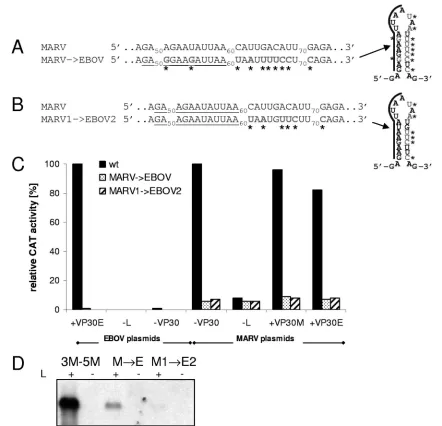
Chimeric transcription start signals of MARV and ZEBOV are transcriptionally inactive.To characterize the influence of the primary sequence and the secondary structure formed by the NP transcription start signal on transcription activity, we designed two MARV minigenomes containing ZEBOV-spe-cific sequences: First, we replaced (italics) the MARV tran-scription start signal (5⬘-GAAGAAUAUUAA-3⬘) with the ZEBOV transcription start signal (5⬘-GAGGAAG AUUAA-3⬘) as well as the downstream sequence to retain the ZEBOV-specific secondary structure (Fig. 3A). Second, we kept the MARV-specific transcription start signal sequence but altered the downstream sequence to obtain a ZEBOV-like secondary structure (Fig. 3B). Both constructs were tested for transcrip-tional activity using the minigenome assay. It has been de-scribed previously that replication in the absence of transcrip-tion does not lead to CAT gene expression. Nevertheless, CAT activity does not solely reflect transcription activity, because the minigenomic template must be amplified by replication to yield sufficient amounts of transcribed mRNAs (29). BSR-T7/5 cells were transfected with either ZEBOV or MARV plasmids
on November 8, 2019 by guest
http://jvi.asm.org/
(NP, L, VP30, and VP35) and the respective wild-type minig-enome or the mutant minigminig-enome (Fig. 3C). Wild-type ZE-BOV minigenome was transcribed only in the presence of L and VP30, and transcription did not occur when any of the expression plasmids was omitted. Neither of the two chimeric MARV minigenomes was transcribed by ZEBOV nucleocap-sid proteins independently of the presence of VP30. As ex-pected, the wild-type MARV minigenome was transcribed in the absence or presence of VP30 in the MARV minigenome system. Again, no CAT activity was observed with either of the two chimeric constructs. When we analyzed the levels of
rep-licated RNA of the two chimeric minigenomes, we found that replication activity of both constructs was strongly reduced or not detectable (Fig. 3D). These data suggested that in contrast to the case for ZEBOV, the sequence downstream of the MARV transcription start signal or even the transcription start signal itself contains elements which are important for MARV replication.
The first 70 nt of the 3ⴕNCR support replication and tran-scription. Based on the findings that the transcription start signal might be involved in regulation not only of transcription but also of replication, the MARV promoter for genomic
rep-FIG. 2. Results of the chemical modification assay on RNA of the positive-strand minigenome 3M-5MG(⫹). In vitro-transcribed RNA was subjected to treatment with either DMS or CMCT to specifically modify A and C or G and U residues, respectively. The modified RNAs were used as the template in an RT reaction with a32P-labeled primer, and the products were separated on a denaturing polyacrylamide gel. Modified bases led to termination of RT. To relate the pattern of the RNA (left four lanes) to the template, plasmid DNA was sequenced using the same primer and run along with the RT product (right four lanes).⫺, RT products of the untreated RNA template as a background control. (A) Modification pattern of the first 48 nt of the RNA comprising the leader region. Nucleotides that were modified are indicated and are shaded in gray in the sequence below. (B) Modification pattern from the transcription start signal (nt 49 to 60, boxed) to nt 102. Modified nucleotides are marked as described for panel A. The transcription start signal of NP gene is boxed. (C) Interpretation of the modification pattern. A model of the secondary structure was predicted using the online application Mfold; this model was then adapted according to the results of the chemical modification assay. Sequence that was not interpretable is shown in gray. Modified nucleotides are underlined, and asterisks mark the base pairs of which only one base was modified. The transcription start signal is marked by a line. (D) The secondary structure of the ZEBOV transcription start signal as a comparison. The transcription start signal itself is marked by a line.
on November 8, 2019 by guest
http://jvi.asm.org/
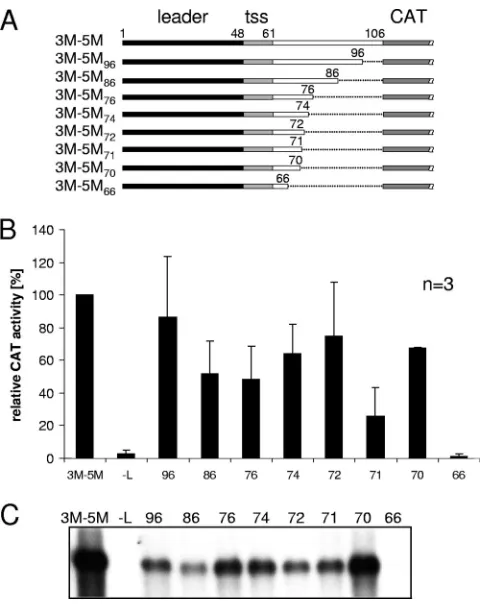
[image:4.585.46.542.68.468.2]lication was mapped. To this end, a set of 3M-5M mutants was generated in which the 3⬘ end was consecutively truncated from the 5⬘ end; the last 10 to 40 nt of the 3⬘ end directly upstream of the CAT open reading frame were deleted (Fig. 4A). These constructs were analyzed for replication and tran-scription activity using the MARV minigenome system. As shown in Fig. 4B, CAT activity of constructs 3M-5M96, 3M-5M74, 3M-5M72, and 3M-5M70was in the range of that of the
[image:5.585.70.512.66.492.2]wild-type minigenome, whereas CAT activity of mutants 3M-5M86, 3M-5M76, 3M-5M71showed a twofold reduction. The CAT activity of only mutant 3M-5M66containing the first 66 nt of the 3⬘end was reduced to the background level. Replication was analyzed by detection of replicated RNA in a Northern blot assay (Fig. 4C). Replication of all constructs except 3M-5M70was reduced, but the employed method does not allow for a direct quantification. Mutant 3M-5M66did not yield any
FIG. 3. Chimeric minigenomes between ZEBOV and MARV transcription start signals. (A) Mutational changes to replace the MARV NP transcription start signal with that of ZEBOV, including the downstream sequence involved in formation of a stable hairpin structure. Mutated nucleotides are shown in boldface and are marked by asterisks. The predicted RNA secondary structure is shown on the right. (B) Changes introduced to resemble the ZEBOV-specific hairpin structure (scheme at right) but keep the MARV-specific transcription start signal. The transcription start signal is underlined for both sequences, and the exchanged nucleotides are marked with asterisks. (C) The two chimeric constructs were tested with the minigenome assay. BSR-T7/5 cells were transfected with either ZEBOV-specific expression plasmids encoding the nucleocapsid proteins NP (0.5g), VP35 (0.5g), L (1.0g), and VP30 (0.1g; left part) or plasmids encoding MARV nucleocapsid proteins (NP, 0.1g; VP35, 0.5g; L, 1.0g; and VP30, 0.5g; right part); the wild-type (wt) minigenome was 1.0g 3E-5E and 3M-5M, respectively. Plasmids for VP30 and L were added as indicated. At 2 days posttransfection, cells were harvested and CAT activity was determined. Positive controls were set as 100%. VP30E, ZEBOV VP30; VP30M, MARV VP30. (D) Analysis of replicated RNA by Northern blot analysis. Huh-T7 cells were transfected with all necessary MARV minigenome plasmids. As the negative control, the plasmid encoding the L gene was omitted. At 2 days posttransfection, cells were lysed and treated with micrococcal nuclease. Protected RNA was purified and subjected to Northern blot analysis. M3E, MARV3EBOV; M13E2, MARV13EBOV2.
on November 8, 2019 by guest
http://jvi.asm.org/
detectable replicated RNA, indicating that the lack of CAT activity was due to the lack of replication. These data show that the genomic replication promoter is located within the first 70 nt of the 3⬘NCR.
The genomic replication promoter of MARV contains UN5
hexamers important for replication. Since the region down-stream of the first transcription start signal was found to be essential for replication activity, the next step was to map and characterize this region in more detail. Interestingly, two iden-tical adjacent hexamers (GUAACU)2 with a high degree of similarity to hexamers found in the 3⬘NCR of various EBOV species are located within this region (Fig. 1). However, when single nt at various positions between nt 61 and 72 were re-placed with the complementary nt (C71G, A70U, U68A, and C65G), neither replication nor transcription activity was signif-icantly impaired (Fig. 5A). Only C71G showed repeatedly low transcription activity of about 40%. Further inspection of the 3⬘ end revealed seven repetitive UN5hexamers that have al-ready been shown to be part of the ZEBOV replication
pro-moter (47). The hexamers span part of the leader, the tran-scription start signal, and the region downstream of the transcription start signal, with the last U residue at position 74 (Fig. 1). To analyze whether the hexameric U residues located in the region downstream of the transcription start signal would influence replication activity, minigenome mutants were constructed in which one, two, or three U residues (positions 62, 68, and 74) were exchanged with A. While a single mutation of either nt 62 or nt 68 led to a significant drop in transcription activity and to a slight decrease in replication, the simultaneous mutation of two or three U residues led to a complete loss of transcription and replication activity (Fig. 5B). These data sug-gest an important role of hexameric U residues located down-stream of the transcription start signal for MARV replication, as was previously shown for ZEBOV.
In order to confirm the importance of the three distal UN5 hexamers, a recombinant full-length MARV clone was con-structed in which U residues 62, 68, and 74 were replaced with A (Fig. 6A). A rescue procedure was performed as described previously (9). As shown in Fig. 6C, lane 2, it was not possible to rescue this mutant, confirming the importance of the U residues for MARV replication.
Although the second promoter element of ZEBOV consists of eight consecutive UN5 hexamers, a stretch of three UN5 hexamers was sufficient for minimal replication activity in a minigenome system. However, the more UN5hexamers avail-able, the more efficiently replication occurred (47). Since ZEBOV grows faster in cell culture than does MARV Musoke, the question of whether the observed differences in the repli-cation cycle might be caused by different promoter structures arose. In order to investigate if additional hexamers would lead to enhanced MARV replication, we elongated the stretch of UN5 hexamers within the recombinant MARV clone MARV3xUN5by insertion of three additional ZEBOV-specific UN5 hexamers (Fig. 6A). The same sequence was added to the minigenome 3M-5M to obtain 3M-5M3xUN5. Transfection of BSR-T7/5 cells with this minigenome resulted in replication/transcription activity that was only slightly en-hanced compared to that of the wild-type minigenome (Fig. 6B). The full-length virus MARV3xUN5 could be recovered easily, as shown by RT-PCR performed with total RNA of infected cells (Fig. 6C, lanes 3, 9, and 10). Determination of the growth characteristics of MARV3xUN5 in comparison to recMARV revealed that the virus containing three additional UN5hexamers did not replicate more efficiently in cell culture (Fig. 6D; MOI⫽0.01), supporting the minigenome results.
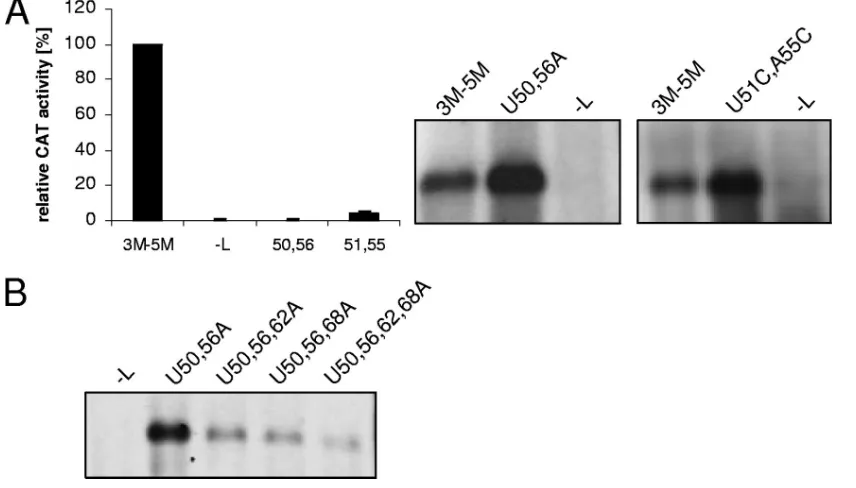
[image:6.585.43.285.66.368.2]The transcription start signal is not relevant for replication activity.Since the region located immediately downstream of the first transcription start signal was found to be essential for replication activity, we next addressed the question of whether the transcription start signal itself would also be involved in replication. The highly conserved transcription start signal con-tains two U residues at position 50 and 56, which are part of the hexameric UN5stretch located in the MARV 3⬘end (Fig. 1). Substitution of A residues for these two U residues minig-enome 3M-5M totally abolished transcription activity (Fig. 7A, left panel), whereas replication activity was enhanced com-pared to that of the wild-type minigenome (Fig. 7A, middle panel). Next, nt 62, 68, or 62 and 68, in addition to nt 50 and 56, were replaced, resulting in minigenomes in which three or
FIG. 4. Mapping of the MARV 3⬘NCR. (A) Schematic drawing of the 3⬘end of the MARV minigenomic deletion mutants. Nucleotides are numbered according to their position in the viral RNA. Deleted sequence is indicated by a dashed line. tss, transcription start signal; CAT, CAT gene. (B) Huh-T7 cells were transfected with plasmids encoding MARV NP, VP35, and L along with the respective truncated minigenome. At 2 days posttransfection, cells were lysed and tested for CAT activity, reflecting replication and transcription of the mini-genomes. The positive control (3M-5M) was set as 100%. The exper-iment was performed three times, and the standard deviations are shown. (C) Northern blot analysis showing replicated RNA of the deletion mutants. Numbers indicate the lengths (in nucleotides) of the 3⬘ends of the truncated minigenomes.
on November 8, 2019 by guest
http://jvi.asm.org/
four UN5 hexamers were simultaneously destroyed. As ex-pected, none of the mutants was transcribed (data not shown). Although replication activity of the mutants was clearly re-duced compared to that of 3M-5MU50,56A, replicated RNA could be detected for each of the mutants, including 3M-5MU50,56,62,68A(Fig. 7B), indicating that, first, the transcription start signal is essential only for transcription and not for rep-lication activity and, second, transcription inhibition led to enhanced replication activity (compare Fig. 7B and 5B, 3M-5MU50,56,62,68Aand 3M-5MU62,68A). This observation was con-firmed by results obtained with a minigenome mutant in which nt 51 and 55 were replaced with C residues, thus mimicking the transcription start signal of ZEBOV. Again, the mutated mini-genome was more efficiently replicated than the wild type, but it was not transcribed (Fig. 7A, right panel).
Taken together, these data show that the MARV transcrip-tion start signal is essential for transcriptranscrip-tion initiatranscrip-tion but not needed for replication activity, indicating that the transcription start signal serves as a spacer sequence that separates the leader region from a second promoter element comprising nt 61 to 79 (Fig. 8). In addition, our data give evidence that inhibition of transcription led to enhanced replication activity, suggesting that there might be a competition between tran-scription and replication initiation.
DISCUSSION
In this study, we investigated cis-acting elements located within the 3⬘end of the MARV genome with respect to
rep-lication and transcription activity. First, we analyzed secondary structure formation of the MARV leader region and the non-translated region of the NP gene in the plus-sense orientation. Our results revealed the formation of two stable stem-loop structures within the first 97 nt of the genome. The first stem-loop is formed by nt 2 to 37 of the leader region. A similar structure was also found for the ZEBOV leader region formed by nt 5 to 44 (47), indicating an important role of these sequences in filovirus replication. Although the leader region is highly conserved between different MARV strains, two MARV isolates collected during a MARV outbreak in Angola showed one nucleotide exchange within the stem re-gion, with a C residue at nt position 28 (41). This exchange was not accompanied by a compensatory mutation at position 11 base pairing with nt 28, leading to the assumption that proper secondary structure formation is not a prerequisite for repli-cation activity. It has also been shown for the ZEBOV leader that substitutions of single residues within the predicted hair-pin loop did not reduce replication activity dramatically (7).
[image:7.585.76.500.69.329.2]Due to a strong complementarity of the 3⬘and 5⬘ends of the genome, formation of a panhandle structure would also be conceivable. However, previous results obtained with ZEBOV sequences showed that the internal 3⬘ stem-loop was also formed when the complementary 5⬘ sequences were present (47). Panhandle structures formed by complementary genome ends are known to serve as replication and transcription pro-moters for segmented negative-sense RNA viruses, such as orthomyxoviruses, bunyaviruses, and arenaviruses (13, 20, 32).
FIG. 5. Characterization of the MARV genomic replication promoter. Various point mutations were introduced into the 3⬘NCR of 3M-5M. Huh-T7 cells were transfected with the minigenome system components and analyzed for replication and transcription at 48 h posttransfection. CAT activity reflects transcription activity, and Northern blot analysis was performed to test for replicated RNA. (A) CAT assay (left) and Northern blot analysis (right) of minigenomes with point mutations in a region of two identical adjacent hexamers located downstream of the transcription start signal. (B) CAT assay (left) and Northern blot analysis (right) of minigenomes in which various hexameric U residues in the 3⬘ NCR of the NP gene were replaced with A. Mutated nucleotides are indicated.
on November 8, 2019 by guest
http://jvi.asm.org/
As of yet, it is not clear if secondary structures play any role in the replication of nonsegmented negative-strand RNA vi-ruses. While the primary sequences located at the genome ends of Sendai virus and human parainfluenza virus type 3
are sufficient to support replication independently of the ability to form a stem-loop structure (17, 40), increased terminal complementarity of vesicular stomatitis virus sub-genomic RNAs strongly promotes replication, suggesting an
FIG. 6. Rescue of recombinant MARV. (A) MARV mutants. U residues 62, 68, and 74 were replaced with A in the full-length MARV mutant 3U3A. The full-length mutant 3⫻UN5contains three extra hexamers derived from the ZEBOV replication promoter. Hexameric U residues are in boldface and underlined. (B) CAT assay of MARV minigenome containing three additional EBOV UN5hexamers. BSR-T7/5 cells were transfected as previously described and analyzed for CAT expression after 48 h. (C) RT-PCR to detect recovered recombinant MARV. BSR-T7/5 cells were transfected with plasmids encoding MARV NP, VP35, VP30, and L and the respective full-length clone along with pC-T7/Pol. At 5 days posttransfection, transfected cells were mixed with fresh Vero C1008 cells and cocultivated for another 6 days. Cells were then lysed, and the lysates were used to infect fresh Vero C1008 cells. Infected cells were lysed at 7 days postinfection, and cellular RNA was used for RT-PCR to amplify nt 5890 to 6521 of the MARV genome. In contrast to the wild-type virus, recombinant MARV viruses contain an additional SspI restriction site within the amplified fragment. The 632-bp fragment was digested with SspI where noted. Two bands, at 301 and 331 bp, indicate the presence of the SspI site. rec MARV, recombinant MARV containing the additional SspI site as a genetic tag; Mock, not transfected and not infected; wt MARV, infected with wild-type MARV. (D) Growth characteristics of recombinant MARV and MARV3xUN5. Huh7 cells were infected with either recombinant MARV or MARV3xUN5at an MOI of 0.01. Cells were harvested daily up to day 7 and subjected to immunofluorescence analysis using a MARV-specific antiserum. Cell nuclei were stained with DAPI. Infectivity of the viruses was determined by counting fluorescent cells. Data were obtained in triplicate, and the standard deviations are shown.
on November 8, 2019 by guest
http://jvi.asm.org/
interaction of the genome termini (49). Hence, further stud-ies have to be done to clarify the influence of panhandle formation on MARV replication and transcription.
Due to methodological limitations, all experimentally deter-mined RNA structures were obtained from naked positive-sense RNA. Since genomic and antigenomic filovirus RNA is enwrapped by the nucleocapsid proteins (27, 29), it is not clear if RNA secondary structure formation takes place at the level of encapsidated RNA. However, it is conceivable that RNA secondary structure formation could occur during replication and transcription, when the RNA template is partially released from the NPs to give access to the viral polymerase complex. The second RNA hairpin within the 3⬘end of the MARV genome includes the transcription start signal of the NP gene except for the first nucleotide, G49. In contrast to the hairpin loop within the leader region, folding of this second stem-loop could take place at the mRNA level, i.e., at the level of naked RNA. The identified stem-loop ranges from nt 50 to 97, thus including almost the entire 3⬘nontranslated region of the first gene. All nucleotides but the first of the transcription start signal are base paired. However, the structure itself seems not to be important for transcription initiation, since we could show that the first 70 nt are sufficient for transcription as well as replication. The transcription start signal of ZEBOV NP is also involved in secondary structure formation; however, the RNA structure differs significantly from that found with MARV (Fig. 2C and D). The ZEBOV-specific secondary structure was shown to regulate VP30-dependent transcription (48). In the MARV minigenome system, VP30 did not affect
transcription activity, although MARV VP30 was able to sup-port transcription in the heterologous ZEBOV minigenome system (29). Since it is conceivable that VP30-independent transcription of MARV minigenomes is due to the lack of the regulatory RNA structure, we constructed MARV mini-genomes forming RNA secondary structures similar to those of ZEBOV. The exchange of the highly conserved MARV tran-scription start signal with the ZEBOV sequence (and down-stream nucleotides to preserve the secondary structure) re-sulted in a loss of not only transcription but also replication (Fig. 3C and D). Moreover, when the authentic MARV tran-scription start signal was preserved and only downstream lo-cated sequences were substituted, replication activity could not be observed either, suggesting an important role of the se-quences downstream of the transcription start signal for rep-lication. Indeed, mapping of the MARV genomic replication promoter revealed that the sequence adjacent to the NP tran-scription start signal is essential for replication.
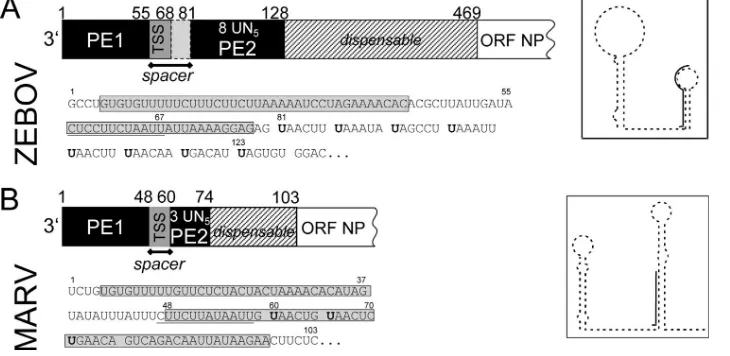
[image:9.585.78.506.71.315.2]The MARV genomic replication promoter comprises 70 nt and is much shorter than the ZEBOV promoter that spans the first 128 nt of the viral genome (Fig. 8). Both promoters are bipartite in nature, consisting of a first promoter element span-ning the leader region and a second promoter element located within the nontranslated region of the NP gene. In the case of ZEBOV, the spacer region located between the leader and the first U residue of the second promoter element comprises the transcription start signal of the NP gene (12 nt) and the fol-lowing 13 nt. This is exactly the region that forms the RNA structure involved in VP30-dependent transcription (47). The
FIG. 7. Mutations within the transcription start signal of the NP gene led to enhanced replication. Point mutations were introduced into the transcription start signal and downstream-located sequences of minigenome 3M-5M. The mutation sites are indicated. Huh-T7 cells were transfected with plasmids encoding the MARV nucleocapsid proteins and the respective mutated minigenome. At 48 h posttransfection, cells were lysed and subjected to a CAT assay, reflecting transcription activity, and Northern blot analysis to show replication activity. (A) CAT assay (left) and Northern blot analysis (right) of minigenomes containing mutations within the transcription start signal of the NP gene. (B) Northern blot analysis of minigenomes in which hexameric U residues located within the transcription start signal of the NP gene and adjacent nucleotides are replaced with A.
on November 8, 2019 by guest
http://jvi.asm.org/
MARV spacer is shorter, consisting of the NP transcription start signal (12 nt) plus one additional nt up to the first con-served U residue. It is noteworthy that the difference in lengths of the two spacers (12 nt) is a number divisible by six (see below).
It has been shown that the ZEBOV spacer region is essential for transcription but dispensable for replication activity (47). Similarly, the MARV transcription start signal is essential for transcription initiation but not needed for replication. More-over, when transcription initiation was inhibited by mutating the NP transcription start signal, replication activity was en-hanced, indicating that there might be a competition between replication and transcription initiation. A negative influence on genomic replication promoter strength by the first transcrip-tion start site has also been described for minigenomes of other nonsegmented negative-strand RNA viruses, such as human respiratory syncytial virus (hRSV) and Sendai virus (22, 25, 43). In these reports, the authors provide two different expla-nations for the observed competition. First, transcription and replication promoter sequences compete for a common pool of RNA polymerase molecules, and second, structurally different replicase and transcriptase complexes bind to adjacent pro-moter sequences, leading to steric interference. Interestingly, the structure of the replication promoters differs significantly between hRSV, Sendai virus, and MARV, with a monopartite promoter in the case of hRSV (11), a typical bipartite pro-moter found with all members of theParamyxovirinae subfam-ily in the case of Sendai virus (39), and an atypical bipartite promoter in the case of MARV, indicating that the observed competition between replication and transcription initiation is a feature shared by all nonsegmented negative-strand RNA viruses.
Our data show that the second promoter element of MARV
consists of a stretch of three UN5 hexamers located down-stream of the first transcription start signal. Mutational anal-ysis revealed that two hexamers were sufficient to support basal replication activity. A similar hexameric sequence repeat has been identified for the ZEBOV replication promoter, with eight consecutive UN5hexamers forming the second promoter element. In addition, a sequence comparison revealed five and six UN5hexamers, respectively, in the 3⬘NCR of the EBOV species Reston and Sudan (Fig. 1).
The only other nonsegmented negative-strand RNA vi-ruses possessing bipartite promoters belong to the subfamily
[image:10.585.110.475.71.249.2]Paramyxovirinae (17, 18, 23, 30, 39, 44, 45). In contrast to filoviruses, the members of theParamyxovirinaesubfamily obey the rule of six, i.e., the total genome length must be a multiple of six to be efficiently replicated and transcribed (4, 8, 21, 33, 36). The overall replication promoter structure of the viruses in the Paramyxovirinae subfamily is similar. The first promoter element is located within the leader region and spans the first 12 to 36 nt of the genome. As with the filoviruses, the tran-scription start signal of the first gene does not belong to the replication promoter but is part of the spacer region. The second promoter element of most members of the Paramyxo-virinae consists of a stretch of three consecutive hexamers containing conserved C or CG residues (18, 23, 30, 39, 44, 45). Despite the hexameric phasing of the second promoter ele-ment of MARV and ZEBOV, filovirus genomes are not a multiple of six or another common integer (3). The lack of an integer length rule is one of the features filoviruses share with the members of thePneumovirinaesubfamily, such as hRSV. There are other similarities between filoviruses and pneumovi-ruses, e.g., the possession of a fourth nucleocapsid protein, which is unique among the nonsegmented negative-strand RNA viruses (1, 5). In contrast to the filoviruses, however, the replication
FIG. 8. Comparison of the genomic replication promoter of ZEBOV and MARV. Promoter elements (PE) for replication are represented by black boxes, the transcription start signal (TSS) of the NP gene is shown in gray, and additional sequences belonging to the spacer region are indicated in a lighter gray. Regions of unimportant sequence are shown with hatching. Nucleotides involved in secondary structure formation are boxed in the sequence below the scheme. Right insets, scheme of predicted RNA secondary structures of these regions. The NP transcription start signal is indicated by a solid line in the insets and is underlined in the sequence. (A) The ZEBOV replication promoter is bipartite (PE1 and PE2). The spacer region includes the transcription start signal as well as the downstream sequence involved in secondary structure formation and can be extended or reduced by a multiple of 6 nt. PE2 consists of eight hexamers with U residues (boldface) at positions 81, 87,…123. (B) 3⬘end of the MARV genome. PE2 of the MARV replication promoter is shorter, containing 3 UN5hexamers. The spacer region between PE1 and PE2 consists of the transcription start signal of the NP gene. ORF, open reading frame.
on November 8, 2019 by guest
http://jvi.asm.org/
promoter of hRSV consists of a single element located entirely within the leader region (6). Since filoviruses share different mo-lecular features with both thePneumovirinaeand the Paramyxo-virinae, it can be speculated that theFiloviridae,Pneumovirinae, andParamyxovirinae represent three distinct virus lineages de-rived from a common ancestor.
ACKNOWLEDGMENTS
We thank T. Takimoto and Y. Kawaoka for providing plasmid pC-T7/Pol and K. K. Conzelmann and V. Gaussmu¨ller for providing cell lines.
This work was supported by the FAZIT Stiftung, the Fonds der Chemischen Industrie (to S. Enterlein), the Manchot Stiftung (to K. M. Schmidt and J. Olejnik), and the Deutsche Forschungsgemein-schaft (SFB 535).
REFERENCES
1.Buchholz, U. J., S. Biacchesi, Q. N. Pham, K. C. Tran, L. Yang, C. L. Luongo, M. H. Skiadopoulos, B. R. Murphy, and P. L. Collins.2005. Deletion of M2 gene open reading frames 1 and 2 of human metapneumovirus: effects on
RNA synthesis, attenuation, and immunogenicity. J. Virol.79:6588–6597.
2.Buchholz, U. J., S. Finke, and K. K. Conzelmann.1999. Generation of bovine respiratory syncytial virus (BRSV) from cDNA: BRSV NS2 is not essential for virus replication in tissue culture, and the human RSV leader
region acts as a functional BRSV genome promoter. J. Virol.73:251–259.
3.Calain, P., M. C. Monroe, and S. T. Nichol.1999. Ebola virus defective
interfering particles and persistent infection. Virology262:114–128.
4.Calain, P., and L. Roux.1993. The rule of six, a basic feature for efficient
replication of Sendai virus defective interfering RNA. J. Virol.67:4822–4830.
5.Collins, P. L., E. Camargo, and M. G. Hill.1999. Support plasmids and support proteins required for recovery of recombinant respiratory syncytial
virus. Virology259:251–255.
6.Cowton, V. M., D. R. McGivern, and R. Fearns. 2006. Unravelling the complexities of respiratory syncytial virus RNA synthesis. J. Gen. Virol.
87:1805–1821.
7.Crary, S. M., J. S. Towner, J. E. Honig, T. R. Shoemaker, and S. T. Nichol.
2003. Analysis of the role of predicted RNA secondary structures in Ebola
virus replication. Virology306:210–218.
8.Durbin, A. P., J. W. Siew, B. R. Murphy, and P. L. Collins.1997. Minimum protein requirements for transcription and RNA replication of a mini-genome of human parainfluenza virus type 3 and evaluation of the rule of six.
Virology234:74–83.
9.Enterlein, S., V. Volchkov, M. Weik, L. Kolesnikova, V. Volchkova, H. D. Klenk, and E. Mu¨hlberger.2006. Rescue of recombinant Marburg virus from
cDNA is dependent on nucleocapsid protein VP30. J. Virol.80:1038–1043.
10.Fearns, R., P. L. Collins, and M. E. Peeples.2000. Functional analysis of the genomic and antigenomic promoters of human respiratory syncytial virus.
J. Virol.74:6006–6014.
11.Fearns, R., M. E. Peeples, and P. L. Collins.2002. Mapping the transcription
and replication promoters of respiratory syncytial virus. J. Virol.76:1663–
1672.
12.Feldmann, H., E. Mu¨hlberger, A. Randolf, C. Will, M. P. Kiley, A. Sanchez, and H. D. Klenk.1992. Marburg virus, a filovirus: messenger RNAs, gene
order, and regulatory elements of the replication cycle. Virus Res.24:1–19.
13.Flick, R., G. Neumann, E. Hoffmann, E. Neumeier, and G. Hobom.1996.
Promoter elements in the influenza vRNA terminal structure. RNA2:1046–
1057.
14.Fowler, T., S. Bamberg, P. Mo¨ller, H. D. Klenk, T. F. Meyer, S. Becker, and T. Rudel.2005. Inhibition of Marburg virus protein expression and viral
release by RNA interference. J. Gen. Virol.86:1181–1188.
15.Groseth, A., H. Feldmann, S. Theriault, G. Mehmetoglu, and R. Flick.2005. RNA polymerase I-driven minigenome system for Ebola viruses. J. Virol.
79:4425–4433.
16.Hartlieb, B., T. Muziol, W. Weissenhorn, and S. Becker.2007. Crystal struc-ture of the C-terminal domain of Ebola virus VP30 reveals a role in
tran-scription and nucleocapsid association. Proc. Natl. Acad. Sci. USA104:624–
629.
17.Hoffman, M. A., and A. K. Banerjee.2000. Analysis of RNA secondary
structure in replication of human parainfluenza virus type 3. Virology272:
151–158.
18.Hoffman, M. A., and A. K. Banerjee.2000. Precise mapping of the replication and transcription promoters of human parainfluenza virus type 3. Virology
269:201–211.
19.John, S. P., T. Wang, S. Steffan, S. Longhi, C. S. Schmaljohn, and C. B. Jonsson. 2007. Ebola virus VP30 is an RNA binding protein. J. Virol.
81:8967–8976.
20.Kohl, A., E. F. Dunn, A. C. Lowen, and R. M. Elliott.2004. Complementarity,
sequence and structural elements within the 3⬘and 5⬘non-coding regions of
the Bunyamwera orthobunyavirus S segment determine promoter strength.
J. Gen. Virol.85:3269–3278.
21.Kolakofsky, D., L. Roux, D. Garcin, and R. W. Ruigrok.2005. Paramyxovirus mRNA editing, the “rule of six” and error catastrophe: a hypothesis. J. Gen.
Virol.86:1869–1877.
22.Le Mercier, P., D. Garcin, E. Garcia, and D. Kolakofsky.2003. Competition
between the Sendai virus N mRNA start site and the genome 3⬘-end
pro-moter for viral RNA polymerase. J. Virol.77:9147–9155.
23.Marcos, F., L. Ferreira, J. Cros, M. S. Park, T. Nakaya, A. Garcia-Sastre, and E. Villar.2005. Mapping of the RNA promoter of Newcastle disease
virus. Virology331:396–406.
24.Martínez, M. J., N. Biedenkopf, V. Volchkova, B. Hartlieb, N. Alazard-Dany, O. Reynard, S. Becker, and V. Volchkov.2008. Role of Ebola virus Vp30 in
transcription reinitiation. J. Virol.82:12569–12573.
25.McGivern, D. R., P. L. Collins, and R. Fearns.2005. Identification of internal
sequences in the 3⬘leader region of human respiratory syncytial virus that
enhance transcription and confer replication processivity. J. Virol.79:2449–
2460.
26.Modrof, J., E. Mu¨hlberger, H. D. Klenk, and S. Becker.2002.
Phosphoryla-tion of VP30 impairs Ebola virus transcripPhosphoryla-tion. J. Biol. Chem.277:33099–
33104.
27.Mu¨hlberger, E., B. Lo¨tfering, H.-D. Klenk, and S. Becker.1998. Three of the four nucleocapsid proteins of Marburg virus, NP, VP35, and L, are sufficient to mediate replication and transcription of Marburg virus-specific
monocis-tronic minigenomes. J. Virol.72:8756–8764.
28.Mu¨hlberger, E., S. Trommer, C. Funke, V. Volchkov, H.-D. Klenk, and S. Becker.1996. Termini of all mRNA species of Marburg virus: sequence and
secondary structure. Virology223:376–380.
29.Mu¨hlberger, E., M. Weik, V. E. Volchkov, H.-D. Klenk, and S. Becker.1999. Comparison of the transcription and replication strategies of Marburg virus
and Ebola virus by using artificial replication systems. J. Virol.73:2333–2342.
30.Murphy, S. K., and G. D. Parks.1999. RNA replication for the paramyxo-virus simian paramyxo-virus 5 requires an internal repeated (CGNNNN) sequence
motif. J. Virol.73:805–809.
31.Neumann, G., H. Feldmann, S. Watanabe, I. Lukashevich, and Y. Kawaoka.
2002. Reverse genetics demonstrates that proteolytic processing of the Ebola virus glycoprotein is not essential for replication in cell culture. J. Virol.
76:406–410.
32.Perez, M., and J. C. de la Torre.2003. Characterization of the genomic promoter of the prototypic arenavirus lymphocytic choriomeningitis virus.
J. Virol.77:1184–1194.
33.Rager, M., S. Vongpunsawad, W. P. Duprex, and R. Cattaneo. 2002.
Polyploid measles virus with hexameric genome length. EMBO J.21:2364–
2372.
34.Sanchez, A., M. P. Kiley, B. P. Holloway, and D. D. Auperin.1993. Sequence analysis of the Ebola virus genome: organization, genetic elements, and
comparison with the genome of Marburg virus. Virus Res.29:215–240.
35.Schultz, D. E., M. Honda, L. E. Whetter, K. L. McKnight, and S. M. Lemon.
1996. Mutations within the 5⬘nontranslated RNA of cell culture-adapted
hepatitis A virus which enhance cap-independent translation in cultured
African green monkey kidney cells. J. Virol.70:1041–1049.
36.Skiadopoulos, M. H., L. Vogel, J. M. Riggs, S. R. Surman, P. L. Collins, and B. R. Murphy.2003. The genome length of human parainfluenza virus type 2 follows the rule of six, and recombinant viruses recovered from non-polyhexameric-length antigenomic cDNAs contain a biased distribution of
correcting mutations. J. Virol.77:270–279.
37.Slenczka, W. G.1999. The Marburg virus outbreak of 1967 and subsequent
episodes. Curr. Top. Microbiol. Immunol.235:49–75.
38.Smith, D. H., B. K. Johnson, M. Isaacson, R. Swanapoel, K. M. Johnson, M. Killey, A. Bagshawe, T. Siongok, and W. K. Keruga.1982. Marburg-virus
disease in Kenya. Lanceti:816–820.
39.Tapparel, C., D. Maurice, and L. Roux.1998. The activity of Sendai virus genomic and antigenomic promoters requires a second element past the
leader template regions: a motif (GNNNNN)3is essential for replication.
J. Virol.72:3117–3128.
40.Tapparel, C., and L. Roux.1996. The efficiency of Sendai virus genome replication: the importance of the RNA primary sequence independent of
terminal complementarity. Virology225:163–171.
41.Towner, J. S., M. L. Khristova, T. K. Sealy, M. J. Vincent, B. R. Erickson, D. A. Bawiec, A. L. Hartman, J. A. Comer, S. R. Zaki, U. Stro¨her, F. Gomes da Silva, F. del Castillo, P. E. Rollin, T. G. Ksiazek, and S. T. Nichol.2006. Marburgvirus genomics and association with a large hemorrhagic fever
out-break in Angola. J. Virol.80:6497–6516.
42.Volchkov, V. E., V. A. Volchkova, E. Mu¨hlberger, L. V. Kolesnikova, M. Weik, O. Dolnik, and H. D. Klenk.2001. Recovery of infectious Ebola virus from complementary DNA: RNA editing of the GP gene and viral
cytotox-icity. Science291:1965–1969.
43.Vulliemoz, D., S. Cordey, G. Mottet-Osman, and L. Roux.2005. Nature of a paramyxovirus replication promoter influences a nearby transcription signal.
J. Gen. Virol.86:171–180.
on November 8, 2019 by guest
http://jvi.asm.org/
44.Walpita, P.2004. An internal element of the measles virus antigenome
promoter modulates replication efficiency. Virus Res.100:199–211.
45.Walpita, P., and C. J. Peters.2007.Cis-acting elements in the antigenomic
promoter of Nipah virus. J. Gen. Virol.88:2542–2551.
46.Watanabe, S., T. Watanabe, T. Noda, A. Takada, H. Feldmann, L. D. Jasenosky, and Y. Kawaoka.2004. Production of novel Ebola virus-like particles from cDNAs:
an alternative to Ebola virus generation by reverse genetics. J. Virol.78:999–1005.
47.Weik, M., S. Enterlein, K. Schlenz, and E. Mu¨hlberger.2005. The Ebola virus genomic replication promoter is bipartite and follows the rule of six.
J. Virol.79:10660–10671.
48.Weik, M., J. Modrof, H. D. Klenk, S. Becker, and E. Mu¨hlberger.2002. Ebola virus VP30-mediated transcription is regulated by RNA secondary
structure formation. J. Virol.76:8532–8539.
49.Wertz, G. W., S. Whelan, A. LeGrone, and L. A. Ball. 1994. Extent of terminal complementarity modulates the balance between transcription and replication of vesicular stomatitis virus RNA. Proc. Natl. Acad. Sci. USA
91:8587–8591.
50.Yu, H., C. W. Grassmann, and S. E. Behrens.1999. Sequence and structural
elements at the 3⬘terminus of bovine viral diarrhea virus genomic RNA:
functional role during RNA replication. J. Virol.73:3638–3648.