University of Southern Queensland
Faculty of Health, Engineering and Sciences
LiDAR Data for DEM Generation
and Flood Plain Mapping
A dissertation submitted by
Maxwell James Burke
In fulfilment of the requirements of
Courses ENG4111 and ENG4112 Research Project
Towards the degree of
Bachelor of Spatial Science (Surveying)
Submitted: October, 2013
Abstract
High-‐resolution Digital Elevation Model (DEM) is a key spatial dataset for flood plain mapping and catchment management. On the 10th of January 2011, heavy rainfall caused flash flooding through Toowoomba city and central business district resulting in loss of life and significant damage to public and private property. Effective flash flood forecasting is a big challenge that requires accurate catchment spatial information. Much research has been undertaken on the use of airborne LiDAR data to generate high-‐resolution DEM.
The aim of this report is to determine the suitability of using airborne LiDAR data for flood plain mapping and catchment management. Airborne LiDAR data will be used to generate a high resolution DEM for a section of West Creek, part of the Gowrie Creek catchment, Toowoomba, Queensland. Accuracy of this high-‐resolution DEM was verified using GPS survey equipment to gather point data over the study area. Flood zone, inundation depth and water volume was extracted from the LiDAR derived DEM for flood surface levels indicative of the 2011 floods. These datasets were verified using the GPD derived DEM.
Disclaimer
University of Southern Queensland
Faculty of Health, Engineering and Sciences
ENG4111 and ENG4112 Research Project
Limitations of Use
The council of the University of Southern Queensland, its Faculty of Health, Engineering and Sciences, and the staff of the University of Southern Queensland, do not accept and responsibility for the truth, accuracy or completeness of material contained within or associated with this dissertation.
Persons using all or any part of this material do so at their own risk, and not at the risk of the Council of the University of Southern Queensland, its Faculty of Health, Engineering and Sciences or the staff of the University of Southern Queensland.
This dissertation reports and educational exercise and has no purpose or validity beyond this exercise. The sole purpose of the course pair entitled “Research Project” is to contribute to the overall education within the student’s chosen degree program. This document, the associated hardware, software, drawings, and other material set out in the associated appendices should not be used for any other purpose: if they are so used, it is entirely at the risk of the user.
Dean
Faculty of Health, Engineering and Sciences
Certification
I certify that the ideas, designs and experimental work, results, analysis and conclusions set out in this dissertation are entirely of my own efforts, except where otherwise indicated and acknowledged.
I further certify that the work is original and has not been previously submitted for assessment in any other course or institution, except where specifically stated.
Maxwell James Burke
Student number: U1002661
Acknowledgements
I would like to acknowledge that this research was carried out under the principal supervision of Dr Xiaoye Liu. Dr Liu support and expertise in this area of research has been invaluable.
Table of Contents
Abstract ... 2
Disclaimer ... 3
Certification ... 4
Acknowledgements ... 5
List of Tables ... 8
List of figures ... 9
Chapter 1 – Introduction ... 11
1.1 Introduction ... 11
1.2 Aim of this Research ... 12
1.3 Expected Benefits ... 12
1.4 Dissertation Overview ... 13
Chapter 2 – Literature Review ... 14
2.1 Introduction ... 14
2.2 Flood plain mapping ... 14
2.3 LiDAR technology ... 15
2.4 DEM generation and accuracy ... 16
2.5 Conclusion ... 18
Chapter 3 – Methodology ... 19
3.1 Introduction ... 19
3.2 Study Area ... 19
3.3 Data Acquisition ... 20
3.4 DEM Generation ... 23
3.5 Validation of GPS Data Acquisition ... 24
3.8 Flood Inundation Depth and Volume ... 30
3.9 Conclusion ... 31
Chapter 4 – Results and Discussion ... 32
4.1 Introduction ... 32
4.2 Validation of GPS Data Acquisition ... 32
4.3 Elevation Accuracy of Airborne LiDAR Derived DEM ... 36
4.4 Flood Zone Delineation ... 42
4.5 Flood Inundation Depth and Volume ... 47
4.6 Conclusion ... 49
Chapter 5 – Conclusions ... 51
5.1 Introduction ... 51
5.2 Further Research and Recommendations ... 51
5.3 Conclusion ... 52
Appendices ... 53
Appendix A -‐ Project Specification ... 53
Appendix B – Risk Assessment Matrix ... 55
Appendix C – LiDAR Report for: Toowoomba Regional Council 2010 LiDAR Capture Project. ... 66
Appendix D – Project Timeline ...74
List of Tables
Table 1 LiDAR meta-‐data (Schlencker Mapping Pty Ltd, 2010, p4) ... 22
Table 2 Land cover classes used in vertical accuracy analysis with descriptions ... 27
Table 3 Stream water levels (metres), Canley stream gauge, Gowrie Creek (QLD DNRM, 2012). ... 30
Table 4 Elevation errors in validation surveys in metres. ... 34
Table 5 Elevation errors in validation survey in metres, with and without retaining wall. ... 35
Table 6 Elevation error (m) of LiDAR generated DEM. ... 38
Table 7 Elevation error (m) of LiDAR generated DEM across grade classes. ... 39
Table 8 Elevation error (m) of LiDAR generated DEM across land cover classes. ... 41
Table 9 Flood zone surface areas for each flood water level surface across GPS generated DEM and LiDAR generated DEM ... 45
Table 10 Flood inundation depth and volume for each flood water surface across GPS generated DEM and LiDAR generated DEM. ... 49
List of figures
Figure 18 Raster images of flood inundation depths for 4.5m water level. GPS is shown on left and LiDAR on right. ... 48 Figure 19 Raster images of flood depths for 3.5 metre water level. GPS is shown on left and LiDAR on right. ... 48
Chapter 1 – Introduction
1.1Introduction
Around lunch time on Monday the 10th of January 2011, without warning, intense rainfall over the Gowrie Creek Catchment caused severe flash flooding through the Toowoomba CBD (Central Business District) resulting in loss of life and great damage to property. Heavy rainfall lasted not much longer than an hour and flood waters peaked only 1.5 to 2 hours after the rainfall began giving little warning time. Accurate flash flood forecasting for specific locations is challenging but necessary for the design of flood mitigation measures to avoid repeats of the damage explained above.
Figure 1 Flooded Toowoomba CBD [Source: Sydney Morning Herald]
[image:11.595.115.539.302.587.2]airborne LiDAR data to provide accurate data across large areas of catchments that can be useful for accurate flash flood prediction.
1.2Aim of this Research
The aim of this research is to determine the suitability of airborne LiDAR data for high-‐ resolution DEM generation and flood plain mapping. LiDAR output will be verified using GPS. This aim is broken into the following research objectives:
a) Use airborne LiDAR point data to generate a high resolution DEM over specified study area.
b) Verify accuracy of LiDAR generated DEM by GPS data acquisition.
c) Use LiDAR generated high-‐resolution DEM to delineate flood zone for typical flash flood water levels.
d) Verify accuracy of flood zone delineation by GPS.
e) Use LiDAR generated high-‐resolution DEM for flood inundation depth and water volume calculations.
f) Verify flood inundation depth and water volume by GPS.
1.3Expected Benefits
1.4Dissertation Overview
This dissertation contains five main chapters. These chapters are given a brief description below:
Chapter 1 Introduction – Gives an introduction to the topic of research. The aims of the research are provided. Background information regarding the topic is discussed as well as perceived benefits of the research.
Chapter 2 Literature Review – Provides a summary of the literature review undertaken for this dissertation. It is broken into three topic areas; flood plain mapping, LiDAR technology and DEM generation and accuracy.
Chapter 3 Methodology – This chapter discusses the methods used to fulfil the aims of the research. Discussion is included regarding the study area, data acquisition, DEM generation and analysis, flood zone delineation and flood inundation depth and volume analysis.
Chapter 4 Results and Discussion – Provides output data from the methodology and discussion of prevalent trends and relationships between airborne LiDAR accuracy and high-‐resolution DEM applications in flood plain mapping.
Chapter 5 – Provides a conclusion to the dissertation
Chapter 2 – Literature Review
2.1Introduction
A literature review was undertaken in regard to three key areas consisting of, flood plain mapping, LiDAR technology and DEM generation and accuracy. This chapter aims to give insight into previous research and findings in this area as well as explaining some key concepts of this area of study.
2.2Flood plain mapping
Flood plain mapping involves the formation of a number of models for analysis and management such as topographic surface models, two-‐dimensional hydraulic surface flow models and thematic land cover maps (Hollaus, et al., 2005). The DEM and its derived parameters such as slope, aspect and drainage network forms the base input data for these models and therefore the accuracy of the input DEM will have direct influences on the output models. Increased accuracy of the input DEM is crucial in minimizing the uncertainties of flood modeling and simulation results (Hollaus, et al., 2005).
McDougall, et al. (2008) reports on the accuracy requirements of DEMs for catchment management. Coverage and accuracy requirements for different applications of catchment management were determined in 2007 by a workshop of 18 participants representing key stakeholders, for Queensland. The coverage and accuracy requirements for the application of “Disaster planning and management (flood and fire)” is defined as +/-‐1m. However, other applications that may be applicable to flash flood prediction have coverage accuracy requirements of <0.5m including, “Hydrological modelling”, “Insurance risk and assessment” and “Land and water management plans” (McDougall, et al., 2008).
depth are usually calculated for a flood event with a specific return period (de Moel et al., 2009). Moel and Aerts (2010) conducted research into the effects of uncertainty in land use, damage models and inundation depth on flood damage estimates. Results of the research indicate that when an uncertainty of 250 cm is assumed for inundation depth, a total uncertainty surrounding the final damage estimate in the case study area can vary up to a factor 5-‐6. In other words, the lowest estimate for flood damage is 5-‐6 times lower than the highest estimate of damage (Moel and Aerts, 2010). Accuracy of inundation depth is clearly critical in estimating flood damage.
2.3LiDAR technology
LiDAR, also referred to as airborne laser scanning, light detection and ranging, or laser altimetry, is an active remote sensing technique, which was originally designed to measure the topography of the Earth’s surface (Hollaus, et al., 2005). A laser emits short infrared pulses towards the Earth’s surface and a photodiode measures the backscattered echoes (Hollaus, et al., 2005). LiDAR technology has been studied for a considerable time period since as early as the 1960’s and continues to be an area of active research and development (Flood, 2001). Though airborne LiDAR data has been commercially in use since the mid 1990’s it is still developing rapidly in regards to sensor technology and data processing. Developments in LiDAR technology allow high-‐ density point data to be captured for more affordable prices. High-‐density point data allows terrain to be represented in much detail (Liu, 2008). As a result of these developments LiDAR data has become a major source of digital terrain information for a variety of applications including hydraulic modelling and flood plain mapping (Raber, et al., 2007).
Elevation error of LiDAR was shown to be the function of a number of variables including LiDAR system measurements, horizontal displacement, interpolation error and surveyor error. Analysis of elevation error was undertaken across a number of land cover and grade classes. The results of the study show that elevation root mean square errors for LiDAR data were 17 to 26 cm. The highest errors were shown to occur over steep land as the horizontal error in this land type introduced further elevation error. LiDAR measurement over land of steep slopes with grades approximately 25 degrees were shown to contain elevation errors twice as large as data collected over slopes of 1.5 degrees. Errors over flat surfaces, even forested ones, were shown to be very low compared to other sources of digital elevation data such as photogrammetry (Hodgson and Bresnahan, 2004).
There have been a number of other studies that assess the accuracy of LiDAR derived elevations for various study areas. Adams and Chandler (2002) found a LiDAR derived elevation accuracy of 26 cm and found improved results over sloping terrain compared to DEMs derived from digital photogrammetry. Bowen and Waltermine (2002) found an overall elevation accuracy of 43 cm. Cobby et al. (2000) found an LiDAR elevation accuracy of 17 cm for data gathered over grass and cereal crop land cover.
2.4DEM generation and accuracy
Liu (2008) provides a study into the effective processing of raw LiDAR data and the generation of high resolution DEM. Methods regarding DEM generation, LiDAR data reduction, LiDAR data filters, and interpolation are discussed. These will be of great importance to the aims of this report as reducing redundant information and generating an accurate DEM efficiently is of importance. Liu (2008) concludes that the filtering of ground and non-‐ground data is the most critical step in generation of an accurate DEM from LiDAR data. Also of worth is the extraction and inclusion of critical elements, such as breaklines, in maintaining accuracy without excessive redundancies (Liu, 2008).
use studies, they introduce significant errors into a DEM if not filtered. Dowman and Fischer (2001) conducted research into the elevation errors of airborne LiDAR derived DEM using multiple returns. These authors found significant errors of up to 4m RMSE over flat ground when no filtering was applied (Downman and Fischer, 2001). Zhang, et al. (2003) provides a study on a progressive morphological filter to remove non-‐ground points from airborne LiDAR data. The filter is developed and tested on mountainous and flat urbanized areas with apparent success. An effective and accurate method of removing non-‐ground data from LiDAR data is critical in generation accurate high resolution DEMs (Zhang, et al., 2003).
Liu and Zhang (2010) provide a study into the automated delineation of drainage networks from high resolution DEM. As the drainage network is one of main factors in flood prediction, accurate means of extracting it are paramount. Liu and Zhang (2010) assess existing methods for drainage network extraction and focus on extraction using the Arc Hydro extension of ArcGIS with different threshold limits (the minimum upstream drainage area). The study concludes with the evidence that high resolution DEMs are required for detailed drainage networks as they can provide adequate data for drainage network extraction using smaller threshold values.
Assessing the accuracy of LiDAR derived DEM is a key outcome of this research project. A commonly accepted method to perform an empirical assessment of LiDAR generated DEM accuracy is to use the root mean square error (RMSE) statistic based on survey spot levels (Raber et al., 2007). The RMSE formula is as follows:
𝑅𝑀𝑆𝐸!"#$% !"#$%&'()*+#=
Σ(𝑍!"#$%−𝑍!"#$%&)!
𝑛
Where:
ZLiDAR = Elevation of LiDAR point (m)
ZSurvey = Elevation of surveyed point (m)
The RMSE value provides a tangible and realistic estimate of errors most likely to be encountered for LiDAR observations. This will be used in analysing the elevation errors of airborne LiDAR generated high resolution DEM.
2.5Conclusion
This chapter has discussed key concepts of the study area as well as reviewing research and findings of relevant literature. Flood plain mapping was the first topic researched. Data requirements for flood plain mapping were identified and the importance of an accurate DEM was noted as many output models are based of this key data set. Accuracy requirements of DEMs for flood plain mapping were defined and the application of flood plain mapping in regards to damage estimates was discussed. Secondly, LiDAR technology was researched. Background information on this technology was provided including history of use and expected error sources. Thirdly, DEM generation and accuracy was researched. Research regarding filtering of non-‐ ground points and accurate DEM generation was presented. Use of DEM for flood plain modelling was discussed as well as statistical methods to analyse DEM elevation accuracy.
Chapter 3 – Methodology
3.1Introduction
This chapter will present the different stages of planning, resources, data acquisition, data processing and analysis in order to meet the aims of the research. It will cover:
• Study Area
• Data Acquisition
• DEM Generation
• Validation of GPS Data Acquisition
• Elevation Accuracy of Airborne LiDAR Derived DEM
• Flood Zone Delineation
• Flood Inundation Depth and Volume
3.2Study Area
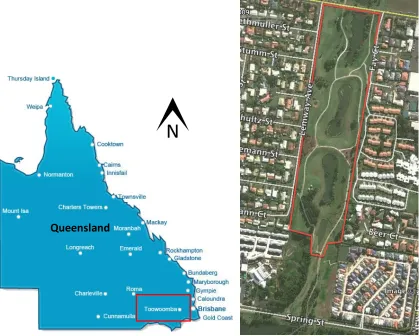
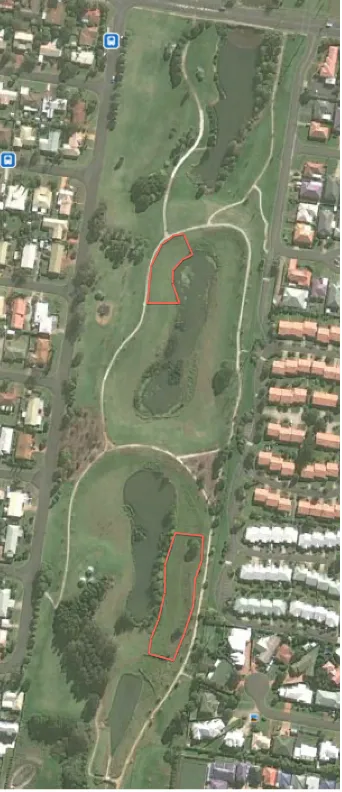
Figure 2 Study area – Toowoomba, Queensland
Figure 2 shows the study area outlined in red. It extends south from Stennar Street, bounded by Lemway Avenue to the west and Fay Court to the east, until past the fourth detention pond as shown.
3.3Data Acquisition
Two types of data were required for this research project. First, LiDAR point data was obtained to generate a high-‐resolution DEM. Second, fieldwork was undertaken to collect point data over the study area using GPS survey equipment.
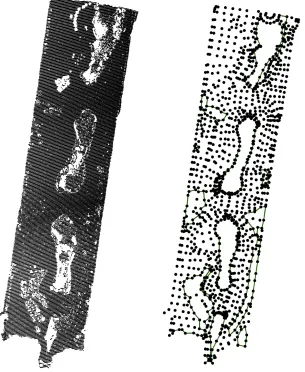
Figure 3 displays the point data acquired for both LiDAR and GPS surveys across the study area.
[image:20.595.120.539.81.417.2]
Figure 3 Data points across study area. LiDAR points are shown on the left and GPS points on the right The LiDAR data was sourced from a Toowoomba wide LiDAR survey conducted in 2010 by Schlencker Mapping Pty Ltd for Toowoomba City Council. The survey covered an area of more than 2760 square kilometres across the Toowoomba Local Government Area (Schlencker Mapping Pty Ltd, 2010). Schlencker Mapping provided the data to Toowoomba City Council in separated layers of ground and non-‐ground points. The method used to separate the point data into ground and non-‐ground is unknown. As can be seen in the above images, the density of LiDAR observations is very high – one of the characteristics of LiDAR data. The average point separation is 1m (Schlencker Mapping Pty Ltd, 2010). The data for this research was cropped from the two adjoin 1km square tiles to cover the West Creek study area.
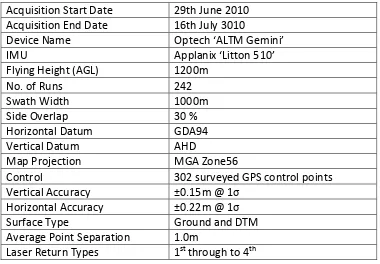
[image:21.595.180.485.85.457.2]Table 1 shows the meta-‐data of the LiDAR survey was provided by Schlencker Mapping (2010).
Acquisition Start Date 29th June 2010 Acquisition End Date 16th July 3010
Device Name Optech ‘ALTM Gemini’
IMU Applanix ‘Litton 510’
Flying Height (AGL) 1200m
No. of Runs 242
Swath Width 1000m
Side Overlap 30 %
Horizontal Datum GDA94
Vertical Datum AHD
Map Projection MGA Zone56
Control 302 surveyed GPS control points Vertical Accuracy ±0.15m @ 1σ
Horizontal Accuracy ±0.22m @ 1σ Surface Type Ground and DTM Average Point Separation 1.0m
Laser Return Types 1st through to 4th
Table 1 LiDAR meta-‐data (Schlencker Mapping Pty Ltd, 2010, p4)
Of note are the quoted horizontal and vertical accuracies of the data. The results were validated by use of a vehicle mounted GPS rover travelling over 218 kilometres of roads through the survey area, which achieved measurements to an accuracy of +/-‐.05 metres (Schlencker Mapping Pty Ltd, 2010). It is worth noting that this validation was only conducted over bitumen and gravel roads and therefore would not be a complete validation of the LiDAR data across different ground covers.
[image:22.595.137.517.130.394.2]validation of LiDAR accuracy over such terrain. It must be noted that elevation data for the water bodies was interpolated and not collected. It was considered too high a risk to enter the water bodies as a single person party undertook fieldwork and expensive equipment used was borrowed from the University of Southern Queensland. In total, 1460 data points were collected across the study area.
3.4DEM Generation
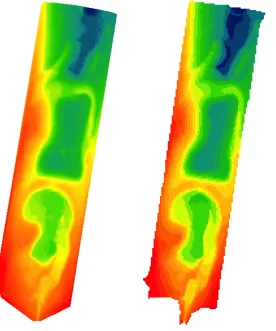
High resolution DEMs were generated for each data set using ESRI ArcMap 10.1 software. Figure 4 shows the two DEMs.
Figure 4 High resolution DEMs. LiDAR generated DEM is shown on the left and GPS generated DEM is shown on right.
As the LiDAR data was already separated into ground and non-‐ground points, the DEM was generated straight from the ground only points.
[image:23.595.195.471.282.613.2]manipulation of triangles to ensure correct surface modelling along banks, retaining walls and other hard breaklines. A high resolution DEM was then generated from this TIN surface.
3.5Validation of GPS Data Acquisition
In order for useful comparison and analysis of LiDAR generated DEM, the GPS generated DEM would need to be validated as an accurate representation of the catchment area. Validation of the GPS survey was accomplished by re-‐surveying two separate areas of the study area on the final day of data acquisition. These surveys covered an area of approximately 4125m2, and consisted of 101 points. Similar to initial GPS processing, TIN surfaces were first generated across each validation area to ensure correct three-‐dimensional surface modelling. DEMs were then generated from these TIN surfaces.
Figure 5 Site map showing approximate positions of GPS validation surveys in red. 3.6Elevation Accuracy of Airborne LiDAR Derived DEM
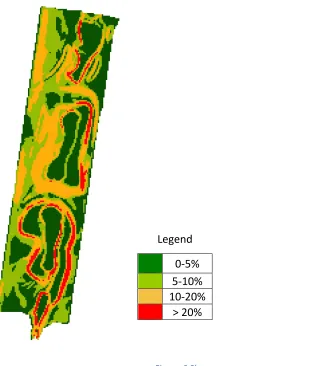
The central objective of this research project is to analyse the vertical accuracy of airborne LiDAR. This was achieved by comparison of the LiDAR generated DEM and the GPS generated DEM to determine the difference in elevation between the models. This was undertaken for the entire data set, but also for sub-‐sets of the data to determine any relationships between vertical accuracy and grade or vertical accuracy and land cover.
[image:25.595.241.412.78.474.2]allow appropriate analysis to determine the influence of grade on vertical error in the LiDAR generated DEM. To achieve this, the GPS generated DEM was copied and cropped so as to only cover the grade of interest. Elevation comparison between the cropped GPS generated DEM and LiDAR DEM was then completed. This process was then repeated for each grade class. It is expected that as grade increases, the elevation error will increase (Hodgson and Bresnahan, 2004).
Figure 6 Slope map
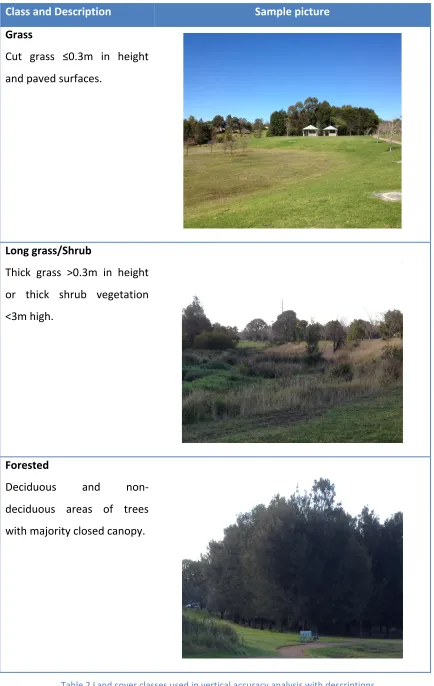
Analysis of vertical error in the LiDAR generated DEM across differing land cover was also undertaken. During GPS data collection, measurements were taken to delineate areas of trees, water bodies, cut grass (including concrete paths), and long grass and shrubs. For purposes of analysis, three land cover classes were selected; grass (including concrete paths), long grass/shrubs, and trees. Table 2 shows typical examples of these areas throughout the study area categorised into the land cover classes used for vertical accuracy analysis.
Legend
[image:26.595.132.453.224.590.2]Class and Description Sample picture
Grass
Cut grass ≤0.3m in height and paved surfaces.
Long grass/Shrub
Thick grass >0.3m in height or thick shrub vegetation <3m high.
Forested
Deciduous and non-‐ deciduous areas of trees with majority closed canopy.
[image:27.595.108.542.75.761.2]
Analysis over water bodies was not undertaken due to the absence of data collection through water bodies as stated in section 3.3. Similar to analysis over different grade classes, the GPS generated DEM was copied and cropped so as to only cover the land cover of interest. This cropped DEM was used as the base for analysis in elevation difference of LiDAR generated DEM over the area. This method was repeated for each land cover class. It is expected that there will be little difference between vertical errors across grass and tree land covers (Hodgson and Bresnahan, 2004).
In order to provide useable data on the expected vertical accuracies of LiDAR data the root mean square error (RMSE) for elevation values will be calculated for the entire study area as well as each grade and land cover class. This statistical analysis is useful in that it returns values in the units of the variable being analysed. In this way the elevation RMSE could be thought of as the expected elevation error for a LiDAR generated DEM. The formula used for RMSE calculations was as follows:
𝑅𝑀𝑆𝐸!"#$% !"#$%&'()*+#= !(!!"#$%!!!"#)!
! (1)
Where:
ZLiDAR = Elevation of LiDAR generated DEM raster cell (m)
ZGPS = Elevation of GPS generated DEM raster cell (m)
n = number of raster cells used for calculation
3.7Flood Zone Delineation
Basic floodplain mapping applications will be performed on each DEM surface in order to meet the other key objective of this research.
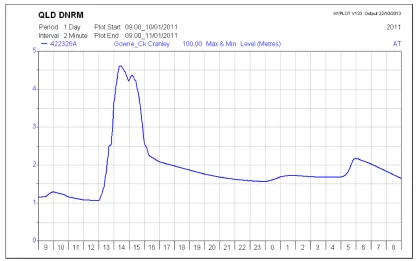
The influence of DEM errors on flood zone delineation will be determined by creation of an indicative water surface level for a flood event in the ESRI ArcMap 10.1 software package. The volumetric difference between this surface and the GPS generated DEM will be calculated using ArcMap ‘Surface Difference’ function. A polygon feature class is returned where each polygon is classified as either ‘above’, ‘below’, or ‘equal’. In this way the line at which the indicative flood water surface level is equal to the ground surface is defined as the flood zone extent. All areas where the water surface is greater than the ground surface would be classified as the flood zone. The same calculations will be repeated for the LiDAR generated DEM. Analysis of the flood zone line for each DEM and surface area of the flood zone will be undertaken to determine how flood zone location and area across the surface are influenced by any errors in the LiDAR generated DEM.
Table 3 Stream water levels (metres), Canley stream gauge, Gowrie Creek (QLD DNRM, 2012). It must be noted that the surface would most likely be an inaccurate representation of an actual flood event across the study. However, for the purpose of analysing the relationship between the different DEMs and the same water level surface, the actual value of the water surface is in some ways irrelevant, as it remains constant. Delineation of actual flood zones across the study area for a specified flood event would require much more site-‐specific information to predict a water surface for the flood event.
3.8Flood Inundation Depth and Volume
Analysis of the influence of error in LiDAR generated DEM on flood inundation depth and volume will completed. As discussed in section 2.2 flood inundation depth is a critical data set for flood plain mapping in the application of flood damage estimation. Relatively low uncertainties between 0.1 -‐0.25m can introduce large uncertainties in damage estimates (Moel and Aerts, 2010).
[image:30.595.122.538.79.340.2]calculations will be undertaken for the LiDAR generated DEM. The RMSE value will be calculated in order to analyse the expected error in flood inundation depth when using LiDAR generated DEM for flood plain mapping.
3.9Conclusion
This chapter discussed what methods would be employed to fulfil the aims of this research. The study area was identified. Data acquisition methods were discussed. Generation of DEMs and analysis methods were discussed. The methodology discussed above provides a framework for the presentation of results and discussion.
Chapter 4 – Results and Discussion
4.1Introduction
In this chapter the results of the research will be presented and discussed. Output from ESRI ArcMap of histograms and raster images will be presented and discussed in regards to:
• Elevation accuracy of GPS under the heading Validation of GPS
• Elevation accuracy of Airborne LiDAR Derived DEM
• Flood Zone Delineation
• Flood Inundation Depth and Volume
4.2Validation of GPS Data Acquisition
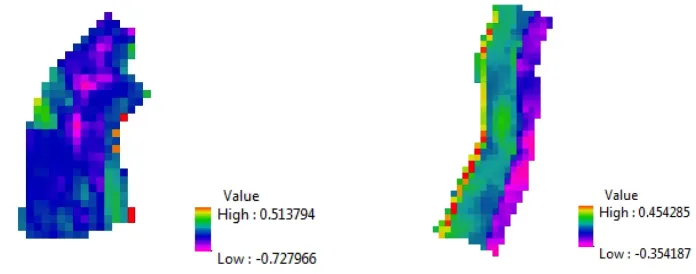
It is important to validate the original GPS survey as explained in section 3.5. To validate the elevation of the original GPS survey, the elevations of the DEMs generated from the validation surveys were each subtracted from the elevations of the DEM generated by the original GPS survey. Figure 7 shows the resultant raster images for these calculations with elevation differences in metres represented by the different colours.
Figure 7 Raster image generated by GPS generated DEM minus validation DEMs. The Northern validation survey is shown on the left and the Southern validation survey on the right.
[image:32.595.152.500.487.624.2]the validation surveys still have value in this research. Figure 8 and Figure 9 show the ArcMap output of the elevation differences between each DEM generated by the validation surveys and the DEM generated by the original survey. ArcMap was used to generate a raster image of the squared differences of the elevations across corresponding raster cells. These values were used to calculate RMSE values for the validation surveys as seen in Table 4. The RMSE values are high at 0.089m and 0.128m for the North and Southern surveys respectively, although the mean differences are more acceptable at -‐0.037m and -‐0.032m for the Northern and Southern surveys respectively.
[image:33.595.128.526.285.591.2]
Figure 9 ArcMap 10.1 output of elevation difference in metres between Southern validation survey and original GPS survey.
Survey Mean Standard
deviation
Raster cell count
(n)
Sum square
ΔV
RMSE
North -‐0.037 0.087 320 2.509 0.089 South -‐0.032 0.126 430 7.055 0.128
Table 4 Elevation errors in validation surveys in metres.
[image:34.595.127.527.78.383.2] [image:34.595.116.536.435.524.2]These lines are calculated as having continuous elevations of constant grade between the nodes. A significant vertical error is therefore generated for these situations, as the straight line of constant grade will ‘skip’ measured points from another data set along the curved retaining wall.
To demonstrate this added error source along curved retaining walls, a TIN surface for the Northern validation survey was generated excluding measured points along the curved retaining wall. A new DEM was generated from this cropped surface and analysed against the original GPS DEM across the corresponding area. Table 5 demonstrates an improvement of this cropped area in terms of vertical accuracy by removing the surface over the curved retaining wall.
Survey Mean Standard
deviation
Raster cell count (n)
Sum square
ΔV
RMSE
North -‐0.037 0.087 320 2.509 0.089 Crop
North
-‐0.032 0.056 277 1.142 0.064
Table 5 Elevation errors in validation survey in metres, with and without retaining wall.
Another error source in elevation differences between the GPS surveys is the inherent vertical errors in the equipment and processes used for data collection. The GPS was used in a rapid real time kinetic (RTK) mode taking three-‐second observations with vertical precisions of approximately 12-‐35mm. Difficulties were encountered across forested areas of the site as the GPS struggled to gain high vertical precisions and would regularly lose position fix when in these areas. Vertical precision through these areas was therefore limited.
[image:35.595.110.546.318.434.2]could be argued that there is a general shift as the mean elevation errors are both very close to -‐0.035m, however for the purposes of flood and catchment applications, and the quoted vertical errors of +/-‐0.15m of the provided LiDAR data as seen in figure 3, this shift would be negligible.
In regards to the spread of vertical differences as discussed above, it would be recommended for future studies to increase point spacing, especially across curved and steep changes of grades, to better represent the surface and create a more accurate DEM. The elevation errors across the validation surveys do present the need for higher accuracy point acquisition across the study area. This could be achieved by longer point observation times or combined use of total station survey equipment for forested areas.
4.3Elevation Accuracy of Airborne LiDAR Derived DEM
Figure 10 shows the resultant raster image produced by subtracting the elevations of the airborne LiDAR generated DEM from the elevations of the GPS generated DEM. The colours represent the calculated elevation difference in meters as shown. This visual representation shows that the majority of the study are (not including the water bodies) returned differences in height between +0.25m and -‐0.25m which is within determined accuracy requirements for flood plain mapping and catchment management of <0.5m (McDougall, et al., 2008).
Figure 10 Raster image of GPS generated DEM minus LiDAR generated DEM
Figure 11 shows the output statistics for the above raster calculation. ArcMap software was used to calculate the square elevation difference between the LiDAR generated DEM and the GPS DEM. This data was used to calculate the RMSE value of the LiDAR elevations according to equation (1). Table 6 provides a summary of these statistics. The RMSE for LiDAR elevation across the entire study area is calculated to be 0.260m. This value is higher than the quoted vertical accuracy of 0.15m in Table 1, although this is not surprising as the means of validation of the LiDAR were conducted along bitumen and gravel roads with minimal steep grades as discussed in section 3.3. We can see that the mean for the entire dataset is -‐0.159m with standard deviation of 0.226m, which confirms the deductions from the raster image discussed above. The mean elevation error and larger histogram area to the left, suggest that the LiDAR DEM elevations generally above the GPS generated DEM elevations as the calculation was ordered as GPS DEM minus LiDAR DEM. These results agree with other empirical
[image:37.595.126.429.80.461.2]studies that have been conducted to date, that suggest accuracies of 26 cm to 153 cm RMSE for large-‐scale mapping applications (Adams and Chandler, 2002; Bowen and Waltermine, 2002; Hodgson et al., 2003).
Figure 11 ArcMap 10.1 output of elevation differences in metres between entire LiDAR generated DEM and GPS generated DEM
Mean Standard
Deviation
Minimum Maximum RMSE
Total DEM -‐0.159 0.226 -‐2.156 0.994 0.260
Table 6 Elevation error (m) of LiDAR generated DEM.
[image:38.595.120.535.183.502.2] [image:38.595.135.519.553.620.2]
Figure 12 ArcMap 10.1 output for elevation differences in metres between LiDAR generated DEM and GPS generated DEM across each grade class.
Mean Standard
Deviation
Minimum Maximum RMSE
Total DEM -‐0.159 0.226 -‐2.156 0.994 0.260 Grade
Classes
0-‐5% -‐0.079 0.116 -‐1.130 0.806 0.130 5-‐10% -‐0.114 0.138 -‐2.027 0.379 0.158 10-‐20% -‐0.108 0.136 -‐1.465 0.865 0.160 > 20% -‐0.169 0.277 -‐2.235 0.709 0.309
Table 7 Elevation error (m) of LiDAR generated DEM across grade classes.
The results from elevation comparison of DEMs across the grade classes confirm previous research that one of the sources for vertical error in airborne LiDAR data is steep grades (Hodgson and Bresnahan, 2004). This relationship is apparent in Table 7
0 – 5% 5 -‐ 10%
[image:39.595.114.541.80.419.2]were we see increased mean, standard deviation and range of errors from grade class 0-‐5% to grade class >20%. There is little difference in elevation error between grades classes 5-‐10% and 10-‐20%, however the elevation errors for these two classes are larger than those in grade class 0-‐5% and smaller than those in grade class >20%. So while the relationship of increasing grade equalling increasing elevation error for airborne LiDAR data is not apparent across grades 5-‐20%, it is evident for grades 0-‐ >20%.
In addition, the above calculations were repeated for the different land cover classes. Figure 13 shows the statistical output for the calculation of LiDAR generated DEM minus GPS generated DEM for each land class. Table 8 summarises these results.
Figure 13 ArcMap 10.1 output for elevation differences in metres between LiDAR generated DEM and
GPS generated DEM across each land cover class.
Cut grass Long grass/shrubs
[image:40.595.111.536.316.646.2]Mean Standard Deviation
Minimum Maximum RMSE
Total DEM -‐0.159 0.226 -‐2.156 0.994 0.260
Land Cover
Cut grass -‐0.080 0.096 -‐1.190 0.421 0.113 Long
grass/shrubs -‐0.161 0.238 -‐1.860 0.961 0.273 Forested -‐0.116 0.143 -‐0.904 0.796 0.178
Table 8 Elevation error (m) of LiDAR generated DEM across land cover classes.
These results show that airborne LiDAR data will return elevation data of best accuracy across areas of cut grass and pavement with an RMSE of 0.113m, under half of the RMSE for the entire study area. The elevation RMSE was also low across forested land covers at 0.178m in comparison to elevation errors of the entire site. These results confirm by past research that shows errors over flat surfaces, even forested ones, are very low compared to other sources of digital elevation data such as photogrammetry (Hodgson and Bresnahan, 2004). These results reflect the characteristics of forested areas of the site. Forested areas consisted of tall trees with closed to majority-‐closed canopies with little to no other ground cover in the form of long grass or shrubs. This allows any LiDAR signals that penetrate the canopy acquire a bare earth elevation with ease. Across forested areas the difference between ground and no-‐ground points would be large as most trees were in a height range of 5-‐15m. This situation would allow for accurate filtering of non-‐ground points from the data set when compared to land covers of dense undergrowth close to the bare earth surface. These land cover types best represent the vertical accuracy of the provided airborne LiDAR data as quoted in Table 1.
[image:41.595.118.533.79.259.2]the entire study area elevation RMSE of 0.260m. These larger elevation errors would be expected, as penetration of such homogenous thick land cover by airborne LiDAR scanners would be difficult. Separation of ground and non ground points would prove to be a further source of error over these land covers as the elevation difference between the bare earth and the top of the grass or shrub would not be as extreme as those differences in forested areas. These inaccuracies have been evident in other studies that returned greatest elevation errors over homogenous meadows with high grass and shrubs (Hollaus, et al. 2005).
4.4Flood Zone Delineation
Flood zones were calculated for each DEM surface for flood surfaces of 3.5 metres and 4.5 metres above the invert levels of each detention basin across the study area. Figure 14 is an output polygon map from ArcMap depicting areas where the 4.5 metre flood surface is above the ground surface (blue polygon) and areas where the 4.5 metre flood surface is below the ground surface (green polygon). Areas where the flood surface is above the ground surface are classified as the flood zone for this indicative flood event. Figure 15 displays the flood zone delineation for the 4.5 metre flood surface overlaid onto the GPS generated TIN surface. The area of the flood zone for the GPS generated DEM was calculated and compared to the surface area of the flood zone for the LiDAR generated DEM. Table 9 shows these areas.
[image:43.595.198.468.81.431.2]
Figure 15 Flood zone delineation produced from GPS DEM and LiDAR DEM for 4.5 metre flood level. Analysis of Figure 15 is limited as the flood surface exceeded the elevations at the northern and southern limits of the ground surfaces as well as majority of the eastern limit and section of the western limit. This is evident in the straight lines of the flood zones along these edges of the study area where the flood zones generated from each DEM are shown as equal. These areas should not be considered the flood zone, as the flood zone would in fact continue past the edges of the study area until reaching higher ground. To provide a complete flood zone for this section of the catchment, two options are available. Firstly, increase size of study area in an easterly and westerly direction to acquire data until the ground surface is above the flood surface level. Secondly, reduce the elevation of the flood surface level to ensure that it will be lower than the extent of the existing ground surface models. This first option would be most desirable so as to increase the study area for more accurate analysis and to maintain a fairly realistic estimate of the flood surface. However, due to time and resource
4.5m flood level.
Flood zone by GPS DEM
[image:44.595.176.483.98.436.2]flood water level of 3 metres above the invert of the detention basins was tested, however the area of the flood zone was significantly reduced due to the embankments separating the detentions being higher than the flood water level. While there are areas downstream of the embankments that are still under the flood water level surface, any areas not connected to upstream areas would not actually be reachable by upstream flood waters due to intervening embankments. Disappointingly, the 3 metre flood water level still reached limits along the western boundary of the study area. Selection of the 3.5 metre flood water level was therefore selected to ensure continuity of flood zone through study area, and even though sections were limited along borders of the study area, as seen in Figure 17, the result is an improvement on the 4.5 metre flood water level.
Similar analysis to the 4.5 metre flood water level was conducted for the 3.5 metre flood water level Figure 16 is an output polygon map from ArcMap depicting areas where the 3.5 metre flood surface is above the ground surface (blue polygon) and areas where the 3.5 metre flood surface is below the ground surface (green polygon). Figure 17 displays the flood zone delineation for the 3.5 metre flood surface overlaid onto the GPS generated TIN surface, as computed by the extent of area where the flood surface is above the ground surface. The area of the flood zone for the GPS generated DEM was calculated and compared to the surface area of the flood zone for the LiDAR generated DEM. Table 9 shows these areas.
DEM source
Flood Level (m)
Flood zone
surface area (m2)
Flood zone surface
difference (m2)
Percentage underestimate
d
GPS 4.5 69339.8
LiDAR 4.5 68204.6 1135.2 1.64%
GPS 3.5 60105.2
LiDAR 3.5 57883.6 2221.6 3.7%
[image:45.595.106.549.537.697.2]
Figure 16 Surface differences for 3.5m flood level. GPS is shown on left and LiDAR on right. The flood zone surface area calculated for the GPS generated DEM is 2,221.6m2 larger than the flood zone surface area calculated for the LiDAR generated DEM. As the flood surface was held as constant for the calculations, this decreased flood zone area for the LiDAR generated DEM indicates that the LiDAR generated DEM is generally higher in elevation than the GPS generated DEM. In percentage terms, the LiDAR generated DEM under-‐estimates the flood zone area by approximately 3.7%.
[image:46.595.182.463.82.428.2]
Figure 17 Flood zone delineation produced from GPS DEM and LiDAR DEM for each flood level. 4.5Flood Inundation Depth and Volume
Flood inundation depth and volume analysis was successfully completed by generating raster surfaces of flood inundation depths across flood zones for flood surface levels of 4.5 m and 3.5 m for GPS generated DEM and LiDAR generated DEM.
Table 10 summarises differences of inundation depth for each DEM. As is shown the maximum inundation depth calculated against the LiDAR generated DEM is 0.477 m shallower than the maximum inundation depth calculated against the GPS generated DEM. All inundation differences have been used to calculate the RMSE value for inundation depth. Table 10 shows that this expected inundation depth error value to be 0.264 m. In regards to estimation of flood damages previous studies (Moel and Aerts, 2010) have shown that this level of uncertainty can equate to lowest damage estimates up to 5-‐6 times lower than the highest estimates.
3.5m flood level.
Flood zone by GPS DEM
[image:47.595.166.478.91.435.2]
Figure 18 Raster images of flood inundation depths for 4.5m water level. GPS is shown on left and LiDAR on right.
[image:48.595.147.496.81.382.2] [image:48.595.142.501.423.730.2]
![Figure
1
Flooded
Toowoomba
CBD
[Source:
Sydney
Morning
Herald]](https://thumb-us.123doks.com/thumbv2/123dok_us/152835.29979/11.595.115.539.302.587/figure-flooded-toowoomba-cbd-source-sydney-morning-herald.webp)