0022-538X/10/$12.00 doi:10.1128/JVI.01532-09
Copyright © 2010, American Society for Microbiology. All Rights Reserved.
A Single Amino Acid Substitution in HIV-1 Reverse Transcriptase
Significantly Reduces Virion Release
䌤
Chien-Cheng Chiang, Shiu-Mei Wang, Yen-Yu Pan, Kuo-Jung Huang, and Chin-Tien Wang*
Department of Medical Research and Education, Taipei Veterans General Hospital, and Institute of Clinical Medicine, National Yang-Ming University School of Medicine, Taipei, Taiwan
Received 23 July 2009/Accepted 27 October 2009
HIV-1 protease (PR) mediates the proteolytic processing of virus particles during or after virus budding. PR activation is thought to be triggered by appropriate Gag-Pol/Gag-Pol interaction; factors affecting this inter-action either enhance or reduce PR-mediated cleavage efficiency, resulting in markedly reduced virion pro-duction or the release of inadequately processed virions. We previously showed that a Gag-Pol deletion mutation involving the reverse transcriptase tryptophan (Trp) repeat motif markedly impairs PR-mediated virus maturation and that an alanine substitution at W401 (W401A) or at both W401 and W402 (W401A/ W402A) partially or almost completely negates the enhancement effect of efavirenz (a nonnucleoside reverse transcriptase inhibitor) on PR-mediated virus processing efficiency. These data suggest that the Trp repeat motif may contribute to the PR activation process. Here we demonstrate that due to enhanced Gag cleavage efficiency, W402 alanine or leucine substitution significantly reduces virus production. However, W402 replace-ment with phenylalanine does not significantly affect virus particle assembly or processing, but it does markedly impair viral infectivity in a single-cycle infection assay. Our results demonstrate that a single amino acid substitution at HIV-1 RT can radically affect virus assembly by enhancing Gag cleavage efficiency, suggesting that in addition to contributing to RT biological function during the early stages of virus replication, the HIV-1 RT tryptophan repeat motif in a Gag-Pol context may play an important role in suppressing the premature activation of PR during late-stage virus replication.
In the late stage of human immunodeficiency virus type 1
(HIV-1) replication, thousands of viral capsid precursor (Pr55gag)
molecules assemble into virus particles and bud out from the plasma membrane (42). During or soon after virus budding,
Pr55gagis cleaved by viral protease (PR) into four major
prod-ucts: matrix (MA) (p17), capsid (CA) (p24), nucleocapsid (NC) (p7), and the C-terminal p6 domain (42). PR is encoded
bypol, which is initially translated as the polyprotein precursor
Pr160gag-pol. It is generally believed that Pr160gag-pol is
incor-porated into assembling virions via interaction with Pr55gag
through its N-terminal Gag determinants (10, 11, 19, 22, 40, 41). However, some researchers have demonstrated that HIV-1 and murine leukemia virus (MLV) Pol can be packaged into virions at a reasonable efficiency despite an absence of Gag-Pol
formation (3, 7). The proteolytic processing of Pr160gag-pol
gives rise to PR, reverse transcriptase (RT), and integrase (IN) in addition to Gag cleavage products. Blocking PR activity does not significantly affect virus particle assembly and release, but it does eliminate viral infectivity (17, 27, 36).
The reading frame of HIV-1 polpartially overlaps that of
gag. During Gag translation, a⫺1 ribosomal frameshift event
occurs at a frequency of 5%, resulting in an approximately 1:20
expression level of Pr160gag-pol to Pr55gag (24). An artificial
overexpression of Pr160gag-polor PR-containing chimeric
pro-teins results in a significant reduction in virion release,
pre-sumably due to the premature cleavage of Pr55gagas mediated
by PR (1, 20, 28, 35, 38, 39, 48). Accordingly, both the PR expression level and PR activation timing with respect to the proteolytic processing of Gag and Gag-Pol are critical to virus assembly. The molecular mechanism behind PR activation is
not entirely clear. It is generally accepted that Pr160gag-pol
di-merization or multidi-merization triggers PR activation, and there-fore, sequences upstream or downstream of PR may affect PR-mediated virus maturation by interfering with Gag-Pol multimerization. Consistent with this suggestion, deletions of sequences upstream of PR (11, 52) or mutations in
down-streampolsequences can significantly affect PR-directed virus
particle maturation (4, 30, 37).
Biologically active RT is assumed to be present in the form of a p66/p51 heterodimer (12, 31). A hydrophobic cluster con-sisting of six tryptophan (Trp) residues has been identified in the connection subdomain of the HIV-1 RT subunit (codons 398 to 414). This Trp repeat motif is highly conserved among primate lentiviral reverse transcriptases (2). It has been shown that substitution mutations of HIV-1 RT Trp repeat motif residues can markedly impair RT dimerization in vitro (33, 44), suggesting a motif role in RT-RT interactions. Although the extent to which the RT domain contributes to Gag-Pol mul-timerization is unknown, some data support the idea that the RT sequence (the Trp repeat motif in particular) may affect PR activation by favoring Gag-Pol multimerization. First, RT truncation mutations involving the Trp repeat motif signifi-cantly impair PR-mediated Gag processing (30). Second, efa-virenz (EFV)—a nonnucleoside reverse transcriptase inhibitor (NNRTI) that greatly enhances HIV-1 RT dimerization in vitro (46, 47)—is capable of suppressing virion production by enhancing the efficiency of PR-mediated Gag and Gag-Pol cleavage (14, 45). However, a W401A alanine substitution
mu-* Corresponding author. Mailing address: Department of Medical Research and Education, Taipei Veterans General Hospital, 201, Sec. 2, Shih-Pai Road, Taipei 11217, Taiwan. Phone: 886-2-28712121, ext. 2655. Fax: 886-2-28742279. E-mail: [email protected].
䌤Published ahead of print on 4 November 2009.
976
on November 8, 2019 by guest
http://jvi.asm.org/
tation that abrogates RT dimerization in vitro (49) almost completely negates the EFV inhibitory effect on virion produc-tion (9). The lack of W401A susceptibility to this inhibitory effect is most likely due to a defect in Gag-Pol/Gag-Pol inter-action that impedes the EFV enhancement of Gag-Pol mul-timerization and consequently nullifies the EFV enhancement of Gag processing.
Based on our previous finding that a W401A-imposed lack of susceptibility to the EFV enhancement effect on Gag pro-cessing is partially mitigated by an additional W402 alanine substitution, the W402 mutation may affect the Gag-Pol mul-timerization required for effective PR activation (9). Here we demonstrate that an alanine or leucine substitution for W402 results in enhanced Gag processing efficiency, which is associ-ated with a dramatic reduction in the released-virion level.
MATERIALS AND METHODS
Plasmid construction.The parental HIV-1 proviral plasmid used in this study was derived from HXB2. RT mutations were generated by PCR-based overlap extension mutagenesis using HIVgpt as a template. RT W401A and W401A/ W402A mutants were as described previously (9). Primers (forward) for engi-neering the W402A, W402L, and W402F mutations were 5⬘-GAAACATGGG AAACCTGGGCCACAGAGTAT-3⬘, 5⬘-GAAACATGGGAAACATGGTTA ACAGAGTAT-3⬘, and 5⬘-GAAACATGGGAAACATGGTTCACCGAGTAT-3⬘, respectively. The reverse primer was 5⬘-GAAATTGGATCCATTGGCAGT ATGTATTG-3⬘. Resulting amplicons served as primers for a second PCR round using either the forward primer 5⬘-AATGATGCAGAGAGGCAAT-3⬘or 5⬘-G GATTAGATATCAGTACAATG-3 or the reverse primer 5⬘-GAAATTGGAT CCATTGGCAGTATGTATTG-3⬘. Amplified DNA fragments were digested with a combination of EcoRV and BsrGI and ligated into HIVgpt. The following constructs have all been described in detail in previous reports: HIV-1 RT mutants (W401A and W401A/W402A) (9); Pol-truncated mutants containing inserted stop codons at the designated IN or RT residue positions (RN198, R560, R515, and R425); plasmids expressing the RT subunits p66 and p51, containing hemagglutinin (HA) tags at the N terminus (9, 29, 30); and the HIV-1 PR-inactivated mutant HIVgpt D25 (11, 48).
Cell culture, transfection, and infection. 293T cells and HeLa cells were maintained in Dulbecco’s modified Eagle medium supplemented with 10% fetal calf serum. Confluent 293T cells were trypsinized, split 1:10, and seeded onto 10-cm dish plates 24 h before transfection. For each construct, 293T cells were transfected with 20g of plasmid DNA by the calcium phosphate precipitation method; 50m chloroquine was added to enhance transfection efficiency. For infection, 10g of wild-type (wt) or mutant HIVgpt was cotransfected with 5g of the vesicular stomatitis virus G (VSV-G) protein expression vector pHCMV-G (5). HeLa cell infection and drug-resistant colony selection were per-formed as previously described (8). Numbers of drug-resistant colonies were converted into titers (CFU/ml). Infectivity was expressed as the ratio of the mutant titer to the wt titer in parallel experiments.
Western immunoblot analysis.Culture medium from transfected 293T cells was filtered through 0.45-m-pore-size filters, followed by centrifugation through 2 ml of 20% sucrose in TSE (10 mM Tris-HCl, pH 7.5, 100 mM NaCl, 1 mM EDTA) containing 0.1 mM phenylmethylsulfonyl fluoride (PMSF) at 4°C for 40 min at 274,000⫻g(SW41 rotor at 40,000 rpm). Viral pellets and cell lysates mixed with sample buffer were subjected to SDS-10% PAGE, followed by im-munoblotting analysis as previously described (9). HIV Gag protein detection was performed using an anti-p24gag (mouse hybridoma clone 183-H12-5C) monoclonal antibody. Cellular-actin was detected using a mouse anti--actin monoclonal antibody (Sigma). Primary antibodies for HIV-1 RT or HA-tagged RT detection were rabbit antiserum, mouse anti-RT (13, 21), or anti-HA (Sigma). Rabbit antiserum served as the primary antibody for HIV-1 IN detection (18); the secondary antibody was either a rabbit antimouse or donkey antirabbit horseradish peroxidase (HRP)-conjugated antibody. The manufacturer’s proto-cols were followed for HRP activity detection (PerkinElmer).
In vitro RT assay. The procedure used for this study has been described previously (11). Briefly, transfected 293T cell culture supernatant was harvested, filtered, and pelleted as described for our Western immunoblot analysis. After serially diluting viral pellets suspended in TSE, 10l of diluted sample was mixed with 40l of reaction cocktail (11). Reaction mixtures were precipitated with ice-cold 10% trichloroacetic acid and filtered through Whatman CF/C filter
papers. After washing and drying, RT activity was determined using a Beckman scintillation counter.
Coimmunoprecipitation assay. 293T cells transfected with the HA-tagged and/or Myc-tagged p66RT expression vector were collected and subjected to immunoprecipitation analysis as previously described (9). Immunoprecipitate-associated agarose beads were pelleted, washed three times with RIPA buffer, washed two times with phosphate-buffered saline (PBS), eluted with 1⫻sample buffer with 5%-mercaptoethanol, boiled for 5 min, and subjected to SDS-10% PAGE as described above.
RESULTS AND DISCUSSION
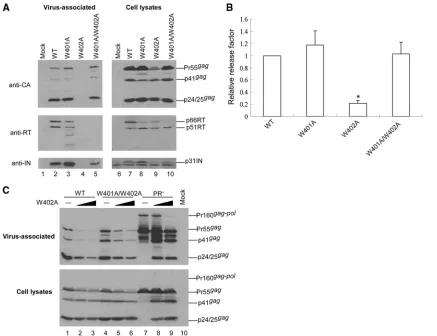
W402A mutant is severely assembly defective and cantrans -dominantly inhibit virion production.To determine whether an alanine substitution of RT codon W402 results in a pheno-type that differs from those resulting from the alanine substi-tution mutations W401A and W401A/W402A, a constructed W402A mutant and the two other alanine substitution mutants were transiently expressed in 293T cells and analyzed by West-ern immunoblotting. To our surprise, the W402A transfectants expressed readily detectable Gag but produced barely detect-able virus-associated Gag, suggesting a severe defect in virus assembly or release (Fig. 1A, lane 4, and 1B). Similar results were observed across several repeated, independent experi-ments. In contrast, both W401A and W401A/W402A transfec-tants produced virus particles at approximately the wt level and displayed partially degraded or barely detectable virus-associ-ated RT (Fig. 1A, lanes 3 and 5), which is consistent with previously reported results (9, 49). Intracellular Gag and RT were readily detected for the W402A mutant, indicating that it had no major impact on Gag and Gag-Pol expression. Notably,
the W402A mutant showed a relatively low cellular Pr55gag/
p24gagratio compared to the wt and other mutants (Fig. 1A,
upper panel, lanes 7 to 10), implying that the
W402A-associ-ated virion production defect may be due to enhanced Pr55gag
cleavage efficiency.
To test whether the W402A mutant can affect virion
pro-duction by wt or assembly-competent mutants in trans, we
coexpressed it with the wt, the W401A/W402A mutant, or an
HIV-1 protease-defective (PR⫺) mutant and observed that
virus-associated p24gag was readily detected when PR⫺ was
coexpressed with the W402A mutant (Fig. 1C, lane 7 versus lanes 8 to 9). Virus yields from the wt or mutants were signif-icantly reduced by the W402A mutant in a dose-dependent manner (Fig. 1C, upper panel), with a noticeable decrease in
the cellular Pr55gag/p24gagratio (Fig. 1C, lower panel). These
data suggest that the W402A mutant can provide functional
PR to mediate Gag cleavage intransand provide support for
the assumption that the W402A-incurred virion assembly de-fect is primarily due to enhanced Gag cleavage efficiency.
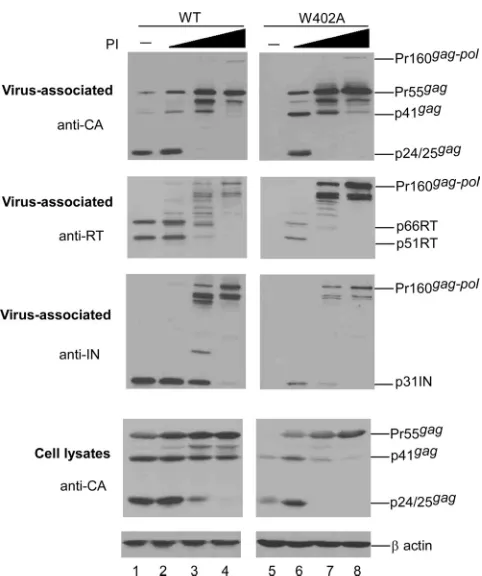
W402A virus assembly defect is PR activity dependent. To determine if the W402A virus assembly defect is directly asso-ciated with viral protease activity, we treated W402A transfec-tants with an HIV-1 PR inhibitor (PI). As expected,
virus-associated W402A Gag (Pr55gag, p41gag, and mature p24gag)
andpol-derived products (IN, RT subunits p66/p51, and
RT-associated precursors, such as Pr160gag-pol) that were
previ-ously undetectable or barely detectable became readily detect-able when PI concentrations were gradually increased (Fig. 2, lanes 5 to 8). Similar results were observed in repeat indepen-dent experiments. These data support the assumption that the
VOL. 84, 2010 HIV-1 RT MUTATION REDUCES VIRION RELEASE 977
on November 8, 2019 by guest
http://jvi.asm.org/
W402A virus assembly defect is dependent on PR activity. Additional verification is the observation that the introduction
of a PR-defective mutation (PR⫺) into the W402A mutant
restored virus production to a level comparable to that of the
PR⫺ mutant, with expressed Pr55gag and Pr160gag-pol levels
comparable to those of the PR⫺mutant (data not shown).
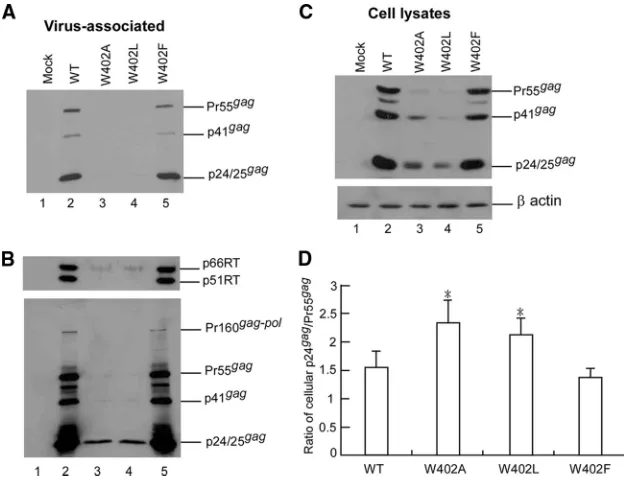
We then tested the idea that replacement of W402 with an-other amino acid residue (in this case Leu or Phe) can produce a phenotype similar to that of the W402A mutant. The result-ing mutants (designated W402L and W402F) were transiently expressed in 293T cells. We also determined that the W402L mutant phenotype was similar to that of W402A, with virus-associated Gag and RT barely detectable in transfectant su-pernatant samples (Fig. 3A and B, lanes 3 and 4). Similar to the case with the W402A mutant, the effect of an HIV-1 PR inhibitor on PR activity resulted in substantial amounts of
virus-associated Gag and Gag-Pol being released from W402L transfectants (data not shown).
In contrast, the W402F mutant exhibited a Gag processing profile similar to that of the wt and a virus-associated Gag level comparable to that of the wt (Fig. 3B, lane 5). This suggests that an aromatic residue at RT codon 402 plays an important role in preventing premature Gag cleavage. We found that both W402A and W402L mutants (hereafter referred to as W402A/L) had relatively low levels of cellular Gag, presumably due (at least in part) to enhanced proteolysis mediated by PR.
In addition, we consistently noted that the p24gag/Pr55gagratios
of W402A/L mutants were significantly higher than those dis-played by the wt and the W402F mutant (Fig. 3D), thus sup-porting our proposal that the W402A/L mutations triggered enhanced PR-mediated Gag cleavage. Reduced virion release as a result of PR-mediated Gag cleavage has also been
ob-FIG. 1. Effects of W402A mutation on virus assembly and processing. (A) 293T cells were transfected with wild-type (WT) or HIVgpt plasmids carrying one of the following RT substitution mutations: W401A, W402A, or W401A/W402A. After 48 h, cells and culture supernatant were collected and prepared for Western immunoblot analysis. Cells (4% of the total sample) and viral pellets (50% of the total sample) were fractionated by 10% SDS-PAGE and electroblotted onto nitrocellulose filters. HIV-1 Gag proteins were probed with an anti-p24CA monoclonal antibody. RT and IN were detected with anti-RT and anti-IN serum. (B) Relative levels of virus particle production. Virus-associated Gag proteins were quantified by scanning mutant and wild-type p24gag-associated band densities from immunoblots as shown in panel A. The total arbitrary
densitometer units of each mutant were normalized to that of the wild type in parallel experiments. Values of the ratios indicate the relative levels of virus particles released. Error bars indicate standard deviation. *, P ⬍ 0.05. (C) 293T cells were transfected with 10 g of wild-type, W401A/W402A, or PR-inactivated (PR⫺) HIVgpt plasmid alone (lanes 1, 4, and 7, respectively) or together with 5g (lanes 2, 5, and 8) or 10 g (lanes 3, 6, and 9) of W402A plasmid DNA. For each transfection, plasmid DNA amounts were maintained at 20g with the addition of pBlueScript SK. At 48 h posttransfection, cells and culture supernatant were collected and subjected to Western immunoblot analysis as described above. Positions of Pr160gag-pol, RT p66 and p51 subunits, Pr55gag, p41gag, and p24gagare indicated.
on November 8, 2019 by guest
http://jvi.asm.org/
[image:3.585.79.516.67.403.2]served in HIV-1 NC deletion mutants, in which the slower NC mutant assembly process allows PR to cleave Gag molecules prior to virion assembly and budding (34). Additional experi-ments using a reticulocyte translation system may help to clar-ify the molecular mechanism behind premature PR activation in our RT mutants (28).
Past studies have confirmed that most amino acid substitu-tion mutasubstitu-tions in RT do not significantly impact PR-mediated Gag cleavage, regardless of whether or not they affect RT dimerization. Substitution mutations at the RT primer grip residues L234, W239, and W229 (6, 16, 25, 43, 50) or at the tryptophan repeat motif residues W401 and W414 (44) that abrogate RT dimerization in vitro are not associated with im-paired Gag processing and/or virion production, even though the L234D and W239A mutants are both deficient in virus-associated RT—presumably due (at least in part) to premature Gag-Pol cleavage (25, 49, 51). Furthermore, substitution mu-tations at HIV-1 RT G191 that are capable of facilitating RT dimerization in vitro (15) have no significant impact on virus particle assembly and release (23). It is therefore very surpris-ing to find that the W402A/L mutation enhances Gag cleavage
efficiency and dramatically reduces virion production. Accord-ing to Tachedjian et al., leucine substitutions in the conserved Trp repeat motif residues W398, W402, Y405, and W410 have no significant effect on RT dimerization (yeast two-hybrid sys-tem and in vitro binding assays) (44). The results of our coim-munoprecipitation experiments suggest that the W402A muta-tion does not significantly affect p66RT self-interacmuta-tion (data not shown). Further work is required to determine if substitu-tion mutasubstitu-tions at W398, Y405, or W410 result in a phenotype similar to that of the W402A/L mutation.
Mutations at W402 significantly impair viral infectivity. Al-though W402F had a virus-associated p66/51RT level compa-rable to that of the wt and exhibited in vitro RT polymerase activity at a level near that of the wt (Fig. 4), according to results from a single-cycle infection assay, its infectivity was reduced 5-fold compared to that of the wt (Table 1). This suggests that the W402F mutation significantly impairs RT biological function during viral replication even though it does not exert any major effects on RT polymerase activity in vitro. In contrast, the very low levels of RT activity demonstrated by the W401A, W402A, and W402L mutants are compatible with their severely impaired infectivity. The relatively low level of virus-associated RT activity for W402A/L may be due in part to a Gag-Pol package defect as a result of premature Gag-Pol cleavage by PR. Consistent with this idea, relatively lower levels of p66/51RT subunits were found in W402A virions than in wt virions when PR activity was partially inhibited (Fig. 2, lane 6 versus lane 2).
W402A mutation significantly impairs Gag processing fol-lowing a deletion in the RNase H subdomain.Given that the W402A enhancement effect on Gag processing is mediated by influencing Gag-Pol/Gag-Pol interaction, additional
C-termi-nal deletions in thepolsequence may incur a conformational
Gag-Pol change and disrupt Gag-Pol/Gag-Pol interaction, thereby mitigating the W402A enhancement effect on Gag processing. We found that virion production for the assembly-competent Gag-Pol-truncated mutants RN198, R560, R515, and R425 (Fig. 5A and 5B, lanes 1 to 5) (30) was markedly reduced following the introduction of the W402A mutation (Fig. 5B, lanes 6 to 10). The one exception was R515/W402A (lane 9), which demonstrated readily detectable virus-associated Gag.
Pr55gag and p41gag were identified as major species in both
supernatant and cell samples (lane 4 versus lane 9). Our find-ing of impaired Gag cleavage accompanied by improved virus production is consistent with our hypothesis that the inhibitory effect of W402A on virion production is primarily due to en-hanced Gag cleavage efficiency. The virus assembly defect characteristic of RN198/W402A, R560/W402A, and R425/ W402A is also dependent on PR activity, since virus-associated Gag and Gag-Pol become readily detectable in the supernatant following treatment with a PR inhibitor (data not shown).
[image:4.585.43.284.64.352.2]The W402A/L mutation may exert its virus assembly inhib-itory effect in a fashion similar to that following EFV treatment (14)—that is, by triggering premature PR activity via Gag-Pol multimerization enhancement. However, at this point it is dif-ficult to determine whether EFV or the W402A/L mutation enhances Pol multimerization efficiency, given that Gag-Pol multimerization largely depends on the N-terminal Gag domain and that most RT deletion mutations have no detect-able effects on Gag-Pol multimerization (30). Together, the
FIG. 2. The W402A assembly defect is HIV-1 protease activity dependent. 293T cells were transfected with wt or mutant HIVgpt plasmids. At 4 h posttransfection, cells were replated on four dish plates and either left untreated (lanes 1 and 5) or treated with the HIV-1 protease inhibitor (PI) Ro31-8959 at a concentration of 0.01 (lanes 2 and 6), 0.1 (lanes 3 and 7), or 1.0M (lanes 4 and 8). At 48 to 72 h posttransfection, cells and culture supernatant were collected, prepared, and subjected to Western immunoblot analysis. Equivalent amounts of supernatant samples were probed with anti-CA, anti-RT, or anti-IN antiserum (upper three panels). To give optimal results for viewing p66/p51 RT subunits, blots were exposed for different lengths of time. Positions of Pr160gag-pol, p66/p51 RT subunits, IN, Pr55gag,
p41gag, and p24gagare indicated.
VOL. 84, 2010 HIV-1 RT MUTATION REDUCES VIRION RELEASE 979
on November 8, 2019 by guest
http://jvi.asm.org/
observations that (i) EFV significantly reduced R515 virion production by enhancing Gag processing (data not shown) and (ii) the W402A mutation markedly impaired R515 Gag pro-cessing (Fig. 5) suggest that W402A triggers PR activation in a manner that is similar but not identical to that of EFV. It appears that the maintenance of an appropriate Gag-Pol
con-FIG. 3. Effects of W402 substitution mutations on virus assembly and processing. (A to C) 293T cells were transfected with wt or mutant HIVgpt plasmids carrying one of the following RT substitution mutations: W402A, W402L, or W402F. At 48 to 72 h posttransfection, cells and culture supernatant were collected and subjected to Western immunoblot analysis. HIV-1 Gag proteins were probed with an anti-p24CA monoclonal antibody. RT was detected with anti-RT serum. Indicated are positions of Pr160gag-pol, RT p66 and p51 subunits, Pr55gag, p41gag, and
p24gag. The lower blot in panel B was derived from the panel A blot by extending the exposure. (D) Effects of the W402A and W402L mutations
on Gag processing efficiency. Cellular Pr55gagand p24gaglevels were quantified by scanning Pr55gagand p24gagband densities from immunoblots.
[image:5.585.135.447.68.307.2]Ratios of p24gagto p55gagwere determined for the wt and each mutant. Bars indicate standard deviations.ⴱ,P⬍0.05.
[image:5.585.301.538.439.612.2]FIG. 4. Relative reverse transcriptase activity levels of HIV-1 RT mutants. 293T cells were transfected with the indicated plasmid. The W401A/W402A double mutant, recognized as being severely defective in terms of RT activity (9), served as a control. At 48 to 72 h post-transfection, supernatant was collected, pelleted, and resuspended in PBS buffer. Equivalent aliquots were subjected to in vitro RT assays and Western immunoblot analyses. Ratios of RT activity to Gag pro-tein levels obtained via immunoblot band density quantification were determined for each mutant and normalized to those of the wt. Values for each construct were derived from at least three independent ex-periments. Error bars indicate standard deviations.
TABLE 1. Infectivities of HIV-1 RT mutantsa
Mutation
Titer (CFU/ml) Infectivityc
(%)
Mean infectivityc ⫾SD Mutant Wild typeb
W401A 392 10,980 3
590 8,400 6
940 12,320 7 5.3⫾2.0
W402A 48 10,980 3
58 8,400 5
280 12,320 10 6.0⫾3.6
W402L 224 10,980 15
278 8,400 24
652 12,320 13 17.3⫾5.8
W402F 432 10,980 20
452 8,400 27
272 12,320 11 19.3⫾8.0
a
293T cells were transfected with the indicated plasmid plus a VSV-G expression vector. At 48 to 72 h posttransfection, approximately 50% of the collected supernatant was subjected to Western immunoblot analysis. The remaining supernatants were ali-quoted and used to infect HeLa cells. Supernatant amounts used for infections: wt and W402F mutant, 50l; W401A, W402A, and W402L mutants, 1 ml. Infection and selection of drug-resistant colonies were performed as described in Materials and Meth-ods. Drug-resistant colonies were converted to titers (CFU/ml). No drug-resistant colo-nies were detected in the absence of VSV-G coexpression (data not shown).
b
Wild-type (HIVgpt) titers were determined in parallel experiments. Exper-iments were performed in triplicate.
c
Ratios of viral titers to Gag protein levels (obtained via immunoblot band density quantification) were determined for each mutant and normalized to those of the wt in parallel experiments. Mean and standard deviation values for viral infectivity are indicated.
on November 8, 2019 by guest
http://jvi.asm.org/
[image:5.585.43.281.482.624.2]formation is critical to the ability of W402A to trigger prema-ture PR activation.
The roles of tryptophan and proline residues in protein-protein interactions have been well documented (26, 32). It is speculated that the large hydrophobic residue Trp (especially its aromatic side chain) may play a stabilizing role in Gag-Pol conformation and thus prevent accelerated Gag-Pol multi-merization. Gag-Pol conformation instability as incurred by W402A/L virus may propel or accelerate Gag-Pol multimer-ization, resulting in premature PR activation. This may explain, at least in part, why a Phe substitution at W402 (which also contains an aromatic side chain) has no measurable effect on virus processing and assembly.
In conclusion, our results indicate that the HIV-1 RT W402 codon in the Gag-Pol context may play a crucial role in pre-venting PR from premature activation by stabilizing the Gag-Pol conformation during Gag-Gag-Pol/Gag-Gag-Pol interaction. A log-ical next step is to test whether the inhibition of virion production by a single amino acid substitution in the Trp re-peat motif residue is also applicable to other primate
lentivi-ruses. Our results point to a potential HIV-1 RT Trp repeat motif target in HIV/AIDS therapeutic interventions.
ACKNOWLEDGMENTS
We thank the following from the National Institutes of Health AIDS Research and Reference Reagent Program for their assistance in ob-taining reagents: anti-RT monoclonal antibody (MAb21), Stephen Hughes; antiserum to HIV-1 RT, Stuart Le Grice; and antiserum to HIV-1 IN, Duane Grandgenett.
This work was supported by grant NSC95-2320-B-010-041-MY2 from the National Science Council, Taiwan, Republic of China.
REFERENCES
1.Arrigo, S. J., and K. Huffman.1995. Potent inhibition of human immuno-deficiency virus type 1 (HIV-1) replication by inducible expression of HIV-1 PR multimers. J. Virol.69:5988–5994.
2.Baillon, J. G., N. T. Nashed, A. Kumar, S. H. Wilson, and D. M. Jerina.1991. A leucine zipper-like motif may mediate HIV reverse transcriptase subunit binding. New Biol.3:1015–1019.
3.Buchschacher, G. L., Jr., L. Yu, F. Murai, T. Friedmann, and A. Miyano-hara.1999. Association of murine leukemia virus Pol with virions, indepen-dent of Gag-Pol expression. J. Virol.73:9632–9637.
4.Bukovsky, A., and H. Gottlinger.1996. Lack of integrase can markedly affect human immunodeficiency virus type 1 particle production in the presence of an active viral protease. J. Virol.70:6820–6825.
FIG. 5. Effects of W402A mutation on assembly and processing of truncated HIV-1 Gag-Pol mutant. (A) Schematic representations of HIV-1 Gag-Pol truncation mutations. Mature Gag protein domains andpol-encoded p6*, PR, RT, and IN (p31) are indicated, along with p66RT subdomain boundaries. Numbers refer to amino acid residue positions. Designated construct numbers indicate IN or RT terminal amino acid residue positions. The final 4 residues in each truncated construct are shown with inserted or altered amino acids in boldface. The W402A mutation was introduced into each of the truncated Gag-Pol mutants; resulting constructs were designated RN198/W402A, R560/W402A, R515/W402A, and R425/W402A, respectively. The backbone of all expression constructs is HIVgpt. “*” denotes the W402 position. (B) 293T cells were transfected with designated constructs. At 48 to 72 h, cells and supernatant were harvested and subjected to Western blot analysis as described in the legend to Fig. 1.
VOL. 84, 2010 HIV-1 RT MUTATION REDUCES VIRION RELEASE 981
on November 8, 2019 by guest
http://jvi.asm.org/
5.Burns, J. C., T. Friedmann, W. Driever, M. Burrascano, and J. Yee.1993. Vesicular stomatitis virus G glycoprotein pseudotyped retroviral vectors: concentration to very high titer and efficient gene transfer into mammalian and nonmammalian cells. Proc. Natl. Acad. Sci. U. S. A.90:8033–8037. 6.Buxton, P., G. Tachedjian, and J. Mak.2005. Analysis of the contribution of
reverse transcriptase and integrase proteins to retroviral RNA dimer con-formation. J. Virol.79:6338–6348.
7.Cen, S., M. Niu, J. Saadatmand, F. Guo, Y. Huang, G. J. Nabel, and L. Kleiman.2004. Incorporation of Pol into human immunodeficiency virus type 1 Gag virus-like particles occurs independently of the upstream Gag domain in Gag-Pol. J. Virol.78:1042–1049.
8.Chen, Y. L., P. W. Ts’ai, C. C. Yang, and C. T. Wang.1997. Generation of infectious virus particles by transient co-expression of human immunodefi-ciency virus type 1 gag mutants. J. Gen. Virol.78:2497–2501.
9.Chiang, C.-C., S.-M. Wang, Y.-T. Tseng, K.-J. Huang, and C.-T. Wang.2009. Mutations at human immunodeficiency virus type 1 reverse transcriptase tryptophan repeat motif attenuate the inhibitory effect of efavirenz on virus production. Virology383:261–270.
10.Chien, A. I., W. H. Liao, D. M. Yang, and C. T. Wang.2006. A domain directly C-terminal to the major homology region of human immunodefi-ciency type 1 capsid protein plays a crucial role in directing both virus assembly and incorporation of Gag-Pol. Virology348:84–95.
11.Chiu, H. C., S. Y. Yao, and C. T. Wang.2002. Coding sequences upstream of the human immunodeficiency virus type 1 reverse transcriptase domain in Gag-Pol are not essential for incorporation of the Pr160(gag-pol) into virus particles. J. Virol.76:3221–3231.
12.di Marzo Veronese, F., T. D. Copeland, A. L. DeVico, R. Rahman, S. Oros-zlan, R. C. Gallo, and M. G. Sarngadharan.1986. Characterization of highly immunogenic p66/p51 as the reverse transcriptase of HTLV-III/LAV. Sci-ence231:1289–1291.
13.Ferris, A. L., A. Hizi, S. D. Showalter, S. Pichuantes, L. Babe, C. S. Craik, and S. H. Hughes.1990. Immunologic and proteolytic analysis of HIV-1 reverse transcriptase structure. Virology175:456–464.
14.Figueiredo, A., K. L. Moore, J. Mak, N. Sluis-Cremer, M.-P. de Bethune, and G. Tachedjian.2006. Potent nonnucleoside reverse transcriptase inhibitors target HIV-1 Gag-Pol. PLoS Pathog.2:e119.
15.Figueiredo, A., S. Zelina, N. Sluis-Cremer, and G. Tachedjian.2008. Impact of residues in the nonnucleoside reverse transcriptase inhibitor binding pocket on HIV-1 reverse transcriptase heterodimer stability. Curr. HIV Res.6:130–137. 16.Ghosh, M., P. S. Jacques, D. W. Rodgers, M. Ottman, J. L. Darlix, and
S. F. J. Le Grice.1996. Alterations to the primer grip of p66 HIV-1 reverse transcriptase and their consequences for template-primer utilization. Bio-chemistry35:8553–8562.
17.Gottlinger, H. G., J. G. Sodroski, and W. A. Haseltine.1989. Role of capsid pre-cursor processing and myristoylation in morphogenesis and infectivity of human immunodeficiency virus type 1. Proc. Natl. Acad. Sci. U. S. A.86:5781–5785. 18.Grandgenett, D. P., and G. Goodarzi.1994. Folding of the multidomain
human immunodeficiency virus type-I integrase. Protein Sci.3:888–897. 19.Halwani, R., A. Khorchid, S. Cen, and L. Kleiman.2003. Rapid localization
of Gag/GagPol complexes to detergent-resistant membrane during the as-sembly of human immunodeficiency virus type 1. J. Virol.77:3973–3984. 20.Hill, M. K., C. W. Hooker, D. Harrich, S. M. Crowe, and J. Mak.2001.
Gag-Pol supplied in trans is efficiently packaged and supports viral function in human immunodeficiency virus type 1. J. Virol.75:6835–6840. 21.Hizi, A., C. McGill, and S. H. Hughes.1988. Expression of Soluble,
enzymati-cally active, human immunodeficiency virus reverse transcriptase in Escherichia coli and analysis of mutants. Proc. Natl. Acad. Sci. U. S. A.85:1218–1222. 22.Huang, M., and M. A. Martin.1997. Incorporation of Pr160(gag-pol) into
virus particles requires the presence of both the major homology region and adjacent C-terminal capsid sequences within the Gag-Pol polyprotein. J. Vi-rol.71:4472–4478.
23.Huang, W., A. Gamarnik, K. Limoli, C. J. Petropoulos, and J. M. Whitcomb. 2003. Amino acid substitutions at position 190 of human immunodeficiency virus type 1 reverse transcriptase increase susceptibility to delavirdine and impair virus replication. J. Virol.77:1512–1523.
24.Jacks, T., M. D. Power, F. R. Masiarz, P. A. Luciw, P. J. Barr, and H. E. Varmus.1988. Characterization of ribosomal frameshifting in HIV-1 gag-pol expression. Nature331:280–283.
25.Jacques, P. S., B. M. Wohrl, M. Ottmann, J. L. Darlix, and S. F. Le Grice.1994. Mutating the “primer grip” of p66 HIV-1 reverse transcriptase implicates trypto-phan-229 in template-primer utilization. J. Biol. Chem.269:26472–26478. 26.Kay, B. K., M. P. Williamson, and M. Sudol.2000. The importance of being
proline: the interaction of proline-rich motifs in signaling proteins with their cognate domains. FASEB J.14:231–241.
27.Kohl, N. E., E. A. Emini, W. A. Schleif, L. J. Davis, J. C. Heimbach, R. A. Dixon, E. M. Scolnick, and I. S. Sigal.1988. Active human immunodeficiency virus protease is required for viral infectivity. Proc. Natl. Acad. Sci. U. S. A. 85:4686–4690.
28.Krausslich, H.1991. Human immunodeficiency virus proteinase dimer as component of the viral polyprotein prevents particle assembly and viral infectivity. Proc. Natl. Acad. Sci. U. S. A.88:3213–3217.
29.Liao, W.-H., K.-J. Huang, Y.-F. Chang, S.-M. Wang, Y.-T. Tseng, C.-C. Chiang, J.-J. Wang, and C.-T. Wang.2007. Incorporation of human immu-nodeficiency virus type 1 reverse transcriptase into virus-like particles. J. Vi-rol.81:5155–5165.
30.Liao, W.-H., and C.-T. Wang.2004. Characterization of human immunode-ficiency virus type 1 Pr160gag-pol mutants with truncations downstream of the protease domain. Virology329:180–188.
31.Lightfoote, M. M., J. E. Coligan, T. M. Folks, A. S. Fauci, M. A. Martin, and S. Venkatesan.1986. Structural characterization of reverse transcriptase and endonuclease polypeptides of the acquired immunodeficiency syndrome ret-rovirus. J. Virol.60:771–775.
32.Ma, B., T. Elkayam, H. Wolfson, and R. Nussinov.2003. Protein-protein inter-actions: structurally conserved residues distinguish between binding sites and exposed protein surfaces. Proc. Natl. Acad. Sci. U. S. A.100:5772–5777. 33.Mulky, A., S. G. Sarafianos, Y. Jia, E. Arnold, and J. C. Kappes.2005.
Identification of amino acid residues in the human immunodeficiency virus type-1 reverse transcriptase tryptophan-repeat motif that are required for subunit interaction using infectious virions. J. Mol. Biol.349:673–684. 34.Ott, D. E., L. V. Coren, and T. Shatzer.2009. The nucleocapsid region of
human immunodeficiency virus type 1 Gag assists in the coordination of assembly and Gag processing: role for RNA-Gag binding in the early stages of assembly. J. Virol.83:7718–7727.
35.Park, J., and C. D. Morrow.1991. Overexpression of the gag-pol precursor from human immunodeficiency virus type 1 proviral genomes results in efficient pro-teolytic processing in the absence of virion production. J. Virol.65:5111–5117. 36.Peng, C., B. K. Ho, T. W. Chang, and N. T. Chang.1989. Role of human immunodeficiency virus type 1-specific protease in core protein maturation and viral infectivity. J. Virol.63:2550–2556.
37.Quillent, C., A. M. Borman, S. Paulous, C. Dauguet, and F. Clavel.1996. Extensive regions of pol are required for efficient human immunodeficiency virus polyprotein processing and particle maturation. Virology219:29–36. 38.Rose, J. R., L. M. Babe, and C. S. Craik.1995. Defining the level of human
immunodeficiency virus type 1 (HIV-1) protease activity required for HIV-1 particle maturation and infectivity. J. Virol.69:2751–2758.
39.Shehu-Xhilaga, M., S. M. Crowe, and J. Mak.2001. Maintenance of the Gag/Gag-Pol ratio is important for human immunodeficiency virus type 1 RNA dimerization and viral infectivity. J. Virol.75:1834–1841.
40.Smith, A. J., N. Srinivasakumar, M. L. Hammarskjold, and D. Rekosh.1993. Requirements for incorporation of Pr160gag-pol from human immunodefi-ciency virus type 1 into virus-like particles. J. Virol.67:2266–2275. 41.Srinivasakumar, N., M. L. Hammarskjold, and D. Rekosh.1995.
Charac-terization of deletion mutations in the capsid region of human immunode-ficiency virus type 1 that affect particle formation and Gag-Pol precursor incorporation. J. Virol.69:6106–6114.
42.Swanstrom, R., and J. Wills.1997. Synthesis, assembly and processing of viral proteins, p. 263–334.InJ. Coffin, S. Hughes, and H. Varmus (ed.), Retroviruses. Cold Spring Harbor Laboratory Press, Cold Spring Harbor, NY.
43.Tachedjian, G., H.-E. G. Aronson, and S. P. Goff.2000. Analysis of mutations and suppressors affecting interactions between the subunits of the HIV type 1 reverse transcriptase. Proc. Natl. Acad. Sci. U. S. A.97:6334–6339. 44.Tachedjian, G., H.-E. G. Aronson, M. de los Santos, J. Seehra, J. M. McCoy,
and S. P. Goff.2003. Role of residues in the tryptophan repeat motif for HIV-1 reverse transcriptase dimerization. J. Mol. Biol.326:381–396. 45.Tachedjian, G., K. L. Moore, S. P. Goff, and N. Sluis-Cremer.2005. Efavirenz
enhances the proteolytic processing of an HIV-1 pol polyprotein precursor and reverse transcriptase homodimer formation. FEBS Lett.579:379–384. 46.Tachedjian, G., M. Orlova, S. G. Sarafianos, E. Arnold, and S. P. Goff.2001.
Nonnucleoside reverse transcriptase inhibitors are chemical enhancers of dimerization of the HIV type 1 reverse transcriptase. Proc. Natl. Acad. Sci. U. S. A.98:7188–7193.
47.Venezia, C. F., K. J. Howard, M. E. Ignatov, L. A. Holladay, and M. D. Barkley.2006. Effects of efavirenz binding on the subunit equilibria of HIV-1 reverse Transcriptase. Biochemistry45:2779–2789.
48.Wang, C.-T., Y.-C. Chou, and C.-C. Chiang.2000. Assembly and processing of human immunodeficiency virus Gag mutants containing a partial replacement of the matrix domain by the viral protease domain. J. Virol.74:3418–3422. 49.Wapling, J., K. L. Moore, S. Sonza, J. Mak, and G. Tachedjian.2005.
Mutations that abrogate human immunodeficiency virus type 1 reverse trans-criptase dimerization affect maturation of the reverse transtrans-criptase het-erodimer. J. Virol.79:10247–10257.
50.Wohrl, B. M., R. Krebs, S. H. Thrall, S. F. Le Grice, A. J. Scheidig, and R. S. Goody.1997. Kinetic analysis of four HIV-1 reverse transcriptase enzymes mutated in the primer grip region of p66. Implications for DNA synthesis and dimerization. J. Biol. Chem.272:17581–17587.
51.Yu, Q., M. Ottmann, C. Pechoux, S. Le Grice, and J. L. Darlix.1998. Mutations in the primer grip of human immunodeficiency virus type 1 re-verse transcriptase impair proviral DNA synthesis and virion maturation. J. Virol.72:7676–7680.
52.Zybarth, G., and C. Carter.1995. Domains upstream of the protease (PR) in human immunodeficiency virus type 1 Gag-Pol influence PR autoprocessing. J. Virol.69:3878–3884.