Valedictory Lecture
A personal view of logic
Fanning the flames
On 26 September 2014, Johan van Benthem, Professor of Pure and Applied Logic, delivered his valedictory lecture in the auditorium of the University of Amsterdam. Modern logic is the broad, exact science of information directed behaviour that plays an important role in connecting the humanities, exact sciences and social sciences at the university, and which forms the bedrock of our information society. In his valedictory lecture, van Benthem illustrates the creation of this scientific field and the most important future challenges facing it.
[image:1.612.36.388.622.755.2]When people hear that you are a logician, their eyes start looking for the nearest exit. But now and then, there are creatures like me, whose encounter with logic changed their life. Already in high school, I liked rules and for-mulas, which I jotted down in a special note-book. And when I arrived at the University of Amsterdam in its revolutionary Sixties, I loved to engage in argumentation about the future shape of Dutch society — to be de-termined of course by us, the student elite. My argumentative skills were not particular-ly successful, however, and I well remember the sinking feeling of slowly, but inexorably talking myself into a corner with an indefen-sible claim. A kind fellow student advised
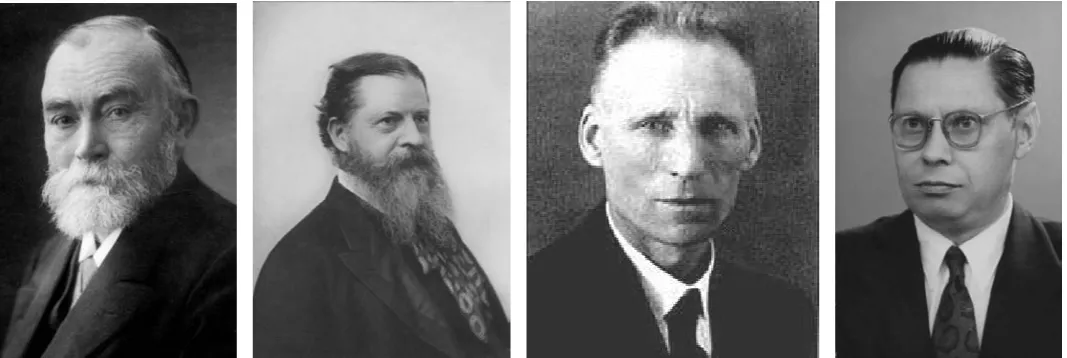
Figure 1 Chrysippos of Soli, W. Stanley Jevons and Else Barth.
me to buy a book about logic, and that is what I did. (In Figure 1 I add three pictures of what the species of logicians looked like to me at the time. The third picture is of my inspiring first teacher in Amsterdam, Else Barth.)
Reasoning patterns
What I bought was a pocket edition of a nineteenth century classic by William Stanley Jevons, available on the internet today. And what I learnt was that reasoning haspatterns, and that some patterns are correct, while oth-ers are not.
Consider the following statement, where capital letters stand for arbitrary sentences:
If B,then not-H,
and ask yourself if it follows logically that
If not-B,thenH.
You might be tempted to agree. But what if the doctor on duty in the emergency room where you have just been rushed in after a collapse, is trying to figure out what is wrong with you? Let us say that, if the cause is in your brain, it is not in your heart — but nothing is wrong with your brain scan. Is it correct to conclude that something is the matter with your heart? I do not think so, and neither should you. For myself, I would prefer a doctor whose reason-ing goes differently, usreason-ing a correct reasonreason-ing pattern like this:
fromifB,then not-H to ifH,then not-B.
Of course there is more to proper diagnosis than just these few rules — but at least, on the lighter side, you now see that logical cor-rectness may be a matter of life or death.
Explaining and teaching
Johan van Benthem
of reason
Logic across cultures
In line with the thread of my own personal experiences, most of this lecture will follow the Western mainstream history of the dis-cipline of logic. However, it is important to emphasize that a sensitivity to reasoning pat-terns and their valid laws is not a Western preoccupation: it is a talent that has occurred quite early across different cultures. Indeed, we live in exciting times where many new his-torical sources for our field are coming to light, as archives yield their secrets. Logic stands in a worldwide movement including ancient Greece, China, India, and the Islamic tradi-tion, as shown in the efforts of a growing num-ber of scholars today.
To complement the dominant facebook of the field shown earlier, I add in Figure 2 some pictures of major logicians in these other cul-tural streams. One day, Mòzˇı, Dign ¯aga, and Ibn-S¯ın ¯a may be names that are as familiar to the intellectual public as Aristotle.1
Reasoning and information
But logic is more than seeing patterns and improving reasoning practice. With the study of correctness and incorrectness, we enter a much broader world of exact scientific ideas. One of these ideas is the ubiquitous notion of
information.
In principle, there are exactly four ways the world might be given the above statementsB andH:
+B+H,+B−H,−B+H,−B−H.
If we then learn the above ruleifB, then notH,
we lose the possibility that+B+H. That is, we eliminate one out of the four options to obtain the information
+B−H, −B+H, −B−H.
If we now learn thatnot-B, we lose the further possibility+B−H, but two still remain:
−B+H, −B−H.
This final state does not have enough infor-mation to determine thatHis the case.
You can check for yourself how this sce-nario of successive information updates dif-fers from that for the logically valid inference fromifB, then notHtoifH, then notB.
[image:2.612.230.576.588.755.2]Here the information does force the con-clusionnot-Bthrough the following stages:
Figure 2 Mòzˇı, Dign¯aga and Ibn-S¯ın¯a.
i. +B+H,+B−H,−B+H,−B−H;
ii. +B−H,−B+H,−B−H
(after learning thatif B,then notH); iii.−B+H(after learning thatH).
So, reasoning is tied up with information, the lubricant of our whole society, and logic sud-denly starts looking like a much bigger field than you might have thought.
Logical systems
Figure 3 Logical piano, Turing machine and Macbook Air.
Reasoning and computation
The criterion for correctness or incorrectness of simple rules like those I gave for implica-tion and negaimplica-tion is manipulating the ‘truth tables’ of basic logic, and thus reasoning gets tied to mathematical structures in computa-tion. This is a general thread in the history of ideas: reasoning is connected to binary arith-metic, or as Hobbes said: “Reasoning is reck-oning.” And once we see this computation-al angle in its genercomputation-al light, the idea emerges naturally, already in the Middle Ages, that rea-soning might be done by machines, provided we find suitable logical languages for them to work with. The first picture in Figure 3 is Stanley Jevons’ ‘logical piano’, one of the pio-neering attempts at creating mechanical com-puting devices.2
The second picture in Figure 3 is Turing’s fundamental model of computation, and the third is an object that has swept the world in recent years. There is a straight historical road from logic to computer science, and the information technology pervading our lives.
This mixture of reasoning, information, and computation is the thriving conglomer-ate of logic, philosophy, mathematics, lin-guistics, and computer science that has put logic firmly at the crossroads of the modern university, and our modern information soci-ety. This, indeed, is the world of the Amster-dam Institute for Logic, Language and Com-putation where I have spent so much of my academic career.
Logical systems and their theory
As we have seen by now, logical patterns and systems capture major ideas that can be analysed and developed as such. And the great engine for pursuing that analysis and development has been themathematical turn
of modern logic since the nineteenth cen-tury, turning it into an exact discipline that unleashes the power of mathematical preci-sion to study systems of reasoning and every-thing that comes in their wake. This is how modern logic works, and nothing that I will say in the remainder of this lecture about
broadening the scope of the discipline is in-tended to depart from this methodology.
Paradoxes and foundational theorems In particular, the power of mathematical thinking allowed the great logicians of the Thirties to reflect on the basic nature of rea-soning itself, both its strengths and its lim-itations. A celebrated instance of this style of ‘confronting reason with itself’, to use a sonorous philosophical phrase, are Gödel’s Incompleteness Theorems that capture sur-prising essential features of the mathemati-cal method par excellence, namely,deductive proof.
Consider one of the oldest instances of log-ical thinking that has come down to us in var-ious cultures, from ancient Greece to ancient China, ‘self-referential’ statements that talk about themselves. A famous case is the Liar Paradox from Antiquity where someone as-serts that the very statement she is making is false. But for here, think of a related but subtly different statementLthat says about itself that it cannot be proved:
L if and only ifLis not provable,
or in Amsterdam style formula notation:3
L↔¬L.
[image:3.612.221.573.637.753.2]Languages have several ways of achieving such self-reference. If you want a dramatic historical instance, the Hebrew God told the
Figure 4 Euclid’sElements, Kurt Gödel and Martin Löb.
Here is a piece of this reasoning at the edge of reason. It is well within your capacities to appreciate — assuming the famous motto of John Perry and Ken Taylor’s radio show Phi-losophy Talk: “the only thing that we donot
question is the hearers’ intelligence.” Let us draw some quick consequences in a first, rather simple pass:
Gödel lite. IsLtrue or false? If we assume thatLis false, thenLis provable.5 But ifL
is provable, thenLis true: and we have con-tradicted our assumption. We conclude from this piece of reasoning thatLcannot be false. In other words: Lis true. But given whatL says, it follows thatLisa true statement that is unprovable.
The pictures in Figure 4 show some re-sounding names in this world of thought.
Living at the edge of reason
This simple piece of reasoning lies at the heart of Gödel’s famous First Incompleteness The-orem. But it is clearly just a very first pass, which invites questions and refinement at once. Indeed, the art of ‘living dangerously’ displayed here is another major attraction of logic, especially to minds of a somewhat ab-solutist bent, and it involves a continuous practice of refining our styles of thinking.
Figure 5 Frege, C.S. Peirce, Brouwer and Beth.
the Thirties such as Gödel, Hilbert and Gentzen thought so, and dropped this as-sumption in their analysis of the power of proof. Let me sketch a more sophisticated ver-sion of Gödel’s argument for you then:
Assume we have(L↔¬L) (*). Next, as-sume thatL. Then using (*), we can prove that¬L. But at the same time, inspect-ing the proof for L that exists byL, we can proveL. Combining the two, a contradic-tion¬L&Lis provable. So, our proof sys-tem is inconsistent, and unreliable.
This time our conclusion gets more sophis-ticated.If our mathematical proof methods are reliable, then there have got to be true unprovable statements beyond their reach.
The process of refining our understanding of truth, proof, and reliability is still going on. Masters of the art included my thesis supervi-sor Martin Löb, Sergei Artemov, Dick de Jongh, and Albert Visser — and still last year, I read surprising delightful new perspectives on the mechanics of Gödel’s reasoning discovered by Lev Beklemishev at the Steklov Institute in Moscow. We can keep reflecting on our under-standing of mathematical proof, and go deep-er and deepdeep-er, until the mind reels.
Science, religion, or common sense? With all this, we are at the heart of clas-sical logic and foundations of mathematics, and its deep results that keep inspiring reli-gious awe in every new generation of students worldwide that gets exposed to logic. Yet, this depth comes with a somewhat narrow focus on mathematical proof, a very specialized hu-man activity. The methods are mathematical, the topic is mathematics.
But I started this lecture in our daily rea-soning practice, and want to return there eventually. As a student, I had to memorize a list of differences between scientific and com-mon sense reasoning — with the former sup-posed to be much deeper and better than the latter. But the striking thing to me is the very opposite. The logical steps for Gödel’s The-orem are the same ones that we employ in daily life, and this observation fits the facts of human cognitive evolution, where bands of hunters with survival skills eventually pro-duced the greatest art and science, all using the same brain.
The true story of modern logic then is as follows. The methods remain mathematical, but the topic becomes much broader: in prin-ciple, any aspect of the human intellect. The true facebook of logic, then, consists of both mathematicians and others looking beyond, forming pairs as in the pictures of contempo-raries, see Figure 5.
Frege was contemporaneous with C.S. Peirce, an independent inventor of first-order logic with a much broader agenda in philoso-phy, semiotics, psychology, and so on, which we are only beginning to carry out today. Our national mathematical icon L.E.J. Brouwer was a contemporary of E.W. Beth, a broad logi-cian and philosopher, and it is their tandem that created the Dutch School in logic that we know today. It would be easy to multiply ex-amples of such facebook pairs all over the history of logic.
So, here is where this lecture is going to go, charting further aspects of what our disci-pline is, or can become. Eventually, I want to understand the laws of what actualreasoning agentscan and should do: in terms of knowl-edge, action, learning, making mistakes, and
all of that in mutual social dependencies. And while setting our bounds that widely, I still hope to convince you that we are doing logic. But before we enter this enticing Realm of Agency, let me first talk about the personal intellectual development that took me there. I will take things slowly, introducing new ideas one by one.
Proof as seeing and as doing
I start with two essential aspects of math-ematical proofs that have occurred entan-gled ever since Euclid’sElementsin Antiqui-ty. A proof isevidencethat a theorem is true: that is, it provides information — but at the same time, it is amethodfor computing so-lutions and creating situations where the the-orem holds. The same duality pervades gen-eral learning and knowledge, where ‘know-ing that’ and ‘know‘know-ing how’ are deeply inter-twined. For instance, we have truly learnt a language when we recognize when given sen-tences are correct, but arealsoable to pro-duce discourse that makes sense, and the same is true for logical systems. Thus, study-ing information also means studystudy-ing action, and vice versa. The two notions are two sides of the same coin. How can logic do justice to this deep duality?
Figure 6 Hintikka, Dynamic Logic, Milner and Aumann.
analysis of programs and processes, but have spread to philosophy and linguistics. These contacts have blossomed over the years, and taken their practitioners to Nobel Prizes, Tur-ing Awards, or their equivalents in philoso-phy. The four pictures in Figure 6 present a gallery of relevant names and topics ranging from philosophy through computer science to game theory.
Modal logic
The abstract common structure of information and action that underlies large parts of phi-losophy, computer science, or game theory is studied in a technical field calledmodal logic. A modal notion states how things might be, insofar as not ruled out by our information — or how things might become, given the ac-tions at our disposal. Very similar laws govern such notions. One example is this:
Distribution Law (A→B)→(A→B)
In terms of information, this simple principle expresses that
if I have evidence forA→B as well as evidence forA, then I also have evidence forB.6
In terms of actions, the same principle says that
if the outcomes of an action satisfyA→B, and they also satisfyA,
then all outcomes of that action satisfyB.
There are many other, and technically much more sophisticated, laws of modal logic, but the simple example of the Distribution Law will have to do here.7
Modal reasoning patterns have been a fo-cus in my work over the years, which offers a systematic study of modal laws, but al-so of connections between modal patterns and other basic logical systems, measured by semantic invariances such as ‘bisimulation’. Some sources are depicted in the sequence of four books in Figure 7.
These matters can be found in any good textbook, but let me stress one point. While modal logic is ‘applied’ as a theory of informa-tion and acinforma-tion, it is at the same time ‘pure’ as a study of basic aspects of reasoning that had not come to light before, and thus it falls squarely within the mathematical methodol-ogy that I have emphasized.8
Information-driven agency
But let us now move beyond the agenda stat-ed so far. For a start, what about the actors getting the information and engaging in ac-tions? What do they do, and why? My next step toward the study of agency is an arena where knowledge and action meet naturally, the basicinformational actsthemselves.
Basic informational acts
While reasoning may seem the only informa-tional action of interest to logicians, in reali-ty, inference steps usually occur together with other equally fundamental acts that make in-formation flow. For instance, the following scenario plays out day by day in Amsterdam caf´es.
The Restaurant. Three people order three
drinks: water, beer, and wine. A new wait-er comes to the table carrying three glasses. There are six ways these drinks could be dis-tributed over the customers, and here is what you will see happen.
Figure 7 Dissertation, Monograph, Handbook and Textbook.
The waiteraskswho has the beer, say, and after hearing the answer, puts down that glass in the right place. This reduces his uncertainty from the initial six options to two, much as in our example of diagnostic rules. The waiter then asks a second question, and puts, say, the glass of water. Now his options are down to one, and he does not ask any more, but caninfer who has the wine, putting it down without a question.
Thus, basic informational acts include, at least, both questions and inferences. But there is more. As it happens, a broad view of informational action was already present with the ancient Chinese logicians in the Mohist school, active from around 500 BC. It stressed the interplay of three sources that come to-gether in producing information:
(zhi wen shuo qin)
an elegant compact statement which says roughly, in a more modern phrasing, that “knowledge comes from three sources: hear-ing from others, proof, or experience”.
[image:5.612.223.571.632.754.2]observingthings.9Observation is what a
log-ical detective like Sherlock Holmes needs in addition to pure deduction, and it is the well-spring of the empirical sciences, on a par with mathematical proof.
The pictures in Figure 8 represent a restau-rant, a Mohist dialogue, Sherlock Holmes at work, and finally, a card puzzle with social reasoning that is often used in my circles.
Logic of information change
My own view of logic has come to resemble this ancient paradigm. We must study all ba-sic informational acts on a par: inference, observation, and communication, and their interplay in how we deliberate, plan, and de-cide. A major test for such a venture is a search for formal laws governing these additional in-formational actions that retain the precision logicians are used to. Here is one:
[!ϕ]Kiψ↔(ϕ→Ki(ϕ→[!ϕ]ψ))
This law describes the new knowledge an agentiwill possess after having received the information thatϕis the case.10 It does so
in terms of the ‘conditional knowledge’ that the agent had before the new information !ϕ came in. Typically, it is ‘recursion equations’ like this law that drive the logical study of information-driven agency.
As an aside, please note how the above principle shows the cooperation of ideas from different fields: the modalityKiψfor
knowl-edge in this law comes from philosophical log-ic, while the dynamic modality[!ϕ]for action comes from logics of computation.
[image:6.612.39.573.599.754.2]Still, we are only at the start of a logical study of agency. The actors in the above could still be instinctive devices recording informa-tion from the environment, like the bees suck-ing up nectar in the flowers in my garden. So let me turn to further intelligent activities that
Figure 8 A restaurant, a Mohist dialogue, Sherlock Holmes and a card puzzle with social reasoning. rational agents engage in, of which I will
men-tion a few in this lecture.
Consistency?
The first new aspect of agency concerns the quest for certainty we saw earlier. The found-ing fathers of modern logic were concerned with the power of proof, and its reliability. Is
consistencyour ultimate goal? Gottlob Frege thought so, saying that mathematics would ‘crumble like a house of cards’ if a contradic-tion were to arise.11 But there can be logical
grandeur in fragility, being wrong, and making a volte face.
Learning is correction
As I said before, proofs give reasons, and a rational agent can be described as someone driven by reasons.12 But at this point, I part
company with the original foundational enter-prise. Our drivers should begoodreasons — but there is no guarantee that they are cor-rect. We make mistakes and often form incor-rectbeliefs, and the task of logic cannot be to prevent that from happening once and for all. Indeed, our beliefs and expectations, even when wrong, represent a creative human tal-ent in navigating a world where knowledge is a currency that is often unavailable.
But this non-eliminable, and perhaps even desirable, potential for error comes with an-other creative talent, our ability tocorrect our-selveswhen beliefs are shown wrong by an observation, or when theories explode after a contradiction comes to light. There is no house of cards that crumbles: indeed, human intelligence shows at its finest in a clever re-covery after we have been shown to be incor-rect. So, a true logic of rational agency toler-ates errors and highlights methods for revis-ing beliefs. What this points at more generally is an intimate connection between reasoning andlearning.
While all this may be true, are beliefs and their revision a fit theme for logic? As it hap-pens, thanks to the work of pioneers like Pe-ter Gärdenfors and others, we know that this more delicate error-tolerant process of adjust-ing to new information still satisfies logical laws, that now involve operators for belief and acts of belief revision. Of such laws, I just dis-play two at this point, merely in order to show you that, once again, we need not sacrifice the mathematical precision of our foundationalist founding fathers:
[!ϕ]Biψ↔(ϕ→Biϕ[!ϕ]ψ),
[⇑ϕ]Bψχ↔
(E(ϕ∧[⇑ϕ]ψ)∧Bϕ∧[⇑ϕ]ψ[⇑ϕ]χ)
∨(¬E(ϕ∧[⇑ϕ]ψ)∧B[⇑ϕ]ψ[⇑ϕ]χ).
Such laws describe which new beliefs arise as new information comes in. This can now happen in two forms: witness the syntax of our two formulas. Changes can be triggered by a ‘hard’ totally reliable event !ϕremoving all¬ϕ-situations for good, but there is also a more ‘soft’ plausibility-changing event⇑ϕ that keeps all situations, while putting those with¬ϕ on top of those withϕ. I am not going to try to explain to you any further what the above formulas say. Their typography may well scare you. These laws of learning are clearly more complex than the simple rules of reasoning that I started with. But then I never said our broader logical skills are simple!
Let me just state the upshot. Correctness forms a tandem with correction — and as some philosophers have said long ago, log-ic is also about learning from errors.13
chal-ence with foundational research too much. There might well be very interesting exten-sions of the classical theorems by Gödel or Turing when, in addition to what is known with total certainty, we also explicitly repre-sent agent’s reason-based, but fallible beliefs about what is true and provable.15
Many minds and social interaction
Beliefs may need correction for all three rea-sons in the earlier picture of information dy-namics: a surprising observation, a paradox-ical inference, or also, being contradicted by somebody else. This leads me to my next fun-damental theme in the logical study of agen-cy, which can be summarized as:
“intelligence seldom comes alone”.
My example of argumentation was a social scenario where different agents interact. This is significant. Rational behaviour is a many-mind talentrather than an isolated skill — just as in modern science, the key is many-body interactions, not single bodies in their natu-ral place, as in Aristotle’s physics. This so-cial theme of deliberation and argumentation runs throughout the history of logic, in both Greek and non-Western traditions. Logic is al-so about how we convince, refute, or other-wise influence others.
Just as earlier, this social dimension has two dual aspects:information, andaction.
Theory of mind
The social aspect of information involves a crucial human ability often called ‘Theory of Mind’ where we reason about the facts, but also about other people’s information, what they know about the facts and about us, and so on. Theory of Mind underlies many in-formational acts. My asking you a question
normally conveys I do not know the answer, and also that I believe you might know the answer.16
Social behaviour is kept in place by a web of such complex iterated information about others that can be studied as before. Again, it has been found that crucial properties of rational social equilibrium then show up in logical laws. For instance, a propositionϕis
in the groupGknows thatψis the case. This looks like a vicious circle that foolishly tries to define common knowledgeCGϕin terms
of that notion itself, but in fact, the above equivalence is a ‘luscious circle’ where the notion at issue is well-defined, and supports precise reasoning.17 18
The program of logical dynamics
The preceding samples suggest a more sys-tematic logical study of information-driven so-cial agency. Over the past decades it has be-come clear that the methods of logic are well up to this agenda extension, creating systems with beautiful laws, not just for inferences, but also observations, questions, correction, learning, and social interaction. And in do-ing so, the grand style of our founddo-ing fathers does not lose its lustre. Its thinking about strengths and limitations also applies to what diverse sources of information do for rational agents.
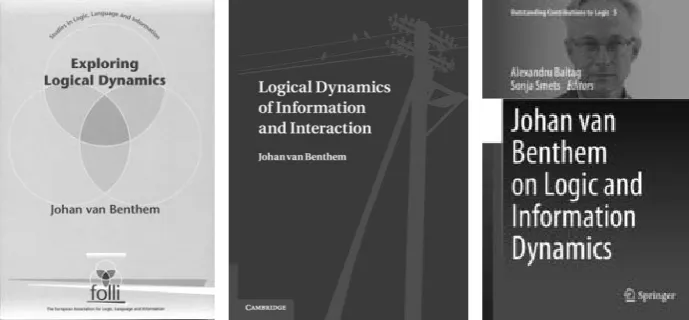
In what follows, I discuss one current high-light of this ‘Logical Dynamics’ research pro-gram, as exemplified in the depicted three books in Figure 9, from 1996, 2011, and 2014, respectively.
Games
[image:7.612.221.566.594.754.2]Social action is at the heart of the fast-developing area of logic and strategic be-haviour ingames. Our actions toward each other congregate to form longer-term strate-gies, where what I choose to do next depends
Figure 9 Three books by (and about) the author on logical dynamics.
equilibrium, meaning that no agent has an incentive for deviating from her current plan.
Only one such law will have to serve as an example here, again mostly just in dis-play. It is very similar qua form to the ear-lier equivalence for common knowledge, and it describes when someone has a strategy for playing a gameG that always achieves the effect ϕ(this is written here as{G∗}ϕ) in terms ofϕ’s being true and what the player can achieve by her currently available moves (the latter ability is written as{G}):
{G∗}ϕ↔ (ϕ∧{G}{G∗}ϕ)
The analogy with the earlier law for knowl-edge again shows the fundamental duality of information and action that governs logic of agency. They are two sides of the same coin, and often, the shape of their mathematical laws reflects their similarities.
Harmony of information and desire
nothing could be further from the truth. What we want to know explains how we seek in-formation, and what we want to achieve de-termines our choices of actions. Instead of a separating barrier between these two realms, a logical perspective on rationality involves understanding their delicatebalance.19 20
A reasonable person keeps her informa-tion in harmony with her goals and desires, plus those of others. That quality shows in the activity of takingdecisions, a growing in-terest among logicians. Incidentally, it is that broader balance of information, desires, and decisions that we should also seek to instil in a true academic education.
Logic in games
Noble causes indeed, but can logic offer any illumination in such a broad arena? What I can say for now is found in my new book Log-ic in Games. It covers two major lines of re-search, that have been developing over the past decades.
The first line islogic of games, being the study of the structure of games and every-thing that happens before, during and af-ter their play by rational agents. There is a lot of intricate reasoning involved in plotting one’s course in games, including the effects of one’s actions, beliefs, preferences, and thinking about the kind of opponent (or fellow player) one is engaging with. This reasoning shows logical patterns that can be studied by the tools I have outlined in the above, includ-ing fixed-point laws for social equilibria where all players do the best they can. This line of research may be considered a joint offspring of logic, game theory, and modern computer science in its interactive-systems mode. Logic of games is now engendering a joint research program that might called ‘Theory of Play’, where we analyse the reasoning of players in games and related social scenarios — and sometimes, more ambitiously, try to design new games that implement desirable forms of social interaction.
But at the same time, there is a sec-ond intimate connection here, that may be called logic as games. As we have hinted at in the beginning of this lecture, paradig-matic logical phenomena such as argumen-tationthemselveshave a game-like charac-ter, and this metaphor can be made very precise. For instance, mathematical proofs have turned out to be very much like ‘win-ning strategies’ in suitably defined dialogue games. This game-theoretic view of log-ic itself also fits very naturally with mod-ern views of computation, where the
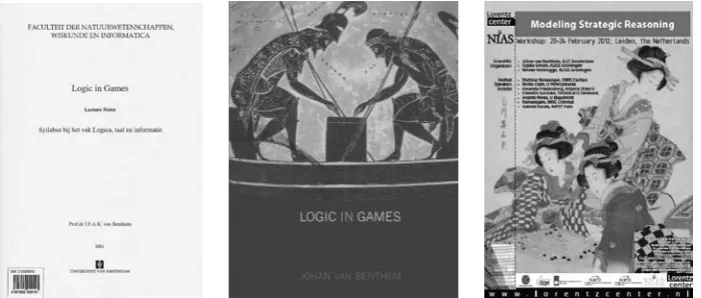
math-Figure 10 Lecture notes and a monograph by the author on logic in games and a workshop on logics for strategic reasoning.
ematical paradigm is no longer isolated Turing machines, but networks of distributed proces-sors that may cooperate or compete for avail-able resources, and that may differ widely in their abilities and intentions.
Thus, once more, logical laws acquire the dual character we have seen several times. Viewed in an informational perspective, they tell us what the world is like. But in a dual dy-namic procedural perspective, they express fundamental facts about strategies and equi-libria in basic scenarios of interactive com-putation or social behaviour. This duality is not an annoying ambiguity, but rather the true face of logic as I see it.
The first two pictures in Figure 10 are lec-ture notes and a monograph of mine on both of the above interfaces of logic and games. The third picture points to a forthcoming book on logics for strategic reasoning, bringing to-gether many communities, that I have edit-ed with Sujata Ghosh and Rineke Verbrugge. This area is in full development.
What is next?
Ladies and gentlemen, I have shown you glimpses and glimmers of my dynamic pro-gram for logic as a broad study of information-driven social agency. As one of my readers put it nicely: “Classical logic handled the straight lines, now you want logic to also do the curves.” Many of those curves are found in my own work and that of my colleagues and students. What is left formeto do?
The empirical facts
In my declining years, I sometimes stray from the glorious path of theory, and feel the pull of the brutefacts. What I told you about informa-tion and agency can be seen as theory-bound andnormative: this is the information that is truly available in the world, these are the con-clusions that agentsshoulddraw, these are the game-theoretic equilibria theyshould
at-tain. In this classical perspective, the laws of logical dynamics have no descriptive content, and how people really act, presumably stupid and ill-mannered, can be left to cognitive or behavioural scientists.
But I fear that this common cosy analytic separation of the normative and descriptive reflects intellectual poverty rather than safe-ty. Logical theory that ignores actual cognitive behaviour seems dangerously empty, lacking focus. On the other hand, I do not want to lose the potential of normative thinking ei-ther, that can help usimproveperformance, or design better ways of dealing with the world and with one another. For instance, my earlier emphasis oncorrection rather than guaran-teed correctness of intelligent behaviour mix-es thmix-ese two motivmix-es. It movmix-es closer to real human behaviour, but what we call success-ful ‘correction’ will still depend on norms. In other words, things are subtle and complex here, and I have no definitive line to offer.21
Let me give an example where these two pressures in my current life come to a head. You might feel that my broad program for logic is becoming a huge machinery of high mathe-matical complexity. Now there is a mathemat-ical unity in logmathemat-ical methods that makes this complexity less daunting. But it is also good to realize that you are in fact good at every-thing that I have discussed in this lecture. In-formation flow, inference, correction, desires, and strategic behaviour occur together in that basic phenomenon that we all engage in all the time: conversation. Therefore, a natural empirical focus for my view of logic is natural language, the vehicle of conversation.
Natural languages and real brains
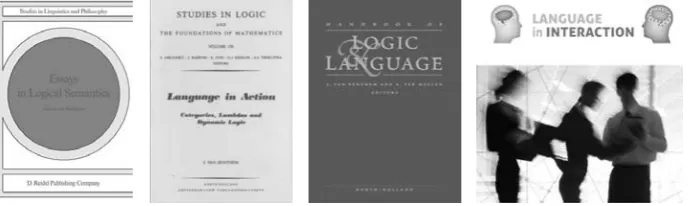
[image:8.612.228.579.76.225.2]‘language of agency’, and all the subtle ways that we use for describing what we do, plus the laws of the natural logic governing this natural language.22
At the same time, I am involved with empir-ical research on language in the brain in our national Gravity Project ‘Language in Interac-tion’ where we will use logic-related games to see what really happens when people com-municate, and how new language arises in that process. The four pictures displayed in Figure 11 show some of my earlier work on logic and natural language in the Eighties and Nineties, a Handbook on this interface, and a logo for the new project that also brings in empirical cognitive science.
Large numbers and probability
[image:9.612.39.384.523.626.2]The second project waiting on my desk con-cerns another aspect of the facts, namely, that there areso manyof them. Logical reasoning and rational agency play in a thin zone of con-scious deliberation where what we think and decide matters. This zone is like the thin realm of our physical abilities, hemmed in between objects that are too large, or too small, for our hands to manipulate. Above us lies the sta-tistical world of social behaviour and public
[image:9.612.36.394.662.755.2]Figure 11 Some work by the author on logic and natural language.
Figure 12 Initiatives in logic education.
terns. My own interest in this area today con-cerns interfaces between logical and dynami-cal systems theory as providing two views of these interfaces. There are many more good reasons for combining logic and probability, but the above may suffice for here.
The interface of logic and probability has a long history: even Stanley Jevons included it in his book. It is also very much in evidence at our institute the ILLC, and I believe that it poses many fundamental problems that go far beyond what we know so far.
Foundational results after all
Factual interests are by no means opposed to the classical modus operandi in logic. Some neuroscience intriguingly repeats ideals from the foundations of mathematics, such as a ‘Universal Scanner’ that tells us exactly what an experimental subject is thinking, a goal with a sinister whiff of Inquisition. Fortunate-ly, one can modify famous arguments in logic to show that universal scanners are as impos-sible as universal decision methods for rea-soning or computation.
Spreading the word in education
The best test of a proposed scientific
perspec-found at www.logicinaction.org.
I recommend a tour of this educational world, which we are still creating and testing out at several sites worldwide, including Am-sterdam, Stanford, Beijing, and Seville. The following pictures illustrate part of this world, as well as its outliers into the Open Univer-sity and on-line education efforts at several pre-university stages.
This reflects the earlier ties between log-ic and learning. People can get better at ar-gumentation, and many other themes in this lecture point at skills that can be taught.
What is logic?
Let me return to the beginning of this lecture. What subject did I choose as a student, and was it the right choice? My general view of decision is quite unlike the paradigm in deci-sion theory of choosing optimal actions given one’s present expectations. This is too pas-sive. In my own life, decisions turned out to be good, not because of superior a priori rea-soning, but becauseI madethem good after-wards by committing to the actions that I had taken. This is also true for choosing logic.
Perhaps the field as it was when I chose it in the Sixties was not an optimal choice for someone like me.23 But I have told you what
logic canbecomeif we take it to its full po-tential as a science of information in action, performed by agents engaged in meaningful activities, doing justice to both the classical ideals and a modern future of the field. In-deed, this view is at the heart of my Logical Dynamics program:
becomingis as important asbeing.
Deep thoughts and noble sentiments: but at the end of this long lecture, you may well prefer a lighter take home message. Let me try. Throughout my presentation, I have ex-tolled the virtues ofreason, as the light that, sometimes, relieves the boredom and dark-ness all around us. But that light has to come at the right time, in the right style.
Figure 13 Four of the ‘habitats’ of the author.
decided to marry my father. Her response was as follows:
“because you were not there to advise against it”.
There is a logical paradox lurking here, not unlike the ones I discussed in this lecture — but my mother’s response also gives me my final definition of logic for you today:
logic is the science ofwit.
People and institutions
In line with what I have said about logic and probability, my own views and life’s decisions have ridden on a statistical sea of behaviour by many others. My formative interactions have included many colleagues and students, so much so, that I often wonder where my own professional persona ends and theirs starts. My work and ambitions in academic life al-so naturally led to helping shape new organi-zations in our field whose lifespan may well exceed our own.
The four pictures in Figure 13 show four of my habitats over the years: the Insti-tute for Logic, Language and Computation in Amsterdam, the European Association for Logic, Language and Information, the Cen-ter for the Study of Language and Informa-tion at Stanford, and as a most recent ini-tiative, a new Joint Research Center in Logic between the UvA and Tsinghua University in Beijing.24These are sites where modern logic
in the style I have explained is flourishing, as well as much more.
But the realm of logic is much larg-er than this plarg-ersonal environment. I warm-ly invite you to open a door into the ac-tual international world of logicians — or just at home, step through Alice’s mirror in-to the internet, and see its attractions for
yourself. k
Noten
1 With a group of dedicated colleagues, I am cur-rently involved in exploring Chinese strands in all of this, in the forthcomingHandbook of the History of Logic in China.
2 Here I am not endorsing the old AI mantra that all reasoning can be done by machines. The ul-timate goal of logic to me is not a world where reasoning and judgement are left to technolo-gy, but one where we understand ‘agency’, in the broad sense to come in this lecture.
3 The strange boxis not a pdf conversion error, but the logical symbol for ‘provability’.
4 Yes, there is much more to the ‘unknowability’ in this example than mere formal logic.
5 Here we use earlier rules: we have¬L→Lby the meaning ofL, and hence also¬L→L.
6 This use of the box notation is naturally related to our earlier formal analysis of provability.
7 In particular, if the actions considered can be different, then Distribution must be modified to an indexed form[x](A→B)→([y]A→[x#y]B), where the variablesx,ystand for actions and
#denotes some suitable operation of combin-ing actions.
8 Modal logic is not the only field that does jus-tice to the information–action duality. Other such paradigms that I admire include process algebra and category-theoretic approaches.
9 The Mohist example was a Dark Room, with an object inside whose colour you do not know. However, you see a white object outside of the room, and someone now tells you that the ob-ject in the room has the same colour. You then conclude that the object in the room is white.
10 These formulas are mainly for display: I ruth-lessly omit technical details in this lecture. Just for once: the stated law describes knowledge after update as conditional knowledge in a re-cursive manner that lends itself well to logical analysis of the relevant modal reasoning.
11 In daily life we also value ‘consistency’, a more subtle virtue of applying the same standards to similar matters, without self-serving shifts, a delicate form ofharmony in judgement.
12 The common idea that rationality means ‘serv-ing one’s own interests’ seems an aberration. Good reasons involve much more, such as an ability to put oneself insomeone else’splace.
13 This tandem view again illustrates the earlier point of the duality of information and action.
14 Students ask why I still grade exams for correct answers, instead of their responses to their er-rors. For lack of a good answer, let me just step aside, and say that exams are an ancient Chi-nese invention that has conquered the world, on a par with paper, gunpowder, and silk.
15 E.g., while it might be provably inconsistent to know that a given statement is true and un-knowable, it could well be consistent for an agent tobelievethat it has these two prop-erties. Technical examples of this line are found in recent work on probabilistic versions of Gödel’s theorems.
16 Of course, both of these presuppositions are switched off when a teacher asks a question to a student, or a valedictory lecturer to his audience.
17 In mathematical terms, logical laws like this
behave like ‘fixed-point equations’.
18 The status of common knowledge is widely de-bated: it may represent a useful fiction.
19 Public audiences often say that emotion rules the world, not logic. My response is finding lip-stick on the collar of your spouse: observation, inference, and emotion entangle in a flash.
20 I sometimes wonder whether this balance also explains why mathematicians keep using nat-ural language in their work and publications, be it enriched with symbols. It has often been asked why this is so. One answer might be that even pure mathematical research requires a constant undercurrent of signals for cooper-ation, competition, goals, and desires.
21 This has not prevented me from publishing pa-pers on the interface of logic and psychology, a fascinating border region where much is hap-pening, also at the University of Amsterdam.
22 More concretely, I am currently looking at sim-ple reasoning patterns concerning the main drivers of our actions: hope, and fear — as well as what are in fact major cognitive abilities such as switching perspectives in going from first-person to third-person reports, and back. Throughout, the fundamental logical harmony of information and action reveals itself.
23 My sons occasionally wonder if I would not have made a much more productive member of Dutch society as a physicist, the field of study that I started with at the UvA.