School of Creative Arts College of Arts, Law and Education
University of Tasmania
Redeeming ‘slippery’ meaning from the gap between the present
and past: Exploring visual art processes and visual representation
By
Juneo Lee Eng Keong
MA (Hons) Visual Arts (University of Western Sydney/Nepean) BFA (University of Tasmania)
Dip Fine Arts (LaSalle-SIA College of the Arts)
June 2018
ii Candidate Declaration
This thesis contains no material which has been accepted for a degree or diploma by the University or any other institution. To the best of my knowledge and belief, it incorporates no material previously published or written by another person except where due acknowledgement is made in the text.
Signed:
iii Authority of Access
This thesis may be made available for loan and limited copying and communication in accordance with the Copyright Act 1968.
Signed:
iv Abstract
This study identifies and then investigates processes intrinsic to artworks that interrogate similarity and difference as situated within different assemblages of materials in artistic space. The impetus for this investigation emerged from an opportunity identified within the existing field of knowledge to redeem slippery meaning from the transitory space between two and three-dimensional forms. In doing so, the investigation demonstrates and makes explicit the significance of process and how it is integral to assembling meaning.
This research explicates my current practices in relational concept and form with previous approaches to art-making, exploring art practices of other artists and published writings by Walter Benjamin, Georges Bataille and Gilles Deleuze. The research considers an artistic position that does not differentiate between sketches, painting, montage and assemblage. In doing so, the investigation explores issues such as ‘formlessness’ in the context of transposition, and slippage in relation to porosity within the procedural application of transparent polymer for three-dimensional painting.
vi Acknowledgements
First and foremost, I wish to thank the late Professor Vincent McGrath for inspiring me to undertake this PhD study. His guidance since my undergraduate days is etched in my heart.
My heartfelt thanks to Dr Malcom Bywaters and Dr Abbey MacDonald for their endearing patience, encouragement, wisdom and supervisory expertise. I would like to acknowledge them for their insightful critique of my works and creating a very memorable learning experience in this PhD investigation.
I would like to thank my former supervisors Professor Marie Sierra and Penny Mason in shaping the trajectory in the early phase of this research project.
Thanks to Bron Fionnachd-Féin for reading and formatting my first draft. Thank you Dr Troy Ruffels for facilitating the studio space for my art-making. Thanks to Robert Boldkald for helping to set up the exhibition. A special thank you Dr Deborah Malor for introducing me to readings that relate to slippage. Thanks also to all support staff in UTAS School of Creative Arts for providing administrative assistance during the course of my study.
I am grateful to Associate Professor Eugene Dairianathan and Paul Lincoln from the Visual and Performing Arts Academic Group, National Institute of Education, Nanyang Technological University for their support in this study.
vii
Contents
Candidate Declaration ii
Authority of Access iii
Abstract iv
Acknowledgements vi
Contents vii
List of Figures x
Colour Plate of Artworks in PhD Examination xxvi
Introduction 1
1 The investigation 1
2 Research question 1
3 Key terms and applications 3
4 My context 5
5 My evolving practice 6
6 Exegesis structure 8
7 Opening into the exegesis 11
Literature review 12
1 On relevant artists 12
2 Exploring the term ‘slip’/’slippage’ from the
different theorists’/artists’ perspectives 14 3 Collage, montage and assemblage: Fragments
viii
4 Epic theatre as montage in relation to experimental
and process-based art 22
5 Deleuze and Guattari’s rhizomatic interconnection
alignment with Benjamin’s flâneur 23
6 Georges Bataille’s ‘formlessness’ 24
7 Conclusion 25
Chapter 1: Shift/slippage from drawing to painting,
collage, montage and assemblage 26
1.1 Introduction 26
1.2 Relationship of my art to montage 27
1.3 My artwork’s relationship to combination printing 28
1.4 Painting’s relationship to collage 29
1.5 My PhD artwork as collage 31
1.6 Linkages to assemblage 34
1.7 Abstract expressionism, and its place within
my enquiry 41
1.8 Sensate and visceral in relation
to abstract expressionism 43
1.9 Bridge as metaphor for crossing and slippages 44
1.10 Décollage 45
1.11 Conclusion 46
Chapter 2: Formlessness (transposition and art processes) 50
2.1 Introduction 50
2.2 Rauschenberg’s Dirt Painting 52
2.3 Georges Bataille’s ‘formlessness’ and ‘not locked
in terms of definition’ 53
2.4 Within the context of informe, investigating transposition from 2D to 3D: The ongoing task of ‘discordant creativity’ remains the crucial
ix
2.5 Lowering 56
2.6 Base materialism and Bataille 58
2.7 Conclusion 59
Chapter 3: Becoming porous 62
3.1 Introduction 62
3.2 Material and porosity 64
3.3 Visual form and multiple meanings 66
3.4 Creating an environment and spaces for fluidity
and the unexpected 67
3.5 Porosity: Between processes and end product 68 3.6 Porosity: Between concept and expressiveness 69
3.7 Conclusion 70
Conclusion 74
Bibliography 85
x List of Figures
Figure 1: Juneo Lee, Unconscious Dialogue 7, 1991, mixed medium on corrugated board, 113 x 113cm.
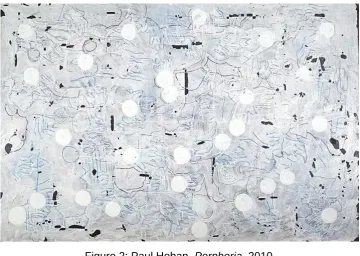
Figure 2: Paul Hoban, Perphoria, 2010,
synthetic polymer paint and ink on canvas, 170 x 255cm.
[image:11.595.117.478.435.691.2]xi
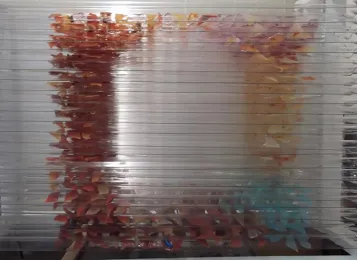
Figure 3i: Juneo Lee, Three-Dimensional Photo Frame, June 2012, polymer on clear polycarbonate roofing sheet, dimensions variable.
[image:12.595.206.390.400.723.2]xii
Figure 4: Robert Rauschenberg, Bed, 1955, combined painting: oil and pencil on pillow, quilt and sheet, on wooden support, 192.4 x 80 x 20.3cm.
xiii
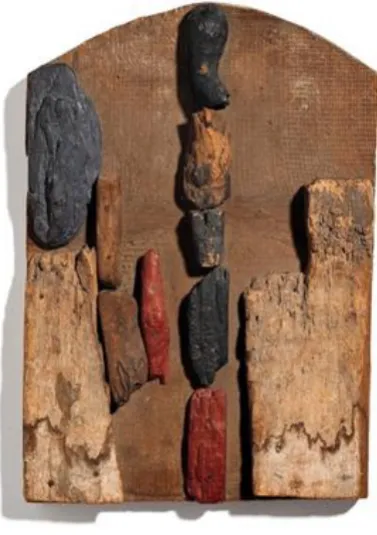
Figure 5: Jean Arp, Trousse D'un Da 1920–1921, Driftwood nailed to wood and touches of
paint, 38.7 x 27 x 4.5 cm.
Image source: https://www.pinterest.com.au/pin/842736148994795057/
[image:14.595.119.478.441.709.2]xiv
Figure 7: Juneo Lee, Mickey Mouse Brush Painting Series 2, 2003,installation view, Chinese ink on rice paper mounted on cotton, dimensions variable.
xv
Figure 9: Hippolyte Bayard, Self Portrait as a Drowned Man, 1840, direct positive print, 9.1 x 11.4 cm.
Image source: https://en.wikipedia.org/wiki/Hippolyte_Bayard
Figure 10: Pablo Picasso, The Guitar, 1913, collage,66.4 x 49.6 cm.
xvi
Figure 11: Kurt Schwitters, The Kots Picture, 1920, collage, 27 x 19.5 cm.
Image source: http://faculty.washington.edu/dillon/rhethtml/dadamaps/kots.jpg
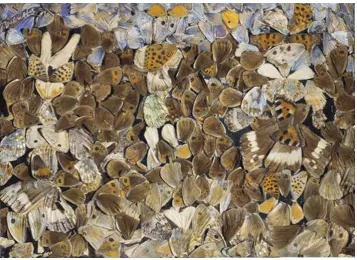
Figure 12: Jean Dubuffet, Paysage (Landscape), 1953, butterfly wings and watercolour on cardboard, 24.7 x 18.4cm.
xvii
Figure 13: Juneo Lee, Hollow Painting I: Experiment on 08 February 2013, detail, biodegradable detergent and acrylic polymer, 30 x 30cm.
xviii
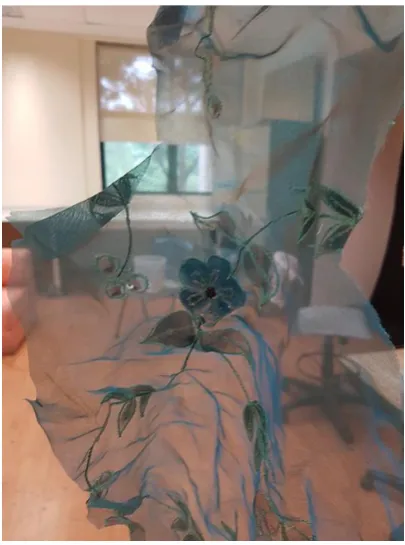
Figure 14ii: Juneo Lee, Circus Tent, detail, November 2012, polymer and cloth, dimensions variable.
xix
Figure 16: Mimmo Rotella, Materia 5, 1956, retro d’affiches (poster backs) on cardboard, 32 x 50 cm.
Image source: Celant, G 2016, Mimmo Rotella catalogue raisonné, vol. 1 1944–1961, Skira, Milan, p. 575.
xx
Figure 18: Robert Rauschenberg, Dirt Painting (for John Cage), 1953, Dirt and mold in wood box, 39.4 x 40.6 x 6.4 cm.
Image source: Seitz, William C 1961, The Art of Assemblage, The Museum of Modern Art, New York
xxi
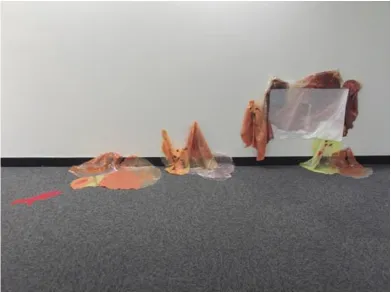
[image:22.595.102.494.71.364.2]Figure 20i: Juneo Lee, Attempt to Create Harmony, installation view, March 2011, polymer and rice paper, dimensions variable.
xxii
Figure 20iii: Juneo Lee, Attempt to Create Harmony, side view, March 2011, polymer and rice paper, dimensions variable.
Figure 21: Édouard Manet, Olympia, 1856, oil on canvas, 130.5 x 190cm.
[image:23.595.102.493.455.722.2]xxiii
Figure 22: Jean Dubuffet, Olympia, 1950, oil on canvas, 89.2 x 116cm.
Image source: https://theartstack.com/artist/jean-dubuffet/olympia-2
Figure 23: Cy Twombly, Olympia, 1957, house paint, crayon and pencil on canvas, 200 x 264.5cm.
[image:24.595.108.489.414.701.2]xxiv
Figure 24: Juneo Lee, K’roo Memories, 2009, Chinese on rice paper mounted on bleached cloth, 385 x 155cm.
[image:25.595.188.408.447.737.2]xxv
xxvi Colour Plate of Artworks in PhD Examination
Figure 27: General view of PhD Art Exhibit (1)
[image:27.595.86.512.442.724.2]xxvii
Figure 29: General view of PhD Art Exhibit (3)
[image:28.595.87.511.410.698.2]xxviii
xxix
xxx
[image:31.595.103.492.405.722.2]Figure 32: Bridge (relationship with shadow), polymer and transparent plastic cup, dimensions variable.
xxxi
xxxii
[image:33.595.81.517.435.729.2]Figure 35: Bridge (relationship with shadow), polymer and transparent plastic cup, dimensions variable.
xxxiii
Figure 37: Tent, polymer and transparent clothe, dimensions variable.
[image:34.595.85.510.454.739.2]xxxiv
Figure 39: Tent (relationship with shadow), polymer and transparent clothe, dimensions variable.
Introduction 1
Introduction
1 The investigation
This PhD research is founded upon my interest in the material exploration of acrylic polymer as an alternative to using linseed oil, as was my practice from 1994. The development of water-based polymer (‘transparentiser’) from the 1950s to the present has meant that it now closely mimics the transparency of linseed oil. I found myself drawn to polymer’s capacity to dry much faster than the oil-based mediums I was accustomed to working with, whilst keeping with the quality of oils’ fluidity and transparency. The pliability of polymer also presents the creative opportunity that allows me to construct and experiment with multi-layering pieces of two-millimetre sheet. For my PhD artistic practice, this material development provides opportunity to extend my practice as a painter by satisfying my desire to work as a painter in process, but in the three-dimensional domain. Hence, this study is premised upon the fluidity of the polymer within the becoming of my art practices. In a broad stroke, this research examines the artistic shift and slipperiness of a creative practice that situates itself in a space between two-dimensional painting and drawing, and three-dimensional sculpture and assemblage, using acrylic as a threshold medium.
2 Research question
Introduction 2 the role of slippages in relation to my PhD art-making. To direct this investigation, the following research question was devised:
How does the interconnectedness of my art practice enable me to identify or locate slippages through relational study?
The nature of inquiry unfolding from this question pointed me to identify and explore similar and antecedent creative practice as a means for comparison. In establishing the interconnections within my varied modes of art-making, I sought answers on how the transition from sketching to painting highlighted a shift in both the expressive and conceptual within visual problem-solving.
Introduction 3 From the research question, the discussion offered in this PhD exegesis brings to the surface a series of implications for creative practice that emerged from an exploratory disruption and lingering in the space between past and present approaches to practice. The ensuing discussion chapters draw together an entwined narrative to explicate how the notions of slipperiness, formlessness and porosity, as articulated in the writings of Benjamin (Benjamin 1999e), Bataille (Bataille 1985b) and Deleuze (Deleuze & Guattari 2003), shaped my creative practice in-process to render a threshold space between two- and three-dimensional art-marking, past and present, possibility and limitation.
3 Key terms and applications
Introduction 4 Benjamin’s command of the term ‘distraction’ slips from a negative connotation in his earlier writing in ‘Theatre and radio’ (Benjamin 1999c) to a later incarnation in ‘Theory of distraction’ (Benjamin 1999d) where it has a positive connotation. These differing meanings make an engagement with distraction not only a reference point from which this inquiry unfolds, they provide insight into the performance of slippage within the operation of distraction.
Benjamin’s Arcades Project (Benjamin 1999a) raises the idea of montages and fragments as points of engagement which resonate powerfully with the many challenges I have encountered in a disjointed art practice that includes working as a full-time lecturer. Montage, in Benjamin’s sense, derives from and becomes distraction. In my own creation of montages, there are movements from distraction to distraction, from my teaching practices to art-making and vice versa in repetition towards infinity. The flowing drapes of the transparent polymer with its folding in and out nestles itself within a multiple interconnectivity with both Benjamin and Deleuze’s thinking on allegory and the Baroque in art.
Introduction 5 Bataille’s writing about informe (Bataille 1985b) provides the platform for the critical study of my process-based art in relation to slippages and porosity around three key throughlines of slippages, formlessness and porosity. These throughlines map the parameters for my theoretical and methodological investigation, through which I explicate the emergence of a new form of content or concept by way of interaction in my practice in a creative metamorphosis.
4 My context
Introduction 6 In this PhD investigation, slippage refers to the shift in conceptual thinking within changes in a different phase of creative practice. Established upon art-making and reading relevant published literature on the theoretical beliefs with regard to Walter Benjamin’s use of ‘distraction’ slips in meaning and concept of the term emerges through the practice-led research approach. Therefore, its working definition, specific to the concept of art-making is developed across the duration of my research process. I focused on Benjamin’s later writing that suggests dependency upon his earlier thinking. This is based on my belief that concepts and ideas perpetually slip from time to time in the mind of creative individuals.
To provide the context for this PhD direction, this introduction gives weight to artistic styles and thinkers that have been documented via published writing from early 20th century to present time that slips from one to another. My research challenges the idea that artists predominantly work in a single style, and in turn reveals the porosity of and erosion eating away at this idea. In Chapter 2, I elaborate on how some creative historians, and artists suggested that this is a representation of post-modernity in art-making.
5 My evolving practice
Introduction 7 from recognisable visual representations that are marked by communication of meaning in the public sphere, to artistic creation that is characterised by my personal search for an individual artistic style in the private domain underpinned by a disregard for completeness. Hence, I see both painting and drawing as a continuum with incompleteness as one of its core features. This incompleteness, as shown in
Unconscious Dialogue 7 (Figure 1), uses visual cues to draw the viewer to form pattern
Introduction 8 6 Exegesis structure
To acquaint my reader with an overview of the key ideas and thinking that have guided and informed my PhD investigation, the sections of this exegesis have been arranged across a narrative thread as per the following:
Chapter 1 (this chapter) provides an overview of the motivations and intentions underpinning this PhD investigation, as well as flagging the key ideas, concepts, theorists and curiosities that have shaped its becoming. Insights are offered as to key terms and definitions with which I have engaged, and how they have been actioned within the context of my practice-based research. My own context as an artist is also shared in order to help those who encounter my work to acquire a sense of past and present approaches to practice, and my processes enacted to emphasise and render the space between.
Introduction 9 Chapter 3 explores the continuum and relationship of slippage between sketches, painting, montage and assemblage within my artistic production. These variant modes of art-making create the developmental trajectory of my art practice and in turn becomes a basis for reflection, analysis and meaning-making. In this chapter, I establish the slippage narrative through which my artistic development moves towards a domain where boundaries between different stylistic forms become blurred. This artistic direction is characterised by the formation of my conceptual thinking that is specific to process-based art with creative processes and operating concepts crossing categorisation and definitions of traditional art forms. Discussions within Chapter 3 make explicit the relationship between artworks completed during my different periods of practice over time and enables me to identify and examine the gaps where slippages occur.
Introduction 10 Chapter 5 unpacks my engagement with Deleuzean tools for unfolding new understanding in the blurring of boundaries between drawing and painting, and two- and three-dimensional work. The rhizomatic becoming of my art processes adopts an organic mode of production that embodies becoming-painting and drawing, heterogeneity, hybridity, repetition and multiplicity. These rhizomatic attributes expand my creative process and enable new ways of envisioning the junction between two- and three-dimensional art-making. It is here that I draw upon porosity to disrupt the threshold between two- to three-dimensional art-making. In becoming porous, I position my art-making in a porous trans-space, where perpetual slippages of conceptual formations brings about creative processes. Chapter 5 explains how completeness and incompleteness, between figuration and abstraction as underpinned by Deleuzean becoming makes way, through porosity, for slippages between two- and three-dimensional works to occur.
Introduction 11 7 Opening into the exegesis
Literature review 12
Literature review
This literature review encompasses the research for the PhD topic ‘Redeeming “slippery” meaning from the gap between the present and past: Exploring visual art processes and visual representation’. My PhD literature review accompanies the artist-researcher through the journey of the investigation, and as thus should be viewed as a diary of information pertaining to the research project. In many ways, the literature review is reflective and specific to Benjamin’s metaphor of the flâneur (Benjamin 1979). Here I am referring to Benjamin’s work exploring the passage in the arcade, where significant moments of this practice-led visual art research are progressively registered by ongoing, in-depth creative investigation. My PhD research undertaken is a reflection-based investigation across a seven-year retrospective period. Reading about the art practices, philosophy and theory of inspiring artists and writers alike has generated moments of awakening in relation to and about my own artistic creation. In the process of my PhD investigation, the literature review operates as an opportunity for additional viewpoints in the relevant topics for the research to be unearthed.
1 On relevant artists
Literature review 13 skin method in painting, Hoban’s artwork is popularly thought of as Conceptual Abstraction.
What Hoban is interested in is ‘lines and blobs dancing in the lid (referring to paint); linking, merging, disappearing cool and bright’ (Hammet 2010). From my observation, Hoban is poetic in his creation of the variety of movement. The movement within the skin of his artwork (for example, in the Psycle series, see Figure 2) is different to the movement of my three-dimensional paintings as produced during the PhD study.
While Hoban’s visual movement is generated from the two-dimensional sphere, a variant visual movement from the third dimension operates in my artwork. As Hammet remarks in After image, the visual elements in Hoban’s painting generate movement that ‘promise directions, instructions and reference points but seem to lead nowhere, into a surface that is both overhead and underneath’ (Hammet 2010). The visual movement in my Three-Dimensional Photo Frame (Figure 3ii) vibrates and radiates outwards. Despite the fact that both Hoban and myself are using synthetic polymer, my artwork focuses more on its transparent quality rather than its quality of movement. It is our unique and distinctive use of these materials for different purposes that sets us apart.
Literature review 14 objects, I believe, can also be viewed as a reference to European artists working in the two-dimensional field, for example Pablo Picasso and Jean Arp. Marcel Duchamp is another European artist working in the three-dimensional domain, his potent symbol of industrial consumerism in Fountain (1917) being a relevant example specific to my PhD artwork. Both Duchamp and myself use materials that reflect the development of the industrial period in creating artwork. In art historical terms, scholarly discussion of Duchamp’s Fountain is a premise for the slip between art and non-art form. These artistic practices of stretching beyond the two-dimensional is known to exist as early as 1917 in Jean Arp’s Trousse D'un Da (Figure 5).
This confluence of antecedent Euro-American art practices in my PhD artworks allows me to critically examine ‘slippages’ within my creative development. The continuum of artistic influence in my art-making forms a non-linear interconnection that interlocks many different conceptual reasons and art approaches that generate space for slippages. This has resulted in my artwork and art-making processes spilling into other creative concepts, for example painting extending into the domain of three-dimensionality.
2 Exploring the term ‘slip’/‘slippage’ from the different theorists’/artists’ perspectives
Literature review 15 ‘distraction’ in his discussion on Brecht’s Epic theatre. Using these two texts, Benjamin differentiated the epic theatre from the ‘theatre of convention’ with words such as ‘cultivation’ to underscore the former, and the word ‘distraction’ to underpin the function of the latter. In his analysis of the ‘theatre of convention’, Zerstreuung (meaning distraction) also emerged to embody the sense of ‘divertissement’ that refers to a form of complacent diversion.
This form of distraction is purportedly produced using ‘witchcraft’ (Benjamin 1999d) to distract the audience into a form of ‘hypnosis’ within the Bannraum, a magic space for the working of a spell. The state of ‘trance’ (Benjamin 1999d) that bears upon the audience of bourgeois theatres of convention is a state which Brecht compares to that of sleepers dreaming restlessly with their eyes open. This is also similar to the ‘strange stare’ and ‘spell-stopped’ stance of the characters in Shakespeare’s Tempest who come under the influence of Prospero’s art. Prospero added that:
‘My high charms work… And these, mine enemies, are all knitted up/In their distractions’ (Shakespeare 1991, p.38).
Literature review 16 alteration in individual artistic creation. This is particular to our pluralistic art world where a number of emerging contemporary creative practices are known to be ‘irregular’ in their individual artistic output. In other words, there is a growing number of artists whose artworks are produced during different time and generational periods, which are perceived to be stylistically distinct.
Literature review 17 145). In a tribute to his old friend Francis Picabia, Marcel Duchamp, as cited in The
writing of Marcel Duchamp, described Picabia’s career as ‘a kaleidoscopic series of
art experiences … hardly related to one another in their external appearances’ (Sanouillet & Peterson 1989, p. 38). The painter and photographer Man Ray explained that he made sudden changes in the style of his work because ‘I enjoyed contradicting myself’ (Gramont 1970, p.136).
Literature review 18 learning and expanding my repertoire in art-making. Theoretically, these slippages of artistic practice enable the Deleuzean rhizomatic interconnectedness within my creative development.
Avant-garde artists such as Picasso, Duchamp and Picabia perceived stylistic change as a significant aspect of their modernist art-making. One can label Dale Frank as a classical avant-gardist because he does not conform to any particular artistic form. A Dale Frank solo exhibition could consist of anything from paintings to a series of found-object sculptures, to a performance-installation where the audience is requested to dance in a gallery decorated as a disco. Once he collated 20 years of his art world correspondence and placed it in a large glass display case in the gallery, along with a $20,000 price tag. His work echoes everything from Marcel Duchamp to the minimalist canvases of Marc Rothko or Yves Klein to the décollage practice of Mimmo Rotella. Dale Frank’s response to the regular criticism of the perceived lack of formal consistency in his artwork is:
‘This idea of “consistency” is a very Australian thing. If you’re consistent you’re known and you can develop a product over several years. People know what they’re getting and think they’re getting value for money. I think art is more than that. The thing that binds [all my art] together will be a lifetime’s work’ (Frost 1999).
Literature review 19 timeframe’ (Frost 1999). When Frank is asked to speculate on what those unifying elements might be, ‘No’, he says emphatically, ‘An artist shouldn’t say things like that anyway, they can be quite easily taken the wrong way’ (Frost 1999). More recently Frank has painted on a fiberglass ‘canvas’, a material that he claims is as archivally sound as cotton duck. And besides, he just likes it. ‘The paintings are on UV-protected woven Chinese (made) fiberglass. I just like the material. It’s as safe as linen, conservation wise. It’s a very technologically “now” material to use’ (Frost 1999). These ‘irregular’ artistic outputs register apparent shift or slip in stylistic pattern and open up questions about the changes within my artistic practice in this PhD research.
The slippage in Benjamin’s use of distraction coincided with his more complicated attitude towards distraction. The evidence of this shift in attitude toward the concept of intoxication indicated by the examples of ‘intoxicated experience’ found in the Arcades Project, for example, the emphasis placed on the anamnestic intoxication of the
flâneur wandering the streets at all hours; on the gambler’s presence of mind in the
intoxication of play; or the enchantment of the collector who both loses himself and renews himself in gazing upon his object.
Literature review 20 associates with the merger of educational value (Lehrwert) and consumer value (Konsumwert) in a new form of learning. Therefore, within the development of Benjamin’s writing, the term ‘distraction’ slips from a negative to a positive form. This slippage formed a reference point for further discussion on issues relating to the change of my artistic practices from one period to another. In Eiland’s analysis (Eiland 2005) of Benjamin’s slippery usage of ‘distraction’, the constant he established for the comparison is how distraction is perceived from Benjamin’s earlier to later writing.
Literature review 21 3 Collage, montage and assemblage: Fragments and ‘breaks’ in exploring
non-linear artistic growth
My artistic development can arguably be read as a non-linear reaching-back to connect with my earlier art practices. Brecht’s idea of epic theatre provides the critical platform to substantiate the connection of montage and its non-linear proliferation to my art-making.
Literature review 22 4 Epic theatre as montage in relation to experimental and process-based art In this investigation, epic theatre as montage is used as a metaphor to mitigate the conceptual alignment of fragments and disruption within my artwork. The affinity between my art processes and Brecht’s writing on the operations of epic theatre reinforces aspects of montage in creating emergence of new potentials for subsequent art-making. The interruption of action that Brecht described in his theatre as ‘epic’ constantly counteracts illusion on the part of the audience. Such illusion is a hindrance to a theatre that proposes to make use of elements of reality in experimental rearrangements. In the end with the experiment, ‘situation’ appears. This is not brought home to but is distanced from the spectator.
Literature review 23 5 Deleuze and Guattari’s rhizomatic interconnection alignment with Benjamin’s
flâneur
Conceptually, my PhD artworks allude to Deleuze and Guattari’s rhizomatic interconnection because the symbiotic connection at one level in forming linkages with various philosophies and theories, writing and practice to another level that intertwine ideas to sketching, painting, montage and the three-dimensional assemblage are the fluid in creating infinite visual possibilities.
Literature review 24 occur in such a space that is defined as porous. A space such as the arcade where infinite multiple connections are made possible without demarcation marks a site where possibilities of the unknown occur. The way my pieces of transparent polymer interlock with each other characterises this interconnection that blurs the boundaries between them. Art processes and conceptual thinking interlock and the connection within this smooth space (Deleuze & Guattari 2003) generates slippage as a movement. Therefore, process-based and end product can be porous where artistic ideas take a variant route and slip into deviant form.
6 Georges Bataille’s ‘formlessness’
Literature review 25 7 Conclusion
Chapter 1: Shift/slippage from drawing to painting, collage, montage and assemblage 26
Chapter 1
Shifts/slippage from drawing to painting,
collage, montage and assemblage
1.1 Introduction
Chapter 1: Shift/slippage from drawing to painting, collage, montage and assemblage 27 visual reference to the type of cloth that I used in this series of work. The non-linear continuum that exists between sketches and paintings crosses into the domain of montage and collage, and then stretches into the third dimension as assemblage.
1.2 Relationship of my art to montage
Montage is known as the technique of combining pictorial elements from numerous visual sources to create the illusion that the elements belonged together originally. In this process, each element is allowed to maintain its separate identity as a way of adding interest or meaning to the composition. My PhD artwork is a form of montage created by using many different layers of polymer and other elements that are produced over a period of time. The seemingly unrelated fragments of these semi-transparent pieces are the results of exploration and experiments with the visual limits of the material. Each piece of polymer in itself forms a narrative of its own. Hugo Ball from Germany who created the Dada manifesto in 1916 pointed out that montage is ‘a contrapuntal recitative in which three or more voices speak, sing, whistle, etc., at the same time in such a way that the elegiac, humorous or bizarre content of the piece is brought out by these combinations’ (Ball 1974; 1996, p. 57). In the visual arts, montage is commonly understood as the formation of figurative or recognisable representation using fragments or cut-outs from other image sources, for example as seen in Three-Dimensional Photo Frame (see Figure 3i).
Chapter 1: Shift/slippage from drawing to painting, collage, montage and assemblage 28 The colour contrast evokes the question of why difference is utilised in order to disrupt the uniformity. In visual terms, this ushers in a sense of strangeness that simultaneously provokes thinking about homogeneity and one’s uniqueness in the world of things. This strangeness is also premised upon my mind-set in mixing the act of painting with the practice of montage. In this context, my artworks echo the operation of montage and at the same time establish a connection to the painterly practices on canvas. Metaphorically, it is painting montage. It is in this meaning-making and perception that, for me, the common denominator between painting and montage is established.
1.3 My artwork’s relationship to combination printing
Chapter 1: Shift/slippage from drawing to painting, collage, montage and assemblage 29 thinking in the exploration and visualisation. The 1840s filmic method of working with transparent film within combination printing, using two or more negatives, relates directly to how I use self-created transparent polymer. Conceptually, the individual pieces of transparent polymer represent the moment of the artwork’s production. The interlocking of these pieces of polymer is used to signify time, in terms of a continuum that seamlessly slips from one period to another.
1.4 Painting’s relationship to collage
Chapter 1: Shift/slippage from drawing to painting, collage, montage and assemblage 31 1.5 My PhD artwork as collage
Collage originates from the word ‘coller’, meaning glue in French (Douglas, Girard & Thompson 2001). In collage, many artworks are juxtaposed and repurposed to form one unique image. In the early 20th century, artists cut and glued newspaper, canvas and many other objects to create collage. For example Picasso’s The Guitar (Figure 10) is an excellent example of the use of collage, specific to the appropriation of ready-made objects. In Shanks’s terms, ‘Collage...is direct quotation, literal repetition or citation of something taken out of its context and placed in another’ (Shanks 1992, p. 149). He added that collage questions the notion of representation in order to establish connection with an exterior reality. Hence, the primary objective of collage is to construct something new out of the old via layering over with images or objects, to merge what may appear dissimilar in order to create new insights and understanding. Shanks (Shanks 1992, p. 149) views montage as cutting and rearranging fragments of images and quotations to generate a new composition. The operations of montage therefore use fragments as a visual device to reconstruct meaning. On the other hand, collage’s visual characteristics do not emphasise visual fragmentation. My PhD artwork crosses boundaries between collage and montage. It is arguably collage because it produces visually new three-dimensional forms out of the polymer that is originally designed for two-dimensional art-making in order to question painting within its traditional premise.
Chapter 1: Shift/slippage from drawing to painting, collage, montage and assemblage 32 of the three-dimensionality of my artwork. As mentioned earlier (see page 43), the polymer is also a reflection of my personal mark making in the expanded field of two-dimensionality. The line between the extension of painting and anti-painting is blurred in the transition of my art-making processes in this research. With reference to my PhD three-dimensional art, the use of montage incorporates the cutting and reassembling of fragments of meanings, images, things such as objects, quotations, and borrowings in the formation of new composition. This is evident in
Three-Dimensional Photo Frame (Figure 3i) where multiple fragments of polymer, each with
Chapter 1: Shift/slippage from drawing to painting, collage, montage and assemblage 33 made and sourced by me. Although it is not specifically a found object, it is cutting from polymer pieces that I created out of a context within various modes of thought, for a work with another concept in mind.
My montage is the piecing together of many different concepts. It is the working of concepts within a concept that seemingly may not be aligned that intrigues and fascinates my creative sensibility. Synonymous with the strangeness in Surrealist painting, my working concept is to locate emerging and fascinating disconnectedness through the material processes. It is vital that I do not logically or consciously manufacture this surreal misalignment. Looking at Three-Dimensional Photo Frame (Figure 3i), as mentioned, the polymer that was originally designed for two-dimensional painting is transformed into use for three-two-dimensional art. The polymer’s usage slips from its place in the flat surface to the sculptural. It is montage not as in film art or painting; it is montage in the third-dimension. In art historical terms, Jean Dubuffet produced a series of collages of butterfly wings, which he titled Assemblages
d'empreintes in the early 1950s. Paysage (Landscape), executed in 1953, is one such
Chapter 1: Shift/slippage from drawing to painting, collage, montage and assemblage 34 1.6 Linkages to assemblage
Chapter 1: Shift/slippage from drawing to painting, collage, montage and assemblage 36 composition. A common notion depicts composition as an independent unity. It has a very specific inference to the notions of event, becoming and sense, which Deleuze discusses at length in other works in the same period. In my work Hollow Painting I:
Experiment on 08 February 2013 (Figure 13), the operation of agencement is
characterised by the way in which the crystallisation of the bio-degradable is fused within the polymer to represent the natural aspect of my concept. My artwork in this context refers to the trace of my fragmented memory.
Chapter 1: Shift/slippage from drawing to painting, collage, montage and assemblage 37 agencement, it is not about the static quality in art. Rather, it features the process of arranging, organising and fitting together. As a constellation of transparent polymer pieces, my expressive dimension is contingent on the imaginative self. Within my process of composing and arranging objects around the body, I have applied/enacted/worked with Deleuze and Guattari’s coding. In this sense, the PhD assemblages are coded by taking a particular form via selection and compositional processes to complete a territory.
Seitz described the common physical characteristics of the artwork featured in the exhibition The Art of Assemblage in 1961 at the New York Museum of Modern Art as: ‘instead of being painted, drawn, modelled, or carved, they are mainly assembled; entirely or in part, assemblages as being made up of pre-formed natural or manufactured materials, objects, or fragments not intended as art materials’ (Seitz 1961). This is of distinctive difference to how Picasso used materials from popular culture and gave them new meaning in The Guitar (Figure 10), which resonates with how my artwork uses materials that are primarily created by me as an individual directive.
Chapter 1: Shift/slippage from drawing to painting, collage, montage and assemblage 38 attached to the smaller pieces of polymer are further reduced. However, visual meaning emerges from the interlocking layers of the transparent polymer. These fragments in Picasso’s case are found objects, whereas the fragments in my PhD artworks are constructed from my personal reality. It is bits of reality that are concealed within the transparent nature of the polymer formed within my art process that is underpinned by my narrative and thinking in each piece. My artwork locates the internal reality of my fragmented self. They are the circulation of signs generated by my ‘inward self’ that exchanges with elements of the external world, for example the polymer material. Similarly, my processes are represented by layers of meaning related to the superimposed isolation of ‘self’, and it is an isolation that I perceive as originating from the desire of my inner personality. For me the use of montage within this PhD inquiry has been used to signal a semiotic fusion of the personal and the creative. My art-making as fragmented is represented by the use of montage because of its impromptu and irregular nature determined by the work hours of my full-time lecturing job at the university.
Chapter 1: Shift/slippage from drawing to painting, collage, montage and assemblage 39 text cited from critics, commentators, and historians to construct the Arcades Project. However, it is different from Picasso’s and Braque’s collage and montages because it only minimally involves the use of ready-made such as newspapers and objects. For example my artwork Circus Tent (Figure 14i), is the aesthetic of integration through the layering of transparent and semi-transparent polymer. The visual image it invokes is not only of a relationship of the juxtaposition of elements such as in the case of The Guitar (Figure 10) by Picasso, it is the experience of the interlocking layers via the transparent polymer.
Chapter 1: Shift/slippage from drawing to painting, collage, montage and assemblage 40 and distraction are key aspects of my working continuum. The Arcade Project or Das
Passagenwerk (Benjamin 1999a), that Walter Benjamin never completed in his lifetime,
is made up of fragments that include description and reflection and extracts of text cited from commentators, critics and historians. These fragments are organised by subject matter and catalogued into 28 different bundles (‘konvoluts’ or folders). There is also a fair amount of cross-referencing between individual fragments in different folders. Overall, it looks like a set of notecards for a history to be written. However, Benjamin was much against writing history in a way that advocated development, unfolding, emergence or progress. Arranging the bits and pieces of polymer in my artworks are synonymous with producing linkages that expand into meaning-making. From what he left at the time of his death in 1940, it is obvious that Benjamin’s main objective was developing collage and montage as constructive principles for a progressive form of writing.
Chapter 1: Shift/slippage from drawing to painting, collage, montage and assemblage 41 constellation of fragments, aperçus (a comment or brief reference which makes an illuminating or entertaining point), swift shifts of thought, the establishment of relationships between disparate objects, across a whole environment. In the material sense of my artwork, the elements of these constellations are the polymer, fabric, colour, textile surfaces and spaces-in-between. They are static elements that register the twofold movement within the operations of my artistic creation, namely art-making as movement and spaces-in-between polymer as hidden liminal movement. This movement or slippage is the significant aspect of my PhD study in relation to montage.
1.7 Abstract expressionism, and its place within my inquiry
Chapter 1: Shift/slippage from drawing to painting, collage, montage and assemblage 42 combination painting and links to the sculptural domain became important in the development of my artistic practice. All these seemingly unrelated concepts and ideas weave into the topic of my PhD investigation.
The relationship of my art practice and that of Rauschenberg’s combined painting Bed (Figure 4) is significant because the production of both of our artworks is the result of critical dialogue between painterly operation and the three-dimensional object. Both Rauschenberg’s and my artworks are a developmental critique of abstract expressionism in an area such as flat space. For example, Rauschenberg uses a bed (in Figure 4), which is a physical object, to make commentary on the canvas surface whereas in Three-Dimensional Photo Frame (Figure 3i), I use the paint pigment (polymer) that extends into three-dimensionality to form a dialogue with flatness. Rauschenberg is important in my analysis because his artwork provides the visual and conceptual reference point for my PhD investigation. It must be noted that my art practices that expand into the third-dimension are not as a direct influence from Rauschenberg’s artwork. What is significant is that we are using different approaches to establish a visual dialogue with abstract expressionism. The dialogue within this crossing between Rauschenberg art and my inquiry generates slippage in terms of thinking, material usage and method in making.
Chapter 1: Shift/slippage from drawing to painting, collage, montage and assemblage 43 methods of a discipline to criticise the discipline itself, not in order to subvert it but in order to entrench it more firmly in its area of competence’ (Greenberg 1992, p. 179). Being trained as a painter, the critique of painting using two-dimensional rationalism ties my art practice closely to the development of abstract expressionism. My artwork evolves within the various constellations of the fragment or fragmentation of visual elements from painting to assemblage via collage.
1.8 Sensate and visceral in relation to abstract expressionism
The practices and issue of abstract expressionism is closely related to the sensate and visceral visual quality of my work – whereas Rauschenberg ‘extended’ the practices of collage and combining painting with painterly elements, my art practice is an extension of painting. Each piece of polymer is a representation of an individual brushstroke. It is an expanded field of painting and collage/montage (Krauss 1993). The sensate and visceral quality of my artwork register the aspect of visual movement (such as in Deleuze’s analysis of Bacon’s painting (Deleuze 2005), it is the head jumping out of the face). For my artwork, these qualities are embedded within the movement that is represented in the form of vibration seen in my artwork
Three-Dimensional Photo Frame (Figure 3i).
Chapter 1: Shift/slippage from drawing to painting, collage, montage and assemblage 44 important to establish terms of reference from antecedent art practices for this PhD investigation.
1.9 Bridge as metaphor for crossing and slippages
If Rauschenberg’s artwork is the bridge between art and life, my work is specifically concerned with bridging the present and the past. I created the Bridge (Figure 15) in this PhD study as a metaphor for slippage and transformation in my art practice. Conceptually, I view the bridge as a point of crossing where the lines in my sketches flow into painting, collages, montages and three-dimensional assemblage. I use the fragmented form to create the illusion of movement to visually represent the bridge in a state of flux.
Chapter 1: Shift/slippage from drawing to painting, collage, montage and assemblage 45 one domain of practice to another are also critical aspects of the continuum in the development of my art practice.
1.10 Décollage
two-Chapter 1: Shift/slippage from drawing to painting, collage, montage and assemblage 46 dimensional art-making. In my PhD artworks, I have extended décollage into the three-dimensional form. For Rotella’s art processes, he tears the movie posters into pieces and reworks them into another composition. In Three-Dimensional Photo Frame (Figure 3i), I created the pieces of polymer as layers of painting and re-applied them in the construction and assemblage. It is a creative operation that draws reference from Deleuzian notions of ‘becoming’ (Deleuze & Guattari 2003), within which undoing is represented by the deterritorialisation of known artistic practice. In this investigation, it establishes a relational explanation of my painting’s linkage to collage and assemblage.
I view American abstract expressionism as a point of crossing for Euro-centric ideas in visual representation. It is a site of exchange with Indigenous visual arts, a point that is characterised by new possibilities via overlaying and interlocking. The Bridge is a point that registers both crossing and connections of sketches, painting, montage, collage, assemblage, emergence and conceptual formation in my art-making. In conjuring different and new visual and conceptual possibilities, slippages occur in within this crossing.
1.11 Conclusion
Chapter 1: Shift/slippage from drawing to painting, collage, montage and assemblage 47 constellation/composition. Unlike montage that uses overlapping images as a means, combination printing interlocks layers of images to create relations of visual meaning. Extending into the operations of collage, my artwork is characterised by a visceral quality that highlights conditions for the working of artistic signature. My personal style is maintained by using abstract fragments in the artwork. Unlike collages that employ recognisable popular imagery, my collages connect the subjective inner-being of my artistic vision with the outside world. Likened to the arcade (Benjamin 1999a) in Benjamin’s writing, they refer to the journey of the flâneur (Benjamin 1979) randomly finding connection to things and objects. The randomly picked objects form the fragments that consist of diaristic entries in bits of polymer within my artwork. In organising the transparent fragments of polymer into a composition, meanings are read through meaning. Interlocking visual form generates interwoven connections in creating deeper meaning of the past. In extending into three-dimensional assemblage, my artwork references Krauss’ ‘painting in the expanded field’ (Krauss 1993, p. 38).
Chapter 1: Shift/slippage from drawing to painting, collage, montage and assemblage 48 Rotella’s décollage is another variant of collage. His artwork makes a connection between destruction and reconstitution, and uses images from popular culture and ‘epistaltic’ poetry. Whereas Rotella reconstitutes his experience of American abstract expressionist art practices to create décollages, my PhD artworks engage the visceral aspect of art-making employing ‘automatism’ in a different way. This is Deleuzean ‘becoming’ (Deleuze & Guattari 2003) as characterised by the deterritorialisation of known artistic practice.
Chapter 2: Formlessness (transposition and art processes) 50
Chapter 2
Formlessness (transposition and art processes)
2.1 Introduction
Chapter 2: Formlessness (transposition and art processes) 51 in relation to many alternatives of conceptual reformulation in my mind. It is not only the act of creating and critiquing as a combined operation, the process of aestheticising, the personality and specific thoughts of the artist are tangled into an undefinable term or operation.
Within the context of Bataille’s writings about ‘informe’, Rauschenberg’s Dirt Painting
(for John Cage) in Figure 18, for example, highlights the interconnection with issues
pertaining to process-based art, impermanence, debasement and my artwork. In my creative processes, I am not conscious of permanence and the hierarchy of materials as the crucial part of the exploration. I perceive play and exploration potentially as an end product. What I am focusing on is the emergence within the seemingly meaningless fiddling with materials. The visual potential of the material that engages me in art-making marginalises issues of permanence or hierarchy of material.
Chapter 2: Formlessness (transposition and art processes) 52 2.2 Rauschenberg’s Dirt Painting
Within the PhD study I investigated, as previously elaborated upon, the artworks produced by Robert Rauschenberg. For the purposes of this study I reviewed Rauschenberg’s artworks from the period 1952 to 1977. For example his Dirt Painting
(for John Cage) in Figure 18 bridges many of the practical and conceptual processes
Chapter 2: Formlessness (transposition and art processes) 53 the rock. This triggered the idea of transferring the elements/pigments of the rock to the transparent acrylic layer (when it is peeled). My thinking process focused on what the relationship between the rock and the polymer has created. In fact, my fascination with the discovery of this primitive ‘printmaking’ method is tied to how linkages between object and materials form possibilities. Synonymous to the open-ended relationship of my sketches and painting, it is the visual and conceptual potential in its fluid stage that I value in art-making.
Similar to the ‘dirt’ that Rauschenberg used in his Dirt Painting, my artwork employed a ‘worthless’ found rock that is a mixture of dirt and clay. In art-making, within the PhD artworks I do not distinguish between materials, whether it be man-made or from nature. Just as Rauschenberg set out to eradicate the traditional hierarchical understanding of materials that existed between art and life (Hopps 1991), there is also no hierarchy in material for me. In a 1987 interview, Rauschenberg remarked to Barbara Rose that ‘There’s no such thing as “better” material. It’s just as unnatural for people to use oil paint as it is to use anything else’ (Rose 1987, p.58). In Polymer and Coloured Rock (Figure 19), the focus is primarily on exploring the relationship of the transparent polymer on the found rock. It is my material play of layering of man-made material on nature to understand the visual tension, the effect and conceptual potential of the polymer.
2.3 Georges Bataille’s ‘formlessness’ and ‘not locked in terms of definition’
Chapter 2: Formlessness (transposition and art processes) 54 painting. This methodology is a critique of the process of two-dimensional art-making using the three-dimensional art-making process, and is conceptually closely linked to Bataille’s writing on ‘informe’ or ‘formlessness’. For Bataille, informe’s objective is to redefine a dictionary where the meaning of words is not the focus; rather their task is emphasised (Bataille 1985a). The designated term is not assigned a clear set of meanings, but would transform it into the processes they already should be. Therefore, informe is primarily task-orientated. The title of Attempt to Create Harmony (Figure 20i) indicates the significance of the process in the artwork by using the word ‘attempt’ as my artistic consciousness. This artwork is therefore a work-in-progress with many other attempts concurrently evolving in my mind. In my art-making, it is not only the task of forming and critiquing as a combined form in operation, the processes of aestheticising whether conscious or subconscious and the personality and specific thoughts of the artist is tangled into an undefinable term or operation.
2.4 Within the context of informe, investigating transposition from 2D to 3D: The ongoing task of ‘discordant creativity’ remains the crucial operation of informe
Chapter 2: Formlessness (transposition and art processes) 55 of life and moving in the evolutionary continuum. The artwork’s form is both generating and degenerating at various stages. This reordering of painting that stretches from the wall to the floor is therefore lowering the physical viewpoint. It engages the viewer with the visual elements below eye level. In addition, what is intended to look like ‘vomit’ on the floor symbolises the transposition and lowering of painting as high art to a distasteful human excrement. It echoes Rauschenberg’s Dirt Painting in the use of worthless and degenerate material as such filth, regarded as the lowly things of society. The task of painting for me is not locked within a set definition, it slips into the operations of three-dimensional art-making.
The red piece, that is also the smallest and ‘purest’ in the sense that its colour remains unmixed with the ‘other’, seems to be evolving into the more complex structure that reaches the pinnacle on the highest point of the installation on the wall. This also illustrates the movement from the lowly floor to its high point on the wall and then degenerating back to the ground level. The work, as it stretches across from the domain of the wall (vertical) to the domain of the floor (horizontal), engages the discourse on art that crosses from the X to the Y axis. The work is positioned below eye-level, deliberately engaging the viewer in the downward view and can be explained through Bataille’s notion of lowering (Bataille 1985a).
Chapter 2: Formlessness (transposition and art processes) 56 2.5 Lowering
Bataille rationalised informe/formlessness as ‘a term that serves to bring things down in the world, generally requiring that each thing has its form’ (Bataille 1985a). With this artwork, it is not only the lowering of sight from the position of a standing viewer but is it also the lowering of the value of the work itself, a lowering of idealism (Bataille 1985a). This is also associated with the visual characterisation of the polymer. For example, in reviewing Figure 20ii, the surface quality of the dark brown polymer appears as a human vomit, which connotes something that is lowly in value. The installation’s overall view evokes a sense of instability, incompleteness and impermanence. It triggers the vision of the unformed that also added to the debasement of its significance.
Chapter 2: Formlessness (transposition and art processes) 57 directly linked to survival in the animal world, it is my personal and inherent primal nature that establishes meaning between the visual aspect and the external environment. Beyond the use of sight, the sense of touch is employed in the creation of my three-dimensional art. My processes with the paint medium extend from using brushes and a palette knife as indirect rendering of the pigments to direct tactile play with the pieces of polymer using my hand. This bodily sensitivity interlocks with primal encounters that register the emergence of visual challenges to form artistic expression as a response. Grosz (2008) brings further context to this idea in her writing:
‘Art is of the animal. It comes, not from reason, recognition, intelligence, not from a uniquely human sensibility, or from any of man’s higher accomplishments, but from something excessive, unpredictable, lowly’ (Grosz 2008, p. 158).
Chapter 2: Formlessness (transposition and art processes) 58 to vertical’s ‘high’), pulse (the low form to the high of steady meaning) and lastly, entropy, the counterpart to accumulation (of form).
2.6 Base materialism and Bataille
‘Base materialism’ refers to a materialism that would purge all idealism, conceptualisation or formalism. Hence, the informe is the lowering of form (Bataille 1985b), an adaptation into physical matter, so that material remains as material. In this sense, Attempt to Create Harmony (Figure 20i) is seen as escaping all idealism because the materials of my artwork are not classified in terms of value. In addition, the medium and the visual form of my artworks do not conceal its materiality. In this case, figuration in meaning formation is not involved. In my PhD artworks, the natural folding of polymer in drapes is what I do not want to control or manipulate. Within the context of the Deleuzean fold, it is characterised by both folding inwards and outwards (depending on the direction of one’s viewpoint). It is crucial to note that the folds of the polymer in their true physical nature are represented as my art piece.
Chapter 2: Formlessness (transposition and art processes) 59 artwork is represented in such a way as to reveal its natural attributes. For anything to remain excluded from the world of form requires that it stay as a process, purging the imposition of form at all stages. In real terms, this is virtually not possible and any attempt can only end in failure. This failing is formlessness/informe. On the provision that ‘base material’ artwork is the play of failures, one should attempt also to locate what fails to come to form or formlessness.
2.7 Conclusion
My PhD artwork is conceptualised as ‘open-ended’ in the search for endless visual possibilities. With my emphasis on a process-centric approach to art-making, it transgresses commodification with the creation of assemblages that are impermanent. Ideas in my mind are obscure and underpinned by excesses of concepts. Meaning in art-making becomes the task of uncovering emergence through practice. My creative processes are also directly or indirectly a critique of my past artistic creation. The tangling of my personality and the abovementioned is synonymous with Bataille’s
informe debasement and impermanence. With exploration and play as key in my art
Chapter 2: Formlessness (transposition and art processes) 60 The transposition of my art-making from two dimensions to the third dimension constitutes the ‘undoing’ of tenets of flat surface art-making. In reflection, Attempt to Create Harmony (Figure 20i) is conceptually designated as an artwork to draw the sense of transposition in visual terms. The ‘vomit’ element on the ground area characterises the worthless and degenerate association the artwork is based upon. Secondly, the transposing of the polymer from its original function on canvas by stripping its adhesive properties is debasing and lowering the material in the creation of my artwork. In visual terms, the polymer displays its materiality in its natural condition. Bataille is not concerned with ‘form’ and ‘content’ but in the operation that dislocates both of these terms. In this process of slippage we see an account of what Bataille calls the informe. Although critics depict Olympia’s body as a rotting corpse which is ‘formless’, Manet is not the precursor of informe. To clearly define the genealogy of informe would be problematic because it is an operation that neither has a theme nor a substance nor a concept and that ‘to this end it participates in general movement of Bataille’s thought, which he liked to call “scatology” or “heterology” (and of which historically the informe constitutes the first operation specified in his writings)’ (Bois & Krauss 1997, p. 18). Krauss pointed out that slippage towards the lowest Olympia is apparent in its various incarnations by artists from Manet (Figure 21) to Dubuffet (Figure 22) and Cy Twombly (Figure 23).