UNIVERSITI TEKNIKAL MALAYSIA MELAKA
DEVELOPMENT OF SURVEILLANCE SYSTEM USING
RASPBERRY PI
This report submitted in accordance with requirement of the Universiti Teknikal Malaysia Melaka (UTeM) for the Bachelor’s Degree in Electronic Engineering
Technology (Industrial Electronic) (Hons.)
by
NAJWA BINTI ABD RAHMAN B071410184
930516-02-5462
UNIVERSITI TEKNIKAL MALAYSIA MELAKA
BORANG PENGESAHAN STATUS LAPORAN PROJEK SARJANA MUDA
TAJUK: Development of Surveillance System Using Raspberry Pi
SESI PENGAJIAN: 2016/17 Semester 2
Saya NAJWA BINTI ABD RAHMAN
mengaku membenarkan Laporan PSM ini disimpan di Perpustakaan Universiti Teknikal Malaysia Melaka (UTeM) dengan syarat-syarat kegunaan seperti berikut:
1. Laporan PSM adalah hak milik Universiti Teknikal Malaysia Melaka dan penulis. 2. Perpustakaan Universiti Teknikal Malaysia Melaka dibenarkan membuat salinan
untuk tujuan pengajian sahaja dengan izin penulis.
3. Perpustakaan dibenarkan membuat salinan laporan PSM ini sebagai bahan pertukaran antara institusi pengajian tinggi.
4. **Sila tandakan ( )
SULIT
TERHAD
TIDAK TERHAD
(Mengandungi maklumat yang berdarjah keselamatan atau kepentingan Malaysia sebagaimana yang termaktub dalam AKTA RAHSIA RASMI 1972)
(Mengandungi maklumat TERHAD yang telah ditentukan oleh organisasi/badan di mana penyelidikan dijalankan)
Alamat Tetap:
131 Halaman Mayang 1,
Bukit Gedung, 11900 Bayan Baru,
Pulau Pinang.
Tarikh: ________________________
Disahkan oleh:
Cop Rasmi:
DECLARATION
I hereby, declared this report entitled “Development of Surveillance System Using Raspberry Pi” is the results of my own research except as cited in references.
Signature : ……….
Author’s Name : Najwa Binti Abd Rahman
APPROVAL
This report is submitted to the Faculty of Engineering Technology of UTeM as a partial fulfillment of the requirements for the degree of Bachelor of Engineering Technology (Industrial Electronic) (Hons.). The member of the supervisory is as follow:
i
ABSTRAK
ii
ABSTRACT
iii
DEDICATION
iv
ACKNOWLEDGEMENT
Bismillahirrahmanirahim,
Alhamdulillah, thanks to Allah SWT, whom with His willing give me opportunity to complete this final year project which is title Development of Surveillance System using Raspberry Pi. This final year project would have not been carried successfully without the cooperation from many parties who contributes in preparing and helping in order to complete the thesis.
My sincere thanks I dedicate to my understanding supervisor En. Ahmad Fairuz Bin Muhammad Amin for his invaluable guidance, ideas, constant encouragement and continuous support during completing the thesis. Without his commitment, the thesis might unable to complete and function properly.
Not to forget, I am grateful to have very understanding family member who always support and concern in my studies. Also a special word of appreciation goes to all individuals and my friends who involved directly and indirectly in giving useful information and valuable comments for me in completing my thesis.
v
TABLE OF CONTENT
Abstrak i
Abstract ii
Dedication iii
Acknowledgement iv
Table of Content v
List of Tables viii
List of Figures ix
List Abbreviations, Symbols and Nomenclatures xi
CHAPTER 1: INTRODUCTION 1
1.0 Introduction 1
1.1 Project Background 1
1.2 Problem Statement 2
1.3 Objective 3
1.4 Work Scope 3
1.5 Thesis Outline 3
CHAPTER 2: LITERATURE REVIEW 5
2.0 Introduction 5
2.1 Home Surveillance Security System 5
2.2 Related Research 6
2.2.1 Research on Surveillance System Using Pic Controller 6 2.2.2 Research on Surveillance System Using Arduino 8 2.2.3 Research on Surveillance System Using Raspberry Pi 10 2.2.4 Research on Face Detection Using Raspberry Pi and Python 11 2.2.5 Research on Implementation Web Surveillance Using
Raspberry Pi 12
vi
2.3 Conclusion 14
CHAPTER 3: METHODOLOGY 15
3.0 Introduction 15
3.1 Research Methodology 15
3.2 Design of the System 17
3.3 Hardware Development 18
3.3.1 Raspberry Pi 3 Model B 18
3.3.2 Passive Infrared Radiation Sensor 20
3.3.3 SG90 9g Micro Servo 22
3.3.4 Vakind 12MP HD USB Webcam 24
3.3.5 Light Emitting Diode 25
3.3.6 Buzzer 26
3.4 Project Flowchart 27
3.5 Software Development 28
3.5.1 Configuration of Raspberry Pi 28
3.5.2 Configuration of Circuit 32
CHAPTER 4: RESULT AND DISCUSSION 34
4.0 Introduction 34
4.1 Development of Surveillance System using Raspberry Pi Hardware
and Software Design 34
4.2 Analysis of Distance between PIR Sensors with Moving Object 42 4.3 Analysis of Time Taken for One Complete Cycle 44
CHAPTER 5: CONCLUSION AND FUTURE WORK 48
5.0 Introduction 48
5.1 Conclusion 48
5.2 Future Work 49
vii
APPENDICES 54
A Raspberry Pi 3 model B datasheet 54
B Hardware Circuit 56
C The coding of the system 55
viii
LIST OF TABLES
3.0 Specification of Raspberry Pi 3 Model B. 20
3.1 PIR Sensor pin configuration. 22
3.2 PIR sensor setting of the jumper. 22
3.3 SG90 9g servo motor specifications. 23 3.4 Specification of Vakind 12MP HD USB Webcam Night Vision 25
3.5 Specification F53GD4SR-1 LED. 26
4.0 4.1
Distance and time taken of PIR sensor with moving object. Time taken for one complete cycle.
ix
LIST OF FIGURES
2.0 System architecture. 6
2.1 Flowchart representation. 7
2.2 The GSM model. 8
2.3 Home security system block diagram. 9
2.4 2.5 2.6 2.7 2.8 2.9
Arduino UNO open source microcontroller. Simcom modem for Arduino UNO controller. System design.
Detection face from captured image. Block diagram.
Flowchart of Smart Surveillance System.
9 9 10 11 12 13 3.0 3.1 3.2
Diagram of system
Planning development of the project. Design system block diagram.
15 16 17 3.3 Top view of Raspberry Pi 3 Model B board. 19 3.4 Bottom view of Raspberry Pi 3 Model B board. 19 3.5 3.6 3.7 3.8 3.9 3.10 3.11 3.12 3.13 3.14 3.15 3.16 3.17 Pyro-electric sensor.
Working principle of the PIR sensor. SG90 9g Micro Servo.
The image Vakind 12MP HD USB Webcam Night Vision. Green F53GD4SR-1 LED.
Buzzer
Flowchart of system function
To install Raspbian Jessie operating system. The Raspbian Jessie installed successfully. The Win32 Disk Imager installed successfully. The Advance IP Scanner.
Tera Term interface. The Raspberry Pi IP Address inserted. The SSH authentication and the passphrase: raspberry.
x 3.18 3.19 3.20 4.0 4.1 4.2 4.3 4.4 4.5 4.6 4.7 4.8 4.9 4.10 4.11 4.12 4.13 4.14 4.15 4.16 4.17 4.18
The Raspberry Pi interface, SSH connection success. The Proteus software icon.
The Isis and Ares software.
The GPIO RPi connection of system Front view of the system.
The top view of the system.
The second PIR located at the right view. The first PIR located at the left view. The back view of system.
The passphrase need to be inserted to connect with Raspberry Pi. The Raspberry Pi interface via Tera Term.
Flowchart details of the system. Results of the system.
Email notification received.
The image that been attached with the link of live streaming. The live streaming that can be watch through internet. Distance and time taken by first sensor.
Distance and time taken by second sensor. Distance and time taken by both sensors.
Graph of time taken for one complete cycle by first sensor. Graph of time taken for one complete cycle by second sensor. Graph of time taken for one complete cycle by both sensors.
xi
LIST OF ABBREVIATIONS, SYMBOLS AND
NOMENCLATURE
CCTV - Closed Circuit Television IoT - Internet of Things
RPi - Raspberry Pi
PIR - Passive Infrared Sensor LED - Light Emitting Diode
PIC - Peripheral Interface Controller GSM - Global System for Mobile SMS - Short Message Service
RISC - Reduced Instruction Set Computer
CMOS - Complementary Metal-Oxide Semiconductor MCU - Multipoint Control Unit
bps - bits per second
UART - Universal Asynchronous Receiver Transmitter
AT - ATtention
2G - Second Generation 3G - Third Generation SD - Secure Digital
IDE - Integrated Development Environment RTC - Real Time Clock
USB - Universal Serial Bus
VNC - Virtual Network Computing OS - Operating System
C - Compile (C programming) OpenCV - Open Source Computer Version HTML - Hypertext Markup Language IP - Internet Protocol
xii LAN - Local Area Network
ARM - Advanced RISC Machines MHz - Mega Hertz
GPU - Graphic Processing Unit RAM - Random Access Memory GPIO - General Purpose Input Output
V - Voltage
A - Ampere
GB - Gigabit
SDRAM - Synchronous Dynamic Random Access Memory I/O - Input/Output
+V - Positive Voltage
+ - Positive
˗ - Negative
GND - Ground
H - High
L - Low
g - gram
mm - millimetre
kgf.cm - kilogram-force centimeter s - second
µs - micro second
˷ - approximate
°C - Degree Celcius MP - Mega Pixel HD - High Definition
AVI - Audio Video Interleave Windows XP - Windows eXperience BMP - bitmap
JGP - Joint Photographic Expert Group
W - Watt
nm - nanometre
xiii SSH - Secure SHell
1
1.0 Introduction
This section consist of the project background, problem statement, objective, work scope and thesis outline.
1.1 Project Background
Nowadays, the system of home security turns into a requirement with the increasing cases of home breaking or thievery cases. Years ago, the traditional home surveillance systems have obtained much demand. As time passes, the technology of traditional home surveillance systems has evolved and offers many exciting benefits to the user. Home surveillance security system is a smart method for controlling and observing at home by utilizing information technology. Hence, the Internet of Things (IoT) have become more familiar with these devices and services which are being used to control the recent home surveillance security Therefore, this project is developed using a Raspberry Pi 3 Model B, (RPi3) based image capturing alarm system. The intruder is detected using PIR sensor. The changes in voltage are checked by the sensor. At the point when an intrusion happens, the presence of an intruder will be detected by the developed system and an image of an intruder will be
INTRODUCTION
2 captured simultaneously. From there on, an email will be sent to the user with the captured image as an attachment. The link of live streaming also will be provided in the mail for user. Meanwhile, an LED will be turned on simultaneously in this developed system. Not only that, this system will also trigger an alarm sound to alert the house neighborhood using a buzzer. The system will assist the house owner to make a report to authorized party with the intruder’s image as evidence. In this era of technology, exploration towards a product that costs reasonable price and capable of solving ideas is increasing. A small embedded microcontroller with a flexible platform utilization of the hardware projects is known as the Raspberry Pi. Raspberry Pi is a card-sized minicomputer that can either operate on mains or battery power. It has Linux as its operating system.
1.2 Problem statement
3
1.3 Objectives
The objectives of the project are:
i. To alert user if there is burglary occur at their house through email notification
ii. To help user to identify the level security in their home all time during the absence of the user anytime and everywhere.
iii. To provide user live streaming of their house condition.
1.4 Work Scope
The work scope of this system created for residential areas. This project will benefits consumer especially during the festive season where the consumer is not at home for a period of time. This project is mainly focus on monitoring house surrounding by using Raspberry Pi. The project used Raspberry Pi 3 Model B as main brain of the system. The PIR sensor will be the input of the system which detects the presence of burglary and the output will be buzzer and email notification. The Raspberry Pi will be programmed python language as a server in this system. The servo motor reads input from PIR sensor. Since the system using two PIR sensor and will be placed at different direction, the servo motor will rotate to which sensor that have been activated first. The image of burglary will be captured and send through email. The homeowner also able to watch live streaming by click at the link that have be provided in the email. Both software and hardware component integrated together.
1.5 Thesis Outline
4 The Chapter 2 consists of a literature review. Literature review will discuss and compare about the past research that related with surveillance system. The different types of surveillance system will also be discussed in Chapter 2.
5
2.0 Introduction
This section basically study on the past research that related to the project. This part will compare the different main brain of the surveillance system and decide which is better. The purpose of this section is to gain more information, knowledge and skill to develop the project.
2.1 Home Surveillance Security System
Recently, the necessity of home surveillance security system is turning out to be extremely important and it is oftentimes utilized in the house or residence, business firms, offices, and also for traffic monitoring systems (Munoz-Ferreras et al. 2008). The purpose of home surveillance security system is essentially used to screen the activities, behavior or other changes in information in order to manage or protect personal belongings. These days, this surveillance system is being installed at home to monitor and avoid any unwanted activities to occur (Nguyen et al. 2013). Thus, the owner can quickly take necessary actions in case of any aggravations (Hariprakash et al. 2008).
LITERITURE REVIEW
6
2.2 Related Research
The research that related with proposed project title has been done to compare the advantages and disadvantages for the project. With the research on past project, project weakness can be determined and the system design of existing project can be review as references. This related research help to achieve the objective of the project.
2.2.1 Research on Surveillance System Using PIC Controller
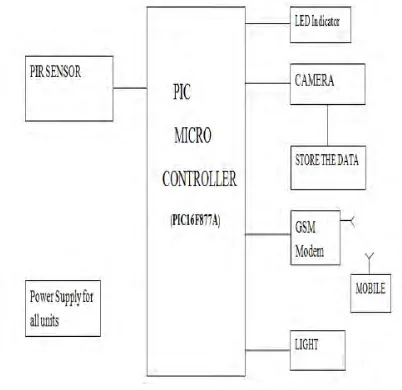
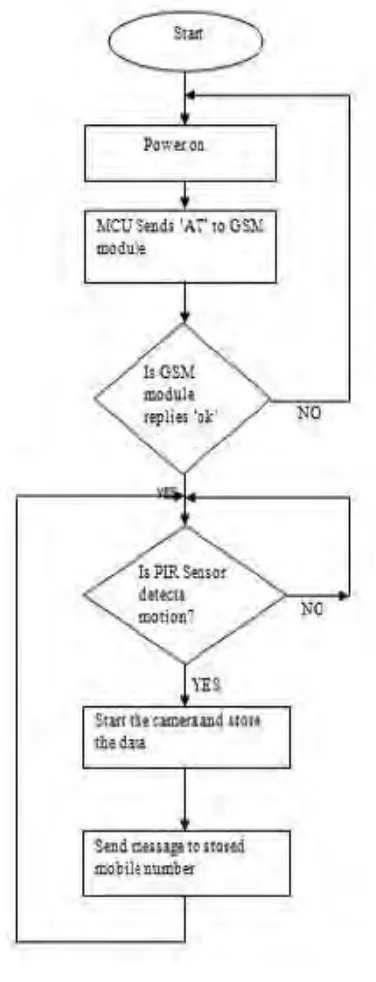
[image:23.595.236.437.497.692.2]In this project, researcher has developed a smart surveillance system using PIC16F877A as the fundamental microcontroller. For a movement detector, the PIR sensor was used and sensor will detect movement in a specific interval of time to see how many intruders. Researcher use GSM Modem to send SMS to homeowner. Once the system has been activated, the image of intruder will be recorded by camera. This highly reactive approach has low computational requirement (M.Sathishkumar & S.Rajini 2015). Figure show system architecture of the Smart Surveillance System using PIR Sensor Network and GSM.
Figure 2.0: System architecture.
7 Researcher has used PIC microcontroller because PIC is the first RISC based microcontroller fabricated in CMOS. Both combination of RISC and CMOS makes low power consumption in small chip size. CMOS also immune to noise compared with other. The PIC16F877 is flash technology and the data is retained even power is switched off.
Figure 2.1:Flowchart representation.