INFORMATION AS CORRELATION VS. INFORMATION AS RANGE: a proposal for identifying and merging two basic logical traditions
Johan van Benthem, Amsterdam & Stanford, December 2005
1 Two logical conceptions of information
Information is a ubiquitous term in everyday discourse, but not a particularly well-defined one. And even in scientific discourse, its formal definitions range from Shannon's information theory of bit transmission and channel capacity to Kolmo-gorov's information theory in terms of shortest algorithmic code driving some universal machine. In addition to these quantitative approaches, there is the great tradition of logic, as the study of meaningful assertions about semantic situations, with deduction or observation as ways of extracting information. 1
There may be one grand unifying mathematical theory lying behind all these perspectives – but 'information' may also just be a loose family term (cf. van Benthem 2006).
Indeed, there is already a striking diversity inside logic itself! One tradition casts information as being encoded in 'state spaces' that shrink as we learn more. This sense of information, initiated by Rudolf Carnap's Meaning and Necessity, is that of epistemic logic, pioneered by Jaakko Hintikka in 1962. Say, you hand me a sealed letter which contains either a raise or my dismissal. A set of two 'possible worlds' R, D encodes the information available in this scenario, where I do not know my fate. I can change my ignorance to knowledge by opening the envelope, shrinking the set {R, D} to just the actual one. The resulting paradigm of formal languages and logics has also crossed from philosophy into computer science and game theory (Fagin, Halpern, Moses & Vardi 1995, Osborne & Rubinstein 1994). One might call this conception of sets of the relevant alternatives: information as range.
But in the 1980s, Jon Barwise and John Perry introduced their 'situation theory' as a radically different logical view of information, taking crucial cues from Dretske's 1980 "Knowledge and the Flow of Information". On that approach, it is 'situations' and 'constraints' between them that typically lead to information flow. Consider a radar screen, where a light blinks if there are enemy planes approaching. A light flash on the screen contains the information that there is a plane in the correlated
1
situation outside. Barwise & Perry 1983, Devlin 1991, Barwise & Seligman 1995 are extensive studies of the resulting logical systems and their scope in philosophy, linguistics, and elsewhere. We call this conception: information as correlation. We will explore these two logical conceptions in more technical detail, compare them, and finally, merge them. Our tools for this are both modal and classical logic.
2 Information as correlation: situations and constraints
One key example of Barwise & Seligman 1995 describes two correlated situations. An observer at the foot of a mountain sees a light flashing. Given the right correlation, this gives her the information that there is someone in distress high up on the mountain. This example is indeed suggestive, and moreover, it is very old. Traditional Indian logic had the 'Syllogism of the Mountain Top':
There is smoke on the top of the mountain, Smoke means fire: Therefore, there is fire on the top of the mountain.
This shows how an observation made right here (S) allows us to deduce a fact (F) about another situation which is not accessible to direct inspection, provided some appropriate constraint holds (S F). Compare this with the Greek syllogism that
Socrates is a man, All men are mortal: Therefore, Socrates is mortal.
Here no situation shift occurs from one location to another, and we are in a special case of logical inference: viz. accumulating facts about one fixed situation.
Indeed, the traditional Indian syllogism had two more parts to its format, reflecting the fact that the minor premise needs suitable 'attachment' to some local situation of observation, while the conclusion needs attachment to the target situation. This set-up is reminiscent of the 'resource situation' and the 'situation described' plus various 'anchoring relations' in the situation-theoretic classic Barwise & Perry 1983.
Now what are 'constraints' in this multi-situation setting? First, it makes little sense to speak of information flowing between two situations if we are just comparing two isolated individual facts or events. In that case, one thing is true here, and another thing true over there - but we lack the 'strategic depth', so to speak, to talk about a connection. Information is always about multiple states of one or more situations. To make this multiplicity view of constraints more precise, consider the simplest case of two situations s1, s2, where s1 can have some proposition letter p either true
s1: p, s2:q s1: p, s2: ¬q
s1: ¬p, s2: q s1: ¬p, s2: ¬q
With all these present, one situation does not carry information about another, as p and q do not correlate in any way. A significant constraint on the total system arises only when we leave out some possible configurations. E.g., let the system be just:
s1: p, s2: q, s1: ¬p, s2: ¬q
Now, the truth value of p in s1 determines that of q in s2, and vice versa. Stated in a formula with some obvious notation, we have the truth of the following constraint:
s1: p s
2: q
But even a less constrained system with three instead of just two global confi- gurations allows for significant information flow:
s1: p, s2: q, s1: ¬p, s2: q, s1: ¬p, s2: ¬q
Presence of p in s1 still conveys the information that q in s2, but absence of p does
not convey information about s2. Again in a formula, we have the implication:
s1: p s
2: q
Contraposing the implication, absence of q in s2 tells us about absence of p in s1, but presence of q has no immediate informative value about s1. 2
Thus we have an essential network view of information beyond one-time facts. Correlation between different situations amounts to restrictions on the total state space of possible simultaneous behaviors. The more 'gaps' in that state space, the more information there is in the system, to be used by potential observers. 3
2
Of course, this can still be refined. E.g., presence of q in s2 also conveys information of a sort: it
tells us that the system is currently subject to the stronger constraint {s1: p, s2: q, s1: ¬p, s2: q}.
3
3 Modal logic of correlation
Constraint models The above setting can be modeled using state spaces of a
semantic sort which is ubiquitous in the literature. Let Sit be a set of primitive situations, which we will take to be finite in most of what follows. Let State be a set of local states that situations can be in. Each situation may have its own local states which are not necessarily the same as those for another. Without loss of generality, we will work with one total set though. A map from situations to states is called a global state of the system. Next, we single out some set C of global states, and call this the constraint. This regulates which total configurations of the system can occur at all. 4
Next, we encode further structure of local states. Let Pred be a set of predicates which local states, or tuples of such states can satisfy. This reflects a view that situations can have local properties like the above p, q, but also significant relationships, such as comparisons between them. We call the resulting structures
M = (Sit, State, C, Pred)
constraint models. Examples of such structures are the above models of situations where local states are partial valuations 5
, a format which would also cover the Mountain Top syllogism. Other examples will occur later: as we will see, properly understood, all models of first-order logic and epistemic logic have this structure. These semantic structures support a simple language for defining constraints.
Modal constraint language and logic We first define a language with names x for
situations (a tuple x stands for an ordered tuple of situations), and atomic assertions Px which express properties of or relations between situations. Over these, we have Boolean operations, plus a universal modality U
stating that
is true everywhere: Px | ¬ | | U
The semantic interpretation has obvious inductive clauses for the following notion:
M, s |=
is true in global state s of model M
4
At the same time, C can be used to rule out all undesired assignments of local states to situations.
5
In particular, we have that Px holds at s if the tuple of local states assigned by s to the tuple x satisfies the predicate denoted by P. This language allows us to express the earlier constraints, with formulas such as:
U(Px Qy).
The logic of this language over constraint models is quite simple: Fact Modal constraint logic is axiomatized completely by classical
propositional logic plus S5 axioms for the universal modality U.
This observation follows from a general theorem in van Benthem 1996, Ch. 10, that each standard relational model for a multi-agent version of S5 with equivalence relations for each agent is bisimilar to a constraint model. So, we find a standard base logic for stating constraints and reasoning about them, without any need for designing exotic new logic systems. Indeed, pursuing the modal analogy a bit further will boost expressive power of constraint reasoning in an interesting way. Local determination and extended constraint logic It seems plausible to say, in
line with our intuitive examples, that a situation x which satisfies p 'settles' the truth of p, plus all repercussions which this may have for other situations in the system. To bring this out, let us define the following relation between global states:
s ~x t iff s(x) = t(x).
This generalize in an obvious manner to a relation ~x for sets or tuples of situations
x by requiring equality of s and t for all coordinates in x. Accordingly, one can add
a set of modalities []x for each such tuple, which express intuitively that the
situations in x settle the truth of in the current system:
6
M, s |= []x iff M, t |= for each global state t ~x s
Constraint models satisfy the following persistence properties for atomic facts: Px []
xPx
¬Px []
x¬Px
This does not hold for all formulas, however. E.g., we do not necessarily have
6
In standard modal terms, the new modalities []x for sets or tuples x involve taking an intersection
of accessibility relations []x for single situations x. This is like 'distributed knowledge' for groups
[]xPx []
y[]xPx,
since accessible global states for x may change after a move in the y coordinate. This language can express more refined properties of the information available in the current model. One vivid way of thinking about it is by viewing situations as agents. The operators []x, []x then express what single situations or groups of
them may be said to know on the basis of inspecting their own local properties. This epistemic interpretation of constraint models will return below.
Again, the extended modal constraint language has a logic with obvious valid laws: Fact Modal constraint logic for the extended language Px | ¬ | | U | []x
is axiomatized completely by the simple fusion of the logics S5 for the universal modality U and all the local modalities []x, plus all
axioms of the forms U []
x , and []
x []
y whenever y x.
Moreover, this modal logic can be shown to be decidable by standard methods. Constraints and definability Constraints say that values for one situation are
correlated with those for another situation. Perhaps the strongest sort of constraint is functional dependency. We can say that x is functionally dependent on x in M if,
whenever two global states s, t in C agree on all values for x, they also agree on their value for x.
The strongest form of this again is when the local state of x has an explicit definition in some suitable formal language in terms of the local states for the x. The same definability may occur, not for local states s, t, ... directly, but at the level of atomic propositions p, q, ... true at them. Now Beth's Theorem in first-order logic tells us that functional dependency (or 'implicit definability') in all models for some given theory T is equivalent to explicit definability inside T. We do not pursue this angle here, but a taxonomy of natural types of dependency would be a useful thing to have – especially, since the term 'dependence' is used in a wide variety of senses. 7
7
4 First-order logic of dependence
Dependent variables So far, we have analyzed the information in a system of
situations in terms of 'correlations' and 'constraints'. Another, intimately related, way of describing this structure is in terms of dependency. Take the following analogy. Situations are like variables x, y, ... which can store values in the register with that variable as its address or label. A global state s is then a variable assignment in the usual first-order sense: i.e., a function assigning an object to each variable. Now standard first-order logic has no genuine dependencies between variables. In any assignment s, we can shift the value of x to some object d to obtain a new assignment s[x:=d], where all other variables have retained their s-value. This is the reason why first-order logic typically has validities like commutation of quantifiers:
x
y
y
x
The order of changing values is completely independent. But in many natural forms of reasoning, e.g., in probability theory, variables x, y can be dependent, in the sense that changes of value for one must co-occur with changes of value for the other. This phenomenon of dependence can be modeled in a first-order setting by using the same strategy as that of our constraint models (van Benthem 1996, Ch. 9, 10): General assignment models, language and logic A general assignment model is
a pair (M, VVV) with M a first-order model with object domain D and interpretation function I, and VVV any designated non-empty set of assignments on M, i.e., a subset of the total function space DVAR. The first-order language is interpreted as usual, now at triples M, VVV, s with s VV – with the following clause for quantifiers:
M, VVV, s |=
x iff for some t VVV: s =x t and M, VVV, t |=
Here =x is the standard relation between assignments of identity up to x-values. These models also support extensions of the standard first-order language. Examples are irreducibly polyadic quantifiers
x binding tuples of variables x:
M, VVV, s |=
x iff for some t VV: s =V x t and M, VVV, t |=
This time, =x is identity between assignments up to values for all the variables in x. In standard first-order logic, the notation
xy• is just short-hand for
x
y or
y
equivalent, as not all 'intermediate assignments' for x- or y-shifts need be present – and indeed, they are both non-equivalent to xy• as defined just now.
8
The modal/first-order logic of general assignment models is axiomatized by the standard axioms for poly-modal S5 plus all atomic 'locality principles'
(¬)Px y (¬)Px when x y =
(Marx & Venema 1997). Not universally valid are these standard first-order laws: [u/y] y with u free for y in Existential Generalization
(x) y
(x) with no y free in (x) Full Locality
These failures reflect the special handling of variables in models where not all assignments need be available. All of x, y, z, ... then acquire a sort of 'individuality', due to their possibly different interactions with other variables. We omit technical details here (cf. Németi 1996, van Benthem 1996, 2005), except for noting that
(a) the first-order logic of dependency models is not only axiomatizable, but even decidable, (b) this logic remains decidable even when we add
operators for smallest and greatest fixed-points.
Modal constraint logic embedded It should be clear that general assignment
models are very close to the earlier constraint models and their logic. But there is a difference in the accessibility relations ~x. With constraint models, these required equality of x-values, while all other values could differ, whereas general assignment models use the dual where the x-value may differ while all others remain the same. But this is equivalent via a simple switch. E.g., we can define the 'constraint variant' in a first-order logic with finitely many variables x = x1, .., xn as follows:
*
xi
:= x–{x
i}
Now, it is easy to see that the connection is very strong:
Theorem Extended modal constraint logic can be translated effectively into the polyadic first-order logic of dependency; and also vice versa.
8
Thus, we really have the same topic in two different guises! Dependency is a major issue in foundations of first-order logic these days (cf. van Lambalgen 1996, van Benthem 1996, Abramsky 2005, Väänänen 2005). Our analysis in the preceding passage shows that this fundamental theme is at the same time a move toward a general logic of information and constraints in the situation-theoretic sense.
In particular, we see that the core logic of dependency or constraints is decidable. Beyond this core, further principles of 'standard' first-order logic express special features of constraint spaces, which may or may not hold in particular applications. An example is the earlier commutativity law x y "!# y x . What it says is
that the constraint set should have a certain richness: Diamond Property If s ~x t ~y u, then there exists
another available assignment v such that s ~y v ~x u.
This expresses order independence. It does not matter how we travel through the space of available assignments, since alternative schedulings are always available. 9 The moral of dependency logic is that imposing such special constraints on global state sets can make them so much like full function spaces that the logic of independence becomes undecidable, with first-order logic as a warning example. 10
5 Information as range, and epistemic logic
Next, we consider the other logical tradition of information identified in Section 1, now in terms of ranges of options, and epistemic modalities describing these. This comes with a full-fledged research paradigm, of which we just sketch some basics. Epistemic language Consider this paradigm for an epistemic view of information:
I ask you: "P?", and you answer "Yes".
Initially, I did not know if P was the case, but you did. This may be pictured as
P me ¬P
Here P is the actual situation. In some obvious sense, this reflects two epistemic presuppositions of my question: (a) I do not know if P, and (b) I think (in fact, I
9
Computationally, this is related to so-called 'confluence properties' of rewrite procedures.
10
With standard modal languages, commutation axioms <x><y>$ % <y><x>$ give the power of
know) that you know whether P is the case. Your answer changes this situation, by eliminating the ¬P-world, which updates this 2-world model to the 1-world one
P
Here we both know that P, we also know about each other that we know it, and in fact, we have achieved what is called common knowledge of the proposition P. Epistemic logic has an explicit language for talking about knowledge:
Kj & agent j knows that &
¬Kj¬& 'or <j>& ( agent j considers it possible that &
Asking a normal question conveys I do not know if P: ¬KI P & ¬KI ¬P, and also that I think that you might know: <I> (Kyou P ) Kyou ¬P
* . There is a social aspect
here of knowing what others know. Common knowledge is even group knowledge sui generis. It says you and I know P, but also that we know this about one another, and so on to each finite depth of iterated knowledge, which is written as follows:
C{I, you} P
A special case With a single agent, models just become sets of possible worlds representing their informational range. For instance, the earlier system of situations
s1: p, s2:q s1: p, s2: ¬q
s1: ¬p, s2: q s1: ¬p, s2: ¬q
can also be viewed as a 4-world epistemic model, where some agent does not know which global state of the system actually obtains. The smaller model
s1: p, s2: q, s1: ¬p, s2: q, s1: ¬p, s2: ¬q
then encodes knowledge that p at s1 implies q at s2, while the still smaller model s1: p, s2: q, s1: ¬p, s2: ¬q
encodes knowledge of the strong correlation equivalence s1: p + s
2: q. We will
return to epistemic interpretations of constraint models in Sections 6, 7 below. Models and logic Models for this epistemic language are of the form
with S a set of worlds, V a valuation for atoms p, q, ..., and for each j- G, an
equivalence relation ~j relating worlds s to all worlds j cannot distinguish from it.
An agent j knows those . true in all worlds that she cannot rule out as options:
M, s |= Kj . iff M, t |= . for all t s.t. s ~
j t
A multi-S5 model (M, s) represents a collective information state for a group of agents, with an actual world s. The worlds form the total range of possible options for the actual state of affairs, structured by accessibility relations encoding agents' different information. The complete logic for these models is again poly-modal S5. Update, model change, and dynamic-epistemic logic Information increases by
updates of such models. In the simplest case, this works by eliminating worlds, and thereby zooming in on the actual world. More precisely, a public announcement of a proposition . changes the current model (M, s) as follows:
from . to
M, s s ¬. M|. , s s
That is: eliminate all worlds which currently do not satisfy .
Update actions are partial functions. If . is true in (M, s), then it can be truthfully
announced with a unique result (M|. , s). More complex updates arise with hiding of
information to some or all group members, or with partial powers of observation. 11 To describe updates explicitly, one can use a dynamic logic with modalities
[A!]. after public announcement of A, formula . holds.
Here is a key valid law of the dynamic-epistemic logic of public announcement, interchanging update actions and our knowledge about their informative effects:
[A!] Ki.0/ (A 1 K
i [A!] . ))
We refer to the literature for details (cf. van Benthem 2002). In particular, the basic logic of public announcement is still decidable: it has exactly the same complexity as poly-model S5, viz. Pspace-complete. But versions which also allow composition and iteration of announcements become undecidable (Miller & Moss 2005).
11
This concludes our quick sketch of basic concepts in the epistemic tradition. Epistemic logic in its modern guise revolves around actions that make information flow, mutual knowledge, and indeed interaction between agents. We will mainly disregard these social aspects in the rest of this paper – important though they are – and focus on single agents. In that case, epistemic models are just sets of worlds. We will pay attention to the dynamic aspect of informational events later on.
6 Merging the two sense of information: constraints and ranges
Information as correlation and information as range seem independent notions. The blinking dot on my radar screen has the information about an airplane approaching. But it does so whether or not I observe it. Whether I know that there is a blinking dot is an additional issue. It depends on whether I have observed the screen. Once I have made that observation S, and assuming I also know the right constraint S 2 A,
I will indeed also know that there is an airplane A. These distinctions are not always clear, because even correlationists tend to talk about correlation between situations s, t in terms like "once I know the current state of s, I always know the current state of t". But this muddies the waters, and the extent to which this talk makes sense can only be ascertained in a combined modal logic of constraints and knowledge. In this section, we will look at the static case first, without explicit actions of observation. Epistemic constraint models and their language Let us now consider a merged
epistemic constraint language, whose syntax has knowledge operators for agents: Px | ¬ | 3 | U | []
x | Ki
Epistemic constraint models are still of the form M = (Sit, State, C, Pred, ~i)
Interplay of knowledge and constraints We now have a setting for disentangling
correlation talk and range talk. Suppose that our model satisfies the constraint s1: p 4 s
2: q
in model M. Then the agent knows this, as the implication is true in all worlds in M. Now suppose that the agent knows that s1: p. In that case, indeed, the agent also
knows that s2: q, by the Distribution law of epistemic logic:
(K s1: p 5 K (s
1: p 4 s
2: q)) 4 K s
2: q
The converse requires some more thought. The point is not that the agent already knows that s1: p, but rather that, if she were to learn this fact, she would also know that s2: q. In dynamic-epistemic terms, we would express this as follows:
[!s1: p] K s2: q
This dynamic information about actions of learning is equivalent to the truth of the constraint. By the earlier-mentioned reduction axiom for dynamic-epistemic logic,
[!s1: p] K s2: q is equivalent to !s1: p 4 K [!s
1: p] s2: q, and this
again to s1: p 4 K (s
1: p 4 s
2: q), which makes K (s1: p 4 s
2: q)
true in our model in case the antecedent s1: p is true anywhere at all.
Our language can also formulate more delicate issues about situations and agents. E.g., what do agents know about the informational content of specific situations x? Suppose that []x6 holds at some world s, will the agent necessarily know this fact:
[]x6
4 7 []
x6 ?
The answer is negative, since []x6 can be true at some worlds, and false at others.
What a situation x 'knows' need not be known to an external agent, unless this agent makes an observation about x. Next, how does 'knowledge' of situations and of agents interact? This is answered by our general logic, at least if the single agent has a K behaving like the universal U. One can easily see that, then,
7 []
x6 the agent knows that 6 is enforced at x,
is equivalent to the inverted scope formula []x7
Both assertions are equivalent to just U8 .
12
Thus, a combined modal-epistemic logic can compare our two senses of information, and study their interaction.
A deeper merge of constraints and range? Our combined analysis so far omits a
striking technical analogy between constraint models and epistemic models. In the literature (cf. Fagin, Halpern, Moses & Vardi 1995), epistemic worlds are often taken to be vectors of 'local states' for individual agents, and epistemic accessibility between worlds s, t for an agent i is then just the above component-wise equality (s)i = (t)i. And this relation can be extended to ~i for groups of agents i, just as we
did in constraint models with the move from ~x to ~x. Indeed, as mentioned before,
van Benthem 1996 already showed that this vector view leads to the same epistemic logic, as every general epistemic model is bisimilar to a vector model. 13 Thus, we could also use one uniform vector format for our combined models!
In particular, this does the following to an earlier illustration. Consider once again
s1: p, s2: q s1: ¬p, s2: ¬q s1: ¬p, s2: ¬q
Let some agent i have an accessibility structure indicated by the black dotted line:
s1: p, s2: q s1: ¬p, s2: ¬q s1: ¬p, s2: ¬q
We can bring this into vector format by adding the agent as a further component. It can be in one of two states, matching the 2 equivalence classes in this picture:
s1: p, s2: q, i: state-1 s1: ¬p, s2: ¬q, i: state-1
s1: ¬p, s2: ¬q, i:state-2
The component-wise accessibility pattern is the same as in the preceding picture. 14
12
This matter is more complicated with many agents, and commutation need not hold then.
13
Essentially, one takes the equivalence classes of the relations ~i as local states for agents i, and
then identifies worlds s with vectors of their equivalence classes for each agent, checking that accessibilities between old and new worlds work out the same way. This construction works with Ki for single agents, but also for distributed knowledge Ki referring to intersections of separate ~i.
14
Without delving into details, there is clearly a general mathematical construction lurking in the background here. When two vector models are given, one for a con-straint model, and one for epistemic accessibility: what is their obvious 'product'? We will look briefly at such issues of structuring models in Section 10.
To summarize, we have seen that information as correlation and information as range co-exist happily inside one formal modelling, and that even in several ways.
7 Events and information change
Dynamic constraint models Correlations and constraint models also have a clear
dynamic aspect. We think of an evolving system in different global states that can change over time. The ground observation post remains in harmony with events on the mountain top over time. This temporal aspect can be dealt with implicitly by redefining situations as instantaneous time slices (x, t)of situations in the old style, and then just using the earlier constraint models. But it seems of interest to bring out temporal dynamics explicitly. One option for this is a dynamic logic of events that generate the runs of the system over time. The other would be a temporal logic of some temporal playground where the system can unfold. We will take the dynamic line, though the temporal one is quite feasible, too (cf. Parikh & Ramanujam 2002 on events and message passing). This time, we consider dynamic constraint models
M = (Sit, State, C, Pred, Event)
where events e are binary transition relations between global states. E.g., we may have had absence of a fire and a smoke signal, and then a combustion event takes place, changing the global state in our Mountain Top setting to (smoke, fire). 15 Dynamic constraint logic The language for these models combines the earlier
constraint language with event modalities from dynamic logic: Px | ¬ | 9 | U | []
x | [e]
Then, we interpret the dynamic modality in the usual modal style: M, s |= [e]: iff for all t with s R
e t: M, t |= :
This language still describes constraints on the current state, but also what happens as the system makes some moves in the space of all its possible developments.
15
The basic logic of this scheme is again a minimal modal logic, or a propositional dynamic one, if we add composition, choice and iteration as operations on events. More interesting information about developments arises when we specify effects of events more concretely. E.g., every event e has preconditions for its occurrence, and postconditions for its effects (cf. van Benthem, van Eijck & Kooi 2005), while it may also affect just a subset of all the available situations x. Such information can be formulated in the language, and it helps describe the effects of e more precisely. Observations and informative events In an epistemic setting, events also played a
role, as it is acts of observation or communication that change our information. The only type of informational event defined in Section 5 were public announcements. But general events have also been studied in a dynamic-epistemic setting, witness the given references, including public or private observations of various sorts. As before, we only consider a simple case. Suppose for convenience that some single-situation system can have 2 states, and we do not know if it is in state P or ¬P. Now we perform an observation, and we learn that it is in state P. This is not really an internal 'system event' in the preceding sense, since it affects some outside agent's view of where that system finds itself. We can treat such public observations !P in standard dynamic-epistemic style as changing the current constraint model M to its submodel M|P leaving only those states that satisfy P. This distinction between system-internal events and external observation-events can be implemented straight-forwardly in the combined epistemic constraint models of Section 6. The agent is trying to find out what the current state s is, though she also allows for the fact that s may change to t after system-internal events e. 16
An internal alternative Again, another viewpoint is possible. If we internalize the agents as in Section 5, making them part of the global state, then observations also become system-internal events, changing local states of part of the vector. In that setting, we may not want to view epistemic events as changing the current model. They rather change epistemic accessibility relations for some agents, resulting in different equivalence classes: more finely-grained ones, if our information grows. A closed system of situations-and-agents will incorporate all possible observations, and hence provide for new internal states corresponding to these observations. Dynamic logic of correlation and range Now let us collect all perspectives so far.
The following table collects our two basic conceptual contrasts:
16
correlation range
static constraint logic epistemic logic
dynamic dynamic constraint logic dynamic epistemic logic
Now these perspectives are not exclusive: they can be merged! Assuming a mixed setting including external observation events, we can define a combined language
Px | ¬ | ; | U | []
x | [e] | Ki
of dynamic epistemic constraint logic, whose models and semantics combine all truth conditions so far. This merged system serves all analytical purposes mentioned earlier. And it allows us to study interactions between all components: correlations, and ranges containing information, and dynamic events modifying these.
The logic of this total system may look complex, but it is still close to the first-order interpretation of Section 4. To demonstrate this, we formulate a final technical result. Fix some finite set of situations x, and some set of agents i. Choose first-order variables x1, .., xk of the right cardinality. Here is a translation of formulas < in our
dynamic epistemic constraint language to first-order formulas tr(< )(x
1, .., xk)
We choose some k-ary predicate letter G(x), and set
tr(Py) = P(xindex(y1), ..., xindex(yr)) with y = y1, .., yr
tr(¬< ) = ¬ tr(< )
tr(< ; = ) = tr(<> ; tr(= )
tr(U< ) = ? x: (G(x) @ tr(< ))
tr([]y < ) = ? u
all u in x – y: (G(y, u) @ tr(< )(y, u))
tr([e]< ) = ? x'(R
exx' @ tr(< )(x'/x))
tr(Ki< ) = ? x'(R
ixx' @ tr(< )(x'/x))
Theorem Dynamic epistemic constraint logic is faithfully embeddable into first-order logic (perhaps with fixed-points), and it is still decidable.
& Németi 1998. (b) Second version with 'poly-S5': equivalence relations required for epistemic accessibility. In this case, we need to add reflexivity, symmetry, and transitivity as axioms to make the tr-translation work. The first of these are guarded, but the third is not. Nevertheless, a modified translation can be used (see van Benthem 2005 for this trick) into the fixed-point extension LFP(GF) of the Guarded Fragment, by defining epistemic accessibility through transitive closure modalities. Graedel 1999 shows that this extended guarded language is still decidable. A
Thus even our most elaborate system of information flow is still close to a standard first-order language – and what is more, its core logic remains decidable!
8 Encore: the art of modeling
Our analysis has operated at a very global level. There is a lot of further interesting structure to situational constraint models and their various connections with epistemic range models. In this final section, which can be skipped by the reader without loss of continuity, we mention a few issues with a clear logical flavour. Relations between situations Why does one situation correlate with another?
Sometimes, this may be a matter of mere accident, just as funds in the stock market may have temporary and ill-understood correlations. But from this case, there runs a whole spectrum to cases of much stronger similarity. A watch keeps time because its stepwise operation is close to the unfolding of time generally. The strongest similarities are structural, and depend a more structured account of situations plus matching links between them. Best of all is a mathematical isomorphism between structured situations M and N, but weaker model-theoretic links are informative, too: say, modal bisimulation. The weaker the link, the less transfer of information. E.g., following Barwise & Seligman 1995, van Benthem 2000 studied 'infomorphisms' between situations 17 , and determined the precise first-order definable properties
17
For Barwise & Seligman, situations are pairs (O, T) of objects and types, where objects B C D
can have type tC T: written as o |= t. An infomorphism between two structures (O, T), (O', T') is a
pair of maps (f, g) with f going from O to O' and g backward from T' to T, such that for all o in O, t in T', we have that o |= g(t) iff f(o) |= t. Thus we can investigate an object o in a situation
preserved by them. But other model-theoretic relations between situations make sense, too, such as model extension moving us to larger situations. 18
One way of high-lighting such structure was given in an earlier version of this paper, with structured epistemic constraint models
M = (S, {Pi}i, {Rj}j, {~i}i)
Here, the R are arbitrary relations between the situations in S. This is also the abstraction level used in Barwise & van Benthem 1999 to define, amongst others, 'entailment along a relation' as a general situation-jumping style of inference, in line with our discussion in Section 2 of information in an s1 telling us about another s2.
The corresponding combined modal logic can express knowledge of facts in a situation (e.g., Kip), and also of constraints involving jumps to other situations (e.g.,
Ki(p E [R]q)), while distinguishing possible inference patterns such as
from Kip and p E [R]q to K
i[R]q
from Kip and Ki(p E [R]q)) to [R] K
iq
These inferences spread knowledge when constraints hold, or are known. The first is only valid when the constraint is known. The second requires a reversal principle
Ki [R]q E [R] K
iq
This says that knowledge about another situation persists when we move to that situation. Such a shift principle is typical for a combined modal-epistemic logic – and it suggests analogies with other fields such as the logic of games. 19 20
Product models: full, general, and radical Another theme left implicit in our
analysis are operations that construct new models, especially, those manipulating the structure of global states. We saw examples when combining epistemic structure and constraint models, and we also mentioned 'product update' for observed events
18
Barwise & Perry 1983 have proposed one new situated notion of consequence saying that truth of the premises in a situation s implies truth of the conclusion in some situation t extending s. 19
Ki[R]q F [R] K
iq is like Perfect Recall in logics for games (cf. van Benthem 2001). As a
condition on structured epistemic constraint models, it requires a commutative diagram for links between situations and epistemic uncertainty: G s, s', t': ( s R t H t ~
j t') FJI s': s ~
j s' H t R t').
20
in dynamic-epistemic logic. Indeed, many relevant operations take the form of products. E.g., Barwise & Seligman 1995 define the following full product of models M, N, which works as a sort of 'minimal merge' in the epistemic setting:
MxN has worlds as ordered pairs, accessibility is defined as: (s, t) ~i (s', t') iff s ~i t
and s' ~i t'. Atom p from M is true at (s, t) iff it is true of s, and likewise for N-atoms.
Full product models like this, with atoms referring only to components, do not incorporate any significant constraints on combination as such. This shows in their allowing for logical decomposition of truth. 21 Full product models have been studied in Gabbay & Shehtman 1998. They validate special epistemic-constraint axioms, including the above commutation principles: <>i<R>K L <R><>
iK M
More in line with our constraint models are general product models, being any submodel of a full models MxN – i.e., adding a constraint modelling some dependencies. Here, too, a few general logical preservation results are known. 22 The upshot is this. Any more precise definition of the pair restriction for the submodel helps reduce truth of properties in the generalized product.
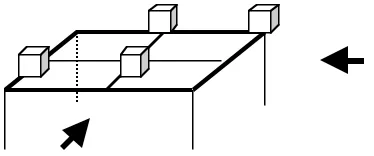
But there can be still more radical product models! Take the well-known example of the Table View (cf. Giunchiglia & Serafini 2002). A simplified 3x3 table top has 9 positions. On each of these, there can be a block or not. We can only observe two neighbouring sides of the table, say 'right' and 'front', each with three positions:
[image:20.595.178.365.459.537.2]We see a block there if there is at least one block in the corresponding line on the table top. In this particular picture, we would see
same t' would also be available to him right now modulo epistemic indistinguishability: N s, s', t':
(s ~j s' O s' R t') PJQ t: s R t O t ~
j t'). This is the modal implication <j><R>R P <R><j>R .
21
For any epistemic formula R , there is a Boolean combination BC(R ) of epistemic S T U over
only M, N such that MxN, (s, t) |=R iff BC(R ) holds for the truth values of the V in M, U in N.
22
E.g., if a first-order theory T is complete for a model class F, and T' for F', then the class of all submodels of direct products of models in F and F' is axiomatized by the universal Horn consequences of the union TW T'. There is also a modal version of this result. Typically, many
right no block, block, block front block, block, block
With such partial observation, sometimes, a side view tells us all about the top: e.g., 'no block' in the side view excludes blocks on its 3-point line at the top. But a block can come about for many reasons. This is not a product model in the earlier sense. The predicate 'block present' for ordered pairs (s, t) is not reducible to component predicates: it is sui generis. This was indeed the point of our relation set up with atoms Px for constraint models in the first place. But it does complicate the logic. 23
9 Conclusion
We have identified two distinct logical senses of information, as found in situation theory ('information as correlation') and in epistemic logic ('information as range'). Both views embody some valid and important insight into the nature of information. We have shown how both perspectives can be modeled in a modal style (Sections 3, 5), making it easy to then combine the two into one sensitive modal semantics for modeling information (Section 6), whose core is a decidable part of (surprisingly) first-order logic, when understood as a logic of dependence. One test case for the combination is that we can now make a further 'dynamic turn' – which makes sense on both conceptions of information – by adding explicit events that change the current situation, and/or our information about it, while still keeping the core logic decidable (Section 7). Finally, we showed how this merge of logical notions of information also raises some interesting new questions of model structure and construction at the interface of situation theory and epistemic logic (Section 8). Our discussion by no means exhausts this comparison between traditions. We left out prominent features of situation theory such as partiality, or channels mediating information flow between situations, while we also omitted physical events that change a current situation essentially qua structure. But the more important issue raised by this paper is not just framework comparison. We really hope to have high-lighted some general ways in which logic can serve as a theory of information.
23
10 References
S. Abramsky, 2005, 'Socially Responsive, Environmentally Friendly Logic', Computing Laboratory, Oxford University. Lecture at the 7th Augustus de Morgan Workshop, King's College London.
P. Adriaans & J. van Benthem, to appear, Handbook of the Philosophy of Information, Elsevier, North-Holland.
A. Baltag, L. Moss & S. Solecki, 1998, 'The Logic of Public Announcements, Common Knowledge and Private Suspicions', Proceedings TARK 1998, 43–56, Morgan Kaufmann Publishers, Los Altos. Updated versions, Indiana University, Bloomington, and Oxford University.
J. Barwise & J. Etchemendy, 1987, The Liar, Oxford University Press, New York. J. Barwise & J. Perry, 1983, Situations and Attitudes, MIT Press, Cambridge MA. J. Barwise & J. Seligman, 1995, Information Flow, the Logic of Distributed
Systems, Cambridge University Press, Cambridge.
J. van Benthem, 1992, 'Logic as Programming', Fundamenta Informaticae 17:4, 285-317.
J. van Benthem, 1996, Exploring Logical Dynamics, CSLI Publications, Stanford. J. van Benthem, 2000, 'Information Transfer Across Chu Spaces', Logic Journal
of the IGPL 8:6, 719-731.
J. van Benthem, 2001, 'Games in Dynamic Epistemic Logic', Bulletin of Economic Research 53:4, 219–248.
J. van Benthem, 2002, 'One is a Lonely Number: on the logic of communication', Tech Report PP-2002-27, ILLC Amsterdam. To appear in Proceedings Colloquium Logicum, Muenster 2002, AMS Publications, 2006. J. van Benthem, 2005, 'Information Is What Information Does', draft editorial,
Handbook of the Philosophy of Information, ILLC Amsterdam.
J. van Benthem & D. Israel, 1999, Review of Information Flow (J. Barwise & J. Seligman), Journal of Logic, Language and Information 8:3, 390–397. J. van Benthem, J. van Eijck & B. Kooi, 2005, 'Logics of Communication and
Change', Tech Report, ILLC, University of Amsterdam. Shorter version in R. van der Meyden, ed., Proceedings TARK 10, Singapore, 253--261. K. Devlin, 1991, Logic and Information, Cambridge University Press, Cambridge. H. van Ditmarsch, 2000, Knowledge Games, Dissertation, ILLC, University of
Amsterdam & Department of Computer Science, Groningen University. F. Dretske, 1981, Knowledge and the Flow of Information, The MIT Press,
H. van Ditmarsch, 2000, Knowledge Games, Ph.D. thesis, University of
Groningen. Dissertation DS-2000-06, Institute for Logic, Language and Computation, University of Amsterdam.
R. Fagin, J. Halpern, Y. Moses & M. Vardi, 1995, Reasoning about Knowledge, The MIT Press, Cambridge (Mass.).
D. Gabbay & V. Shehtman, 1998, 'Products of Modal Logics. Part I', Logic Journal of the IGPL 6, 73 – 146.
E. Grädel, 1999, 'The Decidability of Guarded Fixed Point Logic', in JFAK. Essays Dedicated to Johan van Benthem on the Occasion of his 50th Birthday (J. Gerbrandy, M. Marx, M. de Rijke, and Y. Venema, eds.),
CD-ROM http://turing.wins.uva.nl/~j50/cdrom/, Amsterdam University Press. F. Giunchiglia & L. Serafini, 2002, 'ML Systems: A Proof Theory for Contexts',
Journal of Logic, Language and Information 11(4): 471 – 518. J. Hintikka, 1962, Knowledge and Belief, Cornell University Press, Ithaca. M. van Lambalgen, 1996, 'Natural Deduction for Generalized Quantifiers,
In J. van der Does & J. van Eijck, eds.,Quantifiers, Logic and Language, CSLI Publications, Stanford.
J. Miller & L. Moss, 2005, 'The Undecidability of Iterated Modal Relativization', Studia Logica 97:3, 373-407.