This is a repository copy of New teams in general practice.
White Rose Research Online URL for this paper: http://eprints.whiterose.ac.uk/136923/
Version: Accepted Version
Article:
Hawthorne, K., Jackson, B. orcid.org/0000-0001-8207-6559 and Fisher, D. (2018) New teams in general practice. InnovAiT, 11 (9). pp. 506-512. ISSN 1755-7380
https://doi.org/10.1177/1755738018783786
© 2018 The Authors. This is an author produced version of a paper subsequently
published in InnovAiT. Uploaded in accordance with the publisher's self-archiving policy.
[email protected] https://eprints.whiterose.ac.uk/ Reuse
Items deposited in White Rose Research Online are protected by copyright, with all rights reserved unless indicated otherwise. They may be downloaded and/or printed for private study, or other acts as permitted by national copyright laws. The publisher or other rights holders may allow further reproduction and re-use of the full text version. This is indicated by the licence information on the White Rose Research Online record for the item.
Takedown
If you consider content in White Rose Research Online to be in breach of UK law, please notify us by
New teams in general practice
The NHS is seriously under-doctored, with general practice being one of the worst affected specialties. GPs are a highly trusted, valued profession amongst patients.
)n addition the gatekeeping function and continuity of care they provide is
critical to the efficiency of the services as a whole, keeps hospital admissions down, and produces better healthcare outcomes for communities and populations.
Major efforts are being made to recruit new GPs and retain existing GPs, but there are serious implications for the future of primary care and general practice in particular, as GPs struggle to cope with increased workloads. Increasing the number of GPs in the workforce is critical and this work continues as a priority. However, a parallel stream of work has developed to consider ways in which tasks
traditionally undertaken by a GP might be diverted to new healthcare professionals within primary care teams, freeing up GPs to concentrate on the care and management of their more complex patients.
The GP curriculum and new teams
Core statement 1.0: Being a GP Core capabilities and competences: Working with Colleagues and in Teams. This lists the learning objectives required for a GP, in particular GPs are required to:
Demonstrate the capability to lead and coordinate care at a team and, where appropriate, service level.
Contribute to a team culture that encourages contributions and values co-operation and inclusiveness, and which commits to continuing improvement and preserving a patient-centred focus
Appropriately seek advice from other professionals and team members in accordance with their roles and expertise
Anticipate and manage the problems that arise during transitions in care, especially at the interfaces between different healthcare professionals, services or organisations. Demonstrate the ability to work across these boundaries (e.g. by actively sharing
information and participating in processes for multi-agency review)
Support the transition of responsibility for patient care between professionals and teams through structured planning, coordination and appropriate communication channels
Core competence: Organisational management and leadership.
Recognise that leadership and management are core responsibilities of every doctor Recognise the importance of distributed leadership within health organisations,
which places responsibility on every team member and values the contribution of the whole team
Acknowledge the importance to patients of having an identified and trusted professional responsible for their care and advocate this by acting as the lead professional when required
What we were talking about is the fact that we re bloody drowning in work GP (Group 1). (Jackson, Marshall & Schofield, 2017).
that assumes GP work can be done by clinicians with far less training than a GP receives, our view is that these concerns can be addressed and we should welcome these newcomers warmly. We should support their development and supervision, in a way that ensures they can take some of the pressure off our working days, so that we can spend more time with patients who really need our levels of skill and expertise. This would also give us time to engage with the strategic development of our practices and services to communities, leading the delivery of primary care of the future. The College has consistently emphasised that the expansion of the wider practice team should complement, rather than replace, the expert skills of the GP and the drive to increase the GP workforce and that in order for successful integration to take place, appropriate arrangements for supervision, indemnity and regulation are required (RCGP 2018).
To give some examples from the authors experiences one works in an inner-city practice of 8,000 patients, with a high turnover of needy patients, many with complex medico-social histories. When working in open surgery - 40 patients may attend un-booked before 11am. Clinician time is better spent with the on-call GP seeing 20 patients and supervising another healthcare professional in an adjoining room (in this case, two paramedics), who triage or see up to 20 patients between them. Another is a partner in a practice serving 11,000 patients from deprived communities, which employs an advanced nurse practitioner, two emergency care practitioners and an experienced nurse who was previously a community matron. These staff work flexibly within the team to support access to triage, face-to-face appointments, care planning and home visits.
This article will recount the context in which these new health professionals are being introduced into the NHS, across all four devolved nations, explain their capabilities and skills, and how these can be usefully incorporated into the new 21st century primary care team.
Context of the NHS primary care workforce issues across the four
Nations
It is becoming increasingly obvious that targets set by the GP Forward View are unlikely to be achieved and that numbers of GPs are in fact falling rather than rising (NHS England, 2016; RCGP, 2017; NHS Digital, 2018). To maintain the GP workforce, it is estimated that we need up to 50% of medical graduates to become GPs (Department of Health, 2013), but only 35.8% of trainees entering directly into specialty training were appointed to general practice in 2017 (UKFPO, 2018). At the same time, many GPs are retiring in their mid to late 50s, as their workload becomes untenable and their pension allowances reach saturation, making it easier to leave the profession.
The Primary Care Workforce Commission s report, The future of primary care
the GPFV also committed to building and investing in the wider general practice workforce with a minimum of 5,000 staff by 2020/ 2021. The RCGP s annual assessment of progress in the GPFV work in England, found that there has been an increase of 2,896 FTE additional staff, after just one year (429 FTE nurses, 860 FTE staff working in direct patient care and 1,606 FTE admin/ non-clinical staff) (RCGP, 2017).
In Scotland, Wales and Northern Ireland, there have also been significant efforts to integrate wider practice team roles into general practice and to promote the benefits of multi-disciplinary working, with challenges across the different contexts (RCGP, 2018).
In 2013, the RCGP published a vision for general practice for 2022 (GP 2022, RCGP 2013), in which it describes how a move towards integrated care, in which traditional professional boundaries are broken down, will help transform our approach to delivery of care in order to address changing population needs.
Insert Box 1 here
Of importance is clarifying the difference between task substitution and role substitution in the general practice team the fundamental role of the GP remains central, but some of their tasks could be allocated to, or shared with, other members of the team. This includes some of the more administrative and time-consuming tasks, but also some clinical services, which can be competently performed by members of the expanding clinical team. HEE has developed an
Advanced Clinical Practitioner framework to deliver a single nationally agreed
definition for advanced roles for non-doctor practitioners and a clear career pathway into and within these roles (Box 1) (HEE, 2017). GPs are then freed up to spend more time with their more complex patients, and in strategic development of their practices and services to communities. The remainder of this article will be devoted to explaining some of these new roles and how existing roles might be extended within a GP-led, multi-disciplinary healthcare team.
New healthcare roles
how they fit into the
primary healthcare
team
Physician associates
qualified PAs develop their skills in a general practice employment setting. PAs have to re-take the national assessment every six years to show they have kept up with their on-going knowledge and maintained their competence at this baseline level, which means that they can move from one discipline to another relatively easily.
PAs can only work under the supervision of a medical practitioner. In general practice, they see patients in their own appointments but as dependent practitioners and are currently unable to prescribe independently. However, the outcome of the Department of (ealth s consultation on introducing regulatory arrangements for PAs is expected later this year; this could enable PAs to undertake further training in order to prescribe in the future. Some may already cover this in their training. PAs are also unable to order ionising radiation tests (eg XRays, CT scans etc). The scope of practice for any particular PA develops over time at the discretion of their named supervising GP, who carries overall responsibility for the PA. PAs can see patients of all ages for acute and chronic medical care. They can refer patients to consultants, admit patients and send them to A&E when clinically appropriate. Other duties can include home visits, prescription reauthorisations, review of incoming post and laboratory results. At the present time, with very few PAs working in general practice in the UK, there is limited evidence for their efficacy in this setting. Their inability to prescribe independently adds to the GP supervision time needed and reduces their cost-effectiveness. Anecdotally, the authors have had personal communications with GPs who have been very satisfied with the quality of work done by their employed Physician Associate colleagues, but it is still early days to be sure of their efficacy.
As with other roles, the named supervising GP does not have to be present at all times that the PA is working. Supervision can be structured in different ways but could include lunchtime meetings with the GP and the wider team, and ad hoc advice as needed. For those practices employing a PA, employers anecdotally say that they perform a very useful role because their training prepares them for a wider scope of illness than some of the other roles discussed in this article, adding to the clinical team, and reducing strain on GPs and appointment systems.
There are still very few PAs working in general practice, and many GPs are still uncertain how to use them (Jackson et al, 2017). The Faculty of PAs has recently
published An Employers Guide to Physician Associates PA which includes guidance for general practice settings (Faculty of Physician Associates, 2017).
Medical assistants/general practice assistants
government plans for expansion of these roles, and individual employers will determine uptake.
Familiar healthcare staff in new roles
Clinical pharmacists
Clinical pharmacists are qualified pharmacists with an additional postgraduate qualification, which allows them to take on more responsibilities as an expert in medicines and clinical practice in patient-facing roles. They are not expected to diagnose or manage new conditions. However, qualified pharmacists can undertake additional courses, after undertaking appropriate work experience, including history-taking, diagnosis and Independent Prescribing, for conditions within the competencies of their role. Following this additional training they can offer an enhanced service. They are regulated by the General Pharmaceutical Council (GPhC).
The clinical, community and hospital pharmacy roles are well established with scope for pharmacists to further develop clinical skills. Many practices across the UK now employ a pharmacist, with GPs recognising their benefits in terms of reducing workload, particularly in medication management and prescribing, although the role is still developing. As part of the GPFV, NHS England launched the Clinical Pharmacists in General Practice programme, which provides resources for practices to recruit, employ and further train Clinical Pharmacists for general practice settings. The Centre for Pharmacy Postgraduate Education are currently running the GP pharmacist training pathway for this.
Box 2, produced by RCGP Scotland and the Royal Pharmaceutical Society in 2016, sets out typical areas of responsibility:
Insert Box 2 here.
Advanced nurse practitioners and practice nurses
Advanced nurse practitioners (ANPs) are qualified nurses with at least three
years nursing experience who then take masters level training to become an
ANP. Although there is no standardised training, the Royal College of Nursing has worked with the RCGP to produce an ANP Competency Framework, mapping out the necessary skills needed (RCGP and Annie Barr Associates, 2015). The Nursing and Midwifery Council do not separately regulate ANPs from other nursing roles, but the Royal College of Nursing is now recognising training in advanced level nursing practice standards, which demonstrates these nurses are working at an advanced level (Royal College of Nurses, 2017).
range of patients within general practice and recognise a deteriorating patient and new co-existing medical conditions. They can order all investigations including ionising radiations, refer to most specialties and independently prescribe from the whole BNF, but are not able to sign death certificates or fit notes.
Paramedics
Paramedic training is based on a traditional medical model, applying emergency medicine principles of assessment and protection life support, stabilising patients and rapid transport to treatment. However, as the reasons for 999-callouts have substantially changed over the last few decades, paramedic education has adapted. Regulated by the Health and Care Professions Council (HCPC), paramedic training varies, from 2-4 years in length, with registration renewed every two years following mandatory CPD requirements.
As from 1st April 2018, paramedics are able to become independent prescribers
through advanced training (Human Medicines (Amendment) Regulations, 2018). Practices taking on paramedics have found that they adapt well to general practice, especially to acute/ triage duties and home visits. A guide for GPs considering employing a practice paramedic is being developed, including an outline of competencies and an exemplar job description that can be adapted for use by individual general practices.
Physiotherapists
Physiotherapists have a primary qualification in Physiotherapy, either as a three-year undergraduate programme, or with a two-year full time Masters following a relevant first degree. Physiotherapy training provides a basic understanding of a traditional medical model, but they are also holistically trained to look at how patients function in their own environment, and how to maximise support for this. They are regulated by the HCPC and can gain either supplementary (using a clinical management plan that has been agreed with a doctor) or independent (prescribing for any condition within their area of competence) prescribing rights with further training.
The RCGP has published guidance with the Chartered Society of Physiotherapy and the British Medical Association on General Practice Physiotherapy posts A
guide to implementation and evaluation. (RCGP, Chartered Soc Physiotherapy & BMA, 2016).
Indemnity
All members of the primary healthcare team taking on clinical roles need sufficient indemnity cover. Currently, arrangements depend on the circumstances of the
practice cover and the individual s contract and role As well as cover for the
the Department of Health announced its intention to develop a state-backed indemnity scheme for general practice. This cover would include the activities of practice staff, including non-GP clinicians working for the practice. The RCGP is involved in these discussions with the aim of ensuring that GPs and the practice team are sufficiently covered and is also calling for similar indemnity policies in the Devolved Nations.
Incorporating these new roles to improve primary care services
A key challenge is to clarify the contribution each role can make, noting areas of overlap, as well as variability and differences within and between each role. There is no central reference point or resource for practices, with many GPs asking each
other informally and on What sApp groups for help with job descriptions and
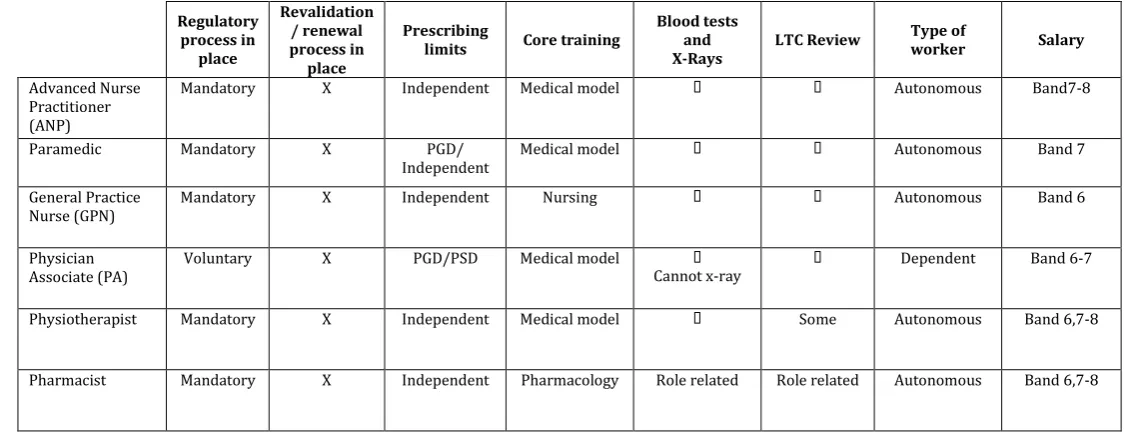
contracts. In a number of places (for example in South Yorkshire and Bassetlaw, https://sbywq.wordpress.com/2016/04/11/navigator/), materials have been developed with a series of practical role descriptions, competencies, career pathways, and other support (a draft competency matrix can be found in Figure 1). The RCGP is also considering developing a free-access repository of useful resources in its CPD Library, to enable practices to understand more about the potential these newer roles carry, and how best to use them within the Primary Health Care Team.
Insert Figure 1 here.
As the scope of work within individual primary care teams varies considerably already (depending on the skills, competencies and interests of existing team members and the requirements of the practices local population), being able to be creative and flexible in the skill mix of these new roles is important. This is particularly crucial given the solid supervisory relationship that needs to develop quickly, as the GP remains ultimately responsible for patient care.
Many of these roles will be the only one of their kind in the practice team, and care and forethought will be needed to ensure new team members feel welcomed as an integral part of the clinical team. Without this, there is a risk these members of staff may be professionally isolated or disenfranchised, and multi-disciplinary working will not be effective. One way to prevent this is to develop organised and structured preceptorships to induct new roles into teams, and to support them across practices in professional networks. For example, Health Education Kent, Surrey, and Sussex has supported the development of a School for Physician
Associates based at East Surrey (ospital in Reigate, which provides support and shared CPD across the region for qualified PAs.
How GPs roles will develop with new skill-mixes in practice teams
with very complex needs. As the population s health needs become increasingly complex, and more health-care is provided in the community, demand for GP expertise will continue to grow. GPs will therefore retain their essential 1:1 roles seeing patients in general practice, but with increasing importance given to the development of supervisory and leadership skills. The development of skills will need to cover the growing needs of the wider practice team in their new roles. As the Chief Executive of NHS England, Simon Stevens has said There is arguably no
more important job in modern Britain than that of the family doctor General
practice will remain key to maintaining quality patient care in the community in the UK and GPs leading teams providing generalist care will be central to this (GP Forward View, 2016).
We know from surveys of GP associates in training and newly qualified GPs that
many would like to develop a special interest that will bring them job satisfaction
and some resilience from the daily toil of long surgery appointment lists. Known
previously as GPs with a special interest or GPwS)s they are now called GPs
with extended roles Box 3). Insert Box 3 here.
Looking to the future, it is likely that doctors who were primarily trained in secondary care settings will work across boundaries in community and primary care, such as they already do in care of the elderly, psychiatry and community paediatrics, but also in other specialties such as respiratory medicine, gastroenterology, endocrinology and cancer care. The generalist expertise of GPs will be critical to help such doctors transfer and develop their skills and competence in a different context. GPs themselves may also cross boundaries, working in secondary care settings, using their skills in risk management and triage, and their broad-based training to diagnose and manage patients presenting to admissions units and A&E departments. Generally, new working relationships will be needed between health professionals as services develop.
What can we learn from overseas - international models of general practice
Many countries with comparable levels of economic development are diversifying the workforce in general practice and including other health professionals. In Sweden, for example, nurses, physiotherapists, occupational therapists and psychologists play an important role in primary care centres. Australia has also adopted a GP-led, team- based model of care, and some provinces in Canada have altered the way family practitioners are paid so that they can directly employ other practitioners such as nurses, pharmacists and mental health co-ordinators. Just as in the UK, Australia has also been moving towards consolidation of practices into larger organisations of practices, to address workload issues. Alternative ways of seeing patients, such as using telehealth consulting, are also being introduced in Australia (BMA International models of care, 2018).
served as a model for clinical commissioning groups in England. They have demonstrated the significant potential of organised general practice to enable innovation and expansion in the provision of care, with the development of more integrated services. In parallel, The Royal Colleges of General Practitioners, Paediatrics and Child Health, and Physicians in the UK have worked together to develop ideas and options for policy makers and commissioners on ways to move
care closer to home developing the concept of Teams without Walls RCP, RCPCH, RCGP, 2008). This is based on the concept of an integrated model of care, where professionals from primary and secondary care work together in teams, across traditional health boundaries, to manage patients and the patient journey using care pathways designed by local clinicians.
Conclusions
There are therefore considerable changes afoot in the way general practitioners will work in the future, and challenges to be met in terms of integrating new members of the healthcare team and developing the skills to work together for the maximum benefit of patients. It will require innovation and leadership from GPs and their colleagues in the NHS. However, the development and integration of these new roles into the general practice team have been largely perceived as a positive move. Strengthening the wider practice team, providing strategies to improve patient care and reduce GP workload through new models of team working, is a key aspect of plans to support primary care, alongside a key commitment to increase the GP workforce itself.
Key points
The NHS in 2018, and general practice in particular, is underfunded, under doctored and overstretched, with workload in general practice increasing
The NHS, supported by the RCGP, (GP 2022, the 5 Year Forward View and GP Forward View) are implementing strategies to both recruit and retain more GPs
A number of new types of clinicians (eg. physician associates) are being introduced into the primary care services, together with some new roles for existing clinicians that require extra training and new skills
Our work as GPs will change; we will still spend the majority of our clinical time seeing patients with complex problems, but we will need to develop new skills relating to supervision and leadership
To cope with workload and bureaucracy, GPs need wider teams with new skills and responsibilities for less complex patients and some of the routine administrative tasks
These new healthcare workers will not displace GPs but may enhance the
primary care team and enable us to spend more doctor time with our
patients
BMA (2018). International models of general practice. Available at: www.bma.org.uk/collective-voice/policy-and-research/nhs-structure-and-delivery/international-models-of-general-practice (accessed 29 April 2018)
Department of Health (2012) Competence and Curriculum Framework for the Physician Assistant 2012. Available at: www.fparcp.co.uk/employers/guidance (accessed 29 April 2018)
Department of Health (2013) A mandate from the Government to Health Education England: April 2013 to March 2015. Available at: www.gov.uk/government/publications/health-education-england-mandate (accessed 29 April 2018)
Faculty of Physician Associates (2017). An Employers Guide to Physician Associates (PA). Available at: www.fparcp.co.uk/employers/guidance (accessed 29 April 2018)
Health Education England (2017). Advanced Clinical Practice. Available at:
www.hee.nhs.uk/our-work/advanced-clinical-practice/multi-professional-framework (accessed 29 April 2018)
Jackson, B., Marshall, M., Schofield, S. (2017). Barriers and facilitators to integration of physician associates into the general practice workforce: a grounded theory approach. British Journal of General Practice, 67(664):e785-e791. doi: 10.3399/bjgp17X693113
NHS England (2016). General Practice Forward View. Available at: www.england.nhs.uk/wp-content/uploads/2016/04/gpfv.pdf (accessed 29 April 2018)
NHS Digital (2018), General and Personal Medical Services, England As at 31 December 2017, Provisional Experimental statistics. Available at: www.digital.nhs.uk/catalogue/PUB30207 (accessed 29 April 2018)
RCGP. Core statement 1: Being a GP. Available at:
www.rcgp.org.uk/training-exams/training/gp-curriculum-overview/online-curriculum/1-being-a-gp.aspx (accessed 29 April 2018)
RCGP (2013). The 2022 GP A Vision for General Practice in the future NHS. London: Royal College of General Practitioners. Available at:
www.rcgp.org.uk/policy/rcgp-policy-areas/general-practice-2022.aspx (accessed 29 April 2018)
RCGP (2014). http://www.rcgp.org.uk/clinical-and-research/resources/a-to-z-clinical-resources/general-practitioners-with-extended-roles.aspx
RCGP (2017), GP Forward View Assessment of progress Year 1. Available at:
www.rcgp.org.uk/policy/general-practice-forward-view.aspx (accessed 29 April 2018)
RCGP (2018). An RCGP position statement on the wider clinical team in general practice. Available at: www.rcgp.org.uk/policy/rcgp-policy-areas/multi-disciplinary-teams.aspx (accessed 29 April 2018)
RCGP and Annie Barr Associates (2015). General Practice Advanced Nurse Practitioner Competencies. London: Royal College of General Practitioners and Annie Barr Associates. Available at:
https://sybwg.files.wordpress.com/2017/02/rcgp-np-competencies.pdf
www.rpharms.com/Portals/0/RPS%20document%20library/Open%20access/Policy%20state ments/rcgps-rps-joint-statement-on-general-practice-based-pharmacists.pdf (accessed 29 April 2018)
RCGP, Chartered Society of Physiotherapy and British Medical Association (2016). General Practice Physiotherapy posts A guide for implementation and evaluation. Available at: www.csp.org.uk/publications/implementing-physiotherapy-services-general-practice-guide-implementation-evaluation (accessed 29 April 2018)
Royal College of Physicians, RCGP, and Royal College of Paediatrics and Child Health (2008). Teams without Walls. The value of medical innovation and leadership. Available
at:www.rcpch.ac.uk/system/files/protected/page/teams-without-walls.pdf (accessed 29 April 2018)
Box 1. Framework definition of advanced clinical practice.
Advanced clinical practice is delivered by experienced registered health and care practitioners It is a level of practice characterised by a high degree of autonomy and complex decision-making. This is underpinned by a master s level award or equivalent that encompasses the four pillars of clinical practice, leadership and management, education and research, with demonstration of core capabilities and area specific clinical competence. Advanced clinical practice embodies the ability to manage clinical care in partnership with individuals, families and carers.
It includes the analysis and synthesis of complex problems across a range of settings, enabling innovative solutions to enhance people s experience and improve outcomes
Source: Health Education England 2017
Box 2. Roles taken by Clinical Pharmacists - Joint Policy Statement on General Practice
Based Pharmacists by RCGP Scotland and the Royal Pharmaceutical Society, 2016. Needs permission
Face to face medication review to improve patient outcomes by:
Reducing inappropriate polypharmacy
Reviewing patients on high-risk medications
Ensuring complete and accurate medication records including medicines prescribed out of the practice
Supporting patients through changes post-discharge and moving between care settings.
Encouraging and supporting people with long-term conditions to manage their medicine.
Other areas include:
Contributing to multi-professional reviews
Point of contact for medicines information within the practice
Relevant/ appropriate contribution to triage and treatment of common clinical conditions
Dealing with queries on prescribing and authorising repeat supplies when appropriate and if within their competency
Dealing with patient concerns re intolerance/ adverse reactions
Resolving issues arising from medicines reconciliations
Box 3. RCGP Definition of GPs with Extended Roles
GPs with Extended Roles (RCGP Council Sept 2014)
The RCGP Guide to the Revalidation of General Practitioners defines extended practice as: - An activity that is beyond the scope of GP training and the MRCGP, and that a GP
cannot carry out without further training or;
- An activity undertaken within a contract or setting that distinguishes it from standard general practice or;
- An activity offered for a fee outside of care to the registered practice population (teaching, training, research, occupational medicals, medico-legal reports, cosmetic procedures, etc).
It has been suggested that there are additional factors that might also extend the definition:
A GP undertaking work that currently attracts an additional or separate medical
Figure 1: Draft key characteristics matrix
Regulatory process in
place
Revalidation / renewal process in place
Prescribing
limits Core training
Blood tests and X-Rays
LTC Review Type of
worker Salary
Advanced Nurse Practitioner (ANP)
Mandatory X Independent Medical model Autonomous Band7-8
Paramedic Mandatory X PGD/ Independent
Medical model Autonomous Band 7
General Practice Nurse (GPN)
Mandatory X Independent Nursing Autonomous Band 6
Physician Associate (PA)
Voluntary X PGD/PSD Medical model Cannot x-ray
Dependent Band 6-7
Physiotherapist Mandatory X Independent Medical model Some Autonomous Band 6,7-8
Pharmacist Mandatory X Independent Pharmacology Role related Role related Autonomous Band 6,7-8
Key
X indicates that the characteristic is found within the role.
Where a characteristic is indicated, this may require additional training beyond the initial qualifications for the accredited role.
Patient Group Directions (PGD), Patient Specific Directions (PSD)
Source: Adapted from draft K C P C W J H S CCG
NB Salary Bands are based on Agenda for Change