IDENTIFICATION OF LATERAL TRANSFER DISTANCE THAT
MINIMIZES TWISTING AND BENDING MOTIONS IN
WORKSTATION DESIGN
This report submitted in accordance with requirement of the University
Teknikal Malaysia Melaka (UTeM) for the Bachelor Degree of
Manufacturing Engineering
(Department of Manufacturing Design)(B.Eng)
by
Lee Poh Yan
B051410035
930508-08-5246
DECLARATION
I hereby, declared this report entitled “Identification of Lateral Transfer Distance that Minimizes Twisting and Bending Motions in Workstation Design” is the results of my own
research except as cited in reference.
Signature
:
Author’s Name : LEE POH YAN
APPROVAL
This report is submitted to the Faculty of Manufacturing Engineering of
Universiti Teknikal Malaysia Melaka as a partial fulfilment of the
requirements for the degree of Bachelor of Manufacturing Engineering
(Department of Manufacturing Design) (B.Eng).
The member of the supervisory committee is as follow:
……….
I
ABSTRAK
II
ABSTRACT
III
DEDICATION
Only
my beloved father, Lee Chee Meng my appreciated mother, Khor Sew Tiam
my adored sisters, Poh Ching, Poh Yin, Poh Wei and Poh Sheen
IV
ACKNOWLEDGEMENT
I would like to express my special thanks of gratitude to my supervisor, Dr. Radin Zaid bin Radin Umar for the dedication in mentoring and guiding me throughout the study. He always welcomes me to discuss or brainstorm for solutions of the problems or question regarding my experiment or thesis. He unswervingly allowed this study to be my own work, but lead me to the right direction whenever I out of track.
I would also like to thank the experts who were involved in the exploitation use of the human motion capture system in this study, Encik Nazreen. Without his willingness partaking and sharing, the experiment could not have been successfully conducted.
Last but not least, I am grateful with the cooperation given by the technician of the ergonomics lab for providing me an ambient room to conduct the experiment comfortably. Also, to all of the volunteers for agreed to be the subject of this study to ensure the experiment could be conducted.
V
Table of Contents
Abstrak ... I Abstract ... II Dedication ... III Acknowledgement ... IV List of Tables ... VII List of Figures ... VIII List of Abbreviations ... XI
CHAPTER 1: INTRODUCTION
1.1 Background ... 1
1.2 Problem Statement ... 3
1.3 Objectives ... 4
1.4 Scopes ... 4
1.5 Significant of Study ... 4
1.6 Organizations of Report ... 5
CHAPTER 2: LITERATURE REVIEW 2.1 Work related Musculoskeletal Disorders ... 7
2.2 Awkward Posture ... 9
2.2.1 Back Bending and Twisting ... 10
2.3 Lateral Transfer Distance Workstation Layout ... 14
CHAPTER 3: METHODOLOGY 3.1 Introduction ... 17
3.2 Project Planning ... 18
3.2.1 Phase 1 ... 19
3.2.2 Phase 2 ... 19
3.2.1 Apparatus Preparation ... 20
3.2.2 Variables in Experiment ... 22
VI
3.2.4 Sample Space ... 25
3.3 Phase 3 ... 26
3.3.1 Mathematical Steps for Qualitative Data... 26
CHAPTER 4: RESULT AND DISCUSSION 4.1 Result ... 28
4.1.1 Visual Postural Assessment ... 28
4.1.2 Statistic Quantitative Analysis ... 31
4.2 Discussion ... 54
4.2.1 Visual Postural Assessment ... 54
4.2.2 Statistic Quantitative Analysis ... 55
CHAPTER 5: CONCLUSION AND RECOMMENDATIONS 5.1 Conclusion ... 56
5.2 Sustainable Design and Development ... 56
5.3 Recommendation ... 57
REFRENCES ... 58
APPENDICES AppeGantt chart of FYP 1 ... 65
BppeGantt chart of FYP 2 ... 66
CppeDegrees of twisting and bending (Subject 1) ... 67
DppeDegrees of twisting and bending (Subject 2) ... 71
EppeDegrees of twisting and bending (Subject 3) ... 75
FppeDegrees of twisting and bending (Subject 4)... 79
GppeDegrees of twisting and bending (Subject 5) ... 83
HppeDegress of twisting and bending (Subject 6) ... 87
Ippe Degrees of twisting and bending (Subject 7) ... 91
Jppe Degrees of twisting and bending (Subject 8) ... 95
KppeDegrees of twisting and bending (Subject 9) ... 99
KppeDegrees of twisting and bending (Subject 10) ... 103
VII
LIST OF TABLES
Table 2.1: Number of accidents by the location of injuries for the year 2010, 2011, 2012,
2013, and 2014. ... 8
Table 4.1: Degrees of twisting and bending (Subject 1) ... 31
Table 4.2: Degrees of twisting and bending (Subject 2) ... 33
Table 4.3: Degrees of twisting and bending (Subject 3) ... 34
Table 4.4: Degrees of twisting and bending (Subject 4) ... 35
Table 4.5: Degrees of twisting and bending (Subject 5) ... 36
Table 4.6: Degrees of twisting and bending (Subject 6) ... 37
Table 4.7: Degree of Twisting and Bending (Subject 7) ... 38
Table 4.8: Degree of Twisting and Bending (Subject 8) ... 39
Table 4.9 Degree of Twisting and Bending (Subject 9) ... 40
Table 4.10 Degree of Twisting and Bending (Subject 10) ... 41
Table 4.11: Mean and Standard Deviation (Twisting) ... 47
Table 4.12: Mean and Standard Deviation (Bending) ... 49
Table 4.13: Mean and Standard Deviation (Maximum’s Value) ... 50
VIII
LIST OF FIGURES
Figure 1.1: Relationships workplace factors, individual factors, and effects within-person. 2
Figure 2.1: Awkward Posture Modal ... 9
Figure 2.2: Definition of Four Codes for the Back Postures in the OWAS System ... 10
Figure 2.3: Bending forward schematic ... 11
Figure 2.4: Twisting schematic ... 11
Figure 2.5: Manual Handling of Loads Postures ... 12
Figure 2.6: Maximum twisting trunk moment as a function of velocity condition and trunk posture. (CCW: counter-clockwise; CW: clockwise)... 13
Figure 2.7: Lumbar flexion (% maximum), total bending moment, and bending moment resisted by the passive tissues of the spine when lifting. ... 14
Figure 2.8: The Scope of Human Factors Engineering ... 15
Figure 2.9: The spine kinematic measures showing significant main effects for transfer distance in either the picking and placing phases (LBV = lateral bending velocity, EV = extension velocity, and Twist=degree of twisting) ... 16
Figure 3.1: Project Planning ... 18
Figure 3.2: A4 paper box with handle to hold the weight ... 20
Figure 3.3: Piles of paper as the load ... 20
Figure 3.4: Wood benches as the workstation ... 20
Figure 3.5: Measuring tape to measure body dimension ... 21
Figure 3.6: Cloth tape to mark bench position ... 21
Figure 3.7: Weighing scale to measure human weight and load ... 21
Figure 3.8: Experiment setup layout... 22
Figure 3.9: Aligning box with the bench’s edge ... 23
Figure 3.10: The subject stand in-between two benches ... 23
Figure 3.11: Direction of Transfer Process ... 24
Figure 3.12: Subject hold box using the handle ... 24
IX
Figure 3.14: Angle between 2 lines ... 26
Figure 3.15: Forward Bending Angle ... 27
Figure 4.1: Postural view of 0.5m ... 29
Figure 4.2: Postural view of 0.75m ... 29
Figure 4.3: Postural view of 1.0m ... 30
Figure 4.4: Postural view of 1.25m ... 30
Figure 4.15: Degree of Twisting (50cm) ... 42
Figure 4.16: Degree of Twisting (75cm) ... 43
Figure 4.17: Degree of Twisting (100cm) ... 43
Figure 4.18: Degree of Twisting (125cm) ... 44
Figure 4.19: Degree of Bending (50cm) ... 45
Figure 4.10: Degree of Bending (75cm) ... 45
Figure 4.211: Degree of Bending (100cm) ... 46
Figure 4.212: Degree of bending (125cm) ... 47
Figure 4.13: Mean and Standard Deviation (Twisting) ... 48
Figure 4.14: Mean and Standard Deviation (Bending)... 49
Figure 4.15: Mean and Standard Deviation (Maximum’s Value) ... 50
Figure 4.216: Visual Postural Assessment ... 54
Figure 4.5 (a): Degree of Twisting (Subject 1) ... 32
Figure 4.5 (b): Degree of Bending (Subject 1) ... 32
Figure 4.6 (c): Degree of Twisting (Subject 2) ... 33
Figure 4.6 (d): Degree of Bending (Subject 2) ... 33
Figure 4.7 (e): Degree of Twisting (Subject 3) ... 34
Figure 4.7 (f): Degree of Bending (Subject 3) 34
Figure 4.8 (g): Degree of Twisting (Subject 4) ... 35
Figure 4.8 (h): Degree of Bending (Subject 4) ... 35
Figure 4.9 (i): Degree of Twisting (Subject 5) ... 36
Figure 4.9 (j): Degree of Bending (Subject 5) 36
Figure 4.10 (k): Degree of Twisting (Subject 6) ... 37
Figure 4.10 (l): Degree of Bending (Subject 6) 37
Figure 4.11 (m): Degree of Twisting (Subject 7) ... 38
X
Figure 4.12 (o): Degree of Twisting (Subject 8) ... 39
Figure 4.12 (p): Degree of Bending (Subject 8) ... 39
Figure 4.13 (q): Degree of Twisting (Subject 9) ... 40
Figure 4.13 (r): Degree of Bending (Subject 9) ... 40
Figure 4.14 (s): Degree of Twisting (Subject 10) ... 41
XI
LIST OF ABBREVIATIONS
HFE - Human Factors Engineering
MMH - Manual Material Handling
MSD - Musculoskeletal System Disorder
NIOSH - National Institute of Occupational Safety and Health
OWAS - Ovako Working Posture Analysing System
SOCSO - Social Security Organisation
1
CHAPTER 1
INTRODUCTION
1.1 Background
Work-related Musculoskeletal Disorders (WMSDs) are defined as the pain, injury, or damage particularly on the muscular system (i.e. muscles, tendons, ligaments, bones, nerves, veins, disks, etc.) and that influence body motion due to work (Wang, D., Dai, F., & Ning, X., 2015). The common WMSDs are muscle/ tendon strain, ligament sprain, back and neck pain and hand tendonitis. Workers that repeatedly involve with manual material handling (MMH) are vulnerable to the risk of WMSDs.
Every organization needs to aware of the potential risk factors of WMSDs at their workstation as the number of recorded cases has been rising in Malaysia. Total of 14 recorded cases in the year of 2006 and has risen sharply to 238 recorded cases in the year of 2010 (Sharifah Raini, 2013; Xiang Yun, 2012). In the same article, National Institute of Occupational Safety and Health (NIOSH) chairman Tan Sri Lee Lam Thye state that the number continue to rise to 268 recorded cases on the following year, 2011. There are many aspects of studying in order to reduce the risk of WMSDs. Despite, the proper design of workstation layout is crucial as many other factors might affect along too.
Moreover, a total of 675 accidents associated with occupational musculoskeletal disorders reported in the annual report year 2014 by Social Security Organisation Malaysia (Social Security Organisation[SOCSO], 2014). In addition, it compromises total of 416 reports and 259 reports, for male workers and female workers respectively. It shows that the rate of WMSD among Malaysian workers is in high rate and needs immediate action to be taken.
2 Workplace Factors
Physical Loads Workstation Layout
Organizational Factors MatchPoor
Individual Factors Work-related abilities & skills
(including physical conditioning. age, gender)
Personality, genetic vulnerabilities, etc
Effects within Person
High biomechanical load Stress Response:
- autonomic - endocrine - behavioural Fatigue, reduced internal
tolerance
Tissue Damage and/or Pain
Work Performance
- Poor Quality of Work - Absenteeism
- Low Productivity
[image:16.595.99.508.66.430.2]
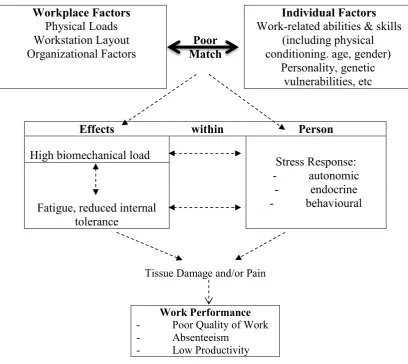
Figure 1.1: Relationships workplace factors, individual factors, and effects within-person
Workplace factors are subdivided into physical loads, workstation layout, and organizational factors. If these factors do not match with the worker’s traits, it may lead to tissue damage and/or pain. These damages could bring major adverse effect the performance and quality of work. The fundamental principal in workstation design is to fit the layout to the workers (Anshel, 2005). Good design of workstation layout is a way to increase productivity, improve quality, and promote worker health and safety. It also reduces the exertion force needed of the worker to support their task.
3
worker to possess twisting posture. Contradictory, the worker might possess bending posture if the gap is too big.
Both twisting and bending posture are the two main contributors to WMDSs in manual handling tasks (Zein, R. M. et al., 2015). The awkward postures like bending and twisting are the major cause of strains and sprains of the back, arms, and shoulders (Bending, Twisting & Reaching, 2011). Proper design of workstation layout promote good postures and thus the alignment of the bone is upright as well as the muscles, joints and ligaments could work at its nature state without sprain or strain (Chris Woolston, 2016). Long term of experiencing pain due to sprain and strain could adverse body health and lead to permanent WMSD.
1.2 Problem Statement
Ideally, the most ergonomic workstation is a fully adjustable workstation as it fit everyone regardless the physique size or shape (Anshel, 2005). However, in a certain situation, the workplace is challenging to be fully adjustability due to cost and design constraints. The parameters of the workplace layout must be set at the beginning before the operations start. Most of the job routine involves transfer process of loads. Thus, lateral transfer distance is one of the vital parameters in the workstation design. Neither research was performed that able to state the optimum lateral transfer distance that minimizes twisting and lateral bending motions of the spine in workstation design in Malaysia.
4 1.3 Objectives
a) To understand design parameter in the workstation layout affecting the posture of workers in manual material handling.
b) To explore the effect of lateral distance to the working posture in manual material handling.
c) To identify the potential optimum lateral transfer distance that minimizes twisting and bending in Malaysia workstation design.
1.4 Scopes
The study is an approach towards the design of the workstation layout. The research would focus on how the lateral distance affects the postures of human body particularly on twisting and bending posture. Adhering to the objective stated, the subjects involved in the study are Malaysian only. Only subjects that do not experience any back pain or related MSDs injury are eligible to perform the experiment.
The study is performed in the experimental based whereby the setup will imitate the desired workstation layout of manual material handling. Both, the weight of the load and the height of the destination conveyor act as the controlled variables. The dimension of the box will also be constant and is not the manipulators in this study.
1.5 Significant of Study
5
Determining the optimum lateral transfer distance could reduce the outstanding expenditures of WMSDs that result from poor ergonomics. Thousands of compensation claims being made each year. The reduction of the WMSDs severity due to the ergonomic interventions could reduce the injury cost (Goggins, R. W. et al, 2008). Optimum lateral transfer distance could minimize the risk of injury, sprain or strain of the musculoskeletal system as it manipulates the posture of the workers. The outcome is beneficial in a varied aspect in the terms of ergonomic in the workplace.
1.6 Organizations of Report
Chapter 1: Introduction
This chapter provides general information regarding the context of the whole study about. It provides a clear statement of the subjects, problems or controversy arise in this study. It also states the reason for this study undertaken and the objectives to be achieved in the end. The extent of the contents or focus to be covered will be specified at this part. It states the areas and limitations in this study context. The outcome of the study is also express.
Chapter 2: Literature Review
This chapter discusses the theories, ideology, and understanding of any relevant information concerning the study. Bounteous sources studies acquire from the past such as journals, books, articles, research papers, etc in order to gain knowledge on this study. Annotations and the relationship between WMSDs and workplace are being resolved at here. The explanatory notes on the design of experiment in this study are being clarified as well.
Chapter 3: Methodology
6 Chapter 4: Results & Discussion
This chapter presents the results or findings obtained from the experiment. It comments on the results obtained and interpreting what the results mean. These data is present in the statistical chart to ease the comparison and the explanation of any results. The discussion section of the reports woven the findings together and the major issues/ themes are identified and discussed. It aims to distinguish the main project findings with the results obtained.
Chapter 5: Conclusion and Recommendations
7
CHAPTER 2
LITERATURE REVIEW
2.1 Work related Musculoskeletal Disorders
Workers that engage to (MMH) in their job routine are in the risk exposure to injuries. The Canadian Centre for Occupational Health and Safety (MMH - Health Hazards, 2013) explain MMH whereby the transferring or handling materials process is by lifting, lowering, pushing, pulling, carrying, holding or restraining. The works involve manual labour rather than automated system Continual high exposure MMH that exceeds one’s capabilities may develop into work-related musculoskeletal disorders (WMSDs) over time.
The term of musculoskeletal disorders (MSDs) signify ache, soreness, sprain or strain endure at the joints, ligaments, tendons, muscles or bones including the associated circulatory system and neurology (Seim, 2015). WMSDs imply developing of MSDs by the cause of the task itself or the workplace. The main contributors to WMDSs are repetitive motion, heavy lifting, forceful exertion, awkward posture and expeditious hand and wrist motion (Shamsuddin, K. A. et al., 2014). The correlation of these factors with the workplace design (e.g. workstation height, space, distance to travel, the angle of movement, etc.) is strong.
8
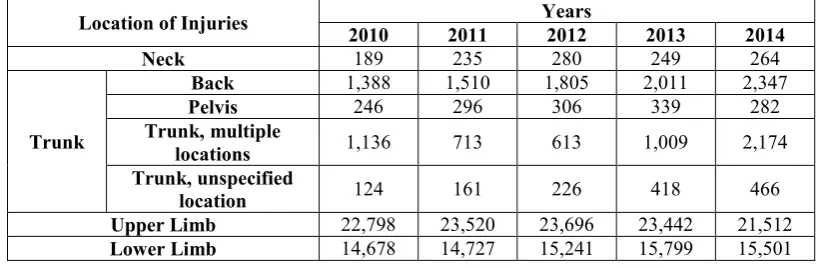
Table 2.1: Number of accidents by the location of injuries for the year 2010, 2011, 2012, 2013, and 2014.
Location of Injuries 2010 2011 Years 2012 2013 2014
Neck 189 235 280 249 264
Trunk
Back 1,388 1,510 1,805 2,011 2,347
Pelvis 246 296 306 339 282
Trunk, multiple
locations 1,136 713 613 1,009 2,174
Trunk, unspecified
location 124 161 226 418 466
Upper Limb 22,798 23,520 23,696 23,442 21,512
Lower Limb 14,678 14,727 15,241 15,799 15,501 Adapted from: SOCSO Annual Reports (SOCSO 2010, SOCSO 2011, SOCSO 2012, SOCSO 2013)
The Table 2.1 listed the locations of injuries related to WMSDs which are the neck, trunk, upper limb and lower limb. Mainly numbers of cases reported from SOCSO increases from the year 2010 to the year 2014. The obvious continually increasing trend from the statistic data are injuries at the back and trunk (multiple locations and unspecified location). The average percentage of increment number of injuries at the back from the four years is up to 14 percent. While, the total number of cases reported regarding injuries at the trunk, both, multiple locations and unspecified location rise drastically from year the 2012 to 2013. These numbers indicate the severity of related WMSDS injuries among Malaysian workers and its risk to the worker’s health and their productivity.
9 2.2 Awkward Posture
Posture defines the position or the pose of the body when executing the job duty. Awkward posture is whereby the body joint is diverging from its ordinary or neutral position that leads to injury risk (Michael, 2002). Higher deviation will lead to a high potential risk of injury, especially towards the musculoskeletal systems. Thus, the fundamental guideline in MMH is by which the workers should perform their task in the neutral joint posture. Awkward working posture like bending, twisting, overstretch along with repetitive motion will develop WMSDs (Raemy et al., 2015). Continually and repeatedly exposure to awkward posture evolves into few possibly paralyzing injuries and musculoskeletal systems disorders.
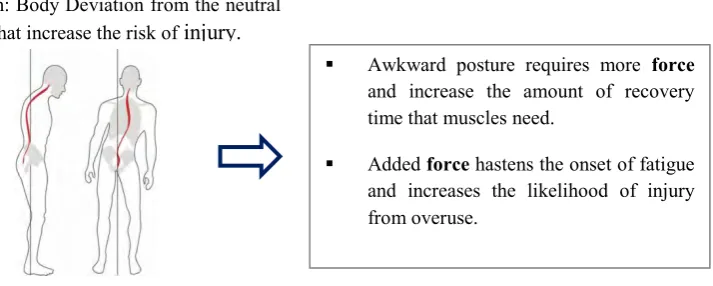
[image:23.595.131.488.506.649.2]MMH activities require great strength from the muscles. However, the muscles will have lesser strength when a joint is in an awkward posture in comparison with a neutral posture. It will have to work with closer to their maximal strength or effort. The person tends to feel fatigue subsequently in a continuous awkward working posture (Rosnah et al., 2013). The common warning sign that indicates a worker experiencing muscle fatigue is the weakness. The workers suffer insufficiency energy or the incapability to perform the works due to the insufficient stream of blood flow to the extremities (Stern, 2014). The drawback of this state will reduce their efficiency and productivity. The interpretation of awkward posture as shown as Figure 2.1.
Figure 2.1:Awkward Posture Modal
Adapted from: (Awkward Postures – Safety Talk, n.d.)
As previously stated, when working in an awkward posture, the efficiency of the muscles is greatly reduced other than exerting large physical force to perform the work.
Definition: Body Deviation from the neutral position that increase the risk of injury.
Awkward posture requires more force
and increase the amount of recovery time that muscles need.
10
This extra exertion causes muscle-tendon to exhaust and injured. It reduces the output forces in doing work (Awkward Postures – Safety Talk, n.d.). If the worker sustains the awkward postures when performing the work, the tension on the muscles and tendons may trigger inflammation and irritation of the ligaments and muscles. (Awkward Postures, n.d.). It explains that the increased stress on nerves and blood vessels, contracting the blood supply to the working tissues and ligaments. Awkward posture such as bending and twisting is the main ergonomic risk factor to whereby the workers are exposed to WMSD.
2.2.1 Back Bending and Twisting
Bending or twisting during MMH tasks illustrates as an improper posture. The twist is identified when the absolute angle of the shoulders in conjunction with the pelvis go beyond 20o. The similar measure is used to identify lateral bending by the relative angle of
the torso (the cord from L3 to C7) in conjunction with the vertical of the anterior plane (Neumann, W. P. et al, 2001). There are four classification back postures in the Ovako Working Posture Analysing System (OWAS), which are straight, bend, twisted (or bend sideways), and both (bend and twist) (Karwowski & Marras, 2003). Thus, it has the option of 1 to 4 to be the first digit in the posture code of the back as shown in the Figure 2.2.
Figure 2.2: Definition of Four Codes for the Back Postures in the OWAS System (Karwowski & Marras, 2003).