IN SIX LOCAL GOVERNMENT COUNCILS IN SYDNEY
by
Martin J„ Painter
This thesis was submitted in partial
fulfilment of the requirements for
the degree of Doctor of Philosophy
in the Australian National University
O
\(L'Avv\\iv\,v.vkr3,
The thesis compares decision making in six suburban local councils in Sydney: Bankstown, Burwood, Ku-ring-gai,
Leichhardt, Liverpool, and North Sydney. Three types of political
issues or decisions are distinguished: distributive decisions, or ’doing favours’ (parochial or individual-oriented and particu laristic); regulative decisions (rule-bound and affecting larger categories of people through precedent), and redistributive
decisions (affecting broad categories by redistribution of wealth). Sydney suburban councils are basically administrative
bodies. However, much of local politics involves disputes over what would normally be classed as administrative decisions; that
is many local political issues are distributive. In the six councils, elections are often characterised by very localised personal support for candidates and by parochial or distributive issues rather than issues of policy. Local interest groups are mostly organised at the neighbourhood level and press parochial interests. Many aider- men pay more attention to individual constituency pressures than to council officials. In making decisions, aldermen are often highly susceptible to pressures from within their own ward. A description of actual decisions in the areas of planning admini stration and budgetary decision making shows that distributive
issues are common-place, often in areas of administration that are intended to be regulative.
American urban machine. The notion that the middle class adopt a ’public-regarding’ ethos as distinct from a working class ’private-
regarding' ethos has some relevance in accounting for the incidence of distributive politics, in the way it helps account for machine politics. Some explanation is also found in differences in local political cultures. These stem from peculiar local factors as well
as from differences in social attitudes supposedly held by broad categories of the population.
It is concluded that while local councils are not an
CHAPTER Page
1 INTRODUCTION 1
11 THE SIX COUNCILS 29
111 THE RECRUITMENT OF ALDERMEN 53
IV LOCAL E L ECTIONS: WINNING SEATS AND
WINNING VOTES
73
V LOCAL INTEREST GROUPS 130
VI THE PAID OFFICIALS 155
VI1 FORMAL AND INFORMAL PROCESSES OF
COUNCIL DECISION MAKING
184
Vlll CASE STUDIES IN PLANNING AND
DEVELOPMENT CONTROL
224
Appendix to Chapter Vlll: Planning
Schemes and Regulations
284
IX BUDGETS 290
X CONCLUSION 341
APPENDIX 375
FIGURE 11-1 1V-1
IV—2
VI1-1 Vll-2 Vll-3vi
1-4
vi
1-5
Vll-6
Vlll-l Vlll-2
v i n
-3
vi
ll-4
1X-1 IX—2 1X-3
ix-4
ix-5
1X-6
lx
-7
Page
Map of Sydney
31
Bankstown 1971 Elections
94
Burwood 1971 Elections
122
Cluster Analysis Bankstown Council
Voting Divisions Showing Blocs
190
Pattern oT Choices of Aldermen for
•Most Respected’
Colleagues
198
Cluster Analysis Ku-ring-gai Council,
all Divisions
202
Cluster Analysis Ku-ring-gai Council,
Divisions over Finance Issues
203
Cluster Analysis, Liverpool Council,
from Recorded Votes and Co—sponsorships
of Motions
213
Cluster Analysis, North Sydney Council
Divisions over Planning Matters
218
Map of
Bankstown Municipality
232
Map of
Ku-ring-gai Municipality
253
Map of
Leichhardt Municipality
266
Map of
North Sydney Municipality
277
Department of Local Government model
I - 1 Suburban Councils (Sydney), General Fund Ordinary Expenditure: jo t o t a l expenditure by major cat egori es of expenditure I9
IO-1969 3
I I - 1 Populations of the Six Mu n i ci p al i t i es
1 9^7-7 1> a t each census 3 2
11-2 Measures of Socio-economic S t a t u s , 1 9 6 6 34
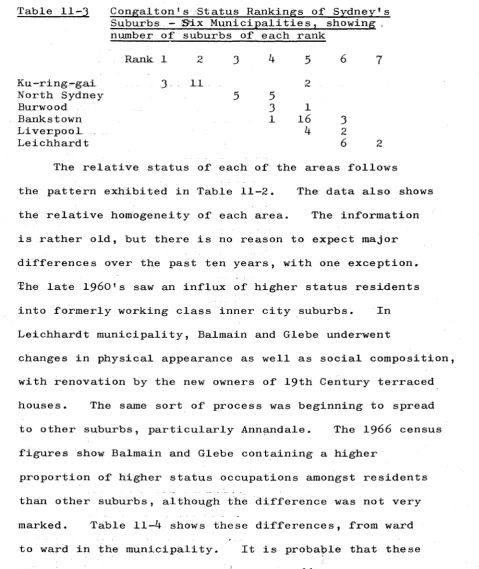
11-3 Congalton’s Stat us Rankings of Sydney’ s Suburbs - Six M u n i c i p a l i t i e s , showing
number of suburbs of each rank 3 5
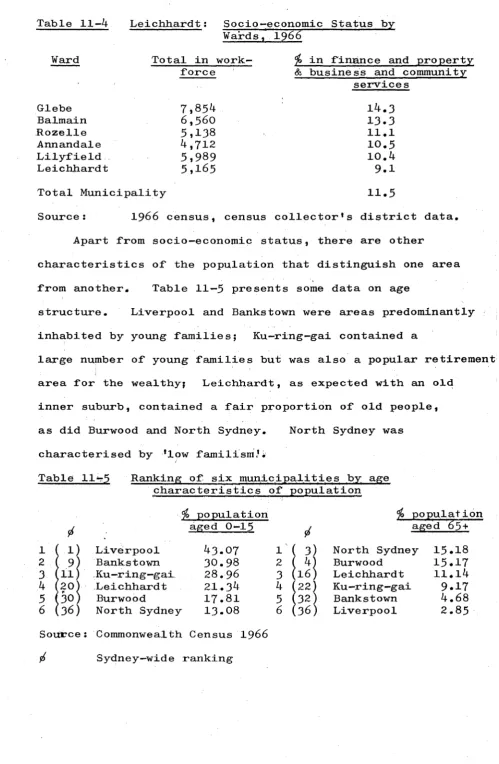
11-4 Leichhardt: Socio-economic Status by
Wards, 1 9 6 6 36
11-5 Ranking of Six M u n i c i p a l i t i e s by age
c h a r a c t e r i s t i c s of population 3 6
11-6 Per cent n o n - B r i t i s h in the six
M u n i c i p a l i t i e s 37
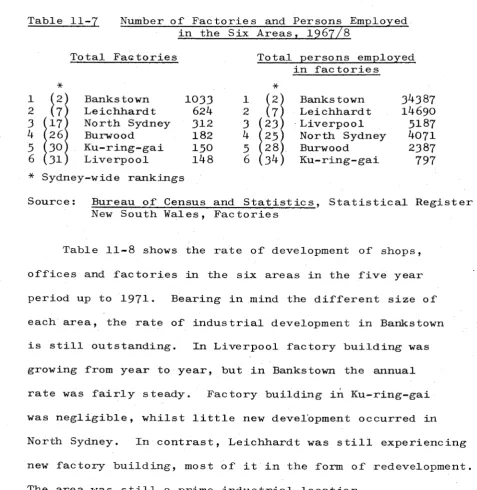
11-7 Number of F act ori es and Persons Employed
in the Six Areas 38
11-8 Value of Completed Buildings (excluding cost of land: Shops, Offices and
F a c t o r i e s , 1 9 6 6 / 7 - 1970/71 38
11-9 New Dwellings (houses and f l a t s )
Completed 1 9 6 2-6 6; 1 9 6 7 - 7 1 40
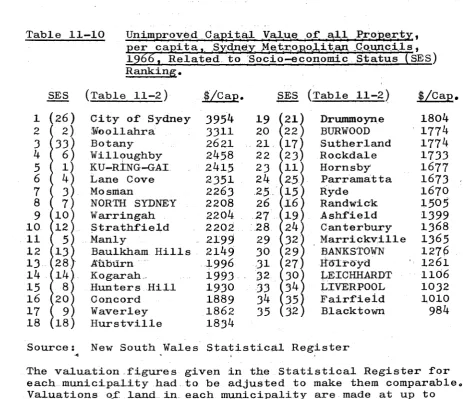
11-10 Unimproved Capital Value of a l l Property, per c a p i t a , Sydney Metropolitan Councils
1 9 6 6, Related to SES ranking 48
11-11 ’Adjusted' 1 9 6 6 Rate and Rate Income
per c a p i t a 1 9 6 6 and 1 9 6 9 49
11-12 Expenditure per c a p i t a on public works
and ' a m e n i t i e s ' 1 9 6 8 5 0
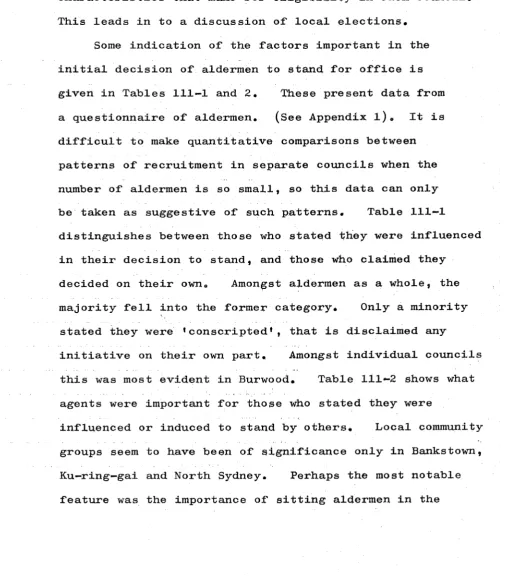
111-1 The Decision to Stand for Office 55
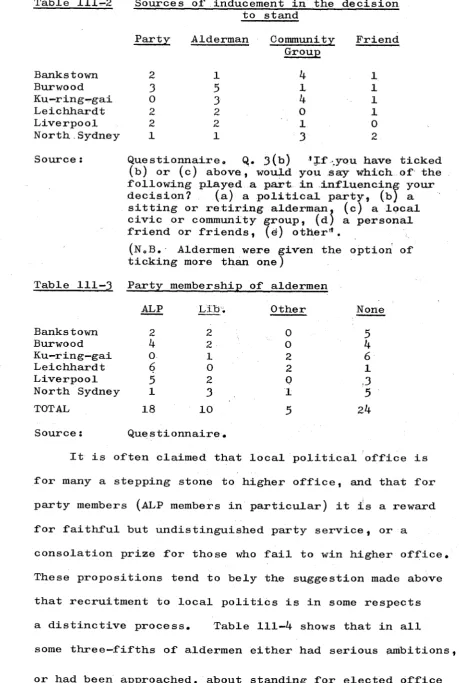
1 1 1 - 2 Sources of inducement in the deci si o n to
stand 5 6
111-3 Party Membership of Aldermen 5 6
111-4 Party Membership and Higher P o l i t i c a l
111-5 Local A ldermen and Higher Political
Office 58
111-6 Party M e m b e r s h i p and Local Group
A c t i v i t y 60
1 1 1 —7 Types oT Groups and Organisations in
w h i c h Local Alde r m e n were I n volved 60 111-8 Residence and W o r k —Place oT Aldermen 63
1 1 1 — 9 Occupations of Aldermen, 1970 64
1 1 1 —10 Occupations of Candidates and Elected
Aldermen, 1971 65
1 1 1 —11 Success Rates of H i gher Income Categories,
1971 Elections 66
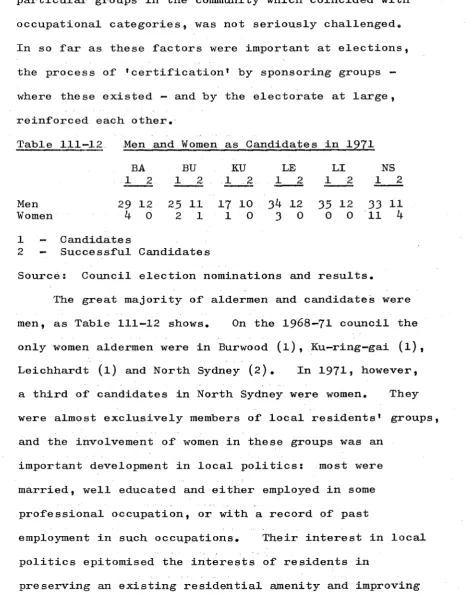
1 1 1 —12 Men and Wom e n as C a ndidates in 1971 69 1 1 1 —13 Incumbent Turnover, 1 9 6 2 —1971 70
IV —1 Percentage of aldermen elected on
preferences whilst polling fewer votes
than one or more unsu c c e s s f u l candidates 74 I V —2 N umber of votes r equired for election 76 I V—3 Per cent ALP Vote in Council and Federal
Elections 78
I V —4 Ban k s t o w n 1971 elections - measures of v a r i a t i o n in polling strength between
different booths 93
I V —5 L i v e r p o o l 1971 elections — measures of v a r i a t i o n in polling strength between
different booths 101
I V —
6
K u —r i n g —gai1968
elections — measures of v a r i a t i o n in polling strength betweendifferent booths
105
I V— 7 K u - r i n g —gai
1968
elections — percentage votes p olled at e a c h b o o t h by candidatesin two wards 106
I V — 8 N o r t h Sydney 1971 elections — percentage votes polled by candidates at separate
l v - 9 Percentage Labor Vote by Wards,
Leichhardt 117
1V-10 Leichhardt 1971 elections — measures of v a r i a t i o n in support for candidates at
separate polling booths 119
V-l The Saliency of Interest Groups for
Aldermen 132
V I -1 Bu r e a u c r a t i s a t i o n and P r o f e s sionalisation 163 V I -2 R e lative importance of sources of
i nformation for council decision making 172 V I -3 Paid officials and ward constituents as
sources of information: responses classi f i e d by occupational b a ckground
of aldermen 176
V I 1-1 Committee Structure and Me m b e r s h i p 187 Vll-2 Alde r m e n R e s p e c t e d and Considered
I n f l u e n t i a l by their Colleagues 198 Vll-3 Mean Agreement Scores for Bloc Members,
K u - r i n g —gai 204
V I 1-4 Agreement Scores on W a r d Matters,
Ku-r i n g - g a i 206
vi 1-5 Agreement Scores on Ward M a t ters (Planning)
N o r t h Sydney 22 0
V I 11-1 T i m etable of preparation of local
p l anning schemes 2 2 9 - 2 3 0
1X - 1 E s t i m a t e s of Expenditure, Bankstown Council 1 969—1 9 7 1 ? showing estimates as
adopted and as revised 3 0 0 - 3 0 1
I X —2 L i v e r p o o l 1971 Budget, Public Works E x p e n d i t u r e , showing reductions made by
finance committee to departmental
requests 313
1X - 3 Leichh a r d t Council, I.969 Expenditures 327
APPENDIX
Table 1 N umber of aldermen interviewedD e c i s i o n m a k i n g and p o l i t i c s in local g o v e r n m e n t c o u n c i l s are in m a n y w a y s q u a l i t a t i v e l y d i f f e r e n t from g o v e r n m e n t a l p r o c e s s e s at o t h e r l e v e l s and in o t h e r forms o f g o v e r n m e n t . T h i s c h a p t e r a i m s to show this a n d also to o u t l i n e the a p p r o a c h to be a d o p t e d in the study.
W h i l s t the d i s c u s s i o n m a y be a p p l i c a b l e to v a r i o u s systems of local g o v e r n m e n t in d i f f e r e n t n a t i o n a l and l o c a l
s e ttings, the r e m a r k s are c o n f i n e d l a r g e l y to l o c a l c o u n c i l s in N e w S o u t h W a l e s and, m o r e s p e c i f i c a l l y , to s u b u r b a n
c o u n c i l s in Sydney.
L o c a l g o v e r n m e n t in N e w S o u t h W a l e s t o o k a l o n g time to b e c o m e f i r m l y e s t a b l i s h e d and, w h e n it did, f a i l e d to a c h i e v e the s t at u s e n j o y e d b y i n s t i t u t i o n s of local
g o v e r n m e n t in the U.K. E a r l y a t t e m p t s b y c o l o n i a l a d m i n i s t r a t i o n s to i n s t i t u t e a s y s t e m of l o c a l self-g o v e r n m e n t w e r e o f t e n o p p o s e d b y r e l u c t a n t t a x p a y e r s an d
s c he m e s for c o m p u l s o r y i n c o r p o r a t i o n of a r e a s failed."*" B a d l y d r a f t e d l e g i s l a t i o n c o n t a i n i n g ’l o o p h o l e s ’ and the S t a t e g o v e r n m e n t ’s u n w i l l i n g n e s s to g i v e i n i t i a l f i n a n c i a l or t e c h n i c a l a s s i s t a n c e c o n t r i b u t e d to an i n a u s p i c i o u s b e g i n n i n g . H o w e v e r , by the e nd of the n i n e t e e n t h century, m o s t of the S y d n e y u r b a n a r e a an d the c o u n t r y i m m e d i a t e l y
s u r r o u n d i n g i t , w e r e i n c o r p o r a t e d u n d e r the p r o v i s i o n s for v o l u n t a r y l o c a l i n c o r p o r a t i o n b y m e a n s of p e t i t i o n . But
it w a s n ot u n t i l 1 9 0 6 that l e g i s l a t i o n p r o v i d e d for c o m p u l s o r y i n c o r p o r a t i o n o f all the p o p u l a t e d a r e a s of the State. A c o n s o l i d a t i n g A c t of 1919? n o w m u c h amended, is the b a s i s of the p r e s e n t s y s t e m of l o c a l g o v e r n m e n t .
The functions delegated to local government were
minimal and remain so„
Local roads and bridges,
footpaths, drainage, street lighting, garbage removal,
public health and building controls and parks and
recreation still form the basis of council activities,
although during the present century important additions
have included public libraries, swimming pools, various
minor ’welfare’
services and the administration of
statutory town planning controls.
State government
retained police and education.
Semi-independent ad hoc
government authorities or statutory corporations were
entrusted with the fire brigade, harbour construction and
administration, water supply and sewerage disposal,
electricity reticulation and the provision of public
housing.
Some of these functions were in part undertaken
by local councils but various metropolitan—wide authorities
(some with local government representation, but directly
responsible to State parliament or a government minister)
have fully taken most of them over.
The Labor Party in New South Wales tried on several,
occasions to give local government broader responsibilities.
These attempts were associated with proposals for the
m a j o r i t y for most of its l i f e , consistently blocked such reforms« These pressures forced the p o s t - 1 9^+1 Labor government to modify its proposals for the amalgamation of over sixty met r o p o l i t a n councils into eight ne w areas. The Local Government (Areas) Act of 1948 finally created thirty nine councils in the m e t ropolitan area, a structure that remains largely unchanged.
Table 1 —1 Suburban Councils (Sydney), General Fund
Ordi n a r y Expenditure: % total expenditure by major categories of expenditure 1 9 1 0 —1969
1910 1920 1930 1939 1930 1939 1969
A d m i n i stration 10.7 8.5 4.3 6.2 708 7.3 8.1
Public Works 1 5^.3 60.2 63 0 2 38.8 47.7 43.6 39.8 Public Hea l t h 2 11.6 13.7 12.2 14.9 23.9 24.0 21.4 Public Services 3 17.2 11.4 6.9 8.3 10.9 12.2 14.7
Council Property 3.2 2.9 1.1 1.9 2.6 3.6 3 0 8
Other 4 3.1 1.3 10.3 9.9 7.1 7.1 10.3
1940, I960 and I 9 7 O figures not available
1 Includes contributions to Department of Main Roads. 2 Includes parks and reserves expenditure.
3 Comprises 2 street lighting, town planning, libraries, fire prevention, pools and beaches, public markets, donations and ' O t h e r 1.
4 Includes interest paid on loans.
Source 2 Statistical. Register, N e w South Wales 2 Local Government.
Table 1-1 shows the prominent place occupied by
public works expenditure — roads, drains, footpaths, kerb and gutter and so on - in the overall expenditure of
suburban councils. A tendency to spend less on these •essentials* in r e l a t i o n to the so-called 'luxuries* is evident from the table and has sometimes been opposed in
[image:12.545.56.523.81.728.2]As the major source of local government finance has always been the property rate, it has been argued that local,
services should largely be for the direct benefit of p r operty owners, or 1 services to p r o p e r t y 1 , rather than amenities that benefit the community at large, or that sector of it that does not own property and does not pay rate s •
This n arrow v i e w of the functions of local government is based on a particular conception of how local councils should be run. Local government administration (with the emphasis on ’a d m i n i s t r a t i o n 1) has t raditionally been
c o n ceived of as a ma t t e r of p r o v iding a range of basic services as cheaply and efficiently as possible. 'Good government' and 'the public interest* are served b y sound management and b a l a n c i n g the budget. Property owners pool
their resources and elect a boa r d of ' t r u s t e e s ’ to manage certain common affairs. Bluett, the author of the standard
'practitioner's guide' on local government, first published in the 1 9 2 0 ' s and now in its eighth edition, sees local council administration in this lights
Tt must be kept in mind that the fundamental principle behind local government is that the community contributes to a common fund to purchase for itself the essential needs of civilised living. It elects from its numbers r e p r e sentatives to decide what m o n e y is requ i r e d and how it will be spent.
That is the t a s k . ... ^
In this picture of local government the no t i o n of an elec t e d body in charge of council affairs occupies a
far ahead of its counterparts in other Australian States in this respect« Plural v o t i n g was abolished in 1906, but a restricted p r operty owning and occupancy franchise was not abolished until 1926* It was not until 19^1 that
the removal of a six mon t h residence qualification brought the franchise into line with State and Federal electoral law, w i t h the exception that non-resident landowners r e t a i n e d a vote« The 1926 and 19^-1 measures were the w o r k of Labor governments. A common argument used against extending the franchise was expressed by
W.E.V. Robson in the Legislative Council, opposing the
1926 measure when he said ’the people who find the m o n e y . •. should control, the election of the representatives in
4
the c o u n c i l ’. He also claimed that the councils were ’purely a d m i n i s t r a t i v e ’ . Mr Bavin (who was to become P r e mier in 1927) spoke against the same Bill and expanded
on this arguments
(A c o u n c i l ’s) primary duty is one of a d m i n i s t r a t i o n . .. However devoted a man m a y be to the abstract idea
of universal s u f f r a g e , no one can say that that is the best me t h o d of obtaining the best men for the purpose of carrying out administrative work. No man in his s e n s e s . . .would have men elected by universal suffrage to carry on the
administration of a business. 5
The idea that r u n ning a local government b ody is little different from r u n n i n g a business is closely linked with the v i e w that the major test of good local government is the effici e n c y w i t h w h i c h it is managed.
In this v i e w there is no r o o m for politics and,
government *o Liberal Party me m b e r of the State
Legislative Assembly, Mr Mutton, expressed the v i e w that — ooothere is no r o o m for party politics in local
governmento One cannot have a political decision about a footpath, a drain or a b u ilding application. Council administers the law: parliament legislates« 7
His party colleague Mr M c G i n t y (a former mayor of W i l l o u g h b y ) , e x tended his condemnation to 'pressure groups'. Decisions should be made ’in accordance with the Local Government
g
Act' and 'solely in the public interest*» Bluett says of party politics:
There is no surer way of cutting the heart out of local government and de s t r o y i n g its image as the people's own community government, coming as it does right to the doorstep of every home with benefit to all and favours to none. 9
The representative has no need of any pressure group, party organisation or sectional interest to tell him how best to act in the public interest. D e c i d i n g what is in the public good is a matter of common sense, for the questions are
practical ones, not political ones. They are matters of administration, not legislation; g ood management and efficiency, not party doctrine»
The currency of these views is demonstrated by the f r e q u e n c y they appear as slogans in local elections. In p a rticular they are u s e d to attack Labor Party candidates,
(the Liberal Party espouses the a n t i —party doctrine as official policy and does not contest local e l e c t i o n s ) . It is a common c o m b ination of campaign themes to find candidates p r o mising to combat party politics by offering the alternative of 'business-like efficient modern
b u siness or administrative experience. The ratepayer whose criterion of good management is ’value for m o n e y ’ , is attracted to these views, and n o n - p a r t y candidates do have considerable success.
L e g i slators c o n c erned with local government have often taken the position that one of the most useful functions local councils perform is to unburden the parliament of minor matters of local interest. The in s t i g a t o r of much of the very early legislation,
Gove r n o r Gipps, held this view, (although he was also of the opinion that local government was to be v alued as an end in itself for the sake of democratic l i f e ) . ^ He h e l d fears that the n e w l y elected Legislative Council for
the C o l o n y wou l d become bogged down in matters of parochial detail and petty disputes unless local government were
instituted. As it turned out, m u c h of the opposition to wider i ncorporation of local areas came from members of p a rliament who were reluctant to surrender their powers
of patronage in ’roads and b r i d g e s ’ and other local matters. The n otion that parliament was concerned with higher and finer things was e x p r essed by Premier J. H. Carruthers in 1 9 0 6 , in an off - t h e - c u f f response to an interjection on the dangers of giving councils more power, during his speech in support of the 1906 legislation for which he was larg e l y responsible:
W h y should not Parliament surrender some of its powers? What do these powers consist in? N o w honou r a b l e members have to humiliate
giving up that which degrades Parliament, in
order that we may uplift ourselves by having
more time to legislate for the country. H
J. H. Carruthers may have believed that the institution
of local government was valuable as an end in itself,
but in his speeches he gave no indication of this, arguing
for stronger local government on the ground of
administrative convenience.
Other advocates have taken a more 'fundamentalist*
line, epitomised by the view expressed in a pamphlet
issued by the Local Government and Shires Association
of New South Waless
'The failure of Local Government will
mean the end of true Democracy'.
In summary, their well
rehearsed arguments were that any system of government
'should give the maximum opportunities to participate,
and Local Government does just that';
’power should at
all times remain with or as near as possible to the
people', i.e. with local government;
local, government
provides a good training ground for citizenship and the
acceptance of responsibility for public affairs by members
of the community at large,
and a good training ground
for public office-holders;
and local government is the
best safeguard against excessive centralisation and
12
bureaucratisation of government.
The firm adherence to the belief of an elected body
in local government gives rise to an ambiguity in
'grass roots' and a c c e s s i b l e to h i s e l e c t o r s , cou p l e d w i t h the n o t i o n that the r e p r e s e n t a t i v e in a local c o u n c i l
p r o v i d e s a s a f e g u a r d a g a i n s t e x c e s s i v e b u r e a u c r a t i s a t i o n , are a l s o s o m e w h a t at odds w i t h the p u r p o r t e d a d m i n i s t r a t i v e c h a r a c t e r of l o c a l g o v e r n m e n t f u n c t i o n s and roles. In e x p r e s s i n g an ' a n t i - b u r e a u c r a t i c ' s e n t i m e n t , a d v o c a t e s of these v i e w s h a v e a p a r t i c u l a r p i c t u r e of bureaucracy-in mbureaucracy-ind: i n a c c e s s i b l e , r e m o t e and u n r e s p o n s i v e to or u n f a m i l i a r w i t h l o cal c o n d i ti o n s . L i b e r a l P a r t y l e a d e r in the N e w S o u t h W a le s P a r l i a m e n t of 1948, V. E. T r e a t t , w a r n e d that the L a b o r G o v e r n m e n t ' s a m a l g a m a t i o n p r o p o s a l s
of 1 9^7 - 8 'widened the g a p b e t w e e n the r a t e p a y e r and the
a l d e r m a n ' and p r o v i d e d a 'happy h u n t i n g g r o u n d for the 13
b u r e a u c r a t , the S o c i a l i s t and the C o m m u n i s t ’. At the 1972 N e w S o u t h W a l e s L o c a l G o v e r n m e n t C o n f e r e n c e , P r i m e M i n i s t e r M c M a h o n w a r n e d a g a i n s t p r o p o s a l s to
'abolish' l o cal g o v e r n m e n t and to r e p l a c e c o u n c i l s wi t h 'a s e r i e s of a r r o g a n t and d i s i n t e r e s t e d b u r e a u c r a c i e s . . . r e m o t e f r o m the l o c a l p r o b l e m s of the c i t i z e n h i m s e l f 0 He c o n j u r e d u p a p i c t u r e of the c i t i z e n t r y i n g to * o b t a i n a r e s p o n s e fr o m a r e m o t e b u r e a u c r a t a b o u t an o f f e n s i v e d r a i n
14
or an u n s a t i s f a c t o r y g a r b a g e serv i c e ' . T h i s seems to s u g g e s t that the role of the l o cal e l e c t e d r e p r e s e n t a t i v e is to 'iron out' the i n e f f i c i e n c i e s and p o s s i b l e i n j u s t i c e s of b u r e a u c r a t i c a d m i n i s t r a t i o n . On the o t h e r hand, there is p e r h a p s a d i l e m m a in that w h i l e l o c a l c o u n c i l s are
p e r f o r m i n g ' a d m i n i s t r a t i v e * f u n c t i o n s , the r e p r e s e n t a t i v e h a s d i r e c t and i m m e d i a t e a c c e s s to the a d m i n i s t r a t i v e
detached and ‘disinterested’
process that characterises
the impartial bureaucratic approach to case by case
administration.
It is perhaps unfair to pick on
Mr McMahon’s use of the term ’disinterested’, but the
notion that there are cases in which special effort has
to be made to find a way around the rules and ’cut the
red tape*, in an individual case where the rules seem to
do an injustice, is an important theme in this general
view of the local representative’s role«
This problem is one that receives perennial attention
in debates about the proper roles of the elected
representative and the paid official in local councils.
The debate stems directly from the nature of a system of
administration in which politicians are performing
administrative functions.
In fact, of course, we have
seen that in the orthodox view of local government the
representative should not be a ‘politician’«
The
structure of local council bodies, following the U.K.
tradition, compounds the problem.
The elected
representatives (referred to in municipalities as aldermen),
are directly responsible for all aspects of council
business.
There is no separate executive body exercising
authority independently from the council.
Although the
mayor is termed the ’chief executive officer’, he is
elected by the council annually and given little
independent formal authority.
The committee system, often
much praised as the core of the U.K. system of local
officials. Bluett recommends that councils should make ful.1 use of the system as it
, « «enables council, to, » „ensure that proper consideration is given to all matters, even of a minor nature 0 15
At the same t i m e , he is quite adamant that
The staff never intrude in p o licy for this is the preserve and authority of the p e o p l e ’s e l e cted representatives! nor, on the other hand,
should members of the council stray into the field of administration. 16
The N e w South Wales Department of Local Government is e q u ally certain and seems to indicate that councils are in need of reform in this matters
The popular conception of a council as a body w h ich has to deal w ith every m i nor detail o f , ,, administration is obsolete.
The obvious solution is the creation of an efficient committee s y s t e m , ,, 17
It is not necessarily bad for aldermen to be concerned in matters of ’d e t a i l ' , so long as the council itself can
•concentrate upon the framing o f c p o l i c y ’. At the same time the Department does recommend the greater use of powers of delegation to paid officials (powers which were only
g r a n t e d to councils by an amendment to the Act in 19^-5 and whi c h they appear to have been reluctant to take advantage of).
The M a u d Committee on management of local, government in the U.K. was concerned to a considerable extent w i t h these questions. It was accepted that the distinction b e t ween ’p o l i c y ’ and ’administrative d e t a i l ’ was an
18
separate cases and new policies can emerge from
precedents set in case by case administration. Minor matters of this nature often come to be charged with political significance; policies generally come under public scrutiny when they are applied and their
implications are understood. In many cases, it is
difficult to devise adequate rules or guidelines sufficient to deal with separate cases and marginal cases have to be decided. The Maud Committee nevertheless settled on a division of decision making functions that followed the traditional policy - administration distinction, although it was rephrased. Elected representatives should
’exercise ultimate direction and control of a f f airs', 'take key decisions on the objectives of the authority', and undertake periodic reviews of 'progress and performance of services' . The 'day to day administration of services' ,
'decisions on case work' and the 'routine process of inspection and control’, should be the functions of the
19
paid officers. The committee expressed concern that
individual 'case work', whilst arousing the'vivid interest' and the 'sympathy and compassion' of councillors, tended to become the main focus of committee decisions, as this could lead to 'decisions being taken in accordance with the subjective opinions of the members present to the
20 prejudice of a consistent approach'.
Maud's criticisms of local government in the U.K. would apply even more to metropolitan suburban councils
s m a l l e r r a n g e of f u n c t i o n s p e r f o r m e d and the n a t u r e of t h ese f u n c t i o n s . T h e p o l i t i c a l a t t e n t i o n d e v o t e d to m a t t e r s of a d m i n i s t r a t i o n of s e r v i c e s and a p p l i c a t i o n of r u l e s and r e g u l a t i o n s s t e m s in part f r o m the r e l a t i v e i n f r e q u e n c y of m a j o r p o l i c y d e c i s i o n s . T h i s wi l l
b e c o m e m o r e e v i d e n t in the c o u r s e of the study. As to the e f f e c t of the s o r t s of d e c i s i o n s c o u n c i l s are c o n c e r n e d w i t h on the w a y a l d e r m e n p e r f o r m t h e i r roles, this is
c r u c i a l in u n d e r s t a n d i n g l o c a l g o v e r n m e n t d e c i s i o n mak i n g . L o c a l g o v e r n m e n t , as B l u e t t so r i g h t l y said, comes »right to the d o o r s t e p of e v e r y home». In 1968 JO.'J'/o
of t otal c o u n c i l i n c o m e w a s r a i s e d b y d i r e c t a n n u a l rate 21
l e v i e s in S y d n e y ' s s u b u r b a n c o u n c i l s . O n l y 3 came f r o m g o v e r n m e n t g r ants. L e v i e d in a l u m p sum, the rate has i m m e d i a t e i m p a c t on the i n d i v i d u a l p r o p e r t y owner. T h e impact of the s e r v i c e s p r o v i d e d is s i m i l a r l y dir e c t . T h e state of the road, f o o t p a t h or the k e r b and g u t t e r
are i m m e d i a t e l y a p p a r e n t and aff e c t d i r e c t l y the 'amenity" e n j o y e d b y s e p a r a t e p r o p e r t i e s . T h e g r e a t m a j o r i t y of s e r v i c e s are h i g h l y ' l o c a t i o n - s p e c i f i c ' in that t h e y are p r o v i d e d p i e c e m e a l to s e p a r a t e s t r e e t s in the case of r o a d w o r k s or to p a r t i c u l a r sub u r b s or n e i g h b o u r h o o d s in the case of p arks and r e c r e a t i o n f a c i l i t i e s , c o m m u n i t y h a l l s and m o s t o t h e r c o m m u n i t y f a c i l i t i e s such as b r a n c h l i b r a r i e s or b a b y h e a l t h centres. T h e impa c t of
property, as well as its value, or the amenity it enjoys
by virtue of the nature of development permitted in its
immediate environment0
Building and health regulations
are specified by Acts of Parliament and are rarely the
subject of political dispute in themselves0
However,
their administration and enforcement by councils is
by no means always a purely routine matter.
Planning
regulations are drawn up by local councils in conjunction
with the State Planning Authority, but even so the great
majority of political conflicts in this area occur when
councils implement them or exercise various discretionary
powers within their ambit.
These conflicts have their
root in the specific development application, involving
the developer himself and possibly immediate neighbours.
The interests involved once again are either individual
property owners or relatively small numbers brought
together by proximity in a specific street or locality.
The process of administering these regulations and
implementing the details of providing services across
the municipality is what much of local politics is all
about.
The property owner is concerned to defend the
value of his property or enhance it.
The occupant wishes
to enjoy a particular standard of amenity in his area
in the form of good roads, other sorts of council, services
or the sort of land use he wants to see next door.
This
applies to occupants of industrial, commercial, and
occupant tend to occur not when the council makes policy decisions such as how much to allocate to kerb and gutter construction, but when a decision is made as to whether kerb and gutter is to be provided to his particular street,
past his front gatej not when the council formulates a zoning scheme for the municipality, but when a developer lodges an application to erect a multi-storey block of flats on the next door property.
To summarise the picture I have presented up to this point, much of local politics is concerned with pressures to obtain a favourable intervention in the administrative process. At the same time there are also occasions when broader and more far reaching issues are the subject of local politics. Broad zoning policies, the level of the rates, or the council's expenditure
priorities do become the subject of political conflict and may involve the business community or sectors of it, groups of residents, social or sporting clubs who are major users of council services, and so on. However, given the limited scope of local council functions and
powers, it is often the case that the issues affecting broad categories of people are resolved elsewhere than at the
22
local level. Thus, real estate interests and business groups seek to influence the content of local planning schemes to protect their interests by approaching the
State Government or the State Planning Authority, treating the issue on a metropolitan, rather than a local, level. Major decisions about development at the urban fringe,
of expressways, the installation of sewerage and water
services are made by State Government or by semi
government authorities.
Local councils find themselves
one amongst many government bodies and interest groups
in the process of decision making over metropolitan
development.
The ‘external relations* of local councils
are an important aspect of their activities, but the
present study is confined to the local level.
The contention that the character of local politics
can only be understood by relating political activity
to the nature of the governmental activities local,
councils are concerned with is the stepping—off point
for the theoretical approach adopted in the present study.
It is adapted from a scheme evolved by T. J. Lowi, in
the context of understanding the great variety of
political power relationships uncovered by a large number
of case studies in American national policy making.
Lowi contends that there are three major categories of
public policiesz
distribution, regulation and
redistribution.
These different 'areas of policy*
constitute 'real, arenas of power's
Each arena tends to develop its own
characteristic political, structure,
political process, elites and group
relations. 23
the cake* , or the particular favour they have sought. So long as there is enough to go around, ’s u p p l i c a n t s ’ do not n e c e s s a r i l y confront one another o r e n t e r into
direct competition, but rather jostle in the queue. E ach decision is an act of patronage and has no
ramifications for future decisions beyond perpetuating an expectation that anyone w i t h a ’deserving c a s e ’ or w i t h sufficient political mu s c l e can expect a favour
themselves. The classic example is the d i s p e n s i n g of
favours and patronage from the p o r k barrel, in a ’roads
and b r i d g e s ’ programme. In legislative bodies (where
pork barrel decisions are t y p i cally taken), log-rolling alliances of common interests are typical of the
distributive arena. Typical roles are the patron and
the broker. Separate alloc a t i o n s are a matter only of
a transaction between patron and client, w i t h perhaps a
broker involved. Conflict b e t w e e n patrons may be
minimised by i n s t i t u t i o n a l i s i n g the procedures for dividing the cake amongst them, as in congressional committees in the U . S . , or more blatantly, as in the
Philippines, w h e r e in the past the d i s t r i b u t i o n of
funds to specific local p r o j e c t s was the prerogative of congressmen, each of w h o m received an annual allocation
of funds for this purpose, d e t e r m i n e d by seniority, formal 24
positions in the party or Con g r e s s and so on.
Regulative policies also involve specific case by case treatment, but each case or political d e m a n d cannot
be treated in c o mplete isolation. Regulative policies
universal application of general rules or guidelines to individual cases, with primary regard to precedent.
Because such decisions involve ramifications beyond the separate case, the regulative arena is typified by
conflict between broader groups than those involved in the distributive arena. The classic case is that area of government activity known as ’regulatory a c t i v i t i e s ’, including such policies as restrictive trades practices legislation, land use zoning schemes and so on. They fall within the context of the ’rule of l a w ’ which
stresses universalism, the antithesis of the favouritism or particularism characteristic of much of the distributive ar e n a .
Redistributive policies are even broader in impact and involve broader interests again. It is not just a matter of handing out benefits, as in distributive politics, but of taking them away from someone for the express purpose of giving them to someone else. Taxation and welfare policies are often redistributive. The groups
involved are often broad classes and fundamental economic interests such as ’big b u s i n e s s ’ , ’the p o o r ’ , and so
o n .
These distinctions do not correspond neatly with conventional distinctions between ’regulatory activities’ and other sorts of government activities involving the direct provision of services and spending of money.
priorities according to n e e d 1 in the process of programme-determination. These pressures seek to place roads and bridges decisions in the regulative arena, by setting
out a set of universal criteria, or policy guidelines, for deciding on a programme» In theory, conflict over programme decisions would then occur over the nature of the criteria adopted, as groups deprived by the
application of the policies tried to right the situation» Similarly, policies that are customarily referred to as
'regulatory* often become matters of distribution. The rules and guidelines may be so vaguely defined that other criteria are used in making decisions, criteria which have nothing to do with the norms of precedent or universality of rule—application, but which are the
criteria patrons use in distributing favours to clients. Furthermore,pressures always exist for the rules to be
'bent' or ignored, from individuals or firms who will benefit from a direct 'indulgence*. Once rules and policies begin to be ignored — as for instance when land—use regulations are ignored in approving planning applications — then each case becomes a separate plea for patronage. Lowi remarks that the distinction
between regulative and distributive policy arenas is more a continuum than a sharp division. However, the basic distinction is still crucial:
It might be argued that no decision about allocating funds can be seen in isolation from the way money is
raised , or divorced from considerations of alternative
programmes or projects that those funds could have been
allocated to, and that all such decisions must then be
seen as redistributive ones. In principle, this is true.
However, the d i s tinctions I have drawn refer to the way groups involved in politics seek to attain their ends, that is to the way they define the issues themselves. P roperty developers m a y find it easier or less ’costly* to exert influence on a council to obtain an exemption from a regulation (an act of patronage and a distributive decision), than to try to alter the regulation itself
(a regulative issue). Aspirants for formal office might
find it politically advantageous to appeal to disadvantaged groups in the community rather than let others ’get away with* benefits obtained by a distributive (pork barrel)
decision. T h e y may even be able to do both at the same
t ime .
Politics operates largely in the short-run and most
groups who are able to exert influence are not concerned about the long-term consequences or ramifications of
the benefits they obtain, unless challenged. Thus,
whilst it is the case that no d i stribution can be made without an ultimate redistributive effect, it does not u s u a l l y suit those who are gaining immediate tangible
benefits to point this out. Those who have qualified
to play the game as it is have little incentive to change
can and do exist and b r o a d e r i m p l i c a t i o n s (some w o u l d r e f e r to th e m as 'the r e a l i s s u e s 1 ) o f t e n are i g n o r e d in the p u b l i c p o l i t i c a l arena.
In a f u r t h e r e l a b o r a t i o n of this scheme,
R. H. S a l i s b u r y t r i e s to p r o v i d e some g e n e r a l a n s w e r s to the q u e s t i o n of w h y an a u t h o r i t y s t r u c t u r e m a k e s one sort of d e c i s i o n r a t h e r t h a n another, g i v e n that no p a r t i c u l a r a r e a of g o v e r n m e n t a c t i v i t y is i n h e r e n t l y f o u n d in one a r e n a r a t h e r than another. S a l i s b u r y f o c u s e s on two m a j o r c h a r a c t e r i s t i c s of the p o l i t i c a l s y s t e m - the s t r u c t u r e of the 'demand pattern' and the s t r u c t u r e of the d e c i s i o n m a k i n g b o d i e s . B o t h are c h a r a c t e r i s e d a c c o r d i n g to the d e g r e e of i n t e g r a t i o n or f r a g m e n t a t i o n . A f r a g m e n t e d d e m a n d p a t t e r n is c h a r a c t e r i s t i c of p o r k b a r r e l p o l i t i c s . S e p a r a t e l o c a l i t i e s e a c h s e e k an 'indulgence* and the i n t e r e s t s i n v o l v e d are p a r o c h i a l . But c o m m o n i n t e r e s t s , in s e e k i n g a c h a n g e in p r i o r i t i e s , m a y p r o d u c e an i n t e g r a t i o n of
d e m a n d s , l e s s e n i n g the d e g r e e of f r a g m e n t a t i o n of p o l i t i c a l i n t e r e s t g r o u p s in the p a r t i c u l a r a r e a of g o v e r n m e n t a c t i v i t y c o n c e r n e d . T h i s o f t e n o c c u r s w h e n r e l a t i v e l y d e p r i v e d g r o u p s , f o r w h o m an e x i s t i n g p a t t e r n of d i s t r i b u t i v e p o l i t i c s is not s a t i s f a c t o r y , v o i c e
d e m a n d s . T h u s , the w a y an i s sue is d e f i n e d d e p e n d s on the w a y i n d i v i d u a l s and g r o u p s p e r c e i v e t h e i r i n t e r e s t s and the type of o r g a n i s a t i o n s that e x i s t to m o b i l i s e t h ese i n t e r e s t s .
A strong legislative body in which individual members are
able to operate relatively free from party discipline
provides one ideal setting for pork barrel decision making*
The lack of centralised leadership and authority make the
organisation of majorities behind major policy matters
27
in the regulative or redistributive arenas very difficult*
On the other hand, a strong majority party system or a
powerful executive arm can provide opportunities for
such issues to be raised and resolved*
In the present
context of local government bodies there are particular
structural characteristics and informal norms or
conventions that exert influence on the way issues are
defined.
Some of these have been discussed above and
some of their results noted.
The discussion of the proper role of local government
as it is customarily conducted is based on the distinction
between politics and administration or legislation
and implementation.
The new distinctions between
different types of decision throw new light on this
problem.
I have already commented on the nature of
local political issues.
If this picture is accurate
much, if not most, of local politics is concerned with
the distributive arena*
Councils do not make decisions
of a major redistributive content, as other levels of
government are the focus for such demands, if they are
made at all.
There is a sense in which local government
is essentially a conservative institution.
Local
of 'non-de c i s i o n s ' has some r e l e v a n c e in this c o n text.
B a c h r a c h and B a r a t z ha v e c h a r a c t e r i s e d 'n o n - d e c i s i o n making* as 'the p r a c t i c e of l i m i t i n g the scope of a c t u a l d e c i s i o n
28
m a k i n g to 'safe' i s s u e s * . It is a p r o c e s s b y w h i c h d e m a n d s for chan g e in the ' e x i s t i n g a l l o c a t i o n of b e n e f i t s and p r i v i l e g e s .... can be s u f f o c a t e d b e f o r e t h e y are
29
v o i c e d ' . Some i s s u e s s i m p l y n e v e r 'get off the ground*. In d e l e g a t i n g s p ec i f i c p o w e r s to l o c a l g o v e r n m e n t , the
n o n - d e c i s i o n s h a v e a l r e a d y b e e n ma d e b e f o r e c o u n c i l s
b e g i n to operate. I f i m p o r t a n t a s p e c t s of the s t a t u s quo are q u e s t i o n e d , then it w i l l not be in the local a r e n a that the issue is d e c i d e d . T h e r h e t o r i c of l o c a l
g o v e r n m e n t t h e o r y that s t r e s s e s the 'apolitical' n a t u r e of c o u n c i l f u n c t i o n s is m o s t s t r o n g l y v o i c e d in the c o n t e x t of o t h e r c o n s e r v a t i v e d o c t r i n e s . M y h e a v y
r e l i a n c e on m e m b e r s of c o n s e r v a t i v e p a r t i e s in o u t l i n i n g 30
this d o c t r i n e is no a c c i d e n t .
W h i l s t r e d i s t r i b u t i v e i s s u e s m a y not be c o m m o n in l o c a l p o l i t i c s t h ere is still some scope for d i s p u t e s o v e r r e s o u r c e a l l o c a t i o n , w h i c h m a y b e c o m e d e f i n e d in some m e a s u r e in r e d i s t r i b u t i v e terms. T h e r e are also
on o c c a s i o n s i m p o r t a n t r e g u l a t i v e i s s u e s in l o c a l p o litics. E v e n here though, c o u n c i l s are c o n c e r n e d to a l a r g e ext e n t w i t h e n f o r c i n g r e g u l a t i v e p o l i c i e s w h i c h have b e e n d e c i d e d e l s e w h e r e , as w i t h b u i l d i n g and h e a l t h r e g u l a t i o n s and
to some e x t e n t p l a n n i n g r e g u l a t i o n s . It is in the f r a m i n g of p l a n n i n g r e g u l a t i o n s that c o u n c i l s find t h e m s e l v e s
case by case treatment of development applications - that the majority of issues arise and many of these are of a distributive nature. The case by case process of enforcement focuses political attention on the particular case and its special circumstances. As James C. Scott sees it, ’influence at the enforcement stage... i s .. .
31
almost exclusively particularistic’. Favourable
government decisions can be achieved not just by combining with those of similar interests to obtain a particular
enactment of legislation, but by making an individual approach to obtain a particularistic decision at the
point of enforcement of existing legislation. This means ignoring the content of the rules and applying other
criteria to the decision. In some cases this may involve corruption, and in all cases favouritism or patronage and what Lowi referred to as ’private
politics’. This is what the distributive arena is all about. Indeed it becomes rather meaningless to talk of
’enforcing legislation', as policies are not a feature of the distributive arena of politics, except insofar as the cumulative effects of discrete acts of patronage or the granting of favours may lead to an observable
regularity in output. But this is not the meaning of the term ’policy' that I prefer to apply, as the notion
32 contains some reference to intention as well as effect.
The major aim of the study is to identify those
or why politics is conducted in one arena rather than
others. I have indicated that the major focus of attention
will be first the nature of political interests current
in local politics and the means by which they are expressed, that is through what sorts of organisations or channels
and in what sorts of issues, and second the structure of
the decision making process of the council itself. It
will become apparent that there is great v a r iety in the issues of local politics from one area to another, in the way local political conflicts are resolved, in the sorts of organisations involved in local politics and so on. Within the framework outlined in this chapter, I shall
attempt to explain some of these differences. This will
take the form of trying to associate the way decisions are made (illustrated b y a series of case studies) with
characteristics of the structure of political interests or demands and the structure of the decision m aking process on the council. I shall look r e s p e c t i v e l y at political recruitment; the electoral process; interest group politics; the relations between aldermen and paid officials and the sorts of interests pursued b y the professionals and
bureaucrats; and the informal rules, procedures and groupings
found in the council decision m aking process. In seeking
to understand differences between the six councils I shall try and relate these features of local politics to various social and economic factors, to see w h e ther they stem from
differences in the social and economic context or 'environment*
from one area to another. In order to 'set the scene 1 and
some of these r e l a t i o n s h i p s , the next c h a p t e r is c o n c e r n e d w i t h a b r i e f d e s c r i p t i o n of the six areas.
F O O T N O T E S
1. On. th.e h i s t o r y of local, .government see H. E. M a i d e n , T h e H i s t o r y of L o c a l G o v e r n m e n t in N e w S o u t h W a l e s ,
(S yd n e y , A n g u s and R o b e r t s o n , I9 6 6) a n d F . A. L a r c o m b e ,
T h e D e v e l o p m e n t of L o c a l G o v e r n m e n t in N e w S o u t h W a l e s , ( M e T h n u r n e .,Cheshire,. I96J-)
2. On m o v e s to f o r m a S y d n e y m e t r o p o l i t a n g o v e r n m e n t see J. D. B. M i l l e r 1 G r e a t e r S ydney, 1 8 9 2 — 1952* .
P u b l i c A d m i n i s t r a t i o n .. (Sydney) , J u n e 195^ 1 PP 1 1 0 — 122 3. A. P. & R. G. Blu e t t , B l u e t t ' s L o c a l G o v e r n m e n t
H a n d b o o k (7th e d .), ( S y d n e y , L a w B o o k , 1962) p ~ 9
k. N e w S o u t h W a l e s P a r l i a m e n t a r y D e b a t e s (NSWPD) 8 O c t o b e r 1925
F o r a m ore r e c e n t d e f e n c e of the r e s t r i c t e d f r a n c h i s e in. W e s t e r n A u s t r a l i a , see A. E. W h i t e , ' S u p p l e m e n t a r y P a p e r 111', in A u s t r a l i a n F r o n t i e r Inc., C on s u i t a t i o n on the F u t u r e of L o c a l G o v e r n m e n t in the P e r t h
M e t r o p o l i t a n R e g i o n , ( C a n b e r r a 1969) 5. NSWPD, 3 S e p t e m b e r 1925
6. B l u e t t , op. cit. p 8 7. N S W P D , 11 S e p t e m b e r 1968 8. NSWPD, 11 S e p t e m b e r 1968 9. B l u e t t , op. cit. p 9
10. See S. K. B a rker, 'The G o v e r n o r s h i p of Sir G e o r g e G i p p s 1 , R o y a l A u s t r a l i a n H i s t o r i c a l S o c i e t y J o u r n a l , 1 9 3 0
p 227i also M a i d e n , op. cit. 11. NSW P D , 2k A u g u s t 1905
12. L o c a l G o v e r n m e n t and S h i r e s A s s o c i a t i o n of N e w S o u t h Wales, R e g i o n a l C o u n c i l s (Sydney,
195l)
PP 6-81 4 . S t a t e m e n t by Prime M i n i s t e r , M r M c M a h o n , 23 O c t o b e r 1972 (Address to the L o c a l G o v e r n m e n t A s s o c i a t i o n C o n f e r e n c e L u n c h e o n , C a n b e r r a ) .
15. Bluett, op. cit. p 7 16. Ibid p 4
1 7 . Ne w S o u t h W a l e s D e p a r t m e n t o f L o c a l G o v e r n m e n t , Local G o v e r n m e n t F i n a n c e and A c c o u n t s B u l l e t i n No. 8 A ,
(S y d n e y , G o v e r n m e n t P r i n t e r , I 9 6 2 ) p 4 8
18. C o m m i t t e e on the M a n a g e m e n t of L o c a l G o v e r n m e n t , M a n a g e m e n t of Local G o v e r n m e n t , (London, H M S O , 1 9 6 7 ) p 30 & PP 3 8 - 9
19 • Ibid p 39 20. Ibid p 53
21. B u r e a u of C e n s u s and S t a t i s t i c s (Sydney) L o c a l A u t h o r i t y F i n a n c e S t a t i s t i c s , 1 9 67 a n d 1 9 6 8 T a b l e s 1 and 3
22. On the q u e s t i o n o f the r e l a t i o n s b e t w e e n ' m e t r o p o l i t a n ’ and 'local' d e c i s i o n s see: S y d n e y S t udy Group,
'A C r i t i q u e of I n t e r g o v e r n m e n t a l R e l a t i o n s A f f e c t i n g the S y d n e y M e t r o p o l i t a n R e g i o n ' , A u s t r a l i a n P l a n n i n g I n s t i t u t e J o u r n a l , J a n u a r y 1 9 6 8 , pp 5~13
.23. T. J. L o w i , ' American B u s i n e s s , Public Po l i c y , Case S t u d i e s an d P o l i t i c a l T h e o r y ' , W o r l d P o l i t i c s,
July 1964, p p 689-90
Se e a l s o T. J. L o w i ' D e c i s i o n M a k i n g vs P o l i c y Making: T o w a r d a n A n t i d o t e f o r T e c h n o c r a c y ' , P u b l i c A d m i n i s t r a t i o n R e v i e w , M a y / J u n e 1970) and T. J. Lowi, F o u r S y s t e m s of Po l i c y , P o l i t i c s a n d C h o i c e , (New York, I n t e r - U n i v e r s i t y C a s e P r o g r a m , 1 9 7 1 )
24. A r t h u r M a as , 'Congress a n d W a t e r R e s o u r c e s ' , A m e r i c a n P o l i t i c a l S c i e n c e R e v i e w , S e p t e m b e r 1950, pp 576-592
L e d i v i n a V i d a l l o n - C a r i n o , T h e P o l i t i c s and A d m i n i s t r a t i o n of the P o r k B a r r e l , (Local G o v e r n m e n t C e n t e r , Sch o o l of Public A d m i n i s t r a t i o n , U n i v e r s i t y o f P h i l i p p i n e s , 1 9 6 6 ) 2 5 . T. J. L o w i , F o u r S y s t e m s of Policy, P o l i t i c s and
C h o i c e , op. cit. p 24
26. R o b e r t H. S a l i s b u r y , 'The A n a l y s i s of P u b l i c Policy: A S e a r c h for T h e o r i e s and R o l e s ' , in A u s t i n Ran n e y
2 7. R o b e r t H. S a l i s b u r y , J o h n Heinz, 'A T h e o r y o f P o l i c y A n a l y s i s and Some P r e l i m i n a r y A p p l i c a t i o n s ’ , in
Ir a S h a r k a n s k y ( e d . ), P o l i c y A n a l y s i s in P o l i t i c a l S c i e n c e , (Chicago, M a r k h a m , 1970) , pp 3 9 - 5 9
S a l i s b u r y and H e in z d i s t i n g u i s h b e t w e e n ’struct u r a l ' and ’a l l o c a t i v e ’ p o l i c i e s , the f o r m e r e n c o m p a s s i n g r e g u l a t i v e and the l a t t e r d i s t r i b u t i v e and
r e d i s t r i b u t i v e . T h i s c o m e s close to the c o n v e n t i o n a l d i s t i n c t i o n b e t w e e n ’m a k i n g a policy' or r u l e and
a p p l y i n g it t h r o u g h an a c t u a l 'allocation' o f benefits, w h e r e a s in m y f o r m u l a t i o n r u l e s c a n be ’a p p l i e d ’ e i t h e r
in r e g u l a t i v e or d i s t r i b u t i v e d e c i s i o n s , and some r e g u l a t i v e d e c i s i o n s i n v o l v e a v e r y c l e a r a l l o c a t i o n of b e n e f i t s .
28. P. B a c h r a c h , M. S. Ba r a t z , T w o Faces of P o w e r , (New Y o rk, O x f o r d U n i v e r s i t y Press, 1970) , p 11 29 . Ibid p 44
30. In the c o n t e x t of l o c a l c o u n c i l p o l i t i c s , it w i l l b e c o m e e v i d e n t that p a r t y c o n f l i c t is o f a r a t h e r d i f f e r e n t n a t u r e than at o t h e r l e v e l s of g o v e r n m e n t . Th e Ä L P c o n t e s t s l o cal e l e c t i o n s , w h i l s t the L i b e r a l P a r t y f o r m a l l y d o e s not, and the A L P o f t e n f i n d s it d i f f i c u l t to d e m o n s t r a t e to e l e c t o r s just w h e r e p a r t y d o c t r i n e , or t r a d i t i o n a l p a r t y s t a n d s on issues, h a v e r e l e v a n c e f o r l o cal p o l i t i c s .
31. J a mes C. Scott, 'Corru p t i o n , M a c h i n e P o l i t i c s and P o l i t i c a l C h a n g e ' , in A r n o l d H e i d e n h e i m e r , P o l i t i c a l C o r r u p t i o n . R e a d i n g s in C o m p a r a t i v e A n a l y s i s (New York, H o l t R i n e h a r t an d W i n s t o n , 197 0 ) , p 550
32. T h e r e ar e d i f f e r e n c e s b e t w e e n a ' s t a t e m e n t o f p o l i c y ' , the ’i m p l e m e n t a t i o n ’ of that policy, or its a p p a r e n t and i m m e d i a t e impact and its ’e f f e c t ’ , w h i c h m a y be m e a s u r a b l e , or i n c a l c u l a b l e . P o l i c i e s c a n b e a l t e r e d as t h e y are a p p l i e d and t h e y m a y h a v e e f f e c t s far d i f f e r e n t f r o m t h eir i n t e n t i o n s . T h e r e is a n o t h e r
sense in w h i c h 'policy' has b e e n taken, by s t u d e n t s a i m i n g to fi n d simple m e a s u r e s o f g o v e r n m e n t