"THE EFFECT OF CODUSE GROUP EXERCISE IMPROVES
BALANCE AND REDUCE FALLS IN PATIENTS WITH
MULTIPLE SCLEROSIS - A COMPARATIVE STUDY.”
A Dissertation Submitted To
THE TAMILNADU DR. M.G.R. MEDICAL UNIVERSITY
CHENNAI
In partial fulfillment of the requirements for the awards of the
MASTER OF THE PHYSIOTHERAPY
(PHYSIOTHERAPY IN NEUROLOGY)
Submitted by
Reg. No. 271720061
NANDHA COLLEGE OF PHYSIOTHERAPY
ERODE – 638052
THE TAMILNADU DR. M.G.R. MEDICAL UNIVERSITY
NANDHA COLLEGE OF PHYSIOTHERAPY
ERODE – 638052
The dissertation entitled
“THE EFFECT OF CODUSE GROUP EXERCISE IMPROVES
BALANCE AND REDUCE FALLS IN PATIENTS WITH
MULTIPLE SCLEROSIS - A COMPARATIVE STUDY”
Submitted by
Reg. No. 271720061
Under the guidance of
Prof.V.VIJAYARAJ M.P.T(Neuro).,M(Acu).,DVMS., MIAP.,
The Dissertation Submitted To
THE TAMILNADU DR. M.G.R MEDICAL UMIVERSITY,
CHENNAI
Dissertation evaluated on ……….
CERTIFICATE BY THE HEAD OF THE INSTITUTION
Prof. V.MANIVANNAN, M.P.T, (Ortho) PRINCIPAL,
NANDHA COLLEGE OF PHYSIOTHERAPY,
ERODE- 638 052.
This is to certify that Reg. No : 271720061 is a bonafide student of Nandha College of Physiotherapy, studying MASTER OF PHYSIOTHERAPY (PHYSIOTHERAPHY IN NEUROLGY) degree course from the year 2017-2019. This dissertation entitled “THE EFFECT OF CODUSE GROUP EXERCISE IMPROVES BALANCE AND REDUCE FALLS IN PATIENTS WITH MULTIPLE SCLEROSIS - A COMPARATIVE STUDY.”
is a record to original and independent work guided and supervised by
Prof.V.VIJAYARAJ M.P.T(Neuro).,M(Acu).,DVMS., MIAP.,
I wish him a great success in his dissertation work.
Place : Erode Principal Signature
CERTIFICATE BY THE GUIDE
Prof.V.VIJAYARAJ M.P.T(Neuro).,M(Acu).,DVMS.,MIAP., HOD-Neurology Department
Nandha College of Physiotherapy,
Erode -638 052.
“THE EFFECT OF CODUSE GROUP EXERCISE IMPROVES BALANCE AND REDUCE FALLS IN PATIENTS WITH MULTIPLE SCLEROSIS - A COMPARATIVE STUDY.” is a bonafide compiled work, carried out by Reg.No. 271720061, Nandha College of Physiotherapy,Erode-638 052 in partial fulfilment for the award of graduate degree in Master of Physiotherapy (Physiotherapy Neurology) as per the doctrines of requirements for the degree from THE TAMILNADU Dr.M.G.R.MEDICAL UNIVERSITY, Chennai. The dissertation represents entirely an independent work on the part of the candidate but for the general guidance by me.
Place : Erode Guide Signature
Date :
DECLARATION
I hereby and present my project work entitled “THE EFFECT OF CODUSE GROUP EXERCISE IMPROVES BALANCE AND REDUCE FALLS IN PATIENTS WITH MULTIPLE SCLEROSIS - A COMPARATIVE STUDY.” is outcome of original research work was undertaken and carried out by me under the guidance of Prof.V.VIJAYARAJ M.P.T(Neuro).,M(Acu).,DVMS., MIAP.,
To the best of my knowledge this dissertation has not been formed in any other basic for the award of any other degree, diploma, associateship, fellowship, preciously from any other medical university.
ACKNOWLEDGEMENT
I am very happy to express my heartfelt thanks to the GOD almighty giving me strength and wisdom in successfully completing this project work in an efficient manner.
I express my sincere Gratitude to our Principal Prof. V.MANIVANNAN, M.P.T., (Ortho)., Nandha college of Physiotherapy, Erode for leading me this success.
I deeply express my indebted thanks to my project guide Prof.V.VIJAYARAJ M.P.T(Neuro).,M(Acu).,DVMS.,MIAP., Nandha college of Physiotherapy for his valuable guidance encouragement and useful comments offered at every stage of work ardently towards the successful completion of the project work.
I express my sincere gratitude to all my beloved staff members Of Nandha College Of
Physiotherapy.
I express my sincere gratitude to my staff Asst.Prof.G.LIJI MARTINA, M.P.T.,(Neuro).,MIAP. Nandha college of physiotherapy.
I also have much gratitude to my FRIENDS for their known interest and in my academic excellence.
PREFACE
It was immense pleasure for me to present this project work on “THE EFFECT OF CODUSE GROUP EXERCISE IMPROVES BALANCE AND REDUCE FALLS IN PATIENTS WITH MULTIPLE SCLEROSIS - A COMPARATIVE STUDY”. Because this opportunity made me learn a lot about this condition.
CHAPTERS NAME OF THE TITLE PAGE NO.
CHAPTER-1 INTRODUCTION
1.1 AIM OF THE STUDY 1
1.2 DEFINITION 1
1.3 ETIOLOGY 2
1.4 NEED FOR STUDY 2
1.5 AIM OF THE STUDY 2
1.6 OBJECTIVE OF THE STUDY 2
1.7 VARIABLES OF THE STUDY 3
1.8 OPERATIONAL DEFINITION 3
1.9
HYPOTHESIS
- NULL HYPOTHESIS
- ALTERNATE HYPOTHESIS
4
CHAPTER-2 REVIEW OF LITERATURE 5
CHAPTER-3 MATERIALS AND METHODOLOGY
3.1 MATERIALS 9
3.2 METHODOLOGY 9
3.2.1 STUDY DESIGN 9
3.2.2 STUDY SETTING 9
3.2.3 SAMPLE SIZE 9
3.2.4 SAMPLING METHOD 9
3.2.6 DURATION OF THE STUDY 10
3.2.7 TREATMENT DURATION 10
3.3 CRITERIA FOR SAMPLE SELECTION
(A) INCLUSION CRITERIA
(B) EXCLUSION CRITERIA
10
3.4 PARAMETER
11 3.5 PROCEDURE
11 CHAPTER -4 DATA PRESENTATION AND ANALYSIS 14
CHAPTER-5 RESULTS AND DISCUSSION 22
CHAPTER-6 LIMITATION AND SUGGESTION 24
CHAPTER-7 SUMMARY AND CONCLUSION 24
LIST OF TABLES
TABLE
NO TITLE PAGE NO
4.2 MEAN AVERAGE AGE GROUP OF GROUP A AND
GROUP B 16
4.3 SEX DISTRIBUTION OF GROUP A AND GROUP B 17
4.4 MEAN DEVIATION VALUES OF GROUP A AND GROUP B
18
4.5 STANDARD DEVIATION VALUES OF GROUP A AND
GROUP B 19
4.6 PAIRED ‘t’ TEST VALUES OF GROUP A AND GROUP B 20
4.7 UNPAIRED ‘t’ TEST VALUES OF GROUP A AND
LIST OF FIGURES
FIGURE LIST OF FIGURE TITLE PAGE
NO.
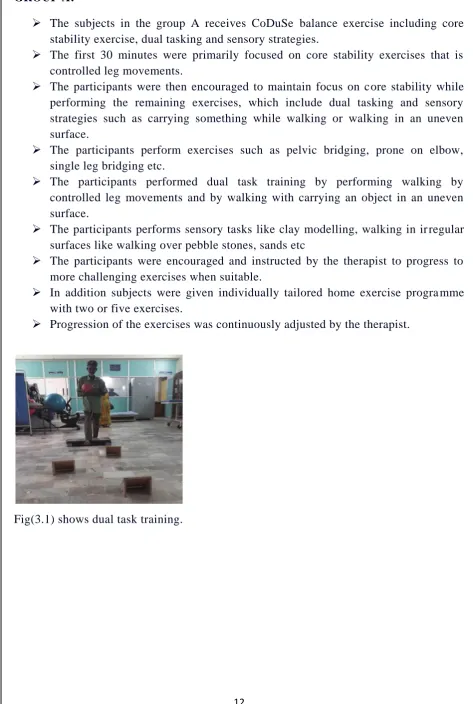
3.1. DUAL TASK TRAINING 12
3.2 CORE STRENGTHENING 13
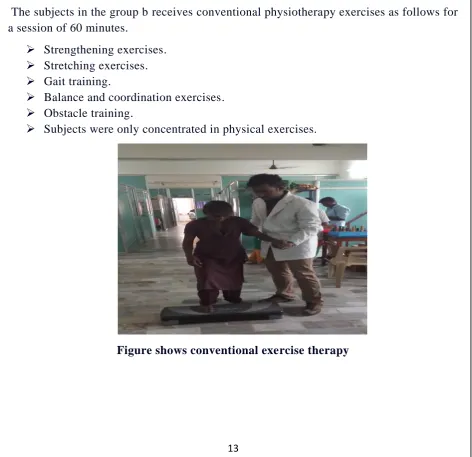
3.3. CONVENTIONAL EXERCISE THERAPY 13
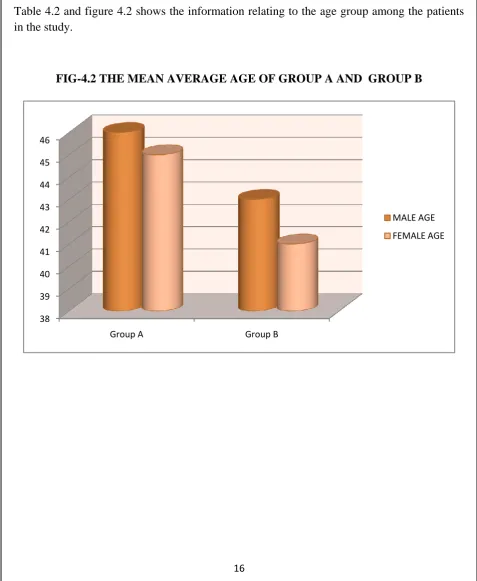
4.2 THE MEAN AVERAGE AGE OF GROUP A AND GROUP B 16
4.3 SEX DISTRIBUTION OF GROUP A AND GROUP B 17
4.4 MEAN DIFFERENCE GROUP A AND GROUP B 18
4.5 STANDARD DEVIATION VALUES OF GROUP A AND
GROUP B. 19
4.6 PAIRED ‘t’ TEST VALUES OF GROUP A AND GROUP B. 20
CHAPTER - I
1
CHAPTER – 1 1.1-INTRODUCTION
Impaired balance and trunk control and difficulty to perform trunk control and difficulty to perform dual tasks are common in people with multiple sclerosis. Balance functions can improve by specific exercise thus possibly reducing falls. Multiple sclerosis (MS) is a demyelinating disease in which the insulating covers of nerve cells in the brain and spinal cord are damaged. This damage disrupts the ability of parts of the nervous system to communicate, resulting in a range of signs and symptoms, including physical, mental, and sometimes psychiatric problems. Specific symptoms can include double vision, blindness in one eye, muscle weakness, trouble with sensation, or trouble with coordination. MS takes several forms, with new symptoms either occurring in isolated attacks (relapsing forms) or building up over time (progressive forms). Between attacks, symptoms may disappear completely; however, permanent neurological problems often remain, especially as the disease advances. Balance function can improve by specific exercise, thus possibly reducing falls. Freeman.etal reported a study in which eight week core stability exercise programmed balance and mobility skills. Another study compared core stability exercises to standard exercise and relaxation sessions in a randomized controlled trial including 100 MS patients. The study revealed that the programme did not improve walking capacity or perceived balance confidence.
1.2) DEFINITION
2
1.3) ETIOLOGY
Age. MS can occur at any age, but most commonly affects people between the ages of
15 and 60.
Sex. Women are about twice as likely as men are to develop MS.
Family history. If one of your parents or siblings has had MS, you are at higher risk of
developing the disease.
Certain infections. A variety of viruses have been linked to MS, including
Epstein-Barr, the virus that causes infectious mononucleosis.
Race. White people, particularly those of Northern European descent, are at highest risk
of developing MS. People of Asian, African or Native American descent have the
lowest risk.
Climate. MS is far more common in countries with temperate climates, including
Canada, the northern United States, New Zealand, southeastern Australia and Europe.
Certain autoimmune diseases. You have a slightly higher risk of developing MS if
you have thyroid disease, type 1 diabetes or inflammatory bowel disease.
Smoking. Smokers who experience an initial event of symptoms that may signal MS
are more likely than nonsmokers to develop a second event that confirms
relapsing-remitting MS.
Genetics
1.4) NEED FOR THE STUDY
This study is intended to improve balance and reduce falls in subjects with multiple sclerosis.
1.5) AIM OF THE STUDY:
This is to compare conventional physiotherapy treatments with CoDuSe group exercise program for improving balance and reduce falls in subjects with multiple sclerosis.
1.6) OBJECTIVE OF THE STUDY
3
1.7 VARIABLES OF THE STUDY
1.7A) DEPENDABLE VARIABLES
BBS
TUG SCALE
1.7B) INDEPENDENT VARIABLES
1. CoDuSe Group Exercise Program
2. Conventional Physiotherapy Techniques
1.8) OPERATIONAL DEFINITION
MULTIPLE SCLEROSIS
Multiple sclerosis (MS) is a potentially disabling disease of the brain and spinal cord (central nervous system).
- ROCHESTER(2014)
CODUSE
Exercise concepts on core stability in combination with dual task and sensiomotor challenges
- Nilsagard(2003) BBS
The Berg balance scale is used to objectively determine a patient's ability (or inability) to safely balance during a series of predetermined tasks.
- Berg K,(1992)
TUG
The Timed Up and Go test (TUG) is a simple test used to assess a person's mobility and requires both static and dynamic balance.
4
1.9) HYPOTHESIS
1.9(A) NULL HYPOTHESIS
There is no significant difference in conventional physiotherapy treatments with CoDuSe group exercise program for improving balance and reduce falls in subjects with multiple sclerosis.
1.9(B)ALTERNATE HYPOTHESIS
CHAPTER - II
5
CHAPTER -2
REVIEW OF LITERATURE
ANNA CARLIN ET AL (2016)
The purpose of the study is to evaluate the effects of a balance group exercise programme (CoDuSe) on balance and walking in PwMS .
ELA TARAKCI . ET AL (2013)
To determine the effectiveness of group exercise training on balance, functional status, spasticity, fatigue and quality of life in patients with multiple sclerosis.
SINIKKA.H. ET AL (2012)
The purpose of the study is to determine the effects of physiotherapy interventions on balance in people with multiple sclerosis.
U DALGAS. ET AL (2011)
The purpose of the study is to determine the effect of exercise therapy on MS fatigue by systematically reviewing the literature.
JACOB J. ET AL (2011)
The purpose of the present study was to assess the relation between demographic, clinical, mobility and balance metrics and falls history in persons with multiple sclerosis (MS).
Knorr S. ET AL (2010)
The purpose of the present study was to examine the convergent validity, sensitivity to change, floor and ceiling effects of the Community Balance and Mobility Scale (CB&M) in community-dwelling stroke survivors.
PAULA KERSTEN. ET AL (2010)
6
LUCA PROSPIRINI. ET AL (2010)
The purpose of this study was to evaluate the effectiveness of a home-based rehabilitation of balance using the Nintendo Wii Balance Board System (WBBS) in patients affected by multiple sclerosis (MS).
JA FREE MAN. ET AL (2010)
To explore the effectiveness of core stability training on balance and mobility.— Resistance exercise via negative, eccentrically induced work (RENEW) has been shown to be associated with improvements in strength, mobility, and balance in multiple clinical populations. However, RENEW has not been reported for individuals with multiple sclerosis (MS)..
CAKIT . ET AL (2010)
The purpose of this study was to evaluate the effects of cycling progressive resistance training combined with balance exercises on walking speed, balance, fatigue, fear of falling, depression, and quality of life in patients with multiple sclera.
ROBERT W. ET AL (2008)
The purpose of the study is to examine the overall effect of exercise training interventions on walking mobility among individuals with multiple sclerosis.
ALFREDO CHETTA. ET AL (2007)
The purpose of this study was to compare the effects of an 8-week AT program on exercise capacity - in terms of walking capacity and maximum exercise tolerance, as well as rehabilitation (NR) in subjects with MS.
BARBARA GIESSER. ET AL (2007)
The purpose of this protocol was to investigate the potential benefits and tolerability of locomotor training using body weight support on a treadmill (LTBWST) in persons with
multiple sclerosis (MS). LARA A. ET AL (2007)
7
DR NF TAYLOR. ET AL (2005)
The purpose of the study is to determine if participation in a progressive resistance exercise (PRE) programme can: (1) increase the ability to generate maximal muscle force, (2) increase muscle endurance, (3) increase functional activity, and (4) improve overall psychological function of people with multiple sclerosis (MS).
L J WHITE (2004). ET AL
The purpose of this study was to evaluate the effect of an eight-week progressive resistance training programme on lower extremity strength, ambulatory function, fatigue and self-reported disability in multiple sclerosis (MS) patients.
GREGORY M. ET AL (2004)
The purpose of this study was to evaluate the effects of an 8-week lower-body resistance-training program on walking mechanics in persons with multiple sclerosis (MS).
BRAZ J . ET AL (2004)
The purpose of the present study was to translate and adapt the Berg balance scale, an instrument for functional balance assessment, to Brazilian-Portuguese and to determine the reliability of scores obtained with the Brazilian adaptation.
WHITNEY. ET AL (2003)
Content validity of the BBS was established in a 3-phase development process involving 32 health care professionals who were experts working in geriatric settings. Criterion-related validity has been supported by moderate to high correlations between BBS scores and other functional measurements in a variety of older adults with
disability.
WILES. ET AL (CM 2001)
8
SE LORD. ET AL (1988)
The purpose of the study is to compare two physiotherapy approaches to improve walking in patients with gait disturbance due to multiple sclerosis (MS).
FRANCO PAOLO ET AL (1997)
CHAPTER - III
“
MATERIALS AND
9
CHAPTER-3
MATERIALS AND METHODOLOGY
3.1) MATERIALS:
A ruler
2 standard chairs (one with arm rests, one without)
A footstool or step
15 ft walkway
Stopwatch or wristwatch
Tape
Recording sheet
Pen/pencil
Couch/mats
Wobble board
Therabands/thera tubes
Cones, obstacles and peg board
3.2) METHODOLOGY
3.2.1) STUDY DESIGN:
Pre and Post test Experimental Study
3.2.2) STUDY SETTING
Kims Hospital, Trivandrum
Senthil Neuro Speciality Hospital, Erode
NIMHANS Hospital , Bangalore
Out Patient Department , Nandha College Of Physiotherapy
3.2.3) SAMPLE SIZE:
30 patients with multiple sclerosis were selected who met with the inclusion cri teria.
Group- 15 patients – conventional physiotherapy techniques
Group b- 15 patients – CoDuSo group exercise program
3.2.4) SAMPLE TECHNIQUE:
10
3.2.5) STUDY POPULATION
The study population selected was 30 patients with multiple sclerosis.
Age: 15-60years
Sex: Both GENDERS
3.2.6) STUDY DURATION
The total duration of study is 9 months.
3.2.7) TREATMENT DURATION:
The treatment duration is 60minutes
3.3) CRITERIA FOR SELECTION
3.3A) INCLUSION CRITERIA:
Multiple sclerosis diagnosed according to the Mc Donald criteria.
Walking ability not exceeding 200m.
Ability to transfer between a wheel chair and a plinth with only slight assistance
Subject aged 16 years and above
3.3B) EXCLUSION CRITERIA:
Cognitive symptoms making it difficult to understand the study information, or follow the instructions.follow .
Having medical care related to impaired walking during the past 3 months.
Having participated in the balance exercise administered by the health care personel for the past 30 days
Having started or changed medication with 4-aminopyridine during the past 30 days
Subject aged below 16 and above 60years of age
History of any recent trauma or fracture
11
3.4) PARAMETERS
BBS [BERG BALANCE SCALE]
TUG SCALE [TIME UP AND GO SCALE]
GENERAL INSTRUCTION
―Today we are going to take a look at how you are able to improve balance. Let me tell you how we are going to go about this. First, I will give you instructions on how to do the task, and then I will show you how to do it. I will describe and demonstrate each task 2 times. Do not practice the task while I‘m describing and demonstrating it. However, I will be happy to clarify any confusing points. Then I will say ―Ready, set, go‖ and you will do the task.‖
It is important that you do not start until I say ―go‖ otherwise, we will need to repeat the entire task. Each of the activities you will be asked to do should be carried out as rapidly as possible. You can work on each task for up to two minutes. We ask that you attempt each part of the test even if you do not think that you can do it. If you are unable to carry out a task, then we will go on to the next one. Again, try to do each task as rapidly as possible.
3.5PROCEDURE:
Subjects were selected by convenient sampling method. 30 subjects who fulfilled inclusion criteria and exclusion criteria were selected by random sampling
method, out of them 15 were allotted in Group A and 15 in Group B.
Subjects were clearly explained about the study about written informed consent was obtained from the subjects who fulfilled the criteria.
After completing the informed consent and they were explained about the scales and the scales were administered.
Proper instructions such as purpose, safety measures, comfort , precautions and psychological support were given to the subjects.
All vitals were checked
12
GROUP A:
The subjects in the group A receives CoDuSe balance exercise including core stability exercise, dual tasking and sensory strategies.
The first 30 minutes were primarily focused on core stability exercises that is controlled leg movements.
The participants were then encouraged to maintain focus on core stability while performing the remaining exercises, which include dual tasking and sensory strategies such as carrying something while walking or walking in an uneven surface.
The participants perform exercises such as pelvic bridging, prone on elbow, single leg bridging etc.
The participants performed dual task training by performing walking by controlled leg movements and by walking with carrying an object in an uneven surface.
The participants performs sensory tasks like clay modelling, walking in ir regular surfaces like walking over pebble stones, sands etc
The participants were encouraged and instructed by the therapist to progress to more challenging exercises when suitable.
In addition subjects were given individually tailored home exercise progra mme with two or five exercises.
Progression of the exercises was continuously adjusted by the therapist.
[image:26.595.58.532.82.787.2]13
Figure(3.2) shows core strengthening
GROUP-B
The subjects in the group b receives conventional physiotherapy exercises as follows for a session of 60 minutes.
Strengthening exercises.
Stretching exercises.
Gait training.
Balance and coordination exercises.
Obstacle training.
[image:27.595.63.538.57.262.2] Subjects were only concentrated in physical exercises.
[image:27.595.64.537.337.794.2]CHAPTER - IV
“
DATA PRESENTATION AND
14
CHAPTER – 4
DATA ANALYSIS AND PRESENTATION 4.1STATISTICAL TOOLS
For the pre and post test experimental study, both paired and unpaired ‗t‘ test was used for each parameter in an intra group analysis to find out the significance of improvement achieved through intervention. Then unpaired ‗t‘ test was used to find out the significance of the changes between two groups i.e., inter-group analysis.
4.1A)PAIRED „t‟-TEST
To compare the effect between two groups ‗t‘ test for paired values.
Formula for paired t-test
S = Σ𝑑 2− (Σ𝑑)2
𝑛
𝑛−1
t = 𝑑 𝑛
𝑠
𝑑 = Mean difference
n = Total number of subjects
S = Standard deviation
d = difference between the pre test and post test
4.1B)UNPAIRED t- TEST
The unpaired t-test was used to compare the effects between two groups, ‗t‘ test for unpaired values
Formula unpaired t –test
S = (𝑛1−1)𝑠1 2+(𝑛
2−1)𝑠22
𝑛1+𝑛2−2
t = 𝑥 1−𝑥 2
15
n1 = Total number of subjects in Group A.
n2 = Total number of subjects in Group B.
𝑋1
= Mean difference between pre test and post test of Experimental Group A.
X2 = Mean difference between pre test and post test of Control Group A.
S1 = Difference between pre test and post test of Experimental Group B.
16
TABLE-4.2
MEAN AVERAGE AGE GROUP OF GROUP A AND GROUP B
Mean Age Group Group A Group B
male‟s 46 43
[image:31.595.58.536.216.798.2]female‟s 45 41
Table 4.2 and figure 4.2 shows the information relating to the age group among the patients in the study.
FIG-4.2 THE MEAN AVERAGE AGE OF GROUP A AND GROUP B
38 39 40 41 42 43 44 45 46
Group A Group B
MALE AGE
17
SEX DISTRIBUTION OF GROUP A AND GROUP B
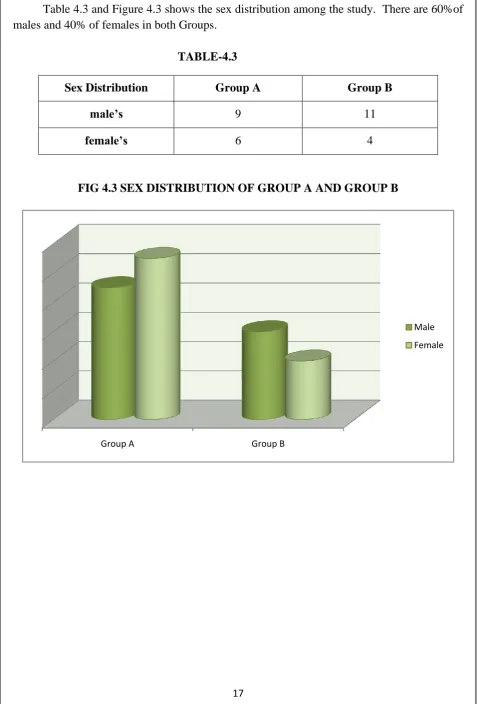
Table 4.3 and Figure 4.3 shows the sex distribution among the study. There are 60%of males and 40% of females in both Groups.
TABLE-4.3
Sex Distribution Group A Group B
male‟s 9 11
[image:32.595.59.537.91.796.2]female‟s 6 4
FIG 4.3 SEX DISTRIBUTION OF GROUP A AND GROUP B
Group A Group B
Male
18
[image:33.595.62.535.101.794.2]MEAN DIFFERENCE BETWEEN GROUP A AND GROUP B OF BBS AND TUG
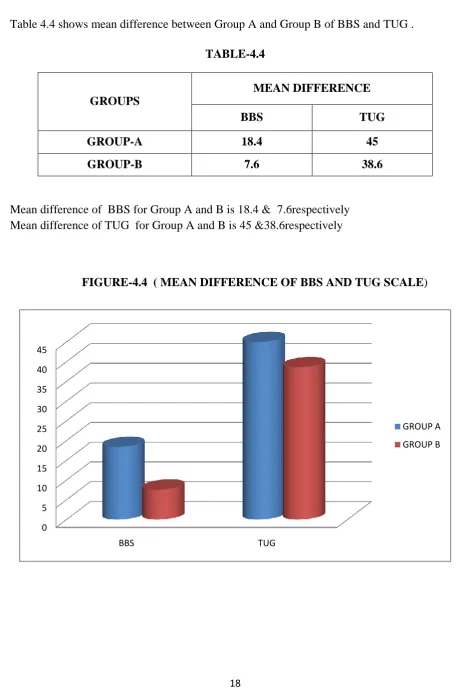
Table 4.4 shows mean difference between Group A and Group B of BBS and TUG .
TABLE-4.4
GROUPS
MEAN DIFFERENCE
BBS TUG
GROUP-A 18.4 45
GROUP-B 7.6 38.6
Mean difference of BBS for Group A and B is 18.4 & 7.6respectively Mean difference of TUG for Group A and B is 45 &38.6respectively
FIGURE-4.4 ( MEAN DIFFERENCE OF BBS AND TUG SCALE)
0 5 10 15 20 25 30 35 40 45
BBS TUG
GROUP A
19
[image:34.595.60.541.52.798.2]STANDARD DEVIATION BETWEEN GROUP A AND GROUP B OF BBS AND TUG SCALES
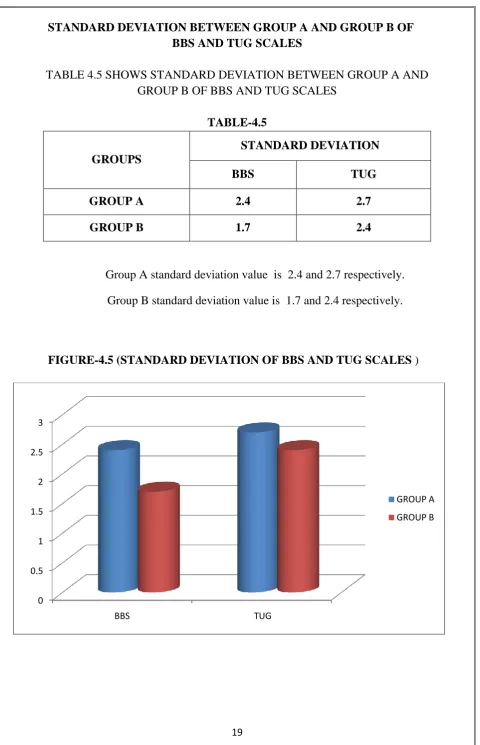
TABLE 4.5 SHOWS STANDARD DEVIATION BETWEEN GROUP A AND GROUP B OF BBS AND TUG SCALES
TABLE-4.5
GROUPS
STANDARD DEVIATION
BBS TUG
GROUP A 2.4 2.7
GROUP B 1.7 2.4
Group A standard deviation value is 2.4 and 2.7 respectively.
Group B standard deviation value is 1.7 and 2.4 respectively.
FIGURE-4.5 (STANDARD DEVIATION OF BBS AND TUG SCALES )
0 0.5 1 1.5 2 2.5 3
BBS TUG
GROUP A
20
[image:35.595.58.540.71.260.2]COMPARISION OF THE PAIRED „t‟ TEST AND TABLE VALUE BETWEEN GROUP A AND GROUP B
TABLE-4.6
GROUPS
CALCULATED 't' VALUE
TABLE VALUE SIGNIFICANCE
BBS TUG
GROUP A 29.13 63 2.15 SIGNIFICANT
GROUP B 16.9 61 2.15 SIGNIFICANT
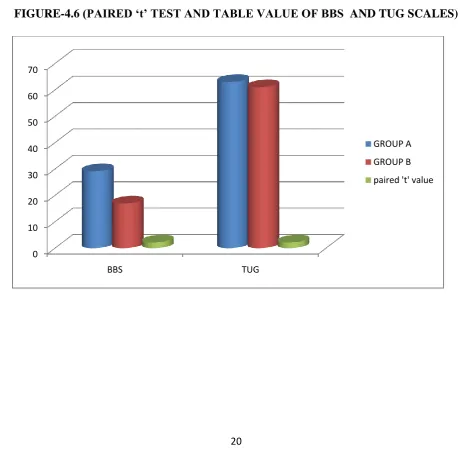
For 9 degree of freedom and at 5%level of significance, the table value is 2.15 and the calculated group A t value is 29.13 and 63, the group B t value is 16.9 and 61since the calculated t values was greater than the table t value, null hypothesis is rejected.
FIGURE-4.6 (PAIRED „t‟ TEST AND TABLE VALUE OF BBS AND TUG SCALES)
0
10 20 30 40 50 60 70
BBS TUG
GROUP A
GROUP B
[image:35.595.61.535.344.799.2]21
[image:36.595.57.538.69.246.2]COMPARISION OF UNPAIRED „t‟ TEST AND TABLE VALUE BETWEEN BBS AND TUG
TABLE-4.7
GROUP UNPAIRED „t‟ TEST TABLE VALUE
SIGNIFICANT
GROUP A & GROUP B
BBS TUG
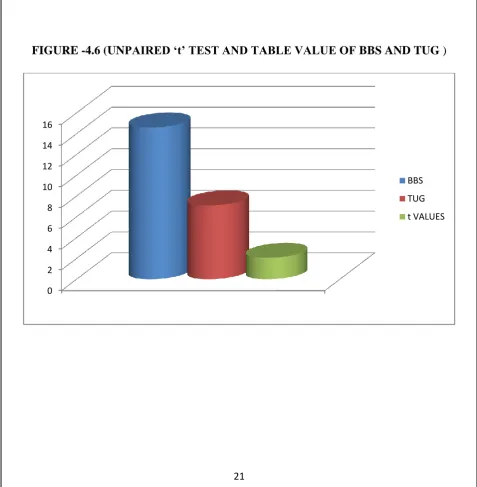
2.05 SIGNIFICANT
14.59 7.1
[image:36.595.58.536.308.796.2]For 9 degree of freedom and at 5% level of significance, the table values is 2.05 and the calculated BBS unpaired t value is 14.59 and the TUG unpaired t value is 7.1 since the calculated unpaired t value was greater than the table t value, null hypothesis is rejected.
FIGURE -4.6 (UNPAIRED „t‟ TEST AND TABLE VALUE OF BBS AND TUG )
0 2 4 6 8 10 12 14 16
BBS
TUG
CHAPTER - V
“
RESULTS AND
22
CHAPTER - 5
RESULTS AND DISCUSSION 5.1RESULTS
The study sample comprised 30 patients ,of which 20 were male and 10 were female patients with multiple sclerosis disease. Among 30 patients 15 were treated with C and other 15 patients were treated with conventional therapy . The pre and post test values were assessed by berg balance scale and mini mental state examination scale in group A . The mean difference value of BBS is 18., .TUG is 45 respectively. The standard deviation of BBS is 2.4, TUG is 2.7 the paired t-test value for BBS is 29.13, TUG is 63 respectively. The paired t-test value is more than the table value 2.15 or 5% level of significance at 14degrees of freedom.
The pre and post test value were assessed by BBS and TUG in group B. the mean difference value of BBS 7.6, TUG is 38.6 respectively. The standard deviation of BBS 1.7,TUG is 2.4 respectively. The t- test for BBS is 16.9 , TUG is 61 respectively. The paired t-test value is more than the table value 2.15 or 5% level of significance at 14 degree of freedom.
23
5.2 DISCUSSIONS
The study sample comprised 30 patients of both gender. The mean age of patient was 50 years. The groups differed at baseline in terms of age , sex and MS subtypes. This study suggests that the CoDuSe balance group exercise programme improves balance, as BBS and TUG scale and perceived limitation in walking due to MS as compared to the conventional physiotherapy treatments.. it also reduces the number of falls as well as near falls. These discussions are in line with those presented in previous study and imply that CoDuSe intervention is a promising intervention in disease stages characterized by significant loss of walking ability. This result is in line with that reported after twelve 30-minutes exercise sessions during 12 weeks of pilates group study exercise , enhanced with individualized daily home exercise home exercise programme.
The CoDuSe intervention led to a reduction of falls which is important , as falls can lead to injury and activity curtailments. The ability to reproduce these results in a new sample strengthens that the intervention is effective to reduce risk of falls atleast in a shorter time period. The number of prospectively reported that near falls also reduced. Being able to manage imbalance without falling can be seen as a successful strategy. The participants also learnt to maintain stability in situations where they had lost balance.
CHAPTER - VI
“
SUMMARY AND
24
CHAPTER -6
LIMITATION AND SUGGESTION
6.1. LIMITATIONS
This study has been conducted on small sized sample only. This study has taken more time to complete.
Variation in calamite, drugs, diet, personal habit, side of involvement, gender, age could not be controlled.
Lack of pre-intervention data on falls and near falls
Heterogeneity is difficult to forestay in samples of MS and study may be under powered
The intention of the MS care is to encourage people to be as active as possible.
6.2 SUGGESTION
A similar study may be extended with larger samples.
CHAPTER - VI
“
SUMMARY AND
25
CHAPTER -7
SUMMARY AND CONCLUSION
The multiple sclerosis is one of the most important neuromuscular disease. About two third of the population experiences this disease. Impaired balance and trunk control and difficulty to perform dual tasks are common with multiple sclerosis patients. Due to imbalance and trunk instability many people are under risk of fall. The CoDuSe intervention led to a reduction of falls which is important , as falls can lead to injury and activity curtailments. The ability to reproduce these results in a new sample strengthens that the intervention is effective to reduce risk of falls at least in a shorter time period.
26
BIBLIOGRAPHY
REFERENCES
Martin CL, Phillips BA, Kilpatrick TJ, et al. Gait and balance impairment in early multiple sclerosis in the absence of clinical disability. Mult Scler 2006; 12620–628.
2. Lanzetta D, Cattaneo D, Pellegatta D, et al. Trunk control in unstable sitting posture during functional activities in healthy subjects and patients with multiple sclerosis. Arch Phys Med Rehabil 2004; 85:279–283.
3. Hamilton F, Rochester L, Paul L, et al. Walking and talking: An investigation of cognitive motor dual tasking in multiple sclerosis. Mult Scler 2009; 15:1215–1227.
4. Nilsagard Y, Gunn H, Freeman J, et al. Falls in people with MS – An individual data meta-analysis from studies from Australia, Sweden, United Kingdom and the United States. MultScler 2015; 21: 92–100.
5. Gunn H, Markevics S, Haas B, et al. Systematic review: The effectiveness of interventions to reduce falls and improve balance in adults with multiple sclerosis. Arch Phys Med Rehabil2015; 96: 1898–1912.
6. Nilsagård YE, von Koch LK, Nilsson M, et al. Balance exercise program reduced falls in people with multiple sclerosis: A single-group, pretest-posttest trial. Arch Phys Med Rehabil 2014; 95:2428–2434.
7. Cattaneo D, Jonsdottir J, Zocchi M, et al. Effects of balance exercises on people with multiple sclerosis: A pilot study. Clin Rehabil 2007; 21: 771–781.
8. Freeman JA, Gear M, Pauli A, et al. The effect of core stability training on balance and mobility in ambulant individuals with multiple sclerosis: A multi-centre series of single case studies. Mult Scler 2010; 16: 1377–1384.
9. Fox EE, Hough AD, Creanor S, et al. The effects of ‗Pilates‘ based core stability training in ambulant people with multiple sclerosis: A multi-centre, randomised, assessor-blinded, controlled trial. PhysTher 2016; 96: 1170–1178.
10. Prosperini L, Leonardi L, De Carli P, et al. Visuo-proprioceptive training reduces risk of falls in patients with multiple sclerosis. Mult Scler 2010; 16:491–499.
11. Sosnoff JJ, Finlayson M, McAuley E, et al. Home-based exercise program and fall-risk reduction in older adults with multiple sclerosis: Phase 1randomized controlled trial. Clin Rehabil 2014; 28:254–263.
27
13. Gunn H, Cattaneo D, Finlayson M, et al. Homeor away? Choosing a setting for a falls-prevention program for people with multiple sclerosis. Int J MSCare 2014; 16: 186–191.
14. McDonald WI, Compston A, Edan G, et al.Recommended diagnostic criteria for multiple
sclerosis: Guidelines from the International Panel onthe diagnosis of multiple sclerosis. Ann Neurol 2001;50: 121–127.
15. Cattaneo D, Jonsdottir J and Coote S. Targeting dynamic balance in falls-prevention interventions in multiple sclerosis: Recommendations from the International MS Falls Prevention Research Network. Int J MS Care 2014; 16: 198–202.
16. Cattaneo D, Jonsdottir J and Repetti S. Reliability of four scales on balance disorders in persons with multiple sclerosis. Disabil Rehabil 2007; 29: 1920–1925.
17. Cattaneo D, Regola A and Meotti M. Validity of six balance disorders scales in persons with multiple sclerosis. Disabil Rehabil 2006; 28: 789–795.
18. Verheyden G, Nuyens G, Nieuwboer A, et al. Reliability and validity of trunk assessment for people with multiple sclerosis. Phys Ther 2006; 86: 66–76.
19. Csuka M and McCarty DJ. Simple method for measurement of lower extremity muscle strength. Am J Med 1985; 78: 77–81.
20. Sturnieks DL, Arnold R and Lord SR. Validity and reliability of the swaymeter device for measuring postural sway. BMC Geriatr 2011; 11: 63.
21. Podsiadlo D and Richardson S. The timed ‗Up & Go‘: A test of basic functional mobility for frail elderly persons. J Am Geriatr Soc 1991; 39: 142–148.
22. Butland RJ, Pang J, Gross ER, et al. Two-, six-, and 12-minute walking tests in respiratory disease. Br Med J 1982; 284: 1607–1608.
23. Gijbels D, Dalgas U, Romberg A, et al. Which walking capacity tests to use in multiple sclerosis? A multicentre study providing the basis for a core set. Mult Scler 2012; 18: 364– 371.
24. Penner IK, Raselli C, Stocklin M, et al. The Fatigue Scale for Motor and Cognitive Functions (FSMC): Validation of a new instrument to assess multiple sclerosis-related fatigue. Mult Scler 2009; 15: 1509–1517.
25. Yardley L, Beyer N, Hauer K, et al. Development and initial validation of the Falls Efficacy Scale- International (FES-I). Age Ageing 2005; 34: 614–619.
28
28. Lamb SE, Jorstad-Stein EC, Hauer K, et al .Development of a common outcome data set for fall injury prevention trials: The Prevention of Falls Network Europe consensus. J Am Geriatr Soc 2005; 53: 1618–1622.
29. Stack E and Ashburn A. Fall events described by people with Parkinson‘s disease: Implications for clinical interviewing and the research agenda. Physiother Res Int 1999; 4: 190–200.
30. Cheng EM, Hays RD, Myers LW, et al. Factors related to agreement between self-reported and conventional Expanded Disability Status Scale (EDSS) scores. Mult Scler 2001; 7: 405–410.
31. Parmenter BA, Weinstock-Guttman B, Garg N, et al. Screening for cognitive impairment in multiple sclerosis using the Symbol Digit Modalities Test. Mult Scler 2007; 13: 52–57.
32. Brown H and Prescott R. Applied mixed models in medicine. 2nd ed. Chichester: John Wiley & Sons, 2006.
33. Paltamaa J, Sarasoja T, Leskinen E, et al. Measuring deterioration in international classification of functioning domains of people with multiple sclerosis who are ambulatory. Phys Ther 2008; 88: 176–190.
34. Learmonth YC, Paul L, McFadyen AK, et al.Reliability and clinical significance of mobility and balance assessments in multiple sclerosis. Int J Rehabil Res 2012; 35: 69–74.
35. Gandolfi M, Munari D, Geroin C, et al. Sensory integration balance training in patients with multiple Multiple Sclerosis Journal 23(10)1404 journals.sagepub.com/home/msj sclerosis: A randomized, controlled trial. Mult Scler2015; 21: 1453–1462.
36. Hobart J, Blight AR, Goodman A, et al. Timed 25-foot walk: Direct evidence that improving 20% or greater is clinically meaningful in MS. Neurology 2013; 80: 1509–1517.
37. Gunn H, Creanor S, Haas B, et al. Frequency, characteristics, and consequences of falls in multiple sclerosis: Findings from a cohort study. Arch Phys Med Rehabil 2014; 95: 538–545.
38. Nilsagard Y, Carling A and Forsberg A. Activities- specific balance confidence in people with multiple sclerosis. Mult Scler Int 2012; 2012: 613925 (8 pp.).
39. Matsuda PN, Shumway-Cook A, Bamer AM, et al.mFalls in multiple sclerosis. PM R 2011; 3: 624–632;quiz 32.
29
REFERENCE BOOKS
HUMAN ANATOMY – B.D CHAURASIA
TEXTBOOK OF NEUROLOGY – NAVNEET KUMAR
NEUROLGY AND NEUROSURGEY-KENNET W LINDSSAY PHYSICAL REHABILITATION-SUSAN B O SULLIVAN
WEBSITE WWW.PHYSIPEDIA.COM
30
APPENDIX-1 ETHICAL CLEARANCE
Ethically permissions for the study will be obtained from the subjects and a written consent form will be taken from each subjects who participates in this study.As this study involve human subjects the ethical clearance has been obtained from the ethical committee of Nandha College of Physiotherapy,Erode as per the ethical guidelines for Bio-medical research n human subjects.2000 ICMR(Indian Council Of Medical Research ) New Delhi.
31
APPENDIX-2
Written Informed Consent Form
NANDHA COLLEGE OF PHYSIOTHERAPY ERODE.
Informed consent form for the volume at Nandha College Of Physiotherapy, Erode who will be participating in the research project entitled, “EFFECTIVENESS OF CODUSE GROUP EXERCISE PROGRAM AND CONVENTIONAL PHYSIOTHERAPY EXERCISE IN IMPROVING BALANCE AND REDUCE RISK OF FALLS IN PATIENTS WITH MULTIPLE SCLEROSIS- A COMPARATIVE STUDY”
Name of the principal investigation 271720061
Name of the Organization Nandha College Of Physiotherapy Erode
This informed consent form has two parts:
Information sheet(to share the information about the research to you)
32
PART:1 INFORMATION SHEET INTRODUCTION:
I postgraduate student in the Department of Physiotherapy, Nandha college of physiotherapy, Erode, I am working on my dissertion titled “CoDuSe group excise programme improves balance and reduces falls in people with multiple sclerosis - A comparative study”. I am going to give you information and invite you to be part of this research. You do not have deice today whether or not you will participate in the research. Before you decide. You can talk to anyone you feel comfortable with about the research
There may be some words that you do not understand .Please ask me to stop as we go through the information and I will take time to explain . If you have questions later ,you can ask them and get yourself clarified.
Purpose of research
To find out the effectiveness in CoDuse group excise program.
Type of research intervention
In this study if you are selected detailed history taking examination and routine investigation will be done
Participant selection
Study group: adult between age 16-65 years
Possible Risk
There are no major physical risks for the person associated with these methods. Complications include exacerbation of symptoms after treatment which is rare possibility.
Reimbursement
You won‘t be given monetary incentives or gifts for being a part of this research.
Confidentiality
The information that we collect from this research project will be kept confidential. Information about the patient that will be collected during the research will be put away and no-one but the researchers will be able to see it.
Right to Refuse or withdraw
33
Who To Contact
This proposal has been reviewed and approved by the Research and Ethical committee of Nandha College of Physiotherapy, Erode, which is a committee whose task it is to make sure that research participants are protected from harm. You can ask me any more questions about any part of the research study, if you wish to . Do you have any questions?
PART II: Certificate of Consent
I have read the foregoing information or it has been read to me. I have been explained the procedure and complications. I am willing to participate in the study . I have had the opportunity to ask questions about it and any questions that I have asked have been answered to my satisfaction. I consent voluntarily to participant in this research.
Name of participant__________________________
Signature of participant________________________
Date ______________________Day/Month/ Year
If illiterate a literate witness must sign (if possible, this person should be selected by the participant and should have no connection to the research team). Participants who are illiterate should include their thumb-prints as well.
I have a witnessed the accurate reading of the consent form to the potential participant and the individual has had the opportunity to ask questions. I confirm that the individual has given consent freely.
Name of witness_________________ Thumb print of participant
Signature of witness____________________
34
Statement by the researcher/person taking consent
I have accurately read out the information sheet to the potential participant and to the best of my ability made sure that the participation understands that the following will be done.
“EFFECTIVENESS OF CODUSE GROUP EXERCISE PROGRAM AND
CONVENTIONAL PHYSIOTHERAPY EXERCISE IN IMPROVING BALANCE AND REDUCE RISK OF FALLS IN PATIENTS WITH MULTIPLE SCLEROSIS- A COMPARATIVE STUDY”
I confirm that the participant was given an opportunity to ask questions about the study and all the questions asked by the participant have been coerced into giving consent and the consent has been given freely and voluntarily.
A copy of this informed consent from has been provided to the participant.
Name of Research /person taking the consent__________________
Signature of Researcher/person taking the consent____________
35
APPENDIX-3 NEUROLOGICAL ASSESSMENT FORM
Name :
Age :
Sex :
Occupation :
Residential Address :
Chief complaints :
Past medical history :
Present medical history :
Personal history
Family history :
Associated problems :
Drug history :
Vital signs:
Temperature :
Blood pressure :
Heart rate :
Respiratory rate :
OBJECTIVE EXAMINATION ON OBSERVATION
Body Built :
Posture :
Attitude of limbs :
36
Pattern of movement :
Gait :
Pressure sore :
External Appliances :
Deformities :
PALPATION
Muscle tone :
Oedema :
Tenderness :
Warmth :
ON EXAMINATION
HIGHER MENTAL FUNCTIONS LEVEL OF CONSCIOUSNESS :
ORIENTATION
Person :
Place :
Time :
MEMORY
Immediate :
Recent :
Remote :
ATTENTION
COMMUNICATION
EMOTIONAL STATUS
2. HIGHER CORTICAL FUNCTION: COGNITION
37
Calculation :
Proverb interpretation :
PERCEPTION
Body scheme/body image disorder :
Agnosia :
Apraxia :
3. CRANIAL NERVES : 4. SENSORY SYSTEM :
Superficial sensation : Deep sensation :
Cortical sensation :
5. MOTOR SYSTEM Muscle girth
Muscle girth Arm Forearm Thigh Calf Right
Left
Muscle tone
38
Range of motion Upper limb
RT
Side Shoulder Elbow Wrist FLX EXT ABD ADD INT
ROT
EXT ROT
FLX EXT FLX EXT
LT
REFLEXES SUPERFICIAL
Abdominal :
Plantar :
Corneal :
DEEP
Biceps :
Triceps :
Brachioradialis :
Ankle jerk :
Knee jerk :
39
6. INVOLANTARY MOVEMENTS:
7. BALANCE
Balance Static Dynamic
Sitting
Standing
BBS SCORE: TUG SCORE: 8 .GAIT
Step length :
Stride length :
Width of base :
Cadence :
9. ASSISTIVE DEVICES :
10. PHYSICAL THERAPY DIAGNOSIS: Direct impairments :
Indirect impairments :
Composite impairments :
Functional limitations :
40
12. PHYSICAL THERAPY MANAGEMENT: A)AIM
B)GOALS- SHORT TERM GOALS LONG TERM GOALS 13. HOME PROGRAMME :
APPENDIX-4
ETHICAL CLEARANCE
41
APPENDIX-5
Written Informed Consent Form
NANDHA COLLEGE OF PHYSIOTHERAPY, ERODE.
Informed consent form for the volunteers at ―Nandha college of Physiotherapy, Erode‖, who will be participating in the research project entitled : ― CODUSE GROUP EXERCISE PROGRAM IMPROVES BALANCE REDUCE FALLS IN PEOPLE WITH
MULTIPLE SCLEROSIS”
Name of Principal Investigator 271720061
Poat graduate student
Name of Organization Department of Physiotherapy,
Nandha college of Physiotherapy, Erode
This Informed Consent Form has two parts:
• Information Sheet (to share information about the research with you) • Certificate of Consent (for signatures if you agree to take part)
42
PART I: Information Sheet
Introduction
I, undergraduate student in the Department of Physiotherapy, Nandha college of Physiotherapy,Erode, am working on my dissertation titled : ― CODUSE GROUP
EXERCISE PROGRAM IMPROVES BALANCE REDUCE FALLS IN PEOPLE WITH MULTIPLE SCLEROSIS”
I am going to give you information and invite you to be part of this research. You do not have to decide today whether or not you will participate in the research. Before you decide, you can talk to anyone you feel comfortable with about the research.
There may be some words that you do not understand. Please ask me to stop as we go through the information and I will take time to explain. If you have questions later, you can ask them and get yourself clarified.
Purpose of the research
To find out the effectiveness of CoDuSe group exercise program vs conventional physiotherapy exercises on balance and walking in multiple sclerosis patients.
Type of Research Intervention
In this study if you are selected, detailed history taking, clinical examination and routine investigations will be done.
Participant selection
Study group: Adult between age groups of 40-70 years presenting with history of MCA Stroke that occur following Contra lateral Hemiparesis (Worse in the arm and face than in the leg), Dysarthria, Hemianesthasia, Aphasia (if the dominant hemisphere is affected) Voluntary Participation
Your participation in this research is entirely voluntary. It is your choice whether to participate or not. It will not affect our patient‘s treatment process.
Benefits
43
Possible risks
There are no major physical risks for the person associated with these methods. Complications include exacerbation of symptoms after therapy which is rare possibility.
Reimbursements
You won‘t be given any monetary incentives or gifts for being a part of this research.
Confidentiality
The information that we collect from this research project will be kept confidential. Information about the patient that will be collected during the research will be put away and no-one but the researchers will be able to see it.
Right to Refuse or Withdraw
You do not have to take part in this research if you do not wish to do so. You may also stop participating in the research at any time you choose. It is your choice and all of your rights will still be respected.
Who to Contact
This proposal has been reviewed and approved by the Research and Ethical committee of Nandha college of physiotherapy,Erode, which is a committee whose task it is to make sure that research participants are protected from harm.
44
PART II: Certificate of Consent
I have read the foregoing information, or it has been read to me. I have been explained the procedure and complications. I am willing to participate in the study. I have had the opportunity to ask questions about it and any questions that I have asked have been answered to my satisfaction. I consent voluntarily to participate as a participant in this research.
Name of Participant_________________________
Signature of Participant ___________________
Date __________________________________
Day/month/year
If illiterate a literate witness must sign (if possible, this person should be selected by the participant and should have no connection to the research team). Participants who are illiterate should include their thumb-print as well.
I have witnessed the accurate reading of the consent form to the potential participant, and the individual has had the opportunity to ask questions. I confirm that the individual has given consent freely.
Name of witness_________________ Thumb print of participant
Signature of witness _____________ Date ________________________
45
Master chart-1 APPENDIX-6
PRE AND POST TEST SCORES OF GROUP A AND GROUP B
SL. NO.
GROUP A( BBS) GROUP B (BBS)
PRE TEST POST TEST PRE TEST POST TEST
01 36 52 36 44
02 38 54 38 46
03 32 56 34 42
04 32 50 32 40
05 36 54 34 42
06 38 52 36 44
07 34 50 38 42
08 32 52 32 40
09 36 56 34 42
110 34 52 38 44
111 32 54 34 46
112 34 56 32 40
113 36 54 34 42
114 38 56 36 42
46
Master chart - 2
PRE AND POST TEST SCORES OF GROUP A AND GROUP B
SL. NO.
GROUP A( TUG) GROUP B (TUG)
PRE TEST POST TEST PRE TEST POST TEST
01 30 9 32 20
02 28 10 34 22
03 29 13 30 21
04 30 12 32 25
05 26 12 30 26
06 28 11 34 27
07 29 10 32 20
08 30 9 30 21
09 30 10 34 23
10 31 9 32 25
11 32 8 30 20
12 29 9 32 19
13 33 10 34 18
14 34 11 32 17
47
APPENIX-7 BERG BALANCE SCALE
SITTING TO STANDING
INSTRUCTIONS: The client is in sitting position, the client is asked to stand up and try not to use his hands.
( ) 4 able to stand without using hands and stabilize independently
( ) 3 able to stand independently using hands
( ) 2 able to stand using hands after several tries
( ) 1 needs minimal aid to stand or stabilize
( ) 0 needs moderate or maximal assist to stand
2. STANDING UNSUPPORTED
INSTRUCTIONS: The client is asked to stand for two minutes without holding on. ( ) 4 able to stand safely for 2 minutes
( ) 3 able to stand 2 minutes with supervision
( ) 2 able to stand 30 seconds unsupported
( ) 1 needs several tries to stand 30 seconds unsupported
( ) 0 unable to stand 30 seconds unsupported
If the client is able to stand 2 minutes unsupported, score full points for sitting unsupported. Proceed to item #4.
3. SITTING WITH BACK UNSUPPORTED BUT FEET SUPPORTED ON FLOOR OR ON A STOOL
INSTRUCTIONS: The client is asked to sit with arms folded for 2 minutes. ( ) 4 able to sit safely and securely for 2 minutes
( ) 3 able to sit 2 minutes under supervision
48
( ) 1 able to sit 10 seconds
( ) 0 unable to sit without support 10 seconds
4. STANDING TO SITTING
INSTRUCTIONS: The client is asked to sit down. ( ) 4 sits safely with minimal use of hands
( ) 3 controls descent by using hands
( ) 2 uses back of legs against chair to control descent
( ) 1 sits independently but has uncontrolled descent
( ) 0 needs assist to sit
5. TRANSFERS
INSTRUCTIONS: Arrange chair(s) for pivot transfer. The client is asked to transfer one way toward a seat with armrests and one way toward a seat without armrests.
( ) 4 able to transfer safely with minor use of hands
( ) 3 able to transfer safely definite need of hands
( ) 2 able to transfer with verbal cuing and/or supervision
( ) 1 needs one person to assist
( ) 0 needs two people to assist or supervise to be safe
6. STANDING UNSUPPORTED WITH EYES CLOSED
INSTRUCTIONS: The client is asked to close the eyes and stand still for 10 seconds. ( 6.1 ) 4 able to stand 10 seconds safely
( ) 3 able to stand 10 seconds with supervision
( ) 2 able to stand 3 seconds
( ) 1 unable to keep eyes closed 3 seconds but stays safely
49
7. STANDING UNSUPPORTED WITH FEET TOGETHER
INSTRUCTIONS: The client is asked to Place the feet together and stand without holding on.
( ) 4 able to place feet together independently and stand 1 minute safely
( ) 3 able to place feet together independently and stand 1 minute with supervision
( ) 2 able to place feet together independently but unable to hold for 30 seconds
( ) 1 needs help to attain position but able to stand 15 seconds feet together
( ) 0 needs help to attain position and unable to hold for 15 seconds
8. REACHING FORWARD WITH OUTSTRETCHED ARM WHILE STANDING INSTRUCTIONS: The client is asked to Lift arm to 90 degrees. Stretch out the fingers and reach forward as far as can. (Examiner places a ruler at the end of fingertips when arm is at 90 degrees. Fingers should not touch the ruler while reaching forward. The recorded measure is the distance forward that the fingers reach while the subject is in the most forward lean position. When possible, ask subject to use both arms when reaching to avoid rotation of the trunk.)
( ) 4 can reach forward confidently 25 cm (10 inches)
( ) 3 can reach forward 12 cm (5 inches)
( ) 2 can reach forward 5 cm (2 inches)
( ) 1 reaches forward but needs supervision
( ) 0 loses balance while trying/requires external support
9. PICK UP OBJECT FROM THE FLOOR FROM A STANDING POSITION INSTRUCTIONS: The client is asked to Pick up the shoe/slipper, which is place in front of the feet.
( ) 4 able to pick up slipper safely and easily
( ) 3 able to pick up slipper but needs supervision
( ) 2 unable to pick up but reaches 2-5 cm(1-2 inches) from slipper and keeps balance independently
( ) 1 unable to pick up and needs supervision while trying
50
10. TURNING TO LOOK BEHIND OVER LEFT AND RIGHT SHOULDERS WHILE STANDING
INSTRUCTIONS: The client is asked to Turn to look directly behind you over toward the left shoulder. Repeat to the right. Examiner may pick an object to look at directly behind the subject to encourage a better twist turn.
( ) 4 looks behind from both sides and weight shifts well
( ) 3 looks behind one side only other side shows less weight shift
( ) 2 turns sideways only but maintains balance
( ) 1 needs supervision when turning
( ) 0 needs assist to keep from losing balance or falling
11. TURN 360 DEGREES
INSTRUCTIONS: The client is asked to Turn completely around in a full circle. Pause. Then turn a full circle in the other direction.
( ) 4 able to turn 360 degrees safely in 4 seconds or less
( ) 3 able to turn 360 degrees safely one side only 4 seconds or less
( ) 2 able to turn 360 degrees safely but slowly
( ) 1 needs close supervision or verbal cuing
( ) 0 needs assistance while turning
12. PLACE ALTERNATE FOOT ON STEP OR STOOL WHILE STANDING UNSUPPORTED
INSTRUCTIONS: The client is asked to Place each foot alternately on the step/stool. Continue until each foot has touch the step/stool four times.
( ) 4 able to stand independently and safely and complete 8 steps in 20 seconds
( ) 3 able to stand independently and complete 8 steps in > 20 seconds
( ) 2 able to complete 4 steps without aid with supervision
( ) 1 able to complete > 2 steps needs minimal assist
51
13. STANDING UNSUPPORTED ONE FOOT IN FRONT
INSTRUCTIONS: (DEMONSTRATE TO SUBJECT) Place one foot directly in front of the other. If you feel that you cannot place your foot directly in front, try to step far enough ahead that the heel of your forward foot is ahead of the toes of the other foot. (To score 3 points, the length of the step should exceed the length of the other foot and the width of the stance should approximate the subject‘s normal stride width.)
( ) 4 able to place foot tandem independently and hold 30 seconds
( ) 3 able to place foot ahead independently and hold 30 seconds
( ) 2 able to take small step independently and hold 30 seconds
( ) 1 needs help to step but can hold 15 seconds
( ) 0 loses balance while stepping or standing
14. STANDING ON ONE LEG
INSTRUCTIONS: The client is asked to Stand on one leg as long as you can without holding on.
( ) 4 able to lift leg independently and hold > 10 seconds
( ) 3 able to lift leg independently and hold 5-10 seconds
( ) 2 able to lift leg independently and hold ≥ 3 seconds
( ) 1 tries to lift leg unable to hold 3 seconds but remains standing independently.
( ) 0 unable to try of needs assist to prevent fall
( ) TOTAL SCORE (Maximum = 56)
TIME UP AND GO TEST
Method:
1. The patient starts in a seated position
2. The patient stands up upon therapist‘s command: walks 3 meters, turns around, walks back to the chair and sits down.
3. The time stops when the patient is seated.
4. The subject is allowed to use an assistive device. Be sure to document the assistive device used.
52
53
APPENDIX-9 ABSTRACT
BACKGROUND:
Imbalance leading to falls is common in people with multiple sclerosis (PwMS).
OBJECTIVE:
To evaluate the effects of a balance group exercise programme (CoDuSe) on balance and walking in PwMS (Expanded Disability Status Scale, 4.0–7.5).
METHODS:
A multi-centre, randomized, controlled single-blinded pilot study with random allocation to early or late start of exercise, with the latter group serving as control group for the physical function measures. In total, 14 supervised 60-minute exercise sessions were delivered over 7 weeks. Pretest–posttest analyses were conducted for self-reported near falls and falls in the group starting late. Primary outcome was Berg Balance Scale (BBS). A total of 51 participants were initially enrolled; three were lost to follow-up.
RESULTS:
Post-intervention, the exercise group showed statistically significant improvement (p = 0.015) in BBS and borderline significant improvement in MS Walking Scale (p = 0.051), both with large effect sizes (3.66; −2.89). No other significant differences were found between groups. In the group starting late, numbers of falls and near falls were statistically significantly reduced after exercise compared to before (p < 0.001; p < 0.004).
CONCLUSION: