This is a repository copy of
Model averaging in ecology: : a review of Bayesian,
information-theoretic and tactical approaches for predictive inference
.
White Rose Research Online URL for this paper:
http://eprints.whiterose.ac.uk/127516/
Version: Accepted Version
Article:
Dormann, Carsten F., Calabrese, Justin M., Guillera-Arroita, Gurutzeta et al. (20 more
authors) (2018) Model averaging in ecology: : a review of Bayesian, information-theoretic
and tactical approaches for predictive inference. Ecological Monographs. pp. 485-504.
ISSN 0012-9615
https://doi.org/10.1002/ecm.1309
[email protected] https://eprints.whiterose.ac.uk/
Reuse
Items deposited in White Rose Research Online are protected by copyright, with all rights reserved unless indicated otherwise. They may be downloaded and/or printed for private study, or other acts as permitted by national copyright laws. The publisher or other rights holders may allow further reproduction and re-use of the full text version. This is indicated by the licence information on the White Rose Research Online record for the item.
Takedown
If you consider content in White Rose Research Online to be in breach of UK law, please notify us by
Model averaging in ecology: a review of Bayesian,
information-theoretic and tactical approaches
Carsten F. Dormann
∗1, Justin M. Calabrese
2, Gurutzeta Guillera-Arroita
3,
Eleni Matechou
4, Volker Bahn
5, Kamil Barto ´n
6, Colin M. Beale
7, Simone
Ciuti
1,20, Jane Elith
3, Katharina Gerstner
8, 9, J´erˆome Guelat
10, Petr Keil
9, Jos´e
J. Lahoz-Monfort
3, Laura J. Pollock
12, Bj¨orn Reineking
13, 14, David R.
Roberts
1, Boris Schr¨oder
15,16, Wilfried Thuiller
12, David I. Warton
17, Brendan
A. Wintle
3, Simon N. Wood
18, Rafael O. W¨uest
12& Florian Hartig
1,191
Biometry and Environmental System Analysis, University of Freiburg,
Germany
2
Smithsonian Conservation Biology Institute, Front Royal, USA
3
School of BioSciences, University of Melbourne, Australia
4
School of Mathematics, Statistics and Actuarial Science, University of Kent,
UK
5
Department of Biological Sciences, Wright State University, USA
6
Department of Wildlife Conservation, Institute of Nature Conservation
PAS, Krak´ow, Poland
7
Department of Biology, University of York, UK
8
Computational Landscape Ecology, Helmholtz Centre for Environmental
Research-UFZ, Leipzig, Germany
9iDIV, Leipzig, Germany
10
Swiss Ornithological Institute, Sempach, Switzerland
12
Univ. Grenoble Alpes, Laboratoire d’ ´Ecologie Alpine (LECA), CNRS,
Grenoble, France
13
Univ. Grenoble Alpes, IRSTEA, UR EMGR, Grenoble, France
14
Biogeographical Modelling, Bayreuth Center of Ecology and
Geoecology, Technische Universit¨at Braunschweig, Germany
16
Berlin-Brandenburg Institute of Advanced Biodiversity Research (BBIB),
Berlin, Germany
17
School of Mathematics and Statistics, Evolution & Ecology Research
Centre, University of New South Wales, Australia
18School of Mathematics, Bristol University, UK
19
Group for Theoretical Ecology, University of Regensburg, Germany
20
Laboratory of Wildlife Ecology and Behaviour, School of Biology and
Environmental Science, University College Dublin, Ireland
December 6, 2017
Running head: Model averaging in ecology
Keywords: AIC-weights, ensemble, model combination, model averaging, nominal coverage, prediction averaging, uncertainty
Abstract 1
In ecology, the true causal structure for a given problem is often not known, and 2
several plausible models exist. It has been claimed that using weighted averages of 3
these models can reduce prediction error, as well as better reflect model selection 4
uncertainty. However, a large range of different model averaging methods exists, 5
raising the question of how they differ regarding these goals. A core question for an 6
analyst is thus to understand under which circumstances model averaging can improve 7
predictions and their uncertainty estimates. 8
Here we review the mathematical foundations of model averaging along with the 9
diversity of approaches available. The terms contributing to error in model-averaged 10
predictions are each model’s bias (i.e. the deviation of each model prediction from the 11
∗corresponding author; Tennenbacher Str. 4, 79106 Freiburg, Email: carsten.dormann@biom.
unknown truth), variance of, and covariance among, model predictions, and 12
uncertainty of model weights. 13
If bias of contributing model predictions is substantially larger than their variance, 14
the advantage of reduced variance through weighted averages is greatly reduced. For 15
noisy data, which predominate in ecology, variance is probably often larger than bias 16
and model averaging becomes an option to reduce prediction error. Correlation 17
between model predictions also reduces the effect of model averaging, and to 18
counteract this effect, model weights could be adjusted to maximise the variance 19
reduction. 20
Model-averaging weights have to be estimated from the data, and this estimation 21
process carries some uncertainty, so that “optimised” model weights may not be better 22
than the use of arbitrary weights, such as equal weights for all models. In the presence 23
of inadequate models, however, estimating model weights is still likely to be superior 24
to equal weights. Many different methods to derive averaging weights exist, from 25
Bayesian over information-theoretical to optimised and resampling approaches, as 26
reviewed here. 27
We also investigate the coverage of the confidence interval of the prediction for 28
different ways to combine model prediction distributions, showing that they differ 29
greatly, and that the full model has very good coverage properties. Our overall 30
recommendations stress the importance of validation-based approaches and of 31
uncertainty quantification to avoid unreflected use of model averaging. 32
1
Introduction
33
Models are an integral part of ecological research, representing alternative, possibly 34
predictions about ecological systems (Mouquet et al., 2015). In many cases it is not 36
possible to clearly identify a single most-appropriate model. For instance, 37
process-based models may differ in the specific ways they represent ecological 38
mechanisms, but several different process models may accord with our ecological 39
understanding. Statistical models are limited in their complexity by the amount of data 40
available for fitting, making several combinations of predictors plausible, and different 41
modelling approaches are available for statistical analysis (e.g. Hastie et al., 2009; Kuhn 42
and Johnson, 2013). 43
Model averaging, as the weighted sum of predictions from several candidate 44
models, provides a potential avenue to avoid selecting a single model over others 45
similarly plausible. Scientists average model predictions for different reasons, most 46
prominently: (a) reducing prediction error through reduced variance, and partially by 47
(b) reducing prediction bias (based on arguments described in Madigan and Raftery, 48
1994), and (c) accommodating/quantifying uncertainty about model parametrisation 49
and structure (Wintle et al., 2003, see also section 2.3). 50
Here we focus on averaging sets of models that differ in structure, as opposed to 51
mere differences in initial conditions or parameter values (Gibbs, 1902; Johnson and 52
Bowler, 2009). The latter case in the statistical and physical literature is called 53
“ensemble”, while in ecology that term is used more loosely. For some ecological 54
examples of model averaging see Wintle et al. (2003); Thuiller (2004); Richards (2005); 55
Brook and Bradshaw (2006); Dormann et al. (2008); Diniz-Filho et al. (2009); Le Lay 56
et al. (2010); Garcia et al. (2012); Cariveau et al. (2013); Meller et al. (2014), and Lauzeral 57
et al. (2015). 58
Several previous publications have reviewed model averaging in ecology and 59
evolution, focussing exclusively on ‘information-theoretical model averaging’ 60
2011; Grueber et al., 2011; Nakagawa and Freckleton, 2011; Richards et al., 2011; 62
Symonds and Moussalli, 2011), probably under the influence of the AIC-weighted 63
averaging popularised by Burnham & Anderson (2002; Posada and Buckley 2004). 64
Bayesianmodel averaging has been treated less frequently in ecology (for an example 65
see Corani and Mignatti, 2015), but for an excellent recent review of this topic in the 66
context of Bayesian model selection see Hooten and Hobbs (2015, see also Hoeting et al. 67
1999; Ellison 2004; Link and Barker 2006). However, none of the above is a 68
comprehensive review of the state of knowledge across the available model averaging 69
approaches. 70
Our aim is to provide such a comprehensive review in the light of developments 71
over the last 20 or so years, summarising the actual mathematical reasoning and 72
offering an intuitive as well as technical entry, illustrated by case studies. We primarily 73
address averaging of predictions from correlative models, although most of the points 74
will similarly apply to mechanistic/process-based models (see, e.g., Knutti et al., 2010; 75
Diks and Vrugt, 2010, for a review in the context of climate and hydrological models, 76
respectively). We do not concentrate on averaging model parameters, because we agree 77
with the criticism summarised in Banner and Higgs (2017): parameters are estimated 78
conditional on the model structure; as the model structure changes, parameters may 79
become incommensurable (see Posada and Buckley, 2004; Cade, 2015; Banner and 80
Higgs, 2017, and Appendix S1 for short review of the parameter-averaging literature). 81
This review is divided into two parts: theoretical and practical. In the first we 82
present the mathematical logic behind model averaging, and why this alone puts 83
severe constraints onhowwe do model averaging. Then, in the second part, we review 84
the different ways model-averaging weights can be derived, comparing Bayesian, 85
information-theoretic and other tactical perspectives (i.e. those not derived from 86
of how to quantify model-averaged prediction uncertainty. We briefly illustrate model 88
averaging with two case studies, before closing with unresolved challenges and 89
recommendations. 90
2
The mathematics behind model averaging
91
Model averaging refers to the computation of a weighted-average predictionYe based 92
on the predictions of several (M) contributing models,Yb1,Yb2, . . . ,YbM: 93
e Y =
M X
m=1
wmYbm , with M X
m=1
wm= 1. (1)
Conceptually, the role of weightswmis to adjust predictions such that the average 94
prediction has improved properties over selecting a single among a number of 95
candidate models (for example, less bias, lower variance or closer-to-nominal coverage). 96
In accordance with virtually all applications of model averaging we encountered, we 97
first focus on how model averaging reduces prediction error, here quantified as mean 98
squared error (MSE) of a predictionYbmof modelm, which is composed of prediction 99
bias and prediction variance: 100
MSE(Ybm) = n
bias(Ybm) o2
+var(Ybm). (2)
We shall now decompose this equation to understand what contributes to prediction 101
error in the context of model averaging. 102
Bias, i.e. the difference between the prediction expectation and the truth (y∗), will
103
depend directly on the bias of the contributing models, as well as their weights (eqn 1). 104
As the truth is unknown (except in simulations), the statistical model-averaging 105
literature typically makes the assumption that individual models have no bias (Bates 106
and Granger, 1969; Buckland et al., 1997; Burnham and Anderson, 2002). In contrast, 107
the focus of averaging process models is primarily on removing bias (e.g. Solomon 108
Prediction variance (arising fromnhypothetical repeated samplings) is composed
of two terms, the variance of each contributing model’s prediction,
var(Ybm) =
1 n−1
n X
i=1
(Ybm−Ybmi)2,
and the covariances between predictions of modelmandm′:
cov(Ybm,Ybm′) =
1 n−1
n X
i=1
(Ybm−Ybmi)(Ybm′−Ybmi′).
For the average of two predictions,Yb1andYb2, we have:
110
var(Ye) =w21var(Yb1) +w22var(Yb2) + 2w1w2cov(Yb1,Yb2). (3)
When averaging several models, we expand eqn (3) to: 111
var(Ye) = var
M X
m=1
wmYbm =
M X
m=1
w2mvar(Ybm) + M X
m=1
X
m′6=m
wmwm′cov(Ybm,Ybm′)
= M X m=1 M X
m′=1
wmwm′cov(Ybm,Ybm′) =
M X
m=1
M X
m′=1
wmwm′ρmm′var(Ybm)var(Ybm(4)′),
whereρmm′ is the correlation betweenYbmandYbm′.
112
Putting eqns 2 and 3 together we get: 113
MSE(Ye) = M X m=1 wm
E(Ybm)−y∗ 2 + M X m=1 M X n=1
wmwm′ρmnvar(Ybm)var(Ybm′),
(5)
whereE(Ybm)−y∗ =bias(Ybm)represents model misspecification bias. 114
2.1
Influences on the error of model-averaged prediction
115Equation 5 allows us to make a number of statements about the potential benefits of 116
model averaging. Firstly, bias will typically remain unknown, as truthy∗ is unknown,
117
but it can be estimated through (cross-)validation, and hence also the relative 118
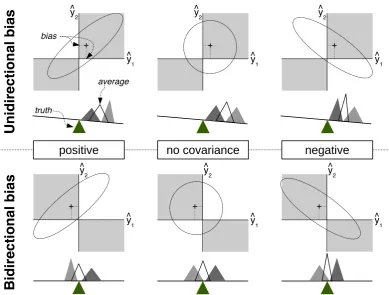
importance of bias to variability of predictions can be quantified (Fig. 1). When each 119
differences between models, then bias dominates (Fig. 1 top). As variance increases (or 121
bias decreases), the different model predictions overlap more and more, until bias is 122
small relative to variance (Fig. 1 bottom). Predictions from any model will now 123
typically have higher variance than the averaged prediction. Also, averaging can 124
reduce bias, if predictions scatter around the truth, but not unidirectional bias, that is if 125
all (most) model predictions err on the same side (see also Fig. 2 top row). However, if 126
predictions scatter around the truth, bias can be reduced by averaging. 127
[Fig. 1 approximately here.] 128
We thus conclude that as bias becomes large relative to prediction variance, model 129
averaging is less and less likely to be useful for reducing variance – it may still be 130
useful for reducing bias (under the condition of bidirectional bias: Fig. 2, lower row). 131
[Fig. 2 approximately here.] 132
Downweighting of variances is the mathematical reason how model averaging 133
reduces the variance over single model predictions. In the unlikely, but didactically 134
important case that predictions are independent, their covariance is 0 and the 135
correlation matrixρmnof eqn 5 becomes the identity matrix (or, equivalently, the 136
covariance term of eqn 4 vanishes). If we also assume both predictions have equal 137
variances (var(Yb1) =var(Yb2) =var(Yb)), and sincew2= 1−w1, the above equation
138
simplifies to var(Ye) = (2w21−2w1+ 1)var(Yb). If one model gets all the weight, we
139
have var(Ye) =var(Yb). If the two models receive equal weight, we have 140
var(Ye) = (2·(0.5)2−2·0.5 + 1)var(Yb) = 0.5var(Yb), a considerable improvement
141
in prediction variance (and the minimum of this equation). Other weights fall 142
in-between these values. More generally, Bates and Granger (1969) showed that for 143
unbiased models with uncorrelated predictions, the variance in the average is never 144
greater than the smaller of the individual predictions (making the important 145
words, model averaging can reduce prediction error because weights enter as quadratic 147
terms in eqn 3, rather than linearly. 148
The correlation between model predictions, i.e. the matrix(ρij)∈RM×M, 149
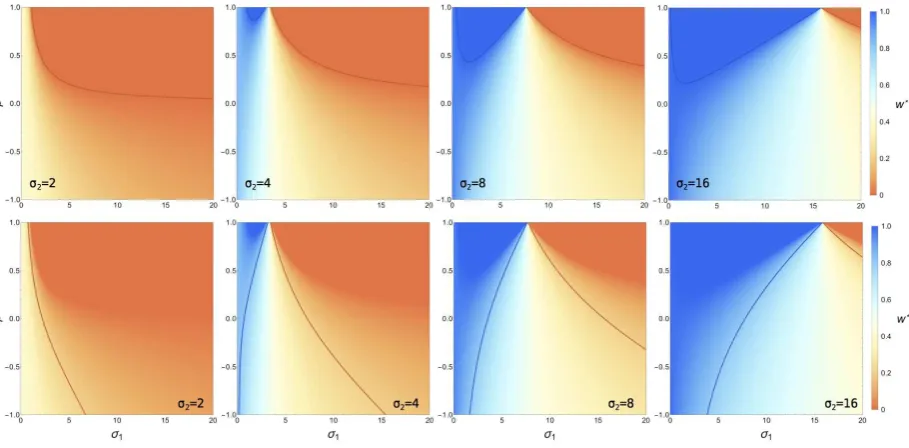
substantially affects the benefit of model averaging (see also Fig. 3 and interactive tool 150
in the Appendix Data S2). In the best case, correlations between model predictions are 151
negative or at least absent, and the second term of eqn (5) is negative or vanishes. Here, 152
the variance in the average is dominated by individual models’ prediction variances. As 153
correlation between predictions increases, the covariance-term contributes more and 154
more to the overall prediction error, making the averaging of perfectly correlated 155
predictions exactly outweigh the benefit gained by the quadratic weights-effect for the 156
variances. 157
[Fig. 3 approximately here.] 158
This point provides some important insights about why some machine learning 159
methods that average a large number of bad models work so well. When averagingpoor
160
models, e.g. trees in a randomForest, covariance is negligible, but the variance of each 161
model prediction is high. Becausewmbecomes very small with hundreds of models 162
(around1/M), the variance of many averaged poor models (with similar variance) 163
tends to be low: var(Ye) =PMm=1 M12var(Ybm) +M12 PM
m=1
P
m6=ncov(Ybm,Ybn)≈ 164
MM12var(Yb) = M1 var(Yb),where the second term disappears due to lack of 165
correlations among predictions. We may speculate that poor models typically also 166
exhibit substantial but undirected bias, which again would be reduced by averaging. 167
The effect of correlations in the potential reduction of prediction error is rather 168
intuitive. If a prediction from a given model is extreme (e.g. on the high end of the 169
distribution), negative correlation will tend to balance out, while positive correlation 170
will accentuate total variance (e.g. Bohn et al., 2010). Ecologists know an analogous 171
(e.g. Thibaut and Connolly, 2013). It states that the fluctuation in biomass of a 173
community is less than the fluctuations of biomass of its members, because the species 174
respond to the environment differently. This asynchrony in response is analogous to 175
negative covariance in community members’ biomass, buffering thesumof their 176
biomasses. 177
Putting bias, variance and correlation together (Fig. 2), we note that model 178
averaging will deliver smaller prediction error when bias is “bidirectional” (i.e. model 179
predictions over- and underestimate the true value: bottom row of Fig. 2) and 180
predictions are negatively correlated (Fig. 2 bottom right). Uni-directional bias will 181
remain problematic (top row of Fig. 2), irrespective of covariances among predictions. 182
Thus, for a given set of weights, the prediction error of model-averaged predictions 183
depends on three things: the bias of the model average, the individual model prediction 184
variances, and the correlation between individual model predictions. 185
2.2
Estimating weights can thwart the benefit of model
186averaging
187Equation 5 assumes that the values of the weights are set a priori, and thus there is no 188
uncertainty about them. However, that would imply that an arbitrary set of weights is 189
used. Instead, the aim of optimising predictive performance suggests weights need to 190
be estimated from the data. But estimation brings associated uncertainty with it, and 191
this has implications for the actual benefits of model averaging: estimated “optimal” 192
weights will be suboptimal (Nguefack-Tsague, 2014), so the averaged prediction even 193
for only mildly correlated predictions will more likely be biased than if the (unknown) 194
truly optimal weights were used (Claeskens et al., 2016). It may in fact be often no 195
1989; Smith et al., 2009; Graefe et al., 2014, 2015). The “simple theoretical explanation” 197
provided by Claeskens et al. (2016) demonstrates that estimating weights introduces 198
additional variance into the prediction. As a consequence, the predictions averaged 199
with estimated weights may be worse than that of a single model (in contrast to the 200
assertion of Bates and Granger 1969; see Claeskens et al. 2016 for an example). 201
Finding optimal weights now becomes far more involved, and currently no closed 202
solution is available, not even for linear models (Liang et al., 2011). The interactive tool 203
we provide (Fig. 3) allows readers to explore this issue in a simple 2-model case. It 204
shows that, in this simple case, estimating weights substantially reduces the parameter 205
space where model averaging is superior to the best single model. 206
The performance reduction does not however imply that estimated weights are of 207
no use, or that the use of arbitrary weights (e.g. equal weights) is generally superior. 208
While uncertainty in estimated weights increases prediction error, the ability to 209
downweight or wholly remove unsuitable models from the prediction set is a 210
substantial benefit. In Claeskens et al. (2016) and similar simulations, all models 211
considered are “alright” (bias-free and with similar prediction variance), which 212
obviously need not be the case. Model weights are a measure of suitability for 213
prediction, which can be derived most logically from validation on (semi-)independent 214
data (see section 3 for details). If the unknown optimal model weights deviate strongly 215
from1/m, their estimation uncertainty is then a price worth paying. 216
2.3
Model averaging (typically) reduces prediction errors
217The majority of studies we encountered (as random draws from the results of a 218
systematic literature search: see Appendix S7) used an empirical approach to assess 219
predictive performance, i.e. forecasting, hindcasting or cross-validation to observed 220
Montgomery et al., 2012; Smith et al., 2013; Engler et al., 2013; Edeling et al., 2014; 222
Trolle et al., 2014). Across the 180 studies we examined, model averaging generally 223
yielded lower prediction errors than the individual contributing models. Most of these 224
studies used test datasets to estimate predictive success, and rely critically on the 225
assumption of independence between test and training datasets (Roberts et al., 2017). 226
Few studies used simulated data to examine the performance of model averaging under 227
specific conditions (e.g. small sample size, model structure uncertainty, missing data: 228
Ghosh and Yuan, 2009; Schomaker, 2012). Very few studies provide mathematical 229
analyses (Shen and Huang, 2006; Potempski and Galmarini, 2009; Chen et al., 2012; 230
Zhang et al., 2013). 231
Summarising section 2 so far, we observe that 232
1. model averaging reduces prediction error by reducing prediction variance and 233
bias; 234
2. the more positively correlated predictions are, the smaller is the benefit gained 235
from averaging them; 236
3. when bias is large relative to the prediction variance of individual models, the 237
least-biased model will be a better choice than the model average; and 238
4. estimating weights introduces additional variance, outweighing, in some 239
situations, the benefits of model averaging. 240
2.4
Quantifying uncertainty of model-averaged
241
predictions
242In random sampling, in addition to a statistic of interest, say a point prediction, we are 243
typically interested in the uncertainty of this statistic, e.g. as quantified by its variance 244
confidence intervals have nominal coverage, i.e. whether the true value is in the 95%-CI 246
indeed 95% of the time in repeated experiments. 247
If we attempt an analogy between random sampling and model averaging, the first 248
catch is that predictions from different models will be non-independent. In this case the 249
standard deviation does not decrease as square root ofn, but more slowly. The second 250
catch is that models are almost certainly not random draws from the population of 251
models (if we just think of all the models which we didnotinclude). Non-random 252
draws from a distribution are almost certain to yield biased estimates of that 253
distribution’s parameters. 254
The first catch can be taken care of by taking into account the variance-covariance 255
matrix of model predictions (see section 2, eqns 3-5). The second catch (models are 256
non-random draws) is harder and the severity of this problem depends on whether 257
model predictions are biased in the same direction (the “unidirectional bias” in Fig. 2) 258
or in different ways. Model averaging can only successfully unite diverging biased 259
predictions when they are biased in different directions. The approaches to computing 260
prediction variance below rely on the assumption that model predictions in fact do 261
scatter around the truth, and that the (weighted) average of model predictions is 262
unbiased. Since truth is unknown, this assumption cannot be tested. When models 263
share their fundamental structure (e.g. process models relying on the same equations), 264
it is more likely that they are unidirectionally biased. 265
2.4.1 Simplified error propagation in model-averaged predictions 266
To approximate the predictive variance of model-averaged predictions, Buckland et al. 267
2002, p. 159-162): 269
var(Ye) =
M X
m=1
wm q
var(Ybm) +γ2m
2
. (6)
Misspecification bias of modelmis computed asγm=Ybm−Ye, thus assuming 270
(explicitly on page 604 of Buckland et al. 1997) that the averaged point estimateYe is 271
unbiased and can hence be used to compute the bias of the individual predictions. This 272
assumption can be visualised in Fig. 2 as the situation where the empty triangles 273
always sit right on top of ‘truth’. This assumption is problematic as it cannot be met by 274
unidirectionally biased model predictions, nor when weightswmfail to get the 275
weightingexactlyright and thusYe remains biased. Less problematically, Buckland 276
et al. (1997) also assumed that predictions from different models areperfectly
277
correlated, making the covariance-term as large as possible, and variance estimation 278
conservative. The distribution theory behind this approach has been criticised as “not 279
(even approximately) correct” (Claeskens and Hjort, 2008, p. 207), but shown to work 280
well in simulations (Lukacs et al., 2010; Fletcher and Dillingham, 2011). 281
Improving on eqn (6) requires knowledge of the correlation matrixρmnof eqn (5). 282
The key problem is that there is no analytical way to compute the correlation of model 283
predictions. While bootstrapping models and their prediction can provide an estimate 284
ofρmn, it can more directly provide an estimate of var(Ye), rendering the indirect route 285
via eqn (6) unnecessary. 286
2.4.2 Coverage of the model-averaged prediction 287
Predictions from a selected single-best modelalwaysunderestimate the true prediction 288
error (e.g. Namata et al., 2008; Fletcher and Turek, 2012; Turek and Fletcher, 2012). The 289
reason is that the uncertainty about which model is correct is not included in this final 290
prediction: we predict as if we had not carried out model selection but had known from 291
Harrell, 2001). Thus, even if we were able to choose, from our model setM, the model 293
closest to truth, we would still need to adjust the confidence distribution for model 294
selection; however, a perfect adjustment was analytically shown not to exist (Kabaila 295
et al., 2015). 296
For statistical models, it is less clear whether the full model (i.e. prior to any model 297
selection; see Appendix S3) or model averaging computes the uncertainty intervals 298
correctly. Simulations suggest that model averaging may improve coverage (Namata 299
et al., 2008; Wintle et al., 2003; Zhao et al., 2013, none of who tested the full model), 300
which can be understood to happen because the process of averaging allows us to take 301
into account model uncertainty (Liang et al., 2011). Given that model averages need not 302
be normal (at the link scale), Fletcher and Turek (2012) and Turek and Fletcher (2012) 303
explore how to improve the tail areas of the confidence distribution, albeit under the 304
assumption that the true model is in the model set. Their approach was re-analysed by 305
Kabaila et al. (2015) under model selection. The key finding of this latter study is that 306
the full model coverage was still superior to all other model averaging approaches, 307
suggesting that the full model should currently be kept in mind, both for inference, 308
minimal bias and correct prediction intervals (see also Harrell, 2001, p. 59). Such 309
findings sit uncomfortably with the bias-variance trade-off (Hastie et al., 2009), which 310
states that overly complex models have poor predictive performance; and indeed the 311
full model has high prediction variance. However, our statements are about the 312
confidence intervals, rather than the point predictions, and those will be incorrectly 313
narrow for model selection without selection-correction. Regrettably, such reasoning 314
cannot be extended in an obvious way to models that do not have a “full model” 315
(non-nested models, process models, or machine learning models). Here model 316
averaging provides a way forward in representing prediction coverage more fairly. 317
section 3, these studies cannot be seen as conclusive, only as suggestive, for the 319
improvement of nominal coverage using model averaging. 320
In a different approach to characterising the uncertainty in model predictions, model 321
averaging can be interpreted as computing the distribution of a random variable that is 322
derived from a collection of random variables (the model predictions), also known as a 323
mixture distribution(Claeskens and Hjort, 2008, p. 217). In a two-step process, the 324
model weights determine the probability of choosing the model, and then the model 325
prediction is drawn from its confidence distribution. If predictions are unbiased, they 326
stack up high around the mean, and yield the same value as the equation for the 327
standard error of the mean. If predictions differ widely, e.g. due to bias, the mixed 328
confidence distribution will be much wider and possibly multi-modal. Mixing 329
distributions assumes their independence, i.e. the random draw of a value from one 330
model prediction is uncorrelated with the next draw of model and prediction. As model 331
predictions are likely to be positively correlated, assuming (conditional) independence 332
willunderestimatevariance (i.e. correlated draws would yield wider confidence 333
distributions). 334
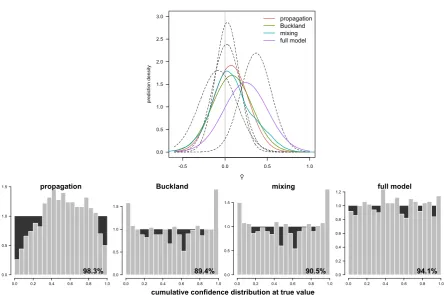
Overall, this leaves us with the following options for computing the confidence 335
intervals of averaged predictions (which we will compute for a set of simple linear 336
regressions in Fig. 5): 337
1. Make the assumption that model-averaged predictions are unbiased (i.e. thaty∗ 338
can be estimated asYe). Use bootstrapping to estimate covariances of predictions 339
for each model. From these estimates, compute prediction variance according to 340
eqn (5). This solution is computer-intensive, but it takes into account covariance 341
of model predictions. (Note that simply averaging predictions from bootstrapped 342
2. Make again the assumption that model-averaged predictions are unbiased. Use 344
Buckland et al. (1997)’s approach (eqn 6). This will yield wider estimates than 345
option 1, because assuming perfect correlation is conservative. 346
3. Make the assumption that predictions from different models are effectively 347
uncorrelated. Use model mixing to compute the confidence distribution of the 348
average. 349
4. Fit the full model (if available) and use its confidence distribution, which can 350
rarely be improved on (Kabaila et al., 2015). 351
[Figure 5 approximately here.] 352
When averaging models with largely independent (i.e. uncorrelated) predictions, 353
only the bootstrap-estimated covariance matrix (option 1 above) will also compute 354
lower variances (according to eqn 4). In our illustration (Fig. 5, see Appendix S8), the 355
first three options (“propagation”, “Buckland” and “mixing”) hardly differ, while the full 356
model has a different location and is wider. The coverage of the 95% confidence 357
interval, computed through 1000 simulations, is best matched by the full model, while 358
the propagation approach is overly conservative. Buckland’s equation and mixing have 359
slightly too low coverage. 360
3
Approaches to estimating model-averaging
361weights
362When faced with predictions from very different models, estimating weights aims at 363
abating poorly, and elevating well predicting ones. For the resulting averaged 364
predictions, the actual method for estimating weights has obvious fundamental 365
elucidate on their interconnections (Table 1). Different perspectives on 367
model-averaging weights have emerged, which we present in somewhat arbitrary four 368
categories of decreasing probabilistic interpretability: 369
1. In the Bayesian perspective, model weights are probabilities that modelMiis the 370
‘true’ model (e.g. Link and Barker, 2006; Congdon, 2007). 371
2. In the information-theoretic framework, model weights are measures of how 372
closely the proposed models approximate the true model as measured by the 373
Kullback-Leibler divergence, relative to other models. 374
3. In a ‘tactical’ perspective, model weights are parameters to be chosen in such a 375
way as to achieve best predictive performance of the average. No specific 376
interpretation of the model is attached to the weights; they only have to work. 377
4. Assigning fixed, equal weights to all predictions can be seen as a reference na¨ıve 378
approach, representing the situation without adjusting for differences in models’ 379
predictive abilities. 380
We shall address these four perspectives in turn, also hinting at relationships 381
between them. 382
[Table 1 approximately here.] 383
3.1
Bayesian model weights
384
Our outline of Bayesian model weights follows that of Wasserman (2000), paying 385
attention to recent computational advances in the field. 386
Theory Bayes’ formula can be applied to models in much the same way as to 387
parameters. Hence, to perform inference with multiple models, one can write down the 388
joint posterior probabilityP(Mi,Θi|D)of modelMiwith parameter vectorsΘi, given 389
P(Mi,Θi|D)∝L(D|Mi,Θi)·p(Θi)·p(Mi), (7)
whereL(D|Mi,Θi)is the likelihood of modelMi,p(Θi)is the prior distribution of the 391
parameters of the respective modelMi, andp(Mi)is the prior weight on modelMi. 392
The joint distribution provides all information necessary for inference. Often, in 393
practice, we want to extract some simplified statistics from this distribution such as the 394
model with the highest posterior model probability, or the distribution of a parameter 395
or prediction including model selection uncertainty. To obtain this information, we can 396
marginalise (average, integrate) over parameter space, or marginalise over model space. 397
If we marginalise over parameter space, we obtain model weights (whilst 398
marginalising over model space yields averaged parameters, which we shall not 399
address here). The first step is to calculate the marginal likelihood, defined as the 400
average of eqn (7) across allkparameters for any given model: 401
P(D|Mi)∝ Z
Θ1
· · ·
Z
Θk
L(D|Mi,Θi)p(Θi)dΘ1· · ·dΘk (8)
From the marginal likelihood, we can compare models via theBayes factor, defined as 402
the ratio of their marginal likelihoods (e.g. Kass and Raftery, 1995): 403
BFi,j =
P(D|Mi)
P(D|Mj)
= R
L(D|Mi,Θi)p(Θi)dΘi R
L(D|Mj,Θj)p(Θj)dΘj
. (9)
with the multiple integral now pulled together for notational convenience. For more 404
than two models, however, it is more useful to standardise this quantity across all 405
models in question, calculating a Bayesian posterior model weightp(Mi|D)(including 406
model priorsp(Mi): Kass and Raftery, 1995, ) as 407
posterior model weighti = p(Mi|D) =
P(D|Mi)p(Mi) P
jP(D|Mj)p(Mj)
(10)
Estimation in practice While the definition of Bayesian model weights and 408
challenging. In practice, there are two options to numerically estimate the quantities 410
defined above, both with caveats. 411
The first option is to sample directly from the joint posterior (eqn (7)) of the models 412
and the parameters. Basic algorithms such as rejection sampling can do that without 413
any modification (e.g. Toni et al., 2009), but they are inefficient for higher-dimensional 414
parameter spaces. More sophisticated algorithms such as MCMC and SMC (see Hartig 415
et al., 2011, for a basic review) require modifications to deal with the issue of different 416
number of parameters when changing between models. Such modifications (mostly the 417
reversible-jump MCMCs,rjMCMC: Green, 1995, see Appendix S5.1.1) are often 418
difficult to program, tune and generalise, which is the reason why they are typically 419
only applied in specialised, well-defined settings. The posterior model probabilities of 420
the rjMCMC are estimated as the proportion of time the algorithm spent with each 421
model, measured as the number of iterations the algorithm drew a particular model 422
divided by the total number of iterations. 423
The second option is to approximate the marginal likelihood in eqn (8) of each 424
model independently e.g. compute the maximum a posteriori model probability, 425
renormalise that into weights, and then average predictions based on these weights. 426
The challenge here is to get a stable approximation of the marginal likelihood, which 427
can be very problematic (Weinberg, 2012, see Appendix S5.1.2). Because of the 428
relatively simple implementation, this approach is a more common choice than 429
rjMCMC (e.g. Brandon and Wade, 2006). 430
Influence of priors A problem for the computation of model weights when 431
performing Bayesian inference across multiple models, is the influence of the choice of 432
parameter priors, especially “uninformative” ones (see section 5 in Hoeting et al., 1999; 433
The challenge arises because in eqns (8) and (9) the prior densityp(θi)enters the 435
marginal likelihood and hence the Bayes factor multiplicatively. This has the somewhat 436
unintuitive consequence that increasing the width of an uninformative parameter prior 437
will linearly decrease the model’s marginal likelihood (e.g. Link and Barker, 2006). 438
That Bayesian model weights are strongly dependent on the width of the prior choice 439
has sparked discussion of the appropriateness of this approach in situations with 440
uninformative priors. For example, in situations where multiple nested models are 441
compared, the width of the uninformative prior may completely determine the 442
complexity of models that are being selected. One suggestion that has been made is to 443
notperform multi-model inferenceat allwith uninformative priors, or that at least 444
additional corrections are necessary to apply Bayes factors weights (O’Hagan, 1995; 445
Berger and Pericchi, 1996). One such correction is to calibrate the model on a part of the 446
data first, use the result as new priors and then perform the analysis described above 447
(intrinsic Bayes factor: Berger and Pericchi 1996, fractional Bayes factor: O’Hagan 448
1995). If sufficient data are available so that the likelihood is sufficiently peaked 449
strongly during the calibration step, this approach should eliminate any complication 450
resulting from the prior choice (for an ecological example see van Oijen et al., 2013). 451
Bayesian variations In a set of influential publications, Raftery et al. (1997), 452
Hoeting et al. (1999) and Raftery et al. (2005) introducedpost-hocBayesian model 453
averaging, i.e. for vectors of predictions from already fitted models. The key idea is to 454
iteratively estimate the proportion of times a model would yield the highest likelihood 455
within the set of models (through expectation maximisation, see Appendix S5.2 for 456
details), and use this proportion as model weight. In the spirit of the inventors, we refer 457
to this approach asBayesian model averaging using Expectation-Maximisation 458
were not necessarily (and in none of their examples) fitted within the Bayesian 460
framework. It has been used regularly, often for process models (e.g. Gneiting et al., 461
2005; Zhang et al., 2009), where a rjMCMC-procedure would require substantial 462
programming work at little perceived benefit, but also in data-poor situations in the 463
political sciences (Montgomery et al., 2012). 464
Chickering and Heckerman (1997) investigate approximations of the marginal 465
likelihood in eqn (9), such as theBayesian Information Criterion(BIC, as defined 466
in the next section; see also Appendix S5.3) and find them to work well for model 467
selection, butnotfor model averaging. In contrast, Kass and Raftery (1995) state (on 468
p. 778) thateBICis an acceptable approximation of the Bayes factor, and hence suitable
469
for model averaging, despite being biased even for large sample sizes. These 470
approximations may be improved when using more complex versions of BIC (SPBIC 471
and IBIC: Bollen et al., 2012). 472
The “widely applicable information criterion”WAIC(Watanabe 2010 and an 473
equivalentWBIC: Watanabe 2013) are motivated and actually analytically derived in a 474
Bayesian framework (Gelman et al., 2014). Its uninformative prior implementation 475
should be seen as a variation of AIC (see next section), while the implementation with 476
model priors is based on posterior distribution of parameter estimates, and computed, 477
for each model, from two terms (Gelman et al., 2014): (1) the log pointwise predicted 478
density (lppd) across the posterior simulations for each of thenpredicted values, 479
defined as lppd= logQni=1pposterior(yi); and (2) a bias-correction term 480
pWAIC=Pni=1var(log(p(yi|θs))), where var is thesamplevariance over allSsamples
481
of the posterior distributions of parametersθ. Then the WAIC is defined as 482
WAIC=−2lppd+ 2pWAIC. In words, the WAIC is the likelihood of observing the data
483
under the posterior parameter distributions, corrected by a penalty of model 484
Model weights are computed from WAIC analogously to equation 11 below. 486
3.2
Information-theoretic model weights
487
In theinformation-theoreticperspective, models closer to the data, as measured by the 488
Kullback-Leibler divergence, should receive more weight than those further away. 489
There are several approximations of the KL-divergence, most famously Akaike’s 490
Information Criterion (AIC: Akaike, 1973; Burnham and Anderson, 2002). AIC and 491
related indices can be computed only for likelihood-based models with known number 492
of parameters (pm), restricting the information-theoretic approach to GLM-like models 493
(incl. GAM): 494
AICm=−2ℓm+ 2pm and wm =
e−0.5(AICm−AICmin)
P
i∈Me−0.5(AICi−AICmin)
, (11)
whereℓmis the log-likelihood of modelm. 495
In the ecological literature, AIC (and its sample-size corrected version AICc, and its 496
adaptations to quasi-likelihood models such as QIC: Pan 2001; Claeskens and Hjort 497
2008) is by far the most common approach to determine model weights (for recent 498
examples see, e.g., Dwyer et al., 2014; Rovai et al., 2015).AIC-weights(eqn (11)) have 499
been interpreted as Bayesian model probabilities (Burnham and Anderson 2002, p. 75; 500
Link and Barker 2006), although we are not aware of a convincing theoretical 501
justification. An alternative interpretation is the proportion of times a model would be 502
chosen as the best model under repeated sampling (Hobbs and Hilborn, 2006), but such 503
an interpretation is contentious (Richards, 2005; Bolker, 2008; Claeskens and Hjort, 504
2008). In an anecdotal comparison, Burnham and Anderson (2002, p. 178) showed that 505
AIC-weights are substantially different frombootstrapped model weights. The 506
latter were proposed by Buckland et al. (1997) and represent the proportion of 507
simulations, AIC-weights did not reliably identify the model with the known lowest 509
KL-divergence or prediction error (Richards, 2005; Richards et al., 2011). Instead, 510
Mallows’ model averaging(MMA) has been shown to yield the lowest mean 511
squared error forlinearmodels (Hansen, 2007; Schomaker et al., 2010). Mallows’Cp 512
penalises model complexity equivalent to−2ℓm−n+ 2pm(forndata points; rather 513
than AIC’s−2ℓm+ 2pm, eqn 11). 514
Other approximations of the KL-divergence include Schwartz’ Bayesian 515
Information Criterion (see previous section), which was designed to find the most 516
probable model given the data (Schwartz, 1978; Shmueli, 2010), equivalent to having 517
the largest Bayes factor (see previous section).BICuseslog(n)rather than AIC’s “2” 518
as penalisation factor for model complexity (Appendix S5.3). A particularly noteworthy 519
modification of the AIC exist, where the model fit is assessed with respect to a focal 520
predictor value, e.g. a specific age or temperature range, yielding the Focussed 521
Information Criterion (FIC: Claeskens and Hjort 2008). We are not aware of a 522
systematic simulation study comparing the performance of these model averaging 523
weights, but AIC’s dominance should not indicate its superiority (see also case study 1 524
below). 525
The weighting procedure can additionally be wrapped into a cross-validation and 526
model pre-selection, which leads to the ARMS-procedure (Adaptive Regression by 527
Mixing with model Screening: Yang, 2001; Yuan and Yang, 2005; Yuan and Ghosh, 528
2008). We shall not present details on ARMS here (for cross-validation see next section), 529
because we regard model pre-selection as an unresolved issue (see section 5.3). 530
3.3
Tactical approaches to computing model weights
531
Methods covered in this section share the “tactical” goal of choosing weights to 532
explicitly building on Bayes or information theory thus most general in application. 534
Cross-validationapproximates a model’s predictive performance on new data by 535
predicting to a hold-out part of the data (typically between 5 and 20 folds). 536
Leave-one-out cross-validationdisturbs the data least, omitting each single data 537
point in turn. The fit to the hold-out can be quantified in different ways. If the data can 538
be reasonably well described by a specific distribution with log-likelihood functionℓ 539
(even if the model algorithm itself is non-parametric), the log-likelihood of the data in 540
thekfolds can be computed and summed (van der Laan et al., 2004; Wood, 2015, p. 36): 541
ℓmCV =
k X
i=1
ℓ(y[i]|θˆmy
[−i]), (12)
where the index[−i]indicates that the datay[i]in foldiwere not used for fitting model
542
mand estimating model parametersθˆm
y[−i]. Cross-validation log-likelihood, specifically 543
leave-one-out cross-validation, is asymptotically equivalent to AIC and thus 544
KL-distance (Stone, 1977), albeit at a higher computational cost. The use of hold-out 545
data in cross-validation implicitly penalises overfitting, and we can hence compute 546
model weightswm
CVin the same way as AIC-weights (Hauenstein et al., 2017):
547
wCVm = e
ℓm
CV
P i∈Meℓ
i
CV
. (13)
Other measures of model fit to the hold-out folds have been used, largely asad hoc
548
proxies for a likelihood function (e.g. in likelihood-free models): pseudo-R2(e.g 549
Nagelkerke, 1991; Nakagawa and Schielzeth, 2013), area under the ROC-curve (AUC: 550
Marmion et al., 2009a; Ordonez and Williams, 2013; Hannemann et al., 2015), or True 551
Skill Statistic (Diniz-Filho et al., 2009; Garcia et al., 2012; Engler et al., 2013; Meller 552
et al., 2014). In these cases, weights were computed by substitutingℓCVin eqn (13) by
553
the respective measure, or given a value of1/Sfor a somewhat arbitrarily defined 554
subset ofS(out ofM) models, e.g. those above an arbitrary threshold considered 555
Ordonez and Williams, 2013). 557
Largely ignored by the ecological literature are two other non-parametric
approaches to compute model weights:stackingandjackknife model averaging(see
Appendix S4 for discussion of averagingwithinmachine-learning algorithms). Both are
cross-validation based, and both optimise model weights on hold-out data.Stacking
(Wolpert, 1992; Smyth and Wolpert, 1998; Ting and Witten, 1999) finds the optimised
model weights to reduce prediction error (or maximise likelihood) on a test hold-out of
sizeH. This is, for RMSE and likelihood, respectively:
arg min wm v u u u t 1 H H X i=1 y[i]−
M X
m=1
wmfˆ
Xi θˆm
[−i]
2
(Hastie et al., 2009) and
arg max wm ℓ y[i]
M X m=1
wmfˆ
Xi θˆm
[−i]
,
wheref(Xˆ i|θˆm[−i])is the prediction of modelm, fitted without using datai, to datai. 558
This procedure is repeated many times, each time yielding a vector of optimised model 559
weights,wm, which are then averaged across repetitions and rescaled to sum to 1. 560
Smyth and Wolpert (1998) and Clarke (2003) reports stacking to generally outperform 561
the cross-validation approach from two paragraphs earlier, and Bayesian model 562
averaging, respectively (see also the case studies in section 4 and Appendix S5). 563
InJackknife Model Averaging(JMA: Hansen and Racine, 2012), each data point 564
is omitted in turn from fitting and then predicted to (thus actually a leave-one-out 565
cross-validation rather than a “jackknife”). Then, weights are optimised so as to 566
minimise RMSE (or maximise likelihood) between the observed and the fitted value 567
across all “jackknife” samples. The optimisation function is the same as for stacking, 568
except thatH =N. Thus, in stacking, weights are optimised once for each run, while 569
for the jackknife only one optimisation over allN leave-one-out-cross-validations is 570
The forecasting (i.e. time-predictions) literature (reviewed in Armstrong, 2001; 572
Stock and Watson, 2001; Timmermann, 2006) offers two further approaches. Bates and 573
Granger (1969)’sminimal varianceapproach attributes more weight to models with 574
low-variance predictions. More precisely, it uses the inverse of the variance-covariance 575
matrix of predictions,Σ−1, to compute model weights. In the multi-model
576
generalisation (Newbold and Granger, 1974) the weights-vectorwis calculated as: 577
wminimal variance = (1′Σ−11)−11Σ−1, (14)
where1is anM-length vector of ones. This is the analytical solution of eqn 5,
578
assuming no bias and ignoring the problem that weights are random variates, under 579
the weights-sum-to-one constraint. Equation 14 does not ensure all-positive weights, 580
nor is it obvious how to estimateΣ. One option (used in our case studies) is to baseΣ
581
on the deviation from a prediction to test data in lieu of measure of past performance 582
(following recommendation of Bates and Granger, 1969). 583
Finally, Garthwaite and Mubwandarikwa (2010) devised a rarely used method, 584
called the “cos-squared weightingscheme”, designed to adjust for correlation in 585
predictions by different models. It was motivated by (i) giving lower weight to models 586
highly correlated with others (thereby reducing the prediction variance contributed 587
through covariances in eqn 5), (ii) division of weights when a new, near-identical 588
model prediction is added to the set, and (iii) reducing all weights when more models 589
are added to the set. Weights are computed as proportional to the amount of rotation 590
the predictions would require to make them orthogonal in prediction space, hence the 591
trigonometric name of their approach. 592
Model-based model combination: varying weights 593
Combining model predictions using statistical models, an approach we term 594
was first proposed by Granger and Ramanathan (1984). Here a statistical modelf is 596
used to combine the predictions from different models, as if they were predictors in a 597
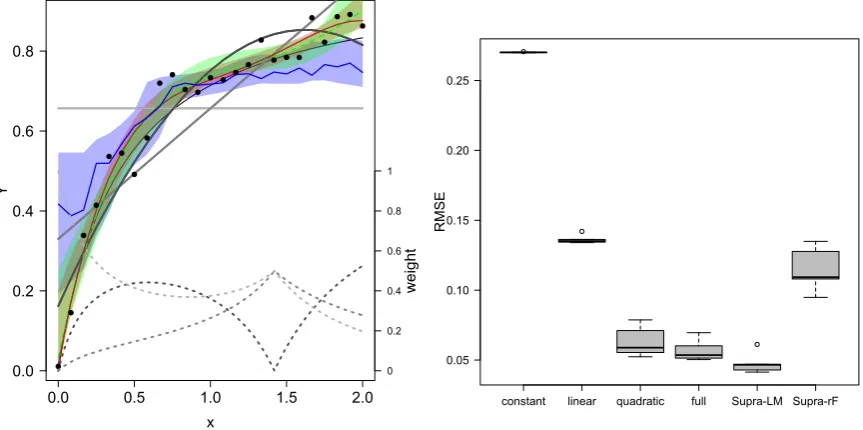
regression:Ye ∼f(Yb1,Yb2, . . . ,Ybm)(see Fig. 4 left). The regression-type modelf can be 598
of any type, such as a linear model or a neural network. We call this regression the 599
“supra-model” in order to distinguish between different modelling levels. 600
A very simple supra-model would compute themedian of predictionsfor each 601
pointXi(e.g. Marmion et al., 2009a). Different models are used in the “average”
602
without requiring any additional parameter estimation. Median predictions imply 603
varying weights, as the one or two models considered for computing the median may 604
change between differentXi.
605
An ideal model combination could switch, or gently transition, between models 606
(such as manually constructed by Crisci et al., 2017). Since the predictions are combined 607
more or less freely in model-based model combinations to yield the best possible fit to 608
the observed data, MBMC should be superior to any constant-weight-per-model 609
approach (see Fig. 4 right), as was indeed found by Diks and Vrugt (2010). This 610
advantage comes with a severe drawback: a high proclivity to overfitting, as we fit the 611
same data twice (once to each model, then again to their prediction regression). 612
[Fig. 4 approximately here.] 613
This does not seem to be recognised as a problem (despite being a key message of 614
Hastie et al., 2009), as all studies we found incorrectly cross-validate the supra-model 615
only, not theentireworkflow (if at all; e.g. Krishnamurti et al., 1999; Thomson et al., 616
2006; Diks and Vrugt, 2010; Breiner et al., 2015; Romero et al., 2016). To correctly 617
cross-validate MBMCs, one has to produce hold-outsbeforefitting the contributing 618
models, and evaluate the MBMC prediction on this hold-out (Fig. 4, Appendix S5.9 and 619
case studies). 620
contributing models. As it is a yet fairly unexplored field in model averaging, analysts 622
are advised to try different supra-model types (Fig. 4). 623
3.4
Equal weights
624
In many fields of science (climate modelling, economics, political sciences), model 625
averaging proceeds with giving the structurally different models equal weight, i.e. 626
1/M (e.g. Johnson and Bowler, 2009; Knutti et al., 2010; Graefe et al., 2014; Rougier, 627
2016). In ecology, studies analysing species distributions reported equal weights to be a 628
very good choice when assessed using cross-validation (Crossman and Bass, 2008; 629
Marmion et al., 2009a; Rapacciuolo et al., 2012), but no better than the single models on 630
validation with independent data (Crimmins et al., 2013). Equal weights may serve as a 631
reference approach to see whether estimating weights reduces prediction error for this 632
specific set of models. In that sense, we may argue, all the above weight estimation 633
approaches only serve to separate the wheat from the chaff; once a set of reasonable 634
models has been identified, equal weights are apparently a good approach. 635
4
Case studies
636All methods discussed above can be applied to simple regression models, while some 637
explicitly rely on a model’s likelihood and can thus not be used for non-parametric 638
approaches. We therefore devised two case studies, the first being a rather simple 639
example to illustrate the use of all methods in Table 1, and the second a more 640
complicated species distribution case study based on a reduced set of methods. Note 641
that we do not include adaptive regression by mixing with model screening (ARMS: 642
Yang, 2001) because its more sophisticated variations (Yuan and Yang, 2005) are not 643
preselected set of models. 645
4.1
Case study 1: Simulation with Gaussian response,
646many models and few data points
647In this first, simulation-based case study, we explore the variability of model-averaging 648
approaches in the common case where several partially nested models are fit (see 649
Appendix S9 for details and code). The simulation was set up so that several of the 650
fitted models have similar support as explanations for the data. This was achieved by 651
generating the response differently in each of two groups (using similar, but not 652
identical predictors). We simulated 70 data points with 4 predictors yielding24 = 16 653
candidate models, and another 70 for validation. We computed model weights in 19 654
different ways (Table 1) and compared the prediction error of weighted averages as 655
well as the individual models to the validation data points. Simulation and analyses 656
were repeated 100 times. 657
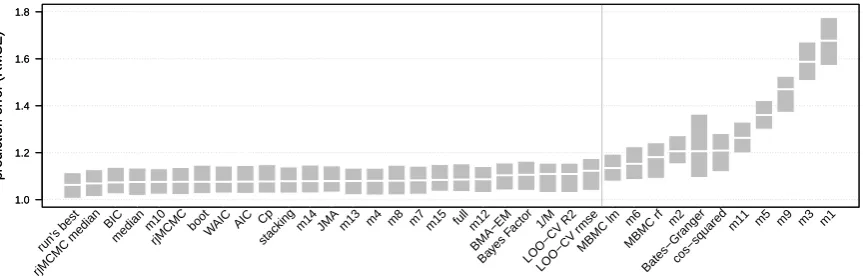
Two results emerged from this simulation that are worth reporting. First, 658
prediction error (quantified as RMSE) was similar across the 19 weight-computing 659
approaches, with a few noticeable exceptions, and most were no better than those of 660
the best nine single model predictions (the two MBMC approaches, minimal variance 661
and the cos-squared scheme: Fig. 6). Second, most averaging approaches gave some 662
weight (w >0.01) to ten or more models (Table 2), despite models being overlapping 663
and partially nested, so that we have actually only five (more or less) independent 664
models (those containing only one predictor: m2, m3, m5, m9 and intercept-only m1). 665
In real data sets, such spreading of weight is the result of data sparseness or extreme 666
noise, making important effects stand out less; indeed, half of our candidate models are 667
[Figure 6 approximately here.] 669
[Table 2 approximately here.] 670
4.2
Case study 2: Real species presence-absence data,
671many data points and a moderate number of predictors
672In the second case study we use data on the real distribution of short-finned eel 673
(Anguilla australis) in New Zealand (from Elith et al., 2008). The data are provided in 674
the R-package dismo, already split into a 1000-rows training and a 500-rows test data 675
set, and featuring 10 predictors. We ran four different model types (GAM, 676
randomForest-rF, artificial neural network-ANN, support vector machine-SVM), along 677
with two variations of the GLM (best models selected by AIC and BIC). For details see 678
Appendix S10. 679
The number of averaging approaches that can be used to compute model weights is 680
smaller than in the previous case study, as three of the six models do not report a 681
likelihood or the number of parameters, precluding the use of rjMCMC, Bayes factor, 682
(W)AIC, BIC, and Mallows’ Cp. In addition, because we do not know the underlying 683
data-generating model, we evaluate the models on the randomly pre-selected test data 684
provided. 685
[Table 3 approximately here.] 686
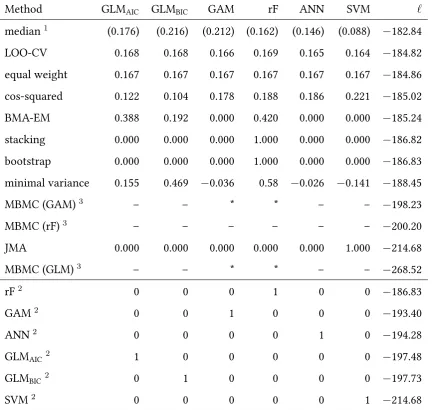
One interesting result is that model averaging was effectively a model selection tool 687
in several cases (Table 3). Stacking, bootstrapping, JMA, and to a lesser degree minimal 688
variance, BMA-EM and the model-based model combinations yielded non-zero weights 689
for only 1 (or 2) models. Apparently, these approaches yielded sub-optimal model 690
weights, as these “model selection”-outcomes of model averaging fared worse than 691
Secondly, the best two model averaging algorithms in this case study, apart from 693
the median where varying weights are used, identified an approximately equal 694
weighting as optimal strategy. That is somewhat surprising, given that SVM performed 695
relatively poorly (and was excluded by BMA-EM, but favoured by cos-squared as a 696
more independent contribution). The likely reason of high weights for the poor SVM is 697
that averaging-in less correlated predictions reduces covariances in eqn (5). 698
The good performance of the median in both case studies suggests that using the 699
central value ofeach prediction, rather than give constant weights to the model itself, 700
may be even more effective in reducing variance and thus prediction error. 701
5
Recommendations
702
Despite setting out to review the field of model averaging for ecologists, the complexity 703
of the topic prevents us from providing final answers. The recent mathematical 704
explanation why estimating optimal weights makes the averaged predictions perform 705
poorly (Claeskens et al., 2016) is an example for fundamental limitations of model 706
averaging. Many issues seem to be statistically unresolved, or addressed by quick-fixes 707
and even fundamental questions remain open, which we will discuss in the final 708
section. 709
It is unsatisfactory to see the large variance in weights and performance of the 710
different averaging approaches in our case studies. Also the literature provides too few 711
comparisons of model weights to provide robust advice. In general, our 712
recommendations are thus guided by reducing harm, rather than suggesting an optimal 713
5.1
Averaged prediction should be accompanied by
715uncertainty estimates
716Just like any other statistical approach, model averaging can also be misapplied. 717
Focussing entirely on the predictions rather than their spread can mislead, as Knutti 718
et al. (2010) showed for combining precipitation predictions: spatial heterogeneity 719
cancelled out across models, giving the erroneous impression of little change when in 720
fact all models predict large changes (albeit in different regions). Similarly, King et al. 721
(2008) found that averaging parameters from two competing models led to no effect of 722
two hypothesised impacts, although in both models a (different) driver was very 723
influential. We thus strongly encourage including at least model-averaged confidence 724
intervals alongside any prediction, possibly in addition to the individual model 725
predictions, to prevent erroneous interpretation of averaged predictions. Also, more 726
attention should be paid to the full model. It has many desirable properties (unbiased 727
parameter estimates, very good coverage), but suffers from violation of the parsimony 728
principle (“Occam’s razor”) and requires more consideration in which form covariates 729
should be fit. Its larger prediction error, compared to the over-optimistic single-best 730
partial model, is the reason for correct confidence intervals. 731
5.2
Dependencies among model predictions should be
732
addressed
733Statistical models, which aim to describe the data to which they are fitted, will often 734
have correlated parameters and fits; process models may overlap in modelled processes. 735
Having highly similar models in the model set will inflate the cumulative weight given 736
to them (as illustrated in Appendix S6) . One way to handle inflation of weights by 737
Another approach would be to pre-select models of different types (see next point). 739
Alternatively, the cos-square scheme of Garthwaite and Mubwandarikwa (2010) uses 740
the correlation matrix of model projections to appropriately change weights of 741
correlated models. It is the only approach currently doing so, and, while the jury is still 742
out on this method, our case study results look only mildly promising (Fig. 6, Tables 2 743
and 3). 744
5.3
Validation-based weighting or validation-based
745pre-selection of models
746Madigan and Raftery (1994), Draper (1995) and more recently Yuan and Yang (2005) 747
and Ghosh and Yuan (2009), have argued that only “good” models should be averaged. 748
Different ways of combining model averaging with a model screening step have been 749
proposed (Augustin et al., 2005; Yuan and Yang, 2005; Ghosh and Yuan, 2009), in which , 750
model selection precedes averaging (pre-selection). This will happen implicitly, and in 751
a single step, if any of the model weight algorithms discussed above attributes a weight 752
of effectively zero to a model, as happened in case study 2. How prevalent this effect is 753
in real world studies is unclear, as weights are rarely reported. 754
In contrast, some studies select modelsafterthe predictions are made (e.g. Thuiller, 755
2004; Forester et al., 2013). These studies have averaged models which predict in the 756
same direction (along the “consensus axis”: Grenouillet et al. 2010), which are the best 757
50% in the set (Marmion et al., 2009a), or however many one should combine to 758
minimise prediction error. Such approaches necessitate addressing the challenge of 759
using data twice (Lauzeral et al., 2015). Post-selection reduces the ability of “dissenting 760
voices” (i.e. less correlated predictions) to reduce prediction error and instead reinforce 761
uncertainty estimation will be overly optimistic. We do not advocate their use. 763
We suggest to employvalidation-based methods of model averagingrather 764
than relying on model-based estimates of error, i.e. (leave-one out) cross-validation and 765
stacking rather than AIC. On account of us rarely believing our models in ecology, test 766
data give us some capacity to make allowances for predictive bias. It is probably of 767
little practical relevance whether models are pre-selected by validation-based estimates 768
of error and then averaged with equal weights or weighted by validation-based 769
estimates of error without pre-selection. 770
5.4
Process models are no different
771In fishery science, averaging process models is relatively common (Brodziak and Piner, 772
2010), as it is in weather and climate science (Krishnamurti et al., 1999; Knutti et al., 773
2010; Bauer et al., 2015). There are at least two connected challenges such enterprises 774
face: validation and weighting. Often process models are tuned/calibrated on all sets of 775
data available, in the logical attempt to describe all relevant processes in the best 776
possible way. That means, however, that no independent validation data are available, 777
so that we cannot use the prediction accuracy of different models to compute model 778
weights. Consequently, all models receive the same weight (e.g. in IPCC reports, or for 779
economic models), or some reasonable but statistically ad-hoc construction of weights 780
is employed (e.g. Giorgi and Mearns, 2002). In recent years, hind-casting has gained in 781
popularity, i.e. evaluating models by predicting to past data. This will only be a useful 782
approach if historic data were not used already to derive or tune model parameters, 783
and if hindcasting success is related to prediction success (which it need not be, if 784
processes or drivers change). 785
Cross-validation is often infeasible for large models, as run-times are prohibitively 786