• No results found

Predication, reference and modification: Major word classes in Bumthang, a Tibeto-Burman language

N/A
N/A
Protected

Academic year: 2019

Share "Predication, reference and modification: Major word classes in Bumthang, a Tibeto-Burman language"

Copied!
98
0
0

Loading.... (view fulltext now)

Full text

(1)

Predication, reference and

modification: Major word

classes in Bumthang, a

Tibeto-Burman language

Bachelor of Arts (Honours in Language Studies)

Australian National University

Naomi Peck

October 2017

This thesis is submitted in partial fulfilment of the

(2)

i Parts of this thesis have previously been submitted as assessment for coursework

relating to the completion of Honours in Language Studies at the Australian National

University.

Substantial parts of Chapter 1 and 2 were submitted as a final assessment for LING4009:

Selected Topics in Methodologies for Researching Language. Data analysis in Chapter 4

borrows from work submitted in LING4011: Selected Topics in Theory and Analysis in

Linguistics.

I hereby declare that, except where it is otherwise acknowledged in the text, this thesis

represents my original work. Any mistakes remain my own.

(3)

ii

Acknowledgements

There are many people that I would like to thank for coming along the journey of preparing my thesis with me, and I will likely forget some of them.

Firstly, I would like to thank my mentor and unofficial supervisor, Ass. Professor Mark Donohue. He has been an invaluable help in both my personal and professional life, helping me both with life and linguistic problems alike. Thank you for introducing me to Bumthang and being right there on this journey with me, even when life got difficult for both of us. I hope to continue working together with you for years to come.

Next, I would like to thank my official supervisor, Professor Jane Simpson. Thank you for agreeing to supervise me when my situation became precarious and I hope learning about Bumthang has been interesting for you, despite my sometimes-unclear

explanations! Your advice has kept me from many a misstep and always kept me on my toes! Thank you as well to Ass. Professor I Wayan Arka who kindly stepped in to officially supervise me for a semester while Jane was on sabbatical.

I would also like to extend thanks to all the people who have helped in my analysis of Bumthang, both past and present. Firstly, to Trom and Yukamo who have been with me for every step, including Honours this year – you guys are the best. Thank you to Bonnie, Naijing and Catherine who took Field Methods with us in 2015; and thank you to the previous cohort of Bumthang-ers, Ginny, Tom and Donna, for helping light Mark’s flame

and providing such good data for us to use. Thank you to Flash and Tinkel for being such good linguistic distractions. Most importantly, thank you to Dorji Wangchuck and his family – he has been the best consultant that anyone could ask for, and I wish you happiness with your whole family now in Canberra.

Thank you to my friends and colleagues in Canberra for keeping me sane. Josh –

although you donated to charity to be in here, you would have been anyway. Thank you for putting up with my non-responsiveness and my general weirdness. Hannah and Christine –I don’t think you were expecting to be in here, but you guys have always

been so forgiving of my faults and so supportive and I really have appreciated it. Thank you to my team at Language Diversity at ANU who have been fighting the good fight since 2016, and to my colleagues at Sidaros McDonalds, who have always been supportive.

I’d also like to acknowledge the support I have received from the Wurm Fund, which has

helped pay for elicitation sessions with Dorji, and from the Centre of Excellence for the Dynamics of Language.

Finally, I would like to thank my parents. I was only able to study at ANU thanks to your

generosity and I don’t think any of us has regretted that decision since. I hope to be able

(4)

iii

Abstract

In this thesis, I investigate the word class system in Bumthang, a Tibeto-Burman

language from central Bhutan. Word classes form a fundamental part of basic linguistic

analysis, as tasks like writing phrase structure rules or positing derivational affixes

require assumptions about how words in a language are organised. Recent work on

word classes has been typologically orientated, with discussion surrounding

cross-linguistic comparison and organisation of word class systems found worldwide. As such,

my thesis will give insights into the structure of word class systems in the Himalayas and

how they work.

Using morphosyntactic distribution, I find that there is evidence for common

cross-linguistic word classes such as nouns, verbs and adjectives in Bumthang. However, while

verbs are easily definable morphologically at the word level, nouns are instead defined

syntactically at the phrase level. Furthermore, adjectives are clearly derived from verbs

but are more nominal in their distribution. All three classes can be further divided into

subclasses, which have restricted morphosyntactic distribution. The status of the three

major word classes in Bumthang allows us to uncover language-internal regularities and

(5)

iv

Contents

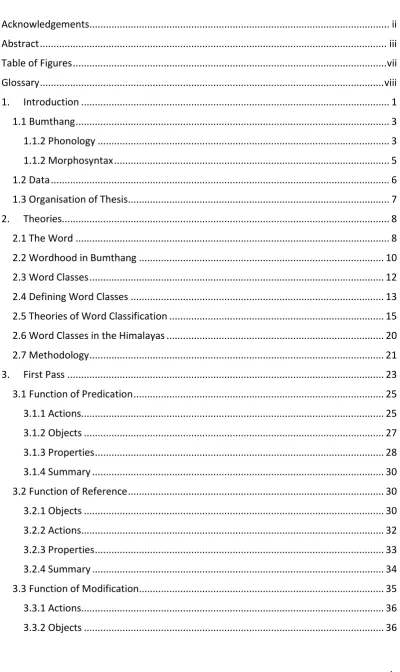
Acknowledgements ... ii

[image:5.595.112.513.111.784.2]

Abstract ... iii

Table of Figures ... vii

Glossary ... viii

1. Introduction ... 1

1.1 Bumthang ... 3

1.1.2 Phonology ... 3

1.1.2 Morphosyntax ... 5

1.2 Data ... 6

1.3 Organisation of Thesis ... 7

2. Theories... 8

2.1 The Word ... 8

2.2 Wordhood in Bumthang ... 10

2.3 Word Classes ... 12

2.4 Defining Word Classes ... 13

2.5 Theories of Word Classification ... 15

2.6 Word Classes in the Himalayas ... 20

2.7 Methodology ... 21

3. First Pass ... 23

3.1 Function of Predication ... 25

3.1.1 Actions... 25

3.1.2 Objects ... 27

3.1.3 Properties ... 28

3.1.4 Summary ... 30

3.2 Function of Reference ... 30

3.2.1 Objects ... 30

3.2.2 Actions... 32

3.2.3 Properties ... 33

3.2.4 Summary ... 34

3.3 Function of Modification... 35

3.3.1 Actions... 36

(6)

v

3.3.3 Properties ... 37

3.3.4 Summary ... 38

3.4 Assessing Markedness across Semantic Classes ... 39

4. Deeper Look ... 41

4.1 Verbs ... 41

4.1.1 Morphosyntactic Marking ... 41

4.1.1.1 Verbal Suffixes ... 41

4.1.1.2 Verbal Prefixes ... 45

4.1.1.3 Other affixes ... 47

4.1.2 Defining non-action words ... 48

4.1.2.1 Action Words ... 48

4.1.2.2 Non-action Words ... 49

4.1.2.2.1 Inchoative-Causative Verbs... 49

4.1.2.2.2 Experiencer Verbs ... 50

4.1.2.2.3 Comparative Verbs... 51

4.1.2.2.4 Copulas ... 52

4.1.3 Conclusion ... 53

4.2 Nouns ... 54

4.2.1 Objects and Non-Objects ... 55

4.2.2 Co-occurrence ... 55

4.2.2.1 Determiners ... 56

4.2.2.2 Possessives ... 57

4.2.2.2.1 Compounds ... 57

4.2.2.3 Numerals ... 58

4.2.2.4 Adjectives ... 59

4.2.2.5 Relative Clauses ... 60

4.2.2.6 Quantifiers ... 60

4.2.2.7 Phrase Structure ... 61

4.2.3 Case ... 61

4.2.3.1 Genitive ... 62

4.2.3.2 Ergative ... 63

4.2.3.3 Headless Noun Phrases ... 64

4.2.4 Expanding the definition ... 65

(7)

vi

4.3 Adjectives ... 67

4.3.1 Properties and non-properties ... 68

4.3.2 Subclasses ... 69

4.3.2.1 ‘Na’ class ... 69

4.3.2.2 ‘La’ class ... 70

4.3.2.2.1 The affix -la ... 71

4.3.3 Distinguishing adjectives ... 73

4.3.3.1 Adjectives versus Verbs ... 73

4.3.3.2 Adjectives versus Nouns ... 73

4.3.3.3 Comparatives and Superlatives ... 74

4.3.4 Conclusion ... 78

4.4 Conclusion ... 79

5. Conclusion ... 81

Appendix: Action Words ... 83

(8)

vii

Table of Figures

Figure 1 Bumthang vowel inventory 3

Figure 2 Bumthang consonant inventory 4

Figure 3 Chomskyan word classification 16

Figure 4 Langacker’s word classification 17

Figure 5 Croftian word classification 19

Figure 6 Word class descriptions in and near Bhutan 21

Figure 7 Characteristics of prototypical semantic classes 23

Figure 8 Prototypical semantic class members 25

Figure 9 Predication in Bumthang 30

Figure 10 Reference in Bumthang 35

Figure 11 Modification in Bumthang 39

Figure 12 Semantic classes and prototypical functions in Bumthang 40

Figure 13 TAME affixes on action words 42

Figure 14 Verbal inflections in Bumthang 44

Figure 15 Negative TAME paradigm 46

Figure 16 Bumthang determiners 56

Figure 17 Bumthang noun phrase 61

Figure 18 Bumthang adjectives 69

(9)

viii

Glossary

1 first person PTNMZ patientive nominaliser

2 second person Q question marker

3 third person QUOT quotative

ABL ablative RED reduplication

ABS absolutive REL relativiser

ALL allative SEQ sequential

APPROX approximative marker SG singular

CAUS causative SPEC specifier

CL classifier SUP superlative

COM comitative TAG.Q tag question marker

COMP comparative marker UNIV universal quantifier

COND conditional VOL volitional

COP copula

DAT dative

DET determiner

DIS distal

EMPH emphatic

EQ.COP equative copula

EQ.Q equative question marker ERG ergative case

EVID evidentiality marker

GEN genitive

IMM immediate

IMP imperative

INDF indefinite relativiser INF infinitive

INSTR instrumental IPFV imperfective IRR.I impersonal irrealis IRR.P personal irrealis LA -la affix

LMNZ locative nominaliser

LOC locative

NEG.NP non-perfective negator NEG.P perfective negator PFV.I impersonal perfective PFV.N neutral perfective PFV.P personal perfective

PL plural

PNMZ pronominaliser PRFM performative

(10)

1

1.

Introduction

This thesis will investigate major word classes in Bumthang from both a cross-linguistic

and functional perspective, and a language-internal morphosyntactic perspective to

determine which categories are relevant for the language. The major word classes of

nouns, verbs and adjectives are commonly found in language descriptions and are tied

to semantic concepts which are claimed to be universal (e.g. Croft 1990, Haspelmath

2012). Furthermore, word classes in the Himalayas have not traditionally been well

described. This description of word classes will help to compare Bumthang to other

languages in a manner accessible to typologists, as well as provide a detailed

morphosyntactic description of word classes within the language itself.

Categorisation is a skill which is innate to all animals. The ability to distinguish friend

from foe and prey from predator is one which can make the difference between life and

death. This process requires perceptual information, which is examined to find

meaningful differences between two or more items. The act of categorisation is also

endlessly flexible, as we can create categories and modify them at will.

Humans use language to create categories to interpret the world. In turn, linguists

categorise aspects of language to capture its organisation (Taylor 2003). For example,

phonology investigates the meaningful differences between phones in a language, which

implies speakers of languages make distinctions between groups of sounds and

categorise them accordingly.

Categorisation and classification of language is not limited to just linguists. Many

cultures have a rich tradition of folk linguistics, with knowledge of areally-specific lexical

(11)

2 knowledge about how some words differ; whether that be a morphosyntactic difference

or etymological.

What I will be discussing in this thesis is one act of classification which both linguists and

laypeople perform: categorising words into word classes. I will specifically be doing this

for Bumthang, a Tibeto-Burman language spoken in central Bhutan by approximately

30,000 people.

Bumthang has been previously described in Michailovsky and Mazaudon (1994), van

Driem (2015 [1995]) and Donohue and Donohue (2016). It forms part of a ‘Greater

Bumthang’ dialect chain, which includes Kurtöp to the north-east (described in Hyslop

(2017)) and Khengkha to the south (van Driem 1994:91).

Four main dialects of Bumthang have been established – Jakar, Chumey, Ura and Tang –

each spoken in a main valley in the region. The Ura dialect is regarded as the outlier of

the four dialects, with noticeably different verbal endings (van Driem 2015 [1995]) and a

highly complicated tonal system (Mark Donohue, personal communication).

Despite the previous work on the language, none has dealt in depth with the word

classes extant in the language. Many Himalayan languages have at least a chapter

devoted to word classes in their grammar but no similar work has been done for

Bumthang.

Through a thorough investigation of the word class system in Bumthang, I hope to

provide a clear illustration of how words are organised and which distinctions are

relevant to speakers of the language. This will help inform typological discussions of

word classes in the Himalayas and beyond; and help as a resource in the analysis of

(12)

3

1.1 Bumthang

Bumthang is a Tibeto-Burman language spoken mainly in the four valleys of central

Bhutan by around 30,000 people. It is part of the East Bodish family (van Driem

2001:828), along with its closest relations, Kurtöp and Khengkha (van Driem 1994). This

section will briefly describe the phonology of the language and its current Roman

orthographic system1 to enable a clearer understanding of the examples used in the

thesis. As the content of this work is largely morphosyntactic in nature, this section will

only have a few notes on the syntax of Bumthang.

1.1.2 Phonology

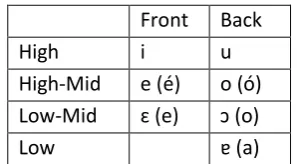
Bumthang has a phonemic inventory of 7 vowels and 26 consonants. Figure 1 details the

vowel inventory of Bumthang, with the relevant orthographic realisation in brackets

when it differs from the IPA. The high-mid back vowel is not attested in lexical words but

is still contrastive. Six diphthongs are found in the language: ai [əj], ae [ɐj], oi [ɔi], ao

[ɐɔ], ui [ui] and ei [ɛi].

Front Back

High i u

High-Mid e (é) o (ó) Low-Mid ɛ (e) ɔ (o)

[image:12.595.237.386.482.564.2]

Low ɐ (a)

Figure 1: Bumthang vowel inventory

(13)

4 A limited system of vowel harmony is present in the language, where the high-mid

vowels are raised in affixes following a high vowel. For example, the sequential affix -sé

is realised as -si when combined with nyit‘sit’ to create nyit-si.

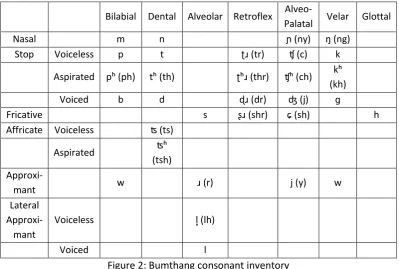
The phonemic consonantal inventory of Bumthang is as appears in Figure 2, with

orthographic equivalents in brackets. A voiced affricate [ʣ] is present in loan words

from Dzongkha but is frequently devoiced by speakers. The retroflex series are

phonemically analysable as consonant clusters, with their realisation vacillating between

a true retroflex and the cluster indicated in the table. The retroflex fricative is only

constrastive with the alveo-palatal fricative in loan words (Mark Donohue, personal

communication).

Bilabial Dental Alveolar Retroflex

Alveo-Palatal Velar Glottal Nasal m n ɲ (ny) ŋ (ng)

Stop Voiceless p t ʈɹ (tr) ʧ (c) k Aspirated pʰ (ph) tʰ (th) ʈʰɹ (thr) ʧʰ (ch) kʰ

(kh) Voiced b d ɖɹ (dr) ʤ (j) ɡ

Fricative s ʂɹ (shr) ɕ (sh) h Affricate Voiceless ʦ (ts)

Aspirated ʦʰ (tsh)

Approxi-mant w ɹ (r) j (y) w Lateral

Approxi-mant

Voiceless l ̥ (lh)

[image:13.595.113.513.368.637.2]

Voiced l

Figure 2: Bumthang consonant inventory

Common allophonic processes involving consonants include intervocalic voicing and

voicing assimilation. Voiceless consonants will frequently be realised as voiced when

following a voiced segment. Voiced consonants are commonly fricated when

(14)

5 Allomorphic processes involve deletion of final /k/ preceding morphemes with an initial

sonorant. A vowel is commonly lengthened to compensate for the missing segment.

Consonant mergers are also common in Bumthang. /k/ and /p/ are frequently realised

as /w/ across morphemic boundaries (but never within a morpheme). When a word

ending in /p/ is inflected with the affix -s, it is commonly realised as a voiceless bilabial

fricative [ɸ]. This second merger is indicated with <f> in the orthography.

As the tonal system is still currently under investigation and involves at least nine tonal

contrasts on monosyllables (Mark Donohue, personal communication), I will only be

indicating tone in two ways in my work. The first is by the graphs <z> and <zh> which

represents the fricatives <s> and <sh> realised with low tone respectively (i.e. <sh> is

[ɕ˦] and <zh> is [ɕ˨]). The second is in minimal pairs, where I will be marking the token

with the higher tonal realisation with an apostrophe (e.g. ‘kher‘made’ vs kher‘make’)2.

Syllables in Bumthang have a maximal phonotactic structure of CCVC, where the second

C in the onset can be any approximant except for /l ̥/. The minimum phonotactic syllable is VV, CV or VC. A reduced set of consonants occurs in the coda: the bilabial, dental and velar nasals and voiceless stops, the alveolar and alveo-palatal fricatives, and the voiced alveolar approximants.

1.1.2 Morphosyntax

Bumthang is an example of an agglutinative language with an ergative case system. Its

default word order is predicate-final, and the predicates are marked with affixes

indicating aspect and evidentiality. Arguments are overtly marked for

ergative/instrumental, genitive, locative, ablative and dative/allative case, with

(15)

6 absolutive case only overtly realised on pronouns. Further discussion of Bumthang

morphosyntax can be found in Chapters 3 and 4.

1.2 Data

The data for the thesis was primarily collected with the help of Dorji Wangchuk, a male

Bumthap from Ura in his thirties, who studies at the University of Canberra. The data

was collected in Field Methods classes run by Ass. Professor Mark Donohue at the

Australian National University in Canberra, Australia in 2013 and 2015, in a Languages of

the Himalayan Area class in 2016 and in follow up sessions with our consultant

afterwards. Additional data was collected in Ura, Bhutan; Tang, Bhutan; and Thimphu,

Bhutan by Ass. Professor Mark Donohue and Dr Cathryn Donohue with other Bumthang

speakers, who helped to confirm our data.

The recordings total over 100 hours, which is currently in the process of being

transcribed and archived with Pacific and Regional Archive for Digital Sources in

Endangered Cultures (PARADISEC). I have been using Fieldworks Language Explorer

(FLEx), software for fieldwork hosted by the Summer Institute of Linguistics (SIL) to

organise the ever-expanding corpus of current transcriptions, field notes and collected

word forms. A downloadable version of the most recent FLEx project can be found at

https://goo.gl/gDtP4i. At the time of writing, the interlinear text corpus consisted of 102

texts, of which 75 were transcriptions from elicitation sessions and 27 were

transcriptions of running text. All running text within the corpus comes from

monologues. This corpus represents approximately half of the collected data (a

generous approximation) but has not been fully analysed.

Examples throughout the thesis have four-line glossing. The first line is an allomorphic

(16)

7 the third, a free translation. The fourth line describes where in the FLEx corpus the

example can be found – the name of text, whether the text is an elicitation (EL) or a

monologue (MN), and the line.

1.3 Organisation of Thesis

The structure of the rest of the thesis is as follows. Chapter 2 will discuss the issues

involved with word class research, including a discussion of wordhood in Bumthang and

the various theories found in the literature. It also will detail the methodology I use for

the rest of the thesis.

Chapter 3 uses a functional approach to construct a potential word class system for

Bumthang. This will involve using a theory espoused by Croft (1990, 1991, 2000) to

identify groups of words which form the core of larger word classes in Bumthang.

Chapter 4 will investigate the hypothesis generated by Chapter 3 by looking closely at

the morphosyntactic realisation of the ‘core’ words. This follows in the steps of more

traditional word class investigations by examining distributional evidence for word class

systems. Finally, Chapter 5 will summarise the results of Chapters 3 and 4 and discuss

(17)

8

2.

Theories

2.1 The Word

For a discussion of word classes, we must first have a definition of ‘the word’. This is an

area of discussion which is highly circular, as a discussion of grammatical wordhood first

requires a theory of grammar; the same for phonological and prosodic words.

Dixon and Aikhenvald (2003) discusses different criteria that languages utilise to define

phonological and grammatical words. Phonological words consist minimally of a syllable

which is defined segmentally, prosodically or phonologically. Applicable segmental

features include phonotactic or segmental structure, word boundary phenomena or

pause phenomena, while prosodic features include stress, tone, nasalisation,

retroflexion and vowel harmony. Some languages also have phonological rules which

apply within the phonological word, while some may apply across a phonological word

boundary, such as sandhi rules (Dixon and Aikhenvald 2003:13). There may also be more

than one relevant phonological word in the language (ibid. 26).

Grammatical words are defined by what Dixon and Aikhenvald see to be universal

criteria (replicated below). They also note that other criteria such as non-recursiveness

and distribution of inflections help to define grammatical words in some languages, and

the principle of uninterruptability and isolatability are tendencies which help support

(18)

9 A grammatical word (sic) consists of a number of grammatical elements which:

(a) always occur together, rather than scattered through the clause (the criterion of

cohesiveness);

(b) occur in a fixed order;

(c) have a conventionalised coherence and meaning.

(Dixon and Aikhenvald 2003:19)

While Dixon and Aikhenvald see prosody as a defining criterion of a phonological word,

Schiering et al. (2006, 2010) show that a prosodic word can be defined separately from a

phonological word in some languages. For example, Hildebrandt (2007) finds that there

are multiple levels of phonological and prosodic words in Limbu (Kiranti,

Tibeto-Burman), which helps to account for “otherwise idiosyncratic alternations” in

phonology.

Mismatches between different types of words are common. Clitics are a good example

of this, as they form a grammatical word but are phonologically dependent (Zwicky

1985). Multiple languages such as Limbu, Yimas, Fijian, Jarawara and Turkish have

compounds which form one grammatical word but two phonological words (Dixon and

Aikhenvald 2003, Hildebrandt 2007). In addition, Limbu verbal bipartite stems vary in

how cohesive they are phonologically (Hildebrandt 2007). The tonal domain in Nar-Phu

(Tibeto-Burman) excludes any morphological prefixes, creating a phonological word

which is smaller than the grammatical word (Noonan 2003).

When defining word classes, linguists usually use the grammatical word. This is partially

as classification examines lexical forms as opposed to lexemes, which necessarily do not

carry overt inflection as part of their lexical entry. However, phonological and prosodic

(19)

10

boundaries’ such as orthographic spaces or pauses in speech around the longer relevant

word unit (Dixon and Aikhenvald 2003:30).

2.2 Wordhood in Bumthang

It is possible to define phonological, prosodic and grammatical words in Bumthang. My

classification of the word system will be primarily based around the grammatical word,

although it will be informed by the other types of words present in the language.

Phonological words in Bumthang consist minimally of two segments and can contain

several allophonic processes. Allophonic processes which take the phonological word as

its domain include intervocalic voicing, assimilation and vowel harmony. In addition,

vowel reduction can occur in disyllabic words with a low vowel in the first syllable. For

example, /gami/ ‘fire’ is realised as [ɡəmi] with a reduced vowel.

Intervocalic voicing, assimilation and vowel harmony can be seen in (1a-d), where the

affix -‘SEQ’ changes form according to the phonological form of its host. The

morpheme is realised with an [s] following an unvoiced obstruent in (1a). Following

voiced segments, /s/ is realised as [z]. This applies for both vowels (1b) and consonants

(1d). Buzi‘do-SEQ’ in (1b) and nyitsi‘sit-SEQ’ in (1c) demonstrate how the high-mid /e/ is

raised to [i] following a high vowel in the preceding morpheme. These processes occur

within the boundaries of a single phonological word.

(1a) Nomé khrak-sé ja thong.

Naomi arrive-SEQ tea drink.PERF.P

‘Naomi arrived and we drank tea.’

170629.EL.41

(1b) ka shruk bu-zi ra-zé ka cen ra-mo…

snow heavy do-SEQ come-SEQ heaviest.snow come-when

‘It was snowing down, one of the heaviest snows…’

(20)

11 (1c) Pema thapsang-nang=ó nyit-si bae-za.

Pema kitchen-in=DAT sit-SEQ cough-IPFV

‘Pema is sitting in the kitchen and coughing.’

131021.EL.28

(1d) …khwi shror-zé ra-s.

…dog escape-SEQ come-PERF.P

‘…the dog escaped and came for me.’

Scary Dog.MN.5

Grammatical words in Bumthang can be defined according to the criteria advanced by

Dixon and Aikhenvald in Section 2.1. Clitics are also present in Bumthang, which leads to

mismatches between phonological and grammatical words. For example, (2a) and (2b)

show that the infinitive clitic =tó undergoes allophonic processes, meaning that the verb

and the infinitive form one phonological word. However, as the clitic constitutes a

separate grammatical word, both seró ‘to die’ (2a) and nyidu ‘to be’ (2b) are examples of

where one phonological word consists of two grammatical words.

(2a) Trom=i Yuka sem se=ró bi-s.

Tom=ERG Yuka heart die=INF CAUS-PERF.P

‘Tom made Yuka sad.’

161021.EL.49

(2b) Ngai Trom them-zé nyid=u bi-s.

1SG.ERG Tom wait-SEQ COP.PFV=INF CAUS-PERF.P

‘I made Tom wait for me.’

161021.EL.70

Prosodic words in Bumthang have not been as well investigated as the other two types

of words, as the tone system is still being researched. However, we can define the

prosodic word separate to the phonological word as a word with a single tonal contour.

An example of where the prosodic word does not match with the other two words is the

lexical form ra-na‘come-PFV.I’. Each morpheme carries a separate falling tone (i.e.

constitute separate prosodic words) but a reduction of the a in the first syllable shows

(21)

12 the two morphemes must occur next to each other, in the same order, to achieve the

same meaning.

2.3 Word Classes

Traditionally, linguists have defined word classes based on morphology and syntax.

When classical grammarians such as Dionysius Thrax, Pāṇini or Priscian constructed their

theories of grammar and word classes, they noted affixes which were limited to a single

class, or words which must occur before or after other words (Fry and Faddegon 1939,

Kiparsky 1995, Haspelmath 2001, Rauh 2010). In this sense, work conducted by modern

linguists is a continuation of this early morphosyntactic approach.

The word classes that we use are heavily influenced by the classic Ancient Greek/Latin

paradigm. Traditional descriptions of languages will commonly include nouns, verbs,

adjectives, adverbs, pronouns, adpositions, conjunctions, numerals and interjections

(Haspelmath 2001). This can be traced back to how Western scholars adapted the Latin

system to ‘fit’ their languages, despite the large difference in morphosyntactic profile,

and the impact the Greek and Latin grammarians had on early linguistics.

Linguists regularly use these traditional word class categories in their descriptions.

However, modern linguists state that the sole universal part of speech is most likely the

interjection (cf Ameka 1992, Schachter 2007), and classes such as ‘noun’and ‘verb’ are

not universally relevant (although common). For example, languages such as Samoan

have been hypothesised not to have a noun/verb distinction (Mosel and Hovdhaugen

1992). The state of other parts of speech, such as the adjective class, is also highly

variable cross-linguistically (e.g. Dixon 1982, Bhat 1994, Wetzer 1996, Dixon 2004).

Evans and Levinson assert that other ‘non-traditional’ major classes of words can be

(22)

13 area (2009). These classes range from ideophones in Mundari (Osada 1992) and

pre-/co-verbs in Australian and Papuan languages (Pawley 1993, Schultze-Berndt 2003), to

positionals in Mayan languages (Brown 1994, England 2004, Bohnemeyer and Brown

2007) and classifiers in East Asia (Goddard 2005).

Another common problem is the classic ‘lumping-splitting’ problem. Linguists have not

yet come to a consensus on how much evidence is needed before we say two things are

different, and have largely acknowledged that it comes down to personal taste (e.g.

Schachter 2007). For example, in Korean, adjectives (hyengyengsa) form a separate class

to verbs (dongsa) but take almost all the same affixes. In this case, some people describe

hyengyengsa as ‘verbs’ to capture the similarities (Martin and Lee 1969).

Most linguists recognise that it is almost impossible to define word classes solely by

semantics (e.g. Wierzbicka 1986). Despite this, some linguists have advocated for a

semantic approach to defining the ‘core’ of word classes (Lyons 1977). This sort of

approach requires use of some sort of prototype theory to define the ‘core’ members,

with typically little discussion of non-prototypical members (cf Baker 2003). However, a

semantic comparison of word classes cross-linguistically is far more possible, as

languages will consistently have words (or roots) denoting meanings like things (e.g.

‘tree’ or ‘child’), actions (e.g. ‘run’ or ‘break’) and properties (e.g. ‘good’ or ‘small’)

(Haspelmath 2012).

2.4 Defining Word Classes

To show how word classes are commonly defined, I will demonstrate with English. Word

classes in English can be morphosyntactically defined with ease. A prototypical verb will

be inflected with ‘-s’ when its subject is in the third person singular (e.g. ‘walks’) and

(23)

14 in complementary distribution and form part of an affixal tense-aspect paradigm in

English. The regularity and predictability of these affixes means we can exclude

superficially similar forms like ‘blue-eyed’ from being verbal, as ‘blue-eyes’ is not a

permissible verb form3.

Furthermore, the verb will select the number of arguments syntactically required. ‘Fall’

requires one argument, and ‘hit’ and ‘put’ take two and three respectively. The verb will

also specify the semantic role of the arguments.

Nouns in English will prototypically occur with a determiner (a, the, that). The times

when overt determiners are ungrammatical are also predictable, as the noun will either

be a mass noun (e.g. furniture), a count noun with a plural affix (e.g. horses) or the

proposition will be a general statement (e.g. ‘Love is grand’). Count nouns can be

pluralised (e.g. horses, children) and you can derive adjectives by attaching affixes such

as ‘-y’ or ‘-al’ depending on the noun (e.g. bug > buggy; nation > national).

Adjectives in English normally occur prenominally, between the determiner and the

noun. There are two methods of forming comparatives and superlatives: the first, a

morphological method where adjectives take -er and -est; and the second, a syntactic

method where the adjective is preceded by ‘more’ or ‘most’. The choice of method

primarily depends on the phonological shape of the adjective, with polysyllabic words

more likely to use the syntactic method. Words which are etymologically from Romance

languages also use ‘more’ and ‘most’ to construct the comparative and superlative.

The definitions of the three English word classes has been conducted using

morphosyntactic distribution. While each class coincides with certain semantic concepts,

3That said, ‘blue eyes’ with a space instead of a hyphen is an acceptable noun phrase in English.

(24)

15 such as verbs encoding events or states, we did not use semantics to define a word

class.

It is impossible to define other languages by the same morphosyntactic criteria as

English. Although adjectives also occur prenominally in Mandarin – marked with -de

relative clauses are encoded the exact same way (Li and Thompson 1981). Thus, a

‘prenominal modifier position’ is not a good criterion for distinguishing Mandarin

adjectives from verbs but it is better for English adjectives and verbs4. Similarly, nouns in

French must be marked for lexical gender. This means gender agreement is a good

criterion to define a class of nouns in French. However, this does not work for defining

English nouns, as there are very few nouns which carry lexical gender marking (as

opposed to semantic), and those that do are atypical.

2.5 Theories of Word Classification

Other ways of defining word classes apart from language-specific morphosyntax have

been proposed by linguists. Over the years, different proposals have been put forward

from generativist, functionalist and cognitive schools of thought. All theories, regardless

of theoretical alignment, have sought to capture different phenomena and build upon

their predecessors’ work.

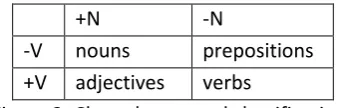
Chomsky originally separated lexical categories (i.e. content words or major word

classes) from functional categories and floated the idea of these categories carrying

features like [+N] and [+V] in his seminal 1970 paper (Chomsky 1970). He later expanded

this to a binary feature set of [±N, ±V] which specified the lexical categories of noun,

4 This is still not the best criterion for distinguishing English verbs and adjectives, as modifying

verbs can also occur prenominally, e.g. ‘a crying baby’. However, morphological evidence helps

(25)

16 verb and adjective (Chomsky 1975). Jackendoff later added prepositions to be a ‘logical’

fourth class (Jackendoff 1977:31). The combined feature paradigm is shown in Figure 3.

+N -N

-V nouns prepositions

[image:25.595.227.399.145.199.2]

+V adjectives verbs

Figure 3: Chomskyan word classification

It is important to note that rather than [N] and [V] simply representing ‘nominal’ and

‘verbal’ features, Chomsky also intended them to represent ‘substantival’ and

‘predicative’ notions respectively (Chomsky 1981:48). Adjectives, which have the value

[+N, +V], thus theoretically carry elements of both substantives and predicates.

This early framework suggests that lexical categories which share the same value (e.g.

nouns and prepositions) should form a natural class. Theoretically, the opposite should

then be true: nouns and verbs should not form a natural class and neither should

prepositions and adjectives. However, this is untrue in English: adjectives and

prepositions are both able to appear clause-finally in resultative constructions, where

nouns and verbs cannot (Baker 2003).

(1a) John pounded the metal flat. (AP) (1b) John threw the ball into the barrel. (PP) (1c) *John pounded the metal a sword. (NP) (1d) *John polished the table shine. (VP)

(Baker 2003:2)

Another problem with the framework was discovered with further research into

language-particular word class systems. A major assumption of the Chomskyan

framework is that [N] and [V] constitute basic features of words and therefore word

class organisation. However, work on Nootkan languages (e.g. Swadesh 1938) and

(26)

17 hypothesised to lack a noun-verb distinction5, showed that we cannot assume that these

features are a part of universal word class categorisation principles.

The Chomskyan framework, while groundbreaking in its own way, was little used in the

generative literature. A notable exception to this was its use in case assignment

principles (Stowell 1981); however, this practice fell out of use. This original framework

is also not congruent with the Minimalist Program (Baker 2003).

Functionalist work on classifying word classes started to gain traction in the eighties. For

example, Hopper and Thompson’s seminal 1984 paper argued for a

discourse-dependant word classification system. Their system involves acategorial words, which

may have a predisposition for a particular word class, gaining full nounhood or verbhood

through their use in discourse (Hopper and Thompson 1984).

Langacker (1987) proposed a feature system which was heavily influenced by cognitive

linguistics, summarised in Figure 4. Like Hopper and Thompson, Langacker believes roots

may be acategorial but acquire nounhood or verbhood in use in constructions. He

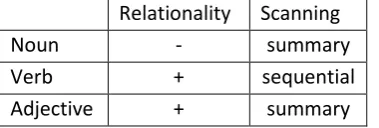
defines nouns, verbs and adjectives based on two criteria, ‘relationality’ and ‘scanning’.

Relationality Scanning

Noun - summary

Verb + sequential

[image:26.595.220.410.521.585.2]

Adjective + summary

Figure 4: Langacker’s word classification (1987)

Verbs and adjectives are both [+relational] as they both ‘relate’ things: verbs connect

participants and events, and adjectives link nouns with properties. Nouns are

(27)

18 [-relational] as they denote discrete entities6. The three classes are also sorted according

to their ‘scanning’ type, with nouns and adjectives needing summary scanning while

verbs are scanned sequentially. This means that nouns and adjectives only require a

single glance for speakers to conceptualise their reality, while verbs necessitate a longer

viewing to determine the nature of the event (hence a ‘scanning’ of sequential events).

Two influential functional theories were advanced in the early 1990s, Hengeveld (1992)

and Croft (1990, 1991, 2000). Hengeveld sees the prototypical functions of verbs as

predicates, nouns as referents, adjectives as noun modifiers and adverbs as non-nominal

modifiers respectively (1992:37). However, all word classes can theoretically predicate

depending on the language. Based on this, he proposes that there are two types of

languages, flexible and rigid, depending on how tightly word classes are associated with

their prototypical functions in the language and how permissive the language is of

non-verbal predicates.

The theory advanced in Croft (1990, 1991, 2000) has been well-recognised in recent

work. Croft defines the syntactic categories of nouns, verbs and adjectives as a

prototype correlation of pragmatic functions and semantic classes. According to this

model, prototypically referential objects, property modifiers and action predicates

should be coded as core classes of nouns, adjectives and verbs respectively. The

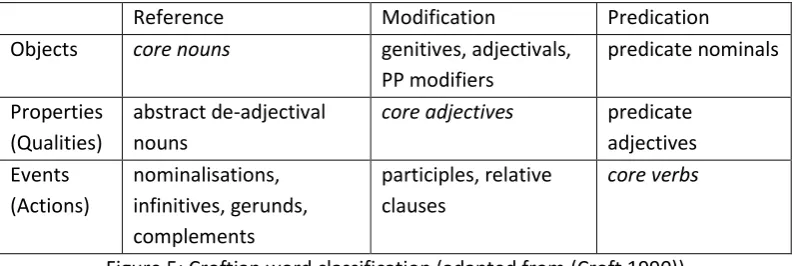
correlation of pragmatic functions and semantic classes is summarised in Figure 5.

(28)

19

Reference Modification Predication

Objects core nouns genitives, adjectivals,

PP modifiers

predicate nominals

Properties (Qualities)

abstract de-adjectival nouns

core adjectives predicate adjectives Events

(Actions)

nominalisations, infinitives, gerunds, complements

participles, relative clauses

[image:28.595.114.513.84.217.2]

core verbs

Figure 5: Croftian word classification (adapted from (Croft 1990))

Croft further claims that if a word is used in a non-prototypical function, it should be

more typologically marked. He uses this to explain how words are more morphologically

marked when performing atypical functions, such as a verb requiring nominalisation to

function reference.

Building on the idea of the prototype correlation put forward by Croft, Baker (2003)

proposes a Principles and Parameters word class framework which defines word classes

purely on a syntactic basis. While Baker uses the same [±N, ±V] features as Chomsky, he

instead defines three word classes and ignores prepositions. The most dramatic

departure from the previous Chomskyan scheme is the classification of adjectives as [-N,

-V] instead of [+N, +V]. This is because Baker’s definition of [N] and [V] is different to

that of Chomsky; rather than denoting ‘substantives’ or ‘predicates’, Baker defines [V] as

taking Spec (i.e. licenses a subject) and [N] as bearing a referential index (i.e. can leave a

trace). As such, he defines verbs ([+V, -N]) as “inherently predicative”; nouns ([-V, +N])

as “inherently referential” and adjectives ([-V, -N]) as neither inherently predicative or

inherently referential (Baker 2003:16). This is a break from functionalist work which

defines adjectives as prototypical attributors, as Baker instead defines adjectives as

(29)

20 The large array of different perspectives on how to classify words and what features are

relevant in a classification means there is no one ‘right’ way to define word classes in a

language. The idea of prototypes – both prototypical examples of words in a language

(e.g. ‘dog’ as a good noun in English) and prototypical functions of word classes – is an

important one which should be incorporated into any analysis of word classes. Any

analysis should be able to handle the good ‘dogs’ and the not-so-good ‘furniture’ within

a single framework to be effective.

2.6 Word Classes in the Himalayas

Work on word classes in the Himalayas has largely consisted of a chapter or two in

grammars and a few papers detailing adjective classes, with little work comparing word

classes in different languages. A common thread can be seen in descriptions, such as

adjectives regularly ‘modifying nouns’ and nouns or noun phrases as syntactic

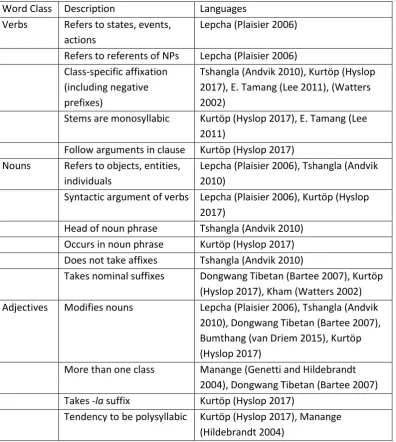
arguments of verbs. Figure 6 details the varied ways that word classes are described and

defined.

Other descriptive tendencies are evident in Figure 6. Some descriptions rely on semantic

definitions for word classes and some rely on position relative to other words. Nouns

and verbs commonly have affixes as a defining criterion, and phonological shape is

remarked upon for verbs and adjectives. Interestingly, more than one class of adjectives

(30)

21

Word Class Description Languages

Verbs Refers to states, events, actions

Lepcha (Plaisier 2006)

Refers to referents of NPs Lepcha (Plaisier 2006) Class-specific affixation

(including negative prefixes)

Tshangla (Andvik 2010), Kurtöp (Hyslop 2017), E. Tamang (Lee 2011), (Watters 2002)

Stems are monosyllabic Kurtöp (Hyslop 2017), E. Tamang (Lee 2011)

Follow arguments in clause Kurtöp (Hyslop 2017) Nouns Refers to objects, entities,

individuals

Lepcha (Plaisier 2006), Tshangla (Andvik 2010)

Syntactic argument of verbs Lepcha (Plaisier 2006), Kurtöp (Hyslop 2017)

Head of noun phrase Tshangla (Andvik 2010) Occurs in noun phrase Kurtöp (Hyslop 2017) Does not take affixes Tshangla (Andvik 2010)

Takes nominal suffixes Dongwang Tibetan (Bartee 2007), Kurtöp (Hyslop 2017), Kham (Watters 2002) Adjectives Modifies nouns Lepcha (Plaisier 2006), Tshangla (Andvik

2010), Dongwang Tibetan (Bartee 2007), Bumthang (van Driem 2015), Kurtöp (Hyslop 2017)

More than one class Manange (Genetti and Hildebrandt 2004), Dongwang Tibetan (Bartee 2007) Takes -la suffix Kurtöp (Hyslop 2017)

[image:30.595.117.514.84.527.2]

Tendency to be polysyllabic Kurtöp (Hyslop 2017), Manange (Hildebrandt 2004)

Figure 6: Word class descriptions in and near Bhutan

2.7 Methodology

This chapter has introduced a multitude of different approaches and methods for the

analysis of word classes. Cross-linguistic theories range from generativist approaches

such as those of Chomsky (1970, 1975, 1981) and Baker (2003), to functionalist

approaches such as Hopper and Thompson (1984) and Croft (1990, 1991, 2000).

Language-specific studies ultimately define word classes using morphosyntactic criteria,

(31)

22 To define word classes in Bumthang, I will begin by using one of the cross-linguistic

theories introduced in 2.5 to identify potential word classes in Chapter 3. A more

detailed examination of the results produced by the chosen method will follow in

Chapter 4. This will allow for a full investigation of the status of word classes in

Bumthang from both a cross-linguistic and language-internal perspective.

I found Croft’s (1990, 1991, 2000) theory to provide the best method for a ‘first-pass’

investigation of word classes in the language. It will provide a good illustration of how

words are functioning in discourse and allow us to establish a language-internal theory

of word classes before investigating further.

Chapter 4 will be a deeper look into how the tentative word classes are distributed

morphosyntactically in Bumthang. By using a strategy which has remained best practice

in word class studies for centuries, I will provide a systematic description of the word

class system in the language. This will help to compare Bumthang word classes with

(32)

23

3.

First Pass

This chapter will establish a working theory of word classes in Bumthang using Croft’s

(1990, 1991, 2000) functional framework. Croft’s model uses the correlation of

pragmatic functions and semantic classes to define prototypical nouns, verbs and

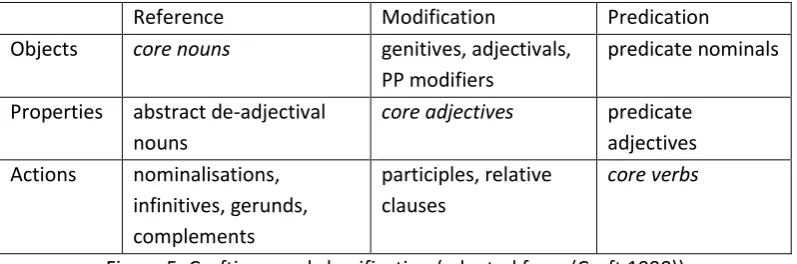
adjectives. This comparison is carried out in pragmatically neutral contexts. Figure 5,

which shows the correlation between functions and semantic classes and how they are

encoded, has been replicated here. We can see that Croft’s model proposes that core

nouns are prototypically referential objects; core adjectives are property modifiers; and

event predicates are prototypical verbs.

Reference Modification Predication

Objects core nouns genitives, adjectivals,

PP modifiers

predicate nominals

Properties abstract de-adjectival nouns

core adjectives predicate adjectives Actions nominalisations,

infinitives, gerunds, complements

participles, relative clauses

[image:32.595.114.513.346.478.2]

core verbs

Figure 5: Croftian word classification (adapted from (Croft 1990))

These semantic classes of object words, property words and action words are

characterised by four binary pairs: relational/nonrelational, stative/dynamic,

persistent/transitory, and gradable/nongradable. The qualities which each semantic

class possess can be seen in Figure 7. Persistence is defined as “how long the process or

state is likely to last over time” (Croft 1991:64), while gradability applies to property

words and corresponds to the traditional grammar use of this term.

Relationality Stativity Persistence Gradability

Objects - + + -

Properties + + + +

Actions + - - -

[image:32.595.163.467.679.740.2]
(33)

24 This correlation of pragmatic functions and semantic classes hinges on the ‘typological

markedness’ of different semantic classes relative to others when performing a selected

pragmatic function. Croft defines ‘typological markedness’ to be morphological or

syntactic coding of pragmatic functions. For example, action words in English require

less morphosyntactic coding to act as predicates than object words7. This means that

English object words are more typologically marked than English action words when

predicative. Generally, more typologically marked values will be marked with at least as

many morphemes as less marked values, whether this be coded morphologically or

syntactically.

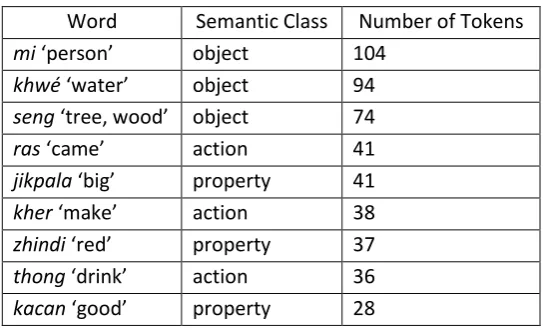
Applying Croft’s theory to Bumthang requires selection of good ‘objects’, ‘properties’

and ‘actions’. To have an impartial selected of which words are ‘good’, I have selected

the three most-used words in my Bumthang corpus (described in 1.2) which best fit

semantically into each class (Figure 8). For our purposes, these words must also be

non-homophonous, fully lexical and occur at least once outside of an elicitation context. This

excludes words which have a secondary function as an auxiliary, such as gae‘go,

become’ or nyit‘sit, STATE’, as well as words with a second unassociated meaning such

as lap‘say; fold dumplings’.

7A typical action word in English like ‘jump’ takes a portmanteau affix which specifies tense and

subject person agreement affix in a simplex clause. Object words like ‘dog’ require a copula,

which is marked for TAME, and a determiner (i.e. ‘is a dog’). Here, I define ‘jump’ as requiring a morphological strategy (affixation) to act as a predicate and ‘dog’ as requiring both

(34)

25 Word Semantic Class Number of Tokens

mi‘person’ object 104

khwé‘water’ object 94

seng ‘tree, wood’ object 74

ras‘came’ action 41

jikpala ‘big’ property 41

kher ‘make’ action 38

zhindi ‘red’ property 37

thong‘drink’ action 36

[image:34.595.176.448.82.247.2]

kacan ‘good’ property 28

Figure 8: Prototypical semantic class members

Attestations of these nine words will serve as the base for establishing a hypothesis of

the word class system in Bumthang. The following sections will each examine a different

prototypical function: predication (3.1), reference (3.2), and modification (3.3),

respectively. A discussion and summary of the findings will follow in 3.4.

3.1 Function of Predication

I will begin my investigation of the prototypical pragmatic functions proposed by Croft

with predication. This is due to Hengeveld’s (1992) hypothesis that predication is a basic

function of words, regardless of word class. This provides a convenient springboard from

which to begin an analysis. Theoretically, action words will be ‘less marked’ when

predicating compared with words that denote objects and properties.

3.1.1 Actions

Action words, like ras‘came’, kher‘make’ and thong‘drink’, occur at the end of clauses

when predicative and do not require any derivational morphology to predicate.

However, they are marked with inflections which encode aspectual and evidential

distinctions.

Throughout the corpus, ras‘came’ only denotes past completed actions like in (1). If we

(35)

26 suggests that the root of ras and raza is ra and that -s and -za are inflections which

encode temporal distinctions.

(1) Tsimini caksai tra-zi gae-mo-né

moreover chain break-SEQ become-when-ABL khwi shror-zé ra-s.

dog escape-SEQ come-PFV.P

‘…and the chain broke, and the dog escaped and came for me.’

Scary Dog.MN.5

(2) Darung tau thungi bomé-dé=ng saekal thung bu-zi ra-za. again from.far.away girl-SPEC=also bicycle PRFM do-SEQ come-IPFV

‘Again, a girl is coming from far away on her bike.’

Pear Story.MN.67

When we compare sentences with kher and thong, we see the same temporal

distinctions made. (3a) and (4a) both denote past, completed actions and (3b) and (4b)

denote actions which have started but have not yet been completed. (3a) and (4a) do

not have an overt -s segment but still retain the tone associated with the affix, a final

rising tone (distinct from sentence-final rising intonation). The deletion of the -s

segment is explainable through phonotactic restrictions, as only one consonant is

allowed in the coda position. (3b) and (4b) both overtly realise the affix -za. This

suggests that these affixes are regular and form part of an aspectual paradigm which is

inflected on predicates.

(3a) Dema sutla zhego zama=ning zhebai=ru ‘kher.

yesterday evening food meal=and beans=DAT make.PFV.P

‘Last night, I made a meal with beans.’

My Cooking.MN.2-4

(3b) Dema Yuk(a)=i Nomé=ró momo kher-za.

yesterday Yuka=ERG Naomi=ALL dumpling make-IPFV

‘Yesterday Yuka was making dumplings for Naomi.’

151114.EL.30

(4a) Trom=i churma ‘thong.

(36)

27

‘Tom drank beer.’

151107_2.EL.38

(4b) Ngat khwé nokpa thong-za. 1SG water cool drink-IPFV

‘I’m drinking cold water.’

151002_6.EL.11

Example (3a) shows that predicates select arguments which can be unrealised if

understood from context. In (3a), the agent of the sentence is implicitly understood to

be the speaker as the utterance comes from a retelling of what the speaker did the night

before.

We can see throughout the examples that action words occur clause-finally. As all

examples represent pragmatically unmarked clauses, we can conclude that this is an

example of a syntactic strategy used by action words to act as predicates.

From the data, we can see that words denoting predicative actions in Bumthang take

morphological TAME marking and occur clause-finally. They are thus typologically

marked morphologically as well as syntactically.

3.1.2 Objects

There is no naturally-occurring data which shows the three words denoting objects

selected in 3.1 in a predicative function. In fact, the most attested object word, mi

‘person’, does not occur once as a predicate throughout the corpus. Both khwé‘water’

and seng‘tree’ have one predicative token each.

(2a) and (2b) show both words occur with the equative copula wen to function as

predicates. In (2a), khwé‘water’ is modified by tshan‘hot’8 while seng‘tree’ in (2b) is

8 We can safely conclude that khwé tshan‘hot water’ is the predicative unit rather than tshan

‘hot’ as tshan‘hot’ is only found when modifying. When predicative, tshan‘hot’ becomes

(37)

28 unmodified. The construction seen here is an equative clause where the second

argument is asserted to refer to the same entity as to the first.

(2a) [Tshae] [khwé tshan wen].

PROX.DET water hot EQ.COP

‘This is hot water.’

160421_2.EL.28

(2b) [Tshae tshik] [seng wen].

PROX.DET word tree EQ.COP

‘This word is ‘tree’.’

150814_1.EL.4

Objects thus require the equative copula to predicate. This is a syntactic strategy

employed by speakers to achieve this function. This equative copula is inflected for

evidentiality (cf Wyatt 2017)9 and must occur clause-finally, meaning that objects need

both one morphological (inflection) and two syntactic strategies (clause-final position

and a copula) to function as predicates.

3.1.3 Properties

Kacan‘good’, zhindi‘red’ and jikpala‘big’ are all attested functioning as predicates

throughout the corpus. However, the examples primarily come from elicitations, with

the only tokens from casual speech being involved in a ‘become X’ construction.

When predicating, properties require the copula na (3a). There are some exceptions to

this strategy. Wen‘EQ.COP’ can appear as a copula with some words denoting

properties, such as zhindi‘red’ like in (3b). This is the same strategy discussed in 3.1.2

for object words.

(3a) [Gon] [kacan na]. 3SG good COP

9 Wyatt (2017) shows that there is an evidentiality distinction marked in the copula between

personal and impersonal using the suffix that codes the imperfective on ‘verbs’. This is also

(38)

29

‘He is well.’

150828_3.EL.78

(3b) [Nigu=é bit] [zhindi wen-za]. pocket=GEN outside red EQ.COP-IPFV

‘The outside of the pencilcase is red.’

150828_3.EL.18

Jikpala‘big’ should form a predicate with the copula na, like kacan‘good’ in (3a). Instead

jikpala‘big’ appears as jikpa‘big’ when forming a predicate with the copula na (3c-d).

This means that jikpala‘big’ is analysable as a root jikpa with an affix -la, as the -la affix

does not appear when jikpa ‘big’ is predicative.

(3c) [Seng] [namésamé jikpa nak-sa].

tree very big COP-IPFV

‘The tree is very big.’

151114.EL.75

(3d) [Tshae tshali] [jikpa=rang na].

PROX.DET orange big=EMPH COP

‘This orange is very big.’/’This orange is the biggest.’

150828_3.EL.91

The predicate can be modified with qualifiers like namésamé‘very’ (3c). An emphatic

clitic can also attach to the property word (3d) to express the speaker’s judgement of

the property in question (i.e. that it is very big).

The predication strategies used by property words can be classified in two ways. Firstly,

zhindi uses the same strategy as object words when predicating by forming a predicate

with wen‘EQ.COP’. On the other hand, the rest of the property words form a predicate

with na‘COP’. Both methods require a second word which inflects for evidentiality. This

second word must then occur clause-finally in pragmatically unmarked contexts.

(39)

30

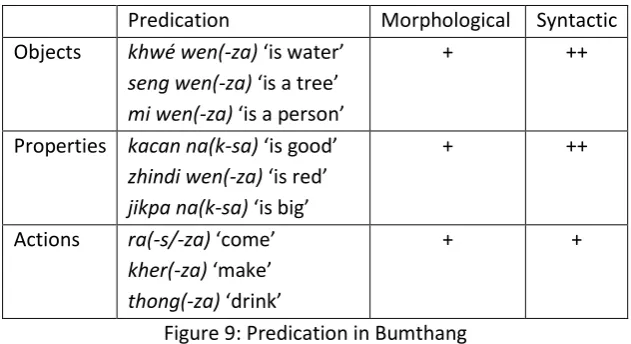
3.1.4 Summary

In Sections 3.1.1-3.1.3, we saw that a mixture of morphological and syntactic structures

is used by words to function as predicates. All predicates require morphological marking

for aspect and evidentiality. In addition, all predicates occur clause-finally, which is an

example of syntactic markedness. Action words require no further marking, while both

object words and property words require a secondary copula (which carries the TAME

affix) to function as predicates. A summary of the strategies used is in Figure 9.

Predication Morphological Syntactic

Objects khwé wen(-za) ‘is water’ seng wen(-za) ‘is a tree’ mi wen(-za) ‘is a person’

+ ++

Properties kacan na(k-sa) ‘is good’ zhindi wen(-za) ‘is red’ jikpa na(k-sa) ‘is big’

+ ++

Actions ra(-s/-za) ‘come’ kher(-za) ‘make’ thong(-za) ‘drink’

[image:39.595.154.470.281.453.2]

+ +

Figure 9: Predication in Bumthang

Out of the three semantic classes, predicative actions are the least typologically marked.

This allows us to classify them tentatively as ‘core verbs’ in Bumthang.

3.2 Function of Reference

Following from predication, I will now look at words that are used in a referential

function. When used referentially, we expect objects to be the least typologically

marked, with properties and actions requiring more morphemes to perform the same

function.

3.2.1 Objects

Most tokens in the corpus for each of the three object words selected occur when the

(40)

31 throughout the corpus fulfilling various roles in a sentence. They can appear alongside

other words to constitute a reference or can occur alone to perform the same function.

For example, in (4a), seng functions as a reference to a non-specific tree and stands

alone. However, in (4b), the reference unit is instead utui seng‘that tree’ with an explicit

determiner. This shows that syntactic strategies (i.e. using more than one word) to

encode object words as references are present in Bumthang but are not required by

speakers.

(4a) Ngai tari=i seng tuf.

1SG.ERG axe=INSTR tree cut.PFV.P

‘Icut the tree with an axe.’

130826.EL.41

(4b) Utui seng ringshing wen.

DIS.IMM.DET tree long EQ.COP

‘That tree is tall.’

130916.EL.5

Object words can also take morphological marking to function referentially. Khwé in (4c)

does not require any affixes to refer to ‘water’, like how seng‘tree’ is realised in (4a).

However, in (4d), khwé‘water’ takes allative case to act as the end state indexed by the

predicate.

(4c) Ngat khwé tsha-za. 1SG water heat-IPFV

‘I am heating up water.’

160526_1.EL.1

(4d) Ka khwé=ró shru-zumo.

snow water=ALL melt-PFV.N

‘Snow melts to water.’

160616.EL.14

What we see here is that no morphological or syntactic marking is required for object

(41)

32 suggests that reference is a less typologically marked function of object words in

Bumthang.

3.2.2 Actions

Compared to object words, we expect action words to be more typologically marked

when performing a referential role. Unsurprisingly, action words require morphological

marking to function referentially, through clausal nominalisation with -thang or through

marking with =tó to act as an infinitive. As only kher‘make’ appears with either of these

markers, examples with other action words have been included in this section.

-Thang attaches to a predicate and turns it into a reference which can take case like

object words (cf 3.2.1). In (5a), the clause includes an agent and a patient and is marked

by the locative case na; in (5b), the clause only includes a patient and is marked by the

genitive case é.

(5a) [Wii tortola sut-thang]=na ta-zi 2SG.ERG squirrel kill-ANMZ=LOC see-SEQ ngat wet=na dék-sa.

1SG 2SG=LOC scare-IPFV

‘Seeing how you kill squirrels, I’m scared ofyou.’

161111.EL.43

(5b) Osae [bramnyai kher-thang] khorning…

PROX.IMM.DET bramnyai make-ANMZ=GEN about

‘This is about how you make bramnyai…’

Making Bramnyai.MN.6

The action word can alternatively take infinitive marking =tó and act as a reference in

(5c). Infinitives can encode a patient argument within its scope, but not agents. As such,

action nominalisations are a better representation of referential action words.

(5c) Ngai kar chong=ó ‘khan.

1SG.ERG run run=INF know.how.IRR.I

‘I know how to run.’

(42)

33 We can conclude that actions are typologically marked as they require morphological

marking to act referentially. This includes obligatory morphological marking of the

action nominaliser -thang or the infinitive =tó.

3.2.3 Properties

Property words should also be more typologically marked when in a referential role than

object words. The only clear examples of the three selected property words acting

referentially are in (6a) and (6b), where zhindi‘red’ requires the -la affix to be a

reference. It co-occurs with ngae‘my’.

(6a) Ngae zhindi-la ao nak-ké?

1SG.GEN red-LA where COP-Q

‘Where is my red one?’

131112.EL.20

(6b) *Ngae zhindi ao nak-ké?

1SG.GEN red where COP-Q

‘Where is my red?’

131112.EL.19

However, we cannot simply characterise the affix -la as a referential marker. In (6c), its

presence allows jikpala‘big’ to form an object word-style predicate like in 3.1.2.

However, zhindi also has the same ‘referential’ form as in (6a) when modifying pecha

‘book’ in (6c)10.

(6c) [Utui pecha zhindi-la] [jikpa-la wen].

DIS.IMM.DET book red-LA big-LA EQ.COP

‘That red book is big.’

131112.EL.8

Whilst there are no recorded examples in the corpus, discussions in session 150828_3.EL

found that jikpala‘big’ can be marked with a plural marker and be an acceptable

(43)

34 reference in a sentence, meaning ‘big things’. There are no examples of jikpa‘big’

occurring without -la in non-predicative examples.

Kacan‘good’ also has no recorded examples of referential use. Our consultant did not

accept the form kacan-la, thus kacan‘good’ cannot be encoded as a reference using the

same strategy as zhindi‘red’ or jikpa ‘big’. This is because kacan ‘good’ requires the

copula na, whereas zhindi‘red’ and jikpa‘big’ do not take the copula outside of a

predicate.

Other examples of property words which require na ‘COP’ include kha tsha‘spicy’. In

(6d), kha tsha‘spicy’ takes na‘COP’, which uses a relativisation strategy like action

modifiers to act referentially. Kacan‘good’ would thus refer using the same construction

(cf 3.3.1).

(6d) Kha tsha nak-khan ajilé yo?

spicy COP-REL whose EQ.Q

‘Whose is the one which is spicy?’

151030.EL.86

We have two clear referential strategies employed by property words. The first is

marking with the affix -la, like zhindila‘red’ and jikpala‘big’. This affix does not explicitly

perform a derivational function allowing properties to act referentially, but does enable

it. The second strategy is using a relativised copula, like kha tsha ‘spicy’ (and kacan

‘good’). Both strategies utilise morphosyntactic marking on the property words.

3.2.4 Summary

We saw in Sections 3.2.1-3.2.3 that encoding reference can be simple (3.2.1) or complex

(3.2.3) in Bumthang.

There is a split in the referring strategies of the property class: one group of words takes

Figure

Table of Figures .................................................................................................................
Figure 1: Bumthang vowel inventory
Figure 2: Bumthang consonant inventory
Figure 3: Chomskyan word classification
+7

References

Related documents