ã
eurostat
STATISTISCHES AMT DER EUROPAISCHEN GEMEINSCHAFTEN STATISTICAL OFFICE OF THE EUROPEAN COMMUNITIES OFFICE STATISTIQUE DES COMMUNAUTÉS EUROPÉENNES L-2920 Luxembourg — Tél. (352) 43 01-1 — T é l e x C O M E U R LU 3423 B-1049 Bruxelles, rue de la Loi 200 — Tél. (32-2) 299 11 11
Eurostat hat die Aufgabe, den Informa-tionsbedarf der Kommission und aller am Aufbau des Binnenmarktes Beteiligten mit Hilfe des europäischen statistischen Systems zu decken.
Um der Öffentlichkeit die große Menge an verfügbaren Daten zugänglich zu machen und Benutzern die Orientierung zu erleichtern, werden zwei Arten von Publi-kationen angeboten: Statistische Doku-mente und Veröffentlichungen.
Statistische Dokumente sind für den Fachmann konzipiert und enthalten das ausführliche Datenmaterial: Bezugs-daten, bei denen die Konzepte allgemein bekannt, standardisiert und wissenschaft-lich fundiert sind. Diese Daten werden in einer sehr tiefen Gliederung dargeboten. Die Statistischen Dokumente wenden sich an Fachleute, die in der Lage sind, selbständig die benötigten Daten aus der Fülle des dargebotenen Materials auszu-wählen. Diese Daten sind in gedruckter Form und/oder auf Diskette, Magnet-band, CD-ROM verfügbar. Statistische Dokumente unterscheiden sich auch optisch von anderen Veröffentlichungen durch den mit einer stilisierten Graphik versehenen weißen Einband.
Veröffentlichungen wenden sich an eine ganz bestimmte Zielgruppe, wie zum Beispiel an den Bildungsbereich oder an Entscheidungsträger in Politik und Ver-waltung. Sie enthalten ausgewählte und auf die Bedürfnisse einer Zielgruppe abgestellte und kommentierte Informa-tionen. Eurostat übernimmt hier also eine Art Beraterrolle.
Für einen breiteren Benutzerkreis gibt Eurostat Jahrbücher und periodische Veröffentlichungen heraus. Diese enthal-ten statistische Ergebnisse für eine erste Analyse sowie Hinweise auf weiteres Datenmaterial für vertiefende Unter-suchungen. Diese Veröffentlichungen werden in gedruckter Form und in Daten-banken angeboten, die in Menütechnik zugänglich sind.
Um Benutzern die Datensuche zu erleich-tern, hat Eurostat Themenkreise, d. h. eine Untergliederung nach Sachgebieten, eingeführt. Daneben sind sowohl die Statistischen Dokumente als auch die Veröffentlichungen in bestimmte Reihen, wie zum Beispiel „Jahrbücher", „Kon-junktur", „Methoden", untergliedert, um den Zugriff auf die statistischen Informa-tionen zu erleichtern.
Y. Franchet
It is Eurostat's responsibility to use the European statistical system to meet the requirements of the Commission and all parties involved in the development of the single market.
To ensure that the vast quantity of ac-cessible data is made widely available, and to help each user make proper use of this information, Eurostat has set up two main categories of document: statistical documents and publications.
The statistical document is aimed at spe-cialists and provides the most complete sets of data: reference data where the methodology is well-established, stand-ardized, uniform and scientific. These data are presented in great detail. The statistical document is intended for ex-perts who are capable of using their own means to seek out what they require. The information is provided on paper and/or on diskette, magnetic tape, CD-ROM. The white cover sheet bears a stylized motif which distinguishes the statistical docu-ment from other publications.
The publications proper tend to be com-piled for a well-defined and targeted public, such as educational circles or political and administrative decision-makers. The information in these docu-ments is selected, sorted and annotated to suit the target public. In this instance, therefore, Eurostat works in an advisory capacity.
Where the readership is wider and less well-defined, Eurostat provides the infor-mation required for an initial analysis, such as yearbooks and periodicals which contain data permitting more in-depth studies. These publications are available on paper or in videotext databases. To help the user focus his research, Eurostat has created 'themes', i.e. subject classifications. The statistical documents and publications are listed by series: e.g. yearbooks, short-term trends or method-ology in order to facilitate access to the statistical data.
Y. Franchet Director-General
Pour établir, évaluer ou apprécier les dif-férentes politiques communautaires, la Commission européenne a besoin d'infor-mations.
Eurostat a pour mission, à travers le sys-tème statistique européen, de répondre aux besoins de la Commission et de l'en-semble des personnes impliquées dans le développement du marché unique. Pour mettre à la disposition de tous l'im-portante quantité de données accessibles et faire en sorte que chacun puisse s'orienter correctement dans cet ensem-ble, deux grandes catégories de docu-ments ont été créées: les docudocu-ments statistiques et les publications.
Le document statistique s'adresse aux spécialistes. Il fournit les données les plus complètes: données de référence où la méthodologie est bien connue, standar-disée, normalisée et scientifique. Ces données sont présentées à un niveau très détaillé. Le document statistique est des-tiné aux experts capables de rechercher, par leurs propres moyens, les données requises. Les informations sont alors disponibles sur papier et/ou sur disquette, bande magnétique, CD-ROM. La couver-ture blanche ornée d'un graphisme stylisé démarque le document statistique des autres publications.
Les publications proprement dites peu-vent, elles, être réalisées pour un public bien déterminé, ciblé, par exemple l'enseignement ou les décideurs politi-ques ou administratifs. Des informations sélectionnées, triées et commentées en fonction de ce public lui sont apportées. Eurostat joue, dès lors, le rôle de conseil-ler.
Dans le cas d'un public plus large, moins défini, Eurostat procure des éléments nécessaires à une première analyse, les annuaires et les périodiques, dans les-quels figurent les renseignements adé-quats pour approfondir l'étude. Ces publications sont présentées sur papier ou dans des banques de données de type vidéotex.
Pour aider l'utilisateur à s'orienter dans ses recherches, Eurostat a créé les thèmes, c'est-à-dire une classification par sujet. Les documents statistiques et les publications sont répertoriés par série — par exemple, annuaire, conjonc-ture, méthodologie — afin de faciliter l'accès aux informations statistiques.
STATISTICAL ANALYSIS OF EC TRADE
IN INTERMEDIATE PRODUCTS
Lionel Fontagné, Michael Freudenberg, Deniz Ünal-Kesenci'
Paris, March 1996
1 L. Fontagné is a professor at the University of Paris I and scientific adviser to the Centre d'Etudes Prospectives et d'Informations > Internationales — CEPII. M. Freudenberg and D. Ünal-Kesenci are economists at the CEPII. This study benefited from the research | assistance of G. Gaulier. The authors would like to thank E. Barredo Capelot, M. Fouquin, B. Lassudrie-Duchêne, J. Pisani-Ferry and ! F. Schönborn for their comments and criticisms.
Theme External trade Series
Studies and research
D
Cataloguing data can be found at the end of this publication
Luxembourg: Office for Official Publications of the European Communities, 1997 ISBN 92-827-7456-2
© ECSC-EC-EAEC, Brussels · Luxembourg, 1996
Reproduction is authorized, except for commercial purposes, provided the source is acknowledged Printed in Spain
Statistical Analysis of EC Trade in Intermediate Products
CONTENTS
Synopsis 7
Chapter 1 : Régionalisation and trade in intermediate goods 11
1.1. Determinants of trade in intermediate goods 13 1.1.1. Specific gain from trade in intermediate goods 15
1.1.2. Variety of intermediate goods and growth 18
1.2. Trade in intermediate goods and régionalisation 19 1.2.1. Vertical complementarity of comparative advantages and regional integration 19
1.2.2. Intermediate goods and limits to régionalisation 19
1.3. Problems of the empirical evaluation of intra/extra-regional trade in intermediate goods 20
1.3.1. Apparent and actual balances 20 1.3.2. Specific nature of the international splitting up of production processes 22
1.3.3. Intra-industry versus inter-industry trade 22
Chapter 2: The trade in intermediate products of the EC, EFTA, the United States 25 and Japan in 1992
2.1. Methodological introduction 25 2.1.1. What empirical tool? 25 2.1.2. Operational definition of intermediate products 26
2.2. Configuration of inter-zone trade according to stages of production 29
2.2.1. Sectoral structure of trade 32 2.2.2. Sectoral structure of the four zones' trade and their trade balances 33
2.2.3. Networks of international trade by stage of production 36
2.3. Market position: state of competition 39 2.3.1. European Community 41
2.3.2. EFTA 43 2.3.3. United States 44
2.3.4. Japan 46 2.3.5. Industries in which the 4 declaring zones are in deficit 49
2.4. International specialisation: strengths and weaknesses 50
2.4.1. European Community 54
2.4.2. EFTA 61 2.4.3. United States 68
2.5. Two-way trade in intermediate products 76 2.5.1. Importance of intra-product trade: two possible readings 78
2.5.2. Intra-product trade in parts 78 2.5.3. Panorama of declaring countries by stages and industries 80
2.5.4. Bilateral intra-product trade 81
Chapter 3: Specific analysis of the European Community 85
3.1. International trade statistics approach (1988-1992) 85
3.1.1. Proposed method 86 3.1.1.1. Definition of "two-way trade in similar products" 86
3.1.1.2. Typology of foreign trade 88 3.1.1.3. Analysis by range 88 3.1.2. Typology of intra-and extra-Community trade 89
3.1.3. Quality/price of the goods traded 96 3.1.4. Types of trade in Community trade in intermediate products 99
3.1.5. Specialisation of the European Community 101
3.2. Input-Output Tables approach (1965-1991) 109 3.2.1. Appraisal of the vertical division of labour 110
3.2.1.1. Input-output method of calculating "Dj" 111 3.2.1.2. Illustration of the method: a comparison of Germany and France 116
3.2.1.3. Analysis by member country 117 3.2.1.4. Analysis of the EC as an economic entity 120
3.2.1.5. A plural vertical division of labour 123 3.2.2. Weight of the international splitting up of production processes 127
3.2.2.1. Input-output method of measuring process 127 3.2.2.2. Large national and sectoral differences 127 3.2.2.3. International splitting up of production processes: intra- or extra-regional? 129
3.2.2.4. A primarily European international splitting up of production processes 130
3.2.2.5 European Community in 1991 132
Bibliography 135
Annexes 141
A.1. Geographical nomenclature 141
A.2. Breakdown by stage and branch of trade between zones in 1992 144
A.3. Detailed results of the "Grubel & Lloyd" indicator 145
Statistical Analysis of EC Trade in Intermediate Products
A.5. Individual situation of the member countries of the European Community 148
A.5.1. France 148 A.5.2. BLEU 151 A.5.3. Netherlands 154 A.5.4. Germany 157 A.5.5. Italy 160 A.5.6. United Kingdom 163
A.5.7. Ireland 166 A.5.8. Denmark 169 A.5.9. Greece 172 A.5.10. Portugal 175 A.5.11. Spain 178
Statistical Analysis of EC Trade in Intermediate Products
Synopsis
The reorganisation of production on a world basis and no longer on a national one has resulted in a globalisation of the world economy. Chapter 1 of this report stresses that firms are supplying the world market on the basis of a new link between products and production processes. Supply policies sometimes make use of remote suppliers; a small number of standard subassemblies produced on a large scale may be combined into a great variety of finished products; finally, components, and even subassemblies, are made in production units in a variety of countries and then traded internationally before being assembled; this is particularly the case of intra-firm trade. Overall, finished goods have a large international trade content even before they are themselves possibly exported or imported.
This reality has brought about a revision of international trade theory, the chief outcome of which is the existence of a specific gain for trade in intermediate goods: vertical specialisation (in segments of processes) rather than horizontal (in processes as a whole) increases the benefits of international integration. This reality has also encouraged the development of empirical works such as this very report. Two distinct methodologies can be used to identify trade in intermediate products, the one using international trade statistics, the other the input-output tables (IOT).
Using the first of these methods in Chapter 2, we aggregated a very detailed nomenclature (5000 products) on the basis of assumed use: primary products, processed products, parts and finished products. Flows are then classified into two "envelopes": first, "intermediate" products comprising the first three categories and, second, finished products intended for final use for consumption or investment.
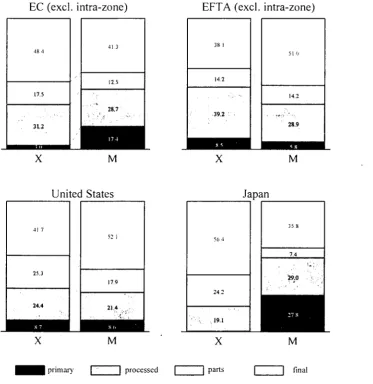
Chapter 2 seeks to use this method to compare the relative performance of four declaring zones in 1992: the EC, EFTA, the United States and Japan. Here, the European Community and the European Free Trade Association are considered as economic entities and their intra-zone flows are excluded from the analysis. Non-declaring partners have been grouped in such a way as to reveal any vertical division of labour between or within the three large geographical regions: the Eurafrican region organised around the EC, the American region and Asia-Oceania, whose economic poles are the United States and Japan respectively.
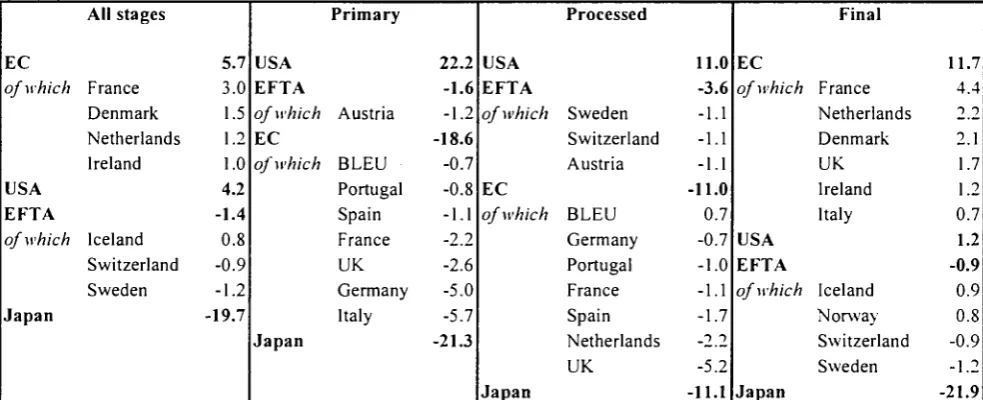
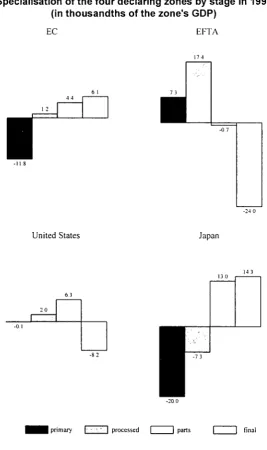
The weight of trade in intermediate products is considerable; it accounts for more than half the trade between the zones in question in 1992. There is a degree of similarity between the breakdowns by productive stage of the overall balances of the European Community and Japan: the deficits are upstream of the production process (primary and processed products), whilst the surpluses tend to be downstream (parts and final goods). For EFTA it is the other way round. Likewise, the United States is very much in deficit in finished products.
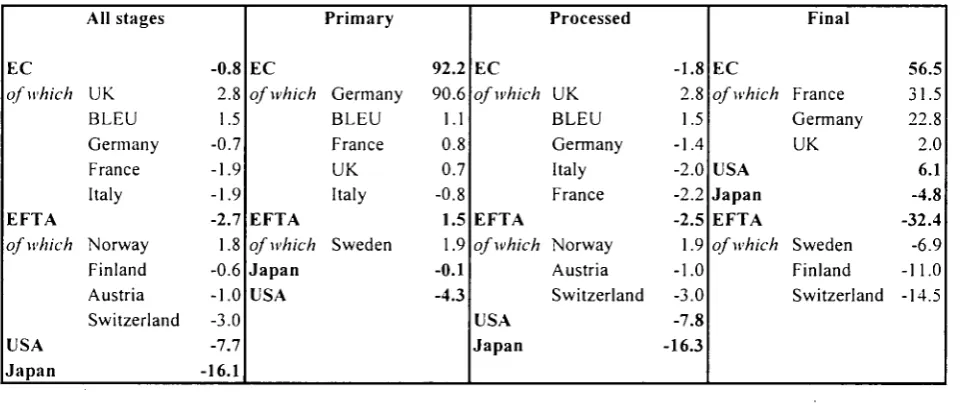
So far as the positions by market are concerned, that is the measurement of competitiveness between zones on a given market, Japan seems to be a special case: in those industries where it is strongly placed, this country remains the most competitive at every stage involved. Although the other three zones show the highest surpluses in some industries, they do not occupy first place at every stage: they dominate only those whose weight is preponderant within the industry in question.
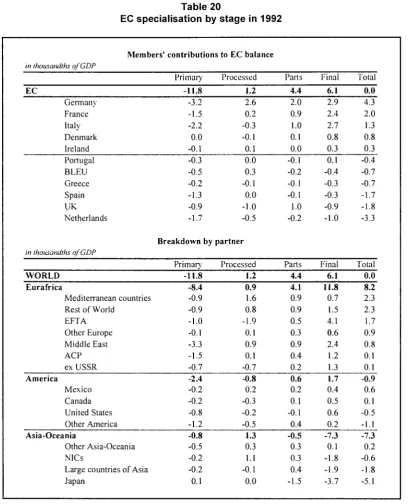
The specialisation by the four zones shows that the EC's and EFTA's involvement in international trade is regional in the first instance. The Community's overall specialisation is shaped by the nature of its relationship with the Eurafrican region: very much at a disadvantage in primary products, the EC has comparative advantages that increase with the value-added content of the goods traded. This specialisation profile changes completely with the other two regions. At its strong points, the Community generally has comparative advantages at every stage. Outside its special relationship with EFTA, it makes a vertical division of work only when in a position of overall disadvantage. Textiles, one of the EC's weak points, are a typical case: although at a great disadvantage vis-a-vis the Mediterranean countries downstream, the Community enjoys a relatively strong position compared with them in processed products.
All partners taken together, the comparative advantages of the United States are concentrated in the middle of the production process, in processed products and especially in parts. However, this overall specialisation profile covers situations that differ greatly according to the three geographical regions, and the advantage of reasoning by stage of production is manifest: the comparative disadvantages in final goods, America's main point of weakness, are derived essentially from the Asia-Oceania region. Like the EC, the United States organises a vertical division of tasks at international level only for those industries in which it is at an overall disadvantage. Textiles are again an example in relations with the NICs (newly industrialising countries) and the large countries of Asia, but the most representative is without doubt the division of labour between the United States and the other two members of NAFTA in private cars.
Japan, which is highly disadvantaged upstream (primary and processed) and advantaged downstream (parts and finished products), keeps the same configuration of comparative advantages by stage vis-à-vis all of its partners. In each of the three regions in question, the most dynamic and the most industrialised zones make a consistent positive contribution to the region's trade balance. Japan's specialisation therefore leaves little room for a logic of division of labour with its partners. At its weak points, Japan is most often at a disadvantage at all stages and vis-à-vis all of its partners.
In its final section, Chapter 2 shows the importance of "intra-industry trade" for the four declaring zones, and in particular for the countries of the European Community. This observation is valid to varying degrees for all stages, for both intermediate products and final goods.
The first part of Chapter 3, the last chapter devoted specifically to the EC, completes this approach: it analyses "intra-industry " trade, making a distinction between horizontal and vertical differentiation (reflecting a difference in quality). It breaks international trade down into different types on the basis of two criteria - the amount of "overlap " of bilateral trade at a fine level and the "similarity" of the unit values:
• two-way trade in similar products (intra-industry trade in products differentiated horizontally) ;
• two-way trade in products differentiated vertically ;
• one-way (inter-industry trade).
Unlinked trade represents two thirds of trade with partners outside the Community, but only one third within the EC. This means that even at this detailed level of analysis, the counterpart of unlinked flows - "crossed trade" - still does not disappear. On the contrary, an analysis covering several years shows that unlinked trade is declining in favour of
the other two types of trade. This is a specialisation that operates within products as defined in the nomenclatures,
with a 45% share of vertical differentiation and 20% of horizontal differentiation. In ¡ntra-Community relations, this phenomenon therefore seems to be a structural trait, reflecting a very fine specialisation associated with the specificity and diversity of demand from "users", that is consumers in the case of consumer goods and producers for intermediate and capital goods.
A question frequently raised in discussions on the experience of regional integration in Europe concerns the integration scenario for the less advanced countries of the European Community: do we find /nfer-industry specialisation - with even greater complementarity between those countries and the richer ones - or /nfra-industry specialisation favouring a convergence of economic structures? Generally speaking, in their bilateral relations the countries of the "hard core" engage in much more crossed trade between themselves, whilst the "South of Europe" is more involved in unlinked trade. Similarity in levels of development between trading partners seems to favour crossed trade, especially trade in products of different quality. Geographical proximity also plays an important part, however, especially when we look at neighbours such as Spain and Portugal or Ireland and the United Kingdom, for example, which have a considerable amount of crossed trade. In the case of France and Germany or the BLEU and the Netherlands, the principal form of integration is more difficult to interpret, given the possible interpénétrations of geographical proximity and per capita income.
Finally, the importance of crossed trade in vertically differentiated products brings us back to the question of the quality segments in which trade takes place. Despite there being specific national circumstances for a particular
industry, the import structures for each range are very similar among the member countries of the EC, suggesting
Statistical Analysis of EC Trade in Intermediate Products
In the "South", on the other hand, most of the exports of Greece, Portugal and Spain are bottom and middle-of-the-range products.
Statistical Analysis of EC Trade in Intermediate Products
Chapter 1 : Régionalisation and Trade in Intermediate Goods
The globalisation of the world economy is seeing production processes reorganised on a regional or even a world basis rather than a national one; firms are seeing their relationship with their country of origin growing increasingly tenuous as they supply a world market, widening their choices of location; flows of foreign direct investment, international subcontracting agreements and strategic alliances are allowing production units to become increasingly specialised. The importance of returns to scale, which requires reducing the number of production units, and the need to standardise processes upstream while differentiating downstream to meet consumers' demand for variety,
combine to make necessary new ways of structuring products and production processes. The components of the
final products, or even of subassemblies, are made in production units located in different countries and are then traded internationally before being assembled; a limited number of subassemblies produced on a large scale can be combined into a great variety of finished products. In all, the finished products already have a high "international trade" content before themselves possibly being exported or imported.
This phenomenon has justified a rewriting of international trade theory, seeking to take account of trade in "work in progress". At the same time, a revival of empirical work seeing trade in "unfinished" products as a specific subject of study has highlighted the quantitative importance of this type of trade. This report forms part of this second field of investigation.
Particular attention will be paid to the "regional" dimension of trade in these "middle products", referred to here as "intermediate goods".
We shall begin, therefore, with a definition. The term 'intermediate good' will be used for any manufactured good
that is reintroduced into the production cycle and disappears during that cycle. Broadly speaking, this stage includes both raw materials and basic manufactured products or finished intermediate goods (components, parts, sections, segments, modules, etc.). For present purposes, we shall take a narrower definition that excludes primary products. Finally, there should be no confusion with capital goods, which do not disappear in the production cycle (cf. box 1).
This definition has de facto an operational content: since intermediate goods are defined by the fact that the
production processes are interrupted by international trade, we need to propose empirical methods that will be consistent with that definition. Ideally, three approaches to the problem can be considered:
• survey, we can use individual data from firms concerning international trade internalised or conducted as subcontracting, combining data from surveys (destination and nature of products) with individual customs records. The precise identification of products and their destination (resale unchanged, processing, etc.) at a microeconomic level, the possibility of combining them with databases providing explanatory variables (value added, profitability, innovation, etc.) make it an ideal investigation tool. Unfortunately, there are few
such databases in Europe and they are very incomplete1. The other, more or less complete, databases on
intra-firm trade are mainly American or Japanese, and the individual firm data is not easy to get hold of.
• input-output a symmetrical solution would be to work on large industries (tracing groupings of fractions of
enterprises rather than of enterprises)2 identifying the inter-industrial relations between those industries. A
measurable fraction of these relations passes through international trade, and in the case of the European Community either between member countries or with third countries. We then trace the intermediate goods
by the (intermediate) intended use3 of the goods traded. This method has the advantage of reliable
principles of calculation and relatively well fed databases, but it also has the drawbacks that the industries are insufficiently disaggregated and there is a considerable delay before the figures are published.
1 The Internationalisation Survey carried out by the Service d'Etudes des Stratégies et des Statistiques Industrielles (Strategic Studies and Industrial Statistics Service) - SESSI - in France is a model of the type, but it deals only with France in 1993 and will not be repeated on a regular basis.
o
ad hoc aggregation of customs data: this means adopting a halfway house strategy, using highly
disaggregated trade flows (6-digit classification or some 5,000 products) and making a technical
identification of the nature of those products. One particular electronic product will be a component, another a finished product, etc. Then, defining four categories - primary, processed, part, finished product - in ascending order of value added, the flows traced will be classified into two "envelopes": first, finished products intended for final use, consumption or investment, and, second, other "unfinished" products, called "intermediate" products4·
Boxi
Some errors of interpretation to be avoided
1 - Production nomenclatures often adopt a definition of intermediate goods that is incompatible with our approach. Thus, in the case of France, the Nomenclature of Activities and Products (NAP, in force until 1992) has, at level 15, a heading "intermediate goods"; this does not cover our much broader definition based on the criterion of intended use
or technical nature of the products. For the record, item U04 of NAP15 combined the production of ferrous ores and metals, the first-stage processing of steel, the production of non-ferrous ores, metals and semi-manufactures, the production of building materials and various minerals, the glass industry, basic chemicals and artificial and synthetic fibres, the paper and board industry and the rubber and plastics processing industries. The importing of electronic components by the electronics industry is not, therefore, trade in "intermediate goods" within the meaning of NAP15.
On the other hand, the intended use approach sees it as including the imported intermediate consumption of the
electronics industry, and the technical nature of the products approach sees it as including the importation of an
"unfinished" product, both cases leading to the diagnosis of an "intermediate" import.
2 - In the German Input-Output Table, Germany's exports to France are shown as a final use for that country. However, they are not necessarily "finished" products, far from it: a not inconsiderable portion of those exports will be reintroduced into production processes in France and will, from the French point of view, be "intermediate products". According to the logic of "intended use", "intermediate goods" ought therefore to be seen from the point of view of the importers, not of the exporters.
3 - Capital goods5 are reintroduced into the production process by the purchaser and more particularly by the
importer so far as we are concerned. However, they are not intermediate goods, since they do not disappear in the production process. In accordance with our definition, they will therefore be classified as final goods.
The second track of empirical research is, despite its failings, useful for taking a long term view of trade in intermediate goods, in this case over the period of European integration, so as to trace the basic trends, the structural elements. This can however be only one stage, so we shall give it only a small place in our discussion of this input-output method.
The heart of this report lies elsewhere: in the original exploitation of Eurostat's external trade database. We "classify" the basic flows, observed at the finest level of the nomenclature, according to the technical nature of the products. This method, which had never been used on such a scale before, allows us both to trace the trade in intermediate goods of the large regional blocks and to make a more particular study of the European case. To make our findings easier to read, the level of aggregation chosen to present them is itself relatively aggregated, 14 industries, but - as will be reiterated further on - always starting from disaggregated data.
Combining these two approaches allows us to take account of the new ways in which Europe is becoming involved in an international division of labour that is strongly characterised by the twin movements of globalisation and régionalisation of the world economy.
Primary products are often traded on the basis of unavailability: energy, ores, etc. One might then wish to exclude them from intermediate goods in econometric work. See for example Fontagné-Freudenberg-Péridy-Ünal Kesenci [1995].
Statistical Analysis of EC Trade in Intermediate Products
1.1. Determinants of trade in intermediate goods
The conventional approach of international trade theory, of looking for the factors determining trade in goods intended for final consumption, cannot explain the empirical evidence of major flows in intermediate goods.
There has been a lot of work demonstrating this shortcoming. For example, Aw and Roberts [1985] showed that imports from the NICs were a production factor complementary to the American factors, starting from an appraisal of functions of production; Lassudrie-Duchêne, Berthélemy and Bonnefoy [1986] establish that, structurally, "productive" imports represent two thirds of French imports, using INSEE's AVATAR model. UNIDO [1985], for its part, notes that cases where a country has a comparative advantage for all stages in a production process are
extremely rare: most often, export performance rests on intermediate imports.
These empirical observations show that there is a need to "refine" our understanding of the comparative advantages
underlying international trade6: a country may, for a given industry, have an advantage, then a disadvantage, then
an advantage again, as we move from upstream to downstream in the same production process. There is then a
reversal of the (revealed) comparative advantages along the production spectrum, and the comparative advantages are vertical in nature (cf. box 2). By contrast, horizontal comparative advantages will be defined by the existence of an advantage for each successive stage in the same process.
Box 2
What is a "reversal of comparative advantage"?
In general, production operations can be considered to be split by international trade in intermediate goods when the conditions of comparative advantage reverse along the production process; we then speak of a "vertical" comparative advantage. Consider, for example, a world with two countries, A and B, producing two finished goods 1 and 2, each involving an upstream process M and a downstream process V, i.e. M1, V1, M2, V2.
When country A has an advantage for M1 and V1 and Β for M2 and V2, in A's case international trade will consist of exporting the finished product 1 and importing the other finished product from Β (case 1 in the table below). We then speak of a horizontal advantage because it covers the entire spectrum of production.
If, on the other hand, A has an advantage for the upstream segments of the two goods (M1 and M2), because they are very capital-intensive, for example, and a disadvantage for the labour-intensive downstream segments, A will export two intermediate goods and import two finished goods (case 2). There is then a vertical comparative advantage7
Comparative Stage of production
advantage Upstream (M) Downstream (V)
Case 1 Horizontal Product 1 + + Product 2
Case 2 Vertical Product 1 Product 2
Note: Comparative advantages (+) or disadvantages (-) of country A in relation to country B.
In an empirical multi-product/multi-stage/multi-country approach, many configurations of comparative advantage can be observed, corresponding to the two standard structures of comparative advantage just mentioned. Thus, the same country may have horizontal comparative advantages/disadvantages for some products and vertical ones for others.
The determinants of international trade in intermediate goods must be sought both in the conditions that permit the splitting of production processes and in the choices of location made by firms and the logics of macro-economic specialisation.
The conditions permitting this are related to technical early considerations; in short, firms are now designing products and processes interdependently, so that certain "subassemblies" can be produced independently and then assembled close to the markets. Monographs on these issues abound: the strategy developed by Ford-Europe for the launch of the Ford Fiesta and pursued since is often cited as an illustration of this logic.
The factors determining the location of firms and the macro-economic advantages are similar to those for finished products when viewed at the level of the process segment, or the intermediate good, rather than at the level of the finished product: it is a matter of the technology or factor content of the activities concerned. Thus, once technical conditions allow them to be separated from the rest of the process, segments that are labour-intensive will tend to be located in low-wage economies, subject to the constraints of transport costs between production units corresponding to the different stages. Likewise, innovative segments will tend to be located in economies with a strong R&D activity, etc.
Statistical Analysis of EC Trade in Intermediate Products
1.1.1. Specific gain from trade in intermediate goods
This awareness of the importance of intermediate goods in empirical work was preceded by a number of theoretical advances8. Thus, back in the fifties, trade policy analysis developed the principle of effective protection: a tariff upstream of the process "deprotects" the value added by the industry concerned. The importance of inter-industrial relations and the vertical structure of customs tariffs have to be taken into account in assessing the impact of trade policies. Finally, it is well known that granting tariff concessions while reducing protection for the upstream processes amounts to the same as strengthening the protective nature of the trade policy of the country granting the concessions.
So far as the analysis of the determinants of trade is concerned, the methodological difficulties involved in taking account of the interruption of production processes by trade have been raised by McKenzie [1954], but it was Vanek [1963] who made the problem a subject for study in its own right. Various representations of production processes were then used in the literature, seeking to account for the possibility of splitting production processes by international trade in intermediate goods (cf. box 3).
In a Leontief-style circular logic, part of the output of each good is used as intermediate consumption by one or more other industries: every good is at one and the same time both input and output. The primary factors9 are internationally immobile, unlike manufactured inputs. In a simple model with two countries, two factors and two goods, the main results of traditional models can then be reproduced.10
0 For a detailed presentation, cf. Fontagné [1991-b].
Unlike "manufactured" production factors, i.e. intermediate goods. 1Ω
Box 3
Representations of the production process in international trade models
final good final good
Final consumption
intermediate
good 1 good 2
consumption
Final consumption
♦ final good
\ (intermediate ' good)
> Final consumption
in conventional models of international trade RICARDO, HECKSCHEROHLIN...
Trade does not interrupt the production process.
in "circular" models
VANEK, BATRA-PATTANAIK, CASAS, DER... Every good is both an input and an output: whether final or intermediate goods are traded is unimportant.
in models with "pure" intermediate goods
Statistical Analysis of EC Trade in Intermediate Products
Labour | specific factors
intermediate good intermediate good
final good final good
Final consumption
primary factor
intermediate goods
final good
intermediate goods
final good
Final consumption
primary factor(s)
stage 1
stage 2
stage n
Final consumption
in sequential models
1. SANYAL-JONES. Trade is only in intermediate goods. Final goods are assembled close to the places of consumption.
in sequential models
2. LASSUDRIE DUCHÊNE-BERTHELEMY-BONNEFOY, FONTAGNE. Analysis is made of the distinction between trade in final goods or in intermediate goods. Where there is a vertical comparative advantage, trade in intermediate goods is the source of the increase in the gain from trade as compared to a situation where only final goods are traded. We speak of a specific gain from trade in intermediate goods.
in sequential models
3. SANYAL, DIXIT-GROSSMAN. The process, referred to as a continium, is split at just one "point" and each country specialises in that fraction of the process for which it has a comparative advantage (vertical, therefore). A specific splitting up gain appears and trade is in middle products.
A second theoretical option, on the other hand, involves giving precedence to the sequential dimension of the
production process11: intermediate goods are required to produce final goods, but the latter cannot act as inputs:
some goods are therefore pure intermediate goods. Because this solution comes close to the reality of a production
sequence, it is logically the next stage in considering the specific nature of trade in intermediate goods-.
The seminal paper by Sanyal and Jones [1982], putting the emphasis on the international division of labour splitting the processes of production, therefore makes a methodological break: intermediate goods are "Middle Products" and trade in these goods derives primarily from an interruption of the production process. The two authors give a refined version of this new context: only intermediate goods are now traded, final goods being assembled in each country to satisfy domestic demand alone.
This sequential logic is found in models where the production process is organised as a continuum of segments:
assuming there is a monotonie relationship between the stage in the production process and the degree of
comparative advantage, trade is then conducted in goods along the same production process, countries specialising
according to one's vertical comparative advantage. Similarly, but using a discrete set of segments, the Ricardian
model of Lassudrie-Duchêne [1985] shows that a vertical comparative advantage generates trade in intermediate goods, whilst trade in final goods is explained by a horizontal comparative advantage (see box 2).
All this work brought us steadily closer to what is today considered a standard result: the refinement of the operation of the comparative advantage afforded by trade in intermediate goods and therefore by the splitting of production processes by international trade, is the source of a specific gain.
If the structure of the comparative advantages is vertical, this can be illustrated by a larger output under constraint of
resources or symmetrically by a reduction in the cost, in terms of resources, of obtaining a given output This gain is
then the result of international differences in the efficiency of resource allocation appearing between segments of production processes rather than between industries. Overall, when based on comparative advantages13, trade in
intermediate goods is the source of a specialisation gain of the same kind as that produced by moving from autarky to free trade in final goods.
1.1.2. Variety of intermediate goods and growth
All the findings referred to above bear the stamp of a rewriting of conventional theories of international trade: trade
flows are determined by comparative advantage, international trade is based on country specialisation, and this implies a fundamental reallocation of resources from industry to industry. As we know, however, conventional international trade theory has been called into question in favour of taking account of growing yields, the imperfection of competition and two-way trade in similar products.
What of the status of intermediate goods in this "new international trade theory"? The central difficulty here is the necessary postulate of differentiation of intermediate goods, which comes up against the empirical evidence of standardisation of upstream processes by firms; differentiation is pushed downstream so as not to jeopardise economies of scale. However, at the level of the economy, differentiation of intermediate goods is a source of efficiency given the differentiation of the needs of producers using these inputs. More variety upstream will increase efficiency in the use of resources, like the gain in variety obtained by final consumers.
Krugman and Venables [1993], for example, propose a stylised version of this reasoning in an economic geography model: an aggregate of differentiated intermediate goods is combined with a composite factor ("labour") within firms'
11
' ' The second theoretical option, adopted by Ruffin [1969], Casas [1972], Batra and Casas [1973] and Kim [1988] brings the theory closer to the reality of a discontinuous process. Sanyal and Jones [1982], Lassudrie-Duchêne [1985] and Lassudrie-Duchêne, Berthélémy, Bonnefoy [1986] followed the same route: a primary factor, or a generic factor plus a specific factor, are used both to produce pure intermediate goods and to assemble them at the final stage. The same principle, extended to n segments, is found in Dixit and Grossman [1982], Sanyal [1983] and Marjit [1987].
19
Statistical Analysis of EC Trade in Intermediate Products
production function. The aggregate of intermediate goods is obtained by aggregating the different varieties produced by the different producers in monopolistic competition. The quantity of composite intermediate good required to manufacture a unit of finished products declines in scale because of the existence of a fixed cost in production. The growth in the number of varieties then increases the efficiency of the productive combination. There are therefore variety gains for producers, too.
Finally, intermediate goods may also play an important role in endogenous growth models.
Wthout going into the formal details of all these approaches here, the following lesson may be drawn from this theoretical rewriting: just as consumers gain from being offered greater variety, their individual needs for difference, quality and diversity being better met, international trade will afford producers a greater variety of specifications for the goods they reintroduce into their production processes. This improves the efficiency of their productive combination and may be likened to an innovation. At macro-economic level, this innovation dynamics is at the origin of a growth gain, whilst at micro-economic level the competitive positions of benefiting firms are strengthened.
1.2. Trade in intermediate goods and régionalisation
The discussions above have outlined a virtuous circle in which the vertical division of labour between countries, be it on the basis of the large conventional determinants associated with location or on that of growing yields and variety, creates a specific gain as compared to what would be obtained from trade in finished goods alone. This specific gain in turn boosts growth and therefore trade and therefore specialisation...
We should not therefore be surprised that trade in intermediate goods occupies a prominent place in international trade and has accompanied the dynamic growth associated with European integration. However, this virtuous circle may find itself in conflict with a different logic: that of globalisation, transcending régionalisation strategies and dislocating European supply in some sectors that are key sectors for growth. Regional integration is then confronted with the problem of the vertical complementarity of comparative advantages.
1.2.1. Vertical complementarity of comparative advantages and regional integration
The multilateralisation of the world economy, of which the completion of the latest round of GATT negotiations and the setting up of the WTO are obvious signs of progress, must not cause us to forget that economies are at the same time merging into large economic areas: Japan is shaping its immediate economic environment; the United States, Canada and Mexico were careful to take account of trade in intermediate goods when setting up NAFTA, hence strict rules of origin that are potentially highly discriminatory against third countries ...
Hand in hand with the multilateralisation efforts and despite some initial thought given to the need for free trade
between regional areas, trade tensions repeatedly arise in sensitive sectors: the motor industry, agriculture, fishing, services, etc. Thus, the organisation of rational free trade between regions ("managed trade") contrasts with the desire for complete intra-regional free trade.
If each region has within it a diversity of comparative advantages and technological competences enabling the different segments of the productive spectrum to be "covered" regionally, regionalism and multilateralism will not be opposed to one another. The diversity of national situations and the expansion Southwards seem to confirm that this analysis is well-founded in the case of Europe. Unfortunately, in some particular cases to be mentioned in this report, things are different. The Region is then a vast market within which products circulate freely, but it lacks the vertical complementarities of supply.
1.2.2. Intermediate goods and limits to régionalisation
More fundamentally, however, economic integration has encouraged the linking of productive operations within the European Community, leading to the development of trade in intermediate goods, components, parts, or work in
progress, between production units in different member countries. This splitting up of production processes within
the EC has, moreover, been going on for a long time, micro-economic strategies having preceded the political choice to complete the Internal Market.
Nevertheless, being now faced with the globalisation of the world economy, will firms operating in the countries of the Community now use the single market simply as an area for circulating final goods, or will they succeed in strengthening the vertical complementarity of the various member countries' supply structures?
This question must not be approached simply by considering the specialisation of countries in final products: the theoretical and empirical progress made in trade in intermediate goods make obsolete any argument of the kind "France ought to abandon telephone and concentrate on the food industry". Production processes are largely fragmented, in the food industry as well as in manufacturing; we shall thus find a marked vertical division of labour in dairy produce, especially in Italy. The problem is therefore much more whether France has an advantage, upstream, in aircraft assembly or Germany in synthetic fibres.
Analysis of European trade in intermediate goods will therefore enable us to tackle head on the question of the cohesion of European production structures. We shall have to assess whether the international division of labour in
which Europe is engaged is based on a regional complementarity of comparative advantages and technological
competences. On a more trivial level, will the strengthening of intra-Community competition resulting from the completion of the single market lead to the development of cooperation between European manufacturers on the basis of a regional complementarity of competences or to a systematic quest for partners from third countries?
Being at the heart of the confrontation between two logics for the structuring of the world economy, globalisation and régionalisation, trade in intermediate goods therefore justifies a specific study based on a specific definition. This is the approach adopted here.
1.3. Problems of the empirical evaluation of intra/extra-regional trade in intermediate goods
1.3.1. Apparent and effective balances
International trade in intermediate goods is the source of a distortion between countries' apparent and effective
performance. The effective export performance of a industry may be hampered by the cost of high imports of
components14. Our approach to country specialisation should therefore take account of this element of complexity.
In non-technical terms, the idea of effective specialisation takes us back to the ijational value added contained in a
given country's exports and to the identification of the foreign value added contained in its imports15 (cf. Box 4).
Ideally, productive imports should be deducted from exports, direct or indirect, and the "prior export content" should be deducted from final imports.
In practice, although the first of these two calculations can be made by using an input-output structure identifying the origin of the intermediate goods used in production, as a rule the second cannot be.
This approach therefore contains a systematic "pessimistic" bias: by design, the effective specialisation shows a
lower performance than the apparent one. However, the advantage of the operation is above all that it compares the
effective specialisation's with each other. In Europe, the industries where this distinction is particularly important are
ores, chemicals, data processing and textiles and clothing. The countries more particularly affected by this distinction are Canada in North America and Belgium, the Netherlands and Ireland in Europe.
Statistical Analysis of EC Trade in Intermediate Products
Box 4
Effective and apparent specialisations
Take the example of a cover rate. The apparent rate is defined as:
(exports of the industry/imports of the industry)
Account must, however, be taken of the intermediate imports contained in exports and of the exports of intermediate goods contained in imports, giving the following effective rate:
(exports - imports contained in exports) / (imports - exports contained in imports)
By way of illustration, this latter ratio would relate French car exports net of components imported to produce them to French car imports net of exports of French components contained in imported foreign cars.
In practice, the input-output calculation does both better and worse than this reasoning:
• better because we can subtract from our exports not only the imports of car components needed to produce the vehicles exported, but also the import content of all the productive combination, that is also the imports resulting from the activity of the other industries supplying domestic intermediate consumption articles to the car industry. For example, the French car industry uses French windscreens whose production in turn gives rise to imports. • less well because it is impossible to value the exports contained in our imports. This therefore produces a
"pessimistic" bias: the effective specialisation, so defined, is by nature less than the apparent specialisation.
• less well also because the high level of product aggregation at which the calculations are made means that imports of the industry's products are deducted twice: once in apparent imports and once in the import content of effective exports. To eliminate this bias we use the ratio of effective specialisation to apparent specialisation. Finally, the coefficient of the vertical division of labour used here is calculated as the ratio of the apparent cover rate to the effective cover rate.
The use made of intermediate imports is not independent of the size of the economies concerned, and it may be useful to work on relative coefficients, the vertical division of labour in each industry to the indicator obtained for all the industry of the country in question: we shall then speak of relative vertical division.
In order to avoid both the drawbacks of the traditional approach and the "pessimistic bias", the reason for which we have just described, it may be worth "tracing" the chain of trade balances along each production process, from upstream to downstream. It may be refined by using one or other position indicator of revealed comparative advantage... But the principle is still to track products by stage of processing, industry by industry, and to see how each country's foreign trade reflects the image of competitive positions along the "chain of value added16".
This is precisely the aim of the method discussed starting in Chapter 3. The reaggregation of goods and the tracking of "reversals in revealed comparative advantage" will allow us to show in more detail, at the level of regional blocks and then at European level, the present logics of the vertical international division of labour.
1.3.2. Specific nature of the international splitting up of production processes
Whereas intermediate imports may consist of importing steel to make cars, the international splitting up of production
processes is defined as the trade in goods belonging to the same industry but located at different stages on the
production spectrum.
The international splitting up of production processes therefore proceeds from a specific logic of vertical division of
labour within industries. Car parts are imported to make cars, dairy produce is imported to make dairy produce.
The theoretical literature17 gives us a vision of this phenomenon based either on production processes with
complementary segments or on continuums of production segments linking the production operations in linear fashion, from upstream to downstream.
In any given case, production operations are split by international trade when the conditions of comparative advantage or more generally of competitiveness are "turned around". One country will be competitive upstream in the process but not in assembly work, and will gain from splitting the production process so that assembly can be carried out abroad. This is, incidentally, the first justification for the preferential tariff clauses generally granted to outward processing traffic in Europe and the United States.
The advantage of looking at this specific aspect of international trade in intermediate goods is that, in the absence of systematic micro-economic surveys, the statistical evidence of the micro-economic strategies brought about by globalisation lies precisely in the indicators of the international splitting up of production processes.
1.3.3. Intra-industry versus inter-industry trade
The revelation of two-way trade in similar products was certainly the decisive empirical advance of the sixties in relation to international trade. It may in fact be seen as the start of the rewriting of international trade theory. On the other hand, such empirical work on intra-industry trade (IIT) has often been undertaken with the minimum of methodological precautions, resulting in well-known controversies.
For example, the confusion between intra-industry and splitting up of processes is a common methodological error.
The vertical specialisation of economies may produce a two-way trade in products of the same industry, called intra-industry in the literature, at quite an aggregated level in the nomenclatures.
Importing fuselages in order to export aircraft cannot be considered an exchange of variety or quality; we shall therefore avoid making such an assimilation and continue in such cases to speak of the splitting up of the production process. Rather, we shall seek to work on levels of nomenclature that are fine enough for the term intra-industry to mean only two-way trade in similar products: a car and its engine are not "similar".
On the other hand, two-way trade in components or parts, traced at the finest possible level, and if possible by quality, is indeed intra-industry trade. This is where the conditions can be shown for upstream variety gains for producers, gains whose advantage we have stressed in implementing a virtuous circle of splitting up, trade and growth.
These things will have to be traced by adopting a methodology that is free of the usual aggregation biases (cf. box 5). In order to solve these various problems, we shall use a method which (1) minimises the geographical aggregation bias by considering only bilateral flows, (2) minimises sectoral aggregation bias by working with highly disaggregated nomenclatures, (3) incorporates price differences in order to account for any horizontal or vertical differentiation in the event of two-way trade, and, finally, (4) a method which defines two-way trade differently, taking account of the totality of intra-industry trade. On no account, however, must it be possible for a two-way bilateral trade in final products for intermediate goods to be recorded as intra-industry.
Statistical Analysis of EC Trade in Intermediate Products
Box 5
Intra-industry trade and reversal of comparative advantages: the case of the motor industry
The phenomenon, identified above, of the reversal of comparative advantages along the spectrum of production, presents a problem when it is revealed on the basis of countries' multilateral trade relations1". The American motor industry provides a good example of this problem. There, too, we therefore have to work on the basis of bilateral trade relations.
A comparative advantage for the United States upstream, coupled with a disadvantage downstream, appears in the United States' multilateral trade relations (cf. first line of the table below). On a bilateral basis, however, this observation disappears vis-à-vis Japan and the EEC (overall disadvantage for the United States) and the Middle East (overall advantage). The reversal of comparative advantage is observed only vis-à-vis Mexico and Canada, because of the presence of subsidiaries of American multinationals that have organised a vertical division of labour on a regional basis.
Comparative advantages of the United States for the motor industry in 1992
Intermediate Final Total World 1.3 -5.9 -4.7 of which:
Middle East Orient EEC4 Japan Canada
0.1 0.5 0.1 0.6 1.1
0.5 -0.5 -0.6 -3.8 -1.9
0.5 0.0 -0.6 -4.4 -0.8
Note : This is the CEPII indicator of contribution to the balance (see section 2.4).
Statistical Analysis of EC Trade in Intermediate Products
Chapter 2 : The trade in intermediate products of the EC, EFTA,
the United States and Japan in 1992
2.1. Methodological introduction
Chapter 1 described the impact of international trade in intermediate goods on the logics of globalization and regionalization of the world economy. It was stressed that a specific gain appeared where international trade in intermediate goods was based on vertical comparative advantages. The vertical division of labour to which this logic leads can take the form of an international splitting up of production processes by firms. The conditions of competitiveness are then profoundly changed: the "comparative advantages" revealed by trade may be reversed not only according to the partners to the trade, as has been known for a long time, but also - and this point will receive particular attention here - according to the stages in the same production process. Intermediate imports make up for the lack of competitiveness at a given stage in the production processes and lead to imports and exports within the same large industries, intermediate goods and final products being in the end traded according to a logic transcending the traditional approaches to international specialisation.
2.1.1. What empirical tool?
This renewed logic of the international division of tasks implies the use of new tools of empirical investigation.
The international linking of production operations, from which trade in intermediate goods proceeds, suggests a "natural" tool: the input-output structures. We then only have to consider that some inter-industrial relations cross the borders of a country or of a region like the European Community (see 3.2). This approach based on the intended
use of the products traded allows us to shake ourselves free of the problems of nomenclature: it is the intermediate
use of an ECU of imports that guarantees that that ECU of trade, is in intermediate goods, even though the large industry in question in fact includes both intermediate goods and final goods. Being geared rather to the analysis of the coherence of production systems and the logics of regional integration in the long term, this first approach is inadequate if we want to make an in-depth study of competitive positions or of the intra-industry or inter-industry nature of trade in intermediate goods.
As the nomenclatures of international trade are not built on the theoretical presuppositions mentioned here, we cannot, however, replace the Input-Output approach by trade statistics used "in the unaltered state". Quite the contrary, trade structures have to be reconstructed on the basis of a logic of reaggregation of elementary customs flows consistent with our concern to identify the vertical division of tasks at international level. This chapter and the first part of Chapter 3 will be devoted to this approach based on the nature of the goods traded.
What interests us is the technical nature of the products and not the destination of their trade. The basic idea is that an ECU of "car parts" traded proceeds from an exchange of intermediate goods and is evidence of a vertical division of labour.
Empirical tracking of intermediate goods
Product traded : ignition plugs 1st use: factory
2nd use: repairer
2nd use: private individual
International trade statistics chapter 2 and section 3.1
intermediate import
intermediate import
intermediate import
IOT section 3.2
intermediate import motor industry
intermediate import repair industry
final import
Note: in bold, empirical diagnosis of vertical division of labour in the motor industry
Having noted these methodological reservations, we shall now go into the detail of the flow reconstruction method used here.
2.1.2. Operational definition of intermediate products
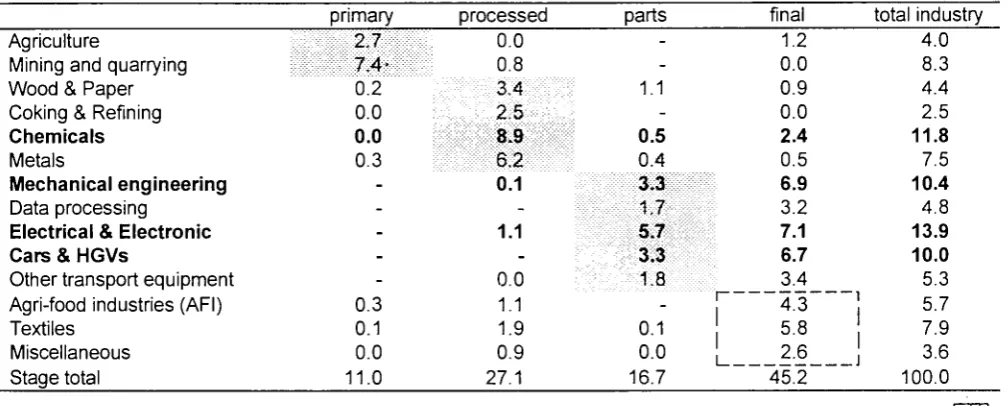
The aggregation key by stage of the product nomenclature used here is based on a modification of BEC (classification by broad economic categories of the United Nations). In order to conform to BEC we have reaggregated the Eurostat (Harmonised System) 6 figures into 4 stages: primary products, processed products, parts and final products (box 6). The 2-figure NACE was also used to produce an aggregation into 14 large industries (Table 1).
Statistical Analysis of EC Trade in Intermediate Products
Table 1
Breakdown of the 5000 Eurostat-HS items by stages and industries
BEC NACE rev 1
Agriculture 01 Agriculture, hunting 02 Forestry, logging
05 Fish and other fishing products Mining and quarrying 10 Coal, lignite and peat
11 Crude petroleum and natural gas 12 Uranium and thorium ores 13 Metal ores
14 Other mining and quarrying Agri-food industries (AFI) 15 Food products and beverages 16 Tobacco products
Textiles 17 Textiles
18 Wearing apparel and furs 19 Leather and leather products
Wood & Paper
20 Wood products, conk, articles of straw 21 Pulp, paper and paper products 22 Printed matter or recorded media
Coke making & Refining
23 Coke, refined petroleum products and nuclear fuel
Chemicals
24 Chemical products and man-made fibres 25 Rubber and plastic products
26 Other non-metallic mineral products Metals
27 Basic metals
28 Fabricated metal products Mechanical engineering 29 Machinery and equipment
Data processing
30 Office machinery and computers Electrical & Electronic
31 Electrical machinery and apparatus
32 Radio, television and communication equipment and apparatus
33 Medical, precision and optical instmment, watches and clocks
Cars and heavy goods vehicles 34 Motor vehicles, trailers and semi-trailers
Other transport equipment 35 Other transport equipment
Others
36 Furniture; other manufactures goods n.e.c. Stage total Primary 136 111 22 3 102 5 3 2 21 71 44 43 1 23 21 1 1 18 14 4 1 1 8 6 2 24 24 3 3 359 Processed 5 1 2 2 5 2 1 2 126 126 431 402 8 21 159 42 109 8 18 18 1027 808 76 143 484 382 102 12 12 65 28 37 1 1 44 44 2377 Parts 9 8 1 1 1 18 16 2 29 29 104 104 6 6 107 45 39 23 26 26 30 30 6 6 336 Final 126 84 6 36 1 1 306 300 6 385 105 235 45 40 10 12 18 1 1 93 55 25 13 84 1 83 400 400 28 28 247 54 49 144 29 29 51 51 136 136 1927 Industry total 267 196 30 41 108 7 4 2 21 74 476 469 7 848 536 244 68 218 66 125 27 20 20 1146 869 119 158 621 407 214 516 516 34 34 419 127 88 204 55 55 82 82 189 189 4999 Note: 33 items of products that could not be classified according to the Nace, Rev. 1, nomenclature were excluded from the
Box 6
The three stages of intermediate products according to the BEC
Developed by the United Nations, BEC is a nomenclature derived from the SITC, Rev. 3 (Standard International Trade Classification). It reclassifies the SITC headings on the basis of the principal use of the products. More precisely, it converts foreign trade data into categories of final or intermediate use, such as capital goods, intermediate goods and consumer goods, following the usage in the System of National Accounts19. The BEC breakdown of intermediate products into the three stages is as follows:
Primary commodities
111 Food and beverages, primary, mainly for industry 21 Industrial supplies, not elsewhere specified, primary 31 Fuels and lubricants, primary
Processed commodities
121 Food and beverages, processed, mainly for industry 22 Industrial supplies, not elsewhere specified, processed 322 Fuels and lubricants, other than motor spirit, processed Parts
42 Parts and accessories of capital goods, except transport equipment 53 Parts and accessories of transport equipment
"In general, commodities have been classified as "primary" if they are characteristically products of primary sectors of the economy, ¡e. farming, forestry, fishing, hunting and the extractive industries. In addition, commodities which characteristically are products of other sectors, such as manufacturing are also classified as primary if nearly all the value of the product is contributed by one of the primary sectors of the economy. For example, cotton undergoes physical transformation when ginned, but as almost all the valued of ginned cotton derives from the agricultural sector, it is classified in the BEC as a primary commodity, not as a product of the textile industry..."20. Therefore, if only a very small part of the value of an intermediate product is ascribable to manufacturing industry, it is classed among primary products.
In this connection, all other intermediate products are deemed to have undergone processing. However, processed products that are parts or accessories of capital goods are classed separately in the parts stage.