White Rose Research Online URL for this paper:
http://eprints.whiterose.ac.uk/1450/
Article:
Saggion, H. and Lapalme, G. (2002) Generating indicative-informative summaries with
SumUM. Computational Linguistics, 28 (4). pp. 497-526. ISSN 0891-2017
https://doi.org/10.1162/089120102762671963
[email protected] https://eprints.whiterose.ac.uk/
Reuse
Unless indicated otherwise, fulltext items are protected by copyright with all rights reserved. The copyright exception in section 29 of the Copyright, Designs and Patents Act 1988 allows the making of a single copy solely for the purpose of non-commercial research or private study within the limits of fair dealing. The publisher or other rights-holder may allow further reproduction and re-use of this version - refer to the White Rose Research Online record for this item. Where records identify the publisher as the copyright holder, users can verify any specific terms of use on the publisher’s website.
Takedown
If you consider content in White Rose Research Online to be in breach of UK law, please notify us by
Summaries with SumUM
Horacio Saggion
∗Guy Lapalme
†University of Sheffield Universit ´e de Montr ´eal
We present and evaluateSumUM, a text summarization system that takes a raw technical text
as input and produces an indicative informative summary. The indicative part of the summary identifies the topics of the document, and the informative part elaborates on some of these topics
according to the reader’s interest.SumUMmotivates the topics, describes entities, and defines
concepts. It is a first step for exploring the issue of dynamic summarization. This is accomplished through a process of shallow syntactic and semantic analysis, concept identification, and text regeneration. Our method was developed through the study of a corpus of abstracts written by professional abstractors. Relying on human judgment, we have evaluated indicativeness, informativeness, and text acceptability of the automatic summaries. The results thus far indicate good performance when compared with other summarization technologies.
1. Introduction
A summary is a condensed version of a source document having a recognizable genre and a very specific purpose: to give the reader an exact and concise idea of the contents of the source. In most cases, summaries are written by humans, but nowadays, the overwhelming quantity of information,1 and the need to access the essential content
of documents accurately in order to satisfy users’ demands calls for the development of computer programs able to produce text summaries. The process of automatically producing a summary from a source text consists of the following steps:
1. interpreting the text
2. extracting the relevant information, which ideally includes the “topics” of the source
3. condensing the extracted information and constructing a summary representation
4. presenting the summary representation to the reader in natural language. Even though some approaches to text summarization produce acceptable summaries for specific tasks, it is generally agreed that the problem of coherent selection and expression of information in text summarization is far from being resolved. Sparck Jones and Endres-Niggemeyer (1995) stated the need for a research program in text
∗Department of Computer Science, University of Sheffield, Sheffield, England, United Kingdom, S1 4DP. E-mail: [email protected]
†D´epartement d’Informatique et Recherche Op´erationnelle, Universit´e de Montr´eal, CP 6128, Succ Centre-Ville, Montr´eal, Qu´ebec, Canada, H3C 3J7. E-mail: [email protected]
summarization that would study the relation between source document and summary, the different types of summaries and their functions, the development of new methods and/or combination of already existing techniques for text summarization, and the development of evaluation procedures for summaries and systems. Rowley (1982) proposes the following typology of different types of document condensations:
• theextract, which is a set of passages selected from a source document
to represent the whole document
• thesummary, which occurs at the end of the document and is a
restatement of the salient findings of a work
• theabridgment, which is a reduction of the original document that
necessarily omits secondary points
• theprecis, which stands for the main points of an argument
• thedigest, which is a condensation of a book or news article
• thehighlight, which is a comment included in specific parts of a
document to alert a reader
• thesynopsis, which in cinematography represents a script of a film.
In our research, we are concerned only with summaries of technical articles, which are calledabstracts. In this context, two main types of abstracts are considered (ANSI 1979; ERIC 1980; Maizell, Smith, and Singer 1971): indicative abstracts, which point to information alerting the reader about the content of an article in a given domain (these abstracts will contain sentences like “The work of Consumer Advice Centres is exam-ined.”), and informative abstracts, which provide as much quantitative or qualitative information contained in the source document as possible (these abstracts will contain sentences like “Consumer Advice Centres have dealt with preshopping advice, edu-cation on consumers’ rights and complaints about goods and services, advising the client and often obtaining expert assessments.”). In the course of our research, we have studied the relation between abstracts and source documents, and as a result, we have developed SumUM (Summarization at Universit´e de Montr´eal), a text summarization system that produces an indicative-informative abstract for technical documents. The abstracts are produced in two steps: First, the reader is presented with an indicative abstract that identifies the topics of the document (what the authors present, discuss, etc.). Then, if the reader is interested in some of the topics, specific information about them from the source document is presented in an informative abstract.
Figure 1 shows an automatic abstract produced by our system. The abstract was produced by a process of conceptual identification and text re-generation we call
se-lective analysis. The indicative abstract contains information about the topic of the
document. It describes the topics of sections and introduces relevant entities. The iden-tified topics are terms either appearing in the indicative abstract or obtained from the terms and words of the indicative abstract through a process of term expansion. The one particular feature of these terms is that they can be used to obtain more conceptual information from the source document, such as definitions or statements of relevance, usefulness, and development, as can be seen in Figure 2.
Designing for human-robot symbiosis
Presents the views on the development of intelligent interactive service robots. The authors have observed that a key research issue in service robotics is the inte-gration of humans into the system. Discusses some of the technologies with par-ticular emphasis on human-robot interaction, and system integration; describes human direct local autonomy (HuDL) in greater detail; and also discusses system integration and intelligent machine architecture (IMA). Gives an example imple-mentation; discusses some issues in software development; and also presents the solution for integration, the IMA. Shows the mobile robot.
Identified Topics: HuDL - IMA - aid systems - architecture - holonic manu-facturing system- human - human-robot interaction - intelligent interactive service robots-intelligent machine architecture-intelligent machine software
-interaction-key issue-widely used interaction-novel software architecture
-overall interaction-robot- second issue-service-service robots-software
-system-Technologies
Figure 1
Indicative abstract and identified topics for the text “Designing for Human-Robot Symbiosis,” D. M. Wilkes et al.,Industrial Robot, 26(1), 1999, 49–58.
Development of a service robot is an extremely challenging task.
In the IRL, weare using HuDLto guide the development of a cooperative service robot team.
IMA is a two-level software architecturefor rapidly integrating these elements, for an intelligent machine such as a service robot.
A holonic manufacturing system is a manufacturing systemhaving autonomous but cooperative elements called holons (Koestler, 1971).
Communication between the robot and the human isa key concern for intelligent service robotics.
Figure 2
Informative abstract elaborating some topics.
of our experimental prototype, SumUM, is then presented in section 3. In section 4, we discuss the limitations of our approach; then, in section 5, we present an evaluation and comparison of our method with state-of-the art summarization systems and human abstracts. Related work on text summarization is discussed in section 6. Finally, in section 7, we draw our conclusions and discuss prospects for future research.
2. Observations from a Corpus
(ISA), andComputer & Control Abstracts. The source documents were found in journals of computer science (CS) and information science (IS), such asAI Communications,AI
Magazine,American Libraries,Annals of Library Science & Documentation,Artificial
Intelli-gence,Computers in Libraries, andIEEE Expert, among others (a total of 44 publications
were examined). The professional abstracts contained three sentences on the average, with a maximum of seven and a minimum of one. The source documents covered a va-riety of subjects from IS and CS. We examined 62 documents in CS and 38 in IS, some of them containing author-provided abstracts. Most of the documents are structured in sections; but apart from conceptual sections such as “Introduction” and “Conclusion,” they do not follow any particular style (articles from medicine, for example, usually have a fixed structure like “Introduction,” “Method,” “Statistical Analysis,” “Result,” “Discussion,” “Previous Work,” “Limitations,” “Conclusion,” but this was not the case in our corpus). The documents were 7 pages on average, with a minimum of 2 and a maximum of 45. Neither the abstracts nor the source documents were electronically available, so the information was collected through photocopies. Thus we do not have information regarding number of sentences and words in the source document.
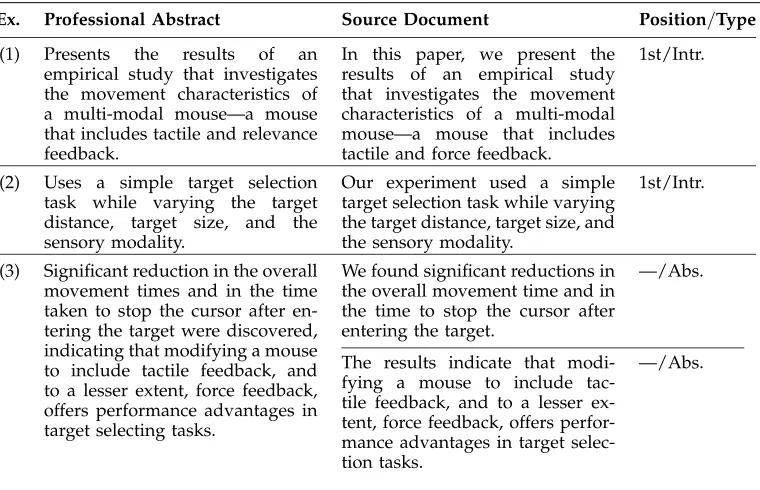
Our methodological approach consisted of the manual alignment of sentences from the professional abstract with elements of the source document. This was accom-plished by looking for a match between the information in the professional abstract and the information in the source document. The structural parts of the source doc-ument we examined were the title of the source docdoc-ument, the author abstract, the first section, the last section, the section headings, and the captions of tables and fig-ures. When the information was not found, we looked in other parts of the source document. The information is not always found anywhere in the source document, in which case we acknowledge that fact. This methodological process was established af-ter studying procedures for abstract writing (Cremmins 1982; Rowley 1982) and some initial observations from our corpus. One alignment is shown in Table 1. All align-ments are available for research purposes at the SumUM Web page http://www-rali.iro.umontreal.ca/sumum.html.
In this example, the three sentences of the professional abstract were aligned with four elements of the source document, two in the introduction and two in the author-provided abstract. The information of the abstract was found “literally” in the source document. The differences between the sentences of the professional abstract and those of the source document are the persons of the verbs (“Presents” vs. “We present” in alignment (1)), the verbs (“were discovered” vs. “We found” in alignment (3)), the impersonal versus personal styles (“Uses” vs. “Our experiment used” in alignment (2)), and the use of markers in the source document (“In this paper” in alignment (1)). This example shows that the organization of the abstract does not always mirror the organization of the source document.
2.1 Distributional Results
informa-Table 1
Item of corpus. Professional abstract: Library & Information Science abstract 3024 and source document: “Movement Characteristics Using a Mouse with Tactile and Force Feedback,”
International Journal of Human-Computer Studies, 45(5), October 1996, pages 483–493.
Ex. Professional Abstract Source Document Position/Type
(1) Presents the results of an empirical study that investigates the movement characteristics of a multi-modal mouse—a mouse that includes tactile and relevance feedback.
In this paper, we present the results of an empirical study that investigates the movement characteristics of a multi-modal mouse—a mouse that includes tactile and force feedback.
1st/Intr.
(2) Uses a simple target selection task while varying the target distance, target size, and the sensory modality.
Our experiment used a simple target selection task while varying the target distance, target size, and the sensory modality.
1st/Intr.
(3) Significant reduction in the overall movement times and in the time taken to stop the cursor after en-tering the target were discovered, indicating that modifying a mouse to include tactile feedback, and to a lesser extent, force feedback, offers performance advantages in target selecting tasks.
We found significant reductions in the overall movement time and in the time to stop the cursor after entering the target.
—/Abs.
The results indicate that modi-fying a mouse to include tac-tile feedback, and to a lesser ex-tent, force feedback, offers perfor-mance advantages in target selec-tion tasks.
[image:6.612.107.487.142.387.2]—/Abs.
Table 2
Distribution of information.
Documents With Author Abstract Without Author Abstract Average
# % # % # % %
Title 10 2 6 2 4 1 2
Author abstract 83 15 83 34 20
First section 195 34 61 26 134 42 40
Last section 18 3 6 2 12 4 4
Headlines
and captions 191 33 76 31 115 36 23
Other sections 71 13 13 5 58 17 11
Total 568 100 245 100 323 100 100
tion is given about the distribution of the sentences in structural parts in the source document.
[image:6.612.105.487.430.594.2]percentage of elements). We also recorded how the types of information are distributed in the professional abstract. For each abstract, we computed the ratio of the number of elements of each type contributing to the abstract to the total number of elements in the abstract (for example, the abstract in Table 1 contains 50% of first section and 50% of author abstract). The last column gives the average of the information over all abstracts. In this corpus, we found that 72% of the information for the abstracts comes from the following structural parts of the source documents: the title of the document, the first section, the last section, and the section headers and captions of tables and figures (sum of these entries on the first column of Table 2). Sharp (1989) reports on experiments carried out with abstractors in which it is shown that introductions and conclusions provide a basis for producing a coherent and informative abstract. In fact abstractors use a short cut strategy (looking at the introduction and conclusion) prior to looking at the whole paper. But our results indicate that using just those parts is not enough to produce a good informative abstract. Important information is also found in sections other than the introduction and conclusion. Abstractors not only select the information for the abstract because of its particular position in the source document, but they also look for specific types of information that happen to be lexically marked. In Table 1 the information reported is the topic of the document, the method, and the author’s discovery. This information is lexically marked in the source document by expressions such as we, paper, present,study, experiment, use, find, and indicate. Based on these observations we have defined a conceptual and linguistic model for the task of text summarization of technical articles.
2.2 Conceptual Information for Text Summarization
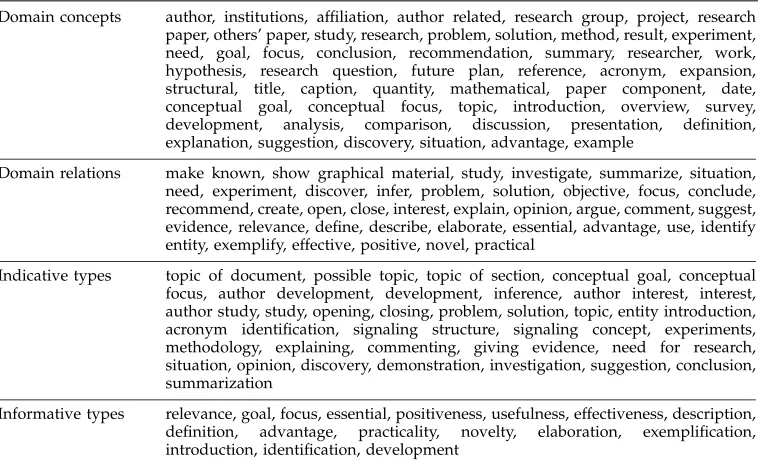
A scientific and technical article is the result of the complex process of scientific in-quiry, which starts with the identification of a problem and ends with its solution. It is a complex linguistic record of knowledge referring to a variety of real and hypothetical concepts and relations. Some of them are domain dependent (like diseases and treat-ments in medical science; atoms and fusion in physics; and algorithms and proofs in computer science), whereas others are generic to the technical literature (authors, the research article, the problem, the solution, etc.). We have identified 55 concepts and 39 relations that are typical of a technical article and relevant for identifying types of in-formation for text summarization by collecting domain-independent lexical items and linguistic constructions from the corpus and classifying them using thesauri (Vianna 1980; Fellbaum 1998). We expanded the initial set with other linguistic constructions not observed in the corpus.
Concepts. Concepts can be classified in categories referring to the authors (the
authors of the article, their affiliation, researchers, etc.), the work of the authors (work, study, etc.), the research activity (current situation, need for research, problem, solu-tion, method, etc.), the research article (the paper, the paper components, etc.), the objectives (objective, focus, etc.), and the cognitive activities (presentation, introduc-tion, argument, etc.).
Relations. Relations refer to general activities of the author during the research
and writing of the work: studying (investigate, study, etc.), reporting the work (present, report, etc.), motivating (objective, focus, etc.), thinking (interest, opinion, etc.), and identifying (define, describe, etc.).
Types of Information. We have identified 52 types of information for the process
Table 3
Conceptual information for text summarization.
Domain concepts author, institutions, affiliation, author related, research group, project, research paper, others’ paper, study, research, problem, solution, method, result, experiment, need, goal, focus, conclusion, recommendation, summary, researcher, work, hypothesis, research question, future plan, reference, acronym, expansion, structural, title, caption, quantity, mathematical, paper component, date, conceptual goal, conceptual focus, topic, introduction, overview, survey, development, analysis, comparison, discussion, presentation, definition, explanation, suggestion, discovery, situation, advantage, example
Domain relations make known, show graphical material, study, investigate, summarize, situation, need, experiment, discover, infer, problem, solution, objective, focus, conclude, recommend, create, open, close, interest, explain, opinion, argue, comment, suggest, evidence, relevance, define, describe, elaborate, essential, advantage, use, identify entity, exemplify, effective, positive, novel, practical
Indicative types topic of document, possible topic, topic of section, conceptual goal, conceptual focus, author development, development, inference, author interest, interest, author study, study, opening, closing, problem, solution, topic, entity introduction, acronym identification, signaling structure, signaling concept, experiments, methodology, explaining, commenting, giving evidence, need for research, situation, opinion, discovery, demonstration, investigation, suggestion, conclusion, summarization
Informative types relevance, goal, focus, essential, positiveness, usefulness, effectiveness, description, definition, advantage, practicality, novelty, elaboration, exemplification, introduction, identification, development
article: background information (situation, need, problem, etc.), reporting of informa-tion (presenting entities, topic, subtopics, objectives, etc.), referring to the work of the author (study, investigate, method, hypothesis, etc.), cognitive activities (argue, infer, conclude, etc.), and elaboration of the contents (definitions, advantages, etc.).
The complete list of concepts, relations, and types of information is provided in Table 3. Concepts and relations are the basis for the classification of types of infor-mation referring to the essential contents of a technical abstract. Nevertheless, the presence of a single concept or relation in a sentence is not enough to understand the type of information it conveys. The co-occurrence of concepts and relations in appropriate linguistic-conceptual patterns is used in our case as the basis for the clas-sification of the sentences. The types of information are classified as Indicative or
Informative depending on the type of abstract to which they will contribute. For
ex-ample, Topic of Document and Topic of Section are indicative, whereas Goal of
EntityandDescription of Entityare informative. Note that we have identified only a
few linguistic expressions used to express particular elements of the conceptual model, because we were mainly concerned with the development of a general method of text summarization and because the task of constructing such linguistic resources is time consuming.
2.3 From Source to Abstract
Table 4
Text editing in human abstracting.
Professional Abstract Source Document
Mortality in rats and mice of both sexes was dose related.
There were significant positive associations between the concentrations of the substance administered and mortality in rats and mice of both sexes.
No treatment related tumors were found in any of the animals.
There was no convincing evidence to indicate that endrin ingestion induced any of the different types of tumors which were found in the treated animals.
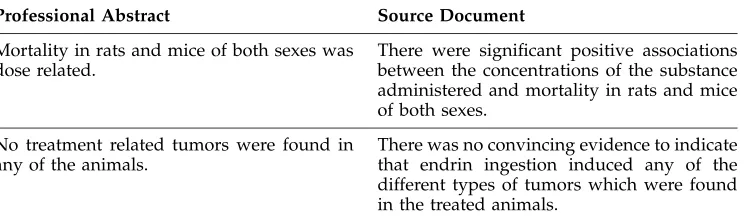
Major transformations are those of the complex process of language understanding and production, such as deduction, generalization, and paraphrase. Some examples of editing given by Cremmins are shown in Table 4. In the first example, the
con-cept mortality in rats and mice of both sexes is stated with the wording of the source
document; however, the concept expressed by the concentrations of the substance
admin-isteredis stated with the expressiondose. In the second example, the relation between
the tumors and endrin ingestion is expressed through the complex nominal treatment
related tumors.
In his rules for abstracting, Bernier (1985) states that redundancy, repetition, and circumlocutions are to be avoided. He gives a list of linguistic expressions that can be safely removed from extracted sentences or reexpressed in order to gain conciseness. These include expressions such as It was concluded that X, to be replaced by X, and It
appears that, to be replaced byApparently. Also, Mathis and Rush (1985) indicate that
some transformations in the source material are allowed, such as concatenation, trun-cation, phrase deletion, voice transformation, paraphrase, division, and word deletion. Rowley (1982) mentions the inclusion of the lead or topical sentence and the use of active voice and advocates conciseness. But in fact, the issue of editing in text summa-rization has usually been neglected, notable exceptions being the works by Jing and McKeown (2000) and Mani, Gates, and Bloedorn (1999). In our work, we partially ad-dress this issue by enumerating some transformations frequently found in our corpus that are computationally implementable. The transformations are always conceptual in nature and not textual (they do not operate on the string level), even if some of them seem to take the form of simple string deletion or substitution. The rephras-ing transformations we have identified are outlined below. We also include for each transformation the number and percentage of times the transformation was used to produce a sentence of the professional abstract. (Note that the percentages do not add up to 100, as sentences can be involved in more than one operation.)
Syntactic verb transformation:Some verbs from the source document are
Lexical verb transformation:A verb used to introduce a topic is changed and restated in the impersonal form. This transformation was observed 13 times (4%).
Verb selection:The topic or subtopic of the document is introduced by a
domain verb, usually when information from titles is used to create a sentence. This transformation was observed 70 times (21%).
Conceptual deletion:Domain concepts such as research paperandauthorare
avoided in the abstract. This transformation was observed 43 times (13%).
Concept reexpression:Domain concepts such asauthor,research paper, and
author-related entityare stated in the impersonal form. This transformation
was observed 4 times (1%).
Structural deletion:Discourse markers (contrast, structuring, logical
consequence, adding, etc.) such asfirst,next,finally,however, andalthoughare deleted. This transformation was observed 7 times (2%).
Clause deletion: One or more clauses (principal or complement) of the
sentence are deleted. This transformation was observed 47 times (14%).
Parenthetical deletion:Some parenthetical expressions are eliminated. This
transformation was observed 10 times (3%).
Acronym expansion:Acronyms introduced for the first time are presented
along with their expansions, or only the expansion is presented. This transformation was observed 7 times (2%).
Abbreviation:A shorter expression (e.g., acronym or anaphoric expression) is
used to refer to an entity. This transformation was observed 3 times (1%).
Merge: Information from several parts of the source document are merged
into a single sentence. This is the usual case when reporting entities stated in titles and captions. This transformation was observed 124 times (38%).
Split:Information from one sentence of the source document is presented in
separate sentences in the abstract. This transformation was observed 3 times (1%).
Complex reformulation:A complex reformulation takes place. This could
involve several cognitive processes, such as generalization and paraphrase. This transformation was observed 75 times (23%).
Noun transformations:Other transformations take place, such as
nominalization, generalization, restatement of complex nominals, deletion of complex nominals, expansion of complex nominals (different classes of aggregation), and change of initial uppercase to lowercase (e.g., when words from titles or headlines, usually in upper initial, are used for the summary). This transformation was observed 70 times (21%).
No transformation:The information is reported as in the source. This
transformation was observed 35 times (11%).
only 11% of the information from the source document is stated without transfor-mation. Although most approaches to automatic text summarization present the ex-tracted information in both the order and the form of the original, this is not the case in human-produced abstracts. Nevertheless, some transformations in the source doc-ument could be implemented by computers with state-of-the-art techniques in natural language processing in order to improve the quality of the automatic summaries.
In this section, we have studied relations between abstracts and their source doc-uments. This study was motivated by the need to answer to the question of content selection in text summarization (Sparck Jones 1993). We have also addressed here an-other important research question: how the information is expressed in the summary. Our study was based on the manual construction of alignments between sentences of professional abstracts and elements of source documents. In order to obtain an ap-propriate coverage, abstracts from different secondary sources and source documents from different journals were used. We have shown that more than 70% of the informa-tion for abstracts comes from the introducinforma-tion, conclusion, titles, and capinforma-tioning of the source document. This is an empirical verification of what is generally acknowledged in practical abstract writing in professional settings. We have also identified 15 types of transformation usually applied to the source document in order to produce a coherent piece of text. Of the sentences of our corpus, 89% have been edited. In section 3.1, we detail the specification of patterns of sentence and text production inspired from our corpus study that were implemented in our automatic system.
Although the linguistic information for our model has been manually collected, Teufel (1998) has shown how this labor-intensive task can be accomplished in a semi-automatic fashion. The analysis presented here and the idea of the alignments have been greatly influenced by the exploration of abstracting manuals (Cremmins 1982). Our conceptual model comes mainly from the empirical analysis of the corpus but has also been influenced by work on discourse modeling (Liddy 1991) and in the phi-losophy of science (Bunge 1967). It is interesting to note that our concerns regarding the presentation and editing of the information for text summarization are now be-ing addressed by other researchers as well. Jbe-ing and McKeown (2000) and Jbe-ing (2000) propose acut-and-pastestrategy as a computational process of automatic abstracting and a sentence reduction strategy to produce concise sentences. They have identified six “editing” operations in human abstracting that are a subset of the transformation found in our study. Jing and McKeown’s work on sentence reduction will be dis-cussed in section 6. Knight and Marcu (2000) propose a noisy-channel model and a decision-based model for sentence reduction also aiming at conciseness.
3. Selective Analysis and Its Implementation
Selective analysis is a method for text summarization of technical articles whose design is based on the study of the corpus described in section 2. The method emphasizes the selection of particular types of information and its elaboration, exploring the is-sue of dynamic summarization. It is independent of any particular implementation. Nevertheless, its design was motivated by actual needs for accessing the content of long documents and the current limitations of natural language processing of domain-independent texts. Selective analysis is composed of four main steps, which are briefly motivated here and fully explained in the rest of the section.
• Indicative selection:The function of indicative selection is to identify
specific patterns. A subset of templates is retained based on a matching process between terms from titles and terms from the indicative
templates. From the selected templates, terms are extracted for further analysis (i.e., potential topics).
• Informative selection:The information selection process determines the
subset of topics computed by the indicative selection that can be informatively expanded according to the interest of the reader. This process considers sentences in which informative markers and
interesting topics co-occur and instantiates a set of informative templates that elaborate the topics.
• Indicative generation:In indicative generation, the set of templates
detected by the indicative selection are first sorted using a preestablished conceptual order. Then, the templates are used to generate sentences according to the style observed in the corpus of professional abstracts (i.e., verbs in the impersonal and reformulation of some domain concepts). When possible, information from different templates is integrated in order to produce a single sentence. A list of topics is also presented to the reader.
• Informative generation:In informative generation, the reader selects some
of the topics presented as a result of indicative generation, thereby asking for more information about those topics. Templates instantiated by the informative selection associated with the selected topics are used to present additional information to the reader.
Whereas the indicative abstract depends on the structure, content, and to some ex-tent, on specific types of information generally reported in this kind of summary, the informative abstract relies on the interests of the reader to determine the topics to expand.
3.1 Implementing SumUM
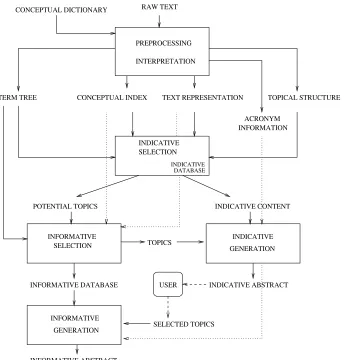
The architecture of SumUM is depicted in Figure 3. Our approach to text summariza-tion is based on a superficial analysis of the source document to extract appropriate types of information and on the implementation of some text regeneration techniques. SumUM has been implemented in SICStus Prolog (release 3.7.1) (SICStus 1998) and Perl (Wall, Christiansen, and Schwartz 1996) running on Sun workstations (5.6) and Linux machines (RH 6.0). For a complete description of the system and its implemen-tation, the reader is referred to Saggion (2000).
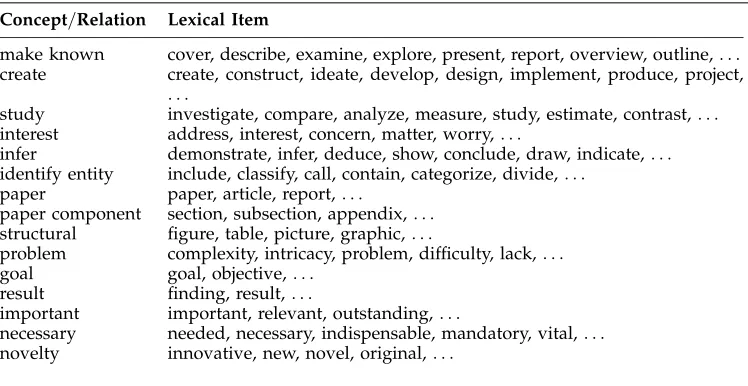
The sources of information we use for implementing our system are a POS tag-ger (Foster 1991); linguistic and conceptual patterns specified by regular expressions combining POS tags, our syntactic categories, domain concepts, and words; and a conceptual dictionary that implements our conceptual model (241 domain verbs, 163 domain nouns, and 129 adjectives); see Table 5.
3.1.1 Preprocessing and Interpretation. The input article (plain ASCII text in English
DATABASE INDICATIVE
INFORMATIVE DATABASE
INFORMATIVE ABSTRACT
TOPICS
INDICATIVE
INDICATIVE ABSTRACT
SELECTED TOPICS
GENERATION
GENERATION
USER INDICATIVE SELECTION
INFORMATIVE INFORMATIVE
SELECTION
RAW TEXT
PREPROCESSING
INTERPRETATION
POTENTIAL TOPICS INDICATIVE CONTENT TEXT REPRESENTATION
CONCEPTUAL INDEX TOPICAL STRUCTURE TERM TREE
[image:13.612.107.453.85.445.2]ACRONYM INFORMATION CONCEPTUAL DICTIONARY
Figure 3
SumUM architecture.
transforms sequences of tagged words into lists of elements, each element being a list of attribute-value pairs. For instance, the word systems, which is a common noun is represented with the following attributes (cat,’NomC’),(Nbr,plur),(canon,system)
in addition to the original word. The frequency of each noun (proper or common) is also computed. SumUM gradually determines the paragraph structure of the docu-ment, relying on end of paragraph markers. Sentences are interpreted using finite-state transducers we developed (implementing 334 linguistic and domain-specific patterns) and the conceptual dictionary. The interpretation process produces a partial represen-tation that consists of the sentence position (section and sentence numbers) and a list of syntactic constituents annotated with conceptual information. As title and section headers are recognized by position (i.e., sentence number 0 of the section), only noun group identification is carried out in those components. Each sentence constituent is represented by a list of attribute-value pairs. The parse of each element is as follows:
• Noun group parsing.We identify only nonrecursive, base noun groups.
Table 5
Overview of the conceptual dictionary.
Concept/Relation Lexical Item
make known cover, describe, examine, explore, present, report, overview, outline,. . .
create create, construct, ideate, develop, design, implement, produce, project,
. . .
study investigate, compare, analyze, measure, study, estimate, contrast,. . .
interest address, interest, concern, matter, worry,. . .
infer demonstrate, infer, deduce, show, conclude, draw, indicate,. . .
identify entity include, classify, call, contain, categorize, divide,. . .
paper paper, article, report,. . .
paper component section, subsection, appendix,. . .
structural figure, table, picture, graphic,. . .
problem complexity, intricacy, problem, difficulty, lack,. . .
goal goal, objective,. . .
result finding, result,. . .
important important, relevant, outstanding,. . .
necessary needed, necessary, indispensable, mandatory, vital,. . .
novelty innovative, new, novel, original,. . .
(i.e., the head of the group in citation form), adjectives, and information referring to the conceptual model that is optional.
• Verb group parsing.The parse of a verb group contains information about
the original string, the semantics (i.e., the head of the group in citation form), the syntactic features, information about adverbs, and the conceptual information that is optional.
• Adjectives and adverbials.The parse of adjectival and adverbial groups
contains the original string, the citation form, and the optional information from the conceptual model.
• Other.The rest of the elements (i.e., conjunctions, prepositions, etc.) are
left unanalyzed.
In order to assess the accuracy of the parsing process, we manually extracted base noun groups and base verb groups from a set of 42 abstracts found on the INSPEC (2000) service (about 5,000 words). Then, we parsed the abstracts and automatically extracted noun groups and verb groups with our finite-state machinery and computed recall and precision measures. Recall measures the ratio of the number of correct syntactic constructions identified by the algorithm to the number of correct syntactic constructions. Precision is the ratio of the number of correct syntactic constructions identified by the algorithm to the total number of constructions identified by the algorithm. We found the parser to perform at 86% recall and 86% precision for noun groups and 85% recall and 76% precision for verb groups.
Term extraction. Terms are constructed from the citation form of noun groups.
Table 6
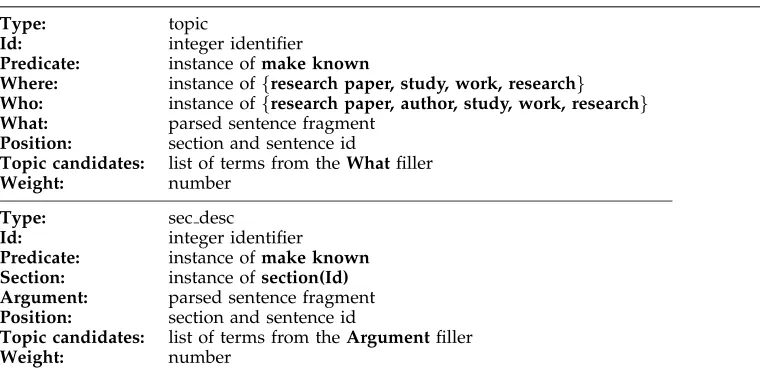
Specification of indicative templates for the topic of the document and the topic of a section.
Type: topic
Id: integer identifier
Predicate: instance ofmake known
Where: instance of{research paper, study, work, research}
Who: instance of{research paper, author, study, work, research}
What: parsed sentence fragment
Position: section and sentence id
Topic candidates: list of terms from theWhatfiller
Weight: number
Type: sec desc
Id: integer identifier
Predicate: instance ofmake known Section: instance ofsection(Id) Argument: parsed sentence fragment
Position: section and sentence id
Topic candidates: list of terms from theArgumentfiller
Weight: number
words are extracted from titles (identified as those sentences with numeral 0 in the representation) and stored in a list, the topical structure, and acronyms and their expansions are identified and recorded.
3.1.2 Indicative Selection. Simple templates are used to represent the types of
informa-tion. We have implemented 21 indicative templates in this version of SumUM. Table 6 presents two of these indicative templates and their slots. The slotTopic candidatesis filled with terms and acronym expansions. Term relevance is the total frequency of all nominal components of the term divided by the total number of nominal components. It is computed using the following formula:
relevance(Term)=
{N∈Term∧noun(N)} noun frequency(N)
|N:N∈ Term∧ noun(N)|
wherenoun(N)is true ifNis a noun,noun frequency(N)is a function computed during preprocessing and interpretation that gives the word count for nounN, and the nota-tion|S|stands for the number of elements in the setS. As complex terms have lower distribution than single terms, this formula gives us an estimate of the distribution of the term and its components in the document. In doing so, a low-frequency term like
robot architectureis assigned a high degree of relevance because chances are thatrobot
andarchitectureoccur frequently on their own. Other techniques exist for boosting the
score of longer phrases, such as adjusting the score of the phrase by a fixed factor that depends on the length of the phrase (Turney 1999). The Weightslot is filled in with the sum of the relevance of the terms on theTopic candidatesslot.
For determining the content of the indicative abstract, SumUM considers only sentences that have been identified as carrying indicative information; excludes sen-tences containing problematic anaphoric references (“the first. . .,” “the previous. . .,”
“that. . .,” quantifiers in sentence initial, etc.), those that are not domain concepts (e.g.,
Table 7
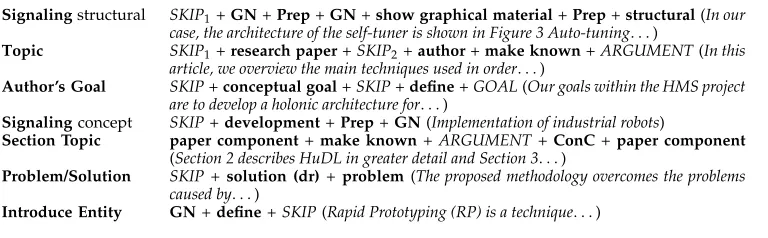
Indicative pattern specification and sentence fragments matching the patterns (in parentheses).
Signalingstructural SKIP1+GN+Prep+GN+show graphical material+Prep+structural(In our case, the architecture of the self-tuner is shown in Figure 3 Auto-tuning. . .)
Topic SKIP1+research paper+SKIP2+author+make known+ARGUMENT(In this article, we overview the main techniques used in order. . .)
Author’s Goal SKIP+conceptual goal+SKIP+define+GOAL(Our goals within the HMS project are to develop a holonic architecture for. . .)
Signalingconcept SKIP+development+Prep+GN(Implementation of industrial robots)
Section Topic paper component+make known+ARGUMENT+ConC+paper component
(Section 2 describes HuDL in greater detail and Section 3. . .)
Problem/Solution SKIP+solution (dr)+problem(The proposed methodology overcomes the problems caused by. . .)
Introduce Entity GN+define+SKIP(Rapid Prototyping (RP) is a technique. . .)
patterns contain variables, syntactic constructions, domain concepts, and relations. One hundred seventy-four indicative patterns have been implemented; some of them are shown in Table 7.
For each matched pattern, SumUM verifies some restrictions, such as verb tenses and voice, extracts information from pattern variables, and instantiates a template of the appropriate type. All the instantiated templates constitute the indicative database (IDB). SumUM matches each element of the topical structure with the terms of the
Topic candidate slots of templates in the IDB. Two terms Term1 and Term2 match if
Term1is a substring ofTerm2or ifTerm2is a substring ofTerm1(e.g.,robotic fruit harvester
matches harvester).
Then, SumUM selects the template with the greatest Weight. In case of conflict, types are selected following the precedence given in Table 8. This order gives prefer-ence to explicit topical information more usually found in indicative abstracts. Where there is conflict, the Position and the Id slots are used to decide: If two topic tem-plates have the sameWeight, the template with position closer to the beginning of the document is selected, and if they are still equal, the template with lower Idis used. SumUM prioritizes topical information by selecting the topical template with greatest weight. The selected templates constitute the indicative content (IC), and the terms and words appearing in theTopic candidateslots and their expansions constitute the
potential topics(PTs) of the document. Expansions are obtained by looking for terms
in the term tree sharing the semantics of any term in the IC.
3.1.3 Informative Selection. For each potential topic PT and sentence in which it
appears, SumUM checks whether the sentence contains an informative marker and matches a dynamic informative pattern. Dynamic patterns include a TOPICslot in-stantiated with the PT before trying a match. They also include concepts, relations, and linguistic information. Eighty-seven informative patterns have been implemented,
Table 8
Precedence for content selection.
Table 9
Informative pattern specification and sentence fragments matching the patterns (in parentheses).
Definition SKIP+TOPIC+define+GN(The RIMHO walking robot is a prototype developed with the aim of. . .)
Description SKIP+TOPIC+describe(The hardware of the MMI consists of a main pendant (MP), an operator pendant. . .)
Use SKIP+use+TOPIC(To realize the control using an industrial robot, such as. . .) Advantage SKIP+advantage+Prep+TOPIC(The biggest advantage of SWERS is the easier and
faster. . .)
Effectiveness SKIP+TOPIC+define+effective(The system is effective in the task of. . .)
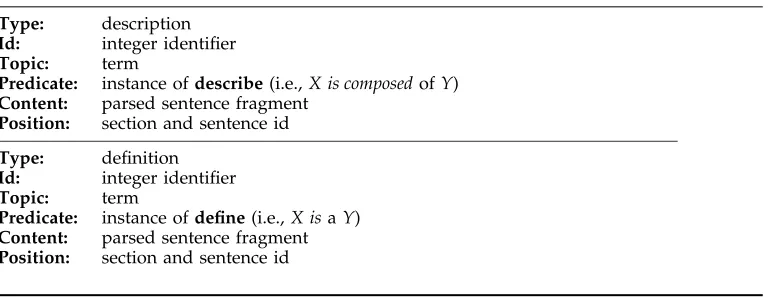
some of which are presented in Table 9. If a sentence satisfies an informative pattern, the PT is considered a topic of the document, and an informative template is instan-tiated with the sentence. The informative templates contain aContent slot to record the information from the sentence, a Topic slot to record the topic, and a Position
slot to record positional information. Examples are presented in Tables 10 and 11. The templates obtained by this process constitute the Informative Data Base (InfoDB), and the topics are the terms appearing in the slotTopicof the templates in the InfoDB.2
3.1.4 Generation. The process of generation consists of the arrangement of the
infor-mation in a preestablished conceptual order, the merging of some types of inforinfor-mation, and the reformulation of the information in one text paragraph. The IC is sorted us-ing positional information and the order presented in Table 12, which is typical of technical articles.
SumUM merges groups of up to three templates of type Topic of Document to produce more complex sentences (Mergetransformation). The same is done for tem-plates of type Topic of Section, Signaling Concept, and Signaling Structural. The template Signaling Concept contains information about concepts found on section headings; SumUM selects an appropriate verb to introduce that information in the abstract (Verb Selection). In this way, for example, given the section heading “Ex-perimental Results,” SumUM is able to produce the sentence “Presents ex“Ex-perimental results.”
The sorted templates constitute thetext plan. Each element in the text plan is used to produce a sentence the structure of which depends on the template. The schema of presentation of a text plan composed ofn(≥1)templates Tmpli is as follows:
Text=
n
i=1
[Tmpli⊕“.”].
The notation A¯ means the string produced by the generation of A, ⊕ denotes con-catenation, and n
i=1Ai stands for the concatenation of all Ai. We assume that all
the parameters necessary for the generation are available (i.e., voice, tense, number, position, etc.).
The schema of presentation of a templateTmplof typeTopic of the Documentis:3
Tmpl=Tmpl.Predicate⊕Tmpl.What
2TOPIC={Term:∃Template∈InfoDB∧Template.Topic=Term}.
Table 10
Specification of the templates for the description and definition of a topic.
Type: description
Id: integer identifier
Topic: term
Predicate: instance ofdescribe(i.e.,X is composedofY)
Content: parsed sentence fragment
Position: section and sentence id
Type: definition
Id: integer identifier
Topic: term
Predicate: instance ofdefine(i.e.,X isaY)
Content: parsed sentence fragment
Position: section and sentence id
Table 11
Definition template instantiated with sentence “REVERSA is a dual viewpoint noncontact laser scanner which comes complete with scanning software and data manipulation tools.”
Type: definition Id: 41
Topic: REVERSA Predicate: be,. . .
Content: REVERSA is a dual viewpoint noncontact laser scanner which. . . Position: Sentence 1 from Section 2
The predicate is generated in the present tense of the third-person singular (Syntactic
Verb Transformation). So sentences like “X will be presented” or “X have been
pre-sented” or “We have presented hereX,” which are usually found in source documents, will be avoided because they are awkward in an abstract. Arguments are generated by a procedure that expands/abbreviates acronyms (Acronym Expansionand
Abbrevi-ation), presents author-related entities in the impersonal form (concept reexpression),
uses fixed expressions in order to refer to the authors and the research paper, and produces correct case and punctuation. Examples of sentences generated by the sys-tem have been presented in Saggion and Lapalme (2000a). In this way we implement some of the transformations studied in section 2.3. The schema of presentation of the
Table 12
Conceptual order for content expression.
Problem Solution,Problem Identification,NeedandSituationin positional order
Topic of Documentsorted in descending order ofWeight Possible Topicsorted in descending order ofWeight
Topic Description,Study,Interest,Development,Entity Introduction,Research Goal,
Conceptual Goal,Conceptual FocusandFocusin positional order
MethodandExperimentin positional order
Results,Inference,KnowledgeandSummarizationin positional order
Entity Identificationin positional order
Topic of Sectionin section order
Topic of Sectionis
Tmpl=Tmpl.Predicate⊕Tmpl.Argument.
The schema of generation of a merged templateTmplis
Tmpl=
n−1
i=1
[Tmpl.Templatesi⊕“;”]
⊕“and also”⊕Tmpl.Templatesn,
whereTmpl.Templatesiis theith template in the merge. Note that ifnadjacent templates
in the merge share the same predicate, then only one verb is generated, and the arguments are presented as a conjunction (i.e., “PresentsXandY.” instead of “Presents
Xand presents Y.”). This is specified with the following schema:
Tmpl=Predicate⊕Tmpl1.Arg⊕
n−1
i=2
[Tmpli.Arg⊕“;”]
⊕“and”⊕Tmpln.Arg,
wherePredicateis the predicate common to the merged templates.
The indicative abstract is presented along with the list of topics that are obtained from the listTopics. SumUM presents in alphabetical order the first superficial occur-rence of the term in the source document (this information is found in the term tree). For the informative abstract, the system retrieves from the InfoDB those templates matching the topics selected by the user (using the slot Topic for that purpose) and presents the information on theContent slots in the order of the original text (using
thePositionfor that purpose).
4. Limitations of the Approach
Our approach is based on the empirical examination of abstracts published by sec-ond services and on assumptions about technical text organization (Paice 1991; Bhatia 1993; Jordan 1993, 1996). In our first study, we examined 100 abstracts and source documents in order to deduce a conceptual and linguistic model for the task of sum-marization of technical articles. Then we expanded the corpus with 100 more items in order to validate the model. We believe that the concepts, relations, and types of information identified account for interesting phenomena appearing in the corpus and constitute a sound basis for text summarization. The conceptual information has not been formalized in ontological form, opening an avenue for future developments. All the knowledge of the system (syntactic and conceptual) was manually acquired dur-ing specification, implementation, and testdur-ing. The coverage and completeness of the model have not been assessed in this work and will be the subject of future studies. Nevertheless SumUM has been tested in different technical domains.
(answering questions, paraphrasing, anaphora resolution, etc.). Concerning the prob-lem of text coherence, we have not properly addressed the probprob-lem of identification of anaphoric expressions in technical documents: SumUM excludes from the content of the indicative abstract sentences containing expressions considered problematic. The problem of anaphoric expressions in technical articles has been extensively addressed in research work carried out under the British Library Automatic Abstracting Project (BLAB) (Johnson et al. 1993; Paice et al. 1994). Although some of the exclusion rules implemented in the BLAB project are considered in SumUM (exclusion of sentences with quantifier subject, sentences with demonstratives, some initial connectives, and pronouns), our approach lacks coverage of some important cases dealt with in the BLAB rules, such as the inclusion of sentences because of dangling anaphora.
This implementation of SumUM ignores some aspects of the structure of textlike lists and enumerations, and most of the process overlooks the information about para-graph structure. Nevertheless, in future improvements of SumUM, these will be taken into consideration to produce better results.
5. Evaluating the Summaries
Abstracts are texts used in tasks such as assessing the content of a source document and deciding if it is worth reading. If text summarization systems are designed to fulfill the requirements of those tasks, the quality of the generated texts has to be eval-uated according to their intended function. The quality of human-produced abstracts has been examined in the literature (Grant 1992; Kaplan et al. 1994; Gibson 1993), using linguistic criteria such as cohesion and coherence, thematic structure, sentence structure, and lexical density; in automatic text summarization, however, such detailed analysis is only just emerging. Content evaluation assesses whether an automatic sys-tem is able to identify the intended “topics” of the source document. Text quality evaluation assesses the readability, grammar, and coherence of a summary. The eval-uations can be made in intrinsic or extrinsic fashions as defined by Sparck Jones and Galliers (1995).
An intrinsic evaluation measures the quality of the summary itself by compar-ing the summary with the source document, by measurcompar-ing how many “main” ideas of the source document are covered by the abstract, or by comparing the content of the automatic summary with an ideal abstract (gold standard) produced by a human (Mariani 1995). An extrinsic evaluation measures how helpful a summary is in the completion of a given task. For example, given a document that contains the answers to some predefined questions, readers are asked to answer those questions using the document’s abstract. If the reader correctly answers the questions, the abstract is con-sidered of good quality for the given question-answering task. Variables measured can be the number of correct answers and the time to complete the task. Recent experi-ments (Jing et al. 1998) have shown how different parameters such as the length of the abstract can affect the outcome of the evaluation.
5.1 Evaluation of Indicative Content and Text Quality
5.1.1 Design. In both evaluations we are interested in comparing our summaries with summaries produced using other methodologies, including human-written ones. In or-der to evaluate the content, we presented evaluators with abstracts and five descriptors (lists of keywords) for each abstract. The evaluators had to find the correct descrip-tor for the abstract. One of the descripdescrip-tors was the correct descripdescrip-tor of the abstract and the others were descriptors from the same domain, obtained from the journals in which the source documents were published. In order to evaluate text quality, we asked the evaluators to provide an acceptability score between 0–5 for the abstract (0 for unacceptable and 5 for acceptable) based on the following criteria taken from Rowley (1982): good spelling and grammar, clear indication of the topic of the source document, conciseness, readability and understandability, and whether acronyms are presented along with their expansions. We told the evaluators that we would consider the abstracts with scores above 2.5 acceptable; with this information, they could use scores below or above that borderline to enforce acceptability. The design of this ex-periment was validated by three IS specialists. The exex-periment was run three times with different data each time and with a different set of summarizers (human or auto-matic). When we first designed this experiment, only one text summarization system was available to us, so we performed the experiment comparing automatic abstracts produced by two summarizers and abstracts published with the source documents. Later on, we found two other summarizers, and we decided to repeat the experiment only considering three automatic systems.
Our evaluation mirrors the TIPSTER SUMMAC categorization task (Firmin and Chrzanowski 1999; Mani et al. 1998) in which given a generic summary (or a full document), the human participant chooses a single category (out of five categories) to which the document is relevant. The evaluation seeks to determine whether the summary is effective in capturing whatever information in the document is needed to correctly categorize the document. In the TIPSTER SUMMAC evaluation, 10 Text Retrieval Conference (TREC) topics and 100 documents per topic were used, and 16 systems participated. The results for TREC indicate that there are no significant differences among the systems for the categorization task and that the performance using the full document is not much better.
5.1.2 Subjects and Materials. All our evaluators were IS students/staff from
Uni-versit´e de Montr´eal, McGill University, and John Abbott College. They were chosen because they have knowledge about what constitutes a good indicative abstract. We used the Latin square experimental design, whereby forms included nabstracts from
ndifferent documents, wherendepends on the number of subjects (thus an evaluator never compared different summaries of the same document). Each abstract was printed on a different page including the five descriptors, a field to be completed with the qual-ity score associated with the abstract, and a field to be filled with comments about the abstract. In order to produce the evaluation forms, we used source documents (all tech-nical articles) from the journalIndustrial Robots, found in the Emerald Electronic Library
algorithm to maximize performance on training data. We used Extractor 5.1, which is distributed for demonstration (downloaded from http://extractor.iit.nrc.ca/). n-STEIN is a commercial system that was available for demonstration purposes at the time we were conducting our research (n-STEIN 2000) (January 2000). The system is based on a combination of statistical and linguistic processing. Unfortunately no technical details of the system are given.
5.1.3 Procedure. Each abstract was evaluated by three different evaluators, who were
not aware of the method used to produce the abstracts. In order to measure the out-come of the categorization task, we considered the abstract to have helped in catego-rizing the source document if two or more evaluators were able to chose the correct descriptor for the abstract. In order to measure the quality of the abstract, we computed the average quality using the scores given by the evaluators.
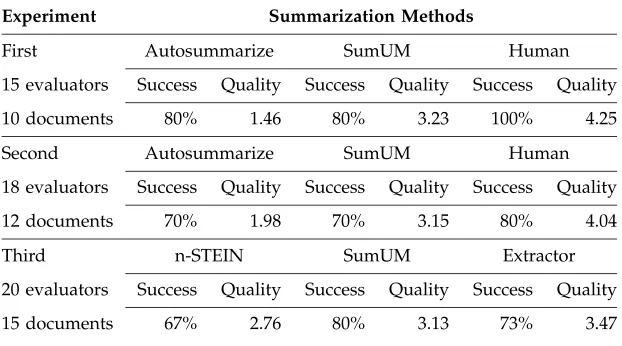
5.1.4 Results and Discussion. In Table 13 we present the average information for
three runs of this experiment. “Success” refers to the percentage of cases in which subjects identified the correct descriptor. “Quality” refers to subjects’ summary quality score. Note that because of this particular design, we cannot compare numbers across experiments, we can only discuss results for each experiment.
Overall, for each experiment no significant differences were observed between the different automatic systems in the categorization task. All automatic methods per-formed similarly, though we believe that documents and descriptors of narrower do-mains are needed in order to correctly assess the effectiveness of each summarization method. Unfortunately, the construction of such resources goes beyond our present research and will be addressed in future work.
The figures for text acceptability indicate that abstracts produced by Autosum-marize are below the acceptability level of 2.5. The abstracts produced by SumUM, Extractor, and n-STEIN are above the acceptability level of 2.5, and the human abstracts are highly acceptable. In the first experiment, an analysis of the variance (ANOVA) for text quality (Oakes 1998) showed differences among the three methods at p ≤0.005
(observedF(2, 27) =9.66). Tukey’s multiple-comparison test (Byrkit 1987) shows
statis-Table 13
Results of human judgment in a categorization task and assessment about text quality.
Experiment Summarization Methods
First Autosummarize SumUM Human
15 evaluators Success Quality Success Quality Success Quality
10 documents 80% 1.46 80% 3.23 100% 4.25
Second Autosummarize SumUM Human
18 evaluators Success Quality Success Quality Success Quality
12 documents 70% 1.98 70% 3.15 80% 4.04
Third n-STEIN SumUM Extractor
20 evaluators Success Quality Success Quality Success Quality
[image:22.612.104.415.529.702.2]tical differences in text quality atp≤0.01 for the two automatic systems (SumUM and
Autosummarize), but no conclusion can be drawn about differences between the ab-stracts produced by those systems and the author abstract at levels 0.01 or 0.05. In the second experiment, the ANOVA showed differences at p ≤ 0.01 between the
three methods (observed F(2, 33) = 10.35). Tukey’s test shows statistical differences
at p ≤0.01 between the two automatic systems (SumUM and Autosummarize) and
differences with the author abstract at 0.05. In the third experiment, the ANOVA for text quality did not allow us to draw any conclusions about differences in text quality (F(2, 42) =0.83).
5.2 Evaluation of Content in a Coselection Experiment
Our objective in the evaluation of content in a coselection experiment is to measure coselection between sentences selected by our system and a set of “correct” extracted sentences. This method of evaluation has already been used in other summarization evaluations such as Edmundson (1969) and Marcu (1997). The idea is that if we find a high degree of overlap between the sentences selected by an automatic method and the sentences selected by a human, the method can be regarded as effective. Nevertheless, this method of evaluation has been criticized not only because of the low rate of agreement between human subjects in this task (Jing et al. 1998), but also because there is no unique ideal or target abstract for a given document. Instead, there is a set of main ideas that a good abstract should contain (Johnson 1995). In our coselection experiment, we were also interested in comparing our system with other summarization technologies.
5.2.1 Materials.
Data used. We used 10 technical articles from two different sources: 5 from the
journalRapid Prototypingand 5 from the journalInternet Research. The documents were downloaded from the Emerald Electronic Library. The abstracts and lists of keywords provided with the documents were deleted before the documents were used in the evaluation.
Reference extracts. We used 30 automatic abstracts (three for each article) and nine
assessors with a background in dealing with technical articles, on whom we relied to obtain an assessment of important sentences in the source documents. Eight assessors read two articles each, and one read four articles, because no other participants were available when the experiment was conducted. The assessor of each article chose a number of important sentences from that article (up to a maximum ofNi, the number
of sentences chosen by the summarization methods). Each article was read by two different assessors; we thus had two sets of sentences for each article. We call these setsSi,j (i∈[1. . .10]∧j∈[1. . .2]). Most of the assessors found the task quite complex.
Agreement between human assessors was only 37%.
Automatic extracts. We considered three automatic systems in this evaluation:
5.2.2 Procedure. We measure coselection between sentences produced by each method and the sentences selected by the assessors, computing recall, precision, and F-score as in Firmin and Chrzanowski (1999). In order to obtain a clear picture, we borrowed the scoring methodology proposed by Salton et al. (1997), additionally considering the following situations:
• Union scenario:For each document we considered the union of the
sentences selected by the two assessors (Si,1∪Si,2) and computed recall,
precision, andF-score for each method.
• Intersection scenario:For each document we considered the intersection of
the sentences selected by the two assessors (Si,1∩Si,2) and computed
recall, precision, andF-score for each method.
• Optimistic scenario:For each document and method we considered the
case in which the method performed the best (highestF-score) and computed recall, precision, andF-score.
• Pessimistic scenario:For each document and method we considered the
case in which the method performed the worst (lowestF-score) and computed recall, precision, andF-score.
5.2.3 Results and Discussion. For each scenario we present the average information in
Table 14 (Saggion and Lapalme [2000c] presented detailed results of this experiment). For the scenario in which we consider the 20 human abstracts, SumUM obtained the bestF-score in 60% of the cases, Extractor in 25% of the cases, and Autosummarize in 15% of the cases. If we assume that the sentences selected by the human assessors rep-resent the most important or interesting information in the documents, then we can conclude that on average, SumUM performed better than the other two summarization technologies, even if these results are not exceptional in individual cases. An ANOVA showed statistical differences in the F-score measure at p ≤0.01 between the
differ-ent automatic abstracts (observed F(2, 57) = 5.28). Tukey’s tests showed differences
between SumUM and the two other automatic methods atp≤0.01.
[image:24.612.106.459.579.701.2]Here, we have compared three different methods of producing abstracts that are domain independent. Nevertheless, whereas Autosummarize and Extractor are truly text independent, SumUM is genre dependent: It was designed for the technical arti-cle and takes advantage of this fact in order to produce abstracts. We think that this
Table 14
Coselection between sentences selected by human assessors and sentences selected by three automatic summarization methods in recall (R), precision (P) and F-score (F).
SumUM Autosummarize Extractor
R P F R P F R P F
Average .23 .20 .21 .14 .11 .12 .12 .18 .14
Union .21 .31 .25 .16 .19 .17 .11 .26 .15
Intersection .28 .09 .14 .13 .04 .06 .08 .04 .06
Optimistic .26 .23 .25 .16 .14 .15 .14 .25 .18
is the reason for the better performance of SumUM in this evaluation. The results of this experiment are encouraging considering the limited capacities of the actual implementation. We expect to improve the results in future versions of SumUM. Ad-ditional evaluations of SumUM using sentence acceptability criteria and content-based measures of indicativeness have been presented in Saggion and Lapalme (2000b) and Saggion (2000).
6. Related Work on Summarization
As a human activity, the production of summaries is directly associated with the processes of language understanding and production: A source text is read and un-derstood to recognize its content, which is then compiled in a concise text. In order to explain this process, several theories have been proposed and tested in text linguistics, cognitive science, and artificial intelligence, including macro structures (Kintsch and van Dijk 1975; van Dijk 1977), history grammars (Rumelhart 1975), plot units (Lehn-ert 1981), and concept/coherence relations (Alterman and Bookman 1990). Computers have been producing summaries since the original work of Luhn (1958). Since then several methods and theories have been applied, including the use of term frequency ∗ inverse document frequency (TF∗IDF) measures, sentence position, and cue and ti-tle words (Luhn 1958; Edmundson 1969; Kupiec, Pedersen, and Chen 1995; Brandow, Mitze, and Rau 1995); partial understanding using conceptual structures (DeJong 1982; Tait 1982); bottom-up understanding, top-down parsing, and automatic linguistic ac-quisition (Rau, Jacobs, and Zernik 1989); recognition of thematic text structures (Hahn 1990); cohesive properties of texts (Benbrahim and Ahmad 1995; Barzilay and Elhadad 1997); and rhetorical structure theory (Ono, Sumita, and Miike 1994; Marcu 1997).
In the context of the scientific article, Rino and Scott (1996) have addressed the problem of coherent selection for text summarization, but they depend on the avail-ability of a complex meaning representation, which in practice is difficult to obtain from the raw text. Instead, superficial analysis in scientific text summarization using lexical information was applied by Lehmam (1997) for the French language. Liddy (1991) produced one of the most complete descriptions of conceptual information for abstracts of empirical research. In our work, we concentrated instead on conceptual in-formation that is common across domains. Liddy’s model includes three typical levels of information. The most representative level, called the prototypical structure, in-cludes the information categories subjects, purpose, conclusions, methods, references, and hypotheses. The other two levels are the typical structure and the elaborated
structure, which include information less frequently found in abstracts of empirical
research. To our knowledge Liddy’s model has never been implemented; nevertheless, it could be used as a starting point for improving our flat-domain model. Relevant work in rhetorical classification for scientific articles, which is the first step toward the production of scientific abstracts, is due to Teufel and Moens (1998), who used statistical approaches borrowed from Kupiec, Pedersen, and Chen (1995).