This is a repository copy of A Genetic Algorithm Approach for Optimising Traffic Control Signals Considering Routing.
White Rose Research Online URL for this paper: http://eprints.whiterose.ac.uk/84765/
Version: Accepted Version
Article:
Teklu, F, Sumalee, A and Watling, DP (2007) A Genetic Algorithm Approach for Optimising Traffic Control Signals Considering Routing. Computer-Aided Civil and Infrastructure Engineering, 22 (1). 31 - 43. ISSN 1093-9687
https://doi.org/10.1111/j.1467-8667.2006.00468.x
(c)2007 Computer-Aided Civil and Infrastructure Engineering. Published by Blackwell Publishing. This is an author produced version of a paper published in Computer-Aided Civil and Infrastructure Engineering. Uploaded in accordance with the publisher's self-archiving policy.
[email protected] https://eprints.whiterose.ac.uk/ Reuse
Items deposited in White Rose Research Online are protected by copyright, with all rights reserved unless indicated otherwise. They may be downloaded and/or printed for private study, or other acts as permitted by national copyright laws. The publisher or other rights holders may allow further reproduction and re-use of the full text version. This is indicated by the licence information on the White Rose Research Online record for the item.
Takedown
If you consider content in White Rose Research Online to be in breach of UK law, please notify us by
A Genetic Algorithm Approach for
Optimising Traffic Control Signals Considering Routing
Fitsum Teklu Research Student
Institute for Transport Studies University of Leeds
38 University Road, Leeds, LS2 9JT, United Kingdom Tel: +44 113 343 1788
Fax: +44 113 343 5334 Email: [email protected]
Agachai Sumalee
Senior Research Fellow, PhD Institute for Transport Studies University of Leeds
38 University Road, Leeds, LS2 9JT, United Kingdom Tel: +44 113 343 5345
Fax: +44 113 343 5334
Email: [email protected]
David Watling*
Professor, PhD
Institute for Transport Studies University of Leeds
38 University Road, Leeds, LS2 9JT, United Kingdom Tel: +44 113 343 6612
Fax: +44 113 343 5334
Email: [email protected]
A Genetic Algorithm Approach for
Optimising Traffic Control Signals Considering Routing
F. Teklu, A. Sumalee, and D. Watling
Institute for Transport Studies, University of Leeds
Abstract
It is well-known that co-ordinated, area-wide traffic signal control provides great potential for
improvements in delays, safety and environmental measures. However, an aspect of this
problem that is commonly neglected in practice is the potentially confounding effect of
drivers re-routing in response to changes in travel times on competing routes, brought about
by the changes to the signal timings. This paper considers the problem of optimising signal
green and cycle timings over an urban network, in such a way that the optimisation anticipates
the impact on traffic routing patterns. This is achieved by including a network equilibrium
model as a constraint to the optimisation. A Genetic Algorithm (GA) is devised for solving
the resulting problem, using total travel time across the network as an illustrative fitness
function, and with a widely-used traffic simulation-assignment model providing the
equilibrium flows. The procedure is applied to a case-study of the city of Chester in the UK,
and the performance of the algorithms is analysed with respect to the parameters of the GA
method. The results show a better performance of the signal-timing as optimised by the GA
method as compared to the other method which does not consider re-routing. This
improvement is found to be more significant with a more congested network whereas under a
relatively mild congestion situation the improvement is not very clear.
1 Introduction
In an urban transportation network, traffic signals have been used to control vehicle
movements so as to reduce congestion, improve safety, and enable specific strategies such as
1997). Through the years, procedures for determining optimum signal timings have been
developed and continuously improved. Early methods such as that of Webster (1958) only
considered a single signalised junction in isolation. Later, fixed time strategies were
developed that optimised a group of signalised junctions using historical flow data (e.g.
TRANSYT: Robertson, 1969). In some cities, real time traffic flow data has also been used
for optimisation in methods commonly referred to as demand-responsive strategies (e.g.
SCOOT: Hunt et. al., 1981). The focus of this research is on fixed time signal plans.
As mentioned earlier, fixed time plans use historical flows observed on links (through traffic
counts) to optimise signal timings. One shortcoming of such optimisation procedures is the
assumption that the flows for which the optimal timings are calculated will remain unchanged
after the new timings are implemented. This may not be a valid assumption if the
implementation of such timings substantially improves the journey time on a certain route,
since the users of alternative routes may divert to the improved route as a result. Such effects
have been observed as a consequence of area wide traffic control schemes (e.g. Almond and
Lott, 1968).
From a modelling viewpoint, the impact of signal time changes on changes in link flows
could also be explained from the perspective of traffic assignment theory. In a transportation
network, where traffic signals are explicitly modelled, drivers’ route choices in a network
could be assumed to a follow Wardrop User Equilibrium (UE) condition (Wardrop, 1952).
From such a perspective, a change in traffic signal timings will cause a change in the
equilibrium route choice behaviour of drivers through the link and route travel times, thus
altering the equilibrium link flow pattern over the network. Such an equilibrium model may
problem), to reflect the anticipated impact of changes to the timings on the flow patterns – i.e.
the flows are determined endogenously, inside the optimisation process.
Such a problem of determining optimum signal timings while anticipating the equilibrium
response of drivers is an instance of the Network Design Problem, NDP. A NDP is concerned
with improving an existing network so that some total network measure is optimised with
respect to some discrete or continuous design variables, while considering users’ response to
the improvement. Some examples of NDPs include the capacity enhancement problem
(Abdulaal and LeBlanc, 1979), the signal-setting problem (Chiou, 1999; Ceylan and Bell,
2004), toll pricing (Shepherd and Sumalee, 2004) and the charging cordon design problem
(Sumalee, 2004).
NDPs are characterized by the so called bi-level structure. On the upper level, a transport
planner is assumed to ‘design the network’, by selecting values for the design parameters so
as to optimise some measure of total social cost (e.g. total delay, pollution, social welfare).
Road users respond to that design in the lower level by altering their travel choices so as to
minimise their own travel costs, which may not agree with the planner’s view of the most
appropriate costs*. Formally, the planner’s optimisation in the upper level is constrained by
the lower level equilibrium problem. Such problems are known to be one of the most
challenging mathematical problems in the optimisation field, due to the non-smoothness of
the objective function (not differentiable everywhere), coupled with the non-convexity of the
feasible region. These properties imply the potential existence of multiple optima, as well as
great difficulty in devising robust and efficient methods for even finding local optima (see,
Luo et al, 1996 for more details).
*
A wide range of solution methods have been applied in an attempt to devise an efficient
technique to solve NDPs, ranging over heuristic iterative methods (Steenbrink, 1974; Allsop,
1974; Suwansirikul et al, 1987), linearization methods (LeBlanc and Boyce, 1986); Ben-Ayed
et al, 1988), sensitivity-based methods (Friesz et al, 1990; Yang, 1997), Karush-Kuhn-Tucker
based methods (Marcotte, 1986; Verhoef, 2002), methods developed from the system optimal
solution (Dantzig et al. 1979; Marcotte, 1981; Bergendorff et al, 1997; Hearn and Ramana,
1998), marginal function method (Meng et al, 2001), cutting plane method (Lawphongpanich
and Hearn, 2004), and stochastic search methods (Friesz et al, 1992; Cree et al, 1998; Ceylan
and Bell, 2004).
This paper presents a solution method for solving a signal timing based NDP using a
metaheuristic optimisation method, namely a Genetic Algorithm (GA). GA is an evolutionary
optimization technique, formulated on the basis of the mechanics of natural selection and
evolution. It offers great flexibility in solving such optimization problems as it does not
require any information on the gradient of the objective function and has the ability to move
out of local optima. An additional motivation for using GA for this problem is the simulation
based framework (as opposed to an analytic one) commonly employed in signal setting
methods (e.g. TRANSYT and SATURN) that do not use explicit mathematical relations
which negates the use of derivative based optimisation methods. GA has been used widely in
the transportation field, for problems such as generating zoning (Balling et al, 2004) or
activity plans (Charypar and Nagel, 2005), transit network design (Bielli et al, 2002;
Chakroborty, 2003), transit scheduling (Chakroborty et al, 1998), traffic parameter estimation
(Sharma et al, 2004), dynamic traffic management (Lo et al, 2001; Abu-Lebdeh and
In signal timing design, GA has been used to optimise cycle time, green time, offsets, and
stage sequences (e.g. Foy et al., 1992; Park et al., 2000; Park and Yun, 2005). These
applications, however, are limited to problems in which no account is taken of re-routing in
the optimisation, andwith the possible exception of Park and Yun who consider a twelve
intersection networkare limited to small networks with few signalised intersections. In the
network design context, Lee (1998), Taale and Van Zuylen (2003) and Ceylan and Bell
(2004) used GA in optimising signal timings, while anticipatingre-routing impacts. For stage
length and cycle time optimisation (without considering offsets) to minimize total travel time,
Lee (1998) presented a comparison of GA and simulated annealing with iterative and local
search algorithms and showed the different algorithms perform better for different network
supply and demand scenarios. Van Zuylen and Taale (2003) reported promising results from
applying a GA to optimise green times within a NDP context, albeit on small artificial
networks. In their approach to the NDP, Ceylan and Bell (2004) used the inverse of a system
performance index, defined as the weighed sum of delays and stops for all traffic streams in
the network, to optimise a common cycle time, green times and offsets. Flows were
constrained to a Stochastic User Equilibrium solution (Daganzo and Sheffi, 1977). Using a
small network, they showed that a bi-level framework with GA gives more efficient results
than an iterative algorithm in terms of system-wide travel costs. Although with a different
application in mind, GA has also been proposed for addressing a number of problems with a
similar bi-level structure, such as the analyses of Kim et al (2001) and Stathopoulos and
Tsekeris (2004) on the equilibrium-based OD matrix estimation problem; and those of Yin
(2000) and Sumalee (2004) on bi-level NDPs.
Building on Ceylan and Bell’s work we aim in the current paper to present a GA based signal
timings optimisation method that considers drivers rerouting and its application on a large
method that does not consider rerouting. The impact of the choice of GA parameters on the
performance of the algorithm is also presented. An illustrative objective function of total
network-wide travel time will be adopted, though clearly many alternative objectives could be
incorporated. . A simulation-assignment model provides the junction delays based on which
travel costs are calculated. Besides delays at signalised junctions, the model also enables the
consideration of delays at non-signalised junctions.
The next section presents the problem formulation and defines signal control design
parameters. The methodology description is given in section 3. The performance of the
program is analysed in Section 4, with conclusions given in the final section.
2 The Problem of Optimising Signals with Equilibrium Constraints
The NDP of optimising signal timings while anticipating drivers’ re-routing is defined in the
present section, and is hereafter referred to as ‘The Problem’.
2.1 Problem Formulation
The Problem is formulated as a Mathematical Program with Equilibrium Constraints (MPEC).
The planner’s upper level objective of minimizing total travel time† (TT) by altering signal
timings is constrained so that the associated flows are at User Equilibrium based on the travel
times resulting from the given signal timings. Additional signal setting feasibility constraints
are also applied. The notation used is given in TABLE 1.
[INSERT TABLE 1 HERE]
TT is defined as the sum of the product of the link flows and travel times over the whole
network. At junctions each turning movement is represented by a separate link of zero-length,
which has the associated delay put as travel time and included in the calculation of TT. TT is
influenced by the signal timings,, and link flow pattern q*( ) in the network; see Section
2.2.
Mathematically the problem is defined as:
L a aa
t
q
q
q
TT
Min
o 1 *))
(
,
(
))
(
,
(
(1)
subject to: (C,,)o (2)
i. e. Cmin CCmax (3)
0h C 1 (4)
max , , min
,r hr hr
h
(5)
h I C h h S r r h S r r
h
1 , 1 , (6)and subject to the constraint that for a given , the UE flow vectorq*( ) is given by the
variational inequality (Smith, 1979),
( , *) ( *) 0
t q q q q (7)
where t and q are the vectors of travel time function and link flow respectively; and is the
feasible space of the link flow vector.
In this paper, the traffic equilibrium problem is solved by use of the simulation-assignment
modelling software package SATURN (Van Vliet, 1982). In contrast to conventional traffic
assignnment models, SATURN places great emphasis on the detailed representation
intersections, turning movements, and associated junction conflicts. Based on the principles of
cyclic flow profiles (Robertson, 1969), its simulation sub-model determines junction delays at
a number of flow states, based on junction turning demands estimated by the assignment
sub-model. It uses this information to estimate marginal relationships between the travel time on
each link/turn and the flow on that link/turn, and these functions are then passed back to the
‘diagonalisation’ algorithm. The assignment sub-model uses the well-known Frank-Wolfe
convex combinations method to determine the equilibrium flow pattern. Although for given
travel-time/flow functions the assignment sub-model has guaranteed convergence to an
equilibrium solution, the process by which the assignment and simulation sub-models are
alternately solved is a heuristic one. Nevertheless, the widespread use of this heuristic in
practice has provided strong numerical evidence that good convergence can be assured
through experimentation with the heuristic process.
2.2 Signal timing design variables and feasibility constraints
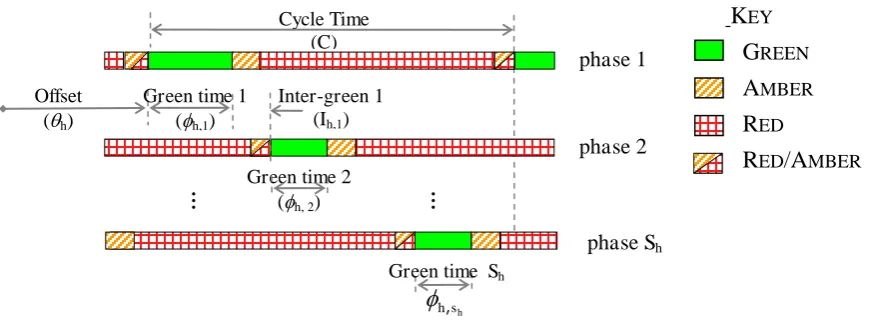
For a junction, FIGURE 1 shows the signal design variables: cycle time, offset, and the green
time for the different stages. A phase is the set of movements which can take place
simultaneously or the sequence of signal indicators received by such movements. The portion
of the cycle over which a given combination of phases is given green is called a stage. For all
signalised junctions, the offset – the difference in time of the start of the green between
adjacent junctions – is defined from a common reference time for one (randomly chosen)
stage. At a junction, the start of the green times for successive stages is defined by the
inter-green period, measured from the end of the inter-green of the preceding stage. For the problem
formulated in Section 2.1, the technical feasibility of the design variables, which is ensured by
equations (3) to (6), is explained briefly in the following paragraphs.
[INSERT FIGURE 1 HERE]
To maintain signal coordination from cycle to cycle each junction in the area considered must
operate with a common cycle time or a simple multiple of it (IHT, 1997). The common
network cycle time,C , is constrained to a minimum,Cmin, and a maximum,Cmax, as shown in
accommodate the inter-green times and the minimum green times as shown in (8). In the
numerical tests reported later,Cmaxis constrained to 120 seconds.
N h I Max C h h S r r h S r rh ) : 1,2,...,
( 1 , 1 min ,
min (8)
For any junction, h, the offset could only vary between zero and the cycle time minus one –
see (4).
For the numerical tests reported later in this study, a green time duration of 7 seconds is used
as a minimum for all stages in the network (9). The maximum green time for a stage,h,r,max, is
obtained by assuming all the other stages at the junction just need the minimum green time. It
is given by (10), taking the lost time per cycle (calculated as the sum of the inter-green
periods) and the minimum green times into account. Equation (10) ensures that the sum of the
green times at a node together with the lost time in that cycle equals the total cycle time.
r h
r
h, min 7sec ,
(9)
h Sh
r y y y h S r r h r
h C I
1 min , , 1 , max , ,
(10)
3 Solution Methodology and Implementation
In order to solve the signal-setting NDP defined in Section 2, the problem will be cast in the
form of a Genetic Algorithm (GA), whereby the GA aims to minimise the upper level
objective TT with respect to the signal setting parameters, while maintaining flows at
equilibrium for those signal settings (achieved through SATURN). Thus each time the
objective function is evaluated at a particular choice of signal settings, a fully convergent run
of SATURN is required in order to determine the flows that would arise under the given
signal settings. While the basic idea is straightforward, there are important issues concerned
sections below. As a pre-cursor to these details, a brief description of the GA method and its
terminology is provided..
GA is inspired by the theory of evolution. Initially, a population of chromosomes, each of
which are potential solutions, are generated. GA evaluates each chromosome against an
objective (fitness) function and, through a probabilistic selection process, selects some
chromosomes to form what is known as an intermediate population. Mimicking the
evolutionary strife for survival, the fitter chromosomes have higher probabilities of selection.
Chromosomes from the intermediate population are then randomly paired to exchange genetic
materials, and produce offspring in the crossover process. Lastly, in the mutation process,
genes, on some probabilistically selected chromosomes, are made to mutate and form the next
population. The process of going from one population to the next represents one generation in
the execution of the GA. This evolutionary process goes on improving the fitness of the
solutions through subsequent generations.
In this study, GA generates and improves on candidate signal timings for the network, for
which the SATURN model determines the UE flow pattern and the respective total travel
time, which is used for evaluating the sampled signal timings and improving the next batch of
candidate timings. This is done repetitively until a ‘converged’ solution is arrived at, or
maximum number of generations is reached. GA-FITSUM (Genetic Algorithm based
Formulation of Integrated Traffic Signal and User equilibrium Model) is the name given to
the computer program that solves this problem. A flow chart describing the implementation of
the program is given in FIGURE 2.
[INSERT FIGURE 2 HERE]
3.1 Chromosome Design
In the signal-setting NDP, the total number of decision variables, , is given by (11). These
are a common cycle time, N offsets (one for each junction), and Sm green times at each
junction, giving a total of:
N
m m
S N
1
) ( 1
(11)
In the GA, each of these variablea is represented by a splice of 8 bits – each bit taken from the
binary set: {0, 1}. For example, considering a network with just two signalised junctions, each
having two stages, the number of splices () is 7. These splices will be combined to form a
chromosome representing a vector of feasible signal setting parameters for the network. For
the example mentioned above, the corresponding chromosome, splices, and represented
variables are given in FIGURE 3. The general form of such a chromosome is shown in
FIGURE 4 for a network with N signalised junctions.
[INSERT FIGURE 3 HERE]
[INSERT FIGURE 4 HERE]
3.2 Chromosome encoding and constraint representation
This section describes how the chromosome decoding is carried out, and how the constraints
given by (3) to (6) are handled in GA-FITSUM. The decoding scheme is based on Ceylan and
Bell (2004).
a. Cycle time: is the proportion of the difference Cmax Cmin as defined by the first splice
on the chromosome, plus Cmin.
) (
1
28 max min
min C C
C
C m
where: ( m) = base 10 equivalent of splice m (m) ‡
Cmax = 120 seconds and
Cmin is calculated using (8)
b. Offset: for a stage at a junction h, it is the proportion of the cycle time as defined by
splice m on the chromosome.
C
m h
1 28
m 2,3,,N1 (13)
where: hm1;
c. Green times: are defined as the sum of the minimum stage length and the proportion of
the remaining green time h r, ,max h r, ,minas follows:
h S x x m m m r h r h r h r h 1 min , max , min , , ( ) ; m N2,N3,..., (14)
where:
1 1 1 h y y S N
x is constant at junction h
x m
r , is a stage at junction h
N
h1,2,...,
3.3 Initialization
The initial set of chromosomes (size of P ) is randomly generated after network specific
information such as the numbers of signalised junctions (N) and stages at each junction (Sh)
have been extracted to determine (see (11)).
‡ For a base 2 number, B, of 8 digits
8 7 6...1 2
b b b b where bk
0,1 ,k1, 2,...,8, the base 10 equivalent is given by,8
1
1
( k* 2k )
k
B b
. It should be noted that3.4 Evaluation/fitness
Each chromosome is decoded and sent to the assignment model to obtain corresponding UE
link flows and the associated total travel time, TT. GA-FITSUM then uses TT as the fitness
function for the selection process.
3.5 Selection
In the Selection stage, GA-FITSUM uses the linear ranking approach proposed by Whitley
(1989) for sampling the intermediate population which will then be modified by GA operators
(Sections 3.6 and 3.7). The chromosomes are firstly ranked in an ascending TT order and a
“stochastic sampling with replacement” (Goldberg, 1989) is then carried out using a roulette
wheel that uses probabilities, pk, based on the rank, k, of each chromosome in a generation –
see (15). That is to say,
) 1 ( * ) 2 2 ( 2 1 P k P c c P
pk w w (15)
where cw [1,2] is the “selection bias”– higher values favour the better fit chromosomes
during sampling.
As part of the selection procedure, elitism is applied which ensures the best performing
chromosomes from the preceding generation are always included in the next generation
without any alteration. The parameter Elite controls the number of such chromosomes which
are passed to the next generation.
3.6 Crossover
During crossover, the elite chromosomes are made present in the breeding pool to share their
good performing genes. Each chromosome in the intermediate population is assigned a
probability of Pc to exchange its genetic materials. Those selected are randomly paired for
which GA-FITSUM uses uniform crossover (Syswerda, 1989). Accordingly a mask
mask chromosome determines which parent chromosome supplies the bit for a certain
position in the chromosomes of their two offspring. The unselected chromosomes will be
passed directly to the mutation process.
3.7 Mutation
The probability of mutation, Pm, determines the likelihood of mutation occurring on a certain
chromosome. For those selected, the mutation is implemented by selecting a random point
(bit) on the offspring’s chromosome length and then changing the value of the that bit to 0 if it
was 1, or vice versa.
4 Case Study Application
GA-FITSUM’s performance is considered here, both in terms of the GA search process and in
terms of the optimality of the solution obtained in comparison with a traffic signal
optimisation process that does not anticipate re-routing. The evidence for this study arises
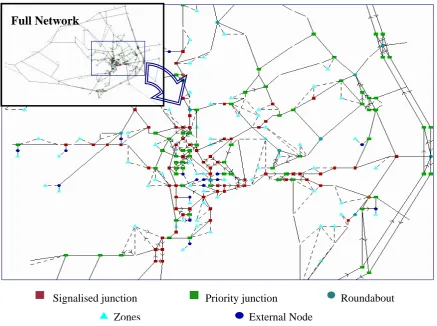
from applications to the road network for the city of Chester in the UK, as illustrated in
FIGURE 5. This network has 75 signalised junctions, 18 roundabouts, and 86 priority
junctions, forming parts of the routes of the various trips in the network. It caters for a total
demand of 22060 pcu/hour, generated from 132 zones.
[INSERT FIGURE 5 HERE]
4.1 GA Parameters and Performance
According to Whitley (1989), population diversity and selective bias are the two important
issues influencing genetic search. As selective bias is increased – which could be
process – the search focuses on the top individuals to exploit their best performing genes and
leads to a fast convergence. A very high selective bias may result in a premature convergence.
Low selective pressure, on the other hand, focuses on diversity and explorative search
behaviour. In GA-FITSUM such an effect could be implemented by higher values of P , Pm,
and Pc. A higher G would increase the number of chances GA gets to improve on the
solution. Several researchers in the field of evolutionary optimisation have tried to investigate
the effect of the GA parameters so as to define these parameters optimally (see for example
Goldberg, 2002). Unfortunately, the most advanced result on optimal adjustment of GA
parameters has been limited to very simple problems.
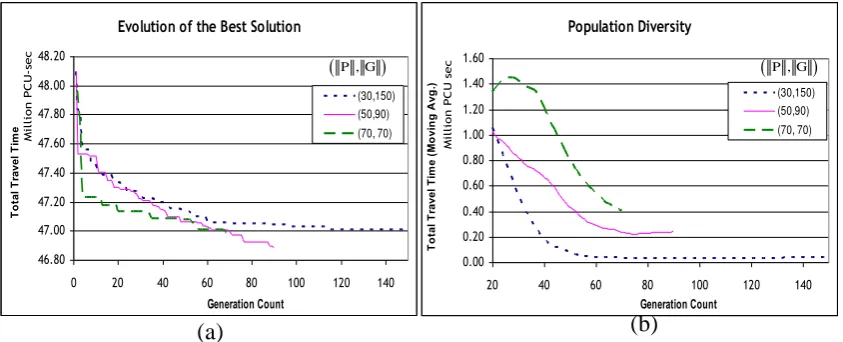
In this paper the performance of GA is presented using the so called “Evolution of Best
Solution” (e.g. FIGURE 6a) and “Population Diversity” (e.g. FIGURE 6b) charts. The former
shows the total travel time resulting from the best solution, in the vertical axis, against the
generation that solution comes from on the horizontal axis. It indicates the speed of solution
convergence. As the Elitism parameter is applied, the solution is observed to improve in
successive generations. Charts of the latter kind show plots of the variance of the total travel
time due to each solution in a generation, smoothed by averaging over a large number of (in
this case 20) generations. It is chosen to indicate the possibility the search has to improve its
solution by incorporating different genes.
[INSERT FIGURE 6 HERE]
FIGURE 6 presents the comparison of different values of the population and generation
number on the search process. The total number of chromosomes (solutions) evaluated has
been constrained to about 4500 so as to see whether it is better to have a larger population size
and thus compromising the generation size, or vice versa. The other parameters were fixed as
with lower values of P in Figure 6b. The relationship between diversity and improvement in
the best solution is clearly evident from the figure. For example, for ( P =30) lower genetic
diversity has limited the search process to fewer improvements after the 60th generation,
whereas a high improvement rate is observed for P =70 in the first few generations. High
and sustained speed of convergence and a better solution are obtained with ( P , G ) equal to
(50, 90).
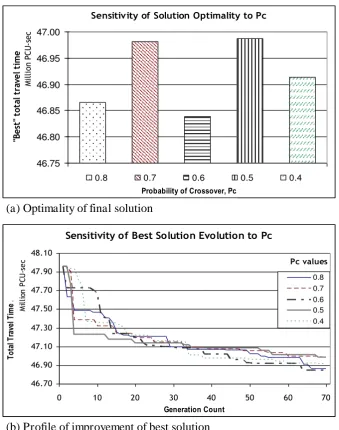
The next parameter tested is the crossover parameter; see FIGURE 7. The values tested are:
0.8, 0.7, 0.6, 0.5, and 0.4. The values of P , G and Pm are fixed at 70, 70 and 0.15,
respectively. The test with Pc=0.6 is shown to provide a better solution than the others.
Similar patterns between solution improvement and diversity are also observed. The high
population diversity up to the 30th generation is associated with faster best-solution
improvement for Pc=0.5. As shown in (c), the diversity decreases with GA evolution except
for Pc=0.4 for which diversity remains about constant after 40 generations.
[INSERT FIGURE 7 HERE]
[INSERT FIGURE 8 HERE]
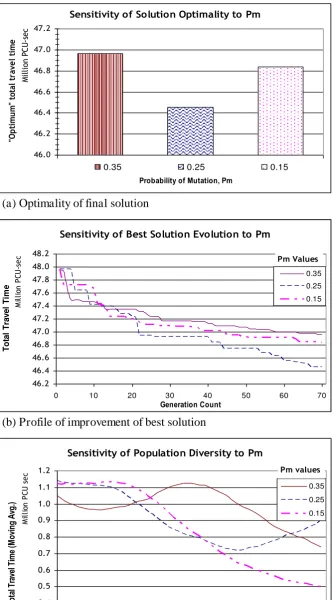
Similarly, the effect of the Pm parameter is presented in FIGURE 8(a-c); values of P , G and
Pc are fixed at 70, 70 and 0.6 respectively. The best solution is found for Pm =0.25. For the
case of Pm,; the effect of different Pm on the diversity of the solutions and the optimal solution
found is, however, rather complex.
4.2 Local Delay Minimising Signal Timings
For comparison, a SATURN based signal optimisation procedure, which will be referred to as
delay is minimized at each intersection using the SATURN simulation model. The method
neither optimises cycle time, nor considers the rerouting effect. After optimum SATOPT
signal times are obtained, traffic is reassigned to take account of drivers’ response to the new
timings. The resulting total travel time is compared with that resulting from GA-FITSUM
timings. In addition, to account for SATOPT not optimising cycle times, and to check how
stage timings and offset optimisations of GA-FITSUM compare with SATOPT, the best
performing common cycle times from GA-FITSUM are also input and compared.
4.3 Results
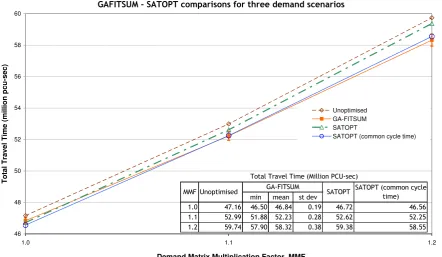
The results from using GA-FITSUM for 3 demand scenarios are presented in Figure 9. The
scenarios are defined by the matrix multiplication factors, MMF, applied on the current year
OD matrix. To account for the effect of different initial random number generating seeds,
GA-FITSUM was run 10 times for each scenario. The mean TT and error bars representing
one standard deviation above and below the mean are plotted in Figure 9. The inset table also
shows the minimum TT obtained from GA-FITSUM. The TT from SATOPT optimised signal
timings with and without the common cycle times are also presented. For benchmarking
purposes, the TT from the un-optimised signal timings are also presented in Figure 9.
As shown in the figure, there does not seem to be much difference between GA-FITSUM and
SATOPT for the first demand scenario. In fact, although the best solution from the 10 runs of
the former gave the smallest TT of 46.5 million pcu-sec, the mean TT from GA-FITSUM
timings is bigger than that resulting from SATOPT timings. For higher levels of demand,
however, it can be seen that GA-FITSUM gives better results than SATOPT does.
SATOPT performs better when the common cycle time from the best performing
GA-FITSUM timings are used, than when the initial node-specific signal timings are in operation.
When compared with GA-FITSUM’s best performing timings, SATOPT results in marginal
increases in TT which get bigger for higher levels of network congestion. This is because it
does not consider the response of the traffic to the changed times.
To see the effect of not anticipating rerouting when optimising signal times, the best
performing signal times and, implicitly, link flows for the first demand scenario is given as
input. For the optimum cycle time determined by GA-FITSUM, SATOPT calculated
optimum stage lengths and offsets after which the traffic was reassigned. FIGURE 10 shows
the difference in link flows as a result of the (new) SATOPT timings, which is unaccounted
for in the conventional optimisation calculations which do not anticipate rerouting. For the
case tested, the associated increase in TT is 0.5 million pcu-sec per hour (which is around
25,000 pcu-hr of delay annually).
5 Conclusions
In this paper, a GA based method was presented for optimising traffic signals in a way that
anticipates re-rerouting of traffic, and its application on the city of Chester was presented. The
GA based method has given promising results in finding optimum signal timings with stable
flows.
When compared to a local delay minimizing timings, the process by which routing is
anticipated has given better results for the network considered in this paper. The
improvements after considering rerouting are relatively bigger when there is a higher level of
varying levels of congestion, to explore the improvements associated with considering routing
in optimising signal timings.
A GA based method should be run several times using different initial random seeds to better
handle solution convergence issues. This will significantly increase the relatively long
computing time associated with the use of GA. The combination of population size,
probabilities of crossover and mutation as well as the chromosome design contributes to how
GA performs. The question of how to find optimum values of the GA parameters is still a
difficult issue and requires further research.
ACKNOWLEDGMENTS
This study was sponsored by the Norwegian Council of Universities' Committee for
Development Research and Education, NUFU. We would like to acknowledge the detailed
comments of all six anonymous referees, which helped us in improving an earlier version of
REFERENCES
Abdulaal, M., & LeBlanc, L. J. (1979), Continuous equilibrium network design models,
Transportation Research Part B, 13(1), 19-32.
Abu-Lebdeh, G. & Benekohal, R.F. (2003), Design and evaluation of dynamic traffic
management strategies for congested conditions, Transportation Research Part A, 37(2),
109-127.
Almond, J. & Lott R. S. (1968), The Glasgow Experiment: implementation and assessment.
Road Research Laboratory Report 142, Road Research Laboratory, Crowthorne.
Allsop, R.E. (1974), Some possibilities for using traffic control to influence trip distribution
and route choice, in Buckley D. J., Ed., Proc. 6th Int. Symp. on Transport and Traffic
Theory, Elsevier, New York, 345-373.
Balling, R., Powell, B., and Saito, M. (2004) Generating future land-use and transportation
plans for high-growth cities using a genetic algorithm, Computer-Aided Civil and
Infrastructure Engineering, 19 (3), 213-222.
Ben Ayed, O., Boyce, D. E. & Blair III, C.E. (1988), A general bi-level linear programming
formulation of the network design problem, Transportation Research Part B, 22(4),
311-318.
Bergendorff, P., Hearn, D. W., & Ramana, M. V. (1997), Congestion toll pricing of traffic
networks, in Pardalos P. M., Hearn D. W., and Hager W. W., Eds., Lecture Notes in
Economics and Mathematical Systems,.450: Network Optimization, Springer, Berlin, 51-71.
Bielli M., Caramia M., & Carotenuto P. (2002), Genetic algorithms in bus network
optimization, Transportation Research Part C, 10(1), 19-34.
Ceylan H. & Bell M. G. H. (2004), Traffic signal timing optimisation based on genetic
algorithm approach, including drivers’ routing, Transportation Research Part B, 38(4),
Chakroborty, P. (2003), Genetic algorithms for optimal urban transit network design,
Computer-Aided Civil and Infrastructure Engineering, 18(3), 184-200.
Chakroborty, P., Deb, K. & Srinivas, B. (1998), Network-wide optimal scheduling of transit
systems using genetic algorithms, Computer-Aided Civil and Infrastructure Engineering
13(5), 363-376.
Charypar, D. & Nagel, K. (2005), Generating complete all-day activity plans with genetic
algorithms, Transportation, 32(4), 369-397.
Chiou, S-W. (1999), Optimization of Area Traffic Control for Equilibrium Network Flows.
Transportation Science 33(3), 279-289.
Cree N.D., Maher M.J. & Paechter B. (1998), The continuous equilibrium optimal network
design problem: a genetic approach, in M.G.H. Bell, Ed., Transportation Networks: Recent
Methodological Advances, Pergamon, Oxford, 163-174.
Daganzo, C. F. and Sheffi, Y. (1977) On stochastic models of traffic assignment,
Transportation Science, 11(3), 253-274.
Dantzig, G. B., Harvey, R. P., Landsdown, Z. F., Robinson, D. W. & Maier, S. F. (1979),
Formulating and solving the network design problem by decomposition, Transportation
Research Part B, 13(1), 5-17.
Foy, M., R. F. Benekohal, & D. E. Goldberg (1992), Signal timing determination using
genetic algorithms, Transportation Research Record, 1365, 108-115.
Friesz, T.L., Cho, H.J., Mehta, N.J., Tobin, R. & Anandalingam, G. (1992), A simulated
annealing approach to the network design problem with variational inequality constraints.
Transportation Science, 26, 18-26.
Friesz, T.L. & Harker, P.T. (1985), Properties of the iterative optimisation-equilibrium
Friesz, T.L., Tobin, R.L., Cho, H.J., & Mehta, N.J. (1990), Sensitivity analysis based heuristic
algorithms for mathematical programs with variational inequality constraints, Mathematical
Programming, 48, 265-284.
Goldberg D.E. (1989), Genetic Algorithms in Search, Optimisation, and Machine Learning,
Addison Wesley Longman Inc., Reading, Mass.
Goldberg D.E. (2002), The Design of Innovation: Lesson from and for competent genetic
algorithms, Kluwer Academic Publishers, Boston.
Girianna, M. & Benekohal, R. (2004), Using genetic algorithms to design signal coordination
for oversaturated networks, Intelligent Transport Systems Journal, 8(2), 117-129.
Hearn, D. W., & Ramana, M. V. (1998), Solving congestion toll pricing models, in Nguyen S.
and Marcotte P., Eds., Equilibrium and Advanced Transportation Modeling, Kluwer
Academic Publishers, Boston, 109-124.
Hunt, P.B., Robertson, D.I., Bretherton, R. D., & Winton, R. I. (1981), SCOOT - A traffic
responsive method of coordinating signals, TRRL Laboratory Report 1014, TRRL,
Berkshire, England.
(IHT) Institution of Highways & Transportation (1997), Transport in the Urban Environment.
Institution of Highways & Transportation, London.
Kim H., Baek S. & Lim Y. (2001), Origin-destination matrices estimated with a genetic
algorithm from link traffic counts, Transportation Research Record, 1771, 156-163.
Lawphongpanich, S. & Hearn, D. W. (2004), An MPEC approach to second-best toll pricing,
Mathematical Programming B, 101(1), 33-55.
LeBlanc, L. & Boyce, D. (1986), A bi-level programming for exact solution of the network
design problem with user-optimal flows, Transportation Research Part B, 20(3), 259-265.
Lee, C. (1998) Combined Traffic Signal Control and Traffic Assignment: Algorithms,
Implementation and Numerical Results, Ph.D. Dissertation, the University of Texas at
Lo, H.K., Chang, E & Chan, Y.C. (2001), Dynamic network traffic control, Transportation
Research Part A, 35(8), 721-744.
Luo, Z., Pang, J.S., & Ralph, D. (1996), Mathematical Programs with Equilibrium
Constraints, Cambridge University Press, New York.
Marcotte, P. (1981), An analysis of heuristics for the continuous network design problem, in
Hurdle, V. F. et al., Eds., Proceedings of the 8th International Symposium on Transportation
and Traffic Theory, University of Toronto Press, Toronto, 27-34.
Marcotte, P. (1986), Network design problem with congestion effects: a case of bi-level
programming, Mathematical Programming, 34, 142 – 162.
Meng, Q., Yang, H., & Bell, M.G.H. (2001), An equivalent continuously differentiable model
and a locally convergent algorithm for the continuous network design problem,
Transportation Research Part B, 35(1), 83-105.
Park, B., Messer C.J., & Urbanik T. (2000), Enhanced genetic algorithm for signal timing
optimization of oversaturated intersections, Transportation Research Record, 1727, 32-41.
Park, B. and Yun, I. (2005). Stochastic Optimization Method for Coordinated Actuated Signal
Systems. Final Report of ITS Center Project: Evaluation of advanced traffic signal
controllers. Center for Transportation Studies, University of Virginia, USA.
Robertson, D. I. (1969), ‘TRANSYT’ method for area traffic control, Traffic Engineering and
Control, 10, 276 – 281.
Sharma, S., Lingras, P. & Zhong, M. (2004), Effect of missing values estimations on traffic
parameters, Transportation Planning and Technology, 27(2), 119-144.
Shepherd, S.P. & Sumalee A. (2004), A genetic algorithms based approach to optimal toll
level and location problems, Networks and Spatial Economics, 4, 161-179.
Smith, M.J. (1979), The existence, uniqueness and stability of traffic
Stathopoulos, A. & Tsekeris, T. (2004), Hybrid meta-heuristic algorithm for the simultaneous
optimization of the O-D trip matrix estimation, Computer-Aided Civil and Infrastructure
Engineering, 9(6), 421-435.
Steenbrink, P. A. (1974), Optimization of Transport Networks, John Wiley & Sons, London.
Srinivasan, D., Cheu, R.L., Poh, Y.P. & Ng, A.K.C. (2000), Development of an intelligent
technique for traffic network incident detection, Engineering Applications of Artificial
Intelligence, 13(3), 311-322.
Sumalee, A. (2004), Optimal road user charging cordon design: a heuristic optimisation
approach, Computer-Aided Civil and Infrastructure Engineering, 19(5), 377-392.
Suwansirikul, C., Friesz, T. L., & Tobin R. L. (1987), Equilibrium decomposed optimization:
a heuristic for the continuous equilibrium network design problem, Transportation Science,
21(4), 254-263.
Syswerda, G. (1989), Uniform crossover in genetic algorithms, Proc. 3rd Intl. Conf. Genetic
Algorithms, Morgan Kaufmann, 2-9.
Taale, H. and Van Zuylen, H.J. (2003). The Effects of Anticipatory Traffic Control for
Several Small Networks. Paper presented at 82nd Transportation Research Board Annual
Meeting, Washington DC, January 12th–16th 2003.
Van Vliet, D. (1982), SATURN - A modern assignment model, Traffic Engineering and
Control, 23, 578-581.
Varia, H.R. and Dhingra S.L. (2004). Dynamic Optimal Traffic Assignment and Signal Time
Optimization Using Genetic Algorithms. Computer-Aided Civil and Infrastructure
Engineering 19, 260-273.
Verhoef, E. T. (2002), Second-best congestion pricing in general networks: heuristic
algorithms for finding second-best optimal toll levels and toll points, Transportation
Wardrop J. G. (1952), Some theoretical aspects of road traffic research, Proc. Institution of
Civil Engineers, 1(2), 325-378.
Whitley, D. (1989), The GENITOR algorithm and selection pressure: Why rank based
allocation of reproductive trial is best, in Schaffer, J., Eds., Proc. of the 3rd Intl. Conf. on
Genetic Algorithms, Morgan Kaufmann, 116-121.
Webster F.V. (1958), Traffic Signal Settings, Road Research Technical Paper No. 39, HMSO,
London.
Yang, H. (1997), Sensitivity analysis for the elastic-demand network equilibrium problem
with applications, Transportation Research Part B, 31(1), 55-70.
Yin Y. (2000), Genetic algorithms-based approach for bi-level programming models, ASCE
FIGURE 1 Signal design variables for junction h
GREEN
AMBER
RED
Cycle Time (C)
KEY
Offset (h)
Green time 1 (h,1)
phase 1
phase 2
Inter-green 1 (Ih,1)
Green time 2 (h, 2)
phase Sh
Green time Sh
h
s h,
FIGURE 2 GA-FITSUM Flow Chart
Is i < P ?
No No
INITIALIZATION
(i. e. generate P feasible solutions randomly)
EVALUATION
CALCULATE TOTAL TRAVEL TIME
PICK THE OPTIMUM SOLUTION
Yes
Yes
FIND THE EQUILIBRIUM FLOW PATTERN
(i. e. run SATURN)
Next so
lu
tio
n,
i =
i+
1
SELECTION
Linear Ranking & Elitism
CROSSOVER AND MUTATION
Is g < G ?
Next g
enerati
on
o
f so
lut
ion
s,
g
=
g +
FIGURE 3: Splices, Chromosome, and represented variables – an illustrative example
2 2 1
2 2
1 1
1 2
1
,
,
,
,
C
7 6
5 4
3 2
1
11111110 0100111
0 00010100 11010100
00101011 10101010
FIGURE 4: Chromosome Structure
|
...,
,
|
...
|
,...,
,
|
...,
,
,
|
|
1 2 1,1 1,2 1, ,1 ,1 N N Sn
S N
FIGURE 5: Layout of the Chester network
Signalised junction Priority junction Roundabout
Zones External Node
FIGURE 6: Comparison of different ( P , G ) values
(a) profile of improvement of best solution (b) moving average (per 20 generations) of the variance in the total travel times of solutions in each generation
(a) (b)
Evolution of the Best Solution
46.80 47.00 47.20 47.40 47.60 47.80 48.00 48.20
0 20 40 60 80 100 120 140
M il li o n P C U -s e c Generation Count T o ta l T ra v e l T im e a (30,150) (50,90) (70, 70)
P ,G
Population Diversity 0.00 0.20 0.40 0.60 0.80 1.00 1.20 1.40 1.60
20 40 60 80 100 120 140
M il li o n P C U s e c Generation Count T o ta l T ra v e l T im e ( M o v in g A v g .) a (30,150) (50,90) (70, 70)
Sensitivity of Solution Optimality to Pc 46.75 46.80 46.85 46.90 46.95 47.00 (30 M il li o n P C U -s e c
Probability of Crossover, Pc
"B e st " to ta l tr av e l ti m e
0.8 0.7 0.6 0.5 0.4
(a) Optimality of final solution
Sensitivity of Best Solution Evolution to Pc
46.70 46.90 47.10 47.30 47.50 47.70 47.90 48.10
0 10 20 30 40 50 60 70
M il li o n P C U -s e c Generation Count T o ta l T ra ve l T im e . 0.8 0.7 0.6 0.5 0.4 Pc values
(b) Profile of improvement of best solution
Sensitivity of Population Diversity to Pc
0.40 0.60 0.80 1.00 1.20 1.40 1.60
20 30 40 50 60 70
M il li o n s P C U s e c Generation Count T o ta l T ra ve l T im e ( M o vin g A vg .) . 0.8 0.7 0.6 0.5 0.4 Pc values
[image:35.595.142.482.54.485.2](c) Moving average (per 20 generations) of the variance in the fitness values of solutions in each generation
Sensitivity of Solution Optimality to Pm 46.0 46.2 46.4 46.6 46.8 47.0 47.2 1 M il li o n P C U -s e c
Probability of Mutation, Pm
"O p ti m u m " to ta l tr a v e l ti m e
0.35 0.25 0.15
(a) Optimality of final solution
Sensitivity of Best Solution Evolution to Pm
46.2 46.4 46.6 46.8 47.0 47.2 47.4 47.6 47.8 48.0 48.2
0 10 20 30 40 50 60 70
M il li o n P C U -s e c Generation Count To ta l Tra v e l Ti m e 0.35 0.25 0.15 Pm Values
(b) Profile of improvement of best solution
Sensitivity of Population Diversity to Pm
0.4 0.5 0.6 0.7 0.8 0.9 1.0 1.1 1.2
20 30 40 50 60 70
M il li o n P C U s e c Generation Count To ta l Tr av el Ti m e (M ov ing A vg. ) 0.35 0.25 0.15 Pm values
[image:36.595.146.481.56.657.2](c) Moving average (per 20 generations) of the variance in the fitness values of solutions in each generation
GAFITSUM - SATOPT comparisons for three demand scenarios
46 48 50 52 54 56 58 60
1.0 1.1 1.2
Demand Matrix Multiplication Factor, MMF
Total
Travel
Time
(mi
ll
ion pcu-sec)
Unoptimised GA-FITSUM SATOPT
SATOPT (common cycle time)
min mean st dev
1.0 47.16 46.50 46.84 0.19 46.72 46.56
1.1 52.99 51.88 52.23 0.28 52.62 52.25
1.2 59.74 57.90 58.32 0.38 59.38 58.55
SATOPT (common cycle time) GA-FITSUM
Total Travel Time (Million PCU-sec)
[image:37.595.90.533.88.345.2]MMF Unoptimised SATOPT
Figure 9 Total travel time comparison of SATOPT and GA-FITSUM
FIGURE 10: Difference in link flows as a result of SATOPT timings (pcu/hour)
TABLE 1 Notation
L Number of links
qa flow on link a (a = 1,2,…,L)
Tij total demand for travel between origin i and destination j
C common cycle time
h offset at junction h, element of the vector of offsets
hr duration of the green time for stage r at junction h, element of green time vector
(C, , ) a vector of signal setting parameters (i.e. cycle time, offsets, and stage lengths)
q*() the vector of user equilibrium link flows gjven signal setting parameters fijp flow between origin i and destination j on route p
ta (, q*() ) travel time on link a
tijp total travel time on route p from origin i to destination j
TT total network travel time
Sh total number of stages at junction h
Ih,r for junction h, the intergreen between the end of the green time for stage r and
the start of the next green
G generation counter
base 2 to base 10 converting function
total number of signal setting variables in a network.
m the mth splice in a chromosome (e.g. 1 = the first 8 bits); see Section 3.1.
P population size G generation number cw selection bias