StackFences: a run-time approach for detecting stack overflows
Andr´e Z´uquete
IEETA / UA
Campus Univ. de Santiago, 3810-193 Aveiro, Portugal Email: [email protected]
Keywords: Buffer overflows, run-time detection, run-time correctness assessment, damage containment, dependability
Abstract: This paper describes StackFences, a run-time technique for detecting overflows in local variables in C pro-grams. This technique is different from all others developed so far because it tries to detect explicit overflow occurrences, instead of detecting if a particular stack value, namely a return address, was corrupted because of a stack overflow. Thus, StackFences is useful not only for detecting intrusion attempts but also for checking the run-time robustness of applications. We also conceived different policies for deploying StackFences, al-lowing a proper balancing between detection accuracy and performance. Effectiveness tests confirmed that all overflows in local variables are detected before causing any severe damage. Performance tests ran with several tools and parameters showed an acceptable performance degradation.
1
Introduction
The exploitation of overflow vulnerabilities has been one of the most popular forms of computer at-tacks during the last 15 years. According to the ICAT Metabase vulnerability statistics1, about 20% of the
vulnerabilities published in the last 4 years are related with buffer overflows. Such vulnerabilities existed in compiled C or C++ code used for different purposes: operating system (OS) kernel; server and client appli-cations. For some people the problem will continue to exist as long C is used, and can only be minimized or eliminated by using other languages instead of C (Mc-Graw, 2002). However, C is still widely used, and probably will continue to be, because it generates fast compiled code and there is a large repository of legacy code written in C. Therefore, there is a real need for techniques and tools that help to minimize the number and the risk of overflows in old or new C programs.
StackFences is a solution for detecting buffer over-flows affecting local variables, i.e., variables allocated in stack frames. The key idea that we explored is an extension to the canary mechanism, introduced in StackGuard (Cowan et al., 1998), complemented with the XOR canary mechanism introduced also in StackGuard. The original canary mechanisms were deployed for protecting only return values stored in
1http://icat.nist.gov
the stack. We extended the protection scope and used canaries for controlling all stack areas susceptible to overflow. This way, we hope to detect each and ev-ery stack overflow, either affecting highly sensible values, like return addresses, or not. We also con-ceived different policies for balancing detection accu-racy and performance. Namely, run-time validations can be performed in two different ways: (i) one more detailed, allowing a more accurate and timely detec-tion of overflows, more suitable for development sce-narios, and (ii) one lazier, checking only when abso-lutely necessary, more suitable for production envi-ronments.
For testing StackFences we developed a prototype for Linux systems using TCC (Tiny C Compiler). C modules compiled with StackFences are fully com-patible with the standard C libraries and with mod-ules compiled with other compilers or compilation options.
2
Overview
type casts and pointer arithmetic. Second, many stan-dard C library functions are intrinsically unsafe con-cerning buffer overflows (e.g. the infamousgets()
and several functions for manipulating strings). Buffer overflows are a problem because they can be used to modify data that controls the execution of a victim process or OS kernel. The exploitation of a buffer overflow vulnerability can expose a victim application to two different risks:
Denial of Service (DoS): an attacker may interfere randomly with the application’s execution flow, eventually making it fail after some illegal opera-tion.
Penetration: An attacker may take control of the application’s execution flow by performing a crafty buffer overflow.
Ideally, one would like to avoid both risks, but that may be difficult or even impossible to achieve with current hardware architectures and existing soft-ware. Comparing both risks, the risk of penetration is greater than the risk of DoS. Therefore, it seems use-ful to avoid penetration risks by transforming them into DoS risks. We followed this reasoning in the de-sign of StackFences.
2.1
Detection vs. prevention
Buffer overflows may be detected using static analy-sis, i.e., before actually compiling and deploying the code (e.g. (Wagner et al., 2000; Larochelle and Evans, 2001)). Another possibility is to tackle buffer over-flows dynamically, or at run-time, during the execu-tion of the vulnerable applicaexecu-tions. This was the ap-proach that we followed in StackFences.
Dealing with buffer overflows at run-time implies either prevention or detection. Prevention attempts to conceal overflow vulnerabilities or to make their oc-currence partially or totally harmless. Though preven-tion does not help finding problems out, it is highly desirable for avoiding both DoS and penetration risks. However, total prevention is difficult to achieve.
Detection attempts to detect the occurrence of ab-normal facts, such as buffer overflows. Detection only mitigates the problem, since the usual reaction is to raise some sort of alert and immediately terminate the affected application or OS kernel, eventually leading to a DoS situation. Therefore, detection helps to as-sess correctness on the execution of applications with overflow vulnerabilities, which is important for im-proving damage containment and reducing penetra-tion risks. StackFences is a detecpenetra-tion solupenetra-tion.
2.2
Anatomy of a stack overflow
The overflow of the stack memory reserved for a C variable can corrupt the execution flow of an
applica-tion in many ways. Assuming only overflows across memory with growing addresses and an x86 micro-processor, we have at least the following scenarios:
1. By setting the value of a neighbouring variable be-low in the stack.
2. By setting the value of a saved frame pointer of a previous stack frame to another address. When the modified frame pointer is recovered, the appli-cation will use, in that stack frame, different local variables and function arguments.
3. By setting the return address for the calling func-tion. When the function returns it will continue to execute at an address chosen by the attacker.
These attacks can be complemented by inserting auxiliary data, like microprocessor instructions or function parameters, into input buffers, overflowed or not. The auxiliary data can be used later for a pene-tration bootstrap if the attacker succeeds in using it.
Most overflow attacks are stack-smashing at-tacks (Aleph One, 1996), i.e., atat-tacks of the third type referred above, that overwrite return addresses and jump into bootstrap penetration code. The famous In-ternet Worm of 1988 did it (Spafford, 1989), as well as many other attacks thereafter.
But the two other types are also risky. J. Wilander and M. Kambar pointed out, in (Wilander and Kam-bar, 2002), that a general weakness of the solutions presented so far for run-time detection or prevention is that they protect known attack targets, mainly re-turn addresses in the stack, instead of protecting all targets. From a pragmatic point of view, we can un-derstand why that happens: stack-smashing attacks are the simplest and most popular ones. But for deal-ing with future and more sophisticated attacks ex-ploiting buffer overflows we need to change the pro-tection paradigm, like we did with StackFences.
3
Related work
In this section we describe the approach followed by several run-time overflow detection or prevention techniques. We do not address any static detection solutions.
Propolice(Etoh and Yoda, 2000) enhances the basic protection of StackGuard by rearranging local variables. The assumptions ofpropoliceare that (i) only character arrays are vulnerable to overflows and (ii) function arguments do not contain character arrays. Thus, vulnerable local variables — charac-ter arrays or structures with characcharac-ter arrays — are packed together in a vulnerable location next to the canary (guard). All other variables are placed above in the stack. This way, overflows can occur inside vulnerable locations but cannot affect non-vulnerable variables neither the return address, which is pro-tected by the canary. However,propolice assump-tions are not complete, because there are other kinds of vulnerable variables besides character arrays, and ignores overflows affecting only variables in a vulner-able area.
Another way of protecting return addresses is by hiding them with a XOR canary, or cookie. The XOR canary is XORed with the return address in a func-tion’s prologue and again in the epilogue. Attackers not knowing the value of the XOR canary are un-able to modify return addresses in a useful manner. StackGuard was the first to use XOR canaries to frus-trate attacks (to return addresses) circumventing the basic canary mechanism2. StackGhost (Frantzen and Shuey, 2001) is kernel-level solution for Sparc archi-tectures that protects return addresses with XOR ca-naries. It uses either per-kernel or per-process XOR canaries, but the first is too weak for competent hack-ers. Overflow attacks affecting return values produce wrong return addresses. These can be automatically detected in 75% of the cases because Sparc instruc-tions must be aligned on a 4-byte boundary; on the other 25% the program will run uncontrolled.
StackGuard’s MemGuard (Cowan et al., 1998) pro-tection makes return addresses in the stack read-only during the normal execution of functions. This way, any attempts to overwrite them raise a memory ex-ception. However, the performance penalty of this approach is huge.
Another way of protecting return addresses is to keep a separate copy of them in a return-address stack. Return addresses are stored in and fetched from the return-address stack in the function’s prologue and epilogue, respectively. Vendicator’s StackShield3
Global Ret Stackprotection and Secure Return Address Stack (Xu et al., 2002) use only the copied values, thus preventing attacks affecting return ad-dresses stored in the normal stack. But these solutions fail completely in protecting any other stack values from overflows.
The Return Address Defender (Chiueh and Hsu, 2001) also uses a return-address stack but provides
2
This mechanism was introduced in version 1.12. 3
http://www.angelfire.com/sk/stackshield
only detection because return addresses on the Re-turn Address Repository are compared with the ones in the ordinary stack before being used, and the pro-cess is halted if they are different. StackShield’sRet Range Check is similar but stores a copy of the current return address in a global variable. They are both useless against overflow attacks overwriting the return address with its exact value, which is not diffi-cult to guess for a competent hacker.
Libverify (Baratloo et al., 2000) also uses a return-address stack but it can be transparently applied to existing binary code by means of a dynamic library. The drawback of Libverify is that all protected code must be copied into the heap to overwrite instructions in the prologue and epilogue of all functions. This means that processes are unable to share the code they effectively run in main memory and absolute jumps within the text area must be handled with traps.
Libsafe (Baratloo et al., 2000) is a dynamic library that replaces unsafe functions of the standard C li-brary that are typically used for performing buffer overflows. All Libsafe functions compute the upper bounds of destination’s buffers before actually trans-ferring data into memory. The upper bounds are de-fined by the location of return addresses. But the pro-tection is limited and misses unsafe functions com-piled inline within existing applications or libraries.
PointGuard (Cowan et al., 2003) is an extension of the original XOR canary mechanism for protect-ing pointer variables. Pointers are stored encrypted (XORed with the XOR canary) and are decrypted when loaded into CPU registers. However, this ap-proach raises problems when integrating mix-mode code (some PointGuard, some not).
Practically all protection mechanisms look only at the effects of overflows within the current stack frame — exceptions are PointGuard and Libsafe. Stack-Guard 3 (Wagle and Cowan, 2003) and Libsafe also protect saved frame pointers, which are collocated with return addresses. Andpropolice, under their assumptions, further protects all variables that are not character arrays or structures with character arrays.
Most of the protection mechanisms described are added at compile time; exceptions are Libsafe, Lib-verify and StackGhost. StackFences is also added at compile time.
4
Our contribution: StackFences
To detect overflows in stack variables we use StackGuard-like boundary canaries between them. The management of canaries — allocation, set-up and checking — depends on the kind of stack variables we are dealing with: local variables or function parame-ters. In this paper we handle only the management of boundary canaries for local variables.
The value of canaries is protected with a XOR ca-nary, that is a per-process random 32-bit value. The canary is stored in a publicly known variable (cXor
hereafter) and should not be modified after being setup. Adaptive attacks trying to guess the correct value of a process’ canary are infeasible, in theory, because attacked processes should terminate after an attack with an unsuitable, tentative canary value. We assume, like for StackGuard, StackGhost and Point-Guard, that attackers cannot get dumps of memory areas containing any well-known values XORed with the XOR canary.
4.1
Overview
Boundary canaries are located near local variables, on higher addresses. The questions now are (i) which variables we want to, or should, bind with canaries, (ii) how do we find the canaries and check their value; and (iii) when do we want to, or should, check the value of canaries.
4.1.1 Variables to bind with canaries
Following a high security policy, we should bind all stack variables. But this is a sort of brute force ap-proach that has considerable impact in the perfor-mance of modified applications.
A more relaxed policy, which we chose for Stack-Fences, is to bind only potentially vulnerable vari-ables. These are the variables for which a pointer is taken and used in the current function or other func-tion called upon it. This policy is more efficiency than the previous one and should tackle most stack over-flow problems, since they usually derive from defi-cient uses of legitimate stack addresses.
Because the size of C structures cannot be altered, canaries cannot be added between members of local
structvariables. Therefore, overflows may still oc-cur inside structures, but not affecting external mem-ory areas.
4.1.2 Looking for and checking canaries
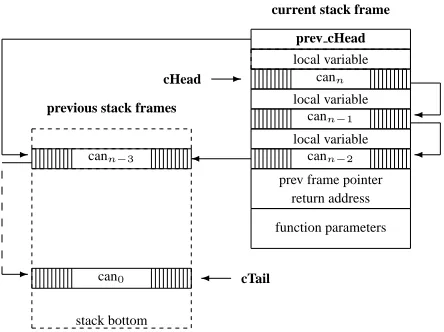
We used a function-independent way of locating and checking canaries, because it appeared to be more flexible and simple to implement and test. The set of all boundary canaries forms a linked list, as shown
cann−3
can0
- cTail
function parameters prev frame pointer return address
cann−2
local variable cann−1
local variable cann
local variable
-cHead
current stack frame
previous stack frames
stack bottom
[image:4.612.308.530.96.262.2]
-prev cHead
Figure 1: Example of the list of canaries, starting in the current stack frame (cann) and until the first
one inserted at the beginning of the process execution (can0). Variables cHeadandcTail point the head
and tail of the list. Shaded boxes represent canaries XORed with the process’ XOR canary.
in Fig. 1. The location of the head and tail canaries of the list are stored in publicly known variables (cHead
andcTailin this text). The virtual address (of an-other canary) stored in each canary is protected using the XOR canary previously referred. This way an at-tacker causing the overflow of a stack variable cannot easily guess valid values for boundary canaries be-tween the overflowed variable and the neighbouring variables to be tampered.
The full list of canaries, or particular sub-lists, can easily be checked by dereferencing canaries, XOR-ing the obtained value with the XOR canary and test-ing whether the result is a valid address. Testtest-ing the validity of an address is straightforward: (i) it must be higher than the previous one, because the list goes strictly from the top to the bottom of the stack, and (ii) it cannot be higher than a target canary address that we want to reach. Any violation of these asser-tions is an overflow evidence.
4.1.3 Triggering canary checking
There are at least two distinct situations that should trigger canary checking:
Before doing some operation related with the ex-ternal perception of the application’s behaviour. Broadly, this means that checking should be done before any I/O attempt;
In the first case, we should check the full list of canaries, from cHead to cTail, because we are looking for any stack overflow. The more times it is checked, the more timely we can find stack overflows, but with a significant impact on the performance of the application.
In the second case, we should check only the list of canaries belonging to the local stack frame (cann to cann−2in Fig. 1) since we are looking for evidences
of local stack overflows that are about to disappear. If no canaries exist in the current stack frame then no local checking is required. Checking a local list of canaries is also an iterative walk starting incHead
but ending in the head canary of the previous stack frames (cann−3in Fig. 1).
4.2
Management of the canary list
StackFences’ canaries are similar to local variables, but are invisible to application code and have a compiler-defined (initial) value. The stack space for canaries is allocated when the compiler defines the location of local variables. The setup of the canaries should occur after the normal C prologue.
The list of canaries is increased after the prologue of a function and decreased when the function returns. Increasing the list consists of adding all canaries in the local stack frame to the head of the list and storing in
cHeadthe address of the new top-most stack canary (cann in Fig. 1). Decreasing the list consists simply
of setting the value ofcHeadusing the address of the head canary of the previous stack frames (cann−3in
Fig. 1).
The list of canaries must also be increased when the program callsalloca. The space requested should be increased to accommodate a canary at the end of it, which becomes the new list head. The list must also be decreased when the program callslongjmp; in this context it is similar to a long return. The value ofcHeadmust be set with the address of the head canary in the stack frame we are jumping into, or in some other stack frame below.
4.3
Policies for canary checking
Checking boundary canaries is a potentially expen-sive operation, thus it needs to be carefully managed in order to balance two requirements: (i) effective de-tection of stack overflows and (ii) efficient execution of the program. Furthermore, in terms of effective-ness, two natural approaches should be contemplated considering the software life cycle: (i) in develop-ment stages, the sooner overflows are spotted the bet-ter, while (ii) in production stages, preventing applica-tions from “making damage” may be enough for most cases.
Thus, considering the two execution environments mentioned above – development and production – we conceived two different policies for checking the cor-rectness of boundary canaries. The two policies de-fine when two lists of canaries are checked: (i) the list of canaries belonging to the current stack frame and (ii) the full list of canaries.
4.3.1 Checking local canaries
As previously explained, boundary canaries on the current stack frame should be checked when the stack frame is about to be released; otherwise, we could miss local overflows. Consequently, the reduction of the canary list, both within a normal function return and within a call tolongjmp, always checks the con-sistency of all released canaries.
The extra code for checking local canaries and re-ducing the list of canaries was placed in a function (canReduce) that is called before the function’s epi-logue. It gets, as a parameter, the address of the head canary in the previous stack frames (cann−3in
Fig. 1). This address is stored (in clear) at the top of the current stack frame in the function’s prologue (prev cHeadin Fig. 1). The functioncanReduce
checks the canaries fromcHeaduntilprev cHead
and, at the end, storesprev cHeadincHead. For handling the reduction of the canary list af-ter a longjmp call we use a function similar to
canReduce. The function starts fromcHeadand walks along the canary list until finding a canary with an address higher than the stack pointer saved in the jump context. The address of that canary will be stored incHead. Jump contexts stored bysetjmp
and used by longjmp are not modified; only the functionality oflongjmpneeds to be extended.
4.3.2 Checking all canaries
We conceived two policies for checking the full list of canaries: one more suitable for development sce-narios, another more suitable for production environ-ments. In either case, we tried to prevent an attacked process from doing any I/O after a stack buffer over-flow. The checking function is namedcanWalk.
Development policy: In a development scenario we want to catch an overflow as accurately as pos-sible, in order to simplify the process of finding and fixing the vulnerability. It is, thus, natural to sacrifice execution efficiency in favour of debugging effective-ness. Our development policy consists of acanWalk
call before each function call. This approach is com-putationally costly but has the advantage of detecting overflows not far from where they occurred.
their I/O. Our production policy consists of a watch-dog process to catch all the system calls of the target process and to call canWalkbefore each I/O sys-tem call requested by the target process. We define an I/O system call as a system call interacting with I/O objects (files, pipes, sockets, etc.) or with other operating system resources (e.g. send signals to other processes, manage virtual memory attributes, change the ownership of the process, etc.).
5
Implementation
For implementing all the mechanisms and poli-cies previously described for detecting stack buffer overflows we modified a C compiler and developed 3 auxiliary C modules for Linux systems that must be linked with the applications we want to protect. The applications only need to be recompiled with the modified compiler and linked with some of the mod-ules to use StackFences.
For the C compiler we used the version 0.9.20 of TCC (Tiny C Compiler), a simple but complete C compiler developed by Fabrice Bellard (Bellard, 2003). We chose this compiler mainly because it al-lows a fast prototyping for getting a proof of concept. The first auxiliary module defines variables and functions that are common to all overflow checking facilities — the public variablescXor, cHeadand
cTail; the XOR canary setup function (that uses the file /dev/urandom), the function canReduce; and a newlongjmpfunction.
The second auxiliary module defines a newmain
and all the checking/aborting functions for the de-velopment policy. The newmaindefines the initial boundary canary, initiates variables in the previous module and calls the application’s originalmain.
The third auxiliary module defines a newmainand all the checking/aborting functions for the production policy. The newmaincreates a child process for run-ning the application and the initial process stays as the watchdog of the new one (usingptrace). The code of newmainexecuting in the child process is basi-cally identical to the one of the second module.
The watchdog triggers a call tocanWalkbefore allowing the execution of any requested I/O system call. The canWalk function is similar to the one in the second module but fetches canary values with
ptracebecause it runs in a different process.
6
Effectiveness evaluation
We tested the effectiveness of StackFences with the test suite described in (Wilander and Kambar, 2002) and kindly provided by the authors. The results were
the best possible: StackFences detected and halted all 12 attacks overflowing stack variables. We were also able to do so using either of the canary checking poli-cies described in§4.3.2.
The empirical results obtained with the same test suite and using 4 protection tools — StackGuard, StackShield, propolice and Libsafe/Libverify – showed that the tools where able to handle, in the best case, 10 out of the 12 attacks (with propolice). Note, however, that:
• the test suite is not complete, it only overflows character arrays, which are exactly the vulnerable variables considered bypropolice. But Stack-Fences is more powerful, being able to detect over-flows in local variables other than character arrays. Therefore, StackFences is much better suited for assessing the correctness of applications in run-time than propolice, but that cannot be fully demonstrated with this test suite.
• propolicedoes not detect any overflows within consecutive character arrays, as StackFences does, and such vulnerability is also not explored by the test suite.
7
Performance evaluation
The performance penalties introduced by Stack-Fences depend on several factors, namely: (i) the number of vulnerable local variables; (ii) the number of function calls; (iii) the length of the list of canaries whencanWalkis called; and (iv) the number of I/O operations that trigger the call tocanWalk(if using the production policy).
We evaluated StackFences with both micro and macro benchmarks. The micro benchmarks provide upper bounds to the overheads caused by setting and checking canaries in each function’s prologue and epilogue, respectively. The macro benchmarks help us to have an idea about the relative cost of each checking policy, because they control the calls to
canWalk, and also to get an idea about the space occupied by canaries. But, for lack of space, micro benchmarks are not further referred in this article.
For the evaluation of StackFences with macro benchmarks we chose 3 tools with moderate file I/O and high CPU activity: ctags, tcc and bzip2. These 3 tools where compiled in 4 different ways — withgcc,tcc, andtccwith the two StackFences checking policies — and executed with 3 different pa-rameters — the sources of each of the 3 tools. All benchmarks ran in a Red Hat 8.0 Linux box (kernel 2.4.18-27.8.0) with a Pentium IV at 2.4 GHz, 256 MB RAM and 512 KB cache.
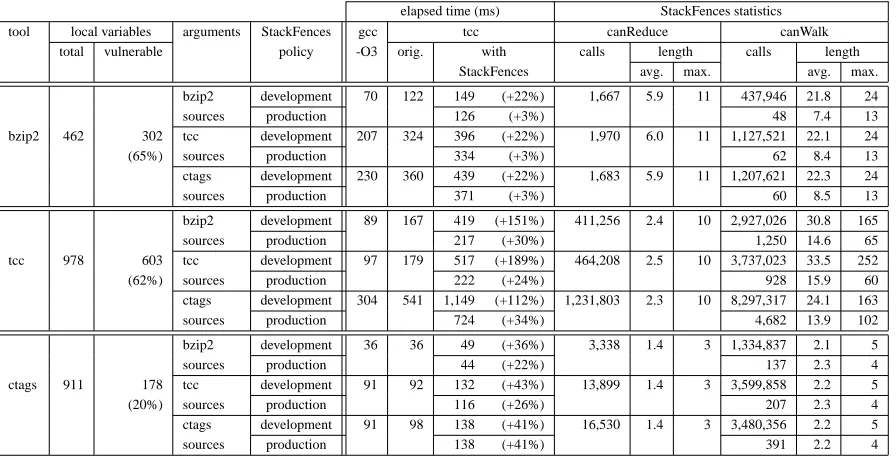
num-elapsed time (ms) StackFences statistics tool local variables arguments StackFences gcc tcc canReduce canWalk
[image:7.612.76.524.94.324.2]total vulnerable policy -O3 orig. with calls length calls length StackFences avg. max. avg. max. bzip2 development 70 122 149 (+22%) 1,667 5.9 11 437,946 21.8 24 sources production 126 (+3%) 48 7.4 13 bzip2 462 302 tcc development 207 324 396 (+22%) 1,970 6.0 11 1,127,521 22.1 24 (65%) sources production 334 (+3%) 62 8.4 13 ctags development 230 360 439 (+22%) 1,683 5.9 11 1,207,621 22.3 24 sources production 371 (+3%) 60 8.5 13 bzip2 development 89 167 419 (+151%) 411,256 2.4 10 2,927,026 30.8 165 sources production 217 (+30%) 1,250 14.6 65 tcc 978 603 tcc development 97 179 517 (+189%) 464,208 2.5 10 3,737,023 33.5 252 (62%) sources production 222 (+24%) 928 15.9 60 ctags development 304 541 1,149 (+112%) 1,231,803 2.3 10 8,297,317 24.1 163 sources production 724 (+34%) 4,682 13.9 102 bzip2 development 36 36 49 (+36%) 3,338 1.4 3 1,334,837 2.1 5 sources production 44 (+22%) 137 2.3 4 ctags 911 178 tcc development 91 92 132 (+43%) 13,899 1.4 3 3,599,858 2.2 5 (20%) sources production 116 (+26%) 207 2.3 4 ctags development 91 98 138 (+41%) 16,530 1.4 3 3,480,356 2.2 5 sources production 138 (+41%) 391 2.2 4
Table 1: Results of the execution of macro benchmarks with existing applications for evaluating the total over-heads introduced by StackFences and statistic data regarding the checking of StackFences’ canaries.
ber of local variables used by the tools and the num-ber and percentage of them that are vulnerable and checked by StackFences; the fourth column shows the arguments used with the tools; the fifth column shows the protection policy used with StackFences. In the rest of the columns we have execution results: the sixth and seventh columns show the elapsed time ob-served with the tools compiled withgcc(with max-imum optimisation) and the normaltcc(that has no optimisations); the eighth column shows the elapsed time observed with the tools compiled withtccand StackFences, using both security policies, and the overhead in percentage comparing with the results of the previous column; the last six columns show the number of calls tocanReduce andcanWalk
and the average and maximum number of canaries checked per call. StackFences’ auxiliary modules were written in C and compiled withgccand max-imum optimisation. The elapsed times are the mini-mum observed in 100 consecutive runs of each test.
The values provided for gccare only indicative, because many dynamic solutions for dealing with buffer overflows were implemented with it. But it doesn’t make sense to extrapolate the overhead of StackFences comparing with gccbecause some of the optimisations used by the latter would also reduce the overhead of StackFences if it was part of gcc. For instance,tcchas many smallinlinefunctions. Since our version of TCC ignoresinlinequalifiers, that greatly increases the number of canReduce
calls and the average number of canaries checked by
canWalk. Such overhead would not happen if we had integrated StackFences withgcc.
The results in Table 1 show that the overheads in-troduced by StackFences are acceptable. With the de-velopment policy, overheads are between 22% and 189% of the elapsed time with tcc and without StackFences. With the production policy, overheads are lower, as desired, between 3% and 41%. The pro-duction policy greatly reduces the number of calls to
canWalk, as expected. But in some cases, namely withctags, results show that it is almost irrelevant to use either checking policy. That happens because the average number of canaries checked bycanWalk
is low, making more relevant the cost of the process switching between the application and its watchdog in the production policy.
Considering the applications tested, the extra space occupied by canaries in the stack is not an issue. In the worst case there is a maximum of 252+10 canaries (when tccis compiled by itself using the develop-ment policy), which represents a memory overhead of about 1 KB.
A small comparison can be established between the performance of ctags with StackGuard and with StackFences. According to (Cowan et al., 1998),
According to Table 1, gcc and tcc generate equally fastctagsexecutables. Therefore, for this particular experience we can compare the overheads of the two protection mechanisms independently of the compilers implementing them. And the conclu-sion is that StackFences is faster than StackGuard, which makes less validation actions! This paradox is probably explained by the fact that the performance figures presented in (Cowan et al., 1998) were ob-tained with a non-optimized version of StackGuard, that added canaries and code for checking them to all functions, instead of doing it only for functions with vulnerable local variables. This fact is mentioned in the performance optimisations for StackGuard de-scribed in (Cowan et al., 1998). StackFences, on the contrary, was optimized to add canaries and for checking them locally with canReduce only in functions with vulnerable variables.
8
Conclusions
We have presented StackFences, a run-time solu-tion for detecting buffer overflows affecting variables allocated in stack frames. StackFences detects over-flows in all potentially vulnerable local variables in-stead of detecting only overflows affecting known at-tack targets, like return addresses. To the best of our knowledge this is the first solution to perform such a detailed run-time stack analysis.
For balancing detection accuracy and performance we conceived two checking policies for StackFences: a development policy, more detailed and allowing a more accurate and timely detection of overflow occur-rences, suitable for development scenarios; and a pro-duction policy, lazier, checking only when absolutely necessary, suitable for production environments.
In terms of effectiveness, StackFences detected and halted all the 12 attacks of the test suite described in (Wilander and Kambar, 2002). Although it may appear that StackFences is minutely different from
propolice, which avoids 10 of those attacks, that is not true because StackFences detects other over-flows that are not considered by the test suite and nei-ther tackled bypropolice. StackFences is much better suited for assessing the correctness of applica-tions in run-time thanpropolice, though the test suite does not properly demonstrate that.
The performance of StackFences is acceptable but depends a lot on the compiled application. We be-lieve that optimizing canary checking code can fur-ther reduce StackFences’ overheads. As desired, the overhead of the production policy is lower than the overhead of the debug policy. Finally, StackFences’ overheads are mainly compiler independent, though they may depend on some compiling options.
REFERENCES
Aleph One (1996). Smashing The Stack For Fun And Profit.
Phrack Magazine, 7(49).
Baratloo, A., Singh, N., and Tsai, T. (2000). Transparent Run-Time Defense Against Stack Smashing Attacks. In Proc. of the USENIX Annual Technical Conf., San Diego, CA, USA.
Bellard, F. (2003). Tiny C Compiler, version 0.9.20.
http://fabrice.bellard.free.fr/tcc. Chiueh, T.-C. and Hsu, F.-H. (2001). RAD: A Compile-time
Solution to Buffer Overflow Attacks. In IEEE Int.
Conf. on Distr. Computing Systems (ICDCS), Phoenix,
AZ, USA.
Cowan, C., Beattie, S., Johansen, J., and Wagle, P. (2003). PointGuard: Protecting Pointers From Buffer Over-flow Vulnerabilities. In 12th USENIX Security Symp., Washington, D.C., USA.
Cowan, C., Pu, C., Maier, D., Hinton, H., Walpole, J., Bakke, P., Beattie, S., Grier, A., Wagle, P., and Zhang, Q. (1998). StackGuard: Automatic Adaptive Detec-tion and PrevenDetec-tion of Buffer-Overflow Attacks. In
Proc. 7th USENIX Security Conf., pages 63–78, San
Antonio, TX, USA.
Etoh, H. and Yoda, K. (2000). propolice: Im-proved stack-smashing attack detection. IPSJ SIGNotes Computer SECurity Abstract, 43(12).
http://www.ipsj.or.jp/members/ Journal/Eng/4312/article053.html. Frantzen, M. and Shuey, M. (2001). StackGhost:
Hard-ware Facilitated Stack Protection. In Proc. of the 10th
USENIX Security Symp., Washington, D.C., USA.
Larochelle, D. and Evans, D. (2001). Statically Detecting Likely Buffer Overflow Vulnerabilities. In Proc. of the
10th USENIX Security Symp., pages 177–190,
Wash-ington, D.C., USA.
McGraw, G. (2002). Building Secure Software. In
RTO/NATO Real-Time Intrusion Detection Symp.,
Es-toril, Portugal. Invited Talk.
Spafford, E. H. (1989). The Internet Worm Incident. In Ghezzi, C. and McDermid, J. A., editors, ESEC‘89
2nd European Software Engineering Conf., University
of Warwick, Coventry, United Kingdom. Springer. Wagle, P. and Cowan, C. (2003). StackGuard: Simple Stack
Smash Protection for GCC. In Proc. of the GCC
De-velopers Summit, pages 243–255.
Wagner, D., Foster, J. S., Brewer, E. A., and Aiken, A. (2000). A First Step towards Automated Detection of Buffer Overrun Vulnerabilities. In Proc. of the
Inter-net Soc. Symp. on Network and Distr. Systems Security (NDSS 00), pages 3–17, San Diego, CA, USA.
Wilander, J. and Kambar, M. (2002). A Comparison of Pub-licly Available Tools for static intrusion prevention. In
Proc. of the 7th Nordic Workshop on Secure IT Sys-tems, pages 68–84, Karlstad, Sweden.
Xu, J., Kalbarczyk, Z., Patel, S., and Iyer, R. K. (2002). Architecture Support for Defending Against Buffer Overflow Attacks. In 2nd Works. on Evaluating and
Architecting System Dependability (EASY), San Jose,