ix
Saurabh Bagchi (Chapter 10) is an assistant professor in the School of Electrical and Computer Engineering at Purdue University, West Lafayette, Indiana. He is a fac-ulty fellow of the Cyber Center and has a courtesy appointment in the Department of Computer Science at Purdue University. He received his M.S. and Ph.D. from the University of Illinois at Urbana–Champaign in 1998 and 2001, respectively. At Purdue, he leads the Dependable Computing Systems Lab (DCSL), where he and a group of wildly enthusiastic students try to make and break distributed systems for the good of the world. His work is supported by NSF, Indiana 21st Century Research and Technology Fund, Avaya, and Purdue Research Foundation, with equipment grants from Intel and Motorola. His papers have been runner-ups for best paper in HPDC (2006), DSN (2005), and MTTS (2005). He has been an Organizing Committee member and Program Committee member for the Dependable Systems and Networks Conference (DSN) and the Symposium on Reliable Distributed
Systems (SRDS). He also contributed to Information Assurance: Dependability
and Security in Networked Systems , published by Elsevier, 2007.
Bruce S. Davie (Chapter 1) joined Cisco Systems in 1995, where he is a Cisco Fellow. For many years, he led the team of architects responsible for Multiprotocol Label Switching and IP Quality of Service. He recently joined the Video and Content Networking Business Unit in the Service Provider group. He has 20 years of networking and communications industry experience and has written numer-ous books, RFCs, journal articles, and conference papers on IP networking. He is also an active participant in both the Internet Engineering Task Force and the Internet Research Task Force. Prior to joining Cisco, he was director of internet-working research and chief scientist at Bell Communications Research. Bruce holds a Ph.D. in computer science from Edinburgh University and is a visiting lecturer at M.I.T. His research interests include routing, measurement, quality of service, transport protocols, and overlay networks. He is also a co-author of
Computer Networks: A Systems Approach , published by Elsevier, 2007.
Adrian Farrel (Chapter 5) has over two decades of experience designing and developing communications protocol software. As Old Dog Consulting, he is an industry-leading freelance consultant on MPLS, GMPLS, and Internet routing, for-merly working as MPLS Architect for Data Connection Ltd., and as director of Protocol Development for Movaz Networks, Inc. He is active within the Internet Engineering Task Force, where he is co-chair of the CCAMP working group responsible for GMPLS, the Path Computation Element (PCE) working group, and the Layer One VPN (L1VPN) working group. Adrian has co-authored and contrib-uted to numerous Internet drafts and RFCs on MPLS, GMPLS, and related
tech-nologies. He is also the author of The Internet and Its Protocols: A Comparative
Approach , published by Elsevier, 2004.
About the Authors
BIO-P374463.indd ix
x
Bingrui Foo (Chapter 10) is a Ph.D. student in the School of Electrical and Computer Engineering at Purdue University in West Lafayette, Indiana. Presently, he is involved in two research projects: one in the fi eld of network security, spe-cifi cally the design of intrusion-tolerant systems and automated response mecha-nisms, and one in the fi eld of statistical modeling, which consists of extending mixture models by adding hierarchal structure to images and videos. His papers
have appeared in DSN and ACSAC. He also contributed to Information Assurance:
Dependability and Security in Networked Systems , published by Elsevier, 2007.
Vijay K. Garg (Chapter 7) has been a professor in the Electrical and Computer Engineering Department at the University of Illinois at Chicago since 1999, where he teaches graduate courses in Wireless Communications and Networking. Dr. Garg was a Distinguished Member of Technical Staff at the Lucent Technologies Bell Labs in Naperville, Illinois, from 1985 to 2001. He received his Ph.D. from the Illinois Institute of Technologies, Chicago, Illinois, in 1973, and he received an M.S. from the University of California at Berkeley, California, in 1966. Dr. Garg has co-authored several technical books, including fi ve in wireless communications. He is a fellow of ASCE and ASME, and a senior member of IEEE. Dr. Garg is a registered professional engineer in the states of Maine and Illinois. He is an academic member of the Russian Academy of Transport. Dr. Garg was a feature editor of Wireless/PCS
Series in IEEE Communication Magazine from 1996 to 2001. He is also the author
of Wireless Communications & Networking , published by Elsevier, 2007.
Matthew W. Glause (Chapter 10) Center for Education and Research in Information Assurance and Security (CERIAS), Dependable Computing Systems Laboratory, School of Electrical and Computer Engineering, Purdue University.
He also contributed to Information Assurance: Dependability and Security in
Networked Systems , published by Elsevier, 2007.
Gaspar Modelo-Howard (Chapter 10) is a Ph.D. student in the Department of Electrical and Computer Engineering and a member of the Center for Education and Research in Information Assurance and Security (CERIAS) at Purdue University, West Lafayette, Indiana. He came to Purdue after spending seven years as an infor-mation security offi cer for the Panama Canal Authority and fi ve years as a college professor for network security courses. His current research interests include machine-learning techniques for intrusion response and the convergence between security and dependability. He has an M.S. in information security from Royal Holloway, University of London, and a B.S. in electrical engineering from
Universidad Tecnologica de Panama. He also contributed to Information Assurance:
Dependability and Security in Networked Systems , published by Elsevier, 2007.
James Joshi (Chapter 2) is an assistant professor in the School of Information Sciences at the University of Pittsburgh, Pennsylvania. He is a cofounder and the director of the Laboratory of Education and Research on Security Assured
About the Authors
BIO-P374463.indd x
xi
Information Systems (LERSAIS). At Pitt, he teaches several information assurance (IA) courses and coordinates the IA program. His research interests include access control models, security and privacy of distributed multimedia systems, trust man-agement, and information survivability. His research has been supported by the National Science Foundation, and he is a recipient of the NSF-CAREER award in 2006. He received his M.S. in computer science and a Ph.D. in electrical and com-puter engineering from Purdue University, West Lafayette, Indiana, in 1998 and 2003, respectively. He is also a co-author of Information Assurance: Dependability and Security in Networked Systems , published by Elsevier, 2007.
Prashant Krishnamurthy (Chapter 2) is an associate professor with the graduate program in Telecommunications and Networking at the University of Pittsburgh, Pennsylvania. At Pitt, he regularly teaches courses on wireless commu-nication systems and networks, cryptography, and network security. His research interests are wireless network security, wireless data networks, position loca-tion in indoor wireless networks, and radio channel modeling for indoor wire-less networks. His research has been funded by the National Science Foundation and the National Institute of Standards and Technology. He is the co-author of the
books Principles of Wireless Networks: A Unifi ed Approach and Physical Layer
of Communication Systems (Prentice Hall; 1st edition, December 11, 2001). He served as the chair of the IEEE Communications Society, Pittsburgh Chapter, from 2000 to 2005. He obtained his Ph.D. in 1999 from Worcester Polytechnic Institute,
Worcester, Massachusetts. He is also a co-author of Information Assurance:
Dependability and Security in Networked Systems , published by Elsevier, 2007.
Pete Loshin (Chapter 6) writes and consults about Internet protocols and
open source network technologies. Formerly on the staff of BYTE Magazine,
Information Security Magazine , and other publications, his work appears regu-larly in leading trade publications and websites, including CPU, Computerworld, PC Magazine, EarthWeb, Internet.com, and CNN. He is also the author of IPv6: Theory, Protocol, and Practice , published by Elsevier, 2003.
James D. McCabe (Chapter 3) was an advisor on networking to NASA and the Department of Commerce OCIOs. He is the recipient of multiple NASA awards and holds patents in supercomputer network research. He has been architect-ing, designarchitect-ing, and deploying high-performance networks for over 20 years. He also consults, teaches, and writes about network analysis, architecture, and design. McCabe holds degrees in chemical engineering and physics from Georgia Institute
of Technology and Georgia State University. He is also the author of Network
Analysis, Architecture, and Design , published by Elsevier, 2007.
Lionel M. Ni (Chapter 8) is a professor and head of the Computer Science Department at the Hong Kong University of Science and Technology. Dr. Ni earned his Ph.D. in electrical and computer engineering from Purdue University,
About the Authors
BIO-P374463.indd xi
xii
West Lafayette, Indiana, in 1981. He was a professor in the Computer Science and Engineering Department at Michigan State University, where he started his academic career in 1981. He has been involved in many projects related to wire-less technologies, 2.5G/3G cellular phones, and embedded systems. He is also a
co-author of Smart Phone and Next Generation Mobile Computing , published
by Elsevier, 2005.
Larry L. Peterson (Chapter 1) is a professor and chair of Computer Science at Princeton University. He is the director of the Princeton-hosted PlanetLab Consortium and chair of the planning group for NSF’s GENI Initiative. His research focuses on the design and implementation of networked systems. Peterson is a fel-low of the ACM. He received his Ph.D. from Purdue University in 1985. He is also a co-author of Computer Networks: A Systems Approach , published by Elsevier, 2007.
Rajiv Ramaswami (Chapter 9) leads a group in planning and designing pho-tonic switching products at Nortel Networks. He has worked on optical networks since 1988, from early research to product development, that includes stints at IBM research, Tellabs, and Xros (now part of Nortel). He is an IEEE Fellow and a recipient of the IEEE W.R.G. Baker and W.R. Bennett prize paper awards, as well as an Outstanding Innovation award from IBM. Rajiv received a Ph.D. in electrical engineering and computer science from the University of California at Berkeley. He is also a co-author of Optical Networks: A Practical Perspective , published by Elsevier, 2001.
Kumar N. Sivarajan (Chapter 9) is cofounder and chief technology offi cer at Tejas Networks, an optical networking start-up in Bangalore, India. He has worked on optical, wireless, ATM, and Internet networking technologies for over a decade, fi rst at IBM Research and then at the Indian Institute of Science, Bangalore. He is a recipient of the IEEE W.R.G. Baker and W.R. Bennett prize paper awards. Kumar received his Ph.D. in electrical engineering from the California Institute of Technology. He is also a co-author of Optical Networks: A Practical Perspective , published by Elsevier, 2001.
Eugene H. Spafford (Chapter 10) is one of the most senior and recognized lead-ers in the fi eld of computing. He has an ongoing record of accomplishments as a senior advisor and consultant on issues of security, education, cyber crime, and computing policy to a number of major companies, law enforcement organiza-tions, and academic and government agencies, including Microsoft, Intel, Unisys, the U.S. Air Force, the National Security Agency, the GAO, the Federal Bureau of Investigation, the National Science Foundation, the Department of Energy, and for two presidents of the United States. With nearly three decades of experience as a researcher and instructor, Dr. Spafford has worked in software engineering, reli-able distributed computing, host and network security, digital forensics, computing
About the Authors
BIO-P374463.indd xii
xiii
policy, and computing curriculum design. He is responsible for a number of “ fi rsts ” in several of these areas. Dr. Spafford is a professor with a joint appointment in com-puter science and electrical and comcom-puter engineering at Purdue University, West Lafayette, Indiana, where he has served on the faculty since 1987. He is also a pro-fessor of philosophy (courtesy) and a propro-fessor of communication (courtesy). He is the executive director of the Purdue University Center for Education and Research in Information Assurance and Security (CERIAS). As of 2007, Dr. Spafford is also an adjunct professor of computer science at the University of Texas at San Antonio, and is executive director of the Advisory Board of the new Institute for Information Assurance there. Dr. Spafford serves on a number of advisory and editorial boards, and he has been honored several times for his writing, research, and teaching on
issues of security and ethics. He also contributed to Information Assurance:
Dependability and Security in Networked Systems , published by Elsevier, 2007.
George Varghese (Chapter 4) is a widely recognized authority on the art of network protocol implementation. Currently a professor in the Department of Computer Science at UC–San Diego, he has previously worked for Digital Equipment Corporation and taught at Washington University. Elected a fellow of the ACM in 2002, he holds (with colleagues) 14 patents in the general fi eld of network algorithmics. Several algorithms that he helped develop have found their way into commercial systems, including Linux (timing wheels), the Cisco
GSR (DRR), and MS Windows (IP lookups). He is also the author of Network
Algorithmics: An Interdisciplinary Approach to Designing Fast Networked Devices , published by Elsevier, 2004.
Yu-Sung Wu (Chapter 10) is a Ph.D. student in the School of Electrical and Computer Engineering at Purdue University, West Lafayette, Indiana, since 2004. His primary research areas are information security and fault tolerance in computer sys-tems. He is a member of the Dependable Computing Systems Laboratory at Purdue, where he participates in the research projects for ADEPTS (an intrusion response system) and CIDS (a correlation framework for intrusion detection). Yu-Sung also has been working closely with researchers at Avaya Labs on building the IDS/IPS solutions for voiceover IP systems. He also contributed to Information Assurance: Dependability and Security in Networked Systems , published by Elsevier, 2007.
Pei Zheng (Chapter 8) was an assistant professor in the Computer Science Department at Arcadia University and a consultant working in the areas of mobile computing and distributed systems during the writing of this book. Dr. Zheng received his Ph.D. in computer science from Michigan State University in 2003. He was a member of the technical staff in Bell Laboratories/Lucent Technologies. He joined Microsoft in 2005. His research interests include distributed systems, network
simulation and emulation, and mobile computing. He is also a co-author of Smart
Phone and Next Generation Mobile Computing , published by Elsevier, 2005.
About the Authors
BIO-P374463.indd xiii
1
Computer networks are typically a shared resource used by many applications representing different interests. The Internet is particularly widely shared, being used by competing businesses, mutually antagonistic governments, and opportu-nistic criminals. Unless security measures are taken, a network conversation or a distributed application may be compromised by an adversary.
Consider some threats to secure use of, for example, the World Wide Web. Suppose you are a customer using a credit card to order an item from a website. An obvious threat is that an adversary would eavesdrop on your network commu-nication, reading your messages to obtain your credit card information. How might that eavesdropping be accomplished? It is trivial on a broadcast network such as an Ethernet, where any node can be confi gured to receive all the message traffi c on that network. Wireless communication can be monitored without any physi-cal connection. More elaborate approaches include wiretapping and planting spy software on any of the chain of nodes involved. Only in the most extreme cases, such as national security, are serious measures taken to prevent such monitoring, and the Internet is not one of those cases. It is possible and practical, however, to encrypt messages so as to prevent an adversary from understanding the message contents. A protocol that does so is said to provide confi dentiality . Taking the concept a step further, concealing the quantity or destination of communication
is called traffi c confi dentiality —because merely knowing how much
communica-tion is going where can be useful to an adversary in some situacommunica-tions.
Even with confi dentiality there still remain threats for the website customer. An adversary who can’t read the contents of your encrypted message might still be able to change a few bits in it, resulting in a valid order for, say, a completely different item or perhaps 1,000 units of the item. There are techniques to detect, if not prevent, such tampering. A protocol that detects such message tampering provides data integrity . The adversary could alternatively transmit an extra copy
of your message in a replay attack . To the website, it would appear as though
you had simply ordered another of the same item you ordered the fi rst time. A protocol that detects replays provides originality . Originality would not, however,
Network Security Overview
1
CHAPTER
CH01-P374463.indd 1
2 CHAPTER 1 Network Security Overview
preclude the adversary intercepting your order, waiting a while, then transmit-ting it—in effect, delaying your order. The adversary could thereby arrange for the item to arrive on your doorstep while you are away on vacation, when it can be easily snatched. A protocol that detects such delaying tactics is said to provide
timeliness . Data integrity, originality, and timeliness are considered aspects of the more general property of integrity .
Another threat to the customer is unknowingly being directed to a false web-site. This can result from a DNS attack, in which false information is entered in a domain name server or the name service cache of the customer’s computer. This leads to translating a correct URL into an incorrect IP address—the address of a false website. A protocol that ensures that you really are talking to whom you think you’re talking is said to provide authentication . Authentication entails integrity since it is meaningless to say that a message came from a certain partici-pant if it is no longer the same message.
The owner of the website can be attacked as well. Some websites have been defaced; the fi les that make up the website content have been remotely accessed and modifi ed without authorization. That is an issue of access control : enforcing the rules regarding who is allowed to do what. Websites have also been subject to denial of service (DoS) attacks, during which would-be customers are unable to access the website because it is being overwhelmed by bogus requests. Ensuring a degree of access is called availability .
Finally, the customer and website face threats from each other. Each could unilaterally deny that a transaction occurred, or invent a nonexistent transaction.
Nonrepudiation means that a bogus denial (repudiation) of a transaction can be disproved, and nonforgeability means that claims of a bogus (forged) transaction can be disproved.
Although these examples have been based on Web transactions, there are com-parable security threats in almost every network context. Although the Internet was designed with the redundancy to survive physical attacks such as bombing, it was not originally designed to provide the kind of security we have been discuss-ing. Internet security mechanisms have essentially been patches. If a comprehen-sive redesign of the Internet were to take place, integrating security would likely be the foremost driving factor. That possibility makes this chapter all the more pertinent.
The main tools for securing networked systems are cryptography and fi re-walls. The bulk of this chapter concerns cryptography-based security.
1.1
CRYPTOGRAPHIC TOOLS
We introduce the concepts of cryptography-based security step by step. The fi rst step is the cryptographic algorithms—ciphers and cryptographic hashes—that are introduced in this section. They are not a solution in themselves, but rather building blocks from which a solution can be built. The next step (Section 1.2)
CH01-P374463.indd 2
3
addresses the problem of distributing the keys, the secret parameters that are input to cryptographic algorithms. In the next step (Section 1.3), we describe how to incorporate the cryptographic building blocks into protocols that pro-vide secure communication between participants who possess the correct keys. Finally, Section 1.4 examines several complete security protocols and systems in current use.
1.1.1
Principles of Ciphers
Encryption transforms a message in such a way that it becomes unintelligible to any party that does not have the secret of how to reverse the transformation. The sender applies an encryption function to the original plaintext message, result-ing in a ciphertext message that is sent over the network, as in Figure 1.1 . The
receiver applies a secret decryption function—the inverse of the encryption
function—to recover the original plaintext. The ciphertext transmitted across the network is unintelligible to any eavesdropper, assuming she doesn’t know the decryption function. The transformation represented by an encryption function and its corresponding decryption function is called a cipher .
Cryptographers have been led to the principle, fi rst stated in 1883, that encryp-tion and decrypencryp-tion funcencryp-tions should be parameterized by a key , and furthermore that the functions should be considered public knowledge—only the key need be secret. Thus, the ciphertext produced for a given plaintext message depends on both the encryption function and the key. One reason for this principle is that if you depend on the cipher being kept secret, then you have to retire the cipher (not just the keys) when you believe it is no longer secret. This means potentially
FIGURE 1.1
Symmetric-key encryption and decryption.
1.1 Cryptographic Tools
CH01-P374463.indd 3
4 CHAPTER 1 Network Security Overview
frequent changes of cipher, which is problematic since it takes a lot of work to develop a new cipher. Also, one of the best ways to know that a cipher is secure is to use it for a long time—if no one breaks it, it’s probably secure. (Fortunately, there are plenty of people who will try to break ciphers and who will let it be widely known when they have succeeded, so no news is generally good news.) Thus, there is considerable cost and risk in deploying a new cipher. Finally, param-eterizing a cipher with keys provides us with what is in effect a very large fam-ily of ciphers; by switching keys we essentially switch ciphers, thereby limiting the amount of data that a cryptanalyst (code-breaker) can use to try to break our key/cipher, and the amount she can read if she succeeds.
The basic requirement for an encryption algorithm is that it turns plaintext into ciphertext in such a way that only the intended recipient—the holder of the decryption key—can recover the plaintext. What this means is that encrypted messages cannot be read by people who do not hold the key.
It is important to realize that when a potential attacker receives a piece of ciphertext, he may have more information at his disposal than just the ciphertext itself. For example, he may know that the plaintext was written in English, which means that the letter e occurs more often in the plaintext that any other letter; the frequency of many other letters and common letter combinations can also be pre-dicted. This information can greatly simplify the task of fi nding the key. Similarly, he may know something about the likely contents of the message; for example, the word “ login ” is likely to occur at the start of a remote login session. This may
enable a known plaintext attack, which has a much higher chance of success
than a ciphertext only attack. Even better is a chosen plaintext attack, which may be enabled by feeding some information to the sender that you know the sender is likely to transmit—such things have happened in wartime, for example.
The best cryptographic algorithms, therefore, can prevent the attacker from deducing the key even when the individual knows both the plaintext and the ciphertext. This leaves the attacker with no choice but to try all the possible keys—exhaustive, “ brute-force ” search. If keys have n bits, then there are 2 n
possi-ble values for a key (each of the n bits could be either a zero or a one). An attacker could be so lucky as to try the correct value immediately, or so unlucky as to try every incorrect value before fi nally trying the correct value of the key, therefore, she would have tried all 2 n possible values; the average number of guesses to
dis-cover the correct value is halfway between those extremes, 2 n /2. This can be made
computationally impractical by choosing a suffi ciently large key space and by mak-ing the operation of checkmak-ing a key reasonably costly. What makes this diffi cult is that computing speeds keep increasing, making formerly infeasible computations feasible. Furthermore, although we are concentrating on the security of data as it moves through the network—that is, the data is sometimes vulnerable for only a short period of time—in general, security people have to consider the vulnerabil-ity of data that needs to be stored in archives for tens of years. This argues for a generously large key size. On the other hand, larger keys make encryption and decryption slower.
CH01-P374463.indd 4
5
Most ciphers are block ciphers : they are defi ned to take as input a plaintext block of a certain fi xed size, typically 64 to 128 bits. Using a block cipher to
encrypt each block independently—known as electronic codebook (ECB) mode
encryption—has the weakness that a given plaintext block value will always result in the same ciphertext block. Hence recurring block values in the plaintext are recognizable as such in the ciphertext, making it much easier for a cryptanalyst to break the cipher.
To prevent this, block ciphers are always augmented to make the ciphertext for a block vary depending on context. Ways in which a block cipher may be
aug-mented are called modes of operation . A common mode of operation is cipher
block chaining (CBC), in which each plaintext block is XORed with the previous block’s ciphertext before being encrypted. The result is that each block’s cipher-text depends in part on the preceding blocks (i.e., on its concipher-text). Since the fi rst plaintext block has no preceding block, it is XORed with a random number. That random number, called an initialization vector (IV) , is included with the series of ciphertext blocks so that the fi rst ciphertext block can be decrypted. This mode is illustrated in Figure 1.2 . Another mode of operation is counter mode , in which successive values of a counter (e.g., 1, 2, 3, . . .) are incorporated into the encryp-tion of successive blocks of plaintext.
FIGURE 1.2
Cipher block chaining (CBC).
1.1 Cryptographic Tools
CH01-P374463.indd 5
6 CHAPTER 1 Network Security Overview
1.1.2
Symmetric-Key Ciphers
In a symmetric-key cipher, both participants 1 in a communication share the same key. In other words, if a message is encrypted using a particular key, the same key is required for decrypting the message. If the cipher illustrated in Figure 1.1 were a symmetric-key cipher, then the encryption and decryption keys would be iden-tical. Symmetric-key ciphers are also known as secret-key ciphers since the shared key must be known only to the participants.
The U.S. National Institute of Standards and Technology (NIST) has issued
stan-dards for a series of symmetric-key ciphers. Data Encryption Standard (DES)
was the fi rst, and it has stood the test of time in that no cryptanalytic attack bet-ter than brute-force search has been discovered. Brute-force search, however, has gotten faster. DES’s keys (56 independent bits) are now too small given current processor speeds. Consequently, NIST updated the DES standard in 1999 to indi-cate that DES should only be used for legacy systems. Nonetheless, DES is still widespread.
NIST also standardized the cipher Triple DES (3DES) , which leverages the
cryptanalysis resistance of DES while in effect increasing the key size. A 3DES key has 168 ( 3 * 56) independent bits, and is used as three DES keys; let’s call them DES-key1, DES-key2, and DES-key3. 3DES-encryption of a block is performed by fi rst DES-encrypting the block using DES-key1, then DES- de crypting the result using DES-key2, and fi nally DES-encrypting that result using DES-key3. Decryption involves decrypting using DES-key3, then encrypting using DES-key2, then decrypting using DES-key1.
The reason 3DES encryption uses DES de cryption with DES-key2 is to interop-erate with legacy DES systems. If a legacy DES system uses a certain key, then 3DES can compute the same encryption function by using that key for each of DES-key1, DES-key2, and DES-key3: In the fi rst two steps we encrypt and then decrypt with the same key, producing the original plaintext, which we then encrypt again.
Although 3DES solves DES’s key-length problem, it inherits some other short-comings. Software implementations of DES/3DES are slow because it was origi-nally designed, by IBM, for implementation in hardware. Also, DES/3DES uses a 64-bit block size; a larger block size is more effi cient and more secure.
3DES is being superseded by the Advanced Encryption Standard (AES) issued
by NIST in 2001. The cipher selected to become that standard (with a few minor
modifi cations) was originally named Rijndael (pronounced roughly like “ Rhine
dahl ” ) based on the names of its inventors, Daemen and Rijmen. AES supports key lengths of 128, 192, or 256 bits, and the block length is 128 bits. AES permits fast implementations in both software and hardware. It doesn’t require much memory, which makes it suitable for small mobile devices. AES has some mathematically
1 We use the term participant for the parties involved in a secure communication since that is the
term we have been using throughout the chapter to identify the two endpoints of a channel. In the security world, they are typically called principals.
CH01-P374463.indd 6
7
proven security properties and, as of 2005, there are not known to have been any successful attacks against it.
1.1.3
Public-Key Ciphers
An alternative to symmetric-key ciphers is asymmetric, or public-key, ciphers. Instead of a single key shared by two participants, a public-key cipher uses a pair of related keys, one for encryption and a different one for decryption. The pair of keys is “ owned ” by just one participant. The owner keeps the decryption key secret so that only the owner can decrypt messages; that key is called the private
key . The owner makes the encryption key public, so that anyone can encrypt
messages for the owner; that key is called the public key . Obviously, for such a scheme to work it must not be possible to deduce the private key from the public key. Consequently, any participant can get the public key and send an encrypted message to the owner of the keys, and only the owner has the private key neces-sary to decrypt it. This scenario is depicted in Figure 1.3 .
Because it is somewhat unintuitive, we emphasize that the public encryption key is useless for decrypting a message—you couldn’t even decrypt a message that you yourself had just encrypted unless you had the private, decryption key. If we think of keys as defi ning a communication channel between participants, then another difference between public-key and symmetric-key ciphers is the topol-ogy of the channels. A key for a symmetric-key cipher provides a channel that is two-way between two participants—each participant holds the same (symmetric)
FIGURE 1.3
Public-key encryption.
1.1 Cryptographic Tools
CH01-P374463.indd 7
8 CHAPTER 1 Network Security Overview
key that either one can use to encrypt or decrypt messages in either direction. A public/private key pair, in contrast, provides a channel that is one-way, and many-to-one from everyone who has the public key to the (unique) owner of the pri-vate key, as illustrated in Figure 1.3 .
An important additional property of public-key ciphers is that the private decryption key can be used with the encryption algorithm to encrypt messages so that they can only be decrypted using the public encryption key. This prop-erty clearly wouldn’t be useful for confi dentiality since anyone with the public key could decrypt such a message. (Indeed, for two-way confi dentiality between two participants, each participant needs its own pair of keys, and each encrypts mes-sages using the other’s public key.) This property is, however, useful for authentica-tion since it tells the receiver of such a message that it could only have been created by the owner of the keys (subject to certain assumptions that we will get into later). This is illustrated in Figure 1.4 . It should be clear from the fi gure that anyone with the public key can decrypt the encrypted message, and assuming that the result of the decryption matches the expected result, it can be concluded that the private key must have been used to perform the encryption. Exactly how this operation is used to provide authentication is the topic of Section 1.3. As we will see, public-key ciphers are used primarily for authentication and to confi dentially distribute sym-metric keys, leaving the rest of confi dentiality to symsym-metric-key ciphers.
A bit of interesting history: The concept of public-key ciphers was fi rst pub-lished in 1976 by Diffi e and Hellman. Subsequently, however, documents have come to light proving that Britain’s Communications-Electronics Security Group had discovered public-key ciphers by 1970, and the U.S. National Security Agency (NSA) claims to have discovered them in the mid-1960s.
The best-known public-key cipher is RSA, named after its inventors: Rivest, Shamir, and Adleman. RSA relies on the high computational cost of factoring large numbers. The problem of fi nding an effi cient way to factor numbers is one that mathematicians have worked on unsuccessfully since long before RSA appeared in 1978, and RSA’s subsequent resistance to cryptanalysis has further bolstered
FIGURE 1.4
Authentication using public keys.
CH01-P374463.indd 8
9
confi dence in its security. Unfortunately, RSA needs relatively large keys, at least 1,024 bits, to be secure. This is larger than keys for symmetric-key ciphers because it is faster to break an RSA private key by factoring the large number on which the pair of keys is based than by exhaustively searching the key space.
Another public-key cipher is ElGamal. Like RSA, it relies on a mathematical problem, the discrete logarithm problem, for which no effi cient solution has been found, and requires keys of at least 1,024 bits. There is a variation of the discrete logarithm problem, arising when the input is an elliptic curve, that is thought to be even more diffi cult to compute; cryptographic schemes based on this problem are referred to as elliptic curve cryptography.
Public-key ciphers are, unfortunately, several orders of magnitude slower than symmetric-key ciphers. Consequently, symmetric-key ciphers are used for the vast majority of encryption, while public-key ciphers are reserved for use in authenti-cation (Section 1.1.4) and session key establishment (Section 1.2).
1.1.4
Authenticators
Encryption alone does not provide data integrity. For example, just randomly modi-fying a ciphertext message could result in a value that decrypts into valid-appearing plaintext, in which case the tampering would be undetectable by the receiver. Nor does encryption alone provide authentication. It is meaningless to say that a message came from a certain participant if the contents of the message have been modifi ed. To some extent one may focus on either of authentication or data integ-rity temporarily, but they are fundamentally inseparable.
An authenticator is a value, to be included in a transmitted message, that can be used to verify simultaneously the authenticity and the data integrity of a mes-sage. We defer discussion of the use of authenticators in protocols to Section 1.3. Here we focus on the algorithms that produce authenticators.
To support data integrity, an authenticator includes redundant information about the message contents; it is like a checksum or cyclic redundancy check (CRC). To support authentication, an authenticator includes some proof that whoever created the authenticator knows a secret that is known only to the alleged sender of the message; for example, the secret could be a key, and the proof could be some value encrypted using the key. There is a mutual dependency between the form of the redundant information and the form of the proof of secret knowledge. We discuss several workable combinations.
We initially assume that the original message need not be confi dential—that a transmitted message will consist of the plaintext of the original message plus an authenticator. Later we will consider the case where confi dentiality is desired.
One kind of authenticator combines encryption and a cryptographic hash
func-tion . A cryptographic hash function (also known as a cryptographic checksum) is
a function that outputs suffi cient redundant information about a message to expose any tampering. Just as a checksum or CRC exposes bit error introduced by noisy links, a cryptographic checksum is designed to expose deliberate corruption of
1.1 Cryptographic Tools
CH01-P374463.indd 9
10 CHAPTER 1 Network Security Overview
messages by an adversary. The value it outputs is called a message digest and, like an ordinary checksum, is appended to the message. All the message digests pro-duced by a given hash have the same number of bits regardless of the length of the original message. Since the space of possible input messages is larger than the space of possible message digests, there will be different input messages that produce the same message digest, like collisions in a hash table. Cryptographic hash algorithms are treated as public knowledge, as with cipher algorithms.
An authenticator can be created by encrypting the message digest. The receiver computes a digest of the plaintext part of the message, and compares that to the decrypted message digest. If they are equal, then the receiver would conclude that the message is indeed from its alleged sender (since it would have to have been encrypted with the right key) and has not been tampered with. No adversary could get away with sending a bogus message with a matching bogus digest because she would not have the key to encrypt the bogus digest correctly. An adversary could, however, obtain the plaintext original message and its encrypted digest by eaves-dropping. The adversary could then (since the hash function is public knowledge) compute the digest of the original message, and generate alternative messages look-ing for one with the same message digest. If she fi nds one, she could undetectably send the new message with the old authenticator. Therefore, security requires that
the hash function have the one-way property: It must be computationally
infea-sible for an adversary to fi nd any plaintext message that has the same digest as the original.
For a hash function to meet this requirement, its outputs must be fairly randomly distributed. For example, if digests are 128 bits long and randomly distributed, then you would need to try 2 127 messages, on average, before fi nding a second message whose digest matches that of a given message. If the outputs are not randomly distributed—that is, if some outputs are much more likely than others—then for some messages you could fi nd another message with the same digest much more eas-ily than this, which would reduce the security of the algorithm. If you were instead just trying to fi nd any collision —any two messages that produce the same digest— then you would need to compute the digests of only 2 64 messages, on average. This surprising fact is the basis of the birthday attack—see the exercises for more details.
The most common cryptographic hash algorithms are Message Digest 5 (MD5) and Secure Hash Algorithm 1 (SHA-1). MD5 outputs a 128-bit digest, and SHA-1 outputs a 160-bit digest. Researchers have recently discovered techniques for fi nd-ing MD5 collisions much more effi ciently than brute force, and well within com-putational feasibility. This led to recommendations to shift from MD5 to SHA-1. Even more recently researchers have discovered techniques that fi nd SHA-1 colli-sions somewhat more effi ciently than brute force, but are not yet computationally feasible. Although collision attacks (attacks based on fi nding any collision) are not as great a risk as preimage attacks (attacks based on fi nding a second mes-sage that collides with a given fi rst mesmes-sage), these are nonetheless serious weak-nesses. NIST has proposed to phase out SHA-1 by 2010, in favor of four variants of SHA that are collectively known as SHA-2.
CH01-P374463.indd 10
11
In this approach (encrypted message digest) to generating an authenticator, the digest encryption could use either a symmetric-key cipher or a public-key cipher. If a public-key cipher is used, the digest would be encrypted using the sender’s private key (the one we normally think of as being used for decryption), and the receiver—or anyone else—could decrypt the digest using the sender’s public key.
A digest encrypted with a public-key algorithm but using the private key is called a digital signature because it provides nonrepudiation like a written signa-ture. The receiver of a message with a digital signature can prove to any third party that the sender really sent that message, because the third party can use the sender’s public key to check for herself. (Symmetric-key encryption of a digest does not have this property because only the two participants know the key; furthermore, since both participants know the key, the alleged receiver could have created the message herself.) Any public-key cipher can be used for digital signatures. Digital Signature Standard (DSS) is a digital signature format that has been standardized by NIST. DSS signatures may use any one of three public-key ciphers, one based on RSA, another on ElGamal, and a third called Elliptic Curve Digital Signature Algorithm.
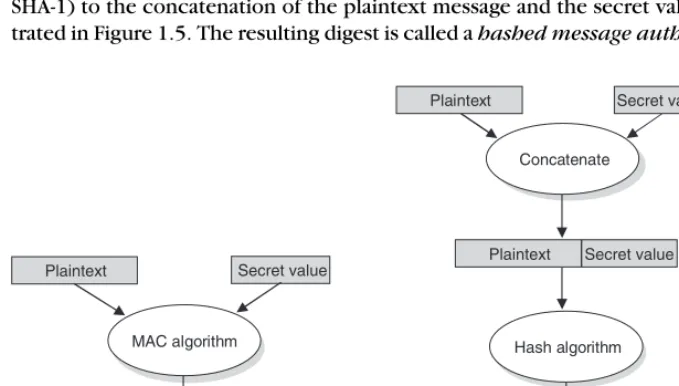
Another kind of authenticator is similar, but instead of encrypting a hash, it uses a hashlike function that takes a secret value (known to only the sender and the receiver) as a parameter, as illustrated in Figure 1.5 . Such a function outputs an authenticator called a message authentication code (MAC) . The sender appends the MAC to her plaintext message. The receiver recomputes the MAC using the plaintext and the secret value, and compares that recomputed MAC to the received MAC.
A common variation on MACs is to apply a cryptographic hash (such as MD5 or SHA-1) to the concatenation of the plaintext message and the secret value, as illus-trated in Figure 1.5 . The resulting digest is called a hashed message authentication
(a) (b)
FIGURE 1.5
Computing a MAC (a) versus computing an HMAC (b).
1.1 Cryptographic Tools
CH01-P374463.indd 11
[image:17.597.68.408.395.588.2]12 CHAPTER 1 Network Security Overview
code (HMAC) since it is essentially a MAC. The HMAC, but not the secret value, is appended to the plaintext message. Only a receiver who knows the secret value can compute the correct HMAC to compare with the received HMAC. If it weren’t for the one-way property of the hash, an adversary might be able to fi nd the input that generated the HMAC and compare it to the plaintext message to determine the secret value.
Up to this point, we have been assuming that the message wasn’t confi dential, so the original message could be transmitted as plaintext. To add confi dentiality to a message with an authenticator, it suffi ces to encrypt the concatenation of the entire message including its authenticator—the MAC, HMAC, or encrypted digest. Remember that, in practice, confi dentiality is implemented using symmetric-key ciphers because they are so much faster than public-key ciphers. Furthermore, it costs little to include the authenticator in the encryption, and it increases secu-rity. A common simplifi cation is to encrypt the message with its (raw) digest, such that the digest is only encrypted once; in this case, the entire ciphertext message is considered to be an authenticator.
Although authenticators may seem to solve the authentication problem, we will see in Section 1.3 that they are only the foundation of a solution. First, how-ever, we address the issue of how participants obtain keys in the fi rst place.
1.2
KEY PREDISTRIBUTION
To use ciphers and authenticators, the communicating participants need to know what keys to use. In the case of a symmetric-key cipher, how does a pair of par-ticipants obtain the key they share? In the case of a public-key cipher, how do participants know what public key belongs to a certain participant? The answer differs depending on whether the keys are short-lived session keys or longer-lived predistributed keys.
A session key is a key used to secure a single, relatively short episode of com-munication: a session. Each distinct session between a pair of participants uses a new session key, which is always a symmetric-key key for speed. The participants determine what session key to use by means of a protocol—a session-key estab-lishment protocol. A session-key estabestab-lishment protocol needs its own security (so that, for example, an adversary cannot learn the new session key); that security is based on the longer-lived predistributed keys.
There are several motivations for this division of labor between session keys and predistributed keys:
■ Limiting the amount of time a key is used results in less time for
computation-ally intensive attacks, less ciphertext for cryptanalysis, and less information exposed should the key be broken;
■ Predistribution of symmetric keys is problematic;
CH01-P374463.indd 12
13
■ Public-key ciphers are generally superior for authentication and session-key establishment but too slow to use encrypting entire messages for confi dentiality.
This section explains how predistributed keys are distributed, and Section 1.3 will explain how session keys are then established. We henceforth use “ Alice ” and “ Bob ” to designate participants, as is common in the cryptography literature. Bear in mind that although we tend to refer to participants in anthropomorphic terms, we are more frequently concerned with the communication between software or hardware entities such as clients and servers that often have no direct relation-ship with any particular person.
1.2.1
Predistribution of Public Keys
The algorithms to generate a matched pair of public and private keys are pub-licly known, and software that does it is widely available. So if Alice wanted to use a public-key cipher, she could generate her own pair of public and private keys, keep the private key hidden, and publicize the public key. But how can she publicize her public key—assert that it belongs to her—in such a way that other participants can be sure it really belongs to her? Not via email or Web, because an adversary could forge an equally plausible claim that key x belongs to Alice when
x really belongs to the adversary.
A complete scheme for certifying bindings between public keys and
identities—what key belongs to whom—is called a public key infrastructure
(PKI) . A PKI starts with the ability to verify identities and bind them to keys out-of-band. By “ out-of-band, ” we mean something outside the network and the com-puters that comprise it, such as in the following scenarios. If Alice and Bob are individuals who know each other, then they could get together in the same room and Alice could give her public key to Bob directly, perhaps on a business card. If Bob is an organization, Alice the individual could present conventional identifi ca-tion, perhaps involving a photograph or fi ngerprints. If Alice and Bob are com-puters owned by the same company, then a system administrator could confi gure Bob with Alice’s public key.
Establishing keys out-of-band doesn’t scale well, but it suffi ces to bootstrap a
PKI. Bob’s knowledge that Alice’s key is x can be widely, scalably disseminated
using a combination of digital signatures and a concept of trust. For example, suppose that you have received Bob’s public key out-of-band, and that you know enough about Bob to trust him on matters of keys and identities. Then Bob could
send you a message asserting that Alice’s key is x and—since you already know
Bob’s public key—you could authenticate the message as having come from Bob. (Remember that to digitally sign the statement, Bob would append a cryptographic hash of it that has been encrypted using his private key.) Since you trust Bob
to tell the truth, you would now know that Alice’s key is x , even though you
had never met her or exchanged a single message with her. Using digital signatures,
1.2 Key Predistribution
CH01-P374463.indd 13
14 CHAPTER 1 Network Security Overview
Bob wouldn’t even have to send you a message; he could simply create and publish a digitally signed statement that Alice’s key is x . Such a digitally signed statement of a public-key binding is called a public-key certifi cate , or simply a certifi cate. Bob could send Alice a copy of the certifi cate, or post it on a website. If and when you need to verify Alice’s public key, you could do so by getting a copy of the certifi cate, perhaps directly from Alice—as long as you trust Bob and know his public key. You can see that by starting from a very small number of keys (in this case, just Bob’s) you could build up a large set of trusted keys over time. More on this topic below.
One of the major standards for certifi cates is known as X.509. This standard leaves a lot of details open, but specifi es a basic structure. A certifi cate clearly must include
■ The identity of the entity being certifi ed;
■ The public key of the entity being certifi ed;
■ The identity of the signer;
■ The digital signature;
■ A digital signature algorithm identifi er (which cryptographic hash and which cipher).
An optional component is an expiration time for the certifi cate. We will see a par-ticular use of this feature below.
Since a certifi cate creates a binding between an identity and a public key, we should look more closely at what we mean by “ identity. ” For example, a certifi cate that says, “ This public key belongs to John Smith ” may not be terribly useful if you can’t tell which of the thousands of John Smiths is being identifi ed. Thus, cer-tifi cates must use a well-defi ned namespace for the identities being cercer-tifi ed. For example, certifi cates are often issued for email addresses and DNS domains.
There are different ways a PKI could formalize the notion of trust. We discuss the two main approaches.
Certifi cation Authorities
In this model of trust, trust is binary; you either trust someone completely, or not at all. Together with certifi cates, this allows the building of chains of trust . If X certifi es that a certain public key belongs to Y , and then Y goes on to certify that another public key belongs to Z , then there exists a chain of certifi cates from X to
Z , even though X and Z may have never met. If you know X ’ s key—and you trust
X and Y —then you can believe the certifi cate that gives Z ’ s key. In other words, all you need is a chain of certifi cates, all signed by entities you trust, as long as it leads back to an entity whose key you already know.
A certifi cation authority or certifi cate authority (CA) is an entity claimed (by someone) to be trustworthy for verifying identities and issuing publickey certifi -cates. There are commercial CAs, governmental CAs, and even free CAs. To use a CA, you must know its own key. You can learn that CA’s key, however, if you can obtain a chain of CA-signed certifi cates that starts with a CA whose key you already know. Then you can believe any certifi cate signed by that new CA.
CH01-P374463.indd 14
15
A common way to build such chains is to arrange them in a tree-structured hier-archy, as shown in Figure 1.6 . If everyone has the public key of the root CA, then any participant can provide a chain of certifi cates to another participant and know that it will be suffi cient to build a chain of trust for that participant.
Alternatively, there could be multiple CAs whose public keys are considered well known (i.e., obtained out-of-band). As a bookkeeping device, such a CA can generate its own certifi cate, signing it with the very key defi ned in the certifi cate. Such certifi cates are known as self-certifying certifi cates . Web browsers such as Firefox and Microsoft’s Internet Explorer come preequipped with self-certifying certifi cates for a set of CAs; in effect, the browser’s producer has decided these keys can be trusted. These certifi cates are accepted by SSL/TLS, the protocol most often used to secure Web transactions (Section 1.4.3).
There are still signifi cant issues with building chains of trust. First of all, even if you are certain that you have the public key of the root CA, you need to be sure that every CA from the root on down is doing its job properly. If just one CA is willing to issue certifi cates to entities without verifying their identities, then what looks like a valid chain of certifi cates becomes meaningless. X.509 certifi cates provide the option of restricting the set of entities that the subject of a certifi cate is, in turn, trusted to certify.
Web of Trust
An alternative model of trust is the web of trust exemplifi ed by Pretty Good
Privacy (PGP), which is further discussed in Section 1.4.3. PGP is a security sys-tem for email, so email addresses are the identities to which keys are bound and by which certifi cates are signed. In keeping with PGP’s roots as protection against government intrusion, there are no CAs. Instead, every individual decides whom he trusts and how much he trusts them—in this model, trust is a matter of degree.
IPRA IPRA Internet Policy
Registration Authority (root) PCAn Policy certification authority CA Certification authority
PCA1
CA CA CA CA CA CA
CA User
User User
User User
User User User
CA
PCA2 PCA3
FIGURE 1.6
Tree-structured certifi cation authority hierarchy.
1.2 Key Predistribution
CH01-P374463.indd 15
16 CHAPTER 1 Network Security Overview
In addition, a public-key certifi cate can include a confi dence level indicating how confi dent the signer is of the key binding claimed in the certifi cate. So a given user may have to have several certifi cates attesting to the same key binding before he is willing to trust it.
For example, suppose you have a certifi cate for Bob provided by Alice; you can assign a moderate level of trust to that certifi cate. However, if you have additional certifi cates for Bob that were provided by C and D , each of whom is also moder-ately trustworthy, that might considerably increase your level of confi dence that the public key you have for Bob is valid. In short, PGP recognizes that the problem of establishing trust is quite a personal matter and gives users the raw material to make their own decisions, rather than assuming that they are all willing to trust in a single hierarchal structure of CAs. To quote Phil Zimmerman, the developer of PGP, “ PGP is for people who prefer to pack their own parachutes. ”
PGP has become quite popular in the networking community, and PGP key-signing parties are a regular feature of IETF meetings. At these gatherings, an indi-vidual can
■ Collect public keys from others whose identity he knows;
■ Provide his public key to others;
■ Get his public key signed by others, thus collecting certifi cates that will be
persuasive to an increasingly large set of people;
■ Sign the public key of other individuals, thus helping them build up their set
of certifi cates that they can use to distribute their public keys;
■ Collect certifi cates from other individuals whom he trusts enough to sign keys.
Thus, over time a user will collect a set of certifi cates with varying degrees of trust.
Certifi cate Revocation
One issue that arises with certifi cates is how to revoke, or undo, a certifi cate. Why is this important? Suppose that you suspect that someone has discovered your private key. There may be any number of certifi cates in the universe that assert that you are the owner of the public key corresponding to that private key. The person who discovered your private key thus has everything he needs to imper-sonate you: valid certifi cates and your private key. To solve this problem, it would be nice to be able to revoke the certifi cates that bind your old, compromised key to your identity, so that the impersonator will no longer be able to persuade other people that he is you.
The basic solution to the problem is simple enough. Each CA can issue a
cer-tifi cate revocation list (CRL) , which is a digitally signed list of certifi cates that have been revoked. The CRL is periodically updated and made publicly available. Because it is digitally signed, it can just be posted on a website. Now, when Alice receives a certifi cate for Bob that she wants to verify, she will fi rst consult the lat-est CRL issued by the CA. As long as the certifi cate has not been revoked, it is valid. Note that if all certifi cates have unlimited life spans, the CRL would always be getting
CH01-P374463.indd 16
17
longer, since you could never take a certifi cate off the CRL for fear that some copy of the revoked certifi cate might be used. However, by attaching an expiration date to a certifi cate when it is issued, we can limit the length of time that a revoked cer-tifi cate needs to stay on a CRL. As soon as its original expiration date is passed, it can be removed from the CRL.
To overcome certain defi ciencies of CRLs, Online Certifi cate Status Protocol (OCSP) was created. OCSP is used to communicate with, and between, OCSP serv-ers called OCSP responders to check a certifi cate’s validity.
1.2.2
Predistribution of Symmetric Keys
If Alice wants to use a secret-key cipher to communicate with Bob, she can’t just pick a key and send it to him because, without already having a key, they can’t encrypt this key to keep it confi dential and they can’t authenticate each other. As with public keys, some predistribution scheme is needed. Predistribution is harder for symmetric keys than for public keys for two obvious reasons:
■ While only one public key per entity is suffi cient for authentication and con-fi dentiality, there must be a symmetric key for each pair of entities who wish to communicate. If there are N entities, that means N ( N 1)/2 keys.
■ Unlike public keys, secret keys must be kept secret.
In summary, there are a lot more keys to distribute, and you can’t use certifi cates that everyone can read.
The most common solution is to use a key distribution center (KDC) . A KDC
is a trusted entity that shares a secret key with each other entity. This brings the
number of keys down to a more manageable N 1, few enough to establish
out-of-band for some applications. When Alice wishes to communicate with Bob, that communication does not travel via the KDC. Rather, the KDC participates in a pro-tocol that authenticates Alice and Bob—using the keys that the KDC already shares with each of them—and generates a new session key for them to use. Then Alice and Bob communicate directly using their session key. Kerberos (Section 1.3.3) is a widely used system based on this approach.
1.3
AUTHENTICATION PROTOCOLS
We described how to encrypt messages and build authenticators in Section 1.1, and how to predistribute the necessary keys in Section 1.2. It might seem as if all we have to do to make a protocol secure is append an authenticator to every message and, if we want confi dentiality, encrypt the message.
There are two main reasons why it’s not that simple. First, there is the problem of a replay attack : an adversary retransmitting a copy of a message that was previ-ously sent. If the message was an order you had placed to a website, for example,
1.3 Authentication Protocols
CH01-P374463.indd 17
18 CHAPTER 1 Network Security Overview
then the replayed message would appear to the website as though you had ordered more of the same. Even though it wasn’t the original incarnation of the message, its authenticator would still be valid; after all, the message was created by you, and it wasn’t modifi ed. In a variation of this attack called a suppress-replay attack , an adversary might merely delay your message (by intercepting and later replaying it), so that it is received at a time when it is no longer appropriate. For example, an adversary could delay your order to buy stock from an auspicious time to a time when you would not have wanted to buy. Although this message would in a sense be the original, it wouldn’t be timely. Originality and timeliness may be considered aspects of integrity. Ensuring them will in most cases require a nontrivial, back-and-forth protocol.
The other problem we have not yet solved is how to establish a session key. A session key is a symmetric-key cipher key generated on the fl y and used for just one session, as described in Section 1.2. This too involves a nontrivial protocol.
What these two issues have in common is authentication. If a message is not original and timely, then from a practical standpoint we want to consider it as not being authentic, not being from whom it claims to be. And when is it more criti-cal to be sure whom a message is from than when you are arranging to share a new session key? Usually, authentication protocols establish a session key at the same time, so that at the end of the protocol Alice and Bob have authenticated each other and they have a new symmetric key to use. Without a new session key, the protocol would just authenticate Alice and Bob at one point in time; a ses-sion key allows them to effi ciently authenticate subsequent messages. Generally, session-key establishment protocols perform authentication (a notable exception is Diffi e-Hellman, Section 1.3.4). So the terms authentication protocol and session-key establishment protocol are almost synonymous.
There is a core set of techniques used to ensure originality and timeliness in authentication protocols. We describe those techniques before moving on to par-ticular protocols.
1.3.1
Originality and Timeliness Techniques
We have seen that authenticators alone do not enable us to detect messages that are not original or timely. One approach is to include a timestamp in the message. Obviously the timestamp itself must be tamperproof, so it must be covered by the authenticator. The primary drawback to timestamps is that they require distrib-uted clock synchronization. Since our system would then depend on synchroniza-tion, the clock synchronization itself would need to be defended against security threats; this in addition to the usual challenges of clock synchronization. Another issue is that distributed clocks are synchronized to only a certain degree—a cer-tain margin of error. Thus, the timing integrity provided by timestamps is only as good as the degree of synchronization.
Another approach is to include a nonce —a random number used only once—
in the message. Participants can then detect replay attacks by checking whether
CH01-P374463.indd 18
19
a nonce has been used previously. Unfortunately this requires keeping track of past nonces, of which a great many could accumulate. One solution is to combine the use of timestamps and nonces, so that nonces are required to be unique only within a certain span of time. That makes ensuring uniqueness of nonces manage-able while requiring only loose synchronization of clocks.
Another solution to the shortcomings of timestamps and nonces is to use one or both of them in a challenge-response protocol. Suppose we use a timestamp. In a challenge-response protocol, Alice sends Bob a timestamp, challenging Bob to encrypt it in a response message (if they share a symmetric key) or digitally sign it in a response message (if Bob has a public key, as in Figure 1.7 ). The encrypted timestamp is like an authenticator that additionally proves timeliness. Alice can easily check the timeliness of the timestamp in a response from Bob since that timestamp comes from Alice’s own clock—no distributed clock synchronization needed. Suppose instead that the protocol uses nonces. Then Alice need only keep track of those nonces for which responses are currently outstanding and haven’t been outstanding too long; any purported response with an unrecognized nonce must be bogus.
The beauty of challenge-response, which might otherwise seem excessively complex, is that it combines timeliness and authentication; after all, only Bob (and possibly Alice, if it’s a symmetric-key cipher) knows the key necessary to encrypt the never-before-seen timestamp or nonce. Timestamps or nonces are used in most of the authentication protocols that follow.
1.3.2
Public-Key Authentication Protocols
Both of the public-key authentication protocols we present assume that Alice and Bob’s public keys have been predistributed to each other via some PKI (Section 1.2.1). We mean this to include the case where Alice includes her certifi cate in her fi rst message to Bob, and the case where Bob searches for a certifi cate about Alice when he receives her fi rst message.
This fi rst protocol ( Figure 1.8 ) relies on Alice and Bob’s clocks being synchro-nized. Alice sends Bob a message with a timestamp and her identity in plaintext plus
FIGURE 1.7
A challenge-response protocol.
1.3 Authentication Protocols
CH01-P374463.indd 19
20 CHAPTER 1 Network Security Overview
her digital signature. Bob uses the digital signature to authenticate the message, and the timestamp to verify its freshness. Bob sends back a message with a timestamp and his identity in plaintext, and a new session key encrypted (for confi dentiality) using Alice’s public key, all digitally signed. Alice can verify the authenticity and fresh-ness of the message, so she knows she can trust the new session key. To deal with imperfect clock synchronization, the timestamps could be augmented with nonces.
The second protocol ( Figure 1.9 ) is similar but does not rely on clock synchro-nization. In this protocol, Alice again sends Bob a digitally signed message with a timestamp and her identity. Because their clocks aren’t synchronized, Bob cannot be sure that the message is fresh. Bob sends back a digitally signed message with Alice’s original timestamp, his own new timestamp, and his identity. Alice can verify the freshness of Bob’s reply by comparing her current time against the timestamp that originated with her. She then sends Bob a digitally signed message with his original
FIGURE 1.8
A public-key authentication protocol that depends on synchronization.
FIGURE 1.9
A public-key authentication protocol that does not depend on synchronization. Alice checks her own timestamp against her own clock, and likewise for Bob.
CH01-P374463.indd 20
21
timestamp and a new session key encrypted using Bob’s public key. Bob can ver-ify the freshness of the message because the timestamp came from his clock, so he knows he can trust the new session key. The timestamps essentially serve as conve-nient nonces, and indeed this protocol could use nonces instead.
1.3.3
Symmetric-Key Authentication Protocols
As explained in Section 1.2.2, only in fairly small systems is it practical to predis-tribute symmetric keys to every pair of entities. We focus here on larger systems,
where each entity would have its own master key shared only with a KDC. In this
case, symmetric-key-based authentication protocols involve three parties: Alice, Bob, and a KDC. The end product of the authentication protocol is a session key shared between Alice and Bob that they will use to communicate directly, without involving the KDC.
The Needham-Schroeder authentication protocol is illustrated in Figure 1.10 . Note that the KDC doesn’t actually authenticate Alice’s initial message and doesn’t communicate with Bob at all. Instead the KDC uses its knowledge of Alice’s and
FIGURE 1.10
The Needham-Schroeder authentication protocol.
1.3 Authentication Protocols
CH01-P374463.indd 21