crystal for quantum computing
Rose Ahlefeldt
A thesis submitted for the degree of
Doctor of Philosophy at
The Australian National University
This thesis is an account of research undertaken between January 2009 and May 2013 at the Laser Physics Centre, Research School of Physics and Engineering, The Australian National University, Canberra, Australia.
Except where acknowledged in the customary manner, the material presented in this thesis is, to the best of my knowledge, original and has not been submitted to a degree at any other university.
Rose Ahlefeldt May, 2013
I would first like to thank my supervisor, Matt Sellars, for his guidance and support throughout this project, and for sharing his enthusiasm for physics, education and understanding how things work with me. I’m grateful for his patience and willingness to explain, many times if necessary, any concept I struggled with.
I would also like to thank the Laser Physics technical staff, Craig Macleod and John Bottega, for the pieces of equipment they built for me and for sharing their tech-nical knowledge. I’d particularly like to thank Craig for undertaking the painstaking job of making the superconducting coils that were so vital to this project and John for keeping me supplied with helium.
I would like to thank Hans Riesen for his advice on growing hydrated crystals and Wayne Hutchison for his interest throughout this project as well as his help with EPR measurements. Thank you also to Jevon Longdell and David McAuslan for making me welcome during my stay in Dunedin and for letting me loose in their lab.
One of the things that has made the past few years so enjoyable is the wonderful people I’ve worked with in the Solid State Spectroscopy group. I’d particularly like to thank Neil Manson for his support throughout my project and John Bartholomew for many interesting discussions during five years of sharing an office. I’d also like to thank Neil Manson and Kate Ferguson for proofreading this thesis.
Finally, I would like to thank my friends and family, for reminding me that there are other things to life than physics.
This thesis presents a spectroscopic study of the 7F
0 →5D0 transition of Eu3+ in
EuCl3·6H2O, which is used to evaluate the potential performance of a quantum
com-puting system implemented in EuCl3·6H2O and, more generally, in stoichiometric
rare earth crystals.
EuCl3·6H2O has one of the narrowest optical inhomogeneous linewidths of any
solid but this linewidth is shown to be still much larger than that required for practical quantum computing in a rare earth crystal. To assess the possibility of reducing the linwidth, the contributions of isotopic impurities to both the optical linewidth and line structure were investigated, and ligand isotopes were identified as a major source of both inhomogeneous broadening and structure on the optical transition, suggesting that the linewidth could be substantially reduced by isotopi-cally purifying EuCl3·6H2O. The effect of ligand isotopes on the optical lifetime and
coherence time was also investigated. It was found that fully deuterating the crystal to EuCl3·6D2O substantially improves both the lifetime and coherence time.
The satellite lines formed in the optical spectrum of a rare earth crystal when it is doped with another rare earth are proposed as qubits. A crucial step in char-acterising EuCl3·6H2O for quantum computing is associating these satellite lines in
EuCl3·6H2O with crystallographic sites. A new method for associating sites with
lines, which works for low symmetry crystals such as EuCl3·6H2O, is presented.
This method involves modelling the splitting of the ground state hyperfine levels caused by the magnetic dipole-dipole interaction between a Kramers dopant and the Eu3+ ion. Using this method, most of the outer satellite lines in rare earth
doped EuCl3·6H2O were assigned to crystallographic sites.
It has been proposed that the electronic interactions between these satellite lines be used to enact two-qubit gates in a rare earth quantum computer. These interac-tions were measured between a number of different satellite lines using a new two-laser spectral holeburning technique. Interactions of up to 46.081±0.005 MHz were
observed, and this was the first time that electronic interactions between weakly coupled rare earth ions had been measured. The two most common interactions identified between rare earth ions in solids are electric dipole-dipole and exchange, but the observed interactions are stronger than expected from a electric dipole-dipole model and occur at too large a distance to be superexchange.
It is shown that the development of a moderate-sized quantum processor, one
Declaration iii
Acknowledgements vi
Abstract ix
List of papers xiv
1 Introduction 1
1.1 Quantum computing . . . 1
1.1.1 An example: ion trap quantum computing . . . 3
1.2 Quantum computing using frequency- addressed qubits . . . 4
1.2.1 Liquid-state NMR quantum computing . . . 6
1.2.2 Quantum computing in stoichiometric rare earth crystals . . . 7
1.2.3 Quantum computing in rare earth doped solids . . . 10
1.2.4 Effect of ensemble inhomogeneity . . . 11
1.3 Direction taken in this thesis . . . 12
1.4 Outline of the thesis . . . 13
2 Background theory 15 2.1 Chemistry of the rare earths . . . 16
2.2 4f energy levels . . . 19
2.2.1 f →f transitions . . . 20
2.3 Hyperfine interactions . . . 22
2.3.1 Hyperfine interaction in Eu3+ . . . 23
2.4 Stark shift . . . 24
2.5 Lifetimes . . . 25
2.6 Coherence times . . . 26
2.7 Inhomogeneous broadening . . . 28
2.7.1 The statistical continuum model of inhomogeneous broadening 30 2.7.2 Experimental studies of inhomogeneous broadening . . . 31
2.8 Satellite lines . . . 33
2.9 Electronic ion-ion interactions . . . 37
2.9.1 Experimental studies of ion-ion interactions . . . 39
2.9.2 Difficulties in studying ion-ion interactions in rare earth crystals 41
2.10 EuCl3·6H2O . . . 43
3 Experimental techniques 47 3.1 Crystal growth and preparation . . . 48
3.1.1 Growth of high purity EuCl3·6D2O . . . 49
3.1.2 Sample preparation . . . 52
3.2 Excitation spectroscopy . . . 53
3.3 Raman heterodyne spectroscopy . . . 54
3.4 Spectral holeburning . . . 56
3.5 Photon and spin echoes. . . 58
3.5.1 Instantaneous spectral diffusion (ISD). . . 61
4 Inhomogeneous line structure in EuCl3·6H2O 63 4.1 Experimental method for excitation spectroscopy . . . 63
4.2 Experimental method for Raman heterodyne spectroscopy . . . 65
4.3 Undoped EuCl3·6H2O . . . 65
4.3.1 Fitting the inhomogeneous line structure . . . 71
4.4 Inhomogeneous broadening caused by isotopes . . . 76
4.5 Satellite structure in rare earth doped EuCl3·6H2O . . . 80
4.6 Macroscopic inhomogeneous broadening. . . 84
4.6.1 Imaging fluid inclusions . . . 90
4.6.2 Defect signatures in double resonance spectra . . . 92
4.7 Summary . . . 93
5 Hyperfine structure in EuCl3·6H2O 95 5.1 Spin Hamiltonian theory . . . 96
5.2 Experimental method . . . 97
5.3 Experimental results . . . 101
5.4 Fitting the spin Hamiltonian . . . 103
5.4.1 The fitting procedure . . . 104
5.4.2 Ambiguities in the fitted parameters . . . 105
5.4.3 Fitting results . . . 106
5.5 Superhyperfine structure in Kramers doped EuCl3·6H2O . . . 110
5.6 Peak assignments . . . 113
5.6.1 Experimental method. . . 116
5.6.2 Results . . . 117
6 Coherent properties of EuCl3·6H2O and EuCl3·6D2O 127
6.1 Optical lifetimes. . . 127
6.2 Optical coherence times . . . 133
6.2.1 Method . . . 134
6.2.2 Results . . . 135
6.3 Hyperfine lifetime . . . 136
6.4 Summary . . . 137
7 Electronic ion-ion interactions 139 7.1 Method . . . 140
7.1.1 Level orderings . . . 144
7.2 Results . . . 145
7.2.1 Broadening of spectral features by the interaction . . . 158
7.3 Identifying the electronic interaction . . . 159
7.3.1 Electric dipole moment of Eu3+ . . . 160
7.3.2 Comparison with experiment. . . 163
7.3.3 Extensions and future work . . . 165
7.4 Summary . . . 167
8 Quantum computing in stoichiometric rare earth crystals 169 8.1 Qubits and initialisation . . . 169
8.1.1 Qubit preparation using a low linewidth material . . . 173
8.1.2 Qubit preparation using a low linewidth material with multi-ple isotopes . . . 175
8.1.3 Qubit preparation using spectral holeburning . . . 178
8.2 Gates . . . 181
8.3 Readout . . . 185
8.4 Ideal material properties for quantum computing . . . 188
8.5 Summary . . . 191
9 Conclusion 193
(i) R. L. Ahlefeldt, A. Smith, and M. J. Sellars. Ligand isotope structure of the optical 7F
0 →5D0 transition in EuCl3·6H2O. Physical Review B, 80(20):
205106–5, 2009.
(ii) R. Ahlefeldt, W. Hutchison, and M. Sellars. Eu3+ superhyperfine structure
due to magnetic dipole–dipole interactions with Nd3+ in EuCl
3.6H2O.Journal
of Luminescence, 130(9):1594–1597, 2010.
(iii) R. Ahlefeldt, N. Manson, and M. Sellars. Optical lifetime and linewidth studies of the7F
0 →5D0 transition in EuCl3.6H2O: A potential material for quantum
memory applications. Journal of Luminescence, 133: 152–156, 2013.
(iv) R. L. Ahlefeldt, M. Zhong, J. G. Bartholomew, and M. J. Sellars. Minimizing zeeman sensitivity on optical and hyperfine transitions in EuCl3 ·6H2O to
extend coherence times. Journal of Luminescence, in press.
(v) R. L. Ahlefeldt, D. L. McAuslan, J.J. Longdell, and M. J. Sellars. Precision measurement of electronic ion-ion interactions between neighbouring Eu3+
op-tical centers. In preparation.
(vi) R. L. Ahlefeldt and M. J. Sellars. Correspondence between optical satellite lines and crystallographic sites in rare earth doped EuCl3·6H2O. In preparation.
Introduction
Quantum systems display features that have no classical analogue, such as the ability for a system to be in a superposition of quantum states, or the phenomenon of entan-glement: non-classical correlations between quantum objects even when separated by arbitrarily large distances. In recent decades, it has been recognized that these intrinsically quantum effects could be utilised in information processing, to make, for instance, provably secure communications networks using quantum cryptogra-phy [1], or computers that could solve problems insoluble by a classical computer [2, 3].
These applications require the development and integration of a set of hardware devices. The difficulty in making these devices lies in preventing decoherence of quantum states to maintain the quantum nature of information while it is stored, transmitted or manipulated. Much of the focus of quantum information processing research is on developing new materials and systems in which there is little decoher-ence and the quantum nature of information can be preserved. Rare earth ions in solids are one system that is interesting for its good coherence properties, and this has led to the suggestion that these solids could be used, for example, for quantum computing[4,5] or quantum memories [6]. This thesis is an account of the character-isation of one particular rare earth solid, EuCl3·6H2O, for quantum computing. This
material was chosen because it has a high density of optically active rare earth ions and very low disorder, which are very useful properties for the rare earth quantum computing scheme described in this thesis.
1.1
Quantum computing
Similar to a classical computer, a quantum computer is made up of bits, which are used to store information. There is, however, a crucial difference between classical bits and quantum qubits: a qubit can exist not only in the binary states |0i and |1i, but in any superposition of these states, so it can, effectively, sample many
different states at once. The increased parallelism arising from this feature means
that a quantum computer can solve some problems that are not readily soluble on a classical computer, such as factorising a number into its integer factors [7], or simulating a quantum system [2].
These applications have stimulated an explosion of research into quantum com-puting over the last two decades. A huge variety of systems have been suggested in which to implement quantum computing, including individually trapped ions [8], superconducting circuits [9] and quantum dots [10]. However, only a handful of these systems have demonstrated any computing operations beyond a two-qubit entangling gate, a basic building block of any quantum computer. This fact high-lights the difficulty of satisfying the very stringent requirements quantum computing places on the physical system, which are summarised by the well-known DiVincenzo criteria[11]:
1. The system must have well defined qubits, and be scalable.
2. There must be a way of initialising the system to a well-known state.
3. The coherence time must be much longer than the gate operation time. A
co-herence time 104 to 105times longer than the gate operation time is considered
to be long enough that error rates are kept manageable.
4. A universal set of gates must exist. One example of a universal set of gates is
a single qubit arbitrary rotation gate, and a two-qubit CNOT gate.
5. There must be a way to read out a single qubit.
Since DiVincenzo first stated the criteria above, additional requirements have been added to address the problem of integrating a quantum computer into a quantum communication system [11]:
1. There must be a way to convert between stationary and flying qubits. The
flying qubits are generally considered to be photons.
2. There must be a way of transmitting flying qubits between locations.
These two additional requirements mean that stationary qubits that are optically addressable are desirable because they provide a pathway to transfer information from the stationary qubit to a photon serving as a flying qubit.
physical qubits, and redesigning the gates so that errors in one of the physical qubits can be detected. To enact these error correction protocols, there must be a high de-gree of parallelism in the interactions between qubits: ideally, it should be possible to enact gates between every pair of qubits in the system.
1.1.1
An example: ion trap quantum computing
Arguably the most successful quantum computing system to date is trapped ions, and this provides a good example how the DiVincenzo criteria are realised in prac-tice. In an ion trap quantum computer, singly charged ions are confined in an electromagnetic trap and laser-cooled into a well-defined array, in which the separa-tion between ions is determined by the balance of the external trap forces and the Coulomb repulsion between the ions. Two electronic or hyperfine levels of each ion serve as the qubit levels. As the ions are well separated from each other, transitions between these levels can have extremely long coherence times, of the order of min-utes [12], which is one of the chief advantages of this quantum computing scheme. If the separations between the ions are sufficiently large, they can be individually addressed with a focused laser beam.
Initialisation is achieved by using optical pumping to drive each ion into one of the qubit levels, and optical pulses can be used to enact single qubit gates. Reading out the qubit state requires the existence of a cyclic transition from one of the qubit levels to an electronic excited state: a transition that can only decay to the original qubit level. If such a cyclic transition exists, a resonant laser can be used to repeatedly excite the transition, which will result in a large amount of fluorescence if the qubit is in the resonant level and none if it is in the non-resonant level. This gives a very reliable readout of the quantum state. The requirement for a cyclic transition limits the type of ions that can be used to alkaline earth elements and some transition metals.
of ion trap quantum computing. The coherence time of vibrational excitations is also much shorter than the single qubit coherence time at much less than 1 s [13]. The gate operation time is dependent on the number of ions in the trap and the separation between the ions. At smaller separations the gates are faster but it is more difficult to individually address each qubit.
Gate operations have recently been demonstrated between 14 qubits in an ion trap [14]. The number of qubits is limited by the slowdown in gate speeds and proliferation of vibrational modes that occurs at higher numbers of ions in the trap [15]. Slow gate speeds mean high gate error rates, while a high density of modes can result in crosstalk amongst the modes, leading to loss of information. By optimising the laser pulses used in experiments, it should be possible to scale to tens of qubits in a linear array [15]. One method for scaling beyond this level is a modular system, a quantum charge-coupled device (QCCD) [16]. In this device, ions are stored in a set of medium-sized traps, and ions can be moved amongst traps to enable gates between any pair of qubits.
The example of ion trap quantum computing described above highlights two dif-ficulties faced by almost all quantum computing hardware systems: first, trade-offs have to be made between the DiVincenzo criteria to obtain optimal performance in the system, such as between fast gates and individual addressability, and second, scaling to even a moderate number of qubits is very difficult. Quite often, assem-bling a large number of qubits is difficult, but even when an array of qubits can be created, enacting gates between qubits that are separated by large physical dis-tances becomes a problem for any hardware system. While it is possible to replace direct two-qubit gate operations with “shuffling” type operations where a succession of local interactions are used to entangle distant qubits, the increased number of computations involved means that the error rates that allow efficient error correc-tion are much lower than if shuffling is not used [17,18]. The solution is a modular approach in which mid-sized qubit systems are coupled together by some sort of bus qubit, often an optical qubit. In an ion trap, for example, coupling physical and optical qubits can be done by placing the ions in an optical cavity.
1.2
Quantum computing using frequency-
ad-dressed qubits
computing systems demonstrated to date use spatially addressed qubits, this method has two main disadvantages. First, to allow qubits to be spatially resolved, the dis-tances between qubits need to be very large, at least 1 µm for ion traps. This is
a problem because it can mean that the interactions between qubits are weak. For instance, in condensed matter systems, the separation between qubits is much larger that the separation between each qubit and non-qubit atoms in the environment, so isolating qubits from the environment becomes very difficult. The second disadvan-tage of spatial addressing is that it requires a single-instance quantum system, and there are very few systems that have both good coherence properties and a method of single-instance readout of individual qubits.
An alternative is to use qubits that are non-identical in some respect, typically in their transition frequencies. As these qubits can be addressed by the frequency, they do not need to be spatially resolved and can be very close to each other: in the systems described in this section, separations between qubits are of the order of 10 Å or less. As the qubits are very close together, strong interactions can exist between them. A second advantage of frequency addressing is that it is possible to use an ensemble-based system made up of multiple, identical copies of the same quantum system. Each ensemble qubit is then the ensemble of individual qubits in each system that have the same frequency. Using large ensembles means that it is possible to work with systems that cannot be read out in single instance.
Frequency-addressed quantum computing does have its own disadvantages. An oft-cited problem is that as the number of qubits increases, the frequency space the qubits occupy “fills up”, and eventually there are no more frequencies avail-able, limiting the number of qubits. However, this is not a problem exclusive to frequency-addressing: a directly analogous problem occurs in spatially addressed systems because the extent in space that the quantum system can occupy is limited by the requirement that the qubits must be able to interact, so that eventually this space is filled and no more interacting qubits can be added. In both methods of ad-dressing, minimising this filling problem requires minimising the amount of space (in the spatial or frequency domain) taken up by each qubit relative to the total space available, although the problem can be ameliorated by using shuttling or shuffling operations, such as those described in Section 1.1.1.
The major disadvantage of frequency-addressed quantum computing comes from the use of ensemble-based systems. When using an ensemble, inhomogeneity in the ensemble can lead to computational errors and is the limiting factor on the number of qubits an ensemble-based system can be scaled to. As discussed in this thesis, this limit is around 100 qubits in EuCl3·6H2O, similar to the limit in ion traps,
(a) (b)
Figure 1.1: Examples of the molecules used in liquid-state NMR quantum computing. The blue atoms are those used for qubits. (a) is trichloroethylene, a three qubit system and (b) is a perfluorobutadienyl iron complex, a seven qubit system, used in the work of Vandersypen et al. [23].
distant qubits. Scaling beyond this limit using frequency addressing is possible using a single-instance system.
1.2.1
Liquid-state NMR quantum computing
The most well-known ensemble-based quantum computing scheme is liquid-state nuclear magnetic resonance (NMR) quantum computing. First described in 1997 [19, 20], NMR quantum computing progressed rapidly, with demonstrations of a variety of quantum algorithms ([21,22,23] and many others) and computations with up to seven qubits [23]. While liquid state NMR is intrinsically not scalable [19], it has served as a useful testbed for quantum computing and many of the techniques developed can be directly transferred to various solid state NMR implementations, such as the rare earth systems that are the subject of this thesis.
Liquid-state NMR quantum computing is performed on a solution containing molecules that contain a number of spin-half nuclei. Two examples of the types of molecules used are shown in Figure 1.1. The solution is placed in a magnetic field to split the two spin-half levels. These two levels serve as qubit levels. Each nucleus in the molecule is in a unique magnetic environment and so has a different splitting. A qubit is formed from an ensemble of nuclei in identical sites on differ-ent molecules, and the number of qubits available is given by the number of distinct spin-half nuclei on each molecule. Because the molecules are tumbling rapidly within the solution, interactions with the environment are averaged to zero over the mea-surement timescale, and coherence times of nuclear spin transitions are long, often many seconds. Interactions via the chemical bonds between nuclei are used to enact two-qubit gates, and readout is achieved by measuring the bulk magnetisation of the sample using standard NMR spectroscopy techniques.
is that it is not possible to initialise the ensemble into a pure state. Because the splitting between the qubit levels is small, both are thermally populated at room temperature. Pseudo-initialisation is possible by selecting a sub-ensemble in an “effective pure state” but the size of this ensemble decreases exponentially with the number of qubits, which means that liquid-state NMR is not scalable. A second problem is that operating a gate between two qubits affects the evolution of other qubits, necessitating the use of refocusing pulses to undo the unwanted evolution. This requires very long pulse sequences, and if all the qubits are coupled to one another, the number of refocusing pulses required increases exponentially with the number of qubits.
These two problems– the inability to initialise qubits, and the inability to isolate gates– prevent liquid state NMR from being scaled beyond, at most, twenty qubits [24]. A solution to the initialisation problem is to use a material that can be cooled to temperatures at which the qubit levels are not thermally populated, or a material in which the ensemble can be optically pumped into one qubit level and in which the thermal relaxation between levels is very slow, suggesting the use of a solid. There are a number of solid state systems in which spin coherence times approaching, and even surpassing, those of liquids are possible. The larger problem in using solid state systems is that, unlike in liquids where the rapid motion of molecules averages out any differences in qubit environments, inhomogeneities in the ensemble become important. The number of systems in which well-defined qubits can be created is, therefore, much smaller. Although a number of very promising systems for single instance quantum computing in solids have been described, including phosphorus dopants in silicon [25], quantum dots [10] and nitrogen-vacancy centres in diamond [26], to my knowledge the only system in which ensemble quantum computing has been proposed is rare earth doped crystals [4].
1.2.2
Quantum computing in stoichiometric rare earth
crys-tals
Rare earth ions in solids are an interesting candidate quantum computing system because they have very long coherence times on their optical and spin transitions. Chapter 8 in this thesis outlines a method for quantum computing in a stoichio-metric rare earth crystal, one that is fully concentrated in the rare earth ion used for quantum computing. For clarity, the description here assumes the material is stoichiometric in Eu3+, but this scheme could be applied to other rare earth ions.
Eu3+ has an optical transition at 580 nm from its 7F
0 ground state to its 5D0
(a) (b)
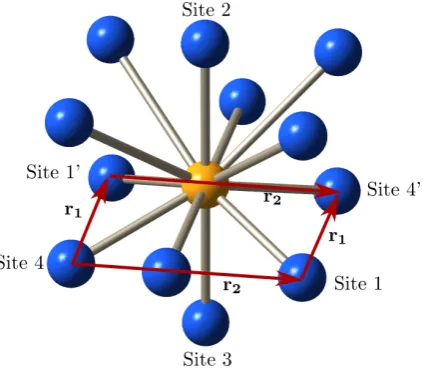
Figure 1.2: (a) A solid-state “molecule”. Eu3+ ions (blue) around a dopant in a sto-ichiometric Eu3+ crystal. For clarity, only the eleven closest ions are shown. (b) The corresponding optical spectrum. The nearest Eu3+ ions to the dopant have their optical transition frequencies shifted, leading to satellite lines in the spectrum. In this simulated spectrum, only eleven satellite lines are shown although rare earth crystals can show many more satellite lines than this.
interaction. Two of the ground state hyperfine levels are used as qubit levels because the coherence times of hyperfine transitions in rare earth ions can be more than 30 s [27], much longer than optical transitions, which have coherence times of the order of milliseconds. At liquid helium temperatures, all three ground state hyperfine levels are equally populated but it is still possible to initialise the ions in a well-defined state because the population can be optically pumped into one level. Relaxation amongst the hyperfine states is extremely slow, so once the ensemble is prepared in one qubit level, it will stay there for many hours.
To create multiple qubits in a rare earth quantum computer it is necessary to dope the stoichiometric material with a low concentration of another rare earth ion. When the stoichiometric material is doped with another rare earth the dopant substitutes at Eu3+ sites, but because it has a different radius from the host ions,
it causes strain in the crystal structure. The Eu3+ ions surrounding the dopant,
which were previously identical, are now each in a unique environment due to the strain and the frequency of their optical transition is shifted by different amounts. The dopant ion and the Eu3+ ions surrounding it become, therefore, a solid state
(a) (b)
Figure 1.3: Enacting gates on rare earth ensemble qubits via the optical excited state. (a) Single qubit rotation: two opticalπ pulses can be used to change the qubit state from
|0i to|1i. (b) Two-qubit gate: exciting the control qubit shifts the optical frequency of the target qubit, and a single qubit rotation will not change the qubit state. This is a CNOT gate.
in the spectrum is due to the Eu3+ ions in a single site relative to the dopant ion,
and every Eu3+ ion in that site contributes to that line. This ensemble of ions is a
qubit.
As each qubit is optically resolved, it can be addressed and manipulated indi-vidually. While the qubit levels are two ground state hyperfine levels, it is possible to manipulate the state of the qubit optically by applying pulses at the transition frequencies between these levels and the optical excited state, as illustrated by Fig-ure 1.3 (a). Readout of the ensemble qubits is achieved using coherent transient or incoherent techniques standard in rare earth spectroscopy.
Electronic ion-ion interactions between qubits can be used to enact multi-qubit gates. These interactions result in a shift of the optical transition frequency of surrounding ions when one ion is transferred into the optical excited state. Using these shifts, gates can be enacted on the optical transition, as shown in Figure 1.3
(b). The advantage of this method of enacting gates is that it does not affect the ground state hyperfine levels, so it is possible to enact a gate between two qubits without disturbing any other qubits, which is not possible in liquid-state NMR. Additionally, since the ions in one qubit will be very close to ions in another qubit (ion separations in rare earth crystals are of the order of 10 Å), the interactions between them are likely to be correspondingly strong, and the shifts large.
one hundred or more, depending on the host and dopant material. This number can also be increased if the linewidth of each line is reduced, so that satellite lines that may previously have been overlapped with each other are resolved. Scaling to larger numbers of qubits than the number of resolvable lines is difficult in an ensemble scheme. However, the same system could be used for single-instance quantum com-puting if it were possible to read out a single rare earth ion. This is difficult because rare earth optical transitions are weak, but it has recently been achieved using an electrical method in Si [28], and using an up-conversion process in a Pr3+-doped
crystal [29], suggesting that single instance quantum computing using rare earth ions is feasible.
1.2.3
Quantum computing in rare earth doped solids
Quantum computing schemes using rare earth ions have been proposed previously [4], and demonstrations of the initial steps towards computation have been made, in-cluding a low-fidelity two-qubit gate [30]. These proposals use the rare earth dopant, rather than host, ions in a crystal. This allows a wider range of materials to be used, as many rare earth materials stoichiometric in the rare earth ion have interactions between ions so strong that the coherence properties are poor. Additionally, doped materials are much more commonly studied in rare earth spectroscopy and their in-teractions are better understood. There are, however, substantial disadvantages to using a doped crystal, which stem from the fact that the dopant ions are randomly distributed in the crystal.
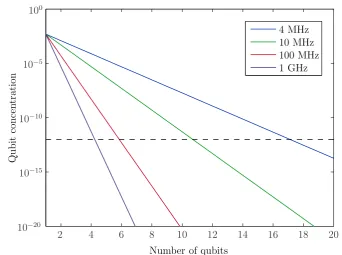
To create qubits in a doped material, sub-groups of ions are selected out from the inhomogeneously broadened optical line using optical pumping. Each of these ensemble qubits can be manipulated and read out by the same methods as described above for the qubits in a stoichiometric material. The major difference comes when enacting multi-qubit gates. Because the dopant ions are randomly distributed in the crystal, there is no fixed spatial relationship between ions in one qubit and ions in a second qubit. This means that there is a wide range in interactions strengths between two qubits. Interactions are also relatively weak because the distances between ions are large. To allow high-fidelity gates, it is necessary to apply a further selection process to both qubits, so that only those ions with strong interactions are retained. This substantially reduces the size of the ensemble qubit. The more qubits in the system, the more times this selection process must be applied, and the ensemble size shrinks exponentially. Eventually, it reaches a level too low for the qubit to be detected and this limits the number of qubits that could be demonstrated in a rare earth doped material: for a crystal of 0.5% Eu3+:YAlO
for quantum computing [31], it can be calculated that the concentration of suitable sets of six interacting qubits isO(10−19), or approximately one instance per crystal.
Two main methods have been suggested to improve the scaling of a rare earth doped quantum computer. The first is to designate one of the dopant ions as a bus qubit, and to enact gates between any two client qubits in a two step process using their individual interactions with the bus qubit [32]. This increases the number of ions in each ensemble qubit because the client qubits need only have strong interactions with the bus qubit, not every other qubit. However, the ensemble size still decreases exponentially with the number of qubits in the system, so a bus qubit is unlikely to make any significant difference to the limiting number of qubits. The second method for improving scalability is, similar to in a stoichiometric crystal, to use a single-instance approach where the crystal is doped with an ion that can be read out in single instance, and this ion is used to read out the state of nearby qubit ions [32]. In single-instance, the exponential scaling is no longer a problem. However, because the dopant ions are still randomly distributed in the crystal, it is necessary to find the ions that are close enough to interact with each other and the readout ion, and as the number of qubits required increases, the number of ions that have to be rejected because they do not interact with all other qubits also rises, meaning the preparation time for the qubit system increases exponentially with the number of qubits. It has been suggested [32] that it is possible to use a chain qubit configuration, where each qubit need only interact with its nearest neighbours. The reduced parallelism in such a system, however, reduces the error threshold that allows fault-tolerant quantum computation.
1.2.4
Effect of ensemble inhomogeneity
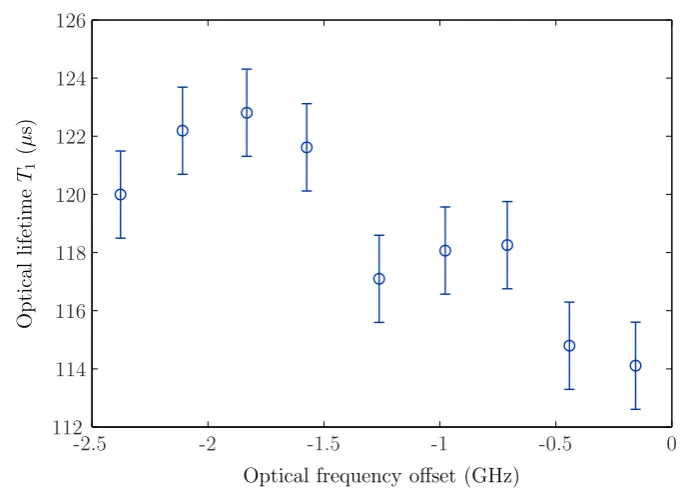
When using any sort of ensemble for quantum computing, the major problem is inhomogeneity amongst the ensemble. In a rare earth crystal, the primary concern is inhomogeneity in the optical transition frequency, which arises because defects in the crystal mean that each host rare earth ion is in a slightly different crystalline environment, leading to inhomogeneous broadening of the transition. These defects may be impurities, point defects such as vacancies, or growth defects, and their concentration can vary substantially between materials. The broadening they cause can be very substantial: homogeneous linewidths in rare earth crystals are of the order of kilohertz, while inhomogeneous linewidths are of the order of gigahertz, a factor of 106 larger. With large inhomogeneous broadening on each ensemble qubit
narrow sub-ensemble from each qubit [33]. The disadvantage of such a method is that each new qubit contains a different ensemble of ions, and there is no guarantee that an ion in one qubit will have a corresponding partner in another qubit. An additional selection process is required that retains only those ions in each qubit that can interact with ions in all other qubits. Similar to the selection process required for rare earth doped materials described in Section 1.2.3, this selection process means that the number of ions in each ensemble qubit decreases exponentially with the number of qubits, and limits the number of qubits that could be prepared.
A second type of inhomogeneity is inhomogeneity in the interaction strength between the ions in two ensemble qubits, as this will introduce errors during gate operations. This is a far larger problem in a doped crystal, where the ions in two ensemble qubits do not have a fixed spatial relationship, than in a stoichiometric crystal.
1.3
Direction taken in this thesis
Scalable ensemble-based quantum computing in rare earth crystals will only be pos-sible if the inhomogeneous broadening is sufficiently low that spectral-holeburning-selection of qubits is not necessary. The threshold broadening is of the order of 1 MHz: at this linewidth, an entire satellite line (ensemble qubit) could be coher-ently manipulated with sufficicoher-ently strong laser pulses. Unfortunately, this is an order of magnitude smaller than the narrowest linewidth observed in a rare earth solid to date, 10 MHz in Nd3+:Y7LiF
4 [34], and two orders of magnitude smaller
than narrowest linewidth in a stoichiometric solid, 95 MHz in EuCl3·6H2O (reported
here).
Inhomogeneous broadening in rare earth crystals is not well understood. In part, this thesis is a detailed investigation of inhomogeneous broadening in EuCl3·6H2O,
the stoichiometric material with the lowest inhomogeneous linewidth. The purpose of this investigation is to better understand sources of broadening in low linewidth materials and determine whether it is possible to reduce the linewidth of EuCl3·6H2O
below the 1 MHz limit, or whether it is feasible that materials could be found with much lower linewidths.
While the linewidth of EuCl3·6H2O is too large to allow truly scalable quantum
homogeneous and inhomogeneous linewidths to determine how many qubits could be prepared in current materials; associating satellite lines in the spectrum with spatial positions in the crystal; and measuring the interactions between qubits that could be used to enact multi-qubit gates.
1.4
Outline of the thesis
The thesis is organised as follows:
Chapter 2 gives the basic theory of rare earth spectroscopy relevant to the re-mainder of the thesis. It focuses on how interactions between rare earth ions and inhomogeneities in their environment affect the spectroscopic properties of the rare earth ion.
Chapter 3 describes the experimental techniques used throughout the thesis, including the crystal growth process developed to grow high-quality crystals, and the spectroscopic methods used to study the complicated structure of the7F
0 →5D0
transition of EuCl3·6H2O.
Chapters 4–7 detail the experimental results. Chapter 4 describes a study of the inhomogeneously broadened lineshape and satellite structure of the 7F
0 →5D0
transition of EuCl3·6H2O, and investigates the contribution of chemical dopants and
isotope impurities to the linewidth and line structure. The possibility of reducing the linewidth by purifying the crystals is discussed in this chapter.
The spin Hamiltonian of the optical ground and excited states of EuCl3·6H2O
is characterised in Chapter 5. Using this information, the magnetic dipole-dipole interactions between Eu3+ ions and a Ce3+ dopant were modelled, and this model
was used to assign satellite lines to crystallographic sites around the dopant. Chapter 6 describes measurements of the optical coherence time and lifetime. The improvements to both the lifetime and the coherence time that can be made by fully replacing the hydrogen ligands in the crystal with deuterium are measured in this chapter.
The electronic ion-ion interactions between Eu3+ ions in different satellite lines
that could be used to enact two-qubit gates are measured in Chapter 7for a set of seven satellite lines. These are compared with a model that assumes the interactions are electric multipole-multipole.
Chapter 8 describes how quantum computing could be achieved in a stoichio-metric rare earth crystal in more detail than presented in this chapter. Using the results of the previous four results chapters, the performance expected of a quantum computer implemented in EuCl3·6H2O is briefly outlined.
Background theory
Quantum information processing is the most recent in a myriad of applications of rare earth ions in solids. From phosphors in lighting to lasers and fibre amplifiers, rare earth solids have found uses due to two key properties: the prevalence of tran-sitions in or near the visible spectrum, and the relative insensitivity of the ions to their crystalline environment. It is this second feature, which results in sharp optical transitions with high spectral densities and long coherence times, that is crucial for quantum computing, for which a qubit needs to be extremely well isolated from its environment to avoid the loss of quantum information through decoherence. The coherence times obtainable in rare earth crystals are substantial: the longest optical coherence time observed is 4.8 ms in Er3+:Y
2SiO5 [35] while hyperfine coherence
times in excess of 30 s have been measured in Pr3+:Y
2SiO5 [36]. These are among
the longest coherence times observed in any material.
While the interactions between rare earth ions and their environment are weak, they provide the fundamental limits on the spectral density and coherence times in rare earth solids. For example, fluctuating magnetic fields due to nearby spin flips result in dephasing on optical and hyperfine transitions, while inconsistencies in the electric field of the crystal due to defects lead to inhomogeneous broadening of optical transitions, thereby lowering the spectral density. These effects vary substantially between rare earth ions and between host materials, and it is not always clear why. This thesis investigates EuCl3·6H2O, a material with unusually weak interactions,
in an attempt to shed light on this question.
Interactions are also important for a different reason: any quantum computing scheme needs a method of coupling qubits to enact quantum gates. In rare earth quantum computing schemes, it is the electronic ion-ion interactions between rare earth ions that are proposed for enacting gates. These interactions are difficult to study in rare earth crystals and, in many systems, not well understood. One of the primary purposes of this thesis is to outline a set of techniques that can aid in the study of these interactions.
This chapter begins with a brief explanation of the relevant theory of rare earth
Figure 2.1: Radial probability distribution for the outer orbitals of Gd+, copied from the figure in [37].
spectroscopy focusing on that relevant to Eu3+. This is followed by an outline of
knowledge about the contribution of interactions to dephasing and inhomogeneous broadening, and a survey of previous measurements of electronic ion-ion interactions between rare earth ions. The chapter concludes with a section on EuCl3·6H2O, the
material studied in this thesis.
2.1
Chemistry of the rare earths
The rare earths, which comprise the lanthanide elements and yttrium although scan-dium is sometimes included, are a group of chemically and physically very similar metals. They are strongly electropositive, and their most common oxidation state is 3+. The trivalent lanthanide ions have partially filled 4f orbitals, with the
elec-tronic configuration [Xe]4fn forn from 0 to 14, as shown in Table2.1. The chemical
similarity of the rare earth ions as well as their insensitivity to a crystal environment, are the result of this electronic structure. The filled 5s and 5p orbitals penetrate
farther from the nucleus than the valence 4f shell as shown in Figure 2.1, so they
shield the 4f electrons from the environment and are the primary bonding electrons.
lan-Atomic
number Element Electron config-uration RE3+
Ground state
RE3+
Ionic radius RE3+ (pm)
21 Sc 3d0 1S
0 87
39 Y 4d0 1S
0 101.9
57 La 4f05s25p6 1S
0 116.0
58 Ce 4f15s25p6 2F
5/2 114.3
59 Pr 4f25s25p6 3H4 112.6
60 Nd 4f35s25p6 4I
9/2 110.9
61 Pm 4f45s25p6 5I
4 109.3
62 Sm 4f55s25p6 6H5/2 107.9
63 Eu 4f65s25p6 7F
0 106.6
64 Gd 4f75s25p6 8S
7/2 105.3
65 Tb 4f85s25p6 7F6 104.0
66 Dy 4f95s25p6 6H
15/2 102.7
67 Ho 4f105s25p6 5I
8 101.5
68 Er 4f115s25p6 4I15/2 100.4
69 Tm 4f125s25p6 3H
6 99.4
70 Yb 4f135s25p6 2F
7/2 98.5
71 Lu 4f145s25p6 1S0 97.7
Point group n Equivalents Symmetry elements
Cn 1, 2, 3, 4, 6 n-fold rotation axis
Cnh 1, 2, 3, 4, 6 Cs = C1h Cn + mirror plane perpendicular to
n-fold axis
Cnv 1, 2, 3, 4, 6 C1v = C1h Cn + mirror plane parallel to n-fold
axis
Dn 1, 2, 3, 4, 6 D1 = C2 Cn + n 2-fold rotation axes
perpendic-ular to the n-fold axis
Dnh 1, 2, 3, 4, 6 D1h = C2v Dn+ mirror plane perpendicular to the
n-fold axis
Dnd 1, 2, 3 D1h = C2v Dn + n mirror planes parallel to the
n-fold axis passing between two n-fold axes S2n 1, 2, 3 Ci = S2 2n-fold rotation-reflection axis
(rota-tion followed by reflec(rota-tion in a perpen-dicular plane)
Table 2.2: The crystallographic point groups, excluding those with multiple high-order symmetry axes (the tetrahedral group T, Th and Td, and the octahedral group O and Oh). The groups are given in Schönflies notation, the notation most commonly used in rare earth optical spectroscopy.
thanide contraction, which arises because the 4f electrons, although well shielded
from the environment, are not well shielded from the nucleus. As the nuclear charge increases across the period, the radius of the rare earth ion decreases by 20%, mean-ing that erbium has a similar radius to yttrium. Because the bondmean-ing electrons do not change across the lanthanide period, the differences that exist in chemistry between the rare earths arise from the differences in radius. These differences are generally small and the crystal structures of materials that differ only in the rare earth they contain are often isomorphous. Rare earth ions are most commonly coordinated with eight ligands, although other coordination numbers are possible.
Point groups
Centrosymmetric S2, C2h, D2h, C4h, D4h, S6, D3d, C6h, D6h, Th, Oh
Non-centrosymmetric C1, C2, Cs, D2, C2v, C4, S4, D4, C4v, D2d, C3, D3, C3v,
C6, C3h, D6, C6v, D3h, T, O, Td
Polar
non-centrosymmetric C1, C2, Cs, C2v, C4, C4v, C3, C3v, C6, C6v
Axial C4, S4, C4h, D4, C4v, D2d, D4h, C3, S6, D3, C3v, D3d, C6,
C3h, C6h, D6, C6v, D3h, D6h, T, Th, O, Td, Oh
Non-axial C1, S2, C2, Cs, C2h, D2, C2v, D2h
Table 2.3: Divisions of the point groups that are important in the study of rare earth spectroscopy.
2.2
4f energy levels
The low lying transitions of the lanthanide elements are between levels within the 4f
configuration. The strong shielding of the 4f electrons from the crystal environment
means that these levels are very similar in energy to those of the free ion, and the crystal field can be considered as a perturbation to the free ion Hamiltonian. To a first approximation, the free ion Hamiltonian consists of the Coulomb attraction between the electrons and the nucleus, as well as the central part of the Coulomb repulsion between the electrons, which acts to reduce the attraction to the nucleus. In this central field approximation, all the n = 4 levels are degenerate. Beyond
the central field approximation, there are a number of interactions that contribute to the energy level structure, and these are listed in Table 2.4. The next most important interactions are the non-central part of the Coulomb repulsion which lifts the degeneracy in n, and the spin orbit interaction, which lifts the degeneracy of
the 4f levels. The spin orbit interaction mixes states with different orbital angular
momentum L and spin S, but the same total angular momentum J. Because the
spin orbit interaction is large in the rare earths, the mixing is substantial and L
and S are no longer good quantum numbers. The resulting (2J + 1)-degenerate
multiplets are labelled according to J and the dominant L and S values with the
Russell-Sanders symbol 2S+1L
J.
The crystal field partially or wholly lifts the 2J + 1 degeneracy. The degree to
Interaction mechanism Energy splitting (cm−1)
Configuration splitting (4fN −4fN−15d) 105
Non-central Coulomb 104
Spin-orbit interaction 103
Crystal field interaction 102
Hyperfine splitting 10−1 – 10−3
Superhyperfine splitting (ion-ligand hyperfine) 10−2 – 10−4
Table 2.4: Energy levels splittings for rare earth ions in crystals [39].
EuCl3·6H2O. Kramers ions retain a two-fold degeneracy even in low-symmetry sites.
The crystal field level of a state is indicated in brackets after the Russell-Sanders symbol for the state.
The energy levels for each of the lanthanides that result from the combination of free ion and crystal field Hamiltonians are shown in the Dieke diagram in Figure
2.2. The host material in this case is LaCl3, but the levels are very similar for other
host materials. The crystal field levels are not resolved in this diagram; the degree of splitting is indicated by the width of the lines.
2.2.1
f
→
f
transitions
In a free rare earth ion, electric dipole transitions between the 4f levels are forbidden
because the electric dipole operator connects states of different parity and all the 4f levels have the same parity. However, in crystals these transitions do occur for
rare earth ions in non-centrosymmetric sites. As explained by Judd [41] and Ofelt [42], in these sites the crystal field mixes opposite parity states of the 5d and other
configurations into the 4f levels, leading to mixed parity states for which non-zero
transition probabilities are possible. In the Judd-Ofelt theory, transitions between levelsJ = 0 toJ0 are strong forJ0 = 2,4,6 and forbidden forJ0 = 0,1,3,5. If mixing
between 4f levels due to the crystal field is included in the model, the forbidden
transitions become allowed for crystallographic sites belonging to the polar point groups [43]. In particular, the 0 → 0 transition becomes allowed due to mixing
of J = 2 levels into the ground state. The transition studied in this thesis, the 7F
0 →5D0 transition, is a 0→0 transition.
electric dipole transitions are forbidden, defects in the crystal structure can lift the symmetry and partly allow the transition.
2.3
Hyperfine interactions
The crystal field levels are further split by a number of interactions, which lead to hyperfine structure. For the purposes of describing this hyperfine structure, the Hamiltonian of the rare earth ion is often written as [44]:
H =HF I +HCF + (HHF +HQ+Hz +HZ). (2.1)
In this equation, HF I and HCF are the free ion and crystal field Hamiltonians
respectively, which describe the electronic levels, and the bracketed terms are treated as a perturbation on this electronic Hamiltonian. To simplify the treatment of the perturbation, an approximation of the electronic Hamiltonian is used in which the
L and S mixing by the spin orbit interaction and the J mixing by the crystal field
are assumed to be small. In this approximation, L, S and J are good quantum
numbers.
In the treatment given here, I consider only the the perturbation Hamiltonian rel-evant to Eu3+ in EuCl
3·6H2O, that for a non-Kramers ion in a non-centrosymmetric
site. The low symmetry crystal field quenches the orbital angular momentum so that all the states are electronic singlets.
The four bracketed terms in Equation (2.1) are the hyperfine interaction HHF,
the nuclear electric quadrupole interaction HQ, the nuclear Zeeman interaction Hz
and the electronic Zeeman interaction HZ. The two electronic terms HHF and HZ vanish to first order because the orbital angular momentum is quenched. Their
second order terms are of a similar size to the nuclear termsHzandHQ. By applying
second order perturbation theory to the Hamiltonian in Equation (2.1), an effective spin Hamiltonian can be constructed [45]:
Hef f =−gJ2µ 2
B(B·Λ·B)ˆE−B·(γNE+ 2AJgJµBΛ)·ˆI−ˆI·(AJ2Λ+ 2TQ)·ˆI, (2.2)
where,
• gJ is the Lande g-value, gJ = 32 −L(L
+1)−S(S+1) 2J(J+1) ,
• µB is the Bohr magneton,
• B is the vector magnetic field,
• ˆIis the nuclear spin operator,
• E is the identity matrix,
• ˆE is the identity operator,
• AJ is the magnetic hyperfine constant, and
• TQ is the tensor describing the nuclear quadrupole interaction.
Additionally, the tensor Λ describes the second order electronic effects:
Λαβ = 2J+1
X
n=2
h1|Jα|nihn|Jβ|1i En−E1
, (2.3)
where the sum is taken over all members of the J multiplet except the level the
Hamiltonian applies to, designated |1i.
The first term in Equation (2.2), which is quadratic in the magnetic field, is the second order electronic Zeeman interaction, while 2AJgJµBB·Λ·Iis a second order
cross term between the electronic Zeeman and hyperfine interactions. This linear term has the same form as the nuclear Zeeman interaction and these two terms can be combined to form the enhanced nuclear Zeeman tensor, which is anisotropic with principal axes given byΛ. Likewise, the second order magnetic hyperfine interaction A2
JI·Λ·I has the same form as the nuclear quadrupole interaction and is termed
the pseudoquadrupole interaction. The principal axes of the pseudoquadrupole and quadrupole tensors do not coincide in sites with less than axial symmetry, and the total quadrupole tensor will have principal axes different from the pseudoquadrupole, quadrupole and enhanced Zeeman tensors.
2.3.1
Hyperfine interaction in Eu
3+The Eu3+ optical transition studied here, the7F
0 →5D0 transition, is unique among
trivalent rare earth f−f transitions in having both ground and excited stateJ = 0
levels. These singlet levels have very weak interactions with the crystal lattice, with the interactions that do exist arising from slight admixtures of the nearby J = 1,2
states. The admixture is larger in the 7F
0 state than the 5D0 state because the
separation to the 7F
1 state (≈ 10 THz) is much smaller than to the 5D1 state (≈
30 THz). As a result, the second order contributions to the5D
0 state, corresponding
to the pseudoquadrupole, quadratic Zeeman, and anisotropic linear Zeeman terms in Equation (2.2), are small.
Eu3+ has two isotopes, 151Eu3+ and 153Eu3+, which are present in nearly equal
and the total quadrupole Hamiltonian splits the 7F
0 and 5D0 states by 10–100 MHz
into three doubly degenerate levels in zero field. The sign of the pseudoquadrupolar contribution to the 7F
0 ground state is opposite to the true quadrupole, and so
the splittings in the ground state are smaller than in the excited state, where the pseudoquadrupole contribution is negligible.
2.4
Stark shift
While the sensitivity of a rare earth transition to magnetic fields is given by the Zeeman effect, its sensitivity to electric fields is given by the Stark effect. All rare earth f → f transitions experience a Stark shift δf in an electric field E, which is
written [46]:
∆f =−L∆µ·E− 1
2L2E·∆α·E. (2.4)
In this equation, ∆µis the difference in ground and excited state static electric
dipole moments, α is the electric polarisability of the ion, and L is the local field
correction, which describes the modification of the electric field by the crystal. In general, L is anisotropic, but is commonly approximated as L = 1+23 with 1 the
low frequency dielectric constant, which is the isotropic local field correction in a site of cubic symmetry [47].
The linear Stark shift is only present in non-centrosymmetric sites, for which it dominates the quadratic Stark shift. A static dipole moment is possible in these sites because of the admixture of opposite parity states into the 4f levels. The static
electric dipole moment of a state |ψii,
µi =hψi| −eˆr|ψii, (2.5)
is a measure of this admixture and tends to be larger in lower symmetry sites. It is closely related to the electric dipole transition strength hψi| −eˆr|ψjibetween two
levels|ψiiand|ψji, although the Stark shift itself may be smaller than the transition
dipole moment as it is dependent on thedifferencein ground and excited state dipole moments. Stark shifts for doped Eu3+ crystals are typically on the order of tens of
kHz.V−1.cm [46, 48].
2.5
Lifetimes
The optical lifetime T1 of a state can be written:
1
T1
= Γr+ X
i
Γnr,i, (2.6)
where Γr is the radiative decay rate and the Γnr,i’s are various non-radiative decay
rates. Optical states in rare earth ions can be very long lived, both because the radiative lifetimes are long, and non-radiative decay processes are often weak. Ra-diative lifetimes are long because the oscillator strengths of optical transitions are weak. These transitions are forbidden (often doubly forbidden) in the free ion, but become slightly allowed in the lowered symmetry of a crystalline environment. The resulting radiative lifetimes are up to milliseconds.
Coupling to phonons is the major non-radiative decay mechanism. At tempera-tures below 4 K, the regime relevant in this thesis, few thermal phonons are present and non-radiative decay is due to multi-phonon emission, the rate of which decreases exponentially with the energy gap between optical levels [49]. The decay rate is also dependent on the energies of the phonon modes available in the crystal, as this de-termines the number of phonons required to span the energy gap. If phonon modes exist for which the number of phonons required to span an energy gap is five or less, non-radiative decay can be comparable to radiative decay [50]. The phonon energies available vary between host materials, but are commonly less than 30 THz. For the lowest states in a multiplet, such as the5D
0 state in Eu3+, the energy gaps are large
and non-radiative decay is weak in most materials.
One important exception is materials containing molecules with high energy modes, particularly H2O. The O-H stretching mode has a frequency of the order of
≈110 THz, and requires four phonons to bridge the gap between the Eu3+ 5D 0 state
and the7F
6state, the highest lying state of the ground state multiplet. Non-radiative
decay via this high energy phonon mode is responsible for the short lifetimes of hydrated rare earth materials compared to anhydrous materials ([51, 52, 53] and others). These lifetimes can be substantially increased by deuterating the material because O-D bonds have a lower phonon energy of ≈80 THz. In Eu3+, this means
that five phonons are required to bridge the 5D
0 to7F6 energy gap rather than four,
and improvements in the excited state lifetime of a factor of twenty are typically observed [54, 55, 56].
ion-ion interactions. Energy can be transferred between rare earth ions, migrating through the crystals to non-standard sites in which it is lost non-radiatively (flu-orescence traps). A second mechanism for non-radiative decay is cross-relaxation quenching: an optically excited ion transfers some of its energy to an unexcited ion, leaving both ions in intermediate states from which they decay non-radiatively by other means. Ion-ion interactions are examined in more detail in Section 2.9.
Hyperfine transitions have very long lifetimes, partly because they are less sensi-tive to the environment than optical transitions, and partly because there are very few phonons at the very low energies of hyperfine transitions. Lifetimes as long as weeks have been observed in rare earth hyperfine transitions [57].
2.6
Coherence times
One of the most interesting properties of rare earth ions for quantum and clas-sical processing is their very long optical coherence times, which arise from their weak interactions with the environment. The coherence time T2 is related to the
homogeneous linewidth Γh, which is the linewidth of a single ion:
Γh = 1 πT2 =
1 2πT1 + Γ
φ (2.7)
where the first term describes the contribution to decoherence of population decay and the second describes the contribution of pure dephasing processes.
The ultimate limit on the coherence time is 2T1, but the coherence time is often
much shorter than this due to dephasing processes. At room temperature, phonon processes dominate dephasing, but these scale with temperature asT7and are
gener-ally negligible below 4 K. At cryogenic temperatures, dephasing of rare earth optical transitions is commonly caused by fluctuations in the electric or magnetic field at the rare earth site, as these cause fluctuations in the frequency of the optical transi-tion via the Stark and Zeeman effects. For hyperfine transitransi-tions, fluctuatransi-tions in the magnetic field lead to coherence times on the order of milliseconds, much shorter than the lifetimes.
ISD commonly arises from a difference in magnetic dipole moments between optical levels. This is the dominant mechanism for in Tb3+ in high symmetry YLiF
4 [59]
or Er3+ in most materials, such as CaWO
4 [60] and Y2SiO5 [61]. For non-Kramers
dopants in low symmetry sites, ISD is normally attributed to electric dipole-dipole interactions, for example, in Eu3+:Y
2SiO5 [62] or Y2O3 [63]. An exception is in
Pr3+ doped materials, where non-equilibrium phonons are often the source of ISD
[64, 65]. These phonons are produced during non-radiative steps in the decay of optically excited transitions, and then excite other Pr3+ ions from the ground state
to a close-lying Stark level. This mechanism is only possible in Pr3+ because the
energy separation between the lowest Stark levels to the optical ground state is unusually small (1.5 THz), and the phonons produced at this frequency are long-lived. The effect of ISD on experimental measurements of the coherence time is described in Section 3.5.1.
The contribution of ISD to dephasing can be reduced by decreasing the excitation density of perturbing ions. In the limit of low excitation density, dephasing is dominated by the fluctuating magnetic field generated by randomly flipping nuclear spins. The longest optical coherence times are generally observed in low spin hosts, such as Y2SiO5, where the only prevalent species with a magnetic moment is Y, and
its moment is small. The dephasing can be further reduced by applying a magnetic field to the crystal, as this causes splitting of the nuclear spin levels and slows the rate of mutual spin flips. By applying a field of 10 mT to a crystal of Eu3+:Y
2SiO5,
Equall et al. [66] measured optical coherence times as long as 2.61 ms. The longest coherence times observed on a solid state electronic transition were in Er3+:Y
2SiO5,
in which a coherence time of 4.38 ms was observed by applying a magnetic of 7 T. This corresponds to a homogeneous linewidth of 73 Hz [67].
Another way of extending the coherence time is to minimise the sensitivity of the transition to fluctuations in the magnetic field. This is achieved by finding a mag-netic field direction and magnitude at which the transition of interest undergoes a turning point in all three dimensions, the ZEFOZ technique (ZEro First Order Zeeman) [68]. This was one of the methods used to observe a coherence time of 30 s in Pr3+:Y
2SiO5 [36]. While this method has mostly been applied to hyperfine
Figure 2.3: Inhomogeneous broadening on an optical transition as a consequence of randomly distributed defects (yellow ions). The homogeneous linewidth Γhis much smaller relative to the inhomogeneous linewidth Γinh than shown: typically, Γinh/Γh>104.
2.7
Inhomogeneous broadening
While the homogeneous linewidths of rare earth optical transitions can be sub-kilohertz at low temperature, the linewidth of an ensemble of rare earth ions (the in-homogeneous linewidth) is much larger, ranging from 10 MHz to more than 100 GHz depending on the material. The inhomogeneous linewidths of hyperfine transitions are much smaller, typically tens of kilohertz, but still greater than the sub-kilohertz homogeneous linewidths. The relationship between homogeneous and inhomoge-neous linewidths is shown in Figure 2.3. Inhomogeneous broadening occurs because the crystalline environment experienced by a rare earth ion varies from site to site due to imperfections in the crystal lattice, and the optical and hyperfine transi-tions are sensitive to changes in the crystalline environment. Optical transitransi-tions are sensitive to inhomogeneities in the electric field, and, for non-singlet levels, the magnetic field, while both magnetic and electric field effects broaden hyperfine tran-sitions. The discussion that follows concentrates mostly on broadening of optical transitions.
Imperfections in a crystal may arise from impurities introduced during the crystal growth process or in the starting material, or defects that occur during crystal growth and subsequent treatment of the crystal. They can be classified according to their dimension:
• 1D: Line defects (dislocations).
• 2D: Planar defects such as grain boundaries in polycrystalline materials or stacking faults in layered materials.
• 3D: Volume defects such as voids, fluid inclusions or clusters of point defects.
Most crystals used in rare earth spectroscopy are high quality single crystals, in which 2D and 3D defects are quite rare. When present, they cause large perturba-tions to the crystal environment, leading to macroscopic inhomogeneous broadening: broadening that varies with position in the sample. 0D and 1D defects lead to mi-croscopic broadening, which is constant throughout the crystal. This section focuses on microscopic broadening.
Substitutional impurities are a very common source of broadening in rare earth crystals. In crystals doped with the rare earth ion of interest, the dopant itself is often the major impurity and dominant source of broadening. Even in crystals stoichiometric in the rare earth, other rare earth ions are a common impurity because the chemical similarity of the rare earth ions makes them hard to separate.
Dislocations are line defects in the crystal structure, which arise during crystal growth or when the crystal is subjected to stress. They occur naturally in all crystals, although the dislocation density can vary greatly between materials. There are two basic types of dislocations. An edge dislocation can be thought of as the line along which a plane of atoms suddenly terminates in the crystal; the atoms slip in a plane perpendicular to the dislocation. A screw dislocation occurs when atoms slip in a direction parallel to the dislocation.