
Visualising Co-evolution with CIAO Plots
Dave Cliff∗
Complex Adaptive Systems Group, Hewlett-Packard Labs Europe, Bristol BS34 8QZ, England UK.
Phone +44 117 312 8189 (desk) Fax: +44 117 312 8924
Geoffrey F. Miller Department of Psychology, University of New Mexico, Albuquerque, NM 87131, USA.
Phone +1 505 277 1967 (desk)
A
bstract
In a previous paper [2], we introduced a number of visualization techniques that we
had developed for monitoring the dynamics of artificial competitive co-evolutionary
systems. One of these techniques involves evaluating the performance of an
individual from the current population in a series of trials against opponents from all
previous generations, and visualizing the results as a 2-d grid of shaded cells or
pixels: qualitative patterns in the shading can indicate different classes of
co-evolutionary dynamic. As this technique involves pitting a Current Individual against Ancestral Opponents, we referred to the visualizations as CIAO plots. Since then, a number of other authors studying the dynamics of competitive co-evolutionary
systems have used CIAO plots or close derivatives to help illuminate the dynamics
of their systems, and it has become something of a de facto standard visualization technique. In this very brief paper we summarise the rationale for CIAO plots,
explain the method of constructing a CIAO plot, and review important recent results
that identify significant limitations of this technique.
Keywords
Co-evolution; visualization; CIAO Plot.
1. Introduction
Attempting to define and monitor “progress” in the context of co-evolutionary
systems can be a somewhat nightmarish experience. In a co-evolutionary system, by
definition, evaluating the fitness of any one individual genotype requires that the
effects of other genotypes be taken into account. For instance, consider the case
where two separate populations are maintained, such that the fitness of individual
genotypes in Population A is dependent in some way on the genomes in Population
B, and vice versa. Then the fitness landscape for each population is partially
determined at any one time by the distribution of genotypes in the other population
at that time. As the distribution of genotypes changes in each population (i.e. as a
result of directed selection, or of genetic drift), so the other population’s fitness
landscape may alter, sometimes dramatically; and these changes in the landscape can
occur even when the function used to evaluate fitness is constant throughout the
evolutionary process.
This reciprocity in the fitness evaluation process can make monitoring progress
much more difficult than in the non-co-evolutionary case. Simple graphs of
best/average fitness measures over time in co-evolutionary systems can be totally
misleading. For example, genuine progress may be occurring in the sense that there
is constant evolutionary innovation in both populations, yet if any evolutionary
innovation in one population is rapidly met with a counter-innovation in the other
which would conventionally be interpreted as a sign of no progress. For further discussion of the range of problems that can occur, see [2,1].
In a previous paper [2], we discussed a number of visualization techniques that we
had developed and found useful for monitoring progress in artificial competitive
co-evolutionary systems. Use of all of these was demonstrated on real data from our
experiments exploring the co-evolution of sensory morphologies and
continuous-time recurrent neural-network “controllers” for autonomous agents that engaged in
pursuit and evasion. In those experiments we maintained a population of
“predators”, selected for their pursuit behaviour; and a separate population of
“prey”, selected for evasion behaviours. A single run of one experiment, simulating a
few hundred generations of co-evolution, could take many days (or even weeks) of
real time. These long run-times were due to a variety of reasons that were particular
to our experiments, but we argued that such long experiment run-times would
become the norm rather than the exception as co-evolutionary GAs were increasingly
applied to non-toy autonomous-agent design problems. Our view was that if
progress in co-evolutionary systems was not monitored accurately (or, at least, if lack
of progress was not readily detectable), then very large amounts of computer-time
could be wasted. Hence we thought that the development of appropriate new
visualization techniques for monitoring progress in artificial co-evolutionary systems
would meet a significant and growing need. The techniques we developed allowed
us to better describe the co-evolutionary dynamics of our system, and to demonstrate
the presence or absence both of desirable and of pathological co-evolutionary
Of the three new visualization techniques we introduced in [2], one particular
technique that we named CIAO plots has since become something of a de facto standard in the Artificial Life, Evolutionary Computation, and Adaptive Behaviour
literature on artificial co-evolutionary systems. For example, Cartlidge & Bullock’s
critical survey [1] points to usage of CIAO plots in recent papers on evolutionary
robotics [3,4,7], on co-evolution of game-playing strategies [8], and on co-evolution of
simple linguistic interactions [5]. Most recently, Izuka & Ikegami used CIAO plots in
their analysis of the co-evolutionary dynamics of turn-taking behaviours in
autonomous agents [6]. In this very brief paper, we only give details of the method
for constructing a CIAO plot; but we urge the reader to consult Cartlidge & Bullock’s
[1] recent elegant studies of how qualitatively different co-evolutionary dynamics
manifest themselves (or fail to manifest themselves) in CIAO plots, which reveals
some significant weaknesses – discussed briefly later in this paper.
2. How to CIAO
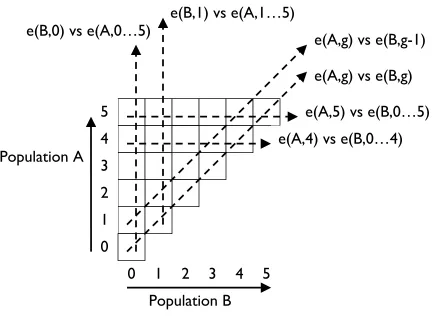
score-vectors of diminishing length. To visualise the values in this sequence of
vectors, fill the square cells in a triangular grid such as that shown in Figure 1with
gray-scales or colors that vary in accordance with the scalar values. For example,
normalise over all scores and then shade the highest-scoring cell black, the
lowest-scoring cell white, and assign appropriate shades of gray to cells with intermediate
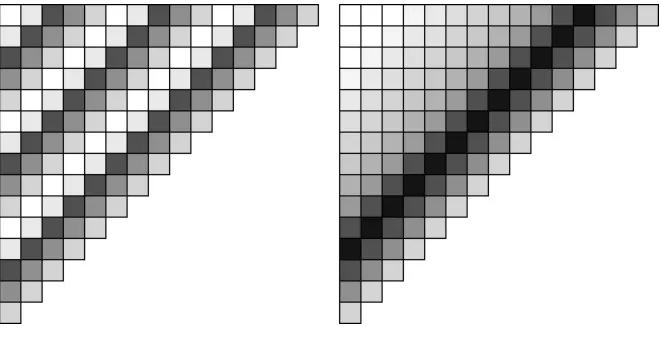
scores. Co-evolutionary dynamics such as limited evolutionary memory, or
intransitive dominance cycling, will then be revealed as certain qualitative visual
patterns, idealizations of which are shown in Figure 2. These could in principle be
detected by performing simple image processing on the CIAO plots. CIAO plots of
real data, such as that shown in Figure 3, tend to be more noisy and harder to
interpret than the idealizations of Figure 2.
Defined this way, CIAO plots are manifestly useful in generational co-evolutionary
systems where individuals compete one-on-one and are rated using an extrinsic
fitness evaluation function, but the visualisation technique would need to be
modified if it is to be applied to less explicitly sequenced systems, such as
steady-state systems; or to systems where the fitness function is implicit or intrinsic. Note
also that the computational cost of calculating the data for a CIAO plot rises as
O(½·G2) and so can easily become greater than the actual computational cost of the
co-evolutionary experiment that the plot is generated to visualise.
* * * FIGURE 2 NEAR HERE * * *
* * * FIGURE 3 NEAR HERE * * *
3. Goodbye to all that?
We are of course pleased that other authors whose work we respect have
approvingly used the CIAO plot technique that we introduced, as it demonstrates
that our intuition regarding the need for such visualization tools was correct.
Nevertheless, we are even more pleased that Cartlidge & Bullock [1] have conducted
a careful dissection of the limitations of our method. Although CIAO plots have been
used by several authors over the years, the paper by Cartlidge & Bullock is the first
detailed exploration of the strengths and weaknesses of this visualization technique.
The central motivation for Cartlidge & Bullock’s paper is the observation that no CIAO plots of real experimental data have ever been published that resemble the
idealised plots of Figure 2. Instead, they note, almost all CIAO plots of real data are
much more reminiscent of ”banded” tartan or plaid patterns familiar from woven
textiles, and they explore why these tartan patterns occur, and what these patterns
might reveal about the underlying co-evolutionary dynamics. In doing so, they
that prominent bands are only shown in the CIAO plot when there is periodic
cycling through set of strategies, whereas aperiodic trajectories through strategy
space may not be readily identified from a CIAO plot.
Progress in any field is rarely if ever monotonic: the clear challenge now is to
develop visualization techniques better able to reveal qualitative, or even
References
[1] Cartlidge, J. & Bullock, S., (2004). Unpicking Tartan CIAO Plots: Understanding
irregular co-evolutionary cycling. Adaptive Behavior 12:69-92, 2004.
[2] Cliff, D. & Miller, G. F. (1995). Tracking the Red Queen: Measurements of
Adaptive Progress in Co-Evolutionary Simulations. In F. Morán, A. Moreno, J. J.
Merelo & P. Chacón (editors) Advances in Artificial Life: Proceedings of the Third European Conference on Artificial Life. Lecture Notes in Artificial Intelligence Vol. 929. Berlin: Springer-Verlag. pp.200-218.
[3] Floreano, D. & Nolfi, S. (1997). Adaptive behavior in competing co-evolving
species. In P. Husbands & I. Harvey (editors) Proceedings of the Fourth International Conference on Artificial Life. Cambridge MA: MIT Press. pp.378-387.
[4] Floreano, D. & Nolfi, S. (1997). God save the Red Queen! Competition in
co-evolutionary robotics. In J. R. Koza, K. Deb, M. Dorigo, D. B. Fogel, M. Garzon, H.
Iba, & R. L. Riolo (editors) Genetic Programming 1997: Proceedings of the Second Annual Conference. Morgan Kauffman. pp. 398-406.
[5] Ficici, S. G. & Pollack, J. B. (1998). Challenges in co-evolutionary learning:
H. Kitano, & C. Taylor (editors) Artificial Life VI. Cambridge MA: MIT Press. pp.238-247.
[6] Izuka, H. & Ikegami, T. (2004). Adaptability and Diversity in Simulated
Turn-Taking Behavior. Artificial Life, 10: 361-378. MIT Press.
[7] Nolfi, S. & Floreano, D. (1998). How co-evolution can enhance the adaptive power
of artificial evolution: Implications for evolutionary robotics. In P. Husbands & J.-A.
Meyer (editors) Evolutionary Robotics: First European Workshop (EvoRobot98). Lecture Notes in Computer Science Vol. 1468. Berlin: Springer-Verlag. pp.22-38.
[8] Rosin, C. D. & Belew, R. K. (1997). New methods for competitive co-evolution.
e(A,g) vs e(B,g-1)
e(B,0) vs e(A,0…5)
e(A,g) vs e(B,g)
e(A,5) vs e(B,0…5)
e(A,4) vs e(B,0…4)
Population A
0
1
2
3
4
5
5
4
3
2
0 1
Population B
[image:10.595.89.522.113.431.2]e(B,1) vs e(A,1…5)
Figure 1. Schematic for constructing a CIAO plot for Population A. The square cells
would be shaded or colored to represent scores in competitions, the dashed lines
indicate different vectors of scores that could be visualized as conventional
Figure 2: Idealised CIAO plot patterns, with darker shading indicating higher scores.
Left: intransitive dominance cycling, where current elites score highly against
opponents from 3, 8, and 13 generations ago but not so well against generations
inbetween;. Right: limited evolutionary memory where the current elites do well
against opponents from three, four, and five generations ago, but much less well
![Figure 3: A CIAO plot showing 700 generations of real data, from [2].](https://thumb-us.123doks.com/thumbv2/123dok_us/8499894.347186/12.595.174.421.187.441/figure-ciao-plot-showing-generations-real-data.webp)
