EC Structural Funds
GREECE
Community Support Framework
1994-99
Objective 1 : Structural development and adjustment of regions
whose development is lagging behind
The Objectives of the Structural Funds
Objective 1 (1994-1999) Objective 2 (1994-1996) Objective 5b (1994-199) New members (1.1.95)
Economic adjustment of regions whose development is lagging behind.
Economic conversion of declining industrial areas.
Economic diversification of rural areas.
Information on the eligible areas in Austria, Finland and Sweden will be available shortly.
<^W^\
EC Structural Funds
GREECE
Community Support Framework
1994-99
Objective 1 : Structural development and adjustment of regions
whose development is lagging behind
Series of «Community Support Frameworks 19941999 — Objective 1»
Neue Länder — Gemeinschaftliches Förderkonzept Catalogue No: CX8594276DEC Italia — Quadra comunitario di sostegno Catalogue No: CX8594284ITC Ireland — Community support framework Catalogue No: CX8594107ENC Portugal — Quadra comunitário de apoio Catalogue No: CX8294771PTC Espana — Marco Comunitario de Apoyo Catalogue No: CX8594292ESC
Ελλάδα — Κοινοτικό πλαίσιο στήριξης Catalogue No: CX-85-94-462-GR-C
Series of «Single Programming Documents 1994-1999 — Objective 1»
France
Martinique, Guyane, Guadeloupe, Réunion —
Documents uniques de programmation. Synthèse Catalogue No: CX-85-94-301-FR-C Corse — Document unique de programmation. Synthèse Catalogue No: CX-85-94-325-FR-C Arrondissement de Douai, Valenciennes, Avesnes —
Document unique de programmation Catalogue No: CX-85-94-317-FR-C
United-Kingdom
Highlands and Islands — Single programming document Catalogue No: CX-85-94-357-EN-C Merseyside — Single programming document Catalogue No: CX-85-94-373-EN-C Northern Ireland — Single programming document Catalogue No: CX-85-94-365-EN-C
Belgium
Hainaut — Document unique de programmation Catalogue No: CX-85-94-260-FR-C
The Netherlands
Flevoland — Gecombineerd programmeringsdocument Catalogue No: CX-85-94-268-NL-C
These documents can be obtained in the language of the relevant country from the addresses given at the end of the brochure.
For further information on other language versions, please contact: European Commission
DG XVI.F2 Rue de la Loi 200 B-1049 Brussels Fax: (32-2)296 60 03
Cataloguing data can be found at the end of this publication.
Luxembourg: Office for Official Publications of the European Communities, 1995 ISBN 92-827-4006-4
Contents
Chapter 1
Context and analysis of regional development
Page
1.1. Presentation of the plan and procedure 7
1.2. General description 7
1.3. Analysis of disparities/cohesion gaps 8
1.3.1. Basic infrastructures 8 1.3.2. Human resources 11 1.3.3. Productive sector 11
1.4. Principal problems of development 13 1.5. Results of the CSF 1989-93 14 1.6. Assessment of the environmental situation 16
1.7. Strategy of the plan 18
1.8. Appraisal of the regional development plan 18
1.8.1. Introduction 18 1.8.2. Macroeconomic appraisal 19
Chapter 2
The CSF — Axes of development and forms of intervention 21
2.1. Introduction and development strategy 21 2.1.1. Coherence with the White Paper 22
2.1.2. Impact of the CSF 22 2.1.3. Implementation 23 2.1.4. Adjustments to the financial allocations 23
2.1.5. Axes of the CSF 25
2.2. Axis 1 — Reduction in the degree of peripherality and promotion
of internal integration by the development of major infrastructures 26
2.2.1. Transport 26 2.2.1.1. Road networks and access 27
2.2.2. Communications 29
2.2.3. Energy 30
2.3. Axis 2 — Improvement of living conditions 31
2.3.1. Urban development 31 2.3.2. Health and welfare 32 2.3.3. Environment 34
2.4. Axis 3 — Development and competitiveness of the economy 35
2.4.1. Industry and services 35 2.4.2. Research and technology 37 2.4.3. Tourism and culture 39 2.4.4. Agriculture and rural development 40
2.4.5. Fisheries 43
2.5. Development of human resources and employment promotion 45
2.5.1. Introduction 45 2.5.2. Education and initial training 47
2.5.3. Continuing training and employment promotion 49 2.5.4. Combating exclusion from the employment market 52 2.5.5. Support for the modernization of public administration 54
2.6. Reduction in regional disparities and opening-up of island areas 55
2.6.1. Introduction 55 2.6.2. Eastern Macedonia and Thrace 57
2.6.3. Central Macedonia 60 2.6.4. Western Macedonia 63
2.6.5. Epirus 66 2.6.6. Thessaly 69 2.6.7. The Ionian Islands 71
2.6.8. Western Greece 73 2.6.9. Central Greece 76
2.6.10. Attica 79 2.6.11. The Péloponnèse 81
2.6.12. The northern Aegean 84 2.6.13. The southern Aegean 87
2.6.14. Crete 90
2.7. Technical assistance 93 2.8. List of indicators 94 2.9. Impact of the CSF on the environment 96
Chapter 3
Financing plan 99
3.1. Coordination between the Structural Funds, the Cohesion Fund,
the ElB/other instruments, EFTA 99
3.2. Additionality 100 3.3. Monitoring procedures 100
Financial tables 101-108
Chapter 4
Implementing the CSF 109
4.1. Principles and procedures governing prior appraisal, monitoring and interim
assessment and ex-post evaluation 109
4.1.2. Monitoring and interim assessments (Artide 25 of
Regulation (EEC) No 4253/88) 110 4.1.3. The ex-post evaluation (Article 26 of Regulation
(EEC) No 4253/88) 110 4.1.4. Quantifying objectives 111
4.2. Monitoring the CSF 111 4.2.1. The CSF Monitoring Committee 111
4.2.2. Procedures for amending the CSF 112
4.3. Monitoring the operations 114 4.3.1. The Monitoring Committee for a programme 114
4.3.2. Procedures for altering a programme 115 4.3.3. Reports relating to the implementation of the measures
(Article 25(4) of Regulation (EEC) No 4254/88) 116
4.4. Specific implementing provisions 117 4.4.1. Improvement of the public works production procedures 117
4.4.2. Improving administrative/managerial capacity 117
4.5. Experts 118 4.6. Information and publicity 119
4.7. Provisions governing financial implementation 119
4.8. Compliance with Community policies 125
CHAPTER 1
Context and analysis of regional
development
1.1. Presentation of the plan and procedure
In accordance with Article 8 paragraph 4 of Regulation (EEC) No 2052/88, as amended by Regulation (EEC) No 2081/93, the Greek authorities presented to the Commission, on 10 September 1993, their regional development plan (RDP) concerning Objective 1 for the period 1994-99. Following the legislative elections of 10 October 1993, the new government presented to the Commission, on 17 December 1993, an addendum modifying the original plan. On 18 March 1994, a consolidated RDP was presented to the Commission, integrating both the earlier modifications and certain elements that were required to ensure compliance with the regulations governing the Structural Funds.
The plan was the subject of consultations at both national and regional level, and of discus-sions with economic and social partners. It was also presented to and discussed by the Euro-pean Parliament's committee responsible for regional policy, regional development and rela-tions with local and regional authorities.
The plan is a valid basis for the development of the CSF In accordance with the proposal made by the Greek authorities, separate decisions will be taken concerning the CSF and the forms of intervention.
1.2. General description
Greece has no common land borders with other Member States of the European Union and is also geographically distant from the centre of the EU. It covers a surface area of 131 957 km2, comprising two parts: the mainland, which is relatively mountainous (81% of the total surface area), and a multitude of islands, forming an archipelago.
1993. The employed population as a percentage of the population of working age is 53.1% (EUR 12: 61.4%), but the rate of occupational activity is 47.4% (Community average: 55.1%).
The Greek economy has not performed well over the past few years. It has diverged in real terms from the Community average and Greece's per capita GDP was 60% in 1993. Low levels of investment (GFCF7GDP 17.4% in 1993, with private investment accounting for 13.2 points) and high levels of public debt and deficit (117.9 and 13% respectively in 1993) are major obstacles to sufficient growth for launching a process of convergence in real terms.
However, the slowing of inflation that began in 1991 is beginning to bear fruit (19.7% in 1991, 14.4% in 1993 and a current rate of 10.4%), though the rate is still much higher than the Com-munity average.
1.3. Analysis of disparities/cohesion gaps
1.3.1. Basic infrastructures
Transport
Road infrastructures: indicators show that the Greek road network is underdeveloped (GR: 30 km of road per 100 km2 in 1988; EUR 12: 158 km per 100 km2) and is, in particular, lack-ing in high-capacity roads (GR: 0.2 km of motorway per 100 km2; EUR 12: 1.5 km of motor-way per 100 km2).
The poor quality of the road network contributes to the high number of road accidents (GR: 69 deaths per 100 000 vehicles; EUR 12: 26 deaths per 100 000 vehicles).
Completion of the road network forming part of the trans-European network (TEN) will require considerable effort: the latest figures indicate that some 1 000 km of motorway will have to be constructed.
Rail infrastructures: the Greek railways are relatively underdeveloped (GR: 1.8 km per 100 km2; EUR 12: 5.7 km per 100 km2) and of mediocre quality. Only 10% of the network is twin-track (EUR 12: 43%) and only 3% is electrified (EUR 12: 40%). The average speed of the fastest trains on the TEN network is 88 km/h, which is one of the lowest speeds for all Member States of the Union.
Airports: Greece has a highly developed network of airports but infrastructures are inade-quate in terms of the length of runways (particularly at small airports), terminals and navigation-assistance equipment.
Ports: the ports of Igoumenitsa and Patras have serious shortcomings, particularly as regards internal harbour facilities, land installations, electromechanical equipment, skilled personnel and land access.
The other major national ports (Piraeus, Salonika, Alexandroupolis, Volos and Iraklion) also lack adequate infrastructures.
Telecommunications
Although Greece has a particularly high number of lines per capita (90% of the European average), the quality of services is inadequate. Although the latest figures supplied by the Greek authorities indicate improvements in 1993, customers have to wait a very long time to have a new telephone installed: on average, three years (in 1992), which is six times greater than the average for regions covered by Objective 1. Faults occur at a rate of 0.5/line/year, as against a Community average of 0.2. The rate of digitalization is the lowest in the Community (GR: 24% at the end of 1993, compared with 35 to 80% for other Member States).
Over the period 1987-90, Greece invested ECU 66 per line, compared with a Community average of ECU 214.
Energy
Greece and Portugal are the only countries in the Community that do not have a natural gas distribution network. In 1990, energy intensity (quantity of energy consumed per unit of pro-duction) in Greece was 410 kgoe/ ECU 1 000 of GDP, as against 240 in the Community as a whole.
Distribution of water
In 1986, some 80% of Greece's water resources were consumed by the agricultural sector. Only 89% of households are connected to the public supply network, compared with 95% for EUR 12. In some regions, and particularly in Epirus and the Ionian Islands, the rate of con-nection to the public network remains very low (Epirus: 64%, Ionian Islands: 69%).
Environment
Only 50% of the urban population is connected to the public sewage system (Spain: 81%).
In 1989, Greece produced 3.1 million tonnes of solid urban waste, 90% of which was disposed of at landfill sites, many of which are uncontrolled. No more than 6% of waste is recycled. Greece produces some 450 000 tonnes of dangerous or toxic industrial waste each year.
According to some calculations (Korine database), 20% of land (in terms of surface area) is at high risk of erosion. In the case of Khios, the Cyclades and Khania, more than 70% of land is at risk of erosion.
Health
Over the past decade, the resources allocated to the health sector in Greece have increased considerably (6.2% of GNP in 1977 and 7.8% in 1990 — EUR 12: 7.2%). Indicators have im-proved throughout the country, for example in 1989, infant mortality was 0.99% of live births (EUR 12: 0.86%). In 1990, there were 5.1 hospital beds per 1 000 people (EUR 12: 7.82) and 3.4 doctors per 1 000 people (EUR 12: 2.5).
However, despite all the efforts that have been made, the health sector in Greece is still suffer-ing from a large number of problems and shortages. In particular, the current situation is mark-ed by a general lack of equipment and by a lack of buildings in certain regions (e.g. the Aegean Islands and Thrace).
1990 Number of beds per Number of hospital 1 000 inhabitants patients per doctor
Attica 6.9 55.9 Central Macedonia 5.5 76.4 Ionian Islands 4.9 117.1 Mainland Greece 1.8 91.1 Epirus 3.4 91.3
In addition to these problems, there are the natural difficulties associated with the major geographical dispersion of Greek territory and the ageing of the country's population, which is more rapid than in any other Member State of the European Union.
1.3.2. Human resources
Employment, education and training
Underutilization of the potential workforce is one of the major challenges that will have to be faced by the Greek economy in the next few years. It is a problem the extent of which is only very partially reflected in the figures for registered unemployment. It may, for instance, be noted that the employed population, as a percentage of the population of working age, fell from 57.2% in 1986 to 53.1% in 1991 (EUR 12: 61.4%). And the same trend has affected the rate of occupational activity, which fell from 50.1% in 1986 to 47.7% in 1991 (EUR 12: 55.1%).
Within the Union, Greece has the lowest level of public investment in education (Greece: 4.2% in 1993 — EUR 12: 5.1% in 1989) and expenditure on active employment policies (average of 0.85% of GDP for the years 1989-93) is also extremely low.
The gap becomes even more evident if we compare per capita expenditure on education and training, which amounts to barely a third of the Community average (Greece: 202 PPR EUR 12: 575 PPP — in 1989).
The chronic shortage of financial resources has damaged the effectiveness of the education and training system in its role as a producer of skills appropriate to economic and social life. In Greece, a high proportion of the population of working age has only a standard of education equivalent to primary school level (Greece: 53%, EUR 12: 17.2%). Furthermore, there are heavy regional disparities even as regards this level of education (Attica: 38%, eastern Macedonia: 71%).
Despite the progress that has been made over the past few years, school attendance rates are still very low, particularly for the 15-19 age group (Greece: 61% — Member States with better facilities: 75%).
Repeat rates and school-leaving rates are also high (9.5% in general secondary education, 24.5% in technical and vocational education).
1.3.3. Productive sector
Industry and services
The structure of the Greek economy is very different from that of other countries in the Com-munity. Employment in industry is markedly lower than the Community average (GR: 19.1% of total employment; EUR 12: 25.6%).
ac-counted for by three sectors: textiles 22.2%, clothing 12.6% and the agri-foodstuffs sector 12.9%.
In only three regions does the industrial sector account for more than 20% of total value-added: mainland Greece 31%, central Macedonia 23% and Attica 21%.
Apart from tourism and transport, the service sector is very under-represented in the Greek economy, which also includes a barely modernized banking and financial sector. The real cost of money is too high for enterprises, by comparison with the rest of the Community. Greece has had difficulty in attracting direct foreign investment.
Agriculture and rural development
Agriculture is handicapped by a collection of unfavourable natural and structural conditions that shape its destiny: frequent and prolonged drought, small size and fragmentation of holdings, large proportion of disadvantaged areas: holdings are of an average size of 4.0 hec-tares (as against a Community average of 15 ha) and comprise an average of 6 to 7 sections, whilst zones covered by Directive 75/268/EEC account for 80% of the area used for agriculture (compared with a Community average of 55%) and are dominated by large areas of mountainous territory. The fragmentation of rural land is further accentuated by the existence of large island regions, which are poor in natural resources.
Employment in the primary sector still accounts for 22% of total employment, and the sector's GVA amounts to some 15% of GDP (1992). The corresponding indicators for EUR 12 are 6 and 2.8% respectively. Social structures in the agricultural sector are handicapped by the gradual ageing of agricultural workers (56% of farmers are over the age of 55), by their low level of vocational skills and training, and by the depopulation of disadvantaged rural areas. Agricultural GVA per holding and per unit of agricultural labour is equivalent to 52 and 63% of Community averages, respectively. Natural and social conditions in the sector have led out-put to be oriented towards crops rather than animal products and the ratio of the two branches is 67:33, in terms of the sector's final product (EUR 12: 49:51).
Rural land covers a total surface area of 12 million hectares, with the AUA (Agricultural used area) accounting for 9.1 million hectares and forestry covering 2.9 million hectares. The AUA can be divided into 3.9 million hectares of arable land and 5.2 million hectares of pasture. Some 30% of arable land is irrigated. Greece enjoys climatic conditions that favour Mediterra-nean crops, such as fruit and vegetables, cotton, tobacco, olives and vines, as well as exten-sive rearing of sheep and goats.
Fishing
At 1990 prices, fishing accounts for 0.74% of Greece's GDP and 4.8% of its gross agricultural output; employment in the sector accounts for 5.1% of agricultural employment and 1.2% of total national employment.
The number of boats in the Greek fishing fleet represents 22.6% of the Community fleet, whereas its capacity, measured as a percentage of potential Community output, represents only 6.3% in terms of tonnage and 8.5% in terms of engine power.
The Greek fleet's output of 49 000 tonnes in 1991 represents 2.18% of total Community out-put, whilst the farming of bass and bream accounted, in 1992, for more than half the Com-munity's total output. In terms of employment, the Greek sector accounts for 7% of all employ-ment in the Community's fishing industry.
and the processing industry (3 300), and also generates indirect employment in the activities associated with the sector and its products.
Tourism
Tourism is the third most important economic activity in Greece, after agriculture and industry.
According to 1992 figures, tourism accounted for 7% of GDP, although the influx of foreign currency it generated represented some 41% of all invisible earnings.
Tourism also accounts for 10% of employment during the high season. Recent trends are disturbing. Average expenditure per tourist has stagnated (USD 370 in 1981, USD 340 in 1993), and there has also been a drop in the average number of nights each tourist spends in Greece. Because of the change in the economic climate, however, the figures for 1994 are expected to be good.
Research, technology and development
Greece's expenditure on research, technology and development (R&TD) has increased recently, but from a very low level (from 0.3% of GDP in 1986 to 0.56% in 1992, as against a Community average of 2%). Even taking account of this increase, the level of expenditure remains the lowest in the Union.
Also, only 25% of expenditure comes from the private sector, whilst, in the Community as a whole, this percentage is of the order of 65%.
The proportion of staff trained in R&TD and employed in Greek enterprises amounts to only one tenth of the Community average. In terms of disparities among regions, the concentration of R&TD in Athens is still significant, accounting for 58% of public expenditure and 67% of private expenditure.
1.4. Principal problems of development
Greece has a modest economy. The main indicators suggest a relatively unstable macro-economic situation (see, in particular, Section 1.8.2 — Macromacro-economic appraisal), and the level of public debt and deficit suggests a risk of a significant slide if corrective measures are not taken quickly. Similarly, the very high real rates of interest limit the possibilities of investment in the productive sector of the economy.
The poor performance of the main sectors of the economy (in particular, industry and agriculture), the fragility of the enterprise fabric and the inadequacy of infrastructures and facilities, as well as the low level of education of the active population (see Section 1.3 Disparities/cohesion gaps, and Chapter 2), are all factors that impede Greece's development.
By the same token, considerable geographical imbalances in terms of development (more than a third of the population and of economic activity are concentrated in the region of Attica) are leading to underutilization of the indigenous potential of the country's outlying regions.
As indicated earlier, Greece's peripheral position in the European context is further accen-tuated by the current instability in the Balkans.
Notwithstanding the above, the Greek economy has some strong points:
(i) considerable natural resources as yet untapped (mineral deposits and agricultural products), plus climatic and environmental conditions and a very rich historical heritage that can be exploited, particularly for tourism;
(ii) a strategic geographical position in terms of the opening of markets with neighbouring Balkan States;
(iii) a pool of dynamic entrepreneurs who are well placed to take advantage of economic exchanges with countries in Central and Eastern Europe.
1.5. Results of the CSF 1989-93
The main objectives on which the CSF 1989-93 focused were the construction of basic in-frastructures, the development of agricultural structures, the competitiveness of enterprises, the balanced development of tourism, the development of human resources and the reduc-tion of regional disparities.
Cofunding from the Structural Funds and from the special budget item for SM Es during the period was of the order of ECU 7 200 million at 1989 prices, giving rise to total public invest-ment of more than ECU 13 000 million, plus private investinvest-ment of some ECU 1 500 million. In addition to this, Community initiatives implemented during the same period contributed ECU 730 million, under the Structural Funds, and led to total investment of more than ECU 1 000 million.
In the short term, the impact of the CSF on some economic indicators at the end of 1993 was significant: GDP +2%, creation of 50 000 jobs, cofunding of 70% of total public investment and a contribution of 20% towards gross formation of total fixed capital in the Greek economy.
As regards its impact in the medium and long term, an evaluation is currently under way, but we can estimate that the structural effects of the CSF will make themselves felt over the next decade in further growth of Greece's GDP as a result of cofunded investments.
In terms of the absorption of credits, the CSF 1989-93 had a healthy balance sheet, with 93% of the total budget having been spent in the field by the end of 1993. This success is due in particular to the mobilization of the regions (boosted by programme managers and indepen-dent evaluators), which were able to absorb rapidly the credits made available to them under the national section of the CSF
The reinforcement and acceleration of the regional programmes resulted in significant ad-vances being made in basic infrastructures in the regions (road networks, water supply, sewage treatment). They also mobilized local development initiatives and, in some cases, the stimulation of research and technology (e.g. Salonika and Iraklion) and the setting-up of new SME support agencies (e.g. Patras). It is important to note that the integrated Mediterranean programmes, which also contributed significantly to the general uplifting of infrastructure and were instrumental in supporting SM Es and local and rural development, were completed under CSF 1.
Work on several very large infrastructures of national importance got under way in CSF 1 in-cluding the Athens underground, the natural gas project and the Athens-Salonika and Athens-Corinth motorways. However such complex projects are often difficult to manage and, unfortunately, they ran into serious delays on both the physical and financial fronts.
The significant sums spent on vocational training have led to a considerable increase in the amount of training for 'human capital', but training activities have often been of poor quality and inadequately related to the needs of enterprises and of the employment market.
The six basic priorities in CSF 1 were undoubtedly suited to the development needs of Greece as perceived when the framework was adopted. These covered the following (the percentage figures give the relative share of public expenditure programmed in CSF 1):
Relative share1 at Relative share1 beginning of CSF 1 at end of CSF 1
m
Priority 1:
Upgrading of basic
infrastructure 37.4 28.8
Priority 2:
Development of primary sector and rural
development 5.9 6.1
Priority 3:
Improvement in the
com-petitiveness of firms 7.0 3.8
Priority 4:
Balanced development of
tourism 1.3 0.8
Priority 5:
Development of human
resources 7.5 10.2
Priority 6:
Development of the 13 regions' indigenous
potential 40.9 50.3
The relative shares reflected in the outturn figures at the end of 1993 show the shift in priorities which resulted from the transfer of resources from underperforming programmes in priorities 1, 3 and 4 to priority 5 and, especially, priority 6.
Consequently while the priorities may have been well chosen at the outset and despite the efforts of the Greek authorities and the Commission, other factors (in particular the inability to come to grips with the management of large projects and to put in place an industrial strategy capable of stimulating adequate levels of investment) forced a shift in emphasis dur-ing the implementation of CSF 1.
Also, within some sectors, important shifts took place. For example, some of the funds released from the large infrastructures went to reinforce the effort on telecommunications. A special jointly devised 'CRASH' programme for 1992 and 1993 was launched and appears to have achieved a considerable impact in improving the standards of telecommunications (which, however, it should be stated remain rather poor). Equally, within human resources, in line with the trend in the new Structural Fund regulations, a gradual shift towards improving education structures took place towards the end of the CSF.
1.6. Assessment of the environmental situation
Introduction
This section provides a brief description of the condition of the environment in Greece, point-ing to some of the specific problems.
General considerations
With the exception of a few specific environmental problems, which usually concern large con-urbations, the condition of the environment in Greece is generally satisfactory
This varied environment, rich in biotopes and offering remarkable biodiversity, has been preserved into modern times (barely planned and at a relatively low cost), thanks, in particular, to the country's low population density and the concentration of industrial development in a small number of regions. And yet, every year, the environment is subject to greater and greater pressures.
The Greek environment is deemed to be a European heritage worthy of preservation. This justifies, firstly, considerable public expenditure on the environment and, secondly, the re-quirement that the country's economic development be pursued within the framework described, in particular, in the fifth action programme for sustainable development in com-pliance with environmental law. The action of the Funds may be decisive in this respect, and especially that of the ERDF, thanks to the support of productive investment and environmental infrastructures associated with regional development.
To this will be added the action of the EAGGF in the general framework of reform of the CAR as well as the action of the ESF and FIFG, which may lead to important synergies in the right direction.
Description by sector
(a) Aquatic environment
Greece is relatively rich in water. However, its geological formation, the nature of its subsoil and regional imbalances in terms of the volume of water available, rainfall and the distribution of the population, agriculture and industry, all reduce the amount of water actually available and cause difficulties in the management of water resources. The methods of water-resource management used are empirical. The lack of a central plan for the management of water resources sometimes leads to major supply problems, particularly in Athens and on some islands.
In terms of pollution, surface freshwaters are generally of satisfactory quality. The quality of groundwaters (particularly on the agricultural plains) is subject to environmental pressures as a result of the use of fertilizers and phytosanitary products, as well as overuse of aquifers, leading to the risk of salination.
Marine waters are in a satisfactory condition, except in the immediate proximity of major con-urbations (Athens, Salonika), which coincide with major ports and a heavy concentration of industrial activity.
number of treatment plants within the framework of regional operational programmes 1989-93, the Envireg initiative, the LIFE programme and schemes financed by the Cohesion Fund.
(b) Waste
The problem of waste arises on two levels: the problem of household waste and that of toxic waste.
Greece produces 3.5 million tonnes of household waste every year, which is not adequately managed. The existence of major conurbations and the lack of sufficient provision for recycl-ing leads to the saturation of public landfill sites; and yet the creation of new sites often meets with opposition from local residents. In rural areas, there is the problem of fly tipping, uncon-trolled landfill and the 'home' incineration of waste. At present, only 10% of household waste is disposed of in a satisfactory way.
Greece produces fewer toxic waste and effluent (0.5 million tonnes/year), but this waste presents similar problems, mostly because of the lack of appropriate collection and treatment plants. Highly toxic waste is transported for processing.
As a nuclear-free country, Greece has no problem with radioactive waste, apart from the radioactive products used in the health sector.
(c) Nature — Biotopes
Greece is undoubtedly the richest country in the Union in terms of biotopes. To date (1994), some 400 biotopes have been listed, 11 of which are protected by the Ramsar Convention; 26 areas enjoy special protection and there is one marine park. In the Greek countryside, scientists have catalogued 6 000 species of higher plants, 900 species and sub-species of vertebrates (this figure does not include fish) and 20 000 invertebrates (the list of which is con-stantly being extended).
The extent of these biotopes and their fragility form a heritage for the Union that is worthy of the greatest care. At present, a large number of these biotopes are subject to considerable pressures as a result of development, property speculation, intentional or accidental fires, authorized hunting, uncontrolled tourism, stock-rearing, etc.
(d) The air
Air quality throughout the country is satisfactory, except in major towns (particularly the region of Athens and, to a lesser extent, Salonika) and in areas close to power stations that use lignite as fuel.
The infamous problem of air quality in Athens is the subject of far-reaching studies. Some pro-gress has been made over the past few years: for example, the concentrations of lead and sulphur dioxide have dropped significantly and carbon monoxide seems to be under control. And yet heavy pollution persists, particularly in the form of nitrogen dioxide and suspended particles.
(e) Noise
Noise is not generally a problem outside towns, except along major roads.
(f) Town planning and regional development
The absence of any coherent policy on town planning and regional development has led to an accumulation of problems for the entire country, has been an obstacle to balanced development and has deprived the authorities of an effective instrument for protecting the natural environment.
1.7. Strategy of the plan
The objective set out in the plan is to guarantee substantial progress in terms of Greece's economic and social cohesion within the framework of the European Union. It is also con-sidered important to take account of the role Greece may play as the 'gateway to Europe' in the Balkans.
To achieve this objective, the Government's policy rests on the following principles:
(i) stability of the macroeconomic framework, thus creating an environment that encourages private investment;
(ii) a satisfactory economic and social infrastructure;
(iii) an adequate level of training for the active population;
(iv) efficient functioning of the public service.
According to the proposals contained in the plan:
(i) macroeconomic stability will be pursued in the framework of the convergence programme concerning EMU;
(ii) greater public investment and help from Community funds will make it possible to increase investment, particularly in major infrastructures;
(iii) a more voluntarist policy will make it possible to improve the international competitiveness of Greek industry and, together with a stable macroeconomic framework, will encourage private investment;
(iv) an effort will be made to modernize the public service;
(v) the quality of the education and training system and of the government's active employ-ment policy will gradually be improved.
1.8. Appraisal of the regional development plan (RDP)
1.8.1. Introduction
The strategy underlying the plan may, therefore, be seen as being compatible with the overall objective of securing Greece's economic and social cohesion within the framework of the European Union. The plan is based on four main axes of development:
(i) the construction of basic infrastructures;
(ii) the development of human resources;
(iii) the competitiveness of the economic fabric;
(iv)the reduction of regional disparities.
The main innovations in relation to the preceding period are:
(i) greater concentration on major transport infrastructures, particularly within the framework of trans-European networks;
(ii) a more ambitious policy for industry;
(iii) in the area of human resources, more emphasis on the sector of initial education and train-ing than on continuous traintrain-ing and employment;
(iv)a new emphasis on the environment;
(v) an innovative policy for the energy sector, with emphasis being placed on energy savings and renewable sources of energy.
The Commission was assisted in the appraisal of the RDP by a team of independent experts whose main conclusion was that, whilst the basic strategy of the plan addresses the key prob-lems of the Greek economy, its success would depend on a number of accompanying measures notably those to tackle fiscal imbalances and to improve the ability of the administra-tion to cope with implementaadministra-tion.
1.8.2. Macroeconomic appraisal
In the period 1989-93 Greece experienced relatively slow growth in economic activity and made little progress in terms of real convergence. Its relative position compared to the rest of the Community, measured as per capita GDP, deteriorated from 60.8% in 1989 to 60% in 1993 after reaching a low of 57.8% in 1991. The above divergence is registered despite Struc-tural Fund transfers that reached 2.80% of GDP in 1993 and an estimated overall 2% positive impact on growth from the implementation of CSF 1989-93. Developments in the labour-market have also been unsatisfactory with employment growth at 0% over the 1989-93 period and employment in manufacturing declining steadily. The unemployment rate rose from 7.7% in 1989 to 9.8% in 1993.
Structural inefficiencies and an unstable macroeconomic environment have been the main impediments to higher growth and employment in Greece. Real investment growth was positive in 1989-90 but turned negative afterwards: - 4.3% in 1991, 0% in 1992 and -1.3% in 1993. Public investment registered modest increases throughout the period, mainly due to the implementation of the CSF, while private investment declined.
The state of public finances is the main destabilizing factor in the economy. The general government net borrowing requirement was close to 13% in 1993 and public debt reached 117.9% in the same year. The large public debt financing needs have kept marginal interest rates on government borrowing high creating thereby a floor for interest rates in the economy.
Clearly in the difficult macroeconomic conditions facing Greece at the present time, the new round of Structural Fund activities will become a cornerstone in the Greek authorities' pro-gramme for stabilizing the economy and developing the prospects for growth.
However, despite the interventions envisaged in the framework of the new CSF, the growth prospects for the Greek economy do not look particularly encouraging. Both the Commis-sion's and the Greek Government's latest forecasts for Greece for the period 1994-96 indicate growth rates below the Community average resulting in a continuation of real divergence in the short term. The level of investment and the extent of the public sector debt and deficit are singled out as the most significant impediments to growth.
In order to avoid further lagging behind the Community, at the end of the financing period 1994-99, Greece needs to address both its structural and its macroeconomic problems.
Although the convergence programme should address the underlying macroeconomic problems of the Greek economy and shall determine the growth prospects of the economy as a whole, the CSF should address the structural aspects in a way that takes account of the budgetary constraints and that maximizes microeconomic efficiency. The CSF's objective should be to minimize the divergence in the short term and create the basis for real con-vergence over the long term. In particular, the aim is to ensure that the projected time path of growth provides the basis for rapid convergence in the second part of the financing period and immediately after 1999. In that context, the new round of support, which provides a uni-que opportunity to create a favourable environment for investment, should be programmed to derive the benefits of maximizing the participation of the private sector in the development effort and, thereby, maximizing the leverage that the Structural Funds could provide in increas-ing the total investment in the economy.
Chapter 2
The CSF — Axes of development and forms
of intervention
2.1. Introduction and development strategy
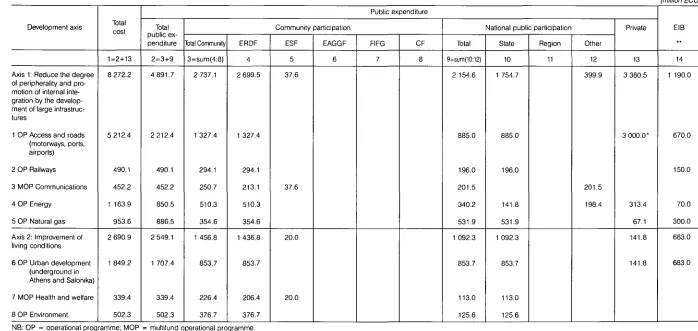
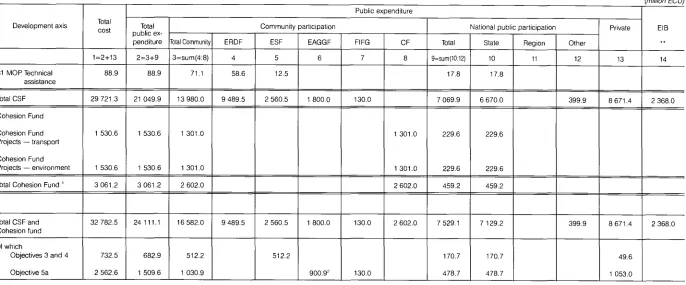
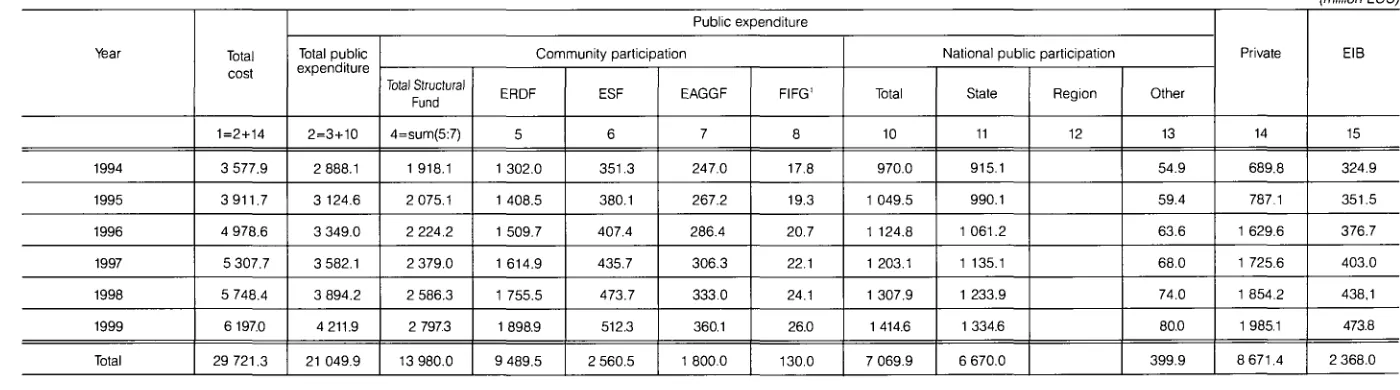
This Community support framework represents an agreement between the Commission and the Greek Government concerning objectives and priorities for the use of a sum of ECU 13 980 billion (at 1994 prices) from the Structural Funds for the period 1994-99. The sums that will be allocated from the Structural Funds within the framework of Community initiatives, as well as from the Cohesion Fund, are not covered by the CSF, although the indicative amounts for the Cohesion Fund are mentioned. Aid from the Cohesion Fund that will be made available during the period of application of the CSF has been taken into account in the definition of the overall strategy governing the CSF.
During discussions and negotiations on the RDP submitted by the Greek authorities, in-cluding informal discussions in the lead-up to the revision of the original plan in December
1993, the Commission emphasized four areas of paramount importance:
(i) the need for a strong investment effort in large infrastructures; (ii) a radical reshaping of industrial strategy;
(iii) mechanisms to improve the quality of training activities; (iv) a new approach to management in the public sector.
The Greek authorities recognize the importance of these issues and thus both partners subscribe to the strategy underpinning the revised plan. Accordingly, the Commission has constructed the CSF on the same basic strategy.
While it is very difficult to establish a reliable target in terms of GDP evolution in Greece by the end of 1999, both the Greek Government and the Commission consider that the CSF will lay the foundation for reversing the trend of the previous programming period, during which Greece's efforts to catch up with the rest of the Union in real terms did not bear fruit.
Stimulus it will provide for private investment in industry and the productive sectors in general. Furthermore, the Greek authorities have stated their intention to make efforts to attract private capital for infrastructure investment where possible. This will also contribute decisively in the reduction of pressures on the public finance situation and encourage further growth.
The CSF is based on the further stimulation of investment in:
(a) the productive sector brought about by specific measures designed to create a climate in which the current long term trend of disinvestment is reversed. This reversal is to be brought about in particular by a radical change from the past in industrial strategy (see Section 2.4.1) and a more innovative approach to the development of tourism;
(b) infrastructures closely related to the productive sector, for example transport, telecom-munications, energy. Here the CSF proposes to boost investment in large infrastructures beyond the levels proposed in the RDP by further resorting to private capital to finance the projects in question. (Clearly the constraints on public finances render it impossible to increase the public effort on this front beyond that included in the RDR) In addition to the large projects included in the RDP the main focus of attention for this respect is the motorway network (see Section 2.2.1);
(c) the development of human capital in order to promote investment leading to higher levels of productivity. In effect, the Greek economy needs to develop the scientific and technological base of economic activity. Success in this effort depends heavily on the mobilization of human resources and more specifically on the availability of a highly qualified human potential possessing the skills required for the use of advanced technologies as well as on the ability to adapt in a changing environment. The educa-tion/training system and the other active measures for the labour-market, can play an im-portant role in mobilizing the process of economic growth and employment promotion, if they are conceived on the basis of these objectives and are adequately funded.
2.1.1. Coherence with the White Paper
Coherence between the White Paper and the current CSF is reflected in major overall objec-tives: competitiveness, growth and employment, which are the objectives pursued through virtually all the axes of development.
The concentration of interventions in the area of infrastructures on those that are part of major European networks (motorways, railways, natural gas project) and the establishment of a stable macroeconomic climate should create conditions propitious to productive investment.
A more ambitious industrial strategy focusing on the international competitiveness of enter-prises, together with high-quality vocational training and education schemes, should make it possible to create and maintain secure jobs.
It is worth noting that the strategy developed in the CSF reflects the importance of the develop-ment of human resources, which is a major priority of the White Paper.
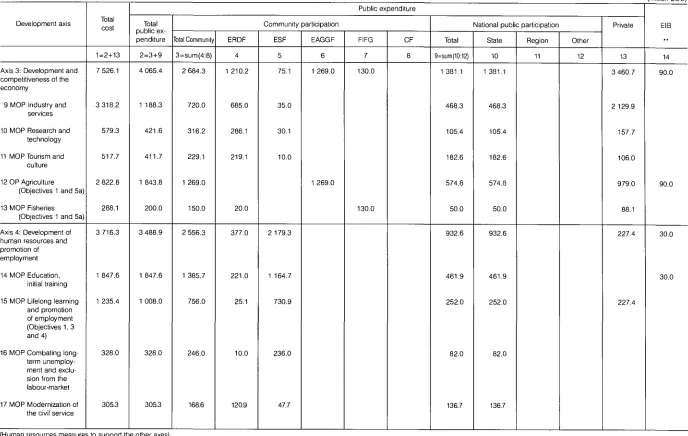
Similarly, interventions in the area of the environment, urban development (network of metropolitan transport) and health will improve people's living conditions. It should be noted that 80% of the CSF budget will be dedicated to investment in the productive system: that is, ECU 16 840 million in national and Community public funds, plus more than ECU 8 000 million ECU expected from the private sector. If it materializes, this private investment will make it possible to ease the pressure on public finances.
2.1.2. Impact of the CSF
prices (16 582 if one includes the average of the Cohesion Fund's share), and will be attributed by means of an annual distribution in accordance with the commitments entered into at Edin-burgh. The Commission services have carried out an evaluation of the expected impact, plac-ing the emphasis on the anticipated contribution from the Structural Funds to the develop-ment of the Greek economy.
Structural Fund transfers amount, on average, to 2.67% of GDP (3.66% when Cohesion Fund and Community initiative transfers are taken into account). Approximately 49.4% of the resources will be devoted to basic infrastructure, 21.2% to human resources and 29% to pro-ductive related infrastructure and propro-ductive investment with the objective of boosting both public and private investment over the financing period.
The CSF 1994-99 is estimated to have a significant impact on the Greek economy. Growth prospects shall be greatly influenced by the macroeconomic stability but current projections by the Commission show that the CSF will contribute at least 1 percentage point to annual GDP growth. The Structural Funds alone will account for 0.5% increase in annual growth rate and the level of GDP will be, at the end of the financing period, 3% higher than without the transfers.
Moreover, Structural Funds will account for approximately 10.5% of gross fixed capital forma-tion over the financing period creating the basis for a reversal of the declining investment trend in Greece.
On employment it is estimated that at least 55 000 jobs will be maintained or created in the private sector as a result of the CSF implementation. Given the importance of self-employed labour in Greece, the growth of which cannot be accurately forecasted, this figure could be easily raised to over 120 000 jobs.
In absolute terms, the commercial exchanges generated by the Structural Funds will only have a limited effect on Greece's overall commercial balance, but the impact of the Structural Funds is significant in terms of imports. A large part of Community transfers result in additional im-ports, largely from the rest of the European Union. It can thus be estimated that on average, almost 25% of Funds will be transformed into imports.
2.1.3. Implementation
In the light of experience from the past and the magnitude of the task facing the Greek authorities to implement the CSF efficiently in order to ensure the economy derives the benefits so essential for its development, the Commission and the Greek authorities have agreed that new management systems should be put in place and that the public works system should be improved.
These measures are crucial to the successful implementation of the CSF and are summarized in Chapter 4. Section 4.4.2 covers the broad lines of the agreement on the creation of a management organization unit to be attached to the Ministry of National Economy whereas Section 4.4.1 outlines the basic reforms to be undertaken regarding the public works system and the creation of special agencies for the implementation of large and/or complex projects. Where appropriate these agencies will be supported by professional project management structures to the extent that such support is not already incorporated into the agency itself.
2.1.4. Adjustments to the financial allocations
Besides applying a linear reduction to the Community aid figures proposed by the Greek authorities in order to eliminate the overbid in the RDR the CSF reflects some adjustments in balance between funds and sectors agreed between the parties.
Furthermore, the Structural Fund allocations to health and welfare, culture and sports and public administration have been reduced by a total of some ECU 270 million to allow for in-creases in education, research and technology, environment, agriculture and fisheries.
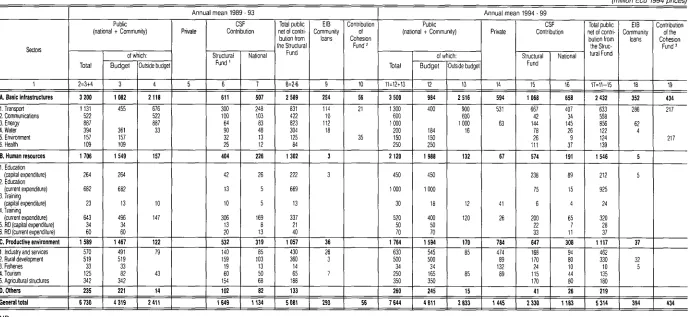
The attached table compares the sectoral distribution of Structural Fund-supported public ex-penditure in Greece under CSF 1 during the period 1989-93 with that proposed by the Greek authorities in their RDP and, taking account of the reallocations proposed, that programmed under CSF 2 for the period 1994-99.
It can be seen from the table that there is a major shift in the emphasis put on basic infrastruc-tures from CSF 1 to the RDR This emphasis is shared by CSF 2 reflecting the huge needs in this area and the fact that CSF 1 did not manage to come to grips with Greece's basic in-frastructural problems.
Within the basic infrastructures, as proposed by the RDR the main priority goes to transport with over 30% of CSF 2 public expenditure if the two underground railway projects are in-cluded.
The increase in the relative share of the expenditure devoted to energy is to be noted (8.3% in CSF 2 compared to 7.9% in the RDP and 5.2% in CSF 1) reflecting an increasing priority given in this sector to the rational use of energy and renewable sources and completion of the natural gas project.
The apparent fall in the relative share of resources devoted to the environment is, of course, due to the non-inclusion of the Cohesion Fund. Were the Cohesion Fund to be added at the indicative levels mentioned in the financial tables, the CSF 2 share would increase from the 3.9% mentioned in the table to 9.8%.
Overall the human resources effort increases from 20.7% in CSF 1 to 21.2% in CSF 2 but, within this sector, there is a distinct shift to education and initial training.
In both the RDP and CSF 2, agricultural and rural development receive less emphasis than in CSF 1.
Although there appears to be little change in the relative weight of industry and services from CSF 1 to the RDP and CSF 2, there is a considerable change in approach hidden behind the figures (CSF 1-financed industrial infrastructure and extensive regional aid schemes, especially in the Integrated Mediterranean programmes, whereas CSF 2 has a comprehen-sive package to improve competitiveness — see Section 2.4.1).
Table
Main categories of public expenditure co-financed by the Structural Funds and the FIFG
1989/93 and 1994/99
Prices in million ECU
1993 prices 1994 prices 1994 prices
S e c t o r s
A. Basic infrastructures
1. Transport (including underground) 2. Communications (+ reserve) 3. Environment
4. Health and welfare 5. Energy
B. Human resources
1. Education and initial training 2. Training — employment —
exclusion 3. Civil service
C. Productive environment
1. Agriculture and rural development 2. Industry and services
3. Research and technology 4. Tourism and culture
D. Technical assistance E. Other General total Structural Funds ERDF ESF EAGGF FIFG Total 1989/93 CSF Amount 5 590 2 740 1 015 915 185 735 2 880
Ì 2 880
4 525 2 580 1 125 270 550 43 877 13915
4 051
1 955
1 505
— 7511 % 40.3 20 7.3 6.5 1.3 5.2 20.7
] 20.7
32.5 18.5 8 2 4 0.3 6.2 100 54 26 20 — 100 1994/99 Amount 10 521.8 6 475.5 478.7 794.6 1 070.9 1 702.1 4 748.2 2 599.3 1 812.1 336.9 6 173.8 2 996.5 1 617.0 425.5 1 134.8 94.7 21 538.5 10 437.3 2 605.5 1 821.8 98.4 14 963 plan % 48.8 30 2.3 3.7 4.9 7.9 22.1 12 8.5 1.6 28.7 14 7.5 1.9 5.3 0.4 100 69.7 17.4 12.2 0.7 100 1994/99 CSF Amount 10 389.9 6 442.1 452.2 830.0 928.6 1 737.0 4 463.3 2 507.3 1 650.7 305.3 6 107.8 3 063.1 1 573.3 441.7 1 029.7 88.9 21 049.9 9 489.5 2 560.5 1 800.0 130.0 13 980.0 % 49.4 30.6 2.2 3.9 4.4 8.3 21.2 11.9 7.8 1.5 29.0 14.5 7.5 2.1 4.8 0.4 100 67.9 18.3 12.9 0.9 100
2.1.5. Axes of the CSF
Briefly, the objectives of the CSF are reflected in five axes of development.
Firstly, investment in major infrastructures will help Greece to reduce its degree of peripherality and promote its internal integration, which will make it possible to establish the necessary environment for productive investment that creates income and jobs.
Secondly, interventions concerning the improvement of living conditions will essentially be based on integrated actions in the area of the environment, improving the health system and urban development (metropolitan transport).
Fourthly, investment on human resources and reinforcing the structures of the labour-market will improve the workforce's skill levels and employment prospects.
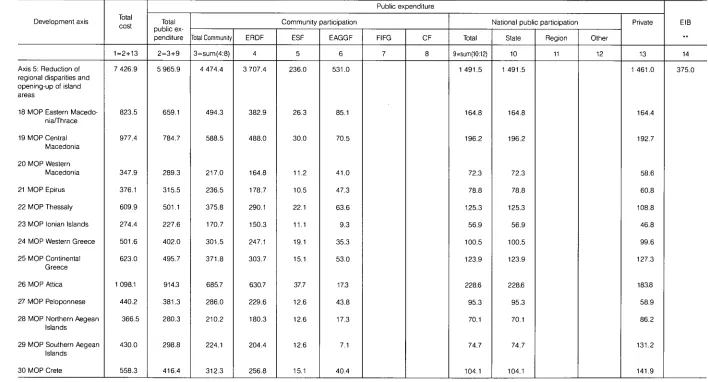
Fifthly, the reduction of regional disparities in development and the opening-up of island regions will make it possible to take advantage of the indigenous potential of the Greek regions.
The coherence of the overall strategy is reflected in the synergies between the various CSF interventions. The competitiveness of the economy depends largely on the availability of major infrastructures and the development of human resources, as well as on exploitation of the in-digenous development of the regions. The proposed actions will make it possible to reduce several of the disparities and cohesion gaps mentioned in Section 1.3. For example, they will make it possible to bridge the gaps in terms of transport, energy and the environment, to im-prove the low levels of training of the active population and to increase efforts concerning research, innovation and technology. The reduction of disparities and gaps, together with the other actions proposed for the economic sectors (industry, agriculture, fisheries and tourism), will help to improve the competitiveness of the Greek economy as a whole. As a result, the synergies created by this strategy should ensure that the total impact of the CSF will be greater than the sum of its parts.
Actions financed by the CSF should also help Greece to exploit the possibilities offered by the opening of the markets of Central and Eastern European countries, and of the Balkan States, in particular.
2.2. Axis 1 — Reduction in the degree of peripherality and
promotion of internal integration by the development
of large Infrastructures
2.2.1. Transport
The development of transport infrastructures is undoubtedly one of the fundamental priorities governing the boosting of the Greek economy. The deficit to be made good, in both quan-titative and qualitative terms, is very considerable in all branches of the sector and it is, therefore, valid to give the sector special attention and priority.
Analyses conducted concerning the sector's priorities have made it possible to define the priority axes associated with the distribution of the country's major urban and economic cen-tres and the opening of an access route to the European Union through Italy via the ports on the Western coast ('western gate concept'), an alternative to the traditional route through the Balkans. This new access route will comprise a Patras-Athens-Salonika road/rail corridor and the Egnatia road route linking the port of Igoumenitsa with northern Greece. The development of these corridors, integrated in trans-European transport networks (TENs), goes hand in hand with the associated major investment in the ports of Patras and Igoumenitsa.
The Greek authorities and the Commission agree that, given the general macroeconomic situation and the need, in conjunction with more direct measures to stimulate private invest-ment in the productive sectors, to maximize investinvest-ment in infrastructures which will improve the competitive position of Greece, every effort will be made to attract private capital to suitable projects. Such projects include those already identified in the RDP such as Spata airport, Rio-Antirio bridge, the Athens ring road and the underground in Salonika. Equally the main road connections between Patras, Athens and Salonika (the 'PATHE' corridor) and between Igoumenitsa, Salonika and Kipi on the Turkish border (the 'Egnatia' corridor) are of major importance.
opera-tion of concessions under market condiopera-tions which, whilst creating a climate in which the private sector can operate satisfactorily under adequate control by public authorities, ensures that the appropriate socioeconomic development benefits can be derived from the investments in question.
In regard to the motorway network, the mobilization of private capital should allow the attain-ment of the jointly agreed dual priority objectives of completion of the PATHE and Egnatia corridors to motorway standard with appropriate assistance from all of the Union's financial instruments. Consequently without blocking the continuation of works in progress — the Greek authorities have undertaken, on the basis of a regulatory framework to be set up and an open call for proposals, to seek private sector partners to invest in completing the corridors and to operate appropriate concession(s) on their full length.
It is estimated that the additional investment capable of being generated by this process will allow the corridors to be fully completed by the year 2000 and will enable considerable sav-ings in public (national and Union) expenditure on the corridors. Assuming PATHE is thus completed, the funds released will be diverted as a priority to completing the Egnatia corridor to the extent that sufficient private capital cannot be mobilized to this end, and, where necessary and within the limits of the resources available, the other priority projects for co-financing with the private sector.
It is recognized that it is not possible to anticipate accurately the reaction of the private sector and that there are many factors external to the CSF which will, in the final analysis, determine whether and to what extent private capital can be attracted to the investments under con-sideration. However in addition to the private investment in transport infrastructure already foreseen in the RDP there are reasonable grounds for programming on the basis of an addi-tional investment of the order of ECU 1.5 to 2 billion by the attraction of private capital to the PATHE and Egnatia corridors. The CSF is therefore drawn up on this basis and allocates public funds which should be adequate to attain, in conjunction with Cohesion Fund resources and those becoming available under the newly launched Interreg II initiative, the objective of completing these corridors to satisfactory standards. If it transpires that the estimates for private investment have to be revised then, within the resources available in the CSF and according to rules governing its revision, priority will be given to finding adequate resources to complete the corridors in question in the first place, and Spata and the other large projects earmarked in the RDR
Furthermore, the fact that some of these projects are included in the list of priority projects annexed to the Commission's White Paper on growth, competitiveness and employment, opens the possibility of Community support for the mobilization of private capital.
It should be remembered that the improvement of the system governing public works con-tracts agreed by the Greek authorities and the Commission, in the form of the creation of a new framework for the allocation of contracts and mechanisms to ensure the quality of pro-jects and their efficient implementation, is also a condition of primary importance for the trans-port sector, which is necessary to the success of the chosen development strategy.
2.2.1.1. Road networks and access
(a) Actions concerning the road network will be heavily concentrated (together with interven-tions under the Cohesion Fund) on the Patras-Athens-Salonika and Egnatia corridors (star-ting with the western section of the Egnatia corridor, i.e. the Igoumenitsa-Salonika section), the aim being that, by the year 2000, motorways along these two priority axes should be virtually completed. This entails the construction of more than 1 000 km of motorway be-tween now and the year 2000, that is, 10 times the length of motorway constructed during CSF 1. This comparison illustrates the acute need to develop effective new implementation mechanisms.
ring road and some particular actions between loannina and Rio, between Salonika and the Bulgarian border and on the road network in northern Crete.
Actions on road networks to be undertaken in the framework of regional programmes will be selected with account being taken of their coherence in relation to the axes funded at national level, which are themselves fully integrated in the TEN. Routes facilitating access to the major axes of the TEN or forming part of their layout will receive priority treatment.
On completion of the CSF in 1999, the length of motorways per 100 km2 will be more than doubled by comparison with the situation in 1993 (from 0.21 to 0.51), and investment in motorways forming part of the TEN will rise from 0.007% of GDP to 0.013%, while fatalities on the roads, measured by the number of deaths per million vehicles, should fall from 672 in 1993 to 360 in 1999.
With the completion of the PATHE corridor, the average travelling time between Patras and Athens and between Athens and Salonika will be cut by 30 minutes and 60 minutes, respectively.
(b) As regards ports, priority actions will concentrate on the western coast. Major moderniza-tion work will be undertaken at the ports of Igoumenitsa and Patras, in accordance with an approach that is coherent with the investment made in the PATHE and Egnatia cor-ridors. The port of Corfu will also be the subject of action within the framework of the CSF These measures will help to improve the interconnection with the European Union through Italy and stimulate the development of combined transport.
Three ports on the eastern coast (Alexandroupolis, Kavala and Volos) will be the subject of works to facilitate the development of goods transport from and to the Balkan States,
(c) Actions to develop the capacity and performance of airports will be undertaken in relation to both national and international airports. Of Greece's international airports, special atten-tion will be given to funding the new Spata airport. Modernizaatten-tion work will also be under-taken, particularly at the airports of Salonika, Iraklion, Corfu and Rhodes.
Provision is also being made for a network of heliports, mainly to meet social needs (to transport sick people and supplies) but also to encourage the development of isolated regions.
Work on airport infrastructures should result in a reduction in the number of inhabitants per airport from 270 000 in 1993 to 260 000 in 1999 and a reduction in surface area per airport from 3 474 km2 to 3 219 km2.
2.2.1.2. Railways
The significant effort required to improve rail transport will be reflected in the drawing-up of a business plan, which will cover both investments and the modernization of the Greek Railways Company and its operation.
As regards investments to be made during the period covered by CSF 2, priority will be given to the Patras-Athens-Salonika link, which is part of the rail TEN. Funding from both the Struc-tural Funds and the Cohesion Fund will make it possible to move towards completion of the infrastructure of the Athens-Salonika line (civil engineering, signalling, telecommunications, electrification), with a view to guaranteeing, in the long term, a travelling speed of 200 km/h. By the year 2000, the Athens-Salonika line will be twin track along 88% of its length (60 km of track between Lianokladi and Domokos, which would be particularly difficult and costly to convert, will remain as single track) and journey time will be 4 hours 20 minutes (as compared with 5 hours 50 minutes in 1994 and 6 hours 15 minutes in 1993).
the line between Corinth and Patras continues within a period compatible with the viability of the investment in the Eleusis-Corinth line. With this in mind, a technico-economic feasibility study will be immediately launched and will provide the necessary information for programm-ing the appropriate financprogramm-ing. Modernization of the Corinth-Patras section must be seen as a priority project, which will receive any amounts which may be released by the reallocation of CSF resources during its implementation.
The second action, in terms of the amount of investment envisaged, concerns the supply of rolling-stock, supplementing the investments already made under CSF 1.
Remaining resources (of the order of 12% of total funding) will be used for particular im-provements to other lines of the Greek network, the construction of a link with the port of Kavala and horizontal actions and technical assistance activities. The latter type of activity is, also, necessary for the creation of an ad hoc implementation mechanism, which is considered indispensable.
Work planned for the period covered by CSF 2, including financing from the ERDF and the Cohesion Fund, will lead to an increase in the length of track from 2 484 to 2 588 km, in the percentage of twin track from 8.5 to 13.3%, in the percentage of electrified lines from 3 to 21.2%, and in the percentage of track on which trains travel at a speed of over 140 km/h from 0.6 to 13.3%, whilst the percentage of the high-speed TEN remaining to be completed will fall from 51 to 40%. Most of these indicators will be further improved when the new Eleusis-Corinth line is extended to Patras.
2.2.2. Communications
(a) Telecommunications
Considering its relative GDP per capita, Greece has a remarkably high number of main lines per capita (40 per 100 inhabitants at the end of 1992, compared to an EUR 12 average of 44). The 1993 figure has already reached 45. On the other hand the quality of the service is par-ticularly poor: for example, the number of faults per line per year in 1992 at 0.53 was the highest in the Union. Also, Greece has a very long waiting list (11 months at end 1993), the least digitiz-ed network in the EU (24% of main lines connectdigitiz-ed to digital local exchanges, end 1993) and the lowest investment per capita in telecommunications of any EU Member State. The revenue per line in the national telecommunications operator's (OTE) network was, in 1991, 40% of the average of the EU countries.
Those figures clearly indicate that poor telecommunications is a serious bottleneck to economic development in Greece. In order to overcome such a bad situation, and following the initiative jointly undertaken by the Greek authorities and the Commission from 1990 on-wards a strategic and comprehensive approach to the development of telecommunications in Greece was developed. As a first step in the implementation of this approach, the so-called CRASH programme was launched in 1992, aimed at putting into practice the modernization of Greek telecommunications as a whole.
Amongst the main conclusions reached to date has been the need to enable operators and service providers (notably OTE) to conduct their affairs on a commercial basis (including the ability to make a long-term business plan) and the need for OTE to adapt its organizational and administrative structure so that it acts with a 'customer service' orientation.
In accordance with a strategic approach and principally with a view to improving the quality of services and the efficiency of the sector, action to be supported by the CSF should not nor-mally concern the usual commercial operational investments of a service provider or operator but would concentrate on measures aimed at securing the provision of services in relatively high-cost areas, improving access to TENs, introducing new technology for remote or topographically difficult areas, speeding up or improving the provision of advanced services to major commercial user groups of importance to the economy, modernizing the public
ad-ministration, improving the development of rural, border or island areas. Measures for training related to the introduction of new technologies and modern methods of management and for stimulating the market for new services should also be given priority.
An ad hoc set of precise indicators will be included in the operational programme for com-munications, adapted to the specific and quantified objectives of the action to be undertaken.
(b) Postal services
It is proposed to support a relatively small but important measure to modernize the Greek postal service. This will be undertaken in the framework of a programme of action, to be set up in accordance with the conclusions of a strategic study of the national post office (ELTA) and in the context of a business plan for ELTA which will be developed as part of the strategic study. The reforms necessary to achieve real modernization, including those resulting from Community legislation in this field, will be fully analysed in the strategic study. The basic objec-tive is to provide a comprehensive framework for the future short- and long-term development of postal services.
Among other key issues, the means to improve the quality of services will be analysed as well as the performance, main features and organization of ELTA, the use of its resources and assets and its relationship with productivity and efficiency, the services provided by ELTA and their potential expansion, the cost system and tariffs, the definition of minimum service stan-dards and the principles of ELTA's public service obligations.
2.2.3. Energy
Actions concerning the energy sector will come partly within the framework of an operational programme covering the whole sector and partly under the implementation of the scheme for the introduction of natural gas to Greece, which began under CSF 1 and the Community's REGEN initiative and is currently included in the list of priority projects in the Commission's White Paper on growth, competitiveness and employment.
The creation of a national energy council will be a first step towards the establishment of an energy policy and an overall strategy for the sector.
Priority will be given to the launching of a policy for conserving energy and developing renewable sources of energy, including, in addition to technical-assistance measures, a system of financial aid for enterprises involved in investments leading to energy savings (in this respect, provision is made for significant cofunding with the private sector). Implementa-tion of this scheme implies the creaImplementa-tion of an adequate management mechanism that would allow, in particular, effective monitoring and assessment of the real impact of actions under-taken. Planned interventions, corresponding to the introduction of a policy for saving and mak-ing rational use of energy, will lead to a slowmak-ing of the observed trend towards an increase in total energy consumption per unit of GDP (from 440 kgoe/t ECU 92 in 1992 to 452 in 1999) and in energy consumption in industry per unit of industrial production (from 742 kgoe/t ECU 92 in 1992 to 760 in 1999).