Implementation evaluation of multiple
complex early years interventions: an
evaluation framework and
study protocol
Nimarta Dharni, 1 Josie Dickerson,1 Kathryn Willan,1 Sara Ahern,1 Abigail Dunn,2
Dea Nielsen,2 Eleonora Uphoff,2 Rosemary R C McEachan,1 Maria Bryant3
To cite: Dharni N, Dickerson J, Willan K, et al. Implementation evaluation of multiple complex early years interventions: an evaluation framework and study protocol. BMJ Paediatrics Open 2019;3:e000479. doi:10.1136/ bmjpo-2019-000479
►Additional material is published online only. To view please visit the journal online (http:// dx. doi. org/ 10. 1136/ bmjpo- 2019- 000479).
Received 5 March 2019 Revised 28 May 2019 Accepted 30 May 2019
1Born in Bradford, Bradford
Institute for Health Research, Bradford, UK
2University of York, York, UK 3University of Leeds, Leeds, UK
Correspondence to Dr Nimarta Dharni; nimarta. dharni@ bthft. nhs. uk © Author(s) (or their employer(s)) 2019. Re-use permitted under CC BY-NC. No commercial re-use. See rights and permissions. Published by BMJ.
What is already known on this topic?
Early years interventions are integral to improving the life chances for children and reducing inequalities in health and well-being. However, there is a dearth of evidence examining the impact of interventions, especially those that have been developed and/or adapted for local contexts.
What this study hopes to add?
Our focus on implementation presents a pragmatic and consistent approach to evaluating multiple early years interventions, including those deemed as not yet ready for evaluations of effectiveness. The mixed-methods approach and use of routinely collected data provide an efficient, feasible and manageable evaluation framework that can be easily embedded within services as they are being delivered.
AbstrACt
Introduction Implementation evaluations are integral to understanding whether, how and why interventions work. However, unpicking the mechanisms of complex interventions is often challenging in usual service settings where multiple services are delivered concurrently. Furthermore, many locally developed and/or adapted interventions have not undergone any evaluation, thus limiting the evidence base available. Born in Bradford’s Better Start cohort is evaluating the impact of multiple early life interventions being delivered as part of the Big Lottery Fund’s ‘A Better Start’ programme to improve the health and well-being of children living in one of the most socially and ethnically diverse areas of the UK. In this paper, we outline our evaluation framework and protocol for embedding pragmatic implementation evaluation across multiple early years interventions and services. Methods and analysis The evaluation framework is based on a modified version of The Conceptual Framework for Implementation Fidelity. Using qualitative and quantitative methods, our evaluation framework incorporates semistructured interviews, focus groups, routinely collected data and questionnaires. We will explore factors related to content, delivery and reach of interventions at both individual and wider community levels. Potential moderating factors impacting intervention success such as participants’ satisfaction, strategies to facilitate implementation, quality of delivery and context will also be examined. Interview and focus guides will be based on the Theoretical Domains Framework to further explore the barriers and facilitators of implementation. Descriptive statistics will be employed to analyse the routinely collected quantitative data and thematic analysis will be used to analyse qualitative data.
Ethics and dissemination The Health Research Authority (HRA) has confirmed our implementation evaluations do not require review by an NHS Research Ethics Committee (HRA decision 60/88/81). Findings will be shared widely to aid commissioning decisions and will also be disseminated through peer-reviewed journals, summary reports, conferences and community newsletters.
IntroduCtIon
The early years of life are integral to promoting positive outcomes throughout
the lifespan.1 Women’s health in pregnancy
and the first two years of their children’s lives have been identified as critical periods in children’s emotional, cognitive and physical development.2–4 Early years interventions are
therefore crucial to reduce inequalities and ensure the health and well-being of children as they grow. However, many preventative interventions delivered by early years services have not been subjected to rigorous devel-opment and evaluation, thus leaving them without a robust evidence base.5–8
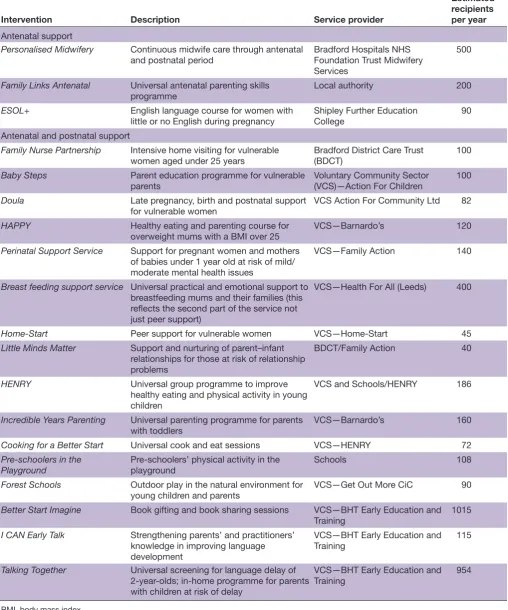
Better Start Bradford is a Big Lottery– funded programme that has commissioned and implemented over 20 early years interven-tions into existing practice in three deprived and ethnically diverse inner-city wards of Brad-ford. The interventions aim to improve social and emotional development, communication and language development, and nutrition and health in children 0–4 years old.8 9 The
limited availability of evidence of effect for
on 24 July 2019 by guest. Protected by copyright.
http://bmjpaedsopen.bmj.com/
Table 1 Interventions commissioned for delivery as part of the Better Start Bradford programme
Intervention Description Service provider
Estimated recipients per year
Antenatal support
Personalised Midwifery Continuous midwife care through antenatal
and postnatal period Bradford Hospitals NHS Foundation Trust Midwifery Services
500
Family Links Antenatal Universal antenatal parenting skills
programme Local authority 200
ESOL+ English language course for women with
little or no English during pregnancy Shipley Further Education College 90 Antenatal and postnatal support
Family Nurse Partnership Intensive home visiting for vulnerable women aged under 25 years
Bradford District Care Trust (BDCT)
100
Baby Steps Parent education programme for vulnerable
parents Voluntary Community Sector (VCS)—Action For Children 100 Doula Late pregnancy, birth and postnatal support
for vulnerable women VCS Action For Community Ltd 82
HAPPY Healthy eating and parenting course for
overweight mums with a BMI over 25 VCS—Barnardo’s 120
Perinatal Support Service Support for pregnant women and mothers of babies under 1 year old at risk of mild/ moderate mental health issues
VCS—Family Action 140
Breast feeding support service Universal practical and emotional support to breastfeeding mums and their families (this reflects the second part of the service not just peer support)
VCS—Health For All (Leeds) 400
Home-Start Peer support for vulnerable women VCS—Home-Start 45
Little Minds Matter Support and nurturing of parent–infant relationships for those at risk of relationship problems
BDCT/Family Action 40
HENRY Universal group programme to improve healthy eating and physical activity in young children
VCS and Schools/HENRY 186
Incredible Years Parenting Universal parenting programme for parents
with toddlers VCS—Barnardo’s 160
Cooking for a Better Start Universal cook and eat sessions VCS—HENRY 72 Pre-schoolers in the
Playground Pre-schoolers’ physical activity in the playground Schools 108 Forest Schools Outdoor play in the natural environment for
young children and parents VCS—Get Out More CiC 90
Better Start Imagine Book gifting and book sharing sessions VCS—BHT Early Education and
Training 1015
I CAN Early Talk Strengthening parents’ and practitioners’ knowledge in improving language development
VCS—BHT Early Education and
Training 115
Talking Together Universal screening for language delay of 2-year-olds; in-home programme for parents with children at risk of delay
VCS—BHT Early Education and
Training 954
BMI, body mass index.
many early years interventions means that the majority of Better Start Bradford interventions are considered as being ‘science based’ with some in the foundational
stages of development and/or evaluation5 10 (see table 1
for further details about the interventions and Better Start Bradford9).
on 24 July 2019 by guest. Protected by copyright.
http://bmjpaedsopen.bmj.com/
Figure 1 Modified conceptual framework for
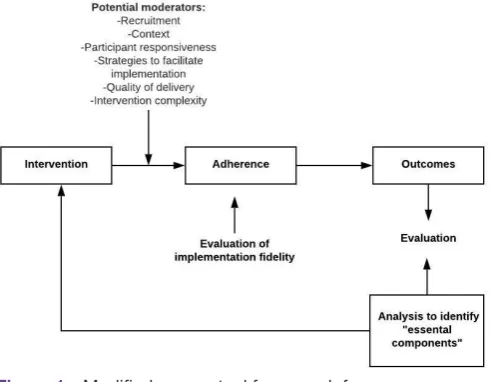
implementation fidelity Carroll et al 2007, Hasson et al 2010. Born in Bradford’s Better Start (BiBBS) experimental birth cohort was established to provide independent effectiveness evaluations for these early years interven-tions through planned controlled experiments and using quasi-experimental methods. However, effective interventions are those that show a positive outcome on key outcomes and also those that are able to recruit and engage participants and can be delivered with fidelity in usual service settings. It is therefore critical to conduct implementation evaluations to provide evidence of the feasibility, reach, context and short-term impact of inter-ventions.6 11 Furthermore, implementation or process
evaluations can help allude to the transferability of inter-ventions, providing local commissioners and service providers with guidance on the practical measures they can take to successfully embed interventions within their settings and communities.6
This paper describes a framework and protocol to eval-uate the implementation of interventions being deliv-ered as part of the Better Start Bradford programme. Our evaluation framework can be used by researchers, practitioners, commissioners and service providers across multiple settings to evaluate the quality of implementa-tion of early years intervenimplementa-tions being delivered in usual settings and maximise potential for more intensive levels of evaluation.
MEthods
Conceptual framework
Underpinned by the Medical Research Council guid-ance on process evaluations of complex interventions, our implementation evaluations draw on the conceptual framework for implementation fidelity (figure 1).12 13
Fidelity, termed as adherence, is defined as a combi-nation of content, frequency and duration of delivery, and coverage.12 13 Examining fidelity therefore seeks to
establish the extent to which the active ingredients of the intervention were delivered as often and for as long as
planned.12 13 Also included in the framework are
poten-tial moderators of implementation process and fidelity such as intervention complexity, participant responsive-ness (including engagement and satisfaction), quality of delivery and strategies that facilitate implementation. Context and recruitment were later added as potential moderators in the modified framework.12 The
modera-tors are proposed to be intrinsically linked to each other as well as to implementation fidelity.
Adoption of the conceptual model of implementation fidelity will help glean the factors affecting the implemen-tation of the Better Start Bradford interventions (inde-pendently and collectively) and, in turn, examine their impact on outcomes as interventions increase in their potential for evaluation of impact. While drawing on published examples12 14 we plan to apply the framework
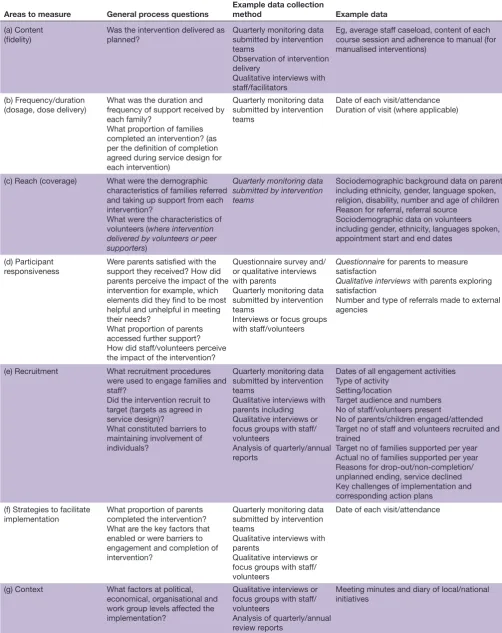
consistently across multiple interventions with much of the data collection being integrated in the routine delivery of interventions to yield an efficient and prag-matic approach to evaluation. Table 2 outlines the eval-uation framework including the overarching research questions, corresponding data source and method of collection.
data collection
Data for the implementation evaluation will be derived from a number of sources:
Quantitative data collected by intervention teams
Prior to the implementation of each intervention, a service design process takes place in collaboration with commissioners, intervention delivery teams, academic researchers and other stakeholders including health professionals and community representatives to ensure each intervention meets the needs of the local popula-tion. During this process, recruitment targets and process and outcome data to be collected by intervention teams throughout the delivery period and submitted quarterly to the research team are also agreed. A guide to the service evaluation process and templates including a minimum dataset for implementation evaluation is avail-able on our website.15
Satisfaction questionnaires
We have developed a brief six-item satisfaction question-naire to capture participants’ satisfaction across all inter-ventions (see online supplementary additional file 1). Questions are based on the key constructs of commonly used patient satisfaction surveys,16 17 but have been
adapted following advice from our Community Research Advisory Group (CRAG), composed of local parents and volunteers alongside intervention team managers, commissioners and the research team to ensure accepta-bility for the local community. This process resulted in a questionnaire that is brief and uses visual cues and simple language that can be easily understood and translated into other languages.
on 24 July 2019 by guest. Protected by copyright.
http://bmjpaedsopen.bmj.com/
Table 2 Implementation and process evaluation key elements and research questions within Better Start Bradford
Areas to measure General process questions Example data collection method Example data
(a) Content (fidelity)
Was the intervention delivered as planned?
Quarterly monitoring data submitted by intervention teams
Observation of intervention delivery
Qualitative interviews with staff/facilitators
Eg, average staff caseload, content of each course session and adherence to manual (for manualised interventions)
(b) Frequency/duration
(dosage, dose delivery) What was the duration and frequency of support received by each family?
What proportion of families completed an intervention? (as per the definition of completion agreed during service design for each intervention)
Quarterly monitoring data submitted by intervention teams
Date of each visit/attendance Duration of visit (where applicable)
(c) Reach (coverage) What were the demographic characteristics of families referred and taking up support from each intervention?
What were the characteristics of volunteers (where intervention delivered by volunteers or peer supporters)
Quarterly monitoring data submitted by intervention teams
Sociodemographic background data on parents including ethnicity, gender, language spoken, religion, disability, number and age of children Reason for referral, referral source
Sociodemographic data on volunteers including gender, ethnicity, languages spoken, appointment start and end dates
(d) Participant responsiveness
Were parents satisfied with the support they received? How did parents perceive the impact of the intervention for example, which elements did they find to be most helpful and unhelpful in meeting their needs?
What proportion of parents accessed further support? How did staff/volunteers perceive the impact of the intervention?
Questionnaire survey and/ or qualitative interviews with parents
Quarterly monitoring data submitted by intervention teams
Interviews or focus groups with staff/volunteers
Questionnaire for parents to measure satisfaction
Qualitative interviews with parents exploring satisfaction
Number and type of referrals made to external agencies
(e) Recruitment What recruitment procedures were used to engage families and staff?
Did the intervention recruit to target (targets as agreed in service design)?
What constituted barriers to maintaining involvement of individuals?
Quarterly monitoring data submitted by intervention teams
Qualitative interviews with parents including
Qualitative interviews or focus groups with staff/ volunteers
Analysis of quarterly/annual reports
Dates of all engagement activities Type of activity
Setting/location
Target audience and numbers No of staff/volunteers present
No of parents/children engaged/attended Target no of staff and volunteers recruited and trained
Target no of families supported per year Actual no of families supported per year Reasons for drop-out/non-completion/ unplanned ending, service declined Key challenges of implementation and corresponding action plans
(f) Strategies to facilitate
implementation What proportion of parents completed the intervention? What are the key factors that enabled or were barriers to engagement and completion of intervention?
Quarterly monitoring data submitted by intervention teams
Qualitative interviews with parents
Qualitative interviews or focus groups with staff/ volunteers
Date of each visit/attendance
(g) Context What factors at political, economical, organisational and work group levels affected the implementation?
Qualitative interviews or focus groups with staff/ volunteers
Analysis of quarterly/annual review reports
Meeting minutes and diary of local/national initiatives
on 24 July 2019 by guest. Protected by copyright.
http://bmjpaedsopen.bmj.com/
box 1 Inclusion criteria for all participants
(a) Intervention participants
► Reside in a postcode within the Better Start Bradford area
► Are enrolled to attend a Better Start Bradford intervention OR
► Eligible but declined to take part, or dropped out (where relevant)
► Agree for their data to be shared with the research team for
eval-uation purposes
► Agree to be contacted by the research team, where further
qualita-tive studies are planned
(b) Intervention staff, volunteers, stakeholders and/or commissioners
► Work/volunteer for an intervention or are actively involved in
com-missioning or delivering an intervention
► Have delivered at least one full intervention according to the
inter-vention delivery schedule (interinter-vention delivery teams only)
► Agree to take part in an interview/focus group/observation
Semi-structured interviews and focus groups
Semistructured interviews and/or focus groups, where appropriate, will be undertaken with intervention partic-ipants and delivery teams to allow more in-depth explo-ration of elements of the conceptual model. Topic guides will be based on the Theoretical Domains Framework (TDF).18 19 The TDF encompasses a comprehensive
range of constructs from theories of behaviour change including beliefs about capabilities, knowledge, skills, emotions and social influences. Furthermore, use of the TDF provides a firm theoretical basis to allow under-standing of the mechanisms of action as well as the barriers and facilitators of implementation.20 It has been
extensively applied to investigate and address implemen-tation problems.20 While the interview questions may
differ by intervention, use of the TDF ensures the under-lying theoretical concepts explored in all interviews are explored using a consistent approach.
All studies will include data from sources 1 and 2. In-depth qualitative work may be triggered in response to issues identified by interventions such as difficul-ties in engaging families from particular ethnic groups, low completion rates and priorities highlighted by the commissioning team.
Eligibility
Inclusion criteria for all participants are listed in box 1.
Exclusion criteria
For qualitative studies, participants who have completed an interview/focus group within the past 12 months will not be approached to take part in a second study to avoid unnecessary burden.
sample size & selection
Quantitative process and demographic data will be collected for all participants who consent for their data to be shared with the evaluation team. Sample sizes will not be determined in advance as this will be dependent on the uptake of interventions.
For qualitative evaluation, a purposive sampling method will be used to identify and recruit participants repre-senting key characteristics including ethnicity, number of children and primary language to represent the different ethnic and cultural groups in Bradford. Other charac-teristics will be included based on the key objectives of the intervention as defined during the service design process, for example, maternal mental well-being for interventions relating to social and emotional health, and body mass index for interventions relating to nutri-tion. We will continue to recruit until we reach data satu-ration, with an estimate of 20–30 interview participants per intervention. Where focus groups are undertaken, we would aim to recruit 8–10 participants per group, with potentially separate focus groups depending on partici-pants’ ethnicity, gender, primary language and/or neigh-bourhood area. For staff/volunteers, we aim to interview a minimum of 5/6 people per intervention, depending on the size of the intervention delivery team.
recruitment
Quantitative intervention data and satisfaction questionnaires Quantitative data will be collected from all participants as a part of the standard service provision.
Qualitative studies
Participants will be identified and approached by one of two methods:
1. By researchers directly from the BiBBS cohort As part of the consent process for our experimental BiBBS cohort study, expectant parents consent to being contacted in the future to learn about participation in further studies. Researchers will write to consenting parents, attaching a cover letter and information sheet about qualitative studies and contact them via telephone within 2 weeks. Where a participant speaks a language other than English, the initial phone call will be made by a bilingual researcher or an interpreter.
2. By intervention delivery staff/managers
Intervention coordinators will be asked to circulate the study information sheet to all participants who have enrolled onto an intervention. Coordinators will share the names and contact details of those individuals who are willing to be interviewed with the research team. Staff and volunteers will first be approached by their service managers, and if they agree, their contact details will be passed onto the research team.
In both methods of approach, for those interested in taking part, we will check their eligibility (as described above) and check they have read and understood the information sheet. A convenient date/time/place for an interview will be confirmed if agreed.
Consent
Quantitative data sharing
All intervention participants are given a privacy notice (that complies with the General Data Protection Regu-lation (GDPR)) when they enrol for an intervention that
on 24 July 2019 by guest. Protected by copyright.
http://bmjpaedsopen.bmj.com/
explains that data will be shared for service evaluation. The privacy notice and consent form clearly explain how participants can opt out of data sharing/withdraw their consent at any time. All forms were developed with the English language and literacy abilities of the service participants in mind and with guidance from both our CRAG and members of the wider community; the simpli-fied version of the privacy notice has a Flesch reading score of 61 and deemed to be easily understood by indi-viduals aged 12 and above.21 Information is also available
in print in Urdu, Bengali and Slovakian, and is translat-able to any other language through the Better Start Brad-ford website.22
Qualitative data sharing
We will obtain written informed consent from all partici-pants prior to commencing interviews/focus groups. For interviews with non–English-speaking participants, the information sheet and consent form will be explained by an interpreter. At every stage of the research process, the right of participants to refuse consent without giving a reason will be respected.
data management
Quantitative intervention and satisfaction questionnaire data Data-sharing agreements will be in place between inter-vention teams, Better Start Bradford and the research team before data are shared. For those participants who have agreed to data sharing, the intervention teams will share individual-level, identifiable data with the research team using secure transfer methods. Personally iden-tifiable data items will be removed and replaced with a unique intervention identification number prior to anal-ysis.
Qualitative data
Audio recordings will be uploaded to an encrypted and secure network and will be deleted following transcrip-tion and verificatranscrip-tion of transcripts.
Confidentiality
All data shared will be strictly confidential and held securely for the duration of the Better Start Bradford programme. We will comply with all aspects of the GDPR,23 abide by the Caldicott principles and work
within NHS Information Governance requirements. Anonymised data and transcripts will be available to the research team for the purposes of service evaluation only.
Analysis
Quantitative intervention and satisfaction questionnaire data Data will be summarised using descriptive statistics, including frequencies, summary statistics, CI esti-mates and ranges for continuous variables (eg, partici-pant age, referral and recruitment rate, attrition), and proportions/percentages for categorical variables (eg, ethnicity, intervention completion). The analysis will also explore whether there are any differences in referrals, recruitment rates, intervention reach, attendance and
satisfaction between different groups of participants, for example, by parity, ethnicity and spoken English profi-ciency.
Qualitative data
Qualitative data will be analysed using thematic analysis (TA), a widely used method in evaluative studies which seeks and reports patterns inherent within the data.24 TA
was chosen as it allows for an understanding of the data to be developed and patterns within the thoughts and views of participants to be examined. Specific barriers and enablers influencing implementation and satis-faction of interventions will be coded according to the TDF.18 19 We will also explore any patterning of themes by
individuals’ ethnicity, socioeconomic circumstances and English-language ability. Transcripts will be coded system-atically and iteratively until the analysis team are satisfied that the emerging framework adequately captures the data and saturation has been achieved. Ten per cent of the transcripts will be coded by a second researcher to maintain reliability of the coding framework. Any disa-greements will be resolved through discussion and revis-iting the coding framework. Data will be managed within the Nvivo data management program (NVivo qualitative data analysis software; QSR International Pty Ltd).
Patient and public involvement
Community involvement is integral to the ethos of BiBBS and Better Start Bradford. As such, we have set up a CRAG composed of local community representatives including parents, volunteers, councillors and leaders of local groups and charities. The group have been involved in every stage of development including in setting the overall evaluation objectives, development of information sheets, consent forms and satisfaction questionnaires. The CRAG will continue to advise on the development and refinement topic guides, methods for engaging local parents as well as playing a key role in the interpretation and dissemination of findings.
dissemination
Findings will be disseminated widely to aid commissioning decisions and ensure shared learning with local partners. Findings will also be shared at local and national confer-ences, relevant public health events and via publication in academic journals. Finally, summaries of key findings will be shared with participants and the local community via our CRAG, newsletters and on the Born in Bradford website.25
dIsCussIon
In this paper, we have outlined our framework for imple-mentation evaluation across multiple, complex early years interventions. This framework has so far proved invaluable to ensure consistent and manageable data collection across all interventions as well as identifying and resolving issues in the quality of routinely collected
on 24 July 2019 by guest. Protected by copyright.
http://bmjpaedsopen.bmj.com/
data. Through the cyclical transfer of knowledge, find-ings from our implementation evaluations may also help delivery teams respond to any challenges identified and further optimise the delivery and reach of their interven-tions.
Understanding the key components of interventions and local context are integral to ensuring the successful implementation of public health interventions. However, setting up evaluations for interventions being delivered as part of usual practice is challenging, particularly where adaptations are required to ensure interventions can be integrated into the complex systems they are being deliv-ered in. Through partner working with a wide range of stakeholders including service providers, commissioners and community representatives, our evaluation approach will also consider the role of contextual factors, delivery procedures, acceptability and scalability of the interven-tions. We have shared our learning on the practicali-ties of translating research into practice, the challenges encountered and the strategies adopted to address them elsewhere.26
Our implementation evaluation framework and asso-ciated tools15 are designed to be sustainable beyond
our involvement as external service evaluators to allow commissioners and intervention teams to continue monitoring and evaluating the implementation of their services. While in-depth qualitative evaluation may still require input from researchers, the rest of this framework can be applied by service providers and commissioners to embed pragmatic evaluation within the delivery of services while taking positive steps towards building a robust evidence base for early years interventions.
Acknowledgements We are grateful to all the participants, all members of the Community Research Advisory Group, Born in Bradford staff, the Better Start Bradford staff and projects, health professionals and researchers who have supported the development and set-up of this evaluation study.
Contributors ND, JD, KW, AD, SA, DN, RRCM and EU contributed to the design of the study, were involved in drafting this manuscript, approved the final version of this manuscript and agree to be accountable for this work.
Funding This study has received funding through a peer-review process from the Big Lottery Fund as part of the A Better Start programme.
disclaimer The Big Lottery Fund have not had any involvement in the design or writing of the study protocol.
Competing interests None declared. Patient consent for publication Not required.
Ethics approval The protocol for the BiBBS cohort including consent to contact for other studies has been approved by Bradford Leeds NHS Research Ethics Committee (15/YH/0455). Research governance approval has been provided from Bradford Teaching Hospitals NHS Foundation Trust. The Health Research Authority has confirmed that our implementation evaluations do not require review by an NHS Research Ethics Committee (HRA decision 60/88/81). However, we will adhere to all ethical principles in the conduct of our evaluations and written informed consent will be obtained from all participants prior to qualitative interviews and/or focus groups.
Provenance and peer review Not commissioned; externally peer reviewed. data sharing statement There are no data in this work.
open access This is an open access article distributed in accordance with the Creative Commons Attribution Non Commercial (CC BY-NC 4.0) license, which permits others to distribute, remix, adapt, build upon this work non-commercially,
and license their derivative works on different terms, provided the original work is properly cited, appropriate credit is given, any changes made indicated, and the use is non-commercial. See: http:// creativecommons. org/ licenses/ by- nc/ 4. 0/.
rEFErEnCEs
1. Hickey G, McGilloway S, Furlong M, et al. Understanding the implementation and effectiveness of a group-based early parenting intervention: a process evaluation protocol. BMC Health Serv Res 2016;16.
2. Axford N, Sonthalia S, Wrigley Z, Goodwin A, Ohlsen C, Bjornstad G, Barlow J, Schrader-Mcmillan A, Coad J, Toft A. The best start at home: what works to improve the quality of parent–child interactions from conception to age 5 years. A rapid review of interventions The Early Intervention Foundation; 2015.
3. Marmot M, Allen J, Goldblatt P, et al. Fair society, healthy lives:
strategic review of health inequalities in England post 2010. London:
The Marmot Review, 2010.
4. Tickell D. The Early Years: foundations for life, health and learning— an independent report on the Early Years Foundation Stage to Her
Majesty’s Government. London: Department for Education, 2011.
5. Dartington the social research unit at Dartington, Axford NBJ. What works: an overview of the best available evidence on giving children a better start; 2013.
6. Evans R, Scourfield J, Murphy S. Pragmatic, formative process evaluations of complex interventions and why we need more of them. J Epidemiol Community Health 2015;69:925–6.
7. Hurt L, Paranjothy S, Lucas PJ, et al. Interventions that enhance health services for parents and infants to improve child development and social and emotional well-being in high-income countries: a systematic review. BMJ Open 2018;8:e014899.
8. Dickerson J, Bird PK, McEachan RRC, et al. Born in Bradford's Better Start: an experimental birth cohort study to evaluate the impact of early life interventions. BMC Public Health 2016;15. 9. Better Start Bradford. Available: www. betterstartbradford. org. uk 10. EIF evidence standards. Available: http:// guidebook. eif. org. uk/ eif-
evidence- standards
11. Moore GF, Audrey S, Barker M, et al. Process evaluation of complex interventions: Medical Research Council guidance. BMJ 2015;350:h1258.
12. Hasson H. Systematic evaluation of implementation fidelity of complex interventions in health and social care. Implement Sci 2010;5.
13. Carroll C, Patterson M, Wood S, et al. A conceptual framework for implementation fidelity. Implement Sci 2007;2.
14. Hasson H, Blomberg S, Dunér A. Fidelity and moderating factors in complex interventions: a case study of a continuum of care program for frail elderly people in health and social care. Implement Sci 2012;7.
15. Better start Bradford innovation hub: a guide for designing, implementing and evaluating interventions. Available: https:// borninbradford. nhs. uk/ what- we- do/ pregnancy- early- years/ toolkit/ 16. Marshall GN, Hays RD. The Patient Questionnaire Short‐form
(PSQ‐18, 1994.
17. Attkisson CC, Greenfield TK. The Client Satisfaction Questionnaire
(CSQ) Scales and the Service Satisfaction Scale-30, 1994.
18. Michie S, Johnston M, Abraham C, et al. Making psychological theory useful for implementing evidence based practice: a consensus approach. Qual Saf Health Care 2005;14:26–33. 19. Cane J, O'Connor D, Michie S. Validation of the theoretical domains
framework for use in behaviour change and implementation research. Implement Sci 2012;7.
20. Atkins L, Francis J, Islam R, et al. A guide to using the theoretical domains framework of behaviour change to investigate implementation problems. Implement Sci 2017;12. 21. Flesch R. A new readability yardstick. J Appl Psychol
1948;32:221–33.
22. Better Start Bradford privacy notice. Available: https:// betterstartbradford. org. uk/ privacy- notice/
23. European Union: regulation (EU) 2016/679 of the European Parliament and the Council of 27 April 2016 on the protection of natural persons with regard to the processing of personal data and on the free movement of such data, and repealing directive 95/46/ EC (General data protection regulation). OJ 2016:1–88.
24. Braun V, Clarke V. Using thematic analysis in psychology. Qual Res Psychol 2006;3:77–101.
25. Born in Bradford. Available: www. borninbradford. nhs. uk 26. Dickerson J, Bird PK, Bryant M, et al. Integrating research and
system-wide practice in public health: lessons learnt from Better Start Bradford. BMC Public Health 2019;19.
on 24 July 2019 by guest. Protected by copyright.
http://bmjpaedsopen.bmj.com/