Maclellan, Effie (2001) What counts as numeracy? Scottish Educational Review, 32 (2).
pp. 157-168. ISSN 0141-9072.
http://
strathprints
.strath.ac.uk/7320/
This is an author-produced version of a paper published in
Scottish Educational Review, 32 (2).
pp. 157-168. ISSN 0141-9072
. This version has been peer-reviewed, but
does not include the final publisher proof corrections, published layout, or pagination.
Strathprints is designed to allow users to access the research output of the University
of Strathclyde. Copyright © and Moral Rights for the papers on this site are retained
by the individual authors and/or other copyright owners. You may not engage in
further distribution of the material for any profitmaking activities or any commercial
gain. You may freely distribute both the url (
http://eprints.cdlr.strath.ac.uk
) and the
content of this paper for research or study, educational, or not-for-profit purposes
without prior permission or charge. You may freely distribute the url
(
http://eprints.cdlr.strath.ac.uk
) of the Strathprints website.
SYNOPSIS
The purpose of the study was to infer the Scottish HMI view of what is meant by Numeracy given
the concerns that primary children’s achievements in Numeracy reflect a lack of flexibility in
handling number and an overemphasis on procedures at the expense of understanding (HMI,
1997). Three hundred HMI reports on primary schools in Scotland were randomly selected.
Content analysis of the sections on Number, Money and Measurement revealed Numeracy to be
conceived of as computational proficiency and as understanding of number. Surprisingly, there
were significantly more (p<0.05) references to computational proficiency than there were to
understanding of number. The results are discussed in terms of what it means to understand
number. It is suggested that there needs to be much clearer delineation of what is required and
meant by the idea of understanding number.
INTRODUCTION
The Number Curriculum has long since been concerned with proficient computation (McIntosh,
1981; Brown 1999; 2001). While computational proficiency is perfectly appropriate, Skemp (1971)
points out that what many pupils experience is the rote manipulation of symbols without the
opportunity to construct meaning for these symbols. As well as being boring to execute, the rote
enactment of meaningless procedures does not of itself allow the pupil to develop an elaborated and
integrated cognitive structure for the scope of, and the inter-relationship between, different sets of
numbers (that is natural numbers, integers, rational numbers and real numbers). Without such a
conceptual structure, the pupil is powerless either to act strategically or solve problems. What this
means in practice is that pupils may perform basic algorithmic operations accurately but when these
operations are applied to realistic situations (Robertson et al, 1996) or when the numbers involved
include fractions (Wearne and Hiebert, 1988) accurate performance drops. That pupils have difficulty
in connecting the procedural and conceptual aspects of number (Hart, 1989) does not mean that they
are incapable of number conceptualisation. In the real world children can perform numerical
& Bryant, 1996). This disjunction between procedural and conceptual knowledge has been
recognised by many, including Her Majesty’s Inspectorate (1997), and is typically attributed to
pedagogical practices which emphasise symbol manipulation at the expense of conceptual learning
(Treffers, 1991; Mayer & Hegarty, 1996).
While, over the years, there has been much pedagogical guidance on how to improve children’s
Numeracy (Brown, 1999), it is important to remember that learning to implement new teaching
strategies or use new materials is only one aspect of changing teachers’ practices. A second, and
equally important, aspect is the change in teachers’ beliefs since beliefs, however implicit or
idiosyncratic they may be, strongly affect behaviour (Pajares, 1992). Teachers' ideas about what
Numeracy is and about how Numeracy teaching is best effected are closely linked (Stein et al, 1990).
If teachers are to change their practices with the intention of improving children’s Numeracy they
may also have to change some of their educational beliefs about what constitutes Numeracy and what
constitutes the effective learning and teaching of Numeracy. Without such a change in beliefs,
teachers’ practices can become a pastiche of techniques, strategies, and materials which may be based
on different, and even inconsistent, theoretical positions about learning (Schifter & Simon, 1992) with
the possible consequence that effective teaching and learning cannot occur because, while surface
practices may have been altered, there is no examination by the teachers as to what fundamental
purposes are served by changes in the practice (Alexander, 1992). The influence of beliefs is thought
to be the variable which explains the difference between effective and less effective teachers of
Numeracy when their teaching styles and strategies were observed to be similar (Askew, 1999).
Askew et al (1997) designated highly effective teachers as having a connectionist orientation to
teaching. A primary belief among teachers with a connectionist orientation is that teaching is based
on dialogue between learner and teacher so that teachers better understand learners' thinking and so
that learners can access the teacher's knowledge. By way of comparison, Askew et al (1997) also
teacher) and a discovery orientation (where the teacher's beliefs focus on children learning
independently) to the teaching of Numeracy. While Askew (1999) regards these orientations as ideal
types rather than as mutually exclusive categories since teachers are unlikely to have a set of beliefs
which precisely matches those delineated within each orientation, he nevertheless argues that teachers
are predisposed to talk and behave in ways which accord more with one orientation than with the
others.
While beliefs do not translate simply into observable behaviour (Pajares, 1992), there is
nevertheless a congruence between teachers' beliefs and their pedagogical practices (Stipek et al,
2001) which reflects the distinction between procedural and conceptual knowledge. Teachers
who emphasise pupil performance through getting correct answers, getting high scores and
completing tasks speedily, are of the view that ability is stable (Dweck, 2000) and that teachers
should exercise complete control over pupil learning and activity (because teachers have a
responsibility to transmit to pupils the rules and procedures which yield correct answers). On the
other hand teachers who encourage pupil learning through problems/activities that require
understanding and reasoning, are of the view that ability develops as a consequence of effort and
learning (Dweck, 2000) and that there should be pupil autonomy in the choice and conduct of
mathematical activities (Stipek et al, 2001).
Given the fundamental role of beliefs in conceptualising and delivering the mathematics curriculum
and given the concerns of Her Majesty's Inspectorate (1997) that primary children’s achievements in
Numeracy reflect a lack of flexibility in handling number and an overemphasis on procedures at the
expense of understanding, it seems appropriate to consider what the 'official' conception of Numeracy
might be, in Scotland. The Inspectorate is charged with the practical task of inspecting individual
schools and reporting on standards. In order to do this, the Inspectorate must have a view on what
published pronouncements as to what constitutes effective teaching and learning of Numeracy feed
into other reports, initiatives and publications (HMI, 1997).
The Inspectorate's conception of Numeracy could reflect one of two positions. It could be of the
view that Numeracy is procedural knowledge which is developed through learning facts and
routines and learning how to use these quickly and efficiently. Or it could be of the view that
Numeracy is conceptual knowledge which is developed through reasoning about, reflecting upon
and arguing about solutions to problems. That these two conceptions are presented as alternatives
is perhaps slightly misleading if not erroneous since an emphasis on understanding need not
imply a laissez-faire attitude towards computational proficiency. It should not be necessary to
sacrifice procedural knowledge for conceptual knowledge, nor conceptual knowledge for
procedural knowledge. Both should develop together (McIntosh et al, 1992). While both
conceptual and procedural knowledge should develop together, it is nevertheless important to
make explicit that the study reported here was conducted on the assumption that being numerate
means understanding the concept of number itself, understanding the effects of operations on
numbers and understanding the application of numbers and operations to computational settings
(McIntosh et al, 1992). To the extent that 'understanding' is not emphasised as an integral part of
computational proficiency, the dichotomy between conceptual and procedural knowledge still
exists.
Because of role of the Inspectorate in shaping the nature and delivery of the curriculum, it was
reasoned that their reports on the inspection of schools would be fertile sources of data. Information
from the reports was gathered to try to ascertain:
What conception of Numeracy can be inferred from published HMI Reports on school
METHOD
Three hundred HMI reports on primary schools in Scotland (published between 1988 and 1999)
were randomly selected. The time span is the twelve years since the inception of the Curriculum
and Assessment 5 – 14 Programme (Scotland).
Design
In each report the section(s) on mathematics, teaching and learning were identified and, within
that, the references to Number, Money and Measurement, an attainment outcome which "is
concerned with knowledge and understanding of number and its applications" (SOED, 1991).
The sections of text referring to Number, Money and Measurement in each report were the
sampling units. The sampling units were not all of equal size, ranging from 48 to 229 words, with
the average size being 85 words. This is partially explained by differences in the reports
themselves (so that Extended Reports were lengthier than Standard Reports) and partially
explained by differences in reporting 'style' (some authors wrote more or less than others on
Number, Money and Measurement). The recording units were those segments of text that
referred to computational proficiency or to understanding of number. Because, however, the
meaning of the text segment is derived in part from the environment in which it occurs, the
context unit for determining the category into which the text segment was placed was the
grammatical clause or sentence. So, for example, the segment, "multiplication tables" would be
coded as referring to computational proficiency in the context, "most senior pupils had good
recall of multiplication tables" but would be coded as understanding of number in the context,
"pupils could use their multiplication tables when serving in the shop". In a few instances,
however, the context was insufficiently explicit to allow a clear categorisation of the text
segment. Being "quick at mental tasks" was, for example, ambiguous (and hence categorised as
such) in that it is unclear whether this segment refers only to the recall of factual numerical
information or whether it refers to strategic numerical thinking and behaviour. It is important to
proficiency or understanding of number (as defined below) were counted. Segments which made
general reference to learning and teaching and general references to mathematics and number
such as "emphasis on number at the expense of some other aspects of maths" or "most pupils
attaining the appropriate national targets in number" were not included. It is recognised that the
selection of only semantically appropriate segments leaves the study open to the potential
criticism that not all of the data were accounted for (Robson, 1993). However, the purpose of the
study was not to analyse audit reports per se but to interrogate the reports for what they had to say
specifically on Numeracy.
Coding Categories
The category definitions were devised by the author but were influenced by the literature which
draws attention to a distinction between conceptual and procedural knowledge in the learning of
Numeracy (McIntosh et al, 1992; Rittle-Johnson & Siegler, 1998; Anghileri, 2000). Segments
which were coded as computational proficiency were those that made reference to:
1. number 'facts': that is the quick, accurate and relatively effortless retrieval of the sums or
products of integer-pairs, such as 4 plus 5 or 3 times 9;
2. the written algorithms for addition, subtraction, multiplication and division: examples
might be the verbal protocols to observe when using either the 'equal additions' or 'decomposition'
method for written subtraction;
3. the sequences of actions to be invoked for solving problems: as in activating the
mnemonic, RACE CAR (McDougall & Cook, 1993).
Segments which were coded as understanding of number were those that drew attention to the
"logical structure underlying numbers and number operations" (Anghileri, 2000). This
understanding is principled knowledge which underpins the flexible use of quantitative methods.
1 about the concept of number: for example that the digit '2' in 243 is not the same as the
digit '2' in 26; or that 3.5 is a rational number because it is the ratio of 35 to 10;
2 the effects of operations on numbers: for example that multiplication may mean repeated
addition, but it also might mean rectangular arrays or even scaling; and similarly that division can
be understood as sharing, but it can also be understood as repeated subtraction and ratio;
3 that the application of numbers and operations to computational settings means selecting
and even creating appropriate strategies depending upon how exact or approximate the data are/or
need to be (McIntosh et al, 1992).
Procedure
Coding was tested on a sample of reports. The researcher and an assistant who was familiar with
the literature on the distinctions between the conceptual and procedural aspects of numeracy
independently coded a sample of 50 reports. This testing indicated that the distinction between
'conceptual' and 'procedural' was robust (Kappa Coefficient 0.79) although there was initial
disagreement as to how to quantify the segments within each category. For example, in the
statement, "most could round numbers to the nearest unit and some could round decimals" both
coders agreed that this statement implied an understanding of number and so categorised it as
such. The issue turned on whether this statement contained two segments, "could round
decimals" and "could round numbers to the nearest unit" or one segment (in which case "could
round decimals" would be subsumed by "could round numbers to the nearest unit"). This
difference was resolved by agreeing that although conceptually one idea may have been an
elaboration of a previous idea, it was nevertheless the report author's intention to add information
to what had already been said. In the above example there would thus be two segments. Having
determined the reproducibility of the coding procedure, the researcher coded the full set of 300
coding procedure was acceptable with kappa coefficients for procedural knowledge being 0.88
and for conceptual knowledge being 0.78.
RESULTS
Insert Tables 1 – 4 about here, one below the other.
DISCUSSION
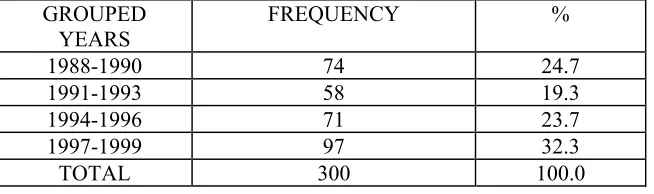
That there were no significant differences in the numbers of reports analysed in each of the four
groups of years suggests that the sample of reports was drawn from an evenly distributed
population. This is reassuring since the other analyses reveal instability, which is presumably not
a function of faulty sampling. The segments signifying proficiency were significantly more
numerous than those signifying understanding. Segments such as "pupils were insecure in their
recall of number bonds", "basic number operations were well developed at all stages", "some
pupils require to improve their recall of multiplication tables" and "pupils were competent in
adding, subtracting, multiplying and dividing numbers at appropriate levels of difficulty" were
very plentiful while segments such as "pupils successfully applied their number skills in context",
"P5 had difficulty in giving change from £1" and "pupils were confident in equivalence of
fractions" were significantly fewer. This might, simplistically, suggest that the Inspectorate
conceptualised Numeracy as computational proficiency rather than as understanding. However,
that segments signifying proficiency and segments signifying understanding were not evenly
distributed rather suggests that the Inspectorate's conception of Numeracy was unstable. Had the
Inspectorate's conception been stable, it would have been reasonable to expect the proportions of
understanding segments and proficiency segments either to be constant or to follow some trend.
The statistics, however, support the contention that the conception of Numeracy purveyed by the
Given the concerns of the concerns of Her Majesty's Inspectors (1997) it seems absurd to suggest
that they were less concerned with the understanding of number and more concerned with
proficiency in number (which is what the statistics suggest). Perhaps however the difficulty
hinges on what is meant by understanding number. Understanding is a complex idea with several
distinct nuances of meaning (Putnam et al, 1990). One meaning of understanding is as
connections between different types of knowledge (and such a view of understanding would seem
to be consistent with the Inspectorate's concerns). These connections allow a person to operate
flexibly with numbers such that, for example, the person uses known number facts to derive facts
of which he/she is less sure, decides whether a particular number is a reasonable answer, finds an
approximate rather than an exact answer, decomposes and recomposes numbers to simplify a
calculation, appreciates the relative size of numbers, is able to move flexibly among different
possible representations of numbers (Resnick, 1989b). This flexibility means that the person
makes connections between formal and informal knowledge, between conceptual and procedural
knowledge (Putnam et al, 1990) and between the various pieces of knowledge and skill which the
individual has developed (Lesh, Post & Behr, 1987). But these connections are not
unproblematic.
Firstly, the connection between formal and informal will not happen without the careful and
systematic intervention of the teacher. Many three and four-year olds and most five-year olds
(Resnick, 1989a) have developed a rich store of conceptual knowledge about Number. They can
count with a tolerable level competence and they can add and subtract (Gelman & Gallistel, 1978;
Fuson & Hall, 1983). However the young child's conceptual grasp of Number is at an informal
level only and the significance of this informal knowledge for what happens in school need not be
obvious to the child (Bryant, 1997). But it would be reasonable to assume that Her Majesty's
Inspectors would appreciate the significance of the young child's informal knowledge given the
Unfortunately there was little evidence of this. Many of the reports contained segments to the
effect that most pupils "had made a confident start with number" or that P1 pupils "could
confidently work with numbers to 10" or that "pupils at the early stages made satisfactory
progress in counting and numerical calculations involving addition and subtraction". This should
not be surprising since the research evidence (Gelman & Gallistel, 1978; Fuson & Hall, 1983,
Resnick, 1989a ) suggests that most children do make a very satisfactory start on number
knowledge before coming to school. But none of the reports made any reference to helping
children to make connections between their own informal knowledge and the formalisms of
school. Yes, the Inspectors recognised the need for children to be proficient in formal Number, in
segments such as "by P3 half could confidently perform written addition and subtraction" but
there was never any attempt to reflect that children can use a range of different calculation
strategies to perform (informal) addition and subtraction and that it is the linking of children's
own strategies with formal notation which enables the child to impute meaning into the
formalisms of Number (Resnick, 1989b). In that there was scant regard for the potential of
informal knowledge to illuminate formal Number (a finding that is corroborated in Resnick,
1989a; Brown, 2001), the Inspectors did not recognise the power or significance of children's
informal knowledge in the development formal curricular Number knowledge. To this extent the
'official' conception of Numeracy does not include connections between informal and formal
knowledge.
Secondly the connection between conceptual and procedural knowledge is difficult to make
because conceptual knowledge about number is abstract knowledge. Because number is the
property of a set or collection of items rather than the property of the individual items within the
set, there are, strictly speaking no denotable objects. So, for example, when we speak of a set of
blue plates, the adjective ‘blue’ describes the plates but when we speak of a set of five plates, the
reason about objects that exist only as mental abstractions. But according to a Piagetian model of
development, young children, and this may include many children at primary school (Resnick,
1989a), can reason about Number only when tangible objects and events are present. That
concrete operations refer to reasoning which has not yet separated from its empirical context has
resulted in teaching practices which typically involve the use of manipulative or concrete
materials on the assumption that the experience of concrete materials will enable the child to
construct a mental representation of the concept (Orton & Frobisher, 1996). In the present study
the importance attributed to manipulatives was evidenced in segments such as "practical materials
were used to explore new ideas", "pupils were able to use structured materials for place value", "a
practical approach is also used in introducing simple fractions", "more practical experiences
should be provided to enable pupils to learn and understand basic number relationships". Almost
always, references to concrete materials implied that their use was a 'good thing' as in "apparatus
to aid number work should be used more extensively". The exception to this was the comment, a
version of which appeared more than once, that "too many children were over-reliant on finger
counting". That concrete materials were viewed so positively while the use of fingers was viewed
negatively suggests that fingers were not seen as concrete materials!
However, the use of concrete materials has not necessarily produced the intended outcome of
meaningful links between procedural and conceptual knowledge (Hart, 1989; Boulton-Lewis,
1993; Boulton-Lewis & Tait, 1994; Hall, 1998). The reasons for this are complex. One reason
posited is that since numerical meaning does not reside in the materials but has to be imposed on
them the materials can only mediate understanding if the structure of the numerical idea is
recognised by the child (Cobb, 1987). In other words the concrete materials will only be
meaningful to those children who already have the concept which the materials are supposed to
exemplify. One implication of this is that the materials themselves may be potential barriers to
concrete materials to promote understanding is that the use of materials is imposed, or at least
legitimised, by the teacher (as seems to be the case in this study) and therefore may not articulate
with the informal knowledge and strategies of the child (Gravemeijer, 1997). Although the role
of concrete materials in the development of understanding would appear to be more complex than
was originally understood (Lesh, Post & Behr, 1987), the assumption that concrete materials will
as a matter of course help children to develop number concepts and skills in a more meaningful
way is clear in the Inspectors' pronouncements in the audit reports. To the extent that the role of
concrete materials is questionable, the 'official' conception of Numeracy is limited by what seems
to be a lack of awareness of research which surrounds the issue of Number representation.
Thirdly, to suggest that understanding is about making connections between different types and
pieces of knowledge means that the learner can use extant knowledge to interpret and structure new
knowledge. That learners build new knowledge on the basis of previous knowledge (and, by
implication, that each learner brings to any situation a unique web of knowledge) means that prior or
extant knowledge is critically important. But what is also important is the nature of the relationship
between prior knowledge and new knowledge. As was argued earlier, the young child’s informal
knowledge is an essential precursor to the development of meaningful formal work on Numeracy.
Most children come to school with the idea that numbers are grounded in the counting principles and
the related activities of addition and subtraction (Gelman & Gallistel, 1978). This knowledge serves
children in the early primary school well because the formal tasks in which they are expected to
engage depend almost exclusively on the concept of natural number (cf. SOED, 1991). In the early
years only cursory reference is made to fractions and not until Level E is there any reference to
negative numbers. This is not to be critical of the learning targets to be achieved, but merely to
emphasise that the mathematical understanding required in most of the formal tasks in early primary
However, what children's informal knowledge can contribute to the formal learning of 'topics' such as
multiplication, division and fractions is much more questionable. Meaningful learning of
multiplication, division, decimals, fractions, ratio and proportion builds on the concept of rational
number. Essentially what this means is that the nature of the unit has now changed. No longer are all
quantities represented in terms of units of ‘one’ (as they are in natural number). The unit can now
mean composite units or, indeed, partitioned units on which the task of enumeration is a useless
exercise (for example, one cannot count things to generate a fraction nor can one use counting based
algorithms to sequence fractions). If children are to meaningfully engage in the formal work which is
typically suggested for the upper primary school (SOED, 1991) they require to reconceptualise what a
'number' can now mean. And yet nowhere in the audit reports was there any explicit recognition that
such reconceptualisation is critically important to the continuation of meaningful learning of
Numeracy. For example, while there were frequent references to the varying levels of proficiency in
the "recall of multiplication tables" or in the "written calculation of decimals, fractions and
percentages" there was no reflection of multiplication being anything more than 'repeated addition' or
division being anything more than 'sharing'. While these notions of multiplication and division are
not necessarily wrong, they are primitive because they depend only on the concept of number being
understood as a natural or whole number which constrains numerical thinking (Fischbein et al, 1985).
The dominance of natural number can leave the child with a range of misconceptions, some of which
are that 'you can't divide by a larger number', that '½ is less than ¼ because 2 is less than 4' that
'fractions are not numbers' and that 'the answer to 5.3+2.42 is 2.95' (Owens, 1993). Given such
misconceptions it is perhaps not surprising that segments such as "pupils in the upper stages had
difficulties with decimal calculation", "some P7 pupils had difficulty adding simple vulgar fractions",
"some P6 did not know the meaning of the decimal point" were common while segments such as
"some had grasped the relationship between decimals and fractions" and "the most able showed a
grasp of decimal place" were much less common. What this seems to point to is that the
developmental nature of Number. If one's conception of Numeracy is not primarily based on the idea
that becoming numerate is an intellectual achievement which begins early in life, which operates with
representations of objects (as distinct from the objects themselves) and in which the essential object, a
number, has a series of increasingly more differentiated meanings, then it is probably quite reasonable
for Numeracy to be thought of a the mastery of a system of symbols which are manipulated according
to predetermined rules and procedures.
CONCLUSION
In a study designed to infer the 'official' conception of Numeracy (as published in Scottish HMI audit
reports), it is clear that computational proficiency is a very significant part of what it means to be
Numerate. While the understanding of number is also part of what it means to be Numerate, the
emphasis placed on understanding appears to be much less than that placed on proficiency. The
implications of this finding are alarming. If children's proficiency in computation is beyond their
level of conceptual understanding, many of them are getting correct answers to problems that they do
not understand. This disjunction is of concern (as indeed it has been for many years) and would seem
to be in urgent need of examination. If understanding is a significant part of what it means to be
Numerate, then finding ways of enabling understanding to develop would seem an appropriate matter
for educational research to address. Numerical understanding, it has been argued here, is about
making connections between different pieces of knowledge: between informal and formal knowledge,
between extant and new knowledge and between procedural and conceptual knowledge. One
question to which we now need answers is, 'How might these different pieces of knowledge be
related?' When we better understand the nature of the relationship, a second question which arises is,
'How can formal pedagogical practices better support the development of Numerical understanding?'
These are clearly difficult and complex questions but they are ones to which we need answers if we
are to seriously address the concerns that children's Numerical achievements reflect a lack of
ACKNOWLEDGMENTS
This study was funded through a Research and Development grant from the University of Strathclyde.
REFERENCES
Alexander, R. (1992) Policy and Practice in Primary Education, London: Routledge.
Anghileri, J. (2000) Teaching Number Sense, London: Continuum.
Askew, M., Brown, M., Rhodes, V., Wiliam, D. and Johnson, D. (1997) Effective Teachers of Numeracy in Primary Schools: Teachers’ Beliefs, Practices and Pupils’ Learning, Paper presented at the BERA Annual Conference, 11-14 September, University of York.
Askew, M. (1999) It ain’t just what you do: effective teachers of numeracy, in: I. Thompson (Ed.)
Issues in Teaching Numeracy in Primary Schools, Buckingham: The Open University Press.
Boulton-Lewis, G. (1993) ‘Young Children’s Representations and Strategies for Subtraction’, British
Journal of Educational Psychology, 63, 441-456.
Boulton-Lewis, G. and Tait, K.(1994) ‘Young Children’s Representations and Strategies for Addition’, British Journal of Educational Psychology, 64, 231-242.
Brown, M. (1999) Swings of the pendulum, in: I. Thompson (Ed.) Issues in Teaching Numeracy in
Primary Schools, Buckingham: The Open University Press.
Brown, M. (2001) Influences on the teaching of number in England, in J. Anghileri (Ed)
Principles and Practices in Arithmetic Teaching, Buckingham, The Open University Press.
Bryant, P. (1997) Mathematical understanding in the nursery school years, in T. Nunes & P. Bryant (Eds.) Learning and Teaching Mathematics, Hove, East Sussex; Psychology Press.
Cobb, P.(1987) An investigation of young children’s academic arithmetic contexts, Educational
Studies in Mathematics, 18, 109-24
Dweck, C. (2000) Self-Theories: Their Role in Motivation, Personality and Development, East Sussex: Psychology Press.
Fischbein, E., Deri, M., Nello, M and Marino, M. (1985) The role of implicit models in solving verbal problems in multiplication and division. Journal of Research in Mathematics Education, 16(1), 3-17.
Fuson, K. & Hall, J. W. (1983) The acquisition of early number word meanings: a conceptual analysis and review, in: H. Ginsburg (Ed.) The Development of Mathematical Thinking, London, Academic Press.
Gravemeijer, K. (1997) Mediating between concrete and abstract, in T. Nunes & P. Bryant (Eds.)
Learning and Teaching Mathematics, Hove, East Sussex; Psychology Press.
Hall, N. (1998) Concrete representations and the procedural analogy theory, Journal of
Mathematical Behaviour 17(1), 33-51.
Hart, K. (1989) ‘There Is Little Connection’ in Ernest, P. (Ed.) Mathematics Teaching: The State of
the Art, Falmer Press: London.
HMI (1997) Improving Mathematics Education 5-14, Edinburgh, SOEID.
Lave, J. (1988) Cognition in Practice: Mind, Mathematics and Culture in Everyday Life, Cambridge: Cambridge University Press.
Lesh, R., Post, T. & Behr, M. (1987) Representations and translations among representations in mathematics learning and problem solving in C. Janvier (Ed.) Problems of Representation in the
Teaching and Learning of Mathematics, Hillsdale, New Jersey: Lawrence Erlbaum Associates.
Mayer, R. & Hegarty, M. (1996) The process of understanding mathematical problems in R. Sternberg & T. Ben-Zeev (Eds.) The Nature of Mathematical Thinking, Mahwah, NJ: Lawrence Erlbaum Associates.
McDougall, M and Cook, R (1993) On the Track to Problem Solving, Glasgow: Nelson Blackie.
McIntosh, A. (1981) ‘When will they ever learn?’ in Floyd A. (Ed.) Developing Mathematical
Thinking. Wokingham, England: Addison-Wesley in association with the Open University Press.
McIntosh, A, Reys, B. & Reys, R. (1992) A proposed framework for examining basic number sense, For the Learning of Mathematics, 12(3) 2-8.
Nunes, T. & Bryant, P. (1996) Children doing Mathematics, Oxford: Blackwell.
Office for Standards in Education (1993) The Teaching and Learning of Number in Primary
Schools, HMSO: London.
Orton, A. & Frobisher, L. (1996) Insights into Teaching Mathematics, London, Cassell.
Owens, D. (1993) Research Ideas for the Classroom: Middle Grades Mathematics, New York: Macmillan Publishing Company.
Pajares, M. (1992) Teachers' beliefs and educational research: cleaning up a messy construct,
Review of Educational Research, 62(3) 307-332.
Putnam, R., Lampert, M. & Peterson, P. (1990) Alternative perspectives on knowing mathematics in elementary schools, in C. Cazden (Ed.) Review of Research in Education, Washington, D.C.: American Research Association.
Resnick, L (1989b) Defining, assessing and teaching number sense, in J. Sowder & B. Schappelle (Eds.) Establishing Foundations for Research on Number Sense and Related Topics: Report of a
Conference, San Diego State University, Center for Research in Mathematics and Science
Education.
Rittle-Johnson, B. and Siegler, R. (1998) The relation between conceptual and procedural knowledge in learning mathematics: a review, in C. Donlan (Ed.) The Development of
Mathematical Skills, Hove, East Sussex: Psychology Press.
Robertson, I., Meechan, R., Clarke, D. and Moffat, J. (1996) Assessment of Achievement
Programme: Fourth Survey of Mathematics (1994), Glasgow: University of Strathclyde.
Robson, C. (1993) Real World Research, Oxford, UK: Blackwell Publishers.
Schifter, D & Simon, M. (1992) Assessing teachers’ development of a constructivist view of mathematics learning, Teaching &Teacher Education, 8, 2, 187-97.
Scottish Office Education Department (1991) Curriculum and Assessment in Scotland: National
Guidelines on Mathematics 5-14, Edinburgh: Scottish Office Education Department.
Skemp, R. (1971) The Psychology of Learning Mathematic, Harmondsworth, Penguin.
Stein, M., Baxter, J. & Leinhardt, G. (1990) Subject matter knowledge and elementary instruction: a case from functions and graphing, American Educational Research Journal, 27, 4, 639-663.
Stipek, D., Givvin, K., Salmon, J. & MacGyvers, V. (2001) Teachers' beliefs and practices related to mathematics instruction, Teaching &Teacher Education, 17, 2, 213-226.
Treffers, A. (1991) Meeting innumeracy at primary school, Educational Studies in Mathematics, 22, 333-352.
Wearne, D. & Hiebert, J. (1988) Constructing and using meaning for mathematical symbols: the case of decimal fractions, in J. Hiebert & M. Behr (Eds.) Number Concepts and Operations in the
Middle Grades, Hillsdale, NJ: Lawrence Erlbaum Associates in association with the National
Table 1 Number of Reports Sampled 1988-1999
YEAR FREQUENCY %
[image:19.612.86.413.323.420.2]1988 29 9.7 1989 26 8.7 1990 19 6.3 1991 20 6.7 1992 8 2.7 1993 30 10.0 1994 26 8.7 1995 32 10.7 1996 13 4.3 1997 34 11.3 1998 45 15.0 1999 18 6.0 TOTAL 300 100
Table 2 Reports Sampled in Grouped Years1988-1999
GROUPED YEARS
FREQUENCY %
1988-1990 74 24.7 1991-1993 58 19.3 1994-1996 71 23.7 1997-1999 97 32.3 TOTAL 300 100.0
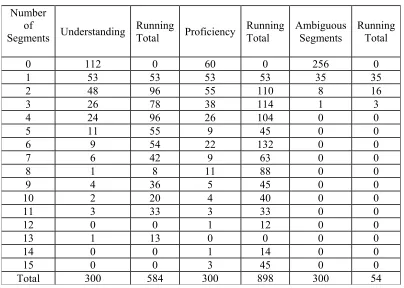
Table 3 Frequency of References to Key Components of Numeracy
Number of
Segments Understanding
Running
Total Proficiency
Running Total
Ambiguous Segments
Running Total
0 112 0 60 0 256 0
1 53 53 53 53 35 35
2 48 96 55 110 8 16
3 26 78 38 114 1 3
4 24 96 26 104 0 0
5 11 55 9 45 0 0
6 9 54 22 132 0 0
7 6 42 9 63 0 0
8 1 8 11 88 0 0
9 4 36 5 45 0 0
10 2 20 4 40 0 0 11 3 33 3 33 0 0
12 0 0 1 12 0 0
13 1 13 0 0 0 0
14 0 0 1 14 0 0
15 0 0 3 45 0 0
Total 300 584 300 898 300 54
The incidence of ambiguous segments was small. In 256 of the reports there were no ambiguous segments. In 35 of the reports there was one ambiguous segment. In 8 of the reports there were two ambiguous segments and in 1 of the reports there were three ambiguous segments.
One hundred and twelve (112) reports contained no segments referring to Understanding while 1 report contained thirteen segments referring to Understanding. There were many more segments referring to Proficiency. Sixty (60) reports contained no segments referring to Proficiency while 3 of the reports contained fifteen segments referring to Proficiency.
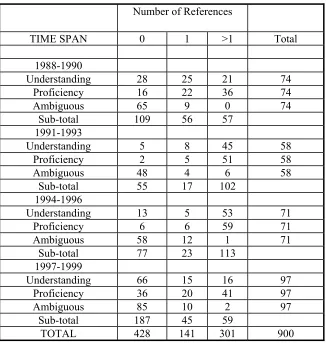
Table 4 References to Key Components of Numeracy across Grouped Years
Number of References
TIME SPAN 0 1 >1 Total
1988-1990
Understanding 28 25 21 74
Proficiency 16 22 36 74
Ambiguous 65 9 0 74
Sub-total 109 56 57
1991-1993
Understanding 5 8 45 58
Proficiency 2 5 51 58
Ambiguous 48 4 6 58
Sub-total 55 17 102
1994-1996
Understanding 13 5 53 71
Proficiency 6 6 59 71
Ambiguous 58 12 1 71
Sub-total 77 23 113
1997-1999
Understanding 66 15 16 97
Proficiency 36 20 41 97
Ambiguous 85 10 2 97
Sub-total 187 45 59
TOTAL 428 141 301 900
Segments deemed to signify Understanding were significantly different (χ² = 531.05, p<0.05)
across the groups of years. Segments deemed to signify Proficiency were significantly different