An empirical study of performance management systems in
quality-oriented organisations
Soltani, E., Gennard, J., van der Meer, R., Williams, T. University of Strathclyde, Glasgow, UK
Abstract reports findings from a research designed to investigate the main issues of the current HR performance evaluation systems in over 150 UK-based quality-focused organisations. The study identified the main characteristics of HR performance evaluation systems currently conducting in TQM-based organisations. The research approach consisted of a questionnaire survey in a sample of cross-section organisations in different economic sectors with enough experience of quality management to reflect the widest possible range of characteristics in the HR performance evaluation practices such as formal performance appraisal, frequency of appraisal, appraisers, purposes of appraisal, alignment of performance evaluation measures with TQM expectations, modification of the performance management system resulted from commencement of TQM, role of personnel management on TQM steering committee, responsibility for quality programmes and performance evaluation practices and, effectiveness of performance evaluation systems in improving and meeting TQM expectations. The survey results provide the most recent details of the performance appraisal systems currently conducting in TQM organisations and their effectiveness in improving and achieving TQM objectives.
Implications of these findings for HR performance measurement systems in general, and a quality-driven HR performance measurement in particular, are discussed.
Key Words: Total Quality Management, HR performance measurement system (performance appraisal), Performance appraisal practices.
1. Introduction
evaluation was also spearheaded by other TQM / HRM researchers following the lead of W Edwards Deming (e.g. Scholtes, 1993).
Consequently, addressing any change in performance evaluation has not been easy since most organisations use performance appraisal to control employees rather than to help employees to improve their performance. This problem is referred to as ‘performance control’ by Randell (1994), and in a similar vein, addressed in the following statement by Townley (1991: 92): “contributing to an overall approach to the handling of labour relations”. Although, the TQM literature is replete with the ideas of how HR performance evaluation systems are inconsistent with quality management perspective and fail both organisations and employees’ needs and requirements (see, Cummings, 2001; Seddon, 2001), the following charges keep recurring and citing in quality management texts with regard to HR performance evaluation (see, for example, Deming, 1986; Scholtes, 1993; Ghorpade et al. 1995; Cardy, 1998, Waldman, 1994):
• It disregards the existence of a system
• It disregards variability in the system
• It holds workers responsible for errors that may be the results of faults within the system
• It undermines teamwork
Furthermore, authors such as Ghorpade and his associates (1995) and Scholtes (1993) highlighted creating a band of discouraged workers, establishing an aggregate of safe goals in the organisations, and robbing the workers of their pride in workmanship for criticising the performance evaluation systems in TQM-based organisations. The evidence also suggests that, in Cardy’s (1998:132) words, “dissatisfaction with appraisal is a common survey finding”.
that the task still be done as effectively as possible”. Perhaps the best that can be stated is that, in Bowman’s (1994) words, “a growing number of organisations are adopting TQM, but most, instead of eliminating performance appraisal, have attempted to make it more compatible with quality management (e.g. Carson et al., 1991).
In doing so, this paper investigates the main issues of the HR performance evaluation systems currently conducting in over 150 UK-based quality-driven organisations as the first step towards identifying the main criteria of a quality-driven HR performance management system. This investigation begins with a brief overview of the profile and distribution of the surveyed organisations. Next, the main practices of HR performance evaluation systems are discussed, followed by an examination of the effectiveness of the current performance management systems in improving and achieving TQM objectives. The remainder of this paper briefly examines the extent to which the existing performance management systems are congruent and in line with TQM principles. A full description of ‘the extent to which the current performance management systems are consistent with TQM requirements’ and ‘a TQM-based HR performance evaluation system’ developed from the research findings will be presented with a detailed discussion in the follow-up paper once the interview survey, complementary of the postal questionnaire, has been completed.
2. Research Method
On the basis of an extensive and in-depth review of literature covering a wide range of source material collected to date, a draft questionnaire was designed. This was discussed in detail in terms of layout, content, and structure through a pilot study of nearly 40 organisations, and finally helpful and constructive comments were received. As a result of pilot study, changes were made to the questionnaire and the final version of the questionnaire was sent out to over 150 TQM-oriented organisations all based in Scotland, UK, in order to investigate the main issues of the current HR performance evaluation systems in quality-driven context. A primary advantage of the postal questionnaire, apart from different advantages such as wide coverage, being economical, pre-coded data (Denscombe, 1998), reducing the biasing error, providing a high degree of anonymity for respondents (Nachmias and Nachmias, 1997, p. 226), is to figure out standardised answers of all respondents to build up a relationship between HR performance evaluation system components and those TQM requirements and demands of employee performance measurement system. In addition, participants’ responses will not be influenced by the presence of researchers or evaluators as in other data gathering instruments.
both departments. Finally, each organisation completed a seven-page questionnaire comprising three sections covering a variety of issues on quality management, HR performance evaluation systems, and the main criteria of a quality based HR performance evaluation system.
3. Profile of the survey organisations
The large majority of organisations had experience of quality management for a time scale from 4 to 6 years. The size of each organisation varied from 24 or less employees to over ten thousand employees. In addition, there was no variation in its usage between commercial companies and public sector organisations, nor in size of the organisation. In fact, small and medium-sized (SMEs) organisations (nearly 19%) are just as likely to have quality management system as large organisation.
Turning to ownership, the survey found that nearly 85% of the respondents were Uk-owned. Within the UK-owned replies, 60.9% were from publicly-owned organisations, and 23.4% form privately-owned organisations. US-owned organisations and continental-Europe owned accounted for 12.5% and 3.1% of the respondents, respectively. However, the very small number of responses from US-owned, continental-Europe, Japanese-owned, and other North American organisations means that no significant comparisons can be drawn between these and other organisations.
Profile of organisations responded to the survey also showed that of the 64 returns to the questionnaire survey nearly 43% of respondents provide public services ranging from large organisations to small and medium-sized organisations, with manufacturing or production industries, professional and scientific consultancy together for approximately over 28%, whereas the remaining 29% were involved in construction, energy and water supply, mining and chemical, and retail and distribution.
4. Questionnaire analysis
In order to discuss the main issues of performance evaluation systems, the sample organisations were provided a series of questions covering the following areas:
• Applying some from of formal HR performance evaluation • Frequency of HR performance evaluation
• Performance appraisers
• Objectives of HR performance evaluation
• Modification and changes made in the HR performance evaluation at the commencement and as a result of TQM programmes to date
• Alignment of HR performance evaluation with TQM precepts and demands
• The position of personnel manager on the TQM committee, and responsibility for driving / owning and steering TQM and performance appraisal practices
4.1. Formal HR performance evaluation system
Of the all organisations studied, 61 (95.3%) were currently operating a form of formal HR performance evaluation system. The responses to this question confirm the findings of Freemantle’s research in 1994, in which 122 UK-based organisations participated. The research investigated the effectiveness of performance appraisal as currently conducted in the surveyed organisations and found that 89% of the organisations studied had a formal performance appraisal system. The remainder organisations which were accounted for over 4% had no a formal HR performance appraisal system for a variety of reasons. Typical answers:
“No systematic approach in place. Support staff subject to annual development interview. Uniformed service only appraised during probationary 2 year period or on applying for promotion” (Public, local Authority).
“Trade union opposition” (Local authority).
“Training requirements are considered at the Management Review Meeting” (UK-privately-owned, manufacturing).
“Not appraisal, but identification of personal objectives in line with corporate and team objectives, plus identification of staff development required to support this. However, review of this is poor” (Public, education).
Accordingly, in Freemantle’s research project, few organisations were against performance evaluation for a variety of reasons including: trade union opposition, or the opposition of councillors (a local government authority) or simply because the previous scheme did not work and was abolished. In a similar study published in Management Today (Anonymous: 1998), some 80% of UK companies were operating a performance appraisal system.
A number of respondents indicated, in their written responses, that they were intending to extend and update their HR performance management systems in order to meet the requirements of other management systems. All evidence shows that performance management is now widely used throughout the UK organisations. There is no variation, as noted by Freemantle (1994), in its usage between commercial companies and public sector organisations, nor in the size of the organisation. In fact, small organisations are just as likely to have performance management as large companies.
4.2. Frequency of HR performance evaluation
The survey also examined the frequency with which individual performance is measured. Data for employee performance review shows, perhaps not unexpectedly, that nearly 40% of the organisations conducted HR performance review annually, compared to Freemantle’s survey (1994), in which, the large majority of organisations conducted appraisal on an annual basis. Accordingly, the remaining 60% of organisations did appraise at other frequencies which varied from annually with interim reviews accounted for over 23%, to annually with monthly / quarterly reviews and annually with 6-8 weekly reviews accounted for nearly 11% and 8%, respectively.
staff. Fisher also agrees that the modal frequency of appraisal interviewing is probably annual, while biennial is not uncommon, and six-monthly or quarterly appraisals are also possible. In particular, the most recent evidence strongly suggests that performance reviews should be performed on a frequent an ongoing basis. Boice and Kleiner (1997), for example, agree with conducting frequent and ongoing performance review for two main reasons:
1. Selective memory by the supervisor or the employee, and 2. Surprises at an annual review
According to the survey, the actual time period varies in different organisations and with different aims, however, a typical frequency would be bi-monthly or quarterly. Prior surveys also confirm the confusion over the frequency of appraisal. In Freemantle’s words, “the problem of frequency is therefore a double-bind for the organisation and is one of the major limitations of any formal approach to performance appraisal. Too long an interval between each appraisal and its contents lose relevance and risk artificiality and, in turn, too short an interval and the process becomes too time-consuming. There is no easy answer to this and it does beg the question of the efficacy of the traditional approach of ‘annual appraisal.”
4.3. Who are the appraisers?
With regard to the current HR performance evaluation, the survey indicates that individuals are appraised by a variety of people ranging from immediate supervisors / line managers to multi-raters. According to the survey, line managers deliver the performance measurement and are given increased responsibility for the development and motivation of staff. Certainly, the survey highlighted the centrality of a line manager-delivered HR evaluation process to the conducting of the system. Nearly 77% of respondents to the survey had conducted HR performance evaluation by immediate supervisors / line managers, with multi-raters, subordinates, immediate supervisor and peers, and others (self-and line managers, self-and external evaluation) accounting for just approximately 10%, 3%, 3%, and 8%, respectively. In many systems, the front-line supervisor is responsible for conducting the performance review. According to Storey (1987), the role of the immediate supervisor is a factor, which is frequently cited and reinforced throughout the performance appraisal literature. In addition, evidence from performance appraisal survey and case studies also confirm that in majority of cases surveyed the immediate supervisor was responsible for conducting the performance review (e.g. Long, 1986; Storey, 1987). However, other methods of conducting performance evaluation should be considered.
Self-appraisal, for example, would be the best judge of employee performance particularly if supervisor cannot observe individual on a regular basis. In an employee survey conducted by the Minnesota Department of Transportation on its performance appraisal process, they found that a majority of participants were in favour of self-appraisal (Laumeyer and Beebe, 1988).
for appraisal in team-based settings and notes that when teamwork is being stressed, peer or co-worker input would represent a logical source of important performance information (see, Barnes, 1997).
Subordinate evaluation which sometimes referred to as upward evaluation or reverse appraisal is another form of conducting appraisal. In this process, employees rate the performance of individuals who manage them directly, usually by responding to a questionnaire using a rating scale (Antonioni, 1999). Initially organisations used upward appraisals for developmental purposes. However, as some surveys report, organisations are currently beginning to use the results for personnel evaluation, specifically, to determine merit raises (e.g. Cardy and Dobbins, 1986; Ghorpade et al., 1995).
Multi-rater or 360-degree feedback, on the other hand, is also known as multi-source feedback allows for assessments to be made by peers, subordinates, boss, customers, suppliers and consultants outside the organisations. As Barnes (1997) demonstrates, in multi source feedback all ‘stakeholders’ are involved. Barnes also argues that due to a number of factors organisations today should conduct 360-degree appraisal. Among these are: wider span of control or flatter organisations, greater geographical spread, greater use of matrix structures and project management where individual managers have more than one reporting line, and greater cross functional cooperation and higher level of communication. Rowe (1995) concentrates on the main sources of performance appraisal and describes that 360-degree feedback is made up of four main elements including: downward appraisal, upward appraisal, peer appraisal, and self-appraisal (see, for more detail, Barnes, 1997; Long, 1986). In short, it is clear that conducting employee performance evaluation function in order to provide constructive feedback from different sources will result in different employee expectations and, therefore, different approaches to performance management and, in turn, different organisational performance. Consequently, TQM companies that hope to succeed in today’s competitive business environment through continuous improvement as one of the main quality management precepts must learn to identify their most capable employees for placement in key organisational appointments through an effective feedback process. In other words, effective performance evaluation is an ongoing process that requires informal and formal feedback from a variety of sources. As a result, in order to maximise the effectiveness of performance appraisal system, open lines of communication between appraisers and employees, therefore, must complement the performance evaluation system to be successful (McBey, 1994).
4.4. Objectives of HR performance evaluation
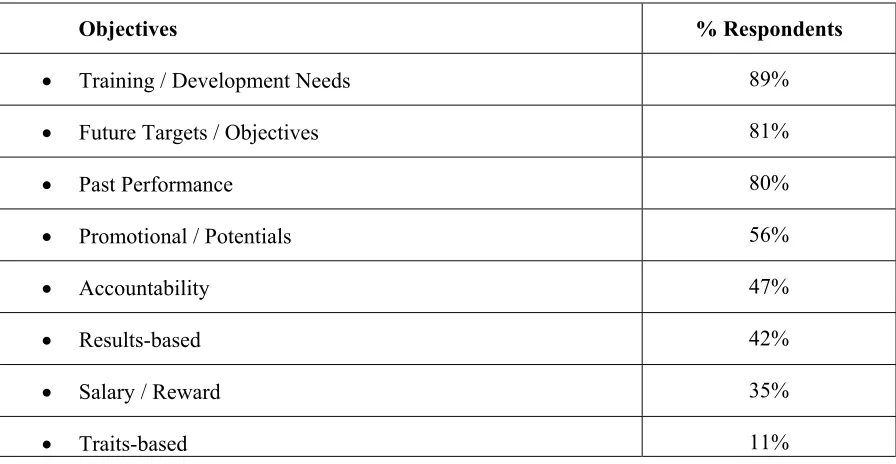
Respondents were asked to mention the main objectives of their organisations’ performance evaluation systems. A summary of main functions of performance management, each of which can be seen to some degree in all appraisal schemes, ranked in order of importance, is given in Table 1.
basis for salary and rewards was indicated as an objective of performance management only by 35%.
Table 1. Objectives of HR performance Measurement
Objectives % Respondents
• Training / Development Needs 89%
• Future Targets / Objectives 81%
• Past Performance 80%
• Promotional / Potentials 56%
• Accountability 47%
• Results-based 42%
• Salary / Reward 35%
• Traits-based 11%
Training / Development needs: A thorough analysis of the concepts and the practice of individual development and training has been set out by Squires and Adler (1998). They referred to the development and retention of workforce as ‘the key to survivor’ for many organisations. As they report, there is a growing appreciation for the dual nature of the performance appraisal process, first identified by Meyer et al. in 1965. Not only must an effective appraisal accurately evaluate past performance as an equitable basis for rewards, it should also guide training / future development, leverage existing strengths, and address skill deficiency. The result of such approach to performance evaluation is to help the organisation to set its future targets and objectives. However, against this increasing need to link appraisal and employee training / development processes stands an imposing set of practical and theoretical challenges which were thoroughly reviewed by Squires and Adler (1998: 446-7) in one of the most current textbook on performance appraisal. Among these are: time, organisational support, expertise, diagnostic tools, developmental resources, and HR planning. Other deficiency was taken up by Wilson and Western (2000), who assert that training and development plans are sometimes unachievable because they are inappropriate, too expensive, or there is a lack of time.
In addition, along with these practical challenges and directly influencing practice, there are a range of advices and recommendations by researchers and writers which really face up to the considerable problems and, in turn, demands of organisations for an effective performance evaluation systems consistent with different organisational contexts. Squires and Adler, for example, recommended a set of theoretical challenges, that must be successfully addressed, as follows:
• Better understanding of the processes for skill development so as to determine the employee’s stage of development for a particular skill.
• Developing an adequate prescription based upon a diagnosis so as to identify cost-effective strategies for addressing developmental weaknesses.
• Applying a theory of instruction and effective instructional methodology for prescription specified so as to deliver the right training at the right time to achieve maximum impact.
Today, large organisations are increasingly conducting developmentally oriented appraisals outside the context of the regular supervisor appraisal process (see, for more details, Squires and Adler, 1998). Moreover, for those involved with HRM practices, the performance appraisal is widely regarded as one of the main instruments for identifying training and development needs at the individual levels. Indeed, Armstrong and Baron (1998: 8) maintain that “performance management should really be called performance and development management”. In a similar vein, in an attempt to support training and development activities associated with performance appraisal, Wilson and Western (2000) comment that discussion of training and development issues should be entirely separate from assessment, promotion and remuneration discussions (see, for more detail, Orr, 2002).
Past Performance: Performance appraisal systems of 80% of organisations surveyed were based on an assessment of the past. In this view, it is believed that the past is the main determinant of the present and the future. As Randell (1994:231) reports, implicit in this view is that if good performance is observed and then rewarded, the chances of it being repeated are increased, while poor performance is discouraged or even punished to decrease the chance of it happening again. Whilst it is much easier to assess the past than the future, viewing the performance appraisal as a control and maintenance system does, however, little to realise future performance improvement. In particular, the main difficulties with this traditional performance appraisal purpose are: to ensure that minimum standards for the job were being maintained (referred to as ‘performance control’ by Randell, 1994), and to provide an opportunity to criticise rather than give recognition or meaningful support for performance improvement. Clearly, as mentioned earlier, during recent years performance systems have tended to move away from being primarily control and maintenance based and have moved towards an approach more concerned with motivational and developmental issues.
promotability and potential as one of the main purposes of appraisal had fallen appreciably, from 87% to 71%.
Accountability: This purpose was cited by 47% of organisations studied as one of the main functions of employee performance appraisal. In this form of appraisal, employees are brought to account for their actions and job behaviours. From the organisation’s point of view, one of the most important reasons for having a system of performance appraisal is to establish and uphold the principle of accountability. For decades, it has been known to researchers that one of the chief causes of organisational failure is ‘non-alignment of responsibility and accountability’. Non-alignment occurs where employees are given responsibilities and duties, but are not held accountable for the way in which those responsibilities and duties are performed. What typically happens is that several individuals or work units appear to have overlapping roles. The overlap allows – indeed actively encourages – each individual or business unit to ‘pass the buck’ to the others. Ultimately, in the severely non-aligned system, no one is accountable for anything. In this event, the principle of accountability breaks down completely, and organisational failure is the only possible outcome (Archer, 2002).
Salary / Reward / PRP: Performance related pay (PRP) is one of the principal objectives of performance appraisal by 34% of organisations surveyed. Many writers of HRM, such as Clark (1995), Storey and Sisson (1993), include PRP as an intrinsic part of performance management. Further, the importance of performance appraisal functions in different management decisions has been mirrored by the popularity of performance-related-pay (PRP) schemes which reward individual employees on the basis of their job performance, defined by ACAS (1996:8) as “a method of payment where an individual employee receives increases in pay based wholly or partly on the regular and systematic assessment of job performance”. However, although there have been few attempts to explain empirically any observed success or failure of PRP, PRP literature indicates that unsuccessful implementation of PRP is often associated with ineffective performance management processes (Lewis, 1998). In an analysis of research data from 3 financial services organisations using a PRP process cycle developed from the performance management literature, Lewis found that in 2 organisations the PRP process cycle was implemented ineffectively and there was a low level of acceptance of PRP by recipient managers. Further, the research findings indicated that the inclusion of pay in the performance management process might be unnecessary.
Focus on Traits: Just fewer than 12% of those organisations surveyed were measuring traits that were felt to be important to the job. This approach to performance management is very much traditional and as Fisher et al., (1996) report, a trait-based appraisal system assesses the abilities or other personal characteristics of an employee. These included traits such as resourcefulness, enthusiasm, drive, application and other traits such as intelligence. However, one difficulty with these is that everyone defines them differently, and the traits that are used are not always mutually exclusive. Raters, therefore, are often unsure of what they are rating. Moreover, ill-defined scales like these are more susceptible to bias and prejudice (Torrington and Hall, 1998; Bernardin and Beatty, 1984).
In short, the research reveals that there is much more confusion over the purposes of performance evaluation. According to responses given by the organisations surveyed, there are many conflicting purposes of performance appraisal and, as Randell (1994) reports, it is not possible to advocate or prescribe any particular techniques. All purposes that exist have their place in the overall scheme of employee appraisal. However, getting such purposes appropriate to the needs of the organisations, and the employees, is one of the key issues of personnel management. In other words, form organisation’s perspective, the principal reason for performance evaluation is to make people accountable. Put another way, the objective is to align responsibility and accountability at every organisational level. Accordingly, from employee viewpoint, the purpose of performance appraisal is to let them know what to do, how well they have done, help them improve their performance, and reward them for good performance.
4.5. Modification and changes in HR performance evaluation resulted from TQM
• Introducing mandatory training courses
• Designing a standardised formal review
• Continuous monitoring of
achievement of objectives
• Registration with IiP
• Moving from pay-based to personal development and training-based
• Smart objectives
• Applying a standardised formal review
[image:12.612.94.533.73.175.2]A number of respondents, however, noted that they have made changes in their HR performance evaluation systems but not as a result of adopting a quality management approach. In other words, of 35% of respondents, only 20% of the respondents had made changes in their performance evaluation systems as a result of implementing TQM programmes. Table 2 summaries the main changes that the respondents have made due to applying a quality management system.
Table 2. Changes in HR performance evaluation system due to adoption of TQM • Emphasis on continuous improvement from all employees
• Amendment from implementation of Scottish Quality Management System (SQMS) • Introduction of win-executive-team based performance criteria
• Baldrige criteria applied to appraisal format and content • More future career path
• Gone from individual to team for shopfloor
• Appraising performance review system annually Review of individual development meeting, following a review of staff views on current system
4.6. Alignment of HR performance evaluation system with TQM precepts
Respondents were asked whether their HR performance evaluation criteria had been aligned with TQM expectations and principles. The results indicate that over 45% of performance appraisal systems were aligned with TQM principles compared to 55%, which were not aligned with TQM precepts. However, as mentioned earlier, it was rare to find that the alignment of performance appraisal systems with TQM precepts and philosophy was a result of adopting a quality management system within the organisation. The written responses (open-ended questions) confirm the findings in the previous question of the survey that changes in HR performance evaluation system were not mainly due to the adoption of TQM systems.
4.7. The role of HR manager in TQM committee
The survey also examined the position of the personnel manager in the TQM steering committee. Approximately, 42% of the organisations surveyed said that the personnel manager had a place on the TQM steering committee, compared with 58% of organisations that indicated their personnel managers had no place on TQM committee.
other words, responses to the question ‘where does responsibility lie for driving / owning, steering and implementing of quality programmes?’ clearly show that in a large proportion of organisations (nearly 77%) quality programmes are driven mainly from the top of the organisation. With regard to the responsibility for implementation of quality programmes, approximately 72% reported that quality leadership team (QLT) or TQM committee had retained responsible for the quality management programmes after the decision to proceed had been taken. In general, the survey suggests that CEO or senior management team take responsibility for steering quality management programmes, while implementation lies with personnel or staff development. However, both driving / steering and day-to-day responsibility of quality management programmes appear to be cross-functional activities and not the sole responsibility of any one department. Some respondents, for example, indicated that the involvement of all functional activities within the organisations is necessary for successful implementation of quality management programmes. A number of organisations surveyed specifically referred to the need for all staff and departments to be equally involved in the driving, steering, and facilitating of quality management.
Accordingly, in relation to the responsibility for HR performance evaluation, it appears that in most organisations surveyed performance evaluation are driven mainly by HR department, and personnel management have a lead role in the development and maintenance of the HR performance measurement system. In approximately 61% of cases HRM department takes responsibility for driving and steering performance evaluation system, although in approximately 77% of these cases supervisors or direct line managers evaluate the employees performance.
Perhaps this is one of the most controversial questions about HR performance measurement in quality management context. In other words, to what extent should HR performance evaluation in quality management context be seen as a function which is designed, developed, driven, and administered merely by HR department? Ideally, in quality environmental organisations, the drive for HR performance evaluation should come from the chief executive and senior manager with personnel having an essential support role. However, in too many cases covered by this research, also consistent with Freemantle’s findings in 1994, the drive came from HR department with, regrettably, line managers or immediate supervisors being reluctantly dragged along. Consistent with the current research, the most recent lesson offered by the participants in the Freemantle’s research (1994:8) was related to securing the support, commitment and leadership from directors and senior management to the practice of performance appraisal. As a corollary to the above conclusion, the evidence suggests that, in Freemantle’s words, “appraisal cannot be seen as a personnel thing. However, it must be driven by the executives who are ultimately accountable for the performance of the organisation”.
4.8. Effectiveness of HR performance evaluation in improving and achieving TQM objectives
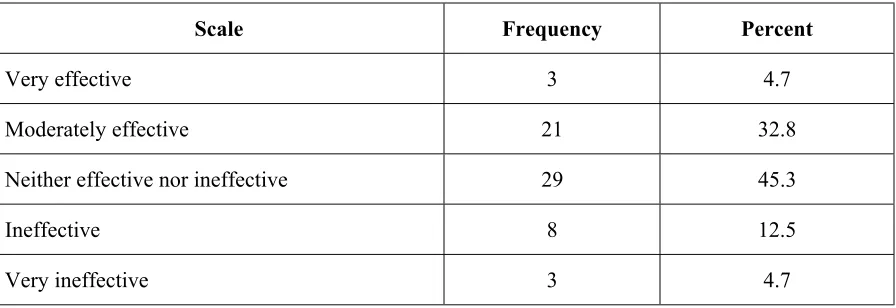
ineffective’ or ‘ineffective’ in improving quality programmes. Overall the perception of nearly 63% of organisations responding was that the current HR performance evaluation system had not had a positive impact on the improvement of TQM programmes. Further, in Table 3 data for effectiveness of HR performance evaluation systems are presented and they show, perhaps, not unexpectedly, very few organisations (only 4.7% of all respondents) mentioned that their HR performance evaluation systems were effective in improving quality management programmes.
Table 3. Effectiveness of HR performance evaluation
Scale Frequency Percent
Very effective 3 4.7
Moderately effective 21 32.8
Neither effective nor ineffective 29 45.3
Ineffective 8 12.5
Very ineffective 3 4.7
Implications and Conclusions
A key objective throughout this paper has been to document the main issues related to HR performance evaluation systems such as formal performance appraisal, frequency of appraisal, appraisers, purposes of appraisal, alignment of performance evaluation measures with TQM expectations, modification of the performance management system resulted from commencement of TQM, role of personnel management on TQM steering committee, responsibility for quality programmes and performance evaluation practices, effectiveness of performance evaluation systems in improving and meeting TQM expectations in a sample of UK-based quality-focused organisations, and to explore the degree of congruity between TQM precepts and performance management systems currently conducting in quality-driven organisations. While on the whole, the data point to an increase in performance evaluation usage amongst the UK-based organisations, however, there is relatively low consistency between TQM requirement and the performance management systems currently conducting in the sample organisations.
Turning first to the issue of formal HR performance evaluation system, the data reported that over 95% of the respondents were currently operating a form of formal HR performance evaluation system. The responses to this question confirm the findings of the previous surveys in the UK. However, in the current research approximately 40% of the organisations surveyed, conducted HR performance evaluation annually. In contrast, the most recent evidence strongly suggests that in TQM context, performance reviews should be performed on a frequent and on going basis (see, Boice and Kleiner, 1997). In Freemantle’s words, “the problem of frequency is therefore a double-bind for the organisation and is one of the major limitations of any formal approach to performance appraisal.”
With regard to the source of performance appraisal, the survey highlighted the centrality of a line manager-delivered HR evaluation process to conducting of the system. However, an important issue for the quality-based approach is, as Cardy puts it, “to include sources who are most knowledgeable about the person and system factors that influence a worker’s performance (1998: 157).
The research also reveals that there is much more confusion over the purposes of performance evaluation. According to responses given by the organisations surveyed, there are many conflicting purposes of performance appraisal and, as Randell (1994) reports, it is not possible to advocate or prescribe any particular techniques. All purposes that exist have their place in the overall scheme of employee appraisal. However, getting such purposes appropriate to the needs of the organisations, and the employees, is one of the key issues of personnel management. Within a quality environment, in particular, the primary purpose of performance appraisal should be to help the employees improve their performance (Ghorpade et al., 1995). Put differently, within all organizational contexts, an inevitable purpose of performance appraisal is to arrive at some judgement about the worth of the individual's contribution to the organization over a period of time. In an ongoing relationship, however, appraisal cannot stop at an assessment of past achievements or failures. In addition, it is widely recognized that a second purpose of appraisal is the development of the individual (see, Cummings and Schwab, 1973).
some changes in their performance evaluation systems at the commencement of TQM programmes, however, only 20% of these respondents had made changes in their performance evaluation systems as a result of implementing TQM programmes. Thus, performance issues must be addressed by making changes in the system, and the responsibility of performance management is to build an infrastructure of TQM if changes are to have a lasting effect (see, Bowman, 1994). Further, the results indicate that over 45% of performance appraisal systems were aligned with TQM principles compared to 55%, which were not aligned with TQM precepts. However, as mentioned earlier, it was rare to find that the alignment of performance appraisal systems with TQM precepts and philosophy was a result of adopting a quality management system within the organisation. In particular, the written responses (open-ended questions) confirm the findings in the previous question of the survey that changes in HR performance evaluation system were not mainly due to the adoption of TQM systems.
In respect to the role of HR manager in TQM committee, nearly 42% of the respondents reported that the personnel manager had a place on the TQM steering committee. In general, the survey suggests that CEO or senior management team take responsibility for steering quality management programmes, while implementation lies with personnel or staff development. However, both driving / steering and day-to-day responsibility of quality management programmes appear to be cross-functional activities and not the sole responsibility of any one department. Some respondents, for example, indicated that the involvement of all functional activities within the organisations is necessary for successful implementation of quality management programmes. Furthermore, a number of organisations surveyed specifically referred to the need for all staff and departments to be equally involved in the driving, steering, and facilitating of quality management.
Finally, the survey deliberately set out to gauge the effectiveness of HR performance measurement in improving and achieving TQM programmes from a number of angles. Overall the perception of nearly 63% of organisations responding was that the current HR performance evaluation system had not had a positive impact on the improvement of TQM programmes. As Freemantle (1994) reports “such performance measurement systems are demotivational.” There is paradox, in that whilst many organisations pursue so called ‘excellence’ in their business through precepts at the heart of the quality management, they do not allow the vast majority of their people to be described as ‘excellent’. However, organisations must therefore re-evaluate their HR performance evaluation systems and eliminate any confusion arising from inconsistency and incongruity of the system with TQM principles and philosophy. In Cardy’s (1998:159) words, “HR performance evaluation is still a vital necessity in the quality management context, but it needs to be adapted in important ways so that the practice maximally contributes to the quality efforts.”
References
• ACAS, (1996), Appraisal Related Pay, London: ACAS.
• Anonymous, (1998), Performance appraisal systems could do better, Management Today, P. 12, London, April.
• Antonioni, D. (1999), Predictors of upward appraisal ratings, Journal of Managerial Issues, Vol. 11, No. 1, pp. 26-36.
• Archer, N. (2002), Performance Appraisal: a UK based company (No date), [Online]. Available: www.performance-appraisal.com/basic.htm. [Access: June 2002].
• Armstrong, M. and Baron, A. (1998), Performance Management: The New Realities, London: Institute of Personnel and Development.
• Arthur, J. B. (1994), Effects of Human resource systems on manufacturing performance and turnover, Academy of Management Journal, Vol. 37, pp.670-687.
• Baird, L. and Meshoulam, I. (1988), Managing two fits of strategic human resource management, Academy of Management Review, Vol.13, pp.116-128.
• Barnes, P. (1997), Making appraisal work in the new millennium, Management Services, Vol. 41, No. 7, pp. 14-16.
• Bernardin, H. J., and Beatty, R. W. (1984), Performance Appraisal: assessing human behaviour at work, Boston: Kent.
• Boice, D. F. and Kleiner, B. H. (1997), Designing effective performance appraisal system, Work Study, Vol. 46, No. 6, pp.197-201.
• Bowman, J. S. (1994), At last, an alternative to performance appraisal: total quality management, Public Administration Review, Vol. 45, No. 2, pp. 129-136.
• Cardy, R. L. and Dobbins, G. H. (1996), Human resource management in a total quality management environment: shifting from a traditional to a TQHRM approach, Journal of Quality Management, Vol. 1, pp.5-20.
• Cardy, R. L. (1998), Performance Appraisal in a Quality Context: A New Look at an Old Problem, In Smither, J. W. (Ed), Performance Appraisal: State of the Art in Practice; San Francisco: Jossey-Bass Publishers.
• Cardy, R. L. and Dobbins, G. H. (1994), Performance appraisal: A consideration of alternative perspectives, Cincinnati: South-Western.
• Carson, K. P., Cardy, R., and Dobbini, G. H. (1991), Performance appraisal as effective management or deadly management disease, Group and Organisation Studies, pp. 143-159, June.
• Clark, G. (1995), Performance Management, In Mabey, G. and Salaman, G. (Eds) Strategic Human Resource Management, Oxford: Blackwell.
• Crosby, P. B. (1979), Quality is free: The art of making quality certain, New York: New American Library.
• Cummings, L. L. and Schwab, D. P. (1973), Performance in Organizations, Glenview, IL: Scott, Foresman & Company, 1973.
• Cummings, N. (2001), Staff appraisal needs shake-up, OR News Letter, p. 4, May.
• Deming, W. E. (1986), Out of Crisis, Cambridge: Massachusetts Institute of Technology, Centre for Advanced Engineering Study.
• Fisher, C. D., Schoenfeldt, L. F. and Shaw, J. B. (1996), Human Resource Management, 3rd ed., Boston: Houghton Mifflin company.
• Fisher, C. M. (1994), The difference between appraisal schemes: variation and acceptability - part I, Personnel Review, Vol. 23, No. 8, pp.33-48.
• Fletcher, C. (1993), Appraisal: an idea whose time has gone?, Personnel Management, September.
• Freemantle, D. (1994), The performance of performance appraisal – an appraisal, UK: Superboss Ltd.
• Ghorpade, J., Chen, M. M., and Caggiano, J. (1995), Creating quality-driven performance appraisal systems, The Academy of Management Executive, Vol.9, No.1, pp.32-40.
• Gudim, M. and Meer, R. v. d. (1995), Issues surrounding the implementation of TQM: The Scottish experience, University of Strathclyde, Department of Management Science, Working Paper, February.
• Hemmings, B. (1992), Appraisal Development, The TQM Magazine, Vol.4, No.5, pp.309-312.
• IPM: Institute of Personnel Management (1993), Quality: People management matters, Exeter: Short Run Press Ltd, UK.
• Juran, J. M. (1989), Juran on leadership for quality, New York: Free Press.
• Laumeyer, J. and Beebe, T. (1988), Employee and their appraisal, The Personnel Administrator, Vol. 33, No. 12, pp.76-80.
• Lewis, P. (1998), Managing performance-related pay based on evidence from the financial services sector, Human Resource Management Journal, Vol. 8, No. 2, pp.66-77.
• Long, P. (1986), Performance appraisal revised, Institute of Personnel Management: London.
• Longenecker, C. O. and Fink, L. S. (1999), Creative effective performance appraisals, Industrial Management, Sep / Oct.
• McBey, K. (1994), Perfecting performance appraisals, Security Management, Vol. 38, No. 11, pp.23-26.
• Meyer, H. H., Kay, E., and French, J. R. P. (1965), Split roles in performance appraisal, Harvard Business Review, Vol. 43, pp.123-129
• Moen, R. D. (1989), The performance appraisal system: Deming’s deadly disease, Quality Progress, Vol. 22, pp. 62-66.
• Nachmias, C. F. and Nachmias, D. (1997), Research Methods in the Social Sciences, 5th ed., London: Arnold.
• Naden, J. and Bremner, A. (1991), A guide to total quality management, Scottish Enterprise, Glasgow.
• Oakland, J. S. (1989), Total Quality Management, Heinemann, London.
• Oakland, J. S. (1998), Total Quality Management: text with cases, 4th ed., McGraw-Hill.
• Orr, B. (2002), Focus on strengths, manage weaknesses, Canadian HR Reporter, Vol. 15, No. 10, pp.6-8.
• Randell, G. A. (1994), Employee Appraisal, In Sisson K. (Ed), Personnel Management: a comprehensive guide to theory & Practice in Britain, Oxford: Blackwell Publishers Ltd.
• Rowe, C. (1995), Introducing 360-degree feedback: the benefits and pitfalls, Executive Development, Vol. 8, No. 7, pp.14-21.
• Scholtes, P. R. (1993), Total quality or performance appraisal: choose one, National Productivity Review, Vol. 12, No.3, pp.349-363.
• Scholtes, P. R. (1995), Performance Appraisal: Obsolete and harmful, Quality Magazine, pp. 66-70.
• Seddon, J. (2001), Performance a miracle: praise the workers, The Observer, 11 March.
• Simon, S. K. L. and Schaubroeck, J. (1999), Total quality management and performance appraisal: An experimental study of process versus results and group versus individual approaches, Journal of Organisational Behaviour, Vol. 20, No.4, pp.445-457.
• Sinclair, D. and Zairi, M. (1995), Performance Measurement as an obstacle to TQM, The TQM Magazine, Vol.7, No.2, pp.42-45.
• Squires, P. and Adler, S. (1998), Linking appraisals to individual development and training, In Smither, J. W. (Ed), Performance appraisal: state of the art in practice, pp.443-495, San Francisco: Jossey-Bass Publishers.
• Storey, J. (1987), Developments in the management of human resources: an interim report, Warwick papers in Industrial Relations No. 17, IRRU, School of Industrial and Business Studies, University of Warwick, November.
• Storey, J. (1995), Introduction: from personnel management to human resource management, In Storey, J. (Ed), New Perspectives on Human Resource Management, London: Routledge.
• Storey, J. and Sisson, K. (1993), Managing human resources and industrial relations, Buckingham: The Open University Press.
• Torrington, D. and Hall, L. (1998), Human Resource Management, 4th ed. Prentice Hall.
• Townley, B. (1991), Selection and appraisal: Reconstituting “social Relations”? In Storey, J. (Ed), New perspectives on human resource management, London: Routledge.
• Waldman, D. A. (1994), The contributions of total quality management to a theory of work performance, Academy of Management Review, Vol. 19, pp. 510-536, San Francisco: Jossey-Bass Publishers.
• Waldman, D. A. (1997), Predictors of employee performance for multi-rater and group-based performance appraisal, Group and Organisation Management, Vol. 22, No. 2, pp.264-287.
• Wilkinson, A., Redman, T., Snape, E., and Marchington, M. (1998), Managing with total quality management, London; McMillan Press Ltd.
• Wilson, J. P. and Western, S. (2000), Performance appraisal: an obstacle to training and development? Journal of European Industrial Training, Vol. 24, No. 7, pp.384-390.