Luxembourg: Office for Official Publications of the European Communities, 2009
Work programme
Luxembourg:
Office for Official Publications of the European Communities, 2009
ISBN 978-92-896-0591-5
© European Centre for the Development of Vocational Training, 2009 All rights reserved.
The European Centre for the Development of Vocational Training(Cedefop) is the European Union's reference centre for vocational education and training. We provide information on and analyses of vocational education and training systems, policies, research and practice.
Cedefop was established in 1975 by Council Regulation (EEC) No 337/75.
Europe 123, 570 01 Thessaloniki (Pylea), GREECE
PO Box 22427, 551 02 Thessaloniki, GREECE
Tel. +30 2310490111, Fax +30 2310490020 E-mail: [email protected]
www.cedefop.europa.eu
Aviana Bulgarelli, Director
Christian Lettmayr, Deputy Director
Contents
Introduction 1
Policy background 3
Informing European vocational education and training (VET) policies 5
Interpreting European trends in and challenges for skills, competences and learning 9
Assessing vocational education and trainingʼs benefits 12
Raising the profile of vocational education and training 13
Management, resources and internal controls 15
Working in partnership 16
Risk assessment 17
Activity fiches 18
Activity-based budget 2009 50
Annexes
I Provisional publications list 2009 52
II Cedefop organisation chart 53
III Human resources 54
IV Cedefopʼs networks 55
V Cooperation between Cedefop and the European Training Foundation 56
VI Cooperation between Cedefop and Eurofound 57
About half the European population acquires skills through vocational education and training (VET). The European Union (EU), its Member States and social partners (1) are committed to
making Europeʼs education and training systems the best in the world. This requires VET to respond to rapid changes in labour markets and technology. VET must be integral to systems of lifelong learning, to enable people to adapt and develop their skills continuously. To achieve this, the EU began to develop systematic policy priorities and common European tools in 2000.
Founded in 1975 (2) and based in Greece since
1995, Cedefop is the EUʼs agency supporting European VET policy development. Cedefop is supporting the EU, its Members States and the social partners who are working more closely than ever to modernise VET and create a European working and learning area. Cedefopʼs added value is the high quality of its analyses, expertise and information to support European cooperation in VET. Cedefop provides:
(a) an independent scientific European perspective through comparative analyses of developments that raise awareness and understanding of VET issues across the EU; (b) insights into complex issues to identify common European approaches and principles to improve VET and achieve common aims;
(c) a unique forum that brings together diverse VET interests of policy-makers, social partners, individual learners, researchers and practitioners to debate proposals for policy and research;
(d) increased awareness of VETʼs image and importance, ensuring VET issues are considered in other policies, including general education, employment and social policy. Skills bring opportunity, equity, and progress. Opportunities can arise for people through better job prospects and for businesses through competitive advantage. Equity is strengthened as skills can help people at a disadvantage in the labour market overcome barriers to a satisfying working life (3). Progress can come as
skills may contribute to innovation (4), develop
-ment, better services and safer products. Cedefopʼs strategic objective for 2009-11 (5)
is to ʻcontribute to excellence in VET and strengthen European cooperation in developing, implementing and evaluating European VET policyʼ.
This strategic objective is supported by four priorities, namely:
(a) informing European VET policies;
(b) interpreting European trends in and challenges for skills, competences and learning (6);
(c) assessing VETʼs benefits; (d) raising the profile of VET.
These priorities guide Cedefopʼs annual work programmes. They focus its activities on supporting VET policy-making by strengthening European cooperation through new knowledge, better understanding and mutual learning. Using its expertise gathered through research, policy analysis and networking, Cedefop monitors and reports on VET policies, helps design and develop common European principles and tools to support policy implementation. It brings new knowledge
Introduction
in skills and competences, stimulates debate and disseminates information through its website, publications, networks, study visits, conferences and seminars.
Cedefopʼs activities are relevant to both initial and continuing VET and their contribution to lifelong learning. The outcomes are aimed at decision-makers in European institutions, Member States, and the social partners who are, uniquely, present at all levels of VET policy and practice, in particular sectors and enterprises.
This work programme outlines how Cedefop will support development of European VET policy in 2009. It is divided into:
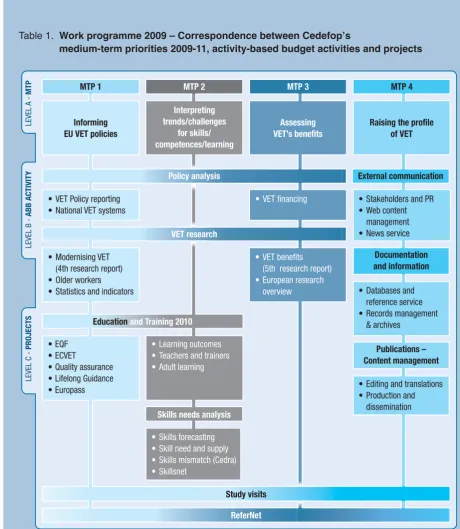
(a) a narrative which reviews the policy background and then outlines how Cedefop will take forward each of its four priorities in 2009 (see Table 1);
(b) detailed activity and project fiches. They present Cedefopʼs work in a logical frame -work, showing the expected impact of each activity and the output of each related project. An activity may include several projects and it should be noted that not all projects in a particular activity serve the same priority. How the activities and their projects relate to each of the four priorities is shown in the table ʻCorrespondence between medium-term priorities, activity based budget activities and projects
(c) an activity-based budget (ABB) that shows the human and financial resources allocated to each activity.
The work programme is consistent with the European VET policy framework set by the Lisbon strategy (7) Education and training 2010work
programme (8) and its Copenhagen process (9).
It is also consistent with new policy developments concerning lifelong learning such as Europeʼs renewed social agenda (10), preparation of an
updated strategic framework for European cooperation in education and training (11), which
is expected to include themes that Cedefop is working on, such as learning outcomes, lifelong guidance and teachers and trainers and the forthcoming Commission Communication new skills for new jobs: anticipating and matching labour market and skills needs. It is also consistent with the European Commissionʼs evaluation of Cedefop (12), completed in 2008,
by focusing Cedefopʼs work on supporting policy development and proposing improvements to align communications and other policies in Cedefop to complement this approach.
Cedefopʼs activities in 2009 also look beyond 2010, when the current strategy agreed in Lisbon in 2000 is scheduled to end. Several Cedefop studies launched in 2009 will be finalised in 2010. They will help bridge the transition to the new strategy and provide it with a firm evidence base.
Policy background
General competence levels must increase, to meet the needs of the labour market and to enable citizens to enjoy high standards of living. There are around 80 million low-skilled people in Europe, a third of the population of working age. Forecasts point to a sharp decline of almost 12.5 million jobs for those with no or low formal qualifications. However, Europe (13) potentially
faces a major skills problem in the near future. Over 20 million new jobs are expected to be created between 2006 and 2020. According to a Cedefop study (14), most additional jobs over the
period 2006-20 will require high-level qualifications. However, numbers of early school leavers (more than one in seven young people left school at lower-secondary level in 2007) remain persistently high. More than half the total job openings (new jobs, plus jobs to replace people leaving the labour market) are expected to require medium-level qualifications. Further, the skills in many current jobs will change, requiring people to continuously update them. Many of these jobs will require vocational qualifications, emphasising the critical role of VET in lifelong learning. However, overall, not enough adults participate in lifelong learning (15)
and recent years have not seen any significant improvement (16). Consequently, there is strong
evidence of increasing need for, and even shortages of, people with adequate levels of qualification in many areas.
European social trends (17) also emphasise
the importance of skills. Increased life expectancy and declining birth rates bring longer working lives. A more mobile younger generation requires linguistic and cultural skills. Climate change and increasing pressure on natural resources brings the need for innovation and new ʻgreenʼ jobs. Immigrants and an increasing number of second generation learners with a migrant background (18)
need the right skills to integrate successfully (19).
Low levels of educational attainment and insuf -ficient skills are major causes of poor labour market performance and social exclusion. They threaten older workers and those marginalised in society who risk losing, or cannot find, a job. They polarise jobs dividing them into those of high-quality with good conditions and those of low quality with poor conditions. They emphasise the ʻdigital divideʼ between those benefiting from advances in new technology and those left behind by it. They separate regions and sectors develop -ing through globalisation from others struggl-ing with economic restructuring. To avoid such divisions that undermine social cohesion, Europe must invest more in its human and social capital. VET is a major tool in the construction of Europeʼs new social agenda (20).
Table 1. Work programme 2009 – Correspondence between Cedefopʼs
With increasing emphasis on education and training, the 2008-10 Lisbon cycle focuses on developing and implementing existing policies. Cedefop combines policy analysis, research, expertise and peer learning to support develop -ment of European VET polices and common European tools and principles.
Following its mandate from ministers in the Maastricht and Helsinki communiqués (21) and the
Bordeaux communiqué in November 2008 (22),
Cedefop will organise debate on the findings of its third policy report on the Copenhagen process. This report succeeds those presented at Maastricht in 2004 (23) and Helsinki in 2006 (24)
and reviews what Member States are doing to achieve shared policy aims and agreed European objectives. Setting its analysis in a clear socio -economic context, the report aims to be a valuable source for evidence-based European VET policies by sharing knowledge and stimulating ideas and innovation. Senior policy-makers will debate the reportʼs findings at an Agora conference in Cedefop in March 2009. It will be jointly organised with the Czech Presidency. Cedefop will disseminate the report widely and stimulate debate on its conclu-sions through presentations at conferences and meetings throughout the year. In cooperation with the European Commission Cedefop contributes to monitoring implementation of VET priorities by Member States, outlined in their national reports, under the Education and training 2010 work programme.
To strengthen the evidence base for policy-making in the Copenhagen process, Cedefop has gathered research expertise to examine VET policy priorities. In 2009, Cedefop will disseminate
the results of ʻModernising vocational education and training: Cedefopʼs fourth report on VET researchʼ. Taking a medium-term perspective, the report analyses how the pressures of an ageing workforce, people lacking the right skills, the need for enterprises to learn and innovate, and the aim to increase social cohesion are affecting VET.
Research suggests four complementary keys for future policy-making in the Copenhagen process; social, economic, institutional and profes-sional. For the social strand, evidence suggests that VET has a major role to play to reduce social exclusion and increase social cohesion. For the economic, research confirms how critical training is, demonstrating that company-provided training enhances process and product innovation, eco -nomic growth and productivity. Research on VET attractiveness emphasises that some institutional policies are of particular interest. These include diversifying VET provision; opening routes for lower-ability students; modularisation; options to re-enter general education either at secondary or tertiary level; and the modernisation of VET systemsʼ governance (quality assurance, quali-fications frameworks, partnerships). The report confirms the importance of information, advice and guidance to make career-related decision-making more efficient over the lifespan. Research suggests various ways to modernise information, advice and guidance and maximise its impact, all dealing with professional practice.
Given demographic change and VETʼs role in ʻactive ageing policiesʼ to support older workers
in the Council conclusions on adult learning (25),
Cedefop will circulate the findings of its analysis PRIORITY 1
Informing European vocational education
and training policies
PRIORITY 1
of current and new research on the relationship between ageing, work performance and learning behaviour.
Cedefopʼs database on national VET systems
and developments enables comparisons to be made between Member States. Reports will be edited and updated for all Member States in English on Cedefopʼs European training village website (http://www.trainingvillage.gr/).
Communiqués agreed in the Copenhagen process and the Council conclusions called for a coherent framework of statistics and indicators
and the Copenhagen process to monitor progress in education and training policy (26). Cedefop, in
cooperation with the European Commission and Centre for Research on Education and Lifelong Learning (CRELL), will continue to support the development of relevant VET statistics and indi-cators. Cedefop will disseminate the findings of its analyses of the third continuing vocational training survey (CVTS3) in enterprises. It will bring new insights into investment in, types of and participation in training in enterprises. Cedefop will continue to contribute to statistical activities at European and international levels to improve data quality, methods and collection. It will work on ways to exploit data from in the Labour Force Survey and support developments in the Adult Education Survey.
The European qualifications framework (EQF) is a tool for comparing qualifications throughout Europe to support lifelong learning and educational and job mobility, not only between countries, but also between the different parts of the education and training systems within coun-tries. This is increasingly important as the
bound-aries between VET, general and higher education are blurring. More and more higher education programmes relate to labour market needs and higher education institutions are also moving more into continuing training. The EQF and national qualifications frameworks, (NQFs) will support creation of flexible learning pathways, enabling people to transfer from VET to general education and vice-versa, at all levels of learning. Cedefop will build on the European Parliament and Council recommendation to establish the EQF (27) and will support the European
Commis-sion in coordinating its EQF advisory group (and its subgroups). Cedefop will support the work on implementing the EQF through scientific expertise, conceptual and background information provided by various studies and comparative analyses. A key aspect of this work is to consult and involve all stakeholders, including the social partners whose support for NQFs is essential for them to have value on the labour market.
The European credit system for VET
(ECVET) is being developed to enable credits for learning outcomes to be transferred from one qualifications system to another, or between general and vocational education, to promote lifelong learning through VET. Cedefop will build on the proposed Recommendation of the Euro-pean Parliament and of the Council (28) by
providing technical and scientific support to the European Commissionʼs working groups and European network on ECVET. By analysing in -novative aspects of ECVET, Cedefop will advise on the relationship between credit systems and European, national and sector qualifications frame-works. It will also advise on steps towards a Euro-pean credit system for lifelong learning, including on links between the European credit transfer system for higher education (ECTS) and ECVET.
Quality assuranceis the basis of trust in other VET systems. Success of the EQF and ECVET depends on this trust being in place. Adoption and implementation of the proposed Recommen-dation on the European quality assurance refer-ence framework for VET 29with the European Commission and the European network on quality assurance in VET (ENQA-VET). Cedefop will continue its support for quality assurance by disseminating the findings of its pilot study on accreditation approaches of VET providers and programmes in Member States. It will follow this up by starting, in 2009, a more extensive compara -tive analysis, which will be the subject of a joint Cedefop and European Commission conference in spring 2010. Cedefop will also disseminate information on quality approaches in European small and medium-sized enterprises in food
processing, retail and tourism and finalise a study on the social care sector. In 2009, linked to the work of the ENQA-VET network, a peer-learning event is planned to examine the priorities of the social partners concerning quality assurance.
To make informed choices about lifelong learning and manage their careers, people need
guidance throughout life. To assist the European Commission in supporting imple mentation of the Council Resolution on guidance endorsed in 2004 (30) and following up the new Council
Reso-lution (31), Cedefop will identify successful initiatives
and make recommendations on policy develop-ment and impledevelop-mentation. Cedefopʼs study on guidance for young people moving from education to work will be debated and proposals made on how best to support them. Cedefop will contribute to the debate on a European competence-based framework for guidance practitioners by presenting information on the qualifications and competences career guidance counsellors need. Cedefop will also study the role of guidance in strategies to support workers at risk due to economic restruc-turing.
The Decision of the European Parliament and of the Council establishedEuropass (32) to support
geographical and job mobility. It is a portfolio of five instruments to make peopleʼs skills and qual-ifications more easily understood in Europe. Cedefop will continue to support the European Commission in implementing the proposals of the Europass external evaluation (33) and will
improve the Europass CV in consultation with interested groups such as employers and recruit-ment agencies. Cedefop will continue to develop and maintain the Europass web resources
PRIORITY 1
(http://europass.cedefop.europa.eu) and support national Europass centres in ensuring that Europass complements related tools, such as the EQF and ECVET.
Study visitsfor education and vocational training specialists support European cooperation and policy development in lifelong learning. They provide an opportunity for experts from different countries to meet and discuss issues of common interest and share their experience and expertise. Study visits are part of the Lifelong learning programme 2007-13 (34). They are carried out by
national agencies and coordinated by Cedefop on behalf of the European Commission. In the academic year 2008/9, Cedefop will implement and monitor 260 study visits, with around 2 600 participants and 40 themes covering the priorities set for education and training at national and European levels. Ensuring the quality of the study visits programme will be a specific focus in 2009 and involves finalising assessment tools to measure the visitsʼ impact. Cedefop will assess study visitsʼ results and identify examples of good practice and disseminate them widely. For the academic year 2009/10, Cedefop will prepare and disseminate the visits catalogue, coordinate the call for applications and monitor the imple-mentation of study visits. Cedefop will further improve its interactive management information system. Working with the European Commission, Cedefop will continue its efforts to strengthen coherence between the study visits programme and the policy priorities set for education and training at European and national levels (Lisbon strategy and Copenhagen process).
To interpret European trends, Cedefopʼs work is based on three related aspects; analysing skill demand and supply, examining trends in the way people acquire skills and supporting the profes-sional development of the VET teachers and trainers.
Future demand and supply of skills in the EU, early identification of new emerging skill and competence requirements at all levels, and an -t i cipa-tion – and preven-tion – of po-ten-tial skill gaps and mismatch due to demographic change and economic restructuring are at the heart of the current EU policy agenda, in line with the Lisbon strategy. The Integrated guidelines for growth and jobs 2008-10 and the 2007 Council Resolution on new skills for new jobs (35) are important
mile-stones in this strategy. In response to the Councilʼs request for an assessment of future skills require-ments (36), Cedefop contributed to a
Communi-cation of the Commission on anticipating and matching labour market and skills needs (37).
Cedefop provided a forecast of skill needs up to 2020 (38), analyses of skill needs in key sectors
of the economy and of systems on early identi-fication of skill needs in the European Member States (39).
Over the past years, Cedefop has become a key reference for skill needs analysis and fore-casting. In 2009, Cedefop will continue to be prominent in this field. With financial support from the European Commissionʼs Directorates General for Employment and Education and Culture Cedefop will begin the work to help establish a regular, systematic assessment of long-term supply and demand in EU labour markets, and engage in new research to fill knowledge gaps,
for example on the interaction between skill demand and supply. In doing so, it will continue to play an important role in implementing the above-mentioned Commissionʼs Communication on new skills for new jobs and assist the European Commission in further development. Cedefop will organise an Agora conference in Thessaloniki to present and discuss the results of its forecast of skill supply and potential labour market imbalances between demand and supply.
However, skill demand and supply forecasts refer to macroeconomic developments and for-mal skills and qualifications. The analysis of skill and competence needs – both in quantitative and qualitative terms – at the meso level of sec-tors and the micro level of enterprises is essen-tial to complement the macro picture. There is a considerable knowledge gap in identifying skill and competence needs in enterprises and selected key sectors at European level. Cede-fop, in consultation with the social partners and other stakeholders, will fill this gap by conducting a feasibility study of an employersʼ skill survey to identify future skill, competence and training needs in European enterprises and by analysing skill needs in selected key sectors of the Euro-pean economy.
PRIORITY 2
Interpreting European trends in
and challenges for skills, competences
and learning
PRIORITY 2
Further, Cedefop will carry out research on
skill mismatchand its impact. Its findings will provide new insights on skill obsolescence, over-education and skill shortages. Research will look at the impact and persistence of skills mismatch and measures that may be taken to prevent or alleviate the distortions it may cause on the future labour market. International cooperation with OECD will continue with a joint international seminar in February 2009 on measuring generic work skills, presenting the pilot results from the job requirements approach module of the Programme for international assessment of adult competences (PIAAC) (40).
Learning outcomesform part of an innova-tive approach to teaching, training and learn-ing (41) and are regarded by some as a paradigm
shift. The emphasis is on defining learning out-comes to shape the learnerʼs experience, rather on the content of the subjects that make up the curricula. Learning outcomes are central to the EQF and national qualifications frameworks, Europass, and ECVET. Cedefop will support the debate and systematic exchange of experiences and peer-learning between Member States and social partners on qualifications and learning outcomes through a range of comparative stud-ies analysing different aspects of this issue. First, how definitions and renewals of occupational and education/ training standards influence qual-ifications and how standards may be used to improve links between the labour market and qualifications systems. Second, the changing role of qualifications in Europe, their interrelation with lifelong learning and globalisation and how to develop qualifications systems and
frame-works. Third, the relationship between learning outcomes and VET curricula and learning pro-grammes. Fourth, on the EQF and sectoral qual-ifications. In May 2009, Cedefop will organise a major conference on qualifications and learning outcomes to present the findings of several stud-ies on the changing roles of qualifications in Eu-rope to key policy-makers and stakeholders. The conference aims to contribute to developing a comprehensive lifelong learning strategy at na-tional and European levels by examining the im-pact of defining and describing qualifications through learning outcomes.
This information will support the European Commissionʼs cluster on recognition of learning outcomes, which is jointly coordinated by Cedefop. Work in 2009 will focus on supporting development of national qualifications frame-works and implementing systems for validating non-formal and informal learning, based on the common principles agreed in 2004 (42) and
the European guidelines launched by the cluster in autumn 2008. The European Commission, Member States and Cedefop will prepare an up-date of the inventory on validation (43).
Cedefopʼs contribution to implementing the European long-term e-Skills agenda (44) will
Cedefop will continue monitoring trends and developments affecting the roles and compe-tences of VET teachers and trainers. As high-lighted in the communiqués of the Copenhagen process, the Council conclusion on teacher educa-tion and the European Commissionʼs communi-cation on improving competences for the 21st Century (45). Teachers and trainers are central to
assuring high quality education and training. Cedefop will support the European Commissionʼs focus group on VET teachers and trainers and will jointly organise a major conference on the changing competences of VET teachers and trainers. Cedefop will support the debate and policy developments through its study on the new roles and competences of VET teachers and trainers in new concepts of learning, in particular, the competences they need to implement didac-tical approaches based on learning outcomes. Cedefop will also disseminate a set of competence frameworks for VET teachers and trainers and a compilation of good practice and policies on the professional development of in-company trainers. It will also disseminate a study on mismatches in VET teachers and trainersʼ competences and their continuing training opportunities. Cedefopʼs training of trainers network – TTnet –will continue to be a Europe-wide platform of expertise on VET teachersʼ and trainersʼ professional development.
Cedefop will support development of a Euro-pean adult learningpolicy as part of the lifelong learning strategy through follow-up of the Councilʼs conclusions (46) and the European Commissionʼs
action plan (47). Cedefop will monitor and assess
adult learning trends and policy developments such as broadening access and participation of adults in education and training, strengthening the quality of provision and upgrading the quali -fications of the adult population, in particular groups at risk.
PRIORITY 2
Despite its perceived benefits, research on returns to public and private investment in skills is rela-tively underdeveloped in Europe. Although there are many studies on the benefits of education not enough is known about the more specific impact of VET. Understanding how VET contributes to careers and employment prospects, as well as its impact on productivity, enterprise performance, competitiveness and social inclusion is essential to informing investment choices about VET. Council conclusions on efficiency and equity in education and training called for research on the impact of investment in education and training (48).
By providing evidence of the specific economic and social benefits of VET, as compared to other learning pathways, in its Fifth report on Euro-pean VET research – Economic and social benefits of VET, to be published and dissem -inated in 2011, Cedefop will fill a knowledge gap and inform education and training policy. Cedefop will analyse existing research, review the theories, methods and data and design and finance new research to break new ground on the returns to VET. Research will cover economic and social benefits for society, economic sectors, companies and individuals. To complement this work and support knowledge exchange, Cedefop will analyse and disseminate online national VET research reports from the Member States, Iceland and Norway.
VET financingis a key issue and investment in human capital is a high priority (49). Cedefop
will provide information on levels, trends and patterns of VET expenditure, focusing on cost-sharing policies and instruments, such as sectoral training funds (where social partners have a leading role) individual learning accounts, loans and tax incentives. VET cost-effective sharing instruments in the newer Member States and VET financing in non-EU countries will be the subject of a Cedefop conference in cooperation with its European and international partners. Cedefop will jointly organise, in Brussels, a confer-ence with the European Commission on tax treat-ment of education and training expenses. PRIORITY 3
VET is a basis for high performance and quality in working life for an increasingly diverse and ageing workforce. However, it does not enjoy parity of esteem with general education and its value at the centre of lifelong learning tends to be underestimated. Barriers between VET, general and high education need to come down as in each country separate systems of education and training are restructuring to become a single national system of lifelong learning, which values all types of learning. This will enable people to move between VET and general education and vice-versa, at all levels of learning, including higher education.
Raising the profile of VET requires effective communication. Cedefopʼs communications policyis to disseminate clear, reliable, timely, and – where possible – comparable information, striking a balance between the specific information needs of policy-makers, including social partners, and act as an open source of information for the wider VET community of researchers, practitioners and the general public.
Cedefop is reorganising its communication services to align them with its new priorities 2009-11. Following the recommendations of the external evaluation, Cedefop (50) is moving to an
impact-driven strategy for publications, with a gradual shift to web-based products and digital publications, to match better the needs of target groups.
During 2009, Cedefop will establish its web portal www.cedefop.europa.eu. The portal will have new information structures for web content and provide a unique entry point to access all Cedefopʼs web services including:
(a) information on Cedefopʼs activities,
(b) projects and networks and Cedefop as an organisation,
(c) news on training developments (policy briefing notes, newsletter, press releases),
(d) Cedefopʼs databases (bibliographical data-base, online European training thesaurus, information on VET systems in Europe, research, statistics and indicators),
(e) the Cedefop bookshop,
(a) forthcoming conferences, events, workshops and seminars,
(f) access to the Europass and study visits websites.
A search engine optimisation strategy also aims to improve the ranking and positioning of Cedefopʼs web services on search engines.
Cedefop will communicate key messages on VET to stakeholders and media (including local and European newspapers, radio and TV) through regular information, in hard-copy and electronic format. It will establish relationships with European journalists, press agencies and the European Commissionʼs press services and will issue fort-nightly press releases. Cedefop will continue to produce high quality publications that contribute to its recognition as a source of reliable, relevant and useful information on VET for its various target audiences and major stakeholders. PRIORITY 4
Raising the profile of vocational
education and training
PRIORITY 4
Cedefop will support VET experts access to literature by maintaining the most comprehensive collection of hard-copy and online material on VET in Europe, with over 60 000 references in its bibliographical database. Cedefopʼs reference service is open to answer questions and queries on VET from Cedefopʼs stakeholders. Throughout the year Cedefop expects to receive and make presentations to around 3 000 experts and visitors from all over Europe, helping establish Thessa-loniki as an important venue for European VET policy.
In 2009, Cedefop will publish three issues of the European journal of vocational training, in English only, two of which will be thematic: (a) Issue 46 (I/2009), on higher education and
VET.
(b) Issue 47 (II/2009), a general issue;
(c) Issue 48 (III/2009), on assessment, recog-nition and certification of non-formal and in-formal learning.
An effective and efficient administrationmakes an indirect but important contribution to achieving Cedefopʼs operational objectives. It helps develop, organise and manage the organisationʼs skills. It maintains the physical environment and ICT architecture with which colleagues work and supports them in procurement, contract and finan-cial procedures. Further, in its dealings with outside organisations and contractors it projects Cedefopʼs image. Cedefop has set itself the goal to move toward quality management in managing its human and financial resources. In 2009, Cedefop will consolidate administrative changes introduced over the previous years. Using results from ex -ternal and in-ternal audits, evaluations and in-ternal assessments, and applying modern manage-ment techniques, in full compliance with the regu-lations, priority will be given to increasing effi-ciency by streamlining procedures, planning and reporting.
The Internal Audit Capability will continue to support the Director to control risks and monitor compliance through assurance audits and solu-tion-oriented consultancy designed to add value and improve Cedefopʼs operations.
Cedefop will further improve its planning and reporting. These developments are guided by the objectives to establish an efficient and compre-hensive performance monitoring system, improve periodic reporting to management including project managers, ensuring good documentation of busi-ness processes, and structure risk assessment and risk management. Cedefop has developed a set of impact indicators to measure its perform-ance and impact over the period 2009-11 at activity level and sources of verification to measure
them. These indicators represent an aggregation of the expected impact of Cedefopʼs various activ-ities. These sources will be monitored and analysed to provide an assessment of Cedefopʼs performance.
In 2009, Cedefopʼs activity-based budget-ing(ABB) will be used for budget planning, mon-itoring and reporting. In procurement, automation of procedures will continue and efficiency will be improved by implementing fewer but larger tendering procedures.
To raise Cedefopʼs corporate image the new architecture for the Cedefop website, integrating Cedefopʼs various websites on a single operat-ing platform, will be implemented in 2009. Cede-fop will migrate and/or re-implement web appli-cations to use Microsoft.NET technology as a development operating platform. Cedefop will also migrate to use RedDot technology for web content management. Cedefop will also renew its conference systems infrastructure. Concern-ing the buildConcern-ing, works to ensure its safety will continue and the findings of the ongoing study implemented.
Management, resources
and internal controls
Working in partnership
In working to improve VET, Cedefop partners many organisations, each bringing its unique expertise. In VET policy Cedefopʼs major partners are the European Commission, Member States and social partners. On issues of social partner-ship, labour relations and VET, Cedefop shares expertise with Eurofound (the European Foun-dation for the Improvement of Living and Working Conditions – see Annex VI). Cedefop shares infor-mation with the ETF (European Training Foun-dation – see Annex V), to help integrate candidate countries into the European VET policy process. In close cooperation with the European Commis-sion, Cedefop partners the Centre for Research on Education and Lifelong Learning (CRELL) working on education and training benchmarks and indicators to support policy-making. Cedefop will also work with the network for quality assur-ance in VET (ENQA-VET) and the European life-long guidance policy network (ELPGN). Devel-opments in general education and its growing links with VET are followed in liaison with Eurydice (the European Education Network). In the interests of VET, Cedefop seeks strategic partnerships with other EU agencies, such as the European Agency for Health and Safety at Work (OSHA), international organisations, such as OECD, UNEVOC and ILO and VET research institutions in non-EU countries.
Cedefopʼs networks (see Annex iv) are powerful tools to collect and disseminate information, exchange experience, stimulate debate and generate ideas. Cedefopʼs major networks include:
ReferNet(European network of reference and expertise in VET) is Cedefopʼs primary source of information on VET systems and policy devel-opments in Member States. It provides Cedefop with data for documentation activities and contributes to various projects, including reporting on VET-related policy and research activities in the EU. It also supports Cedefopʼs communication strategy by channelling and disseminating infor-mation at national level. ReferNet comprises national consortia consisting of representatives of VET organisations in each Member State led by a national coordinator;
Skillsnet(network on early identification of skill needs) brings together highly qualified researchers and other experts from various fields, to present and discuss methods and outcomes of analysis to anticipate skill needs, as well as medium to longer-term prospects of skills available in the labour market at European and international levels.
Risk assessment
There are budgetary, policy and operational risks to the 2009 work programme.
Further budget cuts can affect staff and oper-ations.
Policy risks can bring uncertainty or changes in Cedefopʼs expected contribution and so affect the quality, relevance and impact of Cedefopʼs work. Policy risks are largely beyond Cedefopʼs control, but through close cooperation with its partners it aims to identify potential problems as early as possible and adapt quickly. Policy risks include:
(a) changes in VET-related policy priorities of the European Commission, Member States and social partners;
(b) new demands to take on additional respon-sibilities that may stretch resources and limit the impact of Cedefopʼs work;
(c) different expectations of Cedefopʼs work among its Governing Board and stake -holders, leading to disappointment over the final results, reduced impact and the view that resources were wasted and opportun -ities lost;
(d) stakeholders being unable to provide sufficient commitment to Cedefopʼs networks and steering groups;
(e) partiality towards general education over -shadowing VET issues.
Operational risks can delay work and under-mine its quality and impact. Cedefop has a greater degree of control over some operational risks. It manages them through planning, clear proced -ures, internal controls and, where appropriate, wide dissemination and marketing.
Operational risks include:
(a) other internal policies (communications, IT, personnel, financial and administrative) not aligned in support of Cedefopʼs core busi-ness;
(b) ineffective communication with stakeholders; (c) the calibre of personnel being insufficient to
meet the work demands;
(d) unsuccessful tenders, delays and poor quality of submissions from external contractors, partners, or both;
(e) resource or other constraints of European Commission services having service-level agreements with Cedefop, affecting admin-istrative tasks, for example, training, EPSO competitions, new financial software (ABAC), publications through the Publications Office.
Activity fiches
SPECIFIC OBJECTIVE
Informing European vocational education and training policies
Activity – Policy analysis
Policy analysis aims at carrying out comparative and contextualised analysis of policy progress in VET and reporting on developments in major policy areas, considering in particular the EU policy goals for VET set in the Copenhagen process.
According to the mandate given to Cedefop in the Helsinki and the Bordeaux Communiqués, the aim of the activity is to monitor and analyse performance and progress Member States have made in implementing the Copenhagen objectives and priorities to modernise European VET systems, taking into account wider socio-economic developments as well as links with other policy areas.
Activity impact indicators
The policy report and the Agora conference 2009 is able to inform on policy developments and modernisation of VET systems. Also by showing examples of good practice and VET developments in a global perspective, policy makers and the public become more aware of the need to consider the potential VET has and the challenges it faces in the wider socio-economic context.
Furthermore, the outcomes of the Cedefop policy reporting which comprises also comparative analysis of national reporting and countriesʼ self-assessments represent one of the most relevant sources for an evidence-based European VET policy and decisions on further measures and priorities in the Copenhagen process.
Cedefopʼs publications and expertise are widely used also for the preparation of various EU documents (e.g., communications, joint reports, progress reports), events and working groups at EU and national level, as was already the case in 2008 (e.g. briefings, ministerial meetings, preparation of the Bordeaux Communiqué)
Project 1. VET policy reporting
Monitoring and analysing progress in the field of VET within the Copenhagen process and follow-up of the Helsinki and Bordeaux Communiqués.
Output indicators 2009
Publications
• 2008 Copenhagen process policy report ready for the Agora (March 2009) and disseminated in several languages and to major Cedefop partners and policy makers/stakeholders (1stsemester, dissemination strategy improved and nr of recipients
to be increased)
• Online posted national reports on VET policy developments (in English) received from ReferNet (1stsemester). Some reports will be made available in the native language by
ReferNet members
Conferences and meetings
Other key outputs
• Progress in implementing the Copenhagen objectives and priorities is analysed and presented in a comparative way at various occasions and events, taking into account the wider socioeconomic context; prepare support documents and presentations for wide dissemination
• Adjustment of the approach in future reporting activities
• The preparation of the next reporting exercise, the results of which will be presented during the Belgian Presidency (II/2010) and its adjustment to future needs and priorities as agreed in the Bordeaux Communiqué
• Contribution to reporting activities of the DG EAC in the context of the Education and Training 2010 Work programme (as done in previous years)
• Cooperation with DGVT, ACVT, ETCG and other bodies and committees in the process of preparation of various European policy documents and reports
Project 2. Informing on national VET systems
Elaborate and disseminate comparable thematic information on national VET systems and developments, gathered by ReferNet. The online database on National VET systems (eKnowVet) is available for a broader public and can be read both on a cross-national or thematic basis to facilitate comparison. Collaboration with the European Commission and Eurydice will continue.
Output indicators 2009
Publications
Comparative reports on VET themes and recent developments in all Member States posted online (in English) throughout the year. Some reports will be available in the native language on the ReferNet websites
Conferences and meetings
Other key outputs
Establishment of a working group to discuss the structure of the reports and re-examination of the submission and revision procedure
Activity – ReferNet
ReferNet is a network to obtain and disseminate information on VET developments in the Member States, Norway and Iceland. Its activities are of mutual benefit for countries and Cedefop. ReferNet is a major source of information on VET systems, policies and research, which feeds into several Cedefop activities. ReferNet provides also information on publications, conferences, recent VET developments and initiatives in the Member States. Finally, the network actively disseminates Cedefop work. The ReferNet network is established under multiannual framework partnership agreements until 2011.
Activity impact indicators
The use of the information collected and analysed by ReferNet for several Cedefop activities and making comparative results available to a wide audience contribute to better inform policy makers
and the public on European VET systems, developments and policy initiatives as well as research. With the support of ReferNet, Cedefop outcomes and outputs are better disseminated within the Member States.
Output indicators 2009
Publications
Conferences and meetings
• Plenary meeting of the network in Autumn 2009 • Meeting of the national consortia throughout the year • Regional meetings of national networks throughout the year • Meetings with the ReferNet core group throughout the year
Other key outputs
• A work programme for 2010 will be proposed in the first half of 2009 and
be the object of specific grant agreements to be concluded by the end of the year • National research reports delivered to Cedefop in September 2009
• Description of the VET system by end May 2009 • Developing VET-Bib (monthly)
• Providing news on recent developments and new initiatives in VET policy (at least 3 times per year)
• Maintaining and updating a national ReferNet website/web pages (continuous) • Dissemination of news/press releases on recent developments and initiatives
in VET policy (monthly)
• Providing information on national conferences, seminars and workshops (biannually) • Providing contacts with the press (biannually)
Activity – VET research
The activity is to review, analyse and report on VET research and related fields including links with the economy and labour market; to initiate new research that can fill in knowledge gaps; to promote cooperation and exchange with the research community; and to foster networking and communication between researchers, policy-makers and practitioners.
The aim of the activity is to analyse, review and contextualise current VET research in Europe on the modernisation of VET and provide stakeholders and the broader public with research findings and statistical data which are of relevance for and can back up evidence-based policy making.
Activity impact indicators
Policy makers and other stakeholders are informed about research findings on the modernisation of VET and their relevance and implications for policy making.
The analysis of the enterprises training patterns in Europe as well as of the working and learning behaviour of older workers triggers reflection on adequate incentives to promote continuing vocational training.
Project 1. Modernising vocational education and training
The4threport on VET research– Modernising vocational education and training examines
the main VET policy priorities agreed in the Copenhagen process from a research perspective and puts them in a wider context. The report reviews, among other things, developments linked to an ageing workforce, the need for enterprises to learn and innovate, and the goal to increase social cohesion and reduce social exclusion. It also examines how VET systems are modernising in response to these pressures and the priorities set in the Copenhagen process. These include attracting more people into VET, implementing qualification systems and frameworks based on learning outcomes, the professional development of VET teachers and trainers, and improving guidance and counselling to help people manage their career.
Output indicators 2009
Publications
• Fourth synthesis report on VET research ʻModernising Vocational Education and Trainingʼ (2ndsemester), based on the Background reports with original contributions from researchers
which have been published in 2008
• Flyer and executive summary for broad distribution (2ndsemester) Conferences and meetings
Other key outputs
• Particular research findings are analysed in a comparative and contextualised way and published separately, if convenient
• Active dissemination of the results to the media, Cedefop stakeholders, in external conferences and meetings
Project 2. Working and learning of older workers
Carry out analyses of current research and developments to provide new insights on older workers and the interrelation between ageing and working performance and learning behaviour, to support evidence-based active ageing policies.
Output indicators 2009
Publications
A reader on working and learning at old age, containing the proceedings of a workshop held in September 2008 (2ndsemester)
Conferences and meetings
Other key outputs
Initiate a research project that addresses older workersʼ learning behaviour and working performance from a neurological and educational perspective and synthesise critically other streams of research on this subject
Project 3. Statistics and indicators
Support evidence-based policy and practice in VET by providing sound statistical evidence on VET related issues, support statistical activities at European and international levels and further develop quality, methods and data collection.
Output indicators 2009
Publications
Key results and analyses of the third European Continuing Vocational Training Survey in enterprises (2ndsemester)
Conferences and meetings
Workshop on the further development and improvement of the European Continuing Vocational Training Survey in enterprises in (autumn 2009)
Other key outputs
• Statistics are analysed and provided in a comparative and contextualised way • Better exploitation of LFS data, including national data
• Statistical support services including web, review and contribution to various publications, data provision and in-house information service
• Support future methodological developments by: – A study on the Adult Education Survey
– Cooperating actively with partner organisations such as Eurostat and the OECD, and participating in various international working groups and meetings
SPECIFIC OBJECTIVE
Interpreting European trends in and challenges for skills,
competences and learning
Activity – Skill needs analysis
To early identify and anticipate emerging and future skill developments and analyse skills mismatches at European, national, sectoral and company/occupational levels and transfer results to support education and training policies
Activity impact indicators
By allowing policy makers, social partners, researchers, and practitioners to gain and exchange information and expertise on skill needs analysis and anticipation at European and international level, Cedefop supports the transfer of results into education and training policies. Active participation of, and communication with, experts in this field is ensured by participating in EC working groups and by Cedefopʼs Skillsnet platform.
By improving labour market intelligence through forecasting and analysing skill needs and skill mismatch at different levels, the activity supports policy-making in education, training and employ-ment.
Project 1. Forecasting skill demand and supply
Forecasting skill demand and supply in Europe by projecting and analysing future skill needs and supply and their potential imbalances
Output indicators 2009
Publications
Results of skills supply forecast and analysis of potential future labour market imbalances (2ndsemester)
Conferences and meetings
• Agora conference during the 1stsemester to present and discuss mainly results of the
skills supply forecasts and potential labour market imbalances, possibly in cooperation with the Czech presidency
• Expert workshops to discuss the methodology and validate data for regular forecast of skill demand and supply (2ndsemester)
Other key outputs
• Develop regular forecasts of skill demand and supply including various scenarios, such as a policy/impact scenario, if feasible
• Provide detailed analysis of potential labour market imbalances
• Explore the feasibility to develop a model/methodology on the interaction between skill demand and supply
• Continue active participation in activities by DG EAC and DG EMPL, as for example in 2008 on the Communication from the Commission on the New skills for new jobs initiative
Project 2. Identifying skill needs in sectors and enterprises
Enrich knowledge on future skill needs in Europe by qualitative and quantitative information on skill and competence needs in different economic sectors or areas of strategic importance and on skill and training needs in enterprises as reported by employers.
Output indicators 2009
Publications
Results of the feasibility study ʻEmployersʼ survey on skill needs in Europeʼ (2ndsemester;
on-line)
Conferences and meetings
• Expert workshop on results and follow up of the feasibility study on employersʼ skill survey in Europe (1stsemester)
• Expert workshop on methods and approaches for skills analyses in particular sectors, in cooperation with Eurofound (2ndsemester)
• International seminar on measuring generic work skills, in cooperation with the OECD in February 2009 (pilot results from the Job Requirements Approach module of the Program for International Assessment of Adult Competences – PIAAC)
Other key outputs
• Carry out exploratory work on employersʼ surveys as a tool to identify future skill and training needs in public and private enterprises in Europe, also involving social partners;
if feasible, start developing a pilot European employersʼ skill survey
• Carry out an overview of national sectoral approaches and methodologies to identify skill needs with their possible utilisation at European level, also by involving the social partners
Project 3. Analyse skill mismatch and its impact
Carry out theoretical and empirical research to provide policy makers with new knowledge and research findings about various forms of skill mismatch, their impact, and implications for policy.
Output indicators 2009
Publications
First study on a taxonomy of skill mismatch based on a) type of skill mismatch, b) level of analysis, c) methods used to assess skill mismatch, d) nature of the impact (transitory/permanent, short/medium/long-term) and e) policy measures effective in addressing skill mismatch (2ndsemester)
Conferences and meetings
Workshop on policy to address and/or prevent skill mismatch (2ndsemester) Other key outputs
• Analyse and disseminate research findings that provide new insights on different types of skill mismatch, particularly skill obsolescence, overeducation and skill shortages, their impact at various levels and their policy implications, as well as the effectiveness of policies directed at reducing skill mismatch;
• Preparatory activities for empirical studies on current gaps in skill mismatch research.
Project 4. Skillsnet
Manage the Skillsnetnetwork – a platform bringing together highly qualified researchers and experts to discuss methods and outcomes of skill needs analyses and anticipation at European and international level
Output indicators 2009
Publications
Regular newsletters and other information material, including working and discussion papers, both in print and online.
Conferences and meetings
Other key outputs
• Expand the Skillsnet network to include more countries and experts, and maintain fruitful and effective cooperation with Skillsnet members
• Share constantly information about main trends and developments in skill needs and supply in Europe, both in a quantitative and qualitative perspective
SPECIFIC OBJECTIVE
Assessing vocational education and trainingʼs benefits
Activity – VET research
The activity is to review, analyse and report on VET research and related fields including links with the economy and labour market; to initiate new research that can fill in knowledge gaps; to promote cooperation and exchange with the research community; and to foster networking and communication between researchers, policy-makers and practitioners..
The aim of the activity is to improve knowledge on the economic and social benefits of VET for individuals, social groups, enterprises, economic sectors and for societies as a whole; to assess various returns to investments in VET at different stages of the life cycle and compared to other possible of educational investments. Such knowledge is crucial for the foundation of policies and measures related to initial and continuing VET.
Activity impact indicators
By providing evidence of the specific economic and social benefits of VET, as compared to other learning pathways, Cedefop fills in a knowledge gap and informs education and training policy as well as future economic and social research.
Cedefop is being cited in the international literature on VET research for its work on the economic and social benefits of VET. Decision makers are aware of the benefits of VET and take them into account in their policies.
Project 1. Report on European research on the economic and social benefits of VET
Carry out empirical research to provide policy makers and researchers with new knowledge and research findings on the economic and social benefits of VET. Prepare a background and synthesis report presenting theories, methods and results of research and drawing implications for policy-making, to be published in 2011 as Cedefopʼs fifth Research report
Output indicators 2009
Publications
Conferences and meetings
Other key outputs
• Design, develop and monitor research to break new grounds on the specific benefits of VET, covering both economic and social outcomes and including all levels – society, sectors, companies, individuals and groups of individuals;
• Synthesise critically available research on the benefits of education and VET and review the theories, methods and data that are applied to the field.
Project 2. Overview on European research activities
The European Research Overview (ERO) promotes VET-related cross-national research and supports the exchange of knowledge and information. It carries out analyses of current research and development activities by applying quantitative and qualitative research methods in comparative education. The thematic focus in 2009 is on the economic and social benefits and financing of VET.
Output indicators 2009
Publications
Online publication of the National Research Reports provided by ReferNet on research on the economic and social benefits of education and financing of VET in the Member States, Norway and Iceland, by December 2009.
Conferences and meetings
Other key outputs
Compilation and analysis of the National Research Reports to prepare an analytical summary to be included in Cedefopʼs report on the economic and social benefits of VET, to be published in 2011.
Activity – Policy analysis
Policy analysis aims at carrying out comparative and contextualised analysis of policy progress and reporting on developments in major policy areas, considering in particular the EU policy goals for VET set in the Copenhagen process.
For this specific objective, the aim of the activity is to inform stakeholders on the level, trends and patterns of VET financing, including CVT.
Activity impact indicators
The level, trends and patterns of VET financing are better known by key stakeholders and this contributes to the exchange of good practice in the field.
Project Innovative mechanisms in VET financing
Carry out comparative policy analysis of new models and trends in VET financing in European and in competitor countries, with a focus on cost-sharing policies and innovative funding mechanisms, such as sectoral training funds, individual learning accounts, loans, tax incentives.
Output indicators 2009
Publications
• Study on ʻTax incentives to promote education and trainingʼ, which presents an in-depth analysis of six member states (1stsemester);
• Study on ʻVET financing mechanism in selected member statesʼ (VET cost-sharing instruments in EU-12; 2ndsemester).
Conferences and meetings
• Conference on tax treatment of education and training expenses, in cooperation with DG TAXUD (1stsemester);
• Seminar on (developing) VET cost-sharing policies/ instruments in EU-12 (1stsemester);
Other key outputs
• Disseminate the study on VET policies in non-EU countries (which includes financing); • Carry out a study on loans and potential involvement of financial institutions.
SPECIFIC OBJECTIVE
Raising the profile of vocational education and training
Activity –
European journal of vocational training
The European journal of vocational training is a scientific Journal aiming at informing European VET policies and at contributing to the debate and discussion on vocational training in Europe, by publishing quality articles on research, practices, policies and innovation in this field.
Activity impact indicators
Provide a platform for disseminating findings of research, policy and practice in Europe and beyond.
Output indicators 2009
Publications
• Three issues, in English only:
– Issue 46 (I/2009) on higher education and VET; – Issue 47 (II/2009) a general issue;
– Issue 48 (III/2009) on Assessment, recognition and certification of non-formal and informal learning.
Conferences and meetings
One meeting of the editorial committee Other key outputs
• Call for expressions of interest to take over EJVT publication process; • Proposals to the Governing Board on the future of the European journal
and decision taken in June 2009
SPECIFIC OBJECTIVE (MEDIUM-TERM PRIORITY)
Informing European vocational education and training policies
ABB Activity –
Education and Training 2010
Education and Training 2010 provides a European framework for policy cooperation between Member States and the Commission in education and training. To achieve its specific objective ʻInforming EU VET policiesʻ, Cedefop will continue to contribute significantly to the conceptual development, design and implementation of the European principles, tools and frameworks for VET and lifelong learning aimed at enhancing the transparency of qualifications and increasing the mobility
of learners and workers. Active cooperation with the ETF and the ILO will be ensured, especially on the developments on qualifications frameworks and mobility tools.
Activity impact indicators 2009
By end 2009:
• Cedefopʼs technical, scientific and coordination support to the clusters, networks and working groups set up to implement the Education and Training 2010 agenda has fostered the development and implementation of the common European tools and principles at Member States level and has increased the basis for comparison and European cooperation in education and training;
• Cedefopʼs independent comparative studies and analyses on quality assurance mechanisms in accreditation and certification of VET provision, credit systems and qualifications framework, lifelong guidance policies and strategies have identified and filled knowledge gaps, have fed directly into policy making and institutional developments at EU, national and sectoral level and contributed to a coherent implementation of European principles, tools and frameworks;
• Cedefopʼs work has increased awareness of links and compatibility between the European tools (e.g. ECVET, EQF, Europass).
• Cedefop is acknowledged as a key institutional actor as regards the common EU tools, principles and frameworks, including through explicit mention in EU policy and working documents, requests for technical and scientific advice by EU policy-makers and stakeholders, membership in European Boards/Committees, invitations to contribute to international and EU major events.
Project The European Qualifications Framework for Lifelong Learning – EQF
The European Qualifications Framework (EQF) is a translation grid for qualifications throughout Europe aimed at supporting cross-border mobility and facilitating lifelong learning. In 2009, Cedefop will continue, in close cooperation with the Commission, to provide scientific and coordination support to the EQF Advisory Group (and its sub-groups) and carry out a number of independent comparative studies and analyses on issues not sufficiently covered.
Output indicators 2009
Publications
A comparative study on how certification processes are quality assured is published during the 1stsemester 2009 and widely disseminated. The studyʼs results represent a substantial
input to the sub-group of the EQF Advisory Group on quality assurance issues.
Conferences and meetings
Other key outputs
The EQF Advisory Group and sub-groups are, in close cooperation with DG EAC, successfully supported in order to ensure coherence and transparency of the EQF implementation; conceptual and background information is developed.
A study is carried out to examine to which extent VET takes place at qualifications levels 7 and 8 of the EQF. Possibilities and obstacles in this field are identified and current trends assessed.
An in-house analysis is carried out to map the rapid development of National Qualifications Frameworks (NQFs) and to identify their main strengths and limitations.
The outcomes of testing and piloting of the EQF within LdV and LLP are analysed and cross-sectoral trends identified.