Rochester Institute of Technology
RIT Scholar Works
Theses
Thesis/Dissertation Collections
1996
3-D CFD analysis of flow in a mixed-flow pump
diffuser
Yi Zhao
Follow this and additional works at:
http://scholarworks.rit.edu/theses
This Thesis is brought to you for free and open access by the Thesis/Dissertation Collections at RIT Scholar Works. It has been accepted for inclusion
in Theses by an authorized administrator of RIT Scholar Works. For more information, please contact
Recommended Citation
3-D CFD Analysis of Flow in a
Mixed-Flow Pump Diffuser
by
Yi Zhao
A Thesis Submitted
In
Partial Fulfillment
of the
Requirement of the Degree of
Master of Science
In
Mechanical Engineering
Approved by:
Dr A. Ogut - Thesis Advisor
Dr. R.
1.
Hefner
Dr. A. Nye
Dr. C. Haines
Department of Mechanical Engineering
College of Engineering
Rochester Institute of Technology
Rochester, New York 14613
Thesis Reproduction Permission Statement
Permission Denied
Title of thesis: 3D CFD Analysis of a Mixed-Flow Pump Diffuser
I, Yi Zhao, hereby deny permission to the Wallace Library of the Rochester Institute of
Technology to reproduce my thesis
in
whole or
in
part.
Dedication
I
wouldlike
todedicate
thisworkto avery
specialpersonin my life
whohas
always
been my
sidethroughalltheunforgettableyears, andwhohas
always encouragedAcknowledgments
I
wouldlike
to thank theRochester
Institute
ofTechnology's
Mechanical
Engineering
Department
faculty
ofthefor
theinstruction
and support ofmy
educationin
the
field
ofMechanical Engineering.
Especially,
I
want to thankDr. Ali Ogut for his
guidance as
my
thesisadvisor andMr. Paul Ruzicka in Goulds
Pump
Inc.
for his
support.I
would alsolike
to thankDr. Robert Hefner
for his
continuous support throughmy
school years atRIT,
especially for giving
me theopportunity
to work on theSurface
Condenser
Study
Project.
Yi
Zhao
ABSTRACT
The
primary
goal ofthe project was to gaininsight into
theflow
patternin
amixed-flow pump diffuser
by
using FLUENT CFD
code andk-e
turbulencemodel,
andimprove
thedesign
ofadiffuser for higher pump
efficiency.The diffuser
chosenin
this thesisis
usedin
a mixedflow
multi-stagepump
whichcollects the
nearly
radialflow
(water)
atimpeller discharge
and convertsit
to anearly
axialflow
at theinlet
ofthefollowing
pump
stage.A
three-dimensional computational model wasdeveloped for
threedifferent
diffuser
designs
labeled
asDiffuser
A,
Diffuser B
andDiffuser
C.
CFD
resultsindicated
thatDiffuser
C had better
pressurerecovery
characteristics thanboth
Diffuser
A
andDiffuser B.
These
results wereconfirmedby
comparing
withthe experimentaldata for
thesediffusers
providedby
thepump
manufacturer.The
major conclusionresulting from
theflow
patternstudy for Diffuser
A,
B
andC is
that the exitangle ofthe mean
flow
near thehub
side ofthediffuser has
astrong
effect on thediffuser
performance.The
greatertheflow
exit angle, thehigher
thedegree
ofsecondary flow
formation
which tends to reduce static pressure recovery.Based
on thatfinding,
severaldifferent diffuser
geometrieswere modeledin
an effort to reducetheexitflow
angle.It
canbe
concludedfrom
this work thatFLUENT
CFD
code canbe
used to modelinternal
subsonicflows
withahigh
degree
of confidence.There
wasgood correlationbetween
Table
ofContents
List
ofFigures
iv
List
ofTables
viiList
ofSymbols
viii1.
Introduction
1.1
Project Background
1
1.2
Project
Objectives
1
1.3
Project Description
2
1.4
Literature
Search
4
2.
Turbulent Flow
Theory
2
1
Governing
Equations
5
2.2
Methodology
ofAnalysis
6
2.3
Diffuser
Flow
10
2.4
Secondary
Flow
12
3. FLUENT Computational Fluid Dynamics
Analysis
Code
3.1 FLUENT Code
Introduction
14
3.1.1
Code
Application
andFeatures
14
3.1.2
Program Structure
15
3.1.3
Modeling
Technique
15
3.2
Diffuser
Modeling
Process
18
3.2.2
Grid Generation
20
3.2.3
Case
File Generation
23
3.2.4
Computing
theResults
24
4. Results
andDiscussions
4.1
General CFD Results
25
4.1.1 Alphanumeric Illustration
25
4.1.1
Graphical Illustration
27
4.2
Flow Pattern
Study
28
4.2.1
Diffliser
A
28
4.2.2 Diffuser B
32
4.2.3 Diffuser
C
35
4.2.4
Flow
Pattern
Comparison Of Diffuser
A,
B
& C
38
5.
Conclusions
andRecommendations
39
5.1
Conclusions
39
5
.2 Recommendations
40
Reference
41
List
ofFigures
1
.1
Mixed-Flow
Pump
2.1
Near Wall
Model
2.2
Sample
Diffuser
Geometry
2.3
Schematic
ofShroud
toHub
Curvature
Caused
Secondary
Flows
2
4
Schematic
ofPS
toSS
Curvature
Caused
Secondary
Flows
3.1
Schematic
ofDiffuser Location Inside
aMixed Flow
Pump
3.2
Surface
Grid
ofDiffuser
A
3.3
Surface
Grid
ofDiffuser B
3
.4
Surface
Grid
ofDiffuser C
3.5
Twisting
(Chord)
Angle Comparison
3.6
Diffuser Intersection Angle (Between Outlet & SS
onHub)
Illustration
4. 1
Area Progression
ofDiffuser
A,
B
& C
4
2
Static Pressure
Recovery
ofDiffuser
A,
B
& C
4.3
Total Pressure Loss
ofDiffuser
A. B & C
4.4A
Diffuser A:
Velocity
Vector
Plot
ofSlice J=2 (Near
Hub)
4.4B
Diffuser A: Zoom View
ofVelocity
Vector
Plot
atOutlet
ofSlice
J=2 (Near
Hub)
4.4C
Diffuser A:
Static Pressure
Distribution
Filled
Contour
ofSlice J=2 (Near
Hub)
4.
5 A
Diffuser A:
Velocity
Vector
Plot
ofSlice J=19 (Near
Shroud)
4.5B
Diffuser
A:
Static Pressure
Distribution
Filled Contour
ofSlice
J=19 (Near
Shroud)
4.6A
Diffuser
A:
Velocity
Vector
Plot
ofSlice
J=l 1
(Mid-Spanwise)
4.6B
Diffuser A:
Static Pressure Distribution Filled Contour
ofSlice J=l 1
(
Mid-Spanwise)
4.7A
Diffuser
A:
Velocity
Vector Plot
ofSlice
1=2
(Near
SS)
4.7B
Diffuser A:
Static
Pressure Distribution Filled Contour
ofSlice 1=2 (Near
SS)
4.8A
Diffuser A:
Velocity
Vector Plot
ofSlice 1=19 (Near
PS)
4.8B
Diffuser A:
Static
Pressure Distribution Filled Contour
ofSlice 1=19 (Near
PS)
4.9A
Diffuser A:
Velocity
Vector Plot
ofSlice 1=1
1
(Mid-Pitchwise)
4.9B
Diffuser A:
Static
Pressure Distribution Filled Contour
ofSlice 1=1
1
(
Mid-Pitchwise)
4.10A Diffuser A:
Static
Pressure Distribution Filled Contour
ofSlices
K=l,
30,
50, 70,
100
4.
1
1 A Diffuser
A:
Velocity
Vector Plot
ofSlice K=100
(Outlet)
4.1 IB
Diffuser A:
Velocity
Vector Plot
ofSlice
K=100
Side
View
(Outlet)
4.1 1C
Diffuser A:
Static Pressure Distribution Filled Contour
ofK=l 00
(Outlet)
4.12A
Diffuser
B:
Velocity
Vector Plot
ofSlice J=2 (Near
Hub)
4.
12B
Diffuser
B: Zoom
View
ofVelocity
Vector Plot
atOutlet
ofSlice J=2 (Near
Hub)
4.12C
Diffuser
B:
Static Pressure
Distribution
Filled Contour
ofSlice J=2 (Near
Hub)
4. 13
A
Diffuser
B:
Velocity
Vector Plot
ofSlice
J=19 (Near
Shroud)
4.13B
Diffuser
B:
Static Pressure
Distribution
Filled Contour
ofSlice J=19 (Near
Shroud)
4.14A Diffuser
B:
Velocity
Vector
Plot
ofSlice J=l
1
(Mid-Spanwise)
4.14B
Diffuser
B:
Static Pressure
Distribution
Filled Contour
ofSlice J=l 1
(
Mid-Spanwise)
4.15A
Diffuser
B:
Velocity
Vector
Plot
ofSlice 1=2 (Near
SS)
4. 1 5B
Diffuser
B:
Static Pressure
Distribution
Filled Contour
ofSlice
1=2 (Near
SS)
4. 16B
Diffuser
B:
Static Pressure Distribution
Filled
Contour
ofSlice 1=19 (Near
PS)
4.17A
Diffuser
B:
Velocity
Vector Plot
ofSlice
1=11
(Mid-Pitchwise)
4. 1
7B Diffuser B:
Static
Pressure
Distribution Filled Contour
ofSlice 1=1
1
(
Mid-Pitchwise)
4.18A Diffuser B.
Static
Pressure Distribution Filled Contour
ofSlices
K=l, 30, 50, 70,
100
4.
19A
Diffuser
B:
Velocity
Vector Plot
ofSlice K=100
(Outlet)
4. 19B
Diffuser
B:
Velocity
Vector Plot
ofSlice
K=100 Side View
(Outlet)
4. 19C
Diffuser B:
Static Pressure Distribution Filled Contour
ofK=100
(Outlet)
4.20A Diffuser C.
Velocity
Vector Plot
ofSlice J=2
(Near
Hub)
4.20B
Diffuser
C: Zoom View
ofVelocity
Vector Plot
atOutlet
ofSlice
J=2 (Near
Hub)
4.20C
Diffuser
C: Static Pressure
Distribution
Filled Contour
ofSlice J=2 (Near
Hub)
4.21
A
Diffuser
C:
Static Pressure Distribution Filled Contour
ofSlices
K=l, 30, 50, 70,
100
4.22A
Diffuser C:
Velocity
Vector
Plot
ofSlice K=100
(Outlet)
4.22B
Diffuser
C:
Velocity
Vector Plot
ofSlice K=100 Side View
(Outlet)
4.22C
Diffuser
C: Static Pressure
Distribution
Filled Contour
ofK=100
(Outlet)
4
23
Ideal
Diffuser Flow
Pattern
4.23 A
Velocity
Vector
Plot Comparison
ofDiffusers A.
B
& C
ofSlice J=2 (Near
Hub)
4.23B
Static
Pressure Distribution
Comparison
ofDiffusers
A,
B
& C
ofSlice J=2 (Near
Hub)
List
ofTables
3
.1
Model
Geometry
Comparison
4. 1
Summary
ofResults
4.2
Test Data for
Diffuser
A
& B
4.3
Comparison
ofCFD Results & Test Data
List
ofSymbols
Nomenclature
A
Net
Flow
Cross Area
AR
Area Ratio
C1.2
Empirical
Constants in
s andk
equationsCu
Empirical
Constant
in
Viscosity
Model
Cp
Pressure
Recovery
Coefficient
Cp.
iIdeal Pressure
Recovery
Coefficient
E
Log
Law
Constant
G
Shear Generation Term
k
Turbulent
Kinetic
Energy
kr
Von
Karmans'Constant
kP
Near Wall
Turbulent
Kinetic
Energy
/
Turbulence
Intensity
L
Diffuser
Wall Length
/
Turbulence
Length Scale
P
Fluid Pressure
P*
Dimensionless
Pressure
Q
Flow
Rate
[Gpm]
R
Radius
of streamlineRe
Reynolds
Number
t
Time
//
Friction
Velocity
//,
Velocity
in
i-direction
if
Dimensionless
Velocity
up
Near Wall
Velocity
I
'Diffuser
Inlet Fluid
Velocity
I
'm
Meridional
Velocity
V
Normal
Velocity
(velocity
componentin
thedirection
ofdiffuser
channel)
V,
Tangential
Velocity
(velocity
component orthogonalto thedirection
ofdiffuser
channel)
W
Diffuser Width
Dimensionless Normal Distance from Wall
Greek Letters
i]
Diffuser
Efficiency; Arbitrary
Field
Variable
s
Dissipation
Rate
ofk
6
Divergence Angle
ofDiffuser
5
Boundary
Layer
Thickness
p
Fluid
Density
n
Pi [3.14159
...Jco
Vorticity
r
Shear Stress
a
Empirical
Constants
Oh
Turbulent
Prandtl Number
fj.
Absolute
Viscosity
Subscripts
I
Inlet Node
2
Outlet Node
/
Grid
Index
in
theSpanwise Direction
J
Grid Index in
thePitchwise Direction
K
Grid Index in
theStreamwise Direction
n
Normal
Direction
b
Binormal
Direction
s
Streamwise
Direction
Chapter 1 Introduction
1.1 Project Background
Diffusers
are one ofthebasic
componentsof centrifugalpump
systems.The primary
function
ofadiffuser is
to convert theinlet
dynamic
pressure(kinetic
energy)
to a staticpressure
rise.
For
subsonicflow
thisis
done
by decelerating
thefluid
particlesby
providing
a continuous and gradual
increase
ofthe cross-sectionalflow
area.The desired
effectis
torecoveras much ofthe
inlet
dynamic
pressureaspossiblewithsteady flow
conditions.The
scope ofthis thesis covers the analysis of a turbine-bowldiffuser
usedin
amixed
flow
multi-stagepump,
and toinvestigate
theapplicability
ofusing CFD
code as anaid
in
designing
effectivediffusers.
The
multistagepump has
a15
inch
outsidebowl
diameter,
and thepump has
a specific speed of4750.
(Specific
speedis
adimensionless
coefficient
for
compare certainaspects ofthedifferent
families
ofturbomachines.)
In
order tohave
optimum performance, a mixed-flowpump,
notonly
requires anoptimally designed impeller but
also amatching designed diffuser.
Currently,
there are twoversions ofthe
diffuser:
Diffuser
A
andDiffuser
B,
Diffuser B
was shapedby
untwisting
Diffuser
A along
thebowl
axisapproximately
five degrees.
1.2 Project Objectives
Present diffuser design
methodslack
theoreticaldepth
and sufficient empiricaldata
for
determining
the optimum geometry.This lack
ofknowledge is
in
partdue
to thecomplexnature of
flow
in
diffusers,
andis
alsodue
tothe
difficulty
ofmaking
the requiredThe
project goal atRIT
is
tomodify
a mixedflow
pump'sdiffuser geometry
toimprove
thedischarge
performanceby
using FLUENT
computationalfluid
dynamics
analysismethod.
The
task ofthis thesis wastodevelop
athree-dimensionalturbulent modelof current
designs
asbase
models,
thenmodify
thesedesigns
for
improvements
using
FLUENT.
The
method ofincreasing
thediffuser
performance,
however
should notsignificantly
alterthediffuser
geometry.1.3 Project Description
All
centrifugal pumps utilizebut
onepumping
principle: therotating impeller
imparts
energy
tofluid,
building
up
avelocity head.
At
theperiphery
ofthepump
casing.the
fluid
is directed
into
adiffuser.
The diffuser
most oftenhas
aconstantly
increasing
cross-sectional area
along
its
length,
so that as thefluid
proceedsalong
the channel,its
velocity
is
reduced.Because
theenergy level
ofthefluid
cannotbe
substantially dissipated
atthis point, the conservation ofthe
energy
requiresthat whenthefluid
loses
kinetic
energy
as
it
movesalong
the channel,it
mustincrease
theenergy
related to pressure.That
is,
thepressureofthe
fluid increases.
A
mixedflow
pump,
(a
type of centrifugal pump),develops
head
partly
by
centrifugal
force
andpartly
by
thelift
ofthe vanes on theliquid.
This
type
ofpump has
asingle
inlet
impeller
with theflow entering axially
anddischarging
in both
axial and radialdirections. Pumps
ofthis typeusually
have
aspecific speedfrom 4200
to9000.
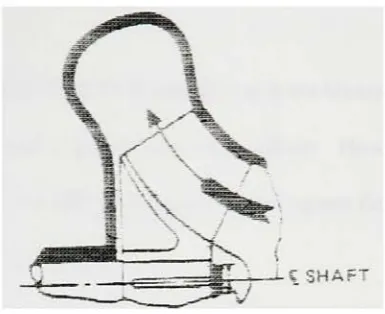
Figure
1
.1
Mixed Flow
Pump
The
turbine-bowldiffuser in
this thesis consists of eight passages which areseparated
by
eight vanes.In
order to reduce computational effort, a three-dimensionalcomputational model
in FLUENT
wasdeveloped for
one passageof eachdiffuser design.
Based
on theCFD
resultsfor Diffuser
A
andB,
different
geometries wereconstructed and modeled
in
order toimprove
thedesign.
After
consultation with themanufacturer, one ofthe modeled geometries was chosen and analyzed
in
thisthesis
as thefinal improved design. This
is
labeled
asDiffuser
C. The design
ofDiffuser C is actually
anoptimized
design
ofDiffusers A
andB.
constructedby
enlarging
theintersecting
anglebetween
suction side wall and outletin
thehub from
90to 108
This
modificationchallenges the traditional
diffuser design
practicein
theindustry
whichis
believed
that theoptimum
design
for
vane passageways to reducelosses
is
a channelthat
is
as square as [image:17.554.185.378.60.217.2]1.4 Literature Search
In
spite ofanextensive effortfor
literature
search vialibrary
andInternet,
no articlewas
found
relatedto thesubject ofmixedflow pump diffuser.
However,
theresearchrelatedto mixed
flow
pump
anddiffuser
computermodeling
andflow
analysis wasinsightful
whichis listed
asfollowing:
Zhang
andSun
(1995)
presented a methodbased
ona3-D
viscousflow
analysisfor
theperformance prediction
for
themixed-flowpump1
Favre
(1995)
introduced
afull 3-D flow modeling
methodtostudy
themixed-flowpump impeller
performance2
Zhang
andGaron
(1993)
presented a3-D
simulation ofthepassage-averagedvorticity-potential
formulation
oftheincompressible
viscousflow
field
withinamixed-flow
********
Chapter
2 Turbulent Flow
Theory
2.1
Governing
Equations
Turbulence4
is
one ofthe mostdifficult
phenomenain
the area ofphysical sciences.In
turbulentflow
situations,
thefluid
motionis
highly
random,
unsteady,
andthree-dimensional. Due
tothese complexities,
the turbulent motion and mass-transfer phenomenaassociated with
it
areextremely difficult
todescribe
and thus predict theoretically.It
is
believed
that thesolution ofthe time-dependentthree-dimensionalNavies-Stokes
equations^can
completely
describe
turbulentflows.
This
canbe done
by
describing
thefluid flow
atevery
pointin
theflow
regimefor
all timeby
taking
into
consideration the principles ofconservation of
mass,
momentum and energy.These
general equationscompletely describe
the
fluid
flow (the
equationfor energy
conservationis disregarded here due
toits
irrelevance
totheproblem).The
nature ofthe specificflow
under consideration allowsfor
some simplification.It
is
assumed that within thediffuser.
theflow
canbe
described
asturbulent,
steady,incompressible, isothermal,
andNewtonian in
nature.The
conservation ofenergy
equationis
disregarded based
upon these assumptions, and the equationsfor
conservation of massand momentumarereduced to:
(Eq.
1)
(Eq.
2)
^
=0
p
cP
c
d
[atl
{ex
where Uj
is
thefluid
velocity
withi, j
=1
,
2,
& 3 for
athree-dimensionalproblem, P
is
thepressure,
andF
representsbody
forces.
Ul
Methodology
ofAnalysis
To practically
describe
turbulent motion,it
is necessary
to use time averagedquantities rather than
instantaneous
ones.This
approachis based
upon the conservationlaws for
mass and momentum(Eq.
1
and2). Osborne Reynolds
was thefirst
to suggestusing
a statistical approach where the equations are averaged over a time scale whichis
comparatively
long
with that ofthe turbulent eventin
question.The resulting
equationsdescribe
thedistribution
ofthemeanvelocity
andpressure within thecontrolvolume^
In
this statistical approach, each ofthefield
variables(velocity,
//;& pressure,P
)
areseparated
into
mean andfluctuating
quantities which allowsfor
the use of mean values ofthe
field
variables{it.
&
P)
in modeling
thelarge
scaleflow
characteristics.For
anarbitrary field
variable(r\),
themean value canbe defined
as_
1
f'-v'rj
=}tjc/C(Eq.
3)
where the
averaging
timeAt
is
long
compared with the time scale ofthe turbulent motion.The instantaneous
variabler\
is
then givenby,
rj
= ff+rj'(Eq.
4)
where rf
is
the timeaveragedquantity
andif
reflectsthe small scalefluctuations
associatedwith turbulence.
This
decomposition
is
applied to theNavies-Stokes
equations which arethen
integrated
over the timeinterval
(t,
t +At)
resulting in
thefollowing
time averagedDue
to thenon-linearity
ofthe
Navies-Stokes
equations,
theaveraging
processintroduces
a correlationbetween
fluctuating,
velocities utu .Multiplying
this termby
p
givesthe transport ofmomentum
due
to the turbulentmotion.The
relationr
r-f
P",uj
=J
pu;u;dr(Eq.
5)
describes
the transport ofx; momentumin
thedirection
ofXj,
and acts as a stress on thefluid
(Reynolds
stress).It
summarizes the effect of small scaleeddy behavior
on thelarge
scale mean
flow.
To
solve theNavies-Stokes
equations andEq.
5
requires away
ofdetermining
the turbulence correlation.This determination is
the main roadblockin
analyzing
turbulentflows.
A
turbulence model which approximates this correlationalong
with the Navies-
Stokes
equationsforms
a closed set of equations which canbe
solvedfor
themean values of
velocity
and pressure.Generally,
the two equationk-s
turbulence modelis
employed tofacilitate
thesolution, where
k
standsfor
turbulentkinetic energy
and s standsfor dissipation
rate.In
thek-s
model,
Reynolds
stressesare relatedto themeanflow
viatheBoussinesq
hypothesis:
~> '
a,
at"
">
at
v<
J ex,
1
The
effective or"turbulent"
viscosity, jut,
is
computedfrom
avelocity
scale (k2)
and ak2
length
scale(
)
which are predicted at each pointin
theflow
via solution oftransports
l{pk)
+--(p,i,k)
=-?-l^--Gk+G>-pe(Eq.
7)
a
exi
cxi
at.exi
and
(Eq.
8)
c i , c , , c u. ce s
s2
"Tl
pe)
+pu,e)
=~'--L\pGk
-C\pa
c*,
ex,
<j
exk
k
where
Gjk
is
thegeneration ofk
andis
givenby:
(&',
ai\ai,
G,
=Mi\-~L\-(Eq.
9)
\cx:
exj
exand
Gh
is
thegenerationdue
to thebuoyancy:
Gfc=-g,
-^
(Eq.
10)
poh
ex,
P,Cr
whereoi, isthe turbulentPrandtl number,
k,
The
turbulentviscosity is
thenrelatedtok
and sby
theexpression:X-2
M,=PCU
(Eq.
11)
e
The
coefficientsC\, C2, Cib
ol,
and az are empirical constants whichhave
thefollowing
empirically derived
values.C,
=1
.44,
C2
=1
.92,
Q
=0.09,
ak=\.0,ae=\.3In
turbulentflow,
the wallboundary
layer
consists ofalaminar
sublayer and aso-called
log-law
regionin
which theflow
is
fully
turbulent.In
thelog-law
region, the
wall".
1
-4=
ln(>'")
(Eq.
12)
where
v
=Von
Karmans'constant
(0.42)
E
=log
law
constant(9.8)
u =
friction
velocity
-V
Ptip=
near wall
velocity
Note
that the assumption of equilibriumin
theboundary
layer (production
equal todissipation)
canbe
used toderive
thefollowing
expressionfor
v(dimensionless
normaldistance
from
wall):v
^^
IV 1^>' =
(Eq.
1j)
M
where:
kv
=near wallturbulent
kinetic energy
p
=fluid viscosity
A>> =
distance
to thewall
In
general, the
inlet
turbulenceintensity
and characteristiclength
are afunction
ofthe
flow
parameters upstream.The
turbulenceintensity
is defined
as the ratio ofthe
turbulent
fluctuations in
velocity
to the meanflow velocity (
'/
avg),
expressed as apercentage.
The
inlet
values ofk
and s are calculatedfrom
the specifiedinlet
turbulence0.2
Core
-Flow(TV)
1
yA
/
/
I/
Fully
Turbulent Flow
0.1
Fully
Turbulent Layer
(IH)
Buffer
Wall Layer
Layer
(D)
Viscous Sublayer
(1)
y,/R
1
A-x-~^~~^
i
Viscoa Layer777?MV//V^^ '//////////////////////////..
1
[image:24.554.92.466.208.511.2]or
k
=^(u^l)2
(Eq.
14)
The
dissipation
rateis
thengivenby:
e=CJ^-
(Eq.
15)
where
/
is
alength
scale characteristicofthe turbulencein
theinlet
flow.
The
characteristiclength
is
used to computethemixing length for
the small-scale eddies and shouldbe
set tothe
hydraulic
radius oftheinlet.
The
inlet
turbulencelength
scale,
/,
is
calculatedby:
/
=0.077?
(Eq.
16)
Note
that thefactor
of0.07
is derived from
the"average"mixing length in
turbulent pipeflow,
whereR
is
theradius ofthepipe.The
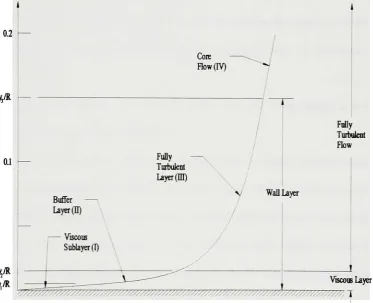
turbulentflow
regime canbe described
by
distinct
regionsbased
upon thedefinitions
and characteristicsfrom
above.The
viscous sublayeris
theregion nearestto thewall where
is less
thanor equal tofive.
The
fully
turbulent coreis
nearthe centerlineofthe
flow
where vis
greater than30.
The buffer
regionis
located between
the viscoussublayerand the
fully
turbulentregion.Figure 2. 1
showsthese regionsin
a graphicalform.
The
regions aredefined
by
thedifferent flow
characteristics that arefound
within eachregion,
whichis helpful in
discussing
thecomplexities ofturbulentflow.
2.3 Diffuser Flow
One
ofthebasic
components ofapump
is
thediffuser.
The
diffuser's purposeis
toconvertthe
inlet dynamic
pressure ofthefluid
to a static pressure rise.For
subsonicflow,
this
is
accomplishedby decelerating
thefluid
particlesby
the application of a gradualincrease
ofthecrosssectionalflow
area.It
is desirable
to recoveras much oftheentering
dynamic
pressure as possible.It
is
alsoimportant
that theexiting flow
be
steady
andhas
auniformprofile
for
thenextimpeller
stage.There
are several parameters used todescribe
adiffuser
geometry6
These
quantities are useful
in analyzing
the performance ofthediffuser.
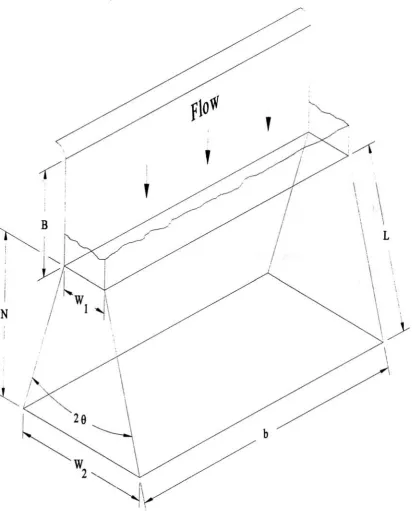
A
simpleflat diffuser is
shown
in Figure 2.2.
The geometry
ofadiffuser
is
specifiedby
the aspect ratiob/Wi,
thedivergence
angle20,
thelength-to-width
ratioL
Wi,
and the cross-sectional area ratioW2
W\.
The
pressurerecovery
coefficientCp
describes
theperformanceofadiffuser:
CP=~r
L(Eq.
17)
where
P2
is
the outlet staticpressure,
Pi
is
theinlet
staticpressure,
and v,is
the throatvelocity.
Under
ideal
conditions,
the maximum pressurerecovery
coefficientCp.ideai
is
afunction
ofthegeometry
andis
givenby
where
AR
is
the area ratio.The
ratiooftheactual pressurerecovery
coefficientto theideal
pressure
recovery
coefficientis known
asthediffuser efficiency
77.rj=
(Eq.
19)
(
P. IdealIn
thediffuser,
thedevelopment
ofthe turbulentboundary
layer has
a significantimpact
on thediffuser
performance.If
the turbulentboundary
layer
is
thick enough tocreate a
large
throatblockage,
separation will occur neartheinlet
ofthediverging
section.The
fluid
particlesdecelerate
near thewall regionundertheeffect of anincreasing
pressuregradient and reduced transverse momentum transfer.
As
thefluid
progresses through thediffuser,
in
the presence offlow
separation,
excessiveblockage
occurs,
whichin
turnreducesthe
diffuser
efficiency.2.4
Secondary
Flows
Due
to thediffuser
wall3-D
curvature,secondary
flows
canbe easily found in
amixed-flow
pump
diffuser.
The
cause ofsecondary
flows
canbe
traced to thedynamics
ofstreamwise
vorticity,
with reference to a right-hand reference system composed ofstreamwise
(s),
normal(),
andbinormal(A)
directions.
Under
thehypotheses
ofincompressible stationary
flow,
theproductionof streamwisevorticity is:
cfcoA
2co
cs\\
J
Rv
where co
is
vorticity,
vis
absolutevelocity, andR
is
radius of streamline.Eq. 20
canbe
reduced
by
use oftheBernoulli's
equation and scalar productin direction b
to:c VN
2
cv2
cPtcsVpvJ
(Eq.
21)
Rpv
ab
Rpv' cbwhere
P,
standsfor
totalpressure.The
production of streamwisevorticity
depends
thus
on the gradients ofvelocity in
binormal direction.
These
gradients ofvelocity
aretypically
associatedwiththepresence ofboundary
layers,
which are encountered on thehub
and shroud walls as well as on thesuction and pressure side walls.
It
is
possible to separatethe
effects ofshroudto
hub
andpressureto suctionsidewall curvatures:
a)
Shroud
toHub
Curvature
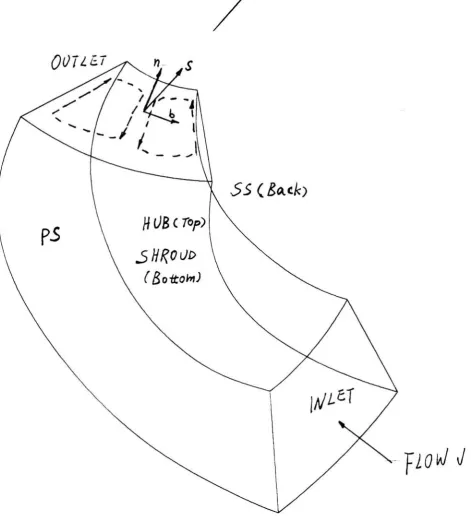
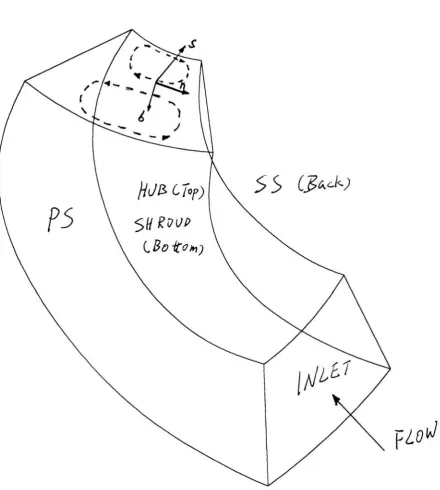
Figure 2.3
is
a schematic ofthe mixedflow
pump
diffuser,
the normal n pointsinward
in
radialdirection,
thatis
from
shroud tohub;
thebinormal b
is
in
tangentialdirection
from
pressure side(PS)
to suction side(SS).
Under
these
conditions,
{cTtld))
is
positive onPS (total
pressureis increased
at the outerPS
boundary
layer),
and negative on theSS
(total
pressureis decreased
at theinner SS
boundary
layer).
Vorticity
production(clockwise;
displacing
n towardsb)
is
positive onPS
and negative
(counterclockwise,
displacing
b
towards)
onSS.
This
means that thedirection
ofsecondary
flows
willbe from
shroud tohub both
onboth PS
andSS
wallsurface:
low-total
pressurefluid
accumulatesin
thehub
boundary
layer
and thenrecirculatesto the shroud at the center ofthe
diffuser
passage.This
pattern,
shownby
dashed
lines
in
Figure 2.3
is
responsiblefor
the rapidbuildup
ofalarge hub
boundary
layer,
whichis
thensubject to
further secondary
effects.b)
PS
toSS
For
PS
toSS
curvature(Figure
2.4),
the normal nis
directed
in
tangential
direction
from PS
toSS;
thebinormal
b
points outwardin
radialdirection,
thatis
from
hub
to shroud.Under
these conditions.{cPtlcb)
is
positive at thehub (total
pressureis
increased
at the outerhub
boundary
layer),
and negative at the shroud(total
pressureis
decreased
at theinner
shroudboundary
layer).
Vorticity
production(clockwise,
displacing
n towards
b)
is
positive at thehub
and negative(counterclockwise;
displacing
b
towards n)
atthe shroud.
This
would meanthatsecondary
flows
should circulatefrom PS
to
SS
atthe
both
hub
and shroud(dashed lines in Figure 2.4).
Flow
Oonz<
\
.sSSifath
J
10
hi
J
[image:30.554.47.519.61.578.2]Flow
[image:31.554.59.500.88.579.2]55
(3**-)
Chapter
3
FLUENT
Description
and
Implementation
3.1
FLUENT
CFD
codeintroduction
3.1.1 Code
Application
andFeatures
The
use of advanced computationalfluid
dynamics
techniquesis very helpful in
the
analysis of complex
flow
patterns encountered within a centrifugal pump's subcomponents.
In
this workFLUENT
was usedfor
such a purpose.FLUENT
is
a generalpurpose computational program
for modeling
fluid
flow,
heat
transfer,
and chemicalreactions.
FLUENT
models this wide range of phenomenaby
solving
the conservationequations
for
mass, momentum, energy, and chemical speciesusing
a control volumebased
finite-difference
method.The governing
equations arediscretized
on a curvilinear grid toenable computations
in
complex/irregular geometries.A
nonstaggered systemis
usedfor
storageof
discrete
velocities and nodal pressures.Interpolation
is
accomplishedvia afirst-order,
Power-Law
scheme oroptionally
via thehigher
orderQUICK
scheme.The
equations are solved
using
theSIMPLEC
algorithm with aniterative line-by-line
matrixsolverand multigrid acceleration or withthe
GMRES
full-field
iterative
solver7In
this thesiswork,
FLUENT
was used to analyze regions ofstagnation,
flow
separation,
andsecondary flow
patterns within the variousdiffuser
configurations.The
flow
was modeledin
threedimensions
and accountedfor
theincompressibility
and viscousnature ofthe
flow.
FLUENT
presents several optionsfor
the solution oftheReynolds
averaged Navier-
Stokes
equationsfor
turbulentflow.
This
solutionincorporates
the
two-equation
kinetic energy dissipation
turbulencek-s
model.In
thisturbulence
model,
the
turbulence
field
is
characterizedin
termsoftwo variables,
the turbulentkinetic
energy,
andthe viscous
dissipation
rate ofkinetic
energy.The
criteriafor effectively using
finite
difference
method are numerousin
orderto
ensure a solution that converges and givesrealistic results.
Among
the mostimportant
are the choices ofgriddensity
and celltypes,
inlet
andboundary
conditions,
solutiontechniques,
andtheextension ofthekinetic
energy-dissipation
modelto thenear-wall region.3.1.2 Program
Structure
FLUENT
is
atwo part programconsisting
of a preprocessor-PreBFC,
and a mainmodule
FLUENT.
PreBFC
is
used todefine
thegeometry
and a structured gridfor
themodel.
Then
thegridinformation is
transferredfrom PreBFC
toFLUENT
via aGRID File.
Following
thistransfer,
FLUENT
is
used todefine
physical models,fluid/material
properties,
andboundary
conditionsthatdescribe
theproblem.This
information is
addedtothe grid
information
and storedin
aCase File
thatis
a record ofall theinputs
for
problemdefinition.
Calculation
andpost-processing
are also performedin
FLUENT,
the results arestored
in
aData File.
3.1.3
Modeling
Technique
3. 1.
3.
J Problem
Solving
Steps
Once
theimportant features
ofthe problem aredetermined,
thebasic
proceduralsteps arethoseshown
below:
1
.Create
orimport
themodelgeometry
and grid.2.
Choose
thebasic
equations tobe
solved(i.e.
enthalpy,
species,
turbulence
transport).
3.
Identify
additional models needed(fans,
porousmedia,
specialboundary
conditions,
speciestransportor chemicalreaction,
etc.).4.
Specify
the
boundary
conditions.5.
Specify
the
fluid
properties6.
Set
up
adispersed
phase(optional).
7.
Adjust
the solution controlparameters(optional).
8.
Calculate
asolution(fluid
phaseand/ordispersed
phase).9.
Examine
theresults.10.
Save
theresults.1 1
.Consider
revisionsto the numerical or physical model.3.1.3.2
Choosing
aSuitable Grid
The
grid represents adiscrete
approximation ofthe continuousfield
phenomenathat users must model.
The accuracy
and numericalstability
oftheFLUENT
calculationsdepend
onthesegrid characteristics.In
otherwords, thedensity
anddistribution
ofthegridlines determines
theaccuracy
with which theFLUENT
model representsthe actual physicalphenomena.
In
FLUENT,
the control volumemethod,
sometimes referred toas thefinite
volumemethod,
is
used todiscretize
the transportequations.In
thediscrete
form
ofthe equations,
values of the
dependent
variables appear at control volumeboundary
locations.
These
values
have
tobe
expressedin
terms ofthe
values at thenodes ofneighboring
cellsin
orderto obtain solvable algebraic equations.
This
taskis
accomplished via aninterpolation
practice
known
as a"differencing
scheme"
The
choice ofdifferencing
scheme notonly
affectsthe
accuracy
ofthesolutionbut
thestability
ofthenumerical method.3.1.3.2.1 Grid
Spacing
nearWalls
In
turbulent
flow,
thespacing
between
the wall and the adjacent gridline
shouldbe
suchthat the grid
line lies
in
thelog-law layer
oftheturbulentboundary
layer.
This
implies
a
dimensionless distance from
thewall, y~,
greater than about25
andless
than about300-500.
3.1.3.2.2
Non-Uniform Grid
Spacing
One
way
to minimize the number ofcells whilemaintaining
a sufficientdegree
ofaccuracy in
the solutionis
to use a non-uniform grid.In
a non-uniformgrid,
the gridspacing
is
reducedin
regions wherehigh
gradientsare expected andincreased
in
regionswherethe
flow is relatively
uniform.The
rateofchange ofgridspacing
shouldbe
minimizeddue
to stability effects thatresult.
Normally
thespacing between
adjacent gridlines
should not changeby
more than20%
or30% from
onegridline
to thenext whichimplies
expansionfactors
between
0.7
and1.3.
This is
anaccuracy
consideration,primarily
impacting
theaccuracy
ofthediffusion
terms
in
thegoverning
transportequations.3. 1. 3. 2. 3 Cell Aspect Rations
The
aspect ratio ofthe computational cellsis
an additionalissue
that arisesduring
the
setup
ofthe computational grid.While
large
aspect ratiosmay
introduce
acceptabledegrees
of errorin
someproblems,
ageneral ruleofthumb mightbe
to
avoid aspect ratiosin
excess of5:1.
This
limit
canbe
exceeded without significant consequence whenthe
gradients
in
onedirection
arevery
small relative to thosein
the seconddirection.
Conversely,
excessive aspect ratios canlead
tostability
problems,
convergencedifficulties,
andthepropagationof numerical errors.
3.1.3.2.4
Grid
Skewness
When using
body-fitted
coordinates,
the gridlines may
notbe
orthogonal.While
some
degree
ofnonorthogonality is
allowable, andis
accountedfor in
the solutionprocess,
the computational grid should maintain grid
intersection
angles close to90
degrees
wheneverpossible.
3.1.3.2.5
Weighting
Factors for Grid Redistribution
Weighting
factors
canbe
used to control the griddensity
at each endpoint of asegment.
A weighting factor
greaterthan1.0
implies
thatthegriddensity
willbe
increased,
thusa
finer
(denser)
grid attheendpoint caneasily be
achieved3.1.3.3
Solver Selection
The default
k-s
modelis
a semi-empirical model thathas been
proven to provideengineering accuracy in
a widevariety
ofturbulentflows
including
flows
with planar shearlayers
such asjet-flows,
duct
flows,
etc.This
model wasfound
suitablefor
the conditionspresent
in
this project.3.2
Diffuser
Modeling
Process:
Since
theflow
patternin
eachdiffuser
channelis
identical,
only
one channel wasmodeled
in
each ofthe threediffuser designs.
3.2.1
Geometry
Creation:
The geometry data for Diffuser
A,
R
andC
is
givenin Table 3.1.
This
tableprovidestheaxial
(Z)
, radial(R),
and chord angle(
9)
coordinatesfor
the pointsalong
thetwo
sides ofone oftheeightblades
in
thediffuser:
The inner
sideis
theintersection
ofSS
and the
hub
side,
andthe outer sideis
theintersection
ofSS
and the shroud side.Chordal
thickness
(
Th)
ofinner
&
outer side represents thediffuser PS
andSS
wall thickness.All
the
data
was suppliedin English
units,
thusgeometries were constructedin English
unitsin
Cadkey
andPreBFC
and convertedinto SI
unitsin FLUENT.
Figure 3.1
shows thediagram
ofthediffuser location
inside
a mixedflow
pump.To
reducethecomputationaland analysis effort,it
was criticaltofind
andlocate
theinlet
and outlet planenormal to thediffuser
channel.This
became
one ofthe mostdifficult
challenges
due
to the diffuser's complex geometry.Finding
these planes exceeded thecapability
ofthePreBFC
package,
which constructsgeometry only based
on coordinates.Cadkey
3-D
software wasintroduced into
theproject tofind
the normal planes.The
rawgeometries were
built
up
based
ongeometry
data,
and then the normalinlet
and outletplanes were
located using
therecently introduced
surface package offeredin
Cadkey
version
7
The
excess portion ofthegeometry
was removedfrom
the modelalong
thenormal
inlet
and outletplanes.The resulting diffuser
channel point coordinates wereinput
into
thePreBFC
to generatetheCFD
models.Diffuser
A:
This
wasthe originaldesign.
As
shownin
Figure
3.5,
from
outlet toinlet:
thetwisting
angle ofthePS
andSS
walls on thehub
side rangedfrom
0
to62.36
degrees,
onthe shroud sideincreased from 3.35
to77
degrees;
thehub
radius variedfrom
1
.912in
to4.875
in,
while theshroud radius variedfrom 4.909
in
to
7.026 in
Table 3.1
Model
Geometry
Comparison
Diffuser A
InnerSide Blade OuterSide Blade
# Axial Radial Chord Angle Chord Thickness Axial Radial Chord Angle Chord Thickness
(to)
(to)
(degree)
(to)
(to)
(to)
(degree)
(to)
1 12.507 1.912 0 0.125 14.035 4.909 3.35 0.218
2 11.864 2.451 1 0.138 12.879 5.475 4.35 0.295
3 10.866 3.288 10 0.182 11.867 6.055 10 0.39
4 10.2 3.847 20 0.223 10.806 6.539 20 0.47
5 9.526 4.359 30 0.254 9.787 6.858 30 0.479
6 8.786 4.699 40 0.238 8.725 7.056 40 0.491
7 8.042 4.857 50 0.227 7.672 7.125 50 0.477
8 7.21 4.875 62.36 0.22 6.347 7.125 62.36 0.432
9 5.059 7.026 77 0.333
Diffuser B
Inner Side Blade Outer Side Blade
# Axial Radial Chord Angle Chord Thickness Axial Radial Chord Angle Chord Thickness
1
(to)
12.507(to)
1.9118(degree)
0(to)
0.125(in)
14.035(in)
4.909(degree)
0(to)
0.18752 11.647 2.6335 1 0.245 12.5411 5.6706 1 0.5
3 10.9983 3.1779 5 0.255 1 1.2989 6.3345 5 0.55
4 10.4526 3.6358 10 0.2416 10.5518 6.6308 10 0.543
5 9.6504 4.2799 20 0.2395 9.4302 6.9391 20 0.458
6 8.8753 4.6682 30 0.244 8.353 7.0943 30 0.3632
7 8.1631 4.842 40 0.2472 7.3604 7.125 40 0.3908
8 7.5531 4.875 50 0.2502 6.455 7.125 50 0.4121
9 7.1773 4.875 57.1889 0.2534 5.8621 7.1124 57.1889 0.433
10 5.059 7.0264 67.9884 0.3807
Diffuser
C
Inner Side Blade Outer Side Blade
# Axial Radial Chord Angle ChordThickness Axial Radial Chord Angle ChordThickness
(to)
(to)
(degree)
(to)
(to)
(to)
(degree)
(to)
1 12.507 1.9118 -9.2436 0.125 14.035 4.909 0 0.1875
2 11.9707 2.3619 -5 0.1367 12.5411 5.6706 1 0.5
3 11.3719 2.8644 0 0.1525 11.2989 6.3345 5 0.55
4 10.8591 3.2947 5 0.1853 10.5518 6.6308 10 0.543
5 10.4273 3.657 10 0.2219 9.4302 6.9391 20 0.458
6 9.6503 4.28 20 0.2395 8.353 7.0943 30 0.3632
7 8.8753 4.6682 30 0.244 7.3604 7.125 40 0.3908
8 8.1631 4.842 40 0.2472 6.455 7.125 50 0.4121
9 7.5531 4.875 50 0.2503 5.8621 7.1124 57.1889 0.433
iJBSll^s
Ei
s s
j 5
=
3
1
18
C o
'a
u
o
h4 Ui u
Q
CmO
u (75
Diffuser
B.
This
was animproved
design
developed
purely
by
experience,
noCFD
analysiswas
done
onDiffuser B
prior to this thesis work.As
shownin Figure
3.5,
from
outletto
inlet:
thetwisting
angleofthePS
andSS
wallsonthehub
siderangedfrom 0
to57.
19
degrees,
onthe shroud sideincreased from
0
to67.98
degrees;
thehub
radiusvariedfrom 1
.912 in
to4.875
in,
whilethe shroud radiusvariedfrom 4.909 in
to7.026
in.
Diffuser
C:
Diffuser C
is
an optimizeddesign combining
aspects ofDiffuser A
andB.
As
shownin
Figure
3.6,
Diffuser
C has
anenlarged,
108vs.
90,
intersecting
anglebetween
SS
and outletin
thehub.
As
shownin Figure
3.5,
from
outlet toinlet:
thetwisting
angle ofthe
PS
andSS
walls onthehub
sidewasincreased from
-9.24 to57.
19
degrees,
onthe shroud side ranged
from
0
to67.98
degrees;
thehub
radius variedfrom 1.912 in
to4.875
in,
andtheshroud radiusvariedfrom 4.909 in
to7.026
in.
3.2.2 Grid Generation:
The
griddensity
is
the mostimportant
criteriafor providing
a realistic andconverging
solution.In
order to obtain the optimal griddensity,
many
parameters oftheregion
had
tobe
takeninto
consideration.This
was accomplished through trial-and-error.A
Body-Fitted
Coordinate Based
grid withacurve segmentation size ofI
=20. J
=20
andK
=100
(total 44541
cells)
was chosenfor
themodel.As
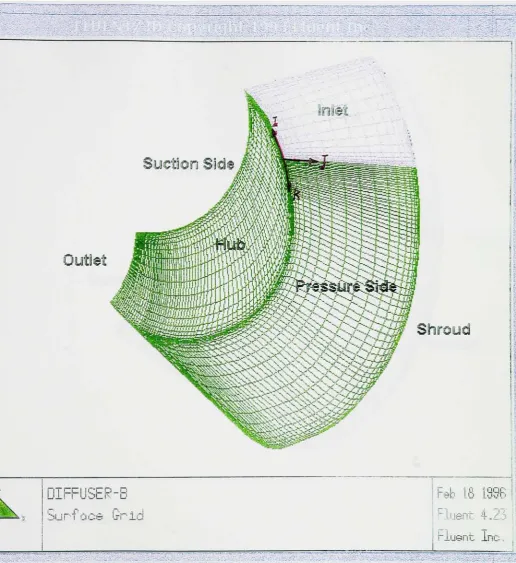
shownin Figure
3.2,
I
is
takenalong
the pitchwise(PS
toSS) direction,
J
is
takenalong
spanwise(hub
toshroud)
direction,
andK
is
takenalong
streamwise(inlet
tooutlet)
direction.
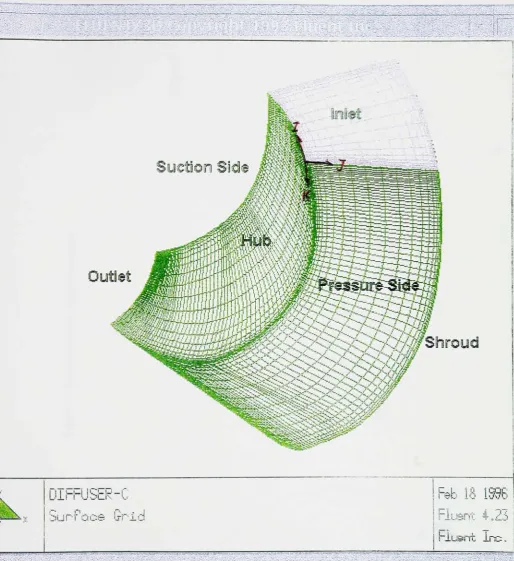
(The
grid selectionis
the same
for Diffuser B
andDiffuser
C
as shownin Figure 3.3
andFigure
3.4.)
The 20
x20
x100
grid provided adequate resolution and the value of wasapproximately
40
atgrid points adjacent to the
PS
andSS
walls.The
value ofy
wasapproximately
45
at gridpoints adjacent to
the
shroud andhub
surfaceswhich ensuredthe
gridline
tolie in
thelog-law layer
ofthe turbulent
boundary
layer
asdiscussed in
paragraph3.1.3 2
1
-Grid
Spacing
near
Walls. The
major stepsinvolved
in generating
thegridare asfollows:
1
.Specify
the nodedistribution along
theboundaries
(map
theboundaries).
2.
Adjust
themapped nodesalong
theboundaries.
3
.Create
thegridinside
thedomain
viainterpolation.
4.
Smooth
theinterpolated
grid.5.
Display
andverify
thegrid.It
wasdetermined
that the grid needed tobe finer
in
regions where properties ofinterest
werechanging
rapidly.It
was alsoimportant
to notethat care mustbe
exercisedin
the
design
ofthecomputational meshtoensure asmooth spatialdistribution
of nodal pointsthroughout the entire
flow domain.
If
the transitionin
griddensity
was abrupt,especially
along
thedirection
offlow,
spurious spatial oscillationin
theflow
variablesmay be
observed
causing
adivergent
numerical solution.Since
themajority
oflosses,
flow
separationandvortices occur nearthewalls,
dense
cell
layers
shouldbe
set close to walls to catch those phenomena.In
other words, toeffectively
capture viscouseffects,grids areclustered near wall surfaces.This
canbe done
by
redistributing
nodesaccording
to specifiedweighting
factors.
Dividing
thedistance between
nodesin
theneighborhood ofthe selected adjustment pointsby
theweighting
factor
will redistributethe nodesaccording
to a smoothhyperbolic
tangent
function.
The
following
gridweighting
factors
arefound
suitablefor
thediffuser
model:Outlet
i
j;
iff
^.
DIFFUSER-jiun oce
brid
I
Feb
18
1356
j
Fluent
423
i
hlusnt
Inc
.Outlet
Suction Side
M
I
1
I
I
urr
5ER-B
SijrT
OC
Irf
'IdFeb 16 139
F
Luent
4.2/
Fluent
lnc
:
[image:43.554.24.541.69.633.2]j
t
-I
!
I
II >_!_
JSE
P4-. Ifl JQQCburr
qc Hi!liT-FluBnt
ire:.
[image:44.554.22.537.71.633.2]i '".;
..._._.._,____,. ,
o
c
a
a
o
g>
IP
<
o _a
too a a
c/3
CO
CQ
<
c
o
3
3
C O on in
$s
3
o
e <u <uPQ jy
00
c
<
c '-4'o
0)
Q
CO <D ' 3
Hub(Jl)
PS
(II)
Shroud(J20)
SS(I20)
Inlet:
10-10
10-10
10-10
10-10
Outlet: 10-10
10-10
10-10
10-10
A
gridweighting factor
of3
-3
was also applied
along
the channelfrom inlet
tooutlet to account
for any
flow
pattern changein
theinlet
and outlet region.Six-point
interpolation
method was usedfor
grid generation.A
grid verificationis
performed afterthe grid
generation,
whichincludes
celltype check,
cell volumecheck,
relative cell sizecheck and skewness check.
The
models passed all the standard check requirements whichare the program
defaults:
20
to1
ratio of maximum volume ratiobetween
adjacentcells,
and
60
degrees
maximumdeviation from
orthogonal.%%.%.%.%5 %;%
This
areaintentionally
left
blank.
********3.2.3
Case File Generation
(Boundary Conditions
andAssumptions):
In
this phase ofthe modeling,
constraints and variables such as geometric unitconversion,
fluid
properties,
andboundary
conditionswereappliedto
the model.For
thisproblemthe
SI
system wasthe unitbase
chosenfor
analysis.Water
was used asthefluid
medium with
density
=1000
kg/m\
and absoluteviscosity
=9.8
x 10""1
kg.s/m
at20
C.
The
modulechosenin
FLUENT only
required theinlet
boundary
conditiontofully
define
themodel.
The
noslip
condition onthewallsurfaceswasalsoinput
into
theprogram.In
order to predictflow
patternsfor
theinlet
boundary
conditions at thedesign
flow
rate,
normal velocities toward theinlet
plane are adopted since theincidence
angleeffects were unknown.
The
normalvelocity
was calculatedbased
on4500
gpmflow
rate:rr
Q
4500?/w7x 3.7854
x10''m3
1
gallon ..,., ,. ,V
= =^ ; =?
16.8 \m
I
min=8.6 \m
I
sec "A
8x412x1(T3ot-For
each channeltheinlet
surfaceareawas4.
12x10""' m2
pvD 1
000A-? /
m:"
8.6 \mIs 0.064;/;
Re=
-= : =56229
H 9.8x10
^kg.s/m
Given
thishigh Reynolds
number,
it is
clear that turbulentflow
is
present withinthe
diffuser.
The
k-s
turbulentflow
model wasused,
which requiresinlet
turbulenceintensity
and characteristiclength input.
A
turbulenceintensity
of10%
(based
on thedesign flow
of4000
to5000 gpm),
characteristiclength
of0.032
m were used asinlet
condition.
Due
to the adiabatic nature ofthediffuser,
isothermal
flow
conditions were3.2.4
Computine
The Results:
For
eachmodel,
approximately
1000
iterations
were performed to reach theFLUENT
default
convergence criteria.The
programmed criteria proved adequatefor
thisstudy
anddid
not require alteration.Data
files
were createdduring
the program analysiswhich contained the solution
for
the
CFD
problem.Results
were presentedin both
graphical
(velocity
vectorplot,
pressuredistribution
contourplot)
and numericalformat.
********
This
areaintentionanv
ieft blank.
********Chapter
4
Results &
Discussion
4.1 General CFD Results
4.1.1
Alphanumeric
Illustration
The
goal of adiffuser is
to converttheinlet
dynamic
pressure ofthefluid
to a staticpressure rise.
It
is desirable
to recoveras much oftheentering dynamic
pressure aspossible.It
is
alsoimportant
that theexiting flow be steady
andhas
a uniform profilefor
the nextimpeller
stage.Table 4.
1
lists
thegeneral resultsfrom
theFLUENT
programfor Diffusers
A,
B
andC
Table
4.
1
-Summary
ofResults
AR
Static
Pressure
Recovery
AP
(Pa)
cP
Cp,
idealDiffuser
Efficiency
Diffuser A
1.3037745
0.209
0.41
50.90%
Diffuser B
1.406 134150.303
0.49 61.33%Diffuser C 1.426 14202
0.330
0.51
65.03%
Compared
withDiffuser
A,
Diffuser B
has approximately
an8%
area ratioincrease,
the static pressure
recovery
coefficient,
CP,
whichis
the measure of thediffuser
performance,
has improved
from 0.209
to0.303;
diffuser efficiency n,
increases from
50.9%
to
61.33%.
Compared
withDiffuser
B,
Diffuser
C
has roughly
a1.5%
area ratioincrease;
CP
increases
from
0.303
to0.33;
theefficiency r\
increases from
61.33%
to65.03%.
The
improvements
shownhere
arevery
significantfor
thepump
industry,
whichstrivesfor
every
percentage
improvement
in diffuser
performance.In
ordertovalidatethereliability
of theCFD
results,
acorrelation was performedto test
data
as statedbelow.
Both
Diffuser A
andB
weretestedin
a mixedflow pump
atdesign flow
rate.Table 4.2 Test Data for Diffuser A & B
Pump
withDiffuser
A
Pump
withDiffuser B
Test RPM
1770
1770
GPM
4500
4500
Static
Pressure
Recovery
(kPa)
405
411
Pump Efficiency
79.2%
81.1%
Jl
The
testdata
cannotbe
used to makedirect
comparison with theCFD
results ofeach
diffuser
since the tests weredone
by
using
apump
whichhas
other components suchas motor and
impeller besides diffuser.
However,
relative comparison can stillbe
madeby
following:
the testdata (Table
4.2)
indicated
that at thedesign
flow
condition, the staticpressure
recovery improvement from Diffuser A
toDiffuser
B
is
approximately 6000 Pa
(411kPa
405kPa).
From
CFD
results(Table
4.1):
the static pressurerecovery
improvement from Diffuser A
toDiffuser B
is
5670 Pa.
Table
4.3
Comparison
ofCFD Results & Test Data
CFD
Test
Static
Pressure