von Cube, C. and Kruse, D. and Zimmermann, C. and Courteille, Ph. W. and Robb, G.R.M.*
and Piovella, N. and Bonifacio, R. (2004) Self-synchronization and dissipation-induced threshold
in collective atomic recoil lasing. Physical Review Letters, 93 (8). pp. 083601-1. ISSN 0031-9007
http://eprints.cdlr.strath.ac.uk/2978/
This is an author-produced version of a paper published in
Physical Review Letters, 93 (8).
pp. 083601-1. ISSN 0031-9007
. This version has been peer-reviewed, but
does not include the final publisher proof corrections, published layout, or pagination.
Strathprints is designed to allow users to access the research output of the University
of Strathclyde. Copyright © and Moral Rights for the papers on this site are retained
by the individual authors and/or other copyright owners. You may not engage in
further distribution of the material for any profitmaking activities or any commercial
gain. You may freely distribute both the url (
http://eprints.cdlr.strath.ac.uk
) and the
content of this paper for research or study, educational, or not-for-profit purposes
without prior permission or charge. You may freely distribute the url
(
http://eprints.cdlr.strath.ac.uk
) of the Strathprints website.
arXiv:quant-ph/0402013 v1 2 Feb 2004
Selfsynchronization and dissipation-induced threshold in collective atomic recoil lasing
C. von Cube, S. Slama, D. Kruse, C. Zimmermann, and Ph.W. Courteille
Physikalisches Institut, Eberhard-Karls-Universit¨at T¨ubingen, Auf der Morgenstelle 14, D-72076 T¨ubingen, Germany
G.R.M. Robba, N. Piovellab, and R. Bonifaciob
a
Department of Physics, University of Strathclyde, Glasgow, G4 0NG, Scotland.
bDipartimento di Fisica, Universit`a Degli Studi di Milano and INFM,Via Celoria 16, I-20133 Milano, Italy.
(Dated: June 28, 2006)
Networks of globally coupled oscillators exhibit phase transitions from incoherent to coherent states. Atoms interacting with the counterpropagating modes of a unidirectionally pumped high-finesse ring cavity form such a globally coupled network. The coupling mechanism is provided by collective atomic recoil lasing (CARL), i.e. cooperative Bragg scattering of laser light at an atomic density grating, which is self-induced by the laser light. Under the rule of an additional friction force, the atomic ensemble is expected to undergo a phase transition to a state of synchronized atomic motion. We present the experimental investigation of this phase transition by studying the threshold behavior of the CARL process.
PACS numbers: 42.50.Vk, 05.45.Xt, 05.65+b, 05.70.Fh
Lasing mediated by collective atomic recoil (CARL) has been predicted as the analogue to free-electron las-ing [1] and observed recently [2]. In the experiment an ensemble of cold atoms couples to the two counterprop-agating modes of a unidirectionally pumped high-finesse ring-cavity and collectively scatters photons between the modes. A collective instability leads to self-amplification and to exponential gain for a light mode on one hand and atomic bunching on the other. In the absence of en-ergy dissipation for the kinetic degrees of freedom, the gain must remain transient. The introduction of a fric-tion force for the kinetic energy of the atoms permits however a steady-state operation of the CARL at a self-determined frequency (viscous CARL) [3].
The CARL represents a system of coupled oscillators. Collective dynamics in networks of weakly coupled sys-tems is a very general phenomenon. The richness of this paradigm is illustrated by the large amount of examples, ranging from physical systems, like arrays of Josephson junctions or phase-locked lasers, to biological systems like cardiac pacemaker cells or chorusing crickets [4]. Ku-ramoto, Strogatz and others [5, 6] have shown that en-sembles of coupled oscillators operating at different fre-quencies or being subject to stochastic noise synchro-nize, if their number and their mutual coupling strength exceeds a critical value. I.e. cooperative action starts beyond a threshold value of the coupling strength after crossing a thermodynamical phase transition.
In the present paper, we investigate the threshold be-havior of the CARL as an example of a phase transi-tion of the Kuramoto type [5, 6]: If, for viscous CARL, the dissipation (or cooling) mechanism is limited to finite temperatures by some diffusion process, a phase transi-tion occurs in the atomic density distributransi-tion when the system is pumped at threshold. Consequently, a
min-imum pump power is necessary to start CARL lasing, just like in ordinary lasers. However, in extension to the original Kuramoto model, the collective frequency is self-determined. We report on the observation of such a threshold and characterize it in terms of the theoretical model presented in Ref. [7].
The optical layout of our experiment has been out-lined in Ref. [2]. A titanium-sapphire laser is tightly phase-locked to one of the two counterpropagating modes of a ring cavity by means of a Pound-Drever-Hall type servo control. The amplitude decay rate of the ring cav-ity is κ = (2π)22 kHz. In the following, we label the modes by their complex field amplitudes scaled to the field per photonα±. The intracavity light power is then
P± = ~ωδ|α±|2, where δ = 3.5 GHz denotes the free spectral range of the cavity. The phase dynamics of the two counterpropagating cavity modes is monitored via the beat signal between the two outcoupled beams: Any displacement of the standing wave inside the ring cavity is translated into an amplitude variation of the observed interference signal,Pbeat=~ωδ|α++α−|2.
The contrast of the standing wave Pbeat is weak as
compared to the pump power (a few %). Assuming α+
real and|α−| ≪α+, the probe beam power can be related
to the contrast of the beat signal ∆Pcont= 4~ωδα+|α−|,
P−= ∆P2
cont
16P+
. (1)
In our experiment, we load 85
Rb atoms from a stan-dard magneto-optical trap (MOT) into the optical dipole potential, which is generated by a TEM00 mode of the
unidirectionally pumped ring cavity and tuned to the red of theD1line. Typically 2×10⁶atoms are trapped and
2
cloud reaches a peak density of about 2×109cm−3 and
a temperature of a few 100µK. Absorption images of the atomic density distribution taken after a time-of-flight and spectra of the velocity distribution obtained by excit-ing recoil-induced resonances (RIR) [8] yield information on the kinetic degrees of freedom of our system, which is complementary to that on the field amplitudesα±.
A genuine problem of the CARL is the following: In the absence of damping for the external degrees of freedom the CARL process continuously accelerates the atomic center-of-mass [2, 9]. Even though the acceler-ation decreases because the Doppler-shifted CARL fre-quency eventually drops out of the cavity resonance, it never reaches a stationary value. In fact, being focussed on studies of transient phenomena, the original CARL model [1] does not consider relaxation of the translational degrees of freedom. On the other hand, standard meth-ods of optically cooling atoms are based on controlled dissipation, e.g. optical molasses. Close to resonance the motion of atoms in an optical molasses is well de-scribed by a friction force. In our experiment, we har-ness this dissipation mechanism and subject the dipole-trapped atomic cloud to an optical molasses. We use the laser beams of the MOT and tune them 50 MHz below the cooling transition (D2, F = 3 → F′ = 4). In this
situation, the beat frequency oscillations quickly reach a stable equilibrium frequency between ∆ω/2π= 100 kHz and 170 kHz, which corresponds to an atomic velocity of 7 to 13 cm/s.
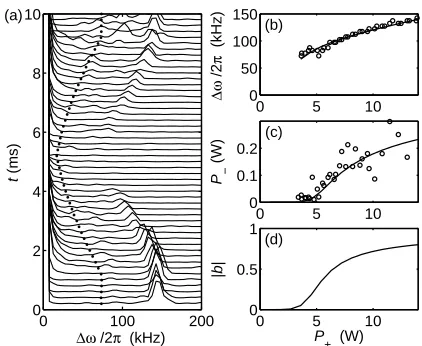
In order to observe a threshold behavior in experi-ment, we adiabatically ramp up and down the inten-sity of the pump laser. The CARL radiation is mon-itored by recording the time evolution of the beat fre-quency of the counterpropagating modes. The curves shown in Fig. 1(a) represent frequency spectra obtained by Fourier transforming the beat signal restricted to suc-cessive time-intervals. The peaks’ locations then denote the instantaneous frequency shift of the probe beam, and their heights reflect the standing wave’s contrast. The pronounced dependence of the CARL frequency on the pump intensity revealed by the series of Fourier spectra is emphasized in Fig. 1(b). The intensity of the CARL radiation shown in Fig. 1(c) decreases with the pump in-tensity, but more important is the fact that the curve exhibits a minimum pump intensity required to initiate CARL lasing. Just like in common lasers, only if the en-ergy fed to the system exceeds the losses, the laser emits coherent radiation.
The experimental observations may be discussed in various ways. The model of Ref. [2] to describe the impact of optical molasses on CARL consisted of sim-ply adding a friction force, proportional to a coefficient
γf r, to the equations governing the atomic dynamics.
This procedure certainly represents a coarse simplifica-tion. For example it predicts that the atoms quickly bunch under the influence of the molasses, and are cooled
0 100 200
0 2 4 6 8 10
∆ω /2π (kHz)
t (ms)
(a)
0 5 10
0 50 100 150
∆ω
/2
π
(kHz)
(b)
0 5 10
0 0.1 0.2
P−
(W)
(c)
0 5 10
0 0.5 1
P
+ (W)
|b
|
[image:3.612.333.544.52.225.2](d)
FIG. 1: (a) Sectionwise Fourier-transform of the interfer-ence signal Pbeat with the pump laser power being ramped
up and down. The dotted line is proportional to the pump laser power. (b)Dependence of the CARL frequency on the intracavity pump power. (c) Dependence of the probe field intensity on the pump power. The CARL laser threshold is aroundP+ = 4 W intracavity power. The fitted curves are based on a Fokker-Planck theory outlined in [7]. (d) Cal-culated bunching parameter. The parameters areγf r = 4κ,
N= 106
, ∆a=−(2π)1.7 THz, andT= 200µK.
until the temperature of the cloud is T = 0, and it de-nies the presence of any threshold. In reality, the mo-lasses temperature is limited by diffusion in momentum space, i.e. heating. To account for this heating, one may supplement the dynamic equations for the trajectories of individual atoms (Ref. [2], Eq. (1)) with a stochastically fluctuating Langevin force ξn(t) with hξn(t)i = 0 and
hξn(t)ξm(τ)i= 2γf r2 Dδmnδ(t−τ), where the diffusion
co-efficientD =σ2
/γf r is proportional to the atoms’
equi-librium temperature, which is related to the Maxwell-Gaussian velocity spread byσ≡2kpkBT /m:
¨
θn = 4εiU0α+ α−e−iθn−α∗
−eiθ
n
−γf rθ˙n+ξn . (2)
Here we defined θn ≡ 2kxn as the position of the nth
atom along the optical axis normalized to the optical wavelength and assumed the pump laser stabilized on resonance with the cavity, α+ is set real and constant.
N is the total atom number, and ε ≡ ~k2/m is twice
the recoil frequency shift. The coupling strengthU0 (or
single-photon light shift) is related to the one-photon Rabi-frequency g and to the laser detuning from reso-nance by U0 ≡ g2/∆a. The functional dependence of
the quantity α− on the order (or bunching) parameter
b≡ |b|eiψ≡N−1P
meiθ
m is determined by the
differen-tial equation
˙
α−=−κα−−iN U0α+ b . (3)
in momentum space induced by optical molasses is a Fokker-Planck approach. Here the thermalization of the atomicdensitydistributionP towards an equilibrium be-tween cooling and heating is described by the interplay of friction and diffusion [7]. In the limit of strong vis-cous damping, where we may adiabatically eliminate the atomic momenta by setting ¨θn = 0, the Fokker-Planck
equation associated to the Langevin equation (2) reads:
∂P ∂t =
4iεU0α+
γth
∂ α∗
−e
2iθ−α
−e−2iθP
∂θ +D
∂2P
∂θ2 , (4)
and the bunching parameter is given byb=R∞
0 P e
iθdθ.
The solid lines fitted to the data in Fig. 1 are calculated by numerical integration of this Fokker-Planck equation. Fig. 1(d) shows the calculated evolution of thebunching. Apparently, the bunching vanishes below the CARL las-ing threshold and tends towards 1 as the pump power is increased. The threshold behavior of the radiation mode is thus intrinsically connected to atomic self-organization. As has already been realized by Kuramoto, the Fokker-Planck equation predicts the occurrence of a thermody-namical phase transition. An alternative approach devel-oped by Bonifacio and Verkerk [10] studies the evolution of the atomicphase-space distribution described by the Vlasov equation towards equilibrium with a single rate
γf r, and Javaloyes et al. [11] found that the Vlasov
ap-proach leads to a phase transition.
Ref. [7] pointed out that the threshold should depend on various parameters like the atom number, the cou-pling strength, the friction coefficient and also on the atomic temperature. However a proper scaling [7] shows that the threshold is ruled by only two independent quan-tities. Analytic expressions for the threshold conditions are obtained from a linear stability analysis of the Fokker-Planck equations. As shown in Ref. [7], by introducing the CARL parameter ρ ≡ (N U2
0α
2
+/2ε
2
)1/3
, the condi-tion for lasing is given by
κσ2
γf r
σ2
+κγf r
2
≤(2ερ)6 . (5)
In the good cavity limitκγf r≤σ2, we may neglect the
second term in the bracket. At threshold, where the equality in the above equation holds, the CARL param-eter becomes ρthr = (κ/γf r)
1/6
(σ/2ε). Therefore the threshold pump powerPthr =~ωδα2+,thr follows with
α2
+,thr=
κ γf r
1/2
σ3
4εN U2 0
. (6)
The threshold power and the threshold CARL frequency are related by [7], ∆ω3
thr = (2ερthr)
3
κ/γf r. As a
conse-quence, the CARL frequency is independent of the atom-field coupling,
∆ωthr =σ
κ
γf r
1/2
. (7)
0 1 2 3
0 5 10
∆a (THz) P +,thr
(
µ
W)
(a)
0 0.5 1
0 5 10
N (106) P +,thr
(
µ
W)
(b)
0 1 2 3
0 50 100 150
∆a (THz)
∆ω
/2
π
(kHz)
(c)
0 100 200 300 0
5 10
T (µK) P +,thr
(
µ
W)
(d)
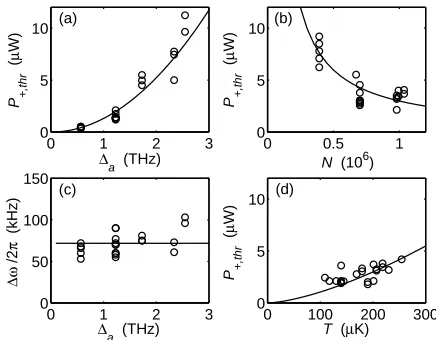
FIG. 2: Pump power threshold measured for various laser detunings(a)and atom numbers(b)determined from curves like those shown in Fig. 1. (c)CARL frequency shifts as a function of the laser detuning. (d) Pump power threshold plotted as a function of the temperature derived from the threshold CARL frequency according to Eq. (7).
Figs. 2(a) and (b) show measurements of the threshold pump power as a function of the laser detuning and the total atom number. Both experimental curves have been obtained from the same data set P+,thr(N,∆a) scaled
either to an arbitrarily chosen reference atom number
N = 106 (curve (a)) or to a reference laser detuning
∆a = −(2π)1.5 THz (curve (b)) using the relationship
(6). The fitted curves are obtained from the same equa-tion (6) by adjusting the temperature to T = 200 µK and the friction coefficient toγf r≈4κ. Fig. 2(c)
demon-strates that the CARL frequencies measured at thresh-old do apparently not depend on the coupling strength. The horizontal line indicates the frequency correspond-ing to the temperatureT = 200µK according to Eq. (7). On the other hand, theory predicts a dependence of the threshold power on the atomic temperature: Hot-ter atomic clouds have a broader velocity distributionσ
and exhibit a higher threshold power. Even though the temperature data shown in Fig. 2(d) seem to confirm this trend, they are too uncertain to be used to improve the fits of Figs. 2(a) and (b).
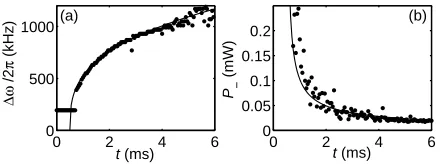
[image:4.612.328.546.54.224.2]dimin-4
ishes while its frequency detuning from the cavity res-onance increases. The acceleration indicates the occur-rence of bunching induced by the optical molasses. The self-organization of the atomic density distribution out of a homogeneous cloud into a spatially ordered arrange-ment spontaneously breaks translational symmetry and represents the strongest signature of CARL action [1].
0 2 4 6
0 500 1000
t (ms)
∆ω
/2
π
(kHz)
(a)
0 2 4 6
0 0.05 0.1 0.15 0.2
t (ms)
P −
(mW)
[image:5.612.66.286.149.231.2](b)
FIG. 3: (a)Evolution of the CARL frequency after molasses has been switched off at timet= 0.5 ms. (b) CARL power calculated via Eq. (1). The fits are based on the theoretical formulae Eqs. (2) and (3) of Ref. [2].
The probe field α− depends on the location of all atoms in a collective way. Consequently, Eq. (2) de-scribes a mean-field type dependence of the location of every single atom on all the others. This fact gets par-ticularly transparent in the limit of strong viscous damp-ing, ¨θn = 0, if we furthermore assume that at steady
state the optical standing wave propagates with a con-stant amplitude at a concon-stant velocity. This condition is formulated by ˙α− =iωcaα−, where the probe beam fre-quency shiftωca=ωca(b) depends on the atomic
bunch-ing. With these approximations we substitute the solu-tion of Eq. (3) into Eq. (2) and obtain, defining the cou-pling constant K ≡8εN U2
0α
2
+ωca/ γf r(ω2ca+κ2)
and restricting ourselves to the good cavity limitκ≪ωca.
˙
θn =
ξn
γf r
+K|b|sin (ψ−θn) . (8)
The equation (8) describes the dynamics of N coupled oscillators with fictitious frequencies ωn =ξn/γf r. This
system, which has been investigated by Kuramoto [6], predicts the synchronization of those oscillators over time, whose frequencies satisfy ωn ≤ K|b|. The
anal-ogy between our viscous CARL and an ensemble of self-synchronizing harmonic oscillators resides in the follow-ing correspondences: The phases of the oscillators are represented by the positions of atoms. Synchronization of the oscillators corresponds to bunching of the atoms. The role of friction is to provide a steady atomic center-of-mass velocity to which the individual atomic velocities may lock. In the case of CARL and unlike for the Ku-ramoto model the collective oscillation frequency is self-determined. Diffusion is the source of disorder, which rules the phase transition by competing with the dynam-ical coupling, in contrast to the Kuramoto model, where disorder occurs via distributed natural frequencies.
To conclude we point out, that the viscous CARL sys-tem is representative for a vast class of syssys-tems. Under
the rule of optical molasses the coupled field-atom sys-tem constitutes an ideal model syssys-tem for an ensemble of weakly coupled oscillators. Despite the fact that the details of the molasses dynamics are complicated, its im-pact on our CARL system is fairly well described by two constants, the friction and the diffusion coefficient. Al-though the system is purely classical, we deal with micro-scopic particles. This bears the possibility of transferring the system to the quantum regime, and thus to study the coupling of large ensembles of quantum oscillators. Furthermore, classical networks of dynamical systems in general depend much on the details of how the coupling is realized. In contrast, the coupling in our system is gener-ated by the fundamental interaction between atoms and light, which is very well understood and even controllable by experiment, e.g. via the tunable friction force or the laser detuning. Because it is mediated by a delocalized object, i.e. a standing light wave, the coupling is instan-taneous (no retardation effects) and truly uniform (every atom couples with the same strength to all its neighbors). The large number of oscillators ensures that the system is in the thermodynamic limit.
We are grateful for valuable discussions with J. Javal-oyes who brought the Kuramoto model to our atten-tion. We acknowledge financial support from the Lan-desstiftung Baden-W¨urttemberg. GRMR, NP and RB acknowledge support from the Royal Society.
[1] R. Bonifacio and L. DeSalvo, Nucl. Instrum. Methods 341, 360 (1994); R. Bonifacio, L. DeSalvo, L. M. Nar-ducci, and E. J. D’Angelo, Phys. Rev. A50,1716 (1994). [2] D. Kruse, C. von Cube, C. Zimmermann, and Ph. W.
Courteille, Phys. Rev. Lett.91,183601 (2003).
[3] Optical bistability has been observed in a high-finesse ring cavity [B. Nagorny, Th. Els¨asser, and A. Hem-merich, Phys. Rev. Lett. 91, 153003 (2003)]. Spatial self-organization induced by collective friction force has been observed in a linear low-finesse cavity [A.T. Black, H.W. Chan, and V. Vuletic, Phys. Rev. Lett.91, 203001 (2003)]. In both cases the underlying dynamics is how-ever not based on CARL [P. Domokos and H. Ritsch, Phys. Rev. Lett.89, 253003 (2002)].
[4] S.H. Strogatz, Nature410,268 (2001).
[5] Y. Kuramoto, Progr. Theor. Phys. Suppl.79,223 (1984). [6] S.H. Strogatz, Physica D143,1 (2000).
[7] G.R.M. Robbet al., quant-ph/0311012 .
[8] D. Kruseet al., Phys. Rev. A67,051802(R) (2003). [9] M. Perrin, G.-L. Lippi, and A. Politi, J. Mod. Opt. 49,
419 (2002).
[10] R. Bonifacio and P. Verkerk, Opt. Commun. 124, 469 (1996).