STUDY ON THE EFFECT OF METHOD OF
ADDITION OF PAPAYA PULP POWDER AS A
DISINTEGRANT IN TABLET FORMULATION
AND ITS IN VITRO EVALUATION
Dissertation work submitted to
THE TAMIL NADU DR. M.G.R. MEDICAL UNIVERSITY,
CHENNAI
In partial fulfillment of the award of degree of
MASTER OF PHARMACY (PHARMACEUTICS)
March 2008
COLLEGE OF PHARMACY
SRI RAMAKRISHNA INSTITUTE OF PARAMEDICAL SCIENCES
CERTIFICATE
This is to certify that the dissertation entitled “STUDY ON THE
EFFECT OF METHOD OF ADDITION OF PAPAYA PULP POWDER AS
A DISINTEGRANT IN TABLET FORMULATION AND ITS IN VITRO
EVALUATION” was carried out by Miss I. Vahidha Banu, in the Department
of Pharmaceutics, College of Pharmacy, Sri Ramakrishna Institute of
Paramedical Sciences, Coimbatore, which is affiliated to the Tamilnadu
Dr. M.G.R. Medical University, Chennai, under my direct supervision and
complete satisfaction.
Prof. S. Kuppusamy, M.Pharm.,
Department of Pharmaceutics, College of Pharmacy, S.R.I.P.M.S, Coimbatore - 641 044.
.
CERTIFICATE
This is to certify that the dissertation entitled “STUDY ON THE
EFFECT OF METHOD OF ADDITION OF PAPAYA PULP POWDER AS
A DISINTEGRANT IN TABLET FORMULATION AND ITS IN VITRO
EVALUATION” was carried out by Miss I. Vahidha Banu, in the Department
of Pharmaceutics, College of Pharmacy, Sri Ramakrishna Institute of
Paramedical Sciences, Coimbatore, which is affiliated to the Tamilnadu
Dr. M.G.R. Medical University, Chennai, under my direct supervision and
complete satisfaction.
Prof. M. Gopal Rao, M.Pharm., (Ph.D.),
Head - Department of Pharmaceutics, College of Pharmacy, S.R.I.P.M.S, Coimbatore - 641 044.
.
CERTIFICATE
This is to certify that the dissertation entitled “STUDY ON THE
EFFECT OF METHOD OF ADDITION OF PAPAYA PULP POWDER AS
A DISINTEGRANT IN TABLET FORMULATION AND ITS IN VITRO
EVALUATION” was carried out by Miss I. Vahidha Banu, in the Department
of Pharmaceutics, College of Pharmacy, Sri Ramakrishna Institute of
Paramedical Sciences, Coimbatore, which is affiliated to the Tamilnadu
Dr. M.G.R. Medical University, Chennai, under the direct supervision and
guidance of Prof. S. Kuppusamy, M.Pharm., Department of Pharmaceutics,
College of Pharmacy, SRIPMS, Coimbatore.
Dr. T.K. Ravi, M.Pharm., Ph.D., FAGE
,
Principal, College of Pharmacy, S.R.I.P.M.S., Coimbatore – 641 044. Place: Coimbatore
ACKNOWLEDGEMENT
I would take pride in tendering my deep sense of gratitude and indebtedness to my esteemed teacher and guide, Prof. S. Kuppusamy, M.Pharm., Department of pharmaceutics, college of pharmacy, SRIPMS for all his excellent suggestions, invaluable guidance, constant inspiration, sustained interest and encouragement that he had given me throughout my work.
My sincere thanks to Prof. M. Gopal Rao M.Pharm., (Ph.D.),
Vice Principal, Head of the Department of Pharmaceutics, for his guidance and help during the course of my work.
I wish to express my sincere thanks to my beloved Principal
Dr.T.K. Ravi, M.Pharm., Ph.D., FAGE, College of Pharmacy, SRIPMS, Coimbatore for his kind co-operation and encouragement and lending me all the facilities required to proceed with my study
I would like to express my sincere thanks to our department faculties Prof. Dr. C. Vijayaragavan, M.Pharm., Ph.D., Associate Professor Mr. K. Muthusamy, M.Pharm., (Ph.D.), Associate Professor Mr. B. Rajalingam, M.Pharm., for their valuable support during this study..
I owe my thanks to Mrs. Gandhimathi, M.Pharm, PGDDM,
Department of pharmaceutical analysis for her valuable help during my work.
I express my heartiest thanks to Dr. R. Venkatesalu Naidu
I extend my thankfulness to Mr. Ramakrishnan M.Sc., B.Ed., (Ph.D)., Mr. Muruganatham, department of pharmaceutics, Miss Geetha , department of analysis and librarians for their kind cooperation during this project work.
I would also thank all my classmate and friends for their encouragement and support during my study.
I express my sincere thanks and gratitude to my room mates for their help during my study.
I am greatly indebted to my beloved Father, Mother, Sister, Chacha, Chachi and Brothers for their love and prayers, which enabled me to complete my work.
I wish to thank one and all who were directly and indirectly responsible for the successful completion of the work.
My pranams to God Almighty for the blessings in bringing out this project in a successful manner.
CONTENTS
INTRODUCTION 1
DRUG PROFILE 47 PROFILE 51 LITERATURE SURVEY 60
OBJECTIVE OF THE WORK 64
MATERIALS AND EQUIPMENTS 65
PREFORMULATION STUDIES 67
FORMULATION OF PARACETAMOL TABLETS 73
EVALUATION OF TABLETS 77
RESULTS AND DISCUSSION 86
INTRODUCTION
Tablets may be defined as solid pharmaceutical dosage forms containing drug substance with or without suitable diluents, prepared by either compression or molding1.
Advantages
They are unit dosage forms and offer the greatest
capabilities of all oral dosage forms for the greatest dose precision and the least content variability.
Their cost is lowest of all oral dosage forms.
They are the lightest and most compact of all oral dosage
forms.
Product identification is potentially simplest and cheapest,
requiring no additional processing steps when employing an embossed (or) monogrammed punch face.
They may provide the greatest ease of swallowing with the least tendency for “hang up” above the stomach,
especially when coated, provided the tablet disintegration is not excessively rapid.
They lend themselves to certain special release profile
products, such as enteric (or) delayed release products.
They are better suited to large-scale production than other
unit oral dosage forms.
They have the best-combined properties of chemical,
mechanical and microbiological stability of all the oral dosage forms.
Disadvantages
Drugs with poor wetting, slow dissolution properties,
intermediate to large dosages or any combination of these features may be difficult (or) impossible to formulate and manufacture as a tablet.
Some drugs resist compression into dense compact, owing
to their amorphous nature (or) flocculent, low density character.
Bitter tasting drugs, drugs with an objectionable odor (or)
drugs that are sensitive to oxygen (or) atmospheric moisture may require encapsulation (or) the tablets may require coating. In such cases the capsule may offer the best and lowest cost approach.
Properties of Tablets
The attributes of an acceptable tablet are as follows:
1. The tablet must be sufficiently strong and resistant to shock and abrasion, to withstand handling during
manufacture, packaging, shipping and use. This property is measured by two tests, the hardness and friability tests. 2. Tablets must be elegant in appearance and must have the characteristic shape, color, and other markings necessary to identify the product. Markings are usually the
monogram (or) logo of the manufacturer.
However, it has been shown that substantial variation in drug dose can occur in the manually broken tablets. 4. Tablets must be uniform in weight and in drug content of
the individual tablet. This is measured by the weight variation test and the content uniformity test.
5. The drug content of the tablet must be bioavailable. This property is also measured by two tests, the disintegration test and the dissolution test.
6. Bioavailability of a drug from a tablet (or) other dosage form is a very complex problem and the results of these two tests do not by themselves provide an index of bioavailability. This must be done by drug levels in blood. 7. Tablets must retain all of their functional attributes, which
include drug stability and efficacy.
Ideal Characteristics of Tablet Dosage Form
It has its own identity free of chips, cracks, discoloration
and contamination.
Should have strength to withstand vigorous mechanical
shocks encounters in its production, packaging, shipping and dispensing.
Should have chemical and physical stability.
On the other hand,
a. It must be able to release the medicinal agent in the body in a predictable and reproducible manner.
b. Must have a suitable chemical stability over time so as not to allow alterations of the medicinal agent.
Types and Classes of Tablets
Tablets are classified by their route of administration or function, by the type of drug delivery system they represent within that route, by their form and method of manufacture.
Tablets Ingested Orally
1) Compressed Tablets (CT)
2) Multiple Compressed Tablets (MCT) a) Layered Tablets
b) Compression Coated Tablets 3) Repeat Action Tablets
4) Delayed Action and Enteric Coated Tablets 5) Sugar and Chocolate-Coated Tablets
6) Film Coated Tablets
7) Air Suspension Coated Tablets 8) Chewable Tablets
Tablets Used in Oral Cavity 1) Buccal Tablets
2) Sublingual Tablets
3) Troches, Lozenges and Dental Cone
Tablets Administered by Other Routes 1) Implantation Tablets
2) Vaginal Tablets
Tablets Used to Prepare Solution 1) Effervescent Tablets
Tabletting Methods
The four basic methods for the preparation of compressed tablets are8
1) Wet Granulation Method 2) Fluid- Bed Granulation 3) Dry Granulation Method and 4) Direct Compression
Wet Granulation
The most widely used and general method of tablet preparation is the wet granulation method. The steps involved in the wet method are weighing, mixing, wetting, granulation, screening the damp mass, drying, dry screening, lubrication and compression. The equipment involved depends on the quantity or size of the batch.
The active ingredients, diluents and disintegrants are mixed or blended well. For small batches the ingredients may be mixed in stainless steel bowls or mortars. The powder blend may be sifted through a screen of suitable fines to remove or break up lumps. This screening also affords additional mixing.
granules will be too soft, breaking down during lubrication and causing difficulty during compression.
The wet granulation is forced through a 6 or 8 mesh screen. For large quantities one of several comminuting mills like stokes tornado mill, stokes oscillator, etc. can be used.
Moist materials from the wet milling step is placed on large sheets of paper on shallow wire trays and placed in drying cabinets with a circulating air current and thermostatic heat control. Now-a-days fluid bed dryers are used. In drying granules it is desirable to maintain a residual amount of moisture in the granules. This is necessary to maintain the various granulation ingredients such as gums in a hydrated state. Residual moisture also contributes to the reduction of static electric charges on particles.
After drying, the granulation is reduced in particle size by passing it through smaller mesh screen. Following dry screening, the granules tend to be more uniform.
The lubricants are added as fine powders after dry granulation. It is usually screened through 60 or 100 mesh nylon cloth to eliminate lumps as well as to increase the covering power of the lubricants. The lubricants are blended with the granules very gently, preferably in a blender.
by the movement of the two steel punches, a lower and upper punch.
Advantages of Wet Granulation19
1. The cohesiveness and compressibility of powders is improved due to the added binder that coats the individual powder particles causing them to adhere to each other so they can be formed into agglomerates called granules. By this method the properties of the formulation components are modified to overcome their tabletting deficiencies. During the compaction process, the granules are fractured exposing fresh powder surfaces, which also improve their compressibility. Lower pressures are therefore needed to compress the tablets resulting in improvements in tooling life and decreased machine wear.
2. Drugs having a high dosage and poor flow and/or
compressibility must be granulated by the wet method to obtain suitable flow and cohesion for compression. In this case, the proportion of the binder required to impart adequate compressibility and flow is much less than that of the dry binder needed to produce a tablet by direct compression.
4. A wide variety of powders can be processed together in a single batch and in so doing, their individual physical characteristics are altered to facilitate tabletting. 5. Bulky and dusty powders can be handled without
producing a great deal of dust and airborne contamination.
Fluid-Bed Granulation9
The fluid-bed granulation method is an extension of wet granulation method, as it incorporates many of its concepts. In this method, particles of an inert material or the active drug are suspended in a vertical column with a rising air stream; while the particles are suspended, the common granulating materials in solution are sprayed into the column. There is a gradual particle buildup under a controlled set of conditions resulting in a tablet granulation that is ready for compression after the addition of the lubricant. The main benefit of this system is the rapid granulation and drying of a batch in a single piece of equipment.
The rate of addition of the binder, temperature in the bed of particles, temperature of the air, volume and moisture of the air all play an important role in the quality and
performance of the final product.
Dry Granulation
or double compression. Steps involved are weighing, mixing, slugging, dry screening, lubrication and compression.
The active ingredients, diluents (if required) and part of lubricants are blended. One of the constituents must have cohesive property. The powdered material is then “slugged” or compressed into large flat tablets or pellets of about 1 inch diameter. The slugs are then comminuted through desirable mesh screen either by hand or for larger quantities by mills. The lubricants remaining is added to the granulation and blended gently and the material is compressed into tablets.
Direct Compression
Direct compression consists of compressing tablets directly from powdered material without modifying the physical nature of the material itself. It involves only two operations, in sequence, powder mixing and tableting. The advantage of this is reduced cost production. The vehicles or carriers used must have good flow and compressible
characteristics. Tablet excipients having the desired characteristics include:
Fillers – Spry dried lactose, microcrystalline cellulose, dicalcium phosphate, micro crystals of alpha monohydrate lactose.
Disintegrating agent – direct compression starch, sodium carboxy methyl starch, cross linked carboxy methyl cellulose fibres, cross linked polyvinyl pyrrolidone.
Glidants – fumed silicon dioxide.
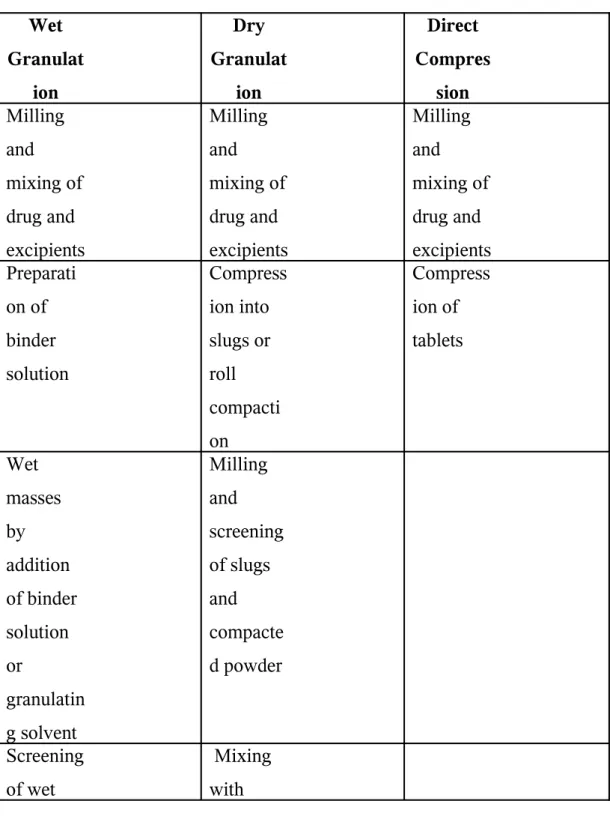
Typical unit operations involved in Wet granulation, Dry granulation and Direct compression11
mass lubricants and disintegra nts
Drying the wet granules
Compress ion of tablets Screening
A Systemic and Modern Approach to Tablet Product
Design
Tablet product design requires two major activities. First, formulation activities begin by identifying the
excipients most suited for a prototype formulation of the drug. Second, the levels of those excipients in the prototype
formula must be optimally selected to satisfy all process/product quality constraints13.
Factors Affecting the Type of Excipients Used in a
Tablet Formulation
The type of excipients used may vary depending on a number of preformulation, medical, marketing, economic and process/product quality factors as discussed in the following sections. Here we mainly focus on the process/product quality.
Typical tests preformed on tablets are as follows:
Weight variation
Hardness
Friability
Disintegration time
Dissolution
Water content
Potency
Product quality is most often addressed at the tablet development stage. However, it is also important to monitor the processing quality of a formulation during development. They
are:-a. To optimize the process as well as the product.
b. To establish in-process quality control tests for routine production
It is more difficult to quantify the processing quality of a formulation than it is to measure the product quality. Some measurements that could be preformed on the process
include:- Ejection force
Capping
Sticking
Take-off force
Flow of lubricated mixture
Press speed (maximum)
Frequency of weight control adjustments
Sensitivity of formula to different presses
Tooling wear
Effect of consolidation load (Batch size)
Hopper angle for acceptable flow
Hopper orifice diameter for acceptable flow
Compressional forces
Environmental conditions (temperature, humidity and
Each of the above processing parameters can become a source of trouble in scale-up (or) routine production. By monitoring these parameters in development, it may be possible to adjust the formula (or) process early enough to alleviate the source of trouble. The expected production output (number of tablets) per unit time will determine what speed tablet press will be required for a particular tablet product. If the anticipated unit output for a tablet product is expected to be large, a high-speed press will be required.
Attempts should be made in formulation development to design a tablet formula that will perform well on a high-speed press. A formula to run on a high-high-speed press should have excellent flow to maintain uniform die fill during compressing. It should have good bonding characteristics so that it can compress with a minimal dwell time.
Compressed Tablets by Wet Granulation
Compressed tablets are defined as solid-unit dosage forms made by compaction of a formulation containing the drug and certain fillers (or) excipients selected to aid in the processing and properties of the drug product.
Formulation of Tablets and Factors to be Considered
As the dose increases, so does the size of the tablet. Drugs with a dose of 100 to 200mg may require tablet weights of 150 to 300mg and round die diameters of 1/4 to 7/16 inches. The diameter depends on the density and
compressibility of the powders used. As the dose of the active ingredient increases, the amount of the excipients and the size of the tablet may vary considerably depending on
requirements of each to produce an acceptable tablet. While the diameter of the tablet may in some cases be fixed, the thickness is variable thus allowing the formulator
considerable latitude and flexibility in adjusting formulations.
As the dose, and therefore the size of the tablet
increases, the formulator uses his expertise and knowledge of excipients to keep the size of the tablet as small as possible without sacrificing its necessary attributes.
Formulation of a tablet then requires the following considerations:
1. Size of the dose (or) quantity of active ingredients 2. Stability of active ingredients.
3. Solubility of active ingredients. 4. Density of active ingredients.
5. Compressibility of active ingredients. 6. Selection of excipients.
7. Method of granulation (preparation for compression) 8. Character of granulation
9. Tablet press, type, size, capacity.
11. Stability of final product.
12. Bioavailability of the active drug content of the tablet.
The selection of excipients is critical in the formulation of tablets. Once the formulator has become familiar with the physical and chemical properties of the drug, the process of selecting excipients is begun. The stability of the drug should be determined with each proposed excipients. This can be accomplished as follows:
In the laboratory, prepare an intimate mixture of the drug with an excess of each individual excipients and hold at 60˚C for 72 hrs in a glass container. At the end of this period analyze for the drug using a stability-indicating assay.
Tabletting Properties
Granules Size and Shape14
The size of the granule is known to affect the average tablet weight, tablet weight variation and disintegration time.
The size can be determined by using13
1. Optical micrometer 2. Sieving
3. Sedimentation
Surface Area
The determination of surface area of finely divided drug powders may be of value to drugs that have only limited water solubility. The two most common methods for
determination of surface area of solid particles are: a) Gas adsorption method (e.g. Quantasorb)
b) Air permeability technique (e.g. Fisher subsieve sizer)
Density
Granule density may influence compressibility, tablet porosity dissolution and other properties. The granule density is measured by pycnometer. The intrusion fluid used may be benzene (or) mercury.
Types of Densities
There are three types of densities:
1. True density: True density of the material itself exclusive of the voids and intra-particle pores larger than molecular (or) atomic dimensions in the crystal lattices.
2. Granule density: Granular density may be determined by the displacement of mercury which does not penetrate at ordinary pressure into pores smaller than about 10µm (or) by using pycnometer.
3. Bulk density: Bulk density is determined from the bulk volume and the weight.
The bulk density of a powder is always less than the true density of its component particles, because the powder contains interparticle pores (or) voids
Bulk density = K true density
K = Bulk density True density
= packaging fraction (or) fractional solids. Content bulk density increases when particle size is more and if the particle size is less bulk density decreases.
Strength and Friability
A granule is an aggregation of compound particles i.e. held together by bonds of finite strength. The strength of a wet granule is mainly due to the surface tension of liquid and capillary forces. To determine granule strength two distinct types of measurements are made.
They are:
1. Compression strength 2. Friability measurement
Flow Properties
The flow properties of a material result from many forces. There are many types of forces that can act between particles.
1. Frictional force
2. Surface tension force
3. Cohesive (or) Vanderwaal force 4. Mechanical force
5. Electrostatic force
Direct methods include hopper flow method and recording flow meter method.
Indirect methods include determination of angle of repose, measurement of bulk density and compressibility index, Carr’s index, Hausner’s ratio and angle of repose, shear cell determinations and critical orifice diameter determination.
Compressibility Index
This is an indirect method of measuring powder flow from bulk densities and was developed by “Carr”
Carr’s Index
It is given by the equation
Carr ' s index Tapped density− Poured density
Tapped density X 100 Carr’s index is related to flowability and is shown in the above information on compressibility index.
A similar index has been defined by Hausner.
Hausner ' s ratio= Tapped density Poured density
Hausner’s ratio
< 1.25 – Good flow = 20% Carr >1.25 – Poor flow = 33% Carr
Angle of Repose
A static heap of powder, when only gravity acts upon it will tend to form a conical mount. If the horizontal surface radius is R and the height of the heap is H.
Then θ = tan-1 (H/R) where θ = angle of repose in
degrees
Table 2
Angle of repose (θ)
Type of flow
< 25 Excellent
25 – 30 Good
30 – 40 Passable
> 40 Very poor
Solubility
Solid drugs, which are administered into the body, must undergo dissolution prior to absorption. So the solubility of dosage form is essential for the formation of solution. As a rule of thumb the compounds with aqueous solubility of less than 1% w/v are considered to posses dissolution related absorption problems.
The solubility of every new drug must be determined as a function of pH over pH range 1- 8. If the intrinsic
dissolution rate was greater than 1mg/cm2/min. the absorption
was greater than 1mg/cm2/min. the absorption was
unimpeded. Dissolution rates of less than 0.1mg/cm2/min.
dissolution rate and solubility are proportional under sink conditions.
Different Adjuvants used in Tablet Formulation
In addition to the active or therapeutic ingredient, tablets contain a number of inert materials called as additives or excipients. Excipients are specified according to the
function they perform in the tablet. They are classified as follows
Fillers (Diluents)
Binders
Disintegrants
Glidants
Lubricants
Antiadherents
Adsorbents
Moistening agents
Coloring agents
Sweetening agents
Flavoring agents
Although they were considered to be inert they
Diluents or Fillers10
These are the inert substances which will increase the bulk of tablet. Selecting the diluent is an important character while tableting. These agents may not be necessary if the dose of drug per tablet is high. Generally, a tablet should weigh atleast 50mg and therefore very low dose drugs will
invariably require diluents to bring the overall tablet weight to atleast 50mg.
Diluents or fillers fall into two general categories:
1. Carbohydrate and modified carbohydrate excipients. 2. Inorganic materials
In wet granulation process, such carbohydrate
substances as sugars, starches and cellulose may also function as binder. Whereas in direct compression systems, they serve as diluent carrier. The inorganic excipients, when used in either system, are not binders that are a cohesive agent, in directly compressible system. Hence they function more as a carrier.
Microcrystalline cellulose (MCC) (AVICEL) is most widely used as direct compression tablet filler. It has a function of disintegrant besides that of a dry binder and is compatible with most excipients and active ingredients.
Lactose is an inexpensive, soluble and easily granulatable diluent. Since it lacks flowability and
The other commonly used diluents are mannitol, kaolin, dry starch, calcium sulfate, dicalcium phosphate.
Binders or Adhesives12
Binders are solid materials used in the manufacture of solid dosage forms because of their adhesive and cohesive properties. Their role is to assist size enlargement by adding cohesiveness to powders, thereby providing granules and tablets with necessary bond strength. They improve the
appearance, hardness and friability of preparations but are not intended to influence the dissolution or disintegration of active substances.
Binders are either starch, gelatin, sugars or polymeric substances. The latter fall into two classes
a. Natural polymers such as starches or gum including acacia, tragacanth, gelatin.
The quantity of binder used has a considerable effect on the characteristic of the compressed tablets. The use of too much binder or too strong binder will make a hard tablet that will not disintegrate easily. Binders are used both as solution and in dry form, depending on other ingredients in the
formulation and method of preparation. However
pregelatinized starches available are intended to be added in dry form so that water alone can be used for granulating solution.
Hydrophilic binders show better dissolution profiles with poorly soluble drugs like phenacetin by imparting hydrophilic properties to the granule surface. Non-aqueous binders like ethyl cellulose retard drug dissolution.
The direct compression method for preparing tablets requires a material that is not only free flowing but also sufficiently cohesive to act as a binder. For this
microcrystalline cellulose, amylase and polyvinyl pyrrolidone is used.
MCC is a non fibrous form of cellulose. It is water insoluble but has the ability to draw fluid into tablet by capillary action. It swells on contact and thus acts as disintegrating agents. The material flows well and has a degree of self lubricating qualities.
viscosity is its draw back. Pregelatinized starch can be used instead of starch paste.
Disintegrants15,19
Disintegrant is the term applied to various agents added to tablet granulation for the purpose of causing the compressed tablet to break apart (disintegrate) when placed in aqueous environment. Basically the disintegrant’s major function is to oppose the efficiency of tablet binder and the physical forces that act under compression to form tablet. The stronger the binder, the more effective must be the
disintegrating agent in order for the tablet to release its medication. Ideally it should cause the tablet to disrupt, not only into the granules from which it was compressed, but also into the powder particle from which the granulation was prepared.
The ideal disintegrant has-1. Poor solubility 2. Poor gel formation 3. Good hydration capacity
4. Good molding and flow properties
5. No tendency to form complexes with the drugs
There are two methods used for incorporating disintegrating agents into the tablet.
1. External addition 2. Internal addition
In the internal addition method, the disintegrant is mixed with some other powders before wetting the powder mixture with granulating solution. Thus, the disintegrant is incorporated within the granule. When this method is used, part of the disintegrant can be added internally, and part externally. This provides immediate disruption of tablet into previously
compressed granules while the disintegrating agent within the granules produces further erosion of the granules to the
original powder particles. The two step method usually produces better and more complete disintegration than the usual method of adding the disintegrant to the granulation surface only.
Disintegrants act by different
mechanisms:- They enhance action of capillaries in producing a rapid
uptake of aqueous fluids. eg. Starch, microcrystalline cellulose.
Those that swell on contact with water. eg. Sodium starch
glycolate, carboxy methyl cellulose.
That release gas to disrupt the tablet structure. eg. Certain
peroxides.
That destroys the binder by enzymatic action. eg. Starch amylase
exchange resins and acid base combinations. Carboxy methyl cellulose, corn and potato starch are popular disintegrants. They have great affinity for water and swell when moistened, then facilitating, the rupture of tablet matrix. Starch usually 5-15% is used.
A decrease in amount of disintegrant can significantly lower bioavailability. Adsorbing disintegrants like bentonite and veegum should be avoided with low dose drugs like digoxin, alkaloids and steroids since a large amount of dose is permanently adsorbed and only a fraction is available for absorption.
A group of materials known as super disintegrants have gained popularity. Croscarmelose, crospovidone and sodium starch glycolate represent examples of a cross linked cellulose, a cross linked polymer and cross linked starch respectively.
Sodium lauryl sulphate in combination with starch is an effective disintegrant. In some cases the effectiveness of surfactants in improving tablet disintegration is postulated as due to an increase in the rate of swelling.
Glidants7
Glidants improve the flow characteristics of the powder mixture. These materials are added in the dry state just prior to compression. They act by reducing the inter-particulate friction and reduce the frictional forces between the granules and dies. Colloidal silicon dioxide is the most commonly used glidant and generally used in low
concentration of 1% or less. Talc is also used and may serve the dual purpose of glidant/ lubricant.
It is important to optimize the order of addition and mixing process of these materials to maximize their effect and to make sure that their influence on lubricants is minimized.
Lubricants
They have a number of functions in tablet
manufacture:- They prevent adhesion of the tablet material to the surface
of the dies and punches
Reduce interparticle friction
Facilitate the ejection of tablets from the die cavity
Improves the rate of flow of tablet granulation
Commonly used lubricants include talc, magnesium stearate, calcium stearate, stearic acid, hydrogenated vegetable oils. Most lubricants are used in concentration below 1% when used alone. Talc is used in concentration as high as 5%. Lubricants are mostly hydrophobic materials. Poor selection or excessive amounts can result in water
Antiadherents
These are useful in tablet formulation, which have a tendency to pick easily. Multivitamin products containing high vitamin E levels often display extensive picking which can be minimized through the use of colloidal silica such as syloid (0.1-0.5%)
Adsorbents
Adsorbents are substances included in a formulation that are capable of holding quantities of fluids in an
apparently dry state. Oil soluble drugs fluid extractors (or) oils can be mixed with adsorbents and then granulated and compressed into tablet.
Coloring Agents
Color helps the manufacturer to control the product during its preparation, as well as serving as means of identification to the users. All colorants used in
pharmaceuticals must be approved by FDA. Lake is the combination of a water soluble dye to a hydrous oxide of a heavy metal resulting in an insoluble form of the dye. The most common method of adding color to a tablet formulation is to dissolve the dye in the binding solution prior to the granulation process. Migration of colors may be reduced by drying the granules slowly at lower temperature and stirring the granules while it is drying.
Moistening Agents
In wet granulation a moistening agent is required usually water. In cases where, water cannot be used because of hydrolysis, alcohol is often substituted. Other moistening agents are industrial methylated spirits, isopropyl alcohol, etc.
Sweetening Agents
In addition to the sweetness which may be afforded by the diluents of the chewable tablet. eg. Mannitol (or) lactose. Sweeteners other than sugar that have an advantage of
reducing the bulk volume are cyclamates, saccharin, aspartame (Searle)
Surfactants
Molecules (or) ions that are adsorbed at interfaces are termed as surfactants. Depending on the number and nature of the polar and non-polar groups presented, the amphiphile may be predominantly hydrophilic suggesting that the molecules (or) ion have a certain affinity for both polar and non-polar solvents.
The hydrophilic portion of the surfactant is soluble in the polar solvent and the lipophilic portion is soluble in the non-polar solvent. The surfactant occupies the interface to decrease interfacial tension and thereby increases the solubility. Release of poorly soluble drugs from tablet and hard gelatin capsules may be increased by the inclusion of surfactants in the formulations.
more effectively and to come into more intimate contact with solid dosage forms. This wetting effect may thus aid the penetration of GI fluids into the mass of capsule contents which often remains when hard gelatin shell has dissolved and reduces the tendency of poorly soluble drug particles to aggregate in the GI fluids. In each case the resulting increase in total effective surface area of drug in contact with the GI fluids would tend to increase the dissolution and absorption rate of drugs.
Production of Tablets
Tablets are made by compressing the formulation containing a drug or drugs with excipients on stamping machines called presses. Tablet compression machine or tablet presses are designed with the following basic components.
1. Hoppers for holding and feeding granulation to be compressed
2. Dies that define the size and shape of the tablet.
3. Punches for compressing the granulation within the dies. 4. Camtracks for guiding the movement of the punches. 5. A feeding mechanism for moving granulation from the
hopper into the dies.
Punches and Dies
Punches and dies (toolings) must be stored, lightly oiled, in containers which prevent accidental contact. The ease of manufacture and the final appearance of the tablet depend on unblemished, highly polished working surfaces. Punch edges must be sharp and free from burrs.
Working
Once the machine has been assembled, trial tablets may be made with the press. The optimum tablet hardness depends on the material to be compacted and the ultimate use of the tablets.
upper punches enter a fixed distance into the dies, while the lower punches are raised to squeeze and compact the
granulation within the dies. After the movement of
EVALUATION OF TABLETS
In the evaluation of tablets the physical, chemical and bioavailability properties of tablets should be evaluated. The following are the different properties, which are to be
evaluated.
Official Tests
Weight Variation1,3,7:
The weight variation test would be satisfactory method for determining drug content uniformity and drug distribution. In practice, this test is performed by taking 20 tablets from a batch. Then 20 tablet, are weighed and the average weight is taken. Then the tablet is weighed individually. The percentage deviation can be determined by using the following formula.
Deviation = Average weight −Individual weight
Average weight X 100 The percentage deviation limit based on average weight is shown in the following table according to I.P, B.P and U.S.P.
Table 3
Sl. No Average weight (I.P)
Average weight (B.P)
Average weight (U.S.P)
% Deviation
allowed 1 80mg (or) less 80mg (or) less 130mg (or) less 10.0
2 80-250 mg 80-250mg 130-324mg 7.5
Hardness Test
Tablets require a certain amount of strength, or
hardness and resistance to friability, to withstand mechanical shocks of handling in manufacture; packaging and shipping. The relationship of hardness to tablet disintegration and perhaps more significantly, to the drug dissolution release rate, has become apparent. The hardness of tablets from each batch can be tested by using Monsanto hardness tester. The tester consists of a barrel containing a compressible spring held between two plungers. The lower plunger is placed in contact with the tablet, and a zero reading is taken. The upper plunger is then forced against a spring by turning a threaded bolt until the tablet fractures. As the spring is compressed, a pointer rides along a gauge in the barrel to indicate the force. The force of fracture is recorded, and the zero force reading is deducted from it. The other hardness testers available are Pfizer tester, Strong-Cobb tester, Erweka tester and the Schleuniger tester.
Friability
It is a measure of tablet strength. The friability is determined by using Roche friabilator. This device, subjects a number of tablets to the combined effects of abrasion and shock by utilizing a plastic chamber that revolves at 25rpm, dropping the tablets at a distance of six inches with each revolution. Normally a preweighed tablet sample is placed in the friabilator, which is then operated for 100 revolutions. The tablets were then dusted and reweighed. The percentage
F=100X1−w/wο Where, wo = Weight of tablets before friability
w = Weight of tablets after friability
Conventional compressed tablets that do not lose more than 0.5 to 1.0% of their weight are generally considered acceptable. When capping is observed on friability testing, the tablet should not be considered for commercial use.
Disintegration
For most tablets the first important step towards solution is break down of the tablet into smaller particles or granules, a process known as disintegration. The time that it takes to disintegrates is measured in a device described in the USP/NF.
The apparatus consists of 6 glass tubes that are open at the top and held against a 10 mesh screen at the bottom end of the basket rack assembly. One tablet is placed in each tube, and basket rack is positioned in a 1L beaker of water or
Dissolution
The breakdown of tablet into granules and formation of clear solution is dissolution. According to IP, BP and USP/NF the various apparatus like rotating basket, rotating paddle and reciprocating cylinder, etc. are used to determine
dissolution.Common dissolution tolerance in the USP/NF is not less than 75% dissolved in 45 min.
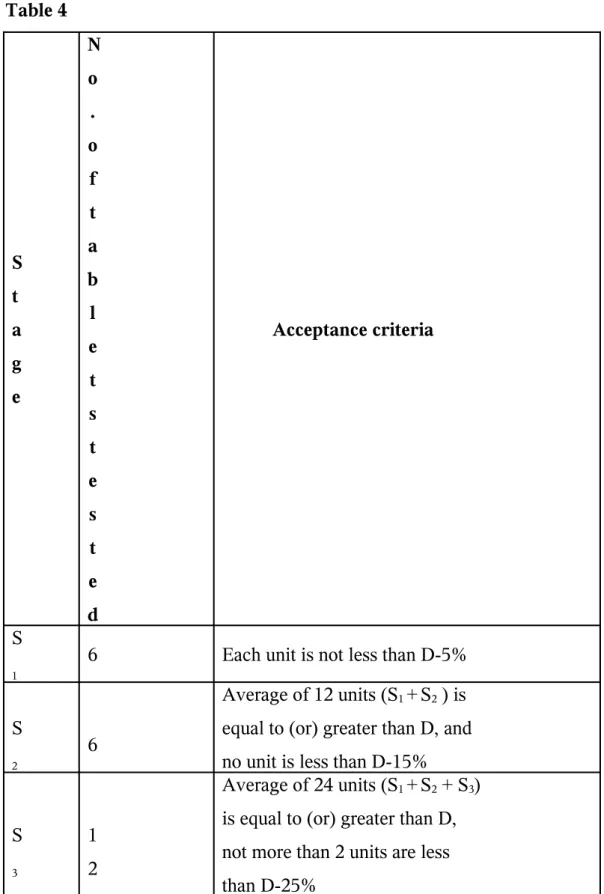
Table 4 S t a g e N o . o f t a b l e t s t e s t e d Acceptance criteria S 1
6 Each unit is not less than D-5%
S
2
6
Average of 12 units (S1 +S2 ) is
equal to (or) greater than D, and no unit is less than D-15%
S
3
1 2
Average of 24 units (S1 +S2 + S3)
D = The amount of dissolved active ingredients specified in monograph expressed as a percentage of the state amount.
Appearance
DISSOLUTION
“Dissolution25 is defined as the process by which solid
substances enters in solvent to yield a solution.
Fundamentally, it is controlled by the affinity between the solid substance and the solvent.” The physical characteristics of the dosage form, the wettability of the dosage unit, the penetration ability of the dissolution medium, the swelling process, the disintegration and the deaggregation of the dosage forms are few of the factors that influence the dissolution characteristic of drugs.
Wagner proposed a scheme for the processes involved in the dissolution of solid dosage forms.
Carstensen proposed a scheme incorporating some other factors in the following sequence9:
1. Initial mechanical lag
2. Wetting of the dosage form
3. Penetration of the dissolution medium into the dosage form
4. Disintegration
5. Deaggregation of the dosage form and dislodgement of the granules
6. Dissolution
7. Occlusion of some particles of the drug.
absorbed until the drug particles are dissolved by the fluids at some point within the gastrointestinal tract.
For instance, when the solubility of a drug is dependent upon either an acidic or basic medium, the drug would be dissolved in the stomach or intestines respectively. The process by which a drug particle dissolves is termed as dissolution. i.e. dissolution is the process by which a solid of only fair solubility characteristics enters into solution.
The rate of dissolution of drug substance is determined by the rate at which solvent-solute forces of attraction
overcome the cohesive forces present in the solid. This process is rate-limiting when the release of solute into
solution is slow and the transport into the bulk solution is fast. In this case the dissolution is said to be interfacially
controlled. Dissolution may also be diffusion controlled, where the solvent-solute interaction is fast compared to transport of solute into the bulk solution. In diffusion-controlled process, a stationary diffusion layer of solute adjacent to the solid/liquid interface is postulated. The saturation concentration of solute develops at the interface and decreases with distance across the diffusion layer.
Apparatus
The breakdown of tablet into granules and formation of clear solution is dissolution. According to IP, BP and USP/NF the following apparatus are used to determine dissolution.
1) Apparatus I ( Rotating Basket )
3) Apparatus III (Reciprocating Cylinder)
4) Apparatus IV ( Flow through cell )
5) Apparatus V (Paddle Over Disk)
6) Apparatus VI (Cylinder)
Apparatus I (Rotating Basket Apparatus)
The assembly consists of the following, a covered vessel made of glass or other inert transparent material, a motor, a metallic drive shaft and a cylindrical basket. The vessel is partially immersed in a suitable water bath of any convenient size that permits holding the temperature inside the vessel 37±0.2 ºC during the test and keeping the bath fluid in constant smooth motion.
Apparatus that permits observation of the specimen and stirring element during the test is preferable. The vessel is cylindrical, with a hemispherical bottom. It is 180mm to 175mm high, its inside diameter is 98mm to 106mm and its nominal capacity is 1000ml. Its sides are flanged at the top. A fitted cover may be used to retard evaporation. The shaft is positioned so that its axis is not more than 2mm at any point from the vertical axis of the vessel and rotates smoothly and without significant wobble. A speed-regulating device is used that allows the shaft rotation speed to be selected and
maintained at the rate specified in the individual monograph, within ±4%. Shaft and basket components of the stirring element are fabricated of stainless steel, type 316 or
used. The dosage unit is placed in a dry basket at the beginning of each test. The distance between the inside bottom of the vessel and the basket is maintained at 25±2mm during the test.
Theory of Dissolution
Diffusion Layer Model (Film Theory) 8,26
In 1897 Noyes & Whitney developed an equation based on Fick’s 2nd law to describe the dissolution
phenomenon.
dc
dt =KCs−Ct (1)
Where dcdt → dissolution rate of the drug
K → Proportionality constant
Cs → Saturation concentration (maximum
stability)
Ct → Concentration at time t
Cs – Ct → Concentration gradient
The proportionality constant K is also known as
dissolution constant and the equation has been shown to obey first order kinetics.
In their experiments Noyes and Whitney maintained a constant surface area. However, because such a condition is not always applicable, Brunner and Tolloczko modified equation (1) to incorporate the surface area, S, as a separate variable.
dc
In order to explain the mechanism of dissolution, Nernst in 1940 proposed the film-model theory. Under the influence of no reactive or chemical force, a solid particle immersed in a liquid, undergoes two consecutive steps 1. The solution of the solid at the interface, forming a thin
stagnant layer of film ‘h’ around the particle and
2. The diffusion from this layer at the boundary to the bulk of the fluid.
In the 1st step, solution formation is almost
instantaneous; in the 2nd step diffusion is much slower and,
therefore, is the rate-limiting step.
By using Fick’s first law of diffusion and Nernst’s newly proposed film theory, Brunner expanded equation (2) to include the diffusion co-efficient, D. the thickness of the stagnant diffusion layer, h, and the volume of the dissolution medium, “v” producing
dc dt =K2
DS
vh Cs−Ct (3)
The proportionality constant K2is known as the
intrinsic dissolution rate constant and is characteristic of each chemical compound.
Sink Condition
Therefore, under in vivo conditions, there is no concentration build up and hence the retarding effect of the concentration gradient on the dissolution rate, as predicted by equation (1), does not occur. In order to simulate the in vivo sink condition, in vitro dissolution testing usually is conducted using either a large volume of the dissolution medium or a mechanism by which the dissolution medium is replenished constantly with fresh solvent at a specified rate so that the concentration of the solute never reaches more than 10 to 15% of its maximum solubility. If such a parameter is maintained, the dissolution testing is said to be conducted under sink conditions. i.e. not under the influence of the concentration gradient. This can be seen from the following mathematical gradient.
Assuming that Cs >> Ct, equation (3) becomes
dc dt =K2
DS
vh Cs (4)
Cs and D are constants for each specific chemical
substance. Therefore, they could be incorporated in K2 and
appear in equation (5) as K3
dc
dt =K3vhS (5)
If the volume of the dissolution medium and the surface area are kept constant during the duration of the dissolution test, then
dc
dt =K (6)
Equation (6) is also believed to be approximate the in vivo condition where the dissolution rate of sparingly soluble drugs plays a fundamental role in determining their bioavailability.
Hixson & Crowell Cubic Root Law for Dissolution In equation (2), the surface area was considered
constant for the duration of the dissolution test. Although this could be achieved by using a nondisintegrating disk of the chemical substance, a technique usually employed for the determination of the intrinsic dissolution rate, the same could not be maintained in dissolving crystal or a regular solid dosage form where a complete disintegration is a priority. Therefore, in order to develop a dissolution equation that is based on a changing surface area, Hixson and Crowell modified equation (2) to represent the rate of appearance of the solute in the solution by multiplying each side of the equation by v (volume), letting K1v = K
dW
dt =KSCs−Ct (7) Where, W = Weight of the solute in solution
They also assumed that S =kw2/3 , where k is a
constant containing the shape factor and the density of the particle, and w is the weight of the undissolved particles at time t.
dW
dt =Kkw
2/3C
Dissolution
Absorption (In vivo)
Dissolution
After mathematical treatment involving the application of Fick’s first law and integration under the condition that w is equal to wo, the initial weight of the particle at time zero,
equation (9) results.
w
ο1/3− w 1/3
=K1t (9)
Equation (9) is called the Hixson and Crowell’s “Cubic root law” for dissolution.
Wagner’s schematic diagram illustrates the processes involved in the dissolution of solid dosage forms
Factors Affecting the Rate of Dissolution Relating
to the Solid Dosage Form
Factors affecting the dissolution rate of drugs from a dosage form include the following9,18,25:
1. Factors related to the physicochemical properties of the drug
2. Factors related to drug product information
3. Effect of processing factors on the dissolution rate 4. Factors related to the dosage form
Factors Related to the Physicochemical Properties of
the Drug
Effect of Solubility
The modified Noyes and Whitney equation shows that the aqueous solubility of the drug is the major factor that determines its dissolution rate. The drug solubility data should be taken into consideration in the formulation design.
Effect of Particle Size
According to Nernst-Brunner theory, the dissolution rate is directly proportional to the surface area of the drug exposed to the dissolution media. In order therefore to increase the dissolution rate for a given amount of drug, the effective surface area has to be increased. This can be achieved easily by decreasing the particle size of the drug. But the particle size reduction of the hydrophobic drug may produce a smaller effective area and a reduction in dissolution rate. The mechanism by which the reduction in particle size improves dissolution is usually through the enhancement of the drug solubility.
Effect of Solid Phase Characteristics of the Drug
Amorphicity and crystallinity, the two important solid-phase characteristics of drugs affect their dissolution profile. Numerous studies have demonstrated that the amorphous form of a drug usually exhibits greater solubility and higher dissolution rate as compared to that exhibited by the
Effect of Polymorphism
Polymorphism and the state of hydration, salvation and /or complexation markedly influence the dissolution
characteristics of the drug. Examples are tolbutamide, chloramphenicol and others.
Factors Related to Drug Product Formulation
Effect of Binding Agents
Binding agents are incorporated into tablets during granulation in order to improve the flowability of the drug and to enhance compressibility. These agents coat the drug particles and therefore the rate of solution of the binder in water can determine the release rate from the tableted drug. Tablets containing soluble binders (hydrolysed gelatin and PVP) had rapid dissolution rates whereas slow and
incomplete disintegration of tablets formulated with starch paste led to protracted release of drug.
Effect of Disintegrants
To enhance the disintegration of tablets and capsules, disintegrants are added. Disintegrants act by either bursting open the tablet and/or promoting the rapid ingress of water into the center of the tablet or capsule. In many cases capillarity and therefore the rate of water penetration
Effect of Lubricants
Lubricants are added to dosage form to prevent it from sticking to the processing machinery. Magnesium stearate, a hydrophobic-lubricant tends to retard the dissolution rate of salicylic acid tablets, while a water soluble surface active lubricant, sodium lauryl sulphate enhanced the dissolution. The enhancing effect of Sodium lauryl sulphate , on the other hand, was suggested to be due, in part, to an increase in the microenvironment pH surrounding the sparingly soluble weak acid and to increase wetting and better solvent penetration into the tablets and granules as a result of lowering the interfacial tension between the solid surface and the solvent. The most effective lubricants are very hydrophobic and they must therefore be properly formulated to avoid reducing dissolution rate and bioavailability.
Effect of Diluents
Increasing the starch content (most commonly using diluent) from 5 to 20% resulted in the dissolution rate of salicylic acid tablets. This was attributed to better
disintegration. Later, Finholt suggested that the hydrophobic drug crystals acquire a surface layer of fine starch particles that imparts a hydrophilic property to the granular
formulation and thereby increase the effective surface area and hence the dissolution rate.
Effect of Granulating Agents
Factors Related to Processing
Many processing factors used in tablet manufacturing greatly influence the dissolution rates of the active
ingredients. The method of granulation, the size, density, moisture content and age of the granules as well as the
compression force used in the tableting process, all contribute to the dissolution rate characteristics of the final product.
Method of Granulation
Granulation process, in general, enhances the
dissolution rate of poorly soluble drugs, The use of fillers and diluents, such as starch, spray-dried lactose and
microcrystalline cellulose, tend to increase the hydrophilicity of the active ingredients and improve their dissolution
characteristics. In this regard, the wet granulation procedure was considered as a superior method compared to the dry of double compression procedure. With the advent of newer tableting machines and materials, it became more evident that the careful formulation and proper mixing sequence and time of adding the several ingredients are the main criteria that affect the dissolution characteristics of the tablets and not the method of granulation process.
Effect of Compression Force
and the inhibiting effect due to the increase in particle
bonding that causes an increase in density and hardness and, consequently, a decrease in solvent penetrability. The high compression also may inhibit the wettability of the tablet due to the formation of a firmer and more effective sealing layer by the lubricant under the high pressure and temperature that usually accompanies a strong compressive force.
Factors Related to the Dosage Form
Drug Excipient Interaction
These interactions can occur during any unit operation, such as mixing, blending, drying, and/or granulating, resulting in a change in dissolution pattern of the dosage form in
question. The effect of magnesium stearate on the
disintegration time of tablets containing either potato starch or sodium starch glycolate was found to depend on the swelling characteristics of the disintegrants. By minimizing, if not eliminating, these interactions, adverse effects on the
performance of the final product can be avoided. The better process control is also possible with noninteracting drug-excipient interactions.
Deaggregation
Factors Related to Dissolution Test Parameters
9,24Agitation
The relationship between intensity of agitation and the rate of dissolution varies considerably according to the types of agitation used, the degree of laminar and turbulent flow in the system, the shape and design of the stirrer and
physicochemical properties of the solid.
When a stirring device is used, such as the basket, paddle, or rotating filler, the speed of agitation generates a flow that continuously changes the liquid-solid interface between the solvent and the drug in a way similar to the flow rate in the flow-through dissolution apparatus. In order to prevent turbulence and sustain a reproducing laminar flow, which is essential for obtaining reliable results, either the speed of agitation or the flow rate, depending on the type of apparatus employed, should be maintained at a relatively low level.
The empirical relationship between the rate of dissolution and the intensity of agitation is
K = a (N)b
Where N is the speed of agitation, K is the dissolution rate and a & b are constants.
Temperature
Generally a temperature of 37ºC is always maintained during the dissolution determinations. The effect of
temperature variation of the dissolution medium depends mainly on the temperature/solubility curves of the drug and excipients in the formulation. For a dissolved molecules, the diffusion coefficient, D, depends on the temperature T according to the Stokes equation.
D = kT (6πηr)
Where K is the Boltzmann constant and 6πηr is the Stokes force for a spherical molecule (η is the viscosity in cgs or poise units, and r is the radius of the molecule)
Dissolution Medium
9The selection of the proper fluid for dissolution testing depends largely on the solubility of the drug, as well as mere economics and practical reasons.
pH of Dissolution Medium
Great emphasis and effort was first placed on
the deleterious effects of hydrochloric acid is to replace it with acidic buffers, such as sodium acid phosphate, to maintain the required low pH.
Surface Tension of the Dissolution Medium
Surfactants and wetting agents lower the contact angle and thereby improve the penetration process of the matrix by the dissolution medium. Measurable enhancement in the dissolution rate of salicylic acid from an inert matrix was reported by Singh and co-workers when the contact angle,θ, was lowered from 92º (water) to 32º (using 0.01% dioctyl sodium sulfosuccinate). The surface tension also was
correspondingly lowered from 60 to 31 dynes/cm. The same findings were obtained in benzocaine studies when
polysorbate 80 was used as the surface-active agent. Low levels of surfactants were recommended to be included in the dissolution medium as this seemed to give a better correlation between the in vitro data and in vivo condition.
Viscosity of the Medium
Miscellaneous Factors
Adsorption
The adsorbent has an influence on the dissolution rate of a slightly soluble solid. It was also reported that the
adsorbent is capable of increasing the dissolution rate observed in water under conditions of a decreased
concentration gradient applying Nernst-Brunner film theory. Sorption
It was found that water sorption from the atmosphere into the tablet containing microcrystalline cellulose is a very rapid first-order process, resulting in substantial changes in the physical properties. These changes are attributed to the breaking of the hydrogen bonds. The relative density of the tablets was found to decrease, resulting in increased
disintegration time with increase in water sorption-rate constants. These changes were found to be irreversible.
Humidity
Moisture has shown to influence the dissolution rate of many drugs from solid dosage forms. Environmental
Detection Errors
Two most common variables leading to interlaboratory disagreement are the failure to use standards during analysis, and external vibration. Extreme care must be exercised when laboratory methods are introduced into quality control to ensure that no part of the equipment interferes with sensitive determinations. Despite the fundamental relationship between bioavailability and dissolution rate, the present evidence suggests that no single dissolution-rate test can be applied to all drugs.
Compendial Methods
When selecting apparatus for dissolution testing, routine quality control, new drug development, or complying with regulatory requirements, the analyst must follow the latest issue of compendia, including revisions.
DRUG PROFILE
PARACETAMOL
27,28,28,30Category
Analgesic, Antipyretic
Structure
OH
Synonyms
Acetaminophen, N-Acetyl-p-aminophenol
Chemical Name
4-L Hydroxy Acetanilide
Molecular Formula C8H9NO2
Molecular Weight 151.16
Dose
500mg to 1gm every 4-6 hrs. upto 4gm daily in divided dose.
Description
White odorless crystals (or) crystalline powder, tastes bitter.
Therapeutic Concentration
Plasma concentration 10-20µg/ml
Solubility
Freely soluble in ethanol (95%) and in acetone. Sparingly soluble in water, Very slightly soluble in chloroform. Practically insoluble in ether. Soluble in solutions of alkali hydroxides.
Dissociation Constant pKa 9.5 (24°)
168˚C to 172˚C
Storage
Store in air tight, light resistant containers.
Standards
Paracetamol contains not less than 99.0% and not more than 101.05% or C8H9NO2 calculated with reference to the
dried substance.
Identification
The infra red spectrum is concordant with the reference spectrum of paracetamol or with the spectrum obtained from paracetamol.
Adverse Effects
Side effects of paracetamol are usually mild, although hematological reactions have been reported. Skin rashes and other allergic reactions occur occasionally. Symptoms of paracetamol over dosage in the first 24 hours are nausea, vomiting, anorexia and abdominal pain.
Allergy
Fixed drug eruption due to paracetamol is reported.
Precautions
Interaction
Alcohol-paracetamol hepatotoxicity was enhanced by alcohol in patients.
Mechanism of Action
The recent research (2) has shown the presence of a new, previously known cyclooxygenase enzyme COX-3, found in the brain and spinal cord, which is selectively
inhibited by paracetamol, and is distinct from the two already known cyclooxygenase enzymes COX-1 and COX-2. It is now believed that this selective inhibition of the enzyme COX-3 in the brain and spinal cord explains the effectiveness of paracetamol in relieving pain and reducing fever without having unwanted gastrointestinal side effects.
Half Life
Adults – 1.5-3 hrs
Clearance
Plasma clearance about 5ml/min/kg
Protein Binding Above 60µg/ml
Absorption and Fate
Uses
Paracetamol has analgesic and antipyretic actions similar to those of aspirin, but it has no useful
EXCIPIENTS PROFILE
STARCH
20Non Proprietary Names
BP: Maize starch, Potato starch, Rice starch, Tapioca starch, Wheat starch
Synonyms
Amido, amidon, amilo, amylum, Aytex P, Cassava starch.
Chemical Name Starch
Empirical Formula (C6H10O5)n
Where n = 300 – 1000
Functional Category
Glidant, tablet and capsule diluent, tablet and capsule disintegrant, tablet binder.
Application In Pharmaceutical Formulation (or) Technology
Starch is widely used as an excipient primarily in oral solid dosage formulation where it is utilized as a binder, diluent and disintegrant.
As a diluent, starch is used for the preparation of
In tablet formulation, freshly prepared starch paste is used in concentration of 5-25% w/w in tablet granules as a binder. Selection of the quantity required in a given system is determined by optimization studies, using parameters such as granule friability, tablet friability, hardness, disintegration rate and dissolution rate. Starch is one of the most commonly used tablet disintegrant at concentration of 3-5%w/w.
Description
Starch occurs as an odorless and tasteless, fine white-colored powder comprising of very small spherical or ovoid granules whose size and shape are characteristic for each botanical variety.
Stability and Storage Conditions