
Solubility Enhancement of Co-Crystal Based Solid Dosage Form.
145
0
0
Full text
(2) “Dedication is not what others except of you; it is what you can give to others” DEDICATED TO THE ALMIGHTY AND MY BELOVED FAMILY.
(3) Evaluation Certificate This is to certify that this dissertation entitled “SOLUBILITY ENHANCEMENT OF CO-CRYSTAL BASED SOLID DOSAGE FORM” is. a bonafide research work Submitted by Reg. No: 26103001, to “The Tamilnadu Dr. M.G.R. Medical university” Chennai , in partial. fulfillment of the requirement for the award of degree in Master of Pharmacy. (Pharmaceutics),. was evaluated by us during the. examination held on......................................... Internal Examiner. External Examiner.
(4) Certificate This is to certify that this dissertation entitled “SOLUBILITY ENHANCEMENT OF CO-CRYSTAL BASED SOLID DOSAGE FORM” is. a bonafide research work done by M.Y.ANEEF, Reg. No:26103001, in partial fulfilment of the requirement for the award of degree in Master of Pharmacy (Pharmaceutics), under the guidance of Dr. R. SAMBATH KUMAR. M.Pharm.,. Pharmaceutics,. Ph.D.,. Head. J.K.K.Nataraja. and. professor,. college. of. Dept.. pharmacy,. Komarapalayam, during the academic year 2011-2012.. Place: Komarapalayam,. Dr. P. PERUMAL, M.Pharm., Ph.D., A.I.C.. Date:. Principal, J.K.K. Nattaraja College of Pharmacy, Komarapalayam - 638183. Tamil Nadu.. of.
(5) Declaration by the Candidate I hereby declare that the work incorporated in the dissertation “SOLUBILITY ENHANCEMENT OF CO-CRYSATAL BASED SOLID DOSAGE FORM” is my own work except for the guidance received. from my Project Supervisor, Dr. R. SAMBATH KUMAR M.Pharm., Ph.D., Head and professor, Dept. of Pharmaceutics , J.K.K.Nataraja college of pharmacy, Komarapalayam.. Place: Komarapalayam. Mr. M.Y.ANEEF,. Date :. Reg.No:26103006..
(6) Certificate This is to certify that this dissertation entitled “SOLUBILITY ENHANCEMENT OF CO-CRYSATAL BASED SOLID DOSAGE FORM”. is submitted by M.Y.ANEEF, Reg. No:26103001, in partial fulfillment of the requirements for the award of degree in Master of Pharmacy (Pharmaceutics), comprises the bonafide work done by him in the. Department of pharmaceutics, J.K.K.Nataraja college of pharmacy, Komarapalayam, under my guidance and direct supervision during the academic year 2011-2012. Certified further that to the best of our knowledge and this report was not copied or does not form part of any other thesis or dissertation.. Dr. R. SAMBATH KUMAR, M.Pharm., Ph.D., Professor, Head, of Department of Pharmaceutics, J.K.K. Nattaraja college of Pharmacy, Komarapalayam-638183. Tamilnadu..
(7) ACKNOWLEDGEMENTS “I’ve learned that people will forget what you said, people will forget what you did, but people will never forget how you made them feel.” As I complete the thesis and close my eyes, thoughts race down the memory lane and rushes back with surging emotions and poignant remiscences of my stay at J.K.K.NATARAJA COLLEGE OF PHARMACY, komarapalayam and through this page I thank all those who made it memorable. First of all I would like to pay our unfathomable owes to my guide Mr. Dr. R. Sambath Kumar M.Pharm., Ph.D., head and professor, department of pharmaceutics since ,for his constructive suggestions, unfaltering inculcations, criticisms, and invaluable guidance rendered during the course of my project work. I take this opportunity to express my heartful thanks to our beloved Principal. Dr.P.PERUMAL, M.Pharm., Ph.D., A.I.C., J.K.K. Nattaraja. College of Pharmacy, Komarapalayam, for his indispensable support which enable us to complete this task vast success. I would like to convey my humblest regards and deep sense of gratitude and heartfelt thanks to late Thiru. J.K.K. NATARAJAH CHETTIAR, Founder of our college.. I wish to express my sincere thanks to our most respectful. Correspondent Tmt. N. SENDAMARAAI and our beloved Director Mr. S. OMM SHARRAVANA, B.Com, LLB, and Executive Director Mr. S. OMM SINGARAVEL, B.E.,M.S., for enabling us to do the project work. My glorious acknowledgement to Dr.K.SENGODAN, M.B.B.S., administrative officer for encouraging us in a kind and generous manner to complete this work..
(8) My sincere thanks to Professor Mrs. R. Senthil Selvi, M.Pharm, Ph.D., Mrs.S.Bhama, M.Pharm., Asst Professor, Department of Pharmaceutics, Mr.Jaganathan, M.Pharm., Asst. Professor, Mr. R. Kanagasabai, B.Pharm., M.Tech., Assistant Professor, Department of Pharmaceutics for their valuable suggestions during my project. I expresses my sincere gratitude to Mr.V. Sekhar, M.Pharm., Ph.D., Professor & Head, Mr. M. Jayaseelan, M.Pharm., Asst. Professor, Mr. M. Senthil Raja, M.Pharm., Ph.D Asst Professor, Mr.D.Boopathi, M.Pharm., Ph.D., Asst Professor,. Department of Pharmaceutical analysis, for their. valuable help during my project. I express my sincere gratitude to Mr.N.Venkateswara Murthy, M.Pharm., Ph.D.,. Asst Professor & Head, Mr. Raja Rajan, M.Pharm.,. Lecturer. Ms. S. Thangamani, M.pharm., Lecturer, Department of pharmacy practice for their Valuable suggestions. I express my sincere gratitude to Dr. P. Sivakumar, M.Pharm, Ph.D Professor, Mr. M. Vijayabaskaran, M.Pharm., Ph.D Asst Professor, Mrs.P.Vijayanthimala, M.Pharm. Lecturer, Mrs. Mahalaksmi, M.Pharm., Lecturer, Department of Pharmaceutical Chemistry, for their valuable suggestion and inspiration. My sincere gratitude to Mr. V. Rajesh, M.Pharm, Ph.D., Asst.Professor, Dr. B. Ashok Kumar, M.Pharm., Ph.D., Asst.professor, Mrs. M. Sudha, M.Pharm.,. Asst.Professor, Mrs. K.Krishnaveni, M.Pharm., Lecture.. Department of pharmacology for their valuable help during my project. My sincere gratitude to Dr. S. Sureshkumar, M.Pharm., Ph.D., Professor & Head. Mr.M.K. Senthilkumar, M.Pharm., Asst. Professor, Department of. Pharmacognosy for their valuable suggestions..
(9) My sincere gratitude to Mr.N.Kadhirvel, M.C.A., for his help during the project. I am delighted to express my gratitude to Mrs.V.Gandhimathi, M.A., M.L.I.S., Librarian., Mrs. S. Jayakala, B.A., Asst. Librarian, for providing necessary facilities from Library at the time of Work. I extend my gratitude to Mr. Venkatesan, Storekeeper, Mr.B.Muthu, Lab Assistant, Mr.Manikandan, computer lab Assistant, for their help during the project. I would like to pay my unfathomable owes to my role model Dr. M.Sevukurajan M.Pharm..,Phd.., for his constructive suggestions, unfaltering inculcations, criticisms and valuable guidance rendered during the excellent scientific guidance and support, which made the dissertation a grand and glaring success. My heartfelt gratitude to my peternal uncle B. Srinivas Kumar , for providing the pure drug , which plays a key role of my success. My highly heartful thanks to A. Sarvanana Kumar M.Pharm.., who helped in this journey , for his valuable suggestions and for his help in pharmacological studies. As I am impossible to frame the help of Mr.M.Ravi kiran for his help during in analysing of FT-IR ,DSC ,DISSOLUTION studies which plays a vital role in my work . I especially like to acknowledge and thank Mr.Karthik. my cousin for imparting his knowledge in the practice of. Powder X-ray crystallography as an indispensable tool in my work. Working on my thesis would be a lot different without Miss.K. Tejo Vidyulatha who helped me particularly in completing the scientific work, I used in my simulations. You know that your contribution in coming up with this thesis is indispensable. I thank him for lending his ear and more orientation.
(10) during the testing period of my candidature. I will forever be grateful for having you as my friend. Last, but not the least, I thank my parents for all their love and encouragement and also for providing me with the physical and mental space to nucleate and crystallize into who I am today and making my dreams come true. I am grateful to my dad for giving me the life I ever dreamed. I can’t express my gratitude for my mom in words, whose unconditional love has been my greatest strength. The constant love and support of my sweet brothers is sincerely acknowledged. To them, I dedicate this thesis. Finally, my greatest regards to the Almighty for bestowing upon me the courage to face the complexities of life and complete this project successfully. Being thankful,. M.Y. ANEEF (26103001).
(11) CONTENTS CHAPTER. TITLE. PAGE NO.. 1. INTRODUCTION. 1-34. 2. LITERATURE REVIEW. 35-42. 3. AIM AND OBJECTIVE OF THE WORK. 4. SCOPE OF WORK. 5. PLAN OF WORK. 6. DRUG AND EXCIPIENT PROFILE. 47-59. 7. MATERIALS AND EQUIPMENTS. 60-61. 8. ANALYTICAL METHOD OPTIMIZATION. 62-64. 9. PREFORMULATION STUDIES. 65-80. 10. PHARMACEUTICAL CHARACTERIZATION. 81-90. 11. RESULTS AND DISSCUSION. 91-111. 12. SUMMARY AND CONCLUSION. 112-114. 13. BIBLIOGRAPHY. 115-123. 43 44-45 46.
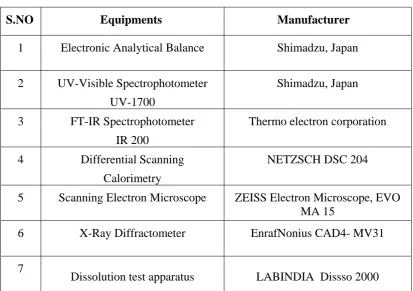
(12) S.No.. LIST OF TABLES. PAGE NO.. 1. Solubility Classification Scheme. 2. 2. Possible homosynthons and heterosynthons in the supramolecular. 11. Chemistry. 3. Type of different bonding interactions. 13. 4. Types Of Crystals. 23. 5. Serum And Tissue Levels Of Curcumin In Rodents And Human. 32. After Different Routes Of Administration 6. Materials Used For Study. 60. 7. Equipments Used For The Study. 61. 8. Standard Curve Of Curcumin In Ph 1.2 Buffer. 62. 9. Standard Curve Of Co-crystal In Ph 1.2 Buffer. 63. 10. FTIR Studies Of Pure Curcumin. 66. 11. FTIR Studies of Resorcinol. 70. 12. FTIR Studies of prepared crystals. 73. 13. Solubility Data In PH 1.2 Buffer. 77. 14. Determination Of Drug Content. 78. 15. Angle Of Repose. 78. 16. Compressibility Index. 79. 17. Hausner’s Ratio Limits. 80. 18. Quantity of Raw materials per Tablet (in mg). 82.
(13) 19. Pre Compression Parameters. 82. 20. Evaluation Chart Of Tablet. 85. 21. Disintegration Time. 86. 22. Uniformity Of Dispersion. 86. 23. Comparitive Invitro Dissolution Study Of Pure Drug And Prepared. 99. Crystals 24. Comparitive Invitro Dissolution Study Of Prepared Formulation. 100. (Tablets) 25. Release Kinetics Of Pure Drug. 101. 26. Release Kinetics Of Crystals By Lag Method. 102. 27. Release Parameters Of Pure Drug And Crystals. 102. 28. Accelerated Stability Studies. 107. 29. Effect of Curcumin-Resorcinol crystals in ethanol (8 ml/kg). 108. induced gastric ulcer in rats.
(14) S.NO.. LIST OF FIGURES. PAGE NO.. 1. Process Of Solubilisation. 3. 2. The Range Of Single Crystalline Forms That Is Possible For An. 12. API 3. A General Guideline For Co-Crystal Design And Screening. 18. 4. The Unit Cell. 22. 5. Curcumin. 25. 6. Two Forms Of Curcumin. 27. 7. Different Forms Of Curcumin. 28. 8. Uv-Vis Spectrum Of Curcumin In 40% Etoh-Water. 66. 9. Ftir Spectrum Of Pure Drug. 66. 10. Photography Of Curcumin. 67. 11. Dsc Thermo Gram Of Pure Curcumin. 68. 12. Powder Xrd Of Pure Curcumin. 68. 13. SEM Photograph of pure curcumin. 69. 14. Ftir Studies Of Resorcinol. 70. 15. Dsc Thermo Gram Of Pure Resorcinol. 71. 16. Xrd Spectra Of Pure Resorcinol. 72. 17. SEM Photograph of pure resorcinol. 73. 18. Ftir Spectra Of Crystals By L.A.G. Method. 74. 19. DSC thermo gram of prepared crystals. 75.
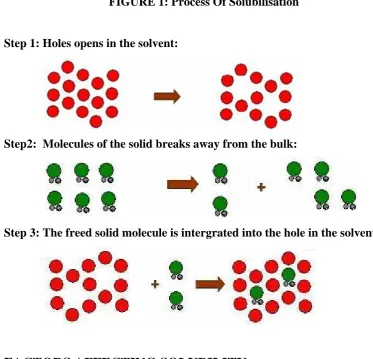
(15) 20. PXRD of prepared crystals. 76. 21. SEM Photograph of Prepared crystals. 77. 22. Photography of curcumin and prepared crystals. 91. 23. Comparative Ftir Spectra Of Curcumin Resorcinol And Prepared. 92. Crystals 24. DSC Thermo Grams Of Curcumin Resorcinol And Prepared. 94. Crystals 25. Comparative Pxrd Of Curcumin Resorcinol And Prepared Crystals. 95. 26. Comparative SEM of Curcumin, Resorcinol and Prepared crystals. 96. 27. Expected structure of prepared crystals crystal. 98. 28. Percentage Drug Release Of Pure Drug And Crystals. 99. 29. Effect of Curcumin-Resorcinol crystals pretreatment on ethanol-. 110. induced gastric ulcer in rats. 30. An effect of Curcumin-Resorcinol crystals pretreatment on ethanol -induced gastric ulcer in rats.. 111.
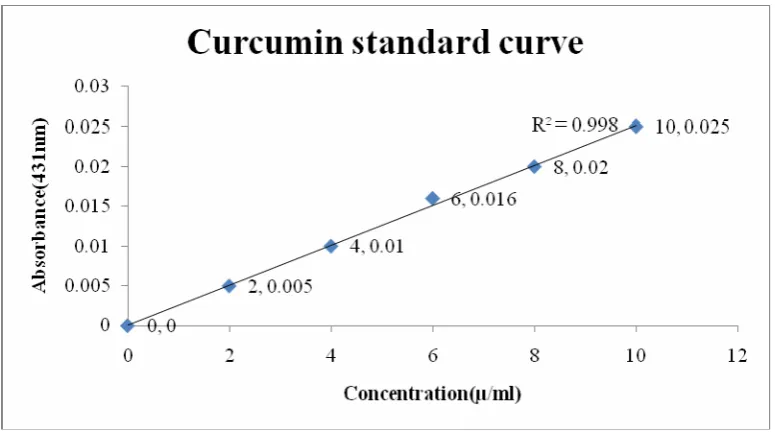
(16) S.No.. List of graphs. Page no.. 1. Standard Curve Of Curcumin In Ph 1.2 Buffer. 63. 2. Standard Curve Of Curcumin Resorcinol Crystals. 64. 3. Comparative invitro dissolution. 100. 4. Zero Order Release Model for Curcuminin pH 1.2 buffer. 103. 5. Zero Order Release Model for Curcumin crystals by liquid assisted. 103. grinding method in pH 1.2 buffer 6. First Order Release Model for Curcumin in pH 1.2 buffer. 104. 7. First Order Release Model for Curcumin crystals by Liquid assisted. 104. grinding method in pH 1.2 buffer 8. Higuchi Release Model for Curcumin in pH 1.2 buffer. 105. 9. Higuchi Release Model for Curcumin crystals by Liquid assisted. 105. grinding method in pH 1.2 buffer 10. Krosmeyer Release Model for Curcumin in pH 1.2 buffer. 106. 11. Krosmeyer Release Model for Curcumin crystals by Liquid-assisted. 106. grinding method in pH 1.2 buffer 12. Effect of prepared crystals in ethanol (8ml/kg) induced gastric ulcer in rats. 109.
(17) Chapter 1. Introduction. INTRODUCTION Solubility of active pharmaceutical ingredients (API) has always been a concern for formulators, since inadequate aqueous solubility may hamper development of parenteral products and limit bioavailability of oral products. In recent years, the problem has become more acute and more common as pharmaceutical companies cast the drug discovery net ever wider in the anticipation of finding new therapeutic approaches and improving drugs for existing therapeutic areas. Experimental determination of drug solubility is not a single event but is performed multiple times along the drug discovery and development process, the assays and their focus varying with the phase. Among the five key physicochemical screens in early compound screening, PKa, solubility, permeability, stability and lipophilicity, poor solubility tops of the list of undesirable compound properties. Compounds with insufficient solubility carry a higher risk of failure during discovery and development since insufficient solubility may compromise other property assays, mask additional undesirable properties, influence both pharmacokinetic and pharmacodynamic properties of the compound, and finally may affect the develop ability of the compound. Ideally solubility liabilities should be known prior to any functional evaluations. Conceptually, solubility is an easy parameter to measure but its meaning and concept of use is often different for discovery and development scientists and this can be a source of misunderstandings and controversy. In a broad sense, solubility may be defined as the amount of a substance that dissolves in a given volume of solvent at a specified temperature. More specifically, compound solubility can be defined as unbuffered, buffered, and intrinsic solubility. Unbuffered solubility, usually in water, means solubility of a saturated solution of the compound at the final pH of the solution (which may be far from pH 7 due to self-buffering)1. Buffered solubility also termed apparent solubility refers to solubility at a given pH, e.g. 2 or 7.5, measured in a defined pH-buffered system and usually neglects the influence of salt formation with counterions of the buffering system on the measured solubility value. Intrinsic solubility means the Department of Pharmaceutics. JKKNCP.
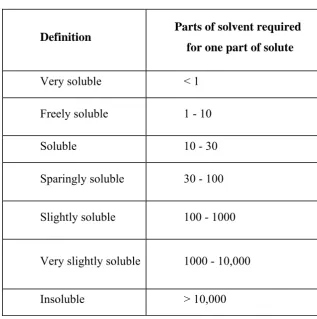
(18) Chapter 1. Introduction. solubility of the neutral form of an ionizable compound. For neutral (nonionizable) compounds all three definitions coincide. Solubility plays an essential role in drug disposition, since the maximum rate of passive drug transport across a biological membrane, the main pathway for drug absorption, is the product of permeability and solubility. Poor solubility has been identified as the cause of numerous drug development failures. It is one of the components of the Biopharmaceutical Classification Scheme (BCS) and is particularly important for immediate release BCS class II drugs, for which absorption is limited by solubility (thermodynamic barrier) or dissolution rate (kinetic barrier). TABLE 1: Solubility Classification Scheme. Definition. Parts of solvent required for one part of solute. Very soluble. <1. Freely soluble. 1 - 10. Soluble. 10 - 30. Sparingly soluble. 30 - 100. Slightly soluble. 100 - 1000. Very slightly soluble. 1000 - 10,000. Insoluble. > 10,000. PROCESS OF SOLUBILISATION: The process of solubilisation involves the breaking of inter-ionic or intermolecular bonds in the solute, the separation of the molecules of the solvent to. Department of Pharmaceutics. JKKNCP.
(19) Chapter 1. Introduction. provide space in the solvent for the solute, interaction between the solvent and the solute molecule or ion.. FIGURE 1: Process Of Solubilisation. Step 1: Holes opens in the solvent:. Step2: Molecules of the solid breaks away from the bulk:. Step 3: The freed solid molecule is intergrated into the hole in the solvent. FACTORS AFFECTING SOLUBILITY: The solubility depends on the physical form of the solid, the nature and composition of solvent medium as well as temperature and pressure of system.1 Particle Size The size of the solid particle influences the solubility because as a particle becomes smaller, the surface area to volume ratio increases. The larger surface area allows a greater interaction with the solvent. The effect of particle size on solubility can be described by2. Department of Pharmaceutics. JKKNCP.
(20) Chapter 1. Introduction. Where, S is the solubility of infinitely large particles S is the solubility of fine particles V is molar volume g is the surface tension of the solid r is the radius of the fine particle Temperature: Temperature will affect solubility. If the solution process absorbs energy then the solubility will be increased as the temperature is increased. If the solution process releases energy then the solubility will decrease with increasing temperature3. Generally, an increase in the temperature of the solution increases the solubility of a solid solute. A few solid solutes are less soluble in warm solutions. For all gases, solubility decreases as the temperature of the solution increases4. Pressure: For gaseous solutes, an increase in pressure increases solubility and a decrease in pressure decrease the solubility. For solids and liquid solutes, changes in pressure have practically no effect on solubility4. Molecular size: Molecular size will affect the solubility. The larger the molecule or the higher its molecular weight the less soluble the substance. Larger molecules are more difficult to surround with solvent molecules in order to solvate the substance. In the case of organic compounds the amount of carbon branching will increase the solubility since more branching will reduce the size (or volume) of the molecule and make it easier to solvate the molecules with solvent3.. Department of Pharmaceutics. JKKNCP.
(21) Chapter 1. Introduction. Polarity: Polarity of the solute and solvent molecules will affect the solubility. Generally non-polar solute molecules will dissolve in non-polar solvents and polar solute molecules will dissolve in polar solvents. The polar solute molecules have a positive and a negative end to the molecule. If the solvent molecule is also polar, then positive ends of solvent molecules will attract negative ends of solute molecules. This is a type of intermolecular force known as dipole-dipole interaction. Polymorphs: A solid has a rigid form and a definite shape. The shape or habit of a crystal of a given substance may vary but the angles between the faces are always constant. A crystal is made up of atoms, ions, or molecules in a regular geometric arrangement or lattice constantly repeated in three dimensions. This repeating pattern is known as the unit cell. The capacity for a substance to crystallize in more than one crystalline form is polymorphism. It is possible that all crystals can crystallize in different forms or polymorphs. If the change from one polymorph to another is reversible, the process is called enantiotropy. If the system is monotropic, there is a transition point above the melting points of both polymorphs. The two polymorphs cannot be converted from one another without undergoing a phase transition. Polymorphs can vary in melting point. Since the melting point of the solid is related to solubility, so polymorphs will have different solubilities2. SOLUBILITY ASSAYS IN DISCOVERY AND DEVELOPMENT: Depending on the experimental set-up, solubility measurements determine either the kinetic or the thermodynamic solubility of compounds. In most cases, kinetic (non-thermodynamic) solubility measurements start from dissolved compound and represent the maximum (kinetic) solubility of the fastest Department of Pharmaceutics. JKKNCP.
(22) Chapter 1. Introduction. precipitating species of a compound. The type of precipitating material is not determined and can be amorphous or crystalline, neutral or a salt, exist as a cocrystal or a combination of these possibilities. Kinetic solubility values are strongly time dependent and due to the degree of super-saturation that may occur, values are likely to over predict the thermodynamic solubility and are not expected to be reproducible between different kinetic methods11. For thermodynamic solubility measurement, the dissolution rate of compounds plays an important role, since the compound's crystal lattice has to be disrupted as part of the solubilization process. Consequently, the amorphous material or poorly crystalline material that is often generated in early discovery almost always exhibits higher solubility in all solvents compared to crystalline drug12. Apart from crystallinity, the dissolution rate is affected by a number of additional factors, such as stirring rate, drug solubility, temperature, time, particle size, compound wettability, solvent viscosity (diffusion coefficient), and the polarity of the solvent13. In practice, ‘equilibrium’ solubility is often determined only by single measurements, generally after 24–48 h. However, to really confirm that equilibrium has been achieved, compound solubility has to be constant with time and hence solubility measurements at several time points are necessary. The key questions addressed by solubility assays in development focus on formulation and solid phase properties of compounds and on the identification of in vitro/in vivo correlations. In early development, thermodynamic assays are performed to confirm earlier kinetic solubility results, to rule out potential artifacts, and to generate quality solubility data with crystalline material to support the discovery scientist in the selection of potential clinical candidates. Re-testing of compound solubility of new batches in this and in subsequent development phases is a must. Frequently, amorphous or partially crystalline material in early batches is gradually replaced in subsequent large scale batches by polymorphs with increasing thermodynamic stability and higher purity which may in turn result in significantly lower compound solubility14,16.. Department of Pharmaceutics. JKKNCP.
(23) Chapter 1. Introduction. In early development, solubility screens are also performed in organic solvents. They are required to support initial salt and polymorph screening activities which aim to generate pure, stable, crystalline material in the most desirable physical form of the compound as early as possible for development17. Additionally, organic solvent solubility data are very useful for formulators, process chemists, and analytical chemists for formulation, scale-up, and analytical method development, respectively17. In much later phases, the solubility profile in organic solvents is necessary to develop efficient cleaning validation protocols for the cleaning of pilot plant and equipment, which comply with regulatory requirements. CRYSTAL ENGINEERING: Polymorphism, which is the definite arrangement of molecules within a solid, has been known to influence various physicochemical and biological properties of a crystalline moiety. However, crystal habit has been paid scant attention. Crystallization is commonly employed as the final step for purification of a drug. Use of different solvents and processing conditions may alter the polymorphic state and or habit of the purified drug, leading to variation in raw material characteristics. In addition, crystal habit influences flowability, packing, compaction, syringability, stability and dissolution characteristics of a drug powder.. Department of Pharmaceutics. JKKNCP.
(24) Chapter 1. Introduction. “Crystal engineering is the understanding of intermolecular Interactions in the context of crystal packing and in the utilization of such Understanding in the design of new solids with desired physical and chemical properties.”102 Crystal engineering allows for the design of new compositions or multicomponent crystalline phase of matter using existing pharmaceuticals, which allows for a much wider range of possible pharmaceutical compositions than present approaches such as salt formation (ion-pairing). It has been suggested that pharmaceutical co-crystals could play a major role in the future of pharmaceutical formulations given that they, in principle, will outnumber polymorphs, solvates and pharmaceutical salts combined. The physical properties of interest for specific API’s could be systematically optimized by rational design. New opportunities for producing a larger diversity of solid forms of drug substances exhibiting the proper balance of important properties for development into a viable and effective drug product may be met by co-crystals18. Furthermore, exploring the co-crystallization potential around an API increases the intellectual property protection over a particular drug product; thus, reducing the risk of costly litigation and market erosion19,20.. Department of Pharmaceutics. JKKNCP.
(25) Chapter 1. Introduction. CRYSTAL ENGINEERING FOR IMPROVING SOLUBILITY AND DISSOLUTION RATES: Crystal engineering approaches, which can potentially be applied to a wide range of crystalline materials, offer an alternative and potentially fruitful method for improving the solubility, dissolution rate and subsequent bioavailability of poorly soluble drugs. The ability to engineer materials with suitable dissolution characteristics, whilst maintaining suitable physical and chemical stability provides a strong driver for the utilisation of new and existing crystal engineering approaches to drug delivery system design. The challenges of low aqueous solubility provide an ideal situation for the application of crystal engineering techniques for improving bioavailability, whilst also developing stable and robust pharmaceutical products. Therefore potential utility of crystal engineering as an approach for designing efficacious dosage forms for poorly soluble drugs. Crystal engineering is taken as the design of molecular solids in the broadest sense with the aim of tailoring specific physical or chemical properties. The subject of the approaches is therefore to present those diverse aspects of crystal engineering which may be used to manipulate the solubility and or dissolution rate of the parent molecular components in the crystalline state. At the centre of these available approaches is the need to change surface and molecular assembly in equilibrium with a solution. Consequently, it covers the possible ways; this may be achieved from recent developments in the study of molecular solids and reviews topical issues such as habit modification, polymorphism, solvation, co-crystal formation and surface modification. Particular attention will be paid to the area of co-crystallisation, which is an emerging area of strategic importance to the pharmaceutical sector. Although numerous strategies exist for enhancing the bioavailability of drugs with low aqueous solubility, the success of these approaches is not yet able to be guaranteed and is greatly dependent on the physical and chemical nature of the molecules being developed. Crystal engineering offers a number of routes to improved solubility and dissolution rate, which can be adopted through an in-depth Department of Pharmaceutics. JKKNCP.
(26) Chapter 1. Introduction. knowledge of crystallization processes and the molecular properties of active pharmaceutical ingredients. CRYSTAL ENGINEERING IN DRUG DEVELOPMENT: Crystal engineering has been described as the ‘exploitation of non-covalent interactions between molecular or ionic components for the rational design of solid-state structures that might exhibit interesting electrical, magnetic, and optical properties’. It is also recognized that it ‘is becoming increasingly evident that the specificity, directionality, and predictability of intermolecular hydrogen bonds can be utilized to assemble supramolecular structures of, at the very least, controlled dimensionality’. Crystal engineering now encompasses many aspects of solid-state intermolecular interactions, structure prediction, control and rationalisation, as well as the synthesis of novel molecular building blocks and crystalline materials, and may be broken down into the components of analysis and synthesis. Within the notion of a crystal as a supramolecular entity lies certain key ideas central to the activity of crystal engineering. These are the nature of the crystallisation process at a molecular level, crystal packing, molecular interaction and directed molecular recognition, which will all be explored to some extent in this review and which should provide some understanding of crystal engineering approaches as a means of addressing the challenges of low aqueous solubility. It is clear that the crystal and particle engineering strategies have notable potential to strengthen the available methods for addressing problems of low aqueous solubility of drug substances. These methods are applicable not only to molecules of a specific physical and chemical nature, but to a wide range of crystalline materials, although a comprehensive knowledge of drugs at the molecular level is required to determine the appropriate approach to improving solubility and dissolution rate. SUPRAMOLECULAR TECHNIQUE:. Department of Pharmaceutics. JKKNCP.
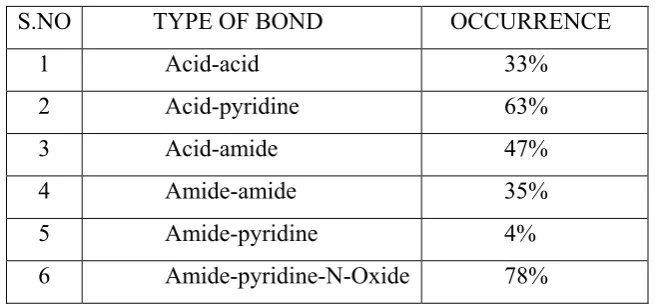
(27) Chapter 1. Introduction. Supramolecular chemistry has grown around Lehn's analogy that ‘supermolecules are to molecules and the intermolecular bond, what molecules are to atoms and the covalent bond’. If molecules are built by connecting atoms with covalent bonds, solid-state supermolecules (crystals) are built by connecting molecules with intermolecular interactions. The fundamentals of crystal engineering were described in detail under the term ‘molecular engineering’21. Modern crystal engineering initially began as a method for understanding the regioselectivity and product distribution in solid-state molecular reactions, termed topochemistry21. This field has developed rapidly, particularly with the arrival of modern crystallographic techniques such as four circle diffractometers in the early 1970's followed by the introduction of area detector technology. Supramolecular chemistry is an important, interdisciplinary branch of science and compassing ideas of physical and biological processes, defined as ‘chemistry beyond the molecule’, i.e. the chemistry of molecular aggregates assembled via non-covalent interactions22,23. The term ‘synthon’ was initially established. to. explain. synthetic. organic. structural. features. The. term. ‘supramolecular synthon’ established by Desiraju is defined as: “Structural units within super molecules which can be formed and/or assembled by known conceivable synthetic operations involving intermolecular interaction”.. TABLE 2: Possible homosynthons and heterosynthons in the supramolecular Chemistry S.NO. TYPE OF BOND. OCCURRENCE. 1. Acid-acid. 33%. 2. Acid-pyridine. 63%. 3. Acid-amide. 47%. 4. Amide-amide. 35%. 5. Amide-pyridine. 4%. 6. Amide-pyridine-N-Oxide. 78%. Department of Pharmaceutics. JKKNCP.
(28) Chapter 1. Introduction. In biological processes, supramolecular chemistry is nothing but noncovalent molecular binding recognized by Paul Ehlrich and Emil Fisher’s lockand-key. principle. through. concept. of complementarily. and. selectivity.. Progressively non-covalent bonds were understood in more detail and the importance of supramolecular chemistry was well established by 1987. Supramolecular chemistry has broad range of applications in different areas such as catalysis, material technology, green chemistry, data storage and processing. Apart from these supramolecular chemistry has been used in the design and development of new pharmaceutical therapies by understanding the interactions at a drug binding site.. Department of Pharmaceutics. JKKNCP.
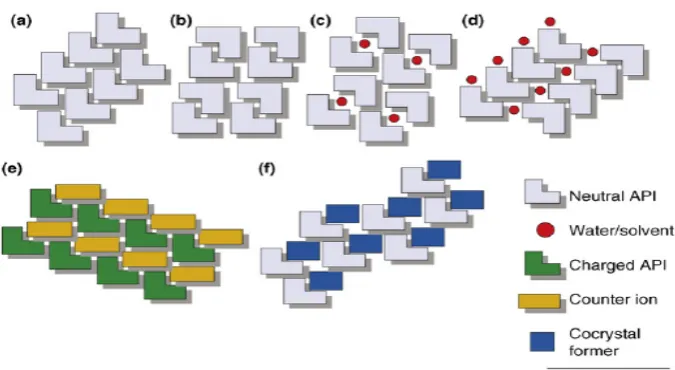
(29) Chapter 1. Introduction. Figure 2: The range of single crystalline forms that is possible for an API: (a) pure API; (b) polymorph of pure API; (c) clathrate hydrate/solvate of API; (d) hydrate/solvate of API; (e) salt of API; (f) pharmaceutical co-crystal. Salts and cocrystals can also form hydrates, solvates, and polymorphs.. COCRYSTALS: Pharmaceutical materials science being a fundamental branch that continuously provide important insights, theories, and technologies to formulation sciences. During the development of the pharmaceutical industry, crystallization has been engaged more and more extensively for the purification, separation particle formation and co-crystallization of pharmaceutical materials It is estimated that more than 70% of all solid drugs are produced by crystallization. With regards to this, an understanding of the effect of the crystallization process on the final solid state of a drug is vital for several of the activities of the pharmaceutical industry. The recent advances in this area have brought the possibility to produce pharmaceutical materials by design. In particular, the formation of co-crystals, i.e. crystalline molecular complexes of two or more neutral molecules, represents a potential route to achieve pharmaceutical materials with improved properties of interest, including dissolution rate and stability under conditions of high relative humidity. Department of Pharmaceutics. JKKNCP.
(30) Chapter 1. Introduction. Co-crystals consists of API and a stoichiometric amount of a pharmaceutically acceptable co-crystal former. APIs are among the most valuable crystalline substances and crystal engineering has been successfully utilized in the generation of cocrystals of drugs with improved physicochemical properties such as solubility, stability and bioavailability in pharmaceutical development without changing the chemical composition of the API. These can be constructed through several types of interaction, including hydrogen bonding, pi-stacking, and vander Waals forces. Phase transformations induced during processing or storage affects the mechanisms of conversion of crystalline drugs to co-crystals. Pharmaceutical co-crystals considered better alternatives to optimize drug properties could play a major part in the future of API formulation and can be employed for chiral resolution. TABLE 3: Type of different bonding interactions INTERACTION TYPE. EXAMPLE. Very strong H bonds. O...H...O- , F...H...F-. Coordinative bonds. M...N , M...O. Strong hydrogen bonds. O...H...O , N...H...O. Weak hydrogen bonds. C—H...O , O—H..pi. Van der waals interactions. CH3...CH3 , CH3...Ph. Hetero atom interactions. N...Cl ,I...I , Br...Br. pi-stacking. Ph...Ph , nucleobases. Co-crystallization is a result of competing molecular associations between similar molecules, or homomers, and different molecules or heteromers23. Hydrogen bonds are the basis of molecular recognition phenomena in pharmaceutical systems and are responsible for the generation of families of molecular networks with the same molecular components (single component crystals and their polymorphs) or with different molecular components (multiple component crystals or co-crystals) in the crystalline state24 Cocrystals with the same active pharmaceutical ingredient will have strikingly different pharmaceutical Department of Pharmaceutics. JKKNCP.
(31) Chapter 1 Introduction properties (melting point, solubility, dissolution, bioavailability, moisture uptake,. chemical stability, etc.), depending on the nature of the second component.. A co-crystal can be described as a crystalline structure formed by two different or more molecular entities where, in contrast to salts, the intermolecular interactions are not ionic, but weak forces like hydrogen bonding and π-π stacking. The big advantage of co-crystals compared to salts is that co-crystallisation is also applicable to non-ionisable molecules where salt formation is not possible. Co-crystals offer great potential in various fields: •. Chiral resolution: whether a molecule is ionisable or not, selective diastereomeric. co-crystallisation. can. be. attainable. using. an. enantiomerically pure coformer. •. Separation and purification: co crystals can be a good option, especially with non-ionisable products, to purify some intermediates, consequently avoiding expensive chromatographic techniques.. •. Crystallisation of non-solid products: liquids, pastes and oily products can become a solid form by means of co-crystallisation, leading to more robust and efficient manufacturing processes.. •. Improvement of solid state properties (of APIs and other organic substances): several important characteristics of pharmaceutical substances like solubility, bioavailability, stability, hygroscopicity, morphology, filtration and flowability can be modified by means of co-crystal formation. In the case of APIs, it is remarkable that the number of pharmaceutically acceptable co-crystal formers is larger than the number of counter ions for salt formation. In the pharmaceutical field, the increase attention of investigation of co-. crystal forms of API relates to four main factors: a) Design - many drugs contain functional groups which are complimentary to a range of coformers to form pharmaceutical cocrystals.. Department of Pharmaceutics. JKKNCP.
(32) Chapter 1. Introduction. b) Discovery - numerous processes, including conventional solution crystallisation, liquid assisted grinding, slurry conversion and melts crystallisation, can be used to generate wide ranges of co-crystal forms of drugs. c) Diversity-. Pharmaceutical. co-crystals. demonstrate. different. physicochemical properties compared with pure crystal forms of API. d) Development - Co-crystals signify non-obvious forms of drugs and therefore can represent intellectual property for future development. Additionally pharmaceutical co-crystals enhance other essential properties of the APIs such as chemical stability, compressibility, flowability and hygroscopicity25,26. Pharmaceutical Co-crystals: An alternative approach available for the enhancement of drug solubility, dissolution and bioavailability, is through the application of crystal engineering to co-crystals, historically referred to as molecular complexes. The physicochemical properties and the bulk material properties of the API can be modified, at the same time as maintaining the intrinsic activity of the drug molecule. Pharmaceutical co-crystallization is emerging as an attractive alternative to polymorphs, salts and solvates in the modification of an active pharmaceutical ingredient (API) during dosage form design. The intellectual property implications of creating co-crystals are also highly relevant. This approach of co-crystal involves the expansion of a supramolecular library of co-crystallizing agents. A hierarchy of guest functional groups is classified within the library according to a specific role to a crystal packing arrangement, which is dependent on the host molecule functionalities. These are obtained from investigation of structure property relationships present in the CSD which contains classes of known crystal structures27. Generally in the pharmaceutical industry, Chemists and engineers try to deliver crystalline forms of their active compounds, principally due to the inherent stability of crystalline Department of Pharmaceutics. JKKNCP.
(33) Chapter 1. Introduction. materials and the well-established impact of crystallization processes on isolation and purification of chemical substances28. Increasing interest is now receiving on the impact of properties of material on drug discovery and development29, The task of pharmaceutical industry is to quick advance development programs through good confidence with the intention that formulation problems are unlikely to occur and to maximize a compounds potential as a therapeutic30. A major tool which is accountable for the majority of directed intermolecular interactions in molecular complex pharmaceuticals is the hydrogen bond. Co-crystals are multi-component crystals depend on hydrogen bonding interactions lacking the transfer of hydrogen ions to form salts. Pharmaceutical cocrystals can be defined as multicomponent crystalline materials comprised of an API and one or more unique co-crystal formers, which are solids under ambient conditions. For nonionizable compounds, co-crystals enhance pharmaceutical properties by modification of solubility, dissolution rate, chemical stability, mechanical behavior, moisture uptake and bioavailability31. Recently, Pharmaceutical co-crystallization has only gained widespread attention as a tool of changing the physicochemical properties of drugs, for the reason that co-crystal formation may probably be employed with all drugs, including acidic, basic and non ionizable molecules and a large number of probable ‘counter molecules’ which possibly considered to be non toxic possibly rising the scope of the pharmaceutical co- crystallization over the salt forms. To salt selection, an correlation can be drawn in which pKa point of view are used to select acid-base pairs that can be converted to salt compounds. Chemistry exhibits that a pKa difference between an acid and a base of at least two units is necessitated to form a salt that is stable in water32. In addition, it is significant to remember that salt formation is usually directed at a single acidic and basic functional group. On the contrary co-crystals can concurrently address multiple functional groups in a single API. As well space is not limited to binary combinations that is acid-base pairs as tertiary and quaternary cocrystals are realistic one33,34.. Department of Pharmaceutics. JKKNCP.
(34) Chapter 1. Introduction. The key difference between solvates and co-crystals is the physical state of the individual components35. At room temperature if one component is liquid then the crystals were assigned as solvates, if both components are solids at room temperature then the crystals are called as co-crystals. Though, co-crystals have a propensity to be a product of more rational design and are more stable, predominantly as the co-crystallizing agents are solids at room temperature. The key remunerations associated with approach of co-crystallization to alter the properties of pharmaceutical solids are the theoretical ability of all types of drug molecules to form co-crystals including weakly ionisable and nonionizable, and the existence of numerous, potential countermolecules, including preservatives, food additives, pharmaceutical excipients as well as other drugs, for co-crystal synthesis. Major advantage for the pharmaceutical industry is co-crystal synthesis which may offer is an opportunity to address intellectual property (IP) issues by extending the life cycles of old APIs36. Co-crystals - Preparation Methods: Formation of co-crystal described shows the disreputably difficult situation these systems present with regard to preparation it has been recognized to take 6 months to prepare a single co-crystal of appropriate quality for single X-ray diffraction analysis37. This is partially as such a heteromeric system will only form if the non covalent forces between two or more molecules are stronger than between the molecules in the corresponding homomeric crystals. Cocrystal design strategies are still being researched and the mechanism of formation is far from being understood. Co-crystals can be prepared by solid and solvent based techniques. The solvent-based techniques involve solvent evaporation, slurry conversion, cooling crystallization and precipitation. The solid based techniques involve net grinding, solvent-assisted grinding and sonication (applied to both to dry or wet solid mixtures) 80o to 85° 38.. Department of Pharmaceutics. JKKNCP.
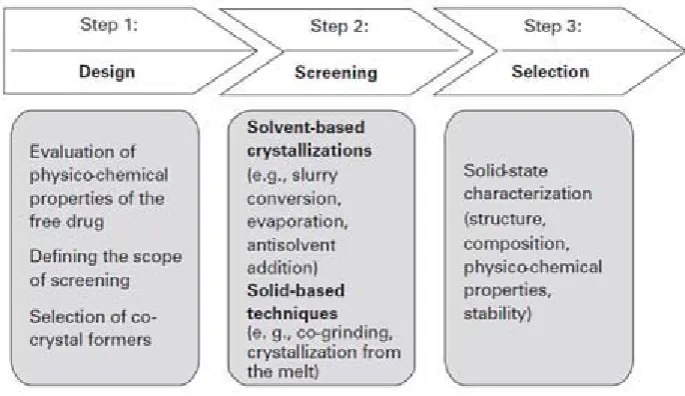
(35) Chapter 1. Introduction. Figure 3: A general guideline for co-crystal design and screening.. Co-crystallization from Solution: The two components must have similar solubility for solution cocrystallization; otherwise the component which has least soluble will precipitate out entirely. On the other hand similar solubility of two components alone will not promise success. It has been recommended that it possibly useful to believe polymorphic compounds, which exist in more than one crystalline form as cocrystallizing components. If a molecular compound exists in numerous polymorphic forms it has showed a structural flexibility and is not locked into a single type of crystalline lattice or packing mode. Therefore, the possibility of conveying such a component into a different packing arrangement in coexistence with another molecule is improved. Obviously polymorphism alone does not promise the functionality of a molecule to act as a co-crystallizing agent, at the same time as the ability of a molecule to contribute in intermolecular interactions clearly plays a critical role39. Co-crystal from Small-scale preparation has been described. Scale-up crystallization was carried out in a water-jacketed glass crystallization vessel and temperature was controlled by a circulating water bath. Teflon blade and overhead stirrer with a glass shaft were attached to vessel ports and also a reflux column, Department of Pharmaceutics. JKKNCP.
(36) Chapter 1. Introduction. digital thermometer were attached. The API and cocrystal former were added to this vessel and were dissolved in ethanol/methanol mixture and heated to 700 C under reflux for 1 hour. To induce precipitation of co-crystal, temperature was decreased at a rate of 100 C in a stirred, un seeded system. Literate to improve solids recovery decrease the additional temperature40. Co-crystallization by Grinding: The product acquired when preparing co-crystals from grinding is usually consistent with that obtained from solution. This may specify that patterns of hydrogen-bond connectivity are not idiosyncratic or determined by non-specific and uncontrollable effects of solvent or crystallization conditions. Many co-crystal materials can be prepared from both solution co-crystallization and solid-state grinding, some can only be prepared by solid-state grinding where as some can be prepared by solution cocrystallization. For instance, in the co-crystallization of 2,4,6- trinitrobenzoic acid and indole-3-acetic acid, different crystal forms were prepared from solution when compared with grinding co-crystallization. Disappointment in co-crystals formation by grinding co-crystallization possibly due to an incapability to generate suitable co-crystal arrangements rather than due to the stability of the initial phases. The reason for the successful formation of co-crystal from solution but not from grinding may be of solvent inclusion in stabilizing the supramolecular structure. Even though formation of co-crystal by solidstate grinding has been established for a moment and a late 19th century report is frequently cited as the initial reference to such a procedure, the current technique of liquid assistant grinding has been shown to improve the kinetics and facilitate co-crystal formation and as lead to increased attention of solid-state grinding as a method for cocrystallization39. Co-crystallization by Slurry conversion: Experimentations in slurry conversion were carried out in different organic solvents and water. 100 to 200 ml of Solvent was added and the resulting Department of Pharmaceutics. JKKNCP.
(37) Chapter 1. Introduction. suspension was stirred at room temperature for few days. After few days, the solvent was decanted and the solid product was dried under a flow of nitrogen for few minutes. The remaining solids were then characterized using PXRD analysis40. Co-crystallization by addition of ant solvent: This is one of the precipitation methods for co-crystallization of the coformer and drug. In this method, solvents include buffers (pH) and organic solvents. For instance in preparation of aceclofenac-chitosan cocrystals, in which solution of chitosan was prepared by soaking chitosan in glacial acetic acid for few hours. By using high dispersion homogenizer the drug was dispersed in chitosan solution. This dispersion was added to distilled water or sodium citrate solution to precipitate chitosan on drug40. Sublimation: If a compound is sufficiently volatile at accessible vacuum pressures it can be crystallized. This technique is often used in the purification of crude mixtures. Crystals may form from a fusion, or by sublimation; but crystallization almost always takes place from solution39. Melting: Melts have generated an interest in co-crystal formation. By simply melting two co-crystal formers together and cooling, a co-crystal may be formed. If a cocrystal is not formed from a melt, a seed from a melt may be used in a crystallization solution in order to afford a co-crystal41. Seeding: A seed crystal of the same or a similar material is added to a supersaturated solution in order to induce the growth of single crystals of a certain form as the solution evaporates41.. Department of Pharmaceutics. JKKNCP.
(38) Chapter 1. Introduction. Pharmaceutical Co-Crystals as Intellectual Property: Compared to other types of solid forms, co-crystals possessed particular scientific and regulatory advantages, and alongside these advantages were intellectual property issues which give co-crystals with exclusive opportunities and challenges. Researchers accounted the importance about patents on pharmaceutical co-crystals to the pharmaceutical industry42. The worth of co-crystals to the pharmaceutical industry should become clearer, mostly with respect to several relevant legal and regulatory issues, as products containing co-crystal technology come out from pharmaceutical development pipelines onto the market. Characterization of Co-Crystals: Characterization spectroscopy, 42,44. diffraction). single. of. co-crystals. crystal. x-ray. involves. both. crystallography. structures and. (infrared. powder. x-ray. and physical properties (e.g. melting point apparatus, differential. scanning calorimetry, thermo gravimetric analysis)45,46. The analytical prospective of NIR spectroscopy for co-crystal screening using Raman spectroscopy as a comparative technique has been reported47. Crystallography: X-ray crystallography is the study of crystals and their structure by means of the diffraction of X-rays by the frequently spaced atoms of crystalline materials44,48. When an X-ray beam is directed at a crystalline sample, the atomic structure of the lattice causes the X-rays to be scattered in a defined manner creating a diffraction pattern. The electron density in the crystal may be deduced from this diffraction pattern, enabling an accurate molecular structure to be determined. To understand this theory further and precisely determine crystal structures it is useful to have a general knowledge of crystal structures and their interaction with X-rays48,84.. Crystal Structure: Department of Pharmaceutics. JKKNCP.
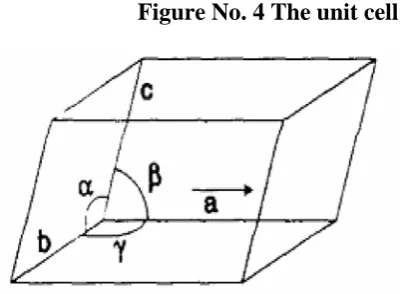
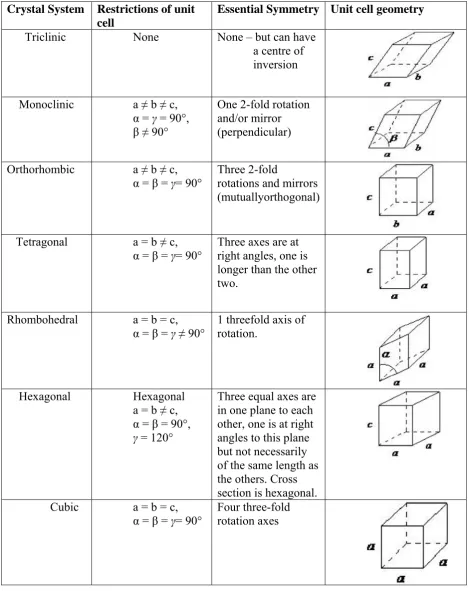
(39) Chapter 1. Introduction. Crystalline solid compounds are highly ordered structures; the molecules are arranged in an exactly regular array that is repeated by translation in three dimensions. Consequently crystal structures consist of structural units that are stacked side by side in all directions, thus forming a lattice in which the molecules in the repeated structural units are thought of as points. The lattice is considered to be infinitely large. The lattice points connect to form unit cells - a unit cell is the smallest group of atoms which has the overall symmetry of a crystal structure. The entire lattice can be built up by repetition of the unit cell in three dimensions. Figure no. 4 depicts a unit cell; it is a parallelepiped defined by sides of length a, b and c, and three angles α, β, γ. The number of molecules in the unit cell is given as Z; the number of molecules in the asymmetric unit is given as Z’48. Figure No. 4 The unit cell. Crystal Systems: Due to restrictions imposed by reflection and rotation symmetry on the unit cell parameters, there are only seven types of crystal systems possible. These are shown in Table no. 348.. Department of Pharmaceutics. JKKNCP.
(40) Chapter 1. Introduction. TABLE 4: TYPES OF CRYSTALS Crystal System Triclinic. Monoclinic. Restrictions of unit cell None. Essential Symmetry Unit cell geometry None – but can have a centre of inversion. a ≠ b ≠ c, α = γ = 90°, β ≠ 90°. One 2-fold rotation and/or mirror (perpendicular). Orthorhombic. a ≠ b ≠ c, α = β = γ= 90°. Three 2-fold rotations and mirrors (mutuallyorthogonal). Tetragonal. a = b ≠ c, α = β = γ= 90°. Three axes are at right angles, one is longer than the other two.. Rhombohedral. a = b = c, α = β = γ ≠ 90°. 1 threefold axis of rotation.. Hexagonal a = b ≠ c, α = β = 90°, γ = 120°. Three equal axes are in one plane to each other, one is at right angles to this plane but not necessarily of the same length as the others. Cross section is hexagonal. Four three-fold rotation axes. Hexagonal. Cubic. a = b = c, α = β = γ= 90°. Department of Pharmaceutics. JKKNCP.
(41) Chapter 1. Introduction. Lattice Types: Within these seven crystal systems there are two possible lattice types: primitive and non-primitive. A primitive lattice (P) only has lattice points at the corners of the unit cell, whereas a non-primitive lattice also has points on the faces or within the unit cell as well as on the corners. Non primitive lattices may be sidecentred (A, B or C), face-centred (F) with a lattice point at the centre of each face, body-centred (I) with a lattice point at the centre of the unit cell, or in the special case of trigonal rhombohedra, doubly-centred at (⅓,⅓, ⅔) and (⅔, ⅔, ⅓).. Bravais Lattices: When the above crystal systems and lattice types are combined, only 14 crystal lattices are possible. These lattices are called Bravais lattices as they were defined by Bravais and Frankenheimer in the19th century. Figure depicts these lattices – they correspond to the seven unit cell shapes of the seven different crystal systems. Each lattice has a centre of inversion and all the points in the lattice are equivalent byinversion48. Space Groups: In a single molecule the various combinations of symmetry operations are called point groups as all the symmetry elements refer to one point49. For a crystal, however, the symmetry elements are arranged in space in accordance with the lattice translational symmetry, therefore these sets of symmetry operations are called space groups50. There are 230possible space groups; each space group represents a combination of point and space symmetry elements that is compatible with the geometrical requirements of 3-D lattices. The complete crystal structure can be obtained from the asymmetric unit and its appropriate space group symmetry operations. Each space group is denoted by a symbol comprising of an upper case letter showing the Bravais lattice type followed by lower case numbers and letters to represent the combination of symmetry elements present. Rotation and screw axes Department of Pharmaceutics. JKKNCP.
(42) Chapter 1. Introduction. are symbolized by numbers and mirror and glide planes by letters. For example, P21/c is the most common space group consisting of a primitive unit cell with a screw axis parallel to the b-axis and a glide plane perpendicular to b with translation along c. The International Tables for Crystallography list all 230 space groups and their associated systematic absent reflections50. CURCUMIN: Turmeric has been used historically as a component of Indian Ayurvedic medicine since 1900 BC, to treat a wide variety of ailments. Research in the latter half of the 20th century has identified curcumin as responsible for most of the biological activity of turmeric4,51 Invitro and animal studies have suggested a wide range of potential therapeutic or preventive effects associated with curcumin. At present, these effects have not been confirmed in humans. However, as of 2008, numerous clinical trials in humans were underway, studying the effect of curcumin on various diseases, including multiple myeloma, pancreatic cancer, my elodysplastic syndromes, colon cancer, psoriasis and Alzheimer’s disease5,52. FIGURE 5: CURCUMIN. Department of Pharmaceutics. JKKNCP.
(43) Chapter 1. Introduction. TURMERIC COMPOSITION: CURCUMIN: The most active component of turmeric is curcumin, which makes up 2 to 5% of the spice. The characteristic yellow colour of turmeric is due to the curcuminoids, first isolated by Vogel in 1842. Essential oils: They are about 1.5 and 5.5% of the composition. These essential oils consist of a 60% of sesquiterpene, lactone, turmerone. They also contain zingiberene (25%), α- and γ-atlantone, bisabolene, guaiane, germacrene, 1,8cineole, borneol, δ-sabinene, caprilic acid, dehydroturmerone, 1-phenyl-HONpentane, limonene, linalol, eugenol, curcumenol, curcumenone, curlone and phelandrene. Other active principles: Turmeric extract is rich in carbohydrates, especially in starch (45-55%). It also contains arabinogalactans (ukonans), potassium salt and resins. Turmeric is a popular spice frequently used in Indian foods and curry. The biological activities of turmeric are attributed to the active component, curcumin. Curcumin today occupies a unique global niche as “A Wonder Molecule”. Curcumin (1, diferuloylmethane) is the active ingredient in the traditional herbal remedy and dietary Indian spice turmeric; it is derived from the rhizome of the herb Curcuma longa. Curcumin is extracted from turmeric by solvent extraction. Powdered turmeric is dissolved in a suitable solvent (such as ethanol, acetone, or methanol) and solvent is partially evaporated. The concentrate is then cooled to allow curcumin to crystallize. After a wash with solvent such as hexane, impurities are removed and residual solvent vaporized to obtain yellow crystals of curcumin.. Department of Pharmaceutics. JKKNCP.
(44) Chapter 1. Introduction. Curcumin is classified as a hydrophobic polyphenol compound that gives turmeric its bright yellow colour. Besides being a popular dietary supplement, it is used as a food colouring agent. Curcumin holds a high place in ayurvedic medicine as a “cleanser of the body,” and today, science has documented several diseased conditions that can be healed by the active ingredients of turmeric54-7,55-8. CHEMISTRY: Curcumin was first chemically characterized in 1910. Chemically, curcumin is bis-α,β-unsaturated β-diketone (diferuloylmethane) which exists in a keto-enol tautomerism where keto is predominant in neutral and acidic pH and stable-enol form is in alkaline pH . FIGURE 6: TWO FORMS OF CURCUMIN. It is a hydrophobic phenol that is insoluble in water, but soluble in acetone, DMSO and alcohol. At pH 3–7, curcumin acts as a potent H-atom donor and at alkaline pH, curcumin acts mainly as an electron donor. Curcumin has a molecular weight of 368.37 and a melting point of 183°C. Commercial grade curcumin (from Sigma Aldrich) has 70% curcumin, 1020% of demethoxycurcumin and less than 5% of bis demethoxycurcumin . Commercial grade curcumin is known to have comparable inhibitory effects on carcinogenesis as pure curcumin. This can be attributed to the pro- and anti-oxidant capacities of both the analogue of curcumin 56-11,57-12. Department of Pharmaceutics. JKKNCP.
(45) Chapter 1. Introduction. FIGURE 7: DIFFERENT FORMS OF CURCUMIN Chemical structure of curcuminoids. Curcumin (A), curcumindemethoxy derivatives. (demethoxycurcumin. and. bisdemethoxycurcumin)(B). and. hydrogenated curcumin metabolites (tetrahydrocurcumin, hexahydrocurcumin and octahydrocurcumin).. Activities of curcumin: Curcumin has been shown to exhibit following well established activities: Antioxidant58,9 Anti-inflammatory59,10 Antimicrobial60-11,61-12 Anticarcinogenic62,13 Hepato and nephro-protective63-14,64-15 Thrombosis suppressing65,16 Myocardial infarction protective 66-17,67-18 Hypoglycemic68-19,69-20 Anti-atherosclerotic 70,21 Antirheumatic71,22 Department of Pharmaceutics. JKKNCP.
(46) Chapter 1. Introduction. It also inhibits lipid per oxidation and scavenges super oxide anion, singlet oxygen, nitric oxide and hydroxyl radicals72,23. Recent work has also demonstrated that curcumin possesses the ability to prevent protein aggregation in debilitating diseases such as Alzheimer’s 73,24and Parkinson’s74,25 . Various animal models75,26 or human studies76-27,77-28 proved that curcumin is extremely safe even at very high doses. For example, three different phase I clinical trials indicated that curcumin, when taken as high as 12 g per day, is well tolerated. 76-27,77-28. . Despite having multiple benefits and extremely superior safety. profile, the administration of curcumin to patients has a serious practical problem.. Challenges: A major challenge in using curcumin for treatment of diseases is the poor. aqueous solubility (20 μg/mL), which significantly limits its availability in. biological systems. For the fraction of curcumin that is aqueous soluble, another main challenge to widespread clinical application is the lack of stability. Curcumin undergoes rapid degradation first by hydrolysis, which is then followed by molecular fragmentation 78,29 . After oral administration, curcumin was poorly absorbed 79,30 and only trace amounts of curcumin compound appeared in blood76,27, while most orally administered curcumin was excreted in the feces and urine after rapid metabolization in the intestine to form several reduced products. 80,31. . One of the. causes of reduced bioavailability of curcumin is due to its poor solubility in water at either acidic or physiological pH, which makes curcumin hard to absorb81,32. Together with membrane permeability, drug solubility is among the key determinants for oral bioavailability.. Department of Pharmaceutics. JKKNCP.
(47) Chapter 1. Introduction. The reasons for reduced bioavailability of any agent within the body are low intrinsic activity, poor absorption, and high rate of metabolism, inactivity of metabolic products and/or rapid elimination and clearance from the body. The poor bioavailability of curcumin from biological system82,33 is due to its: •. Low absorption. •. Rapid metabolism. •. Fast systemic elimination.. Curcumin decomposes rapidly in neutral and alkaline medium, >90% decomposition occurs within 30 min in pH 7.4 buffer medium78,29. The pharmacological safety and efficacy of curcumin makes it a potential compound for treatment and prevention of a wide variety of human diseases. In spite of its efficacy and safety curcumin is still not approved as a therapeutic agent, and the relative bioavailability of curcumin has been highlighted as a major problem for this. Studies to date have suggested a strong intrinsic activity and, hence, efficacy of curcumin as a therapeutic agent for various ailments. However, studies over the past three decades related to absorption, distribution, metabolism and excretion of curcumin have revealed poor absorption and rapid metabolism of curcumin that severely curtails its bioavailability. The aqueous solubility of curcumin can be improved by increasing the pH of the solution. However, this approach leads to an undesirable outcome: a high rate of degradation by alkaline hydrolysis83,34. An attractive alternative approach to addressing the poor aqueous solubility issue is to encapsulate curcumin in surfactant micelles. Several studies have shown that curcumin has a significantly. higher solubility (740 μg/mL) in micellar solutions84,35.. Department of Pharmaceutics. JKKNCP.
(48) Chapter 1. Introduction. Biomacromolecules, including gelatin, alginate, and maltodextrin (MD), have been used to improve the water solubility, stability, and bioavailability of curcumin85-36,86-37 . Physical processing methods, which reduce particle size and generate an amorphous state, have been applied to improve the dispersity of curcumin powder particles. The problems of poor solubility, instability and poor bioavailability have been overcome by several methods: 9 By adding adjuvants such as piperine to block the metabolic pathways of curcumin. 9 By nano-particle based drug delivery approaches in which curcumin is encapsulated in liposomes Serum Albumin. [88,39]. 87,38. , solid lipid micro particles such as Bovine. and chitosan89,40 or complexed with phospholipids and. cyclodextrin90,41. 9 With concomitant administration of lecithin, quercetin, genistein, eugenol, terpinol etc. The aqueous solubility of curcumin was enhanced 38-fold in the presence of 1-10% (w/v) rubusoside. The bioavailability of curcumin in water and lipid medium was enhanced by complexation with phosphatidyl choline in equimolar ratio. Recently synthesis of curcumin-encapsulated polymeric Nanoparticles of N-isopropyl acryl amide with N-vinyl-2-pyrrolidone and poly (ethylene glycol) mono acrylate has been reported91,42 .. STUDIES CARRIED OUT ON CURCUMIN BIOAVAILABILITY: Serum Concentration: One of the major observations related to curcumin studies involves the observation of extremely low serum levels. The first reported study to examine the uptake, distribution, and excretion of curcumin was by Wahlstrom and Blennow in 1978 using Sprague– Dawley rats. Negligible amounts of curcumin in blood Department of Pharmaceutics. JKKNCP.
(49) Chapter 1. Introduction. plasma of rats after oral administration of 1 g/kg of curcumin showed that curcumin was poorly absorbed from the gut92,43 .In 1980, Ravindranath et al. showed that after oral administration of 400 mg of curcumin to rats, no curcumin was found in heart blood, whereas a trace amount (less than 5 μg/mL) was found in the portal blood from 15 min to 24 h after administration of curcumin79,30. Pan et al., for example, investigated the pharmacokinetic properties of curcumin administered either orally or intra peritoneal (i.p.) in mice. With oral administration of 1.0 g/kg of curcumin, low plasma levels of 0.13 μg/mL appeared in plasma after 15 min, while a maximum plasma level of 0.22 μg/mL was obtained at 1 h; plasma concentrations then declined below the detection limit by 6 h. Entirely different plasma curcumin levels were found after i.p. administration of 0.1 g/kg. Plasma curcumin levels peaked (2.25 μg/mL) within 15 min of administration and declined rapidly within 1 h80,31. Table 5: Serum and Tissue Levels of Curcumin in Rodents and Human after Different Routes of Administration SPECIES ROUTE. DOSE. PLASMA/TISSUE. LEVELS. Mice. I.P.. 100 mg/kg. Plasma. 2.25 µg/ml. Mice. Oral. 100 mg/kg. Plasma. 0.22 µg/ml. Rat. Oral. 1 g/kg. Serum. 0.5 µg/ml. Rat. Oral. 500 mg/kg. Plasma. 0.06±0.01 µg/ml. Rat. I.V.. 10 mg/kg. Plasma. 0.36±0.05 µg/ml. Human. Oral. 10 g. Serum. 50.5 ng/ml. Human. Oral. 3.6 g. Plasma. 11.1±0.6 nmol/ml. Tissue distribution: Uptake and distribution of curcumin in body tissues is obviously important for its Biological activity, yet only a limited number of studies have addressed this Department of Pharmaceutics. JKKNCP.
(50) Chapter 1. Introduction. issue. Ravindranath et al. showed that after oral administration of 400 mg of curcumin to rats only traces of unchanged drug were found in the liver and kidney. At 30 min, 90% of curcumin was found in the stomach and small intestine, but only 1% was present at 24 h79,30. In an in vitro study, when everted sacs of rat intestine were incubated with 50–750 μg of curcumin in 10 mL of incubation medium 30–80% of the curcumin disappeared from the mucosal side and no curcumin was found in the serosal fluid. Less than 3% of the curcumin was found in the tissues at the highest curcumin concentration93,44. Metabolism: Various studies have evaluated the metabolism of curcumin in rodents and in humans. Once absorbed, curcumin is subjected to conjugations like sulfation and glucuronidation at various tissue sites. The very first biodistribution study reported the metabolism of major part of curcumin orally administered to rats. Liver was indicated as the major organ responsible for metabolism of curcumin 9445,95-46. . Holder et al. reported that the major billiary metabolites of curcumin are. glucuronides of tetrahydrocurcumin (THC) and hexahydrocurcumin (HHC) in rats. A minor biliary metabolite was dihydroferulic acid together with traces of ferulic acid. In addition to glucuronides, sulfate conjugates were found in the urine of curcumin treated rats [30] .Hydrolysis of plasma samples with glucuronidase by Pan et al. showed that 99% of curcumin in plasma was present as glucuronide conjugates. This study also revealed curcumin–glucuronoside, dihydrocurcumin– glucuronoside, tetrahydrocurcumin (THC)–glucuronoside, and THC are major metabolites of curcumin in vivo80,31. Elimination: Systemic elimination or clearance of curcumin from the body is also an important factor, which determines its relative biological activity. An early study by Wahlstrom and Blennow reported that when 1 g/kg curcumin was given orally to rats, 75% of it was excreted in the feces and negligible amounts were found in the urine. Intravenous (i.v.) and i.p. administration of curcumin resulted in biliary excretion of drug from cannulated rats96,47. Department of Pharmaceutics. JKKNCP.
(51) Chapter 1. Introduction. A clinical study with 15 patients and oral curcumin doses between 36 and 180 mg of curcumin daily for up to 4 months found neither curcumin nor its metabolites in urine, but curcumin was recovered from feces97,48. The absorption and elimination half-lives of orally administered curcumin (2 g/kg) in rats were reported to be 0.31 ± 0.07 and 1.7 ± 0.5 h, respectively. But in humans, the same dose of curcumin did not allow the calculation of these half-life values because the serum curcumin levels were below the detection limit at most of the time points in most of the experimental subjects.. Department of Pharmaceutics. JKKNCP.
(52) Chapter 2. Literature review. LITERATURE REVIEW Ashwini Nangia et al 2011, He worked on fast dissolving curcumin cocrystals and reported novel cocrystals of curcumin with resorcinol and pyrrogallol obtained by liquid assisted grinding. They also characterized by X-ray diffraction, thermal analysis, FT-IR, FT-Raman, and solid-state. 13. C NMR spectroscopy. The. dissolution rates of co-crystals in 40% etoh-Water are faster than that of curcumin78. S. Manju, K. Sreenivasan 2011, Studied on hollow microcapsules built by layer by layer assembly for the encapsulation and sustained release of curcumin. Hollow microcapsules fabricated by layer-by-layer assembly (LBL) using oppositely charged polyelectrolytes are an emerging technique for the design of novel drug delivery systems. The possibility of loading a fair amount of active component of poor aqueous solubility is one of the encouraging factors on the wide spread interest of this emerging technology. LBL constructed polyelectrolyte microcapsules based drug delivery systems have the potential for dispersing hydrophobic agent like curcumin in aqueous media. They composed of poly (sodium 4-styrene sulfonic acid) and poly (ethyleneimine). The microcapsules were found to be cytocompatible while the extract of capsules loaded with curcumin showed severe cytotoxicity on the mouse fibroblast cell indicating released curcumin is active77. H.Tang et al 2010 Were reported a novel type of polymer-drug conjugates. The high molecular curcumin polymers (polycurcumins) made by condensation polymerization of curcumin. The polycurcumins as backbone-type conjugates have advantages of high drug loading efficiency, fixed drug loading contents, stabilized curcumin in their backbones and tailored water-solubility. The polycurcumins are cytotoxic to cancer cells, but a polyacetal-based polycurcumin (pcurc 8) is highly toxic to SKOV-3, OVCAR-3 ovarian cancers, and MCF-7 breast cancer cell lines. It can be quickly taken up by cancer cells into their lysosomes, where pcurc 8 hydrolyzes and releases active curcumin. In vivo, the polymer showed remarkable antitumor activity in a SKOV-3 i.p. Tumorxenograft animal model76. Department of Pharmaceutics. JKKNCP.
(53) Chapter 2. Literature review. Anindita Mukerjee and Jamboor K. Vishwanatha 2009, Worked on formulation, characterization and evaluation of curcumin- loaded PLGA (polylactic-co-glycolic acid) nanospheres for cancer therapy. PLGA nanospheres were prepared by solid/oil/water emulsion evaporation method and characterized for % yield, encapsulation efficiency, surface morphology, particle size, drug distribution studies, drug-polymer interaction studies and in vitro drug release profiles. The in vitro release study showed that curcumin was released in a sustained manner over a prolonged of time. Intracellular uptake and cell viability assays also demonstrated efficient uptake and action of the curcumin nanospheres in prostate cancer cell lines, thus making it a potential candidate for cancer therapy75. R.S. Mulik et al 2010 Investigated the in vitro anticancer activity and photo stability of transferrin mediated solid lipid nanoparticles containing curcumin (Tf-C-SLN). Tf-C-SLN were prepared by homogenization method and characterized by size, zeta potential, entrapment efficiency and stability, transmission electron microscopy (TEM), X-ray diffraction (XRD) and in vitro release study. Microplate analysis and flow cytometry techniques were used for cytotoxicity and apoptosis studies. The cytotoxicity, cell uptake and anticancer activity of curcumin were enhanced with Tf-C-SLN compared to curcumin solubilized surfactant solution and curcumin-loaded SLN. The proposed drug delivery system of curcumin is suitable for the effective delivery of curcumin considering the aspects of sustained release, biocompatible and biodegradable nature, and the targeting effect74. Anirban Maitra et al 2007, worked on polymeric nanoparticle encapsulated. formulation. of. curcumin-nanocurcumin.. They. synthesized. nanocurcumin by utilizing the micellar aggregates of cross-linked and random copolymers of N-isopropylacrylamide (NIPAAM), with N-vinyl-2-pyrrolidone (VP) and poly (ethylene glycol) monoacrylate (PEG-A). Physico-chemical characterization of the polymeric nanoparticles by dynamic laser light scattering and transmission electron microscopy confirms a narrow size distribution in the 50 Department of Pharmaceutics. JKKNCP.
Figure
+7
Related documents