Rochester Institute of Technology
RIT Scholar Works
Theses
Thesis/Dissertation Collections
1-1-1967
Ceramic fountains
Tarrant Hookham
Follow this and additional works at:
http://scholarworks.rit.edu/theses
This Thesis is brought to you for free and open access by the Thesis/Dissertation Collections at RIT Scholar Works. It has been accepted for inclusion
in Theses by an authorized administrator of RIT Scholar Works. For more information, please contact
Recommended Citation
CERAMIC
FOUNTAINS
Tarrant
Hookham
Candidate
for
the
Master
ofFine
Arts
Degree
College
ofFine
andApplied Arts
Rochester
Institute
ofTechnology
Rochester,
New
York
December
20,
1967
Hobart
Cowles
TABLE
OF
CONTENTS
Introduction
lv
Discussion
ofFountains
1
Technical
Data
12
Illustrations
20
Everyone
has
his
ownidea
of what should constitute amaster's
thesis;
whathe
intends
to
putinto
it
and whathe
m
expects
to
obtainfrom
It.
I
began
graduate workbecause
I
felt
that
I
was not capable ofstanding
onmy
ownin
the
worldof ceramics.
My
ideas
and approachesto
problems weredirect
adeptations of other potters.
I
realizedthis
and yetI
felt
that
I
neededfurther
instruction,
perhaps not asIntense
asI
had had
previously.I
also needed accessto
the
materialsand equipment with which
to
acquire additional experience.It
is
a strangetime
in
yourlife
no matter what yourage
because
yourdevotion
is
divided between
youridea
of agood student and
that
of aprofessional,
notreally
belonging
to
either.This
indecision,
of which one youreally
are,
addsto
the
frustration but
is
a majorpart,
I
believe,
of graduatework.
The
thesis
itself
Is
somany
things:
it
is
a period oftime;
an expression ofthe
material,
the
artisan,
andthe
projector conceptual
idea.
It
is
allthese
things
and yet none ofthem.
What
makesthe
thesis
a success orfailure
is
the
attitude
ofthe
artisantowards
his
work andthe
growth andthe
development
ofthis
attitude.I
believe
my
thesis
to
be
asuccess
because
I
am a potter now whileI
was a student whenA
fountain
is
avery
complex concept.It
is
sculpture;
sound,
sight and movement of water.Anything
containing
orsurrounded
by
water canbe
afountain.
Tke
Japanese
have
expressed
its
simplicity
in
anoverflowing
basin.
Complicated
sculptural
forms
involved
in
dramatic
action wasthe
expressionof
the
Baroque
European,.
Modern
fountains
aregeometric,
figurative,
amultiplicity
offorms
and movement of numeroussprays,
or astanding
sculpturein
a still pond.As
I
startedwork
my
mind wasflooded
with endless possibilities.In
trying
to
limit
myself sothat
some coherent actionwas
feasible,
I
decided
to
confinethe
watersupply
problemby
the
use of a smallrecirculating
pump.In
addition,
I
decided
to
Include
the
constuction of abasin
for
eachfountain
of
my
design.
Later
I
wasto
changemy
mindconcerning
both
the
basin
andthe
environment.An
attemptto
coordinatethese
three
elements
in
the
simplest manner was madein
the
first
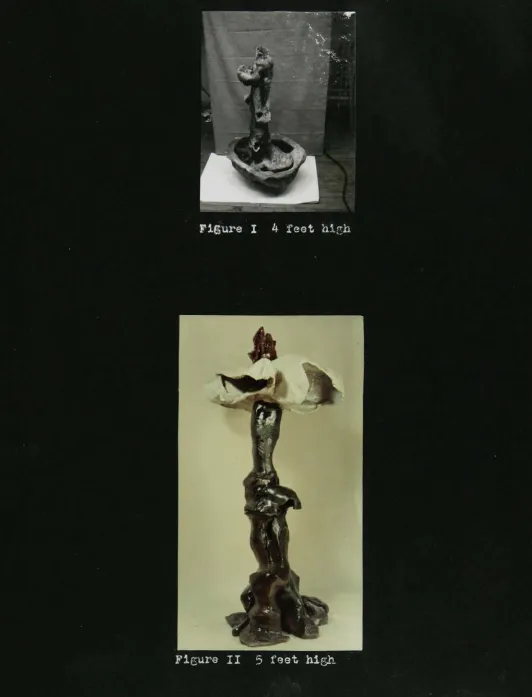
fountain.
This
piece consistedfundamentally
of a rathergeometric
overflowing
form
and as organicbasin.
I
believe
it
succeedsin
integrating
the
basin
andtthe
form
whichis
the
source of water.These
first
fountains
wereto
be
gardenfountains.
I
wanted
them
to
belong
to
their
environment soprecisely
that
they
wouldbe
"found"among
the
plants.In
these
worksthe
basin takes
on a "rooty" or growth-likefeeling
to
precipitate
its
integration
withthe
foliage.
It
nearly
takes
the
place ofthe
environmentitself.
The
third
fountain
does
notinclude
t>:e
basin
and wasintended
to
be
placedin
a sunken pond.All
three
ofthem
werehandbuilt
from
slabs or strips and
take
on a plant-like resemblancedue
concept.
They
arefaulty
jLntheir
sculpturalform.
While
there
is
adistinction between
the
base
andthe
source of waterform,
throughout
the
entire piecethere
seemsto
be
too
even acadence or rythem
in
the
surfaceform.
In
otherwords,
there
is
notension
withinthe
piece;
there
is
noclimax.
Rather
the
technique
is
so repetitivethat
it
is
boring.
I
was notattentive enough and
became
mesmerizedby
the
constructiontechnique.
However,
notrecognizing
this
atthat
point,
I
would
have
continuedin
the
same veinhad
notthe
lack
ofkiln
space prevented
it.
Reversing
my
environment conceptentirely,
I
decided to
make
small,
interior,
self-containing
fountains.
These
couldbe
placed on a mantle ortable
devoid
of organic environment.I
also changedmy
constructiontechnique
sothat
they
werebuilt
ofthrown
pots,
cutup
and reassembled.To
workin
clay
meansto
face
problemsin
construction,
drying,
cracking,
large
forms
andcutting
them
into
pieces which were sometimeshollowed
out,
I
had
encountered allthe
above problems witheach of
the
first
fountains.
The
warping
in
the
drying
andfiring
ofthese
sections was almost prohibitive.By
changing
my
method ofbuilding,
I
couldfire
the
fountains
in
this
partof
the
seriesin
their
entirety.In
additionto
these
changesI
involved
myself withtrying
to
makethe
waterdo
tricks,
andwith
the
dispute
concerning
the
audibleversus
the
visualaspects of
the
water.I
do
notbelieve
that
the
sound ofthe
water andthe
sight of
it
needhave
equal considerationin
any
particularfountain.
The
placement ofthe
fountain
in
the
interior
wassufficient reason
for
restricting
the
waterflow
andprojecting
the
audible aspects.The
first
ofthese
smallfountains
is
completely
closed and revealsthe
water not at all.The
maincriticism of
this
wasthat
any
form
with atape
recording
ofthis
may
seemthis
criticismhas
a greatdeal
ofmerit.
Is
visual water
the
essential part of afountain?
I
do
notknow
the
answerto
this
question.However,
I
abandonedfor
the
time
being
the
idea
of acompletely
enclosedfountain.
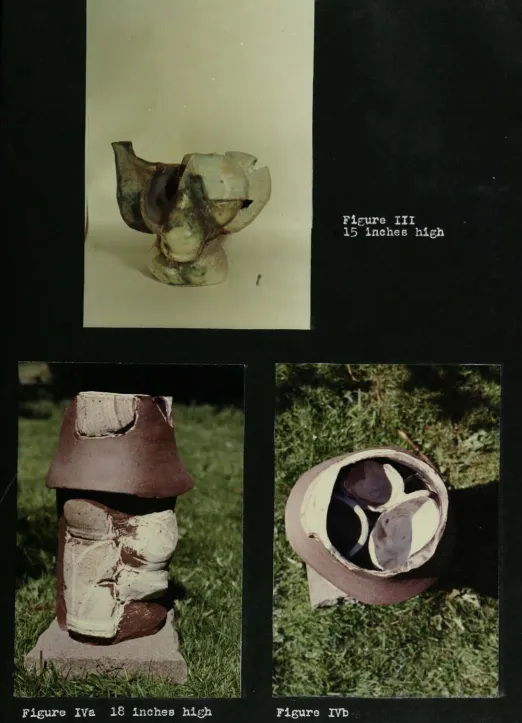
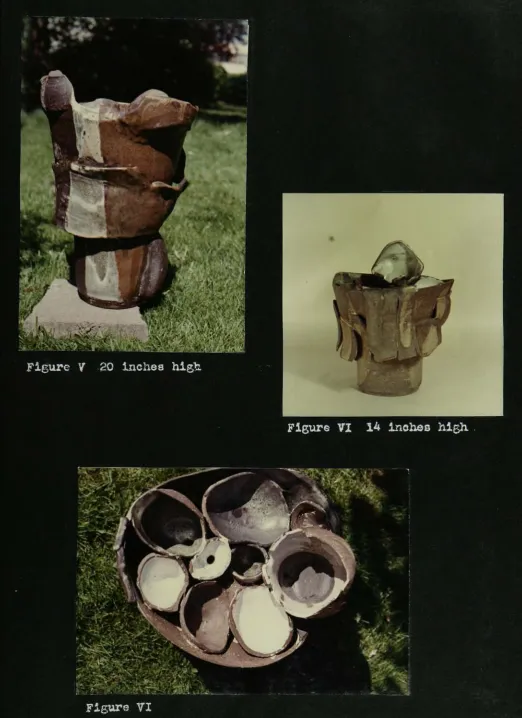
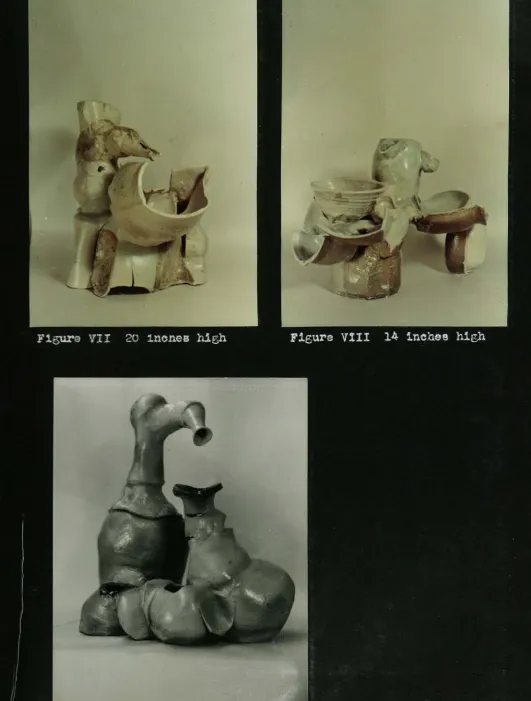
Figures
IV
through
VIII
showthe
changes which occurredin
the
opening
up
ofthe
forms
as a means ofexposing
the
water.In
the
enclosedfountain
atleast
the
forms
ofthe
wheelthrown
objects
have
been
subordinatedto
the
newform
ofthe
fountain.
However,
in
the
others,
especially
the
last
ones,
the
thrown
forms
are muchtoo
prominent andthe
construction ofthem
is
overly
obvious.I
became
engulfedin
the
prospect andnecs-sity
ofshowing
the
water.Like
pointilismthese
werebuilt
up
of small parts.But,
there
Is
no wholefor
the
eyeto
grasp
no matterhow
far
away
you can manageto
get.These
seemed
to
pushthe
faults
ofthe
first
fountains
to
a newdimension.
parts
involved
but
alsothe
scale ofthe
whole.The
waterhad
not sufficient room
in
whichto
flow
and produce a mature soundor
sight;
thus
all ofthese
fountains
weretoo
small.I
alsofound that
eventhough
the
water was self-containedthey
neededan environment of some
foliage
to
absorb part ofthe
sound.Previously
I
mentionedthat
the
possibilities were endless.After
six months of workI
had
reached a number of negativeresults.
In
working
on a project ofthis
sort negative resultsare often
the
case.It
is
frequently
necessary
to
push aform
too
far
in
orderto
seeits
faults.
I
think
I
know
whatI
do
not want
but
canbarely
recognize whatI
do
want.You
mustreach
the
point where youknow
you are notgetting
what youdo
not
like.
Then,
I
believe,
it
is
a matter ofbeing
ableto
recognize
the
good whenit
occurs andto
let
it
happen.
The
control,
if
there
be
any,
whichI
have
overmy
workis
in
the
perceiving.
from
the
previous ones.I
think
they
are more successfulfor
several
reasons.
Another
changein
constructiontechnique
anda change
in
scalebeing
the
two
major reasons.All
eight ofthese
fountains
are a combination ofhandbuilding
andthrown
forms.
This
combination oftechniques
enabled meto
changethe
scale of
the
parts as well asthat
ofthe
whole.Heretofore
I
wasamassing
many
unitsin
orderto
makesomething
large.
However
alarge
form
has
a character ofits
own which canonly
be
found
by
making
a singlebig
form.
The
fountains
in
figures
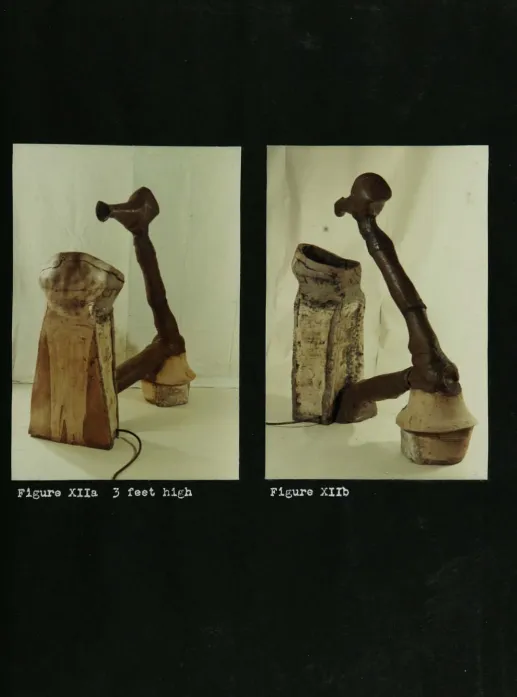
IX through XII
canbe
seento
take
on an animated or
bird-like
quality.The
sight ofthe
waterassumes a subordinate
role;
yetthe
entire complex offorms
appropriates
the
feeling
ofbeing
madesolely
for
this
streamof water.
In
the
priorfountains
the
water always seemedto
be
alien;
but
nowit
is
serving
its
function
in
the
forms.
With
the
advent ofthe
rectangular and pipe-likeforms,
formed between this
architecturalfeeling
andthe
organic orgrowth-like
feeling
ofthe
thrown forms.
The
rectangles,
whilerich
in
detail,
read as a massiveform
and givethe
viewer'seye a
large
plane on whichto
rest.The
oppositionbetween the
excitment created
for
the
eyeby
the
thrown
forms
andthe
respite of
the
large
planes produces astimulating
effect.Note
this
development
in
figures
XI 1 1
1
through, XVI.
The
most obviousdifference
in
these
last
fountains
is
that
I
ambeginning
to
feel
comfortable withthe
pump,
the
water,
but
mostImportant
withthe
clay
andtechnique
itself.
Earlier
I
mentionedthat
the
important
outcome of athesis
wasthe
artisan's attitude
towards
his
work.I
believe
that
youfind
your
really
creativeideas
outside your media.And
it
is
the
way
you assimilatethese
ideas
into
your media whichbecomes
your
"style".
Additional
experience enablesthe
incorporation
of
ideas
to
occur with greater ease.Soon
you startto
"speak"in
the
media.I
believe
this
is
beginning
to
happen
with me.I
amapproaching
my
work moreintuitively.
Any
discussion
of colorhas
been
avoidedheretofore
because
I
regardmy
development
in
glazetechnique
considerably
lagging
behind
my
constructiontechnique.
I
believe
this
to
be
a consequence of
the
media.It
is
also one ofthe
things
whichmakes ceramics so
facinatlng.
When
you ma^e a potthere
is
anImmediate
reactionto
the
product;
however,
whenglazing
there
is
atime
lag
of severaldays.
It
is
difficult
to
Obtain anunconscious
knowledge
in
glaze actionbecause
ofthis.
Also,
most
bad
pots aredestroyed before
they
reachthe
glaze stage.Being
faced
by
the
best
pots whenapproaching
the
glazing has
an
extraordinarily
inhibiting
effect.More
inhibition
is
created when once you
have
glazedthe
clay
surface you realizeit
is
lost
forever.
When
glazing
I
seemoverly
conscious ofwhat
I
andoing
and afraid ofspoiling
whatI
have.
The
glazeeffects observed
in
the
photographs are rather conservativedue
Perhaps.
. .sculpture need nothave
color?Working
in
the
ceramic media was reason enough
for
meto
feel
aresponsibility
to
glaze.The
use of atleast
some glazed areas was suggestedto
meby
the
flowing
and wet properties of water.I
desire
to
be
ableto
use glaze as a painter uses paint.Not
that
I
want
to
simulatepaint,
but
ratherI
wantJo
have
the
subtlety
of color and
the
character of glaze.This
takes
a greatmany
negative as well as positive results and much experience.
The
use offountains
as athesis
problemhas
been very
informative
whileIntensely
frustrating.
In
choosing
an excessively
open problemthere
has
been
little
tradition
onwhich
to
base
my
decisions.
This
occurred notonly
in
terms
ofceramic
form
but
alsoin
the
employment ofthe
water andthe
glaze.
Questions
have
arisen asto
whether sculpture shouldbe
colored;
whether,
from
a structural point ofview,
fountains
should
be
ceramic;
whetherit
is
advisableto
build
this
large
in
clay;
and whetherthe
water mustbe
visible.It
has
been
difficult
for
meto
imagine
how
to
usemy
experiencein
glazing
pots while
glazing
forms
entirely
different
in
size andfunc
tional
concept.I
have
made numerousmistakes,
somereasonable,
others
preposterous.
I
think,
though,
I
have
comeaway
with alittle
less
fear
andtimidity
and contrivancein my
work.My
choice of aclay
body
wasbased
on a needfor
the
body
to
have
a greatdeal
of strengthin
the
greenstage,
to
dry
well and not
be
too
brittle
for
moving
to
the
kiln.
It
had
to
have
placticity
sothat
it
threw
well and alsobe
flexible
sothat
I
couldbuild
thinly.
It
had
to
have
a warmbut
light
color so
that
it
wouldtake
glaze withouteffecting
the
colora great
deal.
The
receipeI
usedis
asfollows:
A.
P.
Green
fire
clay
40
Tennessee
#5
ball
clay
20
XX
Saggar
fire
clay
20
Kingman
Feldspar
10
Flint
10
Bentonite
3%
Red
Iron
Oxide
1%
Grog
(medium)
15%
I
fired
this
body
to
cone5
in
the
first
ninefountains
and used stoneware glazes.
It
behaved
fairly
wellespecially
in
the
smallerfountains.
However
whenbuilding
the
last
eight
larger
fountains
I
decided
to
fire
to
cone04
in
orderto
reduce
the
cracking
and strain onthe
clay
producedby
the
size and
forms
ofthese
last
ones.An
unfortunate side effectin
firing
lower
asfar
asfountains
are concernedin
that
they
are
very
absorbent.A
solutionI
found
I
couldlive
with wasto
glazethe
surfaces nearthe
water which reducedthe
absorbtion,In
other cases oncethe
fountain
was saturatedthere
was nolonger
a problem.Only
if
the
fountain
was outsidein
the
cold
do
I
believe
this
absorbentquality
would causeit
to
crack and
break
withtemperature
changes which wouldnormally
not effect ceramics.
The
first
three
fountains
werestrip
built
in
the
usualmanner.
With
the
smallerfountains
I
cutup
thrown
pots andtried
to
assemblethem
into
a wholesomething
otherthan
the
form
ofthe
pots.I
tried to
cutthe
potsup vertically
and usethe
inside
surface as well asthe
outsidein
orderto
lose
the
"feeling"
of
the
pot.I
found
I
had
to
throw
atleast
three
times
asmany
pots asI
neededin
orderto
have
enough sizeand shape
differences
to
work with.The
best
potforms
werevase or
bottle
forms
because
the
"complete
body"shape was
easiest
to
paddle anddeal
with.The
rims andfeet
werekept
simple
because
the
complex shapes seemedto
look
strange and"read"
too
muchlike
a pot.However,
in
the
smallones,
particularly
the
last
ofthese,
I
got carriedaway
withthe
potsand
lost
the
feeling
of a whole.One
ofthe
problemsthat
cameup
withthe
linear,
bird
like
forms
wasthe
supporting
ofthe
appendages with stiltsand
fire-bricks
whileworking
onthem.
Numbers
Xl.'andcxil-I
raised
the
problem ofhaving
to
cutthe
tubular
forms
in
orderto
transport
to
the
kiln
andto
fire
withouttheir
colapsing.I
learned
to
build
a collarinside
the
tubes
wherethey
werecut so
that
they
couldbe
fitted
whenthey
were glued.Also
this
collar added supportto
the
gluejoint.
These
weredif
ficult
to
visualizein
the
glazing
because
they
werein
sectionswhich
had
to
be
gluedto
be
jseen.In
building
the
large
rectangles ofthe
last
four
fountains,
I
found
an unusual work patternthat
seemedvery
satisfactory.Late
the
first
day
I
would roll outthe
large
slabs whichwould constitute
the
box
and coverthem
lightly
with plastic.The
nextmorning
on alarge
board
I
wouldJoin
the
sidesto
one of
the
large
surfacessupporting
them
withfire
brick.
This
wasleft
exposedto
the
airto
stiffen.I
wouldthen
throw
the
potsI
neededto
carry
outmy
concept.In
the
afternoon
I
built
abrick
andboard
supportinside
the
box
andflipped
the
otherlarge
surface ontop
ofthis
joining
it
to
the
sides.This
I
covered overnight.The
nextmorning
I
removed
the
bricks
andboards
andusing
the
large
board that
the
box
wasbuilt
on as alever
andsupport,
,flip
the
box
onto aslab which
became
the
bottom.
My
pots werethen
leather hard
and
I
spentthe
rest ofthe
day
paddling,
cutting
andshaping
them.
I
wouldjoin
them
to
the
box
andfinish
the
fountain
before
I
left
that
night.This
may
seem anexceptionally
fast
way
to
work,
but
I
found
It
very
suitableto
my
personality.I
alsofeel
I
reduced the
chances ofcracking
a greatdeal
by having
the
entirepiece a uniform wetness and
letting
the
wholething dry
naturally
in
the
air.It
seemsto
suit mebetter
atthis
time
to
build
fast
and produce a number of pieces ratherthan
to
play
withand change one
form.
While
clay
canbe
kept
wt
along
time,
this
way
ofworking
suitsthe
mediain
some respects andre-tains
a spontanious surfacequality
whichI
find very
nice.Most
ofthe
last
fountains
were glazed with a variationof one of
two
glazes.The
receipes are asfollows:
Rhodes
#82
Elbrook
Feldspar
46.8
Flint
10
Colemanite
11
1-6*White
Lead
27
Whiting
4
Borax
15
Elbrook
Feldspar
18
Flint
18
Rut
lie
5
Zircopax
20
Brown
Red
Iron
Oxide
10
Whiting
13
Barium
Carbonate
13
Zinc
Oxide
4
Dark
Brown
Red
Iron
Oxide
8
Manganese
Dioxide
1.5
Blue
Copper parbonate
3
Cobalt
Carbonate
.75Manganese
Dioxide
.5Purple
Cobalt
Carbonate
2
Manganese
Dioxide
8
The
Rhodes
#8
glaze,
if
appliedthinly,
gave a ratherdry
surface which made .a nice effect withthe
water.I
usually
appliedthe
glaze with aspray
gun.Also
I
was ableto
pour some of
the
surfacesby
making
atemporary
basin
with alarge
sheet of plastic.Occasionally
I
left
the
light
clay
body
exposed or stainedIt
with rediron
oxide which produced1.
Sr.
Kristen,
student,
School
for
American
Craftsmen,
1967.
2.
Rhodes,
Daniel,
Clay
andGlazes
for
the
Potter,
Chilton
Books,
Philadelphls,
Pa.
1957,
p7~2"09.a
purplish
colordue
to
the
low
firing
temperature.
The
first
nine pieces were
heavily
reduced at cone5
in
the
12
cubicfoot
up-draft
Alpine
orin
the
down-draft
kiln.
However,
as statedbefore,
to
prevent excessivecracking
the
last
eightfountains
were
fired
at cone04
In
the
30
cubicfoot
up-draftAlpine
kiln.
I
attemptedto
maintain anoxidizing,
atmospheredue
to
the
use ofthe
lead
glazes.A
small,
plastic-incasedrecirculating
pump
was usedthroughout
the
fountain
series.Little
Giant
Pump
Company
Oklahoma
City,
Oklahoma
Model
no.1
In
the
constructing
ofthe
fountains
it
is
important
to
keep
the
shrinkage ofthe
clay
in
mind whenmaking
the
housing
for
the
pump.Also
you must rememberthe
hole
for
the
electriccord;
andthere
mustbe
a passage sothat
the
water can reachthe
pump.When
installing
the
pump
flexible
plastictubing
was used.
I
found
the
use ofhard
plastic "Y1s"the
best
solution when
it
wasneccessary
to
splitthe
waterflow.
If
a piecebroke
in
the
green stageI
usedkiln
cementto
repairit
andthen
glazed overit.
When there
was a cleanbreak
in
afinished
pieceI
usedGlass
andCeramic
Adhesive
by
Dow
Corning.
Silastic
Clear
Sealer
by
Dow
Corning
was usedto
make watertight
repairs.It
was also ueedto
seal ababy
nipple aroundthe
inside
ofthe
hole
for the
electriccord.
I
found
the
best
gluefor
assembling
the
large
sectionsof
the
fountains
wasFyber Flexible
Auto
Body
Paste
whichI
colored with oxides
to
matchmy
glaze colors.It
dries
fast,
fills
well andIs
quite strong.a
Figure
I
4
feet
high
[image:25.554.14.547.19.717.2]'._Ss
Figure
III
15
Inches
high
J
kin.
y
-1
TTi
5K
[image:26.554.23.546.12.736.2]*r^*
i
k<}
,- ,^
Figure
V
20
inches
hlgfe
[image:27.554.28.551.13.732.2]Figwe
VII
20
menes
high
Figure
VIII
14
Inches
high
[image:28.554.10.542.15.717.2]Figure Xa
30
inches
high
Figure
Xh
I
it
,A [image:30.554.33.551.16.714.2]tyr
Figure
XIII
3*
inches high
[image:31.554.10.544.14.734.2]Figure XV
4 feet high
BIBLIOGRAPHY
Rhodes,
Daniel,
Clay
andGlazes
for the Potter,
Chilton
Books,