0022-538X/96/$04.0010
Copyrightq1996, American Society for Microbiology
Construction of a Type 1 Human Immunodeficiency Virus That
Maintains a Primer Binding Site Complementary to tRNA
HisJOHN K. WAKEFIELD, SANG-MOO KANG,ANDCASEY D. MORROW*
Department of Microbiology, University of Alabama at Birmingham, Birmingham, Alabama 35294
Received 21 September 1995/Accepted 2 November 1995
The initiation of human immunodeficiency virus type 1 reverse transcription occurs by extension of a tRNA3
Lys
primer bound near the 5*end of the viral RNA genome which is designated the primer binding site
(PBS). Sequences within the viral genome upstream of the PBS which are complementary to the anticodon loop
(USUU) and the TCC loop and arm (AGGGTmC) of tRNA3
Lys
are postulated to play a role in maintaining the selective use of tRNA3
Lys
in reverse transcription. To investigate this possibility, proviral genomes which contain a PBS complementary to the 3*-terminal 18 nucleotides of tRNAHis
[pHXB2(His)] as well as sequences upstream of this PBS which are complementary to either the anticodon loop [CCACAA; pHXB2(His-AC)] or
TCC loop [GACCGAGG; pHXB2(His-TCC)] of tRNAHis were constructed. Infectious virus was recovered
upon transfection into COS-1 cells of pHXB2(His), pHXB2(His-AC), or pHXB2(His-TCC). The appearance of
infectious virus after cocultivation with SupT1 cells was delayed for the proviruses containing a PBS
comple-mentary to tRNAHis
compared with that obtained by transfection of the wild-type provirus [pHXB2(WT)]. However, by several passages in SupT1 cells, the mutant viruses demonstrated replication kinetics similar to those of the wild-type virus. A DNA sequence analysis of the PBS region from integrated proviruses revealed
that by day 15 of culture, the PBS of viruses derived from pHXB2(His) and pHXB2(His-TCC) reverted back
to the wild-type PBS complementary to tRNA3 Lys
. In contrast, viruses derived from pHXB2(His-AC) maintained
a PBS complementary to tRNAHis
for over 4 months in culture encompassing 12 serial passages. This study, then, is the first report of a stable human immunodeficiency virus type 1 which utilizes an alternative tRNA primer and suggests that interactions between the primer tRNA anticodon loop and viral sequences upstream of the PBS contribute to the specificity of the tRNA primer used in reverse transcription.
A distinguishing feature of retrovirus replication is the con-version of a single-stranded RNA genome into a double-stranded DNA intermediate prior to integration into the host cell chromosome. This process, which is referred to as reverse transcription, is carried out by the virally encoded enzyme reverse transcriptase (RT), which utilizes a cellular tRNA bound to the primer binding site (PBS) as a primer (2, 33). The PBS is an 18-nucleotide sequence located near the 59end of the viral RNA genome that is complementary to the 39 -termi-nal 18 nucleotides of the primer tRNA. Following initiation of reverse transcription by extension of the 39OH of the primer tRNA, a complex process of plus- and minus-strand transloca-tion, or ‘‘jumping,’’ allows the RT to copy the viral RNA genome. Two copies of the PBS are generated during reverse transcription; a minus-strand copy which is the complementary sequence of the PBS originally present within the RNA ge-nome and a plus-strand copy resulting from the copying by the RT of the 39-terminal 18 nucleotides of the primer tRNA (9, 19, 20, 30, 31, 32, 34). As a consequence of this feature of retrovirus replication, a PBS sequence complementary to the 39-terminal 18 nucleotides of the tRNA used to initiate reverse transcription is represented in the integrated provirus.
Within a given group of retroviruses, both the PBS and the tRNA primer used in reverse transcription are highly con-served (reviewed in reference 7). For example, avian sarcoma and leukosis viruses use tRNATrpto initiate reverse transcrip-tion, whereas most of the mammalian tumor-inducing retrovi-ruses such as murine leukemia viretrovi-ruses (MLVs) and the human T-cell leukemia viruses utilize tRNAPro. Both human immu-nodeficiency virus (HIV) and simian immuimmu-nodeficiency virus
as well as mouse mammary tumor virus utilize tRNA3 Lys, while
Mason Pfizer monkey virus, Visna virus, and spumavirus use tRNA1,2Lysto initiate reverse transcription. The exclusive selec-tion by retroviruses of the tRNA primers used to initiate re-verse transcription has been the subject of several recent stud-ies. Colicelli and Goff (7) isolated a replication-competent recombinant MLV that contained a PBS complementary to tRNAGln, suggesting that this virus replicated by means of a tRNAGlnprimer. Lund et al. (16) provided further evidence for the utilization of a different primer tRNA in MLV repli-cation by demonstrating the efficient transduction of an Akv MLV-based vector containing a PBS corresponding to tRNA1
Gln, tRNA 2
Gln, or tRNA 3
Lys. Our laboratory and others
have demonstrated that HIV type 1 (HIV-1) can use several different tRNAs to initiate reverse transcription if the PBS is made complementary to the respective tRNA (8, 15, 36). How-ever, the viruses with PBSs complementary to these alternate tRNAs were not stable, and the PBS reverted back to wild-type PBS complementary to tRNA3
Lys. Thus, it was concluded that
complementarity between the primer tRNA and the PBS is not the sole determinant for the preferential use of tRNA3
Lys in
HIV-1 reverse transcription. The mechanism by which tRNA3
Lysis preferentially selected
by HIV-1 for the initiation of reverse transcription is unknown. Previous studies have demonstrated by in vitro analysis that the HIV-1 RT specifically binds tRNA3Lysin the presence of excess amounts of nonspecific tRNAs (3–6, 25, 27, 29, 37). The inter-action between tRNA3Lysand the RT, most likely in the context of the Gag-Pol polyprotein precursor, is also believed to con-tribute to the incorporation of tRNA3Lysinto the virion during particle assembly (17). However, tRNAs other than tRNA3Lys have been shown to be incorporated into HIV-1 virions at levels similar to that of tRNA3Lys (12, 13). Therefore, the
se-* Corresponding author. Phone: (205) 934-5705. Fax: (205) 934-1580.
966
on November 9, 2019 by guest
http://jvi.asm.org/
lective use of tRNA3Lys in reverse transcription cannot be ex-plained solely by an exclusive presence of tRNA3Lys in the virion. The interaction of tRNA3Lyswith sequences of the viral RNA outside the PBS might be a factor in the selective use of tRNA3Lys. For example, in avian sarcoma and leukosis virus, complementary base pairing between the retroviral U5 RNA and the TCC loop and arm of the tRNATrpreplication primer has been shown in vitro to be required for the efficient initia-tion of reverse transcripinitia-tion (1). Sequences complementary to the TCC loop and arm of tRNA3
Lys are present in the U5
region of the HIV-1 viral RNA genome. A recent study using in vitro assays has provided evidence that a sequence in the HIV-1 U5 region just upstream of the PBS consisting of 4 adenine residues binds to the 4 uridine residues found in the anticodon loop of tRNA3
Lys (10, 11). These nucleotides have
been predicted to be positioned within a loop structure which has been referred to as the A-rich loop (10, 11).
In the present study, we have tested whether mutations of sequences in the HIV-1 RNA genome that are complementary to the anticodon and TCC loop of tRNA3
Lysaffect the
utiliza-tion of an alternative primer tRNA in HIV-1 reverse transcrip-tion. Since we previously demonstrated that a provirus with a PBS complementary to tRNAHis was infectious (36), we con-structed additional mutant proviral genomes in which se-quences complementary to the anticodon or TCC loop of a tRNAHis molecule were also present upstream of the PBS complementary to tRNAHis. The PBSs of the viruses were analyzed after extended culture. Only viruses containing the sequences complementary to the anticodon loop of tRNAHis maintained a PBS complementary to tRNAHis. The results of this study point to a role for the interaction between a region in the HIV-1 genome and the anticodon loop of the primer tRNA, as well as the tRNA-PBS interaction, in maintaining the selectivity of the primer tRNA used in reverse transcription.
MATERIALS AND METHODS
Materials.Unless otherwise specified, all chemicals were purchased from Sigma Chemical Co. Restriction endonucleases were obtained from New En-gland Biolabs. The Taq DNA polymerase was purchased from BRL-Gibco, and all of the reagents used for PCR were acquired from Perkin-Elmer Cetus. Tissue culture media and reagents were obtained from BRL-Gibco. The synthetic oli-gonucleotides used for mutagenesis and PCR were prepared by the Cancer Center Oligonucleotide Synthesis Facility at the University of Alabama at Bir-mingham. The enzyme-linked immunosorbent assays (ELISAs) for p24 antigen were obtained from Coulter Laboratories.
Tissue culture.COS-1 cells were maintained in Dulbecco’s modified Eagle’s medium supplemented with 10% fetal calf serum at 378C and 5% CO2. SupT1
cells were grown in RPMI medium supplemented with 15% fetal calf serum. Construction of mutant proviral genomes.General laboratory procedures were followed for DNA manipulation, plasmid preparation, and subcloning essentially as previously described (18). Single-stranded DNA of M13mp18PBS used for oligonucleotide site-directed mutagenesis was prepared as previously described (35). M13mp18PBS contains HIV-1 proviral sequences between the HpaI and PstI sites of pHXB2gpt, which encompasses the PBS region (24). The oligonucleotide used to substitute the wild-type HIV-1 PBS complementary to the 39-terminal 18 nucleotides of tRNA3Lyswith sequences complementary to the
39-terminal 18 nucleotides of tRNAHis[pHXB2(His)] was 59-CGCTTTCAAAT
CCGAGTCACGGCACCACTGCTA-39. The conditions used for mutagenesis were as previously described (35). Single-stranded M13mp18PBS phage DNA containing the PBS complementary to tRNAHis
was used as the template for the construction of the mutations that changed the sequences upstream of the PBS. These mutations substituted sequences complementary to the anticodon and TCC loops of tRNA3
Lys
with sequences complementary to the corresponding anticodon and TCC loops of tRNAHis
. The oligonucleotides for each respective mutant are as follows: pHXB2(His-AC), 59-CTGCTAGAGTTGTGGCACACT GAC-39; pHXB2(His-TCC), 59-CACTGACTACCTCGGTCTGAGG-39. Con-firmation of the desired mutations was carried out by the dideoxy DNA sequenc-ing method of Sanger et al. (28) with Sequenase (U.S. Biochemicals). The replicative form M13mp18PBS DNA containing the mutations was isolated and digested with HpaI and BssHII, resulting in an 868-bp fragment encompassing the PBS. The 868-bp fragment was subcloned between the HpaI and BssHII sites
of pHXB2gpt (22, 23), and the resulting mutant proviral plasmids were screened by restriction digests and confirmed by DNA sequencing (28).
DNA transfections and analysis of proviral gene expression.Transfection of proviral plasmid DNA into COS-1 cells with DEAE-dextran was carried out as previously described (35). Forty-eight hours posttransfection, the supernatant was collected and filtered through a 0.45-mm-pore-size syringe filter (Nalgene). The levels of p24 antigen were determined from five independent transfections by an ELISA (Coulter Laboratories).
Analysis of virus infectivity.To test for virus infectivity, SupT1 cells, which express CD4 and support high-level replication of HIV-1, were cocultured with COS-1 cells transfected with the various proviral constructs for 3 days. Following cocultivation, the SupT1 cells were harvested by low-speed centrifugation (1,000
3g) and further cultured with fresh media and additional SupT1 cells. For cell-free infections, SupT1 cells (106
cells per ml) were infected with 100 ng of virus per ml as measured by p24 antigen. After allowing the virus to adsorb for 24 h, SupT1 cells were pelleted (1,0003g), washed with phosphate-buffered saline (pH 7.0), and further cultured. SupT1 cultures were monitored visually for the formation of multicell syncytia and, at various intervals, were refed with fresh SupT1 cells. At the designated time intervals, samples of the culture supernatant were collected and analyzed for p24 antigen by ELISA (Coulter Laboratories). PCR amplification and DNA sequencing of PBS-containing proviral DNA. Analysis of the proviral PBS sequences from infected SupT1 cells was carried out as previously described (35). Briefly, proviral DNA encompassing the PBS was amplified by PCR from approximately 10mg of total cellular DNA isolated from the infected SupT1 cultures. PCR-amplified DNA was digested with HindIII and EcoRI and subcloned between the EcoRI and HindIII sites present in the polylinker region of M13mp18 replicative form DNA. Following ligation, the DNA was transformed into competent Escherichia coli DH5aF9and plated on a lawn of E. coli DH5aF9containing isopropyl-b-D-thiogalactopyranoside (IPTG) and 5-bromo-4-chloro-3-indolyl-b-D-galactopyranoside (X-Gal [U.S.
Biochemi-cals]) (35). Following identification of colorless phage plaques, the single-stranded DNA prepared from individual recombinant phage clones was se-quenced (28).
RESULTS
Construction of mutant HIV-1 proviral genomes containing
sequences complementary to the anticodon and TCC loops of
tRNAHis
. In a previous study, we demonstrated that HIV-1 could use a tRNAHismolecule to initiate reverse transcription if the PBS was complementary to the 39-terminal nucleotides of tRNAHis (36). Simply having a PBS complementary to tRNAHis, though, was not sufficient to produce a virus capable of maintaining the use of tRNAHis over multiple rounds of replication, as evidenced by the eventual reversion of the PBS back to that of a wild-type virus. Previous studies have sug-gested that regions outside of the PBS might be involved in the interaction of the primer tRNA with the PBS (8, 14, 15, 36). Two viral RNA sequences located upstream of the HIV-1 PBS which are complementary to the anticodon and TCC loops of tRNA3
Lyshave been identified. The 4 uridine residues
(33USUU36) of the tRNA 3
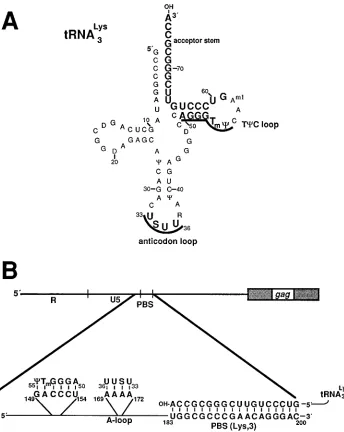
Lys anticodon loop (Fig. 1A) are
complementary to the 4 adenine residues located at nucleo-tides 169 to 172 of the HIV-1 viral RNA (derived from mo-lecular clone HXB2gpt; Fig. 1B). These 4 adenines correspond to the 4 adenines found at nucleotides 164 to 167 of the HIV-1 (Mal isolate) RNA which was shown to be positioned within a loop structure (A-loop) (10, 11). Further upstream of the A loop is the sequence GACCCU, located at nucleotides 149 to 154 (Fig. 1B), which shares complementarity with the 50AGGGT
mC
55sequence of the tRNA 3
LysTCC loop and arm
(Fig. 1A). We wanted to determine if these viral RNA se-quences play a role in the selection of tRNA3
Lysfor the
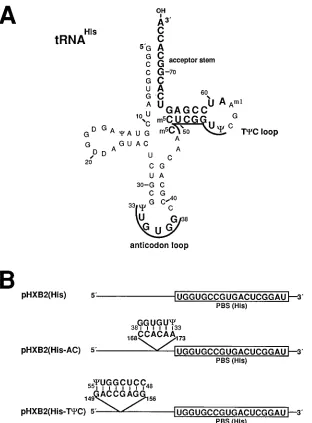
initia-tion of reverse transcripinitia-tion in viruses that contained a PBS complementary to tRNAHis. Site-directed mutagenesis was used to substitute the wild-type PBS with sequences comple-mentary to the 39-terminal 18 nucleotides of tRNAHis [pHXB2(His), Fig. 2B]. Two additional mutations in pHXB2(His) in which each of the viral sequences which are complementary to the anticodon and TCC loops of tRNA3Lys were substituted with nucleotides complementary to the cor-responding anticodon loop and TCC loop and arm of tRNAHis
on November 9, 2019 by guest
http://jvi.asm.org/
were constructed (Fig. 2A). These mutant constructs are re-ferred to as pHXB2(His-AC) and pHXB2(His-TCC), respec-tively, and are depicted in Fig. 2B. In pHXB2(His-AC), a CCACAA sequence, which is complementary to the33CUGU GG38nucleotides found in the anticodon loop of the tRNAHis, was positioned at nucleotides 168 to 173 of the viral RNA (168CCACAA173). pHXB2(His-TCC) contained the sequence GACCGAGG at nucleotides 149 to 156 (149GACCGAGG156), which is complementary to the48CCUCGGUC55sequence of the tRNAHisTCC loop and arm.
Expression of HIV-1 proteins from mutant proviral ge-nomes.To determine if the mutations in the 59region of the
[image:3.612.133.477.69.501.2]HIV-1 genome affected viral gene expression, we analyzed COS-1 cells transfected with the mutant and wild-type proviral genomes for intracellular viral proteins and the supernatants for released virus particles. No differences in the intracellular viral proteins between the cultures transfected with the plas-mid containing wild-type or mutant proviruses were evident, as determined by metabolic labeling and immunoprecipitation with sera from AIDS patients (data not shown). To determine if the mutations had any effect on the release of virus, the culture supernatants were measured for p24 antigen by using an ELISA. No significant differences between the amounts of p24 released from cultures transfected with the wild-type or FIG. 1. Diagram of mammalian tRNA3Lysand depiction of sequences found at the 59end of the HIV-1 viral RNA genome that are complementary to nucleotides
of tRNA3Lys. (A) The cloverleaf diagram of rabbit liver tRNA3Lysis illustrated as described by Raba et al. (21). Those nucleotides complementary to sequences in the
HIV-1 viral RNA are shown in boldface type, with the nucleotides of the anticodon and TCC loops complementary to the sequences upstream of the PBS also underlined. (B) An expanded view of the 59end of the HIV-1 viral RNA genome depicting the location of the sequences sharing complementarity with tRNA3Lysas
well as the predicted base pairing. The PBS, located between nucleotides 183 and 200, is predicted to base pair with the 39-terminal 18 nucleotides that make up the acceptor stem of tRNA3Lys. By use of in vitro studies, the 4 adenine residues located upstream of the PBS (at nucleotides 169 to 172) have been shown to bind to the
4 uridine residues of the tRNA3Lysanticodon loop (11). These adenines are predicted to be positioned within a loop structure, termed the A-rich loop. The sequences
complementary to the TCC loop are positioned at nucleotides 149 to 154. S, 5-methoxycarbonylmethyl-2-thiouridine;C, pseudouridine; D, dihydrouridine; Tm,
29-O-methyl-5-methyluridine; Aml, 1-methyladenosine.
on November 9, 2019 by guest
http://jvi.asm.org/
mutant proviruses were seen (Fig. 3). The minor variations seen were due to differences in the transfection efficiencies from the five independent experiments.
Replication potential of mutant HIV-1 viruses.To
deter-mine the replication potential of the mutant viruses, SupT1 cells were cocultured with the transfected COS-1 cells. At various times postcoculture, replication of both the wild-type and mutant viruses was monitored by quantitating the levels of the viral capsid antigen (p24) in the supernatant. The increas-ing levels of p24 antigen in the culture supernatants indicated that viruses derived from COS-1 cells transfected with either pHXB2(His), pHXB2(His-AC), or pHXB2(His-TCC) were infectious in SupT1 cells (Fig. 4). The increase in the level of p24 antigen in the cultures also correlated with the increase in the number of syncytia. Although the appearance of virus from
cells transfected with proviruses containing the mutant PBS was delayed compared with the case for the wild type, by day 15 postcoculture peak levels of p24 antigen in all of the culture supernatants were similar to that found in the culture of the wild-type virus (Fig. 4).
[image:4.612.155.467.67.490.2]DNA sequence analysis of the PBS and surrounding region. To determine the DNA sequence of the PBS region, high-molecular-weight DNA was isolated from each of the infected SupT1 cultures at days 9 and 15 postcoculture. The PBS re-gions of the integrated proviruses were amplified by PCR. Since the first 18 nucleotides of the primer tRNA are copied during plus-strand strong-stop viral DNA synthesis, analysis of the proviral PBS sequence will determine which tRNA species was used to initiate reverse transcription. At day 9 postcocul-ture, the viruses derived from pHXB2(His), pHXB2(His-AC), FIG. 2. Diagram of tRNAHisand description of the mutations within the PBS region. (A) A diagram of HeLa cell tRNAHisis depicted as described by Rosa et al.
(26). The nucleotides of tRNAHiswhich were used to model the mutations within the PBS region are depicted in boldface type, with the anticodon and TCC loop
sequences also underlined. (B) A mutation in the PBS was constructed such that the PBS (box) was complementary to the 39-terminal 18 nucleotides of tRNAHis
[pHXB2(His)]. Two additional mutant proviral genomes, which contained sequences complementary to the anticodon loop [pHXB2(His-AC)] and TCC loop [pHXB2(His-TCC)] of tRNAHisin place of those sequences complementary to the corresponding anticodon and TCC loops, respectively, of tRNA
3 Lys, were
constructed. The predicted base pairing between the mutant viral RNA sequences and the anticodon and TCC sequences are also depicted. The numbers indicate the nucleotide positions of the mutant residues within the RNA genome. m5C, 5-methylcytidine.
on November 9, 2019 by guest
http://jvi.asm.org/
and pHXB2(His-TCC) maintained a PBS complementary to tRNAHis(Table 1). The viruses derived from pHXB2(His-AC) also contained several nucleotide substitutions upstream of the mutant PBS. Similar substitutions were not present in the proviral sequences derived from pHXB2(His) or pHXB2(His-TCC).
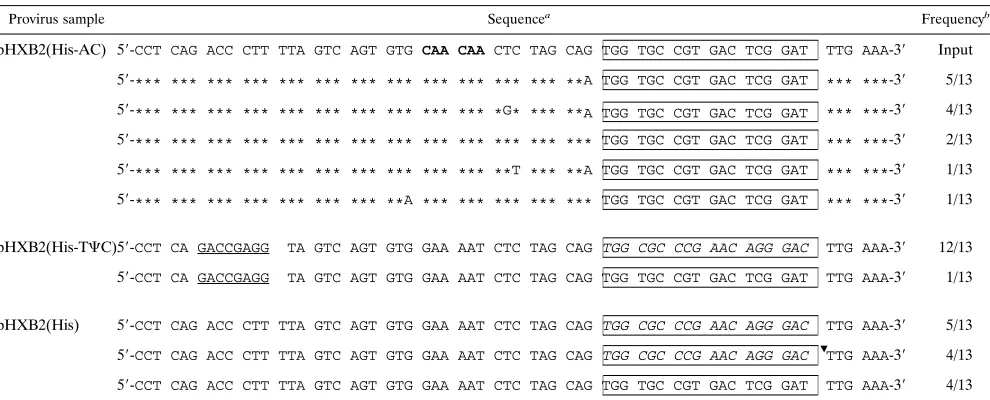
By 15 days postcoculture, there were substantial amounts of virus in all of the cultures, as determined by the level of p24 antigen (Fig. 4). Analysis of the PBS sequences from provi-ruses derived from pHXB2(His) and pHXB2(His-TCC) re-vealed the presence of sequences complementary to the 39 -terminal 18 nucleotides of tRNA3
Lysas well as tRNAHis(Table
2). All the viruses derived from the pHXB2(His-TC C)-in-fected cultures contained the original sequences upstream of the PBS which were made complementary to the TCC loop of tRNAHis. Therefore, the TCC-complementary sequences up-stream of the PBS did not stabilize the use of tRNAHis in reverse transcription. Four of 13 revertant viruses derived from
pHXB2(His) contained an insertion of 12 nucleotides down-stream of the wild-type PBS which were identical to the last 12 nucleotides of the mutant PBS. This insertion could have oc-curred during the second template transfer of reverse tran-scription through inappropriate base pairing between the plus-strand PBS copy, which corresponds to the 39-terminal 18 nucleotides of tRNA3
Lys, and the minus-strand copy of the PBS,
which is complementary to the original mutant PBS (24, 35). A completely different result was found upon analysis of the PBS region from viruses derived from pHXB2(His-AC). The PBS remained complementary to the 39-terminal 18 nucleotides of tRNAHisin all of the sequences analyzed (13 of 13). No PBS sequences complementary to tRNA3
Lyswere found. The A-loop
sequences of these viruses also remained complementary to the anticodon loop of tRNAHis; however, more single-nucle-otide changes were found surrounding these mutant se-quences.
Stability of a PBS complementary to tRNAHis
in viruses
derived from pHXB2(His-AC). To determine the stability of
the PBS in the mutant viruses, culture supernatants were col-lected at day 15 postcoculture, and equal amounts of virus as measured by the level of p24 antigen (100 ng/ml) were used to infect fresh SupT1 cells. The viruses were allowed to replicate for 10 days, after which the viruses were again collected and used to infect fresh SupT1 cells as before. The viruses were passaged in SupT1 cells following this protocol for 12 serial passages. At passages 5 and 10, the replication kinetics of the viruses were analyzed. The viruses derived from pHXB2(His) and pHXB2(His-TCC) exhibited replication kinetics similar to those of the wild type at passages 5 and 10 (Fig. 5). At passage 5, the viruses derived from pHXB2(His-AC) replicated more slowly than the wild type; however, by passage 10 the virus had replication kinetics similar to those of the wild type.
After five serial passages, the PBS sequences of all viruses isolated from pHXB2(His) and pHXB2(His-TCC) had re-verted to a wild-type PBS sequence complementary to the 39-terminal 18 nucleotides of tRNA3
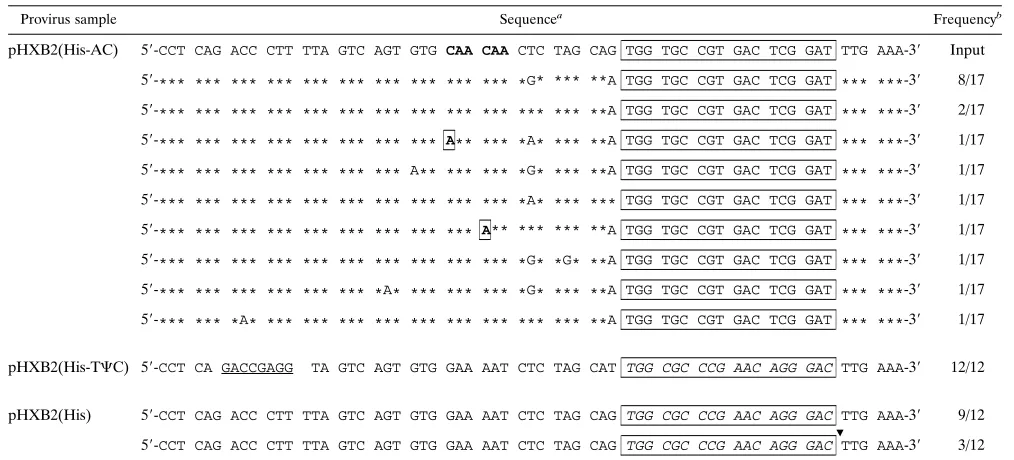
Lys(Table 3). Again, the
sequence complementary to the tRNAHis TCC loop was present in viruses derived from pHXB2(His-TCC). The sur-prising result was that viruses derived from pHXB2(His-AC) contained PBS sequences complementary to tRNAHisafter 5, 10, and 12 serial passages, representing a time of over 4 months in continuous culture. Sequence analysis of 48 independent M13mp18 phage clones (17 at passage 5; 21 at passage 10; and 10 at passage 12) revealed PBS sequences complementary only to tRNAHis. Taken together, these results point to a stable virus containing a PBS that is complementary to tRNAHis.
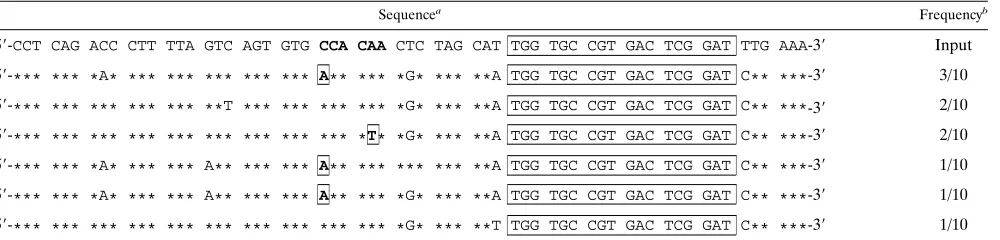
Although the PBS sequence of the virus derived from pHXB2(His-AC) did not change, the number of point muta-tions found upstream of the PBS increased over time in culture (Table 4). In the majority of clones sequenced, two changes were observed in the PBS region: a G-to-A change at position 182 and a T-to-G change at nucleotide 175. We did find several changes within the 168CCACAA173 sequence. A C-to-A change for C-168 was found most frequently; C-171 was re-placed with an A in a single clone found at passages 5 and 10. A single clone with a C-to-A change at position 169 resulting in a168CAACAA173sequence was found from analysis of passage 10 viruses. Both of these viruses, though, were unstable, since a PBS with these mutations were not recovered at passage 12 (Table 5). In contrast, an A-to-T change at position 172 result-ing in a168CCACTA173sequence was found in a single clone at both passage 10 and passage 12. No nucleotide substitutions for A-170 or A-173 were found in any of the 48 clones exam-FIG. 3. Release of virus from COS-1 cells transfected with the wild-type and
[image:5.612.72.278.72.213.2]mutant proviral genomes. COS-1 cells were transfected with the designated plasmids, and at 48 h posttransfection, the supernatant was analyzed for released p24 antigen by ELISA (Coulter). The levels of p24 antigen (in nanograms per milliliter of supernatant) were determined for five independent transfections. Standard deviations are represented by error bars.
FIG. 4. Kinetics of the appearance of infectious virus derived from transfec-tion of wild-type and mutant proviral genomes. The plasmids containing the wild-type and mutant proviral genomes were transfected into COS-1 cells and then cocultured with SupT1 cells for an additional 3 days. The SupT1 cells were then isolated by centrifugation, washed once, and further cultured with more uninfected SupT1 cells and fresh medium (day 0). At various intervals postcocul-ture, culture supernatants were collected, and the p24 antigen was quantitated by ELISA (Coulter).
on November 9, 2019 by guest
http://jvi.asm.org/
[image:5.612.58.299.499.661.2]ined, encompassing the samples obtained from passages 5, 10, or 12.
DISCUSSION
[image:6.612.56.559.82.251.2] [image:6.612.60.555.485.685.2]HIV-1 proviral genomes which contained not only a PBS complementary to the 39-terminal 18 nucleotides of tRNAHis [pHXB2(His)] but also one of two sequences positioned up-stream of the PBS which are complementary to the anticodon loop [pHXB2(His-AC)] and TCC loop and arm [pHXB2 (HisTCC)] of tRNAHis were constructed. Transfection into COS-1 cells of each of these constructs resulted in the produc-tion of infectious virus. PCR amplificaproduc-tion of the PBS region and DNA sequence analysis revealed that at day 9 following
infection, the PBSs were complementary to tRNAHis. By day 15 in culture, viruses derived from pHXB2(His) and pHXB2(His-TCC) contained PBS sequences complementary to tRNA3Lys. In contrast, viruses derived from pHXB2(His-AC) maintained a PBS complementary to tRNAHis. The virus was stable and maintained a PBS complementary to tRNAHis for over 4 months in culture, encompassing 12 serial passages in SupT1 cells.
The generation of a stable HIV-1 virus which maintains a PBS complementary to a tRNA other than tRNA3Lysis a sig-nificant step towards understanding the complexities of the interaction between the tRNA primer and the viral RNA ge-nome, which is a prerequisite first step in the initiation of
TABLE 1. Sequences of the PBS region of proviruses isolated at day 9 postcoculture
Provirus sample Sequencea
Frequencyb
pHSB2(His-AC) 59-CCT CAG ACC CTT TTA GTC AGT GTG CCA CAA CTC TAG CAG TGG TGC CGT GAC TCG GAT TTG AAA-39 Input
59-*** *** *** *** *** *** *** *** *** *** *** *** *** TGG TGC CGT GAC TCG GAT *** ***-39 5/9
59-*** *** *** *** *** *** **A *** *** *** *** *** *** TGG TGC CGT GAC TCG GAT *** ***-39 2/9
59-*** *** *** *** *** *** *** *** *** *** *** *** **A TGG TGC CGT GAC TCG GAT *** ***-39 1/9
59-*** *** *** *** C** *** *** *** *** *** *** *** *** TGG TGC CGT GAC TCG GAT *** ***-39 1/9
pHXB2(His-TCC) 59-CCT CA GACCGAGG TA GTC AGT GTG GAA AAT CTC TAG CAG TGG TGC CGT GAC TCG GAT TTG AAA-39 Input
59-CCT CA GACCGAGG TA GTC AGT GTG GAA AAT CTC TAG CAG TGG TGC CGT GAC TCG GAT TTG AAA-39 8/8
pHXB2(His) 59-CCT CAG ACC CTT TTA GTC AGT GTG GAA AAT CTC TAG CAT TGG TGC CGT GAC TCG GAT TTG AAA-39 Input
59-CCT CAG ACC CTT TTA GTC AGT GTG GAA AAT CTC TAG CAG TGG TGC CGT GAC TCG GAT TTG AAA-39 3/3
aThe sequences located in the A-rich loop region which were made complementary to the anticodon loop of tRNAHisare shown in boldface type. Asterisks denote
identity with the input sequences. The sequences complementary to the TCC loop of tRNAHisare indicated by underlining. The PBS sequence, which is complementary
to tRNAHisin all cases, is boxed.
bFrequencies of the DNA sequences of the PBS region obtained from independent M13 phage clones. The input sequence refers to the initial mutations in the PBS
region.
TABLE 2. Sequences of the PBS region of proviruses isolated at day 15 postcoculture
Provirus sample Sequencea
Frequencyb
pHXB2(His-AC) 59-CCT CAG ACC CTT TTA GTC AGT GTG CAA CAA CTC TAG CAG TGG TGC CGT GAC TCG GAT TTG AAA-39 Input
59-*** *** *** *** *** *** *** *** *** *** *** *** **A TGG TGC CGT GAC TCG GAT *** ***-39 5/13
59-*** *** *** *** *** *** *** *** *** *** *G* *** **A TGG TGC CGT GAC TCG GAT *** ***-39 4/13
59-*** *** *** *** *** *** *** *** *** *** *** *** *** TGG TGC CGT GAC TCG GAT *** ***-39 2/13
59-*** *** *** *** *** *** *** *** *** *** **T *** **A TGG TGC CGT GAC TCG GAT *** ***-39 1/13
59-*** *** *** *** *** *** *** **A *** *** *** *** *** TGG TGC CGT GAC TCG GAT *** ***-39 1/13
pHXB2(His-TCC)59-CCT CA GACCGAGG TA GTC AGT GTG GAA AAT CTC TAG CAG TGG CGC CCG AAC AGG GAC TTG AAA-39 12/13
59-CCT CA GACCGAGG TA GTC AGT GTG GAA AAT CTC TAG CAG TGG TGC CGT GAC TCG GAT TTG AAA-39 1/13
pHXB2(His) 59-CCT CAG ACC CTT TTA GTC AGT GTG GAA AAT CTC TAG CAG TGG CGC CCG AAC AGG GAC TTG AAA-39 5/13
59-CCT CAG ACC CTT TTA GTC AGT GTG GAA AAT CTC TAG CAG TGG CGC CCG AAC AGG GAC TTG AAA-39 4/13
59-CCT CAG ACC CTT TTA GTC AGT GTG GAA AAT CTC TAG CAG TGG TGC CGT GAC TCG GAT TTG AAA-39 4/13
a
The sequences located in the A-rich loop region which were made complementary to the anticodon loop of tRNAHis
are shown in boldface type. Asterisks denote identity with the input sequences. The sequences complementary to the TCC loop of tRNAHis
are indicated by underlining. The PBS sequence is boxed; roman letters represent a PBS which is complementary to tRNAHis
, and italic letters indicate reversion back to a PBS complementary to the 39-termini 18 nucleotides of tRNA3 Lys
. ç, insertion site of sequence CGTGACTCGGAT, which corresponds to the last 12 nucleotides of the PBS complementary to the 39-terminal nucleotides of tRNAHis
.
b
Frequencies of the DNA sequences of the PBS region obtained from independent M13 phage clones. The input sequence refers to the initial mutations in the PBS region.
ç
on November 9, 2019 by guest
http://jvi.asm.org/
reverse transcription. Using in vitro systems, previous studies have identified several regions in the 59end of the RNA ge-nome outside of the PBS which might interact with the tRNA3
Lys primer used for reverse transcription (10, 11, 14).
Whether the interactions between tRNA3
Lys and these viral
RNA sequences had any significance with respect to replica-tion could only be addressed in the context of the complete viral genome and generation of infectious virus. Our approach
[image:7.612.69.554.68.272.2]used HIV-1 proviral cDNAs containing mutations in the PBS region. Since the PBS is regenerated during plus-strand syn-thesis of reverse transcription when the RT copies the 39 -terminal 18 nucleotides of the initiating tRNA, PCR amplifi-cation of the integrated proviral PBS region followed by DNA sequence analysis allows the determination of which tRNA was used as the primer for reverse transcription. Analysis of the PBS sequences of viruses derived from pHXB2(His), FIG. 5. Kinetics of replication of the infectious virus. SupT1 cells were infected with equal amounts (approximately 100 ng/ml) of virus isolated after 5 or 10 serial passages. After 24 h, the initial virus-containing medium was removed and new medium and SupT1 cells were added to the cultures. Supernatants were removed and assayed for p24 antigen. (A) Kinetics of virus replication after 5 serial passages. (B) Kinetics of replication of viruses obtained after 10 serial passages.
TABLE 3. Sequences of the PBS region of proviruses isolated at passage 5
Provirus sample Sequencea
Frequencyb
pHXB2(His-AC) 59-CCT CAG ACC CTT TTA GTC AGT GTG CAA CAA CTC TAG CAG TGG TGC CGT GAC TCG GAT TTG AAA-39 Input
59-*** *** *** *** *** *** *** *** *** *** *G* *** **A TGG TGC CGT GAC TCG GAT *** ***-39 8/17
59-*** *** *** *** *** *** *** *** *** *** *** *** **A TGG TGC CGT GAC TCG GAT *** ***-39 2/17
59-*** *** *** *** *** *** *** *** A** *** *A* *** **A TGG TGC CGT GAC TCG GAT *** ***-39 1/17
59-*** *** *** *** *** *** *** A** *** *** *G* *** **A TGG TGC CGT GAC TCG GAT *** ***-39 1/17
59-*** *** *** *** *** *** *** *** *** *** *A* *** *** TGG TGC CGT GAC TCG GAT *** ***-39 1/17
59-*** *** *** *** *** *** *** *** *** A** *** *** **A TGG TGC CGT GAC TCG GAT *** ***-39 1/17
59-*** *** *** *** *** *** *** *** *** *** *G* *G* **A TGG TGC CGT GAC TCG GAT *** ***-39 1/17
59-*** *** *** *** *** *** *A* *** *** *** *G* *** **A TGG TGC CGT GAC TCG GAT *** ***-39 1/17
59-*** *** *A* *** *** *** *** *** *** *** *** *** **A TGG TGC CGT GAC TCG GAT *** ***-39 1/17
pHXB2(His-TCC) 59-CCT CA GACCGAGG TA GTC AGT GTG GAA AAT CTC TAG CAT TGG CGC CCG AAC AGG GAC TTG AAA-39 12/12
pHXB2(His) 59-CCT CAG ACC CTT TTA GTC AGT GTG GAA AAT CTC TAG CAG TGG CGC CCG AAC AGG GAC TTG AAA-39 9/12
59-CCT CAG ACC CTT TTA GTC AGT GTG GAA AAT CTC TAG CAG TGG CGC CCG AAC AGG GAC TTG AAA-39 3/12
a
The sequences located in the A-rich loop region which were made complementary to the anticodon loop of tRNAHis
are shown in boldface type. Asterisks denote identity with the input sequences. Single nucleotides in boxes denote nucleotide changes found in the mutant A-rich loop sequences (CCA CAA). The sequences complementary to the TCC loop of tRNAHis
are indicated by underlining. The PBS sequence is boxed; roman letters represent a PBS which is complementary to tRNAHis
, and italic letters indicate reversion back to a PBS complementary to the 39-terminal 18 nucleotides of tRNA3 Lys
.ç, insertion site of sequence CGTGACTCG-GAT, which corresponds to the last 12 nucleotides of the PBS complementary to the 39-terminal nucleotides of tRNAHis
.
b
Frequencies of the DNA sequences of the PBS region obtained from independent M13 phage clones. The input sequence refers to the initial mutations in the PBS region.
ç
on November 9, 2019 by guest
http://jvi.asm.org/
[image:7.612.54.561.439.669.2]pHXB2(His-TCC), and pHXB2(His-AC) at early passages re-vealed that tRNAHiswas used to prime reverse transcription. This result is consistent with previous studies from our labo-ratory as well as others which have established that multiple tRNA species can function to initiate reverse transcription of HIV-1 (8, 15, 36). In these studies, even though the viral genomes contained a PBS complementary to the 39-terminal 18 nucleotides of the alternate tRNAs, the PBS sequences of all of the mutant viral genomes reverted back to a wild-type sequence, complementary to tRNA3Lys. The period of time before these revertant viruses appeared in culture varied from 8 to 30 days. In the present study, the PBS sequences of viruses derived from transfection of pHXB2(His) and pHXB2(His-TCC) also reverted back to wild-type by 15 days in culture. However, viruses in which the A-rich loop was made comple-mentary to the anticodon loop of tRNAHismaintained a PBS complementary to tRNAHisfor over 4 months. The results of our studies, then, demonstrated that the presence of a
se-quence upstream of the PBS that is complementary to the anticodon loop of tRNAHiswas critical for the maintenance of a PBS complementary to tRNAHis.
The generation of a virus which stably maintains a PBS complementary to a tRNA other than tRNA3
Lys provides
[image:8.612.65.554.81.278.2]in-sights into how the virus selects the tRNA used for reverse transcription. It was previously demonstrated that incorpora-tion of tRNAs into HIV-1 virions is independent of the PBS (17). Thus, similar levels of tRNA3Lys probably existed in vi-ruses derived from pHXB2(His-AC), pHXB2(His), and pHXB2 (His-TCC). The reversion back to the wild type of viruses derived from pHXB2(His) and pHXB2(His-TCC) clearly demonstrates the ability of tRNA3Lys to prime initiation of reverse transcription from a PBS complementary to tRNAHis. The fact that tRNA3Lyscan initiate reverse transcription from a PBS which is complementary to an alternate tRNA is consis-tent with previous studies from our laboratory which demon-strated that only the first 6 nucleotides of the HIV-1 PBS are
TABLE 4. Sequences of the PBS region of proviruses derived from pHXB2(His-AC) viruses at passage 10
Sequencea
Frequencyb
59-CCT CAG ACC CTT TTA GTC AGT GTG CCA CAA CTC TAG CAG TGG TGC CGT GAC TCG GAT TTG AAA-39 Input
59-*** *** *** *** *** *** *** *** *** *** *G* *** **A TGG TGC CGT GAC TCG GAT *** ***-39 8/21
59-*** *** *** *** *** *** *A* *** *** *** *G* *** **A TGG TGC CGT GAC TCG GAT *** ***-39 3/21
59-*** *** *** *** *** A** *** *** *** *** *G* *** **A TGG TGC CGT GAC TCG GAT *** ***-39 2/21
59-*** *** *** *** *** *** *** A*A *** *** *G* *** **A TGG TGC CGT GAC TCG GAT *** ***-39 1/21
59-*** *** *A* *** *** *** *** *** *** *** *G* *** **A TGG TGC CGT GAC TCG GAT *** ***-39 1/21
59-*** *** *** *** *** **T *** *** *A* *** *G* *** **A TGG TGC CGT GAC TCG GAT *** ***-39 1/21
59-*** *** *** *** *** *** *A* *** *** A** *** *** **A TGG TGC CGT GAC TCG GAT *** ***-39 1/21
59-*** *** *** *** *** *** *** *** A** *** *G* *** **a TGG TGC CGT GAC TCG GAT *** ***-39 1/21
59-*** *** *** *** *** *** *GA *** *** *** *G* *** **A TGG TGC CGT GAC TCG GAT *** ***-39 1/21
59-*** *** *** *** *** *** *** A** A** *** *GA *** **A TGG TGC CGT GAC TCG GAT C** ***-39 1/21
59-*** *** *** *** *** **T *** *** *** *T* *G* *** **A TGG TGC CGT GAC TCG GAT *** ***-39 1/21
aThe sequences located in the A-rich loop region which were made complementary to the anticodon loop of tRNAHisare shown in boldface type. Asterisks denote
identity with the input sequences. Single nucleotides in boxes denote nucleotide changes found in the mutant A-rich loop sequences (CCA CAA). The PBS sequences, which are complementary to tRNAHisin all cases, are boxed.
bFrequencies of the DNA sequences of the PBS region obtained from independent M13 phage clones. The input sequence refers to the initial mutations in the PBS
region.
TABLE 5. Sequences of the PBS region of proviruses derived from pHXB2(His-AC) viruses at passage 12
Sequencea Frequencyb
59-CCT CAG ACC CTT TTA GTC AGT GTG CCA CAA CTC TAG CAT TGG TGC CGT GAC TCG GAT TTG AAA-39 Input
59-*** *** *A* *** *** *** *** *** A** *** *G* *** **A TGG TGC CGT GAC TCG GAT C** ***-39 3/10
59-*** *** *** *** *** **T *** *** *** *** *G* *** **A TGG TGC CGT GAC TCG GAT C** ***-39 2/10
59-*** *** *** *** *** *** *** *** *** *T* *G* *** **A TGG TGC CGT GAC TCG GAT C** ***-39 2/10
59-*** *** *A* *** *** A** *** *** A** *** *** *** **A TGG TGC CGT GAC TCG GAT C** ***-39 1/10
59-*** *** *A* *** *** A** *** *** A** *** *G* *** **A TGG TGC CGT GAC TCG GAT C** ***-39 1/10
59-*** *** *** *** *** *** *** *** *** *** *G* *** **T TGG TGC CGT GAC TCG GAT C** ***-39 1/10
a
The sequences located in the A-rich loop region which were made complementary to the anticodon loop of tRNAHis
are shown in boldface type. Asterisks denote identity with the input sequences. Single nucleotides in boxes denote nucleotide changes found in the mutant A-rich loop sequences (CCA CAA). The PBS sequences, which are complementary to tRNAHis
in all cases, are boxed.
b
Frequencies of the DNA sequences of the PBS region obtained from independent M13 phage clones. The input sequence refers to the initial mutations in the PBS region.
on November 9, 2019 by guest
http://jvi.asm.org/
[image:8.612.61.561.565.685.2]sufficient for the initiation of reverse transcription (24). Taken together, the results of these studies again point to the fact that different tRNAs can be used to initiate reverse transcription. The results from our studies and the in vitro binding studies of Isel et al. (10, 11) clearly support the idea that tRNA3Lys inter-acts with both the A-rich loop and the PBS. In viruses derived from pHXB2(His) and pHXB2(His-TCC), the A-rich loop was complementary to the anticodon loop of tRNA3Lys, and this complementarity may have stabilized the binding between the mutant PBS and the 39-terminal 18 nucleotides of tRNA3
Lys,
allowing tRNA3
Lysto be used to initiate reverse transcription.
After one round of replication in which tRNA3
Lyswas used to
initiate reverse transcription, 50% of the proviruses would contain a PBS complementary to tRNA3
Lys. The substitution of
the A-rich loop with sequences complementary to the tRNAHis anticodon loop might have stabilized the interaction between the 39-terminal 18 nucleotides of tRNAHis and the PBS. Al-ternatively, the A-rich loop complementary to tRNAHismight have prevented the positioning of the tRNA3
Lys, at the PBS
complementary to tRNAHis. Further studies will be needed to characterize the binding between tRNAHis and the mutant viral RNA. If indeed complementary binding between the A-rich loop region and the anticodon loop of tRNA3
Lysis required
for selection of the tRNA3
Lys primer, we would predict that
HIV-1 viruses maintaining PBSs complementary to different tRNAs could be generated by construction of proviruses with changes in the A-rich loop region. Studies to test this possibil-ity are ongoing. Finally, the inabilpossibil-ity of viruses derived from pHXB2(His-TCC) to maintain a PBS complementary to tRNAHisis also consistent with the findings of Isel et al. (10), which demonstrated that the TCC arm of tRNA3Lys did not interact with the HIV-1 viral RNA but instead base paired with nucleotides located within the 59strand of the tRNA3Lys accep-tor stem.
The viruses derived from transfection of pHXB2(His-AC) exhibited several characteristics different from those of the wild-type virus. The viruses derived from pHXB2(His-AC) had slower replication kinetics at passage 5, but by 10 serial pas-sages the kinetics of replication were similar to those of the wild type. A number of nucleotide substitutions were found in and around the viral168CCACAA173sequence which is com-plementary to the anticodon loop of tRNAHis. We believe that these mutations are not random, because a similar buildup of mutations adjacent to the sequences complementary to the TCC loop of tRNAHiswere not seen following multiple rounds of replication of viruses derived from pHXB2(His-TCC). Sev-eral nucleotide changes were also common to all of the PBS clones analyzed from the viruses derived from pHXB2(His-AC). For example, 16 of the 17 clones analyzed at passage 5 and all (21 of 21) analyzed at passage 10 contained a G-to-A substitution at the first nucleotide 59 of the PBS (nucleotide 182). A T-to-G substitution at position 175 was also found in a majority of the proviral sequences analyzed. Additional muta-tions were evident in all of the samples, such that the complete input sequence from pHXB2(His-AC) was not found by pas-sage 10 or 12. Given the fact that the pHXB2(His-AC)-derived viruses at passage 10 had replication kinetics similar to those of the wild type, we favor the hypothesis that these additional mutations represent an evolution of the virus to stabilize use of tRNAHis as the primer for reverse transcription. Extended serial passage of the virus followed by analysis of the PBS region will be required to determine if the number of muta-tions continue to increase or a virus with a predominant se-quence emerges. Finally, we did find that several nucleotides within the168CCACAA173mutation were maintained through-out all of the PBS regions analyzed. In particular, the
169CAC171mutation was maintained in all of the clones
ana-lyzed at passage 12. The169CAC171mutation might be impor-tant, because these nucleotides would be predicted to interact with the anticodon of tRNAHis. Thus, the maintenance of the 169CAC171mutation might be critical for the continued use of
tRNAHisas a primer and maintenance of a PBS complemen-tary to tRNAHis. Studies with additional mutants to test this possibility are ongoing.
ACKNOWLEDGMENTS
We thank Zhijun Zhang for helpful comments and Dee Martin for preparation of the manuscript. C.D.M. expresses thanks to M.A.R. for continued help and discussion.
Culture of HIV was carried out at the UAB AIDS Research Center Virus Core facility (AI-27767). Oligonucleotides were prepared by the Cancer Center Core facility (NCI contract CA13148). The UAB AIDS Molecular Biology Core facility provided help with PCR. This study was supported by PHS grant AI34749 from NIH (C.D.M.).
REFERENCES
1. Aiyar, A., D. Cobrinik, Z. Ge, H.-J. Kung, and J. Leis. 1992. Interaction between retroviral U5 RNA and the TCC loop of the tRNATrpprimer is
required for efficient initiation of reverse transcription. J. Virol. 66:2464– 2472.
2. Baltimore, D. 1970. RNA-dependent DNA polymerase in virions of RNA tumor viruses. Nature (London) 226:1209–1211.
3. Barat, C., S. F. J. Le Grice, and J.-L. Darlix. 1991. Interaction of HIV-1 reverse transcriptase with a synthetic form of its replication primer, tRNAlys,3
. Nucleic Acids Res. 19:751–757.
4. Barat, C., V. Lullien, O. Schatz, G. Keith, M. T. Nugeyre, F. Gruninger-Leitch, F. Barre-Sinoussi, S. F. J. Le Grice, and J.-L. Darlix.1989. HIV-1 reverse transcriptase specifically interacts with the anticodon domain of its cognate primer tRNA. EMBO J. 8:3279–3285.
5. Barat, C., O. Schatz, S. Le Grice, and J.-L. Darlix. 1993. Analysis of the interactions of HIV-1 replication primer tRNAlys3
with nucleocapsid protein and reverse transcriptase. J. Mol. Biol. 231:185–190.
6. Bordier, B., L. Tarrago-Litvak, M.-L. Sallafranque-Andreola, D. Robert, D. Tharaud, M. Fournier, P. J. Barr, S. Litvak, and L. Sarih-Cottin.1990. Inhibition of the p66/p51 form of human immunodeficiency virus reverse transcriptase by tRNAlys
. Nucleic Acids Res. 18:429–436.
7. Colicelli, J., and S. P. Goff. 1987. Isolation of a recombinant murine leuke-mia virus utilizing a new primer tRNA. J. Virol. 57:37–45.
8. Das, A. T., B. Klaver, and B. Berkhout. 1995. Reduced replication of human immunodeficiency virus type 1 mutants that use reverse transcription primers other than the natural tRNA3Lys. J. Virol. 69:3090–3097.
9. Gilboa, E., S. W. Mitra, S. Goff, and D. Baltimore. 1979. A detailed model of reverse transcription and tests of crucial aspects. Cell 18:93–100. 10. Isel, C., C. Ehresmann, G. Keith, B. Ehresmann, and R. Marquet. 1995.
Initiation of reverse transcription of HIV-1: secondary structure of the HIV-1 RNA/tRNALys,3(template/primer) complex. J. Mol. Biol. 247:236–
250.
11. Isel, C., R. Marquet, G. Keith, C. Ehresmann, and B. Ehresmann. 1993. Modified nucleotides of tRNALys,3modulate primer/template loop-loop
in-teractions in the initiation complex of HIV-1. J. Biol. Chem. 268:25269– 25272.
12. Jiang, M., J. Mak, A. Ladha, E. Cohen, M. Klein, B. Rovinski, and L. Kleiman.1993. Identification of tRNAs incorporated into wild-type and mutant human immunodeficiency virus type 1. J. Virol. 67:3246–3253. 13. Jiang, M., J. Mak, M. A. Wainberg, M. A. Parniak, E. Cohen, and L.
Kleiman.1992. Variable tRNA content in HIV-1IIIB. Biochem. Biophys.
Res. Commun. 185:1005–1015.
14. Kohlstaedt, L. A., and T. A. Steitz. 1992. Reverse transcriptase of human immunodeficiency virus can use either human tRNALys,3or Escherichia coli
tRNAGln,2as a primer in an in vitro primer-utilization assay. Proc. Natl.
Acad. Sci. USA 89:9652–9656.
15. Li, X., J. Mak, E. J. Arts, Z. Gu, L. Kleiman, M. A. Wainberg, and M. A. Parniak.1994. Effects of alterations of primer binding site sequences on human immunodeficiency virus type 1 replication. J. Virol. 68:6198–6206. 16. Lund, A. H., M. Duch, J. Lovmand, P. Jorgensen, and F. S. Pedersen. 1993.
Mutated primer binding sites interacting with different tRNAs allow efficient murine leukemia virus replication. J. Virol. 67:7125–7130.
17. Mak, J., M. Jiang, M. A. Wainberg, M.-L. Hammarskjo¨ld, D. Rekosh, and L. Kleiman.1994. Role of Pr160gag-pol
in mediating the selective incorporation of tRNALys
into human immunodeficiency virus type 1 particles. J. Virol. 68:2065–2072.
18. Maniatis, T., E. F. Fritsch, and J. Sambrook. 1982. Molecular cloning: a laboratory manual. Cold Spring Harbor Laboratory, Cold Spring Harbor, N.Y.
on November 9, 2019 by guest
http://jvi.asm.org/
19. Peters, G., and J. E. Dahlberg. 1979. RNA-directed DNA synthesis in Molo-ney murine leukemia virus: interaction between the primer tRNA and the genome RNA. J. Virol. 31:398–407.
20. Peters, G. G., and C. Glover. 1980. tRNAs and priming of RNA-directed DNA synthesis in mouse mammary tumor virus. J. Virol. 35:31–40. 21. Raba, M., K. Limburg, M. Burghagen, J. R. Katze, M. Simsek, J. E.
Heck-man, U. L. Rajbhandary, and H. J. Gross.1979. Nucleotide sequence of three isoaccepting lysine tRNAs from rabbit liver and SV40-transformed mouse fibroblasts. Eur. J. Biochem. 97:305–318.
22. Ratner, L., A. Fisher, L. Linda, J. Agodzinski, H. Mitsuya, R.-S. Liou, R. C. Gallo, and F. Wong-Staal.1987. Complete nucleotide sequences of func-tional clones of the AIDS virus. AIDS Res. Hum. Retroviruses 3:57–69. 23. Ratner, L., W. Haseltine, R. Patarca, K. J. Livak, B. Starcich, S. F. Josephs,
E. R. Doran, J. A. Rafalski, E. A. Whitehorn, K. Baumeister, L. Ivanoff, S. R. Petteway, Jr., M. L. Pearson, J. A. Lautenberger, T. S. Papas, J. Ghrayeb, N. T. Chang, R. C. Gallo, and F. Wong-Staal.1985. Complete nucleotide sequence of the AIDS virus, HTLV-III. Nature (London) 313:277–284. 24. Rhim, H., J. Park, and C. D. Morrow. 1991. Deletions in the tRNALys
primer-binding site of human immunodeficiency virus type 1 identify essen-tial regions for reverse transcription. J. Virol. 65:4555–4564.
25. Robert, D., M.-L. Sallafranque-Andreola, B. Bordier, L. Sarih-Cottin, L. Tarrago-Litvak, P. V. Graves, P. J. Barr, M. Fournier, and S. Litvak.1990. Interactions with tRNAlys
induce important structural changes in human immunodeficiency virus reverse transcriptase. FEBS Lett. 277:239–242. 26. Rosa, M. D., J. P. Hendrick, Jr., M. R. Lerner, J. A. Steitz, and M. Reichlin.
1980. A mammalian tRNAHis
-containing antigen is recognized by the poly-myositis-specific antibody anti-Jo-1. Nucleic Acids Res. 11:853–870. 27. Sallafranque-Andreola, M. L., D. Robert, P. J. Barr, M. Fournier, S. Litvak,
L. Sarih-Cottin, and L. Tarrago-Litvak.1989. HIV RT expressed in trans-formed yeast cells. Biochemical properties and interactions with bovine tRNALys. Eur. J. Biochem. 184:367–374.
28. Sanger, F., S. Nicklen, and A. R. Coulson. 1977. DNA sequencing with
chain-terminating inhibitors. Proc. Natl. Acad. Sci. USA 74:5463–5467. 29. Sarih-Cottin, L., B. Bordier, K. Musier-Forsyth, M.-L. Andreola, P. J. Barr,
and S. Litvak.1992. Preferential interaction of human immunodeficiency virus reverse transcriptase with two regions of primer tRNALysas evidenced
by footprinting studies and inhibition with synthetic oligoribonucleotides. J. Mol. Biol. 226:1–6.
30. Taylor, J. M. 1977. An analysis of the role of tRNA species as primers for transcription into DNA of RNA tumor virus genomes. Biochim. Biophys. Acta 473:531–534.
31. Taylor, J. M., and T. W. Hsu. 1980. Reverse transcription of avian sarcoma virus RNA into DNA might involve copying of the tRNA primer. J. Virol. 33:531–534.
32. Temin, H. 1981. Structure, variation and synthesis of retrovirus long terminal repeat. Cell 27:1–3.
33. Temin, H. M., and S. Mizutani. 1970. RNA-directed DNA polymerase in virions of Rous sarcoma virus. Nature (London) 226:1211–1213. 34. Varmus, H., and R. Swanstrom. 1982. Replication of retroviruses, p. 369–
512. In R. Weiss, N. Teich, H. Varmus, and J. Coffin (ed.), Molecular biology of tumor viruses: RNA tumor viruses, 2nd ed. Cold Spring Harbor Labora-tory Press, Cold Spring Harbor, N.Y.
35. Wakefield, J. K., H. Rhim, and C. D. Morrow. 1994. Minimal sequence requirements of a functional human immunodeficiency virus type 1 primer binding site. J. Virol. 68:1605–1614.
36. Wakefield, J. K., A. G. Wolf, and C. D. Morrow. 1995. Human immunode-ficiency virus type 1 can use different tRNAs as primers for reverse tran-scription but selectively maintains a primer binding site complementary to tRNA3
Lys
. J. Virol. 69:6021–6029.
37. Weiss, S., B. Konig, H.-J. Muller, H. Seidel, and R. S. Goody. 1992. Synthetic human tRNALys,3(UUU) and natural bovine tRNALys,3(SUU) interact with
HIV-1 reverse transcriptase and serve as specific primers for retroviral cDNA synthesis. Gene 111:183–197.