Ten mutants of the simian immunodeficiency virus (SIV) SIVmac239 bearing deletions (
D
) or substitutions
(subst) in the NF-
k
B and/or Sp1 binding elements were created, and the replicative capacities of the mutants
were analyzed. All mutants, including one extensively mutagenized strain entirely missing the NF-
k
B and four
Sp1 binding elements, replicated with wild-type kinetics and to a wild-type level in peripheral blood
mononu-clear cell cultures in 50 to 100% of the experiments. One group of mutants replicated very similarly to
SIVmac239 in kinetics and yield in CEMx174 cells (2xNF
k
B
>
SIVmac239
'
D
NF
k
B
'
D
Sp1234
'
substNF
k
B
'
substSp12
'
substSp23), while a second group replicated with delayed or slightly delayed kinetics in CEMx174
cells (SIVmac239>substSp34>
D
NF
k
B
D
Sp1234
'
D
NF
k
B
D
Sp1>substSp1234). Reversions or additional
mu-tations were not detected in the U3 and R regions of proviral DNA from CEMx174 cells infected with the
SIVmac239 mutants. Similar results were obtained when mutants of SIVmacMER (a macrophage-competent
derivative of SIVmac239) were tested in peripheral blood mononuclear cell and CEMx174 cultures. However,
the growth of most mutated viruses was suppressed in primary rhesus monkey alveolar macrophages
(SIVmacMER
'
2xNF
k
B
'
substNF
k
B>
D
NF
k
B>
D
NF
k
B
D
Sp1234
'
D
NF
k
B
D
Sp1>
D
Sp1234
'
substSp12>
substSp23
'
substSp34
'
substSp1234
>
SIVmac239). Thus, changes in the Sp1 binding sites had the most
dramatic effects on SIVmac replication in primary macrophage cultures. Analysis of long terminal
repeat-driven secreted alkaline phosphatase activity in transient assays showed that, unlike human immunodeficiency
virus type 1, the SIV long terminal repeat possesses an enhancer region just upstream of the NF-
k
B element
which maintains significant levels of basal transcription in the absence of NF-
k
B and Sp1 sites. This region is
responsive to transactivation by Tat. In addition, the SIV TATA box was shown to be stronger than that of
human immunodeficiency virus type 1. Therefore, the surprisingly high replicative capacity of NF-
k
B and Sp1
binding site mutants of SIVmac is due to unique features of the enhancer/promoter region.
The transcription of retroviruses is directed by regulatory
sequences in the long terminal repeats (LTRs), which are
located at the ends of proviral DNA. Each LTR consists of
three regions: U3, R, and U5 (6). Major transcriptional control
elements (TCEs) reside within the U3 region of retroviral
LTRs. Efficient transcription of human immunodeficiency
vi-rus type 1 (HIV-1) requires the presence of the TATA box
promoter, binding sites for transcription factors NF-
k
B and
Sp1, and the Tat-responsive region (TAR) (10, 11, 14, 18, 19,
21, 30, 38 [reviewed in references 8 and 12]). HIV-1 contains
three Sp1 and two NF-
k
B binding sites upstream of the TATA
box. Their elimination results in essentially total inactivation of
the provirus (11, 16, 23, 39). While a number of other
tran-scription factors have been linked to various parts of the HIV-1
LTR (12, 33, 40), none of them can compensate for the loss of
NF-
k
B and Sp1 binding sites. The HIV-1 TCEs appear to
possess a high degree of functional redundancy (32). Mutated
HIV-1 missing one of the NF-
k
B and all Sp1 sites is still
capable of efficient replication in a number of cell types,
in-cluding stimulated peripheral blood lymphocytes (23, 39). The
latter findings are somewhat different from the results obtained
with reporter gene constructs in transient assays in which the
loss of one of the NF-
k
B or Sp1 sites was readily detectable
and in which the elimination of two or more sites had a
pro-found effect on LTR-driven transcription (1, 3, 15, 25, 30, 35).
While numerous studies have focused on the relative
impor-tance of NF-
k
B and Sp1 binding sites for HIV-1 replication in
cell lines and primary activated lymphocytes, we are aware of
only a single study which has addressed a role in primary
macrophages. Moses et al. (29) used transfection assays to
examine the effects of HIV-1 enhancer mutations on
expres-sion in primary monocytes/macrophages. Sp1 elements had the
greatest effect in unstimulated monocytes/macrophages, but
other elements became important in stimulated monocytes/
macrophages (29). Similarly, very little has been done to
ad-dress the effects of NF-
k
B and Sp1 binding site mutations on
the replication of the simian immunodeficiency virus (SIV)
SIVmac and HIV-2 in T-cell lines, primary lymphocytes, and
primary macrophages. Bellas et al. (2) studied an NF-
k
B
bind-ing site mutant of SIVmac and found a much greater effect on
replication in primary macrophages than in cell lines or
pri-mary lymphocytes.
The transcriptional control region of the pathogenic SIV
clone SIVmac239 contains a TATA box, four putative Sp1
binding sites, and only one NF-
k
B binding site (36). While
similar to the TCE of HIV-1 (37, 42), the SIVmac structure is
closer to that of HIV-2 (13, 41). Previous transfection studies
have indicated that HIV-2 and SIVmac contain additional
en-hancer elements that are not found in HIV-1, that are located
upstream of the NF-
k
B binding site, and that are responsive to
T-cell receptor and monocyte stimulation (5, 25, 26, 37).
In this report, we describe the characteristics of variant
SIV-mac239 strains with extensively mutagenized TCEs. Their
growth capacities exhibited in primary macaque peripheral
blood mononuclear cells (PBMCs), primary macrophages, and
* Corresponding author. Mailing address: New England RegionalPrimate Research Center, Harvard Medical School, One Pine Hill Dr., Box 9102, Southborough, MA 01772-9102. Phone: (508) 624-8042. Fax: (508) 624-8190.
3118
on November 9, 2019 by guest
http://jvi.asm.org/
CEMx174 cells, taken together with additional data on
LTR-driven transcription, show that even the total loss of NF-
k
B
and Sp1 sites in SIVmac may be partially or completely
com-pensated for by unique elements present in the SIVmac
en-hancer/promoter region.
MATERIALS AND METHODS
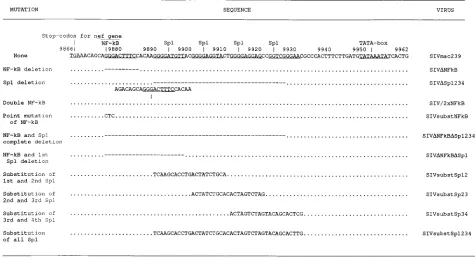
Construction of mutated viruses.Ten mutants of SIVmac239/nef-open bear-ing changes in the NF-kB and Sp1 binding sites were created by means of site-specific mutagenesis (Fig. 1). The mutations were introduced into both proviral LTRs.
The wild-type SIVmac239 was previously cloned in two parts and is carried on plasmids p239SpSp59(59clone) and p239SpE39(39clone), which contain the left and right halves of the genome, respectively (36). In this work, we have used a modified 39clone of SIVmac239 (kindly provided by Z. Du, Harvard Medical School), in which an additional EcoRI site was introduced just after the viral sequence and from which the cellular DNA sequences were eliminated. The resulting 3,834-bp SphI-EcoRI viral DNA fragment was cloned into plasmid pSp72. The use of this construct significantly simplified subcloning and recloning procedures. The viral sequence in this 39clone is identical to that in the 39clone used previously (36), except that the flanking cellular sequences have been removed and the stop codon in nef has been repaired to Glu.
The 854-bp SacI-EcoRI fragment of the 39clone was then subcloned in pSp72 and used for the introduction of site-specific mutations. We have employed PCR-directed mutagenesis (17) with one or two mutagenic primers and two terminal primers in each reaction mixture. Terminal primers spanned Bsu 36I and PflMI sites, which are unique in the reconstructed 39subclone. The resulting 528-bp fragment was digested with those enzymes and inserted into the
SacI-EcoRI subclone. In some instances, the mutation-containing PCR product was
initially cloned into blunt-end cloning vector (PCRII; Invitrogen Corp., San Diego, Calif.) or pUC18/SmaI (Pharmacia, Piscataway, N.J.), and then, upon sequence verification, recloned back into the SacI-EcoRI subclone; the
SphI-SacI fragment of proviral DNA was then cloned into this mutated subclone, thus
creating a full 39clone of SIVmac239. The mutated clones were multiply se-quenced through the TCE region and all restriction sites used in mutagenesis. The introduction of TCE mutations into the 59clone was performed essentially as described earlier (18). The SphI-SacI fragment of the SIVmac macrophage-competent strain MER was inserted into the mutated subclones for the creation of TCE mutants of SIVmacMER. This strain differs from SIVmac239 only by
three amino acid changes in the env gene, which are located in the 39part of the virus genome between the SphI and SacI sites (27, 28).
Molecular cloning.All routine cloning procedures were performed essentially as described earlier (18). Epicurian Coli XL1-Blue MRF9Supercompetent Cells (Stratagene Cloning Systems, La Jolla, Calif.) were used for the transformation and plasmid growth. Construction of mutated secreted engineered alkaline phos-phatase (SEAP) expression plasmids was performed with wild-type HIV and SIV LTR-SEAP plasmids (kindly provided by R. Means, Harvard Medical School). These plasmids contained the SEAP gene under the control of viral TCEs (nucleotides 9806 to 10093 for SIV and 9405 to 9611 for HIV), which included all NF-kB and Sp1 binding sites, the TATA box, and the full transactivation-responsive region (TAR). These fragments of the viral LTRs had been inserted into a SEAP-containing plasmid between unique MluI and HindIII sites (26a). These plasmids were used for PCR-directed mutagenesis for the creation of various HIV and SIV LTR-SEAP constructs. Each of the resulting plasmids was sequenced at least twice through the viral insert. PCR-amplified viral fragments from infected culture cell lines were treated with polynucleotide kinase and cloned into pUC18/SmaI-cut vector (Pharmacia) according to manufacturer’s recommendations.
Primers.All nucleotide primers were custom-made by Amitof, Inc. (Boston, Mass.) or GIBCO BRL (Grand Island, N.Y.). The terminal primers used in PCR mutagenesis were 59-GATTACACCTCAGGACCAGG-39(9548 to 9567) and 59-GCACCGGCCAAGTGCTGGTGA-39 (10089 to 10069). Primers 59-GGG ATTTATTACAGTGCAAGAAGA-39(6 to 29) and 59-GGCTAGGAGAGAT GGGAACACACA-39(724 to 701) were used for the amplification of SIVmac U3 and R regions from infected cells.
PCR amplification and DNA sequencing.PCR amplification and DNA se-quencing were performed essentially as described earlier (18). A thermal cycler produced by MJ Research (Watertown, Mass.) was used for PCR amplification. Nucleotide sequence analysis. Nucleotide sequences were analyzed and aligned by using MacVector version 4.1.4. software (International Biotechnolo-gies, Inc., New Haven, Conn.). The sequence of SIVmac239 has been published previously (36). The sequence of HIV-1 NL4-3 was taken from GenBank (ac-cession number M19921) (4).
[image:2.612.70.545.75.333.2]Cells.Rhesus monkey PBMCs, CEMx174, and COS-1 cells were maintained as described earlier (18). Alveolar macrophages were obtained from bronchoal-veolar lavage specimens, as described previously, from healthy, mature rhesus macaques that were serologically negative for SIV, type D retrovirus, and simian foamy virus (27). Macrophages were maintained in RPMI 1640 medium (GIBCO Laboratories, Grand Island, N.Y.) supplemented with 10% heat-inac-tivated fetal bovine serum and 2.5% human type AB serum (GIBCO), penicillin FIG. 1. Mutations in SIVmac239 transcriptional control elements. The nature of the introduced mutations, their sequence, and the designations of respective mutant viruses are shown. Proviral SIVmac239 genome sequences can be found in an article by Regier and Desrosiers (36). Dots indicate identities in sequence, and dashes indicate deletions. The stop codon for the nef gene, NF-kB and Sp1 binding sites, and the TATA box are underlined. Mutant SIV/2xNFkB contains an insertion of the sequence shown between nucleotides 9889 and 9890, creating a duplication of the NF-kB element.
on November 9, 2019 by guest
http://jvi.asm.org/
were sampled, clarified, and assayed for SIV p27 by antigen capture. Isolation of cellular DNA.Infected CEMx174 cells were pelleted, washed, and lysed in a small volume (50 to 100ml). DNA was isolated in a single microcen-trifuge tube for each sample with the HRI AmpPrep kit (HRI Research, Inc., Concord, Calif.) and subjected to the PCR amplification technique described above.
SEAP assay.COS-1 cells were transfected with various HIV or SIV LTR-SEAP plasmids (1mg) in the presence of DEAE-dextran (7) 1 day after being split. SEAP in the culture supernatant was detected 16 to 18 h later with the Phospha-Light chemiluminescent reporter gene assay system (Tropix, Inc., Bed-ford, Mass.) according to the manufacturer’s recommendations. Each assay was done in triplicate. Each experiment was performed three to six times separately.
RESULTS
Replication of SIVmac239 TCE mutants in vitro.
TCE
mu-tations were placed into both LTRs to prevent generation of
pa-rental sequences by recombinational or replicative events. All
SIVmac239 TCE mutants replicated in CEMx174 cells after
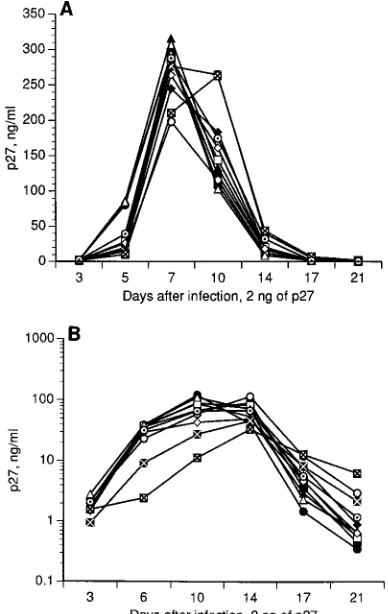
transfection of cloned DNA (Fig. 2A and B). While most
mu-tants consistently replicated with kinetics similar to those of the
wild type after transfection, the appearance of several mutants
was delayed. The replication of mutant viruses
D
NF
k
B
D
Sp1
and substSp34 was slightly delayed, and the replication of
D
NF
k
B
D
Sp1234 and substSp1234 was substantially delayed
(Fig. 2A and B). The latter two viruses are the most
severe-ly altered of all the mutants (Fig. 1). Virus stocks prepared
from transfection were used to infect CEMx174 cells with
amounts normalized to contain 2 ng of p27 CA antigen. The
pattern of replication after infection was similar to that
ob-served after transfection (Fig. 2C). The greatest delays in
rep-lication were observed with
D
NF
k
B
D
Sp1234,
D
NF
k
B
D
Sp1,
and substSp1234. All mutant viruses ultimately reached similar
levels of virus production in CEMx174 cells (Fig. 2C).
The replication of mutant viruses was also examined with
phytohemagglutinin-stimulated PBMCs from rhesus monkeys
in the presence of interleukin 2. Normalized amounts of virus
containing 2 ng of p27 were again used for infection. The
replication of mutant viruses in rhesus monkey PBMCs was not
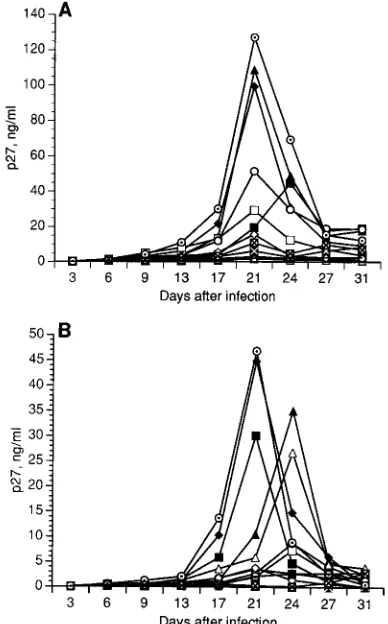
significantly delayed in most cases. In fact, the severely altered
mutant
D
NF
k
B
D
Sp1234 was not delayed in four of four
ex-periments, and viruses
D
NF
k
B
D
Sp1 and substSp1234
exhib-ited wild-type kinetics in two of four experiments.
Represen-tative results of the replication of SIVmac239 TCE mutants in
rhesus PBMCs are shown in Fig. 3. A summary of the results
of all experiments is presented in Table 1.
Sequence of the TCE region in SIVmac239-infected cells.
To-tal cellular DNA from SIV-infected CEMx174 cell cultures was
used for PCR amplification of the U3 and R regions (Fig. 4).
Multiple clones were derived and sequenced through the TCE
of each mutant. The clones derived from
D
NF
k
B
D
Sp1234 (six
clones) and substSp1234 (four clones) were sequenced through
all of the U3 and R regions. No reversions in the TCE were
detected, and except for an occasional sporadic mutation in a
single clone, no other mutations that could possibly explain the
surprisingly high replicative capacity of these mutant viruses
were observed.
Replication of SIVmacMER TCE mutants in vitro.
We also
wanted to test the replication of mutant viruses in primary
macrophage cultures. Since SIVmac239 replicates poorly in
primary cultures of rhesus monkey macrophages (9, 28), we
transferred the TCE mutations into a different genetic
back-FIG. 2. Replication of SIVmac239 TCE mutants in CEMx174 cells. Results of transfection with SIVDNFkB, SIVDSp1234, SIV/2xNFkB, SIV point mutant NFkB, SIVDNFkBDSp1234, and SIVDNFkBDSp1 (A) and with SIVsubstSp mutants (B) are shown. (C) Virus stocks derived from the transfections described above were used for infection of CEMx174 cells. Virus containing 2 ng of p27 was used for each infection. Symbols: A,■, SIVDNFkB;F, SIVDSp1234;å, SIV/2x NFkB;}, SIVsubstNFkB;h, SIVDNFkBDSp1234;E, SIVDNFkBDSp1;Ç, SIV mac239; B,■, SIVmac239;F, SIVsubstSp12;å, SIVsubstSp23;E, SIVsubst Sp34;h, SIVsubstSp1234; C,■, SIVDNFkB;F, SIVDSp1234;å, SIV/2xNFkB;}, SIVsubstNFkB;h, SIVDNFkBDSp1234;E, SIVDNFkBDSp1;Ç, SIVsubst Sp12;{, SIVsubstSp23;:, SIVsubstSp34; , SIVsubstSp1234;J, SIVmac239.
on November 9, 2019 by guest
http://jvi.asm.org/
bone. SIVmacMER contains three mutations in the envelope
relative to SIVmac239: 67V
3
M, 176K
3
E, and 382G
3
R (27,
28). These mutations confer the high replicative capacity of
the virus for primary rhesus monkey macrophages (27). We
thus exchanged the TCE mutations into the background of
SIVmacMER and analyzed the growth properties of the
mu-tant viruses.
The TCE mutants of the macrophage-competent strain SIV
macMER replicated in CEMx174 cells and primary rhesus
PBMC cultures similar to the equivalent mutants of SIVmac
239. SIVmacMER viruses
D
NF
k
B
D
Sp1234,
D
NF
k
B
D
Sp1,
sub-stSp1234, substSp34, and
D
NF
k
B grew with a delay in CEMx
174 cells in transfection and infection experiments (Fig. 5A).
As with SIVmac239 TCE mutants, the delay in replication of
these SIVmacMER mutant viruses was slightly longer after
transfection than after infection. All viruses ultimately reached
the wild-type level of production in CEMx174 cells. Only
SIV-macMERsubstSp1234 exhibited a slight growth delay in
stim-ulated rhesus monkey PBMCs (Fig. 5B and C), while all other
viruses exhibited wild-type kinetics and levels of production.
[image:4.612.323.548.72.193.2]In contrast to the results with CEMx174 and rhesus
maca-que PBMC cultures, most of the SIVmacMER TCE mutants
showed both delayed and suppressed replication in primary
rhesus macrophages (Fig. 6 and Table 2). The results varied
slightly in macrophage cultures derived from different
ani-mals. However, it could be clearly seen that only 2xNF
k
B and
substNF
k
B mutants showed a wild-type pattern of replication
FIG. 3. Replication of SIVmac239 TCE mutants in rhesus monkey PBMCs.Virus containing 2 ng of p27 was used for each infection. SIVmac239 was used in parallel. The results of two separate experiments with PBMCs from two different rhesus monkeys (A and B) are shown. Symbols:■, SIVDNFkB;F, SIVDSp1234;å, SIV/2xNFkB;}, SIVsubstNFkB;h, SIVDNFkBDSp1234;E, SIVDNFkBDSp1;Ç, SIVsubstSp12;{, SIVsubstSp23;:, SIVsubstSp34; , SIV substSp1234;J, SIVmac239.
FIG. 4. PCR amplification of proviral U3 and R regions from the DNA of infected CEMx174 cells. DNAs from the cultures infected with SIVDNFkB, SIVDSp1234, SIV/2xNFkB, SIVsubstNFkB, SIVDNFkBDSp1234, and SIVD NFkBDSp1 (lanes 1 to 6, respectively) were used for amplification as described in Materials and Methods. The locations of molecular size markers (base pairs) are shown to the left.
TABLE 1. Replication of SIVmac239 TCE mutants in vitro
Virus
Replication capacitya
CEMx174 cells
PBMCs (infection) Transfection Infection
SIVDNFkB 1111(1) 1111(3) 1111(4) (slightly delayed once)b
SIVDSp1234 1111(1) 1111(3) (slightly delayed once) 1111(4) (slightly delayed once)b
SIV/2xNFkB 11111(2) At least1111(3) 1111(4)
SIVsubstNFkB 1111(1) 1111(3) 1111(4) (delayed once)b
SIVDNFkBDSp1234 Delayed (2) Delayed (2) 1111(4)
SIVDNFkBDSp1 Delayed once (2) Delayed (3) Delayed twice (4)c
SIVsubstSp12 1111(2) 1111(3) 1111(4)
SIVsubstSp23 1111(2) 1111(3) 1111(4)
SIVsubstSp34 Delayed (1) Delayed (1) 1111(4) (slightly delayed twice)
SIVsubstSp1234 Substantially delayed (2) Delayed (2) Delayed twice (4)
a1111
, replication reached wild-type level (no less than 50%) with no or an unsubstantial delay compared with SIVmac239;11111, replication reached the peak level earlier than with wild-type SIVmac239; slightly delayed, replication reached wild-type levels 2 to 3 days later than SIVmac239; delayed, replication reached wild-type levels 4 to 7 days later than SIVmac239; substantially delayed, replication reached wild-type levels$7 days later than SIVmac239. The number of experiments for each mutant with each cell type is shown in parentheses.
b
In this case, replication of the mutant in PBMCs reached 30% of the wild-type level. c
In these cases, replication of the mutants in PBMCs reached 10 and 30% of the wild-type level.
on November 9, 2019 by guest
http://jvi.asm.org/
[image:4.612.77.271.73.380.2]in all experiments. The ability of SIVmacMER to replicate in
primary macrophages was impaired to various degrees by
all other TCE mutations. Mutant
D
NF
k
B was partially
af-fected, mutant
D
NF
k
B
D
Sp1 was even more suppressed,
mu-tants
D
NF
k
B
D
Sp1234 and substSp12 grew to a significant level
in only one experiment out of three, and the other mutants
(
D
Sp1234, substSp23, substSp34, and substSp1234) never
ex-hibited substantial growth in primary rhesus macrophages. A
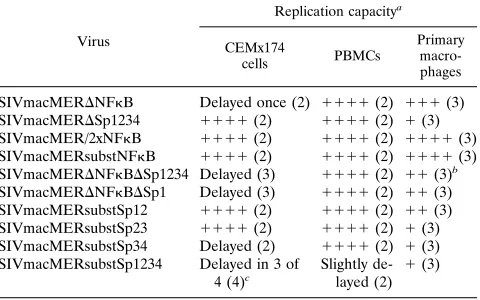
summary of the replicative capacities of SIVmacMER TCE
mutants in vitro is shown in Table 2.
NF-
k
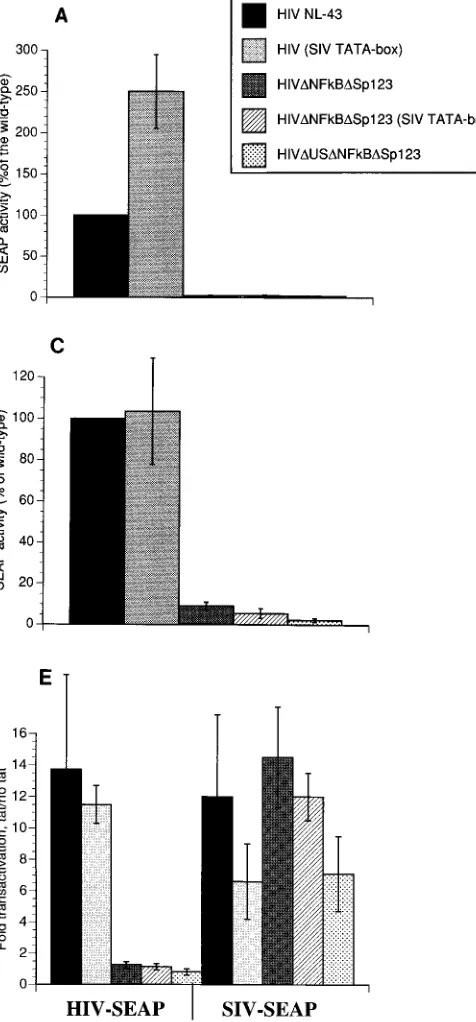
B- and Sp1-deleted form over background levels (Fig. 8B
and E). In contrast, deletion of NF-
k
B and Sp1 elements from
the SIV LTR did not abolish SEAP expression from the
cor-responding plasmid (Fig. 8C). In fact, the SIV-SEAP plasmid
missing the NF-
k
B and Sp1 binding sites retained
approxi-mately 10% of its activity (Fig. 8C). Sequences upstream of the
NF-
k
B and Sp1 binding sites in the SIV LTR were principally
responsible for this residual activity, since their removal
re-duced the residual expression from 10% to 2% (Fig. 8C).
Enhanced transcription caused by these upstream sequences
was also responsive to Tat transactivation (Fig. 8D and E). In
addition to these upstream enhancer elements, the SIV LTR
appeared to contain a slightly more efficient TATA box than
the HIV-1 LTR (Fig. 8A to D).
[image:5.612.79.273.67.544.2]Since the HIV LTR reporter plasmid used for the data in
Fig. 8 contained only 20 bp upstream of the NF-
k
B and Sp1
FIG. 5. Replication of SIVmacMER TCE mutants in CEMx174 cells (A) and rhesus monkey PBMCs (B and C). Virus containing 2 ng of p27 was used for each infection. The results of two separate experiments with PBMCs from two differ-ent rhesus monkeys are shown. Symbols:■, SIVmacMERDNFkB;F, SIVmac MERDSp1234;å, SIVmacMER/2xNFkB;}, SIVmacMERsubstNFkB;h, SIV macMERDNFkBDSp1234;E, SIVmacMERDNFkBDSp1;Ç, SIVmacMERsubst Sp12;{, SIVmacMERsubstSp23;:, SIVmacMERsubstSp34; , SIVmacMER substSp1234;J, SIVmacMER; , SIVmac239.
FIG. 6. Replication of SIVmacMER TCE mutants in primary rhesus monkey macrophages. Virus containing 10 ng of p27 was used to infect 106
cells. The results of two separate experiments with macrophages from two different rhesus monkeys are shown. Symbols are the same as those in Fig. 5.
on November 9, 2019 by guest
http://jvi.asm.org/
[image:5.612.337.531.379.691.2]elements, we constructed an equivalent HIV LTR reporter
plasmid with 65 bp of upstream sequences. Deletion of the
NF-
k
B and Sp1 binding sites from this plasmid also reduced
SEAP expression to background levels (Fig. 9). Thus the
en-hancer element present upstream of the NF-
k
B and Sp1
bind-ing sites in the SIV LTR contains no equivalent element in the
corresponding region of the HIV-1 LTR.
We also examined the effects of LTR mutations on the
SEAP reporter plasmid activity in CEMx174 cells (Fig. 10).
The tat gene was cotransfected in all of these assays. As in
COS-1 cells, elimination of the NF-
k
B and Sp1 sites from the
HIV-1 LTR reduced SEAP activity from transfected cells to
background levels. In contrast, the SIV-SEAP plasmid missing
the NF-
k
B and Sp1 binding sites retained 19% of residual
activity.
DISCUSSION
The transcriptional control region of HIV-1 contains two
binding sites for NF-
k
B and three sites for Sp1 (12). These
sequences quite clearly account for the vast majority, if not the
entirety, of enhancer activity in the HIV-1 LTR. While
muta-tion of each of these elements individually has differential
effects on HIV-1 replication on different cell substrates,
elim-ination of all NF-
k
B and Sp1 binding sites reduces HIV-1
replication to below detectable levels in all cell types tested
(23, 39). Thus, no enhancer elements that can functionally
compensate for the loss of NF-
k
B and Sp1 binding sites are
present in the HIV-1 LTR.
The transcriptional control regions of HIV-2 and SIVmac
[image:6.612.59.299.85.235.2]FIG. 7. Schematic representation of HIV and SIV LTR sequences introduced into SEAP reporter constructs. Nucleotide numbers corresponding to the inserted and deleted proviral sequences are shown. US stands for upstream U3 sequences. The HIVDNFkBDSp123 plasmids have had nucleotides 9425 to 9483 deleted. The HIV (SIV TATA-box) plasmids have had nucleotides 9500 to 9509 changed to nucleotides 9948 to 9957 of SIVmac239. The viral sequence in plasmid HIVDUSDNFkBDSp123 starts with nucleotide 9484. Plasmid SIVmacDNFkBDSp1234 has had nucleotides 9876 to 9927 deleted, plasmid SIVmac (HIV-1 TATA-box) has had nucleotides 9948 to 9957 changed to nucleotides 9500 to 9509 of HIV NL-43, and the viral sequence in plasmid SIVDUSDNFkBDSp1234 starts with nucleotide 9928. The designation of each LTR-SEAP construct is shown. Nucleotide numbers are derived from reference 36 for SIV and from GenBank (4) for HIV-1 NL-43 (accession number M19921).
TABLE 2. Replication of SIVmacMER TCE mutants in vitro
Virus
Replication capacitya
CEMx174
cells PBMCs
Primary macro-phages
SIVmacMERDNFkB Delayed once (2) 1111(2) 111(3)
SIVmacMERDSp1234 1111(2) 1111(2) 1(3)
SIVmacMER/2xNFkB 1111(2) 1111(2) 1111(3)
SIVmacMERsubstNFkB 1111(2) 1111(2) 1111(3)
SIVmacMERDNFkBDSp1234 Delayed (3) 1111(2) 11(3)b SIVmacMERDNFkBDSp1 Delayed (3) 1111(2) 11(3)
SIVmacMERsubstSp12 1111(2) 1111(2) 11(3)
SIVmacMERsubstSp23 1111(2) 1111(2) 1(3)
SIVmacMERsubstSp34 Delayed (2) 1111(2) 1(3) SIVmacMERsubstSp1234 Delayed in 3 of
4 (4)c
Slightly de-layed (2)
1(3)
a1111, replication reached the wild-type level (no less than 50%) with no delay or an unsubstantial delay compared with SIVmac239 in all experiments; slightly delayed, replication reached wild-type levels 2 to 3 days later than SIV mac239; delayed, replication reached wild-type levels$4 days later than SIV-mac239;111, replication reached the wild-type level in two of three experi-ments;11, replication reached the wild-type level in one of three experiments;
1, replication has not reached the wild-type level in any of three experiments. The number of experiments for each mutant with each cell type is shown in parentheses.
bThe level of replication of this mutant in macrophages may be graded as between11and111.
cOne separate stock of this mutant has exhibited wild-type replication in CEMx174 cells. PCR amplification of DNA from infected cells and sequencing of five separate clones through the U3 and R regions have not shown any consistent reversions and differences from ‘‘normally’’ delayed SIVmacMERsub stSp1234 in this part of the proviral sequence. This mutant may have compen-satory mutations elsewhere in the genome.
on November 9, 2019 by guest
http://jvi.asm.org/
contain one binding site for NF-
k
B and three or four
puta-tive binding sites for Sp1 (13, 36). The relaputa-tive importance of
these elements for the replication of HIV-2 and SIVmac
has not to our knowledge been previously investigated.
How-ever, transient expression assays have demonstrated the
pres-ence of enhancer elements upstream of the single NF-
k
B
bind-ing element in HIV-2 and SIVmac and that these additional
enhancer elements are responsive to cell activation signals (5,
25, 26, 37).
The main objective of our present study was to examine the
relative importance of the NF-
k
B and Sp1 binding elements
for replication of SIVmac in primary PBMCs and primary
macrophages of rhesus monkeys. A collection of 10 SIVmac
mutants bearing changes in the NF-
k
B and Sp1 elements was
created for this purpose. Since interaction and cooperation
between transcription factors may greatly influence the level of
transcriptional activity (24, 34, 35), both deletion and
substi-tution mutations were employed.
Unexpectedly, all mutated SIVs replicated with kinetics and
to levels similar to those of parental wild-type virus in rhesus
monkey PBMC cultures. Even mutant virus missing all NF-
k
B
and Sp1 sites replicated similarly to wild-type virus in rhesus
monkey PBMC cultures. At least three viruses,
D
NF
k
B
D
Sp1234, substSp1234, and
D
NF
k
B
D
Sp1, showed a consistent
delay in CEMx174 cells.
[image:7.612.77.315.75.586.2]The terminally differentiated macrophage represents a
sys-tem in which gene expression is principally dependent on
con-stitutively produced transcription factors. One might expect,
therefore, that lentiviral transcription in these cells might be
more sensitive to specific changes in individual elements.
In-deed, we found that most changes in Sp1 binding sites had a
dramatic effect on SIV replication in macrophages. In
partic-ular, Sp1 substitution mutations which had no effect on SIV
replication in CEMx174 and PBMC cultures severely impaired
virus replication in primary rhesus monkey macrophages. In
contrast, the NF-
k
B site had little impact on SIV replication in
FIG. 8. Transcriptional activity of HIV and SIV wild-type and mutant LTR-SEAP constructs. COS-1 cells were transfected with HIV LTR-LTR-SEAP constructs without (A) or with (B) Tat, and SEAP activity in culture supernatants was measured 16 to 18 h later. Similar experiments were also performed with SIV LTR-SEAP constructs without (C) and with (D) Tat. The activity in mutant-transfected cells is expressed as a percentage of that of the wild type. (E) Tat responsiveness in HIV and SIV LTR-SEAP constructs. The results are summa-ries of three to six independent experiments.on November 9, 2019 by guest
http://jvi.asm.org/
macrophages. The SIVmacMER mutant with point mutations
in the NF-
k
B site did not show any growth retardation in
primary rhesus monkey macrophages, and the NF-
k
B deletion
mutant was only marginally delayed in these cultures. Our
results are in direct disagreement with those reported by Bellas
et al. (2), who found profound effects of the NF-
k
B site for
re-plication of SIVmac in primary rhesus monkey alveolar
macro-phages. Our results indicate a cooperative relationship among
Sp1 sites or between Sp1 sites and other enhancer elements.
This cooperation appears to be essential for high-level SIV
replication in unstimulated alveolar macrophages. The relative
effects of NF-
k
B and Sp1 binding elements will not necessarily
apply to other sources of monocytes/macrophages.
The results of transient expression assays suggest that the 70
bp upstream of the NF-
k
B element in SIVmac are principally
responsible for the surprisingly high replicative capacity of
D
NF
k
B
D
Sp1234 in primary rhesus monkey PBMC cultures.
Our results with transient transfection assays are consistent
with previous reports of enhancer elements immediately
up-stream of the NF-
k
B binding sites in SIVmac and HIV-2 (5, 25,
26, 37). We additionally report that this enhancer element is
responsive to Tat transactivation. Thus, this novel enhancer
element, not present in HIV-1, can apparently allow a
signif-icant level of SIV transcription and replication in the complete
absence of NF-
k
B and Sp1 binding sites.
In rhesus monkeys infected with a SIV mutant with a 182-bp
deletion in unique nef sequences, additional nef sequences are
lost over time, including nef sequences which overlap U3 (22).
However, particular cis-acting sequences known to be
impor-tant for viral replication are specifically retained. These include
the polypurine tract, known to be important for reverse
tran-scription, and U3 terminal sequences, known to be important
for viral DNA integration. It is worth noting that the 50 bp of
sequences immediately upstream of the NF-
k
B element, which
correspond to the novel enhancer element, are also
uni-formly retained (22). While multiple mutations over a 300-bp
stretch of upstream U3 sequences (US) were previously shown
not to affect SIVmac239 replication in vitro or in vivo (18),
these mutations did not involve the 50 bp of sequence
imme-diately upstream of the NF-
k
B site containing this novel
en-hancer element. The novel enen-hancer element is overlapped
and contained within the nef reading frame.
In addition to the novel enhancer element, our results
indi-cate that the SIVmac TATA box (TATAAATAT) is more
efficient than the HIV-1 TATA box (ATATAA) and that this
contributes to the residual transcriptional activity in the
ab-sence of NF-
k
B and Sp1 binding elements. Previous studies
have also shown that enlargement of the HIV-1 TATA box
may compensate for other mutations in the TCE (20, 39).
However, this increased activity of the SIVmac TATA
se-quences appears to contribute less than the enhancer elements
upstream of NF-
k
B.
The relative importance of these transcriptional control
el-ements in SIVmac can be evaluated under even more relevant
conditions in whole animals. The use of the SIVmac239 clone
for these constructions will allow assessment of the effects of
these TCE mutations on viral replication and pathogenic
po-tential in vivo. Furthermore, the differential effects of these
mutations in macrophages versus lymphocytes in culture will
allow us to draw correlations regarding which is more
predic-tive of the effects in vivo. Such experiments are in progress.
ACKNOWLEDGMENTS
We thank Susan Czajak for technical assistance, Robert Means for providing HIV and SIV LTR-SEAP plasmids, Sabine Lang for helpful discussion, Prabhat Sehgal for lung lavages, and Richard Gaynor for the suggestion of exchanging TATA boxes.
This work was supported by PHS grants AI35365, AI25328, and RR00168.
REFERENCES
1. Alcami, J., T. Lain de Lera, L. Folgueira, M.-A. Pedraza, J.-M. Jacque, F. Bachelerie, A. R. Noriega, R. T. Hay, D. Harrich, R. B. Gaynor, J.-L. Vire-lizier, and F. Arenzana-Seisdedos.1995. Absolute dependence onkB re-sponsive elements for initiation and Tat-mediated amplification of HIV transcription in blood CD4 T lymphocytes. EMBO J. 14:1552–1560. 2. Bellas, R. E., N. Hopkins, and Y. Li. 1993. The NF-kB binding site is
necessary for efficient replication of simian immunodeficiency virus of ma-caques in primary macrophages but not in T cells in vitro. J. Virol. 67: 2908–2913.
3. Berkhout, B., and K.-T. Jeang. 1992. Functional roles for the TATA pro-moter and enhancers in basal and Tat-induced expression of the human immunodeficiency virus type 1 long terminal repeat. J. Virol. 66:139–149. 4. Bilofsky, H. S., and C. Burks. 1988. The GenBank genetic sequence data
bank. Nucleic Acids Res. 16:1861–1863.
5. Clark, N. M., M. C. Hannibal, and D. M. Markovitz. 1995. The peri-kB site mediates human immunodeficiency virus type 2 enhancer activation in monocytes but not in T cells. J. Virol. 69:4854–4862.
6. Coffin, J. M. 1990. Retroviridae and their replication, p. 1437–1500. In B. N. Fields and D. M. Knipe (ed.), Virology. Raven Press, New York. 7. Cullen, B. R. 1987. Use of eukaryotic expression technology in the functional
analysis of cloned genes. Methods Enzymol. 152:684–703.
8. Cullen, B. R., and W. C. Greene. 1989. Regulatory pathways governing HIV-1 replication. Cell 58:423–426.
9. Desrosiers, R. C., A. Hansen-Moosa, K. Mori, D. P. Bouvier, N. W. King, M. D. Daniel, and D. J. Ringler.1991. Macrophage-tropic variants of SIV are FIG. 9. Transcriptional activity of HIV/largeUS LTR-SEAP constructs. The
plasmids HIV/largeUS and HIVDNFkBDSp123/largeUS were created by the insertion of HIV NL-43 nucleotides 9362 to 9404 into plasmids HIV NL-43 and HIVDNFkBDSp123 of HIV LTR-SEAP.
FIG. 10. Transcriptional activity of LTR-SEAP constructs in CEMx174 cells. Five micrograms of SEAP plasmid and 2mg of Tat plasmid were used for each transfection. The results shown are the average of duplicate measurements.
on November 9, 2019 by guest
http://jvi.asm.org/
dent activation of the human immunodeficiency virus in phorbol ester stim-ulated T lymphocytes. EMBO J. 9:4417–4423.
15. Harrich, D., J. Garcia, F. Wu, R. Mitsuyasu, J. Gonzalez, and R. Gaynor. 1989. Role of SP1-binding domains in in vivo transcriptional regulation of the human immunodeficiency virus type 1 long terminal repeat. J. Virol. 63: 2585–2591.
16. Henderson, A. J., X. Zou, and K. L. Calame. 1995. C/EBP proteins activate transcription from the human immunodeficiency virus type 1 long terminal repeat in macrophages/monocytes. J. Virol. 69:5337–5344.
17. Higuchi, R., B. Krummel, and R. K. Saiki. 1988. A general method of in vitro preparation and specific mutagenesis of DNA fragments: study of protein and DNA interactions. Nucleic Acids Res. 16:7351–7367.
18. Ilyinskii, P. O., M. D. Daniel, M. A. Simon, A. A. Lackner, and R. C. Desrosiers.1994. The role of upstream U3 sequences in the pathogenesis of simian immunodeficiency virus-induced AIDS in rhesus monkeys. J. Virol. 68:5933–5944.
19. Jones, K. A., J. T. Kadonaga, P. A. Luciw, and R. Tjian. 1986. Activation of the AIDS retrovirus promoter by the cellular transcription factor, Sp1. Sci-ence 232:755–759.
20. Kashanchi, F., R. Shibata, E. K. Ross, J. N. Brady, and M. A. Martin. 1994. Second-site long terminal repeat (LTR) revertants of replication-defective human immunodeficiency virus: effects of revertant TATA box motifs on virus infectivity, LTR-directed expression, in vitro RNA synthesis, and bind-ing of basal transcription factors TFIID and TFIIA. J. Virol. 68:3298–3307. 21. Kawakami, K., C. Scheidereit, and R. G. Roeder. 1988. Identification and purification of a human immunoglobulin-enhancer-binding protein (NF-kB) that activates transcription from a human immunodeficiency virus type 1 promoter in vitro. Proc. Natl. Acad. Sci. USA 85:4700–4704.
22. Kirchhoff, F., H. W. I. Kestler III, and R. C. Desrosiers. 1994. Upstream U3 sequences in simian immunodeficiency virus are selectively deleted in vivo in the absence of an intact nef gene. J. Virol. 68:2031–2037.
23. Leonard, J., C. Parrott, A. J. Buckler-White, W. Turner, E. K. Ross, M. A. Martin, and A. B. Rabson.1989. The NF-kB binding sites in the human immunodeficiency virus type 1 long terminal repeat are not required for virus infectivity. J. Virol. 63:4919–4924.
24. Majello, B., P. DeLuca, G. Hagen, G. Suske, and L. Lania. 1994. Different members of the Sp1 multigene family exert opposite transcriptional regula-tion of the long terminal repeat of HIV-1. Nucleic Acids Res. 22:4914–4921. 25. Markovitz, D. M., M. Hannibal, V. L. Perez, C. Gauntt, T. M. Folks, and G. J. Nabel.1990. Differential regulation of human immunodeficiency vi-ruses (HIVs): a specific regulatory element in HIV-2 responds to stimulation of the T-cell antigen receptor. Proc. Natl. Acad. Sci. USA 87:9099–9102. 26. Markovitz, D. M., M. J. Smith, J. Hilfinger, M. C. Hannibal, B. Petryniak,
and G. J. Nabel.1992. Activation of the human immunodeficiency virus type
vates expression of human immunodeficiency virus in T cells. Nature (Lon-don) 326:711–712.
31. Naidu, Y. M., H. W. Kestler III, Y. Li, C. V. Butler, D. P. Silva, D. K. Schmidt, C. D. Troup, P. K. Sehgal, P. Sonigo, M. D. Daniel, and R. C. Desrosiers.1988. Characterization of infectious molecular clones of simian immunodeficiency virus (SIVmac) and human immunodeficiency virus type 2: persistent infection of rhesus monkeys with molecularly cloned SIVmac. J. Virol. 62:4691–4696.
32. Parrott, C., T. Seidner, E. Duh, J. Leonard, T. S. Theodore, A. Buckler-White, M. A. Martin, and A. B. Rabson.1991. Variable role of the long terminal repeat Sp1-binding sites in human immunodeficiency virus replica-tion in T lymphocytes. J. Virol. 65:1414–1419.
33. Perkins, N. D., A. B. Agranoff, C. S. Duckett, and G. J. Nabel. 1994. Tran-scription factor AP-2 regulates human immunodeficiency virus type 1 gene expression. J. Virol. 68:6820–6823.
34. Perkins, N. D., A. B. Agranoff, E. Pascal, and G. J. Nabel. 1994. An inter-action between the DNA-binding domains of RelA(p65) and Sp1 mediates human immunodeficiency virus gene activation. Mol. Cell Biol. 14:6570– 6583.
35. Perkins, N. D., N. L. Edwards, C. S. Duckett, A. B. Agranoff, R. M. Schmid, and G. J. Nabel.1994. A cooperative interaction between NF-kB and Sp1 is required for HIV-1 enhancer activation. EMBO J. 12:3551–3558. 36. Regier, D. A., and R. C. Desrosiers. 1990. The complete nucleotide sequence
of a pathogenic molecular clone of simian immunodeficiency virus. AIDS Res. Hum. Retroviruses 6:1221–1231.
37. Renjifo, B., N. A. Speck, S. Winandy, N. Hopkins, and Y. Li. 1990. cis-Acting elements in the U3 region of a simian immunodeficiency virus. J. Virol. 64: 3130–3134.
38. Rosen, C. A., J. G. Sodroski, and W. A. Haseltine. 1985. The location of
cis-acting regulatory sequences in the human T cell lymphotropic virus type
III (HTLV-III/LAV) long terminal repeat. Cell 41:813–823.
39. Ross, E. K., A. J. Buckler-White, A. B. Rabson, G. Englund, and M. A. Martin.1991. Contribution of NF-kB and Sp1 binding motifs to the repli-cative capacity of human immunodeficiency virus type 1: distinct patterns of viral growth are determined by T-cell types. J. Virol. 65:4350–4358. 40. Shaw, J.-P., P. J. Utz, D. B. Durand, J. J. Toole, E. A. Emmel, and G. R.
Crabtree.1988. Identification of a putative regulator of early T cell activation genes. Science 241:202–205.
41. Tong-Starksen, S. E., T. M. Welsh, and B. M. Peterlin. 1990. Differences in transcriptional enhancers of HIV-1 and HIV-2 response to T cell activation signals. J. Immunol. 145:4348–4354.
42. Winandy, S., B. Renjifo, Y. Li, and N. Hopkins. 1992. Nuclear factors that bind two regions important to transcriptional activity of the simian immu-nodeficiency virus long terminal repeat. J. Virol. 66:5216–5223.