R E S E A R C H
Open Access
Finding parasites and finding challenges:
improved diagnostic access and trends in
reported malaria and anti-malarial drug use in
Livingstone district, Zambia
Freddie Masaninga
1, Masela Sekeseke-Chinyama
2, Thindo Malambo
3, Hawela Moonga
4, Olusegun Babaniyi
1,
Helen Counihan
5and David Bell
6*Abstract
Background:Understanding the impact of malaria rapid diagnostic test (RDT) use on management of acute febrile disease at a community level, and on the consumption of anti-malarial medicines, is critical to the planning and success of scale-up to universal parasite-based diagnosis by health systems in malaria-endemic countries.
Methods:A retrospective study of district-wide community-level RDT introduction was conducted in Livingstone District, Zambia, to assess the impact of this programmed on malaria reporting, incidence of mortality and on district anti-malarial consumption.
Results:Reported malaria declined from 12,186 cases in the quarter prior to RDT introduction in 2007 to an average of 12.25 confirmed and 294 unconfirmed malaria cases per quarter over the year to September 2009. Reported malaria-like fever also declined, with only 4,381 RDTs being consumed per quarter over the same year. Reported malaria mortality declined to zero in the year to September 2009, and all-cause mortality declined. Consumption of artemisinin-based combination therapy (ACT) dropped dramatically, but remained above reported malaria, declining from 12,550 courses dispensed by the district office in the quarter prior to RDT implementation to an average of 822 per quarter over the last year. Quinine consumption in health centres also declined, with the district office ceasing to supply due to low usage, but requests for sulphadoxine-pyrimethamine (SP) rose to well above previous levels, suggesting substitution of ACT with this drug in RDT-negative cases.
Conclusions:RDT introduction led to a large decline in reported malaria cases and in ACT consumption in Livingstone district. Reported malaria mortality declined to zero, indicating safety of the new diagnostic regime, although adherence and/or use of RDTs was still incomplete. However, a deficiency is apparent in management of non-malarial fever, with inappropriate use of a low-cost single dose drug, SP, replacing ACT. While large gains have been achieved, the full potential of RDTs will only be realized when strategies can be put in place to better manage RDT-negative cases.
* Correspondence:[email protected]
6Foundation for Innovative New Diagnostics (FIND), Geneva, Switzerland
Full list of author information is available at the end of the article
Background
To achieve universal access to parasite-based diagnosis of malaria-like febrile illness, consistent with current global policy recommendations [1], it will be necessary to deploy malaria rapid diagnostic tests (RDTs) widely at community level in most malaria endemic countries. Mi-croscopy services, the only realistic alternative in low re-source settings, cannot be sustained at this level in most programmes [2], and, therefore, over 100 million RDTs were financed towards filling this gap in 2010 [3]. While it is feasible to train community-level health workers to safely prepare and accurately interpret RDTs [4-6], and evidence exists that withholding treatment on the basis of a negative RDT results can be safe [7-13], RDT intro-duction will be pointless if the diagnostic outcome does not guide subsequent case management. This should in-clude both restriction of anti-malarial drugs to parasite-positive cases, and appropriate early management of non-malarial febrile illness.
Artemisinin-based combination therapy (ACT), the first line anti-malarial forPlasmodium falciparum infec-tion in most endemic countries, is relatively expensive and reliant on an insecure supply of raw materials. Meanwhile, non-malarial febrile illness exerts a higher childhood mortality across malaria-endemic countries than malaria. [14]. RDTs, therefore have an important role to play in targeting ACT prescription and identify-ing non-malarial fever for other management. However, reports of the impact of RDT results on subsequent management vary. While impact on anti-malarial con-sumption on a wide-scale is demonstrated [15-17], a number of published field trials have also revealed poor adherence to results, likely to reduce or negate the po-tential of RDTs to improve disease management [18-21].
Previously in Zambia, malaria diagnosis had been pre-dominantly based on symptoms, with only 12.5% of 1730 public health facilities listed as having diagnostic capacity by microscopy in 2004 [22]. The Ministry of Health revised national guidelines in 2009-2010 to mandate parasitological confirmation of malaria based on microscopy or RDTs in the public and private sec-tors, with RDTs to be used where microscopy was not available, or where RDT use on an out-patient basis by non-laboratory staff would reduce laboratory workloads [23]. This policy built on a decision of the National Mal-aria Control Centre (NMCC) to progress to national scale-up of RDT use in 2009, after a number of RDT trials and introduction of malaria RDTs in certain dis-tricts in the public sector [15,24,25]. ACT had been introduced as first-line therapy in 2005.
As part of this trial of RDTs at community level, a study was conducted in Livingstone District to test and improve RDT instructions and training materials, and trained community health workers (CHWs) in the
district were followed to assess performance in RDT use over 12 months [6]. In view of the dramatic reduction in reported malaria at the district level, resulting in a de-cline from first to 16th in the District Health Manage-ment Team’s (DHMT) list of health priorities (DHMT, Personal communication), a retrospective study was undertaken to review the reported malaria rate, mortal-ity, and consumption of anti-malarial drugs in Living-stone District across the study period, and assess the impact of RDT introduction on these.
Methods Geographical area
Livingstone district is located in southern Zambia, bor-dering Zimbabwe. The district is relatively small in area by Zambian standards, covering 672 square kilometres [26], with a population of 142,034. The economy is based mainly on agriculture and the tourist industry based around Victoria Falls. The climate includes a wet season extending from October to April-May and a dry season from May to September. The Livingstone DHMT oversees 13 health centres and approximately 65 com-munity health workers, the latter overseen locally by the nearest clinic. Malaria had previously been considered the primary public health priority in Livingstone dis-trict, with between 6,000 and 12000 thousand cases reported in each quarter during 2004 to 2006 inclusive, based on symptom-based diagnosis (Figure 1). The limited microscopy-based diagnosis in place at some health centres reported 98% P. falciparum [27]. Indoor residual spraying (IRS) was introduced in Livingstone district in 2004, insecticide-treated bed nets in early 2007, and the first-line anti-malarial treatment changed from sulphadoxine-pyrimethamine (SP) to artemisinin-based combination therapy (ACT) using artemether-lumefantrine in late 2006, in line with Zambian national policy. Quinine continued to be recommended as second-line therapy, and SP was supplied for intermittent pre-ventive treatment in pregnancy (IPTp) and for malaria treatment in patients less than 5 kgs. RDTs had not previ-ously been in routine use in Livingstone District or used by community health workers, but had been introduced to the District Hospital and some clinics from 2005 on a limited basis. Microscopy use is restricted to the district hospital and four health centres and contributes little to total malaria diagnostic figures.
Health centres and health staff
experience in malaria management, though mainly in symptom-based treatment as only two had previously used malaria rapid tests. Full characteristics of the CHWs are described elsewhere [6]. All received 3.5 days training in case management, including a half day specifically devoted to preparation and interpretation of P. falciparum-detecting malaria RDTs (ICT Malaria Pf, ICT Diagnostics, South Africa), and were provided with product-specific RDT job-aids and interpretation guides [28], RDTs and ACT (artemether-lumefantrine, [CoartemW]). They were instructed to test febrile patients and treat with ACT only if the RDT result was positive, and refer cases of significant fever but negative RDT results. CHWs were followed with rou-tine supervision and specific observational review at 3, 6 and 12 months to assess blood safety and diag-nostic performance [6].
CHWs were requested to maintain records of RDTs used, results, and ACT dispensed in a record book and report these to the local clinic. RDT negative fever cases, apparent malaria treatment failures, severe infections and malaria-negative patients were also to be referred to the nearest health clinic, in line with national guidelines [23]. Health centres are provided with oral and paren-teral quinine for severe malaria, early pregnancy and first-line treatment failures, and SP for intermittent prophylactic treatment for pregnancy (IPTp). Clinics stock antibiotics and anti-pyretics for non-malarial fever. CHWs were supervised by the local clinics according to normal practice and resupplied from clinic stock. Health centres, staffed by trained nurses, received RDT
and anti-malarial drug stock from the DHMT, and were also trained by the DHMT to use RDTs and institute parasite-based malaria diagnosis. During 2008 it was observed that some health centre staff continued to base malaria treatment only on clinical diagnosis, and the DHMT re-trained all health centre staff on fever case management and use of RDTs from April to May 2008, with increased emphasis on rational use of ACT.
Incidence and consumption data
[image:3.595.59.539.90.301.2]Malaria incidence and mortality data used for this study are from data submitted by the Livingstone DHMT to the Zambian National Health Information Management System (HMIS), from the first quarter of 2004 to the third of 2009. These data are derived from clinic reports which are reviewed and data checked prior to submis-sion to the DHMT by the health centre‘in-charges’. The reporting period for commodity use for this study extended from January 2007 to October 2009, the first year being part of a study of quality of health worker RDT performance described elsewhere [6]. During November and December 2009, personnel from the NMCC and Malaria Consortium (MC) collated informa-tion on quantities of ACT, SP, Quinine and RDTs dis-pensed by the district office from data in the district stock control cards, while information on quantities of these supplies received by the health centres was obtained from the health centre stock control cards, supply vou-chers and health centre RDT registers. Morbidity and mortality statistics were subsequently obtained from the DHMT and district hospital, including a review of some
malaria mortality case notes to determine whether diag-nosis was confirmed. Data are presented quarterly, to smooth variations in commodity requests and dispensing.
Consumption and dispensing data and malaria report-ing were also reviewed at clinic and CHW level by visit-ing each of the 13 health centres and 45 CHWs who could be located at home and visited during the eight day data review. Stock control cards, RDT registers and case record books were reviewed and data recorded for the period since introduction of HMM to the point of data collection (November 2007 to September 2009). In all cases, records were incomplete, including periods of non-reporting of all data in the majority of cases, absent data in some reporting categories, and inconsistencies incomplete reporting. There were no records at some health centres to indicate supplies (RDTs, ACT, SP or QNN) received and used, most stock control cards at health centres were not updated, RDTs registers that were not in use had often been discarded. In several clinics, stock cards were absent, while several clinics shared a single case record book between several clini-cians, resulting in incomplete data entry. Data obtained from the CHW was at times not integrated in the health centre data, and the supply of RDTs to the CHWs was incompletely documented by health centres. After review of data, CHW and clinic data were, therefore, excluded from analysis.
Data on overall malaria test positive rates was obtained directly from DHMT records for 2009 and 2010, obtained after the main study period. A number of deaths reported as malaria in 2009 in Livingstone District Hospital figures were investigated through a specific review of the medical records by health staff to determine true malaria diagnostic status, i.e. to see if there was a record of microscopy or an RDT being performed.
Analysis
Data were entered in MS Excel directly from stock records, and analysis performed using the same software. In view of the relatively short time-period of the observed intervention, reliance on central consumption data that does not directly reflect actual patient con-sumption at that time, and the fluctuating nature of pre-viously reported malaria incidence, trend analysis has not been attempted and the data are presented as direct comparisons between time periods.
Institutional approval
The study was conducted as part of the National Malaria Control Centre-WHO collaborative work to generate data needs (evidence base) for the NMCC in Zambia. The underlying study on RDT job-aid development
received ethical approval through WHO/TDR and the Tropical Disease Research Centre, Ndola, Zambia [6]. As this study reviewed only aggregated retrospective health service data, no further approval was required.
Results
Reported malaria in Livingstone district (cases recorded in the District Health Office records derived from rou-tine HMIS data) remained above 8,000 cases per quarter (three-month period) from 2004 until the third quarter of 2007, with minor declines in the third quarters of 2005 and 2007. Reported incidence then rapidly declined to only 65 cases reported in the third quarter of 2008, and an average of 12.25 cases per quarter over the year to September 2009 (Figure 1). The decline coincided with the introduction of malaria RDTs, though its mag-nitude was greater than the total number of RDTs dis-pensed (an average of 4,381 per quarter in the year to September 2009). From the second quarter of 2008, a new category of ‘confirmed and unconfirmed malaria’ was reported separately in health statistics over this period.‘Malaria’, restricted to laboratory confirmed mal-aria (RDT or microscopy) continued to decrease, with only two cases reported in the third quarter of 2009. However,‘confirmed and unconfirmed’malaria rose, with the difference (i.e. unconfirmed cases) rising from 177 to 378 per quarter (an average of 294 unconfirmed malaria over the last 12 months). Taking data from the first three quarters of years 2007 and 2009 from which comparative data is available, therefore taking seasonal variation into account, malaria declined from 30,723 cases in 2009 to 23 confirmed and 1022 total cases (including new
‘unconfirmed’ category), a reduction of over 99.9% and 96.6% respectively.
Reported malaria mortality declined from 60 cases in the first quarter of 2004 to zero cases in the third quar-ter of 2008, and remained at zero through the first three quarters of 2009 (to the end of the study period). Con-firmed malaria deaths remained at zero through 2009 (Figure 2). All-cause mortality dropped over the same period from 296 in the first quarter of 2004 to 223 in the third quarter of 2009, but with considerable fluctua-tions (R2= 0.27). Record tracing of 11 deaths reported as fully or partially attributed to malaria in district health statistics in 2009 found all to have been unconfirmed (untested by RDT or microscopy).
period (third quarter of 2009), with an average of 4381 per quarter over the last 4 quarters.
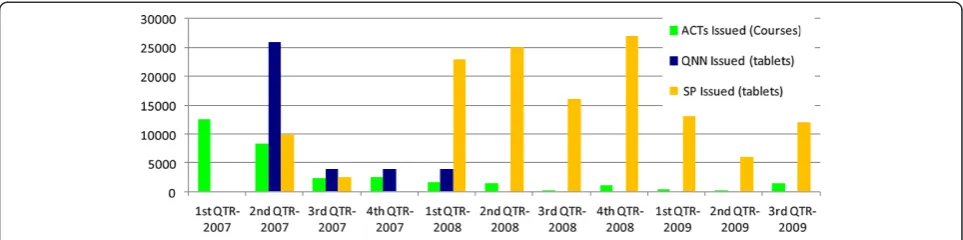
ACT consumption (based on stocks released from the District pharmacy) declined rapidly from early 2007, remaining well below initial levels and below RDT con-sumption from late 2007 onward after the health worker training (Figure 3). The initial decrease was of greater magnitude than the increase in RDT use over the same period. Comparing the first 3 quarters of 2007 and 2009, consumption declined from 23248 courses to 2160 (>90%) across the same seasons. ACT use remained well above the reported malaria rate, however, with 1,440
courses dispensed to clinics in the last quarter of 2009 and a mean of 822 per quarter over the last 12 months of the study (Table 1 and Figure 3).
Quinine was not reported to be dispensed from the District pharmacy in the first quarter of 2007, but after 26,000 tablets were dispensed in the second quarter, only 4,000 were dispensed in the subsequent quarters and no quinine was sent to clinics after early 2008 (Figure 3). In contrast, dispensing of SP from the District office rose after RDT introduction, with 12,600 doses dispensed throughout 2007 and 88,000 in 2008 (equivalent to 4,200 and 26,000 adult courses respectively), remaining relatively high up to the end of the study period (Figure 3).
While the RDT positive rate is not well documented in available district data over the years of the study on a case by case basis, it is possible to see trends by compar-ing data from the study period to more recent data. DHMT data from 2009 records 3,605 suspected cases tests (RDTs or microscopy) and 119 positive results, while in 2011 2,926 suspected malaria cases were tested and 72 were positive.
Discussion
This study indicates that the introduction of malaria RDTs into Livingstone District in southern Zambia was associated with a large reduction on reported malaria and large changes in anti-malarial drug consumption. It also illustrates the challenges faced by health services in dealing with the fundamental changes in febrile disease management that the introduction of parasite-based diagnosis of malaria requires, and the gaps in health
0 50 100 150 200 250 300 350
Reported m
ortality
Quarter and year Malaria
Other causes
All-cause mortality
[image:5.595.56.542.89.305.2]Linear (All-cause mortality)
Figure 2Quarterly malaria and all-cause mortality reported in HMIS data in Livingstone District, Zambia.
Table 1 Rate of issue of RDTs and ACT from district level to health centres from start of 2007 to late 2009 in Livingstone District, Zambia, and recorded malaria rate for the corresponding period
Time period RDTs issued
ACTs issued (Courses)
Recorded
malariaa ‘malariaUnconfirmed’
1st QTR-2007 0 12550 12186
2nd QTR-2007 575 8340 7806
3rd QTR-2007 850 2358 10731
4th QTR-2007 2300 2447 3295
1st QTR-2008 2400 1694 3196
2nd QTR-2008 3350 1470 1081
3rd QTR-2008 3850 270 68
4th QTR-2008 5700 1128 26 177
1st QTR-2009 4275 450 8 276
2nd QTR-2009 4675 270 13 345
3rd QTR-2009 2875 1440 2 378
a: From the 4th
[image:5.595.56.291.541.715.2]system data that can complicate their understanding and management.
While the reduction in reported malaria in Livingstone district is closely associated with the advent of parasite-based diagnosis it was of far greater magnitude than the eventual rate of use of RDTs. Thus, while RDTs contrib-uted to reduced malaria reporting, other factors are also at play. Clinicians were probably imposing stricter defi-nitions of malaria-like fever before RDTs arrived. From late 2008, the reported malaria rate in Figure 1 must be largely accounted for by exclusion of parasite-negative cases by RDT. No RDT stock-outs occurred at a district level during this time (NMCC, Personal communica-tion). Despite the uncertainty in previously-reported malaria mortality, given the apparent uncertainly of pre-vious malaria prevalence overall, the elimination of reported malaria mortality indicates that this tightening of the definition of malaria-like fever and restriction in RDT use and subsequent ACT consumption did not re-sult in significant misdiagnosis of malaria and progres-sion to severe disease.
It is not yet possible to determine whether malaria is declining in Livingstone District, or whether malaria has been uncommon for several years and the use of RDTs has made this visible. It is reasonable to assume that the preceding interventions (IRS and bed net introduction, and change of first-line anti-malarial therapy to an ACT) have had an impact (Figure 1), and indications of reduc-tion in real malaria incidence are noted elsewhere in southern Zambia [29,30]. Whatever the reasons, the re-duction in reported malaria in district health statistics, and very low confirmed malaria rate among those tested, will enable a more effective allocation of health resources to other areas of need; malaria has dropped from first to sixteenth in the district’s disease incidence statistics (Personal Communication; DHMT) and mal-aria mortality was rare or eliminated at the end of the study period. This is a remarkable change in perceptions of local health priorities.
While ACT consumption declined to very low levels after RDT introduction compared to previous dispensing rates, consumption of ACT remained above the reported (now confirmed) malaria incidence, suggesting a leak-age to non-malaria cases or incomplete case reporting (Figure 1). However, large reductions in ACT (and quin-ine) use clearly resulted. These have potential financial benefits for the programmed. A total of 7,065 packs of ACT were returned to the Zambian Central Medical Store unused from Livingstone District in February 2009, and a further 157 expired at the end of 2009 at the District pharmacy (Personal communication, DHMT).
Despite the major decline in ACT consumption, it continued to be consumed at levels above the combined confirmed and unconfirmed malaria rate. Also signifi-cant is the rise in the consumption of the other available anti-malarial; SP. The full potential health benefit on reduced anti-malarial consumption was therefore not being realized. Reasons may include pressure from patients for treatment for what they traditionally regard as ‘malaria’, lack of alternatives (or a need to educate health providers and patients on the appropriateness of alternatives), and low cost of the drug (little financial penalty to the health system). Health providers may also be reluctant to completely reverse years of accepted wis-dom that‘fever equals malaria’. Incomplete adherence to RDT results is well described elsewhere, [18-21,25], but appears far less of a problem here. Well-directed train-ing messages to health workers and the community may have played some role in this, as health workers were specifically warned to expect most RDT results to be negative, and that malaria was considered highly over-diagnosed. The outcomes are also consistent with observations elsewhere of a lag followed by eventual good adherence when RDTs are implemented at a large scale [15,16].
[image:6.595.57.539.89.209.2]In order to fully understand the pattern of consump-tion of anti-malarial drugs (ACT, SP and QNN), their re-lationship to RDT use, and to devise new management
strategies, it will be important to gather better informa-tion from the point of care. The reporting of uncon-firmed malaria, added to district statistics in late 2008, may indicate local RDT stock-outs, or some incomplete trust in, or adherence to, RDT results. The data reflects receipt and action on stock requests, not actual dispens-ing and consumption at a patient level.
No information was obtained on consumption of anti-malarial medicines in the private sector; it is possible that some patients denied ACT after a public sector diagnosis may have sought medicine through this route. Such issues are common in such settings where limited resources and high staff workloads combine, and will re-quire innovative approaches to ensure accurate and timely reporting [31,32]. Zambia commenced introduc-tion of a new software-based health management infor-mation system (HMIS) soon after the end of the study period and it is hoped this will help to address this area of need.
Despite incomplete adherence, this sea-change in pa-tient management through parasite-based diagnosis revealed a previously hidden majority of misdiagnosed febrile patients. This is an essential step toward the de-velopment of a more appropriate management strategy to deal with the syndrome that is acute febrile disease. Current efforts to integrate management of acute re-spiratory and gastro-intestinal infection into community case management of malaria are a step along this path [33]. For Livingstone District, and other areas with simi-lar declines in reported masimi-laria, two major challenges arise. Firstly, management of non-malarial febrile illness is hampered by poor diagnostic capacity and limited availability of treatment; hence the increase in use of SP in the study area. Success in addressing fever as a syn-drome rather than just treating malaria will remain elu-sive as long as most available infectious disease implementation funding for low-resource countries is directed toward only three diseases; malaria, tuberculosis and HIV, and funding for research and development is similarly restricted [34]. Secondly, interest in malaria must be maintained as its incidence declines below that of other severe illnesses. Long-lasting bed nets will quire replacement after three to five years, IRS may re-quire continued annual campaigns, and the availability of RDTs and ACT must be maintained to detect and treat the few remaining malaria cases. New ways of man-aging malaria, as an uncommon disease but potential public health emergency, will need to be developed and resources appropriately targeted.
Conclusion
The introduction of parasite-based community-level diag-nosis of fever in Livingstone District has demonstrated a strong association between introduction of malaria RDTs
and reduction in inappropriate use of ACT. A correspond-ing decline of reported malaria mortality to zero suggests high safety of RDT-based diagnosis in this population. However, the full potential impact of RDT introduction has not been reached due to continued treatment well above the confirmed malaria rate, for reasons not clear under the health information system in place at the time. The results also demonstrate the importance of develop-ing appropriate strategies for management of the multiple causes of non-malarial fever. Inappropriate consumption of ACT may be replaced by inappropriate consumption of other drugs if the next step is not taken to manage fever as a syndrome, rather than as a case requiring only a mal-aria diagnostic test and potentially anti-malmal-arial drugs.
Competing interests
The authors declare that they have not competing interests.
Authors’contributions
FM participated in the implementation of the study and provided inputs into the manuscript. M S-C participated in the design and led the
implementation of the study. TM participated in the implementation of the study. HM participated in the implementation of the study. OB participated in the coordination of the study. HC participated in the design and coordination of the study. DB conceived of the study, participated in its design and drafted the manuscript. All authors read and approved the final manuscript.
Acknowledgements
The authors wish to thank the staff of the District Health Management Team office of Livingstone District, Zambia, and staff of Livingstone District Hospital and district clinics, for their assistance in data gathering and record tracing. We thank the Permanent Secretary of Health for Zambia for permission to publish the study. The study was funded by the Foundation for Innovative New Diagnostics (FIND) through support from the Bill and Melinda Gates Foundation (BMGF) and the UK Department for International Development (DFID).
Author details
1
World Health Organization country office, Lusaka, Zambia.2Malaria Consortium Office, Lusaka, Zambia.3Livingstone District Health Management Team, Livingstone, Zambia.4National Malaria Control Centre, Ministry of Health, Lusaka, Zambia.5Malaria Consortium Office, London, UK.6Foundation for Innovative New Diagnostics (FIND), Geneva, Switzerland.
Received: 2 July 2012 Accepted: 3 October 2012 Published: 8 October 2012
References
1. WHO:Guidelines for the treatment of malaria. 2nd edition. Geneva: World Health Organization; 2010.
2. WHO:Malaria microscopy quality assurance manual - version 1. Version 1st edition. Manila: World Health Organization - Regional Office for the Western Pacific; 2009.
3. RBM MMV:Tracking Progress in Scaling-Up Diagnosis and Treatment for Malaria. Geneva: Roll Back Malaria Partnership; 2009.
4. Harvey SA, Jennings L, Chinyama M, Masaninga F, Mulholland K, Bell DR: Improving community health worker use of malaria rapid diagnostic tests in zambia: package instructions, job aid and job aid-plus-training. Malar J2008,7:160.
5. Mayxay M, Newton PN, Yeung S, Pongvongsa T, Phompida S, Phetsouvanh R, White NJ:Short communication: an assessment of the use of malaria rapid tests by village health volunteers in rural laos.Trop Med Int Health 2004,9:325–329.
rapid diagnostic tests (RDTs) safely and accurately: results of a longitudinal study in zambia.AmJTrop Med Hyg2012,87:57–63. 7. Faucher JF, Makoutode P, Abiou G, Beheton T, Houze P, Ouendo E, Houze S,
Deloron P, Cot M:Can treatment of malaria be restricted to parasitologically confirmed malaria? a school-based study in Benin in children with and without fever.Malar J2010,9:104.
8. Faucher JF, Aubouy A, Beheton T, Makoutode P, Abiou G, Doritchamou J, Houze P, Ouendo E, Deloron P, Cot M:What would PCR assessment change in the management of fevers in a malaria endemic area? a school-based study in Benin in children with and without fever.Malar J 2010,9:224.
9. Yeboah-Antwi K, Pilingana P, Macleod WB, Semrau K, Siazeele K, Kalesha P, Hamainza B, Seidenberg P, Mazimba A, Sabin L, Kamholz K, Thea DM, Hamer DH:Community case management of fever due to malaria and pneumonia in children under five in zambia: a cluster randomized controlled trial.PLoS Med2010,7:e1000340.
10. Njama-Meya D, Clark TD, Nzarubara B, Staedke S, Kamya MR, Dorsey G: Treatment of malaria restricted to laboratory-confirmed cases: a prospective cohort study in ugandan children.Malar J2007,6:7. 11. Mubi M, Janson A, Warsame M, Martensson A, Kallander K, Petzold MG,
Ngasala B, Maganga G, Gustafsson LL, Massele A, Tomson G, Premji Z, Bjorkman A:Malaria rapid testing by community health workers is effective and safe for targeting malaria treatment: randomised cross-over trial in tanzania.PLoS One2011,6:e19753.
12. Mtove G, Hendriksen IC, Amos B, Mrema H, Mandia V, Manjurano A, Muro F, Sykes A, Hildenwall H, Whitty CJ, Reyburn H:Treatment guided by rapid diagnostic tests for malaria in tanzanian children: safety and alternative bacterial diagnoses.Malar J2011,10:290.
13. Senn N, Rarau P, Manong D, Salib M, Siba P, Robinson LJ, Reeder J, Rogerson S, Mueller I, Genton B:Rapid diagnostic test-based management of malaria: an effectiveness study in papua New guinean infants with
plasmodium falciparumandplasmodium vivaxmalaria.Clin Infect Dis 2011,2011:23.
14. Black RE, Cousens S, Johnson HL, Lawn JE, Rudan I, Bassani DG, Jha P, Campbell H, Walker CF, Cibulskis R, Eisele T, Liu L, Mathers C:Global, regional, and national causes of child mortality in 2008: a systematic analysis.Lancet2010,375:1969–1987.
15. Yukich JO, Bennett A, Albertini A, Incardona S, Moonga H, Chisha Z, Hamainza B, Miller JM, Keating J, Eisele TP, Bell D:Reductions in artemisinin-based combination therapy consumption after the nationwide scale up of routine malaria rapid diagnostic testing in Zambia.AmJTrop Med Hyg2012,87:437–446.
16. Thiam S, Thior M, Faye B, Ndiop M, Diouf ML, Diouf MB, Diallo I, Fall FB, Ndiaye JL, Albertini A, Lee E, Jorgensen P, Gaye O, Bell D:Major reduction in anti-malarial drug consumption in senegal after nation-wide introduction of malaria rapid diagnostic tests.PLoS One2011,6:e18419. 17. D’Acremont V, Kahama-Maro J, Swai N, Mtasiwa D, Genton B, Lengeler C:
Reduction of anti-malarial consumption after rapid diagnostic tests implementation in Dar es salaam: a before-after and cluster randomized controlled study.Malar J2011,10:107.
18. Ansah EK, Narh-Bana S, Epokor M, Akanpigbiam S, Quartey AA, Gyapong J, Whitty CJ:Rapid testing for malaria in settings where microscopy is available and peripheral clinics where only presumptive treatment is available: a randomised controlled trial in ghana.BMJ2010,340:930. 19. Reyburn H, Mbakilwa H, Mwangi R, Mwerinde O, Olomi R, Drakeley C,
Whitty CJ:Rapid diagnostic tests compared with malaria microscopy for guiding outpatient treatment of febrile illness in Tanzania: randomised trial.BMJ2007,334:403.
20. Bisoffi Z, Sirima BS, Angheben A, Lodesani C, Gobbi F, Tinto H, Van den Ende J:Rapid malaria diagnostic tests vs. Clinical management of malaria in rural burkina faso: safety and effect on clinical decisions.
A randomized trial.Trop Med Int Health2009,14:491–498.
21. Chinkhumba J, Skarbinski J, Chilima B, Campbell C, Ewing V, San Joaquin M, Sande J, Ali D, Mathanga D:Comparative field performance and adherence to test results of four malaria rapid diagnostic tests among febrile patients more than five years of age in blantyre, malawi.Malar J 2010,9:199–202.
22. NMCC:Malaria diagnosis and treatment manual. Zambia: National Malaria Control Centre, Ministry of Health; 2004.
23. NMCP:Malaria diagnosis and treatment manual. Zambia: National Malaria Control Programme, Ministry of Health; 2010.
24. Chanda P, Hamainza B, Moonga HB, Chalwe V, Pagnoni F:Community case management of malaria using ACT and RDT in two districts in zambia: achieving high adherence to test results using community health workers.Malar J2011,10:158.
25. Hamer DH, Ndhlovu M, Zurovac D, Fox M, Yeboah-Antwi K, Chanda P, Sipilinyambe N, Simon JL, Snow RW:Improved diagnostic testing and malaria treatment practices in zambia.JAMA2007,297:2227–2231. 26. UN-HABITAT:Zambia: livingstone city profile. Nairobi: United Nations Human
Settlements Programme; 2009.
27. Chanda P, Chanda E, Hawela MB, Chizema-Kawesha E:Baseline parasitological assessments and accuracy of rapid diagnostic tests in districts implementing indoor residual spraying for malaria prevention in zambia.Medical Journal of Zambia2007,34:5.
28. RDT job aids and training materials: http://www.finddiagnostics.org/ programs/malaria/find_activities/improving_rdt_use/training_materials.html. 29. Davis RG, Kamanga A, Castillo-Salgado C, Chime N, Mharakurwa S, Shiff C:
Early detection of malaria foci for targeted interventions in endemic southern zambia.Malar J2011,10:260.
30. Chizema-Kawesha E, Miller JM, Steketee RW, Mukonka VM, Mukuka C, Mohamed AD, Miti SK, Campbell CC:Scaling up malaria control in zambia: progress and impact 2005-2008.AmJTrop Med Hyg2010,83:480–488. 31. Kamanga A, Moono P, Stresman G, Mharakurwa S, Shiff C:Rural health centres, communities and malaria case detection in zambia using mobile telephones: a means to detect potential reservoirs of infection in unstable transmission conditions.Malar J2010,9:96.
32. Randrianasolo L, Raoelina Y, Ratsitorahina M, Ravolomanana L, Andriamandimby S, Heraud JM, Rakotomanana F, Ramanjato R, Randrianarivo-Solofoniaina AE, Richard V:Sentinel surveillance system for early outbreak detection in madagascar.BMC Publ Health2010,10:31. 33. Degefie T, Marsh D, Gebremaria A, Tefera W, Osborn G, Waltensperger K:
Community case management improves use of treatment for childhood diarrhea, malaria and pneumonia in a remote district of ethiopia.Ethiop J Heal Dev2009,23:7.
34. Moran M, Guzman J, Ropars AL, McDonald A, Jameson N, Omune B, Ryan S, Wu L:Neglected disease research and development: how much are we really spending?PLoS Med2009,6:e30.
doi:10.1186/1475-2875-11-341
Cite this article as:Masaningaet al.:Finding parasites and finding challenges: improved diagnostic access and trends in reported malaria and anti-malarial drug use in Livingstone district, Zambia.Malaria Journal201211:341.
Submit your next manuscript to BioMed Central and take full advantage of:
• Convenient online submission
• Thorough peer review
• No space constraints or color figure charges
• Immediate publication on acceptance
• Inclusion in PubMed, CAS, Scopus and Google Scholar
• Research which is freely available for redistribution