1 PREFACE
The climate change phenomena is causing unprecedented disasters at the national, regional and global levels. In recent times, hazards like storms, floods, earthquakes and fires have wreaked havoc in many countries leading to destruction of school infrastructure and injury or death of school children and teachers. It has become obvious that the impact of disasters will affect schools posing major threats towards the achievement of access to quality education. Increasingly, schools in Ghana are bearing the brunt of disasters and the exposure of schools to the risks and threats of disasters suggest that our schools are not disaster resilient and cannot be regarded as safe haven for school children.
Ghana Education Service (GES) is responding to the challenges arising from climate change by putting together disaster risk response (DRR) interventions in schools. DRR interventions have been mainstreamed into teaching and learning and will be delivered within a child friendly framework which contributes to the attainment of quality education for Ghanaian children. Overall, DRR interventions will help Ghana to achieve universal access to education and completion of primary schooling for all children (Millennium Development Goal (MDG) No. 2.
The purpose of this manual is to provide information and orientation on the teaching of DRR for basic school teachers. Given the multi-sectoral nature of disaster risk reduction, a broad based team of stakeholders such as NADMO and the Universities were mobilised to partner GES to develop this manual. Financial support was provided by UNICEF.
This manual is essentially to guide teachers on disaster preparedness. It aims at equipping teachers with DRR philosophy and methodologies that should be integrated in a manner that achieves desirable attitudes and behaviours in school children. Additionally, teachers will use the manual to create disaster-resilient school environments as an important practical way of helping to make schools safe for children and prevent disruption of their schooling.
2
guide lesson delivery. Teachers are to note that teaching with this manual is not only about giving information but more importantly also helping children to develop sustainable life skills for maintaining behaviour change. Teachers are encouraged to appraise themselves with the participatory approaches in the manual and be prepared to use them in other areas of lesson delivery. It is my expectation that teachers will be diligent and innovative in the application of the guide.
The manual also recognises the important role of the community in the school disaster risk reduction initiatives. Provision has been made on school community partnership on DRR including activities to be developed and implemented collaboratively. This will minimise the interruption of teaching and learning which usually follows the occurrence of a disaster. Often, when disaster occurs schools and school children are the most affected. In such instances, schools close down and become temporary residences for people who are displaced. School children are gravely impacted as they are unable to attend school.
I encourage users of this manual to see the document as a further demonstration of the determination of GES to play the leadership role in disaster risk reduction as well as mitigating the impact of disasters on the school. In this way we will be helping to making our schools child friendly.
Mr Charles Aheto-Tsegah Director General
3
Acronyms
CCA Climate Change Adaptation
CETA Community Education Teaching Assistants
CFSP Child Friendly School Programme
CRS Catholic Relief Services
DAs District Assemblies
DRR Disaster Risk Reduction
GAS Ghana Ambulance Service
GES Ghana Education Service
GHS Ghana Health Service
GNFS Ghana National Fire Service
GPS Ghana Police Service
GSD Geological Services Department
GYEDA Ghana Youth Employment and Entrepreneurial Agency
MDG Millennium Development Goals
MMDAs Metropolitan, Municipal and District Assemblies
MSA Meteorological Services Agency
NADMO National Disaster Management Organization
NGOs Non-Governmental Organisations
SDMC School Disaster Management Committee
SDMP School Disaster Management Plan
SMC/PTA School Management Committee and Parent Teacher Association
SMCs School Management Committees
4
UNICEF United Nations Children Fund
UNISDR United Nations World Conference on Disaster Reduction
5
Table of Contents
Preface 2
Acronyms 4
Unit 1. Introduction - Context of DRR ... 7
Unit 2. Creating Awareness about DRR in the School ... 16
Unit 3. The School Disaster Management Committee (SDMC)... 23
Unit 4. The School Disaster Management Plan (SDMP)... 25
Unit 5. The School DRR Team... 32
Unit 6. Risk Assessment of the School... 37
Unit 7. Dissemination of the SDMP... 45
Unit 8. Updating the SDMP... 46
Unit 9. Mock Drills... 48
Unit 10. Dos and Don’ts of Disasters... 53
Unit 11. Reference for School Safety Indicators... 57
6 UNIT 1
INTRODUCTION – THE CONTEXT OF DISASTER RISK REDUCTION ____________________________________________________
At the Millennium Summit of the United Nations in 2000, 189 member states of the United Nations, and some 23 international organizations pledged to work towards the achievement of eight development goals by the year 2015 in order to free the world’s population from multiple deprivations. These goals, known as the 8 Millennium Development Goals (MDGs) were:
1. Eradicating extreme poverty and hunger, 2. Achieving universal primary education,
3. Promoting gender equality and empowering women, 4. Reducing child mortality rates,
5. Improving maternal health,
6. Combating HIV and AIDS, malaria, and other diseases, 7. Ensuring environmental sustainability, and
8. Developing a global partnership for development
The second MDG which seeks to achieve Universal Primary Education is to “ensure that by 2015, children everywhere, boys and girls alike will be able to complete a full course of primary schooling”. Ghana has since implemented measures to address shortcomings including the provision/expansion of educational infrastructure in their educational programmes. This has highlighted the need for schools to be disaster resilient to counter the natural and human-made hazards e.g. storms, floods, earthquakes, landslides, tsunamis and fires trigger disasters that wreck school infrastructure and cause injury or even death of school children, thereby frustrating the efforts to achieve MDG 2. Examples of the catastrophic nature of both natural and human-made disasters on schools are presented in Table 1: Disaster impacts on schools in some countries
Year Place Disaster
2008 Sichuan Province of Western China
Earthquake destroyed more than 10,000 school buildings and killed over 9,000 school children and teachers in their schools. 2006 Philippines Typhoon ‘Durian’ damaged 90-100% of school buildings in
three cities and 50-60% of school buildings in two other cities. 2006 Uganda 13 children died in a school dormitory fire where children were
using candles for lighting.
7
To build the disaster resilience and preparedness of schools and communities in poor nations, a number of initiatives has been taken at the global level. One of the major initiatives is the Hyogo Framework for Action (HFA) – a 10-year plan endorsed by the UN General Assembly following the 2005 World Disaster Reduction Conference. The conference, held in Kobe, Hyogo, Japan in January 2005, was themed “Building the Resilience of Nations and Communities to Disasters”. The HFA outlined priority areas for action, and offered guiding principles and practical means for achieving disaster resilience. Its goal was to reduce disaster losses substantially by 2015 by building the resilience of nations and communities to disaster.
Even though Ghana appears not to be a major disaster-prone country, geological and hydro-meteorological records show that the country is earthquake-prone. In fact, tremors or minor earthquakes have been experienced in several areas in the past. Table 2 below shows historical earthquake occurrence in Ghana between– 1909 and 1997
Date Epicentre Cause Magnitude
(M)
Effects and felt areas
09/02/1909 8km South of Tema
Coastal fault
4.9 Felt in Accra and Tema
22/06/1939 Offshore, 40km south-south east of Accra
6.5 Felt in many parts of West Africa, caused great damage (estimated at £1million) in Accra area, 22 people died, about 133, injured many houses collapsed, 1,500 houses had to be demolished, over 600 had to be repaired to make them habitable, isolated foundation failures due to
liquefaction around Sakumono lagoon and along the coast,, ground rapture over distance of 20km between Weija and Fetteh destroyed. 300,000 children were affected. In some districts 80% of schools were destroyed.
2005 Bam, Iran 67 of 131 schools collapsed, the remaining were heavily damaged. 32,843 pupil/students were affected.
2004 Indian Ocean Tsunami destroyed 750 schools in Indonesia and damaged 2,135 more, leaving 150,000 pupil/students without schools.
8 05/09/1978 8km North
of Weija
Akwapim Fault
4.7 Felt seriously in Accra, MacCarthy Hill, Oboglo, Tema
08/01/1997 Weija Akwapim Fault
3.8 Felt in McCarthy Hill, Aplaku, Madina, West Legon, Kasoa, Tema. Panic , no injuries
14/02/1997 Weija Akwapim Fault
4.1 Kasoa, Botianor, Malam, Ashaiman, Legon, Cape Coast, Koforidua, Cracks were
noticed in buildings 06/03/1997 Weija Akwapim
Fault
4.8 Felt in Cape Coast, Apam, Akwapim Ridge towns, Ho, Koforidua, Obuasi. Stampede at national theatre, fire outbreak at Kaneshie North Industrial area, cracks in some buildings in Accra
Source: NADMO, 2012
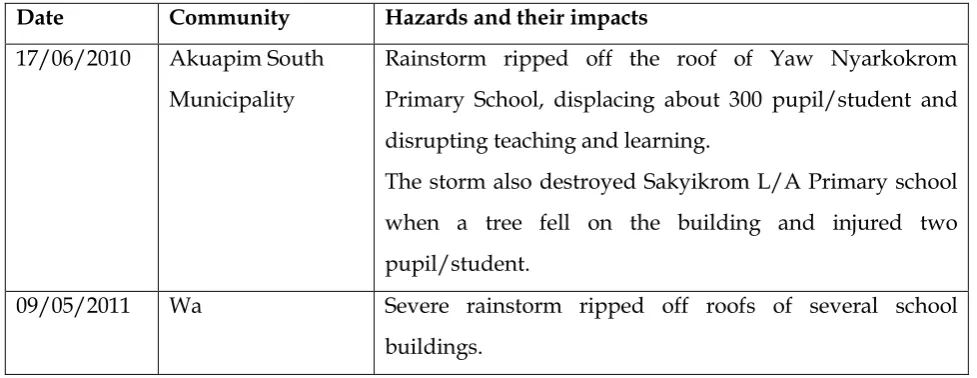
[image:9.595.54.543.588.777.2]Moreover, the rainy season in the country is frequently characterized by windstorms and heavy rains that often wreck infrastructure across the country. For some reasons, including shoddy design and construction, failure to plant trees as windbreaks) school buildings particularly fall easy prey to windstorms, and are frequently wrecked during the rainy season. With the rising incidence of climate change, hydro-meteorological hazards are occurring even more frequently and have the potential of reversing hard-won gains in education and other spheres of development. Table 3 below shows examples of recent rainstorm impacts on schools in parts of the country. In addition to geological and hydro-meteorological hazards, bushfires, electrical fires, structural failure and other hazards continue to threaten schools, and for that matter, the quality education in Ghana.
Table 3: Examples of rainstorm impacts on schools in Ghana Date Community Hazards and their impacts 17/06/2010 Akuapim South
Municipality
Rainstorm ripped off the roof of Yaw Nyarkokrom Primary School, displacing about 300 pupil/student and disrupting teaching and learning.
The storm also destroyed Sakyikrom L/A Primary school when a tree fell on the building and injured two pupil/student.
9 27/05/2011 Talensi-Nabdam
District, UER
Severe rainstorm wrecked 16 school buildings, forcing many schools to hold classes under trees.
04/03/2013 Kumasi Rainstorm ripped off roof of dormitory block of Kumasi SHS, affected over 300 pupil/students.
04/08/2013 Agona Nyarkrom Severe rainstorm ripped off roof of a local primary school, disrupting teaching and learning.
14/03/2013 East Gonja Heavy rainstorm ripped off the roofs of five basic schools, disrupting teaching and learning.
20 /03/ 2013 Akumsa Domase, Nkoranza South Municipality
Following a heavy downpour, 65 buildings including three schools were affected at Akumsa Domase and properties worth several thousands of Ghana Cedis were destroyed.
In view of the frequent occurrence of hazards and their impacts on schools in Ghana, there is the need to be proactive in preventing/reducing them and minimizing or mitigating their impacts on schooling for children. Through DRR education, we can:
save lives and prevent injuries to children should a hazardous event occur;
prevent interruptions to the provision of education, or ensure its swift resumption in the event of an interruption;
develop a resilient population that is able to reduce the economic, social and cultural impacts, should a hazardous event occur.
GHANA’S RESPONSE ON DISASTER RISK REDUCTION IN EDUCATION
As a member of the world community, Ghana is responding to the global efforts through a number of initiatives to developing DRR-minded school populations and disaster-resilient school environments.
1. Integrating DRR into School Curricular
DRR issues have been integrated into Ghana school curricula. At the Primary School level, DRR issues can be found in subjects such as English Language, Mathematics, Citizenship Education, Ghanaian Language and Culture, Physical Education and Creative. Similarly at the Junior High School level, DRR topics have been included in subjects such English Language, Mathematics, Ghanaian Language and Culture, Integrated Science and Social Studies.
10
competence on disaster prevention let alone on how to mitigate the impact of disaster. The review also observed that the lack of disaster preparedness in schools was due to inadequate training of many teachers on the philosophy and methodologies for teaching DRR issues. As a result, they were not able to promote disaster-resilient school environment and inspire the required DRR attitudes and behaviours in the children.
2. The Child Friendly School Programme (CFSP)
The Child Friendly School Programme (CFSP) which is being implemented by GES provides a good platform to introduce DRR in Ghana’s schools. This programme advocates for a safe school environment to promote enrolment and encourage continued schooling by the child. Effective implementation of DRR will also contribute to schools becoming child friendly.
DRR TERMINOLOGY
The following terms form part of CCA/DRR language:
Climate Change: Long-term change in the earth’s weather conditions including changes in temperature, wind pattern and rainfall often resulting in the occurrence of extreme weather events like violent storms, prolonged drought and uncertainty in long-term weather forecasting.
Climate Change Adaptation (CCA): The response-through initiatives and measures - that seek to reduce the vulnerability of humans and the biophysical environment to climate change. Adaptation measures can help reduce vulnerability by building adaptive capacity.
Disaster Risk Reduction (DRR): The concept and practice of reducing disaster risks through systematic efforts to analyse and manage the causal factors of disasters. DRR aims at preventing and reducing the occurrence of disasters, and to mitigate their impacts when they occur. DRR in education is, therefore, the practice of reducing disaster risks in school environments through systematic efforts to analyse and manage the causal factors of disasters with a view to building in the children, the appropriate preventive and response behaviours. This is achieved through disaster preparedness.
11
Disaster: Any serious disruption of the functioning of a community involving widespread human, material, economic or environmental losses and impacts, which exceed the ability of the affected community to cope using its own resources, thereby, requiring external intervention. In other words, it is an overwhelming disruption occurring on a scale sufficient to require outside assistance.
Vulnerability: The degree to which people, property or the environment are exposed to a hazard.
Capacity: The human and material resources available to a community that can be used to prevent or reduce disaster risk or mitigate the impact of a disaster.
Risk: The likelihood or probability of a hazard impacting on a community or the environment. The risk equation is expressed as:
Hazard (H) × Vulnerability (V) Risk (R) = ---
Manageability (M)
We can reduce risk by increasing manageability/capacity
Framework for a DRR school environment.
Creating a DRR school environment requires a minimum of three elements (Fig. 1.2)
Figure 1.2: Framework for a DRR school environment
1. Policy/Legal framework
There should be a national policy requiring:
12
schools to install fire-fighting equipment in all buildings
2. Disaster-resilient Built Environment for schools
school buildings and other infrastructure must be DRR compliant school premises must have well-defined access routes
school premises must have open spaces to be used as emergency assembly points and safe havens during disaster events
all schools must install fire safety equipment in building
all school premises must have access ramps for the physically challenged
3. Preparedness Initiatives
A DRR school environment requires:
preparation of school disaster management and contingency plans,
training and capacity building of teachers and pupil/student including organizing simulation exercise to test the effectiveness of the preparedness plan
Box 1: Guide to promoting a safe school environment
Create awareness on DRR for teachers, pupil/student and school community members Establish School Disaster Management Committee
Conduct disaster risk assessment of the school Draw School Disaster Management Plan Implement School Disaster Management Plan
Integrate DRR activities in the programme of the School Club
Conduct regular simulation exercises on school’s disaster preparedness Monitor, evaluate and update the School Disaster Management Plan.
Why school-community collaboration is important in DRR
13
In many rural areas, school ground is used for community activities, so that the school premise becomes the nucleus of the community. This makes the safety of the school infrastructure paramount.
Schools are among the identified safe havens where displaced people or disaster victims are evacuated to.
Collapse of school buildings disrupts teaching and learning activities for children in the community
Schools serve as platform for information sharing in the community
Stakeholders in the promotion of DRR School Environment
Promoting safe school environments is the joint collaboration of key stakeholders such as: Ministry of Education/Ghana Education Service (MoE/GES)
Heads of schools, Teachers, Pupil/student, Non-Teaching Staff, PTAs (Parent Teacher Associations), SMCs (School Management Committees)
Government Institutions such as Ghana Fire Service, Ghana Police Service, Ghana Health Service, District Assemblies (MMDAs) & Unit Committees and Ghana Ambulance Service, National Disaster Management Organization (NADMO) Civil Society Organisations & Community based Organisations such as Ghana Red
Cross Society, Faith Based Organizations (Churches, Mosques etc.), Town/Village youth groups Traditional/Community leaders
Engineers e.g. Civil engineers, architects, geologists
Summary.
In this unit, we have been able to provide you with what transpired at the Millennium Summit of the United Nations in 2000, where 189 member states of the United Nations and some 23 international organizations pledged to work towards the achievement of eight development goals by the year 2015 in order to free the world’s population from multiple deprivations. We have highlighted the need for schools to be disaster resilient to counter the natural and human-made hazards that can cause injury or death to school children, thereby frustrating the efforts to achieve MDG 2. Ghana’s role in promoting Disaster Risk Reduction has been captured so also has a Guideline for promoting a safe environment. We have also explained some terms and acronyms used in this manual.
15 UNIT 2
CREATING AWARENESS ABOUT DRR WITHIN THE SCHOOL COMMUNITY ____________________________________________________
Introduction
Creating interest and awareness in the school community about DRR is very crucial. Similarly, being aware of the tools for creating awareness is equally important. This will enable the school to educate members of the school community adequately about hazards or probable disasters and promote disaster preparedness.
Objectives
The objectives of this unit are:
to give orientation to teachers on essential tools for creating awareness about DRR issues within the school community;
to equip teachers with skills to provide leadership in handling DRR issues within the school community.
Framework for organising orientation for the school community
The school community must be given adequate orientation on probable hazards in and around the school, their potential impacts and measures to prevent them or mitigate their impacts.
To enhance school community’s capacity for disaster risk reduction, the following should be considered.
The orientation should enhance understanding of disaster risks in the communities. The method and activities should be planned based on routine circumstances,
socio-cultural practices as well as institutional structures in the community.
The activities should be interesting to elicit participation of especially children such as alignment with sports and games, storytelling and drama.
Priority Groups within the School Community
For effective implementation of the School Disaster Management Plan (see Unit 4), the following groups must be adequately involved:
1. School Disaster Management Committee (SDMC) 2. Teaching Staff and Pupil/students
16
Orientation of the School Disaster Management Committee (SDMC)
As the body in charge of DRR in the school, members of the SDMC (see Unit 3) shall be given appropriate orientation to make them effective to implement its mandate. The District Director of Education are responsible for ensuring schools in their respective districts have functional SDMC’s and their activities properly co-ordinated.
Orientation of the Teaching Staff
Orientation of teachers shall be implemented at various levels including - Pre-Service Teacher Training in the Colleges of Education; In-Service Teacher Training for all teachers National Service Personnel posted to educational institutions, Community Education Teaching Assistants (CETA) Module of the Ghana Youth Employment and Entrepreneurial Agency (GYEDA) and all persons posted to teach in basic schools.
Orientation of the pupil/students
DRR orientation should be integrated and infused into classroom teaching. It should also be infused into school-wide activities such as assemblies, worship, and sports and games.
Orientation of the school community
DRR orientation should be organised for all stakeholders of the school in the host community. Relevant targets will include the SMC/PTA, community leaders like assembly members and key individuals in the community.
Organising the orientation
DRR-trainers shall develop and adapt appropriate methodology for the effective orientation of each priority group within the school community. The DRR orientation shall be planned by the SDMC as part of the official school activities. It should be conducted by:
DRR-trained teachers as part of formal in-class sessions
Trained instructors/trainers as part of a combination of formal in-class sessions and co-curricular activities.
17 Identifying resources for awareness creation
Teachers and instructors/trainers are to base their orientation on the contents of this manual. They are also encouraged to adapt and/use other relevant materials of local significance (including visits to local sites) in creating the needed awareness, understanding and knowledge towards desired behaviour.
Content of Orientation
To be effective, the orientation shall ensure a thorough understanding of the following: 1. The School Disaster Management Plan (SDMP) - developed by the SDMC.
2. The school environment and community (the context) - the SDMC shall liaise with the School Health Coordinator to organize regular information sharing meetings on DRR with the school community.
The orientation should cover the following:
Potential hazards in and around the school. The likely impact of the hazards on the school.
Emergency preparedness actions required to minimize the impact of disasters. Resources required for disaster mitigation.
Identification and responsibilities of individuals and organizations to support disaster management in the school.
18
The school club formed among learners shall be given appropriate capacity development training to enable them perform their expected roles in the school community. The following functional areas shall be considered:
Early warning dissemination Evacuation
Search and rescue First aid
Site security
[image:19.595.90.530.250.403.2] Awareness creation
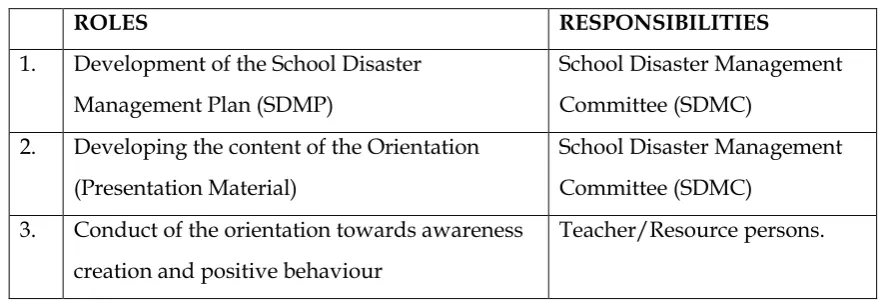
Table 2.1: Stakeholders and responsibilities
ROLES RESPONSIBILITIES
1. Development of the School Disaster Management Plan (SDMP)
School Disaster Management Committee (SDMC)
2. Developing the content of the Orientation (Presentation Material)
School Disaster Management Committee (SDMC)
3. Conduct of the orientation towards awareness creation and positive behaviour
Teacher/Resource persons.
The stakeholders responsible for both formal and co-curricular orientation shall include: Public institutions such as NADMO; Ghana National Fire Service (GNFS); Ghana
Police Service (GPS); Ghana Health Service (GHS); National Ambulance Service (NAS); Heads of Schools, Teachers, selected pupil/student from the senior classes
Civil and community organisations such as: Disaster/Fire Volunteers; Representatives of the PTA; Local NGOs; Traditional/community leaders; Representatives of district assemblies; Representatives of the school management committee; Representatives of religious organizations.
Awareness creation about the School Disaster Management Plan
Teachers, trainers etc. shall adopt child-centred and adult-learning approaches that elicit a high degree of participation to ensure effective orientation session. Where available, audio-visuals that will facilitate holistic learning, recall must be used. Various means can be used to create awareness about the SDMP including:
19
Talking Compounds/essay/quiz competitions/book writing, collecting and developing news items on DRR issues
Demonstrations/Simulations/Field Visits/Firesides
Monitoring for DRR Compliance:
The school shall collaborate with institutions such as NADMO or GNFS to supervise, monitor and guide implementation of the DRR activities on the following:
existence of Disaster Management Plans status of DRR activities implementation functional school club
DRR facilities in schools
Integration of Disaster Risk Reduction issues across subject areas.
DRR Facilities for Schools
The school DRR plan shall make provision for DRR equipment and materials. These may be provided in collaboration with NADMO, GNFS etc. Some of the basic DRR facilities and infrastructure requirements in the school include the following:
Fire extinguishers First Aid kit Sand buckets
Fire hooks (storey buildings) Marked exits
Designated assembly points
Integration of Disaster Risk Reduction issues across subject areas.
To create awareness among all teachers and the entire pupil/student body, DRR should be treated as a cross cutting issue and integrated and taught in specified subject areas and infused into subjects which lend themselves to the teaching of DRR issues.
Strategies for awareness creation on DRR Disaster Alert Days
The school should identify special days on which DRR awareness shall be intensified. Examples of special days are International Disaster Day, World Food Day, World Water Day, World Environment Day and National Fire Day.
Talking Compounds
This involves creating and posting messages around the school to educate, remind and inspire pupil/students on DRR issues. For example:
20 When on fire – ‘Stop, drop and roll’ Trees are life, protect them
Essay/Quiz competition on Disaster Risk Reduction
Essay/Quiz competitions can be organized on DRR-related topics among school children to mark national and international days. The competitions shall aim at making school children aware of probable disasters, its impact and what they can do to prevent their occurrence in the school. For variety, drama, street theatres, role plays, film shows, videos, stories, songs, poetry recitals may be used to substitute essays and quizzes.
School Clubs
Where there is a school club, DRR issues should be mainstreamed into the club activities. However, where there is none, a DRR club may be formed. The club’s programmes and activities must be drawn from the school disaster plan which is a product of the school risk assessment study. Innovative club activities to be carried out may include collection of DRR-related news items, articles, editorials and photos for publication in the media or as school photo album. The materials may be used in DRR-related teaching and learning lessons.
Experience sharing sessions or talks
Talks or speeches and panel discussions should be organized for information sharing and for creating awareness on DRR issues.
Demonstrations/Simulations/Field Visits/Firesides
Demonstrations, simulations, exposure field visits and firesides should be organised at least twice in a term i.e. at the beginning and ending of the school term. School may invite personnel from relevant organisations such as NADMO or GNFS to conduct the exercises.
Summary.
This session has attempted to show some ways in which DRR opportunities can be made use of. These approaches are not exhaustive, but each method or process has been designed to give learners and community the experience of what can be done to create interest and awareness on DRR. A well oriented school community will develop the appropriate response and actions to protect themselves and the school community.
22 UNIT 3
THE SCHOOL DISASTER MANAGEMENT COMMITTEE
Introduction
Disaster risk reduction is a multi-dimensional issue which requires the involvement of stakeholders of varied backgrounds. For effective promotion of disaster risk reduction (DRR) in schools, therefore, each school shall form a School Disaster Management Committee (SDMC) that will have a blend of expertise to oversee DRR activities in the school.
Objective
The objective of this unit is to provide guidance for schools on the formation and functions of school disaster reduction committees.
Composition of the SDMC
List below is the suggested composition of the 21 member School Disaster Management Committee (SDMC):
Head of school (chairperson) Teachers
Representative of School Management Committee (SMC) Representative of Parent-Teacher Association (PTA)
Selected pupil/students (ensure gender and class representation)
Representatives of relevant institutions in public and private sectors as well as civil society organisations such as – GES, NADMO, GNFS, NADMO, GNFS, GHS, GPS, GHS, Meteorological Services Agency (MSA) Geological Services Department (GSD) Relevant NGOs e.g. World Vision, Catholic Relief Services (CRS). Also to be considered are individuals with relevant expertise or skills (e.g. engineers, architects, hydrologists, swimmers)
Functions of the SDMC
The SDMC will take overall charge of DRR issues in the school. Among others, the SDMC shall perform the following functions:
Preparation of the School Disaster Management Plan (SDMP) (see Unit 3). Dissemination of the SDMP to all stakeholders of the school.
23
Organisation of mock drills in consultation with experts to check the disaster preparedness of the school and identify gaps for redress
Regular updating of the SDMP
The SDMC shall meet at least once a term to review the progress of implementation of the SDMP and chart the future course of action for disaster preparedness and mitigation. The school DRR Club and its teams shall hold emergency meetings whenever the need arises.
Summary.
In this unit, we have noticed that disaster risk reduction is a multi-dimensional issue which requires a blend of stakeholders of varied expertise. The composition of the disaster management team has been suggested and the duties of the team outlined.
In the subsequent chapter, we will look at the school’s preparedness to prevent and control, or mitigate disasters in the school and its environs. Expect very fruitful discussions.
24 UNIT 4
THE SCHOOL DISASTER MANAGEMENT PLAN ____________________________________________________ Introduction
The disaster preparedness of a school can go a long way to prevent or reduce the impacts of disasters that may occur in the school. An important component of disaster preparedness is the development of a disaster management plan for the school.
Objectives
The objectives of this section are to: define the SDMP and its purpose; outline the elements of the SDMP; and
provide a sample SDMP to guide schools in preparing their own SDMP.
What is the School Disaster Management Plan (SDMP)?
SDMP is developed by the school to improve disaster resilience. It ensures efficient use of available capacities in the school to prevent probable disasters and mitigate their impacts when they occur. The SDMP which is prepared by SDMC brings together all stakeholders for the purpose of disaster management. The plan should be simple and easy to understand.
Purpose of the SDMP
The purpose of the SDMP is to assess the vulnerability and capacity of schools and identify their disaster preparedness and mitigation measures. The objectives of the plan are to:
identify and manage hazards in and around the school;
prepare and respond to emergencies in and around the school; and prevent disasters or mitigate their effects on the school.
Box 4.1: Elements of the School Disaster Management Plan Introductory information about the school
Name, Location and site, Population, Age range of children, etc. Vulnerability and capacity assessment of the school
Vulnerabilities: areas susceptible to disaster - this information may be obtained from historical data on the school or from a study of similar locations
Capacities: available resources to draw on for disaster management- facilities, skills, knowledge, experience, etc.
25 Roles and duties of the SDMC and the Teams
E.g. responsible for public education, mock drills, evacuation, first aid etc. Plan for the SDM Teams’ training
Type of training required, Dates for training, Training providers etc. Mock drills and updating of the plans
Update plans to accommodate changing situations and events in and around the school
Practise your plan through mock drills for likely disasters Do’s and Don’ts of various disasters
What to do and what not to do during disasters like floods, earthquakes, storms, electrical fire etc.
Table of probable disasters and their expected times/seasons of occurrence
Directory of agencies and individuals who can provide support in disaster situations NADMO, District Assembly, Red Cross, National Ambulance Service, Fire
Service, Police, Health facilities, Doctors, etc. Budget to finance the school disaster management plan Maps of the school and school-community
Items in Box 4.1 are only an indication of key elements of the SDMP. It is not a fixed list so modifications can be made to suit the context of each school.
The SDMP should be prepared in the form of a poster (see sample plan) and disseminated to the entire school community and visitors. Copies should be displayed at vantage points such as notice boards, walls and the entrance to the school premises of main building.
Maps
Maps should be included in the SDMP to provide visual impression of how the school space is organized. Two different maps should be included in the plan. These are the map of the school premises and the map of the school community.
Map of the school premises
The map of the school premises should show the following:
Location of all physical structures or buildings – e.g. classrooms, laboratories, offices, libraries and toilets
Locations of emergency equipment like first aid kits, fire extinguishers, sand bags and communication systems
26
Classroom evacuation plans. Each classroom should have a floor plan outlining the evacuation routes from the classroom. The plans should also show the locations of all fire extinguishers (red dots) and fire alarms (blue dots). The classroom evacuation plans should be placed on walls in the classrooms.
Hazardous areas on the school premises (e.g. open wells, deep pits)
Map of the school-community
The school-community map must show the wider environment of the school or the community where the school belongs. The following elements should be included in the school-community map:
Geographical features (high grounds, low grounds, water bodies, beaches, etc.) Evacuation and transport routes (roads, bridges, footpaths, waterways, railways
etc.).
Safety areas or shelters (parks, community centres, church buildings, etc.)
Nearby resources (health facilities, police station, water sources, fire service, public phones, etc.)
Hazardous areas in and around the school (e.g. mining pits, open wells, open drains) Roads and crossing points
27
Template for preparing the School Disaster Management Plan ____________________________________________________
Name of school: ……….. Circuit Name ………...
1. Population of school
Pupil/student
Class No. of pupil/student
Female Male Primary 1
Primary 2 Primary 3 Primary 4 Primary 5 Primary 6 Total:
Staff
Teachers Other staff
Male Male
Female Female
Total: Total:
2. Directory of members of the SDMC
# Name of SDMC member Contact Phone No. Location address 1
2 3 4 5
28 Date/time Type of
training
Participation Trainer Venue
01/01/13 10.am
Fire Mock drill team GNFS School assembly
grounds 01/02/13
10.am
Earthquake Mock drill team NADMO Class rooms
4. Probable hazards/disasters in and around the school Probable hazards Expected time/season of
occurrence
Areas likely to be affected
Storms Rainy Season Buildings with lose roofing
5. Mock drill schedule for school
Date/time Type of drill Venue for drill Provider/trainer 01/01/13
10. am
Fire School assembly grounds Fire Service
6. Directory of individuals/agencies to provide assistance
# Name of person/agency Contact phone No. Location
29
Disaster type What to do What not to do
Flood
Wind/rain/thunder storm Earthquake
Fire
Structural failure
8. Vulnerability assessment of the school
Type of vulnerability Location What to do What not to do Abandoned open well Behind school
toilet
Cover/silt it Do not play around
Poor waste disposal No access route
Room evacuation Plans
Draw evacuation plans for all classrooms and other rooms in the school. The plans should clearly show all exits from the rooms. The plan for each room should be disseminated to pupil/student in that room and placed on a wall in the room where it can be seen easily. Carry out mock evacuation exercises at least twice in a school term to practise the plans and update them to accommodate any infrastructural changes in the school.
Map of the school environment
Prepare a map of the school environment. On this map, clearly indicate all evacuation routes and emergency assembly points with bright colours. This map should be disseminated to the school community and placed at vantage points where it can be easily seen and studied.
Budget
Prepare a budget for the SDMP to show how funds will be raised to finance the various programmes and activities outlined in the plan.
Designation of person in charge
The head of school or his/her designate will be known as the person-in-charge. He/she will have full responsibility to operationalize SDMP. A predetermined chain of command will be established, should the head of school not be available, to delegate her/his authority.
30
This unit has unveiled what the SDMP is, its purpose, some elements as well as guidelines for schools to prepare their own SDMP. A template for preparing SDMP has been provided. However, it is important to note that the elements provided are not exhaustive. Schools are free to adopt, adapt or add new ones that suit their school environment.
31 UNIT 5
THE SCHOOL CLUB (DRR TEAM)
____________________________________________________ Introduction
Pupil/student are key stakeholders in disaster risk reduction and should be encouraged to participate actively in promoting disaster preparedness in the school. This will be realised through the activities in the school club which will be the platform to cultivate and sustain pupil/student interest and build their capacity for DRR. Activities of school the school club related to DRR shall be implemented by the DRR team.
Objective
The objective of this unit is to describe the composition of the school DRR Team and outline the roles it will play to promote disaster risk reduction in the school.
The School DRR Team
Membership of the DRR Team shall be voluntary but as many pupil/student as possible should be encouraged to join. Essentially, the task of the school DRR Team is to:
promote DRR consciousness and disaster preparedness within the school, and in disaster situation, provide immediate emergency response services in the school
before help comes from outside the school
The DRR Team shall meet at least once in a month when schools are in session to plan DRR activities and enhance the disaster preparedness of the school.
Roles of the School DRR Team
The School DRR Team shall have units responsible for these specific functions: 1. Early warning dissemination Unit
2. Evacuation Search, Rescue and First Aid Unit 3. Site security Unit
4. Awareness creation Unit
1. Early warning Dissemination Unit In normal times, the unit shall:
monitor the school environment for hazards and early warning signs alert the school population about any potential hazards
ensure warning devices are available
32 At the onset of a disaster, the unit shall:
raise alarm to warn the school community of the coming disaster use school bell, megaphones or other media to pass on information ensure that all exit routes are open, if not opened
switch off power supply if required
After a disaster, the unit shall:
check if any pupil/student is still in need of help
assist the school authorities in informing parents of affected pupil/students ask everyone to be alert in case there is possibility of the disaster striking again
2. Evacuation, Search, Rescue and First Aid Unit In normal times, the unit shall:
prepare detailed evacuation maps for the school and every classroom with exits, staircases, doors and windows clearly marked;
train in basic search and rescue procedures;
ensure that emergency exit points and routes are opened and free from obstruction;
ensure that fire safety equipment – extinguishers, hydrants, fire hooks, sand bags, ropes etc. are available, accessible and functional in all classrooms and other buildings;
ensure that the school community know the locations of fire safety equipment and can operate them properly;
ensure that the school community know the warning signals for every probable disaster;
ensure that mock drill for fire, earthquakes, road crossing and other disasters are organized and practised regularly for the school;
properly label and keep first aid kit in a convenient and easily accessible place; Periodically check the first aid kit and ensure its contents are up to date;
organize training on first aid for emergencies like electric shock, lightning strike, food poisoning, snake bite, inhaling of poisonous gas, earthquake, etc. and also how to use bandages, undertake CPR, stop bleeding, dress cuts etc.; and
disseminate information on health, hygiene and ailments in the school community
33
arrange immediate assembly of team members and pass on instruction quickly allay the fears of pupil/student by telling them not to panic
get members of the SDMC informed
ensure that pupil/student are evacuated safely to the designated assembly point assist physically challenged pupil/student to evacuate safely
advise pupil/student not to go back to the disaster scene to recover their items check that all pupil/students are out of classrooms and other rooms after evacuation during earthquake, remind pupil/student to:
perform Drop, Cover and Hold if they are indoors, and
avoid standing near buildings, trees, electric polls, etc. If they are outdoor, provide first aid to those who need it and arrange to send serious cases to the nearest
health facility
After a disaster, the unit shall:
check every classroom or other rooms including lavatories and changing rooms in the building to ensure no one is trapped
report any injuries to the First Aid team
ensure that no one returns to disaster sites for any reason until it is declared safe by experts to do so
assist SDMC in informing parents of affected pupil/student. The head teacher must inform the district directorate of GES about the event
Site Security Unit
In normal times, the unit shall:
identify and designate emergency assembly point and ensure that all pupil/students and teachers are aware of the assembly point
ensure that proper exit routes are available and functional in all buildings ensure stairs and corridors are free of any obstruction
During a disaster, the unit shall:
guide and assist pupils/students to evacuate safely and assemble at the designated assembly point
ensure that no stampede or chaos is created during evacuation
34
undertake headcount at the assembly point to ensure that all have been evacuated
Awareness Creation Unit In normal times, the unit shall:
organize awareness activities with the SDMC
post Dos and Don’ts during disaster on notice board and other visible locations observe “International Day for Disaster Reduction” on 13th October every year
During a disaster, the unit shall:
assist other Disaster Management Teams and SDMC cordon off the disaster site
After a disaster, unit shall:
assist other Disaster Management Teams and SDMC to identify measures for improvement in school disaster preparedness and response and contribute to the report of the SDMC
Key considerations in assigning roles to the DRR Team
Pupil/student (both boys and girls) should be allowed to decide which unit they would like to belong to. However, where there is a mass drift to a particular unit, teachers can encourage some pupil/student to join other units.
Each unit shall be led by a teacher (in fact, all teachers in the school should be leaders of one unit or the other).
Ideally, all the units should have equal number of members.
Schools are to give DRR activities priority in the programme of the School Club
DRR Team Meeting
Once in a school term, the DRR Team of the School Club will: prepare and conduct DRR awareness activities;
organize school mock drills;
invite resource persons (e.g. NADMO, GNFS, Police) to engage the school on DRR issues and build capacity of the team to handle DRR issues;
prepare a report to update the SDMP.
35
The SDMC should be trained in their responsibilities. This shall include training on the t units discussed earlier in this unit. The team should meet regularly for practical exercises to improve on the skills acquired to keep the School Disaster Management Plan alive.
The training components should be discussed in the plan and the necessary resources such as materials and trainers should be identified. Organizations that can help to provide training include GNFS, GHS, NADMO, MSA, GRSC and relevant NGOs.
Summary.
We have provided the composition of the School Disaster Risk Reduction Team and the roles the team will play in disaster risk reduction in the school. We have delved into key considerations that are to be factored into assigning roles to the DRR team. Major roles of the team before, during and after a disaster have been outlined.
In the next unit, we will discuss how to conduct a risk assessment and the strategies that can be employed to assist teachers and the SDMC team to identify risks in a school. A list of natural and artificial disasters has been provided to guide schools and stakeholders. Some potential vulnerabilities have been provided so have sample capabilities that can help ease the work of the Disaster Risk Reduction Team.
UNIT 6
RISK ASSESSMENT OF THE SCHOOL
36 Introduction
Hazards in the school environment (such as deep cracks in classroom walls and exposed life electrical wires) major road crossings to and from school are disaster risks or potential triggers of disaster. To enhance disaster preparedness in the school, we need to conduct risk assessment of the school. Risk assessment is simply a careful observation of the school environment for the purpose of identifying conditions that have the potential to cause disaster and weighing up the school’ capacity to cope before, during and after the onset of a disaster. Risk assessment is, therefore, an important step toward enhancing the disaster preparedness of the school. The elements of risk assessment include hazard assessment, historical timeline, vulnerability assessment, capacity assessment, risk ranking and risk reduction.
Objective
The objective of this step is to equip teachers and other members of the SDMC with skills that would enable them identify the risk(s) faced by the school due to natural or human induced hazards and vulnerabilities, and assess the existing capacities of the school and community to cope before, during, and after the onset of a disaster.
Hazard assessment
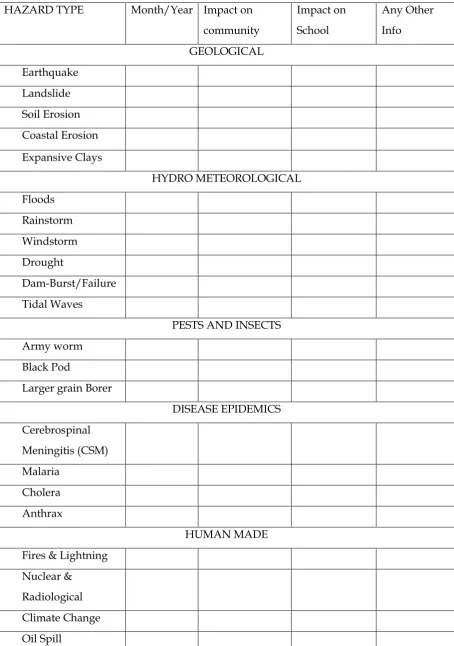
Hazard assessment is the process of carefully observing the school environment and identifying existing hazards. Start hazard assessment by listing past disasters and their impact on a school and its surrounding by asking the question “What potentially damaging physical event or human activity has triggered disaster(s) in the school?”
37 Table 6.1: Disaster profile of the school
HAZARD TYPE Month/Year Impact on community
Impact on School
Any Other Info GEOLOGICAL
Earthquake Landslide Soil Erosion Coastal Erosion Expansive Clays
HYDRO METEOROLOGICAL Floods
Rainstorm Windstorm Drought
Dam-Burst/Failure Tidal Waves
PESTS AND INSECTS Army worm
Black Pod
Larger grain Borer
DISEASE EPIDEMICS Cerebrospinal
Meningitis (CSM) Malaria
Cholera Anthrax
HUMAN MADE Fires & Lightning
Nuclear & Radiological Climate Change Oil Spill
Deforestation Road Accidents Ethnic
38 Historical timeline
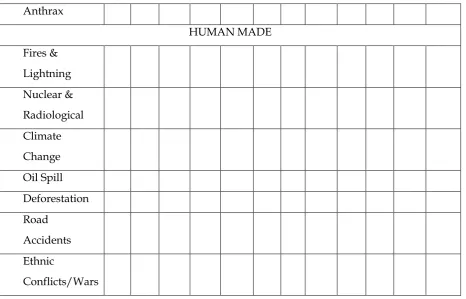
Preparation of historical timeline may be done by the teacher with the class or the SDMC through discussion among the committee and in consultation with local staff of NADMO, District Education Office, and other NGOs. The timeline can be captured in the format shown in Table 6.2 below.
Table 6.2: Disaster timeline for the school
Jan Feb Mar Apr May Jun Jul Aug Sep Oct Nov Dec GEOLOGICAL
Earthquake Landslide Soil Erosion Coastal Erosion Expansive Clays
HYDRO METEOROLOGICAL Floods
Rainstorm Windstorm Drought
Dam-Burst/Failure Tidal Waves
PESTS AND INSECTS Army worm
Black Pod Larger grain Borer
DISEASE EPIDEMICS Cerebrospinal
39 Anthrax
HUMAN MADE Fires &
Lightning Nuclear & Radiological Climate Change Oil Spill Deforestation Road
Accidents Ethnic
Conflicts/Wars
Vulnerability assessment
[image:40.595.67.534.22.321.2]Assess vulnerability by identifying the factors that make the school exposed to disasters e.g. physical, social, economic and environmental.
Table 6.3: Vulnerability assessment of the school
Physical Factors • Quality of buildings (design, material)
• Critical infrastructure (Roads, clinics, fire hydrant) • Pupil/student population
• Drainage system Environmental Factors • Soil type
• Source of water • Waste management • Poor drainage system
• Natural Resource depletion (Vegetation, forest etc.)
Economic Factors • Socio-economic status (Poor or rich) • Access to credit and loans
• Access to critical and basic socio-economic infrastructure and service
• Reserves (food, funds, water, fuel etc.)
40
• Incentives or sanctions for prevention • Risk perception
• Levels of literacy and education • Legal situation and practices • Domination and power relations • Community participation
• Basic human rights
• Gender aspects, minorities • Access to information
Potential vulnerabilities
Potential vulnerabilities within school premises must be identified. In particular, the structural safety of school premises is very important and a certified engineer or architect can help in assessment of the structural safety. Factors that could compromise the structural safety of the school premises include the following:
Narrow stairs
Locked exit doors and windows Unguided swimming pool/beaches Unsafe playground
Exposed live electrical wires
Uncovered drains, unprotected wells, pits Abandoned/disused mines
Hazardous waste
Tall cupboards and unscrewed chalkboards Slippery floors
Unsecured storage of inflammable liquids and gases Power cable and electricity transformer
Big trees and branches
Nearby highway or railway track River, dam, fishing ponds, lakes, etc. Industrial factories, chemical factories
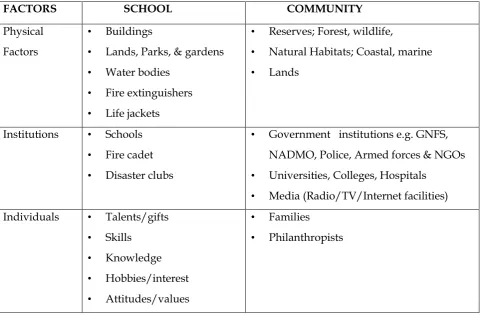
Capacity assessment of the school
41 Table 6.4: Capacity assessment of the school
FACTORS SCHOOL COMMUNITY
Physical Factors
• Buildings
• Lands, Parks, & gardens • Water bodies
• Fire extinguishers • Life jackets
• Reserves; Forest, wildlife,
• Natural Habitats; Coastal, marine • Lands
Institutions • Schools • Fire cadet • Disaster clubs
• Government institutions e.g. GNFS, NADMO, Police, Armed forces & NGOs • Universities, Colleges, Hospitals
• Media (Radio/TV/Internet facilities) Individuals • Talents/gifts
• Skills • Knowledge • Hobbies/interest • Attitudes/values
42 Economic • Capitation grants
• Club/PTA Dues
• Internally Generated Funds (IGF) e.g. Proceeds from school farms
• Donations
• Banks
• Businesses organisations • Credit Unions; Susu • Cooperatives
• Corporations and branches
Associations • School clubs • SRC
• Prefectoral Board
• Neighbourhood Watch Dogs • Humanitarian/Charitable Groups • Civic Education Clubs
• Cultural Groups
• Volunteer Groups; DVGs
• Disability/Special Needs Groups • Environmental Groups
• Advocacy Groups (Disaster platforms) • Religious/Faith Based Groups
• Community Development Associations • Parent Teacher Associations
• Civil Societies
Sample capacities
The existing capacities within the school and even nearby locations should be listed. It can be boats, ropes, life jackets, life buoys, etc.
Sand bags, fire extinguishers, fire belt, fire hydrant, fire alarm, smoke detectors Availability of telephone and telephone numbers of security services e.g. 191-police,
999-general, 192-fire service in the school Closed-circuit television (CCTV)
Top floor of school building can be used as safe shelter from storm surge or slow onset flood
School bell/drums/siren for warning or alert Radio can be used to receive early warning
Pupil/student and teachers are trained as first aiders Assembly point to be used for safe shelter
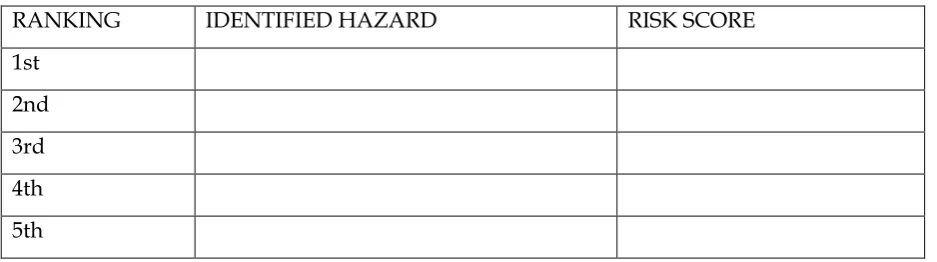
43 Risk ranking
[image:44.595.66.535.144.275.2]Rank the risk level for each hazard according to the impact on school, by using a scoring system (starting from 1- ending at 5; 1 being the lowest and 5 being the highest)
Table 6.5: Risk ranking as class activity
RANKING IDENTIFIED HAZARD RISK SCORE
1st 2nd 3rd 4th 5th
Risk Reduction
The practice of reducing disaster risk starts by:
knowing the risk factors (hazards, vulnerabilities, and capacities) reducing the hazard, if human induced
reducing the vulnerabilities and
increasing the schools’ capacity to cope with the hazards at all times
Summary
This unit has highlighted hazards as potential triggers of disasters. All stakeholders are to examine the school environment carefully to identify existing hazards. A disaster portfolio and a vulnerability assessment of the school, comprising physical, environmental, economic and social factors have been drawn. It behoves all stakeholders to adopt strategies aimed at increasing the schools disaster resilience.
In the next unit, we will examine ways of developing a strategy for disseminating School Disaster Management Plan to deal with disasters when they strike. We will notice that timing for the dissemination of SDMP is very important. We believe you will find it interesting to read.
44
DISSEMINATION OF THE SCHOOL DISASTER MANAGEMENT PLAN ____________________________________________________
Introduction
The school shall develop a SDMP dissemination strategy to make the school community members aware of the plan. The members shall identify and practise their roles assigned to them in the plan. This is a shared responsibility between the school and NADMO or the appropriate public institution closest to the school.
Objective
The objective of this unit is to outline strategies that can be used to disseminate school community and other stakeholders.
Strategies for disseminating plan to the SDMP
Dissemination of the SDMP to school community members will take place at school assembly, in classroom lessons, school club meetings and on school notice boards. Other forum include PTA/SMC meetings, FM radio and town crier announcements.
The SDMP dissemination should be done at the beginning of every academic year so that new pupil/students as well as new teachers become aware of the plan. In the case of seasonal hazards identified in the plan, awareness creation should be intensified close to the time such hazards occur.
Summary.
We have delved into the means by which the school community can learn about the SDMP; how to disseminate a plan of action to the SDMP and how new staff members can be given orientation to keep them alive to their responsibilities.
In our next lesson, we will focus on the importance of updating the SDMP to make their plan relevant to the contemporary needs of the school environment. We will also draw a checklist for assessing the disaster preparedness of the school. We hope you will find the unit interesting. Keep on reading.
UNIT 8
45
____________________________________________________ Introduction
The School Disaster Management Committee must update the SDMP at least once in a year to make the plan relevant in meeting the needs of the school community. This involves assessment, evaluation and updating of the Plan. The school shall fix a time in each year to update the plan in order to ensure its effectiveness. The date and time for the review of the plan will depend on the peculiar locality of the school including the disaster calendar for the locality. The review and revision should take place at least two to three months before the season of the probable disasters. The updated SDMP must be tested through mock drills and disseminated within the school and the community.
Objective
The objective of this section is to:
emphasize the need for periodic update of the SDMP
outline a checklist for assessing the disaster preparedness of the school
Checklist for review of the management capacity of the SDMC
Question Yes No
1. Has the school established the SDMC and included pupil/students and parents who may be helpful as members?
1. Have team members been notified and their roles and responsibilities defined?
2. Has the school developed a list of team members and resource persons with their names, addresses and telephone numbers?
3. Has the school organized training for members of the SDMC and School DRR Club Teams?
4. Has the school developed and disseminated the SDMP document and made provisions for its review and update by the SDMC and School DRR Club and Teams?
5. Has the school involved the District Assembly or town/village Unit Committee members in the SDMP?
6. Have arrangements been made for the following:
regular meetings to discuss the implementation of the SDMP
regular mock drills to test the school’s disaster
46 preparedness
regular training of members of the School DRR Club and Teams
regular programmes on DRR awareness creation
After collecting the responses on the questions above, the YES and NO responses are identified. The questions which received NO responses should be examined. The reasons for those actions not taken should be identified and remedial measures developed and put into the plan.
Summary.
This unit has emphasized the need to update the SDMC periodically. A checklist for the review of management capacity of the SDMC has been drawn to help them to be alive to their responsibilities.
In our next chapter, your attention will be drawn to the need to test the disaster preparedness of the school through simulation exercises or mock drills. This will be an interesting discussion. Keep reading!
UNIT 9 MOCK DRILLS
47 Introduction
From time to time, the disaster preparedness of schools must be tested through mock drills (or simulation exercises). Mock drill is a means of assessing the preparedness of schools in responding to an emergency situation during disasters like an earthquake, fire outbreak, storm or armed attack.
Objective
The objectives of this section are to:
explain what mock drills/simulation exercises are
explain the rationale for conducting mock drills/simulation exercises provide guidance on how to conduct mock drills for selected disaster
Mock drill/simulation exercise
A mock drill (or simulation exercise) is the testing of the effectiveness of a School Disaster Management Plan (SDMP). It is a participatory method to practise the safety-related measures and evacuation of a building during an emergency situation. It is also a practice or a trial warning by a school, acting as if a disaster was happening within the school or its environs. Mock drills are considered an integral part of disaster preparedness in ensuring a safe school environment.
Considering the fact that external help may reach the school late, it is important that school teachers, staff and pupil/students learn about the key aspects of school safety and preparedness. It is critically required that the school administration takes proactive measures to increase awareness about disaster preparedness and also test their preparedness plans by conducting mock drills at regular intervals. To ensure proper execution of a mock drill exercise, the roles and responsibilities of the staff/teachers and pupil/student, as well as Stakeholders like NADMO, GNFS and the Ghana Police Service should be precisely defined and the standard operating procedures (SOPs) should be clearly understood by everyone.
The objectives of conducting Mock Drills in Schools include the following:
Educating and training staff, teachers and pupil/students to react to any unforeseen emergency situations, specifically Earthquake & Fire, mainly because they have a quick onset and hardly have any warning signs.