R E S E A R C H
Open Access
Elevated dry-season malaria prevalence
associated with fine-scale spatial patterns of
environmental risk: a case
–
control study of
children in rural Malawi
Lindsay R Townes
1*, Dyson Mwandama
2, Don P Mathanga
2,3and Mark L Wilson
1Abstract
Background:Understanding the role of local environmental risk factors for malaria in holo-endemic, poverty-stricken settings will be critical to more effectively implement- interventions aimed at eventual elimination. Household-level environmental drivers of malaria risk during the dry season were investigated in rural southern Malawi among children < five years old in two neighbouring rural Traditional Authority (TA) regions dominated by small-scale agriculture.
Methods:Ten villages were randomly selected from TA Sitola (n = 6) and Nsamala (n = 4). Within each village, during June to August 2011, a census was conducted of all households with children under-five and recorded their locations with a geographic position system (GPS) device. At each participating house, a nurse administered a malaria rapid diagnostic test (RDT) to children under five years of age, and a questionnaire to parents. Environmen-tal data were collected for each house, including land cover within 50-m radius. Variables found to be significantly associated withP. falciparuminfection status in bivariate analysis were included in generalized linear models, including multivariate logistic regression (MLR) and multi-level multivariate logistic regression (MLLR). Spatial clustering of RDT status, environmental factors, and Pearson residuals from MLR and MLLR were analysed using the Getis-Ord Gi* statistic.
Results:Of 390 children enrolled from six villages in Sitola (n = 162) and four villages in Nsamala (n = 228), 45.6% tested positive (n = 178) forPlasmodiuminfection by RDT. The MLLR modelled the statistical relationship of Plasmodiumpositives and household proximity to agriculture (<25-m radius), controlling for the child sex and age (in months), bed net ownership, elevation, and random effects intercepts for village and TA-level unmeasured factors. After controlling for area affects in MLLR, proximity to active agriculture remained a significant predictor of positive RDT result (OR 2.80, 95% CI 1.41-5.55). Mapping of Pearson residuals from MLR showed significant clustering (Gi* z > 2.58, p < 0.01) predominantly within TA Sitola, while residuals from MLLR showed no such clustering. Conclusion:This study provides evidence for significant, dry-season heterogeneity of malaria prevalence strongly linked to peridomestic land use, and particularly of elevated risk associated with nearby crop production.
* Correspondence:[email protected] 1
Department of Epidemiology, School of Public Health, University of Michigan, 48104 Ann Arbor, MI, USA
Full list of author information is available at the end of the article
Background
Malaria represents a critical public health issue in a se-verely resource-constrained country such as Malawi. Na-tionally, clinically diagnosed cases of malaria increased from ~3.8 million in 2006 to over six million in 2009 [1]. Young children in Malawi are particularly burdened, aver-aging over one case per year, with little change in preva-lence of malaria from 2001 to 2010 [1,2]. However, a recent nationwide survey indicates only 28% of under-five year olds were parasitaemic by microscopy [3]. All-cause mortality among under-five year olds in Malawi was 112 per 1,000, 15-40% of which is attributable to malaria [4,5]. In Machinga District, Malawi, the study area of this report, 72,155 new malaria cases were reported during 2004– 2005 among under-five year old residents, who numbered 72,354, representing an average of one case per child per year [6]. More recent surveys indicate that malaria preva-lence in Machinga District during the early dry season among children under age five was 43%, while 37% were found to be parasitaemic by PCR [7].
Although malaria is considered endemic throughout Malawi, spatial heterogeneity of transmission is not well characterized. Regional prevalence of fever among chil-dren under-five varies from 29% in the urban and peri-urban Blantyre to 47% in the highly rural Thyolo, while district-level incidence of under-five malaria varies simi-larly, from 997 per 1,000 in Machinga, to 715,636, and 542 in adjacent Zomba, Mangochi, and Balaka Districts, respectively. With as much as two-fold difference in incidence between adjacent districts, it is likely that finer scale analysis of environmental heterogeneity will show even greater geographic variability of malaria risk. Urban–rural differences in symptomatic malaria are also present, with rural area under-fives more often experien-cing fever within the previous two weeks than did those from urban settings [3,6]. Despite important geographic variation in the epidemiology of malaria in Malawi, most studies have focused on socio-economic risk factors for the disease, while spatial, environmental and seasonal data are seldom explicitly included [1,8].
Diverse environmental exposures modulate patterns of malaria risk, particularly in rural areas, including land cover, agriculture, elevation, temperature, soil moisture, topography, human and vector population densities, and construction of human dwellings [9]. Some spatially ex-plicit studies in other countries have explored these as-sociations at relatively coarse geographic scales (i.e., hundreds of metres or more) to describe broad eco-logical and geographic patterns of malaria epidemiology [10-14]. However, malaria risk factors can vary tremen-dously at local or fine scale (i e, tens of metres or less), and these microgeographic patterns are increasingly be-ing studied in order to more efficiently target anti-malaria interventions [15-20]. Of particular interest is
how such local-scale environmental features contribute directly to variation in Plasmodium transmission, while interacting with sociocultural factors commonly associ-ated with malaria disease [21,22].
This study was designed to investigate relationships among local land use/land cover, social factors and recent
Plasmodium falciparum infection in children under five years of age around rural Liwonde, Malawi. These associa-tions were investigated during the dry season when trans-mission was supposed to be less intense. In particular, this study’s aims included: 1) describe household-scale land cover and environmental risk factors for malaria, and evaluate associations with questionnaire-based demo-graphic, socio-economic status (SES) and malaria know-ledge, attitudes and practices (KAP); 2) identify clusters of environmental and social variation, at different spatial scales, that represent increased or decreased malaria risk; and, 3) generate new insights to aid decision-making on malaria risk management and mitigation.
Methods Study site
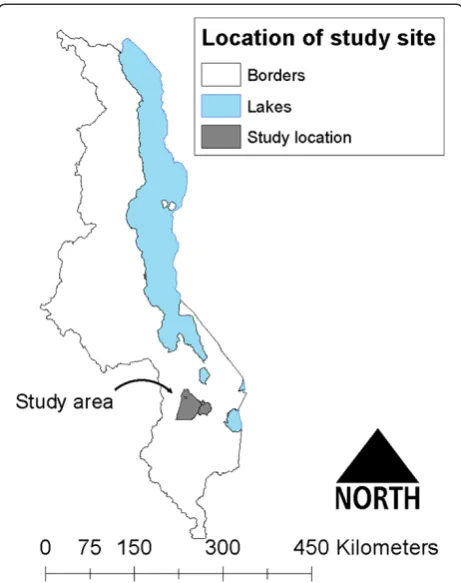
This study was conducted within the catchment area of Machinga District Hospital (MDH), a government-operated hospital which receives patients from villages in Balaka and Machinga Districts along the Shire River of southern Malawi. In addition to the government-operated MDH, smaller private clinics are available in the region, but are beyond the financial means of most residents. Vil-lages in two adjacent Traditional Authorities (TAs), Nsa-mala (pop. ~175,000) and Sitola (pop. ~38,000), were studied (Figure 1). Roughly 95% of the populations in both TAs are considered to be residents of rural settings, with >15% of residents under the age of five years [23]. The terrain is hilly, ranging from ~400 to ~750 m above sea level. The primary economic activity in the two TAs is farm-ing, both subsistence and cash crops. The climate is semi-tropical, marked by wet-dry seasonality. In contrast to the rainy, wet season (November to April), this study occurred over the cool, dry season from June to August, when average temperatures range from 14°C to 28°C, with almost no pre-cipitation [24]. While no direct survey of malaria vectors has been conducted in the Upper Shire Valley, where this study took place, malaria vectors in the Lower Shire Valley have been surveyed, and consist ofAnopheles funestus,Anopheles gambiae sensu stricto, andAnopheles arabiensis[25]. These vectors are common throughout the country, and are likely the primary vectors in the Upper Shire Valley as well, as evi-denced by a study of insecticide resistance around Liwonde National Park [26].
Study participants
lists provided by each TA chief. Because of smaller vil-lage populations, six vilvil-lages were selected from TA Sitola, and four from TA Nsamala. Additionally, because TA Nsamala is partly serviced by another district hos-pital, the village sampling frame was limited to those vil-lages identified by the TA chief as primarily accessing health services at MDH. To conform with Malawian cul-ture and to maximize participation, the research team met with the heads of the two TAs and ten villages, and received permission to work within their domains. The TA and village heads then discussed the study with the residents before the arrival of researchers. Using resi-dents suggested by the village chiefs as guides, a census was conducted of all households with children under five years within each village. For households with more than one under-five child, all children would be tested and treated for malaria if the rapid diagnostic test (RDT) was positive, but a researcher would flip a coin to randomly determine which child would be enrolled in the study. No study households had more than two age-eligible children present at the time of the interview.
Ethical treatment of human subjects
Recruitment and enrolment was done by the research team, which included a Malawian nurse and translator who received training in confidentiality and research
ethics. Due to widespread illiteracy, the study team approached households with verbal informed consent at the time of recruitment, and used thumbprints to indicate consent of illiterate guardians. Copies of the informed consent were available in Chichewa (the dominant local language) and in English for any participant who re-quested one. This study received ethical approval from the University of Michigan Health Sciences and Behavioral Sciences Institutional Review Board and the University of Malawi College of Medicine Institutional Review Board.
Study design and methods
All households with a child aged four months to five years were eligible for enrolment in the study. A Malawian nurse administered the questionnaire to a par-ent or guardian of each enrolled child in every partici-pating household. The questionnaire included items on the child’s recent history of and treatment for malarial illness, as well as bed net ownership, insecticide treat-ment, and use. When the questionnaire respondent was the child’s mother, the nurse asked additional questions on the mother’s malaria illness, treatment and preven-tion methods during either her most recent or current pregnancy. After completing the questionnaire, and with parental consent, the nurse tested all children between four months and five years of age for malaria using SD Bioline Ag. Pf. RDT, and results were recorded on the questionnaire form. Children who had a positive RDT results were designated as cases, and those with negative RDT results were considered controls. The nurse adminis-tered one weight- and age-appropriate dose of artemether/ lumefantrine combination therapy to children with posi-tive RDT results, and provided necessary medication and instructions to parents for subsequent doses.
[image:3.595.58.289.88.380.2]While the nurse and a research team member admin-istered the questionnaire and RDTs, two researchers conducted environmental data collection with the assist-ance of a Malawian translator who was familiar with local agriculture. Each participating household's location (latitude, longitude and elevation) was recorded after averaging a minimum of ten readings by a hand-held Garmin eTrek Venture HC GPS unit to ensure estimated measurement error of <5 m. House structure and mate-rials for windows, roof, and walls were visually charac-terized. Using the GPS waypoint for the participating house, a member of the study team (LRT) assessed land use/land cover at ≤25 m and 26–50 m of the dwelling, treating the distances from 0–25 m and 26–50 m as discrete distance bands encircling the house. In addition, surveyors counted the number of neighbouring houses within each distance band, as there was often at least one house within 50 m of a participant’s house. Four dis-tinct types of land use/land cover were recorded: bare earth, natural vegetation/fallow land, agriculture, and
brickmaking that created large mud pits. Environmental surveyors were blinded as to the malaria status of the enrolled children, and were required to agree about loca-tion and types of land cover classificaloca-tion before record-ing information. Where multiple types of land cover were present, surveyors recorded each of the types. In addition to land cover and household characteristics, the number of neighbouring households present in each band was also recorded. The Malawian translator assisted with distinguishing between actively cultivated crops and harvested/fallow cropland; however, there were no data collected on specific types of crops (e.g., maize, rice or bananas).
Analytical methods
The outcome variable of interest was case or non-case status as defined by the dichotomous RDT result. Expos-ure variables include demographic information, bed net ownership and use, household building materials, and proximity to different types of land cover. Because the aims of this study pertained more to the effects of prox-imity to land cover at a finer scale than is generally assessed and also wished to minimize the number of neighbouring houses within the radius of a given partici-pant’s house, land cover within a 25 m radius was the primary exposure of interest, but results were also calcu-lated for the association of land cover between 25–50 m, and for the entire range of 0–50 m. Bivariate analyses were performed using simple logistic regression, the rele-vant Wald X2 and p-value. Variables found to be signifi-cantly associated with RDT status at p <0.10 were included in multivariate logistic regression (MLR). These same vari-ables were then analysed in a generalized linear mixed model, specifically multilevel, multivariate, logistic regres-sion (MLLR) using PROC GLIMMIX, which allows for generalized linear mixed models, including random intercepts to account for potentially correlated data due to cluster sampling strategy. As cluster selection was done for geographic units (i.e., TA and village), random intercepts for these variables were included in MLLR analysis to account for group-level effects, which would likely include many unmeasured spatially mediated environmental expo-sures. For further confirmation that spatial autocorrelation was accounted for in the models, each model was run with the Getis-Ord Gi* z-scores as the dependent factor. All analyses were conducted using SAS 9.2.
Spatial patterns were explored through ArcGIS 10.0. Geographic data such as elevation, rivers and administra-tive boundaries, were provided by the Malawi National Statistical Office. GPS point data of household locations were uploaded from the Garmin eTrex Venture HC using a GPS software application (Minnesota Department of Natural Resources). Tabular data were joined to GPS data, and all data were projected into the UTM Zone 36S
projection. Clustering of cases and exposure variables was assessed using the local Getis-Ord Gi* statistic in ArcGIS.
Clustering of case and exposure variables was investigated at the level of the entire study area for each TA, and for each village, to assess scale-dependency of effects. In order to assess the role of geographic-dependence on cluster measurements, Pearson residuals from MLLR were joined to GPS locations in ArcGIS, and assessed for clustering with the Gi* statistic.
Results
A total of 390 children and households were enrolled, with one child ultimately being excluded from analysis because of missing RDT status, thus analysis was conducted on 389 children (Table 1). The number of enrolled children per village ranged from 16 to 98. Enrolled children had a mean age of 30.2 (SD =15.2) months with a range of four to 59 months. Of these 389 children, 44.5% (n = 173) were RDT positive for Plasmodium infection (“cases”).
Additional study participant characteristics are in Table 1. The distance between participant households varied among villages, ranging from 29.75 to 82.67 m. The mean distance between participants’ houses for all villages was 68.0 m in TA Sitola and 61.9 m in Nsamala, but these means were not significantly different from one another (p = 0.68).
From bivariate Chi-square analysis, cases were found to be 4.2 times more likely than non-cases to live in TA Sitola than TA Nsamala (95% CI 2.74-6.46), and were 2.9 times more likely to live within 25 m of active dry-season agriculture crops (95% CI 1.74-4.92) (Table 2). In addition to geographic and environmental differences, cases and controls differed significantly by age, sex, bed net ownership, and house roofing materials (Table 2). Houses within TA Sitola were 9.0 times more likely to have agriculture within 25 m (95% CI 4.90-16.66), and be situated at an average elevation that was 54.1 m higher than houses in Nsamala (p <0.0001). Other differ-ences between children residing in either of the TAs included age, sex, and likelihood of bed net ownership (Table 3). All hypothesized exposure variables significant at p < 0.10 in bivariate analysis were included in MLR models. Interaction terms for highly correlated exposure variables were also included in MLR models.
between close household proximity to agriculture and
Plasmodium infection remained relatively unchanged after expanding analysis from crude bivariate (OR = 2.93) to multilevel, multivariate logistic regression (OR = 2.80). This similarly greater risk of infection near active dry-season agriculture was observed even after having con-trolled for bed net ownership.
Univariate spatial analysis of clustering and dispersal was conducted using the Getis-Ord Gi* for all significant
variables in bivariate statistical analysis. While the distri-butions of positive household clusters and of households within 25 m of agriculture overlap significantly, positive
[image:5.595.57.539.120.570.2]and negative clusters of bed net ownership were more widely distributed (Figure 2). Although more households in TA Nsamala than TA Sitola owned bed nets, house-hold proximity to agriculture remained strongly predict-ive of child malaria status after controlling for bed net ownership. Unlike the Gi* hot/cold spot maps for cases and households within 25 m of agriculture, the distribu-tion of bed net ownership did not exclusively cluster in TA Nsamala which had lower Plasmodium infection prevalence (Figure 2(c)). Instead, bed net hotspots were found in both TAs, although more so in Nsamala than Sitola.
Table 1 Demographic and household physical characteristics of 390 study participants surveyed during June to August 2011 residing in ten villages from two Traditional Authority locations in the Machinga District Hospital catchment area of southern Malawi
Participant and household characteristics n (%) Participant and household characteristics n (%)
Traditional Authority (TA) Wall building material
Sitola 161 (41.39) Mud (sun-dried bricks) 249 (64.34)
Nsamala 228 (58.61) Brick (fired bricks) 130 (33.59)
Villages Cement 6 (1.55)
Sitola Other 2 (0.52)
Lawrence 25 (6.43) Windows
Tambula 33 (8.48) No windows 130 (33.68)
Nyama 33 (8.48) Open windows 124 (32.12)
Mboma 20 (5.14) Glass windows 92 (23.83)
Mbaya 34 (8.74) Screened windows 7 (1.81)
Botoni 16 (4.11) Other 33 (8.55)
Nsamala Agriculture 0–25 m from house
Ntonya 27 (6.94) Yes 78 (20.05)
Chilembwe 98 (25.19) No 311 (79.95)
Sitima 66 (16.97) Agriculture 25–50 m from house
Kaniche 37 (9.51) Yes 105 (26.99)
Sex of child No 284 (73.01)
Male 205 (52.70) Agriculture 0–50 m from house
Female 184 (47.30) Yes 115 (29.5)
Household owned≥1 bed net No 274 (70.44)
Yes 207 (53.35)
No 181 (46.65)
Malaria symptoms in past 2 weeks Mean (sd)*
Yes 132 (34.11) Age of child (months) 30.13 (15.19)
No 255 (65.89) Household elevation (m) 524.59 (37.91)
RDT result Number of people living in household 4.36 (1.61)
Positive 173 (44.47) Number of neighbouring houses <25 m 1.15 (1.18)
Negative 216 (55.53) Number of neighbouring houses 25–50 m 1.54 (1.55)
Roofing materials Total number of neighbouring houses 2.77 (2.14)
Thatch 322 (83.20)
Metal 65 (16.80)
Assessment of case clustering at the level of village, TA and study extent revealed remarkably different patterns of negative and positive clusters among the different levels. For example, at the village level there
[image:6.595.61.538.111.657.2]was almost no clustering of cases or controls, while “hot spots” and “cold spots” were in nearly opposite locations in TA level and full study, extent level ana-lyses (Figure 3). Pearson residuals from MLR linked Table 2 Univariate comparison of RDT-basedPlasmodiuminfection status (case, control) and demographic and
household environmental characteristics among study participants Participant and household
characteristics
Cases Controls Wald p-value OR Wald
n (%) n (%) ×2 95% CI
Study sample 173 (44.47) 216 (55.53) 4.75 0.03
Sex of child
Female 98 (25.19) 86 (22.11) 10.92 0.001 1.98 1.32-2.96
Male (ref.) 75 (19.28) 130 (33.42) 1.00
Traditional Authority
Sitola 104 (26.74) 57 (14.65) 43.02 <0.0001 4.20 2.74-6.46
Nsamala (ref.) 69 (17.74) 159 (40.87) 1.00
Reported malaria in <2 weeks
Yes 83 (21.45) 49 (12.66) 26.77 <0.0001 3.11 2.01-4.81
No (ref.) 90 (23.26) 165 (42.64) 1.00
Owned at least one bed net
No 99 (25.52) 82 (21.13) 14.03 0.0002 0.46 0.31-0.69
Yes (ref.) 74 (19.07) 133 (34.28) 1.00
Wall materials
Mud 102 (26.49) 147 (38.18) 3.40 0.07 1.48 0.97-2.26
Brick/cement (ref.) 69 (17.92) 67 (17.40) 1.00
Roofing materials
Thatch 151 (39.02) 171 (44.19) 5.70 0.02 0.50 0.28-0.89
Metal (ref.) 20 (5.17) 45 (11.63) 1.00
Windows
Glass 38 (9.84) 54 (13.99) 0.52 0.47 0.84 0.52-1.35
Other (ref.) 134 (34.72) 160 (41.45) 1.00
Agriculture <25 m from house
Yes 51 (13.11) 27 (6.94) 17.28 <0.0001 2.93 1.74-4.92
No (ref.) 122 (31.36) 189 (48.59) 1.00
Agriculture 25–50 m from house
Yes 62 (15.94) 43 (11.05) 12.37 0.0004 2.25 1.42-3.55
No (ref.) 111 (28.53) 173 (44.47) 1.00
Agriculture 0–50 m from house
Yes 67 (17.22) 48 (12.34 12.57 0.0004 2.21 1.42-3.45
No (ref.) 106 (27.25) 168 (43.19) 1.00
House elevation*(per 10 m) 4.92 0.02 1.06 1.01-1.11
Age of child*(months) 16.46 <0.0001 1.03 1.02-1.04
Number of people within household* 2.41 0.12 1.10 0.97-1.25
Number of houses within 25 m* 1.82 0.18 0.89 0.75-1.06
Number of houses within 25–50 m* 0.11 0.74 0.98 0.86-1.11
Total neighboring houses 0–50 m* 0.73 0.39 0.96 0.875-1.05
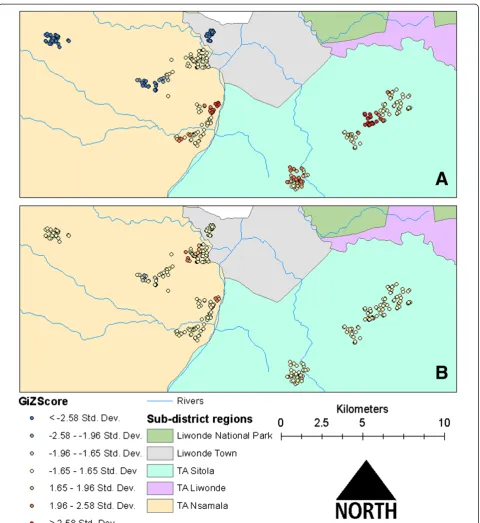
to GPS points of participant households exhibited a similar distribution of clusters in TA Sitola, with some extension of the risk map into TA Nsamala. Re-siduals from MLLR showed very little evidence of
[image:7.595.62.540.105.673.2]clustering, which suggests that much of the unmeas-ured spatial, social and environmental variation was accounted for with the random effects intercepts of MLLR (Figure 4).
Table 3 Characteristics of study participants by Traditional Authority of residence (Sitola or Nsamala) in southern Malawi surveyed during June to August 2011
Participant and household characteristics
Sitola Nsamala ×2 p-value OR 95% CI
n (%) n (%)
Study sample 161 (41.39) 228 (58.61) 11.54 <0.001 161 (41.39)
Sex of child
Female 85 (21.85) 99 (25.45) 3.33 0.07 1.46 85 (21.85)
Male (ref.) 76 (19.54) 129 (33.16) 1.00 76 (19.54)
Traditional Authority
Sitola 104 (26.74) 69 (17.74) 45.04 <0.0001 4.20 104 (26.74)
Nsamala (ref.) 57 (14.65) 159 (40.87) 1.00 57 (14.65)
Reported malaria in <2 weeks
Yes 70 (18.09) 62 (16.02) 11.81 0.0006 2.11 70 (18.09)
No (ref.) 89 (23.00) 166 (42.89) 1.00 89 (23.00)
Owned at least one bed net
No 87 (22.42) 94 (24.23) 6.53 0.011 0.59 87 (22.42)
Yes (ref.) 73 (18.81) 134 (34.54) 1.00 73 (18.81)
Wall materials
Mud 152 (39.48) 75 (19.48) 1.26 0.26 1.27 152 (39.48)
Brick/cement (ref.) 97 (25.19) 61 (15.84) 1.00 97 (25.19)
Roofing materials
Thatch 138 (35.66) 184 (47.55) 1.81 0.23 0.68 138 (35.66)
Metal (ref.) 22 (5.68) 43 (11.11) 1.00 22 (5.68)
Windows
Glass 38 (9.84) 54 (13.99) 0.007 0.93 1.02 38 (9.84)
Other (ref.) 120 (31.09) 174 (45.08) 1.00 120 (31.09)
Agriculture <25 m from house
Yes 63 (16.20) 15 (3.86) 62.37 <0.0001 9.12 63 (16.20)
No (ref.) 98 (25.19) 213 (54.76) 1.00 98 (25.19)
Agriculture 25–50 m from house
Yes 79 (20.31) 26 (6.68) 67.93 <0.0001 7.49 79 (20.31)
No (ref.) 82 (21.08) 202 (51.93) 1.00 82 (21.08)
Agriculture 0–50 m from house
Yes 86 (22.11) 29 (7.46) 75.06 <0.0001 7.87 86 (22.11)
No (ref.) 75 (19.28) 199 (51.16) 1.00 75 (19.28)
Continuous variables Sitola (mean) Nsamala (mean) t-value p > t
House elevation(per 10 m) 556.3 502.2 −19.93 <0.0001
Age of child(months) 29.53 30.64 0.69 0.49
Number of people within household 4.33 4.37 0.26 0.79
Number of houses within 25 m 1.11 1.18 0.58 0.56
Number of houses within 25–50 m 1.48 1.57 0.54 0.59
Discussion
Results from both multivariate and spatial statistical ana-lyses indicate that dry-season malaria risk in children is determined by fine scale, geographic/environmental fac-tors, particularly household level, peridomestic crop pro-duction. In both bivariate and multivariate statistical analysis, children who lived in TA Sitola had much higher odds of testing positive for malaria and living near an active agricultural site when compared to chil-dren in nearby TA Nsamala. Spatial statistical analysis confirmed the multivariable results, with significant ters of cases occurring in TA Sitola, and significant clus-ters of non-cases in TA Nsamala.
Given the cluster sampling strategy, there was concern that clustering of cases and of risk factors might have been an artifact of that selection process, thus violating the assumption of independence. MLLR, however, ad-dressed this potential source of bias. Interestingly, when the association between RDT status and bed net owner-ship was stratified by TA, the results indicated that bed net ownership had no effect on malaria status in Nsamala, but was significantly protective in Sitola. By considering this observation along with the location of agricultural clusters in Figure 2(b), there may be under-lying additional, unmeasured environmental/ecological factors affecting malaria transmission in Sitola that were not present in Nsamala.
Mapping the residuals of both MLR and MLLR in Arc-GIS allowed assessment of the degree of variation in data explained by the modelled variables, while controlling for unmeasured geographic features and sampling strategy. While univariate cluster analysis in GIS showed discrete clusters of malaria cases and households with proximity to agriculture in TA Sitola (Figure 2(a) and (b)), the MLR Pearson residual map (Figure 4(a)) extends the malaria-positive (high value) clusters into TA Nsamala. This expansion into Nsamala is consistent with observed eco-logical patterns, as those villages in Nsamala that are near-est Sitola also border the Shire River. After including random effects estimates for TA and village in the MLLR,
almost all variation in TA Sitola was explained, as evi-denced by the lack of any significant clustering of Pearson residuals in that region (Figure 4(b)). Interestingly, there are some indications that factors other than those in-cluded in the model had a significant relationship with
Plasmodium prevalence in TA Nsamala, while risk was drastically lower than in Sitola. There were some high value clusters along the Shire River in Nsamala, where other unmeasured variables may modify local dry-season malaria risk beyond those related to age, elevation, bed net ownership and proximity to active agriculture. This sug-gests that, while multilevel modelling was able to account for some unmeasured spatial and environmental variation, this method may be less useful in low-prevalence/low-risk settings, where it may still be necessary to directly meas-ure variables of interest.
The scale-dependence of clusters shown in Figure 3 can be explained in light of this residual mapping. When assessed at the village level, there is insufficient environ-mental variation to affect transmission locally. At the TA level, cases clustered in TA Nsamala along the river, which is reflected in the MLR residual map, while almost no clus-ters appeared in TA Sitola. This suggests that malaria risk is more uniformly distributed across Sitola than in Nsamala, which could be a result of more widespread eco-logical conditions conducive to increased vector abundance in Sitola. The relationship between dry-season, active agriculture and malaria may be explained by underlying regional ecological conditions that are conducive both to extended agricultural seasons and Anopheles mos-quito reproduction/survival. Those conditions could in-clude relatively high levels of soil moisture, local humidity, temperature, and standing water, all of which should enhance anopheline survival and reproduction [27-29]. As one example, the lack of actively cultivated crop land in Nsamala suggests that even relatively hardy crops such as cassava are unable to be widely grown there during the dry season, which could be due to a number of unmeasured environmental or social factors, such as the ability of soil to retain moisture [30,31], differences in rainfall associated with elevation in hilly regions [32], or reduced environmental capacity or social ability to sustain irrigation schemes [33].
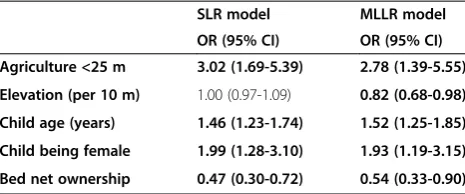
[image:8.595.57.290.133.230.2]The results of this study are consistent with the findings of other studies that examined the relationship between fine-scale land cover heterogeneity or smallholder agricul-ture on malaria. Indoor microclimates varied significantly depending on whether houses were located in deforested or naturally forested areas over a relatively compact 4 sq km study area, and relatively small fluctuations in mean indoor temperature shortened the duration of mosquitoes’ first and second gonotrophic cycles [28], which suggests one potential means by which fine-scaled heterogeneity in land cover might affect malaria transmission. The effect of Table 4 Odds ratios of statistically significant risk factors
for beingPlasmodiumpositive (case) based on simple logistic regression (SLR) and multilevel logistic regression (MLLR) models
SLR model MLLR model
OR (95% CI) OR (95% CI)
Agriculture <25 m 3.02 (1.69-5.39) 2.78 (1.39-5.55)
Elevation (per 10 m) 1.00 (0.97-1.09) 0.82 (0.68-0.98)
Child age (years) 1.46 (1.23-1.74) 1.52 (1.25-1.85)
Child being female 1.99 (1.28-3.10) 1.93 (1.19-3.15)
converting swamp to agricultural land was similarly shown to increase local village evening minimum temperature, which would promote increased mosquito population size and longevity while shortening mosquito gonotrophic cycle duration and parasite extrinsic incubation period [33]. These two studies suggest that local-scale
[image:11.595.59.540.86.610.2]development of agriculture can create conditions favourable to mosquito reproduction and longevity by af-fecting village-level temperature. The relationship between malaria and classified types of agricultural land cover within 2 km of villages showed a great deal of variation based on crop type and proximity, with weaker
associations at shorter distances [17]. However, even the shortest distance band used in that study would mask intravillage variation in malaria risk attributable to even closer proximity to high-risk crop types, as there would be higher expected levels of convergence of exposures within a larger distance band.
Despite being cross-sectional and case–control in design, this study has many strengths. A relatively large sample size was recruited across a range of villages of different sizes and geographic settings. All sampled households were in one public hospital catchment area, which provided similar levels of access to free medical services. By adminis-tering a questionnaire in conjunction with environmental field survey, multiple possible contributors to malaria risk could be examined in this setting. Multilevel, multivariate logistic regression with cluster analysis in GIS allowed for assessment of risk factors and accounted for the cluster sampling strategy that has rarely been considered in such epidemiological field studies. With direct survey of land cover, data were collected on a finer geographic scales than are available through many remote-sensing applications.
Unfortunately, information was not obtained on the size and nature of agricultural sites (e g, type of crop), nor were entomological parameters related to vector mosquitoes or people’s socio-economic status directly measured. Future research in the area should include these variables. Recent, fine-scale, satellite image data on land use/land cover were also not available. Despite the use of point averaging of household locations, GPS measurements are likely to be accurate to within only 5 m. However, even under circum-stances of maximum measurement error, the land cover data remain capable of assessing differences in household-level vegetation patterns. It is further possible that land covers was incorrectly categorized in some instances, however, such errors would likely reduce the strength of observed associations, and would not be biased since re-searchers assessing land cover were blinded to the RDT status of enrolled children. Thus, these rigorously analysed observations can be said to accurately reflect a surprisingly strong association between dry-season cropping nearby households and malaria risk among residents. This associ-ation was observed using different analytic methods and after controlling for possible confounders. Another poten-tial limitation of this study is the reliance on RDT for diag-nosis of recent malaria, which, although highly sensitive, have been shown to have low specificity in comparison to microscopy or PCR-based diagnostics [3,34]. However, since the primary outcome of interest in this study was re-cent infection as opposed to parasitaemia, this limitation should not greatly affect interpretation of these results.
Conclusion
This study examined the relationships between child-hood malaria and household proximity to directly
observed, active, dry-season crop production on a scale of <25 m, finer than that of most previous studies. Ana-lysis demonstrated that proximity to agriculture in-creases the odds of malaria in children under-five by nearly three-fold, even after controlling for age, sex, household elevation, and bed net ownership. The com-bination of multilevel statistical analysis and spatial ana-lysis in GIS provides a powerful means to describe and analyse environmental risk patterns for malaria. These results suggest that measuring disease transmission pa-rameters may be complicated in spatially heterogeneous regions, and that inferences may depend in important ways on the sampling scale. Since dry seasons are normally considered periods of relatively low malaria incidence, it is worth noting that in some villages Plasmodium infec-tion prevalence was still at >50%. This type of fine-scale modelling of malaria risk allows for more efficient targeting of prevention and intervention programmes. Future applications of these methods could integrate the molecular biology of mosquito vectors and other entomological variables across fine spatial scales, along with high resolution remote sensing data of land cover and other ecological and environmental parameters. Such information may be helpful in understanding both the patterns of risk at scales where transmission is oc-curring, and the underlying mechanisms that are giving rise to that risk.
Competing interests
The authors declare that they have no competing interests.
Authors’contributions
LRT conceived of the study, participated in study design, collected environmental and survey data, performed the statistical and spatial analyses, and drafted the manuscript. DM participated in study design and
coordination, and revised the draft manuscript. DPM participated in study design and critically revised the manuscript. MLW participated in study design, and helped draft the manuscript. All authors read and approved the final manuscript.
Acknowledgments
The authors thank the staff of the Malaria Alert Centre in Liwonde for their assistance with this study. Nurse Paul Kabalame is thanked for his work with recruitment, testing and treatment of participants. Translator Frank William is thanked for his survey administration and assistance with land cover identification. Ginger Gamble, Christine Hardwick and Ashley Dunfee are thanked for their contributions to environmental and survey data collection. Funding for this study was provided by the University of Michigan Center for Global Health. The funding body did not play any role in the collection, analysis or interpretation of data; in the writing of the manuscript; or in the decision to submit the manuscript for publication.
Author details
1Department of Epidemiology, School of Public Health, University of
Michigan, 48104 Ann Arbor, MI, USA.2Malaria Alert Centre, College of Medicine, University of Malawi, Blantyre, Malawi.3Department of Community Health, College of Medicine, University of Malawi, Blantyre, Malawi.
References
1. Wilson ML, Walker ED, Mzilahowa T, Mathanga DP, Taylor TE:Malaria elimination in Malawi: research needs in highly endemic, poverty-stricken contexts.Acta Trop2012,121:218–226.
2. Roca-Feltrer A, Kwizombe CJ, Sanjoaquin MA, Sesay SSS, Faragher B, Harrison J, Geukers K, Kabuluzi S, Mathanga DP, Molyneux E, Chagomera M, Taylor T, Molyneux M, Heyderman RS:Lack of decline in childhood malaria, Malawi, 2001–2010.Emerg Infect Dis2012,18:272–278. 3. National Malaria Control Programme (NMCP) [Malawi] and ICF International:
Malawi Malaria Indicator Survey (MIS) 2012.Lilongwe, Malawi and Calverton, Maryland, USA: National Malaria Control Programme and ICF International; 2012. 4. Black RE, Cousens S, Johnson HL, Lawn JE, Rudan I, Bassani DG, Jha P,
Campbell H, Walker CF, Cibulskis R, Eisele T, Liu L, Mathers C:Global, regional, and national causes of child mortality in 2008: a systematic analysis.Lancet2010,375:1969–1987.
5. Dzinjalamala F:Malaria. InThe Epidemiology of Malawi.Edited by Geubbels E, Bowie C. Blantyre, Malawi: College of Medicine, University of Malawi; 2006:1–21.
6. National Statistical Office (NSO) and ICF Macro:Malawi Demographic and Health Survey 2010.National Statistical Office and ICF Macro: Zomba, Malawi and Calverton, Maryland, USA; 2011.
7. Steinhardt LC, Mwandama D, Wolkon A, Shah M, Gimnig JE, Mzilahowa T, Wiegand R, Mathanga DP, Lindblade KA:Characteristics of children with asymptomatic malaria parasitemia in a high-transmission setting of Malawi.Am J Trop Med Hyg2013,89(Suppl 5):392.
8. Mathanga DP, Walker ED, Wilson ML, Ali D, Taylor TE, Laufer MK:Malaria control in Malawi: current status and directions for the future.Acta Trop 2012,121:212–217.
9. Stresman GH:Beyond temperature and precipitation: ecological risk factors that modify malaria transmission.Acta Trop2010,116:167–172. 10. Grillet M-E, Barrera R, Martínez J-E, Berti J, Fortin M-J:Disentangling the
ef-fect of local and global spatial variation on a mosquito-borne inef-fection in a neotropical heterogeneous environment.Am J Trop Med Hyg2010, 82:194–201.
11. Snow RW, Hay SI, Shewchuk T, Borle M, Moloney G, Gething PW, Clements ACA, Noor AM:Spatial prediction ofPlasmodium falciparumprevalence in Somalia.Malar J2008,7:159.
12. Chowell G, Munayco CV, Escalante AA, McKenzie FE:The spatial and temporal patterns of falciparum and vivax malaria in Perú: 1994–2006. Malar J2009,8:142.
13. Raso G, Silué KD, Vounatsou P, Singer BH, Yapi A, Tanner M, Utzinger J, N’Goran EK:Spatial risk profiling of Plasmodium falciparum parasitaemia in a high endemicity area in Côte d’Ivoire.Malar J2009,8:252. 14. Silué KD, Raso G, Yapi A, Vounatsou P, Tanner M, N’goran EK, Utzinger J:
Spatially-explicit risk profiling of Plasmodium falciparum infections at a small scale: a geostatistical modelling approach.Malar J2008,7:111. 15. Myers WP, Myers AP, Cox-Singh J, Lau HC, Mokuai B, Malley R:
Micro-geo-graphic risk factors for malarial infection.Malar J2009,8:27. 16. Bejon P, Williams TN, Liljander A, Noor AM, Wambua J, Ogada E, Olotu A,
Osier FH, Hay SI, Färnert A, Marsh K:Stable and unstable malaria hotspots in longitudinal cohort studies in Kenya.PLoS Med2010,7:e1000304. 17. Krefis AC, Schwarz NG, Nkrumah B, Acquah S, Loag W, Oldeland J, Sarpong
N, Adu-Sarkodie Y, Ranft U, May J:Spatial analysis of land cover determi-nants of malaria incidence in the Ashanti Region. Ghana.PLoS One2011, 6:e17905.
18. Ernst KC, Adoka SO, Kowuor DO, Wilson ML, John CC:Malaria hotspot areas in a highland Kenya site are consistent in epidemic and non-epidemic years and are associated with ecological factors.Malar J2006, 5:78.
19. Gaudart J, Poudiougou B, Dicko A, Ranque S, Toure O, Sagara I, Diallo M, Diawara S, Ouattara A, Diakite M, Doumbo OK:Space-time clustering of childhood malaria at the household level: a dynamic cohort in a Mali village.BMC Public Health2006,6:286.
20. Cohen JM, Ernst KC, Lindblade KA, Vulule JM, John CC, Wilson ML:Local topographic wetness indices predict household malaria risk better than land-use and land-cover in the western Kenya highlands.Malar J2010, 9:328.
21. Brooker S, Clarke S, Njagi JK, Polack S, Mugo B, Estambale B, Muchiri E, Magnussen P, Cox J:Spatial clustering of malaria and associated risk factors during an epidemic in a highland area of western Kenya.Trop Med Int Health2004,9:757–766.
22. Kreuels B, Kobbe R, Adjei S, Kreuzberg C, Von Reden C, Bäter K, Klug S, Busch W, Adjei O, May J:Spatial variation of malaria incidence in young children from a geographically homogeneous area with high endemicity.J Inf Dis2008,197:85–93.
23. Malawi Socioeconomic Database.http://www.maseda.mw/. 24. Climate data for Liwonde.http://en.climate-data.org/location/26679/. 25. Spiers AA, Mzilahowa T, Atkinson D, McCall PJ:The malaria vectors of the
Lower Shire Valley, Malawi.Malawi Med J2002,14:4–7.
26. Pemba DF, Namangale J:Influence on sensitivity to insecticides: a case study of a settled area and a game park in Liwonde.Malawi Med J2009, 21:81–84.
27. Himeidan YE, Zhou G, Yakob L, Afrane Y, Munga S, Atieli H, El-Rayah E-A, Githeko AK, Yan G:Habitat stability and occurrences of malaria vector lar-vae in western Kenya highlands.Malar J2009,8:234.
28. Afrane YA, Lawson BW, Githeko AK:Effects of microclimatic changes caused by land use and land cover on duration of gonotrophic cycles of Anopheles gambiae (Diptera: Culicidae) in western Kenya highlands. J Med Entomol2005,42:974–980.
29. Minakawa N, Githure JI, Beier JC, Yan G:Anopheline mosquito survival strategies during the dry period in western Kenya.J Med Entomol2001, 38:388–392.
30. Patz JA:Predicting key malaria transmission factors, biting and entomological inoculation rates, using modelled soil moisture in Kenya. Trop Med Int Health2002,3:818–827.
31. Kazembe L:Spatial modelling and risk factors of malaria incidence in northern Malawi.Acta Trop2007,102:126–137.
32. Ferguson AE, Mulwafu WO:Irrigation reform in Malawi: exploring critical land-water intersections. InAfrican Water Laws: Plural Legislative Frameworks for Rural Water Management in Africa: 26-28 January 2005; Johannesburg.Edited by van Koppen B, Butterworth J, Juma I. Pretoria: IMWI; 2005:24-1-24-14.
33. Lindblade KA, Walker ED, Onapa AW, Kutungu J, Wilson ML:Land use change alters malaria transmission parameters by modifying temperature in a highland area of Uganda.Trop Med Int Health2000, 5:263–274.
34. Chinkhumba J, Skarbinski J, Chilima B, Campbell C, Ewing V, San Joaquin M, Sande J, Ali D, Mathanga D:Comparative field performance and adherence to test results of four malaria rapid diagnostic tests among febrile patients more than five years of age in Blantyre, Malawi.Malar J 2010,9:209.
doi:10.1186/1475-2875-12-407
Cite this article as:Towneset al.:Elevated dry-season malaria preva-lence associated with fine-scale spatial patterns of environmental risk: a case–control study of children in rural Malawi.Malaria Journal
201312:407.
Submit your next manuscript to BioMed Central and take full advantage of:
• Convenient online submission
• Thorough peer review
• No space constraints or color figure charges
• Immediate publication on acceptance
• Inclusion in PubMed, CAS, Scopus and Google Scholar
• Research which is freely available for redistribution