Rochester Institute of Technology
RIT Scholar Works
Theses
Thesis/Dissertation Collections
12-8-2003
Location/dislocation: Temporal environments
Erin Holscher
Follow this and additional works at:
http://scholarworks.rit.edu/theses
This Thesis is brought to you for free and open access by the Thesis/Dissertation Collections at RIT Scholar Works. It has been accepted for inclusion in Theses by an authorized administrator of RIT Scholar Works. For more information, please [email protected].
Recommended Citation
ROCHESTER INSTITUTE OF TECHNOLOGY
A ThesisSubmittedto the
Faculty
ofTheCollegeof
Imaging
ArtsandSciencesIn
Candidacy
forthe DegreeofMASTEROF FINEARTS
LOCATION/DISLOCATION: TEMPORALENVIRONMENTS
By
Erin Elizabeth Holscher
Chief Advoor ---"K==e!::!i=lhwHio!:.ow=.!l!l~rd!!.- _
(Please type)
I)ale:
(Signature)
T.>
~7.
,
"l _..
~
-:f
Associate Advisor _ _!!:oEi!.!lle!l!eoO!!.AF..5:eelOlloeA,l.y...B~V;usblllnllile!u..!__
(PlC4UICtype)
(Signalure)
!>ale:
!
t.. .
~.
0"'>
Associate Ad\'i5Ol' -llM!!!3!!.!mg,ill; EnGlcn (Please
type)
(SiJ,Mlure)
!>nte~ 19·11-2003
Dcpartmetll
Clmirpenon _ _-LlDoo<So!lL.LJAwnliHllII'/Y.
_ (ptea~el)'pe)(Signature)
!>ate;
1;;'/0
>
TableofContents
Page
1 Introduction
2 Main Thesis
Body
12 Conclusion
13 Endnotes
14
Bibliography
"Shewoke and spread outthemap onthefloor. What
wasshe
looking
for? Her skin washerownsmall ghost,a shroudtobe dead
in,
a newspaperforold newstoberead
in,
gift-wrapping,litter,
asuicide letter.She left itthere,
dressed,
checkedout, gotinthe car.As she
drove,
thetowninthemorningglitteredbehind her. Sheateupthemiles. Herskin
itched,
likearash, likea slow
burn,
felt stretched,asthoughit belongedtosomebodyelse.
Deep
intheboneoldstreetstunneledand
burrowed,
hunting
forhome."1The intent ofthis thesis was to create a
body
of work that explores concepts oflocation anddislocation,
asthey
relate to my personal experience in transient places. This work is aninvestigationofthe physical, emotional, and spiritual displacement felt whenmoving fromplace
to place. The work culminates withthe physical, emotional, and spiritual connectedness that I
have to
"place",
even as I move along.Using
the humanbody
andanatomyas a vantage point,I will explore human temporal relationships with place and environment. Human ephemeral
existence andthe transient places and environs humans inhabit are two elements that I want to
visuallyinvestigate usingnon-toxicprintmakingprocesses.
My
concepts arebestservedthroughaprocess partially ofmy owninvention: the Pastel Wash
Drawing
ConstructionIntaglio-type,
anon-toxicintaglioprocessthatallowed metomergemy drawingswithprintmaking.
I will be referencing the work ofKiki
Smith,
particularly herinvestigations
ofthe human body.The workofcontemporary Boston-basedpainterAnne Harrishas hada significantimpactonmy
own conceptual growth, in herapproachto the humanfigure and use oftransparent
forms.
Iaminfluencedandfascinated
by
theworkoftwocontemporarywriters, Sylvie Germain andJeanetteofplace, and
Winterson,
for her use ofthebody
as metaphor for environment, thebody
aslandscape or sanctuary. Both writers approach the
body
in a raw and visceral manner. I willdiscuss influential artists and writers/philosophers andthe relevance ofmyworkincontemporary
art.
Mapping,
narrative,displacement,
andmemoryareintegralconceptsthatinformanddelineatethis
body
of work.Location/Dislocation: Temporal Environments is an exploration ofthe transient places and
spaces we inhabitthroughout our lives andhow these places, no matter how
fieetingly
they
areinhabited,
becomeembeddedinwho we are. Itisan exploration ofthedisplacedsensationsIhaveexperiencedas Ileaveone placeforanother. Thisthesisexhibition representsmyexperiencewith
thecycleofsettling, uprooting,
leaving,
andresettling: theexperienceofmapping my internalselfthrough theplacesthatI havecalled
"home."
I began my current artistic investigation
by looking
at the artistsKiki
Smith,
AnneHarris,
and a pieceby
JonathonParsons,
an artistwho exhibited in the controversial
"Sensation"
show in New York
City. Both Kiki Smith and Anne Harris confront the physicality of
the human
body,
using veins andbody
parts as a metaphor for thehuman condition. The piece
by
Jonathan Parsons is adissected mapofhis
homeland,
GreatBritain,
displayed in an acrylic box (Fig. 1).The dissected map becomes adisplayed network ofvein-like roads.2
InfluentialwritersJeannette WintersonandSylvie Germain bothwrite Fis ' JonathanParsons Carcass, 1995
poeticallyoftherawandphysical natureofhumanemotionand ofthe 200x110x40cm
power of place. Germain's fiction iscomprised ofcharacters whose
connectionstoplace are
deeply
embeddedintheirbeing. InGermain'sThe BookofTobias,
onecharacter"mightwellhavelivedanywhere,in
fact,
on araft,inatree,
outinthedesert,
intheheart
of acity. . .Shewassomuchanexile,andhadsofewneeds. Itdidnot so much mattertoherwhere
Fig.2,KathyPrendergast fromBodyMapSeries,1983 inkandwatercolor
Throughoutthe exploration, I came acrosscontemporaryartists with
whom I empathized. The relevance of mapping and narrative in
contemporaryartis something Irelatedtoonapersonal
level. Artistssuchas
Kathy
Prendergast (Fig.2)
andLordy
Rodriguezincludemapping intheirworkas adevice for exploring memoryand
displacement. For
Prendergast,
"it is the map that dominates heroeuvre, from her literal maps of cities, to her figurative maps of
the female
body,
to her poetic mapping ofthe passing oftime andbeliefs."3
Lordy
Rodriguez's "mapsare often aboutplaceshe's beenandlongs to return to."5
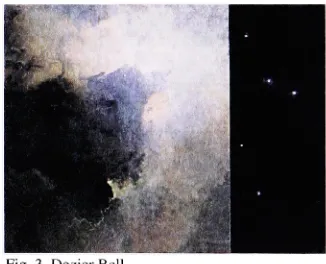
Maine-based painterDozier Bell sees "remote sensing technologiesas
exquisite corollaries of mental processes: map-making, reconnaissance,
detection, destruction,
and
deliverance,
are as applicable to psychological andspiritual life as
they
are to the global theaters ofwar."6Bell
[image:8.549.333.496.346.478.2]questions
faith, divinity,
creation, anddestruction in herwork(Fig. 3). The atmosphere and execution of Bell's paintings
influenced myown approachtoenvironment. Thephilosopher
Gaston Bachelard explores the power of places and intimate
Fig.3,DozierBell, spaces. His book The PoeticsofSpacehadsome
bearing
on Map studyN0.2. 2000acrylic on paper, 14x18"
formulating
my ideasabout"home"
intomore concretethoughts.
My
exploration was notjustone ofadevelopment ofconcept andform,
butalso one of process.My body
of workis comprised of constructionintaglio-types,
createdfrom abody
of pastel washdrawingson
drafting
mylar. The imagesare constructed oflayers,
givingtheimagestransparency,
texture,andlayersofmeaning. Someoftheimagesare composed oftwoor moreplates,
breaking
the image up into two or more panels. This division suggests dislocation through the physical
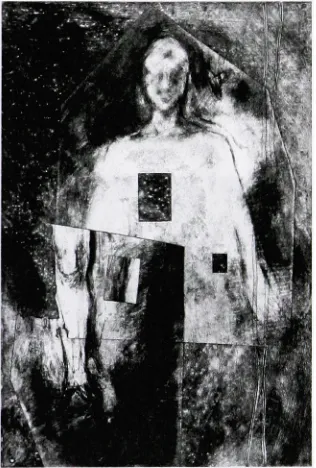
Fig. 4.Epoch.24\27"
Epoch,
thefirst in thebody
ofwork,marksthepassingoftime (Fig. 4). Thethreefigures,
whichrepeat throughoutthe
body
ofwork, represent lineage. The piece notonly symbolizes an era intime, but a breakthrough as well. Epoch is the
turning
point in my use of process. The imagedraws on memory,
lineage,
and thetransitory
state ofbeing. The first ofthe figures representsmy grandmother, someone who has alreadypassed on. Her physicalityand spiritare referenced
through two layers within the print. The middle figure represents my mother. The mother is
divided,
referring to my own divided feelings toward home. The lastfigure,
seen in full butwhose face isnot yet
fully
formed,
isa self-portrait: thefigurerecognizesthe passingoftimeandembracesher
lineage,
but isstillcomingtotermswithwho sheis.Fig.5,Beacon.6x4"
each
"
W
V
.;The diptych Beaconandtheimage Cold
Comfort,
likeEpoch,
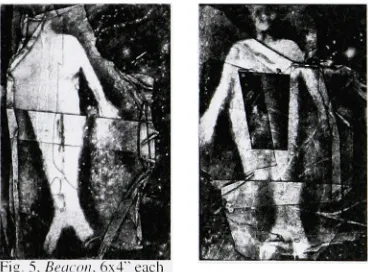
also alludetolineageandthepassingoftime. Beacon (Fig.
5)
represents my grandmother-someone who has passed on and whosedeep
spirituality andgoodnessserve as a guide formyown actions and spirituality. The diptychserves as aliteralpassage, or
transition,
fromone paneltoanother: the transitionfromphysicalto [image:9.549.171.355.452.588.2]appears in
Beacon,
this time representing aloss ofbeing. Thecelestialbackground suggeststheheavens andtranscendence,atheme thatis seen withinother images inthis
body
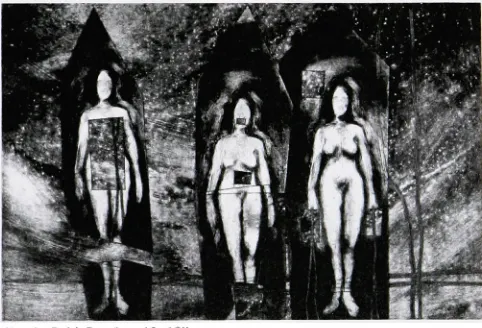
of work. ColdComfort
depicts,
moredirectly,
thepassingoftimethroughmortality. This image (Fig.6)
portraysthree female figuresall containedwithintheirownhouse shapes. The houses seem coffin-like in
theirverticalityandintheircontainment ofthefigures. Although thehouserepresents comfort and
security, the coffin-like qualityofthehouses givesthe imageanunsettlingpsychological torque.
The title also has personal differentmeanings: the first is the literal definition of cold comfort,
meaning lackofcomfort. The second refers to my upbringing in aphysicallycold region. The
nature ofmy
"home"
and sourceof comfort and security isa cold place.
"Winteris
by
fartheoldest ofthe seasons. Not only does itconferageuponourmemories,taking
usbacktoa remote past
but,
onsnowydays,
the housetoo is old. Itis asthough itwereliving
inthepast ofcenturiesgoneby."7
Fig.6,ColdComfort.12x18"
The ambiguous figuresrepresentthemultitude ofhuman experience. The figures may represent
three different individuals or one individual's progression. Ifthe image is read from right to
leftor from left to right, it couldbe interpreted to beone individual's gradual connectedness or
disconnectednesstoplace. The roads evokeveins, as
they
connecttoone figure's hands and runalongthe
leg
andthrough the torsoof anotherfigure. Theroads,which repeatthroughout thebody
ofwork, allude toroads in North
Dakota,
SouthDakota,
andMinnesota,
particularlytheplace of [image:10.549.142.383.362.526.2]Thenext set ofimagesexplores concepts of
identity, impermanence, dislocation,
andtranscendence.Dollhouse Nostalgia /andDollhouseNostalgia II (Fig. 7and
8),
express adeeply
personalsense ofdislocation. Thetitledrawsfrom mychildhood memoriesofmy dollhouse. Thechild'sdollhouse
sets the stage for the child's interpretations of
home,
security, and comfort. I drew from oneparticularmemoryofmydollhouse
being
thrownout asIpreparedtomovetoanewcityandhomewith my family. The casting aside ofthe dollhouse represented apersonal sense ofdislocation:
a transition from childhoodinto young adulthood, and ofuprooting,
leaving,
and establishing anewfoundation. Thisis my memoryofmy firstsense ofdisplacement. The figuresquestiontheir
identity
and search fora sense ofplace: place within environment andfeeling
at"home"
with
themselves. Thenostalgiais forthatof protectionandsecurity, notforchildhood.
Fig.7,DollhouseNostalgia I. 18x12"
Fig.8, Dollhouse Nostalgia.18x10.25"
The houseandfigurereappear,but in fragmented forms. Theatmosphere withinthe twopiecesis
symbolicofsnow, referencingmy home. Thissnowyatmosphereisseenthroughout this
body
ofimages. The snow sweeps throughoutthe picture planesofbothprints,promoting anunsettling,
blizzard-likemovement. "Andso, facedwiththebestial
hostility
ofthe storm andthehurricane,
the housed virtues of protection and resistance are transposed into human virtues. The house
acquiresthephysical and moralenergyof ahumanbody."8
[image:11.549.286.433.299.536.2] [image:11.549.86.244.301.535.2]facestheviewer
directly,
but lacksfacialdefinition. Theambiguous nature ofthisfigurerepresentssomeone still
trying
tounderstand andfeelathomewithherself,
orisarepresentation ofthepassingoftimeandthe
fleeting
nature ofhomeand relationships. Thispiecesuggestsanimpermanenceofstructure: ofrelationships, of
home,
ofsecurity, and ofbeing. The figure passivelyconfronts theviewer withherlackoffacial formation.
Dollhouse Nostalgia II depicts a female figure whose face is more
fully
formed. The figureis fragmented and partially contained within fragments of a house form. Linear elements that
referenceroadspertainingtomychildhoodhome constructaladder-like foundation thatsupports
the house containingthewoman's face andbust. This woman's more
fully
formed faceand castoutward gaze suggestthatsheperceiveschange. Her
feet,
althoughfirmly
planted onthe ground,aredisconnected from her head and shoulders. Althoughsheis
disconnected,
she facesthe stormoutsidethehouse. This figure seemingly hasastrongersenseof self and place.
Fig.9,The ArchitectsSorrow,24x16"
The Architect's Sorrow (Fig.
9)
is based on theimpermanence of structure. Structure becomes a
metaphorfortwobasic ideas: relationships andhome.
The "architect"may be interpreted in afew ways; the
architect is the
father,
the maker, the originator, theplanner, etc. Apair of
feet,
ateither end ofthebottomofthe
house,
serves asthe foundationofthisstructure.Lines referring to specific places are also apparent
withinthe
layers,
referencingplaces that I have calledhome. These
lines,
asthey
runbeneaththehouse andthe
figures,
retain a vein-likequality,whichemphasizesthephysical connection wehavewith our environment.
Theevocation of veins andthetransparentnature ofthe
[image:12.549.35.226.387.679.2]* *
myownwork,
having
seenthework ofBoston-basedartistAnne Harris.First Portrait with
Max,
by
Harris,
is a strong example ofHarris'
treatment ofthe figure and what lies beneath (Fig. 10). The network
ofblue veins that shows beneath stretched, pregnant skin embellishes
therawphysicalityoftheimage. In The Architect's
Sorrow,
thecentralroadlinethatcreates adivisionwithinthehouse hasa spine-likequality,
symbolizing the
dichotomy
of strength and vulnerability. The homeand the relationship are at this point seemingly stable, yet the image Fig.10,Anne Harris
First PortraitwithMax,1996-97
suggeststhat themalefigure may be searching for somethingoutside of oilon canvas-44x30"
his immediateenvironment.
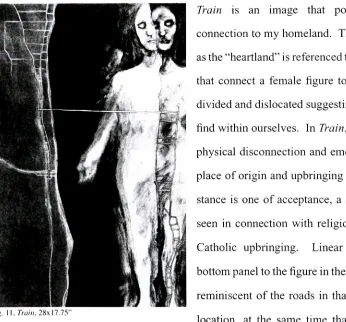
Train is an image that portrays my emotional
connectiontomy homeland. The idea ofthe Midwest
asthe"heartland"isreferencedthroughlinearelements
that connect a female figure to a map. The figure is
dividedanddislocated suggesting dichotomiesthatwe
findwithin ourselves. In
Train,
thisdivision impliesaphysical disconnection and emotional connection to a
place of origin andupbringing (Fig. 11). The figure's
stance is one ofacceptance, a stance that also can be
seen in connection with religion, thus suggesting my
Catholic upbringing. Linear elements connect the
bottompanelto thefigureinthe
top
plate. Thelinesarereminiscent oftheroads inthat particular geographic
location,
at the same time thatthey
could be veins,ladders,
ortraintracks,
icons oftheMidwestern landscape. The suggestion of veins remindstheviewerofhowourenvironment affect us notonlyemotionally,butphysicallyas well.
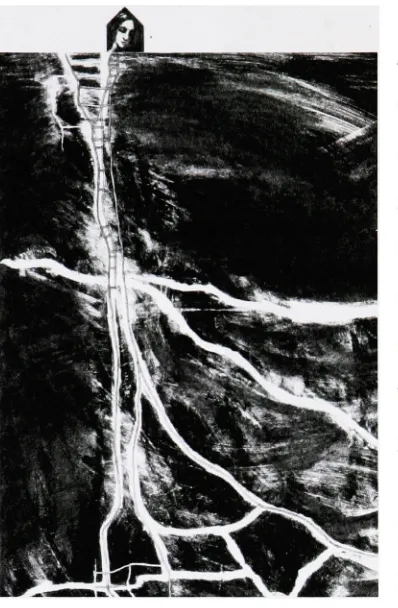
[image:13.549.379.494.64.225.2] [image:13.549.40.386.313.635.2]Motherland gives homage to my Midwestern home
(Fig. 12). Housed within the small plate is the head
and neck of a female
figure,
whose downcast gazerests upon the large panel below. The atmosphere
is suggestive ofthe sweeping winds and tumultuous
snowstorms commonplaceinthe Midwest. Thehoused
female,
althoughtiny
in contrast to the aerial view ofthe plains, calms the sweeping tumult of the larger
panel. Thedarkerlines referencing mychildhoodhome
imply
adisconnection betweenfigureandlocation. Thehoused figure is also the mother and the mapmaker,
}, fli
looking
downupon somethingthat is a part ofherevenas she moves beyond it. The house symbolizes the
samevirtues as a mother: comfort, security, and protection.
The last set of images investigates ideas of location and
dislocation,
and of"home"
and its
associations.
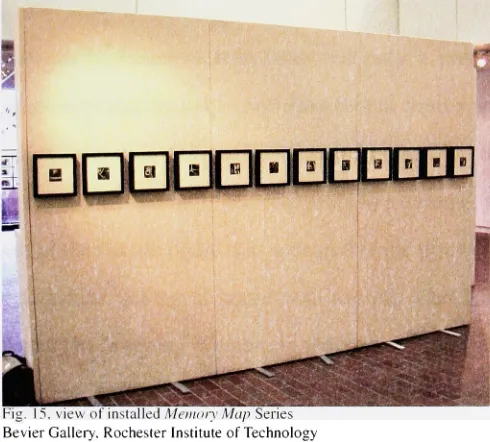
Memory
Mapswascreatedfromthe sameresponsetoprocess asEpoch. The seriesembodies my intuitive response to personal location and dislocation. The series (Fig.
13-15)
containstwelve separate
images,
each constructed offragments of maps. The maps are drawnfrom my memoryofplacesthathave been hometome. Each mapcontains a windowto themap
beneath
it,
alludingtohouseorhome. Each map isanintimatememory,printedandhousedalone,but subtlyembossedtocreate a connectivenetworkbetweeneach map.
SW '-rifi
m ________{
KL_________H
E
W~2j""^-^^^^r~rl m [image:14.549.33.232.31.335.2] [image:14.549.108.417.559.698.2]Fig. 15,viewofinstalledMemory MapSeries BevierGallery,Rochester InstituteofTechnology
42.358N,
71.060W(Location/Dislocation)
is atriptych (Fig.16-18)
referencing aspecific placein relationto feelings oflocation anddislocation. In the firstpanel (Fig.
16),
a female figure iscontainedin the house. Throughout this series, the house serves as a metaphor for avariety of
ideas. Inthis panel, the house isa metaphorforthe
body
ashome. In DisappearanceII,
a short storyby
JeanetteWinterson,
one androgynous character has isolated herself/himself from theoutsideworld,practically
becoming
aphysicalpartofher/hisownhome.Fig.16,17,and18
42.358-N,77.060W (Location/Dislocation),12x6"
"Nevertheless,
itismyhouse inwinterthatIlove,
myhouseclipped andsilent,and me itsmaster.You will understandthatI do not troublemyself withcovering upthe furniture orshutting upthe
fireplaces. Others do that. Room
by
room the house is quieted for the winter, until only I amits
beating
heart.Only
I,
the rise and fall ofitslungs,
thehouse and Ibreathing
togetherin thenight."9
[image:15.549.141.386.33.254.2] [image:15.549.119.407.397.567.2]42.358N
71.060W(Location/Dislocation)
references not only a physical sense of location/dislocation,
butalso an emotional attachment to anddetachment from a specific city. Inthe firstpanel, the house ismore complete and whole. The house is absent from the figure inthe second
panel(Fig.
17),
suggestingalackof"home",
thenreappears inastrange, fragmented form in thethirdpanel(Fig. 1
8)
absentofthefemale figurethatappearedinthefirsttwopanels. Thissuggestsa loss within myself, or a lack of
feeling
at home with myself, afterleaving
this city. SylvieGermain,
in apassage from "TheWeeping
Womanonthe StreetsofPrague",
writes"Cities,
likebodies,
have their smell, theirskin."10Thispassageprofoundly expresses notonlythe emotional,
butalsothephysical powerof place.
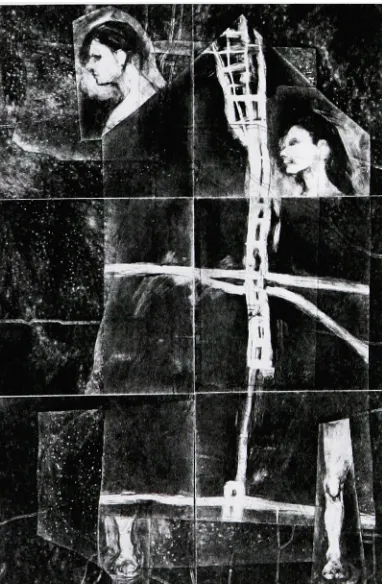
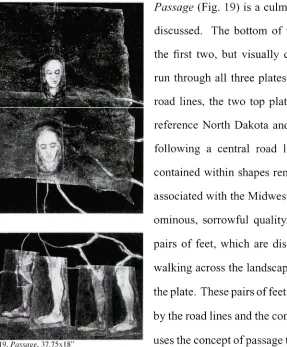
Passage (Fig. 1
9)
is aculmination of all the ideas previouslydiscussed. The bottom ofthe three plates is distanced from
the first two, but visually connected
by
linear elements thatrun through all three plates. Aside from the bottom layer of
road
lines,
the twotop
plates in Passage contain shapes thatreference North Dakota and South Dakota. A strand offilm
following
a central road line connects two heads that arecontainedwithin shapes reminiscent ofgrain silos, which are
associated withtheMidwesternlandscape. The faceshave an
ominous, sorrowful quality. The bottom plate contains two
pairs of
feet,
which are disconnected from thebody,
but arewalkingacrossthelandscape which spansthe bottomthird of
theplate. Thesepairsoffeetare also connectedto the
top
platesby
theroadlinesandthe connectingstrands offilm. Thepieceusestheconceptofpassagetoexploremanyideas: thepassing
from one placeto another, thepath
by
which a persontravels,andthepassingoftime. Locationis suggested
by
theabstract references to stateboundaries
androads,whiledislocation isapparentthrough the
disconnectedness
oftheheadsandFig. 19, Passage,37.75x18"
[image:16.549.46.333.292.639.2]feet to any other
body
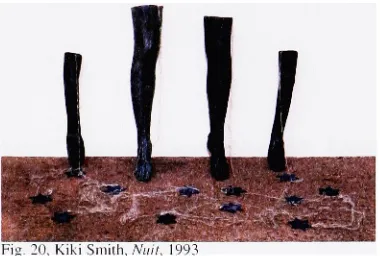
parts. The influence ofNew York-basedartist Kiki Smith can be seeninPassage. Smith'suse ofphysically detachedlimbsinpieces suchasNuit (Fig.
20)
shapedmyownuse ofdisconnected
body
partstoimply
aninner dislocation.Fig.20,KikiSmith,Nuit,1993
anodizedaluminum,bronze,and mohair
"Even ifone's
history
thereis short,a placecanstillbe feltasan extension ofthebody,
especiallythe walking
body,
passing through andbecoming
part ofthe landscape. Michael Martone iseloquent abouthissensuous identificationwith the Midwest: 'TheMidwestis too
big
tobe seen(asthe
Heartland)
. . .1thinkofitmore as a web oftissue, amembrane, a skin. Andtheway I feelabouttheMidwestistheway myskinfeelsandtheway I feelaboutmyownskin. . .theMidwest
is
hide,
an organ of sense andnotpower,delicateandcoarse atthesame time.""My
intentwastocreate abody
of workthatisasconceptually rivetingas it is visually captivatingand
technically
excellent. Thediscovery
ofanewprocess,inadditiontoastrongoeuvre,highlightsthe success ofthis thesis exploration. The pastel wash drawings teamed with the construction
intaglio-typeallowedforanaturaltransitionfrom
drawing
toprint. Thistechniquealso permittedme to work more
intuitively
with the materials. Thelayers,
textures,
andtranslucency
achievedwiththisprocessbestservedmyoriginal concept.
Conceptually,
theimagesworkindividually
andas abody. The images
independently
express either a senseofplace ordisplacement: each ofthepiecesincludedinthis
body
of workevoke adistinct sensationoflocationordislocation,
ofbeing
athomeornotathome. Eachoftheimagesisasimportantasthenext and each contributeswholly
to thedynamicsofastrongand cohesiveoeuvre.
[image:17.549.165.355.132.260.2]Endnotes
1
Duffy,Carol Ann. "TheMap-Woman."
Feminine Gospels (New York: FaberandFaber, Inc.,2002).
p.7
2
Rosenthal,Norman. Sensation: YoungBritish ArtistsfromtheSaatchi Collection (London: Royal
AcademyofArts, 1997) p.203
3
Germain, Sylvie. The BookofTobias (United Kingdom:Dedalus, Ltd., 1998). p.144-145
4
Mahon,Alyce. "ChartingtheFamiliar: KathyPrendergast: The EndandtheBeginning." Make. 28March/May2000,no. 87.
5
Roland,Craig. "SixContemporaryArtistsWho Use Mapsin TheirWork."
www.artjunction.org. Jan. 2002.
6
Bell, Dozier. "DivinityandDevastation: ImagesofHeimsuchung." www.dozierbell.com. July,2001
7
Bachelard,Gaston. PoeticsofSpace (New York: The OrionPress, 1964. Boston: BeaconPress, 1994).
p.41
8 Bachelard
p.46
9
Winterson,Jeannette. "DisappearanceII."
The WorldandOther Places (New York: VintageBooks,
1998). P. 119.
10
Germain,Sylvie. TheWeepingWomanontheStreetsofPrague(United Kingdom: Dedalus, Ltd., 1993). P.35
11
Lippard, Lucy. The LureoftheLocal(New York: NewPress, 1997). P. 34
Bibliography
Bachelard,
Gaston. Poetics ofSpace. New York: The OrionPress, 1964,
Boston: BeaconPress,
1994.p. 41
Bell,
Dozier."Divinity
andDevastation: ImagesofHeimsuchung."
www.dozierbell.com.
July,
2001Duffy,
Carol Ann. "The Map-Woman." Feminine Gospels. New York: Faber andFaber, Inc.,
2002.p.7
Germain,
Sylvie. TheBookofTobias. United Kingdom:Dedalus, Ltd.,
1998. p.144-145Germain,
Sylvie. TheWeeping
Womanonthe StreetsofPrague. United Kingdom:Dedalus, Ltd.,
1993.p. 35
Lippard,
Lucy. The Lureofthe Local. NewYork: NewPress,
1997. p. 34Mahon,
Alyce."Charting
the Familiar:Kathy
Prendergast: The EndandtheBeginning." Make. March/May
2000,
no. 87.Roland,
Craig. "SixContemporary
Artists Who Use Maps in Their Work."www.artjunction.org. Jan.
2002.
Rosenthal,
Norman. Sensation:Young
British Artists from the Saatchi Collection. London: RoyalAcademy
ofArts,
1997. p. 203Winterson,
Jeannette. "Disappearance II." The World and Other Places. New York: VintageBooks,
1998. p. 119.Plates
(Figures)
Fig. 1: Jonathan
Parsons, Carcass, 1995,
dissected map in acryliccase, 200x110x40cmRosenthal,
Norman. Sensation:Young
British Artists fromthe Saatchi Collection. London: RoyalAcademy
ofArts,
1997. p. 135Fig. 2:
Kathy
Prendergast,
fromBody Map
Series, 1983,
inkand watercolorwww.academic.hsu.edu. Laughter Ten Years
After,
Electronic ExhibitionCatalog
Fig. 3: Dozier
Bell,
Map Study
No.2,
2000,
acrylic onpaper,14x18",
www.dozierbell.comFig. 4: Erin
Holscher,
Epoch, 2002,
Pastel WashDrawing
ConstructionIntaglio-type,
24x27"Fig. 5:
Holscher,
Beacon,
2003,
Pastel WashDrawing
ConstructionIntaglio-type,
6x4" eachFig. 6:
Holscher,
ColdComfort,
2003,
Pastel WashDrawing
ConstructionIntaglio-type,
12x18"Fig. 7:
Holscher,
Dollhouse NostalgiaI,
2003,
Pastel Wash rawing ConstructionIntaglio-type,
18x12"Fig. 8:
Holscher,
Dollhouse NostalgiaII,
2003,
Pastel WashDrawing
ConstructionIntaglio-type,
18x10.25"
Fig. 9:
Holscher,
The ArchitectsSorrow, 2003,
Pastel WashDrawing
ConstructionIntaglio-type,
24x16"
Fig. 10: Anne
Harris,
FirstPortraitwithMax, 1996-97,
oil oncanvas,44x30"
York,
Jay. Anne Harris. Boston: NielsenGallery,
Amherst: OxbowPress,
1997.Fig. 11:
Holscher, Train, 2003,
Pastel WashDrawing
ConstructionIntaglio-type,
28x17.75"Fig. 12:
Holscher, Motherland, 2003, Intaglio-type,
liquidaquatint,37.75x23.75"
Fig. 13:
Holscher,
fromMemory
Map
Series, 2002,
Pastel WashDrawing
ConstructionIntaglio-type,
3x3"Fig. 14:
Holscher,
fromMemory Map
Series, 2002,
Pastel WashDrawing
ConstructionIntaglio-type,
3x3"Fig.15:
Holscher,
view ofinstalledMemory
Map
Series,
BevierGallery,
Rochester Institute ofTechnology
Fig. 16-18:
Holscher, 42.358N,
71.060W(Location/Dislocation),
2003,
Pastel WashDrawing
Construction
Intaglio-type,
12x6"each
Fig. 19:
Holscher, Passage, 2003,
PastelWashDrawing
ConstructionIntaglio-type,
37.75x18"Fig. 20: Kiki
Smith, Nuit, 1993,
anodizedaluminum,bronze,
and mohairPosner,
Helaine. Kiki Smith.Boston,
New York: BulfinchPress, Little,
Brown and