Rochester Institute of Technology
RIT Scholar Works
Theses
Thesis/Dissertation Collections
2005
Security in serverless network environments
Carl Holtje
Follow this and additional works at:
http://scholarworks.rit.edu/theses
This Thesis is brought to you for free and open access by the Thesis/Dissertation Collections at RIT Scholar Works. It has been accepted for inclusion in Theses by an authorized administrator of RIT Scholar Works. For more information, please [email protected].
Recommended Citation
Environments
Carl Holtje
Department of Computer Science Rochester Institute of Technology
Rochester, New York United States of America
2004
Advisory Committee
Professor Hans-Peter Bischof, Chairperson
Professor Edith Hemaspaandra, Reader
Professor Phil White, Observer
Contents
1 Introduction and Goals 1
1.1 Motivation and Goals . . . 3
I Background 7 2 Current Security Constructs 9 2.1 Key Agreement . . . 9
2.1.1 Linear Group Key Agreement . . . 10
2.1.2 Tree-Based Group Key Agreement . . . 11
2.2 Message Authentication . . . 14
2.3 Message Authentication Concerns . . . 14
II Thesis Work 17 3 System Design and Specification 21 3.1 Network . . . 22
3.2 Message Processing . . . 22
3.3 Security . . . 23
3.3.1 Key Agreement . . . 23
3.3.2 Message Integrity and Authentication . . . 24
4 Completed Work 27 4.1 edu.rit.m2mp.security . . . 28
4.2 edu.rit.m2mp.security.comm . . . 29
4.3 edu.rit.m2mp.security.crypto . . . 30
4.4 edu.rit.m2mp.security.handlers . . . 30
4.5 edu.rit.m2mp.security.keyagree . . . 31
4.6 edu.rit.m2mp.security.messages . . . 31
4.8 edu.rit.m2mp.security.signatures.hors . . . 33
4.9 edu.rit.m2mp.security.signatures.hors.interfaces . . . 35
4.10edu.rit.m2mp.security.signatures.hors.spec . . . 35
4.11edu.rit.m2mp.security.utils . . . 36
5 Operational Overview 37 5.1 Node Initialization . . . 37
5.2 Genesis . . . 38
5.3 Inner Workings Of Key Agreement . . . 39
5.4 Member Operations With Existing Group . . . 40
5.5 Signatures . . . 41
6 Cryptographic Evaluation 43 6.1 RSA/DSA Algorithmics . . . 43
6.1.1 The Strength of RSA/DSA Schemes . . . 44
6.1.2 Digital Signatures . . . 45
6.2 Elliptic Curve Algorithmics . . . 45
6.2.1 Prime-Order Elliptic Curves . . . 47
6.2.2 Prime-Power Elliptic Curves . . . 48
6.2.3 Common Ground . . . 48
6.2.4 The Strength of Elliptic Curve . . . 48
6.3 Diffie-Hellman Key Agreement Techniques . . . 50
6.3.1 Tree-Based Key Agreement . . . 51
III Conclusions 53 7 Performance 55 7.1 General Key Generation . . . 56
7.1.1 EC-Based Keys . . . 57
7.1.2 JCE Keys . . . 57
7.2 Digital Signatures . . . 57
7.2.1 Architecture 1 - Sparc . . . 58
7.2.2 Architecture 2 - AMD . . . 59
7.3 Conclusions . . . 61
8 Future Work 71 8.1 Authentication and Access Control . . . 71
8.2 Key Agreement . . . 72
CONTENTS Page III
8.4 Multi-MTU Message Transfer Techniques . . . 73
8.4.1 Java’s JRMS Package . . . 73
8.4.2 Resend with ACK-NACK . . . 73
8.4.3 Stream Control Transmission Protocol . . . 74
8.5 Key Distribution . . . 75
8.6 Improved Network Performace . . . 75
8.6.1 Key Improvements . . . 76
8.6.2 Compression . . . 76
IV Appendices 77 A Design and Specification 79 A.1 Message Hierarchy . . . 79
A.2 System Design . . . 80
A.3 Network Design . . . 81
A.4 Message Payload Format . . . 82
A.4.1 JoinRequest . . . 82
A.4.2 JoinGrant . . . 83
B Example Events 85 B.1 Three-Party Genesis . . . 85
B.2 Member Leave . . . 95
C HORS Keypair and Key Exchange 99 D Codebase Statistics 107 D.1 Lines of Code per Package . . . 107
List of Figures
2.1 Linear Key Agreement . . . 10
2.2 Logical Key Heirarchy Key Agreement . . . 12
2.3 Double-Rooted Key Agreement . . . 13
2.4 Binary Tree-Based Key Agreement . . . 14
5.1 Member Join event . . . 40
5.2 Member Leave event . . . 41
5.3 Key Refresh event . . . 42
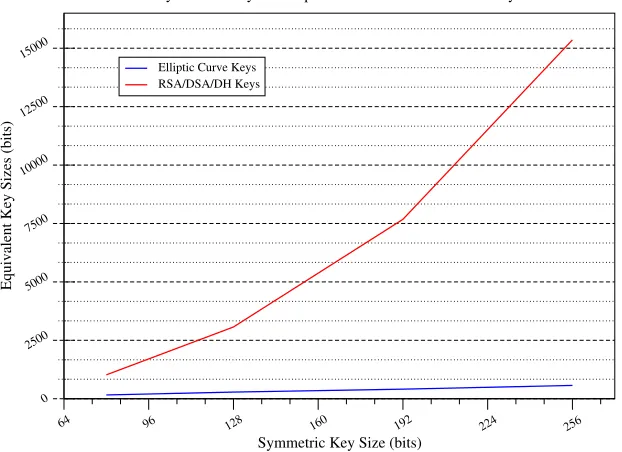
6.1 Equivalent Key Sizes . . . 49
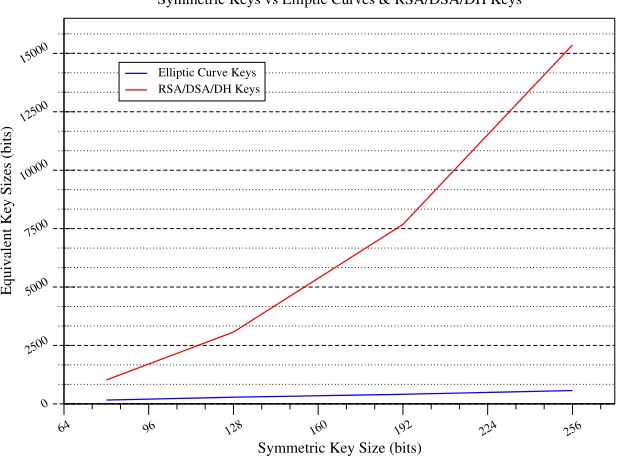
7.1 Equivalent Key Sizes . . . 55
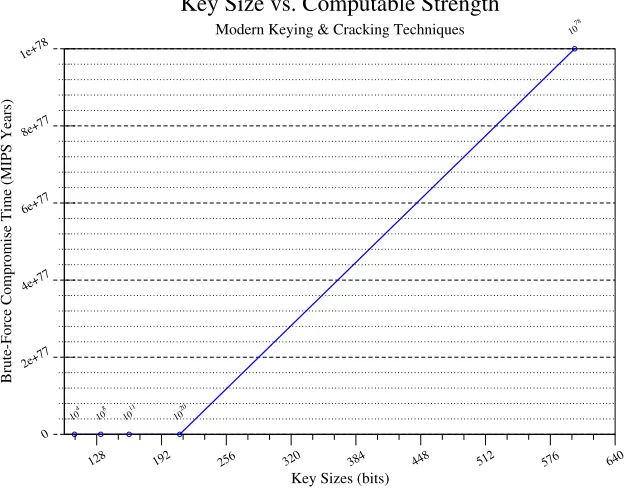
7.2 Computability comparison and key strength . . . 56
7.3 DER-Encoded Public Key Size Comparison . . . 57
7.4 EC key generation timings . . . 58
7.5 JCE key generation timings . . . 59
7.6 Key generation timings . . . 60
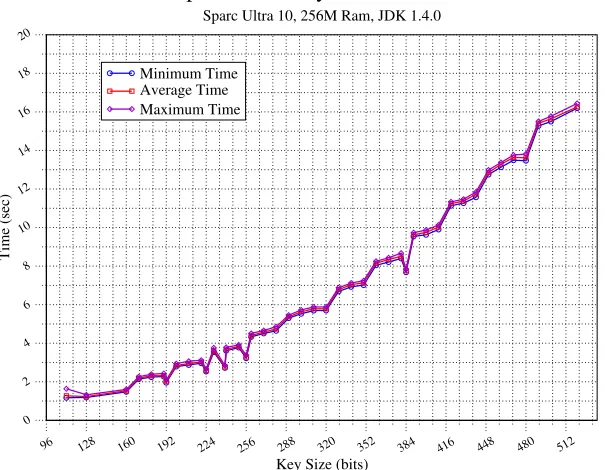
7.7 EC-Based Signature Timing - Min, Max, Avg (Sparc) . . . 61
7.8 EC-Based Signature Timing - Min, Avg (Sparc) . . . 62
7.9 EC-Based Signature Timing - Max (Sparc) . . . 62
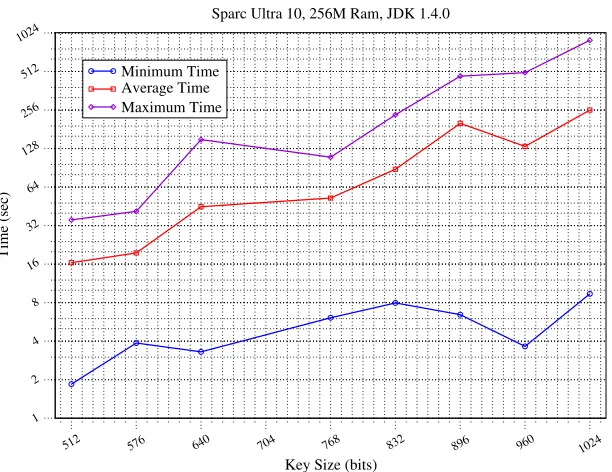
7.10 RSA-Based Signature Timing - Min, Max, Avg (Sparc) . . . 65
7.11 RSA-Based Signature Timing - Min, Avg (Sparc) . . . 65
7.12 RSA-Based Signature Timing - Max (Sparc) . . . 66
7.13 Signature Timing Comparison - Avg (Sparc) . . . 66
7.14 EC-Based Signature Timing - Min, Max, Avg (AMD) . . . 67
7.15 EC-Based Signature Timing - Min, Avg (AMD) . . . 67
7.16 EC-Based Signature Timing - Max (AMD) . . . 68
7.17 RSA-Based Signature Timing - Min, Max, Avg (AMD) . . . 68
7.18 RSA-Based Signature Timing - Min, Avg (AMD) . . . 69
7.20 Signature Timing Comparison - Avg (AMD) . . . 70
A.1 Message Structure Heirarcy . . . 79
A.2 High-level System Design . . . 81
List of Tables
4.1 Message Packet Structure . . . 32
6.1 Equivalent key strength comparison . . . 49
7.1 Elliptic Curve Key Generation Timings . . . 63
7.2 Elliptic Curve Key Generation Timings (cont.) . . . 64
7.3 JCE Key Generation Timings . . . 64
A.1 Module to Package Name Mapping . . . 80
A.2 JoinRequest Message Payload Structure . . . 82
A.3 JoinGrant Message Payload Structure . . . 83
B.1 Communications for 3-Party Genesis - Writing . . . 94
B.2 Communications for 3-Party Genesis - Reading . . . 95
D.1 Codebase Statistics – Lines of Code per Package . . . 108
As portable computing devices grow in popularity, so does the need for secure commu-nications. Lacking tethers, these devices are ideal for forming small proximal groups in an ad-hoc fashion in environments where no server or permanent services are available. Members of these groups communicate over a broadcast or multicast network intercon-nect, and rely upon each other to form a cohesive group. While generally small in size and short in lifetime, security is a critical aspect of these groups that has received much academic attention in recent years.
Much of the research focuses upon generating a common, group-wide private key suitable for encryption. This group key agreement utilizes keying technology that is very costly for small, limited-lifetime devices. Furthermore, key agreement provides no constructs for message authentication or integrity. Traditional systems require two keypairs to address both aspects of the secure group – one for encryption, the other for message validation.
This work investigates the appropriateness of using a shared keypair for both con-tributory group key agreement and message quality guarantees. A JCE-compliant key agreement and digital signature framework has been implemented and is presented, and discussed. Using elliptic curve-based keys, this is possible at no loss in security, and these keys are easily and quickly computable on smaller devices. Algorithms that are known for their cryptographic strength are leveraged in both encryption and digital sig-nature applications. This technique provides a computationally-efficient key agreement scheme and digital signature framework, and a network-efficient key and signature dis-tribution system. Perfect forward and backward security is maintained, and all members retain a current view of the group from a cryptographic perspective.
This thesis is the culmination of several quarters of research and work, all conducted at the Rochester Institute of Technology under the supervison of Dr. Hans-Peter Bischof between December 2002 and January 2004.
Chapter 1
Introduction and Goals
Server-based network security is a well-defined and well-explored topic that enjoys widespread and frequent use in modern computing. Transparent connections are made at all computing levels. From the secure web browser session to IPSec sessions between hardware devices, security is a critical and frequently overlooked aspect of networking.
Mobile computing with laptop computers is, in general, able to extend some of the constructs and techniques shared by their desktop counterparts. This assumes, how-ever, a wired medium for physical network transport.
Wireless computing, on the other hand, presents undeveloped and fertile ground for research and development of security techniques. Many approaches that apply in the wired world simply are not sufficient in a wireless network structure. Access control, session cryptography, and authentication are major issues that have received a great deal of attention in recent years, and will continue to be the subject of much effort. Wire-less devices mimic radio transievers because they are broadcast-based stations, capable of receiving all signals strong enough to reach their antennae. It is this broadcasting that is at the crux of the security issues. Man-in-the-middle attacks are both possible and relatively easy to execute. Denial of Service attacks are simply impossible to defend against, as there is no medium access control. Through all this, the goal is generally to configure a secure connection between a portable device and an access point to a larger network. This is, in a general sense, comparable to the client-server model with a few extra caveats.
(services akin to Kerberos). Each official is equiped with a computing device, such as a PDA or laptop computer, and each device is network-ready. For security reasons, it is
important to be sure all meaningful communications are encrypted, and each message
is verified as both unmodified and sent from whom it reports its sender to be. Each of
these small devices are battery powered. The ability to form a logical grouping of these devices, generate a shared key using influences from each member, and communicate through these devices securely is needed.
As with any system, there are constraints that this system as well as each member in the group is assumed to work within and abide by. In an ad-hoc wireless network environment, these constraints are:
• No central servers or services exist for security-related roles.
• Each device is within proximal broadcast range of every other device
par-ticipating in the group.
• This broadcast medium is unreliable – message delivery or proper
order-ing isnot guaranteed.
• Message routing is not supported.
• Each device works in a manner consistent with group security, and does
not work to limit or inhibit the functionality or security of the group.
• Each device is able to compute the cryptographic components to facilitate
group security in a timely manner.
– It is permissible for larger systems, within proximal range, to
par-ticipate in a group. This requires that employed techniques be suffi-ciently strong to not be compromized by any reasonable system (i.e., a desktop computer should not be able to crack any security constructs used in this environment).
• Membership is dynamic and somewhat volatile. Security constructs must
support this instability to provide perfect forward and backward secrecy, as well as general key freshness.
• The responsibility of group maintenance must not fall upon a single
mem-ber consistently. This encroaches too closely to the server/service paradigm, and reliance upon this service will prove detrimental to group security, stability, and scalability.
There are also a set of issues that this system will not address. These are as follows:
• Broadcast network communication has unreliable delivery; reliability
1.1 Motivation and Goals Page 3
• Each message sent must fit within one maximum transmission unit (MTU).
Multi-MTU messages require some degree of reliability; this topic is ad-dressed later in Section 8.4.
• Denial of Service attacks – these are impossible to defend against in this
environment.
• User uthentication and Access control – this work defines the events
im-mediately following user authentication and access control protocols.
• Group membership changes are announced – the current version does
not handle silent member leave events (moving out of broadcast range, power failure, etc.). This would likely be handled by a heartbeat and heartbeat monitoring functionality [12].
• In terms of member operations, only single-member operations are
sup-ported in this version. Multi-party operations such as group merge and partition are not supported at this time.
Conceptually the multi-party operations could be represented as a series of single-member operations. For scalability and stability reasons, this would likely result in a rewrite of a significant block of the protocol. This is because it is possible in situations of multi-party operations that no single member be able to compute the required subtree, and inter-subtree communication and agreements would be required to complete the full agreement sequence.
It is one of the goals of this document to provide an overview of the issues and cur-rent approaches to the issues surrounding serverless networking. Additionally, a novel approach to minimizing key computations for key agreement and message authenti-cation/integrity validation is presented and discussed. Included in this discussion is a review and performance evaluation of the implemented framework leveraging elliptic curve cryptography and modern encryption techniques.
1.1 Motivation and Goals
This work serves as a subsystem to the Many To Many Invocation/Many To Many Pro-tocol (M2MI/M2MP) framework as developed in the Computer Science Department at the Rochester Institute of Technology [13]. It is important to note, however, that this
security module does not rely uponanyfunctionality from the M2MI/M2MP framework.
Compliance with theedu.rit.m2mp.Channelinterface is maintained; some type-based
As development progressed in the M2MI/M2MP project, it was realized the issues surrounding security and making a broadcast- or multicast-based system secure were numerous. As a result development diverged from security issues, and its inclusion was left for later.
Security Goals
It is the goal of this thesis to provide a secure channel of broadcast communication, sit-uated within the M2MP framework. None of this effort relies upon the larger framework in any functional way. This requires a series of distinct facets be addressed head-on:
1. Confidentiality– Knowing and being guaranteed that it is computationally infeasible for parties other than the intended receiver to determine the contents of a message. This is typically accomplished through the use of cryptography, as the goals of cryptography are privacy of data.
In two-party communications a series of options exist. For symmetric cipher sys-tems, a shared common key is fed into an encryption scheme. This key is agreed upon using a key agreement protocol, much like Diffie-Hellman. For asymmetric cipher systems, a set of keypairs must exist and be known. A sender would then encrypt a message with the receiver’s public key, and the receiver would then de-crypt with their private key. This requires no key agreement, but does require an up-to-date key database that must be known and trusted to be secure and safe from tampering.
In multi-party communications, as in collaborative broadcast-based groups, en-cryption serves as a membership border. By the nature of broadcast, all nodes within a sender’s broadcast range receive the message, but with encryption, only those nodes with knowledge of the encryption key will be able to understand the contents.
2. Group Key Agreement – Multiple network nodes participating in a common group, sharing a common cryptographic key. This is an area of active research as re-strictions on both computational complexity and network utilization are frequently imposed. It must be enforced that perfect backward and forward key secrecy be maintained to prevent any decryption of any messages received while not a mem-ber of the group.
3. Integrity Verification – Knowing and being guaranteed that a received message has not been tampered with or altered in any way. This is generally done with the
1.1 Motivation and Goals Page 5
bit string of k bits. Any change in the message results in a dramatically different
hashcode, and any alteration of the hash will clearly not match the data. Using just hash code values does not prevent a third party from modifying the payload and injecting a new and valid code.
4. Authentication– Knowing and being guaranteed that a received message from sender
S was in fact sent by S. This functionality is combined with integrity verification,
and provided through the use of digital signatures, and, in a more connected world, supported by digital certificates and the Public Key Infrastructure (PKI).
Signatures are based on public and private keypairs. A message would be signed with the sender’s private key, and later verifed with the sender’s public key. This provides irrefutable proof a particular sender sent any given message. Signing includes a mixture of private key and a hash of the message. This verifcation may be done by any party privy to the signature and the signers public key.
The use of elliptic curve-based keys will be evaluated for appropriateness in group key agreement and digital signature. A protocol using objects and object serializa-tion/deserialization will be implemented supporting member join and leave group events. Key-related events and calculations will be compared to RSA/DSA style keys, as gener-ated by the Java security framework (formally known as the Java Cryptography Exten-sion, or the JCE).
Part I
Chapter 2
Current Security Constructs
Complete network security is comprised of three distinct facets – confidentiality, mes-sage integrity, and mesmes-sage authentication. Confidentiality can be gained through en-cryption, following a sequence of one or more key agreement rounds. Message integrity and authentication are ensured through the use of digital signatures.
2.1 Key Agreement
Several protocols have been defined for this purpose, such as CLIQUES [35], Tree-based Group Diffie-Hellman (TGDH) [23], [24], Logical Key Hierarchy (LKH) and their exten-sions (LKH++) [30], and selected others.
There are, in general, two schools on group keying. One, thedistributoryschool, relies
on a single member to exist in all subgroups and survive from the the beginning to the end of the group’s lifecycle. It would be the responsibility of this member to construct and deliver the group key to all group members. While this is very simple, it violates a critical set of our intentions (most notably reliance upon a single group member for providing cryptographic data to the group). The second group keying philosophy, the
contributory philosophy, is the de-facto technique. This technique requires every group member influence the final key in some way, and relies upon no constant or common services or members.
Other secure group environments rely upon every node owning a copy of the key prior to membership; not quite the distributory or contributory designs. This environment would then simply require access control constructs, and provides little security to group members. This works if all members and potential members have the same priviledge to access the network and guarantees can be made that those elements that should not be members cannot be members.
key is used to delineate group boundaries; those nodes with the correct key are in a specific group, while those without are not.
Below is a discussion and an evaluation of the most common techniques of executing group key agreement.
All key agreement techniques implement some form of the Diffie-Hellman key agree-ment algorithm, discussed further in Section 6.3.
2.1.1 Linear Group Key Agreement
Linear group key agreement techniques such as CLIQUES [35] provide a simple path to key agreement for a group of devices.
In this scheme, all group members must obtain the entire key string (that is, all intermediate agreement key sequences). Each node computes the final key based on the
values of every other partial key in the group. This completes inO(n) time.
Figure 2.1: Linear Key Agreement
Figure 2.1 shows the truly linear nature of this style of key agreement. Supposing we start at node 1, our private key would be used to generate a common shared key with node 2, which would then be used in an agreement with node 3. This process would
continue for allnnodes. Any other node would also start at with node 1, but clearly skip
their own public key value.
All nodes visit all other nodes, and compute similar intermediate keys (these will clearly not be identical as the initial private key differs), generating a common final group key.
There are two popular techniques to approach linear key agreement. One places the burden of computing the new key upon the joining member, the other upon an existing member.
2.1 Key Agreement Page 11
The second technique, as utilized by CLIQUES [35], passes the entire key chain to the joining member. They then append their public share, modify (via intermediate key agreement) every other keyshare in the chain, and pass the new chain back to their joining sponsor. The sponsor then computes a new chain of intermediate key values using their private key, and distributes this final chain to the group. Each node can then locate their subkey, and recompute the final group key. This technique is clearly more intensive from a resource allocation and computational perspective, and as such, generally not desireable for implementation.
Issues surrounding linear key agreement in general are further discussed in Sec-tion 8.2.
2.1.2 Tree-Based Group Key Agreement
Tree structures provide a method of key agreement and management that has several desirable qualities. The very nature of being in a tree formation reduces the
complex-ity from O(n) to O(logn) and provides a well-suited structure for dynamic membership
changes. As elements change membership status, the tree requires only a few key-node updates to modify the whole tree. This means only a few messages are passed, reducing computational complexity and bandwidth.
Logical Key Hierarchy (LKH)
This scheme, as presented by [30], places all group members at the leaves of an order-m
B-Tree, and consists of a series of intermediate subgroup keys. Built from the bottom up, intermediate keys higher in the tree serve greater numbers of group members, where the root of the tree is the group key.
The keys delivered to each member are shared, in essence, with no other nodes with the exception of the root. All intermediate keys, however, are shared by all dependents (children in this subtree) of the inner-tree node.
This group tree, in most LKH implementations, is stored on one designated host. It is clear from the role that this node must be a nearly permanent fixture in the model, as failure would place the group in a state of near total confusion. This could be tempered by distibuting the entire key tree to a few network elements, thereby permitting group recovery from a known state, and prevent total group reconstruction.
Membership changes initially affect only those keys above and to the most direct path to the root. As these intermediate values change, a secondary flow will change all other members keys to guarantee perfect forward security and key freshness.
Some thought about this design will reveal an interesting observation – LKH is a combination of linear- and tree-based key agreement. On one hand we have the tree structure maintaining the tree, but to do an agreement at a given tree node, a linear sequence of agreement rounds needs to occur. We gain very little computationally or in network terms using LKH over linear agreement techniques.
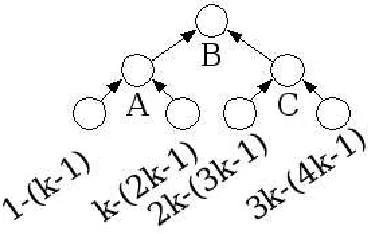
Figure 2.2 shows the general form of LKH agreement on an order-k tree. The first leaf
node, for example, is network elements 1 through(k−1).
Figure 2.2: Logical Key Heirarchy Key Agreement
Extentions to Logical Key Hierarchy (LKH++)
The paper by DiPietro et al ([30]) describes an extension to Logical Key Hierarchy that uses hashing and intermediate key values. Using a key distribution node, dubbed the
center, this protocol attempts to require a minimal amount of network communication and message computation to generate and share the group key. As in other techniques, intermediate values between any given node and the root are required to be maintained by each node.
The main difference between this protocol and other protocols is the use of hashing.
The authors of [30] describe how a new key, K0 is to be sent to the group, encrypted
with the current group key K. The center computes the one-way hash of K (written as
H(K)), followed by the xor of the new key and the hash of the current (Kˆ =H(K)⊕K0,
and sends this to the group. Group members then recover the new key by computing
K0 = H(K)⊕Kˆ. By hashing the values, the key is never sent in the clear or even as a
collection of partial values. Rather, its delivered in a pseudo-encrypted form that only current members, those elements with the current key, can decode and retrieve the new key.
2.1 Key Agreement Page 13
Doubly-Rooted Trees
As an extension of basic singly-rooted trees, Diamonds [32] defines a tree structure that has many desireable properties. Firstly, as a means to maintain group functionality with basic survivability properties, each node is bi-connected. The simplest way to achieve this is by arranging all nodes in a circle. This has a side affect of having a diameter that increases with each member addition, which results in increased network latency. Diamonds, on the other hand, are recursively defined as having two links to other nodes. This helps maintain the connectivity that a singly-connected graph (binary tree) can not have, and the structure grows logarithmically with increased membership.
Aided by structure maintenance functionality, the diamond graphs are easily main-tained and restructured to maintain their bi-connected status. As the diamond is recur-sively defined, nodes are positioned in the structure in a manner preserving ballance. As one side of a diamond grows, so must the other to maintain this ballance. It is this bal-lance that allowed nearly horizontal growth patterns in performance tests [32] for group reconstruction computations, and slight growth in latency as group sizes grew from five to fifty.
Figure 2.3 shows the basic form of the diamond structure.
Figure 2.3: Double-Rooted Key Agreement
Full and Complete Binary Trees
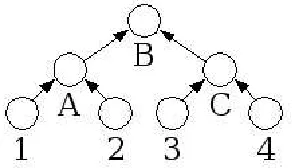
The tree structure used in the implementation of this Thesis is very similar to the Logical
Key Hierarchy system, with a few important deviations. While LKH is an order-m B-tree
(a binary tree with instead of two children, up to m children are supported), our tree
is strictly order-one (one key value with two child references). Instead of the tree being stored and maintained by one central node, the tree is distributed throughout the entire group. This aids in general group scalability as well as stability.
This key agreement structure was chosen for its simplicity both algorithmically and computationally.
this work.
Figure 2.4: Binary Tree-Based Key Agreement
2.2 Message Authentication
In general, message integrity and authentication is achieved through digital signature techniques. Recent advances in encryption provide some authentication guarantees, but these are generally ineffectual for this setting (see [22], [21] and [33]). Such encryption schemes are useful between two parties where each can inject a unique sequence, the nonce or a counting value, and use it in an authentication capacity. In the multi-party setting, this would require a lookup table of member-to-sequence, and would incur futher message processing overhead. Additionally, this would impose greater processing requirements at the time of member-join and in key distribution.
Traditionally, keys used in key agreement are inappropriate for digital signature ap-plications. While this is true for RSA/DSA-style keys, this is not the case for elliptic curve-based keys. This halving of group keys reduces the total number of keys that would otherwise need distribution to the group and generally simplifies the inner- and inter-node protocols.
Having a public and private keypair at the root of our key tree provides us with one additional feature. While not investigated in this work, a group signature would provide an inter-group security construct. Other work has investigated this further.
2.3 Message Authentication Concerns
Using digital signatures requires a keypair suitable for this purpose, requiring distribu-tion of a second key for each node in this group. Requiring a second key to be generated, maintained, and distributed for each node serves as the motivation behind using the same key for key agreement and signing, as investigated by this thesis.
2.3 Message Authentication Concerns Page 15
Part II
Page 19
The code phase of this thesis work included implementing several aspects of the secure broadcast channel. Included in this codebase is:
• JCE-compliant Digital Signature provider, implementing the HORS digital
signature algorithm [31].
• Message hierarchy.
• Message serialization support.
• Protocol definition.
• JCE-compliant tree-based key agreement module for RSA/DSA and
ellip-tic curve-based keys.
• JCE-compliant digital signature module using RSA/DSA and elliptic curve
keys.
• JCE-compliant cryptography module using RSA/DSA and elliptic curve
keys.
• Broadcast network communications point.
• Support classes to maintain state and references for framework.
• Adaptation of Java-internal classes for JCE key manipulation.
• Integration with M2MI/M2MP.
• JavaDoc comments of all components of all implemented elements.
One aspect of this thesis is to make encryption and message authentication more streamlined. This has been accomplished by using the same keys for both operations. This technique has not been explored in other security related research. An evaluation of this idea is provided in chapter 6.
Chapter 3
System Design and Specification
The security framework is divided into a collection of modular blocks as follows:
Communication Network I/O in a non-blocking broadcast fashion.
Messages Messages are the method of communication. Designed and manipulated as Java objects, messages must be serialized before communication, and deserialized back into objects upon receipt. An object-oriented design makes handling and inner-node processing easier.
For efficient marshalling, these message objects all have common ancestry and follow a common template of design. This outlined further in Section A.1.
Key Agreement Core of security constructs. This provides storage of all member public keys as well as the functionality to generate common group key.
The tree-based system is modeled after work described in [24] and uses a common tree-based key storage system for agreement and maintaining digital signature veri-fication keys. It is this framework that provides the private key values to encryption and public key values of other group members to the digital signature verification modules.
Signatures Module that optionally provides message authentication support through the use of digital signatures. Ties closely to the Key Agreement module for members’ verification keys.
Cryptography Module that provides the optional cryptographic utilities to ensure group-wide secrecy.
the Messaging description above and below) and acted upon in the order in which they are received.
Provisions have been taken to ensure that user-level messages (
Application-Messages) are processed simultaneously with all protocol-level messages that are
exchanged. This provides a nearly transparent channel of secured communica-tions.
These messages are, however, only processed upon achievment of Member status.
State Repository Classes whose sole responsibility is to maintain relationships to the various high-level modules and maintain protocol and group member state information.
M2MP Interface Written as an M2MP Channel implementation, this class is the only class that needs instantiation for incorporation into any M2MI/M2MP application.
3.1 Network
The design of the network interface for this project was very simple. In an attempt to acurately model a broadcast environment, like that of a wireless device, this channel utilizes the broadcast network. Messages are written to the IP address 255.255.255.255, and read from the address 0.0.0.0. This is correct for broadcast communication.
Some rate limiting is done to help control the amount of data being sent from any one node. This primarily serves to increase reception rates of messages as a high rate of dispatch was shown to steadily decrease receipt rates.
3.2 Message Processing
Each node receives all messages sent in the group, but only processes messages ad-dressed to two values – those messages ’unicast’ to their ID, and broadcast messages sent to the entire group.
All messages flow through a common processing sequence:
1. Data is received into a byte array by theCommPortnetwork interface.
2. This byte array is passed to theMessageHandler.
3. A quick check is made to be sure the message is not from ourselves.
4. Message reconstruction follows, where these steps are taken:
(a) A first attempt at message reconstruction is made. This is done via
3.3 Security Page 23
(b) If this reconstruction fails, a second reconstruction is attempted after
decryption with the current key (assuming encryption is enabled).
(c) If this second attempt also fails, the message is considered
unrecov-erable and simply discarded.
5. If a message object has been recovered, we first check to ensure the
mes-sage is not from us, and then for a digital signature. If a signature is present and signature verification fails, this message is discarded.
While this may seem extreme, it is understood that if it was important enough to sign, it must be important enough to successfully verify. Accepting a message that fails signature validation might almost not have been signed.
6. An exising message is then processed based on message type and both
node and protocol states.
7. During processing, the incident message is consumed. A reply message
may be generated (depending on the state and behaviour of the protocol).
(a) If signatures are enabled, this message would then be digitally signed.
(b) Likewise, if cryptography is enabled, this message would then be
en-ciphered with the current group key.
(c) The final byte array of the processed message is then sent via the
CommPortinstance.
3.3 Security
Security in this framework is broken into two phases – privacy and message authen-tication. Privacy is supported through encryption, with authentication through digital signatures.
3.3.1 Key Agreement
Using a full binary tree (a tree where each element has either zero or two children), we
can efficiently compute a group key inO(dlogne)agreement cycles.
The second observation is that the keys and signatures used in this setting are very short-lived. Public keys used in key agreement and signature verification are valid only as long as the lifetime of the group or the duration of a members’ affiliation with the group.
Combining these two observations motivates the use of dynamic, temporal signature keys, as described by [31, 10].
3.3.2 Message Integrity and Authentication
Message integrity in the strict sense is ensuring data received has not been modified. A naïve approach would be simple checksums, but a fatal pitfall to this technique is that a third party may modify the data and insert a modified, and correct, integrity checksum. Clearly this approach will not suffice.
Message Authentication Codes (MAC’s), or more specifically Hashed-MAC’s (HMAC’s) are also inappropriate for this environment. These constructs provide data integrity validation, but do not provide message authentication, as the authenticating bytes are generated and verified using the same cryptographic key. Message authentication codes are useful for quickly determining if a file on a computer has changed, but little more [25].
Traditional algorithms for message authentication rely on digital signatures, gener-ally accompanied by a digital certificate chain to prove authenticity. Digital signatures provide the same unique hash value as MAC’s, but include verifiable data from a private key value. This allows a receiver (who, it must be assumed, possesses the associated public key) to verify both the identity of the sender and the message data.
While the dynamic network system will also utilize digital signatures, one critical difference exists with a more connected computing paradigm. In this setting, there is no way of verifying a chain of trust as presented in a certificate. This means, technically, we really do not know who the sender of a message is, but we do know that the message was not modified in transport. We can associate a message with a device or a user, but have very little proof of user authenticity.
Additionally, signature and key agreement keys are separate entities. This is done for algorithmic and mathematical integrity rather than security purposes. As discussed in Section 6, this thesis uses elliptic curve-based keys which are able to work for both applications.
3.3 Security Page 25
explore this application of dual-role keys.
Chapter 4
Completed Work
The security framework consists of a series of packages representing functionality. These are listed and discussed here.
Many of the cornerstone classes (eg, the *Engineclasses) have a report() method
to report statistics and current state. This is useful for monitoring the behavior and
condition of the various modules, and is accessable via a method call toreport()from
an instance of the SecureChannelclass.
Section A.2 provides a high-level view of module interaction. Package listing and functionality description:
The FlexiECProviderProvider Package Provides all the elliptic curve-based
function-ality as used by this research, including key generation, key agreement, and digital signature functionality. Implemented as JCE provider, the implementation is
com-patable with several international security standards. Available from
http://www.-flexiprovider.de[16].
The FlexiCoreProviderProvider Package Also a JCE Provider, this package provides
curve-compatable encryption routines, secure hash functions and secured random
number generation. Available fromhttp://www.flexiprovider.de[15].
edu.rit.m2mp.security Top-level package contains edu.rit.m2mp.Channel
imple-mentation viaSecureChannelclass. All other classes in this framework are utilized
by the channel and should not be instantiated by other classes or applications.
edu.rit.m2mp.security.comm Provides non-blocking broadcast network
communica-tion support. Using a thread pool from theedu.rit.m2mp.security.utils
pack-age, multiple threads are capable of reading and processing in quick succession to permit prompt reaction to incident messages.
available for network reading at any one time. This scalability supports greater group stability and consistency.
edu.rit.m2mp.security.crypto Provides JCE-based encryption through all
currently-loaded JCE providers. The Sun provider supplies several encryption algorithms sufficient for the scope of this work.
edu.rit.m2mp.security.handlers At present, this package contains the ’pinging’ thread
used in group formation/discovery.
edu.rit.m2mp.security.keyagree Provides tree-based key agreement functionality with
the sole purpose of group key generation.
edu.rit.m2mp.security.messages Defines message framework and hierarchy. This is
diagramed in Section A.1. Also provided is the functionality to decompose and recompose message objects to and from serialized byte arrays.
edu.rit.m2mp.security.signatures Provides JCE-based digital signatures for
mes-sages. Tied closely to the key agreement classes through a KeyProxy class, the
public shares of members’ public-private keypairs are used for signature valida-tion.
edu.rit.m2mp.security.signatures.hors.* Implementation of the Hash to Obtain
Ran-dom Signatures (HORS) digital signature algorithm as described by [31]. This is not used by this system as public keys are too large to be practical. This remains in the source tree as proof-of-concept work.
edu.rit.m2mp.security.utils Utility classes to support number translations to and
from byte arrays and array-based operations. Also home to the ThreadPoolclass
used by theCommPortclass for multi-threaded reading.
(several).test Several packages have test sub-packages to examine functional
per-formance in their parent packages.
4.1
edu.rit.m2mp.security“Root-level” package that provides a coordination point and access point into the security framework.
4.2 edu.rit.m2mp.security.comm Page 29
foothold into the security framework, providing status, accessor and mutator meth-ods for aspects controlling inner operation. The ability to redirect error messages and status messages to other displays is also possible.
MessageHandler Reactory-style message processor of system. Receives messages
fromedu.rit.m2mp.security.comm.CommPort, decrypts byte array, reconstructs
object, verifies signature, and processes message. If message results in state
change or requires reply, reply is sent toedu.rit.m2mp.security.comm.CommPort
for transmission.
ProtocolConstantsand Repository Maintain state and inter-module references for
inner-framework use. TheProtocolConstantsclass is a collection of constant
val-ues for configuration of options and general operation.
ExceptionHandlerand ExceptionListener Provide a means to redirect error mess-sages and exception handling. Many exceptions are passed up through this system to the Channel. This provides the ability to deliver security-layer messages to a user for display or extended handling. By default, these are written to standard error.
Each of these classes are interfaces to allow additional implementation. The
Message-Handler class implements these interfaces, and uses the
DefaultException-Handler and DefaultExceptionListener classes to write to the standard error
stream. The NullExceptionListener consumes all messages and displays no
output.
OutputHandlerand OutputListener Similar to theExceptionHandler/
Exception-Listenerpair, this provides a redirection of status and reporting messages. This
provides a means of obtaining system-wide status report information for user dis-play or inquiry by other systems.
Each of these classes are interfaces to allow additional implementation. The
Message-Handlerclass implements these interfaces, and uses the DefaultOutputHandler
and DefaultOutputListenerclasses to write to the standard output stream. The
NullOutputListenerconsumes all messages and displays no output.
4.2
edu.rit.m2mp.security.commCommPort Network-level access point. The current implementation reads and writes to the broadcast address.
A ready set of threads is kept warm for prompt reads from the network channel.
This is provided by an instance of theedu.rit.m2mp.security.utils.ThreadPool
class.
Reader Small object to read from network. This was broken out of the CommPort object to allow higher-speed multi-threaded reads.
Minimal effort would need be expended to convert this output device to other types of connections. It may also be desired to convert this system to a pipe-like implementation
of theedu.rit.m2mp.Channelinterface instead of an endpoint design.
4.3
edu.rit.m2mp.security.cryptoCryptoEngine Provides access to JCE and other cryptographic functionality. This allows selection of many types of encryption algorithms useful in testing.
Cryptographic algorithm is dependent upon key style currently in use; elliptic curve keys do not work in the JCE ciphers expecting RSA/DSA-style keys.
Two instances of the javax.crypto.Cipher class are used; one is initialized for
encryption only, the other for decryption only. This provides the fastest possible processing time as two messages could be encrypted and decrypted simultaneously without synchronization issues.
4.4
edu.rit.m2mp.security.handlersDiscovery Small class to do pre-membership probes. This functionality runs in a
thread that is only terminated when the desire to not be inany group is registered
with the Channel. This allows automatic rediscovery of a group in the event of disconnection.
Once the protocol for membership has begun, this thread is assigned a low prior-ity. This permits state-probing for re-activation, but keeps resource consumption minimal.
4.5 edu.rit.m2mp.security.keyagree Page 31
4.5
edu.rit.m2mp.security.keyagreePackage designed to maintain the classes required to support tree-based key agreement.
AgreementEngine Provides the front-end to key agreement, parameter generation, key operations including key generation, regeneration from bytes, and agreement. Also provides high-level functionality for member operations such as member join and member leave.
AgreementImpl Parent class to all agreement techniques. This provides common functionality used in many agreement styles.
TreeAgreement Full implementation of tree-based key agreement and key-based
op-erations (eg. key refresh). Extension of theAgreementImplclass.
Tree Maintains the current view of all members’ public keys and intermediate
pub-lic/private key values. This is based primarily on descriptions of work done in [24] with optimizations and enhancements implemented where needed.
NodeandMemberNode Containment and organizational classes used within the tree
to maintain member data. Instances ofMemberNoderepresent group members and
exist at the leaves of the tree, where the remainder of the tree consists of Node
objects.
KeyProxy Provides other packages, specifically the
edu.rit.m2mp.security.signa-turesclasses, access to all public keys currently active in the group. It is through
this class that key queries are funneled.
4.6
edu.rit.m2mp.security.messagesDefinition of objects used to control inter-node security constructs and protocols. These messages never extend into application-space as they are entirely consumed by the channel constructs.
The format of all messages is as diagrammed in Figure 4.1. It is this format that allows robust and prompt serialization and deserialization of message objects during transport phases.
It is also important to note that not all messages carry an explicit payload; some
messages relay information and intent by their type, for example theLeaveRequestand
AgreeACKmessages.
Start Byte Byte Count Optional Description
0 1 no Protocol message identifier
1 1 no Message type identifier
2 4 no Source node Id value
6 4 no Destination node Id value
10 4 no Message sequence number
14 1 no Digital signature length
15 ≥0 yes Digital signature (depends on algorithm)
≥15 1 no Payload length
≥16 varies yes Payload
Table 4.1: Message Packet Structure
GroupMessageImpl Provides the base implementation of many of the methods defined
in the GroupMessageinterface for inheritance by the various message classes. All
message objects in this package must extend this class for consistent functionality.
MessageConstants Storage of message-oriented constant values; used by
Message-Utils and MessageHandler(from the edu.rit.m2mp.security.security
pack-age) classes for various processing routines.
MessageUtils Provides a common serialization and deserialization framework for messages.
4.7
edu.rit.m2mp.security.signaturesParent-package supplying digital signature functionality. Both JCE and elliptic-curve algorithms are available, but their use is predicated on which key algorithm is currently in use.
Just as the encryption module uses two service providers, this module employs two
instances of the java.security.Signature class. Again, this allows simultaneous
pro-cessing of two messages without suffering from synchronization issues.
SigningEngine Tied with the key agreement package via aKeyProxyobject, manages digital signature signing and verification processes.
When signing a message, the following message fields are included in the signature hash:
4.8 edu.rit.m2mp.security.signatures.hors Page 33
2. Message source identifiers
3. Message destination identifiers
4. Message sequence number
5. Message payload
For enhanced response and processing time, initialization of the signature module includes two separate signature objects; one for signing, one for verification. This limits the requirement for behavior mode switching with every message.
As mentioned in the discussion of theKeyAgreementpackage, the members’ public
keys used in signature validation are accessed by an instance of the KeyProxy
class. This limits key data replication within the security framework.
4.8
edu.rit.m2mp.security.signatures.horsThe HORS algorithm (Hash to Obtain Random Signature), as described in [31], was implemented as closely to the specification as possible.
This was implemented as a JCE-compatable Provider object.
While functional, this technique is not used in the greater framework for performance reasons – public keys and signatures were too large for general use in this small-message environment.
A partial solution is to hash the final signature; this will provide a collision-resistant fixed-length representation of the signature. This improvement will not, however, affect public key sizes.
Additionally, these keys could not be used for group-wide key agreement without additional modification and security analysis. This inadequacy violates the goals of using a common key for both signatures and encryption-key computation.
A insiders view of a HORS keypair and key serialization/deserialization is available in Appendix C.
HORSProvider Gateway class used by Java Security framework for referencing and loading requested functionality.
HORSParameterGenerator Generates random values used by HORS algorithm during key generation.
HORSKeyPairGenerator Using parameters and random seeds, generates a keypair to be used in digital signature generation and verification.
HORSPrivateKeyandHORSPublicKey Private and public keyshare values for signa-ture keys using the HORS algorithm. As with all other digital signasigna-ture algorithms, the private key is used for signing data and the public key is used for signature verification.
The public key is a function of the private, and should provide no easy way to reconstruct the private key (ie, using a private exponent or multiplier).
HORSSignature Main functionality class that processes all signing operations.
The HORS algorithm, like other cryptographic systems, has three distinct modes of operation - parameter generation, signing of data, and verification of this signature.
Parameter Generation
int l, k, v, h while (true) {
l = randomValue()
if (l >= 128 && l <= 768) if (l mod 64 == 0)
break }
return quad[l, 16, 160, SHAIdentifier]
The values ofk = 16, t= 160and using SHA for hashing are default and set for testing
and compatability. Other values forl,k, andtwere suggested and evaluated in [31].
The bit-size of l may be passed as a parameter, as well as the desired hashing
algo-rithm to influence parameter generation.
Signing
Assume integer parameterstare k established.
byte[] data PrivateKey key
byte[] hash = oneway(data) int[] substrings = new int[k]
substrings = breakHashIntoSubstringsModuloT(hash, substrings, t) byte[] signature = new byte[0]
for i = 0 to k
signature += key[substrings[i]]
4.9 edu.rit.m2mp.security.signatures.hors.interfaces Page 35
Verifying
Assume integer parameterstare k established.
byte[] sig PublicKey key
byte[] hash = oneway(data) int[] substrings = new int[k]
substrings = breakHashIntoSubstringsModuloT(hash, substrings, t) int[] blocks = new int[k]
blocks = breakSignatureIntoSubstrings(sig)
for i = 0 to k {
if (key[substrings[i]] != oneway(blocks[i])) return false
}
return true
TheoneWayHashfunction generates a byte array representative of the parameter data.
This implementation supports SHA-based hashing as well as a custom implementation of a hashing algorithm (algorithm selection is configurable).
This custom hashing algorithm is loosely based on the hashCode() method of the
java.math.BigIntegerclass, and like SHA, returns a constant-length hashcode.
The breakHashIntoSubstringsModuloTmethod segments this known-length hash
and segments it intok equal-length substrings. Each of these substrings is stored as an
integer value modulo t.
4.9
edu.rit.m2mp.security.signatures.hors.interfacesHORSKey,HORSPrivateKey, and HORSPublicKey Define the basic functionalty and pro-vide type safety for keys in the HORS framework.
HORSKeyPairGenerator Define the basic functionality for a key pair generator, as well as comply with required JCE patterns for adaptation by the JCE framework.
4.10
edu.rit.m2mp.security.signatures.hors.specHORSPrivateKeySpec, andHORSPublicKeySpec Define the basic properties and func-tionality of public and private keys of the HORS algorithm.
4.11
edu.rit.m2mp.security.utilsArrays Support for building larger byte arrays from multiple smaller sequences.
Numbers Functionality for reducing and reconstructing multi-byte primitive values into byte arrays of proper length and visa versa.
Chapter 5
Operational Overview
5.1 Node Initialization
Each node is uniquely identified by a Java integer value. This value is chosen at ran-dom at startup. We assume the likelyhood of two nodes selecting the same identifier is small enough to be ignored, however this could be combatted by selecting a new unique identifier after a timeout period while probing for a group. Following this selection, a set of algorithm parameters to be used in key agreement and signature keypair generation is generated. It is important to note that no keypairs are generated at this point; this is done only after contact with another entity, either a lonely node or group, is established.
The various constructs, such as the key agreement infrastructure and message han-dling systems are then initialized. Once ready, the Discovery thread is initiated, and the node begins searching for a group.
The Discovery phase, as mentioned above in the discussion of the handler, is simply a
repeated broadcastJoinRequestmessage consisting of the current node’s ID value and
the parameters they have generated. This message is rebroadcast on a periodic interval until either a response is received or the desire to not join any group is registered with the Channel.
When a second member receives this message, one of two protocols follow. If the
responding party, for discussion namedβ, is also alone, the parameters used by the new
group are those parameters generated by the node with the larger identifiying number.
This is outlined in theGenesissection below. If, on the other hand, the responding party
is part of a group, β’s parameters are used. This is described further in the Member
5.2 Genesis
Genesis occurs at the initial formation of a group; where two or more nodes converge
and form common group structures. For discussion, assume two nodes,αwith ID value
nand β with ID valuem wherem > n, wish to form a group together.
One of three possible scenarios follows:
1. Each will receive the other’s request.
2. Nodeα will receiveβ’s request, butβwill not receive α’s request (at nearly
the same time).
3. Nodeβ will receiveα’s request, butαwill not receiveβ’s request (at nearly
the same time).
In the case of the first scenario, both α and β will be able to decide proper group
responsibilities. Asβ’s ID is larger, the parameters generated and presented byβ will be
used by the new group.
The second situation will require an additional membership probe fromα (assumably
after a timeout has lapsed) to continue the joining process.
In the third scenario, since β’s ID is larger, β is able to reply immediately with a
JoinGrantmessage to α.
A unicast message is then sent from β to α with confirmation of the parameters by
JoinGrant message. Since these parameters are likely different from those that were
locally generated, keys are generated by both parties with these parameters. β can
simply save the local keypair, but α must deliver their new public key to β through a
unicast NewKeymessage.
Upon receipt, β then can update the keytree and compute the new group key. The
entire tree is delivered from β to α— a new group has been formed.
An important theme through this is a pair-wise communication. This is achieved through synchronization and timeout monitoring to be sure only two parties are forming
a group at any given time. It is entirely possible that for an even n nodes, n/2 groups
are formed. While these groups could begin to merge together with the goal of forming a larger group, this was left for future efforts.
In the event of an odd number, n−1, nodes forming a group, up tob(n−1)/2c small
groups will form, leaving one node temporarily out. Once a group has been formed, this
last node will join to a group after a response to their JoinRequesthas been received.
5.3 Inner Workings Of Key Agreement Page 39
5.3 Inner Workings Of Key Agreement
Tree-Based Agreement
In tree-based agreement designs, a logical tree maintains membership and keying in-formation. This implementation employs an array-based storage system, and therefore
must also maintain proper relationships among indices (left child of indexnis at 2n+ 1,
right child is at index 2n+ 2, and a nodes’ parent (if n6= 0) resides at indexb(n−1)/2c. As compared with a reference-based implementation, an array-based design was both simpler from the perspectives of design and implementation, and proved computation-ally more efficient. Recursively defined methods to prune and graft subtrees provide a highly efficient and correct solution.
It is important to note that this binary tree must grow at the root when a pre-join tree is complete and full. Growing downward presents an issue of non-paired children, and is therefore unable to compute an intermediate key. Growing at the root inserts a new root and new right subtree, preserving a pairwise key association.
Any specific intermediate private key within the tree is easily computed with specific knowledge of the children at that tree position. The public key from one child and the private key from the other, and through the workings of a standard Diffie-Hellman key agreement round, will generate a shared key, recoverable by both parties.
This implementation of the tree provides two methods used specifically in group key
generation – getRootPath and getRootCoPath. These concepts are described in [24].
The getRootPathmethod traverses the tree from a specified node to the tree root,
re-turning the nodes on the most direct root-ward path. The getRootCoPathmethod also
traverses the tree starting from a specific node. Instead of generating a list of linearly traversed nodes, a list of ancestral neighbors is formed and returned. From these two lists, the parental private key is generated.
Below is the pseudocode for the tree-based key agreement mechanism as provided in this work.
Node[] path = getRootPath() Node[] coPath = getRootCoPath()
for i = path.length-1 to 1 {
path[i-1].keyPair = doAgreement(path[i].getPrivateKey(), coPath[i].getPublicKey()) }
PrivateKey groupKey = path[0].getPrivateKey()
must be built that is mathematically related to this private value. For both key styles investigated in this work, this meant reaching into other source code. The code from the EC provider was easily ported into this work, but the JCE DSA/RSA key functions required a great deal more effort.
5.4 Member Operations With Existing Group
Post-formation group operations are somewhat more simplified than similar operations done during genesis. Several group-level opeations are defined for this environment – member join, member leave, group merge and group partition. Only the two single member events have been implemented in this work.
When a node announces their desire to join a group, each node tentatively adds the joining member to their group. Only one member, however, will respond and initiate a
conversation with the joining member. Key algorithm parameters are sent (byJoinGrant
message), a public key is received (viaNewKeymessage), and the key tree is re-calculated
and redistributed (by an AgreeSet message) to the group by this sponsor. This
recal-culation process includes the sponsor generating a new random keypair to use in the generation of the new tree. Figure 5.1 shows this event graphically.
Figure 5.1: Member Join event
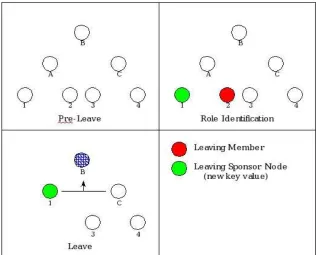
Conversely, when a member announces their intentions to leave the group (via a
5.5 Signatures Page 41
[image:51.612.147.464.157.412.2]recalculating and redistributing the key tree. Like member join, the tree recalculation process includes a new sponsor-local keypair to use in tree recalculation. Figure 5.2 shows this event graphically, and Section B.2 provides a transcript of a MemberLeave event.
Figure 5.2: Member Leave event
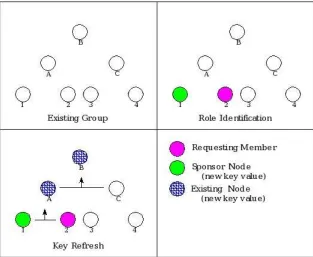
Key update, while not explicitly a member operation, is extremely similar to these
two operations. A member requesting (via KeyUpdatemessage) a key update will
sim-ply broadcast this message to the group. This member’s sponsor will then update the sponsor-local keys, and recompute and redistribute the key tree. While this does not
change the entire tree, it updates logn keys of the tree, including the final group key.
Additional work to ensure more widespread key freshness could easily be conducted, such as key age monitoring and periodic key refresh support. Figure 5.3 shows the key update event graphically.
5.5 Signatures
In theory every message received must be authenticated to ensure message integrity and sender validation. In practice, however, this is not possible.
Figure 5.3: Key Refresh event
key. This means that until a member has sent their NewKeymessage and then become
a member of the group, these messages should not be signed. If they are signed, the signature should be ignored by the receiving party.
Chapter 6
Cryptographic Evaluation
This chapter will address the computational and mathematical foundations of the two key generation and digital signature techniques utilized in this resarch.
6.1 RSA/DSA Algorithmics
RSA - Rivest, Shamir, Alderman Authentication Algorithm
RSA was developed at MIT and released to the public in 1977. With the declassification of government documents in 1977, it was discoverd that British researcher James Ellis developed RSA-like algorithms in 1972. Due to the secrecy of the algorithms at the time, Ellis had no copyright privileges.
RSA keys are generated as follows:
1. With a goal of computing ann-bit key, define large primes p and q where
pand q are of bit-lengthl where(512≤l≤1024), andl≈n/2.
The probability a number pt where pt < n is prime is roughly 6/n, and
therefore a number will be found in roughly n/6 trials. (The number of
primes less thannis roughlyn/lnn, such that the probability of a number
near nbeing prime is approximately1/lnn. Therefore ann/2-bit number
has a probability of roughly 1/ln 2n/2. Removing even numbers from this
field results in a probability of a given number close to n/2 being prime
being approximately6/n).
2. Compute nasn=pq.
3. Findesuch thateis less thannand relatively prime to(p−1)(q−1).
4. Select another valued such that(ed−1)is divisible by (p−1)(q−1).
The public key value is the value-pair (n, e), and the private key is the value-pair
DSA - Digital Signature Algorithm
DSA was designed by the United States federal government to be a very fast and effective signature scheme only. It was later discovered to be a rather effective encryption scheme (a point designers tried to avoid), but proved to be painfully slow. Released to the public in 1991, DSA was not welcomed warmly by a security community that had large financial and technological investments in RSA.
DSA keys are generated as follows:
1. Generate one 160-bit and one 1024-bit prime number asq andp
respec-tivly, ensuring q dividesp−1.
2. Compute g=h(p−1)/q modpfor anh in the cyclic group defined byp.
3. The private key is x and the public key y = gx modp for a random x in
1≤x≤q−1.
6.1.1 The Strength of RSA/DSA Schemes
RSA and DSA techniques are based on the difficulty of the Discrete Logarithm Problem
(DLP). That is, it is computationally difficult to compute the private value d from the
public pair(n, e). This would require factoring the value of emodnintop and q, thereby
providing the path to recovering the private key valued. It is this factoring a large value
into the product of two primes that is the DLP.
The strength of these schemes rests solely on the size of the public key. As [5] reports, factoring the public key can take only a few hours on a standard PC for key sizes less
than 256 bits, which serves as direct motivation for pto be at least 1024 bits.
As DSA parameters and keys are defined over a cyclic sub-group of the integers, DSA is theoretically vulnerable to two discrete logarithm attacks. The first is on the
number field itself as defined by the large prime p. Factoring this number will allow
recomputation of the private key value. The general number field seive provides the best performace for factoring a large prime-product, running in super-polynomial,
sub-exponential time [4]. The second attack uses Pollards-ρ algorithm to compute the value
of x as used in the computation of the keypair. Pollards-ρ algorithm for factoring large
primep works as follows [6] (See [39] and [7] for more):
1. Seta= 2and b= 2.
2. While not solved and not in error condition, compute a = a2+ 1 modp,
b= b2+ 1 modp, andd =gcd(|a−b|, n). If a solution1 < d < n is found, p
has been factored intodandp/d. An error surfaces whend=n. Additional
6.2 Elliptic Curve Algorithmics Page 45
This algorithm runs in O(p
(πn)/2)time, and recent work to parallelize the algorithm
has improved it’s performance toO((p
(πn)/2)/m) form processors.
6.1.2 Digital Signatures
Given a message m generating a digital signature ofm using an RSA/DSA-style private
key n, dis computed as follows. A secure hashing algorithm, such as SHA, is applied to
the message. This generates a constant-length, collision-resistant bit string
represen-tative of m. This hash is then encrypted with the private key, which produces the final
message signature. This signature is included in the message as an appendix.
Verification of this signature is the reverse; upon receipt, the signature is decrypted with the public key share to reveal the hash bit string. The original message, minus the included signature, is then processed with the same hashing algorithm. The two hashes are compared, and if equal, verification has passed [5].
6.2 Elliptic Curve Algorithmics
This technique achieves security by being rooted in the Elliptic Curve Discrete Logarithm Problem (ECDLP). The ECDLP is a subproblem of the DLP, and has been proven more difficult to solve, thereby offering higher levels of security than the DLP.
Elliptic curves are mathematically defined as a set of points over a number field (typically the complex, rational, or real numbers) satisfying a cubic curve of genus 1 (one bisecting cut through the curve removes the notions of inside-the-curve and out-side-the furve). Elliptic curve equations do not define elliptical paths – they are named for their relation to elliptic integrals used in the computation of elliptical arc lengths, and are closely related to the torus. The complex, rational, and real numbers are, by definition, infinite number fields, whereas the integer family describes an infinite ring (recall fields are a s