0022-538X/92/127303-06$02.00/0
Copyright©1992, American Society for Microbiology
Varicella-Zoster Virus
Open Reading Frame 61 Protein Is
Functionally Homologous to Herpes Simplex
Virus
Type 1
ICPO
HIROYUKI MORIUCHI, MASAKO MORIUCHI, HOLLYA. SMITH,
STEPHEN E. STRAUS, ANDJEFFREY I. COHEN*
Medical Virology Section, Laboratory of Clinical Investigation, National Institute
of
Allergy
andInfectious
Diseases, Bethesda,
Maryland
20892Received 2July1992/Accepted 31 August 1992
Thevaricella-zoster virus (VZV) open reading frame 61 (ORF61) protein is thought to be the homolog of herpes simplex virustype1 (HSV-1)ICPO, based on gene location andlimitedamino acid homology. However, HSV-1 ICPO trans activates HSV-1 genes, while VZVORF61 protein trans represses the function of VZV trans activatorsonVZV promoters in transient expression assays. Toinvestigate the functional relatedness of HSV-1 ICPO and VZVORF61 protein, we established Vero and MeWo cell lines which
stably
express VZVORF61 under thecontrolofametallothionein promoter and performed complementation studies with an HSV-1ICPO deletion mutant(7134). Mutant 7134 is impaired for plaque formation and replication at a lowmultiplicity
of infection incell culture, but these defects were complemented by up to 200-fold in Verocell linesexpressing VZVORF61. Likewise,theefficiency of plaque formation was improved by up to 100-fold in MeWo cell lines expressing VZV ORF61. A cell line expressing another VZV immediate-early gene product (0RF62) was unable tocomplement mutant 7134. HSV-1 mutants which are deleted for other HSV-1immediate-early
gene products(ICP4, ICP27) were unable to grow in VZVORF61-expressingcelllines.These results indicate that, despite markeddifferences in their sequences and in effects on their cognate promoters in transient expression assays, VZVORF61protein is thefunctionalhomolog ofHSV-1 ICPO.Varicella-zoster virus (VZV) causes chicken pox with primary infection and shingles on subsequent reactivation fromlatency.Ourknowledgeofthe mechanism of VZV gene regulation is limited, in part because of the difficulty in obtaining the high titers of cell-free VZV required to syn-chronously infect the largenumbers of cells necessary for studying the kinetics and regulation of gene expression. DNA sequenceanalysis showsthat the overall organization of VZV DNA is similartothat ofherpes simplexvirus(HSV) and that there are a number of genes whose predicted products are homologous to HSV proteins (8), suggesting functional similarities between them.
The products of two VZV-encoded putative immediate-early(IE)genes, openreadingframe 4 (ORF4)and ORF62,
transactivateexpressionof viralIE,early,andlate genes in transientexpressionassays(21, 22).VZV ORF4 andORF62 have amino acid homology toHSV type 1 (HSV-1) ICP27 andICP4,respectively. ICP27 acts as a transactivatoror a trans repressor, depending onthe target gene (30, 35,
36).
ICP4 is indispensable to the life cycle of the virus, is involved innegativeregulation of IEgenes, andisrequired throughout the viral replicative cycle for the expression of early and lategenes
(31).
WepreviouslyshowedthatORF62 protein isthe functionalhomologofHSV-1 ICP4bydemon-strating
thatORF62-expressing
cell lines cancomplement
ICP4 mutants (15). This was confirmed when an HSV-1 recombinant which contains VZV ORF62 in place of thecoding
sequencesfor ICP4wasshowntogrowin cell culture (11).ORF61, another putative VZV IE gene, trans represses the function of VZVtrans activators on
putative
viralIE,
*Correspondingauthor.
early, and late genes in transient expression assays (27). VZV ORF61 is thought to be the HSV-1 ICPO (VmwllO) homolog,because both genesare located in similar partsof the genome, and the predicted gene products share a cys-teine-richputative zinc-binding fingerin the amino-terminal region and additional limited amino acid homology else-where(29).While VZVORF61has been shown to bea trans
repressor in transient expression assays, HSV-1 ICPO is a
strongtransactivator forhomologous(HSV-1 IE, early,and late)aswellasseveralheterologous genes(3,4, 12, 18,28). Althoughacarboxy-terminal deletionmutantofICPO shows promiscuoustrans repressing activity(42), full-length ICPO doesnot exhibittrans repression. Therefore, it is notclear whether VZV ORF61 protein is a functional homolog of HSV-1 ICPO.
The growth and plaquing efficiency ofHSV-1 ICPO mu-tants areimpairedat alowmultiplicityof infection(3, 12, 33, 41).Thesemutationscanbecomplemented by growthin cell linesexpressing HSV-1 ICPO(2, 33) orby coinfectionwith VZV or human cytomegalovirus (40). Thus, a VZV gene product(s) must be able to serve as a functional analogof HSV-1 ICPO.
To explore the possible functional similarities between HSV-1 ICPO and VZV ORF61 protein,we established cell lines whichexpressVZVORF61
protein
andemployed
them in complementation studies with an HSV-1 ICPO mutant. HereweshowthatVZVORF61proteincancomplementan HSV-1 ICPO deletionmutantin cell culture.MATERIALSANDMETHODS
Cells and viruses. African green
monkey
kidney
cells (Vero;AmericanType
CultureCollection,
Rockville, Md.)
were
propagated
aspreviously
described(15).
Human ma-7303on November 9, 2019 by guest
http://jvi.asm.org/
7304 MORIUCHI ET AL.
ORF61
SV40
poyA pMTPORF61I
ORF61inverseorientation
FIG. 1. Construction of VZV ORF61 expression vectors.
pMTP-3H contains the metallothioneinpromoter(MTP) followedby
a
KpnI
restriction endonuclease site and asimian virus 40 (SV40)polyadenylation (polyA) sequence. The 1.8-kbAccI-NcoIfragment
from the VZV genome contains the protein-coding sequence of
ORF61, but no upstream transcriptional regulatory sequences.
pMTPORF61R contains the VZV ORF61 gene inserted into the KpnI siteofpMTP-3Hintheright orientation drivenby MTPwith
a simian virus 40 polyadenylation sequence downstream, while
pMTPORF61I contains ORF61 in the inverse orientation.
lignant melanoma (MeWo) cells, obtained from Charles
Grose(20),weregrownin Eagle's minimal essentialmedium
supplementedwith 10%heat-inactivated fetal bovine serum, 2mMglutamine, penicillin G (100 U/ml), and streptomycin
(100 pug/ml). FI-14 cells (VZVORF62-expressing Vero cells
[15]) and 3-3 cells(HSV-1ICP27-expressingVerocells[24]), provided by Priscilla A. Schaffer, werepropagated as
previ-ously described. HSV-1 7134 (an ICPO null mutant [3]), HSV-1 Sdll.2 (an ICP27 deletionmutant [32]), andd120(an
HSV-1ICP4 deletionmutant [9])were provided byPriscilla A.Schaffer. These HSV-1mutantswereallderived from the
KOS strain. Stocks of HSV-1 KOS and 7134 used in this
studywere propagated and titered in Vero cells. Stocks of
HSV-1 Sdll.2 and d120werepropagated in 3-3 cells andE5
cells(HSV-1 ICP4-expressingVerocells [37]), respectively.
Plasmids. Plasmids pORF61, pGORF4, pGi26 (which
ex-pressesORF62), and pltkCAT(which contains thepromoter
for the VZV deoxypyrimidine kinase genefollowed by the
chloramphenicol acetyltransferase [CAT] gene) have been described previously (21, 22, 27). pSV2neo encodes the G418 resistance gene driven by the simian virus 40 early promoter (39). pMTP-3H, a gift from Dwight Kaufman,
containsthehumanmetallothionein promoterfollowed bya
multiplecloning site which includes a
KIpnI
restriction site andasimian virus 40polyadenylation signal.ORF61-containing plasmids (Fig. 1) were derived by
di-gesting recombinantVZV DNA withAccI andNcoI(which cut at nucleotides 102,708 and 104,486, respectively [8]), filling in the5'termini with Escherichia coli DNA
polymer-ase I (Klenow fragment), ligating a double-stranded KpnI
linkeroligonucleotide (5' GCTGCAGGTACCTGCAGC 3') to both ends, digesting with
KpnI,
and inserting into theKonI
site ofpMTP-3H.
Theresulting plasmids,
pMTPORF
61R andpMTPORF61I, contain a single copyof the VZV
ORF61 genewith the consensus sequence for initiation of translation -1to -4bases upstreamof theATG codon and
377 bp of sequence downstream from the stop codonof VZV ORF61 in the right (R) and inverted(I)orientations, respec-tively, under the control of a human metallothionein pro-moter.
Establishment of Vero and MeWo cell lines expressing VZV ORF61. Vero and MeWo cells were cotransfected with pSV2neo and pMTPORF61R or pMTPORF61I. G418-resis-tant cell colonies were selected and subcloned as described previously (15) with the following modifications. About 6 x
105
Vero or 1.2 x10⁶
MeWocells were plated the day before transfection in 60-mm-diameter dishes. pSV2neo (0.5,ug,
linearized withEcoRI) and pMTPORF61R or pMTPORF61I (10
,ug
each, linearized with XmnI) were transfected into Vero cells bythe calcium phosphate procedure (19); this was followed by a 1-min glycerol (15% [vol/vol]) shock 4 h after transfection. For MeWo cell transfections, DNAs were diluted gently in 100,ulof distilled water and then 25,ul
of 2.5 M calcium chloride and 375,ul of lx N-2-hydroxylethylpi-perazine-N'-2-ethanesulfonic acid (HEPES)-buffered saline. DNA precipitates were added to the MeWo cells in medium. Four hours after addition of precipitates, the medium was removed, cells were shocked with dimethyl sulfoxide (25%[vol/vol])
for 4 min, and the medium was replaced. After 48h, transfected Vero and MeWo cells were trypsinized and seeded onto 100-mm-diameter dishes at a density of5 x
103
and 1.5 x
104
cells percm2,
respectively. The following day, the medium was changed and G418 (geneticin; Life Technol-ogies, Inc./GIBCO, Grand Island, N.Y.) was added at 800 or 400,g/ml for Vero or MeWo cells, respectively. One week later, the G418 concentration was lowered to 400 or 250 ,ug/ml for Vero and MeWo cells, respectively. Individual G418-resistant colonies were isolated, amplified, and screened, as below.Cellular nucleic acid isolation and hybridization. For Southern blot analysis, total cellular DNA was isolated (38), digested with
KjpnI,
separated by agarose gel electrophore-sis, and transferred to nylon membranes (Nytran; Schleicher & Schuell, Inc., Keene, N.H.). For Northern (RNA) blot analysis, cadmium chloride was added to the cell culture medium to a final concentration of 10puM.
1 day before the cells were harvested and the cellular RNA was isolated to induce expression from the metallothionein promoter. Total cellular RNA was isolated as described by Chomczynski and Sacchi (7). RNA samples were denatured in 50% formam-ide-6% formaldehyde-lx MOPS buffer (40 mM 3-morpho-linepropanesulfonic acid [pH 7.0], 10 mM sodium acetate, 1 mMEDTA), fractionated on a 6% formaldehyde-1.5% aga-rose gel, andtransferred to a nylon membrane. Southern and Northern blots were prehybridized and then hybridized for 20 h at42°C in Sx SSPE (lx SSPE is 0.15 M NaCl, 10 mM NaH2PO4 [pH 7.7], 1 mM EDTA)-5x Denhardt's solution (0.08% bovine serum albumin, 0.08% Ficoll, 0.08% polyvi-nylpyrrolidone)-50% formamide-0.1% sodium dodecyl sul-fate(SDS)-100 ,ug of denatured salmon testes DNA perml. The probe used for bothSouthern and Northern blots was the VZV ORF61 DNAKpnI
fragment from pMTPORF61R that was radiolabelled by random priming with[a-32P]dClrP
(Amersham Corp., Arlington Heights, Ill.). Blots were washed twice in lx SSPE-0.1% SDS at 37°C, and final washes were performed in0.1x SSPE-0.1%SDS at
65°C
for 30min.CATassays. Vero cells were transfected with a total of 15 ,g of DNAby the calcium phosphate procedure described above. Immediately after transfection, cadmium chloride was added to cellculture medium to induce expression from themetallothionein promoter. Cells were harvested 40 to 48 UL IRL IRSTRS
II
+1778 , N -1 11 ORF61
Accl 2" Ncol
ORF61correctonentation
J. VIROL.
on November 9, 2019 by guest
http://jvi.asm.org/
h after transfection, and CAT assays were performed as describedpreviously(27).Thepercentagesofacetylated and nonacetylated forms of ['4CJchloramphenicol were quanti-tated by a System 200 imaging scanner (BIOSCAN, Inc., Washington, D.C.).
Viral complementation studies. Virus titers were deter-mined by plaquing on various cell lines in the presence of 0.5% human immune globulin (16) (Gammagard; Baxter Healthcare Corp., Glendale, Calif.). To reduce the level of expression from the metallothionein promoter, cells were maintained in medium containing dialyzed fetal bovine se-rum before and throughout the experiments. To induce expression from the metallothionein promoter, cadmium chloride was added to a final concentration of 10 ,uM immediately after infection with virus. Single-step growth studies for HSV-1 KOS and 7134 viruses were done as described previously (15). The yields of KOS and 7134 viruses weredetermined by titrationon Verocells.
Computer analysis. Predicted amino acid sequences of VZV ORF61, HSV-1 ICPO, bovine herpesvirus 1 (BHV-1) p135, and pseudorabies virus EPO were simultaneously compared by using thePileupandPrettyProgramsfromthe Sequence Analysis Software Package (Genetics Computer Group, Inc., Madison, Wis.)(10).
<o0
z-cs - 0
co rrI= .C
LL 0 0 0 0 0
mE O a.z a) aQ ( 0> > > > >
[image:3.612.383.495.81.232.2]1.8kb- j
FIG. 2. Southetnblot analysis of ORF61-specific sequences in transformed Vero cell lines. Electrophoretically separated KpnI
digests (10
Lg)
of cellular DNAs were transferred to a nylon membrane andprobed with the32P-labelled1.8-kbKp4nI
fragment of pMTPORF61R shown in Fig. 1. The leftmost lane contains 50 pg of thesamefragment used for theprobe. VZV ORF61 sequences were detected in Verocellstransformed withORF61(V61R-10,V61R-21, V61I-4, and V611-9), but not withvectorcontrol(VM-3). Marker indicates size in kilobasepairs.RESULTS
Establishmentof VZVORF61-transformed celllines.Vero and MeWo cellswerecotransfectedwithpSV2neo (contain-ing the G418 resistance gene as a selectionmarker) and a 20-fold molar excess of pMTPORF61R or pMT'PORF61I (Fig.
1),
and this was followed by G418 selection. G418-resistant cell colonieswereisolated andsubsequently ampli-fied.Thirty
colonieswereanalyzedbyNorthern blotting, 14 of which expressed VZV ORF61 RNA at various levels. V61R-10 andV61R-21 celllines(Vero cells expressingVZV ORF61),V61I-4 andV61I-9cell lines (Vero cells expressing antisenseVZVORF61), and M61R-4 and M61R-37 celllines (MeWo cells expressing VZV ORF61) were chosen for further characterization, basedonhigh-level expressionon Northern blots. VM-3 (Vero) and MM-1 (MeWo)cell lines containing pSV2neo andpMTP-3Hbut no VZV DNA were used asnegative (vector) controls.CellularDNAsfrom the 61Rand611 families of celllines were digested with
KpnI
and analyzed for the presenceof VZVORF61 DNAbySouthern
blottingwith agel-purifiedKjpnI
fragment frompMTPORF61R
as aprobe. The Vero 61R and 611 celllines chosen forstudy contained a 1.8-kb band corresponding to theKpnI
fragment from pMTPOR F61R. The VM-3 (vector control) cell line did not contain VZV ORF61 DNA (Fig. 2). Hybridization showed the cell line 61R-21 tohavemultiple copies ofVZVORF61 DNA of varioussizes, probably duetorearrangement of transfected DNAaccompanied by integrationintothecellulargenome. DNAfrom M61R-4 and M61R-37cells also containedVZV ORF61DNAof theexpected
size(26).
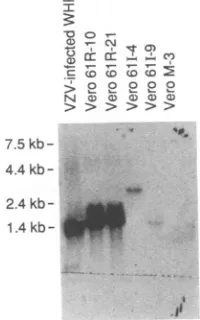
Toanalyzeexpressionof VZV ORF61 in thesecelllines, total cellularRNAs were isolated and Northern blotswere
performedwiththe ORF61
KpnI
fragment as aprobe (Fig. 3). RNA fromVZV-infected whole human fetalfibroblasts(WHF),
which served as apositive
control, contained a1.5-kbtranscript(27).RNA fromV61R-10 and V61R-21 cells contained
transcripts
slightly
larger
than that from VZV-infectedWHF,
presumablybecause ofdifferencesin the site of initiation or termination oftranscription.
RNA from V61I-9 cells alsocontainedatranscript
largerthan that fromVZV-infected
WHF,
whileRNAfromV611-4
cellscontained atranscript much largerthanexpected,probably
becauseof differences in bothinitiation and termination of transcription and rearrangement of VZV DNA in the cell. RNA fromM61R-4
and M61R-37 cells contained transcripts of the expected size(26).transrepressionof VZV target genes byproducts of
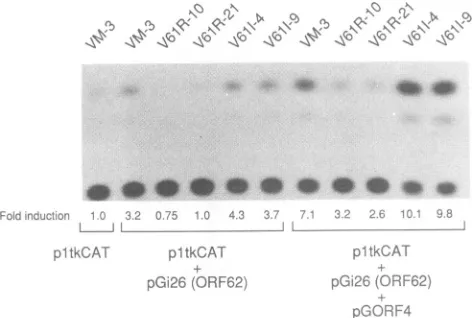
ORF61-expressing cells. VZV ORF61 acts as a trans repressor in transientexpressionassays(27).Todetermine whethercells expressingVZVORF61 madeafunctionally activeproduct, we transfected
cells
with pltkCAT (containing the VZV deoxypyrimidine kinase promoter followed by the CAT gene) aloneorin combination withplasmids
expressing VZVLLI
a)
C-)
a)
N
7.5kb
-O)
-e~'tC
(D (D (- Zs :Z ( 0( (D0 I
. 40.
4.4 kb-2.4kb -1.4kb
-FIG. 3. Northern blotanalysisofORF61-specific transcripts in transformed Vero cell lines. Eachlane contains 15 ,gofcellular RNA. The blotwas hybridized with the same probe asused for
Southernblots.Theleftmost lane containsRNAfromVZV-infected
WHF.VZVORF61transcriptsweredetectedinV61R-10,V61R-21; V61I-4, andV611-9
cells,
but notinVM-3 cells. Marker indicates size inkilobases.on November 9, 2019 by guest
http://jvi.asm.org/
[image:3.612.388.488.500.660.2]7306 MORIUCHI ET AL.
>~I~
-q<
1\1~'1~11~'
le
-§<`
Foidinouctiocn -0 3.2 075 1.0 4 3 3 r. L. (A f
p1tkCAT pltkCAT pGi26(ORF62;1
pltkCAi
pGC,i26 ORF62
pGORF4
FIG. 4. CATactivity in transformed Verocell lines. Vero cell lines (top) werecotransfected with 1 ,gofpltkCATalone or in combination with 5 ,ug of pGi26 (which expresses 0RF62) or pGORF4. Plasmids used for the experiments areindicated atthe bottom. Transfected cellswereharvested 40to48 hafter transfec-tion, andcelllysateswereassayedfor CATactivity.Fold induction of CAT (shown below the autoradiogram) is the CAT activity
relative to thatobtained forplasmid pltkCAT alone inVM-3cells.
ORF62
(pGi26)
orORF4(pGORF4) (Fig. 4).
InVM-3cells,
the expression of CATwas
up-regulated
over threefoldby
ORF62and oversevenfold
by
ORF4 and ORF62together.
The level of expression of CAT stimulated
by ORF62,
orORF62incombinationwith
ORF4,
wasdown-regulated by
55to77%inV61R-10orV61R-21
cells,
butnotinV61I-4 and V61I-9 cells relative to VM-3 cells. These results indicate that the ORF61 geneproduct
in the 61Rcell linesrepresses the activation ofaVZVearly
gene promoterby
aVZV IE gene, as it does intransientexpression
assays.Complementationof ICPO nullmutantof HSV-1 in ORF61-expressingcell lines.(i)
Efficiency
ofplaqueformation.ICPOis notessentialforproductive
infection incell culture butplays
a critical role in viral
growth,
as indicatedby
the poor efficiencyofplaque formationand theimpaired growthofanull mutant (HSV-1 7134
(1]).
Transfection of cells with aplasmidexpressingICPOand HSV-1 7134viralDNAresults in complementation of the 7134 virus (1). To determine whether VZV ORF61 could alsocomplement growthof the
TABLE 1. Titrationof HSV-1 wild type(KOS)andICPO
deletionmutant(7134)stocks on Vero cell linesexpressingVZVORF61'
Cellline CdCl2 (1KOS titer Fold 7134 titer Fold
(108PFU/ml) increase" (PFU/ml) increase"
VM-3 - 3.3 1.0 1.8x 10⁵ 1.0
+ 2.1 1.0 1.5x10⁵ 1.0
V61R-10 - 2.4 0.7 8.9 x 10⁶ 49
+ 2.5 1.2 1.5x 10⁷ 100
V61R-21 - 3.8 1.2 1.2x 10⁷ 67
+ 3.0 1.4 3.1 x 10⁷ 210
V61I-4 - 3.7 1.1 1.3x 10⁵ 0.7
+ 2.9 1.4 9.6 x10 0.6
a Stocks of theindicated virusesweregenerated in Vero
cells;
titersweredeterminedontheindicated cellline,asdescribedpreviously(16).Cellswere
grown ineither the absence (-) or presence (+) of cadmium chloride(CdCl2,
10FM) immediately after infection with virus.
[image:4.612.63.299.83.242.2]bRatio of virus titeronthe indicated cellline to the titer ontheVM-3cell line,in the absenceorpresence of cadmium chloride.
TABLE 2. Titration of HSV-1 wild type(KOS) andICPO deletionmutant(7134) stocksonMeWo cell
linesexpressing VZV ORF61
KOStiter Fold 7134 titer Fold Cellline CdCJ2 (108
PFU/ml)
increase(PFU/ml)
increaseMM-1 - 3.4 1.0 2.0x 10⁵ 1.0
+ 3.4 1.0 1.0 x 10⁵ 1.0
M61R-4 - 2.8 0.82 5.2 x 10⁵ 2.6
+ 2.3 0.68 1.0 x 10⁷ 100
M61R-37 - 3.0 0.88 3.2 x 10⁵ 1.6
+ 2.6 0.76 2.0 x 10⁶ 20
HSV-1 ICPO deletion mutant, we infected cells expressing VZVORF61 with HSV-1 7134. As shown in Table 1, HSV-1 7134 produced 50- to 60-fold more plaques on Vero cells expressing VZV ORF61 (V61R-10, V61R-21) than on the controlcell lines(VM-3, V61I-4).When gene expression was induced with cadmiumchloride, HSV-1 7134produced 100-to 200-fold more plaques on VZV ORF61-expressing cells than on the control cells. Since cadmium chloride increases the levelof VZV ORF61 mRNA(26),thedegreeof comple-mentation ofHSV-1 7134 correlates with thelevel of expres-sion of ORF61. In contrast, cellsexpressing VZVORF61in an antisense orientation (V61I-4) failed to influence the growth of HSV-1 7134, in the presence or absence of cadmium chloride.
HSV-1 7134 infectionyielded only slightlymore plaques on MeWo cells expressing VZV ORF61 than the control cells in the absence ofcadmium; however,induction of VZV ORF61
expression
withcadmiumchlorideresulted in20-to 100-foldmoreplaquesthan oncontrolcells (Table 2).Complementation of HSV-1 7134 was specific for VZV ORF61 anddid not occurwith expression ofanother VZV regulatory gene. The number of plaques obtained with HSV-1 7134 was notincreased when the viruswas used to infectVerocellsstably expressingVZVORF62(Table 3).In addition, ORF61-expressingVerocells were unable to com-plement deletion mutants in other HSV-1 IE genes (5d11.2, an ICP27 deletion mutant; d120, an ICP4 deletion mutant) (Table 3).
(ii)Efficiency of viral replication.Single-stepgrowth stud-ies of HSV-1 7134 and KOS were performed to determine theyield of virus 24 h afterinfection. Sincepriorstudies had shown that thegrowth impairment of HSV-1 7134 is greater at alowmultiplicityofinfectionthan at ahigh multiplicity of infection (3, 12, 33, 41), weperformedgrowth studies with HSV-1 7134 and KOS at both low andhighmultiplicities of
TABLE 3. Titrationsof HSV-1ICPOdeletion mutant(7134),
ICP4deletion mutant
(d120),
orICP27 deletion mutant(5d1l.2)onVerocelllinesexpressingVZVORF62 orORF61 orHSV-1 ICP271
Titer(PFU/ml) Cell line CdCl2
7134 d120 5d11.2
VM-3 - 1.6 x 10⁵ <101 <101
+ 1.0 x 10⁵ <lo1 <101
V61R-21 - 1.0 x 10⁷ <lo1 <101
+ 3.1 x 10⁷ <lo1 <101
FI-14 - 6.8x 10³ 1.6x 10⁵ <101
3-3 - 1.0 x 10⁵ ND 5.5x 10⁷
a TitersweredeterminedonVerocells expressing VZV
ORF61
(V61R-21), ORF62(FI-14),orHSV-1ICP27(3-3).ND,notdetermined.J.VIROL.
on November 9, 2019 by guest
http://jvi.asm.org/
[image:4.612.318.558.110.195.2]TABLE 4. Yield ofHSV-1wildtype(KOS) and ICPO deletion mutant(7134) on Vero cell lines expressing VZV
ORF61, 24 h after infectiona Titer(PFU/dish)
Cell line CdCl2 KOS 7134
LowMOI High MOI LowMOI High MOI VM-3 - 7.7 x 10⁶ 2.7x 10⁹ 2.1 x 10⁴ 2.2 x 10⁶ + 3.2x 10⁶ 5.7x 10⁸ 2.0x 10³ 1.5 x 10³ V61R-21 - 1.2 x 10⁷ 3.3 x 10⁹ 7.0 x 10⁵ 2.5 x 10⁶ + 3.3 x 10⁶ 2.7 x 10⁸ 5.8 x 10⁵ 1.8 x 10 V61R-10 + 5.4 x 10⁶ 1.2 x 10⁹ 7.7 x 10⁵ ND V611-4 + 2.2 x 10⁶ 3.3 x 10⁸ 3.1 x 10³ ND
a Confluent 60-mm disheswereinfected with HSV-1 KOS and 7134atlow (10-' PFUpercell)orhigh(10-1PFUpercell) multiplicity of infection (MOI) calculated fromvirus titersonVerocellsineither the absence(-)orpresence
(+) of cadmium chloride (CdCI2; 10pM).ND,notdetermined.
infection (Table 4). At a high multiplicity ofinfection (0.1 PFU per Vero cell; corresponding to 21 PFU per V61R-21 cell), HSV-1 7134 grewtosimilartiters on cellsexpressing VZV ORF61 asoncontrol cell lines. Thevirus titerswere higheroncellsgrownincadmium-freemedium thanoncells grown in cadmium-added medium. In contrast, at a low multiplicity ofinfection (0.0001 PFU per Vero cell;
corre-spondingto0.02 PFUperV61R-21cell), HSV-1 7134grewto
30-to300-fold-highertitersonVZVORF61-expressingcells thanoncontrolcelllines incadmium-freeorcadmium-added medium, respectively.The failuretonote anincreasein titer for agiven cellline with addition of cadmiumwasprobably due to two different competing effects ofcadmium. While cadmium increases the level of expression of VZV ORF61 in cells expressing this gene (see above),its toxicity reduces the overall growth of both KOS and 7134 viruses in Vero cells.
DISCUSSION
We showed that cell lines expressing VZVORF61 com-plement the growth of an HSV-1
ICPO
deletion mutant, and thereby verifythat VZVORF61is thefunctionalhomolog of HSV-1ICPO.
Theability of VZV ORF61-expressing cells to complement anHSV-1 ICPO deletion mutantisspecificfor the ORF61 gene product. First, HSV-1 mutants which aredeleted for other HSV-1 IE gene products (e.g., ICP4, ICP27)were unable to grow in VZVORF61-expressing cell lines. Second, acell line expressing another VZV IE gene product
(ORF62)
was unable to complement the HSV-1ICPO
deletion mutant. Third, complementation of VZV ORF61for HSV-1ICPO
wasdosedependent,
corresponding
totheamountof VZV ORF61 RNA
expressed.
Comparison
of thepredicted
amino acid sequences of VZV ORF61and HSV-1ICPO
shows substantialhomology in the cysteine-rich motif in the amino-terminal region of VZV ORF61 (Fig.5).
Thesecysteine-rich
motifs are also conserved inhomologs
of otheralphaherpesviruses,
includ-ing thep135
protein of BHV1 (43) and the EPO protein of pseudorabies virus(6).
Each of thesecysteine-rich
se-quences resembles a zinc-finger motifcommon to cellular proteins thatmayinteract with DNA(17).
Thecysteine-rich
regionof HSV-1
ICPO
is thought tobe important fortransactivation (in the absence of ICP4), for virus reactivation fromlatency,and for normalgrowthof HSV-1 in cell culture (1, 5, 12-14). Thus, the homologouscysteine-rich region of ORF61 mayplay similarcritical roles in the
biology
of VZV.VZVORFR 17N T T SDLGK--ITT UTSTSVMPC LHD V R L
HSV-1CP0 114D VCAVC EIIAPHLRCDTFPCMIRFCP CK1UMQL R N TCPLC
BHV-1p135 12-SCICIC A TGAAR.--BLPCLHIAIF AIlRHE GR PTICL
PRVEPO 44MCICLD VAATEAQ-T-LPCMFKFCLDOC RQ TLTSTAl CP L Ca - -C -IC L D- -- - - TL P C - H - F C L - C I - -W-- - - - -C P LC
RCPOQG[E L3HKnIVUST KE3iY E-HPSDDFDGDFSPSFEDSID- 98
NXKLVYLIVGMVITPSG ST IVNDPQTRMEAEEAVRAGTAVDFIW Z2 IPPQMLIfHlSV AIFD E1IPV GGGPGAI7- - -AALEPDAAV IWW 91
RVSILHHVDSDA V EGATDVLDG_EEUEPVGGGFAV W 13
Cameras -A-V-S -H-V-SD-S F - E-PV -- - - - DG - - E ---- -- -AV IW
FIG. 5. Comparison of the predicted amino acid sequences of VZV ORF61(amino acids17 to98) with HSV-1 ICPO (aminoacids 114to202), BHV-1p135(amino acids 12to91), and pseudorabies virus(PRV) early protein 0(EPO) (amino acids44 to128). Gapsare introduced into the sequence (in dashes) for the best alignment. Boxed amino acids are identical residues or conserved substitutions.
VZV ORF61 and HSV-1 ICPO may also share other functional domains. VZV ORF61 has a proline-rich
se-quence(amino acids100to161) adjacenttothecysteine-rich region; HSV-1
ICPO
containsaproline-richsequence(amino acids 225 to 551) near itscysteine-rich motif. The proline-richregionlieswithin the trans activation domain of HSV-1 ICPO (5, 42). Other transcriptional activators, suchasCTF/
NF-1, AP-2, Jun, and OCT-2 (25), possess proline-rich activation domains. In addition,VZVORF61 hasanacidic domain(amino acids 71to105),whileHSV-1ICPOhastwo
acidic domains(aminoacids 1to114and 233to243).Acidic domainsareimportantfortranscriptionalactivation in other herpesvirus regulatory proteins such as HSV-1 VP16 (34) and pseudorabiesvirus IE180(23). The significance of the acidicdomainsin VZV ORF61 and HSV-1ICPOisuncertain, however, since there isno apparent amino acid homology between the twoproteinsin thisregion.
While VZV ORF61 and HSV-1
ICPO
share these very limited areas of amino acid homology, the two proteins exhibitdifferent activities in transient expression assays in vitro.VZV ORF61 trans represses the activation of putative viral IE,early, and lategene promotersby VZV ORF4 and ORF62(27),butitdirectlytransactivatesanHSV-1IEand earlygene promoterofHSV-1(26).In contrast,HSV-1ICPOtransactivates both HSV-1 and VZV promoters(3, 4, 12, 18, 26, 28). Although full-length HSV-1
ICPO
does not showtransrepressing activity,acarboxy-terminaldeletionmutant
ofICPO (retaining aminoacids 1to245)acts as a
promiscu-ous trans repressor (42). This mutant is deleted for the proline-rich domain,but retains thecysteine-richandacidic domains of the molecule. Inaddition, BHV-1
p135
acts as a transactivatoror atransrepressor,dependingonthe target promoter(43). Thus,VZVORF61, HSV-1ICPO,
and BHV-1p135
may each contain both trans activating and trans repressing domains, and the net effect observed for each molecule invitro maydepend
on the target promoter, on interactions with other viral or cellular proteins, or onundefinedpropertiesoftransienttransfection assays. Inconclusion,weshowed that VZVORF61 is
functionally
homologoustoHSV-1ICPO. The
ability
ofVZVORF61 tocomplementanICPOdeletionmutantofHSV-1
implies
that despitemarked differences in amino acid sequences and in activities in transientexpression
assays, the twoproteins
havesimilar functions
during
virus infection.ACKNOWLEDGMENTS
Wethank D. KaufmanforplasmidpMTP-3H,P. A.Schafferfor the HSV-1 mutantsand3-3cells, andC.GroseforMeWocells.
on November 9, 2019 by guest
http://jvi.asm.org/
7308 MORIUCHI ETAL.
REFERENCES
1. Cai, W., and P. A. Schaffer. 1989. Herpes simplex virus type 1 ICP0 playsacritical role in the de novo synthesis of infectious virus following transfection of viral DNA. J. Virol. 63:4579-4589.
2. Cai, W., and P. A. Schaffer. 1991. A cellular function can enhance gene expression and plating efficiency of a mutant defective in the gene for ICPO, a transactivating protein of herpes simplex virus type 1. J. Virol. 65:4078-4090.
3. Cai, W., and P. A. Schaffer. 1992. Herpessimplex virus type 1 ICPO regulates expression of immediate-early, early, and late genes inproductively infected cells. J. Virol. 66:2904-2915. 4. Chen,J.,and S.Silverstein. 1992. Herpes simplex viruses with
mutations in the gene encoding ICPO are defective in gene expression. J. Virol. 66:2916-2927.
5. Chen,J.,X.Zhu,and S.Silverstein. 1991. Mutational analysis of the sequence encoding ICPO from herpessimplex virus type 1. Virology180:207-220.
6. Cheung, A. K. 1991. Cloning of the latency gene and the early protein0gene ofpseudorabies virus. J. Virol. 65:5260-5271. 7. Chomczynski, P., and N. Sacchi. 1987. Single-step method of
RNA isolation by acid guanidium thiocyanate-phenol-chloro-formextraction. Anal. Biochem. 162:156-159.
8. Davison, A. J., and J. E. Scott. 1986. The complete DNA sequence ofvaricella-zoster virus. J. Gen. Virol. 67:1759-1816. 9. DeLuca, N. A., A. M. McCarthy, and P. A. Schaffer. 1985. Isolation and characterization of deletion mutants of herpes simplex virus type 1 in the gene encoding immediate-early regulatory protein ICP4. J. Virol. 56:558-570.
10. Devereux, J., P. Haeberli, and0. Smithies. 1984. A comprehen-sive set ofsequence analysis program for the VAX. Nucleic AcidsRes. 12:387-395.
11. Disney, G. H., and R. D.Everett. 1990. A herpes simplex virus type 1 recombinant with both copies of the Vmwl75 coding sequences replaced by the homologous varicella-zoster virus openreading frame. J. Gen. Virol. 71:2681-2689.
12. Everett, R. D. 1984.Transactivation of transcription by herpes virus products: requirement for two HSV-1 immediate early polypeptides for maximum activity. EMBO J. 3:3135-3141. 13. Everett, R. D. 1987.Adetailed mutational analysis of VmwllO,
atrans-acting transcriptional activator encoded by herpes sim-plex virus type 1. EMBO J.6:2069-2076.
14. Everett, R. D. 1988. Analysis of the functional domains of herpes simplex virus type 1 immediate early polypeptide VmwllO.J. Mol.Biol.202:87-96.
15. Felser, J. M., P.R Kinchington, G. Inchauspe, S. E. Straus, and J. M.Ostrove. 1988. Cell lines containingvaricella-zoster virus open reading frame 62 and expressing the "IE" 175 protein complement ICP4 mutants of herpes simplex virus type 1. J. Virol.62:2076-2082.
16. Felser, J. M., S. E.Straus, and J. M. Ostrove. 1987. Varicella-zoster viruscomplements herpes simplex virus type 1 temper-ature-sensitive mutants. J. Virol. 61:225-228.
17. Freemont, P. S., I. M. Hanson, and J. Trowsdale. 1991. A novel cysteine-rich sequence motif. Cell 64:483-484.
18. Gelman,I. H., and S.Silverstein. 1985. Identification of imme-diate early genes from herpes simplex virus that transactivate the virusthymidine kinase gene. Proc. Natl. Acad. Sci. USA 82:5265-5269.
19. Graham, F. L., and A. J. VanDer Eb. 1973. A newtechnique for theassay ofinfectivity of human adenovirus 5 DNA. Virology 52:456-467.
20. Grose, C., and P. A. Brunell. 1978. Varicella-zoster virus: isolation andpropagation in human melanoma cells at 36 and
32'C.Infect. Immun. 19:199-203.
21. Inchauspe, G., S. Nagpal, and J. M. Ostrove. 1989. Mapping of two varicella-zoster virus-encoded genes that activate the expression of viral early and late genes. Virology173:700-709. 22. Inchauspe, G., and J. M.Ostrove. 1989.Differential regulation by varicella-zoster virus (VZV) and herpes simplex virus-1 trans-activator genes.Virology173:710-714.
23. Martin, K. J., J. W. Lillie, and M. R. Green. 1990. Transcrip-tional activation by the pseudorabies virus immediate early protein. Genes Dev. 4:2376-2382.
24. McCarthy, A. M., L. McMahan, and P. A. Schaffer. 1989. Herpes simplex virus type 1ICP27 deletion mutants exhibit altered patterns of transcription and are DNA deficient. J. Virol. 63:18-27.
25. Mitchell, P. J., and R. Tjian. 1989. Transcriptional regulation in mammalian cells by sequence-specific DNA binding proteins. Science 245:371-378.
26. Moriuchi, H., M. Moriuchi, S. E. Straus, and J. I. Cohen. Unpublished data.
27. Nagpal, S., and J. M. Ostrove. 1991. Characterization of a potent varicella-zoster virus-encoded trans-repressor. J. Virol. 65:5289-5296.
28. O'Hare, P., J. D. Mosca, and G. S. Hayward. 1986. Multiple transactivating proteins of herpes simplex virus that have
dif-ferent target specificities and exhibit both positive and negative regulatory functions. Cancer Cells 4:175-188.
29. Perry, L. J., F. J. Rixon, R. D. Everett, M. C. Frame, and D. J. McGeoch. 1986. Characterization of the IEllO gene of herpes simplex virus type 1. J. Gen. Virol. 67:2365-2380.
30. Rice, S. A., and D. M. Knipe. 1988. Gene-specific trans-activation by the herpes simplex virus type 1 alpha protein ICP27. J. Virol. 62:3814-3823.
31. Roizman, B., and A. E. Sears. 1990. Herpes simplex viruses and their replication, p. 1795-1841. In B. N. Fields, D. M. Knipe, R. M.Chanock,M. S.Hirsch,J. L. Melnick, T. P. Monath, and B. Roizman (ed.), Virology-1990. Raven Press, New York. 32. Sacks, W. R., C. C.Greene,D. P. Aschman, and P. A. Schaffer.
1985. Herpes simplex virus type 1 ICP27 is an essential regula-tory protein. J. Virol. 55:796-805.
33. Sacks, W.R.,and P. A.Schaffer.1987. Deletion mutants in the gene encoding the herpes simplex virus type 1 immediate-early protein ICPO exhibit impaired growth in cell culture. J. Virol. 61:829-839.
34. Sadowski, I., J. Ma, S. Triezenberg, and M. Ptashne. 1988. GAL4-VP16 is an unusually potent transcriptional activator. Nature (London) 346:329-331.
35. Sandri-Goldin, R. M., and G. E. Mendoza. 1992. A herpesvirus regulatory protein appears to act post-transcriptionally by af-fecting mRNA processing. Genes Dev. 6:848-863.
36. Sekulovich, R. H., K.Leary, and R. M. Sandri-Goldin. 1988. The herpes simplex virus type 1 alpha proteinICP27 can act as a trans-repressor and trans-activator in combination with ICP4 and ICPO. J. Virol. 62:4510-4522.
37. Smith, C. A., and P. A. Schaffer. 1987. Mutants defective in herpes simplex virus type 2 ICP4: isolation and preliminary characterization. J. Virol. 61:1092-1097.
38. Southern, E. M. 1975. Detection of specific sequences among DNA fragments separated by gel electrophoresis. J. Mol. Biol. 98:503-517.
39. Southern, P. J., and P. Berg. 1982. Transformation of mamma-lian cells to antibiotic resistance with a bacterial gene under control of theSV40early region promoter.J. Mol. Appl. Genet. 1:327-341.
40. Stow, E. C., and N. D. Stow. 1989. Complementation of a herpes simplex virus type 1 VmwllO deletion mutant by human cyto-megalovirus.J.Gen. Virol. 70:695-704.
41. Stow, N. D., and E. C. Stow. 1986. Isolation and characteriza-tion of a herpes simplex virus type 1 mutant containing a deletion within the gene encoding the immediate early polypep-tideVmwllO. J. Gen. Virol. 67:2571-2583.
42. Weber, P. C., and B.Wigdahl.1992. Identification of dominant-negative mutants of the herpes simplex virus type 1 immediate-early protein ICPO. J.Virol.66:2261-2267.
43. Wirth,U. V., C. Fraefel, B. Vogt, C.
VMcek,
V. Paces, and M. Schwyzer. 1992. Immediate-early RNA 2.9 and early RNA 2.6 of bovine herpesvirus 1 are 3' coterminal and encode a putative zincfinger transactivator protein.J. Virol.66:2763-2772.J. VIROL.