
Uncertainties on atomic data. A case study: N
iv
G. Del Zanna
1⋆, L. Fern´andez-Menchero
2, N. R. Badnell
31DAMTP, Centre for Mathematical Sciences, University of Cambridge, Wilberforce Road, Cambridge CB3 0WA, UK 2CTAMOP, Queen’s University of Belfast, Belfast, Northern Ireland, UK
3Department of Physics, University of Strathclyde, Glasgow G4 0NG, UK
Submitted to MNRAS
ABSTRACT
We consider three recent large-scale calculations for the radiative and electron-impact exci-tation data of Niv, carried out with different methods and codes. The scattering calculations
employed the relativistic Dirac R-matrix (DARC) method, the intermediate coupling frame transformation (ICFT) R-matrix method, and the B-spline R-matrix (BSR) method. These are all large-scale scattering calculations with well-tested and sophisticated codes, which use the same set of target states. One concern raised in previous literature is related to the in-creasingly large discrepancies in the effective collision strengths between the three sets of
calculations for increasingly weak and/or high-lying transitions. We have built three model
ions and calculated the intensities of all the main spectral lines in this ion. We have found that, despite such large differences, excellent agreement (to within ±20%) exists between all the spectroscopically-relevant line intensities. This provides confidence in the reliability of the calculations for plasma diagnostics. We have used the differences in the radiative and
excitation rates amongst the three sets of calculations to obtain a measure of the uncertainty in each rate. Using a Monte Carlo approach, we have shown how these uncertainties affect the
main theoretical ratios which are used to measure electron densities and temperatures.
Key words: Atomic data – Techniques: spectroscopic
1 INTRODUCTION
With the advances in computational power, an increasing number of large-scale atomic calculations for ions of astrophysical impor-tance have become available in the past few years. Within several communities, there is now awareness of the importance of the ac-curacy of atomic calculations for astrophysical applications. The IAEA has organised a workshop on uncertainties of atomic data, and some guidance is provided in e.g. Chung et al. (2016). Within the solar community, Guennou et al. (2013) used some general es-timates of available rates, to assess uncertainties on the tempera-ture distribution of the solar plasma, obtained by combining spec-troscopic observations with atomic data. The resulting uncertain-ties were large. A much better approach is to assess in some way the uncertainty in each single rate, by e.g. comparing theory with experiment or results of different calculations. One of us (GDZ) developed such an approach, and used comparisons of two calcu-lations to assess uncertainties associated with line ratios used to measure electron densities from Fexiii(Yu et al. 2018). A general
overview of some of the uncertainties in atomic data is presented in Del Zanna & Mason (2018).
For most astrophysical plasmas that are collisional (i.e. not photoionised), the main rates affecting the spectral lines of an ion
⋆ E-mail: [email protected]
are those of spontaneous decay (A-values), and those of collisional excitation by electron impact. In this paper, we focus on the latter, considering that they are normally the most complex ones to calcu-late accurately. The main quantity is the effective collision strength Υof a transition, which is the rate obtained from the adimensional cross-section (the collision strength) assuming a Maxwellian distri-bution of the electrons.
Historically, large discrepancies in the effective collision strengths calculated with different approximations and codes were present. However, with the advances in computational power, re-sults have generally converged for low-lying transitions. However, in the recent literature, several cases have now appeared where dif-ferences of up to one or two orders of magnitude for weak and/or high-lying transitions have been found. This clearly raises concerns on the reliability of any of such calculations, and their effects on di-agnostic applications.
Generally, the effective collision strengths to the lower lev-els of an ion agree to within±20%, although in a few cases they
can differ significantly. One such example are the calculations for the coronal Fexi ion, where the values calculated by Del Zanna
et al. (2010) were generally in good agreement (within±20%) with
spin-2
Del Zanna et al.
orbit interaction, so the calculations are very sensitive to the atomic structure.
We are concerned here with those cases where the overall re-sults are significantly different. There are several examples in the literature, some of which have been recently reviewed by Aggarwal (2017). For example, Aggarwal & Keenan (2014) used the Dirac AtomicR-matrix Code (DARC) of P. H. Norrington and I. P. Grant to calculate effective collision strengths for the important coronal Fexiv. They found large discrepancies with the results obtained by
Liang et al. (2010) with the Intermediate Coupling Frame Transfor-mation (ICFT)R-matrix method (Griffin et al. 1998). The Aggarwal & Keenan (2014) calculations adopted much smaller configuration-interaction (CI) and close-coupling (CC) expansions than the pre-vious study, so significant differences are to be expected. Indeed, Del Zanna et al. (2015) carried out a new ICFT calculation with the same CC/CI expansions as that one adopted by Aggarwal & Keenan (2014) and found excellent agreement between the DARC and ICFT results. The main differences between the smaller DARC and the larger ICFT calculation was the CC expansion used.
A similar case concerns Alx. Aggarwal & Keenan (2015)
car-ried out a DARC 98-levels calculation on this ion, showing signif-icant differences with the results obtained by Fern´andez-Menchero et al. (2014) with a much larger (238-level) ICFT calculation. As in the Fexivcase, Fern´andez-Menchero et al. (2015) carried out
ICFT and Breit–PauliR-matrix calculations with the same target (98-levels) adopted by Aggarwal & Keenan (2015), and the results were shown to agree closely. Various comparisons were also pro-vided, showing how both the choices of CC and CI expansions can significantly affect the collision strengths.
On a side note, we stress that it has been shown in the litera-ture that when the atomic struclitera-ture of an ion is similar, and the same CI/CC expansions are adopted, results of the DARC and ICFT are very similar (see, e.g. Liang & Badnell 2010; Liang et al. 2009; Badnell & Ballance 2014). Clearly, many other issues affect the final results, such as the energy resolution and the threshold posi-tions, but are often of less importance, as we have discussed e.g. in the Badnell et al. (2016) review.
There are also reported differences in collision strengths ob-tained with other codes. For example, Aggarwal & Keenan (2017) carried out a DARC R-matrix calculation on Mgvon 86 target
states and found large, order of magnitude differences for weak and/or high-lying transitions with two previous results. One was an earlier (and smaller) ICFTR-matrix calculation carried out by Hudson et al. (2009). The other one, by Tayal & Sossah (2015), was on the same 86 target states but used a completely different ap-proach, the B-splineR-matrix (BSR) method (see, e.g. Zatsarinny 2006; Zatsarinny & Bartschat 2013, for details).
In a recent study, Wang et al. (2017) carried out two sets of BSR calculations, one with the same 86 target states as in Tayal & Sossah (2015), but with a more accurate representation of the target structure; the other one was a much larger calculation with 316 states. Close agreement with the previous BSR calculations was found when the smaller calculation was considered. Significant increases in the collision strengths of the weaker transitions was however found when the much larger calculation was considered. We note that such results are common and are mostly due to extra resonances, and coupling in general, which can increase the cross-sections for weak transitions. Differences with the DARC results were found.
For the present study we have chosen to consider the Be-like Niv, as effective collision strengths obtained with the DARC,
ICFT, and BSRR-matrix codes are now available. They were
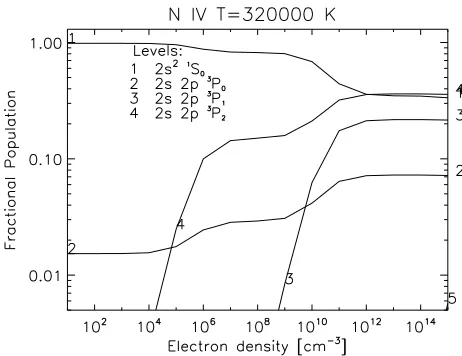
ob-Figure 1.Relative populations of the levels of Niv.
tained with the same set of target states, hence are directly compa-rable. Aggarwal et al. (2016) carried out a DARC scattering calcu-lation for Niv, showing order of magnitude discrepancies for many
weak and/or high-lying transitions with the values calculated previ-ously by Fern´andez-Menchero et al. (2014) with the ICFTR-matrix codes [hereafter ICFT results]. The DARC calculations adopted the same set of configurations for the CI/CC expansions as those used by Fern´andez-Menchero et al. (2014). Therefore, in principle one would expect good agreement, at least for those transitions where slight differences in the atomic structure (which are always present) are not significant.
To shed light into this issue, Fern´andez-Menchero et al. (2017) recently carried out a large-scale calculation with the BSR codes. Good agreement between all calculations was found for the strong transitions within the low-lying states. Significant increasing dif-ferences with both the ICFT and DARC results were found for the increasingly weaker and/or higher transitions. The differences are attributable to the inherent lack of convergence in the target config-uration interaction expansion and/or the collisional close-coupling expansion in all three calculations, which increasingly affects the weaker and/or higher-lying transitions. The convergence study by Fern´andez-Menchero et al. (2015) illustrates this point.
In this paper, we focus on two important aspects: 1) we show that the large differences have negligible effects for astrophysical modelling; 2) we use the differences as a measure of the uncertainty in the rates, and provide a measure of the uncertainty in derived quantities such as electron densities.
It is well-known that a few of the strongest Nivlines are
use-ful diagnostics for astrophysical plasma (e.g. nebulae and the solar corona), see e.g. Dufton et al. (1979) Some have also been used in laboratory plasma (tokamaks).
2 MODELLING SPECTRAL LINE INTENSITIES
2.1 Atomic data
[image:2.595.312.543.101.279.2]Figure 2.Comparisons of gf-values as calculated with the GRASP, AS, and BSR codes for all transitions from the metastable levels. Dashed lines show
±20%.
considered configuration interaction (CI) producing the same set of 238 fine-structure levels adopted by Fern´andez-Menchero et al. (2014). They included a relatively complete set of configurations up to principal quantum numbern=5, plus 72 levels arising from n=6,7 configurations, which was added by Fern´andez-Menchero
et al. (2014) to improve the structure for the lower levels.
Fern´andez-Menchero et al. (2014), on the other hand, used the
autostructure(AS) program (Badnell 2011) and radial
wavefunc-tions calculated in a scaled Thomas-Fermi-Dirac-Amaldi statistical model potential. As shown by Aggarwal et al. (2016), some
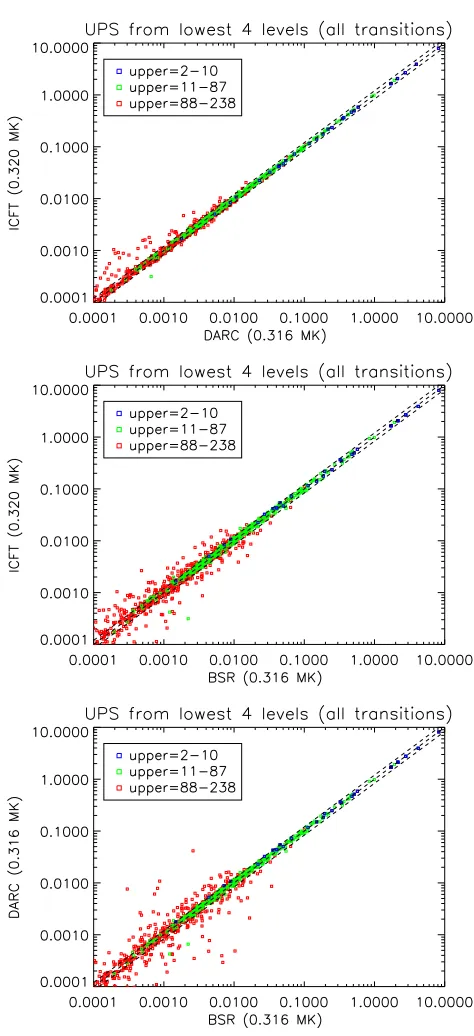
differ-Figure 3.Comparisons of effective collision strengthsΥ(UPS) near ion peak abundance as calculated with the DARC, ICFT, and BSR codes, for all transitions from the metastable levels.
ences in the energies of the two calculations are present, although not apparently large enough to expect large differences in the re-sults of the scattering calculations.
For the scattering calculations, Aggarwal et al. (2016) used the relativistic DARC program. For the comparisons shown here we only consider the results of their ‘DARC2’ calculation, which included in the CC expansion the same set of 238 levels of the CI.
[image:3.595.57.275.101.607.2]4
Del Zanna et al.
(1995). TheR-matrix inner region calculation was inLS-coupling and included both mass-velocity and Darwin relativistic energy cor-rections. For the outer region, the ICFT method was applied to the LS-coupledK-matrices calculated with the STGF code (Badnell and Seaton, unpublished). Collision strengths were ‘topped-up’ to infinite partial waves following Burgess (1974); Badnell & Grif-fin (2001). Finally, the collision strengths were extended to high energies by interpolation using the appropriate high-energy lim-its in the Burgess & Tully (1992) scaled domain. The high-energy limits were calculated withautostructurefollowing Burgess et al.
(1997) and Chidichimo et al. (2003).
As we mentioned, Fern´andez-Menchero et al. (2017) carried out a large-scale calculation with the B-spline R-matrix codes. They included all the valence configurations{2s,2p,3s,3p,3d}nl of N3+. The outer valence-electronnlwave function was expanded in a basis set of 134 B-splines of order 8. The BSR calculation was limited to the total angular momentaJ=0−6, obtaining a total of
1400 levels, including bound and continuum. Of these 1400 levels calculated, 238 were included in the later CC expansion. They used the same outer region STGF code, but now injK-coupling.
We used the collision strengths and A-values published by Fern´andez-Menchero et al. (2017) to calculate the level population for this ion at the temperature of maximum abundance in ioniza-tion equilibrium. We used the codes available within the CHIANTI package (Dere et al. 1997; Del Zanna et al. 2015). Figure 1 shows that for any astrophysical density, and for any plasma laboratory density below 1015cm−3, the levels that drive the population of all
the levels in the ion are the ground state (2s2 1S0) and the three metastable levels, from the 2s 2p3P. This is an important issue: the intensities of the spectral lines are directly proportional to the pop-ulations of the upper levels, which in turn are driven solely by the collision rates from these four lower levels. All the rates from the other levels are irrelevant for the modelling.
We therefore looked at the gf values (weighted oscillator strengths) of all the transitions from these four levels, as calculated by Aggarwal et al. (2016) with GRASP and Fern´andez-Menchero et al. (2014) with AS. They are shown in Figure 2 (top). With very few notable exceptions, there is excellent agreement, to within±
20%, for all the transitions, especially the strong ones. On the other hand, significant differences (over±20%) with the BSR calculated
values are present for the weaker transitions, as shown in the two lower plots of Figure 2.
Such differences become even more evident when all the transitions are considered, as shown in Fig.2 of Fern´andez-Menchero et al. (2017). These differences result directly from the different method used in the atomic structure calculation. The BSR calculations adopted a multi-configuration Hartree-Fock (MCHF) expansion which included the continuum in the form of pseudo-orbitals, and where the radial functions for the outer valence electron were expanded in a B-spline basis. This generated different nonorthogonal sets of one-electron orbitals for each target state and the continuum, and therefore led to a more extended CI expansion, compared to the GRASP and AS results. In particular, CI included configuration mixing with the additional [3s, 3p, 3d]nl bound states, as well as the inter-action with the continuum. One would expect that the use of a more complete basis set in the BSR calculations would pro-vide a better atomic structure. Indeed, as shown in Fern´andez-Menchero et al. (2017), the resultant level energies are the ones closest to the observed values (as available in NIST or CHI-ANTI).
The comparison of theΥas calculated with the DARC, ICFT,
and BSR codes, for the same set of transitions, at temperatures close to ion peak abundance, are shown in Figure 3. Excellent agreement (to within±20%) between the DARC and ICFT is found
for all transitions, with a few cases belonging to the higher levels (2p 4land most of then=6,7, above level No. 87) which deviate
by only about 30%.As in the case of the gf values, larger dif-ferences are found with the BSR values. This is expected as the high-temeprature limits of the effective collisions strengths are directly related to the gf values.
The larger deviations occur for the transitions to higher levels, which are mostly forbidden. Such variations are quite typical for weak forbidden lines, which are very sensitive to a number of is-sues, such as cancellation effects, the positioning of the resonances, etc. Much larger variations are present if one considers all tran-sitions from all levels, as shown by Aggarwal et al. (2016) and Fern´andez-Menchero et al. (2017). However, as we pointed out, they would not have any effect for the modelling.
The question is whether the 30–40% variations in the forbid-den lines have any significant effect on the level population for this ion. To assess this, we have build three ion models and solved the level population.
2.2 Level population and line intensities
Within an atomic database such as CHIANTI (Del Zanna et al. 2015), one typically merges theΥfrom a calculations with ad-hoc, normally more accurate, radiative data (A-values) obtained by a completely different calculation.Among the three calculations we consider, as we have mentioned the BSR one has the best atomic structure so we have adopted the BSR A-values, and built three model ions, with the BSR, ICFT and DARC effective collision strengths. We had to switch the indexing of several levels in the ICFT and DARC calculations, for a meaningful comparison.
All the excitations between all 238 levels were retained, al-though as we pointed out, only those from the lowest four levels are needed to model plasma emission below 1015cm−3. We have used the CHIANTI codes to calculate the line emissivities, finding the level populations by including the proton rates as available in CHIANTI v.8.
Since for diagnostic application one is interested in relative ratios, we have considered the spectral line emissivities, normalised to the intensity of the strongest resonance line, the 2s2 1S0–2s 2p 1P
1at 765 Å.
Figure 4 shows the ratios of the spectral line intensities as calculated with the ICFT, DARC, and BSR collision strengths. The intensities have been calculated at ion peak abundance (log T[K]=5.15) and at an electron density of 1011cm−3, close to the value expected in a solar active region.
Despite the order of magnitude differences in some of the col-lision strengths, Figure 4 clearly shows that there is an excellent agreement, to within±20%, for all the spectroscopically relevant
Figure 4.Ratios of all the spectral line intensities, calculated with the three model ions, based on the ICFT, DARC, and BSRΥvalues, as a function of their normalised intensities (i.e. relative to the strength of the resonance line). Dashed lines indicate±20%.
3 ESTIMATING UNCERTAINTIES ON THE MAIN DIAGNOSTIC RATIOS
As reviewed in Del Zanna & Mason (2018), lines of Be-like ions have been extensively used in astrophysics to measure electron den-sities and temperatures. It is therefore useful to assess the impact of the uncertainties in the atomic rates on the main ratios.
Similarly to the Fexiiistudy (Yu et al. 2018), we have taken
a ‘Monte Carlo’ approach, i.e. we have calculated the level
[image:5.595.321.536.100.268.2]popu-Figure 5.Main density diagnostic for Nivat logT[K]=5. The dashed line indicates the quiet Sun observed value reported by Dufton et al (1979).
Figure 6.Main electron temperature diagnostic for Niv, calculated at an electron density of 1010cm−3. The dashed line indicates the quiet Sun ob-served value reported by Dufton et al (1979).
lations and line emissivities 100 times by randomly varying each A-value and collisional rate within some bounds, using the BSR values as a reference. To define the bounds for each rate, we have compared the three calculated values and taken the maximum rel-ative deviation from the BSR values. We have limited the varia-tion to a minimum of 2% (as some variavaria-tions are smaller than this) and a maximum of 80%, neglecting the few order-of magnitude variations which, as we have shown, have little effect on the line intensities. Unlike (Yu et al. 2018), where a normal distribution was adopted (with standard deviation equal to the bound), we have adopted a strict random distribution within the bounds.
[image:5.595.321.537.320.487.2]6
Del Zanna et al.
value reported by Dufton et al. (1979). We can see that we obtain a similar value, about 1.2×1010cm−3, with an uncertainty of about 0.2 in dex.
The main ratio to measure electron temperatures is the 2s 2p 1P
1–2p2 1D2(1718.5 Å) vs. the 2s2 1S0–2s 2p3P1(1486.5 Å). Fig-ure 6 shows the the theoretical ratio obtained from the BSR data (black line) and the 99 random realisations (grey lines), calculated for an electron density of×1010cm−3. The dashed line indicates the quiet Sun observed value reported by Dufton et al. (1979). We can see that we obtain a temperature of logT[K]=5, the same value estimated by Dufton et al. (1979). The uncertainty is about 0.05 in dex.
Clearly, a proper evaluation of the uncertainties should also include the uncertainties in the observed values. Also, it should in-clude a model of how the densities and temperatures might vary along the line of sight, as the emissivities of the lines we have considered are dependent on both the electron densities and tem-peratures, to some degree. Such model would depend critically on the source region observed. As the observations of the two ratios reported by Dufton et al. (1979) were not simultaneous and were obtained in different conditions by different instruments, it is not possible to further explore this aspect in this example.
4 CONCLUSIONS
We have considered three independent calculations of the effective collision strengths for Nivwhich, for many transitions, show large
order-of-magnitude discrepancies for many weak transitions and/or those involving high-lying levels.
At first glance, such differences are of concern for as-trophysical applications, although we should point out that thay are inherent inR-matrix close-coupling methods based-on truncated CI and/or CC expansions. We view such discrepan-cies as an excellent way to provide a measure on the uncertainty in calculating rates for weak transitions and to high-lying lev-els.
Despite the differences, we have shown that in the case of Niv excellent agreement (to within a relative 20%) is found
among the line intensities obtained from the three independent calculations considered here, for the spectroscopically and as-trophysically important emission lines. Agreement in the line intensities obtained with the ICFT and the DARC effective colli-sion strengths is even better, to within a relative 10%.
The present modelling clearly shows that the few forbidden transitions where the BSR, DARC and ICFT collision strengths dif-fer significantly are not really relevant for any astrophysical appli-cation where densities are below 1015cm−3. If low densities such in astrophysical nebulae are considered, the discrepancies are even smaller, because the level populations are driven solely by the exci-tation rates from the ground state, as this is the only populated level (cf. Fig. 1).
We expect similar results for the other ions along the Be-like sequence. The metastable levels become populated at increasingly higher densities along the sequence (with increasing atomic num-ber). Therefore, we would expect for the higher Z elements better agreement in the line intensities calculated from the different codes for say solar densities (108–1012cm−3).
We have used the differences obtained by the three sets of cal-culations as a measure of the uncertainty in each of the radiative and collisional rates. With simple Monte Carlo simulations, we have shown how such uncertainties affect the main diagnostic
applica-tions for this ion, to measure electron densities and temperatures. We suggest that such an approach should be adopted when estimat-ing uncertainties on the theoretical ratios.
ACKNOWLEDGMENTS
GDZ acknowledges support from STFC (UK) through the Univer-sity of Cambridge DAMTP astrophysics grant. NRB acknowledges support from STFC (UK) through the University of Strathclyde UK APAP Network grant ST/R000743/1. We thank J. Mao for useful comments on the manuscript.
REFERENCES
Aggarwal K., 2017, Atoms, 5, 37
Aggarwal K. M., Keenan F. P., 2003, A&A, 399, 799 Aggarwal K. M., Keenan F. P., 2014, MNRAS, 445, 2015 Aggarwal K. M., Keenan F. P., 2015, MNRAS, 447, 3849 Aggarwal K. M., Keenan F. P., 2017, Canadian Journal of Physics,
95, 9
Aggarwal K. M., Keenan F. P., Lawson K. D., 2016, MNRAS, 461, 3997
Badnell N. R., 2011, Computer Physics Communications, 182, 1528
Badnell N. R., Ballance C. P., 2014, ApJ, 785, 99
Badnell N. R., Del Zanna G., Fern´andez-Menchero L., Giunta A. S., Liang G. Y., Mason H. E., Storey P. J., 2016, Journal of Physics B Atomic Molecular Physics, 49, 094001
Badnell N. R., Griffin D. C., 2001, Journal of Physics B Atomic Molecular Physics, 34, 681
Berrington K. A., Eissner W. B., Norrington P. H., 1995, Com-puter Physics Communications, 92, 290
Burgess A., 1974, Journal of Physics B Atomic Molecular Physics, 7, L364
Burgess A., Chidichimo M. C., Tully J. A., 1997, Journal of Physics B Atomic Molecular Physics, 30, 33
Burgess A., Tully J. A., 1992, A&A, 254, 436
Chidichimo M. C., Badnell N. R., Tully J. A., 2003, A&A, 401, 1177
Chung H.-K., Braams B. J., Bartschat K., Cs´asz´ar A. G., Drake G. W. F., Kirchner T., Kokoouline V., Tennyson J., 2016, Journal of Physics D Applied Physics, 49, 363002
Del Zanna G., Dere K. P., Young P. R., Landi E., Mason H. E., 2015, A&A, 582, A56
Del Zanna G., Liang G. Y., Badnell N. R., Fern´andez-Menchero L., Mason H. E., Storey P. J., 2015, MNRAS, 454, 2909 Del Zanna G., Mason H. E., 2018, Living Reviews in Solar
Physics, 15
Del Zanna G., Storey P. J., Mason H. E., 2010, A&A, 514, A40 Dere K. P., Landi E., Mason H. E., Monsignori Fossi B. C., Young
P. R., 1997, A&AS, 125, 149
Dufton P. L., Doyle J. G., Kingston A. E., 1979, A&A, 78, 318 Fern´andez-Menchero L., Del Zanna G., Badnell N. R., 2014,
A&A, 566, A104
Fern´andez-Menchero L., Del Zanna G., Badnell N. R., 2015, MN-RAS, 450, 4174
Fern´andez-Menchero L., Zatsarinny O., Bartschat K., 2017, Jour-nal of Physics B Atomic Molecular Physics, 50, 065203 Grant I. P., McKenzie B. J., Norrington P. H., Mayers D. F., Pyper
Griffin D. C., Badnell N. R., Pindzola M. S., 1998, Journal of Physics B Atomic Molecular Physics, 31, 3713
Guennou C., Auch`ere F., Klimchuk J. A., Bocchialini K., Parenti S., 2013, ApJ, 774, 31
Hudson C. E., Ramsbottom C. A., Norrington P. H., Scott M. P., 2009, A&A, 494, 729
Hummer D. G., Berrington K. A., Eissner W., Pradhan A. K., Saraph H. E., Tully J. A., 1993, A&A, 279, 298
Liang G. Y., Badnell N. R., 2010, A&A, 518, A64+
Liang G. Y., Badnell N. R., Crespo L´opez-Urrutia J. R., Baumann T. M., Del Zanna G., Storey P. J., Tawara H., Ullrich J., 2010, ApJS, 190, 322
Liang G. Y., Whiteford A. D., Badnell N. R., 2009, A&A, 500, 1263
Tayal S. S., Sossah A. M., 2015, A&A, 574, A87
Wang K., Fern´andez-Menchero L., Zatsarinny O., Bartschat K., 2017, Phys. Rev. A, 95, 042709
Yu X., Del Zanna G., Stenning D. C., Cisewski-Kehe J., Kashyap V. L., Stein N., van Dyk D. A., Warren H. P., Weber M. A., 2018, ApJ, 866, 146
Zatsarinny O., 2006, Computer Physics Communications, 174, 273
![Figure 5. Main density diagnostic for N iv at log T[K]=5. The dashed lineindicates the quiet Sun observed value reported by Dufton et al (1979).](https://thumb-us.123doks.com/thumbv2/123dok_us/1335246.87300/5.595.64.273.100.617/figure-density-diagnostic-dashed-lineindicates-observed-reported-dufton.webp)
