
City, University of London Institutional Repository
Citation
:
Efthymiou, E. & Camara, A. (2017). Effect of spatial variability of earthquakes on
cable-stayed bridges. Paper presented at the X International Conference on Structural
Dynamics, EURODYN 2017, 10-13 Sep 2017, Rome, Italy.
This is the published version of the paper.
This version of the publication may differ from the final published
version.
Permanent repository link:
http://openaccess.city.ac.uk/19056/
Link to published version
:
Copyright and reuse:
City Research Online aims to make research
outputs of City, University of London available to a wider audience.
Copyright and Moral Rights remain with the author(s) and/or copyright
holders. URLs from City Research Online may be freely distributed and
linked to.
Procedia Engineering 00 (2017) 000–000
www.elsevier.com/locate/procedia
X International Conference on Structural Dynamics, EURODYN 2017
E
ff
ect of spatial variability of earthquakes on cable-stayed bridges
Eleftheria Efthymiou
a,∗, Alfredo Camara
aaCity, University of London, Northampton Square, London EC1V 0HB, United Kingdom
Abstract
This paper focuses on the effect of spatially variable ground motions on the towers of cable-stayed bridges with 200, 400 and 600 m main spans. Seismic analysis of the bridges is performed, taking account of different sources of the spatial variability, namely; incoherence and wave passage effects. To address these effects, the response of the towers is assessed under the effect of different propagation velocities of the seismic waves and different assumptions on the coherency of the ground motion, to conclude that the effect of spatially variable motions on the seismic response of cable-stayed bridges is dependent on the assumed wave propagation velocity and rate of coherency.
c
2017 The Authors. Published by Elsevier Ltd.
Peer-review under responsibility of the organizing committee of EURODYN 2017.
Keywords: cable-stayed bridges; spatial variability; wave passage effect; incoherence effect
1. Introduction
Cable-stayed bridges are landmark structures that consist key parts of transportation networks and are capable of spanning very long distances. In the event of an earthquake, these structures are affected by the differential movement of their supports, a phenomenon which is most widely referred to as spatial variability of the ground motion (SVGM). By definition, the differential movement of the supports begins when the structure is long with respect to the wavelengths of the input motion in the frequency range of importance to its seismic response [1].The asynchronism in the ground motion can be attributed to the combination of the following components [2]:
• Wave passage effectrefers to the difference in arrival times of the seismic waves to different stations and is accounted for by considering a finite value of the wave propagation velocity.
• Incoherence effectrefers to the loss of coherency of the ground motion due to consecutive reflections and refractions of the seismic waves and is expressed through the coherency function.
• Local soil effectis due to the local soil conditions and the effect that these have on the amplitude and the frequency content of the ground motion, which is described by assuming different soil conditions at different supports.
∗Corresponding author. Tel.:+44 (0) 20 7040 5060
E-mail address:[email protected]
1877-7058 c2017 The Authors. Published by Elsevier Ltd.
2 E. Efthymiou, A. Camara/Procedia Engineering 00 (2017) 000–000
The SVGM affects the response of cable-stayed bridges when compared to the response from synchronous
motion. However, whether this effect is favourable of unfavourable cannot be determined beforehand due to the highly unpredictable nature of the ground motion. The differential movement between the pylons can alter the inertial forces in the structure and at the same time, additional pseudo-static forces are generated that are not present when the asynchronism is ignored [3].
The velocity of the propagating wavefront impacts the response of the structure and usually for lower velocities the response values tend to increase, which can be explained by the fact that low wave propagation velocities tend to increase the pseudo-static component of the response and decrease its dynamic component [4]. As the velocity increases, the response resembles the one of the synchronous motion and hence the pseudo-static component is gradually eliminated [5]. Furthermore, shorter bridges whose towers were shorter and stiffer were more affected by the asynchronism which comes in agreement with the critical finding that pseudo-static effects are more pronounced in stiffstructures [6]. Indeed, a recent study [7] on the towers of cable-stayed bridges under the effect of various wave propagation velocities of seismic waves that were assumed completely correlated showed that lower velocities resulted in higher internal forces. Zerva [4] compared the impact of the incoherence and wave passage effects on the response of multiply supported structures with two and three spans and concluded that the incoherence effect is more important than the wave passage effect, which can be neglected in cases where the ground motion is highly incoherent. On the other hand, in cases where the seismic motion presents a high rate of correlation, the time lag between different supports can dominate the response of the structure. Later, Shinozuka and his co-authors [8] verified Zerva’s finding for highway bridges but observed that for longer spans,such as those in cable-stayed bridges, the wave passage effect can be the critical component of the SVGM.
The present work is focused on the effect of the wave passage and incoherence effects on the seismic response of cable-stayed bridges. First the adopted bridges are described, followed by the presentation of the procedure to generate spatially variable seismic motions that are applied to the models. Focus is given on the propagation velocity of the seismic waves, by assuming different values in the range 250-2000 m/s to account for the propagation in different soils. Additionally, different approaches for the coherency of the seismic motion are presented in order to examine the extent to which the rate of coherency affects the response of cable-stayed bridges.
2. Description of the studied bridges and the seismic action
2.1. Bridge models
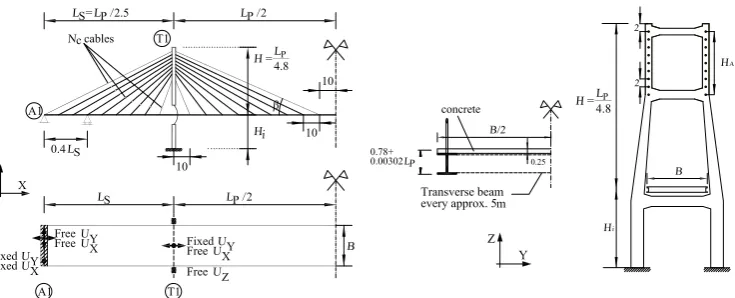
Fig. 1. Parametric definition of the bridges in terms of the main span lengthLP. Units in m.
2.2. Spatially variable motions
The seismic action is applied to the foundations of the bridge models by means of ten sets of independent two-directional horizontal acceleration histories, generated synthetically to account for the SVGM in terms of the wave passage and the incoherence effects. Each set of acceleration histories consists of four different two-directional accelerograms that are applied to the four different, horizontally restrained, supports of the bridge model (abutments and towers). Spectrum-compatible sets of accelerograms are generated parallel to the two horizontal components of the seismic motion.The target spectrum associated with one of these components is reduced by 70% with respect to the other [16] in order to distinguish between the principal components of the earthquake motion. The accelerograms are obtained only for soil type D with different wave propagation velocities in the range of 250-2000 m/s to consider the propagation of the seismic waves in different soils [17]. A peak ground acceleration of 0.5gis selected and the elastic design spectrum as defined in Eurocode 8:Part 1 [10] is adopted for the generation of the signals with aξ=2% elastic damping ratio. The methodology proposed by Deodatis [18] is employed for the generation of the spectrum compatible acceleration histories through an iterative scheme that is based on the assumption that the response spectra of the generated histories, hereafter referred to as ‘obtained RS’ are compared to the target RS and until acceptable convergence is reached (eq. 1).
S0j j(ω)=
RStargetj (ω)
RSf(i)(ω) 2
Sj j(ω) (1)
where: S0j j(ω) is the resulting power spectral density at station j for the next iteration; RStargetj (ω) is the target acceleration RS at station j and RSf(i)(ω) is the resulting acceleration RS from the ith iteration. Figure 2a illustrates a complete set of acceleration histories along the X direction for the four supports of the bridge featuring time delay between supports and loss of coherency. The signals are considered acceptable when the obtained RS of each signal falls within the range 90%-110% of the target RS (fig. 2b).
2.3. Coherency of the signals
4 E. Efthymiou, A. Camara/Procedia Engineering 00 (2017) 000–000
Tolerance range
Fig. 2. (a) Time-histories obtained for the 4 supports; (b) Target and resulting acceleration spectra.
0 2 4 6 8 10
Frequency; ω[Hz]
0.0 0.2 0.4 0.6 0.8 1.0 La g g e d Co he re nc y; γ ( ξ ; ω )
Separation Distance; L =500m
H & V H & W
L & W(α= 2 x 10⁻⁴sec/m)
L & W(α= 1 x 10⁻³sec/m)
Dime nsi onle ss He ig ht; z
Fig. 3. (a) Comparison of the different coherency models. (b) Peak longitudinal,Myy, bending moment along the tower of the bridge withLP=
400 m for different coherency models.
[image:5.544.83.462.65.205.2]parameters. ‘H & W’ presents higher loss of coherency than ‘H & V’ in the low frequency range and this might overestimate the effect of SVGM on the response of the bridges. This is because a lower rate of coherency between signals results in a more pronounced effect on the differential displacements between the corresponding supports. On the other hand ‘L & W’ models are expected to underestimate the effect of SVGM because they result in completely coherent motions in the low frequency range which is important in cable-stayed bridges. To verify the influence of the adopted coherency model on the structural response, Figure 3b compares the peak seismic longitudinal bending moment along the height of the tower in the bridge with 400 m main span. It is observed that ‘H & V’ yields bending moments that are kept between the respective values of the two other ‘extreme’ coherency models and for this reason this model is adopted for the final signals.
Table 1. Adopted coherency models.
Harichandran & Vanmarcke (‘H & V’ and ‘H & W’) Luco & Wong (‘L & W’)
|γ(`,f)|=A·exp −2·B·`
a·v(f)
!
+(1−A)·exp −2·B·`
v(f)
!
|γ(ξ, ω)|=exp−a2 d·ω
2·ξ2
v(f)=k·h1+(f/fo)b
i−1/2
B=(1−A+a·A)
where:
`is the separation distance adis the parameter that controls the decay of the coherency model
fis the circular frequency ωis the frequency
[image:5.544.94.461.235.367.2] [image:5.544.45.501.548.668.2]z Dime
nsi
onle
ss
He
ig
ht;
Dime
nsi
onle
ss
He
ig
ht;
Maximum Seismic Maximum Seismic
Fig. 4. (a) Longitudinal bending momentMyy[MNm]; (b) transverse bending momentMxx[MNm]. Results at the right tower (second tower to
[image:6.544.51.492.59.210.2]receive the seismic actions).
Table 2. Assumed parameters for the coherency models.
Coherency Model Recorded Event (SMART-1 [21]) Parameters
Harichandran & Vanmarcke Event 20 A=0.736 a=0.147 k=5120 m fo=1.09 Hz b=2.78
Harichandran & Wang Event 24 A=0.626 a=0.022 k=19700 m fo=2.02 Hz b=3.47
Luco & Wong ad=2·104s/m
Luco & Wong ad=1·103s/m
3. Results and discussion
Figure 4 shows the longitudinal, Myy, and transverse, Mxx, response of the proposed cable-stayed bridges. The coloured lines represent the average response from the applied accelerations for the different velocities adopted, and the grey band around the average response under the assumption of the assumption of synchronous motion represents one standard deviation. Overall, the SVGM is critical in the longitudinal direction whereas it has a relatively small effect in the transverse direction. The presence of the cable-system contributes to this increment in the longitudinal response because it restrains the towers in this direction. Additionally, in both directions the tower of the shortest bridge is most vulnerable against the asynchronous motion, which verifies the finding that stiffer structures are more prone to be affected by the SVGM [6]. Finally, lower propagation velocities of the seismic waves result in a more critical response. This is especially clear in the case of the short tower in the longitudinal direction (fig. 4a, left plot), where the SVGM results in higher bending moments along the height of the tower. As the velocity increases the response tends to resemble that from the synchronous motions, which is due to the fact that pseudo-static forces progressively decrease as the wave propagation velocity tends to infinity.
It is interesting to note that in the case of the short tower the lowest velocity imposes a delay ofdt=0.8 s in the ground motion of both towers (spaced 200 m apart). This is close to the 8thvibration mode of the bridge (T=0.76 s) which is an anti-symmetric longitudinal vibration mode that involves longitudinal response of the towers and it could explain the amplified response due to the SVGM. Similarly, the intermediate velocity (c=1000 m/s) results in a delay ofdt=0.2 s in the ground motion of both towers in the same bridge, corresponding to a higher-order anti-symmetric vibration mode (T=0.21 s) that involves mainly the longitudinal movement of the upper part of the tower, resulting in the increased longitudinal response of the tower in the area of the cable-system.
4. Conclusions
[image:6.544.35.506.257.324.2]6 E. Efthymiou, A. Camara/Procedia Engineering 00 (2017) 000–000
in different soils. The study also examines different coherency models for the seismic motion and discusses the impact they have on the response of the bridge. The adopted methodology for the generation of multivariate, non-stationary, spectrum compatible acceleration histories that account for the wave passage and incoherence effects is also presented. The results of response-history dynamic analyses show that the effect of the asynchronous motion on the towers of cable-stayed bridges is especially important in the longitudinal direction. The influence of the SVGM is found to be strongly dependent on the stiffness of the towers because shorter towers are found more vulnerable against the SVGM. Additionally, lower wave propagation velocities result in amplified response values compared to higher velocities. Finally, it is seen that the rate of coherency between the signals affects the response of the towers. Consequently, the SVGM should be examined for various wave propagation velocities in the seismic design of long-span cable-stayed bridges, taking also account of the correlation between the differential seismic motions through various coherency models.
Acknowledgements
The authors would like to thank the Research Centre for Civil Engineering Structures and the Department of Civil Engineering at City, University of London.
References
[1] A. M. Abdel-Ghaffar, Cable - stayed bridges under seismic action, in: Cable - stayed Bridges; Recent Developments and their Future, Elsevier Science Ltd., Yokohama (Japan), 1991, pp. 171–192.
[2] A. Der Kiureghian, A. Neuenhofer, Response spectrum method for multi support seismic excitations, Earthquake engineering and structural dynamics 21 (1992) 713–740.
[3] R. W. Clough, J. Penzien, Dynamics of structures, McGraw-Hill, New York, 1975.
[4] A. Zerva, Effect of spatial variability and propagation of seismic ground motions on the response of multiply supported structures, Probabilistic Engineering Mechanics 6 (1991) 212–221.
[5] K. Soyluk, A. A. Dumanoglu, Comparison of asynchronous and stochastic dynamic responses of a cable stayed bridge, Engineering Structures 22 (2000) 435–445.
[6] M. J. N. Priestley, F. Seible, G. M. Calvi, Seismic design and retrofit of bridges, John Wiley & Sons Ltd., 1996.
[7] E. Efthymiou, A. Camara, Spatial variability effects of the seismic action in cable-stayed bridges and modelling techniques, in: IABSE Conference Structural Engineering: Providing Solutions to Global Challenges, Geneva (Switzerland), 2015.
[8] M. Shinozuka, V. Saxena, G. Deodatis, Effect of spatial variation of ground on highway structures, Technical Report, MCEER ISN 1520-295X, 2000.
[9] A. Camara, M. A. Astiz, A. J. Ye, Fundamental mode estimation for modern cable-stayed bridges considering the tower flexibility, Journal of Bridge Engineering 19 (2014).
[10] EN 1998-1:2004, Eurocode 8: Design of structures for earthquake resistance. Part 1: General rules, seismic actions and rules for buildings, 2004. EN 1998-1:2004.
[11] EN 1992-1-1:2004, Eurocode 2: Design of concrete structures. Part 1.1. General rules and rules for buildings, 2004. EN 1992-1-1:2004. [12] EN 1993-1-1:2005, Eurocode 3: Design of steel structures. Part 1.1. General rules and rules for buildings, 2005. EN 1993-1-1:2005. [13] EN 11:2006, Eurocode 3: Design of steel structures. Part 1.11. Design of structures with tension components, 2006. EN
1993-1-11:2006.
[14] Abaqus 6.13, ABAQUS 6.13 (Computer Software), 2013.
[15] H. Hilber, T. Hughes, R. Taylor, Improved numerical dissipation for time integration algorithms in structural dymanics, Earthquake Engineering and Sructural Dynamics 5 (1977) 283–292.
[16] O. A. Lopez, J. J. Hernandez, R. Bonilla, A. Fernandez, Response spectra for multicomponent structural analysis., Earthquake Spectra 22 (2006) 85–113.
[17] A. Dumanoglu, R. Severn, Seismic response of modern suspension bridges to asynchronous longitudinal and lateral ground motion., Proceed-ings of the Institution of Civil Engineers 87 (1989) 73–86.
[18] G. Deodatis, Non-stationary stochastic vector processes: seismic ground motion applications., Prob. Eng. Mech. 11 (1996) 149–168. [19] R. S. Harichandran, E. H. Vanmarcke, Stochastic variation of earthquake ground motion in space and time, J. Eng. Mech. 112 (1986) 154–174. [20] J. E. Luco, H. L. Wong, Response of a rigid foundation to a spatially random ground motion, Earthquake engineering and structural dynamics
14 (1986) 891–908.

![Fig. 4. (a) Longitudinal bending moment Myy [MNm]; (b) transverse bending moment Mxx [MNm]](https://thumb-us.123doks.com/thumbv2/123dok_us/1406748.93610/6.544.51.492.59.210/fig-longitudinal-bending-moment-myy-transverse-bending-moment.webp)