0022-538X/86/100012-07$02.00/0
Copyright © 1986,AmericanSociety for Microbiology
Translation
and
Processing
of Mouse
Hepatitis
Virus Virion RNA
in
a
Cell-Free
System
MARKR. DENISON ANDSTANLEY PERLMAN* DepartmentofPediatrics, University ofIowa, Iowa City, Iowa52242
Received 10 March 1986/Accepted 31 May 1986
The first event after infection with mouse hepatitis virus strain A59 (MHV-A59) is presumed to be the synthesis ofanRNA-dependentRNA polymerasefrom theinputgenomic RNA. Thesynthesisandprocessing of this putative polymerase protein was studied in a cell-free translation system utilizing 60S RNA from MHV-A59 virions. The polypeptide products of this reaction included two major species of 220 and 28 kilodaltons. Kineticsexperiments indicated that bothp220andp28 appeared after60minofincubationand that protein p28was synthesized initiallyas theN-terminal portion ofalarger precursorprotein.When the cell-free translation products were labeled with N-formyl[35S]methionyl-tRNA;, p28 was the predominant radioactive product, confirmingitsN-terminal location withinaprecursorprotein. Translationinthepresence of the protease inhibitors leupeptin and ZnC12 resulted in the disappearance of p28 and p220 and the
appearanceofa newprotein, p250.Thisproduct,whichapproachedthe maximal sizepredictedforaprotein synthesized from genomicRNA,wasnotroutinelydetected in the absence of inhibitorsevenunderconditions whichoptimized thetranslation reaction forelongationofproteins. Subsequentchelation ofZnC12resultedin thepartialcleavageof theprecursorproteinand thereappearanceofp28.One-dimensional peptide mapping withStaphylococcusaureus V-8 protease confirmedthe precursor-productrelationshipofp250andp28. The resultsshowthatMHVvirionRNA,likemanyother viralRNAs,is translated intoalargepolyprotein,which iscleavedsoonaftersynthesisintosmaller, presumablyfunctionalproteins. Thisis in marked contrast tothe synthesis ofother MHV proteins, inwhich minimalproteolytic processing occurs.
The Coronaviridae are a group ofRNA viruses with a
unique replication strategy. The genome ofmousehepatitis virus (MHV), the mostintensively studied coronavirus, is a
single-stranded, infectious RNA molecule withamolecular
size of approximately 6 x 10⁶ daltons (14, 23, 26, 30). MHV-infected cells contain multiple polyadenylated subgenomic RNAs associated with polyribosomes (11, 19,
26). These mRNAs form a 3' coterminal, nested set of
sequences, and only the 5' portion of each RNA, whichis absentfromthenextsmallest RNA,istranslatedintoprotein
(3, 10, 13, 14, 20, 23, 27, 30).
Several of the subgenomic RNAs have beenisolatedand
translated either in Xenopus oocytes or in an in vitro protein-synthesizingsystemfrom rabbitreticulocytes. RNA 2 codes for a 35,000-dalton nonstructural protein, RNA 3 codes for the surface glycoprotein E2, RNA 4codes for a nonstructural protein of 14,000 molecular weight, RNA 5 codesforanonstructuralproteinof 10,000 molecularweight,
RNA 6codes fortheEltransmembrane protein, and RNA 7 codes for the nucleocapsid protein. RNA 1, which is be-lieved to code for the virus-induced RNA-dependent RNA
polymerase, has been translated in vitro into a series of related polypeptides of approximately 200,000 molecular
weight (13, 20, 22, 24, 25).
By analogy with other positive-stranded RNA viruses, such as Sindbis virus (5), these large proteins might be the precursors to the proteins actually present in the viral
polymerase. However, it isdifficult to study these proteins in
infected cells because MHV does not inhibit host-cell pro-tein synthesis efficiently, even at late times after infection. Tocircumventthis difficulty, we used a rabbit reticulocyte
cell-freeprotein-synthesizingsystem to study thetranslation andprocessing of the protein products of the genomic RNA
* Correspondingauthor.
ofMHV. Our results showed that virion RNA was translated in vitro into severallargepolypeptides, in agreement witha previous report (13), and that these large proteins were cleaved toa 28-kilodalton (kDa)
protein.
MATERIALS ANDMETHODS
Preparation of MHV-A59 virion RNA. MHV strain A59 (MHV-A59), used in all studies, was plaque-purified twice and propagated in either L-2 or BALB/c 3T3 clone 17 (17CL-1) cells in Dulbecco minimal essential medium sup-plemented with 2% bovine calfserum.The virus titerwas6 x 108 as determined by plaque assay on 17CL-1 cells. For preparation of virionRNA,4 x 108cells were infectedata multiplicity of infection of 0.04 and grown in Dulbecco minimal essentialmedium with2% bovine calf serum and 20 mM
N-2-hydroxyethylpiperazine-N'-2-ethanesulfonic
acid (HEPES); pH 6.5) for 16 to 24 h, at which timeapproxi-mately50% ofthe cells were involved insyncytium forma-tion.
The cellular supernatants wereharvested,combined, and centrifuged at 1,000 x g for 5min to remove cellular debris. The virus was concentratedby centrifugationfor 90 min at 80,000 x ginaBeckmanSW27rotorandsuspended in 1 ml NTE buffer (0.1 M NaCl, 0.01 M Tris [pH 7.4], 0.001 M
EDTA) by sonication. The virus was further purified by
centrifugation through 5 to 40% sucrose in NTE buffer at 105,000 x g for 45 min in aBeckman SW40 rotor. The visible virus band was harvested, diluted 1: 1 with NTE buffer, made 1% in sodiumdodecylsulfate (SDS), and layered on a 15to 30% sucrosegradient in NTE buffer containing 0.5% SDS. Virion RNA was separated by centrifugation at 45,000 xgfor 16 h in a Beckman SW27 rotor, and the gradient was
fractionated through aGilford spectrophotometer. A single peak of RNAsedimentingatabout 60Swascollected,made 0.5Minpotassiumacetate,andprecipitatedwith 2 volumes 12
on November 10, 2019 by guest
http://jvi.asm.org/
of 95% EtOH at -20°C. In some instances, the homogeneity
ofthe preparation wasconfirmed by formaldehyde agarose gel electrophoresis.
In vitro translation system. Rabbit reticulocyte lysate (New England Nuclear Corp.) was used for all translation
reactions. The translation reaction was usually 25 to 50 ,Il, and the concentrations of potassium acetate (180 mM) and
magnesium acetate (1.5 mM) were optimized for the
trans-lationof MHV-A59 mRNA. Purified MHV-A59 virion RNA or polyadenylated intracellular RNA from
MHV-A59-infected cells was added at a concentration of 8 ,ug/ml.
[35S]methionine
(2,400,uCi/ml)or[3H]leucine(1,000pCi/ml)(New England Nuclear Corp.) was added as radiolabel. Incubations were for 90 min at 30°C unless otherwise
indi-cated.
Forexperimentsinvolving the inhibition of translation of
cappedRNA, the capanalog methyl-7 GTP(P-L
Biochemi-cals, Inc.) was added before virion RNA at concentrations
from0 to 2 mM, keeping the total reaction volume constant. In pulse-chase experiments, unlabeled L-methionine was added toa final concentration of 10 mM.
Reactions were ended by the addition of a large excess of
sample buffer(4% SDS, 40%glycerol, 0.125 M Tris [pH7.4], 2% 2-mercaptoethanol, 0.01% bromphenol blue) (9) before
boiling for4 min at 100°C.
One-dimensional gel electrophoresis. SDS-polyacrylamide gel electrophoresis (PAGE) of translation products was
performed as described by Maizel (15) and modified by Hames (8), with 5 to 18% gradient polyacrylamide gels unless otherwise noted. Thegelswererunfor 14hat50 V.
Thegelswerefixed, stained,andprocessedforfluorography witheither sodium salicylate (2) or22%2,5-diphenyloxazole
indimethyl sulfoxide(12). The treatedgels were exposed to
KodakXAR X-rayfilmat -70°C.
For the determination of the molecular sizes ofthe
cell-free products, sampleswere analyzed on 7to 20% gradient polyacrylamide gels,onwhichlogmobilityisproportionalto
logmolecularsize inthe rangeof14to 300 kDa(8).
Preparation and use of
N-formyl[35S]methionyl-tRNA.
Preparation of
N-formyl[35S]methionyl-tRNAj
wasper-formed by the method ofStanley (28) by using an Esche-richia coli S-100 fraction kindly provided by Thomas
Conway ofthe Department of
Biochemistry, University
of Iowa. Thisfraction contains activetRNAsynthetasesanda tRNAtransformylase, but under the conditions ofthereac-tion, only
methionyl-tRNAi
ischarged bytheE. colisynthe-tase (28).
The final reaction mixture included the E. coli S-100 fraction,
[35S]methionine
(2.0mCi/ml),
theformyl
donor Caleucovorin(0.02mM; LederleLaboratories), unfractionated
calf liver tRNA (0.9
mg/ml; Boehringer
MannheimBiochemicals), 10 mM ATP, 15 mM MgCl2, and 50 mM
cacodylic acid (pH 7.4). After 30 minof incubationat
37°C,
the tRNAwasextracted withphenol andether,
precipitated
with ethanol, and stored at -70°C. Foruse in the reticulo-cyte lysate translation system,
N-formyl[35S]methionyl-tRNAi
wascentrifuged,
lyophilized, suspended
in water,and added at a concentration of 80,ug/ml,
along with alarge
excessof unlabeledL-methionine (10
mM)
whicheliminatedthe incorporation of any residual free
[35S]methionine
(5).
Incubations were for 90 min at30°C,
and the reactionproductswereanalyzedas
previously
described.One-dimensional peptide
mapping.
Partialdigest mapping
was performed by the method of Cleveland et al.
(4).
Individual
[35S]methionine-labeled
protein
bands of interest were excised from 5 to 18%gradient
SDS-polyacrylamide
gels which had been briefly stained and destained. They
were equilibrated for 30 min in buffer containing 0.125 M
Tris(pH 6.8), 0.1%SDS, and 1mM EDTAand thenplaced
ontopofthe
stacking portion
ofa15%polyacrylamide-SDS gel. The gel pieces were overlaid with more of the samesolutioncontaining 10% glycerol and 50p,g of
Staphylococ-cus aureus V-8 protease perml (Miles Laboratories, Inc.).
Electrophoresis
wasperformed
as usual, except that the powerwas turned off for 30 min when thedye
front neared thebottom of the stacking gel.RESULTS
(i)Optimizationof rabbitreticulocytelysateforsynthesis of
high-molecular-weight proteins. Rabbit
reticulocyte
lysate
was optimized forthe translation of virion RNA into
high-molecular-weight
products as described in Materials andMethods.
Incorporation
of[35S]methionine
wasdirectly
pro-portional
to the concentration ofexogenous RNAadded in the rangefrom 2to16,ug/ml,
andnodifferencein the sizeof theproducts
wasobservedby
SDS-PAGEanalysis.
ARNAconcentration of 8
,ug/ml
was used in theexperiments
described below.
The
efficiency
oftranslationwascalculated,
assuming
an averageprotein
methionine content of 1.5% andassuming
that the
endogenous
methionine concentration in the rabbitreticulocyte
lysate
was 10 ,uM (21). Ifall theradioactivity
were incorporated into proteins of 220 kDa, three protein
molecules would be
synthesized
from each RNA moleculeper hour. Because many ofthe translation
products
weresmaller than 220
kDa,
the actual rate of initiation wasprobably in the range of fiveto seven times per hour. This
rate of initiation is similar tothat
reported
for otherlarge
viral proteins (5, 21).(ii) Kinetics of appearance of >200- and 28-kDa proteins.
The time courseofappearanceof radioactive
protein
prod-ucts was determined
by
removing
samples atvarioustimesforassay
by
SDS-PAGE(Fig. 1).
Consistent withthetheo-reticalrateof translationin the in vitro system(16),
proteins
with molecular sizes greater than 100 kDa
appeared
afterapproximately
30 min ofsynthesis,
whereaslarger
poly-peptides
(>200kDa)
didnotappearuntil 60to75 min. The mostprominent large
polypeptide
had a molecular size of220 kDa
(p220),
although
several other bands were also observed. Thesediscretebands,
with molecularsizesrang-ing
from69to200kDa,
wereobserved in allexperiments
andprobably
represented products
of premature termination (seeFig. 8).
Inaddition,
aprotein larger
than 220 kDawasoften
detected,
but because itwasnotpresentasreproduc-ibly
as wasp220,
itwas notfurtheranalyzed.
Another
major
protein,
with a molecular size of 28 kDa(p28), wasfirst detected after 60to75 minof
synthesis.
Thesimultaneouslate appearanceof
p220
andp28
suggested
thatp28
might
resultfrom theposttranslational
processing
ofalarger
protein,
possibly
while thenascentpolypeptide
chainwas still attached to the
polyribosome.
The observationswerenot
dependent
ontheradioactive aminoacid,
because identicalresultswere seenwhen[35S]methionine
rather than[3H]leucine
wasusedasthesourceofradioactivity (Fig. 2).
(iii) Effect of cap analog on in vitro
synthesis
of viralproteins.MHV-A59virionRNA
requires
acapped
5'end for proper translation(11).
To exclude thepossibility
thatp28
was alate-appearing
translationproduct
ofuncapped,
de-graded RNA,
wetranslated virion RNA in the presence ofincreasing
concentrations ofmethyl-7
GTP,
acompetitive
inhibitor of
cap-dependent
initiation(1)
(Fig. 2). Cap analog
on November 10, 2019 by guest
http://jvi.asm.org/
added at a concentration of 1 mM before the addition of RNA inhibited the synthesis of p28 and larger proteins
proportionally, with an overall80% reduction ofradiolabel incorporation, suggesting that all theproteinswereproducts
of translation ofcapped mRNA. The addition of 2 mM cap analog resulted in a97%reduction in [35S]methionine incor-poration.
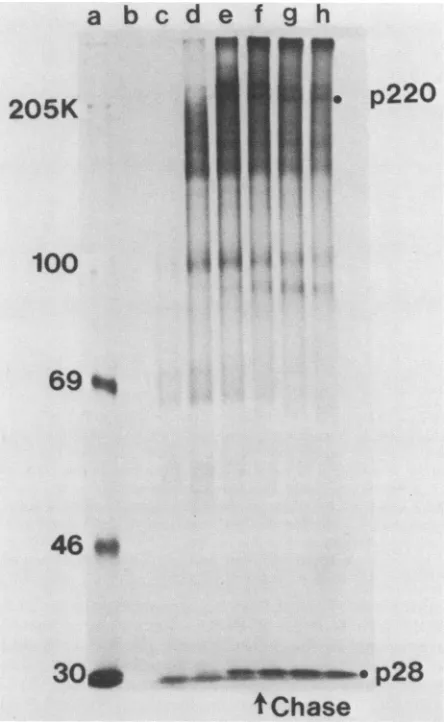
(iv)Processing of proteins after chase with unlabeled methi-onine. Iflargerproteins areprecursorstop28, radioactivity
should continue to accumulate in the smaller proteinin the presenceof a chasewith an excessofunlabeled aminoacid.
We labeledproteinsfor60 minwith
[35SJmethionine
and thenaddedalarge excess ofunlabeledmethionine (final
concen-tration, 10 mM) before an additional 90 min ofincubation
(Fig. 3). Both p220 and p28 were labeled by the end ofthe pulse period, and total acid-insoluble radioactivity did not
increase overthe subsequent 90 min of chase. In contrast, the radioactivity associated with p28 increased
approxi-mately53%overthisperiod, as determinedbydensitometry.
This result suggested that p28 resulted from thecleavage of
alargerprecursorprotein.
We thenused avariablepulse-constant chase analysis to
determine the relative position of p28 within the larger
precursor proteins (Fig. 4). If p28 is located at the N
terminus ofthe precursor protein, it should be synthesized withinthefirst few minutes of incubation,evenifit doesnot appear asadiscreteprotein untillater.Proteinswerelabeled inthecell-free translation systemforperiodsranging from5 to 30 min at 5-min intervals before chase with unlabeled
a
b
cd
ef
g
h
i i-.p28
FIG. 1. Time course of appearance of [3H]leucine-labeled polypeptides ofMHV-A59 translation in vitro. MHV-A59 60SRNA
(8 ,ug/ml) was added to the rabbit reticulocyte lysate cell-free
translation systemcontaining [3H]leucine (1,000 ,uCi/ml). Aliquots
werewithdrawnat the times indicatedandimmediatelyprocessed for electrophoresis on a 5 to 18% gradient polyacrylamide gel.
Lanes:c,15min;d, 30min;e,45min; f, 60 min;g,75min; h,90min;
i, 120min;andj, 150 min. Laneacontains14C-labeledmarkers, and
lane b shows theproduct of 150 min of incubation without added
RNA.
a
b
c
d
e
205K
69
-30 -
.-op220
op28
FIG. 2. Effect of cap analog on in vitro synthesis of [35S]methionine-labeled polypeptides. A competitive inhibitor of cappedinitiation, methyl-7 GTP, wasadded tofourparallel trans-lation reactionsattheconcentrations indicated. Lanes:b, 0 mM; c, 0.4mM;d, 1.0 mM; ande,2.0 mM. [35S]methioninewasaddedasa radiolabel in these 90-min translations. Laneacontains '4C-labeled markers.Equalamountsof each reactionwereelectrophoresedona 5 to18% gradient gel andanalyzed by fluorography.
methionine. Radioactivity associated withp28wasapparent after a5-minlabel and60-min chase, showingthat the RNA encoding this protein was translated at very early times of incubation. Because p28 was not labeled in pulse experi-ments before 60 min of incubation, these results were consistent withanN-terminal location forp28 withinalarger precursorprotein.
(v) N-terminal labeling of in vitro proteins.
N-For-myl[35S]methionyl-tRNAi
is incorporated only into the Nterminus of primary translation products (28). Thus, its presence in a protein indicates that the protein is either a primary translation product or its N-terminal fragment. To confirm the N-terminal location ofp28 within the precursor protein, the cell-free translation products of MHV-A59 virion RNA were labeled with N-formyl[35S]methionyl-tRNA, (Fig. 5). Alarge proportion of the radioactivity was present in p28 (lanes d and e), in marked contrast to the results obtained when [35S]methionine was the radioactive precursor (lane b). The observation that little radioactivity wasassociated with proteins of >200 kDaindicatedthat p28 wascleavedfrommostof the precursorproteins of thissize. (vi) Effect of proteolysis inhibition. Because p28 appeared to result from the proteolytic cleavage oflargerprecursors, we examined the products synthesized in the presence of known protease inhibitors (Fig. 6). We determined that
processing was most effectively inhibited by using either ZnCl2 (1.0 mM) orleupeptin (1.0 mM), both of which are
general inhibitors of thiol and serine proteases (32). Both inhibitors had two effects on the protein patterns seen by SDS-PAGE analysis. First, the accumulation of p28 was
selectively inhibited without a majoreffect on the accumu-lation of the higher-molecular-weight proteins. Second, the
major band,p220, wasreduced in amount, and a new band of 250 kDa (p250) appeared. Many of the other proteins also
appeared toincrease inmolecular size by 20 to 30 kDa. TheinhibitionofproteolysisbyZnCl2shouldbereversible
byachelatingagentsuchasEDTA. In the nextexperiment, proteinswerelabeledfor 60 min in the presence ofZnCl2so
2-0-5-
K
,111
on November 10, 2019 by guest
http://jvi.asm.org/
[image:3.612.357.513.69.249.2] [image:3.612.55.296.378.624.2]a
b
c
d
e
f
g
h
205K
100 4 W r
69e*
46
s
30*
____.
p28
tChase
FIG. 3. SDS-PAGE analysis of polypeptides synthesized in con-stantpulse-variable chase experiment. [35S]methionine and MHV-A59virion RNAwere addedtothecell-free system and incubated for 60 min with samples withdrawnatthe times indicated.Lanes: b, 0 min; c, 15 min; d, 30 min; and e, 60 min. Excess unlabeled methionine(10 mM) wasthen added foranadditional90min, with samples withdrawnat90 min(lane f) 120min(laneg),and150min (lane h).Lane acontains '4C-labeledmarkerproteins. All samples wereelectrophoresedon a7.5%polyacrylamide gel.
that no p28 was detectable (Fig. 7). A portion of the
incubation mixture was then incubated with 1 mM EDTA and unlabeled methionine for an additional 60 min. The
addition ofEDTA to the
ZnCl2-treated
sample resultedin the appearanceof p28(Fig.
7),suggesting that reactivation ofthe protease caused theresumption of processing. Onlyasmallfraction of the usualamount ofp28 was observed after the EDTA treatment, suggesting either that the reversal of inhibition was incomplete or that the precursor proteins
were less efficiently processed afterrelease from
polynbo-somes.
Inotherexperiments,
N-formyl[35S]methionyl-tRNA;
was used to label selectively the N-terminal methionine of theproteins synthesized inthe presenceofleupeptin.Incontrast tothe results shown inFig. 5, mostofthe
radioactivity
wasincorporated into p250 andother
high-molecular-weight
pro-teins, with little incorporated into p28
(data
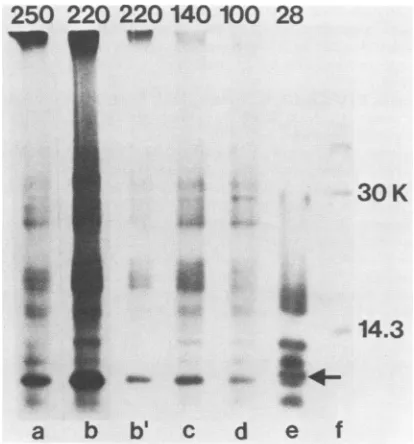
not shown).(vii) S. aureus V-8proteasemappingof in vitroproducts.To
establish moreclearlythe
relationship
between themultiple
large protein products and p28, we performed
one-dimensional peptide mapping with S. aureus V-8 protease (Fig. 8). The products of the in vitro translation were
fractionated by SDS-PAGE, and the individual proteins of interest were excised before treatment with V-8 protease in situ (4). We anticipated that the peptides present in p28 would not be found in the p220 protein but would be present in p250 synthesized in the presence of leupeptin or ZnCl2.
However, most ofthe peptides present in p28 were also found in bothp220 and p250 (Fig. 8), although at least one of thepeptides appearedunique to p28 (indicated by arrow). In
addition,p220 andp250 were very similar by partial peptide
mapping, with no unique peptides observed in p250. The experiment also showed that the multiple proteins observed between p28 and p220 were related, suggesting that they were premature termination products.
These resultsdemonstrated that all of the high-molecular-weight proteins are related and confirmed the
precursor-product relationship of these proteins and p28. The same results were obtained when the cell-free translation products were analyzed bytryptic peptide mapping (data not shown).
DISCUSSION
Using cell-free translation ofMHV-A59 virion RNA, we
identified two previously undescribed products, p28 and p250. p250 appeared to be theprimarytranslation productof virion RNA and was reproducibly detectable only when
proteolysis was inhibited. The data indicated that p28 is
cleaved from the N-terminal portions of p250, as well as from premature termination products. Cleavage occurred eitherfrom nascentpolypeptides during translationorfrom
a
b
cd
ef
gh
I
205K
i
.ii,
69
30
I
.
p220
FIG. 4. SDS-PAGEanalysisofproteinssynthesizedin variable pulse-constant chase experiment. In this pulse-chase experiment, samples werewithdrawn fromthe translation reactionatthe indi-cated times and incubated an additional 60 min at 30°C in the presenceofexcessunlabeled methionine(10 mM).Lanes: c, 5min; d,10 min;e, 15min; f, 20min; g, 25 min; andh,30 min. Lane a
contains14C-labeled markers, and lane b contains theproducts of incubation withoutvirion RNA. Allproductswereanalyzedon a5
to12.5%gradient gel.
0
P28
on November 10, 2019 by guest
http://jvi.asm.org/
[image:4.612.73.295.68.429.2] [image:4.612.334.556.388.635.2]a b c d e
p220i
p28
FIG. 5. Analysis of N-terminal labeling of cell-free translation products. EitherN-formyl[35S]methionyl-tRNAj or[35S]methionine was added to translation reactions and incubated for 90 min. Sampleswerethenrun on asingle5 to18%gradientpolyacrylamide gel. Lanes: b, [35S]methionine-labeled proteins; c, N-formyl
[35S]methionyl-tRNAi
withoutadded RNA; d ande, incorporation from charged or charged and formylated[35S]methionyl-tRNAi,
respectively.Lane acontains'IC-labeledmarkers. Products inlane bwerediluted1:10in SDSsamplebuffer, and 4% ofthetranslation mixturewasapplied. Products inlanes c,d, ande werediluted 1:1, andthe entire translation reaction wasappliedtothegel.The two left laneswereexposedtoKodakXAR film at-70°C for6days, and the three rightlanes wereexposedfor 17days.
newly completed proteins soon after release from polyribo-somes, because p250 was not detected in the absence of protease inhibitors and p220 and p28 appeared nearly simul-taneously in the cell-free lysate.
Experiments with alphaviruses and picornaviruses have demonstrated that the translation and processing of other
viral polyproteins intherabbit reticulocyte lysate faithfully reproduce the eventsoccurring in infected cells (5, 17, 21). In particular, the cell-free translation and processing of another large viral RNA, the bottom component RNA of
a b c
d
p220
.
I
p250
p28
FIG. 6. Effect of protease inhibitors on cell-free translation of MHV-A59 virion RNA. Either leupeptin or zinc chloride was added tothelysate before the addition of MHV-A59 mRNA, and transla-tion reactransla-tions were incubated for 90 min in the presence of [35S]methionine: Lanes: b, control translation without protease inhibitors; c, addition ofleupeptin (1.0 mM); and d, addition of
ZnCI2
(1.0 mM). 'IC-labeled markers are in lane a. Samples were analyzedon a 5 to18%gradient polyacrylamide gel.a b
c d
205K-100
46
30
..p250
p220
.p28
FIG. 7. EDTAreversal ofproteolysis inhibition by ZnC12. Con-trol and ZnCl2 translations were performed as described in the legend toFig. 6, except that thetime of incubationwas 120min. In addition, asample waswithdrawn from the translation containing ZnCl2at 60minand incubatedanadditional60minin thepresence ofEDTA(1.0 mM) and unlabeled methionine (10mM). Lanes: b, [35S]methioninecontrol;c,ZnCl2(1 mM);andd,ZnCl2 pulse-EDTA chase. "C-labeled markers are in lane a. Equal amounts ofeach reactionwereelectrophoresed ona5to 18%polyacrylamide gel.
cowpeamosaic virus (CPMV) is remarkably similarto that of MHV-A59. Whereas MHV-A59wastranslated intop250 and processed rapidly into p220 and p28, the RNA of this
plant virus is translated both in vivo and in vitro into a 200-kDa protein, which is processed to a 32- and 170-kDa protein (18). The 32-kDa protein, like the MHV-A59 28-kDa
protein, is released from the N terminus of nascent polypeptides chains (6), because it appears in the lysate at approximately the same time asdoes the 200-kDa protein.
The 200-kDa CPMV protein is cleaved to the 170- and 32-kDaproteins in vitro by anendogenous protease of the rabbit reticulocyte lysate; a cellular enzyme is presumed
responsible for the cleavage in infected cells (31). The protease responsible for the cleavage of the MHV-A59 precursorproteins was sensitive toleupeptin and toZnCl2, but whether it is viralorhost inorigin isnotknown.
The 170-kDa CPMV protein is further cleaved in vivo at oneoftwolocationstoproduceeithera 110- to60-kDapair or a87-to84-kDapairofproteins.This secondary process-ingoccursinvitro,butonly after prolonged incubation (18 h) of the rabbitreticulocyte lysate(6). In our system, no further
processing of the cell-free products of MHV-A59 virion RNAwas observed after 150 min ofincubation.
The 32-kDa CPMV protein has protease activity and cleaves at a glutamine-methionine (7, 33). This protein probably does not catalyze its own cleavage from a precur-sor protein but is important in the processing of the viral
capsid proteins. Each of the MHV-A59 proteins is translated fromaseparatemRNA (13, 20, 22), andfurther processing, exceptfor the envelope glycoprotein E2 (23, 30) and perhaps the viral polymerase, does not require a virus-induced protease. Thus, although the processing of the MHV-A59 translation product is similar to that of the CPMV p200, there isless needforaproteasein the replication strategy as thus far elucidated.
We were unableto detect p28 in MHV-A59-infected cell
on November 10, 2019 by guest
http://jvi.asm.org/
[image:5.612.367.493.71.267.2] [image:5.612.128.223.72.202.2] [image:5.612.102.246.456.641.2]250
220
220 140 100
28
S
t.
30K
4-14.3
a
b
b'
c
d
ef
FIG. 8. One-dimensional peptide mapping of in vitro products.
Virion RNAwas translatedasdescribed in the legendto Fig. 6for
90 min in the presence and absence of leupeptin. Samples were electrophoresed on a5 to18%polyacrylamide gel, and the bands of
interest were excised and treated with S. aureus V-8 protease as
described in Materialsand Methods. Lanes: a,leupeptin p250 band;
b, controlp220 band; b',control p220 band;c,controlp140band; d,
controlpl00 band;e,controlp28band; and f,14C-labeled markers.
Lanes a and b and b' through fwere exposed for 11 and 5 days,
respectively. A peptideuniquetop28 is indicated by thearrow.
lysatesatearly orlatetimes after infection by either one- or
two-dimensional gel electrophoresis, mostlikely because it is produced inquantities below the limits of detection of the assay procedure. This is not surprising, because in cells infected with other viruses, viral polymerase is usually presentas aminor protein(29), thereby makingidentification
of the specific protein difficult. MHV-A59 does not shut off hostcell protein synthesis efficiently, evenatlatetimes after infection, making detection ofp28more difficult.
The peptide mapping experiments confirmed the
precur-sor-product relationship between p250 and p28. However, they also indicated that p220 contained all the peptides present inp28. Thiswasunanticipated, because thekinetics
analyses suggested that p220 and p28 were both cleavage
products ofp250. The mostlikely explanation for thisresult is incomplete cleavage of p28 from the larger precursor
proteins. The experiments in which the cell-free products
werelabeled with N-formyl[35S]methionyl-tRNAj were
con-sistent with this explanation, because small amounts of radioactivity were associated with the larger proteins,
sug-gesting incomplete processing.
A putative viral polymerase must be able to synthesize complementary-strand RNA, leader RNA, andgenomicand subgenomic positive-strand RNA. Although the enzymatic activities of p28and p220 have notbeen determined, these proteins orother cleavage products are candidates for such
functions.
ACKNOWLEDGMENTS
We thank Peter Rubenstein, C. M. Stoltzfus, and C. Grose for
helpfuldiscussions.
The
investigation
wassupported
in partby PublicHealth Service Biomedical ResearchSupport grant
RR 05372 from the Biomedical ResearchSupport
Branch,
Division of Research Facilities andResources, National Institutes of Health. LITERATURE CITED
1.
Banerjee,
A. K. 1980.5'-Terminal
cap structure in eucaryoticmessenger
ribonucleic acids. Microbiol. Rev. 44:175-205. 2.Chamberlain,
J.
P.
1979.Fluorographic
detectionofradioactiv-ity
inpolyacrylamide
gels
with the water-soluble fluor, sodiumsalicylate.
Anal. Biochem. 98:132-135.3.
Cheley,
S.,
R.Anderson,
M.J. Cupples,
E. C. M.LeeChan, andV. L.Morris. 1981. Intracellularmurine hepatitis virus-specific RNAs contain common
sequences.
Virology 112:596-604. 4.Cleveland,
D.W.,
S. G.Fischer,
M. W. Kirschner, and U. K.Laemmli. 1977.
Peptide mapping
by
limited proteolysis in so-diumdodecyl
sulfate andanalysis
by gel electrophoresis. J. Biol. Chem. 252:1102-1106.5. Collins, P. L., F.J.
Fuller,
P.I.
Marcus,L. E. Hightower, and L. A. Ball. 1982.Synthesis
andprocessing
of Sindbis virus nonstructuralproteins
in vitro. Virology 118:363-379.6.
Franssen, H.,
R.Goldbach,
and A. van Kammen. 1984. Trans-lation of bottomcomponent
RNA ofcowpea mosaic virus inreticulocyte lysate:
faithfulproteolytic
processing of thepri-mary
translationproduct.
VirusRes. 1:39-49.7.
Franssen, H.,
M.Moerman,
G. Rezelman, and R. Goldbach. 1984. Evidence that the32,000-dalton
protein encoded bybot-tom-component
RNA ofcowpea
mosaic virus is a proteolyticprocessing
enzyme.
J. Virol. 50:183-190.8.
Hames,
B. D. 1981. An introduction to polyacrylamide gelelectrophoresis, p.
1-91. In B. D. Hames and D. Rickwood(ed.),
Gelelectrophoresis
ofproteins:
apracticalapproach. IRL Press Ltd., London.9.
Laemmli,
U. K. 1970.Cleavage
ofstructuralproteinsduring theassembly
of the head ofbacteriophage
T4. Nature (London) 227:680-685.10.
Lai,
M. M.C.,
P. R.Brayton,
R. C. Armen, C. D. Patton, C.Pugh,
and S. A. Stohlman. 1981. Mouse hepatitis virus A59:mRNA structure and
genetic
localization of thesequencediver-gence
fromhepatotropic
strain MHV-3. J. Virol. 39:823-834.11.
Lai,
M. M.C.,
C. D.Patton,
andS. A. Stohlman. 1982. Further characterization of mRNA's of mousehepatitis virus: presence of common5'-end
nucleotides. J. Virol. 41:557-565.12.
Laskey,
R.A.,
and A. D. Mills. 1975.Quantitative
filmdetectionof
3H
and"4C
inpolyacrylamide
gels
by fluorography. Eur. J. Biochem. 56:335-341.13.
Leibowitz,
J.
L.,
S. R.Weiss,
E.Paavola,and C. W.Bond. 1982. Cell-free translation of murine coronavirus RNA. J. Virol. 43:905-913.14.
Leibowitz,
J.
L.,
K. C.Wilhelmson,
and C. W. Bond. 1981. Thevirus-specific
intracellular RNAspecies
of two murinecoronaviruses: MHV-A59 andMHV-JHM.Virology 114:39-51. 15.
Maizel,
J.
1971.Polyacrylamide
gel electrophoresis of viralproteins.
Methods Virol. 5:176-246.16.
Merrick,
W. C. 1983. Translation of exogenous mRNAs inreticulocyte lysates.
Methods Enzymol. 101:606-615.17.
Pelham,
H. R. B. 1978. Translation of encephalomyocarditisvirus RNA in vitro
yields
an active proteolytic processingenzyme.
Eur. J. Biochem. 85:457-462.18.
Pelham,
H. R. B. 1979.Synthesis
andproteolytic processing ofcowpea
mosaic virus in reticulocyte lysates. Virology 96:463-477.
19.
Robb, J.,
and C. W. Bond. 1979. Pathogenic murine coro-naviruses. I. Characterization ofbiologicalbehaviorin vitro andvirus-specific
intracellular RNA ofstrongly
neurotropicJHMVand
weakly
neurotropic
A59 viruses. Virology94:352-370.20.
Rottier,
P.J.
M.,
W.J.M.Spaan,
M. C. Horzinek, andB. A. M.van der
Zeijst.
1981. Translation of three mouse hepatitisvirusstrain A59
subgenomic
RNAs in Xenopuslaevis
oocytes. J. Virol. 38:20-26.21.
Shih,
D.S.,
C. T.Shih,
0.Kew,
M.Pallansch, R. Rueckert,andP.
Kaesberg.
1978. Cell-free synthesis and processing oftheon November 10, 2019 by guest
http://jvi.asm.org/
[image:6.612.75.282.70.292.2]proteins of poliovirus. Proc. Natl. Acad. Sci. USA 75: 5807-5811.
22. Siddell, S. 1983. Coronavirus JHM: coding assignments of subgenomic mRNAs. J. Gen. Virol. 64:113-125.
23. Siddell, S., H. Wege,and V. terMeulen. 1983. The biology of coronaviruses. J. Gen. Virol. 64:761-776.
24. Skinner,M. A., D. Ebper, andS.G.Siddell. 1985.Coronavirus MHV-JHM mRNA 5 hasasequencearrangementwhich
poten-tially allows translation ofasecond, downstreamopenreading frame. J. Gen. Virol.66:581-592.
25. Skinner, M. A., and S. G. Siddell. 1985. Coding sequence of coronavirus MHV-JHM mRNA 4. J.Gen. Virol. 66:593-596.
26. Spaan, W., P. Rottier, M. C. Horzinek,and B. A. M.vander
Zv"ist.
1981. Isolation and characterization of virus-specificmRNAs in cells infected with mouse hepatitis virus
(MHV-A59). Virology 108:424-434.
27. Sppan,W.J. M.,P.J.M.Rottier,M. C.Horzinek,and B. A.M.
van der Zeijst. 1982. Sequence relationships between the
genome and the intracellular RNA species 1, 3, 6, and 7 of mousehepatitis virus strain A59. J. Virol. 42:432-439. 28. Stanley, W. M., Jr. 1974. Specific aminoacylation of the
methi-onine-specific tRNAs of eukaryotes. Methods Enzymol. 29:530-547.
29. Strauss, E. G., and J. H. Strauss.1983. Replication strategies of the single stranded RNA viruses of eukaryotes. Curr. Top. Microbiol. Immunol. 105:1-98.
30. Sturman, L. S., andK. V.Holmes.1983. The molecularbiology ofcoronaviruses.Adv. Virus Res. 28:35-112.
31. Tian, Y. C., and D. S. Shih.1986. Cleavage ofaviral polyprotein
byacellularproteolytic activity. J. Virol. 57:547-551.
32. Umezawa, H. 1982. Low-molecular-weightenzymeinhibitors of
microbial origin. Annu. Rev. Microbiol. 36:75-99.
33. Van Wezenbeek, P., J. Verver, J. Harmsen, P. Vos, and A.van
Kammen. 1983. Primarystructureandgeneorganization of the middle component RNA of cowpea mosaic virus. EMBO J.
2:941-946.
![FIG.2.0.4cappedlationradiolabel5markers.[35S]methionine-labeled to Effectof cap analogoninvitrosynthesisof polypeptides](https://thumb-us.123doks.com/thumbv2/123dok_us/1373067.90631/3.612.55.296.378.624/fig-cappedlationradiolabel-markers-methionine-labeled-effectof-analogoninvitrosynthesisof-polypeptides.webp)
![FIG. 7.troladdition,legendZnCl2ofchase.reaction[35S]methionine EDTA EDTA reversal of proteolysis inhibition by ZnC12](https://thumb-us.123doks.com/thumbv2/123dok_us/1373067.90631/5.612.102.246.456.641/troladdition-legendzncl-ofchase-reaction-methionine-reversal-proteolysis-inhibition.webp)