0022-538X/90/083654-07$02.00/0
Copyright © 1990,American Society for Microbiology
Differences in the Basal Activity of the Long Terminal Repeat
Determine Different Replicative Capacities of
Two
Closely Related
Human
Immunodeficiency Virus
Type
1
Isolates
EFIMI. GOLUB, GONGRONG LI, ANDDAVID J. VOLSKY*
Molecular VirologyLaboratory, St. Luke'slRoosevelt Hospital CenterandCollege of Physicians and Surgeons, Columbia University, 432 West58thStreet, New York, New York 10019
Received 6 February 1990/Accepted 23April 1990
Two human immunodeficiency virus type 1 (HIV-1) variants derived from a single parental isolate were foundtodiffersubstantiallyintheirabilitytoreplicateinCD4-positivecells.Using transient chloramphenicol acetyltransferase expressionassays, weshow thatthelongterminalrepeat(LTR) of thebetter-replicatingvirus hassignificantly highercapacitythanthat ofthecompanion virustodirectgeneexpressionin Tcells. Sequence data and site-specffic mutagenesis experiments demonstrate that the higher LTR activity of the better-replicatingHIV-1 isdue toacombinedeffectoftwomutations: (i)apoint mutationinposition -94 (relative tothetranscriptional startsite), whichislocatedbetweenthe twosubunits ofthe HIV-1 enhancer, and (ii)a
duplication of24basepairsinpositions -128to-151, whichwasnotpreviouslyknowntobe involved inany regulatory function. The presence of these mutations increases the basal level of the LTR-driven gene
expression and does not influence the degree ofinduction caused by the viral tat gene product or by cell activation. Reciprocal exchange of LTRs between the respective viral DNAs results in a change of a
recombinant virusreplicationpatternconsistent with theactivity of theparticularLTR. Theseexperiments suggestthat the HIV-1 LTR isoneofthesites whichdeterminesthefunctionalheterogeneityofHIV-1.
Human immunodeficiency virus type 1 (HIV-1), the pri-mary etiologic agent of acquired immune deficiency
syn-drome (AIDS) (5, 12, 24), comprises many molecularly and
functionallydivergentisolates. Functional variations include
differences in serotype, host cell range, cytopathicity, and
replicative potential (9, 25, 37). It hasbeen suggested that progression of HIV disease correlateswiththe emergenceof new HIV-1 variants in an individual (3, 7); for example, HIV-1 isolates from AIDS patients are generally more viru-lent and exhibit wider host cell range than viruses from
asymptomaticindividuals (3, 7, 37).
Theextensiveheterogeneityof HIV-1 has been attributed tothehigherror rateofHIV-1reversetranscriptase(30, 38).
Using 1 to5 years asthe timeofdivergenceamong sequen-tial HIV-1isolatesfrompatients (16), therateofevolution of HIV-1 wasestimatedtobe10-3nucleotidesubstitutionsper site per year for the env gene and 10-4substitutions per site per yearforthe gag gene (16, 38).Although thesemutations
are seen throughout the HIV-1 genome (2), only some are
likely to providethe mutant virus withselective advantage and thus facilitate the spread ofa particular variant.
Fre-quently observed mutations in the variable regions ofthe HIV-1 env gene (2, 36) could produce variants resistant to the immune responseprovoked by the original (nonmutated) viral strain. Mutations in the HIV-1 nef gene may be responsible for the emergence of HIV-1 strains with altered virulence (26). Selective advantage may also result from mutations in other regulatory genes of the virus, tat and rev, orinnoncoding regulatory sites present in the long terminal repeat(LTR).
Recently, wehavedescribed several distinct HIV-1 vari-ants obtained by molecular cloning from a clinical HIV-1
isolate(32, 33).Like other multiple HIV-1 variants from one
patient (15, 16), these viruses are closely related to one
* Correspondingauthor.
another but differprofoundlyintheirbiologicproperties (32,
33). In particular, a variant designated N1T-Einfects cells slowly and without cytopathic effects but replicates
effi-ciently inchronicallyinfected cells. Anothervariant, desig-nated N1T-A, causes rapid cytopathic infection but
repli-cates less efficiently than N1T-E. The difference in the
replicationlevelsofN1T-Eand N1T-A virusespromptedus to compare the respective activities of N1T-E and N1T-A LTRelements. The LTR contains an HIV-1 promoter and several regulatory elements which control proviral DNA
expression (39), and it is likely that some mutations in the LTR may have a profound effect on the activity of the element and the resultant virus replication. Our data show that the N1T-Evirus LTR isatleast three timesmoreactive
thanthe N1T-A LTR indirectingboth viral andheterologous
geneexpression. Theincrease in the N1T-E LTRactivityis dueto twospecificmutations in the LTRregion. Hence,the observed differences in thebiologicproperties ofN1T-E and N1T-A viruses are, at least in part, causedby mutations in
theirrespective LTRs
MATERIALSANDMETHODS
Cell lines and viruses. CD4-positive T-cell lines used in thesestudieswereobtainedasfollows: CEM cells(10)were
receivedfrom the American Type CultureCollection
(Rock-ville, Md.); CR-10, the HIV-1 lysis-resistant subclone of
CEM,wasestablished inourlaboratory (6);andJurkat cells were received from W. Green. Suspension cell lines were maintained in RPMI 1640 medium (GIBCO Laboratories,
Grand Island, N.Y.) supplemented with 5% fetal bovine
serum, penicillin G (100 U/ml), and streptomycin (100
,ug/
ml).The
NiT
isolate ofHIV-1(6)waspropagatedin CEMor CR-10 cells; the N1T-E clone of HIV-1NiT
virus was maintained in CEMcells, and cloneN1T-Awasmaintained inchronicallyinfectedCR-10/NlT-A cells. Virusproduction3654
on November 10, 2019 by guest
http://jvi.asm.org/
A
pEG601 I-'
(-639) (-151)(-128) (-105)(-82)
pEG602 i #
(-63) (-175) (l-2) f4)l
(-105)(82)
(+1) (+80)
(+1)
pEG614-1
Y-(-663)
pEG617-1 63)
(-639)
*yyn
.J-(+1)
(+1)
(+1
B
LTR I "body" LTR
(--634 I 840 I
b 3 s7 *185wis+ G
bp 78 ls
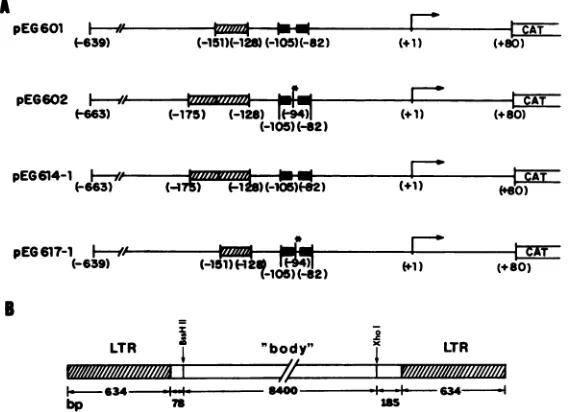
FIG. 1. Schematic representation of HIV-1 LTR and infectious DNA recombinants. (A) N1T-A and N1T-E virus LTR constructs. Symbols: _, enhancerrepeats; M,sequencesduplicatedin N1T-E. The point mutation in position -94 is marked(*). (B) Positions of the
restriction sites used for construction of the recombinant molecular clones of the N1T-A and N1T-E viruses (pEG823 and pE6824, respectively) containing reciprocally exchanged LTRs.
wasmonitored by measuringthelevelsof HIV-1p24antigen inculture supematants.
HIV-1 clones and plasmids. Molecular clones of HIV-1 (strain N1T) were isolated from the high-molecular-weight genomic DNA from the NlT-producing cells as described
previously (32). A detailedcharacterization of these clones
andprogenyviruses has beenpublished (32). Plasmid
pU3R-III, which containsabacterial chloramphenicol
acetyltrans-ferase (cat)geneunderthecontrol ofanHIV-1(clone C15)
LTR, was obtained from W. Haseltine (35). Plasmids
pEG601 and pEG602werederived from pU3R-III by replac-ing the XhoI-HindIII fragment (spanning nucleotides -639 to +80) with respective fragments from N1T-A and N1T-E clones. Plasmids pEG610 and pEG611 were constructed from pEG601 and pEG602, respectively, by deletinga
483-base-pair (bp) XhoI-AvaI fragment. Plasmids pEG610 and pEG611carryHIV-1 LTRsequencesspanning from -157to +80 and from -181 to +80, respectively. pEG614 was derived frompEG602 by substituting cytidine for thymidine in position -94. The substitution was made by the
site-specific mutagenesis procedure ofKunkel (22). pEG617 is similarto pEG602, except that theduplication in positions -128to -151 has beenremovedby digestion with Scal. A schematic drawing of theseconstructs is shown in Fig. 1A. Plasmid pEG621 was obtained by the substitution of the
720-bp XhoI-HindIII fragment of pU3R-III by the 230-bp AvaI-HindIII fragment of thepLTR-1/cat plasmid. The last plasmid carries the catgene controlled by the HIV-1/SF-2
(formerly called ARV-2) LTR(23). Recombinantmolecular clonesofN1T-E and N1T-Avirusescontaining reciprocally exchanged LTRs (plasmids pEG823 and pEG824) were obtained by exchanging BssHII-XhoI fragments of the pNlT-A and pNlT-E. Plasmid pEG823 consists of the N1T-A LTR and N1T-E virus "body"; plasmid pEG824 carries the N1T-E virus LTR and N1T-A virusbody (for a schematicrepresentation, see Fig. 1B).
DNAsequencing. The XhoI-HindIII fragmentsfrom NlT-A and N1T-E provirus clones were cloned into M13mpl8
andM13mpl9 vectors and sequenced inboth directionsby
thedideoxyribonucleotide chain terminationprocedure
(34).
Reactions were catalyzed with modified T7 DNA polymer-ase (Sequenase; United States Biochemical Corp.,
Cleve-land, Ohio) according to the instructions of the manufac-turer.
CATassay. Cell extractswereassayed for chlorampheni-col acetyltransferase (CAT) activity by thin-layer chroma-tography as described elsewhere (4). Spots on the chroma-tography plates corresponding to different forms of
[14C]chloramphenicol
were removed and quantitated in ascintillation counter. CAT enzyme activity was linear in
eachassay.CATactivity valueswerenormalized against the
amountofprotein contained in theextracts.
Other analytical procedures, chemicals, and radiochemi-cals. Unless specifiedotherwise,DNA transfections (DEAE-dextran-dimethyl sulfoxide procedure), plasmidpropagation and DNAisolation, and other molecular-biologicprocedures
were performed according to standard methods (4). HIV-1 infection was monitored as describedpreviously (6, 32) by detecting the presenceof HIV antigens in infected cells by
the indirect immunofluorescence method andby measuring the level ofreversetranscriptase activityorHIV-1 p24core protein (Coulter HIV Ag assay; Coulter Immunology, Hi-aleah, Fla.) in culture supernatants. Enzymes for recombi-nantDNA experiments werepurchased from NewEngland
BioLabs, Inc. (Beverly, Mass.), and Bethesda Research Laboratories(Gaithersburg, Md.),andfluorescein isothiocy-anate-conjugated anti-human immunoglobulin G was
pur-chased from Tago Immunochemicals (Burlingame, Calif.). All radiochemicals were obtained from DuPont, NEN
Re-searchProducts(Boston, Mass.), and otherchemicalswere
purchasedfrom SigmaChemical Co. (St. Louis,
Mo.).
RESULTS
N1T-E virus LTR is moreactive than N1T-A virus LTR. Previous studies demonstrated that N1T-E virus hasahigher
replicative capacityinchronicallyinfected cells thanN1T-A virus(32, 33). The HIV-1 replication rate is determined by
-rCAT
80)
"0)
(+80) I
0
r----41,
I .
0
x
on November 10, 2019 by guest
http://jvi.asm.org/
[image:2.612.163.447.78.284.2], 40-- O pEG601
.
~~~~~~~~~A
pEG60230ts
20-/
10=
10
1
0 500 1000
DNATRANSFECTED (ng)
FIG. 2. Transcriptional activity of N1T-E and N1T-A virus LTRs.CR10/NiT-A cells (107) chronically infected with HIV-1were
transfected with the designated amounts of plasmid pEG601 or
pEG602 and evaluated for CAT activityasdescribed in thetext. the rate of provirus DNA transcription, and this in turn is controlled by the viral LTR(39). Tocomparethe function of N1T-A and N1T-E virus LTRs,we constructed a series of
indicator plasmids containingthecatgeneunder the control ofanappropriate viral LTR(Fig. 1A).The initialconstructs (plasmids pEG601 and pEG602) contained the entire XhoI-HindIII fragment from the respectiveHIV genome(N1T-A in pEG601orN1T-E in pEG602) andthuswereidentical in
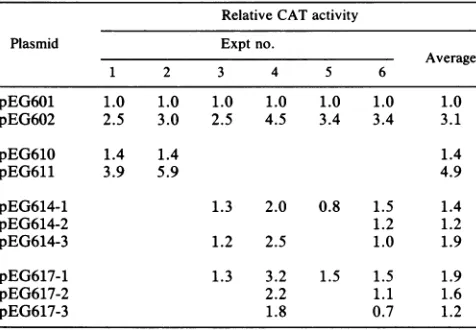
composition to the previously described pU3R-III plasmid (35). Transfections of pEG602 plasmid into HIV-positive cellsresulted inconsistently higherCATactivity compared withpEG601-transfected cells (Fig. 2; Table 1). Onaverage (with data from 11 independent transfection experiments), pEG602-transfected cells synthesized 4.5 times more CAT
enzymethan did thesamecells transfected by pEG601.The
CATactivity directed by plasmid pU3R-III (35)orpEG621, in which CAT expression is controlled by the LTR from HIV-1/SF-2 (23), was similar to that observed with the pEG601 plasmid (data not shown). Transfections with pEG602 resulted in higher CATenzymeactivity, compared
[image:3.612.70.305.62.230.2]with pEG601- or pU3R-III-transfected cells, regardless of
TABLE 1. Effect of mutationsin LTRsonCATactivitya
Relative CATactivity
Plasmid Exptno.
Average
1 2 3 4 5 6
pEG601 1.0 1.0 1.0 1.0 1.0 1.0 1.0
pEG602 2.5 3.0 2.5 4.5 3.4 3.4 3.1
pEG610 1.4 1.4 1.4
pEG611 3.9 5.9 4.9
pEG614-1 1.3 2.0 0.8 1.5 1.4
pEG614-2 1.2 1.2
pEG614-3 1.2 2.5 1.0 1.9
pEG617-1 1.3 3.2 1.5 1.5 1.9
pEG617-2 2.2 1.1 1.6
pEG617-3 1.8 0.7 1.2
a CR10/N1T-Acells(107)weretransfected with 100 ng ofplasmidDNA.
Plasmid composition is shown diagrammatically in Fig. 1A. The numbers
followingplasmid designations (i.e., -1, -2, and -3) indicate independently derivedplasmidsubclones.
whether the cells carried N1T-A, N1T-E, orNiTvirus(data notshown).These results suggest that theintrinsic transcrip-tional activity of the N1T-E virus LTR is significantly
stronger than the respective function of the N1T-A or
HIV-1/III-B LTR.
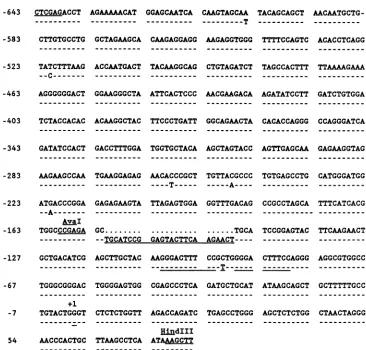
Variantnucleotide sequencesresponsible fortheincrease in the N1T-E virus LTR activity are located between positions -156and +80. Nucleotide sequence analysis revealed that the XhoI-HindIII fragments of the N1T-E and N1T-A vi-rusesdifferby mutationsinsevensites(Fig. 3).Fiveofthese mutationsarelocated within the XhoI-AvaIfragment
(posi-tions -640to-156).Wedeletedthisfragment fromplasmids pEG601 and
pEG602
and obtainedplasmids
pEG610 andpEG611,
respectively.
Thelevel of CATactivity
directedby
plasmid pEG611 was
significantly higher
than that ofthecomparableN1T-A virus-derived
plasmid pEG610 (Table 1).
Thus,thechanges whichincrease the
transcriptional
activity
of the N1T-E virus LTR are localized in the
fragment
betweenpositions -156 and +80.
Mutations which affectN1T-E LTRactivity.The -156/+80 fragmentof the N1T-E LTR differs from the
corresponding
fragment of the N1T-A virus by two mutations:
(i)
apoint
mutation inposition -94, which affects thefour-nucleotide
spacerbetween two 10-bpdirect repeats which are part of the HIV-1 enhancer (31), and
(ii)
aduplication
of 24bp
inpositions
-151 to-128,
which affects a locus that hasnotbeen
implicated
in anyregulatory
function(Fig. 3).
Toelucidate the contribution of these mutations to the
in-creased
activity
of the N1T-ELTR,
plasmids
were con-structed inwhich either thepoint
mutation(pEG614-1)
ortheduplication
(pEG617-1)
waseliminated(Fig. 1A).
As shownin Table1,removalof eitheroneof themutationsresulted in
a
partial
decrease of CATactivity
directedby
the N1T-ELTR, but not to the level observed with the N1T-A LTR.
Thus, each mutationcauses
only
some of the total increase in the HIV-1 LTR-directed CATactivity,
and thehigh-level
activity
observed with the N1T-E virus LTR is a result ofcombinedactionof thetwomutations.
Mutations in the N1T-E LTR result inan increase in the basallevelof
activity.
Different viral and cellularfactorscanconsiderably
modify
thetranscriptional
activity
ofthe HIV-1LTR (18, 19, 29, 40). To determine whether the LTR
mutationsdescribed here influence the basal
activity
of the HIV-1 LTR, weanalyzed
transient CATactivity
in unin-fected Jurkat cells that were transfected withpEG601
orpEG602 in the presence or absence of T-cell activators
phorbol
12-myristate
13-acetate andphytohemagglutinin
(Fig.
4). As in the case of HIV-1-infectedcells,
uninfectedJurkatcells transfected with
pEG602
synthesized
consider-ably
moreCAT enzyme thanpEG601
transfectantsdid(Fig.
4).
Cell stimulation withphorbol
12-myristate
13-acetateandphytohemagglutinin
resulted in CATactivity
increases oftwo- to five-fold above those seen in unstimulated Jurkat cells transfected in
parallel.
The induction index(CAT
activity
instimulated Jurkat cells dividedby
that inunstim-ulated Jurkat
cells)
was similar inpEG602-
andpEG601-transfected cells
(Fig. 4). Thus,
mutations in theN1T-ELTR increase the basal level of theactivity
of theelement,
ratherthan
making
itmore sensitiveto theknown viralorcellulartranscriptional
activators.Reciprocal exchangeof LTRs between N1T-E and N1T-A DNA alters the
replicative phenotype
of recombinant genomes andprogeny viruses. Toexamine the direct effect of variant LTRs onHIV-1 genomeexpression,
weprepared
recombi-nantviral genomes inwhich the N1T-EorN1T-ADNA
body
(minusthe
LTR)
wasrecombined with theLTRof the otheron November 10, 2019 by guest
http://jvi.asm.org/
[image:3.612.69.307.525.690.2]XhoI/A&vaI
-643 CTCGAGACCT AGAAAAACAT GGAGCAATCA CAAGTAGCAA TACAGCAGCT
AACAATGCTG--- ---T ---
---583 CTTGTGCCTG GCTAGAAGCA CAAGAGGAGG AAGAGGTGGG TTTTCCAGTC ACACCTCAGG
-523 TATCTTTAAG ACCAATGACT TACAAGGCAG CTGTAGATCT TAGCCACTTT TTAAAAGAAA -6C3--G-GA- ----GGGC-- T---CT --CG--- ---C-TT
---CT-TGG--463 AGGGGGGACT GGAAGGGCTA ATTCACTCCC AACGAAGACA AGATATCCTT GATCTGTGGA
__________ --- --- --- --- ---- ---- -_-_-__-_-__ -_-____ ___
-403 TCTACCACAC ACAAGGCTAC
__-- - ----__---___---__ __
TTCCCTGATT GGCAGAACTA CACACCAGGG CCAGGGATCA
-343 GATATCCACT GACCTTTGGA TGGTGCTACA AGCTAGTACC AGTTGAGCAA GAGAAGGTAG
-283 AAGAAGCCAA TGAAGGAGAG AACACCCGCT TGTTACGCCC TGTGAGCCTG CATGGGATGG
--- --- ----T--- ---A---- ---
---223 ATGACCCGGA
--A
---AvaI
-163 TGGCCCGAGA
__ ____ _
GAGAGAAGTA TTAGAGTGGA GGTTTGACAG CCGCCTAGCA TTTCATCACG
__________ --- --- - --- -- -- ---
-GC...
[image:4.612.123.489.87.437.2]CrATrrC
... ...TGCA TCCGGAGTAC TTCAAGAACT
AnseArMTrA^ Ar-AAsP _--__---__--___--____
-127 GCTGACATCG AGCTTGCTAC
__-- - ----__---___---__ __
AAGGGACTTT CCGCTGGGGA CTTTCCAGGG AGGCGTGGCC ---T--- _
---67 TGGGCGGGAC TGGGGAGTGG CGAGCCCTCA GATGCTGCAT ATAAGCAGCT GCTTTTTGCC
--- -- ---- - -- - -- -- ---- -- ---
-+1
-7 TGTACTGGGT
54 AACCCACTGC
CTCTCTGGTT AGACCAGATC TGAGCCTGGG
HindIII TTAAGCCTCA ATAAAGCTT
_- - -- ---_--_-__---_-_
AGCTCTCTGG CTAACTAGGG
-_-- ----__-- -__-_----_
FIG. 3. Nucleotide sequences ofthe HIV-1 LTR fragments present in plasmids pEG601 and pEG602. The -643 to +83 nucleotide sequence of theN1T-Avirusisgiven infull, and differencesthat existinthe N1T-E virus areshownbelow the N1T-A sequence. Direct repeats, whicharepartofthe HIV-1 coreenhancer, and theduplication foundin the N1T-E LTR areunderlined.
viral variant(Fig. 1B). The parental and recombinant clones were compared for their ability to replicate in short-term
transfection assays in Jurkat and CEM cells (Table 2). In
addition, molecularly cloned progeny viruses with
recipro-cally exchanged LTRs were evaluated inaninfection assay
(Fig. 5).Asexpected on the basisofpreviouswork (32, 33), N1T-E virus DNAproduced higherlevels of progeny virus than N1T-A DNA did. Reciprocal exchange of LTRs re-versed the ratio, and thus plasmid pEG824 (N1T-A proviral DNAwith N1T-E LTR) produced more progeny than did its counterpart plasmid pEG823 (N1T-E proviral DNA with N1T-A LTR). Similar results were obtained when CAT
activityin thesamecellswasdeterminedas an independent
measure of transfectedDNAexpression (Table2).
Infection experiments withrecombinant progeny viruses
revealed that the reciprocal exchange of the LTRs had an
expected effect on the kinetics ofvirus infection and repli-cation(Fig. 5) butno effecton the cytopathicproperties of the respective viruses (data not shown). The EG824 virus showed faster initial kinetics ofinfection than the parental
N1T-A virus, consistent with higher levels of HIV-1
repli-cation in EG824-infected cells (Fig. 5). TheN1T-A LTR in theEG823virus had little effectonthealreadyslowinfection andreplicationkineticsof theparentalN1T-Evirus(Fig. 5).
DISCUSSION
This paper presentsastructural and functionalanalysisof the LTR elements from two closely related HIV-1 clones withhighand lowreplicationcapacities. Our data show that thetwoLTRsdifferin their activities incorrelationwith the replicationcapacityof theparentalviruses. Thisconclusion
is supported by two lines of evidence: (i) independent of either viral transactivatorTatproteinorthestate of cellular
activation, gene expression directed by the LTR from a
better-replicating N1T-E virus is
significantly
enhancedcompared with that directed by the LTR from a less
effi-cientlyreplicating N1T-A virus (Fig. 2and 4;Table 1); and
(ii) reciprocal exchange of LTRs between the N1T-E and N1T-A viral DNAs reversed the replication ratio (as mea-sured by HIV-1 p24 antigen production per unit of trans-fectedDNA) between the respective proviralDNAs
(Table
2). Furthermore, the
replication
kinetics of recombinant progenyviruses have been alteredto someextent,consistent with the activityofexchanged LTRs (Fig. 5). Byitself,
thefinding of functional differences between the two HIV-1 LTRs was not entirely unexpected. The LTR of murine leukemia virus is perhapsthe most
important
region in the virus forreplication,tissuetropism,and tissuespecificity
forVAWLAUTTUA AVAAti-L
on November 10, 2019 by guest
http://jvi.asm.org/
pEG 601 pEG 602
1 2 3 4 5 6 7 8 9
[PHA+PMA] - - + - + - + - +
00
0)
0)
AcCm E :'
AcOn~~~~~~~~~ 0.2c0
v.
*_lhma_eeee
4
c_w
% of
acety-lation Induction
Index
*9 a * * * * ,
2 11 5 12 14 60 31 67
LJ5 L24
5.5 2.4
2---I
4.3 2.2
FIG. 4. Induction of CAT activity in Jurkat cells. The figure showsatypical autoradiograph from the thin-layerchromatography of conversion of[14C]chloramphenicol (Cm)toitsacetylated form (AcCm) after incubation for20 hwithextractsfromcells transfected by pEG601 (lanes2 to 5) orpEG602 (lanes6 to9). Lanes2,3, 6, and 7show theresults obtainedby transfectionwith 0.5pugofDNAper 5 x 10⁶cells, whilelanes 4, 5, 8, and 9 arefrom transfectants with 2,ugof DNA per 5 x 10⁶ cells. Lane 1 represents mock transfection.
pathogenicity (8, 17). Many regions of the HIV-1 genome,
including the env, nef, vif, and tat genes, are prone to mutation and functionaldiversification, thus contributing to the observed heterogeneity among HIV-1 isolates (2, 15, 16,
32, 36-38). However, the HIV-1 LTR has not been
impli-cated in this context. Ourresults suggest that it should be
included amongthe functionally variable genomic elements of HIV.
Theanalysis presented in this work shows that the higher
activity ofthe N1T-E LTRisdue to acombined effect oftwo mutations. It is unclear from the present data how these mutations may contribute to the observed enhancement of the LTRactivity. The point mutation in position -94 affects a four-nucleotide spacer between two identical direct
re-TABLE 2. Biological properties ofLTRrecombinantsbetween N1T-Aand N1T-E viruses
Measurementofplasmid activity aftertransfectiona
HIV-1 DNA Relative production of Relative CAT
HIV-1p24coreantigen activity
pN1T-A1 1.0 1.0
pN1T-E1 3.3 + 1.3(7) 2.1 ± 0.7(15)
pEG823 1.0 1.0
pEG824 2.2 + 0.6 (4) 1.8 + 0.8 (9)
aJurkat or CEM cells(5x 10⁶)were transfected with appropriate proviral
DNA (0.5 to 1.0jLg)alone or with thepEG601plasmid (100 ng). Two days
aftertransfection, culture supernatants were concentrated 10-fold and
as-sayedfor the presenceofHIV-1 p24 antigens, and cells were assayed for CAT
enzymeactivity.Theresultsare shown as the mean±the standard deviation
of ntransfections, withn in parentheses. Plasmid pEG823 carries theN1T-A
LTRand N1T-Evirus body;plasmid pEG824 carries the N1T-E LTR and
N1T-Abody (Fig. 1B).
100
90
80
70
60
50
40
30
20
1
0
(3.8x10)
5
10)
0
24
6
Timein Culture(days)
FIG. 5. Infection kinetics ofrecombinant NiT viruses with re-ciprocal exchange of LTRs. CEM cells were transfected with appropriate parental and recombinant viral DNA, in duplicate, as
described in footnoteaof Table 2. Twodays later,transfectedcells werewashed andcocultivatedwithhighly HIV-1-susceptibleC-8166 cells. The ratio of infected to uninfected cells was 1:10. At the
designated timepoints, samples were removed and evaluated for HIV-1 infection by immunofluorescence stainingon acetone-fixed cells(31). At the peak of infection, cell-free culture supernatants werealso testedforthelevels ofHIV-1p24 antigens;the resultsare
shown in parentheses as picograms of HIV-1 p24 antigens per
milliliter of supernatant. All the numbers shown in the figure represent averages of measurements from duplicatetestsamples. peats,GGGACTTTCC, which contain binding sequencefor the humanimmunoglobulin enhancer-bindingprotein NF-KB (29) and are part ofthe HIV-1 core enhancer(13, 19, 29). Studies with purified NF-KB protein have shown that it
activates in vitro transcription of the HIV-1 promoter by selective binding to the distal (upstream) repeat sequence (20). This noncooperative binding (and biologic effects) of NF-KB(14) has been attributedto asteric hindrance result-ing from theproximityof thetwosites(20). It is possiblethat the C-to-T mutation in position -94 in the N1T-E LTR changes the configuration ofthe region to increase NF-KB
binding to the downstream repeat. Interaction with NF-KB-like proteins, which require the proximal repeat for
binding (41), could also be altered. In any event, only the
portion of the transcriptional factor(s) binding which is
requiredforbasal promoteractivityappearstobe alteredby
the -94mutation, since both the mutated and nonmutated LTRsareinducedtothesameextent(Fig.4). In contrast to the -94mutation,the24-bpduplicationatthe -128to -151 site in the N1T-E LTR is in a region which has not been
directly implicatedin anyregulatoryfunction.However,one recentstudy has shown that theLTR/CATplasmidcarrying a -119/+80 fragment exhibits a lower level of inducible
transcriptional activity than an analogous plasmid with a -139/+80fragment (19). Conceivably, the -119/-139
frag-ment,which includes part of theduplicationsequencein the N1T-E LTR (spanning positions -128 to -151) influences
transcriptional activity of the HIV-1 LTR. Consistent with these observations, in preliminary experiments we have noted thatareduction of theduplicated regionintheN1T-E LTR to 12 nucleotides reduced the LTR activity to an
on November 10, 2019 by guest
http://jvi.asm.org/
[image:5.612.67.303.61.305.2] [image:5.612.326.559.68.280.2] [image:5.612.66.308.579.655.2]intermediate value between those of the N1T-E and N1T-A LTRs (data not shown).
It is of interest that the more transcriptionally active N1T-E LTRresides in a virus that exhibits slow kinetics of
infection and causes minimal cytopathic effects (32, 33), features which ostensibly point to a defect in virus replica-tion (3, 9). This apparent paradox is resolved if one considers that viral replication (during primary infection) correlates with the kinetics of infection (3, 9, 27) and that the latter are under the controlofother viral elementsbesidesthe LTR. In the case of N1T-E, we have recently mapped the slow infection kinetics and the noncytopathic phenotype of this virus (27, 32) to a defect in the vif gene (K. Sakai, X. Ma, I.
Gordienko, and D. J. Volsky, 6th Int. Conf. AIDS, 1990, abstr. no. 239). Thus, the N1T-E virus exhibits high basal
replicative activity because of the "fast" LTR (this work),
whereas it has slow infection and replication kinetics be-cause ofadefective vif gene.
In summary, ourfindingspointtothe HIV-1 LTRas asite
which may contribute to the variability in the replicative capacity of HIV strains. The difference in the basal and
inducible activity of the N1T-E LTR versus that of the N1T-A or the human T-cell lymphotropic virus type Ill-B LTR was small compared tothe stimulation caused by the Tattransactivatorprotein (35) orby cellular activation (11,
19, 29). However, recentevidence suggeststhat cell activa-tion is not always a requirement for HIV-1 replication (1,
21), and some agentssuch asherpes simplexvirus type1 or adenovirus may activate HIV-1 via pathways which are
distinct from both the tat- and NF-KB-dependent mecha-nisms (28). Higher basal LTR activity levels may thus provideanadvantage forNlT-E-like viruses in the absence of immune stimulationor in the presenceof viral cofactors.
ACKNOWLEDGMENTS
Wethank B.Volsky fortechnicalhelpin partsofthisproject,K. Sakai forhelpful suggestions, W. Haseltinefor the pU3R-III plas-mid,and V. D'Altofortyping the manuscript.
This work was supported by Public Health Service grants CA37465-04,AI-25902,andAI-27397 from theNationalInstitutesof Health.
LITERATURECITED
1. Adachi, A., H. E.Gendelman, S.Koenig,T.Folks,R.Willey,A. Rabson, and M. A. Martin.1986.Productionofacquired immu-nodeficiencysyndrome-associated retrovirus inhumanand
non-humancells transfected withan infectious molecularclone. J. Virol.59:284-291.
2. Alizon, M., S. Wain-Hobson, L. Montagnier, and P. Sonigo. 1986. Geneticvariability oftheAIDSvirus:nucleotidesequence analysis oftwo isolates from Africanpatients. Cell46:63-74. 3. Asjo, B., L. Morfeldt-Manson, J. Albert, G. Biberfeld, A.
Karisson, K. Lidman, and E. M. Fenyo. 1986. Replicative capacity ofhuman immunodeficiencyvirusfrom patientswith varying severity ofHIVinfection. Lancetii:660-662.
4. Ausubel, F. M.,R. Brent, R. E.Kingston, D.D. Moore, J. G. Seidman, J. A. Smith, and K. Struhl (ed.). 1987. Current protocolsinmolecularbiology.JohnWiley&Sons, Inc.,New York.
5. Barre-Sinoussi, F.,J.-C. Chermann,F. Rey,M. T.Nugeyre, S. Chamaret, J. Gruest,C.Axler-Blin,F. Vezinet-Brun,C. Rouzi-oux, W. Rozenbaum, and L. Montagnier. 1983. Isolationofa
T-lymphotropic retrovirus from a patient atrisk for
acquired
immunedeficiencysyndrome(AIDS). Science220:868-871. 6. Casareale, D.,M.Stevenson,K.Sakai,and D.J.Voisky.1987. A
humanT-cell line resistantto cytopathiceffects of the human immunodeficiency virus(HIV).Virology 156:40-49.
7. Cheng-Mayer, C., D. Seto, M. Tateno, and J. A. Levy. 1988.
Biologicalfeatures ofHIV-1 thatcorrelate with virulencein the host. Science240:80-82.
8. DesGroseillers,L.D.,E.Rassart,Y.
Robitailie,
and P.Jolicoeur. 1985. Retrovirus-induced spongiform encephalopathy: the 3'-end long terminal repeat-containing viral sequences influence theincidenceof the disease andthespecificityofthe neurolog-icalsyndrome. Proc. Natl.Acad. Sci. USA82:8818-8822. 9. Evans,L.E.,T.M.McHugh,D. P.Stites,andJ.A.Levy.1987.Differentialabilityofhumanimmunodeficiencyvirusisolatesto
productivelyinfecthumancells.J. Immunol. 138:3415-3418. 10. Foley,G. E.,H.Lazarus,J.Dredd,S.Faber,B.Uzman,B.A.
Boone,and R. E.McCarthy.1965.Continuous culture ofhuman lymphoblastsfromperipheralblood ofachild withacute leuke-mia. Cancer 18:522-529.
11. Folks,T.M., J.Justement,A.Kinter,C. A.
Dinareilo,
andA.S. Fauci. 1987.Cytokine-induced expressionofHIV-1ina chron-icallyinfectedpromonocytecellline. Science238:800-802. 12. Gallo,R.C.,S. Z.Salahuddin,M. Popovic,G. M.Shearer,M.Kaplan, B. F. Haynes, T.J. Palker,R. Redfield,J. Oleske,B. Safai,G.White,P.Foster,and P.D. Markham.1984. Frequent detection and isolation ofcytopathic retroviruses (HTLV-III) from patients with AIDS and at riskfor AIDS. Science 224: 500-503.
13. Garcia,J. A.,F. K.Wu,R.Mitsuyasu,and R. B.Gaynor. 1987. Interactions of cellularproteinsinvolvedin thetranscriptional regulation of the human immunodeficiency virus. EMBO J. 6:3761-3770.
14. Gaynor, R. B.,M. D. Kuwabara, F. K. Wu,J. A.Garcia, D. Harrich,M.Briskin,R.Wall,and D.S.Sigman.1988.Repeated
B motifs in the human immunodeficiency virus type I long
terminal repeat enhancer region do not exhibit cooperative
factorbinding. Proc. Natl. Acad. Sci. USA85:9406-9410. 15. Hahn, B.,M. A.Gonda,G. M.Shaw, M.Popovic,J.A. Hoxie,
R.C.Gallo,and F.Wong-Staal. 1985. Genomicdiversityofthe acquired immune deficiency syndrome virus HTLV-III: dif-ferent viruses exhibit greatest divergence in their envelope
genes. Proc.Nail. Acad. Sci. USA 82:4813-4817.
16. Hahn, B., G. M. Shaw, M. E. Taylor, R. R. Redfield, P. D.
Markham,
S. Z.Salahuddin,F. Wong-Staal,R.C.Gallo,E.S.Parks, and W. P. Parks. 1986. Genetic variation in HTLV-III/LAV overtimein patients with AIDSoratrisk for AIDS. Science 232:1548-1553.
17. Holland, C.A.,J.Wozney, P. A.Chatis,N.Hopkins,andJ.W. Hartley.1985.Construction of recombinants between molecular clones of murine retrovirus MCF247 and Akv: determinant of
an in vitro hostrangeproperty thatmaps in the longterminal repeat. J.Virol. 53:152-157.
18. Jones,K.A., J.T.Kadonaga,P. A.Luciw,and R.Tjian.1986. Activation of the AIDS retrovirus promoter by the cellular transcriptionfactor, Spl. Science 232:755-759.
19.
Kaufmnan,
J. D., G. Valandra, G. Roderiquez, G. Bushar, C.Giri, and M.A. Norcross. 1987. Phorbolesterenhanceshuman
immunodeficiencyvirus-promotedgene
expression
andactsonarepeated10-base-pairfunctional enhancer element. Mol.Cell. Biol. 7:3759-3766.
20. Kawakami, K., C. Scheidereit,and R.G. Roeder. 1988. Identi-ficationand purificationofa human
immunoglobulin-enhancer-binding protein (NF-KB) that activates
transcription
from ahuman
immunodeficiency
virustype 1 promoterin vitro. Proc. Natl.Acad. Sci. USA85:4700-4704.21. Koyanagi, Y.,W. A.O'Brien,J. Q. Zhao, D. W.Golde,J. C. Gasson,and I.S.Y.Chen. 1988.
Cytokines
alterproduction
of HIV-1 from primary mononuclear phagocytes. Science 241:1673-1675.
22. Kunkel,T. A.1985.Rapidandefficient
site-specific
mutagenesis
without phenotypic selection. Proc. Natl. Acad. Sci. USA 82:488-492.
23. Levy, J.A.,C. Cheng-Mayer,D.Dina,and P. A.Luciw. 1986. AIDSretrovirus(ARV-2)clone
replicates
intransfectedhuman and animalfibroblasts. Science232:998-1001.24. Levy,J. A.,A.D.Hoffman,S.M.Kramer,J.A.Landis,J.M.
Shimabukuro,and L.S. Oshiro.1984. Isolation of
lymphocyto-pathic retroviruses from San Francisco
patients
with AIDS.on November 10, 2019 by guest
http://jvi.asm.org/
Science225:840-842.
25. Looney, D. J., A. G. Fisher, S. D. Putney, J. R. Rusche, R. R. Redfield, D. S. Burke, R. C. Gallo, and F. Wong-Staal. 1988. Type restricted neutralization of molecular clones of human immunodeficiency virus. Science 241:357-359.
26. Luciw, P. A., C. Cheng-Mayer, and J. Levy. 1987. Mutational analysisof thehumanimmunodeficiency virus:theorf-Bregion down-regulates virus replication. Proc. Natl. Acad. Sci. USA 84:1434-1438.
27. Ma, X., K.Sakai, F. Sinangil, E. Golub, and D. J. Voisky. 1990. Interactionofanoncytopathic human immunodeficiencyvirus type 1(HIV-1) with targetcells:efficientvirus entry followed by delayed expression of its RNA and protein. Virology 176: 184-194.
28. Nabel, G., and D. Baltimore. 1987. An inducibletranscription factor activates expression ofhumanimmunodeficiency virusin Tcells.Nature(London)326:711-713.
29. Nabel, G. J., S. A. Rice, D. M. Knipe, and D. Baltimore. 1988. Alternative mechanisms for activation ofhuman immunodefi-ciency virus enhancer inT cells.Science239:1299-1302. 30. Preston, B. D., B. J. Poiesz, and L. A. Loeb. 1988. Fidelityof
HIV-1reversetranscriptase. Science242:1168-1171.
31. Rosen, C. A., J. G. Sodroski, and W. A. Haseltine. 1985. The location of cis-acting regulatorysequencesin the humanTcell lymphotropic virus type III (HTLV-III/LAV) long terminal repeat.Cell 41:813-823.
32. Sakai, K., S.Dewhurst, X. Ma, and D. J.Volsky. 1988. Differ-encesin cytopathogenicity and host cellrange amonginfectious molecular clones of human immunodeficiency virus type 1 simultaneously isolated from an individual. J. Virol. 62:4078-4085.
33. Sakai, K., X. Ma, and D. J. Volsky. 1988. Low-cytopathic infectious clone of human immunodeficiencyvirus type 1 (HIV-1).FEBS Lett. 238:257-261.
34. Sanger, F., S. Nicklen, and A. R. Coulson.1977. DNA sequenc-ing with chain-terminating inhibitors. Proc. Natl. Acad. Sci. USA 74:5463-5467.
35. Sodroski, J., C. Rosen, F. Wong-Staal, S. Z. Salahuddin, M. Popovic, S. Arya, R. C. Gallo, and W. A. Haseltine. 1985. Transactingtranscriptional regulation of human T-cellleukemia virus type III longterminalrepeat. Science227:171-173. 36. Starcich, B., B. Hahn, G. Shaw, P. McNeely,S. Modrow, H.
Wolf, W. P. Parks, S. F. Josephs, R.C. Gallo, and F. Wong-Staal. 1986.Identification and characterization of conservedand variable regions in the envelope gene ofHTLV-III/LAV, the retrovirusof AIDS. Cell45:637-648.
37. Tersmette, M., R. E. Y. de Goede, B. J. M. Al, I. N. Winkel, R.A. Gruters, H. T. Cuypers, H. G. Huisman, and F. Miedema. 1988.Differentialsyncytium-inducing capacity ofhuman immu-nodeficiency virus isolates: frequent detection of syncytium-inducing isolates in patients with acquired immunodeficiency syndrome (AIDS) and AIDS-related complex. J. Virol. 62: 2026-2032.
38. Wong-Staal, F. 1988. Variation of the HIV genome: implications for thepathogenesisandprevention of AIDS,p. 147-157. In E. Domingo,J. J. Holland, and P. Ahlquist (ed.), RNAgenetics, vol. III. Variability of RNA genomes. CRC Press, Inc., Boca Raton,Fla.
39. Wong-Staal,F., and R.C.Gallo. 1985.HumanT-lymphotropic retroviruses. Nature(London) 317:345-403.
40. Wu, F., J. Garcia, R. Mitsuyasu, and R. Gaynor. 1988. Alter-ationsinbinding characteristics of the human immunodeficiency virus enhancerfactor. J.Virol.62:218-225.
41. Wu, F. K., J. A.Garcia,D.Harrich, and R. B.Gaynor. 1988. Purification ofthe human immunodeficiency virus type 1 en-hancer andTARbinding proteinsEBP-1andUBP-1.EMBO J. 7:2117-2129.