© Scottish and Southern Electricity Networks
7A Knowledge
Document Owner(s) Project Role
George Bell Project Lead, University of Strathclyde
Han Xu Researcher, University of Strathclyde
Fulin Fan Researcher, University of Strathclyde
Ivana Kockar Principal Investigator (academic lead)
Stevie Adams SSEN Senior Project Manager
Executive summary
Executive summary
This NINES Knowledge and Learning report presents the findings from the
University of Strathclyde research and analysis project which followed the
initial NINES investigation during the period 2011-2013.
This subsequent phase was requested by Ofgem to analyse and present the learning from implementation of the earlier identified opportunities for introducing efficiencies in the operation of the Shetland electricity network, by a combination of renewable generation, a Battery Energy Storage System (BESS) and Domestic Demand Side Management (DDSM), with related services.
University of Strathclyde has a solid history of collaboration with SSEN on energy and grid-related research over a number of years, with contributions from a number of academic faculties and departments. The main research team members in the current project phase were drawn from the Electronic & Electrical Engineering (EEE), Energy Systems Research Unit (ESRU), and the Fraser of Allander Institute (FAI) departments, to provide a multi-perspective engineering and economics view of the challenges and proposed solutions. The commercial firm Smarter Grid Solutions (SGS), responsible for the Active Network Management (ANM) product, was also involved in aspects of this project, and regular discussions were held with other major subcontractors, including Glen Dimplex, Airwave, and customer groups such as Hjaltland Housing Association (HHA).
This research project phase with University of Strathclyde ran for a period of 18 months, and analysed in some detail the generator connections, the operation and control of Domestic Demand-Side Management charging profiles (using storage heaters and hot water tanks) in conjunction with intermittent renewable energy connections (mainly from wind generation), and the effect of a 1MW/3MWh storage battery on the network. The results should aid the decisions of the DNOs and National Grid in optimising energy management scheduling and frequency response of the network. It should also contribute to reducing operating expenditure and may aid the setting of optimal energy tariffs for the Shetland consumers.
The Project integrated a grid-scale BESS and DDSM with an ANM system. Major findings, which are discussed in detail later, are:
• NINES has proven that a distribution system can be operated securely with a high penetration of renewable generation supported by ancillary services from thermal plant. It has also been shown that renewable generators connected via managed connections can experience increased levels of constraint in periods of low demand.
• Frequency responsive DDSM has been shown to
contribute to stable network operation in conjunction with an ANM system. It has also been shown that frequency responsive demand can be used to maintain the frequency stability of the system under the calculated limits.
Contents
Table of Contents
Executive Summary
2
Table of Contents
3
List of Figures and Tables
4
SECTION 1 – Context and Background
5
Project Background
5
NINES Elements
5
NINES Aims and Objectives
7
Agreed Learning Outcomes
9
Project Structure
16
Relevance of NINES to other initiatives
16
SECTION 2 – Modelling & Analysis
19
contributing to Learning Outcomes
Infrastructure and Technology
19
What was learned?
26
Operational and Network Benefits
28
SECTION 3 – Additional Learning Identified
37
ANM
37
DDSM
37
Renewable Generators
39
Battery
39
Operational impact
40
SECTION 4 – Dissemination activities
42
SECTION 5 – Conclusions and main recommendations
48
APPENDICES 51
1. Modelling Approach
51
2. Source Documents for the LO Questions
53
3. List of Contributors
54
4. Glossary
55
Figure 1 NINES in context of other projects 18
Figure 2 overview of NINES elements 20
Figure 3 Schematic representation of the 33kV Shetland network 20
Figure 4 NINES ANM connections 21
Figure 5 DDSM Infrastructure 23
Figure 6 Battery Installation 23
Figure 7 Power outputs (MW) of the 1MW, 3MWh BESS (charge rates are negative and discharge rates 24 are positive) and corresponding variations in SOC (%) within a full cycle from 07:00 on
03/09/2014 to 07:00 on 04/09/2014
Figure 8 Total demand (MW) to be met by generators varying with the BESS’s operation from 07:00 30 on 03/09/2014 to 07:00 on 04/09/2014
Figure 9 Average import (kW) of each flexible DDSM group per day over the year 2016/17 31
Figure 10 flexible demand and margin of stability 34
Figure 11 Maximum wind generation (SVT offline) 35
Under the licence condition, this Integrated Plan was required to demonstrate that it had identified a solution based on the lowest lifecycle costs, taking into account its environmental obligations.
As part of the Integrated Plan submission, consideration was to explore, amongst other things, the upgrading or replacement of Lerwick Power Station, the impact of third party generation requirements, the abundance of renewable energy resources and the future demand on Shetland. The factors influencing the supply and demand issues on Shetland necessitated an innovative approach to their management. However, with innovation comes the need to trial solutions before reaching an answer. As a result, SSEN originally proposed to split the implementation of the Integrated Plan into two phases:
Phase 1 Shetland Trial (Northern Isles New Energy Solutions ‘NINES’) – implementation of the infrastructure necessary to actively manage demand, generation, reactive compensation and energy storage assets. These elements were coordinated to maximise the amount of energy harvested from renewable generation while maintaining supply quality and security. In doing so, two principal effects are achieved:
• a reduction in maximum demand; and
• a reduction in the electricity units generated by fossil fuels
Phase 2 (Shetland Repowering) – upgrading or replacement of Lerwick Power Station by SSEN, taking into account the learning acquired during Phase 1 and, where appropriate, extending the Phase 1 technology.
NINES Elements
NINES was originally designed and developed to operate in conjunction, and integrated, with Lerwick Power Station or its replacement operated by SSEN, and was developed with the main aim of informing the optimum repowering solution. Whilst its primary objective was to trial ‘smarter’ initiatives, importantly NINES has funded elements and infrastructure that are expected to endure as part of, or alongside, the new energy solution. Central to the project has been the creation of an integrated set of models designed to anticipate the impact of NINES, covering the following themes:
• Dynamic Stability
• Steady State
• Unit Scheduling
• Customer demand forecast
• System Development optimisation
• Strategic Risk and Operational risk
• Shetland Economy
• Commercial
Facilitated by modelling and practical learning, the aims of NINES have been to:
1. Increase understanding of how best to accommodate Shetland’s significant wind potential on a small distribution network; and
2. Increase understanding of how the existing and known future demand on the island can be best managed on a constrained, isolated system.
1. Project Background
In 2010, a licence obligation was put in place requiring Scottish and
Southern Electricity Networks (SSEN) to present an Integrated Plan to
manage supply and demand on Shetland. The Shetland Islands are not
connected to the main GB electricity network and, as such, face unique
electrical challenges – but also a unique opportunity to decarbonise supply.
NINES Knowledge & Learning Report Page 5
1
A key driver for the trial has been to develop an understanding how these technologies work and interact in a real-life environment. The learning from NINES has demonstrated that in general terms (with the exception of additional renewables), all NINES technologies predominately involve energy shifting rather than energy reduction.
The following report is one of a number of related reports undertaken by the research team, led by University of Strathclyde and focuses on the main project findings, without excessive detail which might obscure the main message. The detailed reports and conclusions generated by each of the research streams are available on the NINES website for referral by those who have a specific interest in a particular area. These reports are referenced throughout this document, however only the more significant outcomes and observations from each have been incorporated in the following narrative. (See Appendix (2) for full list of reports and links).
NINES Aims and Objectives
The main focus of the project was to increase understanding of:
• how best to accommodate Shetland’s significant and variable wind generation resource within the distribution network; and
• how the existing and future energy demand can best be managed within a constrained, isolated system.
DDSM
The DDSM element of NINES uses innovative “smart heaters” remotely controlled by an ANM System to store energy in heating and hot water appliances located in homes during periods of excess electricity supply. Prototypes of these ‘Quantum’ storage heaters and hot water tanks, developed by Glen Dimplex, were trialled in 6 houses in Lerwick from 2011-2013. Glen Dimplex incorporated lessons learned from that trial into the design of the production versions, which were installed between July 2013 and October 2014 in 234 electrically heated properties owned by the Hjaltland Housing Association (HHA). The details on the impact of DSM, infrastructure requires and network benefits in NINES are presented in in 1A Customer Impact , 1B DDSM Infrastructure , and 1C Network Benefits Report , respectively.
Battery
A BESS rated at 1MW, 3MWh and using lead-acid technology was installed on the network to assist with load-levelling and to support both the variable wind generation inputs to the network and variable demand profiles of the consumers. Initially, a 1MW 6MWh NAS battery was planned to be installed at LPS. However, after an incident involving the same technology in Japan , and after consideration of the risk assessment, SSEN concluded that due to safety concerns related to the location of this installation at LPS, NAS was no longer a suitable technology to be used on Shetland. Details on the NINES BESS operation and it operational effectiveness are given in 2A Battery Operational Effectiveness Report .
Frequency Response
An important area of research was to determine how frequency-responsive elements of the network could be managed to reduce frequency excursions to a minimum. On the mainland of Great Britain, the frequency response is managed by National Grid, however due to the islanded network in Shetland, SSEN are required to manage and control frequency response in that area. Due to the relative size of the Shetland network, i.e. very small in comparison to mainland Britain, there is potential for a wider excursion in the actual frequency of supply. The grid code limits are currently 50Hz (+/-1%), however as an islanded network is subject to potential wider excursion, the research considered +/-2% limits. Assessment of the impact of frequency-responsive DDSM on the Shetland’s network frequency stability is carried out in two aspects, which are commercial impactdetailed in 3A Commercial Impact Report and operational effectiveness detailed in 3B Operational Effectiveness Report.
Renewable Generation
Shetland has a rich source of renewable generation potential, from wind, wave and tidal energy. Previous to NINES, and again due to the islanded network, there was limited scope for connecting intermittent generation. At that time, there was less than 4MW of renewable generation connected, with no further connections possible in order to preserve the stability of the network. Therefore, one of the main aims of the NINES programme was to increase the amount of renewable generation allowable on the network.
These models served to predict the behaviour of the energy systems on Shetland, and to validate each of the key elements of NINES as they were added. Following this validation process, these models have been used to inform the development of the New Energy Solution realised through the competitive process. With the successful operation of NINES, the infrastructure and knowledge to reduce the peak capacity requirement for any replacement solution to a level dependent on the particular assets connected, and the characteristics of the new solution has been determined. The NINES project assets are described below.
1MW battery at Lerwick Power Station
A 1MW battery acts as an energy storage system on the Shetland Network. In addition to facilitating the connection of new renewables, the battery assists in optimising and stabilising the operation of the existing island network by helping to reduce demand peaks. The battery has helped to accommodate the connection of a significant amount of new renewable generation that would otherwise not have been able to connect.
Domestic demand side response with frequency response SSEN has worked with Hjaltland Housing Association to install advanced storage heating and water heating in 223 existing homes, which was the total number of homes participating in NINES DDSM as of March 2017. These new storage and water heaters (which replaced existing traditional storage heaters) were provided through Hjaltland and ERDF funding and have been specifically designed to use a much more flexible electrical charging arrangement. This new charging arrangement is determined based upon the predicted demand, weather forecasts, availability of renewables and any other network constraints. This initial roll out was intended to help gauge the effectiveness of storage and demand side response at the domestic level.
The heaters incorporate additional insulation to minimise heat loss and are fitted with programmable timers to allow users much better control of temperature and operating times when compared with conventional storage and water heating systems. The new heating system is designed to be more efficient, while giving the customer full control of both temperature and operating time and allowing for charging at times that best suit the network.
Renewable generation
Shetland has some of the richest renewable resources in Europe and there is significant interest on the islands to connect a range of new renewable generators. There is a mix of wind and tidal generators currently connected that range in scale from 45kW up to 4.5MW. However, before the advent of NINES these generators could not connect to the network due to the underlying voltage and stability constraints. Connecting more renewable generation, which is unavoidably intermittent, would have exacerbated these problems.
To address this, NINES has trialled an ANM regime which has offered renewable connections to developers. In return, they are required to give their agreement to being constrained when the system cannot accommodate their generation. The measures that have been developed and trialled under NINES are reducing this constraint by being able to actively provide demand when there is renewable resource available.
Indeed, these arrangements could be necessary even if Shetland is to become electrically connected to the mainland at some point in the future. If a single mainland link is damaged, this could result in a prolonged outage, which would mean that Shetland would once again be electrically islanded. Therefore the prospect of and ability to constrain will remain for generators on Shetland, albeit on a less frequent basis.
ANM System
The battery is operated by SSEN to help meet the needs of the Shetland network, by charging during periods of low demand and discharging during periods of high demand. A new control algorithm due to be implemented in 2017 will also take into consideration absorbing of available renewable energy, with an aim of reducing DGs’ curtailment.
LO 2. What is the relationship between intermittent generation and responsive demand, including storage?
• Effectiveness of frequency response demand side management
• Maintaining network stability in an operational environment
• Interaction of numerous variables on a closed electrical system
The ANM platform provides a link between the intermittent generation and responsive demand. Operational experience has provided guidance as to how the ideal scenarios for maximising renewable generation and reducing demand peaks can be found. The project has proven that through active management the relationship between intermittent generation and demand can have a positive impact, and if supported with widespread DDSM and storage elements can help to address network issues such as voltage stability and frequency fluctuations.
• Frequency responsive DDSM has been shown to enable stable network operation in conjunction with an ANM system. We have shown that frequency responsive demand can be used to maintain the frequency stability of the system under the calculated limits.
Implementation of Frequency responsive demand in the Shetland network can increase the amount of renewable generation by two approaches:
• DSM without using frequency response
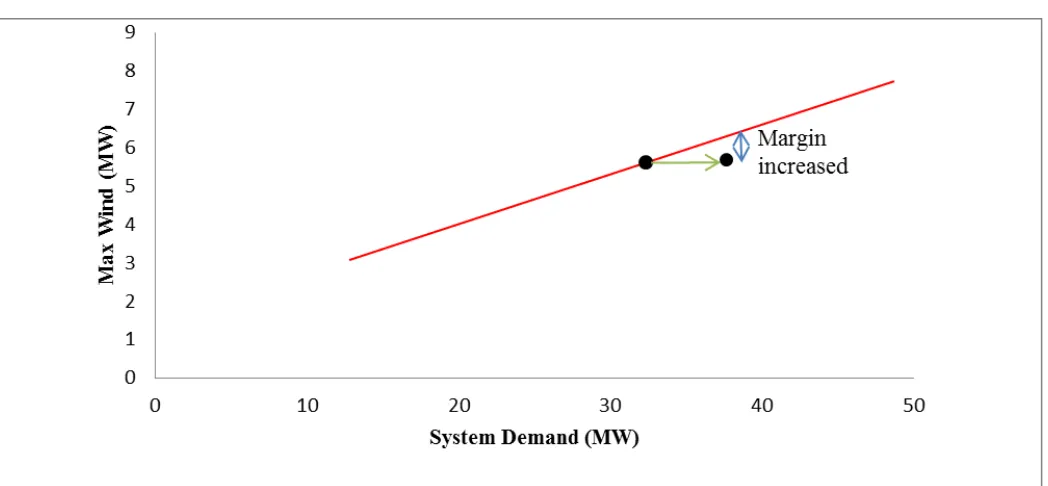
• The use of flexible demand devices without using frequency response can increase the total system demand at certain times and therefore raise the maximum capacity for wind generation
• when heating elements are fully charging in the 223 homes, the total maximum wind generation that is allowed to be connected can be increased by 212 kW.
• DSM with frequency response (FR-DDSM) • The second approach is to use the frequency
responsive demand to maintain the frequency stability of the system under the calculated limits
In general, using FR-DDSM can allow more wind generation than DDSM without frequency response (DSM only when used to increase the demand). For example, the 1.639 MW of FR-DSM allows 1.36 MW of additional wind to be connected, which is higher than using DDSM alone (0.212 kW). The amount of additional wind that could be connected by using FR-DSM is about 6 times greater than that with DDSM only. The use of domestic demand to provide fast frequency response is practical and effective. Further details can be found in the NINES Frequency Response Report 3A 7 and 3B 8;
• The battery analysis detailed in the NINES Report 2A 6 shows the exports of intermittent generation connected via the NINES ANM are limited by constraint rules. The fast-acting SVT export will be reduced to accommodate high outputs from ACG, which may impact the minimum-take export limit of SVT. The BESS can help accommodate high ACG exports through absorbing the ACG power which would otherwise be curtailed. Though the manual schedule is not optimised for this, it has enabled around 52.7MWh of additional ACG export during the off-peak over the period from September 2015 to November 2016. With a large increase in ACG capacity and a new real-time algorithm developed by SSEN to charge the battery in response to ACG curtailment, the BESS will play an important role in promoting the utilisation of intermittent generation while preventing the trigger of reverse power flow protection at SVT.
LO 3. What is the economic impact on industry participants and other stakeholders of the low carbon operation of the network?
• NINES project spending in the Shetland Islands supported 17 person-years of employment on Shetland, over £1 million worth of economic output and £506,850 of the gross value added to the local economy;
• Lower domestic electricity consumption increased household income for the 223 households that were the total number of homes participating in NINES DDSM as at March 2017 by the equivalent of a total of £7,950 for each year of operation;
• The annual economic impact of this additional income on the Shetland economy is equivalent to £10,000 worth of economic output and additional employment of 0.2 persons per year;
• From the economics analysis, a total of 4.9% of the total NINES project budget was spent on Shetland, equivalent to £749,250.
Agreed Learning Outcomes
A list of eight questions has guided the process of research and analysis throughout the NINES programme, and these are presented here for reference, along with representative responses, which are expanded elsewhere in this report and the detailed work package reports.
LO 1. How can a distribution system be securely operated with a high penetration of renewable generation?
Through application of ANM, flexible connections, the 1MW battery and DDSM, NINES has proven that a distribution system can be operated securely with a high penetration of renewable generation. NINES has proven that by controlling these solutions centrally, increased levels of renewables can be connected while maintaining system reliability and safety.
• DDSM was expected to contribute to replacing fossil fuel generation only when at least 14MW wind is connected, and the current wind capacity is well below this. With 19 MW of wind installed, the current deployment could displace 385 MWh of fossil fuel each year;
• NINES 6A Commercial Arrangements and Economics Report determined that DDSM flexible appliances alleviated the curtailment of 77MWh of renewable energy (generated by North Hoo and Luggie’s Knowe), during the period of February 2016 till January 2017. Also, the NINES Report 1C DDSM Network Benefits 4 has concluded that, moving houses from teleswitching to DDSM reduced their maximum possible load at peak times by 0.5 MW as long as the devices followed the imposed schedule. This results from altering fixed schedule times as much as from flexible scheduling. However, unlike teleswitching, DDSM heaters can be charged beyond their schedule. The benefits from frequency response of DDSM were restricted as frequency excursions were in the under-frequency events. In those instances, the DDSM devices could have provided support only if they were in the charging mode, and then were switched off to contribute to network stability. However, charging takes place over around 8 hours at most each day and so far the Lerwick Power Station has not relied on this functionality operationally;
• On average, only around 50-60% of installed capacity was reliably visible and available to the network on any given day. The precise reasons for a significant proportion of appliances being unavailable vary and include appliances being switched off under customer control. Another factor is believed to be poor RF communication between device and Hub within houses;
• With the number of DDSM devices out of communication rising during summer periods to around 50-60%, the theoretical wind generation that could be supported reduces from 385 to 230 MWh;
• A set of constraint rules has been set up to preserve stability of the Shetland network. When a large amount of renewable generations intends to access the network, the fast-acting SVT (Sullom Voe Terminal) generator has to release some load for high exports of non-firm distributed generation, i.e. ANM Controlled Generation (ACG). This may impact the minimum-take export limit of SVT and potentially activate the reverse power flow protection at SVT, which would lead to the curtailment of all ACGs. With the integration of a BESS on the network, the excess of renewable generation can be absorbed by the BESS so as to prevent the large reduction in SVT exports exceeding the limit, especially at times of low demand where the low SVT exports are close to the minimum limit;
• NINES demonstrated that it was possible to fully integrate a number of domestic properties with an ANM system capable of autonomously scheduling demand either at times where intermittent renewable generation would otherwise be constrained, or when demand was low. This has not only served to reduce peak demand on Shetland but has allowed a higher utilisation of renewable energy. Domestic properties have the potential to provide a useful source of demand side response for DNOs. There is significant roll out potential in the UK with over 2.2 million homes currently using electrical heating systems. This could provide significant benefits in balancing the GB network in future;
• The existing commercial arrangements with the DDSM, Shetland generators, and the large-scale VRLA battery contributed to supporting the secure and stable operation of Shetland network. The DDSM customers provide necessary flexibility by allowing shifting a portion of their load (i.e. storage and water heating) to reduce peak demand and renewable generation curtailment. These customers are engaged directly through 6 core methods, which are9: issue payments, website updates, hosting of local meetings, issuing of written communications, initiation of phone calls, and carrying out home visits. Shetland generators include conventional generators, ‘must-take’ renewable generators, and flexibly connected DGs. The conventional generators provide the resource of stability and security for Shetland power system. Renewable DGs commercial arrangements are based on LIFO, which defines an order in which their outputs can be curtailed when needed to maintain secure system operation.
NINES Knowledge & Learning Report
• These new appliances are better insulated than those they replaced and they also provide the HHA tenants with more control over when the stored heat is used. Modelling studies show that, other things being equal, the new heaters should use 10-18% less energy to maintain the same room temperatures because they are able to take only the energy they will need and control the time when it is used. The benefits associated with these appliances can be taken either in terms of costs saving (reduction in energy used) or comfort (increased room temperatures);
• Recruitment of demand flexibility via a Housing Association was found to be relatively straightforward and cost effective. Learning from other trials such as New Thames Valley Vision Project have found that recruitment of private individuals has a higher effort per sign-up and a slower rate of recruitment, which adds considerable time and cost to the process;
• Analysis and experience during NINES shows that there are no significant energy bill differences between customers using prepayment metering arrangements and customers on standard credit metering
arrangements. This indicates that demand flexibility for fuel poor customers can still be leveraged without negatively impacting this potentially vulnerable set of customers;
• The Quantum control system has been designed to prioritise the customer rather than the network, where appliances experienced communications problems this had no impact on customers;
• The grid-scale BESS at Lerwick Power Station was scheduled with a primary aim to discharge at peak times and charge at times of low demand, which smoothed the demand curve of the Shetland network. This led to more level power outputs and thus a more efficient operation of conventional generation units and a reduction in fuel consumption as well. Furthermore, at times the energy used to charge the BESS was from additional export of ACG which would otherwise be curtailed. When the real-time control algorithm is implemented, the energy absorbed by the BESS may be mainly supplied by ACG. The ACG export stored in the BESS will then be injected into the network at peak times to reduce the demand to be met by conventional generation. The time-shifting of conventional generation and intermittent generation enabled by the BESS will reduce fuel consumption and generation costs of conventional generation plants.
Furthermore, additional export of ACG enabled by the BESS which would otherwise be curtailed will increase the financial benefits to ACG owners.
LO 6. To what extent do the new arrangements:
• Stimulate the development of, and connection to, the network of more renewable generation?
• Reduce the area’s reliance on fossil fuels?
• Previously, without a form of controlling generation and responsive demand on the island, it was not possible to facilitate the connection of any new renewable generation due to stability and frequency constraints on the network. The deployment of ANM through NINES has more than trebled the volume of renewable generation on Shetland, taking the contracted renewable capacity to 12.5MW;
• The ANM platform provides the capability to control generation in its current form. The system rules can be altered should future commercial arrangements change. Generation or storage capability can be added or removed from the system, ensuring flexibility for the future network;
• The implementation of frequency responsive demand in the Shetland network can increase the amount of renewable generation that can be connected to the system by two approaches. The first approach is to time shift flexible demand at times that suit the network without using frequency response. Time shifting demand can raise the maximum capacity of wind generation that can be connected as presented in the previous section. As detailed in 3B NINES Frequency Response – Operational Effectiveness Report 8, when heating elements are fully charging in the 223 homes, the total maximum wind generation that is allowed to be connected can be increased by 212 kW. The second approach is to use the frequency responsive demand (with the current settings) to maintain the frequency stability of the system within the limits. When heating elements are fully charging in the 223 homes, the total maximum wind generation that is allowed to be connected can be increased by 1.36MW which is about 6 times greater than that with DDSM only;
LO 4. What new commercial arrangements are needed to support a low carbon network?
• The use of Flexible Solutions is subject to a large number of new risks associated with the interactions between the different economic and social drivers of public authorities and businesses. This results in a need for significant over-provision of flexibility in any given geographical area to achieve the optimal benefit;
• Following the advice of battery provider, the NINES VRLA battery was removed from service after an
incident in January 2017. However, potential commercial arrangements could include the provision of flexible services on Shetland, so to smooth peak demand and reduce renewable generation curtailment. Such services could be contracted from a battery, owned and operated by a third party and could provide contracted services that would assist network balancing;
• Future participation of the NINES elements in the GB balancing mechanism market has also been considered, however it will require a suitable link between Shetland and GB mainland, and is, therefore, beyond the scope of the NINES project;
• To support a move to a low carbon network, areas which require further development include tariff structures, changes to the regulatory framework, development of ancillary market services and a market for domestic services.
The anticipated formal appointment of SSEN to the role of DSO will present the potential for a conflict of interest and a barrier to the DDSM market on Shetland however this could provide the opportunity to develop new commercial arrangements which allow aggregators to engage with domestic customers. SSEN could potentially carry out future tenders (such as CMZ or similar) on Shetland for services, which could provide a route for these parties to become involved.
LO 5. What is the impact of the low carbon network on domestic and industrial customers?
• Effect on fuel poverty
• Changes in attitudes, awareness and behaviour amongst customers
• Extent of financial impact on participants
• Fuel poverty levels on Shetland have reduced in the latest data, with 52% of households living in fuel poverty (down from 53%, Scottish Government, 2017). Lower domestic electricity consumption increased household income for the 223 households by the equivalent of a total of £7,950 for each year of operation; NINES has contributed towards this overall reduction through installation of more efficient heating appliances;
• NINES has more than trebled the volume of renewable generation on Shetland, taking the contracted
renewable capacity to 12.5MW;
• As of 24 March 2017, the amount of renewable energy brought on to the Shetland Network is 14.9GWh. It is predicted that this value will rise to 25.6GWh in 2017/18 following the connection of Garth Windfarm (4.5MW) which is the final renewable generator to connect to NINES. It is estimated that as a result of this, NINES connected wind will reduce fossil fuel generation and provided a reduction in CO2 emissions from fossil fuels of 11.8%;
• A principal intervention of the NINES project is to use DDSM technology at the household level to improve the management of the local electricity supply system. DDSM households were invited to complete survey feedback on their experiences. Of the nineteen surveys received, households’ identified cheaper and more efficient energy through NINES;
• In addition, the application of the DDSM scheme and the 1MW 3MWh battery have alleviated the renewable energy curtailment, thus the project succeeded in utilising more renewable energy and reducing conventional generation outputs. The flexible DDSM customers reduced 77MWh of renewable energy curtailment (26.14MWh generated by North Hoo and 50.87MWh generated by Luggie’s Knowe) from February 2016 to January 2017. For the period from September 2015 to November 2016, the battery alleviated 52.7MWh of additional renewable generation outputs (18.1MWh at North Hoo and 34.6MWh at Luggie’s Knowe). With Garth wind farm commissioned in March 2017, the DDSM flexible customers and the battery are expected to contribute to a greater amount of renewable energy curtailment reduction;
• The BESS may be able to accommodate high ACG export by absorbing additional ACG export which would otherwise be curtailed under the schedule of real-time control algorithm. When the total capacity of ACG on the network increases to the maximum value of 8.545MW, the advantage of the real-time algorithm in alleviating the ACG curtailment may be largely reflected. The ACG exports absorbed and stored by the BESS will be delivered back to the network at peak times subject to current levels of round-trip efficiency of just over 75%. The time-shifting of renewable generation achieved by the BESS will reduce the reliance on fossil fuels;
• As of 24 March 2017, the amount of renewable energy capable of generating on to the Shetland Network is 14.9GWh and it is predicted that this value will rise to 25.6GWh in 2017/18 following the connection of Garth windfarm (4.5MW) in March 2017;
• During the NINES project, emissions related to domestic electricity consumption have reduced with installation and integration of new renewable technologies that displaced some of the generation from conventional LPS. This in part contributed to a 16% reduction in emissions, which is the fastest annual decrease over the last decade. Such rapid improvement is also due to the fact that domestic electricity consumption on Shetland is higher than in many local authority areas, mainly due to a high share of properties using electricity to heat properties;
LO 7. What effect does the NINES project, and its legacy, have on Shetland’s economy?
• University of Strathclyde has provided details in 6A NINES Commercial Arrangements and Economics Report 9 showing NINES project spending in the Shetland Islands supported 17 person-years of employment on Shetland, over £1 million of output and £506,850 of local gross value added;
• They have highlighted that lower domestic electricity consumption increased household income for the 223 households that were the total number of homes participating in NINES DDSM as at March 2017 by the equivalent of a total of £7,950 for each year of operation and that the annual economic impact of this additional income on the Shetland economy is equivalent to £10,000 of output and additional employment of 0.2 persons per year;
• Introduction of NINES has more than trebled the volume of renewable generation on Shetland, taking the contracted renewable capacity to 12.5MW;
• Fuel poverty levels on Shetland have reduced in the latest data, with 52% of households living in fuel poverty (down from 53%) .
LO 8. What effect does the NINES project, and its legacy, have on Shetland’s carbon footprint?
• During the NINES project, emissions related to domestic electricity consumption have reduced with installation and integration of new renewable technologies that displaced some of the generation from conventional LPS. This led to a 16% reduction in emissions, which is the fastest annual decrease over the last decade. Such rapid improvement is also due to the fact that domestic electricity consumption on Shetland is higher than in many local authority areas, mainly due to a high share of properties using electricity to heat properties.
• Combining the reduced emissions from the consumption of electricity in domestic and industrial use on Shetland, DECC statistics reveal that between 2012 and 2015 there is a decline of 31.4 ktCO2 , which is equivalent to a reduction in CO2 emissions of 10.9%.
• As of 24 March 2017, the amount of renewable energy brought on to the Shetland Network is 14.9GWh. It is predicted that this value will rise to 25.6GWh in 2017/18 following the connection of Garth Windfarm (4.5MW) which is the final renewable generator to connect to NINES. It is estimated that as a result of this, NINES connected wind will reduce fossil fuel generation and provided a reduction in CO2 emissions from fossil fuels of 11.8%.
Project Structure
To divide the work into manageable sections, the research project was initially planned and then managed using themed Work Packages as follows:
• WP1 – the DDSM analysis, led by ESRU
• WP2 – the Battery analysis, led by EEE
• WP3 – the Frequency Responsive analysis, led by EEE
• WP4 – the ANM specification and performance, informed by SGS
• WP6 – the Commercial and Economic review, led by EEE and FAI
Each of these work packages generated one or more detailed technical reports, and interaction among the team members has resulted in useful additional areas of research being uncovered and explored. It soon became clear that most of these “Learning Outcomes” questions, as described in the previous section, required to be addressed from multiple viewpoints. A table correlating the detailed reports with the LO questions is included in the Appendix (2).
Relevance of NINES to other initiatives
Influence of NINES on New Energy Solution for Shetland The Integrated Plan for Shetland was submitted to Ofgem on 31 July 2013. Following the submission of the Integrated Plan, Ofgem requested further information including a proposed Incentive Mechanism (IM) and Relevant Adjustment (RA) as required by CRC18A.11. SSEN submitted this to Ofgem on 23 December 2013.
This IM was subsequently rejected by Ofgem in a determination issued on 22 April 2014. This determination required SSEN to carry out various actions including the appointment of an independent auditor to oversee an open and public consultation and competitive tender process. Any proposed solution within the competitive process will have considered, and will integrate with any enduring elements of NINES. The bidders have been required to take the learning, progress and where applicable the outcome of NINES into account when developing their bids.
The tenders are currently under evaluation. Decisions on the outcome of this process are on schedule to take place by the end of 2017.
Work is underway to determine how the enduring component parts of NINES project should be treated in the context of the new energy solution. This is being undertaken with Ofgem, and will reflect feedback provided by bidders and existing NINES stakeholders as the competitive process develops. SSEN’s current proposals are that the ANM system, the NINES generator queue and the battery are retained on an enduring basis, and that the ANM system is used to connect in and dispatch any future intermittent and storage services, and to offer “DSO” functionality.
Influence of NINES on Innovation Projects
The NINES Project is one of a whole portfolio of innovation projects SSEN are managing under LCNF, NIA, NIC, and other funding mechanisms. These can be broadly grouped into four key areas of development which are; Safety, Health and Environment, Reliability and Availability, Connections and Capacity, Customer and Social Obligations, and the ultimate aim of all of these projects is to save the customer money.
NINES Knowledge & Learning Report
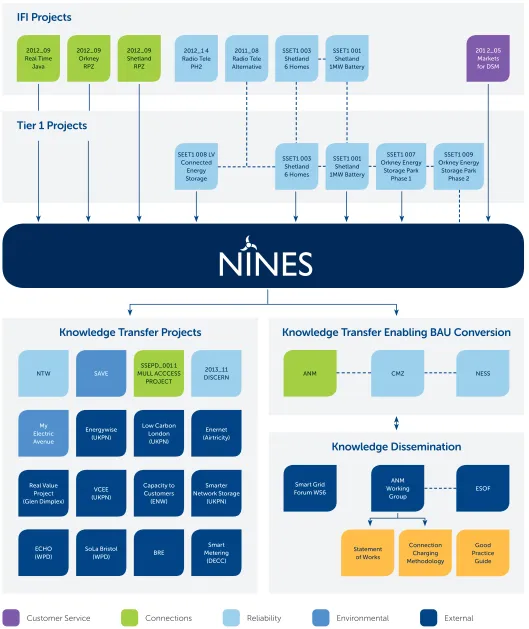
The chart opposite (Fig 1) shows the evolution of NINES as a project and also shows how NINES has already provided knowledge, learning and insight across a whole range of areas.
Early learning outputs from the NINES battery informed a number of other DNOs’ energy storage projects including UKPN’s Smarter Network Storage, and Northern Powergrid’s Customer Led Network Revolution.
[image:10.1191.633.1162.106.735.2]In particular, the learning around energy storage developed through this project led directly to the establishment of the Energy Storage Operators’ Forum (ESOF). This is a forum whose membership comprises all of the GB DNOs and the Transmission System Operator. ESOF facilitates open and honest sharing of information and experience (including any failures or challenges encountered) between members on the practical aspects of Electrical Energy Storage systems through the whole project lifecycle. The learning from the batteries deployed in Shetland contributed two case studies to the ESOF Good Practice Guide on Electrical Energy Storage.
1. Infrastructure and Technology discussion – elements of NINES and communications
2. Customer/Stakeholder discussion
3. Commercial Arrangements and Impact
4. Economic Impact
5. Operational and Network benefits
Infrastructure and Technology
NINES overview
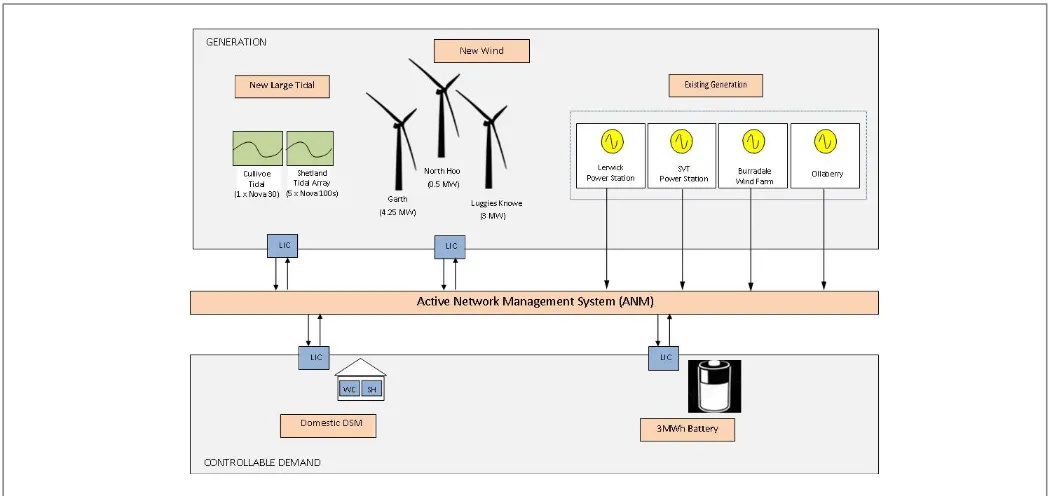
The scope of the NINES Project evolved following the initial planning stage, and currently consists of the following major elements (see Figure 2):
Electricity Generation:
• Existing diesel-powered generators at Lerwick Power Station (owned and operated by SSE), Sullom Voe Terminal (gas turbine generator contracted to SSE via a Power Purchase agreement to supplement LPS), renewable generation at Burradale and Ollaberry (firm wind generator connections, totalling 3.84MW);
• New managed wind generation at North Hoo, Luggie’s Knowe and Garth (totalling 8MW);
• New tidal generation at Cullivoe (which was a tidal test site, generating 50kW) and the larger Shetland Tidal Array (generating 500kW).
Controllable Demand:
• Domestic DDSM provided by controllable storage heaters and hot water cylinders in 223 houses;
• Battery system rated at 1MW, 3MWh (Lead-acid).
2. Modelling & Analysis
contributing to Learning
Outcomes
[image:11.1191.634.1159.495.743.2]This section gives a brief description of the modelling & analysis approach.
Details of the modelling tools are placed in the Appendix.
Figure 2: overview of NINES elements
NINES Knowledge & Learning Report Page 17
2
Modelling & Analysis
contributing to
Control system:
• an ANM scheme, allowing connection of maximum possible renewable generation, providing network balancing, scheduling and enhancing the stability of the network.
Shetland 33kV Network
The isolated electrical network in Shetland consists of 33 kV overhead lines and undersea cables linking various islands together. The 33kV network is connected to a number of low voltage networks around Shetland. Figure 3: Schematic representation of the 33kV Shetland network is a single line diagram of the 33kV network in Shetland.
ANM overview
The ANM system is a real-time control solution that enables the co-ordination of the various elements of the NINES scheme and the Shetland system. Through active management of controllable network devices, the two high-level objectives of the NINES ANM system were to:
• Accommodate renewable generation customers thus reducing reliance on fossil fuels; and
• Smooth the demand curve to minimise peaks and troughs in Shetland system demand.
The ANM functional requirements cover three areas:
1. Stability Constraint Management: Where network devices, such as generators, responsive loads and energy storage devices, are controlled in real-time in response to prevailing network conditions. This meets the objective of accommodating additional customers while managing the network constraints that may arise following their connection;
2. Device Scheduling: Where forecasts are used to derive and issue schedules to appropriate devices to meet the objective of smoothing the demand curve;
3. Confi guration and Interface: The requirements associated with ANM user interactions, the capability to issue manual control commands, and interfaces with other SSEN systems.
Figu re 3: Schematic representation of the 33kV Shetland network
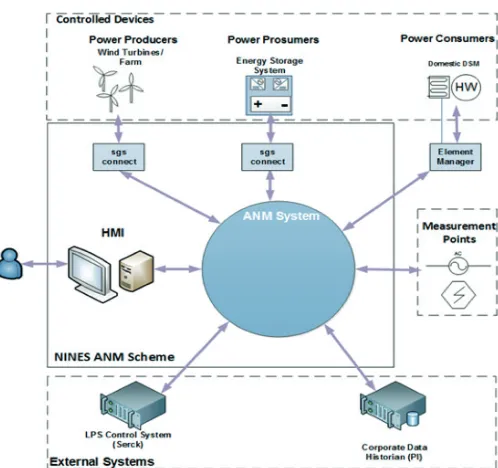
The ANM system was developed to meet NINES requirements by establishing a real-time, deterministic control platform that hosted automated algorithms to monitor network parameters and control ANM elements including renewable generation, large-scale battery storage, and groups of domestic demand side management devices. The ANM platform built upon SSEN learning from the Orkney Smart Grid project, taking real-time constraint management beyond past demonstrations with multiple project partners, and collaborating to establish system constraint rules that defi ne the autonomous management of new renewable generators against stability and operational constraints on the Shetland system.
DDSM overview
Following a review of potential fl exible demand apparent within the Shetland housing stock, which reviewed appliance use vs consumption carried out by SSEN, space and water heating appliances were proven to be the appliances which off ered the greatest potential eff ect on demand ‘shifting’ while still providing customers with the expected levels of comfort and control. SSEN engaged and worked with Glen Dimplex to produce a range of smart electric space and water heating appliances which were communications enabled for installation within the NINES project. SSEN worked with Hjaltland Housing Association and Glen Dimplex to install these advanced storage heating and water heating in 234 existing homes.
These new storage and water heaters (which replaced existing traditional storage heaters) were provided through Hjaltland Housing Association (HHA) and fi nanced in part by ERDF funding and have been specifi cally designed to be compatible with fl exible electrical charging arrangements. The charging arrangement used on NINES is determined based upon the predicted demand, weather forecasts, availability of renewables and other network constraints.
[image:12.1191.639.888.153.387.2] [image:12.1191.34.283.154.393.2]The remote signals that the DDSM appliances receive instruct them when to charge, while also enabling them to send feedback information regarding their statuses, e.g. if they are charging, are on stand-by, switched off , etc. This communication and control allows the DDSM homes to provide capability for demand side management. In addition, the heating devices are frequency responsive, so that they can stop charging if the system frequency drops, or start charging if system frequency rises above the specifi ed limits. Thus, the frequency responsive heaters can help the system operator maintain the balance between the demand and supply and therefore, maintain system frequency and security.
In addition to following signals sent through the ANM system, the appliances are also enabled to consider the comfort level of occupiers in the households. These DSM-capable devices are confi gured to be automatically switched off when room temperature is high and switched on when the room temperature reaches the minimum level, with the high and low temperature levels both set by the users. Based on the energy use during the previous day, and in order to ensure the diff erent comfort level required by each participating DDSM household, an algorithm embedded within the heating devices calculates the Daily Energy Requirements (DER) for each device for the next day.
[image:13.1191.636.1159.155.392.2]Battery Technology
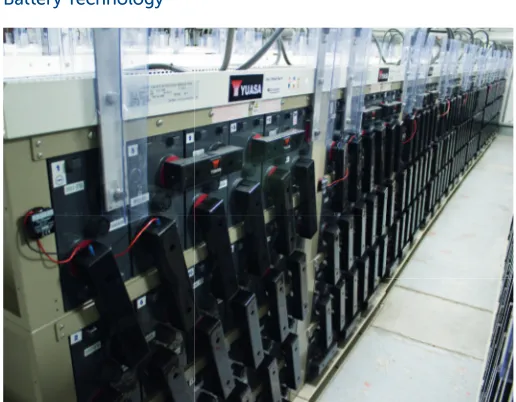
[image:13.1191.34.572.156.393.2]Figure 6: Battery Installation
Figure 5: DDSM Infrastructure
Following initial tendering and specifi cation exercises with supplier S&C, installation of the original NaS battery was completed in September 2011. However, after an incident involving the same technology in Japan5, and after consideration of the risk assessment, SSEN concluded that due to safety concerns related to the location of this installation at LPS, NAS was no longer a suitable technology to be used on this project.
A 1MW/3MWh lead-acid battery was installed and commissioned at Lerwick Power Station in February 2014. The battery system is in part made up of 3,168 individual energy storage cells. The battery sought to help to optimise and stabilise the operation of the existing island network by helping to reduce demand peaks and fi ll demand troughs. Furthermore, the operation of the BESS also helped to facilitate the connection of 8.545MW of new renewable generation.
The daily discharge was limited to 3MWh in addition to a minimum 45% State of Charge (SOC). Twelve 15-minute discharge periods of 1MW were specifi ed to coincide with peak demands each day. A higher energy requirement of 4MWh was required to recharge the battery back to its maximum SOC due to energy losses in a full cycle. When the SOC of the battery increased to 80% and 90%, an initial charge rate of 1MW reduced to 0.66MW and 0.33MW respectively, creating a step-down charging profi le, as shown in Figure 7.
In February 2015, an important project milestone was reached with a further upgrade to the ANM which in turn allowed the scheduling of the battery to become fully automated. A continuous period of operation allowed SSEN to analyse the eff ectiveness of the rules around which the automated scheduling operates and SSEN worked closely with SGS to identify and deliver improvements and refi nements to these rules. However, due to operational issues with the ANM system calculated schedules which had led to an unsatisfactory utilisation (47.2%) of the battery, scheduling was reverted to a manual schedule beyond June 2015. In the main, the battery was manually scheduled to discharge at peak times and charge at times of low demand. The 1MW, 3MWh battery energy storage system (BESS) had completed 288 cycles with a total export of 0.63GWh and a total import of 0.83GWh in the fi rst full year from September 2014 to August 2015. Furthermore, the manually derived schedule had achieved a better utilisation (86.1%) of the battery during the fi rst full year operation.
Considering operational issues with initial rules, an additional constraint rule was introduced beyond September 2015 to ensure that the SVT output was greater than the minimum-take export limit. Under the up-to-date rules, the export of ANM Controlled Generation (ACG) is limited to the rise of SVT output above the minimum-take export limit. The ACG export exceeding the ACG constraint would be curtailed. Charging the battery at off -peak times could alleviate the ACG constraint Figure 7: Power outputs (MW) of the 1MW, 3MWh BESS (charge rates are negative and discharge rates are positive) and
corresponding variations in SOC (%) within a full cycle from 07:00 on 03/09/2014 to 07:00 on 04/09/2014
NINES Knowledge & Learning Report
[image:13.1191.299.557.467.668.2]and provide a certain headroom for additional ACG to generate. Though the manual schedule derived for the battery was not optimised for alleviating ACG curtailment, approximately 52.7MWh of energy used to charge the battery (i.e. 5.6% of the total import 0.94GWh) was supplied by additional ACG export which would otherwise be curtailed over the period from September 2015 to November 2016.
The total import and export of the BESS over more than two years from September 2014 to November 2016 were approximately 1.34GWh and 1.77GWh respectively, meaning a round-trip efficiency of 75.7% on average which was higher than an approximate efficiency of 75%.
Renewable Generation
The first renewable generator on Shetland was the privately owned Burradale wind farm (with installed capacity of 3.68MW), which was commissioned in 2000. It consists of three 660kW turbines installed in 2000, and two 850kW turbines added in 2003 Burradale wind farm is located in the centre of Shetland mainland, just a few miles outside of Lerwick, and is connected under a ‘must-take’ arrangement. The average capacity factor of Burradale is around 52%, which is very high compared to 20% which is typical for most European wind farms.
The Ollaberry wind farm was commissioned in 2014, and is located in the North mainland. This wind farm has a capacity of 180kW, with one 80kW and one 100kW turbine. The power output of the Ollaberry is also ‘must-take’.
Prior to the NINES Project, despite the significant wind and tidal reserves on Shetland, it was not possible to increase connections of the renewable generation to the Shetland network. However, the NINES project has allowed connections and commissioning of additional reviewable generators, with a total capacity of 8.545MW, via managed connections with access to the network controlled by the NINES ANM. These additional new renewable generators are:
• Cullivoe Tidal (45kW trial tidal turbine)
• Garth Windfarm (4.5MW)
• Luggie’s Knowe Windfarm (3MW)
• Shetland Tidal (500kW)
• North Hoo, (500kW)
All of these generators are connected under flexible commercial arrangements, which means the power output can be curtailed according to the requirements of the Shetland network. The key to managing these conditions and ensuring generation is utilised wherever possible is the operation of the ANM.
The NINES managed renewable generators on Shetland are connected under flexible commercial arrangements with Last In First Off (LIFO) arrangement. This means that these generators can be curtailed when necessary to maintain secure system operation. For generators connected under LIFO arrangement, the last connected generator will be curtailed first. A stack position in LIFO order (i.e. the order of curtailment) is determined by the order of DG connection and is not
affected by new additional generators which may be connected at a later date.
What was learned?
Commercial Arrangements
The DDSM scheme currently has 223 households participating, these homes are owned by HHA. The heating devices installed in the DDSM houses are remotely controlled and responsive to the signals sent through the ANM system. The 223 households are distributed on the Shetland Islands, with the majority 78% are in the centre and south of Shetland Mainland and the rest 22% located in North Mainland and North Islands. The DDSM customers were engaged directly in the NINES reports through 6 core methods, which are issue payments (as incentives for participation), website updates, hosting of local meetings, issuing of written communications, phone calls to customers, and carrying out of home visits.
The total cost of DDSM scheme and operational support during the project is £3.2 million, with the total ongoing operation support cost being £491k per annum after the end of the project. These costs are funded by SSEN and HHA, where SSEN contributed 64.8% of total DDSM costs during the project and providing 93.9% of ongoing operation support costs.
The commercial arrangements with the Shetland conventional generators, i.e. LPS and SVT, ensure the provision of the secure and stable operation on Shetland network. Since the New Energy Solution for Shetland tendering process is currently under evaluation, new commercial arrangement needs to be agreed between the potential asset owner(s) and SSEN (as the system operator on Shetland) to allow secure and stable network operation. The NINES project has enabled additional renewable capacity with the introduction of flexibly connected renewable DGs, including Cullivoe Tidal, Garth Windfarm, Luggie’s Knowe Windfarm, Shetland Tidal, North
Hoo. The flexibly connected DGs are connected under LIFO arrangements, with generation onto the Shetland network being controlled by the ANM system. The Shetland network is a closed energy system, and the total generation output must replicate the islands’ demand. The output of the renewable generators are subject to the commercial arrangements and also depend on the wind/tidal availability, as well as curtailment.
A 1MW 3MWh VRLA battery was installed on Shetland during the NINES project. In the period of operation from September 2014 to November 2016, the battery was cycled 612 times, with the total discharge power of 1.34GWh. Following the recommendation of the battery provider, the battery was removed from service in January 2017. The battery is owned and operated by SSEN on Shetland. During operation it sought to help to optimise and stabilise the operation of the existing island network by primarily helping to reduce demand peaks. It also helped to facilitate the connection of 8.545MW of new renewable generation. The battery production cost has been included within the LPS costs. The costs of the BESS are made up of two main components: the capital expenditure (CAPEX) that is the investment that activates the operation of the BESS; and the operational expenditure (OPEX) that is a continuous cost supporting the operation of the BESS. The capital cost of the battery was part funded by DECC via a Smart Grid Demonstration Capital Grant for £1.1m and £1m from Ofgem’s Low Carbon Network Fund Tier 1. The remainder was funded through NINES and was operated by SSEN to help meet the needs of the Shetland network. As the one-time cost, CAPEX of the BESS is estimated to be approximately £3,974,000, including the investment in the storage unit, auxiliary system and other components that put the BESS into service.
The OPEX of the BESS includes the maintenance costs for battery and building, labour costs, etc. The biannual maintenance of the BESS unit was covered by the warranty provided by the battery’s manufacturer which covered either a 5 year period beyond commissioning or until the battery reached 1,500 cycles, whichever came first. Within the warranty, the OPEX is evaluated to be £56,500 per annum. When 5 years or 1500 cycles are reached, the warranty could be extended at a cost of £18,500 per annum and the OPEX would increase to £75,000 per annum.
Possible future participation of the enduring NINES connected elements in the GB ancillary service market has been briefly summarised in 6A NINES Commercial Arrangements and Economics report9, should the potential link between Shetland and GB mainland be realised.
Economic Impact
The total NINES project spending was £15.3 million, with £6.9 million related to staff costs and £8.4 million covering non-staff costs, i.e. equipment, IT, contractors and travel. The non-staff costs also include incentive payments made to each of the 234 households who were originally part of the scheme. 2.97% of staff costs and 6.48% of non-staff costs are spent locally on Shetland. Total spend on Shetland is 4.9% of the total project expenditure, equivalent to £749,250. The NINES project related expenditure of £749,250 added £1.023 million worth of economic output, £506,850 to the gross value added of the local economy, and raised employment by almost 17 person years of FTE employment over the project duration.
A principal intervention of the NINES project is to use DDSM technology at the household level to improve the management of the local electricity supply system. DDSM households were invited to complete survey feedback on their experiences. Of the nineteen surveys received, households’ identified cheaper and more efficient energy through NINES. Thus, a long-term consequence of the change in households’ electricity consumption has been considered based on the Shetland household electricity consumption data from The Department for Business, Energy and Industrial Strategy (BEIS). The latest 2014 – 2015 data reports indicated that median household electricity demand for Shetland customers on “economy 7” tariff fell by 1.9% between 2014 and 2015 (from 7,043kWh to 6,908kWh. The “economy 7” electricity consumption data is used as it is the most closely match with the form of contract used for the majority of households which saw interventions through NINES. The reduction in electricity spending increased 223 DDSM household income by £35 for each year of operation, i.e. a total of £7,950 for all affected customers per year. Moreover, the economic impact of the additional income on the Shetland economy is equivalent to the additional £10,000 worth of economic output, £5,150 to the gross value added of the local economy, as well as 0.2 person years of FTE employment per year.
Operational and Network Benefits
Alleviation of Renewable Energy Curtailment
Additional Renewable generation
• Under the up-to-date constraint rules, the increase in system demand through the utilising flexible DDSM or charging BESS would alleviate the constraint on ACG and allow additional ACG to generate if there was ACG curtailment.
The flexible DDSM was scheduled to alleviate the forecasted ACG curtailment in the order of daily energy requirement (DER) from largest to smallest. The remaining controllable demand was then used to fill demand troughs. It is estimated that around 77MWh renewable energy curtailment has been alleviated by DDSM groups (i.e. 26.1MWh at North Hoo and 50.9MWh at Luggie’s Knowe), over the period from February 2016 to January 2017.
Under the current constraint rules, charging the battery at periods of low demand can increase the limit on ACG export. Though the manual schedule for the battery was not optimised for alleviating the ACG constraints, the charging periods that coincided with high ACG curtailment provided additional headroom for ACG to inject electricity into the network which would otherwise be curtailed. Over the period from September 2015 to November 2016, the total import of the BESS was 0.94GWh, where the charging allowed approximately 52.7MWh of additional ACG (i.e. 18.1MWh at North Hoo and 34.6MWh at Luggie’s Knowe) to be delivered to the grid.
Additional benefits received by ACG owner for additional export
• The ACG owners could receive extra benefits for delivering additional ACG to the network through Feed-In Tariff (FIT): a ‘generation tariff’ which is a fixed price dependent on the type of distributed generator and installation size; and an ‘export tariff’ which is a bonus payment for surplus electricity put onto the network. The ACG could also decline the ‘export tariff’ and negotiate their own Power Purchase Agreements (PPAs) with electricity suppliers.
• Over a one-year period from February 2016 to January 2017, around 77MWh ACG curtailment has been alleviated by flexible DDSM. The payments for the additional export from North Hoo and Luggie’s Knowe are evaluated to be £6,261.90 (i.e. £4,979.20 for generation tariff and £1,282.70 for export tariff) and £4,101.80 (i.e. £1,606.10 for generation tariff and £2,495.70 for export tariff) respectively.
• Over more than one year from September 2015 to November 2016, approximately 52.7MWh of reduction in ACG curtailment has been achieved by charging the BESS. North Hoo and Luggie’s Knowe are estimated to receive £4,325.50 (i.e. £3,439.50 for generation tariff and £886 for export tariff) and £2,785.30 (i.e. £1,090.60 for generation tariff and £1,694.70 for export tariff) respectively.
Savings in conventional generation cost
• Meanwhile, the additional ACG export used to charge the flexible DDSM and BESS led to a saving in conventional generation cost. An estimated cost for conventional generation in Shetland in the period evaluated was £200/ MWh, including all usage, spinning reserve, fuel and maintenance. The 77MWh of conventional generation displaced by ACG, over the period from February 2016 to January 2017, would therefore cost approximately £15,400, which was £5,036.30 higher than the total FIT payment estimated for the 77MWh additional ACG used by the flexible DDSM. The 52.7MWh ACG absorbed by the BESS would be converted into 39.5MWh of energy injected into the grid on the basis of an approximate 75% round-trip efficiency. (This is the ‘time-shifting of ACG’ enabled by the BESS.) The cost of 39.5MWh conventional generation displaced by additional ACG was evaluated to be £7,905 which was £794.29 higher than the total FIT payment for the additional ACG. Considering the electricity suppliers apportion the FIT costs to all their electricity customers, only the export rate is part of the Shetland costs. Therefore, the savings in conventional generation cost through the flexible DDSM and BESS absorbing the additional ACG were around £11,621.70 and £5,324.30 respectively over their respective periods under review. Furthermore, conventional generation being displaced by renewable energy reduces the fuel consumption.
In addition to the time-shifting of ACG enabled by the BESS, the conventional generation cost could be reduced by the time-shifting of conventional generation if there is a significant difference in the cost per unit of conventional generation between peak and off-peak times. That is, the conventional generation absorbed by the BESS during the off-peak period was at low prices. The energy stored in the BESS was then exported to the grid at peak times to reduce the demand to be met by conventional generation which would otherwise require a high cost. Provided that the BESS was operated at a 75% efficiency, the saving in conventional generation cost would be realised when the conventional generation cost at peak times was 1.33 times higher than that at off-peak times. This may be considered in the future arrangements. Furthermore, the smoothed demand curve would result in a more efficient operation of conventional generation units and thus a saving in fuel consumption.
• As of 24 March 2017, the amount of renewable energy capable of generating on to the Shetland Network is 14.9GWh and it is predicted that this value will rise to 25.6GWh in 2017/18 following the connection of Garth windfarm (4.5MW) in March 2017. It is estimated that as a result of this, NINES connected wind will reduce fossil fuel generation and provided a reduction in CO2 emissions from fossil fuels of 11.8%. Therefore, this brings savings of almost £3m from the Shetland pass-through mechanism.
Load levelling
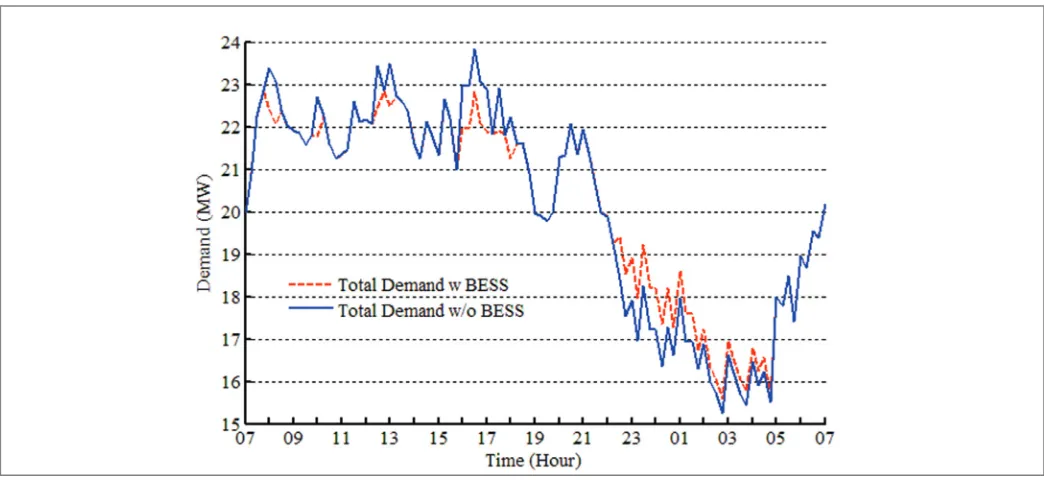
The primary role of the BESS is to smooth the demand curve on the Shetland network. For majority of its operation, the battery was manually scheduled to discharge at peak times to reduce peak demands to be met by conventional generation, and to charge during the off-peak periods which may increase the efficiency of lightly loaded engine sets at Lerwick Power Station. As an illustration, Figure 8 shows the variations (MW) in total system demand to be met by generators following the operation of the BESS that has been described in Figure 8.
In this 24-hour period, the maximum demand provided by generators was reduced from 23.86MW to 22.86MW by discharging the BESS at 1MW. The standard deviation of total export from generators decreased from 2.5MW to 2.1MW on that day, meaning that the demand curve on the Shetland network was largely smoothed. The grid-scale BESS has delivered 1.34GWh energy to the network at peak times and absorbed 1.77GWh energy at times of low demands in total over more than two years from September 2014 to November 2016.
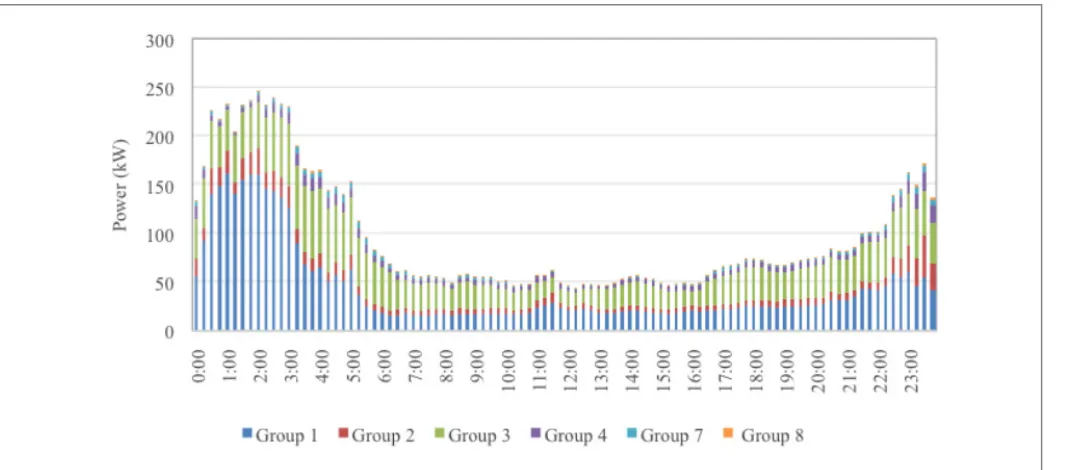
As noted above, the primary role of the flexible DDSM groups is to alleviate the forecasted ACG curtailment. The secondary role was to smooth the demand curve through using the remaining DER to fill demand troughs. As shown in Figure 9, the flexible DDSM groups were usually scheduled to absorb energy during the night where system demand was at a low level. This would help increase the level of system demand during the off-peaks, smoothing the demand curve.
[image:15.1191.635.1157.156.396.2]The non-firm ACG was more likely to be curtailed at the times of low demand. Though the controllable demand might be allocated at the wrong times to alleviate ACG curtailment due to the forecast accuracy and the use of constant SVT export, these controllable demand would contribute to load levelling if the ‘wrong’ times were determined as the moments of low system demand.
Figure 8: Total demand (MW) to be met by generators varying with the BESS’s operation from 07:00 on 03/09/2014 to 07:00 on 04/09/2014
NINES Knowledge & Learning Report
Frequency Stability
Frequency stability in the Shetland network is a major concern, as it forms an isolated system, which operates separately from the rest of the GB network. As the penetration of the wind generation increases, the possibility of a sudden loss of power from installed (and future) wind farms, due to either changes in wind conditions or in response to a network fault, would cause the network frequency to drift outside an acceptable range (±2% of the nominal frequency).
Examining the security of the Shetland network against the loss of all wind generation is critical considering actual events observed on the Orkney distribution network. Historical records for several geographically separated wind farms on Shetland show events where wind generation varies by more than 90% of the installed capacity within 15 minutes at multiple wind farms. Examples of such a sudden change of wind generation output are shown in Figure 10, when there were large variations in power of a short timeframe. Therefore, a very important question arises for Shetland network: what is the maximum penetration level of renewable generation in Shetland network where it may still be operated in a safe, secure and reliable manner with respect to frequency stability?
[image:16.1191.632.1158.152.391.2]To calculate a (theoretical) maximum penetration level of wind power, a number of simulations studies were conducted based on the dynamic modelling of most relevant components of the Shetland’s power network as made available by SSEN. Simulations studies assessed dynamic performance of the network during different demand levels with a specified level of wind generation, then disconnecting the wind generation and allowing the system to respond. The frequency of the Shetland network and the export from SVT were monitored to ensure limits were maintained.
Figure 9: Average import (kW) of each flexible DDSM group per day over the year 2016/17
To investigate the frequency response of Shetland network, two key scenarios are investigated: SVT offline and SVT online.
1. For the distribution system to be securely operated with a high penetration of wind generation, the maximum level of wind penetration has to be defined for each demand level. Two key scenarios were investigated which are the normal operation scenario when SVT is online and the critical scenario when SVT is offline;
2. The simulation results show that the theoretical maximum wind generation that could be connected when SVT is online is mainly limited by SVT circuit protection and voltage support rules. The results show that higher levels of wind generation are acceptable within the definition of frequency stability. However, the maximum wind generation that could be connected when SVT is offline, is limited by frequency stability.
[image:16.1191.35.575.156.391.2]These results are obtained for a unique specific generation dispatch as stated for each demand level as other dispatch may result in different values. Moreover, the simulated system frequency highly depends on the dynamic models used for the study which should imitate the behaviour of the equipment deployed on Shetland network. Power quality meters have to be installed in a number of locations in Shetland network to validate the existing module. However, the results can be used to identify the trends in network behaviour that would be seen with high penetration of wind power if the used dynamic models do not fully imitate the behaviour of the Shetland network equipment.