City, University of London Institutional Repository
Citation
:
Annabi, L. and Garcia Ortiz, M. ORCID: 0000-0003-4729-7457 (2018). State
representation learning with recurrent capsule networks. Paper presented at the Workshop
on Modeling the Physical World: Perception, Learning, and Control, NeurIPS 2018 - 32nd
Conference on Neural Information Processing Systems, 07 Dec 2018, Montreal, Canada.
This is the accepted version of the paper.
This version of the publication may differ from the final published
version.
Permanent repository link:
http://openaccess.city.ac.uk/id/eprint/22453/
Link to published version
:
Copyright and reuse:
City Research Online aims to make research
outputs of City, University of London available to a wider audience.
Copyright and Moral Rights remain with the author(s) and/or copyright
holders. URLs from City Research Online may be freely distributed and
linked to.
City Research Online: http://openaccess.city.ac.uk/ [email protected]
State representation learning with recurrent capsule
networks
Louis Annabi, Michael Garcia Ortiz
AI Lab
Softbank Robotics Europe Paris, France
[email protected] [email protected]
Abstract
Unsupervised learning of compact and relevant state representations has been proved very useful at solving complex reinforcement learning tasks Ha and Schmid-huber (2018). In this paper, we propose a recurrent capsule network Hinton et al. (2011) that learns such representations by trying to predict the future observations in an agent’s trajectory.
1
Introduction
We study the mechanisms that could allow task-independent and self-supervised learning for embodied agents. Specifically, we focus here on the acquisition of perceptive skills, in particular representation for physical objects.
Recently, capsule networks were proposed as a model for representing visual objects. A capsule is a set of artificial neurons that returns both an activation and instantiation parameters. The activation is the estimated probability of the feature being present in the input image, and is similar to the outputs of neurons in convolutional neural networks. The instantiation parameters are estimations of different properties of the detected feature, such as position, orientation, lighting or color. However, reaching configurations where each capsule models one visual entity can be tricky without using a classification loss, here we are looking for an approach that doesn’t rely on external information.
Sensorimotor prediction is often proposed to learn representations. It has been extensively used in reinforcement learning literature as an auxiliary task to learn both state representations and forward models. In Ha and Schmidhuber (2018), the authors first learn a latent representation using variational auto-encoders Kingma and Welling (2013) and then learn a forward model by trying to predict future latent states. In Wayne et al. (2018), the authors propose a fully differentiable RL architecture trained, specially, with a reconstruction loss of the inputs and a KL divergence between the estimated and actual latent state distributions.
In this work, we explore the use of capsule networks for state representation learning. We reformulate the principle of capsules in order to use them in the framework of sensorimotor prediction. This allows us to build a state representation preserving the benefits explained in Hinton et al. (2011) while avoiding the use of external data.
2
Model
Our predictive model is made of four functional blocks, that are repetitively used at each time step : an encoder, a recurrent cell, a transformation cell and a decoder. We use artificial neural networks for
32nd Conference on Neural Information Processing Systems (NIPS 2018), Montréal, Canada.
Figure 1: Recurrent model used to train capsules. E encodes the observationxt into a capsule
representationct, which is fed to a recurrent cellRthat produces the state capsule representationrt.
T usesrttogether with the motor commandsmtto predict the next stateht+1. Finally, the decoder
Destimates the next observationxtˆ+1
each of these blocks, making the model fully differentiable. Figure 1 shows how those blocks are organized to form the full model in charge of predicting the future observations.
2.1 Encoder
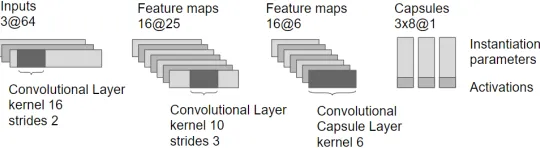
Figure 2: Architecture of the capsule network used for encoding the observations. The network is composed of two convolutional layers, and one convolutional capsule layer.
The encoder outputs a capsule representationctof shape (k,d+ 1) wherekis the number of capsules,
dis the dimension of the instantiation parameter vector returned by each capsule, and the+1stands for the additional activation output for each capsule. Figure 2 shows the architecture of the encoder network that we used in our experiments.
2.2 Custom recurrent cell
The recurrent cell is a custom neural network model that updates the state capsule representationht
with the capsule representation of the observationct. This network outputs an updated state capsule
representationrt. All three variables have the same shape (k,d+ 1). The custom recurrent cell is
making use of the structure of the capsule output (activation dimension denotedaand instantiation parameters dimensions denotedv) and performs better than traditional recurrent cells (GRU, LSTM) on the sensorimotor prediction task. Here is the detail of the operation performed:
rat = max(hat, cat)
t=f(hat, c
a t) =
1
1 +hat
ca t
2
rvt = (1−t)·htv+t·g(hvt, c
v t;w)
Wheregis a linear function of parameterwtaking as input the concatenation ofhvt andcvt. The main idea here is to modulate the output with an update parameterstdepending on the activations of the
state capsule representation and the activations coming from the observation capsule representation.
2.3 Transformation cell
The transformation cell applies the transformation induced by the continuous actionmtto the state
representationrt. We split the instantiation parameters in two categories : the "fixed" parameters
[image:3.612.172.442.281.355.2]denotedvfthat will not be affected by the transformation, and the "variable" parameters denotedvv
that are allowed to change. The transformation cell first computes a matrix representationztfor the
actionmtusing a multi-layer perceptron. The action representation is a square matrix of sizedv < d,
wheredvis the number of variable parameters. Then the capsules received in input are transformed
by multiplying the vector of variable parameters with the action matrix representation. Here is the detail of the operation performed :
hat+1=rat
hvft+1=rvft
hvvt+1=matmul(mlp(mt), rvvt )
2.4 Decoder
The decoder is responsible for computing an estimation of the next observationxˆt+1based on the transformed stateht+1. It is composed of a deep transposed convolutional neural network shared for
each capsule, outputting an individual reconstruction for each capsule, and a custom merge layer, in charge of computing the observation estimation based on the individual reconstructions.
3
Experiment
3.1 Environment
To validate our approach, we tested our model in a partially observable environment with first-person observations. To be able to conduct many experiments, we chose to use the 2D simulator Flatland Caselles-Dupré et al. (2018), where we simulate an environment similar to Eslami et al. (2018). Having a 2D simulator produces observations in 1D, making it faster to conduct experiments. Our environment is composed of three simple round objects of three different colors, as shown in figure 3a. An agent equipped with vision sensor (raw RGB input) moves by random longitudinal displacement, lateral displacement, and rotation.
3.2 Results
The model is trained with a mean squared error loss on the estimated observations. Two additional losses are used to ensure a proper convergence : a sparsity constraint on the activations in the hidden state, and a mean squared error between the hidden state in input of the recurrent cell and the output of the recurrent cell.
(a) One of the simulated envi-ronments, with the agent in light gray and the three objects in pur-ple, orange and green. The posi-tion and size of the three objects vary along episodes.
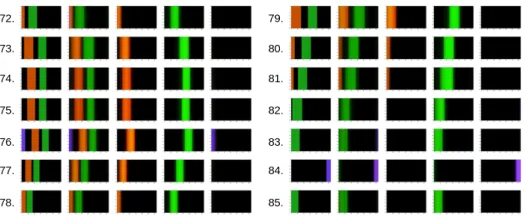
[image:4.612.240.503.499.607.2](b) Next observation prediction at the end of training. This figures shows a sample from a trajectory of length 100 on which the model was not trained. The five columns correspond to: 1. The real observation. 2. The predicted observation. 3. The individual prediction of the first capsule. 4. The individual prediction of the second capsule. 5. The individual prediction of the third capsule.
of vision of the agent since frame 77, which indicates that our model is able to properly track the position of an object through long sequences of actions.
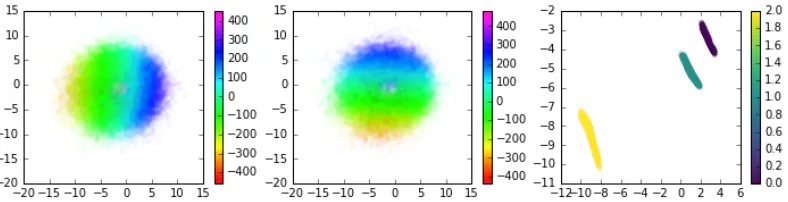
Figure 4: Individual capsule representation plotted according to two dimensions of the variable parameters (left and middle), and the two dimensions of the fixed parameters (right). The color map used correspond to the real relative X (left) and Y (middle) coordinates of the encoded object in the agent’s relative coordinate system, and to the color of the object (right).
Moreover, when looking at the learned representations of each object (see figure 4), we observe a high correlation between some of the capsule dimensions with the real relative position of the corresponding object with regard to the agent. This suggests that the agent has build a notion of space through this prediction process, without any information directly related to space in its observations (such as depth).
4
Future work
First, we need to run more experiments on the learned representations. Early results tend to show that this capsule representation performs well as input of a reinforcement learning algorithm in a navigation task, compared to learning from raw images. To further verify the quality of our model for reinforcement learning, we would need to compare it with other state representation learning methods (like Ha and Schmidhuber (2018)) and on several environments.
In the future, we would like to extend this model, for instance by adding routing with a second layer of capsules, and apply it to more complex environments, with more objects and more variability between objects.
References
Hugo Caselles-Dupré, Louis Annabi, Oksana Hagen, Michael Garcia-Ortiz, and David Filliat. 2018. Flatland: a Lightweight First-Person 2-d Environment for Reinforcement Learning. (2018). arXiv:cs.LG/1809.00510
S. M. Ali Eslami, Danilo Jimenez Rezende, Frederic Besse, Fabio Viola, Ari S. Mor-cos, Marta Garnelo, Avraham Ruderman, Andrei A. Rusu, Ivo Danihelka, Karol Gre-gor, David P. Reichert, Lars Buesing, Theophane Weber, Oriol Vinyals, Dan Rosen-baum, Neil Rabinowitz, Helen King, Chloe Hillier, Matt Botvinick, Daan Wierstra, Ko-ray Kavukcuoglu, and Demis Hassabis. 2018. Neural scene representation and render-ing. Science360, 6394 (2018), 1204–1210. https://doi.org/10.1126/science.aar6170
arXiv:http://science.sciencemag.org/content/360/6394/1204.full.pdf
David Ha and Jürgen Schmidhuber. 2018. World Models. CoRR abs/1803.10122 (2018). arXiv:1803.10122http://arxiv.org/abs/1803.10122
Geoffrey E. Hinton, Alex Krizhevsky, and Sida D. Wang. 2011. Transforming Auto-Encoders. In
Artificial Neural Networks and Machine Learning – ICANN 2011, Timo Honkela, Włodzisław Duch, Mark Girolami, and Samuel Kaski (Eds.). Springer Berlin Heidelberg, Berlin, Heidelberg, 44–51.
Diederik P. Kingma and Max Welling. 2013. Auto-Encoding Variational Bayes.CoRRabs/1312.6114 (2013). arXiv:1312.6114http://arxiv.org/abs/1312.6114
Greg Wayne, Chia-Chun Hung, David Amos, Mehdi Mirza, Arun Ahuja, Agnieszka Grabska-Barwinska, Jack W. Rae, Piotr Mirowski, Joel Z. Leibo, Adam Santoro, Mevlana Gemici, Malcolm Reynolds, Tim Harley, Josh Abramson, Shakir Mohamed, Danilo Jimenez Rezende, David Saxton, Adam Cain, Chloe Hillier, David Silver, Koray Kavukcuoglu, Matthew Botvinick, Demis Hassabis, and Timothy P. Lillicrap. 2018. Unsupervised Predictive Memory in a Goal-Directed Agent.CoRR