City, University of London Institutional Repository
Citation: Baines, Emily Joye (2017). The Ghost in the Machine: The role of mechanical
musical instruments as primary sources for eighteenth-century performance practice in England, and an examination of the style(s) contained therein.. (Unpublished Doctoral thesis, Guildhall School of Music & Drama / City, University of London)This is the accepted version of the paper.
This version of the publication may differ from the final published
version.
Permanent repository link: http://openaccess.city.ac.uk/id/eprint/23095/
Link to published version:
Copyright and reuse: City Research Online aims to make research
outputs of City, University of London available to a wider audience.
Copyright and Moral Rights remain with the author(s) and/or copyright
holders. URLs from City Research Online may be freely distributed and
linked to.
City Research Online: http://openaccess.city.ac.uk/ [email protected]
The Ghost in the Machine: The role of mechanical musical
instruments as primary sources for eighteenth-century
performance practice in England, and an examination of
the style(s) contained therein.
submitted by
Emily Joye Baines
for the qualification of
Doctor of Music (DMus)
Guildhall School of Music & Drama
Research Department
Dedication
This thesis is dedicated to my grandmother, Joyce Muriel Beckett M.B.E. 8th May 1922 - 16th November 2017
whose capacity to love, sense of adventure, and tenacious spirit will continue to inspire me, and whose organisational skills I can only strive to emulate.
‘…go and open the door.
At least there’ll be a draught.’
The Ghost in the Machine: The role of mechanical musical instruments as
primary sources for eighteenth-century performance practice in England and an
examination of the style(s) contained therein
TABLE OF CONTENTS
LIST OF FIGURES 6
LIST OF MUSICAL EXAMPLES 7
ACKNOWLEGEMENTS 10
ABSTRACT 11
CHAPTER 1: INTRODUCTION 12
1.1 REVIEW OF SECONDARY SOURCE LITERATURE RELATING TO THE HISTORY AND MUSIC OF
MECHANICAL MUSICAL INSTRUMENTS IN ENGLAND C.1720-1800. 14
1.1.1 ORD-HUME 14
1.1.2 HASPELS,DIRKSEN,FULLER,DI SANDRO AND CYPESS 16
1.1.3 CUMMING,MALLOCH AND JERROLD 19
1.1.4 MUNROW,SCHWANNBERGER,EGARR,LASOCKI 22
1.2 LITERATURE RELATING TO CURRENT ORNAMENTATION AND HISTORICAL PERFORMANCE
STYLES 25
1.3 RESEARCH QUESTIONS ARISING FROM THE LITERATURE 31
1.4 METHODS FOR RECORDING AND TRANSCRIPTION 33
1.5 TERMINOLOGY 37
CHAPTER 2: BACKGROUND INFORMATION 41
2.1 THE BARREL-ORGAN AND ORGAN-CLOCK IN EIGHTEENTH-CENTURY ENGLAND 41
2.2 THE HOLLAND ORGAN AND CLAY CLOCKS AS THE FOCUS FOR THIS STUDY 46
2.3 EVIDENCE CONCERNING CONSTRUCTION 51
2.4 PINNING STYLES 55
2.5 MUSICAL CONTEXT 57
CHAPTER 3: COMPARING ARRANGEMENTS OF HANDEL'S ‘ALLA FAMA’:
ESTABLISHING CONNECTIONS BETWEEN COMPOSER, CLOCKMAKER AND WIDER
PERFORMANCE PRACTICE 59
3.1 INTRODUCTION AND SOURCES 59
3.2 COMPARISON 62
3.3 CONCLUSIONS 68
CHAPTER 4: COMPARISON OF CORRESPONDING PIECES FROM AYLESFORD
MANUSCRIPT AND WINDSOR CASTLE CLAY CLOCK 74
4.1 INTRODUCTION AND SOURCES 74
4.2 ‘DELL’ONDA I FIERI MOTI’ 75
4.3 ‘IN MAR TEMPESTOSO’ 82
4.4 UNTITLED PIECES 89
CHAPTER 5: LONGITUDINAL COMPARISON (1) OF TWO MECHANICAL VERSIONS OF THE MINUET FROM HANDEL'S OVERTURE TO ARIADNE FROM DIFFERENT
POINTS IN THE EIGHTEENTH CENTURY. 103
5.1 INTRODUCTION AND SOURCES 103
5.2 THE ORNAMENTS 105
5.2.1 OPENING NOTES 106
5.2.2 APPOGGIATURAS 107
5.2.3 TRILLS 109
5.2.4 MORDENTS 113
5.2.5 TURNS 114
5.2.6 OTHER ORNAMENTS AND ANOMALIES 115
5.2.7 OMITTED ORNAMENTS 118
5.2.8 MELODIC ALTERATION 119
5.2.9 REPEATED SECTIONS 120
5.3 OBSERVATIONS 121
5.4 CONCLUSIONS 123
CHAPTER 6: LONGITUDINAL COMPARISON (2) OF THE HOLLAND ORGAN’S ORNAMENTATION STYLE TO WRITTEN SOURCES FROM DIFFERENT POINTS OF
ITS HISTORICAL TIMESPAN. 128
6.1 INTRODUCTION AND SOURCES 128
6.2 COMPARING THE STYLE OF LATE SEVENTEENTH-CENTURY PIECES IN THE HOLLAND ORGAN
TO CONTEMPORARY WRITTEN SOURCES. 129
6.3 COMPARISON OF THE STYLE FOUND IN THE PURCELL TREATISE TO LATER MUSIC 134 6.4 COMPARISON OF HOLLAND ORGAN MUSIC FROM LATER PERIODS WITH THE
ORNAMENTATION STYLE OF DOMENICO CORRI 138
6.5 CONCLUSIONS 144
CHAPTER 7: CYLINDRICAL PINNING AND ITS IMPLICATIONS FOR BOTH
ORNAMENTATION AND HETEROPHONIC PERFORMANCE STYLE. 146
7.1 REPERTOIRE AND FUNCTION OF REPEATING BARRELS 146
7.2 HYMNODY AND HETEROPHONIC PERFORMANCE PRACTICE 147
7.3 IMPLICATIONS FOR STROPHIC SONGS 149
7.4 OTHER EVIDENCE REGARDING THE DOUBLING OF A MELODY LINE IN THE ACCOMPANIMENT 152
7.5 CONCLUSIONS 153
CHAPTER 8: IMPLICATIONS OF THE HOLLAND ORGAN'S PERFORMANCE OF
HANDEL'S ORGAN CONCERTOS OP. 4 IN B FLAT AND F MAJOR 157
8.1 PATTERNS OF ORNAMENTATION 157
8.2 ORNAMENT PLACING IN PASSAGE WORK 159
8.3 OPENING/FINAL NOTE ORNAMENTS 161
8.4 ORNAMENTATION OF THE BASS LINE AND INNER PARTS 163
8.5 UNUSUAL AND HYBRID ORNAMENTS 164
8.6 REPEATED SECTIONS AND MELODIC ALTERATION 166
8.7 CADENZAS 167
8.8 USE OF RITARDANDO 169
8.9 RELATIVE TEMPI OF MOVEMENTS 170
8.10 CONCLUSIONS 173
CHAPTER 9: CONCLUSIONS 179
9.1 WHOSE STYLE IS IT?COMPOSER CONNECTIONS 179
9.3 DOES THE STYLE HAVE PRECEDENTS ELSEWHERE? 183
9.4 DOES THE STYLE CHANGE? 185
9.5 ARE THERE FEATURES OF THE INSTRUMENTS THEMSELVES WHICH NECESSITATE OR
FACILITATE A PARTICULAR PERFORMANCE STYLE? 186
9.6 IS IT PERFORMABLE? 187
9.7 CLOSING COMMENTS 189
APPENDICES 192
APPENDIX A DETAILS OF IMPORTANT MAKERS 193
APPENDIX B CONTENTS OF CLAY CLOCKS AND HOLLAND ORGAN 194
APPENDIX C ENGRAMELLE ORGNAMENT TABLES 197
APPENDIX D RECORDING OF HOLLAND ORGAN 199
APPENDIX E ADDITIONAL RECORDINGS 202
APPENDIX F RECITAL PROGRAMME: DEMONSTRATING THE CONCLUSIONS
OF THIS STUDY 204
List of Figures
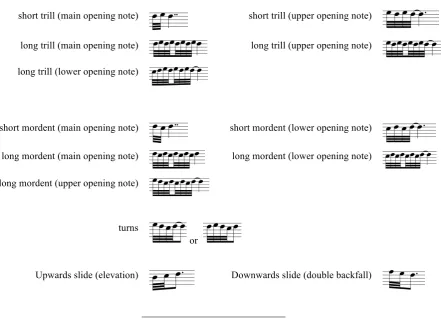
Figure 1.1 - Ornaments with their realisations from Engramelle's Tonotechnie ... 36
Figure 1.2 - Notation of fundamental ornaments ... 39
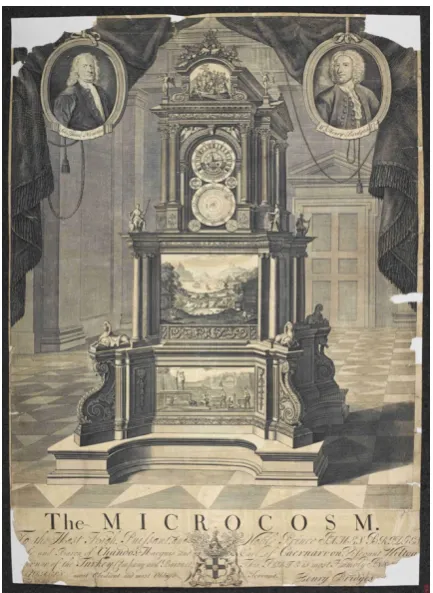
Figure 2.1 - Poster c1750 advertising 'The Microcosm' (British Library Online Digital Archive).. ... 43
Figure 2.2 - Engraving on the frontispiece to Le Mechanisme du Fluteur Automate ... 44
Figure 2.3 - Opening pages to the booklet held by the Colt Clavier Collection, relating to the Holland organ. ... 49
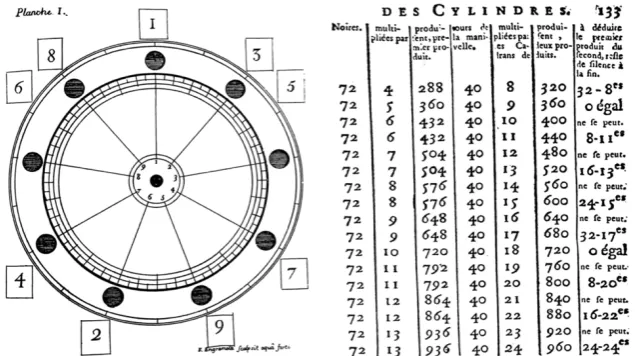
Figure 2.4 - Examples of Engramelle's disc and tables for determining positions for barrel pinning ... 53
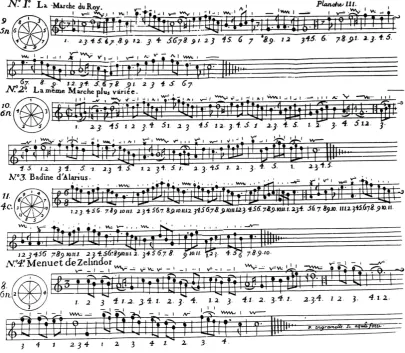
Figure 2.5 - Example pieces from Engramelle's Tonotechnie showing placing of ornaments, articulation marks and how the disc is to be utilised. ... 54
Figure 2.6 - Left: Outer case of Holland organ showing purely ornamental pipework detail. ... 55
Figure 2.7 - Mechanism to lock barrel in place (Holland organ). ... 56
Figure 2.8 - Cases containing spaces to fit 16 barrels for the Holland organ.. ... 57
Figure 3.1 - Contents of Aylesford manuscript (BL R.M.19.a.1, f.160v.-171r). ... 60
Figure 3.2 - 'Alla Fama' as found in the British Library's Aylesford Collection: R.M.19.a.1 (f.166v). ... 61
Figure 3.3 - Second page of 'Alla Fama' as found in Bodleian MS.Don.c.69. (f.27r.).. ... 62
Figure 5.1 - Ornament distribution in the Clay clock version of Ariadne Minuet ... 122
Figure 5.2 - Ornament distribution Holland organ version of Ariadne Minuet ... 122
Figure 6.1 - ‘Rules for Graces’: from 'A Choice Collection of Lessons for the Harpsichord or Spinnet'. ... 130
Figure 6.2 - Extract from William Babell's 'Suits of the most Celebrated Lessons' ... 136
Figure 7.1 - 'Birks of Invermay' published by Bland of Holborn ... 149
Figure 7.2 - 'The Birks of Endermay' from Corri’s ‘Select Collection’ ... 151
Figure 7.3 - Excerpt from ‘When Phoebus Bright’ from Geminiani’s ‘A Treatise of Good Taste…’ (1749). ... 153
Figure 8.1 - The opening of Handel’s organ concerto in Bb as published by J. Walsh (1738). ... 158
Figure 8.2 - Chart showing the percentage of bars containing at least one ornament in the Holland organ versions of Handel’s organ concertos in Bb and F majors (as transcribed by Fuller). ... 160
Figure 8.3 - Final two bars of Handel’s organ concerto in Bb, in 'The Lady’s Entertainment: fifth book' ... 168
Figure 8.4 - Table showing the tempo indications, time signatures and average tempo (beats per minute) of the two organ concertos found in the Holland organ. ... 171
Figure 8.5 - Graph showing the BPM of each movement of Handel's organ concerto in Bb as performed by the Holland organ and recorded by selected players. ... 172
Figure 8.6 - Graph showing the BPM of each movement of Handel’s organ concerto in F as performed by the Holland organ and recorded by selected players. ... 172
List of Musical Examples
Example 3.1 - Bars 17-20 of ‘Alla Fama’. ... 63
Example 3.2 - Bars 21-29 of ‘Alla Fama’ ... 64
Example 3.3 - Bars 33-47 of ‘Alla Fama’.. ... 66
Example 3.4 - Bars 48-60 of the Walsh score vocal line and the final 12 bars of the Aylesford arrangement. .... 67
Example 3.5 - Full transcription of the Aylesford Collection version of ‘Alla Fama’. ... 71
Example 3.6 - Score showing vocal lines of Walsh's original publication and Bodleian MS version of 'Alla Fama' with the corresponding Aylesford upper lines. ... 72
Example 4.1 - Final phrase of 'Dell'onda a i fieri moti' as found in Walsh's original vocal line, Aylesford MS and Windsor Castle clock. ... 76
Example 4.2 - Opening phrase of 'Dell'onda a i fieri moti' as found in Walsh's original vocal line and the Aylesford MS. ... 76
Example 4.3 - - Bars 5-16 of 'Dell'onda a i fieri moti'. ... 78
Example 4.4 - Bars 3-4: Aylesford trill indications and Windsor Castle/Clay clock realisation. ... 79
Example 4.5 - Bar 12: Aylesford trill indication and Windsor Castle/Clay clock realisation. ... 79
Example 4.6 - Bar 4: Aylesford trill indication and Windsor Castle/Clay clock realisation. ... 79
Example 4.7 - Bars 6 and 7 of original Walsh vocal line and clock arrangement. ... 80
Example 4.8 - Bar 11 of Walsh vocal line with version from Aylesford MS and Windsor Castle clock. ... 80
Example 4.9 -Bar 14-15: Walsh vocal line, Aylesford MS, and Windsor Castle clock. ... 81
Example 4.10 - Bars 21-24: Walsh vocal line, Aylesford MS and Windsor Castle clock. ... 81
Example 4.11 - Opening bars of ‘In mar tempestoso’. ... 83
Example 4.12 - Bar 22 of 'In mar tempestoso'. ... 83
Example 4.13 - Bars 14-15 of 'In mar tempestoso'. ... 84
Example 4.14 - Bar 24 of 'In mar tempestoso'. ... 84
Example 4.15 - Final bar of 'In mar tempestoso'. ... 85
Example 4.16 - Bars 12/4-13 and bar 28 of 'In mar tempestoso' ... 85
Example 4.17 - Bars 5-6 of 'In mar tempestoso' ... 86
Example 4.18 - Bars 20-21 of 'In mar tempestoso'. ... 86
Example 4.19 - Bars 4-7:3 and 12:4-15 of Walsh's vocal melody with Aylesford/Windsor Castle clock arrangements ... 87
Example 4.20 - Range of the upper line of ‘In mar tempestoso’ in Aylesford/Windsor Castle arrangements. .... 88
Example 4.21 - Bars 20 - 29:2 and 41:3 - 42 of 'In mar tempestoso' ... 89
Example 4.22 - Bar 5 of Untitled (1) showing trill and mordent realisations. ... 90
Example 4.23 - Bars 11-12 of Untitled (1) showing trill realisations. ... 91
Example 4.24 - Final bar (22) of Untitled (1). ... 91
Example 4.25 - Bars 16-17 of Untitled (3) showing trill realisations. ... 91
Example 4.26 - Bars 19-20:1 of Untitled (3). ... 92
Example 4.27 - Final bar (22) of Untitled (3). ... 92
Example 4.28 – ‘Dell'onda i fieri moti’ - Comparison Score. ... 95
Example 4.30 - Comparison Score of Untitled 1. ... 99
Example 4.31 - Comparison Score of Untitled 3. ... 100
Example 5.1 - Bars 13-16 of Minuet from Ariadne showing Walsh publication's original melody, Braamcamp arrangement and Clay clock realisation, ... 105
Example 5.2 - Bars 1-2 of Minuet from Ariadne.. ... 107
Example 5.3 - Bar 10-11 of Minuet from Ariadne. ... 108
Example 5.4 - Bars 41-42 of Minuet from Ariadne as heard in the Holland organ and bars 11-12 as heard in the Clay clock. ... 111
Example 5.5 - Trill realisations in bars 35 and 19 of the Holland organ. ... 112
Example 5.6 - Bar 3 of Clay clock realisation. ... 112
Example 5.7 - Bars 40:3-45 of Minuet from Ariadne showing pre-beat placing of appogiaturas before mordents on the barlines. ... 113
Example 5.8 - Two alternative realisations of a mordent. ... 114
Example 5.9 Bars 1:3 and 3:3 of Minuet from Ariadne showing decoration of rising figure with a mordent, ... 115
Example 5.10 - Bars 8-9 of the Holland organ realisation of Minuet from Ariadne. ... 116
Example 5.11 - Bars 2, 22 and 58, of the Holland organ realisation of Minuet from Ariadne. ... 116
Example 5.12 - Bar 8 of Minuet from Ariadne as seen in Walsh's score and the Holland organ. ... 117
Example 5.13 - Bar 13 of Minuet from Ariadne. ... 117
Example 5.14 - Bar 69 of Minuet from Ariadne in the Braamcamp score and Clay's clock realisation. ... 118
Example 5.15 - Bars 49, 62 and 71 of Minuet from Ariadne ... 119
Example 5.16 - Bars 75-76 of Minuet from Ariadne as performed by the Holland organ ... 120
Example 5.17 - Final four bars of A section both times it is heard in the Clay clock realisation with the corresponding bars of the Braamcamp score. ... 120
Example 5.18 Final four bars of each iteration of the A section found in the Holland organ. ... 121
Example 5.19 - Minuet, from ‘Overture to Ariadne’ (Comparison Score) ... 125
Example 6.1 - 'March in the Opera Bonducca': showing the plain melody taken from Samuel Arnold’s publication of 1785 and transcription of the version found in the Holland organ. ... 132
Example 6.2 - 'Britons Strike Home'; Original melody and transcription of Holland organ version. ... 133
Example 6.3 – ‘See the Conquering Hero Comes’: original melody and ornamented Holland organ version. . 135 Example 6.4 - 'Rule Britannia': original melody from Arne’s 'Alfred' and Holland organ ornamented version. 137 Example 6.5 - Bars 13-15 of ‘God Save the King’ from Parry's Barrel-Organ ... 137
Example 6.6 - Bars 5-21 of Handel’s 'Pious Orgies, Pious Airs' as notated by D. Corri in A Select Collection (1779) and realised by the Holland organ. ... 139
Example 6.7 - Bars 17-32 (opening vocal phrase) of Arne's 'Water Parted from the Sea'. ... 142
Example 6.8 - Bars 41-80 of ‘Water Parted from the Sea’ by Arne ... 143
Example 7.1- Easter Hymn as found in Lyra Davidica and the Holland organ. ... 148
Example 7.2 - Final five bars of ‘The Berks of Endermay’ as found on Barrel 1 of the Holland organ. ... 152
Example 7.3 – ‘The Berks of Endermay/ The Birks of Invermay’, Comparison Score ... 155
Example 8.2 - Bars 63-74 of Handel’s Organ Concerto in Bb mvt. 2 indicating ornaments heard in the Holland organ version. ... 161 Example 8.3 - Bars 1-9 of Handel’s organ concerto in F major, 1st movement ('Larghetto') as found in the
Holland organ and Walsh edition ... 162 Example 8.4 - Bars 13-15 of Handel’s organ concerto in F major, 2nd movement ('Allegro') with ornaments as
heard in the Holland organ. ... 163 Example 8.5 - Bars 14 and 25 of Handel’s F major Organ Concerto, 1st mvt. (Larghetto) as heard in the Holland organ, and compared to the Walsh edition. ... 164 Example 8.6 - Bar 22 of Handel’s organ concerto in F major as found the Holland organ and Walsh edition and
bar 1 of the Minuet from the Overture to Handel’s Ariadne as found in the Braamcamp Score and Clay clock. ... 165 Example 8.7 - Bars 17-32 of the fourth movement to Handel’s organ concerto in Bb. ... 167 Example 8.8 - The same two bars as in Fig. 8.3 transcribed from the Holland organ with the final bar expanded
Acknowledgements
Over the course of this process I have been helped and supported by a great many people. The following have been instrumental in either the inspiration, research and/or support for this project and are due particular thanks:
Colin Baines Jenny Baines Dr. Jon Banks Alexis Bennett
Alison Biden (Musical Box Society of Great Britain) Jane Booth
Richard and Katrina Burnett (Finchcocks Museum) William Carter
Lucia Capellaro Ivana Cetkovic Joseph Chesshyre Brian Chester
Dr. Katherine De La Matter Prof. Helena Gaunt
The Guildhall Trust
Guildhall School DMus Development Fund
Guildhall School Hardship Fund and staff at Student Affairs Guildhall School ResearchWorks, and particularly Rebecca Cohen John Harrold
Arngeir Hauksson
Grant and Priscilla Herreid
Lisa Hicks, Church of King Charles the Martyr, Shelland, Suffolk Martin Holmes and the Music Collections staff at the Bodleian Library Prof. Barry Ife
Rob Jewers, organist, Church of King Charles the Martyr, Shelland, Suffolk Marieke Lefeber and Museum Speelklok
Colby Mason Arthur Ord Hume
Jere Ryder (Morris Museum, New Jersey, USA)
Rare Books and Music Collections staff at the British Library Prof. Graham Sadler
Mr W.E.H. Spiers (and the Trustees of the Colt Clavier Collection) Stefan Splinter
Michael Solomon-Williams Kirra Thomas
Vladimir Waltham
Mark Windisch, Richard Bethell and the committee of the National Early Music Association
Abstract
This thesis aims to establish three things: the relevance of mechanical musical instruments, specifically barrel-organs and organ clocks, as sources for the performance style of music from eighteenth-century England; what stylistic information can be gleaned from the study of these
instruments; and how this relates to other primary source material concerning performance style of the period. The principal focus is on two sources: Charles Clay's organ clocks, made in London in the 1730s, and the manuscript musical scores connected to them; and a barrel-organ made towards the end of the century by Henry Holland. The question of relevance is addressed, initially, through an investigation into what connections may have existed between known composers/performers and manufacturers of mechanical musical instruments, and whether these instruments merited the
attention of great musical artists. This is undertaken through a comparison of the ornamentation styles found in scores for mechanical instruments, with those known to have been produced by composers, specifically Handel in this instance. The fidelity with which the barrel-pinners followed the
instructions for decoration found within the arrangements is then established, by the comparison of scores with detailed transcriptions from mechanical sources.
Thereafter, comparisons are made between stylistic features of the earlier and later
instruments, investigating whether there is any continuity of style over the course of the eighteenth century. The most prominent feature of the style is the ornamentation which is analysed in detail and compared to primary written sources relating to the use of embellishments. Placing and realisation of ornaments is examined, by means of detailed notated transcriptions made by ear using digital software to alter the tempo of the music. These transcriptions are compared to written verbal and notated descriptions of ornament realisation and instructions regarding how/where they are to be used.
Chapter 1: Introduction
To a good method belong the appoggiaturas, the grace-notes, the trills, the alterations or elaboration of the notes, certain small, agreeable additions and variations, and many other things which are better listened to than described
Scheibe Der Critische Musikus, Hamburg 1737 (translation R. Donington)1
Ah! Who knows not that the Couperins, or the Rameaus, and an infinite number of our best composers of music would have loved to send us their excellent compositions in all their purity, by means of some tables or cylinders, if they had only had the notation.
Engramelle La Tonotechnie - Ou L'art de Noter les Cylindres, Paris 1775 (translation E. Baines)2
The seeds for this project were sown over a period of about ten years beginning with my interest in a recording which has come to have a central place in it. As part of my undergraduate degree, in a class with Graham Sadler I heard a recording of an eighteenth-century barrel-organ playing Handel's Organ Concerto op. 4 no. 5 in F major which I had long known as a recorder sonata. At the time, I was merely astonished that such a record of a past practice existed and that the style seemed to be quite different to how I knew the piece, but some years later at the Museum Speelklok3 in Utrecht I heard another performance which has also become central to my work: an organ clock by Charles Clay. A friend and I had recently completed postgraduate courses in historical performance practice at the Koninklijk Conservatorium, Den Haag, and were intrigued that there were ornaments placed at points in the music where, according to our training, there should not have been. The fact that the clock seemed to have been built in London at a time when Handel was also resident there made this more exciting. This study searches for accurate information and offers analysis regarding these two singular sources, in order to both evaluate the role they should play in informing
performance practice, and distil the musical style that they illustrate with the aim of experimentally incorporating this into my own playing. It focuses on English mechanical organs and organ clocks from the period 1720-1800,4 the outer extremes of the possible construction dates for the principal
instruments for study, although the consequences of the findings may have implications for wider repertoire.
The above quotations from Engramelle and Scheibe, show, firstly, an awareness of the potential for mechanical musical instruments to conserve the abilities of great players for posterity nearly a century before the phonograph; secondly, they demonstrate the value placed on listening and learning by example in many treatises on music from the eighteenth century, which advocate that students should listen to many excellent players/singers and consult good teachers in addition to following the author's precepts. These live examples are naturally lacking in the modern study of
1 Quoted in: Donington, R. (1989) The Interpretation of Early Music. (London, Faber). p. 155
2Engramelle, M. D. J. (1775). La Tonotechnie: ou l'art de noter les cylindres, et tout ce qui est susceptible de notage dans les
instrumens de concerts mechaniques, (Paris: P. M. Delaguette). p. x 3 then called Nationaal Museum van Speelklok tot Pierement
performance practice for such a remote period, and most scholarship on the subject is reliant on surviving texts and notated musical examples. These are hugely informative, but leave many questions unanswered. Examples of ornamented movements do not indicate, for example, whether they show an ideal performance, or the full options available at any given moment; neither can they show precisely how the notated examples were expected to be realised and what extra nuances might have been applied. Likewise, it is not possible to know how widely the practices which some writers railed against were employed, and therefore how commonplace they may have been for other composers or performers.
It has been accepted among some scholars for around 40 years that mechanical musical instruments could be important in the search for historic performance practices,5 but their study, for
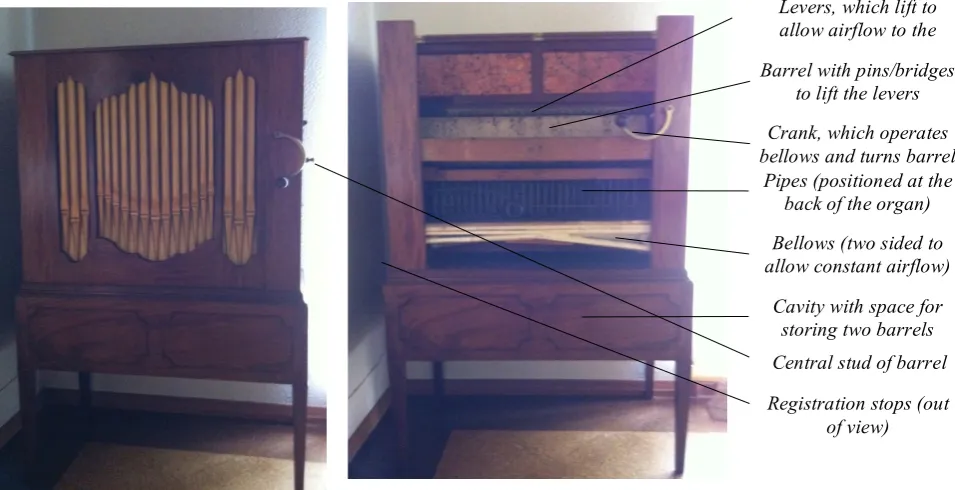
many reasons, has never quite permeated mainstream practices. The term 'mechanical', in this instance, refers to instruments which perform music with only minimal 'player' input. This input generally consists of winding up a clockwork mechanism, which then powers the machine, or of turning a crank throughout the performance. The crank turns a 'barrel' which is pinned to operate a musical instrument and reproduce music which is identical at every playing.6 This system can be
made to apply to many instrument types but this study focuses primarily on the organ, being the most widely mechanised instrument in England during the period in question and easier to analyse by ear than bell playing mechanisms (also popular), since the sound does not automatically sustain. Organ mechanisms can therefore play more complex and nuanced music, and therefore take on the practical uses for social and domestic music-making and listening which will be important to this study. Mechanical musical instruments which survive unaltered from their time of construction effectively provide a 'recording' of a musical style preserved from this period.
Scheibe's assertion that listening is the only true means by which an understanding of musical style may be achieved, when combined with Engramelle's belief that mechanical instruments could provide future generations with the means to do this, makes the lack of interest in audio evidence from the eighteenth-century, relative to reliance on written sources (textual or notated), all the more interesting.7 This may, in part, be due to the frequent division between enthusiasts, enthralled by the machinery but lacking the musical expertise to truly appreciate the instruments' value as
5 A few works which have suggested this are:
Fuller, D. (1983). "An Introduction to Automatic Instruments." Early Music 11(2) pp. 164-166.
Haynes, B. (2007). The End of Early Music : a period performer's history of music for the twenty-first century. (New York, Oxford University Press).
Ord-Hume, A. W. J. G. (1983). 'Ornamentation in Mechanical Music.' Early Music 11(2) pp.185-193. 6 More information on the workings of barrel-organs and organ clocks can be found in Chapter 2. 7 Scheibe is not the only one to make such a suggestion, others include:
Quantz, J. J. (1752) On Playing the Flute : the classic of Baroque music instruction. tr. E. R. Reilly (2001). (London, Faber) p. 7.
musicological sources, and musicians and musicologists who have dismissed the machines as mere novelties. The style and timbre heard in barrel-organs and musical clocks are not always easy to listen to, often owing to deterioration in the mechanics, but also to the musical style which is quite remote to the customary style of performance today. This problem has been described by scholars of early phonograph recordings and in this case many draw the conclusion that any aversion the modern listener may have (and many have found it very unpalatable, even discounting the audible
interference) is due at least in part to a misunderstanding of how earlier performers expressed their musical ideas.8
A number of writers however, have cited mechanical 'recordings' as something which should be more carefully examined and there have indeed been studies on a few pieces. Scores for
mechanical instruments by Mozart and Haydn survive, and English musical organ clocks and barrel-organs advertised connections with great composers such as Handel, but very little evidence has been found which identifies the specific connections of composers working in England with mechanical organ and clock makers. Likewise, no study has analysed in depth the musical performance style contained within those English instruments made in the eighteenth century. Some works have briefly examined the general performance style, mostly regarding ornaments but occasionally touching on other areas, but a deeper investigation, which attempts to truly interrogate the evidence provided by English mechanical organs/clocks of the period and the scores/treatises connected to them, has been lacking. Similarly, very few attempts have been made to compare the style found in these instruments to the many instrumental and vocal treatises from the period from which scholars and performers have gleaned the evidence to support modern 'historically informed performance', and those attempts which have been made are brief, as will be discussed in the following sections.
1.1 Review of secondary source literature relating to the history and music of mechanical musical instruments in England c.1720-1800.
The primary sources regarding the construction of mechanical organs and organ clocks are inextricably linked to the instruments' background and are therefore discussed further in Chapter 2, but there are several secondary sources which have informed the development of the methodology for this work.
1.1.1 Ord-Hume
8 Leech-Wilkinson, D. (2010). "Listening and Responding to the Evidence of Early Twentieth-Century Performance."
Journal of the Royal Musical Association 135(sup1) pp. 45-62.
The most comprehensive modern studies of the workings of mechanical musical instruments are by Arthur W. J. G. Ord-Hume, who has produced many books and papers on various aspects of mechanical music over the last 50 years. His major work Barrel Organ gives a wealth of background information relevant to this study.9 He draws on period sources, gives illuminating explanations
concerning the systems by which barrel-organs are pinned and provides diagrams (both historical and modern) showing the workings of various types of mechanical organ, as well as information regarding their development, history, popularity and social function.10 Ord-Hume’s paper 'Cogs and Crotchets:
A View of Mechanical Music in Early Music' also serves as a primer to what Ord-Hume terms 'the great age of mechanical music'.11 He provides background detail about sixteenth- and
seventeenth-century achievements in mechanical music and also the pedigree and lineage of important makers such as Hassler and the Bidermann and Langenbucher families in the seventeenth century. His main focus, however, is on the eighteenth and early nineteenth centuries. The paper is a general survey of extant instruments, their composers (including Mozart, Haydn, W.F. Bach) and their locations across Europe at the time of writing, and although some of this information may now be a little out of date much remains accurate. Ord-Hume’s assertion that the eighteenth century was the ‘great age’ stems from the mechanical advancements of the period resulting in a level of musical nuance and subtlety not previously possible. It also refers to his belief that the market was still exclusive enough for makers and composers to be in close contact, as opposed to the later nineteenth century, when he postulates that the mass production of orchestrions and dance hall organs devalued them as artistic sources stating that: 'player pianos and street organ-grinders have helped to spread music, but in so doing have generated tolerant smiles or curses: music played automatically has been demeaned thus in the minds of many.'12
The possibility that mechanical musical instruments might be valuable as historical
performance sources is then raised by Ord-Hume in another paper of the same year, 'Ornamentation in mechanical music'.13 Here he raises some questions which will be relevant to this dissertation, but do not seem to have been followed up elsewhere, as this is one of very few articles to address the issue of ornamentation found in mechanical instruments directly. In his opening statement, Ord-Hume points out that most mechanical instruments (which are sufficiently sophisticated) from before the twentieth century contain ornaments. He comments that some may 'despair at ever hearing an air played on such an instrument without a tracery of extensive and fussy embroidery embellishing the whole in an
9 Ord-Hume, A. W. J. G. (1978). Barrel Organ: the story of the mechanical organ and its repair. (London, Allen and Unwin).
10 ibid. pp. 407-427.
11 Ord-Hume 'Ornamentation in Mechanical Music', p. 185.
Ord-Hume, A. W. J. G. (1983). 'Cogs and Crotchets' Early Music 11(2) p. 167. 12 ibid. p.171.
almost architecturally baroque style', clearly having encountered the argument that the renditions are over-ornamented cameos which sound ridiculously elaborate to modern ears.14 The quotation implies
that the lack of notice taken of these sources lies in the fact that they are not to modern tastes. It also links this florid style with a baroque taste for the exuberantly ornate, evidenced in architecture as well as other art forms. Ord-Hume is clearly of the opinion that tastes have changed and it is not possible to impose modern aesthetics on these performances. In further support of this idea he refers to early recordings 'of once-revered singers, whose, often forced voices, glissandi and uncertain intonation would see them off the platform today'.15
Ord-Hume poses three questions arising from his consideration of the ornamentation, 'first, why is it there; second, how important is it; and third, what should be done regarding trying to interpret it today in either written score or performance?'.16 In addressing these questions, he first postulates that these instruments represent a received style of performance. This is an important concept but one which is also vague. Historical performers across the globe operate in an increasing multiplicity of contexts, many of which encourage or demand different approaches to style and varying requirements of historical legitimacy.
Secondly, Ord-Hume draws on the fact that most notated music throughout history has been little more than a framework onto which every performer, human or mechanical, would be expected to hang his own style of interpretation encompassing ornamentation. Finally, Ord-Hume suggests that modern performers might adopt this style, but may need to compromise either by adding little of the ornamentation or using a slower tempo.17 These papers therefore raise some salient issues surrounding
the use of mechanical instruments as sources for ornamentation practice. They only provide an introductory overview however, and this thesis will aim to fully investigate claims regarding the veracity of mechanical instruments as historical performance documents.
1.1.2 Haspels, Dirksen, Fuller, Di Sandro and Cypess
In addition to Ord-Hume’s work there are two other writers (Haspels and Fuller) who provide some comments on the ornamentation and importance of the music contained within mechanical instruments. Jan Jaap Haspels's book Automatic musical instruments: their mechanics and their music 1580-1820 is the most thorough investigation of the music and workings of automated mechanical instruments of this period yet produced.18 Haspels only investigates 'automatic' instruments however, i.e. those powered by clockwork, and does not refer to hand-cranked instruments such as the barrel-organs. However, he does provide some brief analysis of ornamentation in his Chapter 6. The
14 ibid. p. 185. 15 ibid. 16 ibid. p. 186. 17 ibid.
categories he uses for his analysis of ornaments are theappoggiatura, the mordent, the trill, the turn, the slide, and inégalité. Although the broad categorisation of ornaments from audio sources can be problematic (as will be discussed later), nevertheless he demonstrates an analytical approach to the study of ornamentation found in mechanical musical instruments which is seldom found elsewhere.
The book contains over forty transcriptions of music from various mechanical sources from the sixteenth to the late eighteenth centuries including twenty pieces by G. F. Handel, transcribed from two musical clocks made by Charles Clay in the 1730s, including the one noted at the outset of this chapter, which, when sold at Christie's in the 1970s, was found to contain a score of the music it plays.19 Haspels’s transcriptions, provided by Peter Dirksen (also published separately), notate the
ornamentation accurately giving precise rhythms of each note in even the tiniest mordent.20 The
recording from which these transcriptions were taken, has, in part been made available for this study through the mediation of the Museum Speelklok.21 This makes the pieces found in the Clay clocks
excellent material for analysis since it is possible to observe the exact number of oscillations and speed of every ornament and also to check some of the transcriptions. Most have been found to be accurate, though some interpretations may be open to dispute: these will be addressed in Chapter 6.
Further to this, a set of transcriptions has been published by Massimo Di Sandro, since this project began, which have been made by analysing the barrels of a further clock by Charles Clay, now housed in the Royal Collection in Naples.22 The style of ornamentation is very similar to those
transcribed by Dirksen and they provide interesting material: including opera arias etc. (like the two clocks discussed by Haspels), but also some seemingly original material.
In addition to Dirksen's transcriptions, as used by Haspels, others which have proved useful as models are those provided by David Fuller in his Two Ornamented Organ Concertos; as played by an early barrel-organ.23 Fuller has also provided some analysis of performance style in his writings on mechanical instruments. Three publications by him have contributed to this study, written over ten years ending in 1983. The first, Mechanical Musical Instruments as a Source for Notes Inégales,24 attempts to show ways in which mechanical instruments may be used as sources for historical
performance outside the realms of ornamentation. In addition to notes inégales he also refers to tempo fluctuations, another area in which mechanised performances could be revealing. The paper is
presented with audio examples (in the form of a 7” vinyl record) in which Fuller gives examples of
19 The score is not in the hand of Handel, or any of his scribes. It is discussed further in Chapter 6.
20 Dirksen, P. (1987). George Frideric Handel, Twenty Pieces for a Musical Clock: (ca.1738). (Houten, NL, The Diapason Press).
21 I am grateful to Marieke Lefeber at the Museum Speelklok for her help in obtaining permission to use this.
22 Di Sandro, M. (2012). Macchine Musicali al Tempo di Händel : Un Orologio di Charles Clay nel Palazzo Reale di Napoli (Florence, Leo S. Olschki).
23 Handel, G. F. and D. Fuller (1980). Two Ornamented Organ Concertos (opus 4, nos.2 and 5) as played by an early
barrel-organ. (Hackensack NJ, Jerona Music Corporation).
24 I would like to express my thanks to Peter Holman for providing me with this article.
sources both at their original tempi and slowed down for the reader/listener to compare. He draws support from period sources relating to mechanical instruments and gives a clear picture of how the mechanism of a barrel works, therefore highlighting, for example, the impact which a slightly bent pin may have, and the technical difficulties of measuring the distance between consecutive ‘notes’ on a barrel which, though they may be only a millimetre further round the barrel circumference, may be horizontally far apart.25 He quotes Engramelle's claim that, only eleven years after the death of
Rameau, the great master would be appalled by the transformation in the way his pieces are performed, commenting that this style must have changed so much by our own time as to be unrecognisable.26
Many of his conclusions on the performance of notes inégales may be correct but they are unfortunately undermined by faulty mechanics in the principal barrel-organ examined (the Holland organ in the Colt Collection) owing to 300 years of wear and tear. His conclusions about Handel’s
Organ Concerto in Bb are therefore likewise flawed.27 The organ is hand-cranked, so the turning
speed of the operator affects the tempo of the music (which is not discussed), and it has also become clear that with some repairs to the mechanism, much evidence of inegalité was expunged.28 Fuller
acknowledges this in his preface to Two Ornamented Organ Concertos,and retracts his earlier belief in the use of inequality for this particular piece.
Fuller’s final paper on the subject, and the last of his work in the area of mechanical
instruments is his 'Introduction to Automatic Instruments'.29 This introduction, serves, curiously, as a
conclusion to Fuller's first two publications. He reaffirms his belief that mechanical sources must be seen as documents and that they are essential to the study of historical performance practice although, as with all historical sources, they raise as many questions as they answer. For example, he writes:
There is no reason in principle why a barrel mechanism no more elaborate or refined than those made in the 18th century cannot reproduce every nuance of which a harpsichordist’s or organist’s fingers are capable. There are, after all no other significant variables than speed and timing of attack and release, and perhaps depth of stroke. All these can be controlled by the size and contours of the pins and the ‘keys’ they accentuate. Yet in the very few instruments that I have examined, both attacks and releases are everywhere uniform...were they [the makers] too dense to see how these variations might be produced by shaping their pins? Or was good playing measured by a uniformity of touch?30
The elements of musical style which were technologically possible, but omitted, will be relevant to this study, particularly in the later chapters' discussion of ritardando and cadenzas: ornamentation is, Fuller claims, the easiest area of style to study through mechanical instruments. He
25 including Engramelle and Dom Bedos who will be further discussed in Chapter 2. 26 Fuller, D. 'Mechanical Musical Instruments as a source for Notes Inégales' p. 7.
27 as performed by the Holland Organ c1790 in the Colt Collection, (Bethersden, Kent), the same instrument from which he later transcribed his Two Ornamented Organ Concertos.
28 Information provided by Arthur W. J. G. Ord-Hume in personal correspondence.
also states, however, that mechanical musical instruments are essentially ‘keyboard’ instruments, and are therefore of ‘only second-hand relevance to other media’. This view runs counter to eighteenth-century authors, who frequently state that instrumentalists can and should learn from information directed at other players and singers, as seen for example in Quantz's 'Introduction':
I have [...] ventured rather extensively into the precepts of good taste in practical music. And although I have applied them specifically to the transverse flute, they can be useful to all those who make a profession of singing or of the practice of other instruments.31
Similarly, it does not agree with the volume of ornamentation evidence, often very similar in its detail, which survives for widely different instruments.
An interesting recent addition to the literature concerning the validity of mechanical musical instruments as sources for performance practice has been published whilst this thesis was in its final stages. Rebecca Cypess's article "It Would Be without Error': Automated Technology and the Pursuit of Correct Performance in the French Enlightenment' examines the methods of notage expounded in Marie-Dominique-Joseph Engramelle's treatise La Tonotechnie.32 Contextualising Engramelle's work
with that of other pioneers of automata manufacture (much of which can be found in Chapter 2), Cypess examines what might be learned from the extreme detail of Engramelle's notation for pinning cylinders and whether this may, as he claims, be a way in which we can understand more fully the
bon gôut required by Couperin, Rameau and others and lamented as sadly lacking in many players by Engramelle himself. Cypess also addresses the modern reconstructions of instruments capable of realising Engramelle's scores, which he produced in collaboration with the composer and organist Balbastre, finding that, although there is a great deal of detail provided by Balbastre, Engramelle does not always stick to this, possibly prioritising his own theorising over the musical effects desired by the composer. This slightly undervalues the effect of the reconstruction, but does not diminish the detail of the scores, nor the level of understanding as regards what was possible in terms of nuance and performative expression.
1.1.3 Cumming, Malloch and Jerrold
A Sketch of the Properties of the Machine Organ, invented, constructed, and made by Mr Cumming, for the Earl of Bute: and a catalogue of the music on the various barrels, etc. (1812) is an account of Alexander Cumming’s dealings with the Earl of Bute.33 The Earl employed him initially to
advise on improvements to a barrel-organ built in the early 1760s and later to build a new organ on which the Earl could play the barrels from the first organ as well as six newly-constructed barrels.
31 Quantz, J. J. On Playing the Flute, p. 7.
32 Cypess, R (2017) "It Would Be without Error': Automated Technology and the Pursuit of Correct Performance in the
French Enlightenment' Journal of the Royal Musical Association 142(1) pp. 1-29.
33 Cumming, A., F.R.S. (1812). A Sketch of the Properties of the Machine Organ, invented, constructed, and made by Mr
There is much detail about how the second organ improved upon the design of the first: for example, a more efficient bellows mechanism and ease of changing the barrel, avoiding the need to admit servants into gatherings for this purpose. The final section of the book details all the pieces pinned into each of the (over sixty) barrels for the organ and it is this section which has fuelled debate. Most pieces are by Handel, but there are also works by Corelli, Vivaldi, and others as well as what
Cumming terms 'holiday music'.34 This term seems to denote the folk tunes, dances and songs which
feature in many barrel-organs.
Cumming gives precise timings for all pieces, and these were used by William Malloch as the basis for his paper 'The Earl of Bute’s Machine Organ: A Touchstone of Taste', included in the same issue of Early Music as papers by Ord-Hume and Fuller.35 Malloch attempts to use these timings (the
organs are no longer extant) to extrapolate the tempi of the pieces. The descriptions, titles, and timings given by Cumming are very detailed, though he admits it is the product of memory and 50-year-old notes; he was around 80 years old when the book came to print, so it is likely that there are some errors. Malloch acknowledges this but nevertheless draws many conclusions from the
information. He places particular emphasis on the fact that one collaborator on the first organ, employed to arrange the musical repertoire, was John Christopher Smith the younger (1712-1795), Handel’s amanuensis for a large portion of his working life in London and a well-known composer in his own right.36 This, in Malloch's view, imbues these conclusions with even greater authority, although Cumming does not mention Smith directly in his book, a fact pointed out by Beverley Jerold in 'A re-examination of the tempos assigned to the Earl of Bute’s machine organ', published in a later volume of Early Music.37
Malloch’s method is to locate modern recordings of the listed pieces, to record them onto tape and then, using sound equipment with varying speed control, to either stretch or accelerate them to fit Cumming’s timings establishing metronome markings. With this pre-computer software equipment, pitch is affected by speed manipulation, and Malloch claims his results show generally a raising of pitch (i.e. a faster tempo) compared to the ‘modern’ performances. This seems a somewhat
convoluted procedure; simply counting bars in a score and dividing the timings by this number, followed by the number of beats in a bar would give the same results. The primary conclusion, however, is that, as a rule, metronome markings were much faster than those used in 1983 (with some notable exceptions).
34 ibid., p. 38.
35 Malloch, W. (1983). 'The Earl of Bute's Machine Organ: A Touchstone of Taste.' Early Music 11(2) pp. 172-183. 36 Coxe, W. (2009). Anecdotes of George Frederick Handel and John Christopher Smith (1799). (Richmond, Surrey, UK, Tiger of the Stripe). This source is discussed further in Chapter 2.
In theory this could provide interesting information but there are flaws in the methodology, as Jerold points out in her article disputing Malloch's findings.38 Many of the titles for the pieces of
music are unclear in Cumming’s account and Malloch has used some interesting methods to attempt to identify the works from which some of the movements are taken. For example, on a barrel otherwise devoted to Corelli, an unattributed piece identified only as 'Sarabande Largo' is timed at 0'30'' He assumes this is 'Sarabanda: Largo' in 3/4 from Concerto Op. 6 No. 11 and calculates the tempo to be crotchet = 120, but with no way of checking this is even the correct piece, this conclusion must remain suspect.39 As Jerold points out, Malloch is not precise in giving the information on which scores or recordings he used; neither does he state which editions he refers to in his calculations.40
Handel regularly revised and edited his own work, and adapting scores to fit different musical situations was standard practice in the eighteenth century. A cut, repeat, or da capo added or omitted would radically alter any tempo extrapolated from a timing alone. Malloch's methodology may in some cases have produced accurate results, which would be an extremely valuable body of
information. However, this is unverifiable and, unfortunately, undermines the rules which underpin his conclusions.
David Fuller’s metronome markings for Handel’s organ concerto in F major measured from the Holland organ in the Colt Collection are very different for to those arrived at by Malloch. Jerold points out that in certain pieces the speeds required by Malloch’s calculations might render any singer incapable of enunciating the text, which must surely be of concern. Malloch does compare his tempi to those recommended by William Crotch in his Specimens of various styles of music, but where he finds disparities between his own and Crotch’s tempi, he puts this down to conservatism on Crotch’s part, stating that he was clearly 'looking for ''the sublime'' at every turn' and that his choices
demonstrate a 'growing solemnization of Handel’s entire output'.41 However, there are some tempi he finds which agree with Crotch’s, so this 'growing solemnization' cannot have applied to Handel’s 'entire output'.42 As Jerold states, they may be each referring to different scores or even, in some cases, different pieces, since many titles are ambiguous.
From the barrel listings, Malloch also claims that Smith43 in his arrangements created ‘suites’ of pieces from the repertoire (whether ‘serious’ or 'holiday' music).44 He also claims that these timings
enable him to identify mistakes in the measurements or titles of pieces and even to establish ‘rules’ by which Smith programmed these automated ‘concerts’. These are, firstly 'that there should be no cuts
38 ibid.
39 Malloch, W. ‘The Earl of Bute's Machine Organ’, p. 182.
40 Jerold, B. 'A Re-Examination of Tempos Assigned to the Earl of Bute's Machine Organ' p. 586. 41 Crotch, W. (1808-1815). Specimens of Various Styles of Music. (London, Royal Harmonic Inst.). Quoted in Malloch ‘The Earl of Bute's Machine Organ’, p. 178.
42 ibid.
43 Malloch states with conviction throughout the paper that it was Smith who masterminded the musical arrangements and
decided in which order pieces should appear on the barrels. Smith was involved in the arrangements for the first organ and the second was designed to play the earlier barrels, but his level of involvement is not verifiable.
in through-composed pieces' (though he states that sometimes only the A section of da capo aria is used), and secondly, that 'there should be no transpositions'.45 To this he adds that the key transitions
between pieces are carefully chosen and though they may sometimes move up or down by a tone, there are no tritones. His evidence for this is the fact that the pieces found together on a barrel, in their original state, are in related (or at least not jarringly disparate) keys. However, most barrel-organ music is transposed into keys closely related to C major, thereby limiting the number of flats and sharps needed and keeping the number of pipes to be fitted in to a limited space to a minimum, so although this may be pertinent, it may be entirely fortuitous. Malloch concludes, however, that to play all of these pieces un-transposed, the organ would have to be fully chromatic with a wide range. This is possible, but it is a tenuous path leading to a conclusion with little supporting evidence. A wide and chromatic range could be inferred from Cumming's list of stops but is not explicitly stated. If the keys were changed, as is generally the case with pieces on barrel-organs, any original relationship would be irrelevant since they would of necessity be transposed into related keys.
Malloch's final rule is 'that while each composition should have its own appropriate tempo, there should nevertheless be rhythmic continuity from piece to piece'.46 He claims that his results
show a discernible ‘tactus’, linking pieces or movements. This could have far-reaching consequences for the performance of much eighteenth-century music if, and only if, the scores to which Malloch refers when calculating his tempi can be reliably proven to be those used by Smith, Cumming or their associates responsible for the arrangement and pinning of the pieces. However, as Jerold points out, this is not the case, and for this reason his findings are suspect. Had Malloch perhaps drawn fewer conclusions from a smaller number of examples for which accurate scores were traceable, his findings could have been more widely accepted. However, as he attempts to draw ever further-reaching
conclusions, each step takes Malloch further away from verifiable proof.
1.1.4 Munrow, Schwannberger, Egarr, Lasocki
The possible transfer of the performance style found on eighteenth-century mechanical instruments into ‘live’ performance is one which has only rarely been addressed by performers, providing little opportunity for meaningful discussion of the results. A number of organists have recorded some or all of Handel’s music for Clay’s musical clocks but these reflect the notated scores
only,47 which generally do not contain anything like the level of ornamentation found in the
mechanical performances, and give no instruction as to the realisation of those ornaments which are indicated. It is therefore not necessary to study them for this project. However, a few performers have practically investigated using the style of ornamentation which is found in mechanical instruments.
David Munrow, in his 1974 recording The Amorous Flute uses the Holland organ from the Colt Collection as the basis of his performance of Handel’s recorder sonata in F major Op 1 No. 11. This is logical, since the piece performed by the organ, Handel’s Organ Concerto in F, Op. 4 No. 5 (HWV 293), is almost identical and, as Munrow points out in his sleeve notes, 'The majority of the ornaments fit the recorder admirably'.48 They do indeed fit well, as will be seen in Chapter 9 and the
practical element to this thesis, but David Lasocki, in what appears to have been an influential article, does not consider this to be a legitimate performance style or research method.
Lasocki, in his 'A New Look at Handel's Recorder Sonatas: 1. Ornamentation in the first movement of the F major Sonata', strongly dislikes Munrow’s ornamentation.49 He gives a
transcription of it, but also describes it as 'excruciatingly and appallingly bad'. He maintains that Munrow's belief that Handel 'would have expected and enjoyed such ornamentation' is 'dangerous nonsense'.50 He quotes Charles Rosen in an uncited passage as stating that many, if not most eighteenth-century transcriptions of ornaments should be disregarded because they are the work of 'inferior eighteenth-century musicians and [examples of] the worst eighteenth-century taste'.51 Lasocki cites Quantz to reinforce his opinions, with the quotation 'The graces should be introduced only where the simple air renders them necessary'.52 However, this quote from Quantz does not specify how often
this might be. Lasocki’s principal argument against the use of this ornamentation seems to centre around subjective distaste. This is perhaps to be expected given that tastes in musical performance have changed hugely over the last 300 years; it is certainly not possible to subscribe to views such as that described by Neumann that:
we have good reason to assume that no fundamental change has occurred in the aesthetics of
performance [...] We are therefore on fairly firm ground in assuming the basic identity of an informed cultivated taste of today corresponds with the one Mozart expected to encounter in his audiences.53
47 Handel, G. F. ed F. Spiegl (1955). Pieces for a Musical Clock. Edited and transcribed for piano or organ by Fritz Spiegl (London, Schott & Co.).
48 Munrow, D. (1974). The Amorous Flute. CD, (Decca). notes p. 7.
49 Lasocki, D. (1978). 'A New Look at Handel's Recorder Sonatas: 1. Ornamentation in the First Movement of the F major
Sonata.' Recorder and Music 6, pp. 2-9.
The sentiments carried by Lasocki are reiterated in similar articles for Recorder Education Journal (2001), and The American Recorder (1989).
50 Lasocki, D. (1978). 'A New Look at Handel's Recorder Sonatas: 1', p. 6. 51 ibid.
52 ibid. p. 5
Lasocki's alternative models for ornamentation, found in this and later articles54 published in collaboration with Eva Legêne, are the work of William Babell, Handel's own variations in his keyboard works and also the Three Ornamented Arias (ed. W. Dean), which provide a rare source for actual Handelian ornamentation instruction. These are outwardly quite different in ornamentation style to that found in mechanical organs, though they have not been directly compared before this study. As will be seen in Chapter 3, there is a great deal to be gained from this comparison as regards the connection between mechanical performances and Handel.
In fairness to Lasocki, Munrow's translation of the organ's stylistic practice on to the recorder is of limited success, the realisation of the decorations carrying a sense of their unfamiliarity. A little too much articulation within them leads to the ornaments sounding somewhat imposed on the music, rather than being an integral part of it.
A somewhat more successful rendition of the same ornamentation is found on Il Vero Modo's recording Händel: A Flauto e Cembalo, on which Sven Schwannberger and Thomas Leininger perform the same F major recorder sonata alongside the composers other recorder sonatas. In Schwannberger’s notes he contests Lasocki's view, suggesting a link between the Holland organ and earlier baroque recorder treatises similar to those which will be followed up in Chapter 7,55
mentioning instructions in The Compleat Flute Master for the placing of 'essential graces' on particular musical phrases whenever they occur (e.g. conjunct ascending and descending notes, repeated notes etc.).56 Schwannberger suggests that this stylistic practice, is supported by the evidence
of mechanical instruments even late into the eighteenth century. His transfer of the ornamentation style into the other recorder sonatas on the disc is very interesting, as is Leininger's use of Babell's work as a model for the harpsichord part.57
Richard Egarr in both his sleeve notes to Handel Organ Concertos Op. 4 and a video about the making of this album for Dutch Radio station AVRO, refers to the extravagant ornamentation and admits that he has 'indulged [in ornaments] half as much compared to my 'mechanical colleague'.58 Indeed, even with this reduction in embellishment he admits his listener may make accusations of 'gilding the lily', valuable evidence that a change in musical tastes is perhaps the main reason why mechanical instruments have been treated with such suspicion as historical sources. Egarr questions the live performability of the 'superhuman ornamental delivery', which it is hoped will be refuted by the performance at the conclusion of this study.
54 Lasocki, D. E. L. (1989). 'Learning to Ornament Handel's Sonatas Through the Composer's Ears. Part III: Conclusions.'
The American Recorder (Nov 1989) pp. 37-141. See also section 1.2.
55 Schwannberger, S. and L. Thomas (2007). Georg Friedrich Händel - A Flauto e Cembalo [CD] Il Vero Modo, CTH 2540 (Thorofon).
56 Anon (1695). The Compleat Flute Master. (London, J. Hare, J. Walsh).
57 Babell, W. (c.1715) Suits of Harpsicord and Spinnet, Lessons, Collected from the most Celebrated masters works. To
which is added a Great Variety of Passages. (London, R. Meares).
58 Egarr, R. (2008). Handel, Organ Concertos Op. 4. [CD] . Academy of Ancient Music HMU 807446 (Arles, Harmonia Mundi)
Both Schwannberger's and Egarr’s notes name John Christopher Smith the younger as a collaborator on the arrangements for the Holland organ.59 If this were the case it would indeed give
the organ an authoritative pedigree. The lack of concrete evidence to support this, other than its continual use anecdotally in twentieth century sources, will be discussed in Chapter 2.
Most other articles about mechanical musical instruments of the eighteenth century are broadly historical and more concerned with the history of the makers than with the specifics of the music contained within them, and it is not relevant to review them all here. One exception is William Barclay Squire's article, 'Handel's Clock Music' which provides a transcription of the clock music contained within the British Library's Aylesford collection.60 There is no commentary on the music
itself or its performance style, though there is useful background to the manuscript. The music of some mechanical instruments has been released on CDs, such as the Erato recording mentioned earlier made by Olivier Roux, and The Cuckoo and the Nightingale, a collection of 'cylinder organs 1750-1830' released on the Canal Grande label by the Museum Speelklok. These are valuable resources, but they provide documentation rather than analysis of the performance style.
1.2 Literature relating to current ornamentation and historical performance styles
Over the course of this thesis, it will occasionally be necessary to make references to current practices (my own and others') within the broad remit of historically informed (or 'inspired' to adopt Bruce Haynes's preferred term) performance.61 There are, of course, almost as many attitudes to historical performance style as there are performers or scholars, and it is difficult, not to mention controversial, to make generalisations regarding current practices and philosophies. Therefore, I have decided to frame this section as an illustration of publications which have been and continue to be important or influential in the HIP world in which I, as a performer and scholar, have been educated. This will, it is hoped, illustrate my personal background, from which I approached this project, and demonstrate how this fits into the continuum of the HIP movement.
From my perspective, three questions help to establish the broad categories into which HIP literature falls and to elucidate the progression followed by myself and others educated within the field. These are: How was music performed? Why do we attempt to emulate this? Where do we go from here? The first group of these texts (the 'hows') includes standard historical texts detailing what is known about the past. In the case of HIP, this category of texts often focuses on primary reference
59 As do Malloch and Ord-Hume, as discussed earlier. This refers to the claim of Olivier Roux on the notes to his LP Hændel
- Un Enregistrement d'un Epoch (Erato, 1985), Lasocki states in the endnotes to his article in American Recorder that Roux promised to write up his research on this matter and publish, but never did.
60 Barclay Squire, W. (1919). "Handel's Clock Music." Musical Quarterly 5(4) pp. 538-552. This collection is further discussed in Chapter 3.
61 Hereafter this will be referred to as HIP.
material, annotated and categorised with the aim of informing the performing community. The second group (the 'whys') attempt to crystallise the philosophies and attitudes regarding how this historical knowledge can, or should, impact on modern performance. The third group seeks to synthesise these various, often opposing philosophies with both the letter and the spirit of the historical sources, in order to postulate ways of forging a way forward.
The first category is the simplest to deal with, and it is not necessary to venture too far into the thousands of articles, books and other publications which place the music of the baroque period, my focus in this thesis, within its historical and musicological context. However, a few far-reaching texts which epitomise broader genres of work should be mentioned, some of which have retained their relevance over many years, as well as more recent titles which have broadened the scope of this type of work. A great deal of primary source material regarding performance styles in earlier periods is now available, either in facsimile or edited/translated publications, and these are generally viewed as the foundation of modern HIP pedagogy, although, as will be discussed, they are open to much interpretation. The following volumes, however, along with others, provide an excellent point of departure, since they contain huge numbers of references or extracts from treatises and other primary sources, organised by category, including many lesser-known and certainly less widely available texts.
Donington's The Interpretation of Early Music, published in various editions between 1963 and 1989, sets the standard for this type of work, providing a huge volume of quotations, translated and organised clearly to provide reference material on most areas of the performative process.62
Neumann's Ornamentation in Baroque and Post Baroque Music offers more detail, specifically regarding the interpretation of small-scale graces, of particular relevance here, with special reference to the work of J.S. Bach, but encompassing a vast number of sources from many nationalities. These texts are not merely encyclopedic, however, and are also not in their original language so, it follows that wherever there is translation and/or commentary, there must also be interpretation, which has often proved highly influential. Donington's advocacy of the 'prepared' trill, for example, in which the opening upper appoggiatura is lengthened, has certainly permeated general HIP practice.63 Neumann's attitude to this ornament is more circumspect, giving multiple illustrations where there is no
indication of extension to the opening upper note of a trill.64 Examples of 'free' ornamentation, the addition of melismatic, or melodic additions to a more or less skeletal notated line, are presented alongside their original lines, or editorially imagined skeleton forms, in Lasocki and Mather's 1976 publication Free Ornamentation in Woodwind Music. This also contains an introduction in which 'rules' are established, with reference to various primary authors. The tone is cautious, generally
62 Donington, Interpretation 63 Donington Interpretation, p. 241.