City, University of London Institutional Repository
Citation
: Beqiri, Z. (2016). Essays on banking in developing countries. (Unpublished
Doctoral thesis, City, University of London)
This is the accepted version of the paper.
This version of the publication may differ from the final published
version.
Permanent repository link:
http://openaccess.city.ac.uk/18102/Link to published version
:
Copyright and reuse:
City Research Online aims to make research
outputs of City, University of London available to a wider audience.
Copyright and Moral Rights remain with the author(s) and/or copyright
holders. URLs from City Research Online may be freely distributed and
linked to.
countries
Zana Beqiri
This thesis is submitted for the degree of Doctor of Philosophy Cass Business School, City University London
List of Tables v
List of Figures vii
Acknowledgements ix
Declaration xi
Abstract xiii
Abbreviations xv
1 Introduction 1
1.1 Background . . . 1
1.2 Research questions and motivation . . . 3
1.3 Data . . . 10
1.4 Main findings and contributions . . . 13
1.5 Conclusion . . . 15
2 Foreign bank entry and NIMs: evidence from SEE 17 2.1 Introduction . . . 17
2.2 Literature Review . . . 23
2.3 Data and Methodology . . . 27
2.3.1 Foreign banks in SEE countries . . . 27
2.3.2 Net Interest Margins in SEE countries . . . 29
2.3.3 Regulation and supervision . . . 32
2.3.3.1 Activity restrictiveness . . . 33
2.3.3.2 Capital regulation . . . 34
2.3.3.3 Official supervisory power . . . 35
2.3.4.2 Market structure factors . . . 38
2.3.4.3 Macroeconomic factors . . . 38
2.3.5 Methodology . . . 39
2.4 Results . . . 41
2.4.1 Foreign ownership . . . 41
2.4.2 Mode of foreign bank entry . . . 42
2.4.3 Home-country characteristics . . . 43
2.4.4 Control variables . . . 44
2.5 Robustness . . . 45
2.5.1 Endogeneity concern . . . 46
2.5.2 Alternative measures of bank efficiency and market structure 48 2.6 Conclusion . . . 48
Tables . . . 51
Figures . . . 67
Appendices . . . 68
3 Organizational Hierarchy and Institutions 73 3.1 Introduction . . . 73
3.2 Related literature . . . 78
3.2.1 Organizational structure and information production: The-ory . . . 79
3.2.2 Organizational structure and information production: Ev-idence . . . 81
3.2.2.1 Studies using indirect measures of bank organiza-tional structure . . . 81
3.2.2.2 Studies using direct measures of bank organiza-tional structure . . . 86
3.2.3 Organizational structure and loan contracts . . . 88
3.2.4 Institutional environment . . . 89
3.3 Data . . . 90
3.3.1 Bank Organizational Structure . . . 90
3.3.2 Loan and firm data . . . 92
3.3.3 Institutional and macroeconomic indicators . . . 93
3.5.2 Bank organizational structure and loan terms . . . 99
3.5.3 Robustness . . . 99
3.5.4 Firm heterogeneity . . . 100
3.6 Conclusion . . . 101
Tables . . . 102
Figures . . . 114
4 Mobile Money and Traditional Banking 117 4.1 Introduction . . . 117
4.2 Related literature . . . 121
4.2.1 Competition and bank performance . . . 121
4.2.2 Competition and access to finance . . . 123
4.3 Background on mobile money . . . 125
4.4 Data . . . 129
4.5 Results . . . 133
4.6 Additional results . . . 134
4.7 Conclusion . . . 136
Tables . . . 138
Figures . . . 146
5 Concluding remarks 149 5.1 Main findings . . . 149
5.2 Policy Implications . . . 151
5.3 Limitations . . . 153
5.4 Further research . . . 154
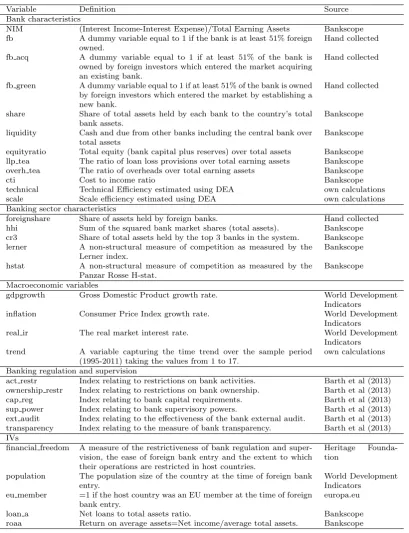
2.1 Variable Definitions and Sources. . . 51
2.2 Number of banks over time. . . 52
2.3 Average NIMs over time. . . 53
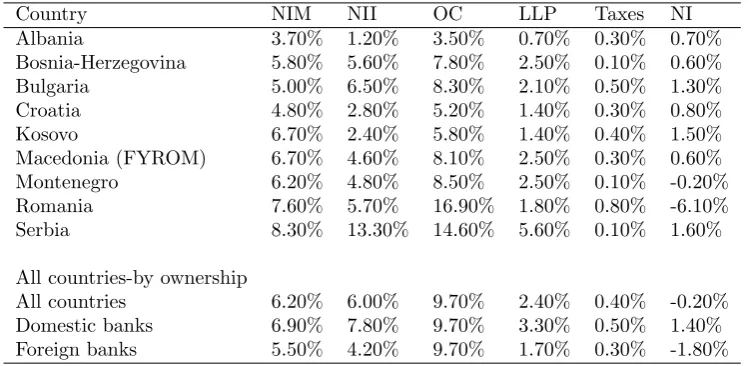
2.4 Average NIMs and Profits by countries and bank ownership type (1995-2011). . . 53
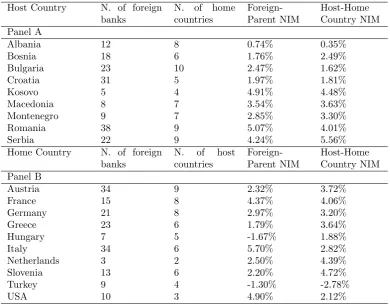
2.5 Home and Host Countries. . . 54
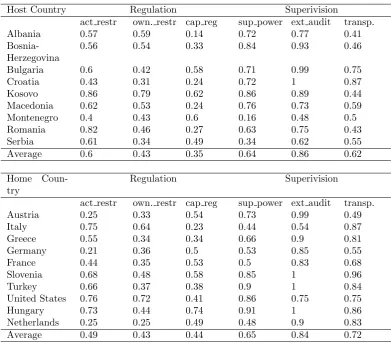
2.6 Regulation and Supervision in Home and Host Countries. . . 55
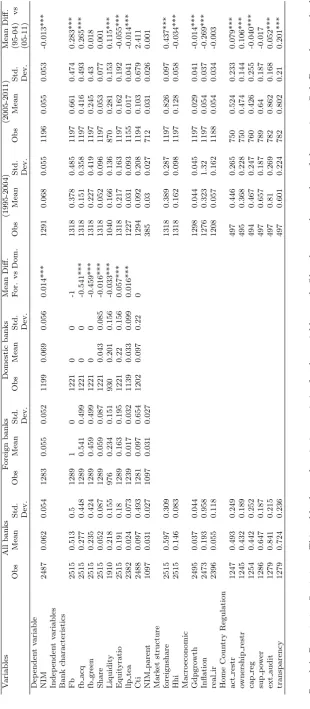
2.7 Descriptive statistics and correlation matrix. . . 56
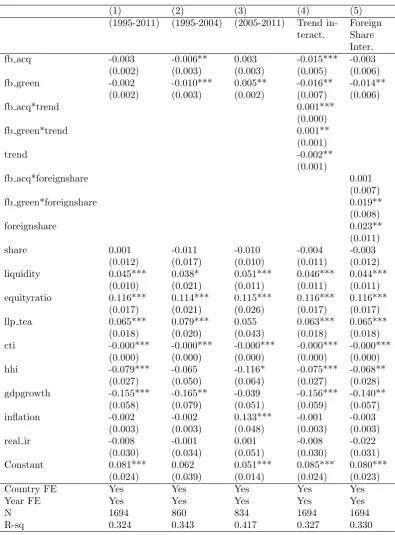
2.8 The impact of foreign bank ownership on bank NIMs. . . 59
2.9 The impact of the mode of foreign bank entry on bank NIMs in host countries. . . 60
2.10 The impact of parent bank NIMs on bank NIMs in host countries. 61 2.11 The impact of home-country regulatory and supervisory indicators on bank NIMs in host countries. . . 62
2.12 Alternative efficiency measures . . . 64
2.13 Alternative market structure measures . . . 65
2.14 Instrumental Variables (IVs) Second-Stage Regression Results . . 66
3.1 Variable definitions and data sources . . . 102
3.2 Summary Statistics by Country. . . 104
3.3 Differences in loan terms. . . 105
3.4 Summary Statistics and Correlations. . . 106
3.5 Decentralization and Institutions. . . 108
3.6 Decentralization and Loan Terms. . . 109
3.7 Firm heterogeneity. . . 110
3.8 Alternative Decentralization measure . . . 111
3.9 Alternative controls . . . 112
4.3 Descriptive Statistics, County Level. . . 141
4.4 Descriptive Statistics, Bank, Household and County Level. . . 142
4.5 The impact of M-Pesa: Bank’s Perspective. . . 144
2.1 Host and home countries. . . 67
3.1 Defining distance. . . 114
3.2 A typical parent bank. . . 115
4.1 Mobile Payment Statistics. . . 146
4.2 Money transfer methods. . . 146
I am hugely indebted to my supervisors Barbara Casu and Daniela Fabbri for their
constant support and guidance. This thesis wouldn’t have been possible without their
patience, attention to detail and invaluable feedback. Everything I know about
aca-demic writing I owe it to them.
I would like to thank Thorsten Beck for being generous with his time whenever I needed
to alleviate any doubts I had with formulating research questions, finding data sources
or dealing with methodological issues. His passion for science is contagious and such a
great source of inspiration.
I am extremely grateful to the European Bank for Reconstruction and Development
for their hospitality during my visit and for kindly providing me with the BEPS II and
BEEPS V data used in the third chapter. I thank Ralph de Haas for providing
invalu-able feedback on the third chapter of the thesis; Helena Schweiger for her help with
the BEEPS V data and all staff at the Office of the Chief Economist for a supportive
and encouraging environment.
I thank my PhD examiners, Sonia Falconieri and John Wilson, for their constructive
comments and suggestions on the thesis.
I would like to thank City University London for the financial support and Cass
Busi-ness School for a stimulating research environment. I thank Ian Marsh for his advice
with the job market and life after PhD. I also thank Malla Pratt and Abdul Momin in
the PhD Office for administrative support.
Thanks to all my colleagues at 24 Chiswell Street for making this a great PhD
experi-ence.
Finally, I could not thank enough the most deserving people for all my successes. It
is through the work discipline, the confidence and the determination they instilled in
me, that I have made it so far. I am of course referring to my dear parents - thank
you Nu¸ci and thank you Bu¸co, I owe you so much. A big thanks to my sisters for their
moral support during tough times that come with living 2,500 km away from home.
A very specialFaleminderit to Artan. I am blessed having had you by my side for the
I grant powers of discretion to the University Librarian to allow this thesis to
be copied in whole or in part without further reference to me. This permission
covers only single copies made for study purposes, subject to normal conditions
This thesis consists of three essays examining different aspects relevant to the
banking sectors of developing economies. The first two essays focus on Emerging
Europe a region with one of the highest foreign bank presence in the world - to
study the impact of foreign bank ownership and bank organizational structure on
the cost of financial intermediation and terms of loan contracts. The last essay
focuses on Kenya which is home to M-Pesa the mobile-phone based money
trans-fer and financing service initially launched in Kenya in 2007 and subsequently
in other emerging countries such as Albania, Romania, India, Egypt and several
other African countries - to examine its impact on the performance and outreach
of commercial banks.
The first essay investigates the impact of foreign bank entry, home and host
country conditions on net interest margins (NIMs), using a newly collected panel
dataset with ownership information for 265 banks operating in nine Southeast
European countries over the period 1995-2011. As the banking sector of many
emerging markets and in particular the European transition economies have been
dominated by foreign banks understanding the impact of such reforms on host
country banking sectors is important for designing supportive policies. We do not
find evidence of foreign bank entry having a beneficial effect for host countries in
terms of reducing the cost of financial intermediation in the long run, as foreign
banks change their behaviour over time. We show that foreign banks have initially
lower NIMs compared to domestic banks, however this effect weakens the larger
the foreign presence and the more established foreign banks become. We find
that home country regulation and supervision have an effect on bank behaviour,
with foreign banks coming from countries with stricter regulation having higher
NIMs in host countries.
The second essay studies the impact of institutions on bank organizational
hier-archy. Studying the internal organizational structure of banks is important as it
determines the type of information acquired and used in lending decisions and
consequently the type of borrowers banks lend to. This is important not only
system stability and economic development. Using a unique bank-level survey
dataset covering 32 countries and 611 banks, we introduce a new and direct
measure of organizational hierarchy and exploit the distinctive feature of
multi-national banks which face different institutional environments in the countries
they operate. We find that the same parent bank is more likely to grant
decision-making authority to its foreign affiliates operating in countries with stronger
institutions compared to those operating in weaker institutional environments.
Combining the bank- with firm-level data we further find that a strong
institu-tional environment which favours a decentralized organizainstitu-tional structure leads
to better lending terms to SMEs decentralized banks grant loans with longer
maturities, lower interest rates and are less likely to require collateral compared
to their centralized counterparts. These findings further our understanding of
bank organizational structure as a channel through which law affects lending.
In the last essay we use the advent of the mobile money innovation in Kenya in
2007 as an interesting laboratory to investigate the impact of a financial
inno-vation on the performance and outreach of commercial banks. Providing more
insights about this link is important as it helps inform the debate among
policy-makers and regulators on the impact of a non-traditional source of competition
on the service provision of formal financial institutions. Given that financial
in-clusion is a major problem in developing countries, detailed micro-level evidence
on this issue is important for promoting household welfare. Combining the 2006,
2009 and 2013 FinAccess household surveys with bank financial statement and
branch penetration data at the county level we find that banks more exposed
to the competitive pressure induced by the mobile money innovation improved
their performance and expanded their outreach towards households traditionally
excluded by formal financial institutions. Additional results further show that
households report less supply side barriers to financial access in counties more
exposed to the advent of the mobile money innovation. These results highlight
the importance of increasing the contestability of banking markets in order to
BEEPS - Business Environment Enterprise Performance Survey
BEPS - Banking Environment Performance Survey
CEE - Central Eastern Europe
EBRD - The European Bank for Reconstruction and Development
EU - The European Union
GDP - Gross Domestic Product
HHI - Herfindahl-Hirschman Index
IV - Instrumental Variables
NIM - Net Interest Margin
OLS - Ordinary Least Square
SEE - South East Europe
SME - Small and Medium size Enterprise
WDI - World Development Indicators
Introduction
This introductory chapter will give an overview of the research area this thesis
belongs to, will place the specific research questions in the context of the
theo-retical and empirical literature and will present the key findings of the research
highlighting the main contributions of the thesis.
1.1
Background
The banking sectors of many developing economies have undergone considerable
reforms aiming at developing a competitive and efficient financial system in order
to facilitate economic growth and financial system stability. Although the pace
and the extent of the reforms varied across countries a common objective has
been reversing the negative consequences of the repressive financial policies
in-herited from the previous regimes. In Eastern Europe, for instance, the transition
from centrally-planned to market-oriented economies entailed the replacement of
socialist banks who acted mainly as bookkeepers for the planned allocation of
re-sources with modern banks whose role is to efficiently channel funds to its most
productive uses. Similar transformations took place in other parts of the
devel-oping world such as Latin America, Asia or Africa. In Sub-Saharan Africa, for
instance, financial sector reforms aimed at dealing with the negative outcomes
government-owned banks and a large number of other banks and non-bank financial
institu-tions most of them unsound, with strong political connecinstitu-tions. In general, as a
consequence of a long period of government intervention the banking sectors of
these countries were characterized by lack of competition, lack of risk
manage-ment practices for monitoring and evaluating the creditworthiness of borrowers,
wide interest spreads as an indication of inefficient intermediation of funds, lack
of interest in lending to local customers and expanding access to finance as well
as unsound lending practices motivated by political considerations. This, coupled
with a poor regulatory environment resulted in several banking crisis. In light
of these fragilities, financial sector reforms included internal structural changes
such as restructurings and consolidations of unviable financial institutions,
pri-vatisations, the liberalization of interest rates, regulations strengthening bank’s
capital bases as well as opening up to foreign competition in order to reduce
the role of state-owned banks, introduce new know-how and expertise as well as
recapitalize the banking sector. In addition, technological innovation has been
an important driving force for expanding access to finance and introducing new
sources of competition which have changed the landscape of traditional banking
and have facilitated the reform process.
These reforms raise a number of questions regarding the structure of the
bank-ing system, its competitiveness, the availability and quality of financial services
provided to firms and households and ultimately the economic development.
De-spite the potentially beneficial role that these reforms are intended to play, they
also introduce new challenges for regulators and supervisors to guard against
fragilities and risks that consumers might be exposed to. Arguments in favour
include the transformation of poorly performing state-influenced banks into
well-capitalized banks, with new risk management procedures able to price risks more
realistically, allocate funds more efficiently, that make use of new technologies
to offer their services and operating in a competitive environment with an
im-proved regulatory framework. Arguments against point to the new challenges
that may arise from increased foreign bank presence, increased competition from
non-bank institutions and consolidations in the banking industry. In particular,
often accused of cherry picking the best customers leaving unattended small and
medium size enterprises which require local knowledge and building personal
re-lationships. Furthermore, the large presence of foreign banks in these countries
makes them prone to imported fragilities from abroad posing the need for
su-pervisors and regulators from home and host countries to expand cooperation
and the information exchange as highlighted by the recent financial crisis.
Fi-nally, the advent of non-bank institutions (such as mobile phone operators) as
financial service providers has given rise to the issue of whether to regulate them
under banking laws and regulations to ensure that the schemes present little risk
to customers and are trustworthy or to offer a more supportive regulatory
envi-ronment in order not to put a heavy regulatory burden on initiatives aimed at
facilitating the provision of financial services to all market segments, including
those neglected by traditional banks.
Against this background, this thesis examines the impact of financial system
reforms in developing countries on the quality and availability of financial services
provided by their banking systems in order to provide policy recommendations for
the future. This is especially important for developing countries with bank-based
financial systems which have under-developed capital markets and rely mainly
on bank financing.
1.2
Research questions and motivation
The first question addresses the impact of foreign bank entry on the cost of
finan-cial intermediation as measured by net interest margins (NIMs). The motivation
for focusing on NIMs (measured as the difference between interest income and
interest expense over total earning assets) is the fact that this indicator is a
com-monly accepted measure of how costly bank intermediation services are for the
society. High NIMs are usually associated with inefficient allocation of resources
as they discourage savings with low returns on deposits and increase financing
costs for borrowers with high interest rates on loans. Given the evidence that
Levine (1997)) and alleviating poverty (Levine (2005)) understanding whether
the reform process more specifically, the liberalisation of the banking sector has
achieved the intended effect of reducing the cost of financial intermediation is
important for identifying policy areas that have a first-order effect on creating a
legal and macroeconomic environment conducive to the efficient operation of the
banking sector.
We aim to answer the following questions: (i) Do foreign banks operate with
lower NIMs compared to domestic banks and has foreign bank entry lead to an
overall reduction of NIMs in host countries? (ii) Does the mode of foreign bank
entry (acquisition vs. greenfield entry) matter for NIMs? and (iii) Do home
country conditions such as parent bank NIM and the home country regulatory
environment impact the NIMs of foreign bank in host countries?
Theoretically the effects of foreign bank entry have been modelled as
informa-tion asymmetry problems between incumbent (domestic banks) and new entrants
(foreign banks). Domestic banks poses an incumbency advantage in terms of
ac-quiring information about existing borrowers, whereas foreign banks poses better
screening technology for evaluating the creditworthiness of new applicants. In
other words domestic banks are better at dealing with soft information, whereas
foreign banks have an advantage in processing hard information (Dell’Ariccia and
Marquez (2004); Detragiache, Tressel and Gupta (2008)). If foreign banks enter
through acquisition they inherit a customer base with all the related
informa-tion about them, which is not the case when entering via greenfield investment.
Claeys and Hainz (2014) argue that the incumbency (informational) advantage of
domestic banks is lower when entry is made via acquisition as these banks inherit
information about the existing customer base on top of the screening advantage
they possess. Domestic banks thus demand a higher interest rate to
compen-sate for this informational disadvantage, which allows foreign banks to demand
a higher interest rate as well. Thus, when entry is made via acquisition the
com-petition is less intense and the interest rates are higher compared to greenfield
investments. Van Tassel and Vishwasrao (2007) also imply that greenfield entry
Empirical studies have found mixed results. Some studies find that foreign bank
entry has contributed to a reduction of NIMs mainly due to increased bank
com-petition (Barajas, Steiner and Salazar (2000); Martinez Peria and Mody (2004))
while others find a positive association between foreign bank entry and bank
mar-gins due to market power and macroeconomic instability (Chirwa and Mlachila
(2004)). A third group of studies find no significant impact of foreign bank
en-try on bank margins (Beck and Hesse (2009); Brown, Maurer, Pak and Tynaev
(2009); Dabla-Norris and Floerkemeier (2007)) or a mixed impact depending on
the level of economic development of host countries (Claessens, Demirguc-Kunt
and Huizinga (2001); Demirguc-Kunt and Huizinga (1999)). In terms of modes of
foreign bank entry the empirical literature has generally found support for the
hy-pothesis predicting a lower interest margin of greenfield compared to acquisition
banks (Havrylchyk and Jurzyk (2011); Martinez Peria and Mody (2004)).
These studies have generally treated foreign banks as a homogeneous group
re-gardless of the characteristics of their parent banks or home country conditions.
There is however evidence that foreign banks are sensitive to home country
fac-tors. Accounting for this heterogeneity is important for countries dealing with
majority foreign-owned banking sectors in order to guide regulatory reform in
this area. A number of papers have found that foreign bank lending reflects
conditions of parent banks in different macroeconomic environments. De Haas
and Van Lelyveld (2010) find that foreign banks with financially strong parents
expand their lending faster. The impact of home country conditions is even more
pronounced in crisis times. Peek and Rosengren (1997) show how the sharp
de-cline of Japanese stock prices was transmitted to the United States resulting in
a decline in lending by US branches of Japanese parent banks. Schnabl (2012)
uses the Russian crisis of 1998 as a negative liquidity shock and finds that after
the shock international banks reduce lending to Peruvian banks which in turn
reduce lending to Peruvian firms. Evidence from the 2007-2008 financial crisis
(Cetorelli and Goldberg (2011); De Haas and Van Horen (2013); Popov and Udell
(2012)) has also shown that foreign banks act as transmitters of their home
coun-try conditions. Furthermore, there is evidence that globally active banks have an
Lin and Ma (2012); Ongena, Popov and Udell (2013)). The aim of this essay is
to provide evidence on the consequences of uneven regulation between home and
host countries for the behaviour of foreign banks in host countries.
The second essay examines how the institutional environment affects bank
orga-nizational hierarchy (i.e. centralized vs. decentralized orgaorga-nizational structures)
and how that in turn affects loan terms to SMEs. The motivation for focusing on
the determinants and consequences of bank organizational hierarchy is that the
level of decision-making authority impacts the amount and type of information
(hard versus soft) that enters the decision-making process and consequently the
type of borrowers served as well as the terms under which these borrowers obtain
financing. This has an impact on bank performance, its portfolio composition,
SME financing and ultimately on local economic development. The widespread
entry of foreign banks in developing countries has raised many concerns that
because of their complexity and large hierarchical distance between host
coun-try subsidiaries and home councoun-try headquarters, foreign banks cannot effectively
lend to small and opaque borrowers compared to domestic banks which are
usu-ally less hierarchical. The aim of this essay is to examine whether a certain type
of bank organizational structure is more prevalent in a particular institutional
environment and what the implications are for SME financing arrangements.
Theoretically, the hierarchical distance between information-collecting officers
and decision-making centres can change incentives for the production and use
of information and lead to worse credit outcomes. At the centre of all
theo-retical models is the idea that in more hierarchical organizations information
sharing between hierarchical layers becomes difficult. Two groups of theories
put forward different explanations. Incentive-based theories (Aghion and Tirole
(1997); Stein (2002)) emphasise the role of ex-ante incentives for the production
of information. In hierarchical (centralized) structures the incentives of lower
hierarchical levels to produce information are diminished as they have to
trans-fer this information to higher hierarchical levels for decision-making. Given that
they cannot utilize this information themselves and given the possibility that
prin-cipal, they have less incentive ex-ante to invest time and effort in producing it.
This is even more pronounced for soft information which is not directly verifiable
and not easily transferred between hierarchical layers. Communication cost
the-ories (Becker and Murphy (1992); Bolton and Dewatripont (1994); Crawford and
Sobel (1982); Dessein (2002); Radner (1993)) emphasise communication and
co-ordination costs between different hierarchical layers arising from the tendency of
informed agents to add noise and strategically manipulate the information which
can lead to suboptimal decisions if their objectives are sufficiently divergent from
those of the uninformed principal. Overall, these theories imply that in choosing
an organizational structure there is a trade-off between information and control.
Decentralized organizational structures utilize the information collected by lower
hierarchical layers however it entails a loss of control for the principal.
Empirically, studies directly testing these theories are scarce as it has been
diffi-cult to operationalize concepts such as hierarchical structure or authority.
Stud-ies have often used indirect measures of organizational hierarchy such as foreign
ownership, bank size or bank complexity. Studies using bank size as a measure
of organizational hierarchy (Berger, Miller, Petersen, Rajan and Stein (2005);
Berger and Udell (1996); Cole, Goldberg and White (2004); Strahan and Weston
(1998)) generally find that large banks tend to lend more to large firms with
good financial history and rely mainly on hard information when making their
loan approval decisions. Another strand of literature has used distance be it
cul-tural, geographical, organizational or institutional between banks and borrowers
to measure its impact on lending to different market segments. The intuition is
that more hierarchically organized banks such as foreign and large banks are more
distant from local information and are therefore at a disadvantage when lending
to small and opaque borrowers. Studies have generally found support for this
pre-diction showing that foreign banks tend to shy away from soft-information based
loans (De Haas, Ferreira and Taci (2010); Mian (2006); Popov and Udell (2012))
or target the same clientele as domestic banks but with transaction-based lending
technologies (Beck, Ioannidou and Schaefer (2014)). The bank-borrower closeness
becomes even more valuable during crisis times when information asymmetries
re-lationships with borrowers continued to lend to SMEs during the recent financial
crisis (Beck, Degryse, De Haas and Van Horen (2014); De Haas and Van Horen
(2013)).
Few studies that use direct measures of bank organizational hierarchy rely either
on single country data, or use proprietary data from a single bank. Canales
and Nanda (2012) create direct measures of bank decentralization based on the
degree of autonomy that branch managers have over various lending decisions.
They find that decentralized banks give larger loans to soft-information (small)
firms. Other studies use bank proprietary data focusing on the direct allocation
of authority (Agarwal and Hauswald (2010); Liberti and Mian (2009); Qian,
Strahan and Yang (2015); Skrastins and Vig (2014)) and generally find that
higher hierarchical layers rely more on objective hard information and less on
subjective information. The aim of this essay is by using direct measures of bank
organizational hierarchy on a cross-country setting to investigate the role of the
institutional environment in shaping the organizational structure of banks and
the implications for small business lending.
The third essay focuses on a different aspect of financial sector developments,
namely the advent of M-Pesa - a financial innovation that allows users to
trans-fer money fast and at a low cost using simple short messaging service (SMS)
technology that has changed not only the way households manage their finances
but also the landscape of traditional banking. Specifically, we investigate the
impact of the competitive pressure induced by the advent of a non-bank entrant
on the performance and outreach of commercial banks. The focus on the
ser-vice provision of formal financial institutions is important as financial exclusion
(i.e. lack of access to traditional banking services) is considered an important
impediment to growth in developing countries ((see Schumpeter, 1912; King and
Levine, 1993; Levine, 1997)). At the micro level, access to basic savings and
credit services helps individuals smooth consumption and invest in productive
activities such as entrepreneurship and education. At the macro level, access to
finance is strongly predictive of future economic growth. Yet, barriers to basic
such as transaction costs, information asymmetries or an inadequate contractual
environment limit the supply of financial services and lead to involuntary
ex-cluded population segments. It is therefore not surprising that there have been
numerous policy efforts to expand outreach starting from microfinance lending,
state-led bank branch expansion programs, agency banking as well as the
in-troduction of new products and technological innovations that foster financial
inclusion. The aim of this paper is to assess whether one such innovation mobile
money had spill over effects in terms of encouraging commercial banks to become
more inclusive while remaining profitable in the process.
Theoretically the impact of competition on bank performance and outreach is
ambiguous. Theories predicting a negative relation between bank competition
and performance rely on general economic theory emphasising inefficiencies
aris-ing from market power. The structure-conduct-performance hypothesis (Bain
(1951)) predicts that higher concentration in the banking system lowers the cost
of collusion thereby allowing banks to earn above competitive profits. The
ef-ficient structure hypothesis (Demsetz (1973)) posits that it is the efficiency of
banks rather than their market share or concentration that explains their
supe-rior performance. On the other hand, the quiet life hypothesis (Hicks (1935))
posits that banks enjoy the advantages of market power by incurring
inefficien-cies rather than reaping monopolistic rents, implying a negative relation between
competition and bank performance. With regards to the relation between
com-petition and banking sector outreach themarket power hypothesis (Klein (1971))
argues that market power is detrimental for consumer welfare as it allows banks
to charge a price above marginal costs and ration credit. Alternatively, the
in-formation hypothesis (Petersen and Rajan (1995)) posits that more competitive
banking sectors make it more difficult for banks to invest in relationship building
as the best customers have more options to opt out leaving the bank to bear
the initial cost of building the relationship, which leads in a reluctance to engage
with less transparent customers.
Empirical studies have found support for both views. Regarding bank
per-formance (Berger and Hannan (1998); Delis and Tsionas (2009); Schaeck and
Cihak (2008)) supporting the quiet life hypothesis and the need to increase the
contestability of banking markets in order to improve bank efficiency. Others
have found a negative relation between competition and bank performance
re-jecting the quiet life hypothesis (Berger (1995); Koetter, Kolari and Spierdijk
(2012); Maudos and Fernandez de Guevara (2007)). With regards to access
to finance studies have found support for both the market power hypothesis
(Beck, Demirguc-Kunt and Maksimovic (2004); Beck, Demirguc-Kunt and
Mar-tinez Peria (2008); Love and MarMar-tinez Peria (2014)) and the information
hy-pothesis (Berlin and Mester (1999); Cetorelli and Gambera (2001); Petersen and
Rajan (1994)).
These studies mainly focus on developed country banking sectors which have
different specificities compared to developing countries. Developing countries
are plagued by information asymmetries, a weak institutional framework and
lack of basic infrastructure necessary for banking which calls for different
solu-tions to the financial exclusion problem. Moreover, all of these studies focus on
interbank competition as opposed to competition from non-traditional sources
such as telecommunication companies. Commercial banks have a roughly similar
business model in terms of customers they target and are therefore less likely to
push the access frontier towards less formally included population segments. The
aim of this paper is to examine whether the advent of M-Pesa as a new non-bank
entrant in the financial landscape of Kenya, has changed the way traditional
com-mercial banks operate. More specifically, we test whether banks more exposed
to the advent of M-Pesa (as measured by a bank-level exposure index) expanded
their outreach towards more opaque market segments, traditionally excluded by
commercial banks and whether they remained profitable in the process.
1.3
Data
The thesis makes use of different data sources starting from hand-collected bank
financial statement and branch penetration data as well as publically available
macroeconomic and regulatory indices. The first two essays focus on Emerging
Europe - a geographical area typically used when examining issues relating with
foreign bank entry. The focus on this geographical area is important for several
reasons: first, the asset share of foreign-owned banks in the region is among the
highest of any banking sector in the world; second, despite a large presence of
foreign-owned banks and banking sector reforms, although considerable progress
has been made, these countries still exhibit high costs of financial intermediation
and an inadequate credit supply to the SME sector which because of their opacity
and under-developed capital markets rely mainly on bank financing; third, recent
data-collection efforts in the region have made possible a thorough investigation
of the impact of different bank business models and ownership structures on the
availability and quality of financial services.
To address the questions posed in the first essay we collect time-varying bank
ownership data for 265 banks operating in nine South-east European countries:
Albania, Bosnia-Herzegovina, Bulgaria, Croatia, Kosovo, Macedonia,
Montene-gro, Romania and Serbia over the period 1995-2011. For each bank and for
each year we know whether the bank is foreign- or domestic-owned. For foreign
banks we know the mode of entry (greenfield vs. acquisition), the country of
origin as well as the name of the parent bank. Unlike Claessens and Van Horen
(2014), we define ownership and country of origin based on ultimate (indirect)
rather than immediate (direct) ownership. Identifying the ultimate ownership
is more time-consuming as it requires tracking the ownership chain all the way
up to the principal owner however it is a better representative of the ultimate
decision-making authority within a banking group. The ownership data is then
supplemented with financial statement data from BankScope, macroeconomic
data from the World Development Indicators database as well as banking
regu-lation and supervision variables from the indices compiled by Barth, Caprio and
Levine (2013) based on the Banking Regulation and Supervision Survey carried
out by the World Bank.
the EBRD Banking Environment and Performance Survey (BEPS) II with
firm-level data from the fifth round of the EBRD-World Bank Business Environment
Enterprise Performance Survey (BEEPS). BEPS II was carried out by a team
of specialized consultants who administered a common questionnaire through a
face-to-face interview with the bank’s CEO across 32 countries in Eastern
Eu-rope, Central Asia and southern and eastern Mediterranean and a total of 611
banks. The main purpose of the survey is to provide information on bank lending
activities, funding and risk management strategies, bank lending technologies as
well as the competitive and regulatory environment. BEEPS is a joint
initia-tive of the European Bank for Reconstruction and Development and the World
Bank Group. The survey was first undertaken in 1999-2000 and subsequently
in 2002, 2005, 2008-2009 and the most recent fifth round used in our analyses
in 2011-2013. The fifth round of the survey (BEEPS V) covered around 15,600
enterprises in 30 countries. The main purpose of the survey is to provide
in-formation on the extent to which different aspects of the business environment
represent obstacles to firm growth. In addition the survey provides detailed
in-formation on firm characteristics and their financing arrangements. These data
are supplemented with bank ownership information, bank financial statement
in-formation from BankScope, regulatory and macroeconomic indicators from the
Doing Business, Worldwide Governance Indicators and the World Development
Indicators database.
The third essay focuses on Kenya - a country which has been at the forefront of
efforts to expand access to finance. The focus on Kenya is important for several
reasons. First, the Kenyan financial landscape witnessed a financial innovation
the money transfer platform M-Pesa - that has drawn global attention and has
had transformative effects on the way households manage their finances as well
as on the service provision of the formal financial sector. Second, as in many
developing countries despite efforts to increase financial inclusion and financial
sector development, the number of households who are excluded from even the
basic financial services remain high, albeit declining. Third, the data collection
effort of the Financial Sector Deepening Trust of Kenya (FSD Kenya) in 2006,
of financial services by product type and institution type before and after the
advent of M-Pesa, which, together with bank financial and branch penetration
data allows us to provide micro-evidence that can inform policy debates on ways
to promote financial inclusion.
1.4
Main findings and contributions
The first essay examines the impact of foreign bank entry on NIMs taking into
ac-count both home and host ac-country factors. We find that during the first years of
banking sector liberalization foreign banks operate with lower NIMs compared to
domestic banks, whereas at more advanced stages of reform this difference
weak-ens and foreign banks start operating with higher NIMs. This effect is stronger for
foreign greenfield banks as they have an efficiency advantage compared to foreign
acquisition banks which may inherit low quality loan portfolio or an inefficient
organizational structure. Furthermore greenfield banks have an informational
disadvantage as they lack proprietary customer information which gives them an
incentive to target the most transparent segments of the market which by being
more competitive provide lower NIMs. Greenfield banks may later tilt their
port-folio composition towards more opaque market segments as they operate longer
in the market and acquire more proprietary information, hence their higher NIM
during the second sample period. Finally, when incorporating home-country
fac-tors into the analysis we find that foreign banks coming from home countries
with stricter regulation on bank activities and capital requirements operate with
higher NIMs in host countries compared to their domestic counterparts. This is
consistent with the idea that foreign banks compensate for the more limited profit
opportunities at home by operating with higher NIMs abroad. These results
con-tribute to the foreign bank entry literature: first, we exploit the heterogeneity of
foreign banks due to their home country conditions and find that stricter home
country regulation has a strong positive association with foreign bank NIMs in
host countries; second, we make use of the newly collected time-varying panel
NIMs and the time span required for the change of ownership to affect bank
NIMs and find that foreign banks change their behaviour during different stages
of financial sector reforms. The results also contribute to the multinational bank
profitability literature by showing that the cost of financial intermediation in host
countries is a function of both domestic and multinational factors.
The second essay examines the impact of the institutional environment on the
level of decentralization of bank lending activities and its impact on SME loan
contracts. We find that a strong institutional environment favours a decentralized
organizational structure. The results confirm the hypothesis that strong
insti-tutions reduce information asymmetries and make monitoring lower hierarchical
levels easier thereby lowering both the within bank and the bank-borrower
dis-tance. Strong institutional environments (as measured by the quality of contract
enforcement, availability of credit information and the efficiency of the
bank-ing regulator) which favour decentralized organizational structures lead to better
lending terms for SMEs decentralized banks are less likely to require collateral,
give longer maturity loans and charge lower interest rates than their centralized
counterparts. The results contribute to the literature on organizational structure
and information production in two ways: first, by introducing a new and
di-rect measure of bank organizational hierarchy. Studies using bank size or foreign
ownership as a proxy, implicitly assume that banks have a homogeneous
organiza-tional structure across all market segments i.e. SME, retail and large corporates,
masking important differences on the intensity of information required for
differ-ent market segmdiffer-ents, hence the appropriate level of decision-making authority;
and second, by showing, for the first time in the literature across a large sample
of countries that cross-country differences in the institutional environment have
a significant impact on bank organizational hierarchies. The results also add to
the law and finance literature by revealing a channel through which law impacts
lending, namely, the hierarchy of bank lending decisions.
The third essay examines the impact of the competition induced by a non-bank
entrant on the service provision of formal financial institutions. We find that
to-wards more opaque market segments i.e. households with no permanent dwelling
and lower asset holdings. We also show that they remained profitable in the
process - a higher exposure index is positively associated with bank ROA and
negatively related with their overhead costs. Overall, these results support
the-ories predicting a positive relation between competition and bank performance
and outreach. The results advance the competition-access to finance literature
in several ways: first, to the best of our knowledge we are the first to link the
advent of M-Pesa to the service provision of formal financial institutions.
Pre-vious studies have investigated the impact of M-Pesa on household welfare or
firm performance but evidence on the impact on commercial banks is lacking.
There are also studies looking at the impact of interbank competition on bank
performance and firm access to finance, whereas the focus here is on the
com-petitive pressure induced by a non-bank entrant and the household rather than
the firm market segment; second, the focus on a single country Kenya, home to
the financial innovation which has drawn global attention and has later spread
to many other developing countries is important as it allows us to abstract from
regulatory and institutional heterogeneity and focus on the effect of local market
competition only; third, we have detailed data at the county level allowing us
to provide micro-evidence on the impact of competition on financial inclusion.
Studies using aggregate measures of outreach might mask important variation in
access and use of financial services at the local level.
1.5
Conclusion
Overall, the thesis presents new evidence on the impact of financial sector reforms
on the availability and quality of financial services in developing economies.
Be-sides the academic contribution the results presented in this thesis have policy
implications by advancing our knowledge on ways to make the financial system
more inclusive and affordable for all market segments. We show that foreign bank
entry which was regarded as one of the necessary steps to introduce fresh
impact on the cost and the availability of credit in host countries depending on
the home country regulatory environment and the business model (i.e.
central-ized vs. decentralcentral-ized organizational structures) adopted by commercial banks.
Countries dealing with majority foreign-owned banking sectors should consider
the origin of foreign banks as well as the business model they operate with so
as to design supportive policies and create a regulatory environment that
pro-motes financial intermediation. Furthermore, this research shows that banking
sector competition need not come from traditional commercial banks only, rather
competition from non-bank entrants can be as effective if not more effective in
expanding access to basic financial services to a wide spectrum of the population
including the lower end of the market.
The remainder of the thesis is organised as follows. The next chapter presents
the first essay on the impact of foreign bank entry on host country net interest
margins. The third chapter presents the second essay on the impact of the
insti-tutional environment on bank organizational hierarchy. The third essay on the
impact of the competition induced by the advent of a mobile money innovation
on the performance and outreach of commercial banks is presented in chapter
four. Chapter five summarizes the main findings and contributions of the thesis,
Foreign bank entry and net
interest margins: evidence from
Southeast Europe
2.1
Introduction
In this paper, we investigate the impact of foreign bank entry on the cost of
financial intermediation in domestic (host) markets. We focus on the net interest
margin (NIM) as a high differential between deposit and lending interest rates
is commonly associated with decreased credit availability and inefficient
finan-cial intermediation.1 High NIMs may hinder the efficient allocation of resources
and reduce the effectiveness with which the financial system channels funds from
borrowers to lenders, more so for emerging economies with under-developed
cap-ital markets that rely mostly on bank financing. This may in turn slow down
economic growth as there is ample evidence about the importance of finance for
economic development (Levine (1997, 2005)). The literature has associated high
1NIM is a measure of the ex post (realized) bank interest spread. The ex ante spread would
NIMs with inefficient banks exploiting dominant positions in their host markets,
as well as an inefficient regulatory environment (Demirguc-Kunt and Huizinga
(1999); Demirguc-Kunt, Laeven and Levine (2004)). In this context, the entry
of foreign banks becomes relevant, although their role in domestic economies
re-mains controversial. Arguments in favour rely on the premise that foreign bank
entry may improve access to international capital markets; enhance the
availabil-ity and qualavailabil-ity of financial services by increasing competition and transferring
of know-how and expertise (Bruno and Hauswald (2014)). In addition, foreign
banks’ presence may improve the regulatory framework, overall financial system
development and economic growth. Arguments against posit that foreign bank
entry may facilitate capital outflows; foreign banks may service only the most
profitable market segments and increase banking system fragility (Giannetti and
Ongena (2009); Gormley (2010)). Although the impact of increased foreign
pres-ence is controversial in the academic literature, one key step of many emerging
markets’ reform process involves the privatization of state-owned banks and the
opening of the financial sector to foreign investors. The rapid expansion of
for-eign bank presence in recent years has raised many questions about the costs and
benefits of this process for domestic banks, borrowers and governments. This
process has been even more remarkable in transition economies. The proportion
of assets owned by foreign banks increased from virtually zero in the early 1990s
to 73.5 % in Central and Eastern Europe (CEE) and 84.7 % in South East
Eu-rope (SEE).2 This can be attributed to two related phenomena. First, the desire
of these transition countries to qualify for EU membership was a strong catalyst
for reform and improvements in bank regulation and supervision. Second, the
prospects of EU membership, made these under-banked markets attractive to
foreign investors.
Despite the growing trend among transition economies to allow greater foreign
2CEE countries are: Estonia, Latvia, Lithuania, Slovenia, Hungary, Poland and Slovakia.
bank entry, the question of whether this process lead to an overall reduction
of NIMs in domestic markets remains controversial. In this paper we study
the impact of foreign bank entry on the cost of financial intermediation in SEE
countries (Albania, Bosnia-Herzegovina, Bulgaria, Croatia, Kosovo, Macedonia,
Montenegro, Romania and Serbia). SEE countries experienced considerable
po-litical, economic and financial sector reforms over the past two decades as they
moved from centrally planned to market oriented economies. A particularly
dif-ficult aspect of the transition process was the transformation of their banking
systems. After more than two decades of reforms, although considerable progress
has been made, SEE countries are still lagging behind Western European
coun-tries. The SEE banking system is small, both in absolute terms and in relation
to its GDP. The average credit to GDP ratio in 2011 amounted to 63% in SEE,
compared to 168% in the EU-15 countries.3 Furthermore, SEE has an even lower intermediation in the private sector: the average private sector credit to GDP
ratio in 2011 was 54% compared to 152% in the EU-15 countries. In addition,
the SEE banking sector has high liquidity and capitalization ratios, while the
level of non-performing loans has often been a cause of concern. In terms of
market structure, the number of banks operating in the SEE banking sector is
large compared to its size. As of 2011, there were 217 banks operating in SEE
countries. The total number of banks has however declined over the years and
the sector is moderately concentrated.4 Notwithstanding the successful reforms5, and the substantial presence of foreign banks, the region is characterised by very
high NIMs. Average NIMs over the period 1998-2008 amounted to 6.75% in SEE,
compared to 6.17% in Latin America, 4.01% in Central and Eastern Europe and
to 3.84% in the EU-15.6 This empirical observation motivates us to examine the
3The EU-15 refers to the number of member countries in the European Union prior to
the accession of ten countries on 1 May 2004. The EU-15 is still used to define the ’old’ EU member states and comprises the following countries: Austria, Belgium, Denmark, Finland, France, Germany, Greece, Ireland, Italy, Luxembourg, Netherlands, Portugal, Spain, Sweden, United Kingdom.
4A detailed overview of the SEE banking sector is provided by Bonin, Hasan and Wachtel
(2009).
5The EBRD index of banking sector reform shows that most SEE countries have a score
of 3, which indicates substantial progress in liberalizing interest rates and allocating credit to private enterprises, privatizing the banking sector, establishing of bank solvency and of a framework for bank supervision and regulation.
impact of foreign bank entry of NIMs in SEE. In particular, we aim to answer
the following questions: (i) Do foreign banks operate with lower NIMs compared
to domestic banks? (ii) Has foreign bank entry lead to an overall reduction of
NIMs in domestic markets? (iii) Does the mode of foreign bank entry matter?
and (iv) Do home country conditions matter?
To answer these questions we collect detailed information on bank ownership for
265 banks operating in nine SEE countries over the period 1995-2011. The SEE
region presents a considerable degree of heterogeneity in terms of progress towards
EU membership: Bulgaria and Romania became EU member states in 2007;
Croatia joined the EU in 2013. Albania, Bosnia-Herzegovina and Kosovo have
applied for EU membership while Macedonia, Montenegro and Serbia are official
candidate countries. These differences should allow us to tease out the variation
in NIMs associated with differences in home-country regulatory environments. In
addition, this data set is particularly suited to investigate the impact of foreign
bank entry for several reasons. First, the banking sector of the SEE area has
attracted among the highest foreign bank presence in the world (on average,
across the region, around 80 per cent of bank assets is foreign owned). Second,
we hand-collected ownership information for all banks in the sample, and for
foreign banks we also collected information about the mode of entry, the country
of origin and the name of the parent bank. This allowed us to match the home
and host country characteristics, as well as parent bank and foreign affiliate
characteristics to analyze which entry modes (acquisition vs. greenfield) and
which home country characteristics impact the relation between foreign bank
ownership and NIMs in host countries. This latter information is supplemented
with balance sheet and income statement data from BankScope, making it one of
the most comprehensive data sets of bank ownership for the sample of SEE banks.
Accounting for these differences will allow us to more precisely disentangle the
relationship between foreign bank ownership and NIMs in host countries. Third,
the long sample period allows us to exploit the time-series dimension of foreign
bank entry, by focusing on the evolution of NIMs in two different periods: the
first one characterized by the rapid expansion of foreign bank presence and the
with a high percentage of banking assets owned by foreign banks. Finally, the
high degree of heterogeneity in the country origin of foreign banks allows us to
identify if home country conditions influence foreign bank NIMs. Specifically, we
collect information of the regulatory and supervisory standards in the home and
host countries, as there is evidence that these influence the behaviour of foreign
banks.
Our results show that foreign banks’ behaviour changes over time. When
for-eign banks enter a host country, they initially do so with lower NIMs compared
to their domestic counterparts. However, as they become more established and
the foreign presence in a host country increases, so do foreign bank NIMs. As a
consequence, over time, we do not find evidence of foreign bank entry having a
beneficial effect for host countries in terms of reducing the cost of financial
inter-mediation. These results are consistent with the analysis of the mode of entry:
up to 2004 foreign banks entered the SEE market via greenfield investment, after
which acquiring existing banks became more common. We find that while entry
both via acquisitions and greenfield is associated with foreign banks operating
with significantly lower NIMs than domestic banks in the first part of the sample
period, only entry via greenfield remains significant in the second part of the
sam-ple period. However, the relation with NIMs becomes positive, indicating a shift
towards higher margin lending, possibly to SMEs. We also find evidence that
foreign banks from countries with more restrictions on bank activities and
own-ership that limit diversification opportunities have higher NIMs in host countries
compared to domestic banks. This might indicate possible regulatory arbitrage,
as bank seek profit opportunities to compensate forgone profits and higher
reg-ulatory costs at home. This is particularly relevant in emerging markets, as the
process of financial liberalization often (but not always) implies a more lenient
regulatory structure. However, we also find evidence of regulatory spillovers:
stricter supervisory standards at home, possibly extending to the supervision of
foreign subsidiaries, seem to translate into lower NIMs in host countries. This
may suggest that stronger home country supervision can limit risk-taking abroad
Our analysis contributes to the literature along different directions. First, we
exploit the heterogeneity of foreign bank entry and home country conditions, to
investigate whether this impacts NIMs in host countries. Second, by using the
newly hand-collected panel data set of bank ownership we are able to explore the
dynamics of foreign banks’ NIMs over a relatively long transition period,
encom-passing relevant regulatory changes, as well as changes in market structure and
industry characteristics. Our paper also adds to the strand of the literature on
multinational bank profitability by analyzing the cost of financial intermediation
in host countries as a function of both domestic and multinational factors.
Fi-nally, our study also relates to the strand of literature on the impact of distance
on bank activities, such as loan rationing (Petersen and Rajan (2002)),
lend-ing constraints (Mian (2006)), and loan rates (Degryse and Ongena (2005)) by
considering the impact of geographical and institutional distance between home
and host countries. More generally, we contribute to the debate of weather the
rapid expansion of foreign banks has been beneficial for host countries in terms
of reducing the cost of financial intermediation and generating economic growth.
In addition, we contribute to the debate on EU integration, by investigating
pos-sible cross-border spillover effects of bank regulation through the behaviour of
foreign banks in host countries. A successful EU integration will depend on the
degree to which reforms have contributed to a sound financial sector which will
in turn fund a sustainable growth and ensure economic convergence. The general
framework for evaluating the success of financial sector reforms in SEE, more
specifically the liberalization of the banking sector to foreign entry, relies largely
on the evaluation of the impact this process has had on reducing the gap between
the economic development of EU and new or potential EU member states.
The rest of the paper is organized as follows. Section 2.2 reviews the relevant
literature. Section 2.3 describes the data and the methodology. Section 2.4
presents the results. Section 2.5 shows several robustness tests. Finally, Section
2.2
Literature Review
Studies analyzing the determinants of bank NIMs date back to the pioneering
work of Ho and Saunders (1981). In their model they view the bank as a
risk-averse dealer that faces uncertainty regarding the flow of deposits and loans.
The bank will demand a positive interest spread for providing immediacy of
ser-vices in the face of this uncertainty. The model shows that the optimal interest
spread is a function of: the degree of bank risk-aversion, the average transaction
size, the degree of competition in the market and the variance of interest rates.
Subsequent work has extended their analysis in several ways. In McShane and
Sharpe (1985) the source of interest rate risk is situated in the uncertainty of
the money market. Allen (1988) allows for different types of credits and deposits
and shows that pure interest margins may be reduced as a result of
diversifica-tion of bank services and products. Angbazo (1997) in addidiversifica-tion to interest rate
risk includes default risk and investigates whether risks are heterogeneous across
banks of different size. Starting from these models several studies have
empiri-cally investigated NIM determinants including different countries, time periods
and different explanatory variables. However, only recently has research focused
on the impact of foreign bank entry on NIMs. As foreign bank entry has been
more pronounced in emerging economies, such studies have mostly focused on
these countries.
Theoretically, the relation between foreign bank entry and NIMs in host countries
has been modelled as an information asymmetry problem between incumbent
(domestic banks) and new entrants (foreign banks). Incumbent banks have better
soft information, while foreign banks are better at processing hard information
(Dell’Ariccia and Marquez (2004)). The main channels through which foreign
bank entry influences interest margins in host countries are the spillover channel
and the competition channel (Goldberg (2007); Lehner and Schnitzer (2008)).
The spillover effect results from the transfer of better screening technology, better
utilization of resources and know-how from foreign to domestic banks. This will
decrease the cost of financial intermediation (NIMs). The competition channel
as a result of opening up the market to foreign entry. Foreign bank entry will
increase the number of banks if it is done via greenfield investments as opposed to
foreign acquisition and will lower NIMs more strongly (Claeys and Hainz (2014)).
This literature identifies the following testable prediction.
H1: Foreign bank entry lowers NIMs in host countries.
Studies that empirically investigate this issue find mixed results. For Latin
Amer-ican countries, Martinez Peria and Mody (2004) find that foreign banks are able
to charge lower spreads than domestic banks, however, they do not find consistent
evidence regarding the direct impact of foreign bank participation on domestic
bank spreads. For CEE countries, Claeys and Vander Vennet (2008) find that
foreign bank entry has contributed to the reduction of interest margins. Other
studies have found a less favourable effect of foreign bank entry for NIMs in host
countries. Claessens et al. (2001) using bank-level data from 80 countries find
that foreign banks in developed countries have lower interest margins than
domes-tic banks, whereas the opposite is true for foreign banks in developing countries.
Similarly, Demirguc-Kunt and Huizinga (1999) find that foreign ownership is
as-sociated with higher interest margins, especially in developing countries. These
mixed empirical results can be due either to different sample periods
correspond-ing to different stages of foreign bank entry, different control variables or to
treating foreign banks as a homogeneous group. The importance of treating
for-eign banks as a heterogeneous group has been highlighted by a number of studies
investigating the modes of foreign bank entry (Claeys and Hainz (2014); Degryse,
Havrylchyk, Jurzyk and Kozak (2012)) and the behaviour of foreign banks as a
function of both domestic and multinational factors (Claessens and Van Horen
(2012); Williams (2003)). Accounting for this heterogeneity will allow us to more
precisely disentangle the relationship between foreign bank ownership and NIMs
in host countries.
Theory suggests that the behaviour of foreign banks in host countries depends
on whether banks enter domestic markets via greenfield investment or by
ac-quiring existing domestic banks. Banks entering by acac-quiring existing domestic
loan portfolio, but they also obtain information on existing customers and bank
personnel. Greenfield banks have higher efficiency advantage and higher
infor-mational disadvantage compared to domestic banks and banks entering via
ac-quisition (Degryse et al. (2012)). The ultimate impact on host market NIMs
will depend on which effect dominates the other. Martinez Peria and Mody
(2004) find that greenfield banks were able to charge lower spreads compared to
banks that entered through acquisition. Havrylchyk and Jurzyk (2011) find that
greenfield banks have higher profitability relative to other banks, but this higher
profitability stems from lower costs rather than from higher interest margins.
This literature identifies the following testable prediction:
H2: The mode of foreign bank entry (acquisition vs. greenfield) has a significant
impact on foreign bank NIMs.
Another source of foreign bank heterogeneity comes from the country of origin
of the foreign bank. Based on the multinational bank profitability literature, we
use two groups of home country factors: parent bank NIMs and home country
regulatory conditions.The relation between parent bank profits and profits in the
host country can be ambiguous. Williams (2003) argues that more profitable
parent banks can devote more resources to foreign subsidiaries and they do so
only if they expect to earn a higher return than they would in the home country.
Furthermore, a more profitable parent bank signals a more stable foreign bank
in the eyes of depositors resulting in a lower cost of deposited funds. Therefore
a positive association between parent bank profitability and the profitability of
their affiliates abroad is expected. Alternatively, parent banks operating in
com-petitive home countries where the opportunity for high bank margins is low, may
be willing to invest resources in foreign subsidiaries where higher profit margins
are expected to compensate for the low margins at home. This would yield a
negative relation between parent bank profitability and the profitability of the
host nation affiliate. Kosmidou, Pasiouras and Tsaklanganos (2007) find that
the profitability of the parent bank has a robust and positive impact on the
prof-its of Greek banks abroad. Williams (2003) on the other hand, does not find