Wild-Type Bacteriophage
T4
Is Restricted
by
the
Lambda
rex
Genes
SIDNEY SHINEDLING, DAVIDPARMA, AND LARRY GOLD*
Department ofMolecular, Cellular and Developmental Biology, University of Colorado, Boulder, Colorado 80309-0347
Received 23 March 1987/Accepted 25 August 1987
ThebacteriophageT4rIIgenesand the lambda rex(rexclusion) genesinteract;rll mutantsareunable to
productively infect rex+ lambda lysogens. The relationship between rex and rll has been found to be
quantitative, and plasmidclones ofrexhaveexcluded notonly rIImutants but T4wildtype and mostother
bacteriophagesaswell. Mutations in the T4motA genesubstantially reversed exclusion of T4byrex.
In1955, Seymour Benzerreported that bacteriophageT4
rII mutantsfailed togrow onEscherichia coli strains
lyso-genic forphage lambda (1). That restriction made possible
the determination ofthe entire molecular genetics ofrIlA
and rlIB, includingthe definition of the cistron (2) and the elucidation of the triplet nature of the genetic code (6). Lambda lysogens also have been shown to restrict the
growth of certain T5 and T7 mutants (15, 27). Two nones-sential lambdagenes,rexA andrexB, arerequiredtorestrict
growth ofmutantsin the nonessentialT4 rIIgenes(23) and of various lambdoid phages (43-45). Ourwork with rIIhas
led usto study rex(39).
Little is known about the properties of the rll and rex
proteins. TherIIandpossiblytherexAproteinsarefound in
themembrane(19, 29, 42), and thereissome evidence that
the rex proteins may be involved in cell lysis (4). Two rll phenomena independent ofrexaretherapid lysis phenotype
(12)and thetoxic effectof therlIB polypeptide encodedby mutants FC237 and FC238 (25). These are both cell lysis phenomenaandpresumablyinvolvethemembrane.Indirect evidenceof the importance oftherexgenestolambdais the fact thattheonly lambdagenesexpressedinalysogenarecI,
rexA, and rexB.
We subcloned rexA and rexB and placed them underthe control of the lac and tet promoters. By doing so, we
demonstratedthat the rexgenes aresufficienttorestrictthe
growth ofT4rIImutantsand thatlambdacI isnotrequired.
We also discovered that wild-type T4 and other bacterio-phages arerestricted byrex.
MATERIALS ANDMETHODS
Media. Hershey broth and enriched Hershey top and
bottom agar were prepared as described by Steinberg and
Edgar (41). Lambda broth and plates contained 10 g of
tryptone (Difco Laboratories, Detroit, Mich.) and 8 g of
sodium chloride perliter.
Bacteria. We used E. coli NapIV, a lacI+ B strain used
extensively for T4 work (24); K strains LG90 and D1204,
which are lacI- and lacIq, respectively (10, 33); Bb for
growing phage stocks and forcrosses; and CR63 (Su') for
growing ambermutants.
Bacteriophage. T4rII were from ourcollection (35). The
T4 sip andfar mutantswere provided by Dwight Hall, and
the motA mutants tsGl and amGl were provided by Tom
Mattson. OuramGl strainwasadoublewiththerIIdeletion NB2226, which we removed by crossing to T4 wild type. Lambda strains were from Ira Herskowitz and Peter
* Corresponding author.
Kuempel. Oftheother phageswe used, T5 came fromJim
McCorquodale, T7came from Bill Studier, and the T-even phages T2, T6,and RB69(32)wereobtained from Bill Wood.
Phagecrosses. Phagecrosseswereperformedin strain Bb at 30°C with aeration. Bacteriawere grownto a concentra-tionofapproximately 2 x 10⁸ cells perml. Eachphagewas
addedat amultiplicity of infection of5,foratotal multiplic-ity of infection of 10. After a 10-min adsorption period, a
sample oftheadsorption mixture wasdiluted in chloroform
to assayunadsorbed phage. Anti-T4 serum was then added
to the adsorption mixture to inactivate unadsorbed phage.
After 5to10mininantiserum,theinfected cellswerediluted
105-fold in prewarmed H broth, andinfective centers were
assayed. At 75min postinfection,chloroformwasadded and progeny phage were assayed.
Complementation tests. Complementation tests were per-formed in NapIV(prex20) at 37°C with aeration. The
com-plementation protocol was identical to that for crosses,
except that in uniparental infections the multiplicity of infectionwas 10.
Plasmids. Plasmid pGW7, obtained fromG. Wilson,bears
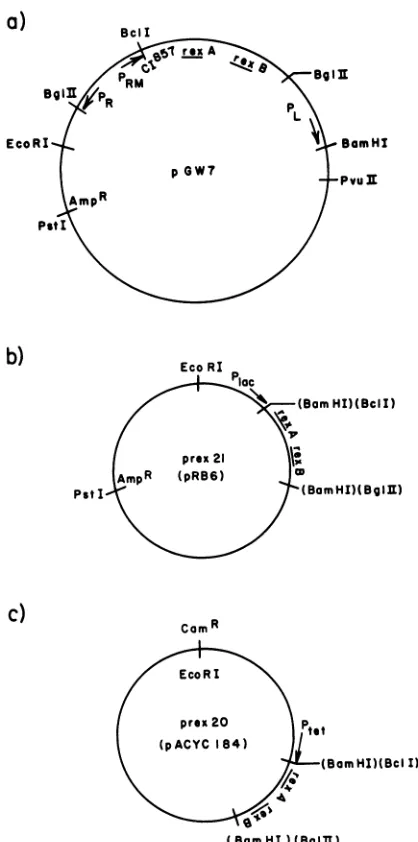
afragmentof lambda DNA which has the Ngene,PL,rexA, rexB, cI857, andPR (Fig. la). pGW7 restricts rII mutants (but not wild-type T4) at low temperatures, but cells
con-tainingitgrowtoopoorlyathigh temperaturestobe tested.
pRB6is an adaptation ofpGL101 (20) made by insertinga
BamHI dodecamer linker into the PvuII site(36). pACYC184 (5) wasprovided by Mike Kahn.
RESULTS
rexexpressed by Piac. In bacteriophage lambda (and
pre-sumablyinpGW7),cIandtherexgenes aretranscribed from
PRM (30). rexB canalso be transcribed from Plit within rexA (28).ToseparatetherexgenesfromthecIandNgenesand
from the strong lambda promotersPL andPR and to make
theminducible,weclonedtheBclI-BglII pGW7 fragment (on
which rexA andrexBarelocated) into the BamHI site3' to the lacpromoterofpRB6 (36), making prex2l (Fig. lb).
We tested whether various T4 translation mutants that
make lessthanwild-typeamountsofrIlBprotein (38) would
growonbacterial strainscarrying prex2l (Table1). Because
of the elevated copy number of the plasmid-borne lac promoter, repression is incomplete in NapIV, even when
expressionisnotinducedwith
isopropyl-3-D-thiogalactopy-ranoside (IPTG). Since D1204 overproduces lac repressor,
expression of rex is minimal. This results in the failure of
uninduced D1204(prex2l) to restrict even the rII deletion
638. Thelevel ofexpressionofrexinD1204musttherefore
be less than thatofalambda lysogen.
3790 Copyright ©)1987, American Society for Microbiology
on November 10, 2019 by guest
http://jvi.asm.org/
a)
b)
Eco RI(BamHl)(BclI)
prex21
AmpR (pRB6) BmgX
PsatIBomHI)( BgIH)
c)
ComR
EcoRI
prex20PO.t
(pACYC184)
(Bar HDI)(BclI)
(SBamHI)(BSg1)
FIG. 1. (a) InpGW7, DNAfrom the EcoRI siteto the BamHI sitewasderived frombacteriophage lambda. From BamHI
clock-wise to EcoRI, it was derived from pBR322. (b) prex2l was constructedby cloningtherexgenesintopRB6 (36). (c) prex20was constructed by cloningthe rexgenesinto pACYC184. Restriction sites inparentheseswereused inconstruction, butnolongerexist.
The T4 rIlB translation mutants are restricted in rough correspondence totheamountofrlIBprotein they make,as measuredatearly times duringphage infection atthe same temperatures (37, 38). TherIlB translation data for30°C are given in Table 1.Restriction wasgreater at higher
tempera-tures and as rex expression was increased by addition of
IPTG. Independent of induction, restriction was also a function of bacterial strain used. The dataalso showed that
cI proteinwas notrequired forrex activity, aformal
possi-bility noted by Toothman and Herskowitz (43). The
un-precedented result was that T4 wildtype was restricted by LG90(prex2l).
Increased restrictionby prex2O.prex20wasconstructedon
thechance thatrexexpression would be increased by using
the tetpromoter of pACYC184. The sameBclI-BglII DNA
fragment was cloned downstream from the tetpromoter at
the BamHI site of pACYC184 (Fig. lc). Cells carrying prex20 were morerestrictive for T4 wildtypethanwerethe samestrains carrying prex2l. LG90(prex2o) restricted
wild-typeT4at30, 37, and42°C and also restrictedrII translation and null mutants. The efficiency of plating of T4+ on
LG90(prex20) at 30°C was about 2 x 10⁻⁴. On NapIV (prex2O),itwas10-1, andonNapIV(prex2l), withorwithout
IPTG, itwas about 1. As with prex2l, the B strain NapIV
mediated considerably less restriction than LG90. When therewas alarge number of phageon aplate, restrictionwas
visiblymore stringentathighertemperatures:phage growth
wastightly restrictedat42°C,abit leakyat37°C, and leakier at 30°C. This may reflect the effect of temperature on the
mechanism of restrictionor ontherelativeamountsofrexor
othergeneproducts. As expected from the results of Garen
(9), the exclusion of wild-type T4 by prex20 was
substan-tially reversed by the addition of magnesium (data not shown).
Mutants that grow onprex2O-containing strains. The
effi-ciency of plating on LG90(prex20) of phage from a T4+
lysate, about 2 in
104,
wasconsistent with the idea thatphagethat grow contain spontaneous mutations of a T4 gene.
Because motA mutations had been shown to increase the viability ofanrll deletiongrown onK(A) (13),wetested the
motAmutant tsGl (21) by plating iton LG90(prex20). tsGl
affects the expression of early genes, causing synthesis of less thanwild-type amountsofsome, butoverproduction of others (22). At 30°C, it plated with an efficiency of 0.3 on
LG90(prex20). The other motA mutants, amGl, farP14, farP85, sip-],andsip-2, weretested to seewhethergrowth onprex20 is allelespecific. Allhad efficiencies ofplatingof
[image:2.612.67.276.71.492.2]0.3 to0.8 on LG90(prex20)at 30°C. The six motA mutants tested were isolated atdifferenttimesby different research
TABLE 1. RestrictionofrIIquantitymutantsbyprex2l-containingbacteriaa
Restrictionby strain:
T4translation % ofwild-type
mutants rlIBat30°C D1204(YacIq) NapIV(IacI+)at: NapIV(lacI+) + IPTG at: D1204(UacIq) + LG90(lacI-) (alltemps) 200C 30°C 42°C 200C 300C 42°C IPTGat420C at420C
T4+ 100 + + + + + + + +
-rzHA87 46 + + + + + + +
rzEM72 39 + + + - + +
rzAP10 27 + + + - + +
rHD263 7 + +
rzP18 3 +
r638 0 +
aBacteriophage(108/ml)werespottedon alawnof freshplasmid-bearingbacteriaonEHAplates.Whereindicated,50
±1l
of0.1 MIPTGwasaddedtothetopagar. +,Clearingofthe spot; -,nosignificanteffectonthelawn.Allofthephagestestedgrewontheparentstrainsatalltemperatures.rIlBquantitydataare fromSingeretal.(37, 38). r638 isadeletionoftheentirerlIBcistron.
on November 10, 2019 by guest
http://jvi.asm.org/
[image:2.612.51.555.593.703.2]groups, but had been found to have somewhat similar
phenotypes and genetic mappositions (11).
We noted that the deletion Sa9grew as poorly as an rII
mutanton LG90(prex20) and preventedrescue ofthe
infec-tion by mutation in motA. Subsequently, we measured efficiencies of plating,ormutation indices, ofmutantsinthe region (Table 2), particularly the SaA series (7). We found
that the gene required for rescue was ndd, which is the
"nonessential" T4gene responsible fordisruption of the E.
coli nucleoid and for early shutoff of host DNA synthesis
(16, 40). This identification was verified by crossing the
motAmutants rim-2, rim-13, and amGl (seebelow)toSa.i5 and SaA3. The double mutants motA-SaA5 would notgrow on LG90(prex20), whereas the motA-SaA3 doubles would.
SaA5 deletes partsorall ofndd, stp, andac, whereas SazA3
covers the 3' endofstp and the 5' end ofac (7).
NewmotA mutants. Wemade stocks oftwoof the phages which grew when we plated a wild type lysate on LG90
(prex20) at 30°C. These spontaneous T4mutants are called
rim-2 and rim-13 (rex immunity). Wenoted that none of the
othermotA mutants grew on aprexhost with the virulence
ofrim-2. rim-13was temperature sensitive and inspottests
phenotypically resembled tsGl.
To genetically map the rim mutants, we performed
complementation tests and genetic crosses. Ifthe rim
mu-tants and amGl were recessive and in the same gene, then
they would failtocomplement each other and hence would produce progenyphage onmixed infection of the restrictive
host, NapIV(prex2O). If they wererecessive and in different genes, then they would complement each other and
conse-quently fail toyield progenyin coinfections.
In single-cycle growth in NapIV(prex20) at 37°C, rim-2,
rim-13,amGl, andT4+ had burst sizes of 239, 147, 12.3, and 0.068, respectively (Table 3). In mixed infection with wild type, the burst sizes of rim-2, rim-13, and amGl were
reducedto7.8, 4.5, and0.62(Table3),respectively, indicat-ing that each mutant is recessive. In mixed infection with each other, the burst sizes were rim-2-rim-13, 191;
rim-2-amGl, 144; and rim-13-amGl, 87.4 (Table 3). Thus, the
mutants failed to complement one another and therefore were in the samefunctional unit orcistron. Neitherthe rim
TABLE 2. Efficiencies of plating ormutation indices onLG90(prex2o) at300C"
T4 strain Efficiency
ofplating
T4+ ... 7.6 x i0-,
rim-2... 0.71
rim-13 ... 0.72
amGl ... 0.50
SaA9 ...<1.0 x 10⁻⁸ Sa..3... 5.0 x 10⁻⁴
SaA4... <1.1 x 10⁻⁷
SaA . ...<2.7 x 10⁻⁷
ndd(98 x 3)... <8.2 x 10⁻⁹
r1589 ... <5 x 10⁻⁸
"Efficiencies ofplatingorindices of mutationarethe ratiosof aphagetiter
onLG90(prex20)at30°Con EHAplatestoits titeronCR63 at37°ConEHA
plates.If aphage growson bothbacteria(i.e.,rim-2),theratiorepresentsthe
relativeefficiencyofplaque-forming ability. If aphageis unabletogrowon
LG90(prex2O)(e.g.,T4+),the ratioapproximatesthefraction ofphagein the
stock that hasgainedtheabilitytogrowonLG90(prex)because ofmutation.
Platingcultures wereprepared bydilutingovernightcultures 100-fold on H
brothand growingthem at 37°Cwithaeration forapproximately3h, after
whichtimetheywere keptonice. LG90(prex20)cultures weregrownin the
presenceof25 ,ugofchloramphenicolperml.
TABLE 3. Burst size data fromsingle-cycle growth and complementationtestswithNapIV(prex20) at37°C
Infecting Burstsizea
phage
rim-2... 239
rim-13... 147
amGl... 12.3
T4+... 0.068 amB22... <0.018
rim-2-T4+ ... 7.8 rim-13-T4... 4.5 amG1-T4+ ... 0.62
amB22-T4. ... <0.018
rim-2-rim-13... 191
rim-2-amGl... 144
rim-13-amGl... 87.4 rim-2-amB22... 3.9
rim-13-amB22... 1.4
amG1-amB22... 0.28 "Average number of progeny phage yielded per infected bacterium. The data foruniparentalinfections, exceptforamB22, aretheaveragesof four experiments,thosefor mixed infectionwithwild typeorrim-rim orrim-amGl
are theaveragesoftwoexperiments,and thoseinvolvingamB22arefroma
singlesetofexperiments.
mutants noramGl yielded progeny in mixed infection with thegene 43 amber mutant amB22 (Table 3).
Fromtheconclusionthat the rim mutants were in motA it can be predicted that they are linked to the ac locus, are distant from gene43, and arecloselylinked to amGl andto
each other. To verify these predictions, we crossed rim-2,
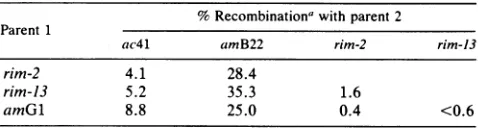
rim-13, and amGl toac4l,amB22, andeach other. The rim mutants andamGlwerelinked to ac4l (Table4, column2),
unlinked to amB22 (column 3), and tightly linked to each other (columns 4 and 5). The frequencies of wild-type recombinants in rim x rim and rim x amGl were as low as orlower than thoseobservedbyMattsonetal.(22)for amGl x tsGl crosses.
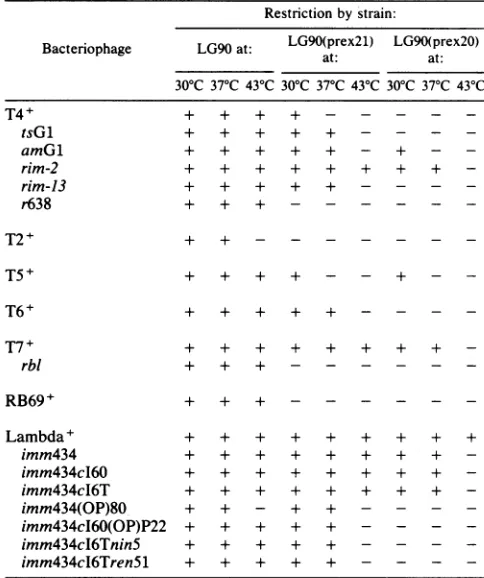
Other bacteriophages. We have tested avariety of
bacte-riophages to see whether they are restricted by plasmids
[image:3.612.325.564.569.634.2]expressing rex (Table 5). T2 and T6 are T-even phages closelyrelated to T4. RB69isa T-evenphage whichhas the unusual property ofexcluding T4 in mixed infections (32). T7rbI is a T7mutant,mappingin gene 5.7(8), which doesnot grow on rex+ lambda lysogens (27). The lambda strains tested are a small representative sample of thosetestedfor
TABLE 4. Recombinationdatafromcrossesinvolving rim-2, rim-13, and amGl
% Recombinationa withparent 2 Parent 1
ac4l amB22 rim-2 rim-13
rim-2 4.1 28.4
rim-13 5.2 35.3 1.6
amGl 8.8 25.0 0.4 <0.6
"Percentrecombinationis 200 times thefrequencyof wild-type recombi-nantsforcrossesinvolvingamB22 and crossesbetweenrim mutantsorrim andamGl. Inthesecrosses,progeny wereplatedonCR63,andindividual plaquesweretestedforabilityto grow on S/6andLG90(prex2O);wild-type
recombinantsgrew ontheformer but not on the latter strain. Thevaluesfor rim-2 xrim-13,rim-2 xamGl,andrim-13xamGlare based on 4 of506,1 of496,and 0of 344recombinants, respectively, pertotal tested. Forcrosses involvingac4l,ac41/rim, orac41-amG1, double mutants wereselectedon
LG90(prex20)supplementedwith 2p.gofacriflavinper ml. Thefrequenciesof recombinants in thesecrosseswere correctedforthe efficiencyofplatingof
ac4l-rim-2, ac4l-rim-13,andac41-amG1double mutants and thenmultiplied by200.
on November 10, 2019 by guest
http://jvi.asm.org/
TABLE 5. Restriction of various bacteriophages byrex" Restriction by strain:
Bacteriophage LG90 at: LG90(prex2l)at: LG90(prex20)at:
300C37°C 43°C 300C 37°C 43°C 300C 37°C 43°C
T4+ + + + +.
tsGl + + + + +
--amGl + + + + + - +
rim-2 + + + + + + + +
rim-13 + + + + +
r638 + + +
T2+ + +.
T5+ + + + + + _
T6+ + + + + +
T7+ + + + + + + + +
-rbl + + +.
RB69+ + + + - - - -
-Lambda+ + + + + + + + + +
imm434 + + + + + + + +
-imm434c160 + + + + + + + +
-imm434cI6T + + + + + + + +
-imm434(OP)80 + + - + +
imm434c160(0P)P22 + + + + +
imm434cI6Tnin5 + + + + +
imm434cI6Tren5l + + + + +
aBacteriophage(104)in20
p.l
of saline were spotted on a lawn of bacteriafromafreshovernightculture grown in lambda broth plus0.2%maltose, with
anantibiotic where appropriate. All plates were warmed while the spots were being applied and untilthespots were dry.Warming the plates significantly increases thestringency of restriction at higher temperatures, but probably resultsinoverstating restriction at the lowest incubation temperature(30'C).
+,Clearing of the spot; -, no significant effect on the lawn. These spot tests were donewith lambda plating medium. The nonlambdoid phages were also tested understandard T4platingconditions (H broth cultures and EHA top and bottom agar), and the same results were obtained. Under those condi-tions, none of the lambdoid phages would grow well, even on the parent LG90 strain, unless magnesium was added to the medium.
rex-mediated exclusion by Toothman and Herskowitz
(43-45). Only wild-type lambdawas unaffectedbyour most
restrictiveconditions. Oftheother phages, T7 was the most
resistant to rex restriction, although its characteristic large plaque wasdiminished by therexA andrexB proteins. The
susceptibilities ofthe lambdoid phage to rexexclusion sup-portthe resultsofToothman andHerskowitz (44): OP
region
substitutions and the nin-5 and ren mutations are the most
readily excluded.
DISCUSSION
rex restrictionof T4.The dataindicatethat rexexclusion of
T4isaquantitative phenomenon. rexexpression wasvaried
by promoter and induction. rIlB synthesis was reduced
by
translationmutants. The rexrestriction was
tighter
athigher
temperatures, and whereas it seems
likely
thatthis was anaspect of the
physiology
of the rexproteins,
an effect of temperature onexpressioncannotbe ruledout. Mostimpor-tant, high-level rex
expression
restricts T4 rII+ growth.rexexclusionwasrelievedif
the
T4phage
wasmotA. We used thischaracteristictoselecttwo newmotAmutants.The motA (modifier oftranscription)
geneproduct
activates T4middle-mode transcription (21, 22). The sequence a/ta/t
TGCTTc/tA in the -30 region of a T4 promoter has been identified as necessary for middle-mode transcription (3; N. Guild, M. Gayle, R. Sweeney, T. Walker, T. Modeer, and L. Gold, J. Mol. Biol., in press). It is possible that motA phage grow on cells harboring prex20 because middle-mode
tran-scription is defective and the levels of some early T4 transcripts are elevated (22; N. Guild et al., in press). That is, a complex redistribution of prereplicative transcripts overcomes rex restriction. Growth could occur because of
underproductionof rnIB and overproduction of rIIA. (In this model, the overproduction of rIIA, rather than just the ratio of rIIAtorIIB, is important: rII mutants which only reduce rIlB synthesis do not grow as well as wild type.) It is also
possible that motA-controlled genes other than rII are in-volved.
The dysfunction of motA protein may relieve rex
restric-tiondirectly, perhaps because the motA protein has a direct role in T4 DNA replication. T4 appears to utilize different typesofreplication origins (17, 18). The motA protein almost
certainly binds to DNA (N. Guild et al., in press), appears very early in infection (46), and could function during
replication by binding to DNA at motA "boxes." motA mutants may be able to escape restriction by rex gene products by switching to an alternate replication initiation pathway.
rex restriction of lambdaand other phages. Of the lamboid phage we tested, only wild-type lambda resisted exclusion
by rexunder all ofthe experimental conditions. The
exclu-sion oflambdoid phage with OPQ-region mutations repeated the findings ofToothman and Herskowitz (44) that these phage are susceptible to rex. The exclusion of the various imm434strainsunder very restrictiveconditions (Table5) is
a new observation, possibly analogous to rex restriction of wild-type T4.
Every bacteriophage tested, other than rex-homologous lambda, could be excluded by rex expressed in cells whose
own replication appeared to be proceeding quite normally. InT4rIIinfections,the rex-mediatedblock to phage growth
occurs relatively late, just after the initial replication of
phage DNA (9, 34). rex interference with many bacterio-phagesimpliesthatthey may beaffectedat a common stage
ofDNAreplication.
ACKNOWLEDGMENTS
WethankIraHerskowitz for lambda strains, Dwight Hall forT4
sipandfarmutants,BrittaSingerforhelpfuldiscussions, and Kathy Piekarski fortypingthemanuscript.
This research was supported by Public Health Service grant
GM19963 fromtheNational Institutes ofHealth.
LITERATURE CITED
1. Benzer, S. 1955. Finestructureofagenetic region in
bacterio-phage. Proc. Natl. Acad. Sci. USA 41:344-354.
2. Benzer, S. 1957. Theelementary units ofheredity,p. 70-93.In
W. D. McElroy and B. Glass (ed.), The chemical basis of
heredity. The JohnsHopkins Press, Baltimore.
3. Brody, E., D. Rabussay, and D. H. Hall. 1983. Regulation of transcription of prereplicative genes, p. 174-183. In C. K.
Mathews, E. M. Kutter, G. Mosig, and P. G. Berget (ed.), Bacteriophage T4. American SocietyforMicrobiology, Wash-ington, D.C.
4. Campbell, J. H.,and B. G. Rolfe. 1975. Evidence for adual control of the initiation of host-cell lysis caused by phage
lambda.Mol. Gen. Genet. 139:1-8.
5. Chang, A. C. Y., and S. N. Cohen. 1978. Construction and
characterization ofamplifiable multicopyDNAcloningvehicles derived from the P15A cryptic miniplasmid. J. Bacteriol. 134:
on November 10, 2019 by guest
http://jvi.asm.org/
1141-1156.
6. Crick, F. H. C., L.Barnett, S. Brenner, and R. J. Watts-Tobin.
1961. General natureofthe genetic code for proteins. Nature
(London) 192:1227-1232.
7. Depew, R. E., T. J. Snopek, and N. R. Cozzarelli. 1975.
Characterization ofa newclass of deletions of the Dregion of
thebacteriophage T4genome. Virology 64:144-152.
8. Dunn, J. J., and F. W. Studier. 1983. Complete nucleotide
sequence ofbacteriophage T7 DNA and the locations of T7
genetic elements. J. Mol. Biol. 166:477-535.
9. Garen, A. 1961. Physiological effects of rII mutations in bacte-riophageT4. Virology 14:151-163.
10. Guarente, L., G. Lauer, T. M. Roberts, and M. Ptashne. 1980. Improvedmethods formaximizing expressionofaclonedgene: abacterium that synthesizes rabbitbeta-globin. Cell 20:543-553. 11. Hall, D. H., and R. D.Snyder. 1981. Suppressorsof mutationsin the rII gene of bacteriophage T4 affect promoter utilization.
Genetics 97:1-9.
12. Hershey, A. D. 1946. Mutationofbacteriophage withrespect to
type of plaque. Genetics 31:620-640.
13. Homyk, T., A. Rodriguez, and J. Weil.1976.Characterizationof T4mutantsthat partiallysuppressthe inability ofT4rIItogrow inlambda lysogens. Genetics 83:477-487.
14. Homyk, T., and J. Weil. 1974. Deletion analysis oftwo
nones-sential regionsof the T4genome. Virology 61:505-523.
15. Jacquemin-Sablon, A., and Y. T. Lanni. 1973. Lambda-repressed mutants of bacteriophage T5. I. Isolation and
genet-icalcharacterization. Virology56:230-237.
16. Koerner, J. F., and D. P. Snustad. 1979. Shutoff of host
macromolecular synthesis afterT-evenbacteriophage infection.
Microbiol. Rev.43:199-223.
17. Kreuzer, K. N., and B. M. Alberts. 1985. A defective phage system reveals bacteriophage T4 replication origins that
coin-cide withrecombinationhotspots. Proc. Natl. Acad. Sci. USA 82:3345-3349.
18. Kreuzer, K. N., and B.M. Alberts. 1986. Characterization ofa defective phage system for the analysis of bacteriophage T4 DNAreplication origins. J. Mol. Biol. 188:185-198.
19. Landsmann, J., M. Kroger, and G. Hobom. 1982. Therexregion ofbacteriophage lambda: twogenes under three-way control. Gene20:11-24.
20. Lauer, G., R. Pastrana, J. Sherley, and M. Ptashne. 1981.
Construction of overproducers of the bacteriophage434 repres-sorandcro proteins.J. Mol. Appl. Gen. 1:139-148.
21. Mattson, T., J. Richardson, and D. Goodin. 1974. Mutant of
bacteriophage T4D affecting expression ofmany early genes. Nature(London)250:48-50.
22. Mattson, T., G.vanHouwe,andR. H. Epstein. 1978. Isolation andcharacterization of conditional lethal mutations in the mot geneofbacteriophage T4. J.Mol. Biol. 126:551-570.
23. Matz, K.,M.Schmandt, and G. N.Gussin. 1982.Therex gene ofbacteriophagelambda is reallytwogenes.Genetics 102:319-327.
24. Nelson, M. A., M. Ericson,L.Gold,and J. F. Pulitzer.1982.The isolation and characterization of TabR bacteria: hosts that restrict bacteriophageT4rIImutants.Mol. Gen. Genet.
188:60-68.
25. Nelson, M. A., B. S. Singer, L. Gold, and D. Pribnow. 1981.
Mutations thatdetoxify anaberrant T4 membrane protein. J.
Mol.Biol. 149:377-403.
26. O'Farrell, P., and L. M. Gold. 1973. Bacteriophage T4 gene
expression: evidencefortwoclasses ofprereplicative cistrons.
J. Biol. Chem. 248:5502-5511.
27. Pao, C. C.,and J. F.Speyer. 1975. Mutants of T7 bacteriophage
inhibitedbylambda prophage. Proc. Natl. Acad. Sci. USA72:
3642-3646.
28. Pirrotta, V.,K. Ineichen,and A. Walz. 1980. An unusualRNA
polymerase binding site in the immunity region of phage lambda. Mol. Gen. Genet. 180:369-376.
29. Pribnow, D., D. C. Sigurdson, L. Gold,B.S. Singer, C. Napoli, J. Brosius, T. J. Dull, and H. F. Noller. 1981. rII cistrons of bacteriophage T4 DNA sequence around the intercistronic divide and positions of genetic landmarks. J. Mol. Biol. 149:
337-376.
30. Ptashne, M., K. Backman, M. Z. Humayun, A. Jeffrey, R.
Maurer, B. Meyer, and R. T. Sauer. 1976. Autoregulationand
function of a repressor in bacteriophage lambda. Science 194:156-161.
31. Pulitzer, J. F., A. Coppo, and M. Caruso. 1979. Host-virus interactions in the control of T4 prereplicative transcription. II. Interaction between tabC (rho) mutants and T4 motmutants. J. Mol. Biol. 135:979-997.
32. Russell, R. L., and R. J. Huskey. 1974. Partial exclusion between T-even bacteriophages; an incipient genetic isolation mechanism. Genetics 78:989-1014.
33. Sadler, J. R., M. Tecklenberg, and J. L. Betz. 1980. Plasmids containing manytandem copies of a synthetic lactose operator. Gene8:279-300.
34. Sauerbier, W., S. M. Puck, A. R. Brautigam, and M. Hirsch-Kauffmann. 1969. Control of gene function in bacteriophage T4. I. Ribonucleic acid and deoxyribonucleic acid metabolism in T4rII-infected lambda-lysogenic hosts. J. Virol. 4:742-752. 35. Shinedling, S., B. S. Singer, M. Gayle, D. Pribnow, E. Jarvis, B.
Edgar, and L. Gold. 1987. Sequences and studies of bacterio-phage T4rnl mutants. J. Mol. Biol. 195:471-480.
36. Shinedling, S., L. T. Walker, and L. Gold. 1986. Cloning the complete rIlB gene of bacteriophage T4 and some observations concerning its middle promoters. J. Virol. 60:787-792. 37. Singer, B. S., and L. Gold. 1976. A mutation that confers
temperature sensitivity on the translation of rIlB in bacterio-phage T4. J. Mol.Biol. 103:627-646.
38. Singer, B. S., L. Gold, S. T. Shinedling, M. Colkitt, L. R. Hunter, D. Pribnow, and M. A. Nelson.1981. Analysis in vivo of translational mutants of therIlB cistron of bacteriophage T4. J. Mol.Biol. 149:405-432.
39. Singer, B.S., S. T. Shinedling, and L. Gold. 1983. TherII genes: a history and a prospectus, p. 327-333. In C. K. Mathews, E. M. Kutter,G. Mosig, and P. B. Berget (ed.), Bacteriophage T4. American Society for Microbiology, Washington, D.C. 40. Snustad, P. D., C. J. H. Bursch, K. A. Parson, and S. H.
Hefeneider. 1976. Mutants of bacteriophage T4 deficient in the ability to induce nuclear disruption: shutoff of host DNA and proteinsynthesis, gene dosage experiments, identification of a restrictive host, and possible biological significance. J. Virol. 18:268-288.
41. Steinberg, C. M., and R. S. Edgar. 1962. A critical test of a current theory ofgenetic recombination in bacteriophage. Ge-netics 47:187-208.
42. Takacs, B. J., and J. P. Rosenbusch. 1975. Modification of Escherichia coli membranes in the prereplicative phase of phage T4infection. J. Biol. Chem. 250:2339-2350.
43. Toothman, P., and I. Herskowitz. 1980. Rex-dependent exclu-sionof lambdoid phages. I. Prophage requirements for exclu-sion. Virology 102:133-146.
44. Toothman, P., and I. Herskowitz. 1980. Rex-dependent exclu-sion of lambdoid phages. II. Determinants of sensitivity to exclusion. Virology102:147-160.
45. Toothman, P., andI. Herskowitz. 1980. Rex-dependent exclu-sion oflambdoid phages. III. Physiology of the abortive infec-tion. Virology102:161-171.
46. Uzan, M., J. Leautey, Y. de'Aubenton-Carafa, and E. Brody.
1983. Identification and biosynthesis of the bacteriophage T4 motregulatory protein. EMBO J. 2:1207-1212.