City, University of London Institutional Repository
Citation: Panayi, M. (2017). Cognition in action C-i-A: Rethinking gesture in
neuro-atypical young people: A conceptual framework for embodied, embedded, extended and enacted intentionality. (Unpublished Doctoral thesis, City, University of London)This is the accepted version of the paper.
This version of the publication may differ from the final published
version.
Permanent repository link: http://openaccess.city.ac.uk/15292/
Link to published version:
Copyright and reuse: City Research Online aims to make research
outputs of City, University of London available to a wider audience.
Copyright and Moral Rights remain with the author(s) and/or copyright
holders. URLs from City Research Online may be freely distributed and
linked to.
Cognition in Action
C-i-A
Re-thinking Gesture in Neuro-atypical Young People
A Conceptual Framework for Embodied, Embedded, Extended and
Enacted Intentionality
Marilyn Panayi
Submitted for the degree of Doctor of Philosophy To
City University, UK
School of Health Sciences,
Division of Language and Communication Science
Abstract
The three aims of my interdisciplinary thesis are:
To develop a conceptual framework for re-thinking the gestures of neuro-atypical young people, that is non-traditional and non-representational
To develop qualitative analytical tools for the annotation and interpretation of gesture that can be applied inclusively to both neuro-atypical and neuro-typical young people To consider the conceptual framework in terms of its theoretical implications and
practical applications
Learning to communicate and work with neuro-atypical young people provides the rationale and continued impetus for my work. My approach is influenced by the limited social, physical and communicative experiences of young people with severe speech and motor impairment, due to cerebral palsy (SSMI-CP). CP is described as: a range of non-progressive syndromes of posture and motor impairment. The aetiology is thought to result from damage to the developing central nervous system during gestation or in the neonate. Brain lesions involve the basal ganglia and the cerebellum; both these sites are known to support motor control and integration.
However, gaps in theoretical research and empirical data in the study of corporeal expression in young people with SSMI-CP necessitated the development of both an alternative
theoretical framework and new tools. Biological Dynamic Systems Theory is proposed as the
best candidate structure for the reconsideration of gesture. It encompasses the global, synthetic and embodied nature of gesture. Gesture is redefined and considered part of an emergent dynamic, complex, non-linear and self-organizing system.
My construct of Cognition-in-Action (C-i-A) is derived from the notion of knowing-as-doing influenced by socio-biological paradigms; it places the Action-Ready-Body centre stage. It is informed by a theoretical synthesis of knowledge from the domainsof Philosophy, Science and Technology, including practices in the clinical, technology design and performance arts arenas. The C-i-A is a descriptive, non-computational feature-based framework. Its development centred around two key questions that served as operational starting points: What can gestures reveal about children’s cognition-in-action? and Is there the potential to influence gestural capacity in children? These are supported by my research objectives.
Phenomenological Analysis methodology is applied for the first time to gesture (G-IPA). These tools facilitate fine-grained corporeal dynamic and narrative gesture feature analyses.
Phenomenal data reveal that these young people have latent resources, capacities and capabilities that they can express corporeally. Iteration of these interpretative findings with the Cognition-in-Action framework allows for the inference of processes that may underlie the strategies they use to achieve such social-motor-cognitive functions. In summary, their Cognition-in-Action is brought-forth, carried forward and has the potential to be culturally embodied.
CONTENTS
1INTRODUCTION RESEARCH CONTEXT AND MOTIVATION ... 1
HUMAN INTERACTION –THE STATUS QUO ... 1
1.1MY JOURNEY ALTERNATIVE BODIES,PATHWAYS AND INTERACTIONS ... 1
1.2MY THESIS AN ARGUMENT FOR BIOLOGICAL SOCIAL BEINGS ... 2
1.3THESIS AIMS AND OBJECTIVES ... 11
1.5OVERVIEW OF THESIS CHAPTERS ... 13-15 2LITERATURE REVIEW ... 16
2.1BACKGROUND ... 16
2.1.2INCLUSION CRITERIA ... 17
2.1.3STAGES OF THE REVIEW ... 18
2.2MOVEMENT SCIENCE ... 22
2.2.1THE MEDICAL MODEL,CLINICAL PRACTICE AND CEREBRAL PALSY ... 22
2.2.2AETIOLOGY ... 22
2.2.3CONCEPTUALIZATION OF DISABILITY ... 24
2.2.4CLASSIFICATION AND SCOPE OF INTERACTION ... 25
2.2.5ACTIVITY:CAPACITY,CAPABILITY AND PERFORMANCE ... 29
2.2.6APPLIED PARTICIPATORY PERFORMANCE ART ... 35
2.2.7TECHNOLOGY ENHANCED CAPTURE,INTERACTIONS AND INTERVENTIONS ... 36
2.2.8IMPLICATIONS FOR INTERVENTION &PSYCHOMETRIC ASSESSMENT ... 41
2.2.9SUMMARY ... 42
2.3MODELS OF ACTION CONTROL ... 44
2.3.1MODELS CONTROL NEUROLOGY OF CEREBRAL PALSY... 44
2.3.2NEUROSCIENCE;IMAGING TECHNOLOGIES AND THEIR LIMITATIONS ... 46
2.3.3MOTOR CONTROL AND COGNITION ... 47
2.3.4MOTOR IMAGERY AND MODALITY ... 47
2.3.5MOTOR IMAGERY AND INTENTION ... 49
2.3.6SOCIAL IMAGERY,INTERACTION AND SPACE ... 50
2.3.7LANGUAGE READY BRAIN OR ACTION READY BODY ... 51
2.3.8MOTOR CONTROL AND DYNAMIC SYSTEMS ... 53
2.4MODELS OF GESTURE ... 56
2.4.1MODELS OF GESTURE ... 56
2.4.2CONVENTIONAL FRAMEWORKS ... 56
2.4.3GESTURE AS THOUGHT,SPATIAL KNOWLEDGE AND METAPHOR ... 58
2.4.4ALTERNATIVE PERSPECTIVES ... 61
2.4.5SUMMARY ... 64
2.5EXECUTIVE SUMMARY ... 65
3RE-THINKING GESTURE ... 67
3.1INTRODUCTION ... 67
3.2GESTURE AS ABIOLOGICAL SYSTEM ... 70
3.2.1COGNITION-IN-ACTION ARCHITECTURE CONSTRUCTS,STRUCTURES AND TOOLS ... 70
3.2.2ACTION-READY-BODY ECOLOGY OF INTERACTION ... 74
3.2.2.1 INTENTIONALITY AND INTERCORPOREALITY ... 75
3.2.2.2 AUTONOMOUS UNITY:THE SELF AND THE OTHER ... 76
3.2.2.3 PREDICTIVE CAPACITY,COUPLING AND VARIABILITY ... 76
3.2.2.4 DYNAMIC SUB-SYSTEM INTERCONNECTIVITY AND INTERPRETATION ... 77
3.2.2.5 BIOSEMIOSIS ... 78
3.2.2.6 GESTURAL FLOW ... 79
3.2.2.7 EMERGENCE BRINGING-FORTH AND CARRYING FORWARD ... 80
3.2.2.8 SENSE-MAKING GAMES AND ARTEFACTS ... 84
3.3MODELS OF CORPOREAL ACTION AND GESTURE ... 90
3.3.1THE ART OF ORATORY IN ANTIQUITY ... 90
3.3.2CONTEMPORARY PERFORMANCE ART MIME,PHYSICAL THEATRE AND DANCE ... 91
3.3.3LUDIC MIME AND THE CHILD GESTURE CORPUS ... 95
3.3.4NARRATIVE THEORY AND SCHEMATA ... 96
3.3.5CORPOREAL NARRATIVE,SCHEMATA AND MIMESIS ... 97
3.3.6ADERIVED NEUROLOGY OF GESTURE ... 99
3.3.7SUMMARY ... 102
3.4COGNITION-IN-ACTION THE FRAMEWORK ARCHITECTURE THE THEORETICAL SYNTHESIS ... 103
3.5EXECUTIVE SUMMARY ... 105
4METHODOLOGY ... 106
4.1INTRODUCTION ... 106
4.2CHILD GESTURE;EMPIRICAL STUDY CONTEXT ... 108
4.2.1CHALLENGES OF GESTURE STUDIES IN ECOLOGICAL INTERACTIONS ... 110
4.2.2LUDIC INTERACTION PARADIGM ... 111
4.2.3SUMMARY ... 112
4.3EMPIRICAL STUDY RESEARCH PLAN ... 112
4.3.1CHILD GESTURE CORPUS SUMMARY DESCRIPTION ... 113
4.3.2THREE CASE STUDIES SELECTION AND DATA FOR CO-PARTICIPANTS ... 115
4.3.3LUDIC INTERACTION PROTOCOLS ... 121
4.3.4CONDITION A,BAND C CHARADES,CO-CONSTRUCTED NARRATIVE AND MANIPULATION OF ARTEFACTS ... 124
4.3.4.1 CONDITION ACHARADE ... 125
4.3.4.2 CONDITION B CO-CONSTRUCTED NARRATIVE ... 128
4.3.4.3 CONDITION C MANIPULATION OF ARTEFACTS ... 130
4.4SUMMARY ... 131
5TOOL DEVELOPMENT ... 133
5.1INTRODUCTION ... 133
5.2THE BODY GESTURE-ACTION-BASED-ANNOTATION-SYSTEM G-ABAS... 133
5.2.1 BODY GESTURE SPACE ... 133
5.2.2 CHALLENGES OF VIDEO ANALYSIS ... 134
5.2.2.1 VIDEO ANALYSIS AND NEURO-ATYPICAL GESTURE ... 135
5.2.3 CHALLENGES OF ANNOTATION ... 138
5.2.3.1 COMMUNICATION SYSTEMS INCLUDING GESTURE ... 138
5.2.3.2 MOVEMENT CLASSIFICATION INVENTORIES ... 139
5.2.3.3 COGNITION AND GESTURE ... 142
5.2.4 DATA CAPTURE AND ANNOTATION TECHNOLOGIES... 143
5.3G-ABASONTOLOGY ... 144
5.3.1 BACKGROUND ... 144
5.3.2 CURRENT VERSION ... 144
5.3.3 SUMMARY ... 148
5.4INTERPRETATIVE PHENOMENOLOGICAL ANALYSIS APPLIED TO GESTURE G-IPA ... 151
5.4.1 IPA AN INTRODUCTION ... 151
5.4.2 GESTURE AND IPA(G-IPA) ... 151
5.5LIMITATIONS,ADVANTAGES AND POTENTIAL APPLICATIONS ... 154
6 ANALYSES I...159
6.1CORPOREAL DYNAMIC FEATURES AND THE C-I-AFRAMEWORK ... 159
6.2THE CHILD GESTURE CORPUS ... 160
6.2.1APRIOR KNOWLEDGE ... 160
6.2.2THE THREE CASE STUDIES ... 160
6.2.3PHASE ONE G-ABASAND LEVEL IG-IPA ... 162
6.3PHASE ONE ANALYSES:CONDITION AADAPTED CHARADE NEURO-ATYPICAL CASE STUDY 1 ... 164
6.3.1 EXEMPLAR ‘PRETEND TO STROKE THE CAT’ ... 166
APPLICATION OF PHASE ONE G-GABAS,LEVEL IG-IPAAND FINDINGS ... 166
ABSTRACTION OF ACTION,MANIPULATION,REPRESENTATION SCHEMA AND IMPROVISATION,PERFORMANCE STRATEGIES AND THEIR IMPLICATIONS ... 170
6.3.2 EXEMPLAR ‘PRETEND TO PLAY THE VIOLIN’ ... 171
APPLICATION OF PHASE ONE G-ABAS,LEVEL IG-IPAAND FINDINGS ... 171
ABSTRACTION OF ACTION,MANIPULATION,REPRESENTATION SCHEMA AND IMPROVISATION,PERFORMANCE STRATEGIES AND THEIR IMPLICATIONS ... 175
6.3.3 EXEMPLAR ‘PRETEND TO LASSO THAT STEER’ ... 176
APPLICATION OF PHASE ONE G-ABAS,LEVEL IG-IPAAND FINDINGS ... 176
ABSTRACTION OF ACTION,MANIPULATION REPRESENTATION SCHEMA AND IMPROVISATION,PERFORMANCE STRATEGIES AND THEIR IMPLICATIONS ... 178
6.4PHASE ONE ANALYSES:CONDITION C MANIPULATION OF ARTEFACTS ... 181
NEURO-ATYPICAL CASE STUDY 3 ... 181
6.4.1EXEMPLAR ‘JELLY MOULD’ ... 181
6.4.2APPLICATION OF PHASE ONE G-ABASAND LEVEL IG-IPA ... 182
6.4.3SUMMARY INTERPRETATIVE FINDINGS ... 184
ABSTRACTION OF ACTION,MANIPULATION,REPRESENTATION SCHEMA AND IMPROVISATION,PERFORMANCE STRATEGIES AND THEIR IMPLICATIONS ... 186
6.5G-ABASAND G-IPAPOTENTIAL FOR SCORING,EVALUATION AND VALIDATION ... 187
6.5.1SCORING ... 187
6.5.2EVALUATION AND VALIDITY COHEN’S KAPPA ... 187
6.6CORPOREAL DYNAMIC FEATURE PATTERN ANALYSES FOR CASE STUDY 1AND 3 ... 188
6.7SUMMARY OF FINDINGS CORPOREAL FEATURE ANALYSES AND C-I-AFRAMEWORK ... 191
7 ANALYSES II...192
7.1CORPOREAL NARRATIVE FEATURES AND THE C-I-AFRAMEWORK...193
7.2PHASE TWO G-ABAS ANALYSES CORPOREAL NARRATIVE FEATURES...195
7.3PHASE TWO ANALYSES:CONDITION BCO-CONSTRUCTED NARRATIVE 7.3.1 NEURO-ATYPICAL CASE STUDY 2.EXEMPLARS ‘COWBOY COMES TO TOWN’...195
7.3.2 APPLICATION OF G-ABAS,G-IPALEVEL IIAND FINDINGS...195
7.3.3 SUMMARY INTERPRETATIVE FINDINGS SENSE-MAKING,SPACE,PERFORMANCE STRATEGIES,IMPROVISATION AND INTEGRATION...199
7.4PHASE TWO ANALYSES:CONDITION CMANIPULATION OF ARTEFACTS...205
7.4.1 NEURO-ATYPICAL CASE STUDY 3:EXEMPLAR CHOCOLATE DOUGHNUT...205
7.4.2 APPLICATION OF G-ABAS ,G-IPALEVEL IIAND FINDINGS...205
7.4.3 SUMMARY INTERPRETATIVE FINDINGS SENSE-MAKING,SPACE,PERFORMANCE STRATEGIES,IMPROVISATION AND INTEGRATION...205
7.5CORPOREAL NARRATIVE FEATURE ANALYSES FOR CASE STUDY 2AND 3...217
7.6G-ABAS AND G-IPA APPLICATION:PEDAGOGIC,CLINICAL AND DESIGN SETTINGS………..…220
7.6.1 INTRODUCING SPATIAL KINAESTHETIC INTERACTION &INTELLIGENCE PROFILE SKIP...220
7.6.2 CORPOREAL GESTURE SPHERE ... 220
7.6.3 SITUATED PRACTICE GUIDES ... 222
7.6.4 ANALYSES OF EXPERIENCE GESTURAL FLOW AND SLOW PROCESS ... 224
7.6.4.1GESTURAL FLOW ... 224
8DISCUSSION ... 228
8.1SIGNIFICANT RESEARCH GAPS AND IMPLICATIONS ... 228
8.1.1 EFFICACY OF EXISTING CLINICAL PRACTICE AND LACK OF THEORETICAL MODELS... 228
8.1.2 MECHANISMS OF NEURO-BIOLOGICAL ACTION ... 229
8.1.3 REVISITING LANGUAGE AND GESTURE ... 229
8.1.4 IMPLICATIONS FOR CHILD GESTURE STUDIES ... 230
8.1.5 NEW AVENUES ... 231
8.1.6 PAUCITY OF RESEARCH AND PRACTICE DATA ... 231
8.2WORK PLAN ... 231
8.2.1NEED TO REVISIT THEORETICAL FRAMEWORKS ... 231
8.2.2NEED FOR TOOLS ... 232
8.2.2.1 RETURNING TO THE CHILD GESTURE CORPUS ... 233
8.2.2.2 THREE CASE STUDIES THE CHALLENGES ... 233
8.2.2.3 NEW TOOLS G-ABASAND G-IPA ... 234
8.2.2.4 UTILITY OF THEORETICAL FRAMEWORKS AND EMPIRICAL TOOLS ... 235
8.3REVISITING THE COGNITION-IN-ACTION FRAMEWORK ... 236
8.3.1ACTION-READY-BODY MEDIATOR OF INTENTIONALITY ... 236
8.3.2KEY FINDINGS AND OUTCOMES ... 238
8.4INSTANTIATING ASPECTS OF THE C-I-A ... 239
8.4.1BRINGING-FORTH DYNAMIC COUPLINGS,MEDIATED AND AUGMENTED ... 239
8.4.2CARRYING-FORWARD AND CULTURAL EMBODIMENT ... 242
8.4.3 IMPLICATIONS FOR AN ACTION-READY-BODY ... 244
8.5SUMMARY SIGNIFICANCE AND IMPLICATIONS OF FINDINGS AND OUTCOMES ... 244-246 9CONCLUSIONS ... 247
9.0CROSSING BOUNDARIES MEETING MY THESIS AIMS &OBJECTIVES ... 247
9.1CONTRIBUTION TO KNOWLEDGE ... 248
9.1.1THE WHY?TIMELINESS OF RESEARCH ... 248
9.1.2 FOR WHOM?RECAPPING THE STAKEHOLDERS ... 250
9.1.3 THE HOW? ... 251
9.2.MEANING AND PRACTICAL IMPLICATIONS ... 254
9.2.1WHAT IS OFFERED TO STAKEHOLDERS? ... 254
9.2.2UTILITY &TIMELINESS OF C-I-AFRAMEWORK AND G-ABAS AND G-IPA TOOLS ... 255
9.3FUTURE WORK NEXT STEPS ... 256
9.3.1MOVEMENT SCIENCE,GESTURE STUDIES AND PERFORMANCE………...256
9.3.2FROM SYSTEMS THINKING TO TRANSDISCIPLINARY SYSTEMS PRACTICE………....256
9.3.3SUMMARY AND HYPOTHETICAL FUTURE USE-CASE SCENARIO………...260-262 APPENDICES ... 263 APPENDICES FOR CHAPTERS 1AND 2 ... 263-270 APPENDICES FOR CHAPTER 4 ... 271-273 APPENDICES FOR CHAPTERS 5
INCLUDING G-ABASANNOTATION CODES AND SUMMARY FOR
E-APPENDICES MEDIA CLIPS FROM CHILD GESTURE CORPUS ... 274-293
List of Figures
Chapter 1
FIGURE 1.1 ASIMPLIFIED SCHEMATIC OF THE C-I-AFRAMEWORK ... 8
Chapter 2 FIGURE 2.1 STAGES OF THE REVIEW AND ISSUES SUMMARIZED FOR CPCHILD GESTURE.. ... 18
FIGURE 2.2 CARE FOR ACPCHILD,SPHERES OF INFLUENCE ... 26
FIGURE 2.3 ICFMODEL (WHO)2004AND ICF-CY(2007) ... 27
FIGURE 2.4 SCHEMATIC ELEMENTS IN MOTOR CONTROL OF GAIT,AFTER MILLER (2007) ... 44
FIGURE 2.5 NEUROLOGY OF CP... 45
FIGURE 2.6 A)KENDON’S GESTURE CONTINUUM, B)FIVE OF EIGHT CONVENTIONAL GESTURE FRAMEWORKS ... 57
Chapter 3 FIGURE 3.1 CORPOREAL KNOWLEDGE GESTURE ACTION ENTITIES ... 73
FIGURE 3.2 C-I-ASCHEMATIC OF SYSTEM COMPLEXITY AS AN ECOLOGY OF INTERACTIVITY ... 75
FIGURE 3.3 AUTOPOIETIC COUPLING,AFTER MATURANA AND VARELA (1992) ... 82
FIGURE 3.4 DERIVED NEUROLOGY OF GESTURE BRAIN REGION MAP, BODY CONNECTIVITY NOT SHOWN ... 100
FIGURE 3.5 SIMPLIFIED SCHEMATIC OF C-I-A ARCHITECTURE ECOLOGY OF INTERACTION – TOPOLOGY AND FLOW ... 104
Chapter 4 FIGURE 4.1 G-ABASOVERVIEW OF TWO MAIN THEMES AND SUB-ORDINATE FEATURE GROUPS113 FIGURE 4.2 CONDITION ACHARADE GAME INTERACTION SCHEMATICALLY ILLUSTRATED ... 126
FIGURE 4.3 CONDITION BNARRATIVE GAME SCHEMATICALLY ILLUSTRATED ... 128
FIGURE 4.4 CONDITION CMANIPULATION OF ARTEFACT GAME ... 130
Chapter 5 FIGURE 5.1 A)3D GESTURE SPHERE SCHEMATIZED B)VITRUVIAN MAN ... 134
FIGURE 5.2 BODY MAP THEMES CORPOREAL DYNAMICS ... 145
FIGURE 5.3 BODY MAP THEMES CORPOREAL NARRATIVE ... 147
FIGURE 5.4 G-ABAS SIMPLIFIED NESTED ONTOLOGY ... 149
FIGURE 5.5 G-ABASGESTURE ONTOLOGY PHASE ONE AND TWO WITH SUBORDINATE THEMES -PATTERN CLUSTERS ... 150
FIGURE 5.6 G-IPAAND G-ABASAPPLIED TO CHILD GESTURE ... 152
FIGURE 5.7 G-IPA CHART I A SIMPLIFIED ONTOLOGY AND G-IPA QUESTIONS LEVEL I AND II ... 153
Chapter 6 FIGURE 6.1 APPLYING CHART I G-ABASONTOLOGY AND LEVEL IG-IPA ... 163
FIGURE 6.2 CORPOREAL GESTURE SPHERE WITH BODY MAP ZONES ... 167
FIGURE 6.3 A)BODY MAP THEME DIAGRAM FOR ‘PRETEND TO STROKE THE CAT’ ... 168
FIGURE 6.3 B)VIDEO MONTAGE AND G-ABASAND LEVEL IG-IPA CONDITION A‘PRETEND TO STROKE THE CAT’ ... 169
FIGURE 6.3 C) VIDEO MONTAGE AND G-ABAS AND LEVEL IG-IPA CONDITION A‘PRETEND TO PLAY THE VIOLIN’ ... 174
FIGURE 6.3 D) BODY MAP THEME DIAGRAM FOR ‘PRETEND TO PLAY THE VIOLIN’ ... 175
FIGURE 6.3 E) VIDEO MONTAGE AND G-ABASAND LEVEL IG-IPA CONDITION A ‘PRETEND TO LASSO THE STEER’ ... 177
FIGURE 6.3 F) BODY MAP THEME DIAGRAM FOR ‘PRETEND TO LASSO THE STEER’ ... 179
FIGURE 6.4 A) VIDEO MONTAGE AND G-ABASAND LEVEL I AND IIG-IPA CONDITION C ‘JELLY MOULD ’ ... 183
FIGURE 6.4 B) BODY MAP THEME DIAGRAM FOR ‘JELLY MOULD’ ... 186
Chapter 7 FIGURE 7.1 G-ABASAND G-IPALEVEL I,IIAND IIIIDENTIFICATION CHART 2 ... 194
FIGURE 7.4 A)-D)VIDEO MONTAGE AND G-ABASAND LEVEL IAND IIG-IPACONDITION C ‘CHOCOLATE DOUGHNUT’ ... 207-210 FIGURE 7.5 INTEGRATION CORPOREAL SPACE-TIME BLENDING DIAGRAM,CONDITION C,
PLAY FOOD ... 216
FIGURE 7.6 A) SUMMARY SKIP GESTURE SPHERE TEMPLATE ... 221
FIGURE 7.6 B) G-ABASCORPOREAL DYNAMIC AND NARRATIVE FEATURES AND G-IPALEVELS I-III ... 221
FIGURE 7.7C-I-A AS SLOW PROCESS ILLUSTRATIVE EXAMPLE ... 226
Chapter 8 FIGURE 8.1 A)SCHEMATIC DYNAMIC SITUATED INTERACTION BETWEEN TWO NEURO-TYPICAL UNITIES,AFTER MATURANA AND VARLEA (1992) ... 240
FIGURE 8.1 B)NEURO-ATYPICAL AND NEURO-TYPICAL COUPLING ... 241
FIGURE 8.1 C)MEDIATED AND AUGMENTED COUPLINGS ... 242
FIGURE 8.2SCHEMATIC OF THE C-I-ACONCEPTUAL FRAMEWORK IN TERMS OF MICROGENETIC, ONTOGENETIC AND PHYLOGENETIC TIME PHASES :BRINGING-FORTH,CARRYING FORWARD AND CULTURAL EMBODIMENT ... 245
List of Tables Chapter 2 TABLE 2.1 CRITICAL REVIEW FOCI IN RELATION TO THESIS OBJECTIVES ... 17
TABLE 2.2 INCLUSION CRITERIA AND EXPLANATION IN RELATION TO THESIS OBJECTIVES ... 18
Chapter 3 TABLE 3.1C-I-ACOMPONENTS AND ASSOCIATED DESCRIPTORS ... 73
TABLE 3.2 AUTOPOIETIC MODEL MOTIVATION AND OPERATIONALIZATION IN RELATION TO C-I-A ... 83
TABLE 3.3 COGNITIVE AND/OR MOTOR CONTROL FUNCTION IN RELATION TO NEURO-CORRELATE AREA INVOLVEMENT IN CP ... 102
Chapter 4 TABLE 4.1 SUMMARY INTERACTION PROTOCOLS FOR EACH CO-PARTICIPANT ... 118
TABLE 4.2 PERSONAL AND DIAGNOSTIC DATA ... .119
TABLE 4.3 METHODS OF COMMUNICATION DATA... 120
TABLE 4.4 MEANS OF MOBILITY DATA ... 121
TABLE 4.5 A)CONDITION ACHARADE PROMPT DATA ... 126
TABLE 4.5 B) ILLUSTRATIVE PRESENTATION SEQUENCE FOR VERBAL PROMPT ... 127
TABLE 4.6 SUMMARY OF PRINCIPAL VERBAL DESCRIPTORS OF NARRATIVE SCRIPT ... 129
Chapter 5 TABLE 5.1 PHASE ONE DESCRIPTORS CORPOREAL DYNAMICS ... 145
TABLE 5.2 PHASE TWO DESCRIPTORS CORPOREAL NARRATIVES ... 147
TABLE 5.3 G-IPAGUIDE FOR QUESTIONS ... 152
TABLE 5.4 A)APPLYING IPATO GESTURE ANALYSIS ... 155
TABLE 5.4 B)THREEFOLD ADVANTAGE OF G-ABAS,USE WITH G-IPAAND POTENTIAL WIDER APPLICATIONS ... 156
TABLE 5.4 C)CRITERIA FOR RELIABILITY AND VALIDITY OF DATA ANALYSIS APPLIED TO G-ABASAND G-IPAFOR GESTURE ... 157
Chapter 6 TABLE 6.1 A)THREE CASE STUDIES DATA ,GESTURE PERFORMANCE MEASURE FOR LUDIC INTERACTIONS ... 160
TABLE 6.1 B)THREE CASE STUDIES EXEMPLARS AND LEVELS OF ANALYSES ... 161
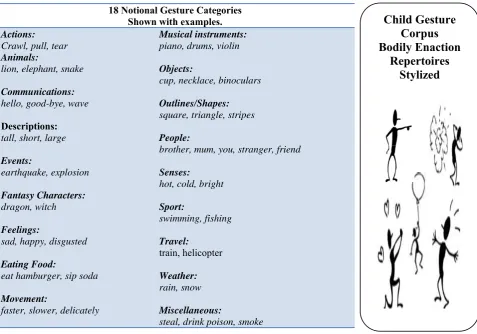
TABLE 6.2 A) NOTIONAL GESTURE CATEGORIES FOR CHARADE GAME AFTER ROY (1996) ... 164
TABLE 6.2 B) CONDITION A CASE STUDY 1141VERBAL PROMPTS ... 165
TABLE 6.3 A)DESCRIPTORS FOR ‘PRETEND TO STOKE THE CAT’ ... 168
TABLE 6.3 B)DESCRIPTORS FOR ‘PRETEND TO PLAY THE VIOLIN ... 175
TABLE 6.3 C) DESCRIPTORS FOR ‘PRETEND TO LASSO THE STEER’ ... 179
TABLE 6.4 D) DESCRIPTORS FOR ‘JELLY MOULD’ ... 186
Chapter 7
TABLE 7.1 CASE STUDIES 2AND 3SUMMARY STAGE OF ANALYSIS AND INTERPRETATION ... 193 TABLE 7.2 CASE STUDY 2CORPOREAL NARRATIVE FEATURE ANALYSES
‘COWBOY COMES TO TOWN’EXEMPLAR ... 200 TABLE 7.3 CONDITION C CASE STUDY 3CORPOREAL NARRATIVE FEATURE ANALYSES
CHOCOLATE DOUGHNUT EXEMPLAR ... 211-212 TABLE 7.4 CASE STUDY 2AND 3CORPOREAL NARRATIVE THEMES,G-ABAS AND
Acknowledgements
I would first like to acknowledge and thank all the children and young people who have co-participated and contributed to the Child Gesture Corpus. Their enthusiasm and insight into child gesture has been invaluable. Without these friendships and experiences, my work would not have been possible. I hope that this research has a positive impact on their lives and learning and will impact the lives and learning of future generations of children and young people.
Particular mention should be made of the students, therapists, teachers, clinicians, parents and carers. The original corpus was collected with the participation and support in the USA from John. G. Leech School, Delaware, Widener Memorial and HMS Schools, Philadelphia and A.I. Dupont Children’s Hospital, Wilmington. The corpus was extended with the invaluable support from the Woluwe NCT Network, Brussels, Belgium; Tuke School, London, UK, and those involved in the i3net European Network of Excellence, Experimental School Environments (ESE) ‘Today’s Stories’ Project, Denmark.
My special thanks to Dr Thomas Sicoli who encouraged me to pursue PhD studies, Drs. Michael Alexander and Freeman Miller, A.I. Du Pont Hospital, USA who gave of their valuable clinical time to share their knowledge of Cerebral Palsy and to Dr. Gary Strong formerly of NSF, USA, for his consistent support of the work.
My particular thanks to colleagues who have contributed to my evolving thinking on gesture, particularly those involved in the ever growing Gesture Workshop Community and the International Society for Gesture Studies; to Susan Goldin-Meadow, Adam Kendon and Roberta Golinkoff for giving generously of their knowledge and expertise during the very early days of the thesis. My thanks to Professor Bencie Woll, the first Chair in Sign Language and Deaf Studies, City University, UK, and now, Director of the Deafness Cognition and Language Research Centre (DCAL) Centre, University College London, UK, for her supervision during the very early stages of my research work.
In addition my thanks to Hans van Balkom, Professor in Severe Speech, Language & Communication Disorders, Augmentative and Alternative Communication (AAC), Behavioural Science Institute, Radboud Universiteit Nijmegen, Netherlands for his advice on an earlier version of my thesis. To Professor Chris Sinha, now Distinguished Professor in Cognitive Science at Hunan University, China who encouraged me and gave so generously of his knowledge. My special thanks to George Eugeniou, Artistic Director of Theatro Technis, UK, for teaching me about theatre and the importance of culture and for introducing me to the work of Augusto Boal.
My more recent thanks are to Dr John Spence, Delta Centre, University of Iowa and Professor Gregor Schöner, Institut für Neuroinformatik, Ruhr-Universität-Bochum for providing me with the opportunity to study Dynamical Systems and Neural Field Theory.
My particular thanks to Professor Norbert Seel and Springer for the invitation to publish my work in the ‘Encyclopedia of the Science of Learning’.
I would also like to thank the numerous unnamed individuals, both colleagues and friends in the UK, Europe and the USA, who have developed my understanding of child gesture and renewed my enthusiasm.
My most heartfelt thanks and sincerest gratitude go to Ewart Carson, Emeritus Professor of System Science, Centre for Health Informatics, City University, UK, whose expert academic advice and stalwart support for the final version of my thesis remains invaluable.
Finally, I would like to acknowledge Dr David Roy, for introducing me to Systems Theory, the magic of gesture and for his collaborative support and constant inspiration.
Financial Assistance The Child Gesture Corpus was established in the USA, originally forming part of the research work on the ‘Computer Recognition of Dynamic 3D gesture of children with cerebral palsy’, Dr D.M. Roy. This was financially supported by the City University, UK and the A.I DuPont Institute, Wilmington Delaware, through EPSRC-UK grant and A.I. DuPont grants awarded to Dr D. M. Roy.
For my thesis work, The ‘Body Tek: The Digital Body ‘ Project was funded by an Interactive Technology Artist’s grant from the Arts Council of Great Britain; this work also contributed material to the Child Gesture Corpus. The initial presentation of my conceptual work was supported by a travel grant from City University, London, UK. I was awarded a summer school fellowship from The National Science Foundation (NSF), USA, and the Delta Centre, University of Iowa, USA; this supported the preliminary development of the Dynamical System Theory aspects of the initial Spatial Cognition in Action Model. Matlab tools and code, together with mathematical modelling support, was provided by Dr Evelina Dineva and the SPAM Lab, Iowa, USA.
The European Network for the Advancement of Artificial Cognitive Systems, Interaction and Robotics (EUCOG II and III) provided financial assistance for me to attend and present work at a series of events, including a workshop on ‘Sensorimotor Contingencies’, San Sebastian, Spain; "Embodied communication", Bochum, Germany; "Social and Ethical Aspects of Cognitive Systems", Brighton, UK and "Cognitive Systems: Present and future in the research, industry and funding landscape", Genoa, Italy. The Society for the Study of Artificial Intelligence and the Simulation of Behaviour (AISB) provided a travel bursary for my attendance at the first "Foundations of Enactive Cognitive Science" conference sponsored by the Centre for Integrative Neuroscience and Neuro-dynamics (CINN) and the University of Reading, UK.
Academic and Practitioner Affiliations have included: the A.I. DuPont Institute, Applied Science and Engineering Laboratories, A.I. DuPont Children’s Hospital; Education Department, University of Delaware, USA; Psychology Department, University of Brussels, Belgium; Natural Interactive Systems Laboratory, i3net European Network of Excellence for Future and Emerging Technologies, University of Southern Denmark, IT-West Denmark; Theatro Technis, London, UK; The School Room, Paediatric Neurosciences, King’s College Hospital London, UK and the School of Health Sciences, City University, UK.
Dedication
To all the children unborn, born and those no longer with us, who allow me a unique insight into their real and imaginary world(s)
To Sophia & Alexander
for the generosity of their love and reflections on gesture. They continue to be my constant inspiration.
For my partner, mother, father and brothers
My philosophical and scientific journey set out to explore both the science and art of gesture. I hope that through sharing my passion and fascination of human corporeal action, I have contributed some new knowledge and caused some level of infection in
List of Acronyms
CP Cerebral Palsy
BST Biological Systems Theory
C-i-A Cognition in Action
CGC Child Gesture Corpus
AE Action Entity
GAA Gesture-As-Action
GAE Gesture Action Entity
P-GAE Procedural Gesture Action Entity
S-GAE Semantic Gesture Action Entity
E-GAE Episodic Gesture Action Entity
GA-EA Gesture As Executed Action
GA-SA Gesture As Simulated Action
SSMI-CP Severe Speech and Motor Impairment due to Cerebral Palsy
NAT Neuro-atypical
NT Neuro-typical
PTI Physicality and Tangibility of Interaction
G-ABAS Body- Gesture-Action-Based-Annotation-System
IPA Interpretative Phenomenological Analysis
G-IPA Gesture-based IPA
SKIP Spatial Kinaesthetic Interaction & Intelligence Profile
SM Sense-making
AAC Augmentative and Alterative Communication
BST Biological Systems Theory branch of General System Theory (GST)
DST Dynamic Systems Theory e.g. motor development; for mathematical
instantiations referred to as Dynamical Systems Theory
DFT Dynamic Field Theory, mathematical formalization of continuous interactions
Chapter 1
Introduction-Research Context and Motivation
Human Interaction The status quo
Traditional theories and models of human interaction are typically based on conceptual frameworks that have the notion of representation at their core. They argue that our human abilities to understand our own and the action of others rely on mechanisms of: inference, prediction, prospection, imitation, emulation or simulations; specifically, of the mental state of the social ‘other’. The majority of research is, however, restricted to a limited understanding of what are clearly complex relationships. Such approaches underlie the development of theories and empirical research in wide-ranging domains including: neuroscience, developmental psychology, language and gesture studies, computer science and beyond. Of particular relevance to my thesis, is that they also significantly influence practices in medicine, rehabilitation, pedagogy and the design of technology for children.
1.1 My Journey
Alternative Bodies, Pathways and Interaction
My theoretical approach and practice is influenced by my work as a developmental biologist, an academic researcher, dramaturg1, teacher, and cognitive academic therapist. My journey began by reflecting on the quality of interaction of children with severe speech and motor impairment due to Cerebral Palsy (CP). Cerebral Palsy is a non-progressive condition affecting motor co-ordination, posture and cognition. It is one of the most common disAbilities in childhood. Its causes lie in what are described as abnormalities that arise from trauma to the developing brain of the foetus or neonate. In terms of the medical model, a diagnosis is often sought when children do not appear to reach ‘normal milestones of development’.
At the neurological level, damage is identified in areas of the basal ganglia and the cerebellum. These structures are involved in the integration of movement and form part of the neural sub-systems associated with human reasoning and adaptive functions. There is a high level of connectivity to the neuronal structures of the thalamus, frontal lobes and prefrontal cortex.
Most recently, researchers who are reviewing the role of the basal ganglia in cognitive-motor interaction throughout development are considering the implication this may have for both motor symptoms and higher order deficits.
The challenges that children with cerebral palsy face are significant. The condition fundamentally affects their primary means of movement and expression. My exploratory work with children with CP revealed that they have latent motor-cognitive capacities which they can use both to express themselves and interact socially with others.
This work revealed that children’s corporeal experiences can ‘bring forth’ and ‘carry-forward’ latent capacities which are in stark contrast to existing reports of their interaction abilities. Reports typically come from: paediatric medical diagnosis, evaluations from physical, occupational and speech therapists, the experience of teachers, parents/carers and importantly the beliefs of children themselves.
These early reflections continue to fuel a questioning of traditional, representational models of interaction. I argue that critically, these models lack the power to explain or help us gain a deeper understanding of the latent capacities of these children.
1.2 My Thesis
An Argument for Biological Social Beings
My thesis presents a concept of interaction driven by the notion of intentionality, more specifically, the intentionality of action. This intentionality of action is fundamental to our interactions as biological social beings. This conceptual approach places the emphasis on 1st person experience and examines the 2nd and 3rd person perspectives. My empirical study focuses on children’s gestures. Gestures can be considered as either overt action phenomena that are externalised and made visible or as covert action that is a non-visible phenomenon. Scientific arguments are put forward that gesture repertoires can provide a window into a child’s corporeal cognition and thus place the ‘Action-Ready-Body’ centre stage.
Gesture-An Ephemeral Phenomenon
My thesis challenges traditional, representational conceptual frameworks that underlie our contemporary understanding of gesture. In this thesis, the scope of gesture is extended and described as:
Intentional actions can provide humans with an extensive repertoire of expressive gestures. Gestures can be considered corporeal phenomena that have the capacity to enhance our interactions; they are both continuous and dynamic. Gestures are both critical to and enrich socialization. They unfold within a variety of environments that are populated by intentional agents. I describe such environments as: ecologies of interaction. The study of how children in particular develop their abilities to integrate into such complex environments provides an opportunity to re-examine their gestural capacities. As organisms we are both intimately a part of and in turn influenced by our social and physical environments.
These ecologies of interaction unfold in three time-space dimensions: the veridical, i.e. physical space-time; the imaginary, i.e. invisible or covert space-time and the hybrid. I introduce the term hybrid to describe environments that encompass both cognitive and material artefacts. Such artefacts extend the nature of our interactions and can include tools and everyday objects. In the imaginary sphere these artefacts, i.e. imaginaries, may be bound to the individual or shared socially with others, e.g. societal beliefs, the unexpected or the futuristic. In contemporary life these artefacts may include interactive digital technologies, such as those used for communication, education, edutainment, rehabilitation, creative practice and performance.
My definition of gesture clearly goes beyond conventional contemporary conceptualizations of gesture that largely envisage gesture as a phenomenon ‘in-the-service’ of language. I would argue that contemporary studies should treat gesture as complex corporeal phenomena that unfold dynamically within such ecologies of interaction. These interactions carry significance for the individual (intra-perspective), between social others (inter-perspective) and for the social others i.e. artefacts (inter-objectivity).
Why neuro-atypical gesture? – The research gap
Children with cerebral palsy offer a unique opportunity to re-think gesture in a neuro-atypical population. This is an area where there has been a paucity of both interdisciplinary and multi-dimensional research on either the gestural or cognitive potential of children. My thesis sets out to re-consider the nature of their physical, emotional and intellectual interactions with the world. This is achieved in part through an in-depth qualitative analysis of the gestural capacities of children.
can be described as conventional gestures, e.g. upward/downward eye movement for yes/no, gross head movement for nod (yes)/head shake (no), gross movement to hit a target on a communication board or mechanical switch to operate a toy or push a joystick.
The movement profiles of these children are often globally described as ‘writhing and chaotic’; they have difficulty with muscle tone, movement and motor skills development. They are reliant on their parents/carers for their daily needs as their independent everyday activities are extremely restricted. Their challenges can be complex and may also involve cognitive, hearing and visual impairments. These children are often quadriplegic wheelchair users. Under the International Classification of Functioning, Disability and Health for Children and Youth (ICF-CY) these children are classified as having motor abilities tending towards level V. Level V is described on the Gross Motor Function Classification System (GMFCS)2 for cerebral palsy as:
Physical impairment: restricted voluntary control of movement and the ability to maintain anti-gravity head trunk posture. All areas of motor function are limited. Functional limitations in sitting and standing are not fully compensated for through the use of adaptive equipment and assistive technology. At level V, children have no means of independent mobility and are transported. Some children achieve self-mobility using a powered wheelchair with extensive adaptations.
External aids are needed for communication as their speech is often difficult to understand, i.e. they have a dysarthric3 speech disorder. Communication is achieved by using alternative systems termed Augmentative and Alternative Communication (AAC) devices, e.g. letter selection from a board using eye gaze or technology with digital speech output. Children with this level of motor compromise cannot access traditional keyboard or tablet interfaces directly with their fingers. They are often educated in special schools with individualised learning programmes. As with their motor profiles, the cognitive profiles of the children are heterogeneous.
However, on a cautionary note, levels of competencies cannot necessarily be inferred by the level of neurological brain damage.
2 See www.motorgrowth.canchild.ca/en/GMFCS/resources/GMFCS_English.pdf for more details.
In fact, leading clinicians in the field warn against predictive diagnosis and prognosis based on such data alone. Although it is stated that generally speaking the:
‘more severe structural changes mean more severe motor and cognitive neurological disability’...’other individuals may have equal cognitive and motor severity with near normal MRI’...’or individuals with severe structural changes on the MRI’ ..and. ’cognitively normal....’ has...’triplegic patterned CP but ambulates’. (Miller, 2007 p.48)
Miller goes on to caution physicians: ‘not to develop prejudices concerning an individual child’s function based on imaging studies’ (ibid, p.48).
The most recent World Health Organization guidelines for working with people with disability highlight the need for further interdisciplinary research. Importantly, for the aims of my thesis, they make recommendations for a more holistic, rather than a deficit model of intervention approaches. However, established medical/clinical models of intervention are largely focused on working towards improving functional motor ability, e.g. in physiotherapy and occupational therapy. Similarly, in speech and language therapy the focus is largely on learning the use of AAC devices.
Cognition-in-Action
Fundamental to the biological perspective that influences my work is the notion that all living organisms are autonomous, bounded entities driven to self-replicate and influenced by their environments; this can be described as an autopoietic system4. Within a Biological System Theory (BST) framework - knowledge can be equated with notions of cognition and action equated with knowledge. These notions support the theoretical foundation for re-thinking gesture. I propose the construct: Cognition-in-Action (C-i-A).
Building on my initial definition of gesture, any child’s gesture can thus be considered an open, bounded, autonomous, self-regulating system that both expresses characteristics of non-linear dynamics and is influenced by varying constraints. Set within the context of attempting a deeper understanding of child gesture, I introduce the term the Action-Ready-Body to reflect the corporeal focus of my work; corporeal is defined as: that has materiality, affecting or characteristic of the body. Within this I re-examine the notion of enactive gesture, where
Enaction is defined as: one of the possible ways of organizing knowledge and one of the forms of interaction with the world.
In my thesis enactive gesture is instantiated during ludic5 interactions in terms of
corporeal performance.
The proposed construct of Cognition-in-Action encompasses both the notion of corporeal agency and the concept that interactions happen within a biological system that creates meaning. In the subsequent chapters of my thesis I go on to present more detailed arguments from the biological sciences and philosophical domains for the consideration of knowledge-as-action.
From a philosophical perspective, I am inspired by the work of the philosopher, Merleau-Ponty, who argued for social cognition that is both non-representational and intercorporeal. He argues for the primacy of the body in perception (Merleau-Ponty, 1962) i.e. corporeality.
This notion of corporeality is described in terms of a life of consciousness-cognitive life, (author’s italics) where:
‘the life of desire or perceptual life – subtended by an ‘intentional arc’ which projects round about us our past, our future, our human setting, our physical, ideological and moral situation, or rather which results in our being situated
in all these respects.’ (Merleau-Ponty, 1945/2005, p.157)
Of child intentionality he gives a very pertinent example when he observes:
‘That is why, in their first attempts at grasping, children look, not at their hand, but at the object: the various parts of the body are known to us through their functional value only, and their co-ordination is not learnt.’ (ibid, p.172)
In terms of the intercorporeality of interaction, he describes the reciprocity of his intentions and the gestures of others: ‘as if the other person’s intentions inhabited my body and mine his.’ He argues that there is a need to review what we mean by both communication and our perception of the ‘thing’. He describes it as there being a:
‘mutual confirmation between myself and others. Here we must rehabilitate the experience of others which has been distorted by intellectualist analyses, as we shall have to rehabilitate the perceptual experience of the thing.’ (ibid, p.215)
Importantly, for my construct of Cognition-in-Action; he identifies that objects become known through perceptual experience equated with exploratory movement, i.e. embodied action.
This knowledge does not arise through some notion of labelling as is commonly thought. In this case he talks about a veridical object in a room-a fireplace:
‘The identity of the thing through perceptual experience is only another aspect of the identity of one’s own body throughout exploratory movements; thus they are the same in kind as each other. Like the body image, the fireplace is a system of equivalents not founded on the recognition of some law, but on the experience of a bodily presence. I become involved in things with my body, they co-exist with me as an incarnate subject, and this life among things has nothing in common with the elaboration of scientifically conceived objects.’ (ibid, p.215).
Acts of Meaning
I go on to argue that any ‘acts of meaning’ can be described in terms of biologically based sense-making as biosemiotic6. These meanings are undoubtedly influenced by our neurology and unfold in what I further describe as neuro-dynamic ecologies7. The detailed neuro-dynamic aspects of the Cognition-in-Action conceptual framework do not form part of this thesis.
These aspects of meaning-making for humans and some mammalian species have relevance not only in the moment-to-moment or microgenetic level but also carry significance at the developmental (ontological) level. They can be considered to illustrate the phenomenon of cognitive adaptation8 that supports knowledge transformed within evolutionary (phylogenetic) timeframes of human culture. Thus, I provide a description of human culture as: the evolution of the interplay of social-motor-cognitive intentional agents, within and across their material and imaginary worlds. My approach is illustrative of theories that advocate a distributed framework for understanding human culture.
The C-i-A Architecture
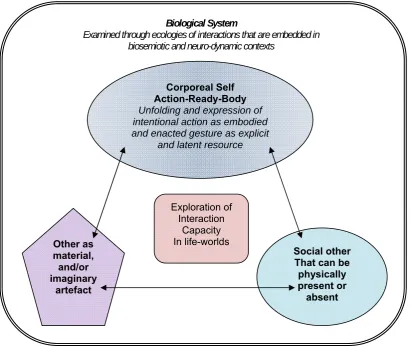
To aid understanding a simplified schematic of the architecture of the proposed C-i-A conceptual framework is presented in Figure 1.1. It is proposed as a descriptive, non-computational biological feature-based system for re-thinking gesture. This figure shows the relationship between the corporeal self as an Action-Ready-Body with capacity to express intentional action as embodied, extended and enacted gesture to reveal latent resources and structures. The self, indicated by the larger ellipse shape is dynamically connected (indicated
6Biosemiotics is a concerned with the study of the production of signs and codes in the biological realm. I will later elaborate on the notion of ‘Umwelt’ proposed by Uexküll (1909) see also Panayi (2012).
7 See Panayi (2012)
[image:23.595.93.505.207.553.2]
by the double ended arrows) to the social other (smaller ellipse) and the other as artefact (hexagonal shape). The framework focuses on the exploration of intentional action as both capacities, indicated by the inner smaller bounded box, and constraints within a biological system indicated by the larger bounded box. A Biological System Theory approach is proposed as the best candidate to examine ecologies of interaction that are embedded in biosemiotic and neuro-dynamic contexts.
Figure 1.1 A simplified schematic of the Cognition-in-Action conceptual architecture.
This thesis presents a descriptive non-computational biological feature based conceptual framework for re-thinking gesture as Cognition-in-Action. A Biological Systems Theory approach is proposed as the best
candidate for the theoretical framework.
Social other That can be physically present or
absent Corporeal Self
Action-Ready-Body
Unfolding and expression of intentional action as embodied and enacted gesture as explicit
and latent resource
Exploration of Interaction
Capacity In life-worlds
Other as material,
and/or imaginary
artefact
Biological System
Examined through ecologies of interactions that are embedded in
A Theoretical Synthesis and Empirical Study
I present an interdisciplinary theoretical synthesis that brings together two perspectives: biological and the phenomenological. The advantage of using a Biological Systems Theory approach is that it allows for the complexity of the system to be considered in a more systematic and effective manner. It supports consideration of evidence both from within and across the domains of Philosophy, Science and Technology, including Practice.
The phenomenological perspective allows for the qualitative analysis of children’s lived-experiences in relation to their gestural capacity within their ecologies of interaction – their ‘life-worlds’. It can be structured for the systematic analysis of specific phenomena to reveal emergent themes. This phenomenological perspective is also supported by an empirical study.
The empirical study presented in my thesis explores the nature of children’s intercorporeality as they engage in playful enactive interactions. These ludic interactions generate meaning through intersubjective experience. They are considered to be both appropriate and ecologically valid. The ecology of interactions allows for an exploration of how pretence may be influenced both by the nature of intersubjectivity and social cognition within the context of levels of child engagement. It is within this framework of phenomenological, participatory experience that the intentionality of corporeal action is interpreted.
These gestural experiences have been captured on video and form the bases of a unique Child Gesture Corpus (CGC). The corpus contains gesture exemplars from both neuro-atypical and neuro-typical children. An in-depth analysis of three case study exemplars from neuro-atypical children with cerebral palsy is presented in this thesis. The relevance of case study methodology to the aims of the thesis is summarised in the following five points:
It typically provides ecologically valid data.
It contributes to a deeper understanding of the phenomenon being explored. It allows for different levels and where appropriate different methodologies of
analysis to be applied at these different levels, e.g. system theory to support theoretical inquiry and case study methods to support the empirical study. It supports theory building and the refining of the Cognition-in-Action
construct by highlighting individual changes and process that can be applied to intervention, e.g. gesture capacity of children, particularly those with severe speech and motor impairments due to cerebral palsy.
The nature of the empirical study also necessitated the development of an annotation tool. This qualitative action-feature based tool has a novel ontology that enables analysis of both corporeal dynamics (procedural features) and corporeal narrative (semantic and episodic features) of child gesture. The tool significantly extends existing gesture study annotation methodologies.
Interpretative Phenomenological Analysis (IPA) is a methodology that allows for phenomenological, interpretive (hermeneutic) and idiographic data to be analyzed together for a specific phenomenon. It is the preferred candidate analysis method as it is consistent with the conceptual framework. It comes from text analysis but was adapted for the first time in my thesis for the video analysis of the neuro-atypical physically expressed gestures of children, henceforth referred to as G-IPA. This methodology allows for the synthesis of both the individual, i.e. emic data and etic data, i.e. derived from research observation and interpretation. These data sets are used to instantiate aspects of the Cognition-in-Action framework. Used iteratively these tools support an explanatory mechanism of access and control of enaction.
The rationale for coupling a case study methodology with a Biological System Theory (BST) approach lies in its robust capacity to consider multiple factors while considering the system as a whole. The limitation of case methodology is undoubtedly that findings cannot be generalised to larger populations without future studies.
However, the conceptual design of the framework can be used inclusively for both neuro-atypical and neuro-typical child gesture, although only neuro-atypical exemplars are analysed in my thesis. The utility of the conceptual framework in terms of its generalizability lies in its future use and as a precursor to larger studies. The validity of the use of case study methodology in pedagogy, clinical practice and technology design is discussed in subsequent chapters of the thesis. The major advantage of applying interdisciplinary methodologies is that they can be used to build new knowledge that can influence theories and affect changes in practice.
have developed and applied can be used independently for qualitative research or used to inform quantitative studies, e.g. in the fields of health, gesture or technology design research and practice. This can be done without recourse to such deficit models of interaction.
1.3 Thesis Aims and Objectives
My earlier exploratory work with children focussed on pedagogy, technology design and performance art. It was here that I began to I identify the need to consider the nature of both procedural and narrative aspects of child gesture, specifically, how motivation and engagement affected the quality of interaction and the relationship that could be developed between co-participating inter-actors.
Aim 1 To develop a conceptual framework for re-thinking the gestures of neuro-atypical young people, which is non-traditional and non-representational: Cognition-in-Action
The first aim proposes the construct of Cognition-in-Action (C-i-A) as means of exploring conceptual frameworks that do not rely on traditional representational explanation for understanding perception-cognition and action. Theoretical frameworks have the advantage of being able to condense and provide coherence to bodies of related knowledge. Equally, the influence of our practice contributes to the development of our theoretical models. This links the first aim to the second and third aims of my thesis.
Aim 2 To develop qualitative analytical tools for the annotation and interpretation of gesture that can be applied inclusively to both neuro-atypical and neuro-typical young people
The second aim addresses the lack of annotation and interpretation tools that can be applied inclusively to both neuro-atypical and neuro-typical child gesture.
Aim 3 To consider the conceptual framework in terms of its theoretical implications and practical application
Objectives
The following objectives addressed my aims, namely:
Objective 1: To critically review existing frameworks and models of medical practice in relation to cerebral palsy children’s action and gesture
The critical review presented in Chapter 2 examines extant literature in the domains of medical and clinical practices, neuroscience and linguistic models of gesture. This chapter identifies the research gaps at both a theoretical and practice levels.
Objective 2: To develop a theoretical framework that can support the re-conceptualization of emergent intentional action by children expressed as gesture I introduce the Biological System Theory motivated conceptual architecture for the Cognition-in-Action framework, presented in Chapter 3
Objective 3: To outline an inclusive methodology that has the capacity to investigate neuro-atypical and neuro-typical gesture within the same paradigm
In chapter 4 I outline the methodology that facilitated young people’s contributions to the Child Gesture Corpus. I show how it underpins the analyses of exemplars in the empirical study.
Objective 4: To identify, develop and adapt qualitative tools to support the annotation and interpretation of bodily expressed child gesture.
I address the challenge and justify the development of novel action body-based gesture annotation system (G-ABAS) and Interpretative Phenomenological Analysis (G-IPA) tools for use with neuro-atypical cerebral palsy gesture data. These are presented in chapter 5.
Objective 5: To examine what gestures reveal about children’s corporeal Cognition-in-Action
In Chapter 6 I present the first level of interpretative analysis that examines both corporeal dynamics and corporeal narrative features.
Objective 6: To consider the relationship of the underlying enaction subsystem In Chapter 7 I present the second and third levels of interpretative analysis where I examine the complexity that necessarily underlies the enaction of gestures by cerebral palsy children.
Objective 7: To identify the practical utility of the gesture-based annotation and interpretative phenomenological analysis tools within the Cognition-in-Action conceptual framework
In Chapter 8 I discuss the utility of the qualitative tools I have developed for the annotation and analysis of child gesture within the C-i-A framework for both practitioners and researchers.
mixed methods approach to develop a deeper understanding of the complex nature of cerebral palsy child gesture within a dynamic system.
1.4 Overview of the thesis
In Chapter 2, I present my literature review. I discuss the scope, inclusion criteria and stages of the review. Three sections review medical models and clinical practice in relation to cerebral palsy; models of action control and models of gesture. Each section ends with a summary. The chapter ends with an executive summary.
In Chapter 3, I introduce my approaches to re-thinking gesture I discuss gesture as a biological system. I then move on to discuss models of corporeal action in relation to gesture. The final section introduces my Cognition-in-Action framework informed by my theoretical synthesis. The chapter ends with a summary.
In Chapter 4, I introduce the methodology that underpins my empirical study of child gesture in the context of the challenges of gesture studies in ecological setting and my ludic paradigm. The second section presents my empirical research plan, it includes a description of the Child Gesture Corpus, the selection criteria and data for my co-participants, I provided details of my ludic interaction protocols for three conditions. Condition A an adapted charade game, the co-constructive narrative interaction (Condition B) and the manipulation of artefacts (Condition C). The chapter ends with a summary.
In Chapter 5, I introduce the background to the development of two tools. The body focused Gesture-Action-Based-Annotation-System (G-ABAS) is presented in the context of the challenges of video analysis of neuro-atypical gesture and the challenges of annotation more broadly. I also included a discussion of issues around the classification and description of communication, movement, and cognition and gesture of children including those with atypical profiles. The G-ABAS ontology is summarised. I introduce Interpretative Phenomenological Analysis method, typically use with text, that I have adapted and applied to gesture for the first time (G-IPA). The chapter ends with a section on the limitations, advantages and potential applications of these tools and a summary.
in these interaction scenarios. The chapter ends with a summary of findings of corporeal dynamic features for case study 1 and 3.
In Chapter 7, I focus on the analyses of corporeal narrative features in the context of the C-i-A framework. Exemplars are presented from Condition B, the co-constructed narrative interaction ‘Cowboy goes to Town’ (Case Study 2) and Condition C, the Manipulation of Artefacts (Case Study 3). Summary interpretative findings are presented that discuss sense-making, space, performance strategies (including improvisation) and integration capacities of these young people. I discuss how the G-ABAS and the G-IPA tools can be applied in pedagogic, clinical and design settings. This is done in the context of the Spatial Kinaesthetic Interaction Intelligence Profile (SKIP). The capacities of these young people are discusses in terms of the corporeal gestural sphere, situated practice guidelines and the concepts of gestural flow and slow process. The chapter ends with a summary.
My discussion is presented in Chapter 8 I revisit the significant research gaps that I have identified and their implications. I review my work plan and revisit the C-i-A framework in the context of my key findings and outcomes. The last section illustrates how aspects of the C-i-A framework can be instantiated. The chapter ends with a summary of the significance and implications of my findings.
CHAPTER 1 AIMS AND OBJ 1 OBJ 2 OBJ 3 OBJ 4 OBJ 5 OBJ 6 OBJ 7 INTRODUCTION
Research Context and Motivation My Journey, My Thesis Aims and Objectives
CHAPTER 9 CONCLUSIONS
Meeting my objective The Why? From Whom? and How? Contribution to knowledge, Timeliness and Implications Future Work
CHAPTER 2
LITERATURE REVIEW
Critical review foci, inclusion criteria and stages
Movement Science Medical Models, Clinical Practice & CP Models of Action Control, Models of Gesture & Alternatives
CHAPTER 3
RETHINKING GESTURE Gesture as a Biological System
Cognition-in-Action Architecture Constructs, Structures and Tools Action-Ready-Body Ecology of Interaction
CHAPTER 8 DISCUSSION
Significant Research Gaps and Implications Work Plan
Revisiting C-i-A and Instantiating aspect of the Framework
Summary of Significance of the Work and Implications of Findings and Outcomes CHAPTER 7 G-ABAS ANNOTATION AND LEVEL III G-IPA ANALYSES Corporeal Narratives Stories and Things
Summary Interpretative Findings and the C-in-A Framework
G-ABAS and G-IPA Application in Pedagogic, Clinical and Design Settings Gestural Flow and Slow Process
CHAPTER 6 G-ABAS ANNOTATION AND LEVEL I and II G-IPA ANALYSES
Corporeal Dynamics Feature Charades and Manipulation of Artefacts G-ABAS and G-IPA Potential for Scoring, Evaluation and Validity Summary Interpretative Findings and C-in-A Framework
CHAPTER 5
TOOL DEVELOPMENT
Body-Based Gesture Annotation G-ABAS Ontology
Gesture based Interpretive Phenomenological Analysis G-IPA Questions Limitations, Advantages and Potential Applications
CHAPTER 4 METHODOLOGY
Child Gesture Study Context and Challenges Empirical Study Research Plan
Chapter 2 Literature Review
2.1 Background
This critical review places my research with reference to the contemporary extant literature in the context of movement sciences, gesture studies and applied and participatory arts practices. My thesis focused on exploring the nature of corporeal expressivity in young people with severe speech and motor impairment due to cerebral palsy (SSMI-CP). Due to the interdisciplinary nature of my work I propose the use of an overarching Biological Systems Theory framework which allows for literature to be considered both within and across the domains of: Philosophy, Science and Technology, including practice. In terms of practice, I consider work in the medical, applied participatory arts and technology arenas. To provide a starting point for the re-thinking of gesture, I revisit both models of action and models of gesture. Where relevant I make reference to historical work.
This synthesis provides a foundation for the aims of my thesis. I discuss conventional models of medical practice, models that underpin our thinking of perception-cognition and action in the neuroscience and linguistics domains, including gesture studies. I also highlight the potential of sensing technologies to facilitate change. I identify the research gaps in both our understanding of corporeal gesture and the nature of intentionality in children with SSMI-CP. This approach is supported by leading clinicians who have identified the need for not only new ideas but also protocols to support the development of our work into the 21st
century.
I begin the chapter by summarising the review foci (Table 2.1), inclusion criteria (Table 2.2) and stages of the review (Figure 2.1). The critical review is presented in three main sections. The first section 2.2 deals with literature in the Movement Sciences. This section re-examines aetiology; conceptualizations of disAbility, classification; activity, capacity, capability and performance. Consideration is given to allied participatory performance art and technology enhanced capture of movement. The implications for intervention and assessment are discussed prior to summary in section 2.1.4
within my gesture-as-performance construct and the C-i-A framework. These aspects are then considered within the language vs gesture debate and set against alternative perspectives. The chapter ends with a summary in section 2.4.
Table 2.1 Critical Review foci in relation to thesis objectives 2.1.2 Inclusion Criteria
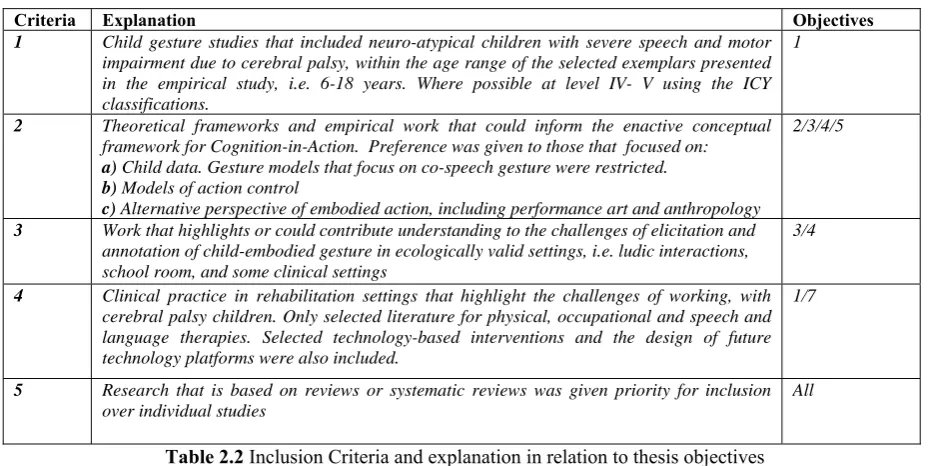
Literature for inclusion was selected based on the five criteria, which are summarised in Table 2.2. The literature was restricted where possible to work that examined child gesture in ecologically valid settings: children aged between 6-18 years classified at GMFCS levels IV-V and MACS IIV-V-IV-V. Preference was given to work informed by child data. The review considered clinical practices that highlighted the challenges of working with cerebral palsy children in rehabilitation settings. The review was restricted to selected literature from physical, occupational, speech and language therapies and applied performance arts practices. I considered theoretical frameworks and empirical work that could both inform and illustrate the timeliness of the Cognition-in-Action conceptual framework. Preference was given to conceptualizations that use dynamic theory. Gesture models that focus on co-speech gesture was restricted. Models of action control are also considered and placed within the movement science domain. In terms of the challenges of elicitation and annotation of child gesture, work was included that could support novel body-based annotation of gesture. Alternative perspectives of embodied action that are influenced equally by performance art and anthropology were considered, as these informed a deeper understanding of the corporeal nature of expression.
Only selected technology-based interventions in terms of motion capture (including use in rehabilitation settings) and the design of future technology platforms were included. Finally, research based on reviews or systematic reviews was given priority for inclusion over individual studies.
Review Foci Objective
Identified the research gaps in our understanding of neuro-atypical child gesture 1
Motivated the theoretical underpinnings and development of the Cognition-in-Action conceptual framework
2
Supported the development of the interaction paradigm that underpinned the contributions of cerebral palsy children to Child Gesture Corpus
3
Supported identification of candidate qualitative methods for the annotation and interpretation of neuro-atypical child gesture data
4
Informs the feature based examination of children’s corporeal cognition and enaction subsystems
5 and 6
Validates the need for alternative conceptual frameworks and practical tools to support our understanding of neuro-atypical child gesture
![Figure 2.3 (ICF) Model. World Health Organization (WHO) (2004) and ICF-CY (2007) with five ‘F’ words modification indicated in italics in the blue ellipses [my additions] after Rosenbaum and Gorter (2012)](https://thumb-us.123doks.com/thumbv2/123dok_us/1425103.95187/42.595.96.493.297.505/figure-organization-modification-indicated-italics-ellipses-additions-rosenbaum.webp)