City, University of London Institutional Repository
Citation
:
Nystrom, E. ORCID: 0000-0003-3628-540X (2017). Morphology of theAmorphous: Spatial texture, motion and words. Organised Sound, 22(03), pp. 336-344. doi: 10.1017/S1355771817000498
This is the accepted version of the paper.
This version of the publication may differ from the final published
version.
Permanent repository link:
http://openaccess.city.ac.uk/20688/Link to published version
:
http://dx.doi.org/10.1017/S1355771817000498Copyright and reuse:
City Research Online aims to make research
outputs of City, University of London available to a wider audience.
Copyright and Moral Rights remain with the author(s) and/or copyright
holders. URLs from City Research Online may be freely distributed and
linked to.
City Research Online: http://openaccess.city.ac.uk/ [email protected]
Morphology of the Amorphous: Spatial texture, motion and words
Erik Nyström
Abstract
On reflection upon my own experience as a composer in theory and practice, I find that terms not only define but also propose. In finding words for spatial texture, I have discovered that spatial texture itself is always proposing: motion of sound suggests texture of space. The texture of space creates an elusive materiality. Form is no better than formlessness.
1. DESCRIBING
The concepts and terms presented here have evolved in a process where music and theory have cross-pollinated in a reciprocal fashion for several years. Relatively abstract extramusical concepts have always been an element in my creative process, influencing both how I develop sounds and the descriptive words I use on occasions such as this. However, the imaginal hypotheses are of course regulated and cultivated through the
process of trial and surprise that occurs when hearing what I do. The ‘idea’ is not an archetype that must be realised, it is, rather, an erratically moving beacon in the dark. Concepts influence how I design sounds, but on the surface of composition, the process is more intuitive. A loop is formed, from diving into the technical substrate, to emerging on the musical surface. That is probably more or less how the concepts are sustained: they are skimmed off the surface and fed back into the stew. On reflection, the musical outcome is never quite what I initially imagined, but the concepts are often embedded. When theorising, as I do now, I tap into the system and package what comes out into words. Since I am part of the process, the terminology cannot claim any neutrality – I ensure I can hear what I say, but my choice of words, and my assessment, is of course influenced by what I am listening out for. Spatial texture, the subject of this article, is similar in nature to the
process described: it moves according to ‘laws’, but not in a predictable manner, and it
spouts morphologies on the sonic surface.
While my terminology does not claim relevance to wider repertory in electroacoustic and computer music, it may be applied as the reader sees fit. In common with established acousmatic taxonomy (e.g. Wishart 1996; Smalley 1997, 2007; Chion 2009), it is presented in terms of perceivable assessment of sound, excluding technical procedure and data. It
technical parameters in composition. This seems natural in music that is based almost exclusively on synthesised sounds, where abstract parameters often have a more direct connection to the character of the sound than in transformations applied to recordings. Thus, it may be that a synthesis-oriented composition method is implicitly favoured, but I leave scope for the technical idiosyncrasies of any potential artist who might apply the ideas in composition. The terminology consists of qualitatively assessed principles of motion – which are not unlike parameters – and motion types. The typology does not claim to be exhaustive, however, since I hope I have not discovered all types yet. I shall be glad if the principles allow other composers to imagine things that have not been described –
thus I am hoping that this is as useful for ideas as it is for assessing experiences.
2. IN FANCIFUL TERMS
The inspirational role that terminology can have in stimulating experimentation and discovery is not often emphasised.1From my own experience, I can, for instance, relate
how my first reading about spectral space in Denis Smalley’s Space-Form and the Acousmatic Image (2007) made me both listen and think differently, imagining vertical expansions and contractions in texture which I then experimented with in composition. An
earlier inspirational experience was when I read Iannis Xenakis’s Formalized Music (1992) for the first time, and how the arcane concepts of stochastic music, the graphic diagrams, and the sporadic interludes of poetic metaphors evoked the idea that anything could be possible. It mattered little that I lacked the competence in mathematics and music notation to understand the technical implementations, because the ideas where enough for me to want to make music – naively daydreaming of ‘elastic bodies’ and ‘sonic perturbations with evolutions, unparalleled and unimaginable until now’ (ibid.: 47). Similarly, trying to
remember the terminology in Smalley’s article was not as important as allowing the
concepts to feed my imagination. Thus, my reading of Formalized Music was not formal at all – it created a free and fertile world of inspiration. And, though Smalley’s writing was
descriptive, I often applied the ideas more hypothetically, in the design of synthesis processes. Of course, both Smalley and Xenakis were (and are) in no lesser degree musical (as opposed to conceptual) inspirations, but such influence is of a different nature, because it tends to engender more imitative results. The ideas I pursued with inspiration of theory were not the same as the ones which were influenced by music. Thus, terminology is not
1Manuella Blackburn (2011) has demonstrated an elegant method for reversing the taxonomical application of
spectromorphology, in constructing ‘sound units’ as morphological strings from visual representations of
simply about defining things, but also about stimulating and proposing.
Here, the notion of potentials is central also to the subject to which the terms are applied. Spatial texture is of processual, relational and emergent nature, and requires us to look beyond theoretical frameworks concerned with the morphology of objects – which are finite and graspable, already existing rather than in the making. Kerry Hagan writes
that ‘texture is a characteristic of an object, requiring a substrate on which to exist. In
focusing on texture, the object itself becomes irrelevant’ (Hagan 2017: 34). She refers to musical texture as a ‘metaobject’, as it is a macroscopic composite of aggregated sonic activity, whose spatiotemporal scale subsumes the listener (ibid.: 35). I would add that, since the ‘metaobject’ exists only because of its textural properties, and has no temporal
cause, it is in a permanent state of creation. Pierre Schaeffer knew well that this kind of material lay outside the ‘sound object’ perimeter, and might have classified it as
‘redundant’, ‘homogenous’, or ‘excentric’ –‘“at the limit” of the field of sounds which can be used for music’ due to displaying ‘a lack of balance in the sense of being too original and complex’ (Chion 2009: 146–7). The ‘excentric’ encompasses composite sounds whose mass or duration exceed what Schaeffer considered to be manageable in a musical context, as well as microsounds which do not have enough duration to be registered by a listener as
objects. ‘Balanced sounds’ – which have a privileged position in his typology, as intrinsically usable for music –on the other hand, are not ‘too elementary or too structured.
If they are too elementary, they will tend to be subsumed by structures more worthy of memorization [...] If they are too structured, they will be capable of breaking down into
more elementary objects’ (Schaeffer quoted in ibid.: 141). It is worth observing that the ‘balanced sound’ is often referred to as a ‘note’, since its duration and morphology is
broadly similar to instrumental sounds. Perhaps this indicates an attachment to a phrase- and gesture-oriented conception of music, related to his apprehension towards embracing of some of the electroacoustic medium’s unique potentials for exploration of perceptual
dimensions and ambiguities lying beyond these archetypes. Schaeffer’s theory has,
however, not prevented a growing repertory of textural music which celebrates precisely
these kinds of ‘excentric’ territories. As John Dack writes:
the potential to be extended by the composer in languages based as much on texture or grain as pitch. […] Furthermore, the value of the ‘excentric sounds’ is in their
refusal to resemble explicitly any particular origin. I would suggest that they can be said to justify in a sense the medium of electroacoustic music in that they are intrinsically electroacoustic. (Dack 2008: 2–3)
Even though Schaeffer’s judgement on ‘excentric’ sounds was demonstrably premature, I
salute him for introducing such a tantalising term to the literature. Its beauty is that it
proposes more than it defines. I indulge in the images: who would not want an ‘excentric’
sound?! That alone should be enough for one to want to become a composer! Xenakis, as is well-known, was interested precisely in these sonic outskirts: deviations, tendencies and densities were essential features of musical structure in his systems for dealing with sound aggregates, their transitions, and their plasticity. In his writing, the models were demonstrated in technical context, but his macro-textural parameters are applicable in
listening too, and the ‘elastic mirrors’2will never run out of potential!
3. A MORPHOLOGY OF THE AMORPHOUS
Spatial texture concerns the intrinsically relational properties that emerge with the spatial distribution and motion of sound within a textural metaobject. With some poetic licence, I might describe it as ‘the perturbations of the amorphous void’, since it has no visible
counterpart in the real world. Spatial texture arises from relationships among sounds: its spatiality evolves with the sounds from which it arises and may in turn also influence perceived textural materiality. Spatial texture creates patterns, states, and forms as a result
of motion, but should not in itself be thought of as ‘a form’ or be said to ‘have form’, as if
it is a static entity. Morphology, in this context, is considered a process of becoming – a morphogenesis. A musical discourse driven by spatial texture therefore evolves in constellation, with an ambiguous systemic mode of causation3of less hierarchical nature
than what is typical in a more gesture-driven aesthetic. Spatial motion is part of the underlying cohesion, while sequential, functional relationships among sounds on the frontline are of lesser consequence. Formless, entropic flux is the necessary origin and
destiny of morphology. Borrowing a phrase from mathematician Benoit Mandelbrot’s
2The elastic mirrors are an element in dynamic stochastic non-standard synthesis; for example, GENDY1
(Xenakis 1992: 295–322).
famous The Fractal Geometry of Nature (Mandelbrot 1983: 1), the discourse of spatial texture might be described as a morphology of the amorphous – as if originated in an effervescent, conductive foam, sparking in every direction.
4. A ‘DIAGRAM OF FORCES’
The form ... of any portion of matter, whether it be living or dead, and the changes of form which are apparent in its movements and in its growth, may in all cases alike be described as due to action of force. In short, the form of an object is a
‘diagram of forces’, in this sense, at least, that from it we can judge or deduce the
forces that are acting or acted upon it. (Thompson 1961: 11)
As D’Arcy Thompson elaborates in On Growth and Form– a classic study of the physical and mathematical properties of morphology in nature – motion has its traces in all shapes
we encounter. While in physical shapes we may encounter motion as a ‘frozen’ imprint on
solid morphology, however, in music the process is the reverse: motion is the experiential
medium and shape its noetic product. ‘Solid’ sounds appear only in memory, since they
need to have happened in order to become finite objects in our cognition. In spatial texture, abstract shape is articulated through motion, but the suggested ‘diagram of forces’ also
supervenes on materiality, allowing the inferring of physical properties related to deformation. The appraisal of spatial texture from its motion has an inherent relation to our participation as listeners; physicality is an important influence on our proprioceptive responses to, and visualisation of, sound. We would not be able to understand sound, space and motion if we did not have embodied experiential concepts with which we perceive. Mark Johnson suggests three main motion schemas that influence our conception of motion in music. In his view, at least the following three experiential concepts are imperative to our understanding of motion (Johnson 2007: 247):
1. our perception of objects moving;
2. the movement of our own bodies;
3. our felt awareness of our bodies being moved by forces.
Johnson’s argument is that we understand motion because we have experienced it. We
conceptions of phenomena such as time and music. In electroacoustic music, motion engages senses such as vision and touch, and textural material that has a no direct association with familiar real-world phenomena can also trigger physical associations: listeners seek ways to understand through metaphorical processing.
In our present context, the first principle above relates to associations with moving objects that texture might evoke; the second, to our sense of orientating ourselves through time and space, although it may also be extended to our perception of manipulating and touching objects; the third is relevant to our feeling of being carried by forces implied in texture. The moving of ourselves and the interaction with physical objects relates to tactile, visual and auditory percepts of manipulating objects in order to determine their physical properties. Textural qualities and materials, and their motion, may prompt associations with interactive responses. This is related to capacities for deformation and transformation inferred in motion: both tactile and auditory texture perception are closely related to the perception of probing surfaces in order to establish their physical properties in relation to moving forces and to other objects and materials (Klatzky and Lederman 2010). Accumulated multimodal experience of physical manifestations of motion and deformation is integral to the understanding of material properties such as elasticity, fluidity or rigidity, which in turn may suggest more specific types of physical materials (e.g., plastic, rubber, metal, glass, wood, rock). In summary, the physicality of textural motion introduces an invisible materiality to space, which might have plastic, fluid, brittle or any other possible properties.
5. DIMENSIONS IN MOTION
My terminology applies some of the fundamental concepts in Smalley’s writing on space -form (Smalley 2007).4His terms spectral space5and perspectival space6are essential to
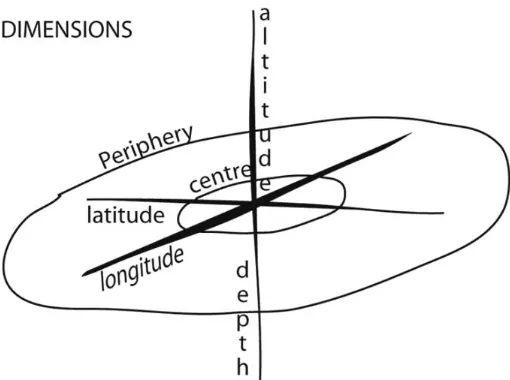
my definition of spatial dimensions (see Figure 1), where the horizontal perspectival field
is made up of longitudes on the front-to-rear axis of the perceived space, and latitudes in the sideways dimension;7 spectral verticality is the frequency-dependent upright
dimension, which has altitude, perceived as above the listener, and depth, below. The
4There are also traces of Smalley’s texture motion typology (1997: 115–18).
5Smalley defines spectral space as ‘the impression of space and spaciousness produced by the occupancy of,
and motion within, the range of audible frequencies’ (Smalley 2007: 56).
6Perspectival space is defined as ‘the relations of spatial position, movement and scale among
spectromorphologies, viewed from the listener’s vantage point’ (ibid.).
dimensions make up an inferred mental structure of distances, orientations and extension, established by relationships in the texture. Since the vertical dimension corresponds with spectrum, spatial motion and sonic shaping are never too far apart.
Spatial texture emerges due to the coexistence of multiple different temporally continual and spatially distributed processes. The cohesion of spatial texture is a result of proximities and similarities among its elements in terms of spectrum, morphology and temporal propagation. But simultaneously, the spatial complexity of such a texture is dependent on spectral and temporal differences across the sound canvas. As an easily comprehensible illustration of spatial texture in nature, one can think of cicadas chirping in a grove of trees. The sound of each insect is very similar, yet morphologically and rhythmically different enough to make itself known. Though the sound sources are stationary, the emergent8spatial pattern to which they contribute is full
of motion: the phasing rhythms of coinciding chirps create rippling spatial patterns projecting across the trees.9We may in addition hear spectral motion patterns when the
different spectra articulated by each cicada merge into a spatiotemporal sequence. Composed spatial textures are often structurally similar, in that much of the spatial motion emerges in the collective pattern rather than in trajectories of the parts.
I have elsewhere outlined models for lower-level structure in spatial texture – the contribution of sound types, their spatial distribution, and temporal propagation (Nyström, 2011, 2013, 2015). Of essence here will be the distinction between textons – time-finite micro-sounds which can articulate space in a relatively precise, pointillistic fashion – and filaments – continuous sounds (typically limited in spectral content) which build texture
8Di Scipio (2011: 101) describes emergence as a condition where ‘higher-level properties of a whole are brought forth and sustained by several interconnected lower-level components mutually affecting each other.’
9When spatially distributed similar sounds coincide temporally, they appear to bridge and narrow the spatial gaps in the texture. Since, in this example, the sounds are recurrent and glide in and out of coincidence, the resulting spatial patterns have a plasmic expanding and contracting quality. This is concurrent with Bregman’s
[image:8.612.73.328.77.267.2]finding that spectral and temporal factors override spatial cues in the grouping of sounds (Bregman 1990).
vertically rather than temporally. The elementary sounds influence the global percept of space by articulating gradients and regions on the sonic canvas.
6. ONTOLOGY OF MOTION IN SPATIAL TEXTURE
What is it that is moving? Spatial texture always exhibits a form of emergent motion. In the case of the cicadas, the texture motion of the whole grove is an ecosystemic and psychological phenomenon – the spatial patterns heard depend on the insects chirping in symphony and the spatial hearing psychophysiology of the listener. This motion cannot be traced to a single causal event or sound in motion but is a pattern of changing relationships. The relationships are differences among morphologies in stationary motion, a type of motion by which sounds do not relocate – they are anchored in a perspectival locality and have a spectral centroid – yet their pulsation contributes to a texture of motion.
Motion can also be inferred on an ecological basis. As D’Arcy Thompson suggested,
via morphology, taken as effect, we can deduce motion and force. When imagination of the motion of a potential sonic cause becomes prevalent in the listening experience, we hear cause-motion. This is a pre-sonic motion, an extrinsic image featuring a sequence of moving events which ostensibly could cause the heard sound – in the above example, it could be the physical, anatomic motion of the cicadas. Even when this motion is a knowingly fictional cause, the notion is enough to introduce external events into the possible imagery of the listener. Though pre-sonic events are not, morphologically speaking, motion in spatial texture, their presence in consciousness can supervene upon our sense of textural materiality and spatiality, not to mention the aesthetic experience as a whole: pure sonic motion and images of motion can blend into mental wholes. Cause-motion can therefore be relevant even if the music does not employ naturalistic sound material.
Sound which is in transportation through space manifests as a body-like entity in relation to our own: the awareness of our own relative position in the environment is
heightened. ‘Naturally’, this should be a form of cause-motion – a vehicle passing, for instance – but in music sounds may move as if they are entities, even if no specific source is implied.10I believe music listeners often fictionalise a cause for locomotion if they are
not certain. The defining aspect of locomotion is the percept of trajectory. In order for it to create spatial texture, its dynamics need to be expansive, busy and prolonged enough for
10In electroacoustic sound reproduction, the cause is obviously loudspeakers, which in most cases do not
the density of trajectories to form an auditory ball of yarn.
7. MOTION PRINCIPLES
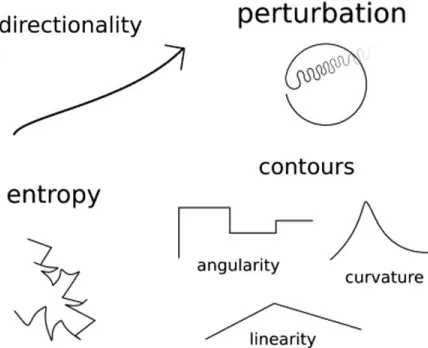
The central parameters which govern motion in spatial texture are directionality,
perturbation and contours (Figure 2). In addition, there are two factors of organisation:
entropy describes the degree of irregularity in any of the parameters, and integration relates to the spatial cohesion of the texture. Direction refers to the orientation of motion along the horizontal dimensions of latitude and longitude as well as spectral verticality. It can be manifest as independent trajectories among textons and filaments in the textural interior –
for instance, glissons (Roads 2001: 121–5) darting across the listening space – or as a global tendency affecting the texture as a whole – for instance, a spectrally ascending contour. Two types of horizontal trajectory are important: peripheral trajectory concerns motion that skirts the edges of the perspectival field, while transverse trajectories cross the field. Note that trajectories do not necessarily imply locomotion – as in sounds being panned to move in vectors – in my music, they are almost exclusively contours which emerge due to relative activity amongst sounds in different areas of perspectival space. This kind of emergent directionality is often a result of shifts in spectral and temporal density in texture. For instance, a texture which shifts in spectral density, from a noisy to a resonant spectrum, may appear to dilate towards the peripheries of space; in other words, an outward motion in peripheral magnitude. The factor of entropy influences the directionality in subversive ways. Textures do not often move coherently in any direction, but rather have sporadic, scattered, entropic orientations of motion.
Perturbation is a small micro-temporal variation in, for instance, spectrum or amplitude, which often enhances physicality in textures, and can suggest a degree of disturbance or restrained volatility. It is often present simultaneously as directional processes taking place over longer durations, as an alternating current. Entropy has a natural role here too, determining the degree of turbulence in the modulations. The ‘shape’ of motion is manifest as
contours which have a strong influence on both physicality and spatiality of texture.
[image:10.612.77.291.486.660.2]Linear motion is characterised by stability, in
that its path remains constant; a linear ascending motion, for example, does not increase or decrease its speed and can therefore seem to be freed from gravitational constraints. This suggests a physical condition of the space created by the music. On the contrary, curved
motion – either accelerating or decelerating – can suggest that a counterforce is present which is gradually overcome or, conversely, increases its constraints. Angular contours represent more abrupt changes in directionality, which may introduce a more mechanical or technological character to textures. Angularity can be a combination of linear trajectories. Note that spectral contours can have an effect on the perception of perspectival motion.
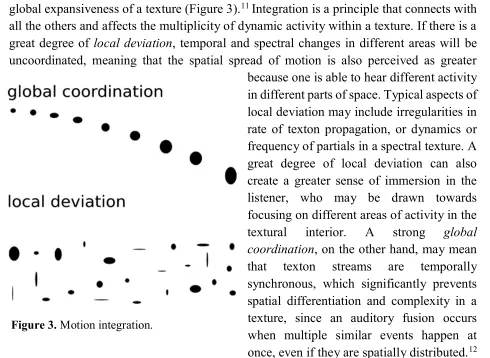
Variations in the degree of collective integration of local temporal and spectral features in motion, particularly perturbations, can have a powerful effect on the perceived global expansiveness of a texture (Figure 3).11Integration is a principle that connects with
all the others and affects the multiplicity of dynamic activity within a texture. If there is a great degree of local deviation, temporal and spectral changes in different areas will be uncoordinated, meaning that the spatial spread of motion is also perceived as greater because one is able to hear different activity in different parts of space. Typical aspects of local deviation may include irregularities in rate of texton propagation, or dynamics or frequency of partials in a spectral texture. A great degree of local deviation can also create a greater sense of immersion in the listener, who may be drawn towards focusing on different areas of activity in the textural interior. A strong global coordination, on the other hand, may mean that texton streams are temporally synchronous, which significantly prevents spatial differentiation and complexity in a texture, since an auditory fusion occurs when multiple similar events happen at once, even if they are spatially distributed.12
11Integration is also an important aspect of distributions in the low-level topology of spatial texture (Nyström
2015: 193).
[image:11.612.63.553.277.635.2]12The role of spectral and temporal factors in the segregation and integration of auditory information is an
This is more likely to give an impression that the motion is global, as if occurring on the textural exterior.
8. SPECIAL MOTION TYPES
The special motion types highlight particular states where motion becomes closely tied to a particular phenomenon, association, behaviour or materiality. They are not formal categories but, rather, discovered perceptual concepts of motion. The reader will notice that different types can apply to the same texture. Although reference is sometimes made to natural biological and physical phenomena, I want to stress that the concepts do not rely on naturalism or truthfulness in such associations. A reason for the emergence of these associations is that complex spatial textures, even in the most abstract and synthetic form, often conjure up force-like or surface-like properties, or establish plausibly environmental interactions and behaviours among sounds. Since the extrinsic associations originate in spatial motion, they are not literal but, rather, fleeting apparitions.
8.1. Phasic motion
The aforementioned cicada environment is an instance of phasic motion: the spatialised phasing relations among multiple temporal cycles in the texture cause a rippling spatial effect. In composed textures, the ripples can occur as a relation between rhythmic amplitude fluctuations amongst different partials, distributed differently in latitude or longitude, so that traces of spectral and perspectival motion trajectories appear although nothing in the texture is actually being displaced.
Sound example 1 (Nyström 2014b) illustrates perspectival ripples; the phasing among pulsations around circumspace creates an expanding and contracting dynamic. In sound example 2 (Nyström 2014c), spectral ripples in the resonances are distributed in the perspectival field in the full eight-channel version: higher strata are further to the rear and modulate faster.
8.2. Fractional motion
Fractured, inconsistent, or stepwise directional or reciprocal processes, which comprise a piecing together of parts, is termed fractional motion. A key characteristic is that streams within the texture, or the texture as a whole, leap between states in an abrupt, angular fashion. This motion type tends to draw attention to textural interior, due to being
oriented. A continuum may be drawn from patterned to statistical, describing the character of organisation within the process. Semi-patterned motion can be a combination of patterned and statistical, so that, for example, ordered figures recur unpredictably or a sporadic motion occurs statistically among fixed spectral states. A typical example may be texton streams with abrupt variations in speed, spectral altitude or pitch, and horizontal locality. A fractional field is established when angular, switching motion is flickering across the perspectival field.
Sound example 3 (Nyström 2014c) is an example of fractional motion: the streams of textons have patterns which alternate in spectral directionality and skip along a lattice. Sound example 4 (Nyström 2016) presents a more entropic instance of this motion type, where high frequency textons cut between different spectral regions. After 0′30′′ one can also hear descending steps along a fragmented glissando trajectory.
8.3. Signal motion
Zoned spaces, behavioural spaces13 and signal spaces14 present interesting aspects of
motion tied to the metaphor of communication. Signal motion may occur among several textures in a complex network of activity and is caused by the interrelation of activities in different zones, as if signals are sent from one place to another in a call-and-response type of communication. Such communication can happen not only in the perspectival field but also among spectral strata, as if the sound sources were elevated to different altitudes.
In sound example 5 (Nyström 2014c) signal motion is manifest in the spatial environment as a whole: bird-like sounds occur in zones on the sides, while the textonal chirpy and croaky sounds articulate a longitudinal path from the distal front towards more centred localities in circumspace.
8.4. Aggregate motion
Aggregate motion is a catch-all for flocks or clouds of textons and filaments, displaying
globally statistical tendencies of motion, such as those present in Xenakis’s stochastic
music and the cloud textures Curtis Roads deals with in Microsound (2001). The scale of
13‘A zone of perspectival space produced by the interaction of sounds which, spectromorphologically and texturally, indicate collaborative, group identity’ (Smalley 2007: 55).
motion here is distinctly different from, for example, fractional motion, where patterns are seen on a lower level.
Smalley’s flocking texture motion type – ‘the loose but collective motion of micro- or small object elements whose activity and changes in density need to be considered as a
whole’ (Smalley 1997: 117) – is an example of aggregate motion. Cloud motion can be imagined as a denser, noisier mass whose motion may imply the presence of pressure forces such as wind. Swarming aggregates may imply multiple erratic streams, together forming a more or less entropic mass of activity: the interior of the swarm may thus consist of morphologies in locomotion.15Streaming motion, another term from Smalley’s texture
motion types, is ‘a combination of moving layers, and implies some way of differentiating
between the layers, either through gaps in spectral space or because each layer does not have the same spectromorphological content’ (ibid.).
8.5. Commotion
Textural motion which appears unstructured and occurs among a disparate array of morphological material, I term commotion. What distinguishes commotion from other entropic motion scenarios, such as aggregate motion or turbulent flow motion, is the cacophonous clash of activity within a heterogenous group of events. Commotion
corresponds with Rudolf Arnheim’s definition of disorder, as ‘not the absence of all order but rather the clash of uncoordinated orders’ (Arnheim 1966: 125).
8.6. Flow motion
Fluidity has a source-bonded presence in many textures, but it also appears in the structures of motion. As described in physics, fluid dynamics involve relationships among
streamlines, the trajectories of flow in a fluid system. When flow is steady or laminar, these run in parallel, but when the speed of flow increases, they begin to curl back on themselves due to friction imposed by viscosity or obstacles, forming eddies, which can turn into vortices. This kind of turbulent flow is entropic – in states of high turbulence, vortical patterns may break up into more chaotic forms (Ball 2009b: 25–32). Flow dynamics do not only apply fluids but are relevant to most collective motion phenomena, such as animals in flocking or swarming motion, human crowds and traffic, pattern
15Scott Wilson (2008) has developed the Spatial Swarm Granulator as part of the BEASTMulch library in
formation among inorganic particles (e.g. ripples and dunes in desert sands, created by the flow motion of wind in combination with gravity), or gaseous or vaporous cloud formations shaped by flow currents.
In spatial texture it is the momentum suggested in the global coordination among sounds which cause flow motion. The spatial behaviour suggests a physical medium through which the music propagates. The impression of flowing sound is often conjured up in textures where multiple streams run in parallel or sinuously interlace, not unlike streamlines. As the temporal and spectral rates of change increase and become more erratic, texture can approach a more turbulent state of fluidity. Viscosity – resistance to flow –
might be a general measure of the ease with which the music flows in textural relationships. If viscosity is high, the texture moves in a slow, syrupy manner, suggesting weight and thickness. Low viscosity, on the contrary, is synonymous with speed and agility, imparting lightness and malleability to texture. Fluid dynamics suggest that there is no fixed background against which things are moving. Just as well as water eddies, then, the imagined context may be amorphous nebulae or galactic formations.
In sound example 6 (Nyström 2014c), the reference to liquidity is an example of cause-motion, but flow is also suggested in the motion contours. Descending streams of droplets in the higher altitudes have a low viscosity. There are textural layers in the lower areas which have a thicker and more swampy quality. The macro-texture gradually acquires impetus as the descending motion in the higher droplets seem to be sucked downwards by lower layers.
9. GROWTH AND MORPHOGENESIS
Imagine a texture which grows and then diminishes in size and mass. The overall spectrum is dilating as textons populate ever higher regions of spectral space; the density increases and, after culminating, leaves the textural interior to dissipate into a sparse void. Throughout, textons become more detailed and elongated, begin to group, and differentiate into divergent streams and figures. The homogenous, powdery mass chrystallises as if we are zooming in on the textural interior. Motion changes from being uniformly entropic towards more localised intermittent patterns. On all levels, a process of morphogenesis is taking place.16 The crescendo established over time becomes a spatial form in itself,
16The term morphogenesis was coined by mathematician Alan Turing, who theoretically demonstrated that
expanding and dissipating. The internal activity is multiplying as if life-forms or molecules are evolving from unicellular or atomic origins. The dynamics of spatial outlines, distances and vectors contribute to a morphological process as sound in constellation is affected.
Morphogenesis is the forming process that constitutes the production of spectromorphological events from textural process, as evolving contours of change become forms. My view is that it is a creative process that originates in the music itself, where we are witnessing a becoming. The morphology is not separate from the texture and it is not a thing that exists outside the music, it is moulded as we hear it. Morphogenesis is part of an aesthetic attitude which can be manifest in any number of ways. Thus, literal sound structures aside, the key feature of this attitude is that forms emerge from a textural process which behaves as if it is self-propagating: there is a sense that new material is born from the amorphous flux. I have identified four types of growth process. Boundary growth is a peripheral expansion of texture, meaning that, for instance, the highest spectral regions are ascending while other parts remain, or that the perspectival peripheries appear to dilate outwards. These processes may suggest that a force is inflating the texture in a balloon-like fashion. Densification processes pack the insides of the texture together and can cause it to solidify into a macro-morphology. Sound example 7 (Nyström 2014c) illustrates this.
Branching processes can induce morphogenesis in textural interior, where activity is furcating spectrally into streams like blood vessels. Crystallisation is the process where textons group into figures or are gradually elongated, so that an iterative morphogenesis is taking place. Sound example 8 (Nyström 2014a) is an example of morphogenesis occurring through boundary growth: a smooth noise-based texture rises above the entropic texture in the lower-mid spectral region, expands laterally and spectrally – as if blown up – and then recedes in a deflation.
10. DEFORMOTION AND TRANSFORMOTION
supervenes on materiality, suggesting – or compromising expectations of – physical properties through a warping process.
If motion has a more profound effect on perceived spatial and material properties of texture, a transformation may occur. In concurrence with motion, the spatiality and materiality of the texture is changing to such a degree that a transition takes place.
Transformotion refers to such situations where motion causes or affords transformation –
motion drives texture into a new phase which is of essentially different nature. This is a rarer type of forming process because it is difficult to achieve. It is most likely occurring due to the convergence of several textures which transform together. In my work, a dominating spectral contour often runs through the transformotion process; for instance,
an ascending contour ‘lifting’ the music onto a different plane – the arrival affords an introduction of new textural material and new spatial configurations, but the process seems to be internal to the musical ecosystem as a whole, rather than caused by a single gesture.
In sound example 9 (Nystrom 2014b) a glissando yields transformotion.
11. LISTENER IN MOTION: (DIS)EMBODIED IMAGINATION
Recalling Johnson’s experiential concepts of motion, we can explore how the different
texture motion principles, types and schemas correspond with these. Factors that come into play relate to implications of size, weight and force. For instance, transverse trajectories and locomotive textures would fall into the first class – listeners experiencing objects moving. Boundary growth processes on the other hand may result in an experience of being carried by forces. For instance, dilation of spatial peripheries may give us an impression of our normally solid physical reference frame turning elastic, its forces affecting our own stability; contractions or deflations can conjure a sensation of the listener being siphoned into a different space. The different states of flow motion can also apply to movement by force, as if listeners were floating in a torrent of sound. The complex alternating patterns among zones in signal motion could inspire the listener to explore different areas of the space, either physically – if they are able to move in the auditorium – or mentally, through focal attention to different parts of the sound environment.
Thus, an embodied mode of listening imagination can be stimulated by the music.
From a composer’s point of view this requires consciousness of spectral verticality but also
to something far larger than themselves. Thus, spectral verticality connects with the verticality imposed on us by gravity on earth: what is below us is more likely to move us, since we rest on it, whereas airborne motion does not affect our stability significantly, except in extraordinary circumstances. If different such texture-listener relationships are combined in composition, a moving spatial counterpoint emerges, where large and small, listener and environment, and figure and ground are all in orbital tension with one another
– where listeners may also feel themselves deformed, enlarged or shrunk. What begins as an understanding based on embodied reality engenders a disembodiment to the physics of a virtual world which has no fixed points, where all elements are continually contributing to the redefining of an emerging spatial context. Spaces, substances and listener become nodes in an elastic topology of sound.
12. TERMODYNAMIC WORDS
If first we acknowledge that spatial texture is not an object but a morphology of the amorphous, we can explore how it is engaged in a creative process by its very mode of existence. Sounds give rise to spatial texture, as motion occurs on different planes (emergent motion, stationary motion, cause motion, locomotion): sounds create motion, which creates a texture of space. The texture of space acquires materiality because its motion suggests physical properties. It deforms, transforms, creates forms. It is intangible, yet physical. It has no source, but keeps propagating. The listener is suspended in a spatial plasm.
More can, and will, be said about the synthesis of spatial texture. But it is good to have drawn out the aesthetic dimensions first. There is a certain causal transparency in spatial texture, because we perceive both the whole and the parts, yet the origin is nothing but spatial relations and vectors. A topology of structural principles, perceptual concepts and morphological processes has been outlined in shades. The luminous figures enter with the listener, the aesthetic work and the creative artist.
REFERENCES
Arnheim, R. 1966. Order and Complexity in Landscape Design. In Toward a Psychology of Art. Berkeley: University of California.
Ball, P. 2009a. Shapes. Oxford: Oxford University Press.
Ball, P. 2009b. Flow. Oxford: Oxford University Press.
Composition. Organised Sound 16(1): 5–13.
Bregman, A. S. 1990. Auditory Scene Analysis. Cambridge, MA: MIT.
Chion, M. 2009. Guide to Sound Objects. Pierre Schaeffer and Musical Research, trans. J. Dack and C. North. Electro-Acoustic Resource Site (EARS). www.ears.dmu.ac.uk.
Dack, J. 2008. Excentric Sounds/Balanced Sounds and the Sublime. Proceedings of Electroacoustic Music Network Conference. Paris, 3–7 June.
Di Scipio, A. 2011. Listening to Yourself through the Otherself: On Background Noise Study and other works. Organised Sound 16(2): 97–108.
Hagan, K. L. 2017. Textural Composition: Aesthetics, Techniques, and Spatialization for High-Density Loudspeaker Arrays. Computer Music Journal 41(1): 34–45.
Johnson, M. 2007. The Meaning of the Body: Aesthetics of Human Understanding. Chicago: University of Chicago.
Klatzky, R. L. and Lederman, S. J. 2010. Multisensory Texture Perception. In M. J. Naumer and J. Kaiser (eds.) Multisensory Object Perception in the Primate Brain. New York: Springer.
Mandelbrot, B. B. 1983. The Fractal Geometry of Nature. New York: W. H. Freeman.
Nyström, E. 2011. Textons and the Propagation of Space in Acousmatic Music. Organised Sound 16(1): 14–26.
Nyström, E. 2013. Topology of Spatial Texture in the Acousmatic Medium. PhD thesis, City University, London.
Nyström, E. 2015. Low-Level Topology of Spatial Texture. Proceedings of the International Computer Music Conference. Denton, TX: CEMI, ICMA.
Roads, C. 2001. Microsound. Cambridge, MA: MIT.
Smalley, D. 1997. Spectromorphology: Explaining Sound Shapes. Organised Sound 2(2): 107–
26.
Smalley, D. 2007. Space-Form and the Acousmatic Image. Organised Sound 12(2): 35–58.
Wilson, S. 2008. Spatial Swarm Granulation. Proceedings of 2008 International Computer Music Conference. Belfast: SARC, ICMA.
Wishart, T. 1996. On Sonic Art. London: Routledge.
Xenakis, I. 1992. Formalized Music. New York: Pendragon Press.
DISCOGRAPHY
Nyström, E. 2014a. Catabolisms (2011–12). On Morphogenèse. Montreal: Empreintes Digitales, IMED-14129-CD.
Nyström, E. 2014b. Cataract (2010). On Morphogenèse. Montreal: Empreintes Digitales, IMED-14129-CD.
Nyström, E. 2014c. Lucent Voids (2012). On Morphogenèse. Montreal: Empreintes Digitales, IMED-14129-CD.