MANAGEMENT
ACKNOWLEDGMENTS
Thanks to these important contributors.
The Marriott School at Brigham Young University for providing many of the resources needed to create this open textbook.
The Friends of the Harold B. Lee Library and Jennifer Paustenbaugh, University Librarian, at Brigham Young University, for generously supporting our efforts from start to finish.
Dr. William Baker for being a role model and inspiration for so many of us. Our students, who light up the world as they enter to learn and go forth to serve.
Producing this open textbook was a group effort.
Lisa Thomas (Lead author and project manager)
Julie Haupt, Andy Spackman, Karmel Newell, Kurt Sandholtz, Melissa Wallentine, Liz Dixon, Crickett Willardsen, Sue Bergin, Mariana Richardson (Writers and contributors)
Linda Christensen, Valene Middleton, Leslie Kawai, Scott Taylor, Lara Burton, Duane Miller, Kacy Faulconer, Ryan Starks, Warren Brunson, Shayne Clarke, Rick Murdock, Ross Storey (Reviewers, editors, cheerleaders)
Clarissa Oliphant (Slide design genius), Mallory Reese (Research assistant extraordinaire)
Want to use this resource?
You can use this online textbook freely as long as you follow our Creative Commons license to attribute the original source. You can also subscribe to our learning activities, assignment prompts, and testing materials for a small fee.
If you’re interested in adopting this curriculum or learning about our textbook creation process, please get in touch! Email us at [email protected].
Kurt Sandholtz, Director Lisa Thomas, Assistant Director The Management Communications Group Marriott School Of Business, Brigham Young University
Last updated 08 Dec 2017
This work is licensed under a
CONTENTS
2
WRITE
Look Good in Print1
WHY
Be a Skilled Communicator?
3
PLAN
Think Before You Write4
ORGANIZE
Structure Matters5
BUILD
Create Clarity & Coherence6
RESEARCH
Find the Answers7
FORMAT
Make Your Message Inviting9
MANAGE
Getting Things Done…With People8
REVISE
Zoom Out – Zoom In10
PERSUADE
Be Convincing11
SHOW
Show What You Mean12
PRESENT
Stand & DeliverCHAPTER
2
This work is licensed under a
Creative Commons Attribute and ShareAlike 4.0 International License.
LINK & LEARN
Examples Required
Reading OptionalTips & Activity
4
WRITE FOR BUSINESS
7
BE A TOP HIRE
9
BECOME A LEADER
10
STAY CONNECTED
CONTENTS
This is Chapter 1
This work is licensed under a
Creative Commons Attribute and ShareAlike 4.0 International License.
Attribute the original source at mcom320.net. Email
3
of our time communicating.
70
%
We spend approximately
HOW DO YOU SPEND YOUR WAKING HOURS?
@
This will be one of the most useful courses you’ll take in college.
Writing and communicating well matters. In this course, you’ll learn how to communicate your
best
ideas
to your most
important audiences
.
•
WRITE FOR BUSINESS
. Clear and concise writing gets noticed and leads to action.
•
BE A TOP HIRE
. Demonstrated communication skills improve your job prospects.
•
BECOME A LEADER
. Effective communication skills help you lead.
•
STAY CONNECTED
. Appropriate communication helps you stay connected in your networks
and relationships.
Get ready to explore ways to manage projects and people, design great-looking documents, and
present your ideas clearly and confidently.
4
Communication is the heart of business. Short emails,
complex reports, private chats, impassioned pitches,
formal presentations, and team meetings move
information and ideas around an organization, define
strategy, and drive decisions.
Business communication is concise, direct, clear, and
compelling.
SECTION ONE
WRITE FOR
BUSINESS
Management Communication “was
one of the toughest classes of my
undergrad, but I learned lessons I use
every day in business.”
James Clarke
5
BEFORE
Timely preparation, including structural and non-structural mitigation measures to avoid the impacts of severe winter weather, can avert heavy personal, business and
government expenditures. Experts agree that the
following measures can be effective in dealing with the challenges of severe winter weather.
AFTER
Severe winter weather can be extremely dangerous. Consider these safety tips to protect your property and yourself.
WRITE TO BE UNDERSTOOD
“A sentence should contain no unnecessary words, a
paragraph no unnecessary sentences, for the same reason
that a drawing should have no unnecessary lines and a
machine no unnecessary parts.”
Clear and Concise Writing
All writing styles, including business writing, can be written clearly without losing meaning. Plain language is a term used
to describe writing that is clear and concise. Many businesses and governments are revising traditionally dense,
hard-to-understand text using plain-language principles. Below is an example from PlainLanguage.gov.
FEMA’s Winter Preparedness Safety Tips
6
Your audience dictates your business writing style. Keep
the following points in mind when composing:
•
Your audience is
busy
. Busy (and business) readers
want concise, no-nonsense information.
•
Your audience is
analytical
. Readers want solid
evidence and transparency.
•
Your audience is increasingly
international
. Even
though English is the global language of business,
avoid language that could create misunderstandings
or confusion for non-native English speakers.
•
Your audience is
decisive
. Business communication
often leads to decisions. Provide well-reasoned
recommendations.
•
Decision makers are
critical
of time wasters.
Business moves quickly, so give only pertinent
information. Make that information reliable and
easy to access.
THE BUSINESS AUDIENCE
BUSY
ANALYTICAL
INTERNATIONAL
DECISIVE
7
Employers are hungry for people with communication
and leadership skills. Job market research firm
Burning Glass
reports
, “Writing, communication skills,
and organizational skills are scarce everywhere.
These skills are in demand across nearly every
occupation—and in nearly every occupation they’re
being requested far more than you’d expect based on
standard job profiles.”
SECTION TWO
BE A
TOP HIRE
“The majority of business
communication today happens through
email and social platforms, so I’m ever
grateful for the critical business writing
foundation that I gained through
[Management Communication].
I would recommend it to anyone.”
Eric Farr
Principal at BrainStorm
8
Employers are eager to hire good writers because clear
writing demonstrates clear thinking. Read about bad
business writing in this
Harvard Business Review
article:
Bad Writing is Destroying Your Company’s Productivity
.
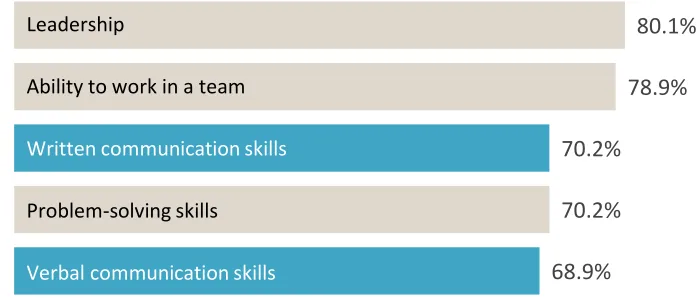
A 2016 survey reveals that written and verbal
communication skills are in the top five attributes
employers are looking for when hiring new college
graduates (see Figure 1.1).
HIRE THE BEST WRITER
LEADERSHIP
ABILITY TO WORK IN A TEAMWRITING SKILLS
PROBLEM-SOLVING SKILLS
VERBAL COMMUNICATION
68.9% 70.2% 70.2%
78.9% 80.1%
Leadership
Ability to work in a team
Written communication skills
Problem-solving skills
Verbal communication skills
EMPLOYERS WANT GOOD COMMUNICATORS
Top five responses employers gave when asked what attributes they look for when hiring new college graduates.
“If you are trying to decide among a few people to fill a position,
hire the best writer
. . . . Clear writing is a sign of clear thinking. Great writers know how
to communicate. They make things easy to understand. They can put themselves in
someone else's shoes. They know what to omit. And those are qualities you want in
any candidate. Writing is making a comeback all over our society...Writing is today's
currency for good ideas.”
Jason Fried
[image:11.792.402.751.197.346.2]Founder of Basecamp, Author of ReWork
9
You become a leader by using your communication skills to
learn from people, coordinate their efforts, share
knowledge, communicate high standards, and inspire.
In their book, The Extraordinary Leader, researchers
Zenger and Folkman report that communicating
“powerfully and prolifically” enhances leadership
competencies, including even seemingly unrelated ones
like technical competence or strategic development.
Powerful communication is a skill—and a habit—that
enhances all other skills.
In your other classes, you’ll spend long hours deepening
your technical knowledge in your chosen field. However, if
you leave college unable to pitch a new idea to your team,
persuade an investor, or clarify data for a client, your
influence will be blunted and much of your effort wasted.
Hone your communication skills and you will be able to
powerfully contribute solutions to your workplace and
enhance your own career.
SECTION THREE
BECOME
A LEADER
“Power comes not from knowledge
kept but from knowledge shared.”
10
SECTION FOUR
STAY
CONNECTED
You can use these skills in
every area of your life…
RELATIONSHIPS You look upset. Want to talk about it?
NEIGHBORHOOD Empty lot cleanup party this Saturday at 10 a.m. Bring a rake. Donuts provided!
COLLEAGUES Does everyone understand the new reporting policy?
CITY The new bond is an essential
tool for improving our transit system for the following three reasons . . .
Human connection is valuable to health, safety, peace, and success. We spend
the majority of our waking time in communication activities, driven to
connect—and stay connected—with other people.
Part of good business communication involves understanding another’s point of
view, delivering bad news clearly but diplomatically, maintaining trust through
ethical and honest messaging, and using language to encourage and motivate a
team.
11
IN CONCLUSION
By practicing concise and direct communication, you’ll become more effective in business, a more
sought-after hire, a more influential leader, and a more connected human being.
12 Bennett, Jeanette. “10 Coolest Entrepreneurs: James Clarke.” Utah
Valley 360, December 11, 2015.
http://utahvalley360.com/2015/12/11/coolest-entrepreneurs-james-clarke/, accessed February 2017.
Bernoff, Josh. “Bad Writing Is Destroying Your Company’s Productivity.” Harvard Business Review, September 6, 2016.
https://hbr.org/2016/09/bad-writing-is-destroying-your-companys-productivity, accessed February 2017.
Burning Glass Technologies. “The Human Factor” (PDF file). November 2015.
http://burning-glass.com/wp-content/uploads/Human_Factor_Baseline_Skills_FINAL.pdf, accessed February 2017.
Wiens, Kyle. “I Won’t Hire People Who Use Poor Grammar. Here’s Why.” Harvard Business Review, July 20, 2012.
https://hbr.org/2012/07/i-wont-hire-people-who-use-poo, accessed February 2017.
Davidson, Kate. “Employers Find ‘Soft Skills’ Like Critical Thinking in Short Supply.” The Wall Street Journal, August 30, 2016.
https://www.wsj.com/articles/employers-find-soft-skills-like-critical-thinking-in-short-supply-1472549400, accessed February 2017.
Fox, Tom. “Dealing with conflict in the workplace.” The Washington Post, May 21, 2015. https://www.washingtonpost.com/news/on-
leadership/wp/2015/05/21/dealing-with-conflict-in-the-workplace/?utm_term=.b1c8cc3c6d24, accessed February 2017.
Friedman, Esther M. et al. "Social strain and cortisol regulation in midlife in the US." Social Science & Medicine 74, no. 4 (2012): 607-15. http://dx.doi.org/10.1016/j.socscimed.2011.11.003, accessed February 2017.
Gates, Bill. “Bill Gates New Rules.” Time, April 19, 1999.
http://content.time.com/time/world/article/0,8599,2053895,00.ht ml, accessed February 2017.
Harris, Lynda. “The Cost of Bad Writing.” NA Business + Management 29, no. 8 (2015): 15, accessed February 2017.
Hartung, Kyle John, and Daniel Gray Wilson. “Conversational Moves That Matter.” Adult Education Quarterly 66, no. 3 (2016): 254-272, accessed February 2017.
LEARN MORE
ARTICLES
(B old cit at ions are referenced in t he cha pt er text .)Loranger, Hoa. “Plain Language is for Everyone, Even Experts.” Nielsen Norman Group. October 8, 2017.
https://www.nngroup.com/articles/plain-language-experts/, accessed October 2017.
NACE. “Job Outlook 2016.” November 18, 2015.
13
LEARN MORE
BOOKS
(B
old
cit
at
ions
are
referenced
in t
he
cha
pt
er
text
.)
LEARN MORE
Plain Language: Improving Communications from the Federal Government to the Public. May 2011. Accessed June 23, 2017. http://www.plainlanguage.gov/index.cfm.
Stewart, Bri. “10 Coolest Entrepreneurs: Eric Farr.” Utah Valley 360, December 11, 2015.
http://utahvalley360.com/2015/12/11/coolest-entrepreneur-eric-farr/, accessed February 2017.
White, Myron L. “How Badly Does Management Want Good Business Writing?” Journal of Business Communication 3, no. 2 (1966): 15-16, accessed February 2017.
Fried, Jason, and David Heinemeier Hansson. Rework. New York, NY: Crown Business, 2010.
Garber, Peter R. 50 Communications Activities, Icebreakers, and Exercises. (Amherst: HRD Press, Inc., 2008.) PDF e-book.
https://www2.cortland.edu/dotAsset/c1a635f6-a099-4ede-8f15-79b86e315088.pdf, accessed February 2017.
Strunk, William, and E. B. White. 2000. The Elements of Style. New York: Longman.
L O O K G O O D I N P R I N T
CHAPTER
2
2
Look Good in Print
When you write for business, write correctly. Simple mistakes can embarrass you and cost your company real money. As evidence, read this New York Times article about the million-dollar comma: Lack of an Oxford Comma Could Cost Millions
In Chapter 2 we’ll touch briefly on 22 fundamentals of good writing. We selected these by counting and categorizing the most common mistakes in a large sample of student papers. In other words, our approach is neither comprehensive nor random, but pragmatic. We want to help you avoid the most common pitfalls.
Grammar Rules. Some of the fundamentals are grammatical, reflecting the rules that govern how sentences are constructed in the English language. These rules have fairly definitive right and wrong answers (although grammar rules do evolve; witness the recent acceptance of the singular “they”by some media outlets).
Style Guidelines. Other fundamentals relate to style: preferred constructions that, while not based on grammar rules, represent recommended practice. Many organizations have their own style guides listing particular do’s and don’ts.
Always follow your employer’s style guide (if available). For purposes of this course, consider sections 2A – 2C your basic in-class style guide. You
are responsible for learning and applying the 22 fundamentals contained in these three chapters.
REMEMBER:
Throughout this text, any link marked with the blue eyeball icon is required reading. You may be tested on the content.
TIP: Each of the 22 fundamentals will be identified as either a grammar rule or style guideline. We don’t expect you to memorize which are which; we simply include this information for those who are curious.
3
Let’s get started . . .
Click on each of these titles to read the content and watch the supporting videos.
Proceed to online resources if you need further clarification and practice.
Remember, applying these fundamentals is now your responsibility.
Need quick access? Remember this link:
bit.ly/
mcom320fundamentals
2A Syntax and Word Choice
Fundamentals
1 - 9
2B Punctuation Plus
Fundamentals
10 - 16
Suggestions?
Click HERE
IN CONCLUSION
If you were blessed with an amazing English teacher, this content may come easily. If you weren’t that lucky, you’ll have to work harder.
This may be your last chance to learn to produce strong, clear writing without errors. We’ve done our best to make it relatively painless.
You’re welcome!
This work is licensed under a
Creative Commons Attribute and ShareAlike 4.0 International License.
Attribute the original source at mcom320.net. Email
CHAPTER
P L A N
T H I N K B E F O R E Y O U W R I T E
2
LINK & LEARN
Examples
Required
Reading OptionalTips & Activity
This work is licensed under a
Creative Commons Attribute and ShareAlike 4.0 International License.
4
PURPOSE
6
AUDIENCE
9
STRATEGY
12
STRUCTURE
CONTENTS
This is Chapter 3
This work is licensed under a
Creative Commons Attribute and ShareAlike 4.0 International License.
Attribute the original source at mcom320.net. Email
3
Without a plan, writing can be frustrating.
You’ve experienced the desperate boredom of listening to a rambling presentation and
the frustration of reading a confusing email that never makes a clear point. Even if you
have a short message or are rushed, save your audience’s time by planning your message
well before delivering it.
To plan a message, follow the steps in the acronym
PASS
:
1. Define your
PURPOSE
2. Consider your
AUDIENCE
3. Develop a
STRATEGY
4
Clearly define your purpose before you start writing. Decide what you want
your audience to know, feel, and do after reading your message.
ASK PURPOSE-DEFINING QUESTIONS
Your employees have not been accurately documenting company expenses.
As a result, your company is losing money. You want to address this issue.
Before you compose an email to them, answer the following questions:
What INFORMATION do I want to share?
I want the employees to understand the new protocol for
submitting invoices.
What FEELING do I want to convey?
I want to encourage employees to be more conscientious
about how they spend the company’s money.
What ACTION do I want to occur?
I want employees to submit invoices that include a detailed
explanation of project expenses.
.
INF
O
RMATI
O
N?
FEELIN
G?
ACTI
O
N?
SECTION ONE
5
In
Writing Well for Business Success,
Sandra Lamb encourages business writers
to define their purpose by composing a
message statement
. “Think through
what you want to communicate until you can concisely state your complete
message in a single sentence—a message statement. The simpler and shorter,
the better.” Condensing your thoughts into one short sentence will clarify your
purpose. For example,
COMPOSE A MESSAGE STATEMENT
“Think through what you
want to communicate
until you can concisely
state your complete
message
in a single
sentence
.”
Sandra Lamb, author
Writing Well for Business
3.1
In this memo I want to explain to
everyone what is meant by casual
dress, especially shorts, collarless
shirts, and business dress, as
opposed to business casual. I will
talk about the new company
policy regarding the dress code, to
see what people think and try to
get them to follow it.
YES
NO
I want to explain our company’s
new “business casual” dress code
and get employees to comply with
it.
6
Who will be reading your message? Always write with your audience in mind. Ask
yourself the following questions before you write:
KNOW.
What does my audience already know about my subject? How will I make
my message interesting and relevant to them? Do they know my qualifications?
FEEL.
Will my audience have positive, negative, or neutral feelings about my
message? How should I address those feelings?
DO.
What action should my audience take based on my message? How will I
motivate them to take that action?
INF
O
RMATI
O
N?
FEELIN
G?
ACTI
O
N?
SECTION TWO
AUDIENCE
KNOW
FEEL
7
INTERNATIONAL AUDIENCES
When doing business with people from another country,
research their expectations for business behavior and
communication.
Choose a country and learn something about its
cultural business expectations
•
Quick Guide to Going Global
•
ProQuest CultureGrams
•
Global Road Warrior
MAKE IT RELEVANT
Everyone has time and resource constraints, so your first
goal should be to help your audience see why your
message matters to them. In Business Writing, Natalie
Canavor explains, “There is one universal to count on:
self-interest. We react to things and make decisions based on
‘what’s in it for me.’
”
PICTURE YOUR AUDIENCE
Try creating a mental picture of your audience before you
write. When world-famous investor Warren Buffett
composes Berkshire Hathaway’s annual report, he writes
with his sisters in mind. Doing so helps him to avoid jargon
because he writes as if he were talking to them and tries to
explain concepts in terms they can understand. He informs
by using plain English. If, however, he were sharing the
same information with one of his colleagues, his approach
would reflect their shared knowledge.
JAPAN
Never use your chopsticks to point during a meal.
RUSSIA
Avoid raising your voice—it’s a sign of
weakness.
MIDDLE EAST
Don’t put your feet up; showing the soles of your feet is
disrespectful.
Note: To access some of these databases you may need to sign into your library account first.
3.2
8
TEST YOUR MESSAGE
What might be obvious to you because of your
background, education, and training might not be obvious
to your audience. Harvard professor Steven Pinker refers
to this phenomenon as "The Curse of Knowledge." Does
your audience understand the terms you are using? Can
they make the connections you are making? Don’t
oversimplify. Supply information at your audience’s level
of knowledge and experience. Test your message by
having someone read it who has a similar background to
your audience.
CONSIDER PRIVACY AND SECURITY
ISSUES
Consider a possible secondary audience. Even if you think
your document is electronically secure, write your email as
if your conversation is not private. Hackers uncovered
secure emails of Sony executives that revealed a general
lack of professionalism from the executives. This hurt the
professional image of a respected global company.
Compose your emails with the widest possible readership
in mind, and remember that written words can easily
go viral.
Be aware that
ANYONE
might read your
business emails. Plan
carefully
and write
consciously
.
9
Never underestimate the power of emotion in the decision-making process.
More than 2,000 years ago, Aristotle
introduced three rhetorical strategies that are still relevant today: ethos, logos, and pathos.
Research increasingly
demonstrates that our emotions are pre-cognitive. In other words,
the way we feel
often precedes and influences
how we
process facts
.
SECTION THREE
STRATEGY
Rhetorical
ETHOS
R
Strategies
Credibility, trust.
Part of being credible is knowing the facts. We’ll explore the importance of
research and evidence in Chapter 6.
LOGOS
Logic, reason, proof.
Decision makers tend to be analytical thinkers who prize logical arguments supported
by data. We’ll cover developing arguments in
Chapter 10.
PATHOS
Emotion, values.
Emotional appeal doesn’t necessarily mean an argument
devoid of facts and logic. Remember, the first step in planning is to think through what you want the audience
10
HOW, WHAT, WHY, WHEN, AND WHERE
Choose the communication channel that best supports your content and most appeals to your
audience.
Would a paper document, an electronic message, or an in-person conversation be best?
Different communication methods involve different costs; speeds of delivery; and verbal,
non-written cues (such as voice inflection and body language).
For example, face-to-face dialogue enables richness of both verbal and non-verbal communication,
but such conversations do not have the permanence of written documents. While emails can be
efficient, they do not have the personal touch of a handwritten note or the urgency of a text
message. A formal report might package information better than a long email.
All such factors play into your choice of channel. The impact of one communication channel over
another can determine whether your message is received in the way you intended.
HOW
WHY
Note the preferred communication channels of your key business contacts. Does your boss ignore emails but respond to texts?
Message people where they are paying attention.
Emphasize why the audience needs to read your message
. You have seconds to capture your
audience’s attention before another message or task distracts them. This is true in communication
to senior executives, in marketing to new consumer audiences, and in situations with skeptical or
unfamiliar audiences. Make your message relevant and let readers know why they should keep
reading.
11
HOW, WHAT, WHY, WHEN, AND WHERE
When formulating a strategy,
be aware of the context
. What professional pressures weigh upon
your audience—both from within and without their organization? What industry-wide problems
affect them? What personal biases might influence them at the moment? What internal or external
factors may shape the way your message is received? Context for a message is like the weather for
an event; it affects everything and can’t be ignored.
Deliberately
pace the delivery
of your content. What time of day should you send that email or
hand-deliver that report? Readers appreciate directness, so introduce vital information right away
instead of slowly winding up to it. Keep your tone upbeat and friendly to avoid being seen as abrupt.
Deliver delicate, disappointing, or disturbing news with more context and less directness. We’ll cover
strategies for delivering bad news in CH 10: PERSUADE.
Most of all, remember to
be concise
. If you take too much time to explain or deliver your message,
the audience will likely move on to another more pressing matter or communication.
WHAT
& WHERE
WHEN
12
The human brain is wired to look for order, patterns, and
structure—chaotic and poorly structured messages quickly
lose a reader’s respect and interest. Make that brain
preference work for you by
building clear frameworks
into
your writing.
The next chapter (CH 4: ORGANIZE) will explore this process
in detail.
SECTION FOUR
13
IN CONCLUSION
The steps require work, but the process is worth it. Being aware of
PURPOSE
,
AUDIENCE
,
STRATEGY
, and
STRUCTURE
as you plan your work will turn potentially mushy, untidy, and costly
messages into sharp and effective ones.
14
Buffett, Warren. “Preface.” In A Plain English Handbook: How to Create Clear SEC Disclosure Documents. Office of Investor Education and Assistance. Washington, DC: US Securities and Exchange Commission, 1998.
https://www.sec.gov/pdf/handbook.pdf, accessed February 2017.
Bradley, Diana. “Lessons from Sony Hack: Be Careful What You Email.” PR Week, December 19, 2014.
lhttp://www.prweek.com/article/1327386/lesson-sony-hack-careful-emai, accessed February 2017.
Ellering, Nathan. “What 10 Studies Say About The Best Time To Send Email.” CoSchedule Blog, CoSchedule.com, March 23, 2016. http://coschedule.com/blog/best-time-to-send-email/, accessed February 2017.
Lerner, Jennifer S. et al. “Emotion and Decision Making.” Annual Review of Psychology 66 (2015): 799-823.
http://www.annualreviews.org.erl.lib.byu.edu/doi/pdf/10.114 6/annurev-psych-010213-115043, accessed February 2017.
Sleek, Scott. “The Curse of Knowledge: Pinker Describes a Key Cause of Bad Writing.” Observer 28, no. 6, (2015).
https://www.psychologicalscience.org/observer/the-curse-of-
knowledge-pinker-describes-a-key-cause-of-bad-writing#.WJVjwrYrLq0, accessed February 2017.
Canavor, Natalie. Business Writing in the Digital Age. Los Angeles, CA: Sage Publications, 2012.
Garner, Bryan A. HBR Guide to Better Business Writing. Boston, MA: Harvard Business School Publishing, 2012.
Gladwell, Malcom. David and Goliath: Underdogs, Misfits, and the
Art of Battling Giants. New York, NY: Little, Brown and Company,
2013.
Lamb, Sandra E. Writing Well for Business Success. New York, NY: St. Martin’s, 2015.
Pinker, Steven. The Sense of Style: The Thinking Person’s Guide to
Writing in the 21st Century. New York, NY: Penguin Books, 2014.
LEARN MORE
ARTICLES
15
Roman, Kenneth, and Joel Raphaelson. Writing That Works; How to
Communicate Effectively In Business. New York, NY:
HarperCollins, 2000.
Berkshire Hathaway. “Annual and Interim Reports.”
http://www.berkshirehathaway.com/reports.html, accessed February 2017.
LEARN MORE
(Bold citations are referenced in the chapter text.)
LEARN MORE
CHAPTER
ORGANIZE
S T R U C T U R E M A T T E R S
2
LINK & LEARN
Examples
Required
Reading OptionalTips & Activity
This work is licensed under a
Creative Commons Attribute and ShareAlike 4.0 International License.
4
ORGANIZE INFORMATION
6
OUTLINE
13
USE 4A STRUCTURE
CONTENTS
This is Chapter 4
This work is licensed under a
Creative Commons Attribute and ShareAlike 4.0 International License.
Attribute the original source at mcom320.net. Email
We don’t like chaos.
Have you ever been frustrated while searching for something important in your junk drawer, in piles of paper on your desk,
or in unlabeled boxes in the basement?
Chaos can make us uncomfortable not only in our physical surroundings, but also in our communications. Communicating
works better when we follow a few basic organizing principles so that our
audience knows what to expect
.
HOURS
GET ORGANIZED
Cottrill Research FIGURE 4.1
1.8
The amount of time
an average office
employee spends
searching for
information per day.
This chapter will introduce you to the following:
•
The importance of
organizing
your written and oral
communication.
•
A few helpful ways to impose structure by using an
outline
.
•
An organizing template that can be applied to nearly all
business communications:
the 4A structure
.
4
In business communication, a jumbled stream of
thoughts—in a voicemail, a report to your boss, or an
email to a supplier—carries a meta-message that you’re
incompetent. Beyond limiting your career prospects,
rambling messages can also cost your company clients or
tarnish its image, resulting in direct financial losses.
SECTION ONE
ORGANIZE
INFORMATION
Thoughtless &
Unprepared
Smart &
Capable
5
STRUCTURE FOR CLARITY
Powerful communication requires organization. Chapter 3
introduced the
PASS
acronym:
In Chapter 3, we explored writing with a purpose, writing for
an audience, and choosing a strategy. In this chapter we focus
on creating a message
structure
.
An unorganized message causes your reader to waste time
trying to understand it.
The work of organizing begins long before you start putting
any words on a page, screen, or slide. Like building a house,
constructing a message begins with putting up the frame—
creating the bare bones structure and then finishing the
detailing after.
Framing a message is called
outlining
.
Organized i
nformation
is understood more quickly and
remembered
UP TO
BETTER.
40%
Identify the PURPOSE
Know the AUDIENCE
Choose the STRATEGY
Create a STRUCTURE
6
Digital word processing has enabled us to spew words onto the screen and then
rearrange them as needed. However, this composition method often produces long,
unorganized messages. Investing time in an outline will improve the clarity, flow, and
brevity of your message. Outlining forces you to do your thinking first, producing
smarter, more powerful messages.
We’ll examine
three approaches to outlining
:
SECTION TWO
OUTLINE
MIND MAPPING
Associate visually.
When you want to visually explore multiple aspects.
TOP-DOWN APPROACH
Discipline your message structure.
When you already know the main subtopics to address.
BOTTOM-UP APPROACH
Create order from chaos.
7
I. Introduction
A. Build rapport
B. State your purpose
(this is where your agenda goes. See the “4A Outline”.)II. Customer needs
A. Identify the “job to be done”
B. Establish the competitor’s performance
C. Identify gaps in the competitor’s offering
III. Product
A. Describe superior head-to-head performance
B. Introduce your product’s unique features
C. Highlight other advantages: cost, quality,
convenience, “cool factor,” etc.
IV. Summary and call to action
A. Emphasize advantages of your solution
B. Gain commitment to purchase
FIGURE 4.2
Need a refresher on alphanumeric outlines? Review Purdue OWL’s Types of Outlines: Alphanumeric Outlines.
OUTLINING AS DISCIPLINE
Top-down outlines work well when you have a clear idea of
what you want to say. Producing a top-down outline allows you
to logically order your ideas and provide sufficient support for
each idea.
Read through the sample alphanumeric outline for a
sales presentation to the right (Figure 4.2).
Notice that the alphanumeric outline uses Roman numerals to
indicate the major sections and letters of the alphabet to
denote subsections. Arabic numerals indicate sub-subsections,
and so on.
A top-down outline is an excellent way to organize your
message, especially if you have a well-developed set of ideas
or structure to start with.
TOP-DOWN OUTLINE
SALES MEETING
8
OUTLINING AS ASSOCIATION
If your ideas are not fully developed, or if you’re more of a
visual thinker, you may prefer a mind map to a formal
outline. The term “mind map” was coined by Tony Buzan,
although the technique is centuries old. Figure 4.3
summarizes creating a mind map.
Create a mind map of the sales presentation outline on the previous page. What is gained by the mind-map approach? What, if anything, is lost?
MIND MAPS
4.1
THE PROCESS OF MIND MAPPING
FIGURE 4.31. Write the main idea in the center of a blank page. This gives you room to branch out in all directions.
2. Identify subcategories of the main idea and assign each a KEYWORD. Single words are more powerful and memorable. Choosing a single word forces you to think clearly and concisely.
3. Draw BRANCHES from your central image with labels for your subcategories. Draw sub-branches for the conceptual components of each category. Make use of color.
4. Expand your subcategories with more branches and keywords. This will allow you to further refine your ideas.
5. Draw CURVED branches. Straight lines feel mechanical; curved lines feel organic. You want your mind map to feel like a living, breathing organism. 6. Add IMAGES to the branches
and sub-branches if you’re more visual. Pictures capture ideas more succinctly and creatively than do words.
[image:43.792.413.750.292.592.2]9
OUTLINING AS CREATION
Bottom-up outlining is a wonderful antidote for writer’s block. It can be used when writing alone or in a group. Follow three
steps: brainstorm, cluster, and sequence. Figure 4.4 gives an example of outlining a reporting email.
BOTTOM-UP OUTLINE
1. Brainstorm
Think about your idea, and write down
whatever comes to mind. Don't hold
back. Capture all the facts, keywords,
concepts, stories, analogies, diagrams,
and related ideas you can think of.
3. Sequence
Finally, look at your clusters and
sequence them in a way that builds
meaning. Pay attention to logical
progression. Make sure your
audience has adequate information
at each step to follow your argument.
2. Cluster
Next, look for patterns in your
brain-stormed list. Group related items
together. Make clusters of meaning,
and stay open to new ideas. Notice
any unusual associations between
facts.
OPENING
• Due dates moved to last day of the month
RESOURCES
• Who to contact with questions
PROJECT STATUS
• Tasks completed
• Status of incomplete tasks
CLOSING
• People who worked on the project and their hours
SEQ
UEN
C
E
• Due dates moved to last day of month (Opening)
• Change takes effect immediately
• People who worked on the project and their hours. (Closing)
• Who determined the changes?
• Tasks completed (Project Status)
• Status of incomplete tasks (Project Status)
• Who to contact with questions? (Resources)
C
LUST
ER
• Due dates moved to last day of month
• Change takes effect immediately
• People who worked on the project and their hours.
• Who determined the changes?
• Tasks completed
• Status of incomplete tasks
• Who to contact with questions?
BRA
IN
ST
O
RM
10
FOLLOW THE RULE OF THREE
Whether writing a long report or a short email, Bryan
Garner, author of
HBR Guide to Better Business Writing
,
suggests that you start with
three main points
. By
narrowing the focus, you are forced to reason before you
write. Garner asserts that our brains prefer groups of
three. Take advantage of this innate preference and
outline in groups of three.
TELL A STORY
The oldest and most satisfying structure is a
story
. When
you are writing a longer piece or giving a presentation,
telling a story can be an effective structure: Set the scene,
build interest and add tension by showing a problem,
need, or pain. Finally, resolve it all with your brilliant
insights and clear thinking. Figure 4.5 shows the elements
of a story arc.
TIPS FOR SEQUENCING AND ORGANIZING
middle
beginning end
resolution climax
conflict
STORY ARC
conflict
conflict
1
2
3
FIGURE 4.511
Headings organize your message and serve as “sign
posts”—which makes reviewing and finding information
quick and easy for readers. Use your outline to write your
headings, tighten your key phrases, and make sure your
points have parallel structure. Most word processors have
an outlining feature that automatically converts your
outline into a hierarchy of headings.
Create an outline by brainstorming, clustering, and sequencing your ideas on how a small business could take advantage of
crowdsourcing. Create headings from the outline.
CONVERT YOUR OUTLINE INTO HEADINGS
FIGURE 4.6
I.
OUTLINE
FINAL PAPER
A. B. C.
A. B.
A. B. II.
III.
12
Below, author Sandra Lamb’s six common ways to sequence a message are applied to the practical example of
recommending the purchase of a new office computer. Read through to see which sequencing options best fit the purpose.
CHOOSE THE RIGHT SEQUENCE
FIGURE 4.7
SEQUENCE
DESCRIPTION
EXAMPLE
CHRONOLOGICAL What happened first, second,
and so on Itemize the computer models according to which ones you researched first, second, and so on. (Probably NOT the best way to share the information for this scenario.)
SPATIAL According to physical
placement—the location of items in relation to other items
Order the analysis according to their country of design or manufacture: model X is designed in China, model Y in South Korea, and model Z in the United States.
(Again, probably not the best way to present the information.)
COMPARATIVE The pros and cons of different
options Evaluate the various computer models by comparing features such as storage space, cost, screen size, reliability, and so forth.
(This could be the best choice.)
ANALYTICAL Based on the steps of critical
thinking; answering a series of “whys?”
Answer a series of questions that are important to your audience: Why is storage space an important criterion? Why does this computer cost more than the other models? Why does this computer have low reliability scores?
IMPORTANCE Advancing from least to most
important information or vice versa
Sequence the information according to what matters most to your audience. If cost were most important, begin with cost and show how that narrows the choices, then continue with the next most important factors such as reliability and performance.
CAUSE-AND-EFFECT How causes interact with effects List the “causes” (or reasons) that led to the “effect” (the search for a new
computer system), then present your recommendation. (In this case, cause-effect becomes problem-solution.)
13
After you create an outline to clarify and sequence your content, build a
solid structure for your message.
In previous writing classes, you may have learned a three-part approach
to writing an essay: introduction, body, and conclusion. We modify this
approach to be business- and brain-friendly. We add an agenda and
re-name the sections to better reflect business style. This approach is
represented by four A’s:
Attention | Agenda | Argument | Action
Take a minute to memorize this “4A” structure.
SECTION 4
4A
STRUCTURE
ATTENTION
AGENDA
ARGUMENT
ACTION
4A
ATTENTION
Why should your audience spend precious time and attention on your message?
This is the first question you must answer.
Hook your audience
by opening with a
compelling statistic, a descriptive metaphor, a relevant story, or a penetrating
question—but keep it brief. In a short email, you might give key context details
that motivate attention.
AGENDA
An old public-speaking tip states that you should “tell ‘em what you’re gonna tell
‘em” at the beginning of a speech. This concept is crucial to business
communication. Your agenda
previews
the body of your message—usually in one
sentence—and prepares the reader for the main points you’re going to make.
ARGUMENT
Your argument is the meat of your message. It includes your main points
supported by solid evidence and logic
. Keep in mind the Rule of Three and keep
your argument simple and memorable by not exceeding three supporting points.
ACTION
Business communication often ends with a
call to action
. Your closing should not
only summarize but also identify next steps (if appropriate), letting your audience
know what you’d like them to do based on the information you’ve shared.
15
IN CONCLUSION
Don't leave your audience wandering hopelessly around in your message. Create an
outline
to
organize and sequence your ideas. Use the
4A structure
to build your outline and guide the
composition of your message:
•
Capture your audience’s
ATTENTION
•
Specify your
AGENDA
•
Craft a strong
ARGUMENT
16
Garner, Bryan A. HBR Guide to Better Business Writing. Boston, MA: Harvard Business School Publishing, 2012.
Lamb, Sandra E. Writing Well for Business Success.New York, NY: St. Martin’s, 2015.
Minto, Barbara. 2009. The Pyramid Principle: Logic in Writing and
Thinking (3rd edition). Harlow, UK: Pearson Education Ltd.
Purdue Online Writing Lab. “Types of Outlines and Samples.” https://owl.english.purdue.edu/owl/resource/544/03/, accessed February 2017.
Tony Buzan. “Home.” http://www.tonybuzan.com/, accessed February 2017.
MacGrercy Consultants. “How to Make a Mind Map.” YouTube, published May 6, 2009.
https://www.youtube.com/watch?v=wLWV0XN7K1g, accessed February 2017.
LEARN MORE
BOOKS
(Bold citations are referenced in the chapter text.)
VIDEOS
WEBSITES
ARTICLES
Gallo, Carmine. “Thomas Jefferson, Steve Jobs, and the Rule of 3” Forbes.
CHAPTER
B U I L D
C R E A T E C L A R I T Y & C O H E R E N C E
2
LINK & LEARN
Examples
Required
Reading OptionalTips & Activity
This work is licensed under a
Creative Commons Attribute and ShareAlike 4.0 International License.
CONTENTS
4
PARAGRAPHS
7
EMAIL MESSAGES
This is Chapter 5
This work is licensed under a
Creative Commons Attribute and ShareAlike 4.0 International License.
Attribute the original source at mcom320.net. Email
3
Start building your message by combining
sentences into paragraphs.
Because emails are simply sets of paragraphs—
and the most common form of business
writing—we’ll also discuss best practices for
business email construction.
4
SECTION ONE
PARAGRAPHS
Readers don’t like solid walls of text. Long paragraphs seem to
demand too much time and effort. When you break messages into
short paragraphs—highlighted by headings, guided by transitions,
and framed by white space—you make your message more inviting.
In general, aim for paragraphs with three to five sentences.
Occasionally, you might use a single-sentence paragraph for
emphasis. Other times, you might need a longer paragraph to
complete your thought.

Most paragraphs
should be about
3 to 5
sentences long.
5
TELLING V. SHOWING
She’s not a good
employee.
She missed the last four
employee meetings, showed up
late for two client meetings, and
lost key sales data.
Our sales team is
doing great.
Our team made 35% more sales
this quarter than during the
third quarter last year.
There are not enough
funds for pay raises.
Our analysis shows that we need
to increase productivity by 8% or
reduce expenses by 3% to afford
a pay raise of 5%.
The retail industry is
not what it used to be
[vague].
Traditional retailers struggle to
compete with the wide margins
and low overhead of online
retailers. [specific]
Supporting details: Seventy-one
percent of shoppers believe they
will get a better deal online than
in stores.
NO YES
BEGIN WITH A TOPIC SENTENCE
The first sentence in each paragraph should introduce your
topic and inform the reader of the paragraph’s purpose.
These
topic sentences
provide a framework for your
paragraph and allow you to deliver content on a unified
theme. Write topic sentences clearly so that busy readers
can
get the gist of your argument by skimming
the topic
sentence of each paragraph.
SUPPLY SUPPORTING DETAILS
Advance from the general to the specific―both within
paragraphs and from paragraph to paragraph. Concrete,
specific details give your claims (and you) credibility. As
author Bryan Garner asserts: “People don’t care about—or
even remember—abstractions the way they do specifics.”
Develop your arguments and examples by carefully
selecting evidence-based details that lead your audience to
draw the conclusions that you want them to make. Read the
examples in Figure 5.1 to see how to show, not tell
.SHOW
don’tTELL
6
MAKE SMOOTH
TRANSITIONS
Transition words and phrases guide readers not
only from paragraph to paragraph in a
document, but also from point to point within
paragraphs. When used well, transitions don’t
call attention to themselves.
Awkward Transition:
And thus we can deduce
that online sales play an important role in the
retail industry.
Smooth Transition:
Clearly, online sales play an
important role in the retail industry.
Transitions might give emphasis, add points,
set up contrasts, establish sequences, signal
conclusions, or orient readers. See Figure 5.2 at
left for some examples.
Keep a list of transition words nearby to help
you form links in your writing.
TRANSITION EXAMPLES
Establish a sequence
At first
,
consumers are hesitant to buy
online,
but after
just a few online shopping
experiences, they seem to prefer online
shopping.
Set up a contrast
And yet
,
nothing can quite replace the
experience of traditional shopping.
Provide an example
For example
,
online shopping carts do not
lead to online dressing rooms. Merchandise
from online stores cannot be tried on—or
even touched—before purchasing.
Add a point
Processing returns
also
feels inconvenient
and expensive for most shoppers.
Concede a point
Even though
returning online merchandise
is easier than it has been in the past,
packaging items for mailing and paying for
shipping still feels burdensome.
Conclude
On the whole,
consumers are shifting to
online shopping with increasing loyalty.
FI
G
UR
E 5
7
Let’s look at the principles of good paragraph writing in action
by applying them to email messages for business.
Most email messages are short and direct. Follow the
4A’s
to
grab readers’ attention, structure your content, and close
your email message.
SECTION TWO
MESSAGES
“In my emails, I bold my key action
items or questions and then change the
color to something that stands out. This
one addition helps me to get a better
response rate and helps people to
answer my questions. It doesn't work all
the time (people are people), but it
does help.”
Stephen Godfrey Senior Technical Consultant, Master of Information Systems, Brigham Young University, Class of 2014
Never SEND an email before
proofreading it.
!
Be friendly, but don’t gush. Give
yourself a budget of ONE
exclamation point per email.
8
USE PARAGRAPHS
To: Brad Smith <[email protected]> From: Bryce Jones <[email protected]> Subject: I had an idea
We’re expanding our marketing efforts into Arizona, and I think our two companies would benefit by collaborating on a custom health-cost software package. We’ve nearly finished our health-cost analysis algorithms. If you are still working on your health-cost visualizations, I believe that our analysis package and your visualization package together would give us both an edge on the market. If you are interested, let’s have our teams meet and work out details on the APIs this month. I’ve attached a list that Jen Clark, our market research analyst, put together of businesses in the Phoenix area that would benefit from our co-developed application. Jen has strong connections, and we’d be happy to share our connections with you if we proceed on this exciting project. Let’s discuss this by phone. Are you free on Monday or Tuesday?
Bryce
To: Brad Smith <[email protected]> From: Bryce Jones <[email protected]> Subject: Let’s Collaborate
We’re expanding our marketing efforts into Arizona, and I think our two companies would benefit by collaborating on a custom health-cost software package.
We’ve nearly finished our health-cost analysis algorithms. If you are still working on your health-cost visualizations, I think that our packages together would give us both an edge on the market.
Take a look at this list that Jen Clark, our market research analyst, put together of businesses in the Phoenix area that would benefit from our co-developed application. Jen has strong connections, and we’d be happy to share them with you if we proceed on this project.
If you’re interested, our teams could meet and work out details on the APIs this month. Let’s discuss this by phone. Are you free on Monday or Tuesday? Bryce
EMAIL APPLICATION ONE
The example on the left is an uninviting wall of text. The right example uses paragraphs to divide the meaning into sections
and make the email more visually appealing. Which would you rather read?
9
USE VISUAL SIGNPOSTS AND TOPIC SENTENCES
To: Amy Wright <[email protected]> From: Adam Kim <[email protected]>
Subject: Get better soon! Amy,
Sorry you missed the meeting last week! That cold sounds really rough. Let me know if there’s anything I can do to help.
It was a good meeting. Not as much rambling as usual. We just covered the basics like the new client list, the ongoing audit, the yearly initiatives. Nothing new to report that you wouldn’t have guessed. Oh, and HR came by and gave us all an update on the new health insurance. It looks really good. It will cost most of us less and should cover more. I’m stoked. Oh, yeah, and we’re supposed to send any tweets about the company on to someone in CX. Then they’ll take over. Well, get better soon.
Adam
To: Amy Wright <[email protected]> From: Adam Kim <[email protected]>
Subject: Report on June 12 meeting Amy,
I hope you’re feeling better. Here’s a quick report on the June 12 meeting that you missed:
• CLIENTS New clients are up slightly. We have lost Case and Quest but signed FastUP and one startup with promise (Coral).
• AUDIT The audit drags on but is projected to finish by August. Victoria needs your billing files by the end of this month.
• CX INITIATIVE Using Twitter as a customer response tool has increased interaction with our millennial clients by 75%. Libby will continue overseeing our Twitter account—she’s been phenomenal!
• HEALTH INSURANCE Our new health insurance (Advantage) will cost us 7% less and cover 15% more. Here’s the link to the signup form. It’s due by 5 p.m. next Friday, June 25.
Looking forward to having you back in the office soon. Take care. Adam
EMAIL APPLICATION TWO
YES
Visual signposts catch the reader’s eye. Bold text, bullet lists, and indents all highlight your important points.
Topic sentences help readers “get” your message even if they simply skim your email.
10
INCLUDE SUPPORTING INFORMATION
To: Melanie Morgan <[email protected]> From: Raj Singh <[email protected]>
Subject: Update on office furniture
I’m so stoked that we get to buy new office furniture. My back has been killing me lately and I’m thinking it might be this dumb chair I’ve been sitting in. It’s definitely not as comfortable as it looks. Hahaha. And there’s the desks. No cord pull holes at all, just a slab, and the workmanship is so shoddy that it’s always wobbling whenever I push back to go get snacks. (Forty times a day.) So yes, we definitely need new furniture. We get to decide what to buy. We could go to Ikea, or we could order online. Brad said we have a budget of $2,500. What are you thinking? Should we even try to match the stuff in the back office, or just get something comfortable? I am thinking we should just go for comfort, but I don’t know. I’ve started looking at the manufacturers and it looks like SitSmart, PosturePod, Wellesley, and BrainComfort are good. We have to decide whether we want to go local or order it shipped to us. I have so many things I want in a good chair, like posture control and height control, also mesh so we don’t get too hot in the summer. But those are more expensive. I don’t know. It’s all so complicated, but I’m glad we get an
upgrade! Raj
To: Melanie Morgan <[email protected]> From: Raj Singh <[email protected]>
Subject: Update on office furniture
Brad finally approved a budget of $2,500 for new office furniture! I’ve attached a spreadsheet listing our current inventory. Hopefully, with the budget, we will be able to replace all of our desks and chairs.
I researched replacements, focusing on stability, cord access ports, lumbar support, and height adjustment. I’ve narrowed our options to the following:
Local (already assembled):
• SitSmart at OfficeBarn
• BrainComfort at Furnishall Online (assembly required):
• Wellsley from ModernOffice,
• PosturePod from Saunders
Look these over and let me know what you think—you may have other feature priorities. Let’s make a decision by Thursday at noon.
Raj
EMAIL APPLICATION THREE
Support your ideas, but find the balance between giving enough and too much information. You don’t want to overburden
your reader, but you need to be credible. Use hyperlinks or attachments to provide more specific details.
11
USE TRANSITIONS
To: TEAM
From: Doug DeWitt <[email protected]> Subject: I have an idea
Team members,
Our website looks a lot better since the update, and I really like the new brochures. Thanks for helping to increase sales this month.
You’ll find some cupcakes in the break room. Feel free to help yourself. Maybe some of the changes we have been trying to make have worked? It looks like you have been smiling more and listening better, and maybe you have not been using the same old memorized pitch? I really want to keep up the momentum we were getting last month.
Remember the steps we talked about last month about being cheerful on calls and customizing your responses. It really makes a difference.
Keep up the good work. Management is really happy about the new website and brochures, but you guys and your work are the main thing.
Sincerely, Doug
To: TEAM
From: Doug DeWitt <[email protected]> Subject: New phone approach is working (and cupcakes!) Team members,
Congratulations on a 16% increase in sales this month—our highest month-to-month improvement yet. Well done! Take a moment to celebrate your achievement by enjoying some cupcakes in the break room.
In an effort to keep up the momentum, I want to review some of the positive steps that we implemented last month.
Beforeanswering the phone, smile as you make the connection. After
greeting callers, listen carefully to their concerns—beforeyou begin to make a pitch. Onceyou think you know the purpose for their call, reflect on what they said, and then customize the pitch to their concerns. No more memorized responses, please.
As you demonstrated last month, YOU are the ones who make the biggest difference when it comes to sales. Of course, we are grateful for recent improvements to our website and brochures, but when it comes to closing the deal, you make it happen. In short, you are irreplaceable. Doug
EMAIL APPLICATION FOUR
Transitions help your audience follow the path through your email and understand the relationship between your paragraphs.
Note: transitions are in
green
to help you notice them—no need to color them in actual emails.
Communicating with funny internet GIFs is classic office fun, but be wary of using them in more traditional workplaces.
However, the use of GIFs and other visuals is increasing. Organizations like General Electric and Disneynow have official collections available on giphy.com.
You might create a GIF to illustrate an office process or demonstrate a trend. In 2015, Google sent an animated GIF to a reporter instead of replying “No Comment”— getting its message across very quickly.
WHAT ABOUT GIF
S
?
12
EMOJI :)
In your first professional emails, don’t use emoji. Acceptable use is still
evolving, and you can’t be sure how your recipient will react to seeing
them in your email. But if you find that your correspondent uses them
freely, go ahead and respond in kind. As with exclamation points, use
them sparingly. Emoji can improve the energy and humor of an email,
but too many make you look immature and overeager.
TEXTING
Texting is becoming more common in business. Generally, save texting at
work only for quick questions or reminders. Information you may need
to reference again is best conveyed via email. To get a handle on texting
for business, read GetVoip’s infographic: The 10 Commandments of
Business Texting,
which shares such essential reminders as “Thou
Shalt Not Text Bad News” and “Thou Shalt Not Text Sensitive or
Privileged Information.”
Unclear exactly what a particular emoji means? Check out the definitions in the Emojipedia.
BUSINESS COMMUNICATION
TECH TIPS
Create a GIF to add motion to a
message, illustrate a process, or highlight a trend.
GIF credit: Giphy.com
13
IN CONCLUSION
Use these examples to start building clear, concise paragraphs today.
Create paragraphs deliberately by using strong topic sentences, meaning-clarifying transitions, and just the right amount of detail.
14
Garner, Bryan A. “Write E-mails That People Won’t Ignore.” Harvard Business Review, February 21, 2013.
https://hbr.org/2013/02/write-e-mails-that-people-wont, accessed February 2017.
Gill, Barry. “E-mail: Not dead, only Evolving.” Harvard Business
Review, June 2013.
https://hbr.org/2013/06/e-mail-not-dead-evolving, accessed February 2017.
Glickman, Jodi. “The Biggest Mistake People Make Afte